Key Points of the Story
- This is a heartwarming tale by Sudha Murty about a young girl who teaches her illiterate 62-year-old grandmother, Krishtakka (Avva), to read Kannada.
- The story beautifully shows how a popular serial novel Kashi Yatre by Triveni becomes the spark for the grandmother’s desire to learn.
- It highlights the deep emotional bond between granddaughter and grandmother, the grandmother’s strong identification with the novel’s protagonist, and her sudden feeling of helplessness when the narrator is away.
- The grandmother’s determination to become independent leads her to learn the alphabet with amazing dedication and set a deadline (Saraswati Puja during Dassara).
- The touching climax shows the grandmother touching her granddaughter’s feet as a mark of respect for her as a “teacher”, reversing the traditional custom and proving that learning has no age bar.
Detailed Summary
The story is narrated by a twelve-year-old girl living with her grandparents in a village in north Karnataka. Every Wednesday, she reads the latest episode of the Kannada serial novel Kashi Yatre to her grandmother, Krishtakka, who is illiterate. The grandmother listens with great interest, memorises the story, and discusses it with her friends, especially relating to the old woman in the novel who sacrifices her wish to go to Kashi for an orphan girl.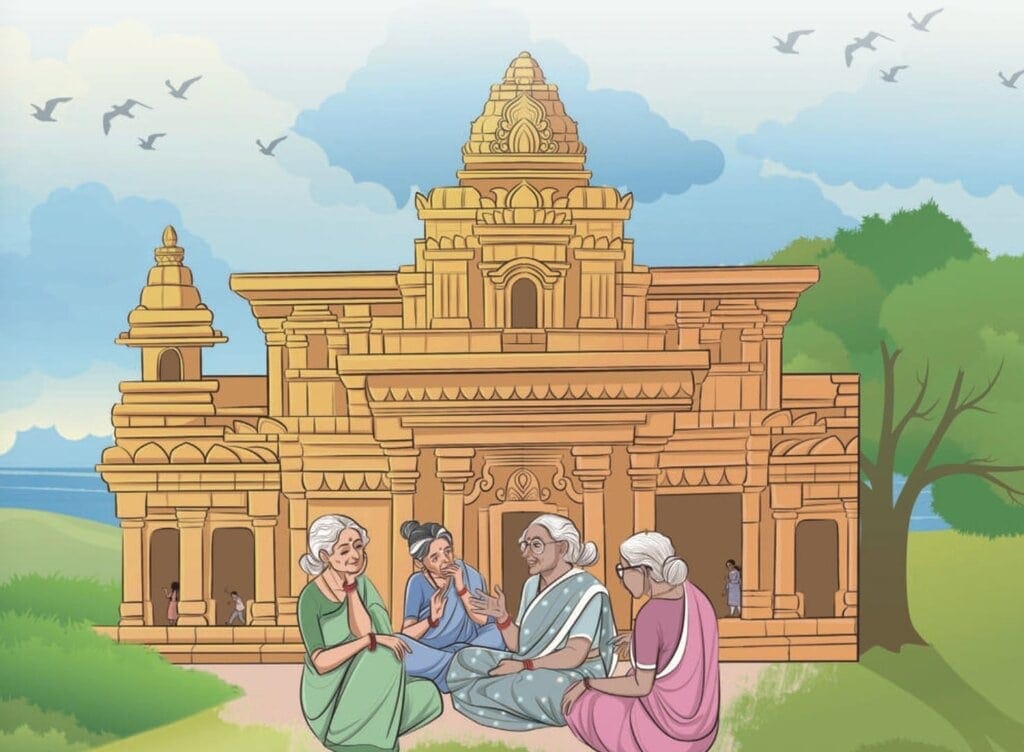
When the narrator goes to a neighbouring village for a wedding and stays for a week, the grandmother receives the magazine but cannot read it. On her return, the narrator is shocked to find her grandmother in tears. That night, the grandmother shares her life story—how she never went to school, got married young, and always regretted being uneducated. She explains that not being able to read made her feel helpless and dependent.
Determined to change this, the grandmother decides to learn the Kannada alphabet. She sets a goal to read a novel independently by Saraswati Puja during Dassara. Though the narrator initially laughs at her due to her age, the grandmother firmly says that there is no age limit for learning.
From the next day, the narrator becomes her teacher. The grandmother studies sincerely, practising reading and writing with dedication. On Dassara day, she surprises the narrator by touching her feet as a mark of respect for her as a teacher. She then confidently reads the title Kashi Yatre, proving her success.
The story highlights the importance of education, determination, and self-reliance, showing that learning is possible at any age.
Let’s Revise: Why did the grandmother cry when the narrator returned from the wedding?
Let’s Revise: What does the grandmother’s action of touching the narrator’s feet reveal?
Theme/Message
Theme
- The central theme of the story is lifelong learning, showing that education is not limited by age, time, or circumstances.
- It emphasises that learning can begin at any stage of life, as seen in the grandmother’s determination to become literate at the age of sixty-two.
- The story highlights the true value of education, not just as a means of gaining knowledge but as a way to achieve independence and self-reliance.
- It shows that illiteracy can lead to dependence, helplessness, and lack of confidence, while education brings freedom and empowerment.
- The grandmother’s journey reflects how education gives a person dignity and self-respect, enabling them to live without depending on others.
- The theme also focuses on determination and perseverance, proving that strong willpower can help overcome any obstacle, including age and social limitations.
- It celebrates the bond between generations, where the granddaughter becomes the teacher and the grandmother becomes the student, showing mutual love and support.
- The story beautifully reflects the Indian tradition of respecting teachers (guru-shishya relationship), where knowledge is valued above age or status.
- It also underlines the importance of spreading education and literacy, especially among those who were deprived of it earlier in life.
- Overall, the theme conveys that education is a powerful tool for personal growth, independence, and transformation, and it is never too late to learn.
Let’s Revise: What message does the story give about the importance of education in a person’s life?
Message
- Learning has no age bar; determination and hard work can overcome any obstacle.
- Education is the key to independence and freedom from helplessness.
- A teacher deserves the highest respect, irrespective of gender, age, or relationship.
- Grandparents and elders have rich life experiences and hidden dreams that we must understand and support.
- The joy of reading and sharing stories strengthens family bonds.
Difficult Words
- Ardent – keen, having a strong desire
- Punya – religious merit / good deed
- Protagonist – main character of a story, around whom the plot revolves.
- Debate – discussion, argument
- Episode – one part of a serial story
- Community – people living in a particular area
- Concentration – complete focus
- Eagerly – with excitement and interest
- Convincing – believable
- Taken aback – surprised and shocked
- Namaskara – respectful greeting (touching feet)