Key Points of the Chapter
- This inspiring chapter “Carrier of Words” pays tribute to the unsung heroes of India Post — the Gramin Dak Sewaks (GDS) who deliver mail in the most remote and harsh regions of the country.
- Somarad is located 120 km beyond the last railhead at Barmer, 50 km beyond the last phone, and 10 km beyond where the road crumbles into sand.
- Despite scorching heat (nearly 50°C), sandstorms, and long walks of up to 20 km on foot with a heavy mailbag, Khetaram ensures letters and money orders reach far-flung hamlets within 24 hours.
- Temperatures sometimes cross 50°C, but are officially recorded as 49.9°C to avoid declaring a state holiday — yet Khetaram continues to deliver.
- The chapter highlights how these “carriers of words” provide not just postal service but emotional connection, trust, and lifeline to families in inaccessible areas where even phones and roads do not reach.
Detailed Summary
The chapter begins by contrasting modern instant communication with the traditional postal system, highlighting how letters were once the main means of connection. Even today, in remote areas beyond roads and railways, Gramin Dak Sewaks (GDS) continue to serve as the only link between isolated communities and the outside world .
The chapter focuses on Khetaram, the sole postman of the Somarad Branch Post Office in Rajasthan’s Thar Desert. For over fifteen years, he has been delivering mail to remote hamlets located near the Indo-Pakistan border. Every day, he walks long distances across sand dunes and soft desert terrain, carrying a heavy mailbag weighing up to 28 kilograms. Despite extreme conditions, he ensures that letters and parcels reach their destination within 24 hours of dispatch.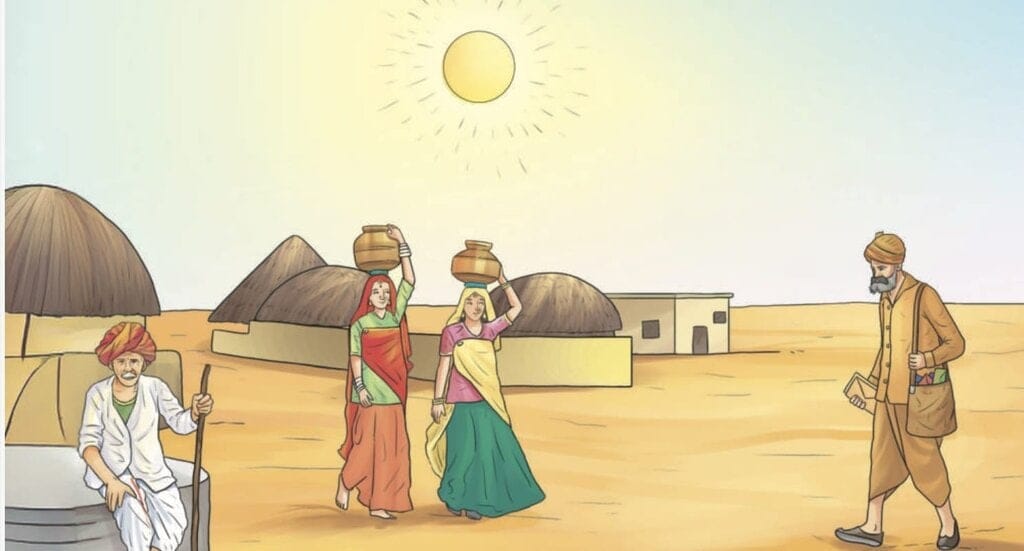
Khetaram works in harsh weather, where temperatures often rise close to 50°C. His khaki uniform and turban are his only protection against scorching heat and sandstorms. Water is scarce, and even basic comforts are limited. Sometimes, due to extreme heat, he delays deliveries until evening. His footprints in the sand reflect the weight of his responsibility and effort.
Apart from delivering mail, Khetaram plays an important social role in the village. Many people are illiterate, so he reads letters and despite his slightly shaky hand from years of work, he writes replies for illiterate villagers, and everyone feels comfortable having him draft their letters. He is warmly welcomed in every home and is treated with great respect and trust. However, he fears delivering letters that carry bad news.An envelope with the right corner torn off indicates that the letter bears news of death. In such cases, he stands outside, reads the letter twice, then tears it to bits — saying ‘Ashubh Samachar cannot be carried into the house’ and ‘Bad news must be destroyed.
Khetaram’s job is essential for his family’s survival, as farming in the desert is unreliable — Akaal or famine is a way of life, and even in a good year he gets only one crop of bajra that cannot feed his family of five.. As Mulk Raj Anand wrote in ‘Story of the Indian Post Office,’ Indians in remote villages are uniquely dependent on the post office for transmitting small sums of money, reflecting their absolute confidence in the postal system. Money orders sent by relatives are a major source of income for many families. The chapter also explains how India Post expanded after independence to connect even the remotest areas, increasing trust among people. After independence, India Post’s mandate was to bring the entire population within the mailing ambit — expanding from 25,000 post offices in 1947 to more than one and a half lakh today.
Gramin Dak Sewaks are to work only five hours a day and are allowed to serve after the age of 60, till the age of 65, enabling them to have another source of livelihood alongside. The chapter concludes by appreciating dedicated workers like Khetaram, who act as “carriers of words” and play a crucial role in keeping the nation connected.
Let’s Revise: Why is Khetaram called the “lone face of the state” in his area?
Let’s Revise: Why does Khetaram tear the letter announcing death?
Theme/Message
Theme
The chapter highlights the dedication, resilience, and silent service of ordinary individuals like Khetaram, who work tirelessly to keep remote parts of the country connected. It shows how, despite harsh conditions like extreme heat, long distances, and isolation, Gramin Dak Sewaks continue their duty with commitment and responsibility. The chapter also emphasises the importance of the human touch in communication, where letters carry emotions, news, and relationships. It reflects the deep trust people place in the postal system, especially in rural areas. Overall, the theme celebrates these unsung heroes who, through their service, play a vital role in maintaining connection, care, and continuity in society.
Let’s Revise: How does the chapter show the importance of Gramin Dak Sewaks?
Message
- Never underestimate the value of simple, dedicated work — it can be a lifeline for thousands.
- Even in the digital age, human connection and trust remain priceless.
- People working in harsh conditions deserve our respect and gratitude.
- Service to others, no matter how small, makes a big difference in society.
- We must salute the “carriers of words” who quietly keep India united.
Let’s Revise: What message does the author give at the end of the chapter?
Difficult Words
- Slumped: drooped or bent due to tiredness
- Dunes: hills of sand in a desert
- Hamlets / Dhaanis: small settlements or villages
- Devoid: completely without
- Sole: only
- Ply: move or travel regularly
- Hefted: lifted with effort
- Stipulate: specify as a condition
- Mojri: traditional Rajasthani footwear
- Inaccessible: impossible to reach
- Ambit: range or scope
- Remitted: sent as gift.
- Dwell:to stay on for sometime
- Threshold: entrance or doorstep of a house
- Dreads: fears greatly
- Missive: letter
- Entail: involve or require
- Striding: walking with long, confident steps