Reflect and Respond
I. Does anyone in your family use a hand fan? What do you call it in your language? What is it made of?
Ans (Sample): Yes, my grandmother uses a hand fan in summer. In Hindi/Punjabi, we call it a pankha. Ours is made of woven moonj grass with a wooden handle, passed down from my great-grandmother.
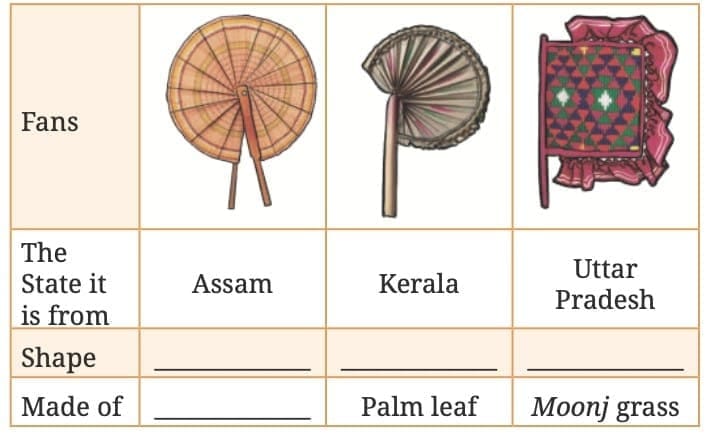

II. Study the pictures and complete the information.
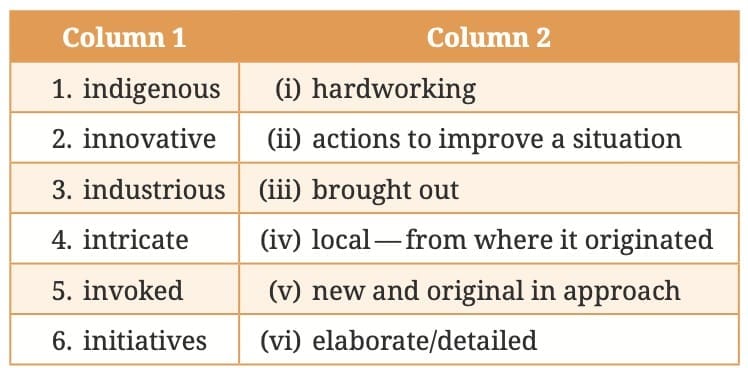
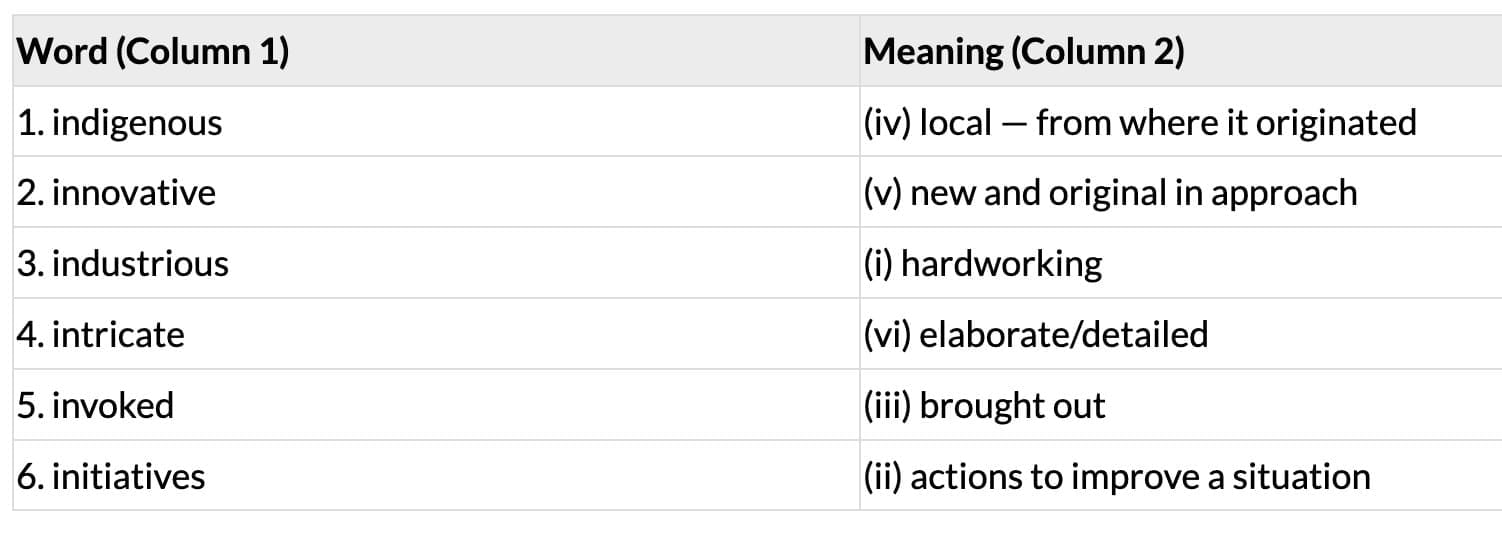
III. Match the underlined words in Column 1 with their meanings in Column 2.
Check Your Understanding
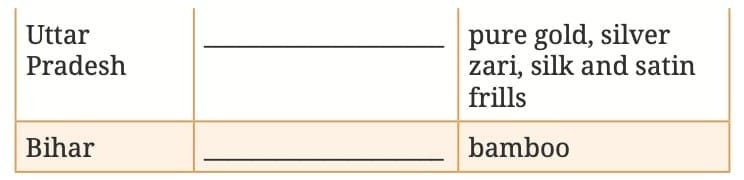
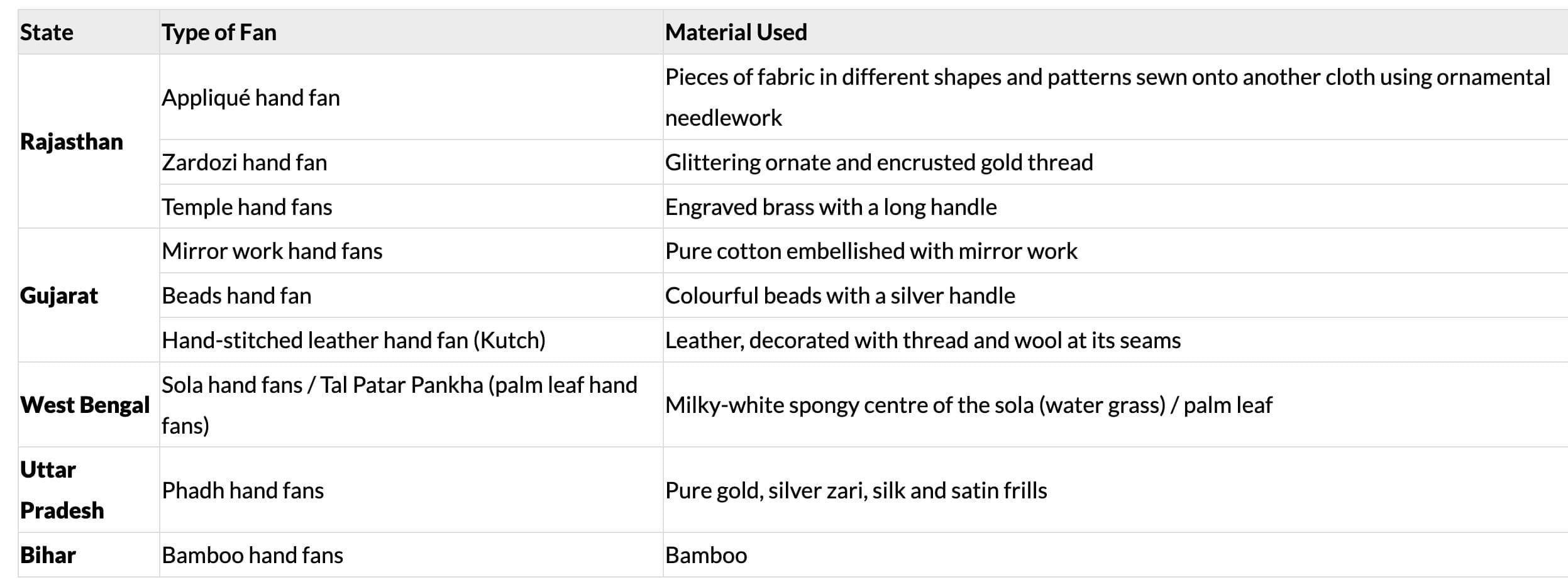
I. Complete the table on pankha.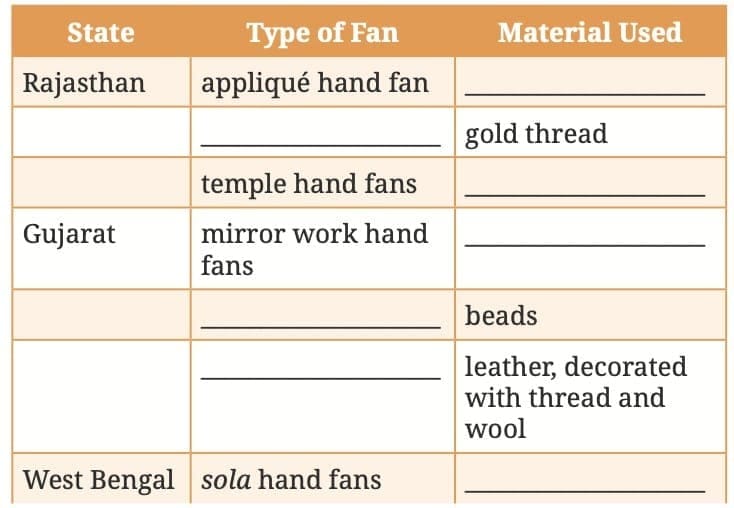
Critical Reflection
I. Read the extracts given below and answer the questions that follow.
Extract 1:
Over time, pankhas became significant cultural goods distributed through trade routes. They were considered exotic and stylish. Although there was substantial commonality in their use across India, different villages and towns developed their own varieties of traditional pankhas. Each place developed pankhas with distinct materials or a variety of intricate designs, that set them apart from one another.
(i) State whether the following sentence is true or false:
Pankhas were one of the most popular items of commerce.
Ans: False. The extract says pankhas became “significant cultural goods distributed through trade routes” — it does not claim they were the most popular items of commerce overall.
(ii) Why has the word ‘traditional’ been used to describe pankhas?
Ans: The word ‘traditional’ is used because pankhas have been made and used in India for centuries, with their designs, materials, and techniques passed down through generations. They carry a long-standing cultural heritage rooted in the specific practices and aesthetics of each local community — they are not mass-produced or modern items.
(iii) Complete the following statement.
The sentence ‘They were considered exotic and stylish’ is an opinion and not a fact because _______________.
Ans: …because it expresses a subjective judgement — what people thought or felt — rather than an objectively verifiable claim. “Exotic” and “stylish” are evaluative terms that depend on the observer’s viewpoint and cannot be measured or proven, unlike a fact which can be confirmed with evidence.
(iv) Infer one reason for commonality in the use of pankhas across India.
Ans: India’s hot climate creates a universal need for fans across all regions. Before electric fans and air conditioning, a hand fan was the simplest, most available cooling tool — a need shared by people of all geographies, cultures, and social classes, making pankhas naturally widespread throughout the country.
(v) Select which one of the two statements is the correct assertion for the given reason.
Reason: Pankhas were made of indigenous materials, unique to the region, with elaborate designs.
A. Each kind of pankha could be distinguished from the other.
B. Pankhas were used by many people.
Ans: A. Because each pankha used different local materials and distinct craftsmanship, one could clearly tell apart a Rajasthani zardozi fan from a Gujarati mirror-work fan or a Bengali sola fan. Assertion B is not logically supported by the stated reason.
Extract 2:
With time and the advent of technology and innovative creations, the beautiful culture of pankhas runs the risk of slowly losing its presence among Indians. Once made for personal use, over time this handicraft has transformed into a commercial business and now provides some form of livelihood to India’s artisans. The slight increase in popularity and demand is significantly factored by the different versions of the pankha being crafted.
(i) Infer one negative impact of technological advancement on pankha.
Ans: The widespread availability of electric fans, air coolers, and air conditioners has dramatically reduced the everyday need for hand fans. Since pankhas were originally made for cooling, modern devices have made them functionally redundant in most households, shrinking demand and the number of artisans who can earn a livelihood from the craft.
(ii) Complete the statement with an appropriate reason.
The writer refers to ‘pankhas’ not just as an object but as a ‘culture’ because ___________.
Ans: …because pankhas carry within them the history, traditions, artistic identity, and values of the communities that make them. Each pankha embodies a region’s unique materials, designs, and craftsmanship — not merely a tool but a living expression of cultural heritage. When pankhas are lost, an entire tradition of knowledge, artistry, and community identity is erased.
(iii) Select a line from the extract which depicts how the role of the pankha has changed over the years.
Ans: “Once made for personal use, over time this handicraft has transformed into a commercial business and now provides some form of livelihood to India’s artisans.” This line shows the pankha’s evolution from a personal domestic utility to an item of commerce — its function has shifted from cooling people to sustaining artisans economically.
(iv) List one way in which the increase in demand of pankhas might benefit artisans.
Ans: Increased demand gives artisans a more stable and sustainable source of income, motivating them to continue practising their craft, invest in better materials, and pass on their skills to the next generation — creating a positive cycle of economic viability and cultural preservation.
(v) Select the factor that has contributed to the commercialisation of pankhas.
A. cultural preservation
B. economic demand
C. technological advancements
D. artisan initiative
Ans: B. economic demand. The extract states that “the slight increase in popularity and demand is significantly factored by the different versions of the pankha being crafted” — pointing directly to economic demand as the driving force behind commercialisation.
II. Answer the following questions.
1. How does the title ‘Winds of Change’ capture the essence of the chapter?
Ans:
- Literally, it refers to the pankha itself — a fan that creates a breeze.
- Metaphorically, “winds of change” means a force of significant transformation — the chapter is about how the pankha has evolved from an ancient personal and ceremonial object to a commercialised handicraft, and how modern technology has reshaped its role.
- It also hints at the cultural winds that threaten traditional crafts, and at the positive change brought by awareness initiatives helping to revive them.
- Thus the title captures the chapter’s dual message — celebrating India’s pankha heritage while acknowledging the forces of modernity reshaping it.
2. Support the following statement with any two relevant examples from the chapter.
‘The structure and design of pankhas are testimony to the cultural identity of the region.’
Ans:
- Rajasthan: The zardozi hand fan, with its glittering gold threadwork, reflects the region’s tradition of opulent, richly embellished handicrafts associated with its royal courts and festive culture.
- Gujarat: The beads hand fan, covered with colourful beads and a silver handle, is directly tied to Gujarat’s identity as a centre for bead craft — reflecting its tradition of vibrant, colourful handicrafts made by industrious home-based women artisans.
3. The chapter mentions pankhas running the risk of slowly losing their presence among Indians. Evaluate how the balance between preserving traditional craftsmanship and incorporating innovative designs in the creation of pankhas will help in this regard.
Ans:
- Preserving traditional craftsmanship ensures cultural authenticity — the intricate needlework, indigenous materials, and regional designs that give each pankha its unique identity must not be lost, or the craft becomes indistinguishable from mass-produced items.
- Incorporating innovative designs ensures pankhas remain appealing to contemporary consumers — through new colour combinations, fusion aesthetics, or use as home décor and gifts — expanding the market base.
- The ideal is a complementary balance: preserving core techniques and cultural identity while allowing creative adaptation within that tradition. This approach has worked for crafts like Madhubani painting, which moved to canvas and fabric while retaining its distinctive style.
- This balance makes pankhas commercially viable without erasing their cultural significance — keeping them living expressions of Indian craftsmanship rather than museum pieces.
4. How might initiatives such as pankha-making workshops contribute to the preservation of this traditional craft?
Ans:
- Skill transmission: Experienced artisans can pass on techniques to younger generations, preventing skills from dying with aging craftspersons.
- Awareness: Workshops expose students, hobbyists, and tourists to the art and history of pankha-making, building informed consumers who value and purchase handmade fans.
- Commercial visibility: Workshops at handicraft exhibitions help artisans demonstrate and sell their work, reaching new markets.
- Economic empowerment: Income from workshops makes the craft financially sustainable, giving artisans a reason to continue.
- Cultural pride: Public celebration of the craft restores dignity and pride in pankha-making, countering the tendency to undervalue traditional manual crafts.
5. The writer mentions celebrating pankhas in the concluding part of the chapter. Assess how this could be beneficial to artisans and the craft.
Ans:
- For artisans: Exhibitions, festivals, and media coverage provide a commercial platform and restore professional identity, motivating artisans to continue rather than abandon the craft for more reliable occupations.
- For the craft: Public celebration raises awareness and demand — nationally and internationally — encouraging artisans to innovate new designs and keeping the craft alive and evolving.
- It also attracts researchers, NGOs, designers, and government bodies, leading to documentation, financial support, and policy-level protection for pankha-making as a traditional craft.
6. How does the restriction of the use of pankha for decorative purposes reflect the changing cultural role of these traditional fans in modern India?
Ans:
- Triumph of technology: Electric fans and air conditioners have made the pankha functionally redundant — it has been “retired” from daily use and relegated to a decorative or collectable status.
- Shift in cultural value: The pankha once held functional, ceremonial, and domestic significance; it now serves primarily as a symbol of heritage — displayed on walls, gifted at festivals, or exhibited in museums.
- Risk of cultural disconnection: When used only decoratively, younger generations may recognise it as “traditional” without understanding the skill and community identity it carries.
- New form of preservation: At the same time, decorative use keeps pankhas visible in homes and public spaces — a form of passive cultural preservation that ensures the object remains part of India’s visual and cultural landscape.
Vocabulary and Structures in Context
I.1. Classify the word pairs into Appearance, Place, and Material.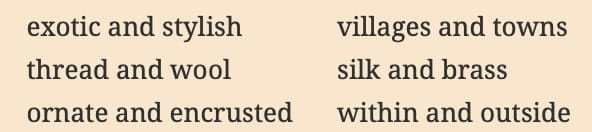

Ans:
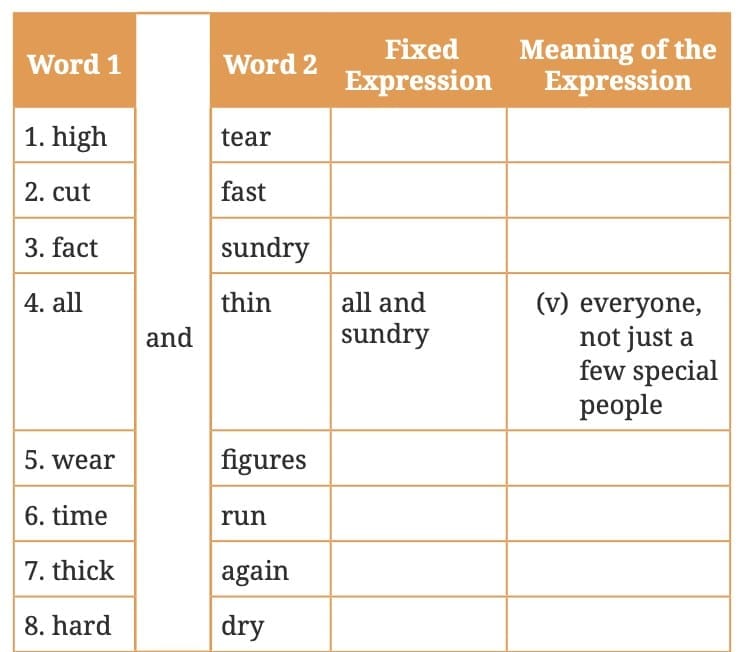
I.II. Fixed expressions with ‘and’ — complete the table and match meanings.
III.1. Choose the appropriate word collocations for the following sentences.
(i) The students have to (take/give) the English exam tomorrow.
(ii) The interviewer asked the candidate to (take/have) a seat.
(iii) My scooter (dashed against/ran into) a car.
(iv) I must (take/own) responsibility for my success.
(v) I would like to (tone up/improve) my grammar.
Ans:
- (i) take — the correct collocation is “take an exam.”
- (ii) have — “have a seat” is the conventional polite expression in this context.
- (iii) ran into — means to collide with unexpectedly; the standard collocation.
- (iv) take — “take responsibility” is the fixed expression for acknowledging accountability.
- (v) improve — “improve grammar” is standard; “tone up” collocates with physical fitness, not language.
IV. Underline the verbs and fill in the blanks with present perfect tense.
Verbs underlined in the given sentences:
- 1. In modern times, pankhas have become traditional craft items in India.
- 2. Gujarat’s industrious home-based women workers have worked tirelessly in the handicraft of pankha-making.
- 3. Many tribes in India have adopted this handicraft.
- 4. Once made for personal use, this handicraft has transformed into a commercial business.
Fill in the blanks with present perfect tense:
Puppets have long fascinated audiences worldwide. Puppeteers (i) have created intricate characters and captivating stories with their skillful artistry. They (ii) have mastered the delicate movements that bring these lifeless figures to life, entertaining both children and adults. Over the years, puppetry (iii) has evolved, using modern technology while preserving traditional techniques. Many puppeteers (iv) have passed down their craft through generations, ensuring its continuity. They (v) have performed in theatres, on television, and at festivals, conveying important cultural narratives.
Speaking Activity
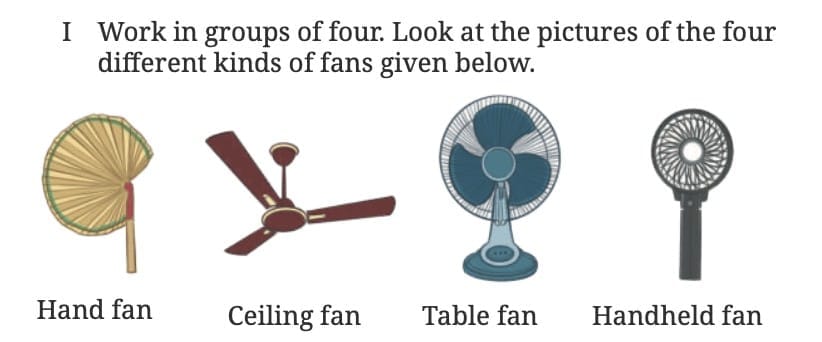 Sample Monologues: Imagining Yourself as a Fan
Each student picks one of four fans (Hand fan, Ceiling fan, Table fan, Handheld fan), imagines themselves as that fan, and speaks for 1–2 minutes covering: introduction, description, likes, weaknesses, and what makes them unique. Sample monologues for all four are given below.
1. The Hand Fan (Traditional Pankha)
Namaste! I am the hand fan — the pankha — one of India’s oldest and most cherished handicrafts. I have been used in India since ancient times, and evidence of my existence can be found in paintings at Ajanta. I come in many forms: sometimes I am made of palm leaf, sometimes of bamboo, sometimes adorned with mirror work or gold thread. My shape varies from state to state — round in Assam, elongated in Kerala, rectangular and fringed in Uttar Pradesh.
What I love about myself is that I am a living piece of art. When you hold me, you are not just holding a fan — you are holding history, culture, and craftsmanship passed down through generations. I am eco-friendly, require no electricity, and make no noise. I am what you need when the power goes out!
My weakness? I cannot cool an entire room, and in this age of air conditioners, people don’t pick me up as often as they used to. Many households have forgotten I exist.
What makes me unique? No two of me are ever exactly the same. I am handmade, and the artisan who crafts me puts their heart, skill, and cultural identity into every stitch and fold. I am not just a fan — I am a story. And stories, unlike electricity, never fail.
2. The Ceiling Fan
Hello everyone! I am the ceiling fan, and I am perhaps the most familiar face in every Indian household, classroom, and office. You will find me spinning overhead in homes, schools, hospitals, and dhabas across the length and breadth of this country. I have three or four blades — sometimes decorative — and I work tirelessly, often for hours at a stretch, to keep you comfortable.
What I love about myself is my efficiency and reach. I can cool an entire room, distribute air evenly, and do so using relatively little electricity compared to air conditioners. I am reliable, and most Indians consider me as essential as a bed or a stove.
My weakness? I need electricity to function, which means I am useless during power cuts — and I cannot compete with an air conditioner in extreme heat. I also cannot be carried from room to room.
What makes me unique? I am a symbol of the Indian home. When people think of a summer afternoon nap, a school classroom, or a grandmother’s room, they picture me turning slowly overhead. I am not just an appliance — I am a memory.
3. The Table Fan
Hi! I am the table fan, and I am small but mighty. You can place me on a desk, a counter, a bedside table — wherever you need me most. I have an oscillating head that allows me to rotate and distribute cool air across a wider angle, making me surprisingly effective for my size.
What I love about myself is my versatility and portability. I can go wherever you take me — from the study room to the kitchen to the verandah. I am perfect for personal use: when you are sitting at a desk for hours, I keep you refreshed without disturbing others.
My weakness? I cool only a small area directly in front of me. I cannot replace a ceiling fan in a large room, and if you forget to plug me in or I run out of battery, I am just a decorative object.
What makes me unique? I am adaptable and personal. Unlike a ceiling fan that everyone in a room shares, I belong to you specifically — you can direct me exactly where you want. In a world that celebrates personalisation, I am the fan that says: this breeze is just for you.
4. The Handheld (Mini Portable) Fan
Hello! I am the handheld fan — the modern, compact, battery-operated or USB-charged version of the ancient pankha. I fit in your bag, your pocket, or the palm of your hand. You will see me at cricket matches, outdoor weddings, on metro platforms in summer, and in the hands of commuters everywhere.
What I love about myself is that I am always there when you need me. I am the fan of freedom — I require no wall socket, no installation, and no permanent space. Just press a button and I am working instantly.
My weakness? I am small, so my cooling effect is limited. My battery runs out, and I am not very powerful in extreme heat. I am a quick fix, not a long-term solution. And I must confess — I am not as beautiful or as culturally rich as the traditional hand pankha.
What makes me unique? I represent the spirit of innovation. I have taken the ancient idea of the hand fan and transformed it for the modern, mobile world. In me, the old and the new meet: I carry the same purpose as the pankha from Ajanta — to create a breeze — but I have evolved with the times. And isn’t that what all good traditions must do?
Writing Task
I. Describe an artefact you have made in your craft class or learnt from someone.
Begin with collection and organisation of the facts with the help of the pointers given above. Do not include your opinion in the factual description.
Ans: Sample Factual Description of an Artefact Made in Craft Class: A Paper Hand Fan
Name and Physical Characteristics:
The artefact is a paper hand fan, approximately 20 centimetres in diameter when fully opened. It is circular in shape and multicoloured — the paper strips used are red, orange, green, and yellow. The handle consists of two wooden sticks approximately 15 centimetres long, bound together at the base with rubber bands and tape. The fan has a pleated, accordion-like construction that allows it to fold flat and open into a full circle.
Materials:
The fan is made from rectangular sheets of coloured craft paper, two flat wooden sticks (ice cream sticks), rubber bands, and adhesive tape. No scissors are required for the folding process, though they are used to trim the edges. The materials are lightweight and cost-effective.
Process of Making:
The paper sheets are first folded accordion-style (back and forth in equal pleats) along their length. Two sheets can be joined together for a larger fan. One wooden stick is then taped to each side at the base of the pleated bundle. The sticks are held together with rubber bands at the bottom. When the rubber bands are released, the fan opens into a full circular shape.
Usage:
The paper hand fan can be used as a personal cooling device in warm weather. It can also be used as a decorative item, a prop for cultural performances, or as a wall display. Multiple fans in different colours can be arranged to create a decorative panel.
Significance:
Making a paper hand fan by hand connects the maker to the long tradition of Indian pankha-making, helping students appreciate the skill and patience required to produce even the simplest version of this ancient craft.