Reflect and Respond
I. Work in pairs. Discuss the memories from your childhood that you remember. List them and share with your classmates and teacher.
Ans (Sample):
Common childhood memories include the smell of rain on dry earth; a grandmother’s lullaby; the taste of a favourite homemade sweet; the feel of sand at a beach picnic; colourful kites during festivals; waking to the smell of fresh parathas; and the school bell at the end of a long day. These small, sensory memories form the texture of childhood and often stay with a person far longer than significant events.
II. Discuss how children’s relationship with their mother can influence their emotions and memories.
Ans:
A mother is typically a child’s first and most foundational bond, shaping the emotional landscape of early life. Her voice, touch, scent, and habits become associated with safety and comfort. Even after the mother is no longer present, these sensory associations continue to trigger emotions involuntarily — a familiar song, a flower’s scent, or a quality of light can suddenly bring back a flood of feeling. Tagore’s poem illustrates this: though he cannot consciously recall his mother, her presence lives on in sensory traces — a tune, a scent, a stillness — showing that the mother–child bond is woven into the senses themselves, not just the mind.
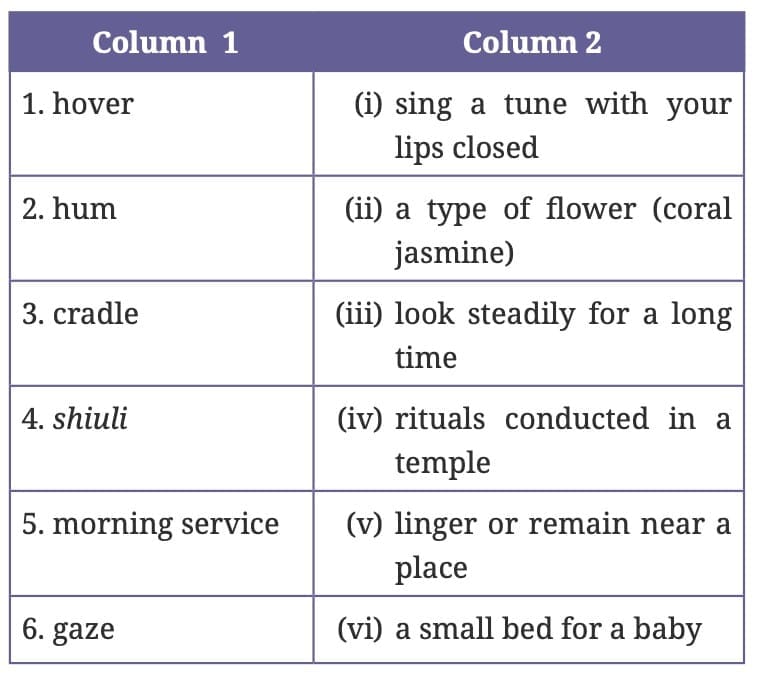
III. Match the words given in Column 1 with their meanings in Column 2.

Ans:
Check Your Understanding
I. Fill in the blanks with appropriate words.
Stanza 1
- The poet remembers his mother while he __________.
- The poet remembers the __________ but not the __________.
Setting: __________ (outdoor/indoor)
Stanza 2
- The poet remembers his mother in the __________ season.
- The poet remembers his mother by the smell of __________.
Setting: __________ (outdoor/indoor)
Stanza 3
- The poet feels that his mother __________ at him from the __________.
Setting: __________ (outdoor/indoor)
Ans:
Stanza 1
- …while he is playing / is in the midst of play.
- …the tune (of the song) but not the words of the song / the mother herself.
- Setting: Indoor
Stanza 2
- …in the early autumn season.
- …by the smell of shiuli flowers (and the morning temple service).
- Setting: Outdoor
Stanza 3
- …gazes / looks at him from the distant blue sky.
- Setting: Indoor
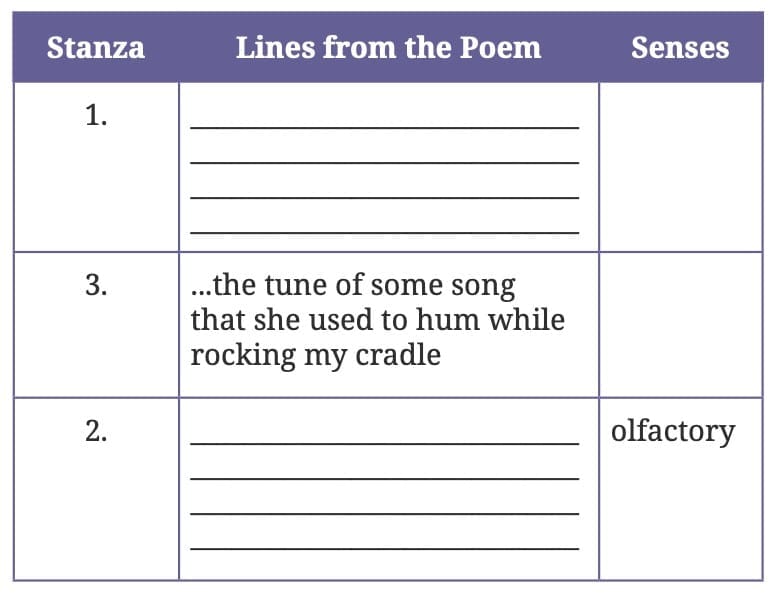
II. The senses of olfactory (smell), auditory (hearing), and visual (sight) are three of the five basic senses in humans. Give examples of references to senses from the poem. Complete the table.

Ans:
III. Read the poem silently once again and complete the following.
Ans:
1. Two examples of alliteration from the poem are:
- “sometimes … seems” — repetition of the ‘s’ sound in “sometimes in the midst” and “a tune seems.”
- “hover … hum” — repetition of the ‘h’ sound in “hover over” and “hum.”
2. An example of onomatopoeia is: “hum” — the word imitates the soft, low, closed-lips sound it describes, recreating the quiet, melodic sound of the mother humming at the cradle.
3. The poem uses imagery extensively. Explain.
- Auditory imagery (Stanza 1): The tune hovering over playthings — the mother’s half-remembered lullaby — creates a vivid sound picture, as if the soft melody drifts through the air of the playroom.
- Olfactory imagery (Stanza 2): The smell of shiuli flowers mingled with temple incense on an autumn morning builds a powerfully atmospheric picture. Scent is the sense most closely linked to involuntary memory, making this the most evocative stanza.
- Visual imagery (Stanza 3): The vast blue sky seen through the bedroom window, equated with the stillness of the mother’s gaze, creates a breathtaking visual metaphor — the sky becomes a canvas on which the poet projects his memory of his mother’s face.
4. Although the poem does not have a rhyme scheme, it is enjoyable because it relies on deeply felt emotional imagery, a natural musical rhythm, and the universally relatable theme of fragmentary childhood memory. The sensory details — sound, scent, and sight — draw the reader into the poet’s world so vividly that the absence of rhyme is never felt as a lack.
5. What is the tone of the poet? Why do you say so?
The tone is wistful, tender, and gently melancholic. It is wistful because the poet reaches toward a memory that keeps slipping away; tender because the fragments are clearly cherished; and gently melancholic because of the underlying sadness of being unable to truly remember the person closest to him in infancy. The repeated phrase “I cannot remember my mother” expresses not despair but quiet, accepting sorrow.
6. What impact does the title of the poem have on the overall mood of the poem?
The title sets a tone of loss and longing before the poem begins. “Cannot” is absolute — the poet truly cannot remember her as a whole person. This prepares the reader for an exploration of what survives at the edges of memory — sensory traces rather than a full image. Each beautiful image (the tune, the scent, the sky) becomes more poignant because it is a substitute for, not a direct memory of, the mother herself.
7. The poet uses ‘I cannot remember my mother’ as a refrain because it serves as the emotional and structural anchor of the poem. Its repetition emphasises the central paradox: even though the poet cannot consciously remember his mother, her presence lives on in his senses. Each stanza begins with the same admission of loss but opens into a rich sensory memory that contradicts it — simultaneously acknowledging what is absent and celebrating what remains. The cumulative effect underscores the depth of his longing and the persistence of maternal love beyond conscious memory.
8. The poet uses symbolism to indicate the memory of his mother’s presence. Identify the symbols used in the poem.
- The hovering tune — the mother’s loving presence that cannot be seen but can still be felt; her care lingering invisibly around her child.
- The cradle — the earliest, most intimate bond between mother and child — the period of complete dependence and unconditional love.
- The shiuli flowers and temple scent — the mother’s spirituality and place in daily rituals. The shiuli, which blooms at night and falls at dawn, also symbolises transience — like the mother, beautiful but brief.
- The blue of the distant sky — infinity, eternity, and the boundless nature of a mother’s love. The sky, which touches all things, becomes a metaphor for the all-encompassing quality of her watchful presence.
- The stillness of the gaze — the calm, unconditional, patient love the mother bestows; peaceful, accepting, and eternal.
Critical Reflection
I. Read the extracts given below and answer the questions that follow.
Extract 1:
I cannot remember my mother
only sometimes in the midst of my play
a tune seems to hover over my playthings,
(i) Complete the following sentence appropriately: The poet is reminded of his mother during his ___________.
Ans: …during his playtime / while playing in the midst of his play.
(ii) What is the primary emotion conveyed by the line ‘a tune seems to hover over my playthings’?
A. It enhances the joy of play.
B. It disrupts the playtime atmosphere.
C. It activates memories of the mother.
D. It symbolises the carefree nature of childhood.
Ans: C. It activates memories of the mother. The hovering tune is the tune the mother used to hum — its primary function is the involuntary activation of her memory, not the enhancement or disruption of play.
(iii) In the context of the poem, what role does the hovering tune play during the speaker’s playtime?
Ans: The tune acts as a bridge between the speaker’s present moment and the earliest memories of his infancy — drifting unbidden into his consciousness, carrying the emotional imprint of the mother who hummed it at his cradle. It is not a conscious act of remembering; the tune simply arrives and hovers, serving as an unconscious, recurring messenger connecting the present child to the absent mother.
(iv) State whether the following sentence is true or false: The poet experiences the tune lingering over playthings only occasionally during playtime.
Ans: True. The poem says “only sometimes in the midst of my play” — confirming the experience is occasional and involuntary, not constant.
(v) How could the poet feel his mother’s presence, even though she isn’t there?
Ans: The poet feels his mother’s presence through sensory memory — the deepest and most persistent form of human recollection. The sensory experiences of his infancy (the tune she hummed, her scent from shiuli flowers and the temple, the quality of her gaze) were recorded in his body and senses at a pre-conscious level. These impressions resurface involuntarily when a similar trigger occurs — a tune during play, an autumn flower’s fragrance, the stillness of the sky. The mother is present not as a remembered image but as a felt quality woven into the fabric of his sensory world.
Extract 2:
I feel that the stillness of
my mother’s gaze on my face
has spread all over the sky.
(i) What does the poet suggest about the stillness of his mother’s gaze spreading over the sky?
A. The mother’s gaze is physically present in the sky.
B. The sky is a symbolic extension of the mother’s presence.
C. The sky mirrors the mother’s emotions.
D. The stillness is fleeting and unrelated to the mother.
Ans: B. The sky is a symbolic extension of the mother’s presence. The vast, still, infinite sky becomes a symbol carrying the quality of the mother’s gaze — her calm, enveloping, watchful love — extending it to fill the entire visible world.
(ii) What emotion does the poet associate with the ‘stillness’ of his mother’s gaze?
A. a sense of grief
B. a sense of anticipation
C. a sense of nostalgia
D. a sense of serenity
Ans: D. a sense of serenity. “Stillness” implies calm, peace, and tranquillity — not grief (active and painful), anticipation (tense), or even nostalgia (an ache of longing). The mother’s gaze was quiet, steady, and peaceful — an anchor of serenity in his early life.
(iii) State whether the following sentence is true or false: The poet suggests that the mother’s gaze has a tangible and visual effect on the sky.
Ans: False. The effect is not tangible but purely emotional and metaphorical. The poet uses the sky as a symbolic canvas onto which he projects the feeling of his mother’s still, watchful presence — it is felt rather than seen.
(iv) What is the purpose of likening the mother’s gaze to the sky?
Ans:
- It conveys the boundlessness of a mother’s love — like the sky, it has no edges and encompasses everything.
- It expresses the permanence of the memory — the sky is always there, as is the feeling of her presence.
- It elevates the personal experience to something cosmic and transcendent — the mother, though gone, has merged with the eternal.
- The sky suggests distance combined with closeness — she is far away but as omnipresent as the sky above.
(v) Complete the sentence appropriately: The tone of the poet in the given extract is _____________ because _____________.
Ans: The tone is serene and contemplative because the poet is not expressing acute grief but a quiet, philosophical peace — gazing into the blue sky and finding in its stillness a reflection of his mother’s calm gaze. The imagery is expansive and tranquil, and the emotion is gentle wonder rather than active sorrow.
II. Answer the following questions.
1. What is the emotional impact of the refrain, ‘I cannot remember my mother’?
Ans: The refrain creates a cumulative emotional impact that is both sorrowful and paradoxical. Each time it opens a stanza, it re-establishes loss — but the lines that follow immediately contradict it with vivid sensory evidence: a tune, a scent, a quality of light. This creates a moving tension between what is intellectually acknowledged (inability to remember) and what is emotionally experienced (the mother’s persistent, living presence). The refrain quietly builds from gentle sadness in the first stanza to quiet awe in the third — and by the poem’s end, has been quietly disproved: the poet does remember his mother, just not in words.
2. Interpret the connection between the poet’s mother and the following: (i) shiuli flowers (ii) humming tune
Ans:
- (i) Shiuli flowers: The shiuli blooms at night and sheds its flowers at dawn, releasing a sweet fragrance on the early morning air. This scent, mingled with temple incense, became the sensory atmosphere the mother carried. The poet connects both to her presence, suggesting she was devout and part of the daily rituals of morning. The transient flower — beautiful but brief — also symbolises the mother herself, whose presence in the child’s life was fleeting but whose scent remains.
- (ii) Humming tune: The mother hummed a song while rocking the cradle — a deeply intimate daily ritual of infancy. Though the poet cannot recall the words, the tune was encoded in his sensory memory at a pre-verbal level. When it appears unbidden during play, it carries the emotional warmth of the cradle — the security and closeness of being mothered — without requiring any conscious effort. It is the earliest form of communication between mother and child, bypassing language and going directly to the heart.
3. What role does nature play in the poet’s description of the memory of his mother?
Ans: Nature plays a central role as the medium through which the mother’s memory is experienced. In each stanza, a specific natural element carries her presence: the tune hovering like something alive in the playroom air, the shiuli flowers’ fragrance on an autumn morning, and the boundless blue sky through the bedroom window. Nature acts as a bridge between the living and the absent — the mother lives on in the seasonal return of a flower’s fragrance, the recurring stillness of a morning, and the permanence of the sky. This reflects Tagore’s philosophical vision: nature is not separate from human feeling but deeply intertwined with it — the language through which the deepest emotions are expressed and preserved.
4. What can be inferred about the poet’s perception of the mother–child relationship?
Ans:
- The deepest and most enduring bond: Though the poet lost his mother too young to form conscious memories, her presence has never left him — embedded in the senses and the body below the level of memory.
- Felt rather than thought: The poet remembers through sound, scent, and sight — involuntary, sensory impressions — suggesting the mother–child relationship belongs to the realm of feeling, not thought.
- Sacred and spiritual: The connection of the mother’s presence to the temple’s morning service suggests she is not merely a domestic figure but something transcendent — as vast as the sky, as fragrant as temple flowers.
- Characterised by unconditional calm: The “stillness” of her gaze — peaceful, not anxious or demanding — suggests her love was calm, patient, and endlessly accepting.
Vocabulary in Context


I. Work in pairs to classify the sensory words given in the box. One example has been done for you.
Ans:

II. Fill in the blanks with sensory words from the box for the passage written by Sarojini Naidu. There are two extra words.

Ans:
Come and share my exquisite March morning with me: this sumptuous blaze of gold and sapphire sky; these 1. scarlet lilies that adorn the sunshine; the voluptuous 2. perfumes of neem and champak and serisha that beat upon the languid air with their implacable 3. scents; the thousand little gold and blue and silver breasted birds bursting with the 4. sweetness ecstasy of life in nesting time. And, do you know that the scarlet lilies are woven petal by petal from my heart’s blood, these little quivering birds are my soul made incarnate music, these heavy 5. flaming are my emotions dissolved into aerial 6. essence, this 7. shrill blue and gold sky is the ‘very me’…
Extra words (not used): sizzle, smooth
III. Write numbers against each picture with the phrases that describe them with their sensorial associations.
- beats of music echo in air
- melody of soothing scent, dancing in the air
- fragrant breeze of blooming buds
- gentle lullaby, a soft melody
- colourful sky, painting a lively sight
- attractive canvas painting the horizon


Ans:
Speaking Activity
I. Work in pairs. Think of an object, song, or a place that is memorable for you. Take turns to speak about it using the prompts given below.
Ans (Sample Spoken Response):
Introduction: “Growing up, I fondly remember the old brass wind chime that hung outside my grandmother’s kitchen window. It was a simple thing — seven metal tubes of different lengths that clinked against each other whenever a breeze came through.”
Sensory details: “I can still picture the faint golden glint of the brass in the afternoon light. The sound it made was not loud — it was a quiet, layered sound, like someone gently clearing their throat. If I close my eyes, I can almost feel the warm summer air on my face that always seemed to accompany that sound.”
Specific memory: “I have a clear memory of one particular afternoon when I was about seven. I had scraped my knee badly while playing and was sitting on the kitchen steps, crying. My grandmother brought me a glass of cool water and sat beside me. She didn’t say much. But the wind chime rang softly in the breeze, and somehow that gentle sound made everything feel manageable again.”
Impact on life: “To this day, whenever I hear the sound of wind chimes — in a shop, or in someone else’s home — I feel a wave of calm. It is as if my grandmother’s presence returns for a moment. It has taught me that comfort does not always require words.”
Why it is meaningful: “This memory is meaningful to me even now because it reminds me that the most comforting things in life are often the smallest ones — a sound, a presence, a moment of quiet companionship. It connects me to a particular kind of love that was wordless, steady, and completely enough.”
Writing Task
I. Imagine you had been on a school trip to a scenic place which appealed to all your senses. Write a diary entry describing the place and why it was a memorable experience.
Ans (Sample Diary Entry):
Saturday, 18 October | 9:30 p.m.Today was one of those days I know I will think about for years. Our school trip took us to the Corbett foothills — a patch of forest reserve at the edge of a river valley — and I do not think I have ever experienced so many things at once through all my senses.
We arrived early in the morning when the mist was still clinging to the treetops. The first thing I noticed was the smell — a deep, green, wet-earth smell that hit me the moment I stepped off the bus. It was the smell of things growing and things decaying all at once, and it was one of the most alive smells I have ever encountered. My friend Ananya said it smelt like rain kept permanently in a bottle.
As we walked the trail, the sounds took over. The forest was never silent. Somewhere above us, unseen birds were calling in high, liquid notes. Further in, we heard what our guide said was the alarm call of a deer — a sharp, hollow bark that made my heart jump. Beneath all of this ran the sound of the river, a continuous low hiss that you could feel in your chest rather than just hear with your ears.
The most significant moment of the day came in the late afternoon. We sat on a boulder by the river and our teacher asked us to be completely silent for five minutes. I watched a heron stand absolutely still in the shallows, its grey feathers reflecting the fading orange sky. I felt the cold of the stone through my clothes, the warmth of the last sunlight on my face, and the cool damp air rising from the water. It was as if every sense had been switched to its highest setting.
On the bus back, nobody spoke much. I think we were all still inside the day. I realised that most of the time, I walk through the world with only part of my attention. Today, for a few hours, I was entirely there — seeing, smelling, hearing, feeling every moment. I want to remember that feeling. I want to carry it back to my ordinary days.
— [Your Name]