Page No. 144
Thinking about the Text
I. Answer these questions.
Q.1. “At last a sympathetic audience.”
(i) Who says this?
(ii) Why does he say it?
(iii) Is he sarcastic or serious?
Ans. (i) The speaker of the given line is Gerrard.
(ii) He says it as he is asked by the intruder to speak about himself.
(iii) This line is delivered with a sense of sarcasm, as Gerrard is not genuinely pleased but rather mocking the situation he finds himself in.
Q.2. Why does the intruder choose Gerrard as the man whose identity he wants to take on?
Ans. The intruder selects Gerrard because he resembles him closely. As a murderer on the run from the police, the intruder believes he can easily take on Gerrard’s identity. This impersonation is his plan to evade capture.
Q.3. “I said it with bullets.”
(i) Who says this?
(ii) What does it mean?
(iii) Is it the truth? What is the speaker’s reason for saying this?
Ans. (i) Gerrard says this.
(ii) It means that when things went wrong, he used his gun to shoot someone for his escape.
(iii) No, it is not the truth. The speaker says this to save himself from getting shot by the intruder.
Q.4. What is Gerrard’s profession? Quote the parts of the play that support your answer.
Ans. Gerrard is a playwright by profession. Several parts of the play reflect this.
Some of these are:
- “This is all very melodramatic, not very original, perhaps, but…”
- “At last a sympathetic audience!”
- “In most melodramas, the villain is foolish enough to delay his killing long enough to be frustrated”.
- “I said, you were luckier than most melodramatic villains.”
- “That’s a disguise outfit; false moustaches and what not”.
- “Sorry I can’t let you have the props in time for rehearsal, I’ve had a spot of bother – quite amusing. I think I’ll put it in my next play.”
Q.5. “You’ll soon stop being smart.”
(i) Who says this?
(ii) Why does the speaker say it?
(iii) What according to the speaker will stop Gerrard from being smart?
Ans. (i) The intruder says the line.
(ii) The intruder says this to frighten Gerrard. He intends to intimidate him and assert control over the situation.
(iii) According to the intruder, Gerrard would stop being smart once he knew what was going to happen to him. The intruder’s plan was to kill Gerard and take over his identity. He felt that when Gerrard would know this, he would stop being smart and start getting scared.Page No. 145
Q.6. “They can’t hang me twice.”
(i) Who says this?
(ii) Why does the speaker say it?
Ans. (i) The intruder says the line.
(ii) The intruder had been telling Gerrard that he had murdered one man and that he would not shy away from murdering him too. This is because the police could not hang him twice for two murders.
Q.7. “A mystery I propose to explain.” What is the mystery the speaker proposes to explain?
Ans. The mystery that Gerrard sought to explain was a fabricated story he created to evade the intruder and protect his life. He claimed to be a criminal like the intruder, questioning why he had no dealings with tradespeople and was perceived as a mystery man. Gerrard suggested that the intruder’s plan had gone awry, as he had committed murder and narrowly escaped capture. He explained that one of his accomplices had been arrested, and crucial evidence had been overlooked. Anticipating trouble that night, Gerrard had packed his bag, ready to flee.
Q.8. “This is your big surprise.”
(i) Where has this been said in the play?
(ii) What is the surprise?
Ans. (i) This has been said twice in the play. On the first occasion, it is spoken by the intruder while revealing his plan to kill Gerrard. Secondly, it is spoken by Gerrard before he reveals his fictitious identity to the intruder.
(ii) The intruder’s surprise is his plan to kill Gerrard and take on his identity to lead a secure and hassle-free life. Whereas, Gerrard’s surprise is his fictitious identity, his way of refraining the intruder from killing him.
Thinking about the Language
I. Consult your dictionary and choose the correct word from the pairs given in brackets.
(i) The (site, cite) of the accident was (ghastly/ghostly).
(ii) Our college (principle/principal) is very strict.
(iii)I studied (continuously/continually) for eight hours.
(iv) The fog had an adverse (affect/effect) on the traffic.
(v) Cezanne, the famous French painter, was a brilliant (artist/artiste).
(vi) The book that you gave me yesterday is an extraordinary (collage/college) of science fiction and mystery.
(vii) Our school will (host/hoist) an exhibition on cruelty to animals and wildlife conservation.
(viii) Screw the lid tightly onto the top of the bottle and (shake/shape) well before using the contents.
Ans. (i)The site of the accident was ghastly.
(ii) Our college principal is very strict.
(iii) I studied continuously for eight hours.
(iv) The fog had an adverse effect on the traffic.
(v) Cezanne, the famous French painter, was a brilliant artist.
(vi) The book that you gave me yesterday is an extraordinary collage of science fiction and mystery.
(vii) Our school will host an exhibition on cruelty to animals and wildlife conservation.
(viii) Screw the lid tightly onto the top of the bottle and shake well before using the contents.
II. The irony is when we say one thing but mean another, usually the opposite of what we say. When someone makes a mistake and you say, “Oh! That was clever!” that is irony. You’re saying ‘clever’ to mean ‘not clever’.
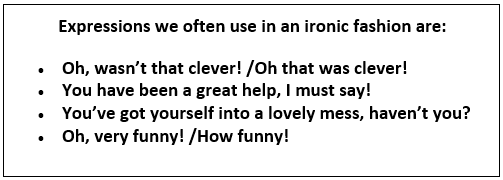
We use a slightly different tone of voice when we use these words ironically.
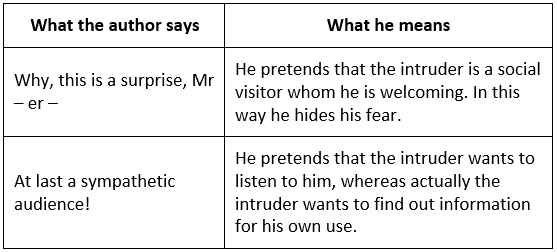
Read the play carefully and find the words and expressions Gerrard uses in an ironic way. Then say what these expressions really mean. Two examples have been given below. Write down three such expressions along with what they really mean.
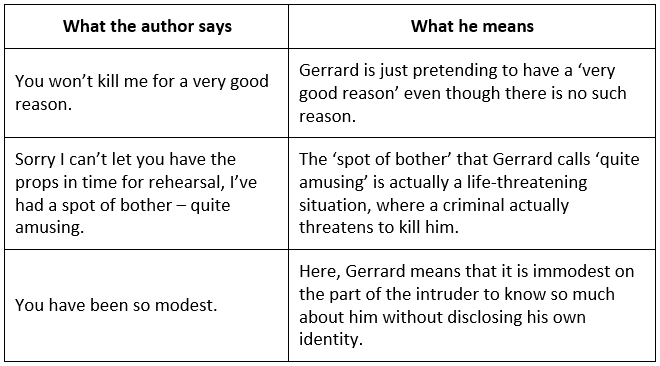
Ans.