Reflect and Respond
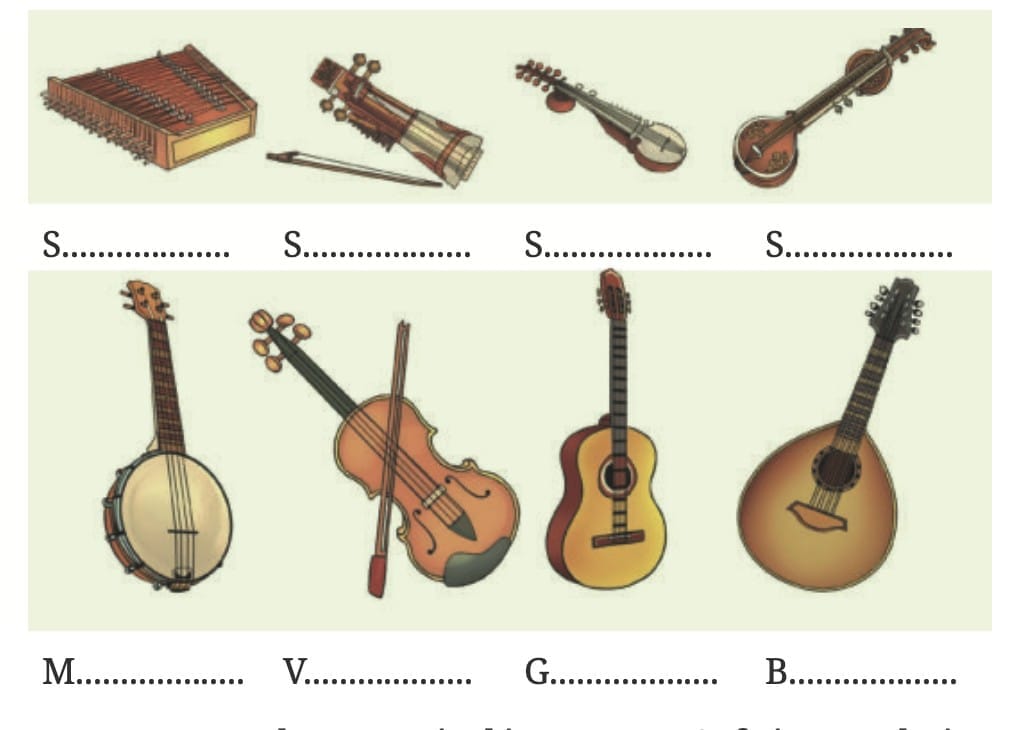
I. Given below are some stringed musical instruments. Work in pairs and identify them by first letter of the spellings of their names.
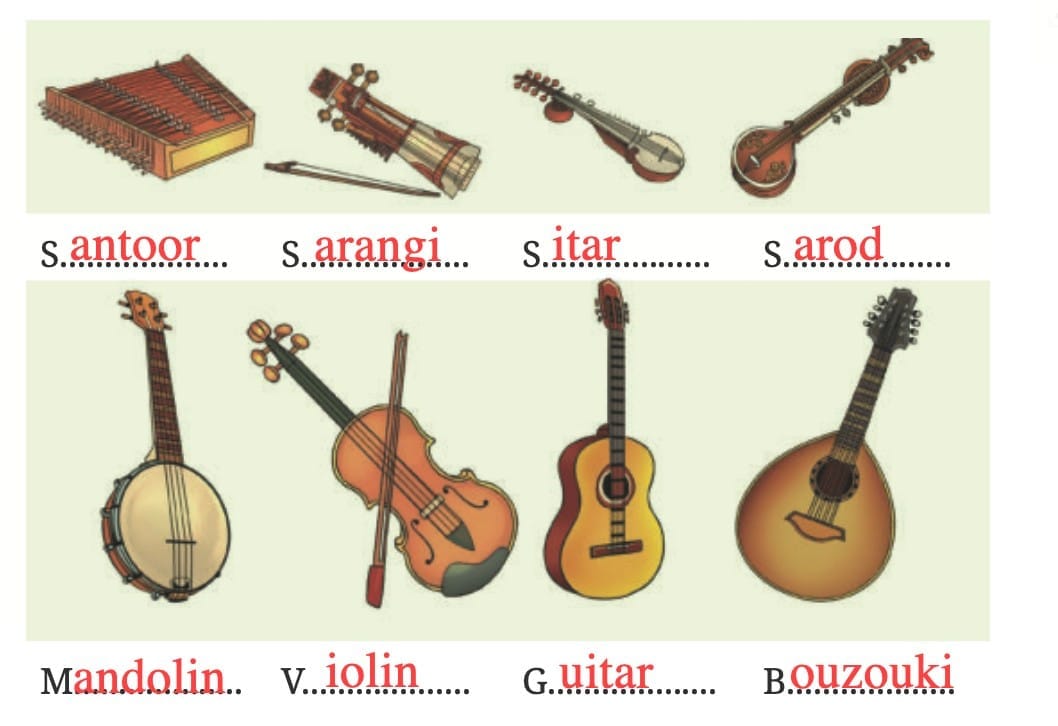

Ans:
II. Do you play a musical instrument? If given a choice, which one would you choose and why?
Ans (Sample):
If given a choice, I would choose to play the violin — it produces a range of emotions from joy to melancholy and works across both classical and contemporary genres. I am also inspired by Shruti in the play, who beautifully blends Indian classical music with a Western instrument.
III. Is there any difference in the choice of music between children and elders? If yes, why? If no, why not?
Ans:
- Exposure: Elders favour classical or folk music from their era; children are exposed to contemporary pop, film music, or fusion through digital media.
- Values: Many elders see classical music as more disciplined and culturally rooted, while children are drawn to experimental styles through peer influence.
- However, music transcends age — as the play shows, the gap is bridgeable through understanding and listening to each other.
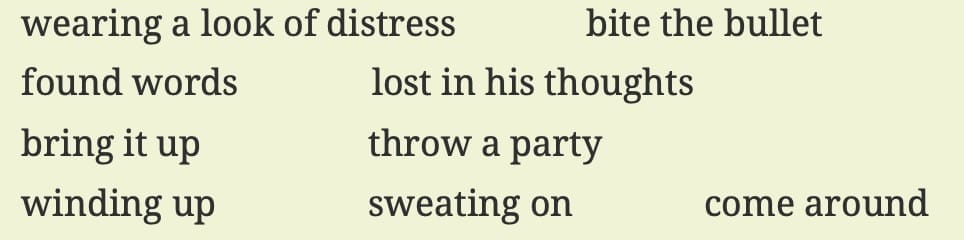
IV. Complete the paragraph by choosing the correct phrases from the box. (Literal or figurative?)
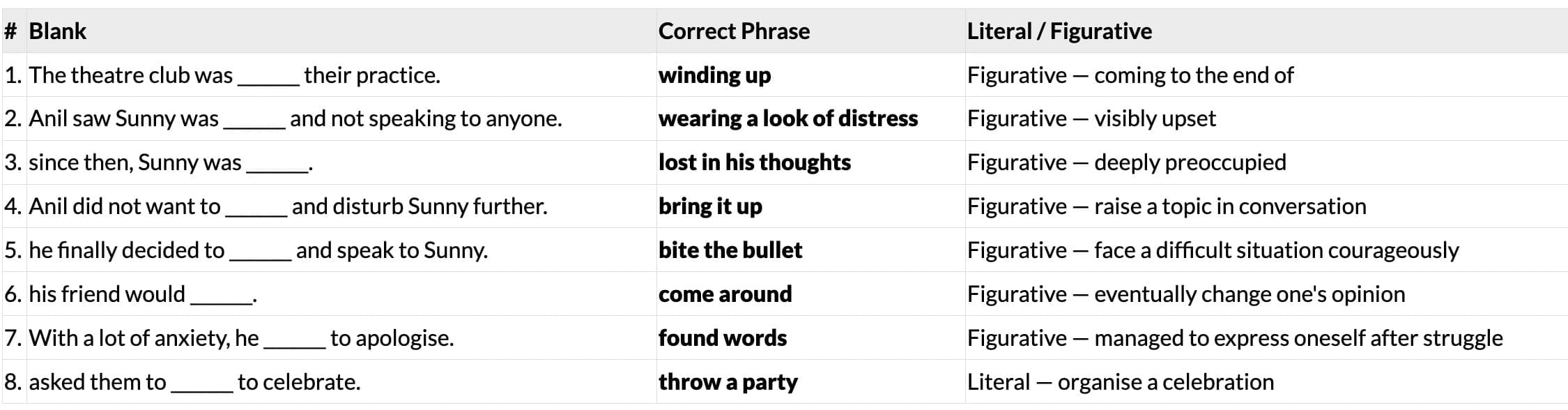
Ans:
Check Your Understanding — Act I
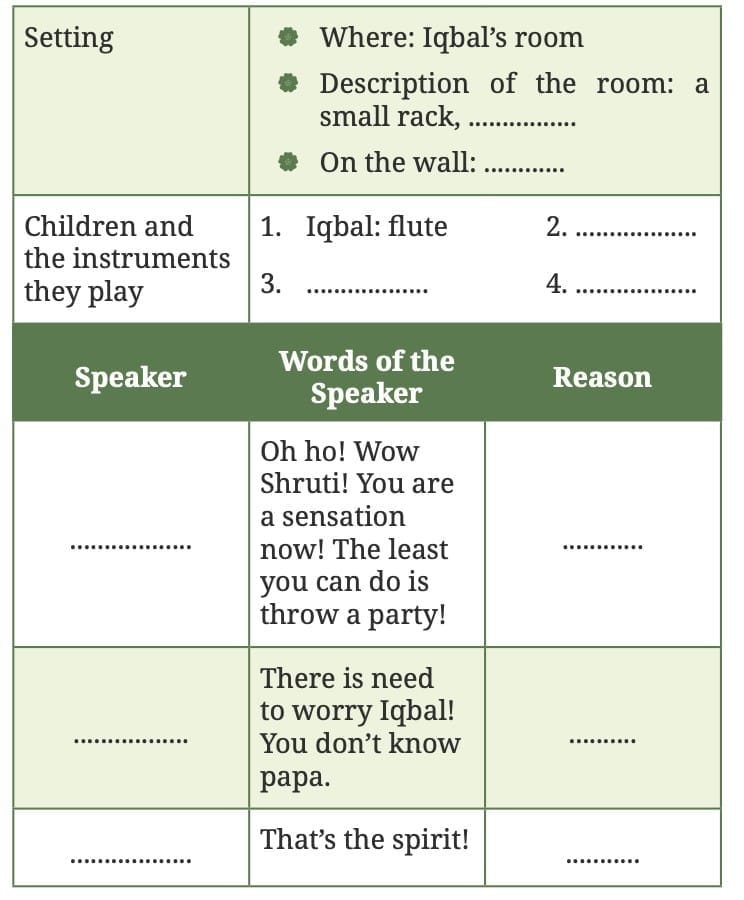
I. Complete the table based on Act I of the play.
Ans:
II. Do you think Shruti will gather the courage to speak to her father? Give a reason.
Ans:
Yes — by the end of Act I, Shruti herself says “I guess it is time to bite the bullet,” indicating firm resolution. Her friends’ encouragement and Iqbal’s reassurance have built her confidence. She promises to bring this up at dinner that very night — a clear shift from anxiety to determined action.
III. What might be Shruti’s father’s reaction? Why?
Ans:
Nabin is likely to react with disappointment and disapproval initially — Shruti herself says he considers it a “desecration” of the violin to play Western tunes and firmly believes only Classical Hindustani music is worthwhile. He may also feel hurt that Shruti practised without telling him. However, as a loving father, he may eventually “come around,” especially if Shruti speaks to him with honesty and respect.
Check Your Understanding — Act II
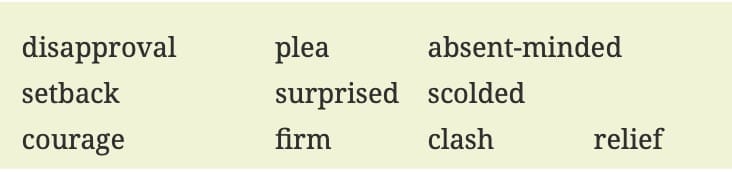
I. Complete the summary of Act II by choosing the correct words from the box.
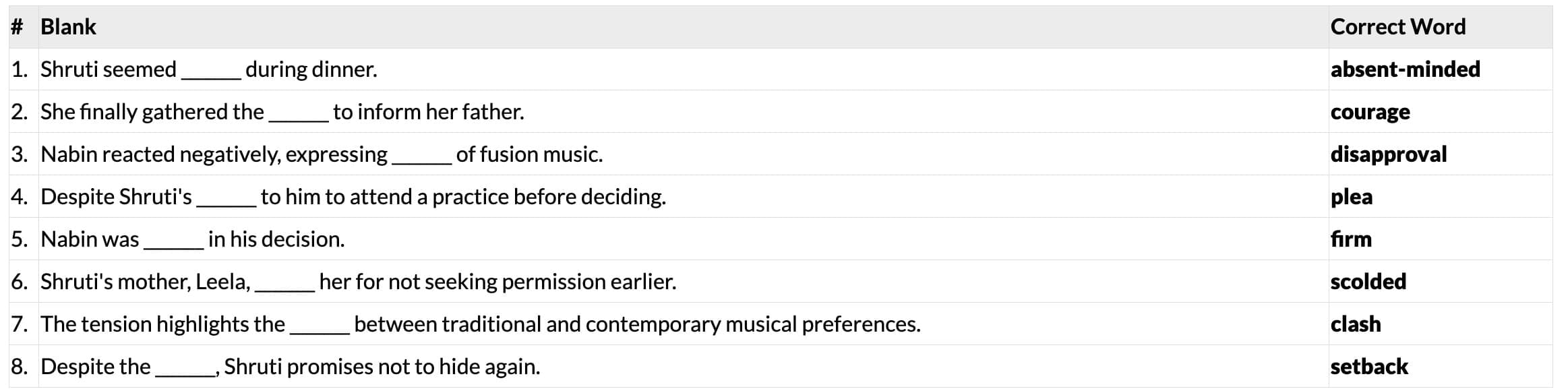
Ans:
Extra words not used: surprised and relief.
II. Will Shruti’s father go for the rehearsal? Support your answer with a reason.
Ans:
Based on Act II alone, it seems unlikely — Nabin leaves abruptly and dismisses Shruti’s plea. However, his love for his daughter and Leela’s likely persuasion suggest he will eventually go. Indeed, Act III confirms he attends and is moved by the performance.
III. Do you think Shruti and her parents would understand one another? If yes, why? If no, why not?
Ans:
Yes — both sides show qualities that make understanding possible. Shruti respects her father’s views and does not want to hurt him. Leela acts as a bridge. Nabin loves Shruti deeply beneath his strictness. The play ends with exactly this understanding — when Nabin hears the music firsthand and cannot deny its beauty while Shruti maintains her classical foundation.
Check Your Understanding — Act III
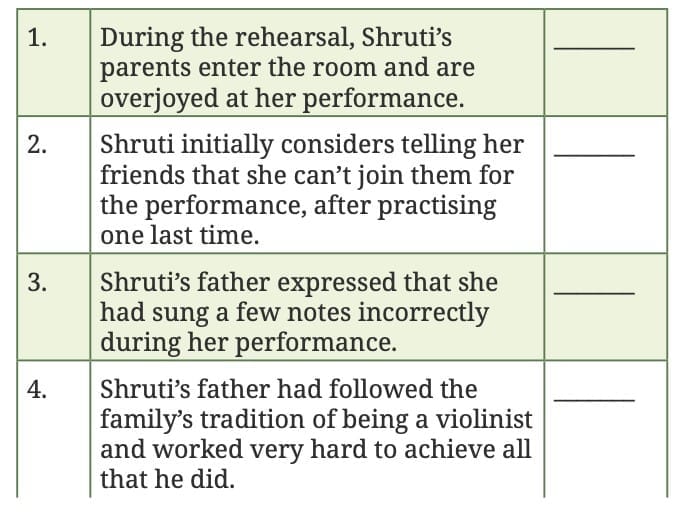
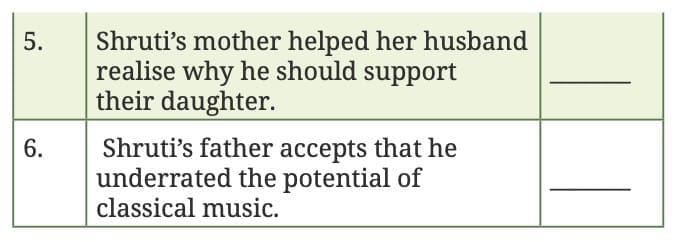
I. Work in pairs. Identify the true statements.
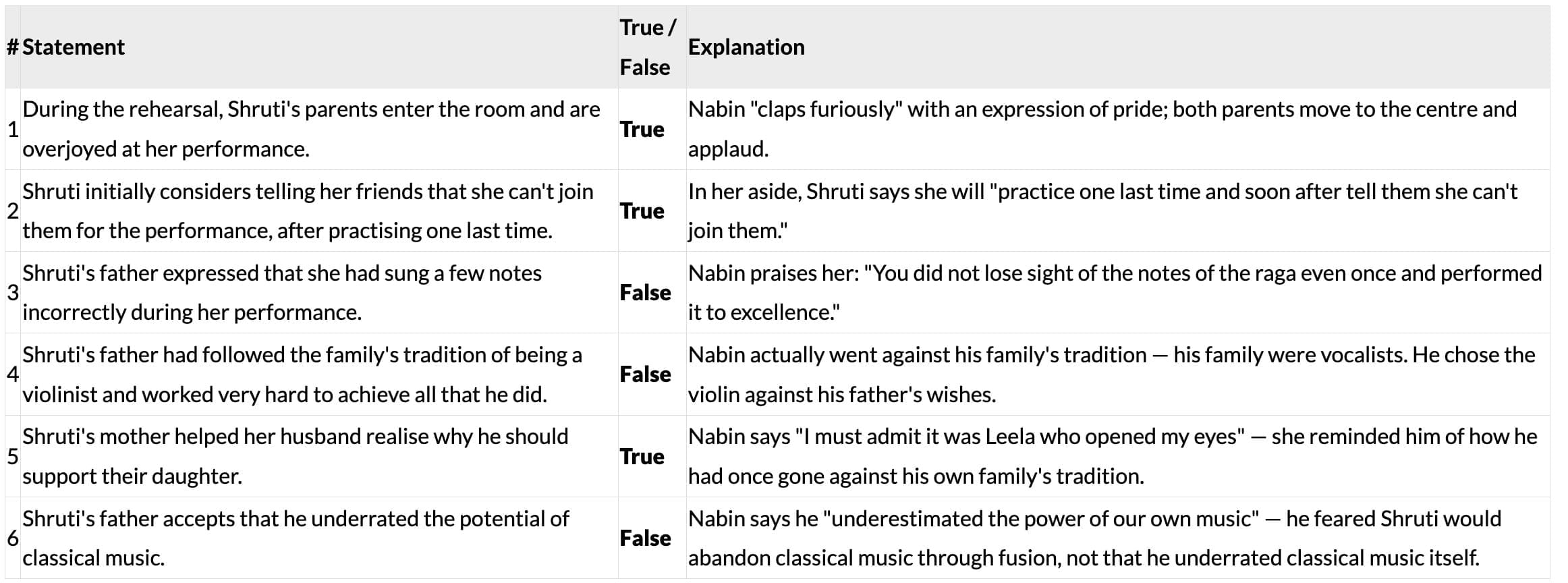
Ans:
Critical Reflection
I. Read the extracts given below and answer the questions that follow.
Extract 1
Shruti: There is need to worry Iqbal! You don’t know papa. He is very strict about these things. He will think it a desecration of the violin to be played to Western tunes. Papa firmly believes that Classical Hindustani music, with its ragas and aalaaps, is the only kind of music that an artist of any worth should play. I don’t want papa to feel that I don’t care about his opinions, because I do. It’s just that I want to give this a try too. I just don’t know how to tell him in the right way!
Iqbal: All ways are right ways, Shruti. He is your father, he will understand.
(i) Select the option that correctly identifies Shruti’s situation.
- A. confident
- B. indifferent
- C. content
- D. in a dilemma
Ans: D. in a dilemma.
Shruti wants to participate in the fusion concert but deeply respects her father’s strict views on classical music. She is torn between her personal passion and her sense of duty towards her father’s values.
(ii) What does Shruti mean by ‘the right way’, in the sentence, “I just don’t know how to tell him in the right way!”?
Ans:
Shruti means a manner of speaking that is honest, respectful, and sensitive to her father’s deeply held views — a way that conveys her passion for fusion without making him feel she dismisses Classical Hindustani music. She wants words and a tone that reassure him her love for the violin and classical tradition remains intact, without damaging their relationship.
(iii) Complete the following with a suitable reason. We can say that the extract reflects the generational gap in understanding art and tradition because _____________.
Ans:
…Shruti’s father sees Classical Hindustani music as the only authentic form, viewing fusion as a desecration — tradition as something fixed and sacred. Shruti respects this deeply but wants to explore the creative possibilities of blending musical forms — tradition as something living and evolving. This clash of “only classical is worthy” versus “I want to give fusion a try too” reflects the generational difference.
(iv) Explain how Iqbal’s words were meant as an assurance to Shruti.
Ans:
Iqbal’s words — “All ways are right ways. He is your father, he will understand” — reassure Shruti on two levels: first, that she need not search for a perfect formula, as honest speech to a loving parent is itself the right approach; second, that however strict Nabin is about music, his parental affection will ultimately allow him to listen. Iqbal tells Shruti not to let fear of imperfect words paralyse her into silence.
(v) Fill in the blank with a phrase from the extract. The critics argued that only films which provoke thoughtful discussion are _________.
Ans:
…are “of any worth” (meaning having genuine value or merit — from “an artist of any worth” in the extract).
Extract 2
Nabin: I underestimated the power of our own music. I was afraid you would be lost to us. I realise that my fears were baseless. After all each bay, its own wind. I trust you Shruti and I will root for your group at the concert!
(Shruti hugs both of her parents)
(i) Select the suitable option to complete the sentence. Nabin’s breakthrough in his understanding of artistic freedom, highlights a bridge between ______.
- A. personal ambition and professional success
- B. traditional values and modern expressions
- C. strict discipline and casual learning
- D. historical techniques and futuristic innovations
Ans: B. traditional values and modern expressions.
Nabin’s transformation — from rigid opposition to proud support — represents a bridge between Classical Hindustani music (traditional values) and Indo-Western fusion (modern expression). He realises these are not opposites but can coexist and enrich each other.
(ii) Fill in the blank with a suitable phrase. The extract uses the word ‘lost’ both in the sense of losing _________ and physical separation.
Ans:
…losing one’s musical identity / classical foundation / cultural roots and physical separation. Nabin feared Shruti would drift away both from her classical heritage and from the family’s artistic values.

(iii) In the line, ‘Shruti hugs her parents’, which word from those given below does NOT show what it conveys?
Ans:
The word that does NOT show what the hug conveys is: duty. The hug conveys reconciliation, harmony, acceptance, and understanding — all spontaneous emotional expressions of love and relief. “Duty” implies formal obligation, not the heartfelt gesture of a hug.
(iv) What can be inferred about Shruti’s future in music following her father’s expression of trust and support?
Ans:
Shruti’s musical future looks bright and free. She will no longer hide her activities or feel torn between passion and family. With Nabin’s praise that she “did not lose sight of the notes of the raga even once,” she can now pursue both classical and fusion openly — growing as a complete musician who honours her classical roots while exploring contemporary forms.
(v) Identify the phrase that refers to the uniqueness of each artist’s journey and style.
Ans:
“Each bay, its own wind.” This metaphor expresses that every individual — like every bay of water — is shaped by its own unique current. No two artistic journeys are identical; each artist finds their own path and expression. Nabin uses it to acknowledge that Shruti has the right to find her own musical identity, just as he once found his.
II. Answer the following questions.
1. Justify the title ‘Twin Melodies’. How does the play explore the theme of tradition and modernity?
Ans:
- Literally: The title refers to the two musical streams — Classical Hindustani music (Nabin’s tradition) and Indo-Western fusion (Shruti’s exploration).
- Metaphorically: There are “twin melodies” in the parallel journeys of Nabin and Shruti — both stepped away from what their family expected to pursue a musical path they believed in. Nabin chose the violin against his family of vocalists; Shruti chooses fusion against her classical father. Their stories are parallel melodies separated by a generation, harmonising in the end.
- Tradition vs. modernity: The play argues they are complementary, not opposing. Shruti’s performance proves that classical foundations enrich modern forms — the resolution (Nabin offering his music room) symbolises tradition endorsing modernity.
2. What are the different perspectives of Peter, Iqbal, and Avinash regarding confronting figures of authority? How do their attitudes towards Shruti’s dilemma provide insight into their own characters?
Ans:
- Peter is straightforward and practical — “just tell them.” His direct approach reflects a confident character who does not dread parental authority.
- Iqbal is reassuring and philosophical — “All ways are right ways. He is your father, he will understand.” His humour about “scolding for breakfast” normalises the fear of disapproval, suggesting a comfortable, open relationship with authority at home.
- Avinash is pragmatic — “What’s the worst that can happen?” He uses risk-assessment logic, urging Shruti to face problems before they escalate — reflecting a reasoned, direct character not easily intimidated.
Together, the three provide a supportive community of different voices — practical, philosophical, and pragmatic — that help Shruti grow in courage.
3. Analyse the character of Nabin Sharma. How does his attitude towards music evolve throughout the play?
Ans:
- Initially: Strict, principled, and inflexible — he believes Classical Hindustani music is the only legitimate form, views fusion as “desecration,” and reacts to Shruti’s revelation by getting up and leaving with a mocking comment about “phoo music.”
- Turning point: Two forces change him — Leela’s reminder of his own past (he had gone against his family of vocalists to play the violin), and the direct experience of hearing Shruti’s fusion performance, where his feet tap involuntarily.
- By the end: Warm, humble, and self-aware. He admits he “underestimated the power of our own music,” offers the children his music room, and says “each bay, its own wind.” His arc — from guardian of tradition to guardian of his child’s artistic freedom — is the play’s most complete character journey.
4. How does the play use Shruti’s internal conflict to explore the theme of duty towards family versus personal passion?
Ans:
Shruti does not dismiss her duty — she is deeply anxious about her father’s feelings and says clearly “I don’t want papa to feel that I don’t care about his opinions, because I do.” This shows her personal passion and sense of duty exist in painful tension, not opposition. The play resolves this tension not by declaring one side victorious, but by showing the conflict was based on a misunderstanding — that fusion means abandoning classical music. When Nabin hears Shruti and sees her classical foundation is intact, the apparent opposition dissolves. The play suggests duty and passion can coexist when approached with honesty, courage, and love.
5. Evaluate the effectiveness of the play’s conclusion. Does it realistically address the conflicts presented?
Ans:
The conclusion is emotionally satisfying and theatrically effective. It is earned — not sudden — through several preparatory steps: Leela’s quiet intervention, Shruti’s bravery in speaking up, her aside revealing she was prepared to quit, and finally Nabin hearing the music firsthand. Nabin’s own history mirrors Shruti’s so exactly that his change of heart is genuine recognition, not mere sentimentality. A critic might note real generational conflicts are often more protracted, but the play — designed for young readers — effectively models open communication, empathy, and the possibility of mutual understanding.
6. Assess how well the role of cultural diversity contributes to the storyline of the play.
Ans:
- Structural: The fusion ensemble itself — violin, flute, tabla, keyboard — is a symbol of harmony across traditions, embodying the play’s theme.
- Character diversity: The names Shruti, Iqbal, Peter, Avinash suggest Hindu, Muslim, and Christian backgrounds — yet the group is united by music and mutual support, modelling how art transcends cultural and religious divisions.
- Central message: The Indo-Western fusion genre is itself an artistic response to cultural diversity — a creative synthesis honouring both traditions. Nabin’s eventual appreciation represents the broader message: cultural diversity, when engaged respectfully, does not dilute heritage but enriches it.
Vocabulary and Structures in Context
I. What is ‘aside’ used for?
- (i) enables characters to talk about the story
- (ii) shows what a character thinks or feels
- (iii) makes a direct link between the audience and the character
- (iv) (i), (ii), and (iii)
Ans: (iv).
An ‘aside’ serves all three functions simultaneously — commenting on events, revealing inner thoughts other characters cannot hear, and creating an intimate connection with the audience. Shruti’s aside (revealing she was about to quit the group) is a perfect example of all three.
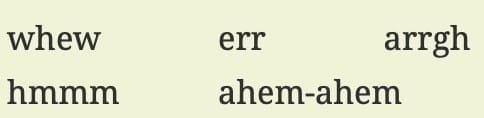
II. Why are ‘Ahem ahem, I … er…’ used?
- to fill gaps while speaking
- to increase clarity
- to provide confidence
Ans: 1. to fill gaps while speaking.
“Ahem ahem” and “er” are non-lexical fillers — sounds used to fill pauses while the speaker gathers their thoughts. Iqbal uses “ahem ahem” theatrically; Shruti uses “er” because she is nervous and searching for the right words.
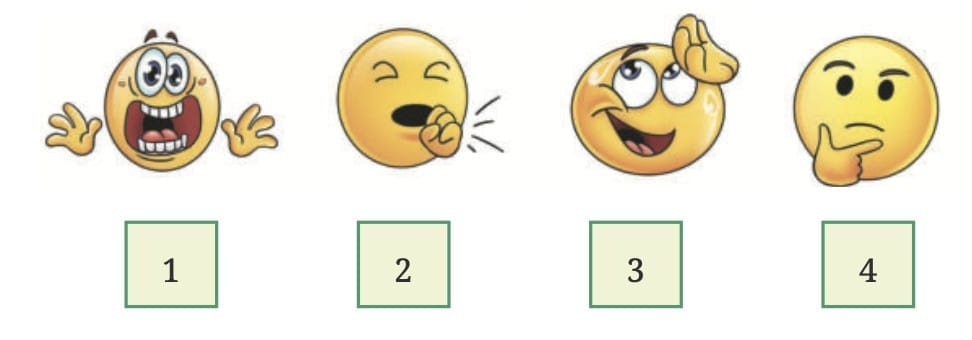

Match the non-lexical fillers to the emoticons 1–4:
Extra word not used: err.
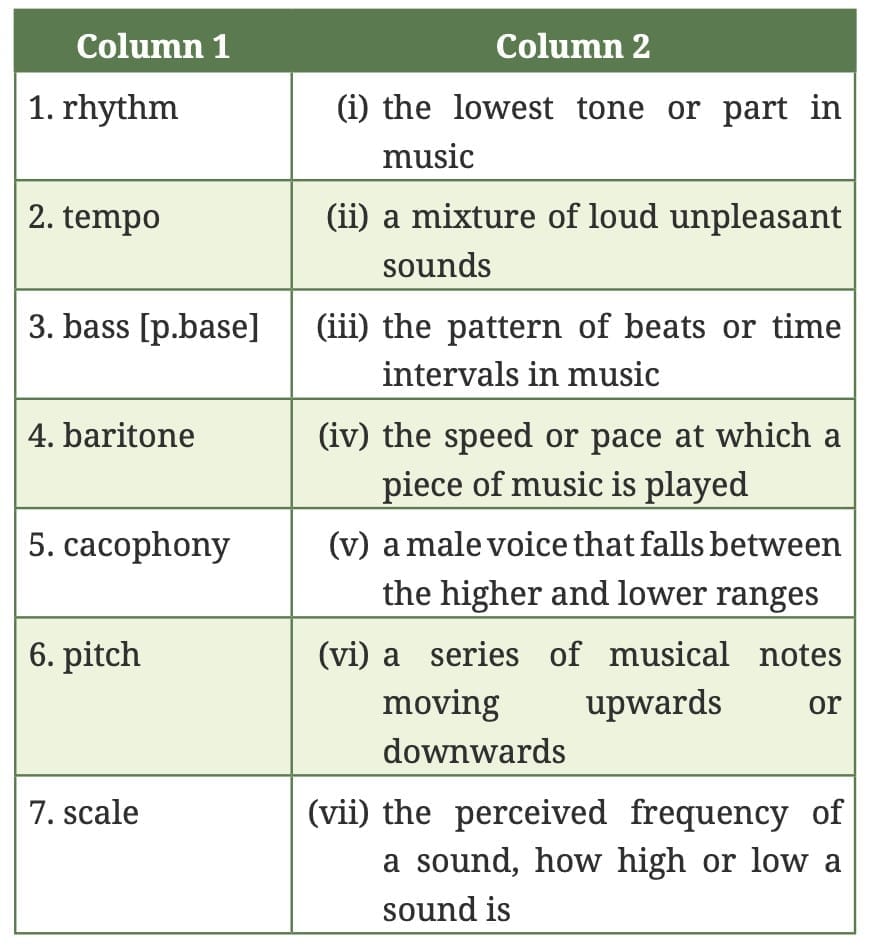
III. Match the music-related words in Column 1 with their meanings in Column 2.
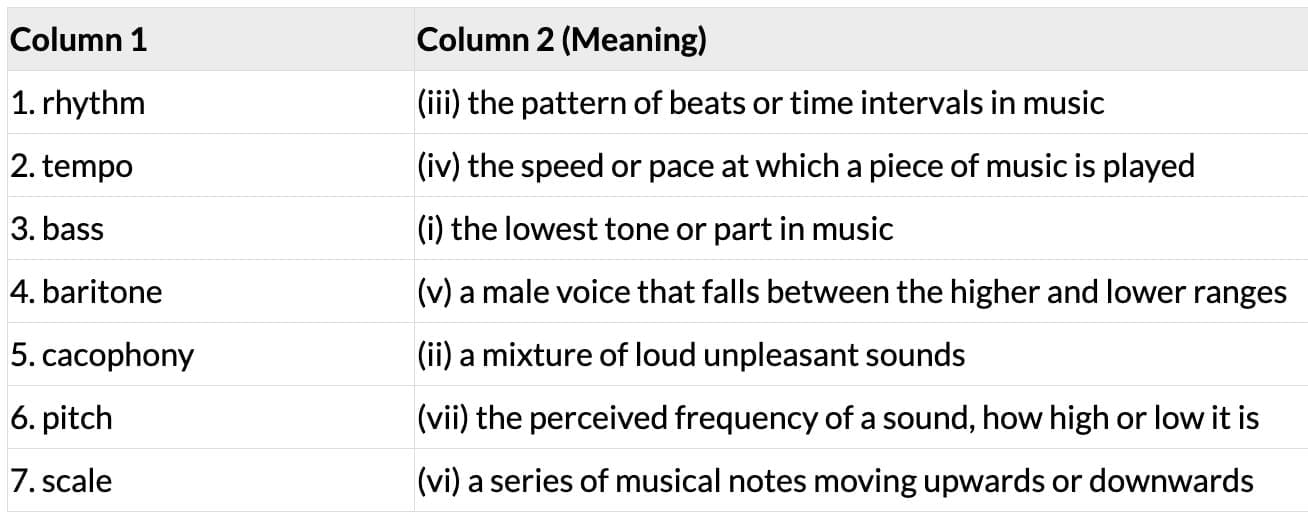
Ans:
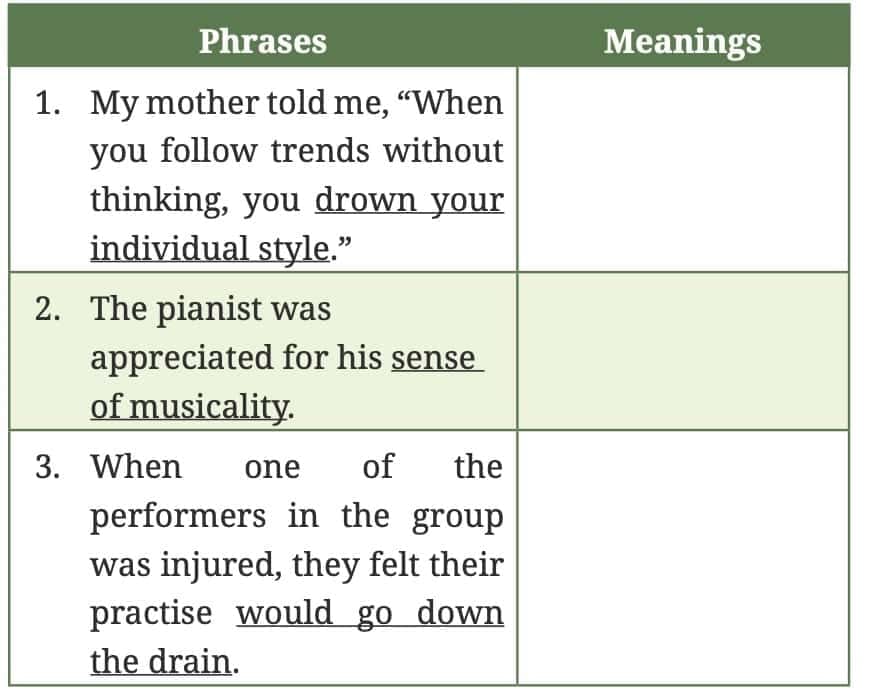
IV. Write the meanings of the underlined phrases based on your understanding.

Ans:
V. Identify the sentence type and convert exclamatory sentences to declarative.
- Oh, how much I enjoy performing this piece!
- Wah, how soulful! You all have done a wonderful job!
Sentences 1 and 2 are __________ sentences. (declarative/interrogative/exclamatory/imperative)
Now, convert the exclamatory sentences given above to declarative sentences.
Ans:

Sentences 1 and 2 are exclamatory sentences.
VI. Write the sentences given below in reported speech.
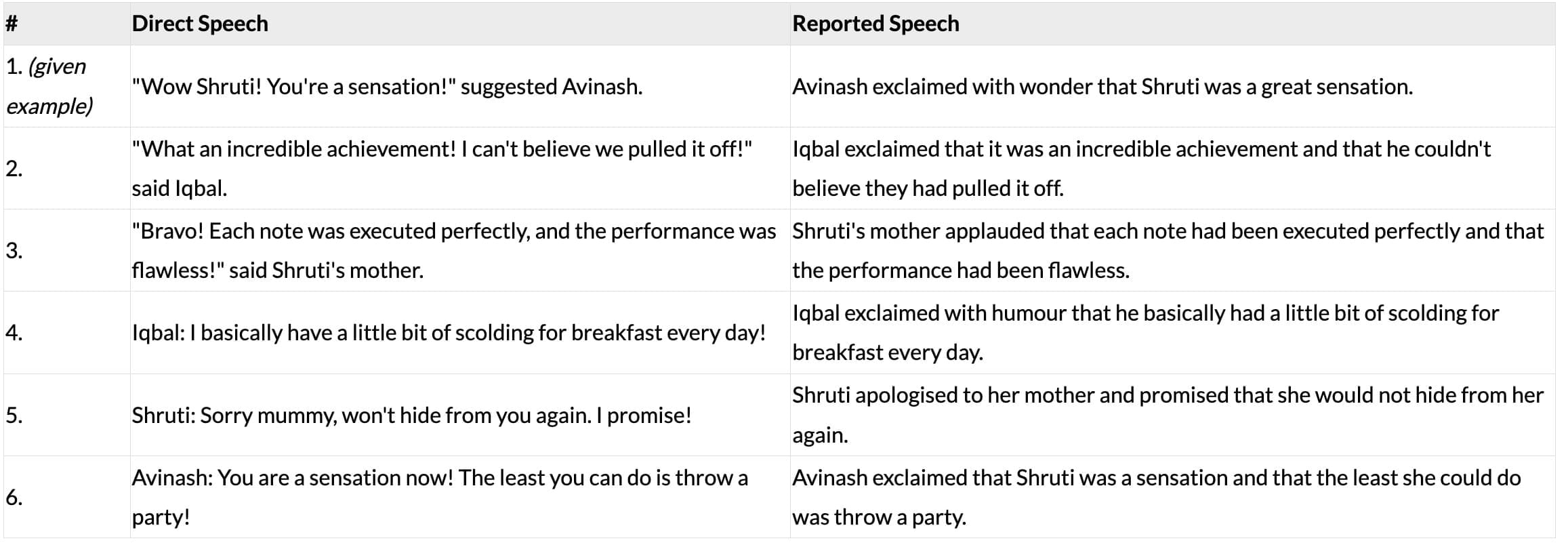
Ans:
VII. Report the following dialogue in the indirect form of speech.
Asma: Wow! What a unique experience I had at the art studio today!
Deepa: Tell me! I’m eager to hear!
Asma: I accidentally spilled paint all over my canvas.
Deepa: Oh, my goodness! What a pity!
Asma: No worries! The painting now looks better than my original plan!
Deepa: That’s incredible!Ans:
Asma exclaimed excitedly that she 1. had had a very unique experience at the art studio that day. Deepa urged her to tell her as she was eager to hear. Asma said that 2. she had accidentally spilled paint all over her canvas. Deepa pitied Asma. However, Asma replied to her not to worry as 3. the painting now looked better than her original plan. Deepa exclaimed that 4. it was incredible.
Writing Task
I. In groups of four, create a play script based on the story of Anuradha.
Ans: Sample Script — “The Tabla’s Voice”
Characters:
Anuradha — A teenage tabla player, extraordinary in skill
Raghunath — Anuradha’s father, a vocalist and music teacher
Kamala — Anuradha’s mother, supportive
Dev — Anuradha’s brother, supportive
Meera — Anuradha’s friend and fellow musician
Setting: The family’s living room. A tabla sits in one corner. A harmonium is near the window. Evening time.
ACT I
(Anuradha sits at the tabla, playing softly. She stops and looks at a letter in her hand.)
Anuradha: (Aside) The letter from the Sangeet Mahotsav! They want me to perform next month! Ahem-ahem … how do I tell Papa? He has never wanted me near the tabla. He says my voice should be my instrument. But this tabla … it speaks for me like nothing else can.
Meera: (entering) Anu! Did you get the letter? You’re in, right? Say you’re in!
Anuradha: (quietly) I got it, Meera. But … er … Papa doesn’t know.
Meera: Arrghh! Anuradha! The concert is in four weeks! You have to tell him.
Dev: (coming in, overhearing) Tell who what? (sees the letter) Wait — the Sangeet Mahotsav? Anu, that’s huge!
Anuradha: I know … but you know Papa.
Dev: (firmly but kindly) Anu, Maa and I are rooting for you. And Papa loves you. Talk to him tonight.
Anuradha: (taking a deep breath) You are right, Dev. I guess … it is time to bite the bullet.
— CURTAIN —
(Students should continue with Act II — the conversation with the father, his initial disapproval — and Act III — resolution, ideally through the father witnessing Anuradha’s performance or being reminded of his own struggles as a musician.)