Reflect and Respond
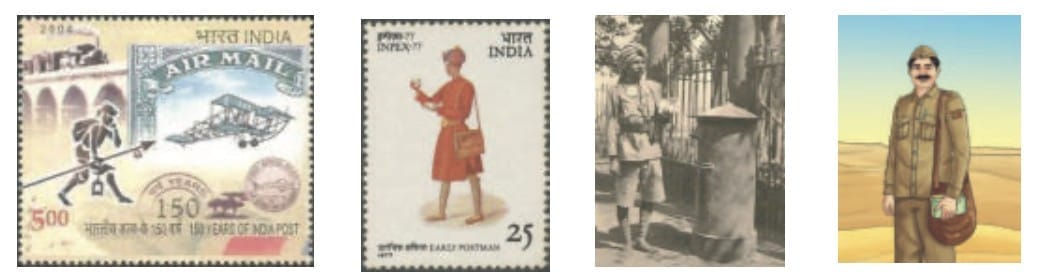
I. Look at the pictures given below of persons engaged in the same profession. Discuss in pairs and share your answers with your classmates and teacher.
1. Which profession do they belong to?
Ans: They belong to the postal profession — postmen / Gramin Dak Sewaks who deliver letters and parcels.
2. Do they face any difficulties while doing their duty?
Ans:
- They travel long distances on foot, by cycle, or over rough terrain.
- They work in extreme weather — scorching heat, sandstorms, heavy rain, and cold.
- They carry heavy mailbags in remote and inaccessible areas.
- They often have to deliver bad news, which is emotionally difficult.
3. How does their profession affect the people they meet?
Ans:
- They connect families separated by distance through letters and money orders.
- They bring joy in the form of good news — births, weddings, promotions.
- For remote communities, the postman is sometimes the only connection to the outside world.
II. Discuss in groups.
1. How can ‘words’ be ‘carried’?
Ans: Words can be carried through letters, postcards, telegrams, books, newspapers, and digitally through emails, SMS, and social media. Physically, a postman carries written words from one place to another.
2. Who could be a carrier of words?
Ans: A carrier of words could be a postman / GDS who delivers letters; a courier agent; a journalist; a teacher; or in earlier times, a messenger or herald. Today, the internet and mobile phones carry words digitally.
3. What are the means for people to stay connected?
Ans: People stay connected through letters and postcards, telephone calls, emails, messaging apps (WhatsApp, Telegram), video calls (Zoom, Google Meet), and social media. In remote areas, the postal service (GDS) remains the primary means of connection.
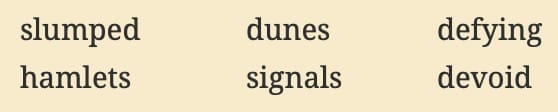
III. Read the words given in the box below and place them in their appropriate context in the following passage.
Ans: We stepped out of the vehicle at the end of the road. Immediately, our body sent 1. signals that our decision to visit the sand 2. dunes in the afternoon was insane. We had passed a few 3. hamlets on our way to the desert. We could not find even a single soul outdoors, 4. defying the blazing sun. Even the camels were 5. slumped in the little shade offered by the khejri trees. In this remote place people relied on BSNL to connect to the world as the area was 6. devoid of any other network service.
Check Your Understanding – Part I
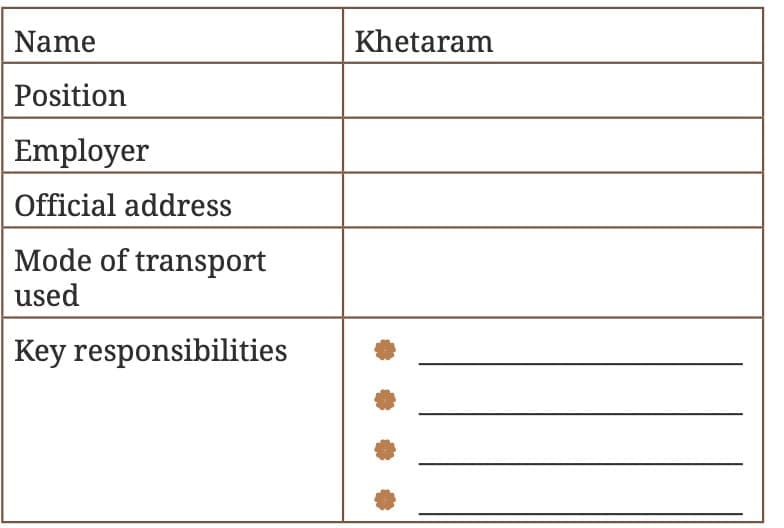
I. Fill up the following information sheet for Khetaram.
II. Discuss with your teacher.
1. Why do you think Khetaram has taken up this challenging job?
Ans: Khetaram took up the job out of economic necessity. He says famine is a way of life and even a good year’s crop of bajra cannot feed his family of five. The GDS salary is essential for his family’s survival. His 15-plus years of service also reflect a strong sense of duty and dedication to his community.
2. How do you think Khetaram would feel about taking up this challenging task every day?
Ans: Khetaram likely feels physical exhaustion alongside deep personal pride. The task is gruelling — 20 km daily in 50-degree heat with a heavy mailbag — yet he says his spine is strong and is grateful to continue after 60. His declaration “Main tayyar hoon” (I’m ready) before setting off suggests resilience, purpose, and a strong sense of community belonging.
Check Your Understanding – Part II
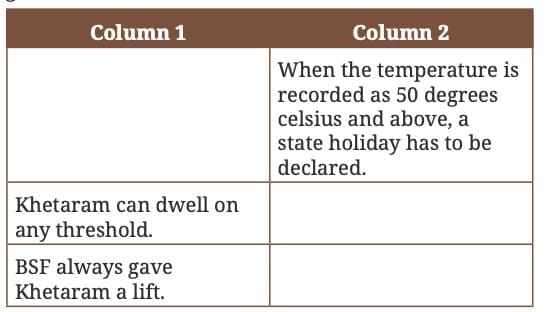
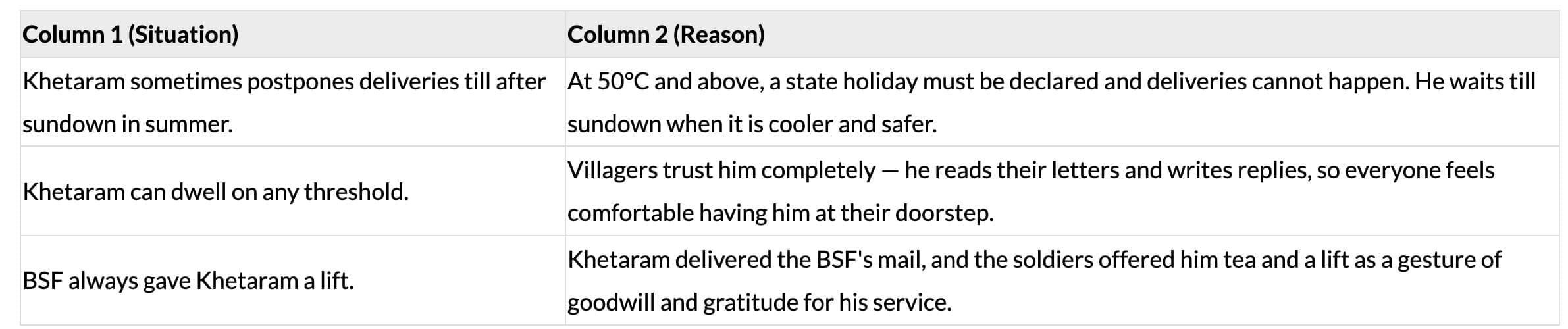
I. Complete the table given below with the situations given in Column 1 and the reasons in Column 2.
II. Why was a piece of jaggery offered in the village when he brought news of a birth or weddings?
Ans: The villagers are very poor — jaggery is the most basic sweet available to them. Offering it is a traditional Indian way of celebrating good news. It reflects both their poverty and their heartfelt appreciation for the joy Khetaram brings.
III. How would phone lines help Khetaram in his job?
Ans: Once phone lines arrive, Khetaram might become a Gramin Sanchar Sewak and carry a mobile phone alongside mail — allowing urgent news to be conveyed immediately, reducing the need to travel long distances for single messages. His enthusiastic “Main tayyar hoon” (I’m ready) suggests he welcomes this upgrade.
Critical Reflection
I. Read the extracts given below and answer the questions.
Extract 1:
Akaal or famine is a way of life here. In a good year, I get one crop of bajra. That cannot feed my family of five. We would starve without this job,” he says.
And for each family which resides in this arid land, survival is partly dependent on money orders remitted by a relative.
(i) Complete the sentence given below with an appropriate reason.
One crop of bajra makes a little difference for people like Khetaram because __________.
Ans: …it is insufficient to feed a family of five for the entire year. With famine being a common occurrence, even a single crop cannot provide year-round food security.
(ii) Why did Khetaram term famine as ‘a way of life’?
Ans: In the arid Thar Desert, drought and food shortage are recurring and normal conditions rather than exceptional events. The people have grown so accustomed to scarcity that famine is no longer a crisis — it is simply the daily reality they live with.
(iii) Give one reason why Khetaram had to take up a job to help his family to survive.
Ans: One crop of bajra per year (in the best of years) was not enough to feed his family of five. Without the GDS salary, his family would have starved.
(iv) Complete the analogy given below with a word from the extract.
Other families: Money orders :: Khetaram: __________
Ans: Other families: Money orders :: Khetaram: Job (GDS salary / bajra crop) — just as other families depend on money orders for survival, Khetaram depends on his GDS job and his one crop of bajra.
(v) What would ‘a good year’ signify?
Ans: ‘A good year’ signifies a year with adequate rainfall in which Khetaram can successfully grow and harvest one crop of bajra — a rare but welcome relief from the usual hardship of desert life.
Extract 2:
There is one letter delivery he dreads. The envelope with the right corner torn off, which signifies that the missive bears news of death. “Ashubh Samachar cannot be carried into the house,” says Khetaram. So, he stands outside, reads out the letter twice, then tears it to bits. “Bad news must be destroyed,” he mutters philosophically.

(i) Choose the correct option for the following question.
Who could have torn the right corner of the envelope?
A. Khetaram B. Sender of the letter C. Receiver of the letter D. The postmaster
Ans: B. Sender of the letter. The torn right corner is a traditional signal from the sender to warn the postman and recipient that the letter contains news of a death.
(ii) Complete the sentence with an appropriate reason.
The most likely reason for Khetaram reading the letter twice is because __________.
Ans: …he wants to ensure the grieving family hears and fully understands the sad news, leaving no room for misunderstanding about the details, and giving the family time to absorb the shock.
(iii) What was Khetaram’s philosophy regarding bad news, and how did he act upon it?
Ans: Khetaram’s philosophy: “Bad news must be destroyed.” He believes once sorrowful news has been communicated, the physical medium should be eliminated to prevent continued pain. He acts on this by standing outside the house (Ashubh Samachar cannot be brought inside), reading the letter twice aloud, and then tearing it to bits — reflecting both cultural sensitivity and compassion.
(iv) State whether the following sentence is true or false.
Khetaram’s action of tearing the letter differed from his beliefs.
Ans: False. His action was entirely consistent with his beliefs — he believed bad news must be destroyed and physically tore the letter after reading it. His actions matched his philosophy perfectly.
(v) Mention any one aspect of Khetaram’s temperament which is revealed through this extract.
Ans: The extract reveals Khetaram’s compassionate and philosophically grounded temperament. He dreads delivering death notices, stands respectfully outside, and tears the letter to spare the family further anguish. His calm philosophy (“Bad news must be destroyed”) shows he has developed a measured way of coping with the sorrowful aspects of his duty.
II. Answer the following questions.
1. Justify the statement made by the Postmaster-General, Rajasthan Western Region, stating that the role of GDS is ‘invaluable’.
Ans:
- GDS workers deliver mail to areas completely inaccessible by any other means — 120 km beyond the last railhead, 50 km beyond the last phone, 10 km beyond where the road crumbles into sand.
- They serve as the sole link between isolated communities and their families, covering frozen deserts, island territories, and riverine communities.
- They deliver money orders on which families in arid lands depend for survival.
- They also serve as informal letter readers and reply writers for illiterate villagers — performing a social function far beyond mere mail delivery.
- When a proposal to replace them with patwaris was made, it was rejected because no one else could perform this irreplaceable role.
2. How was the purpose of India Post different from that of the British postal system?
Ans: The British postal system was set up to relay official company dak between administrative centres — it served the colonial government, not the general population. After Independence, India Post’s mandate became to bring the entire population within the mailing network regardless of remoteness, reflected in growth from 25,000 post offices in 1947 to over one and a half lakh today, and in the GDS system reaching the country’s most remote corners.
3. People trusted Gramin Dak Sewaks. Support this statement with any two instances from the text.
Ans:
Instance 1: Villagers trusted Khetaram enough to ask him to read their letters and draft replies on their behalf — sharing personal correspondence with him, a clear sign of deep trust.
Instance 2: Rural depositors entrust their monthly savings to the post office. Every post office has many operational savings accounts, reflecting absolute confidence in the postal system — and in the local GDS worker who is the face of that system.
4. Infer the most likely reason that Khetaram was grateful to continue as GDS, even after the age of 60.
Ans: Economic necessity combined with a sense of purpose. Khetaram’s bajra crop cannot sustain his family — without the GDS salary, they would starve. GDS rules allow service until 65, and Khetaram is grateful for this continued assured income in a famine-prone environment. His deep sense of duty and community belonging also makes him want to keep serving the people he has been connected with for over 15 years.
5. Explain why the author pays tribute to people like Khetaram.
Ans: The author pays tribute because Khetaram represents extraordinary dedication and resilience under incredibly harsh conditions — walking 20 km daily in 50-degree heat, serving for over 15 years through sandstorms, reading and writing letters for illiterate villagers, and handling death notices with cultural sensitivity. He is the lone human link between isolated communities and the outside world, yet receives little recognition. The author rightly calls such people “part and parcel of our social fabric” — silently holding communities together without glory.
Vocabulary and Structures in Context
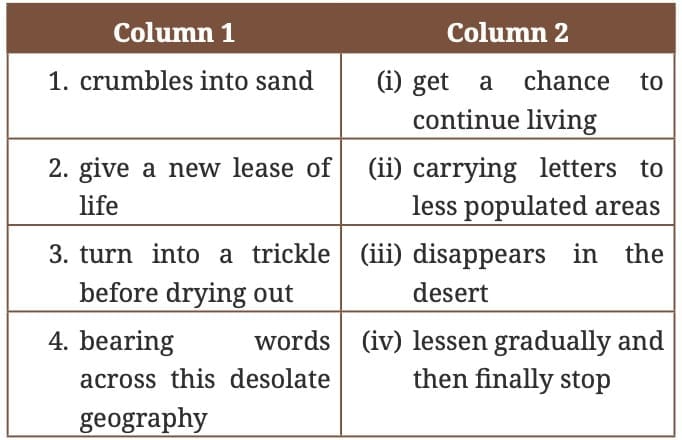
I. Study the phrases given in Column 1 and match them with their meanings in Column 2.Ans (sentences):
- crumbles into sand: The ancient fort’s outer wall had slowly crumbled into sand over the centuries.
- give a new lease of life: The successful surgery gave the elderly patient a new lease of life.
- turn into a trickle before drying out: Due to the summer drought, the once-mighty stream turned into a trickle before drying out completely.
- bearing words across this desolate geography: Khetaram spent decades bearing words across this desolate geography, connecting isolated families to their loved ones.
II. Identify examples of alliteration and metaphor in the extract given below.
“Khetaram’s khaki turban and uniform are his only protection against the desert’s furies, the scorching summer winds and swirling sandstorms which turn him into a walking sandman.”
Ans:
Alliteration: “Khetaram’s khaki” — repetition of the ‘k’ sound. “Scorching summer winds and swirling sandstorms” — repetition of the ‘s’ sound.
Metaphor: “The desert’s furies” — the desert is compared to an angry, furious entity. “Turn him into a walking sandman” — Khetaram is compared to a sandman, so covered in sand he appears to be made of it.
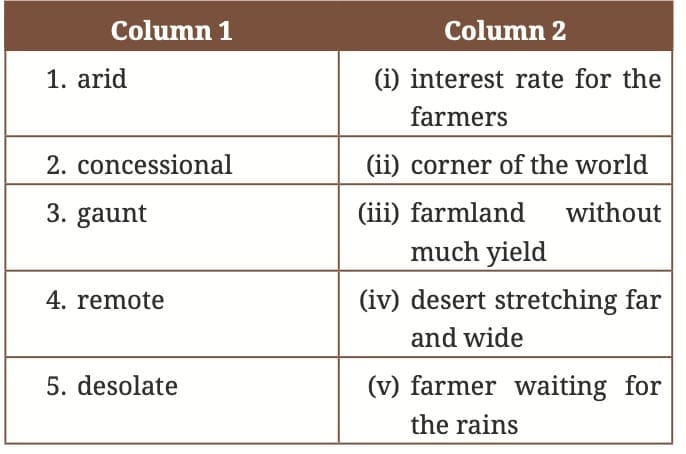
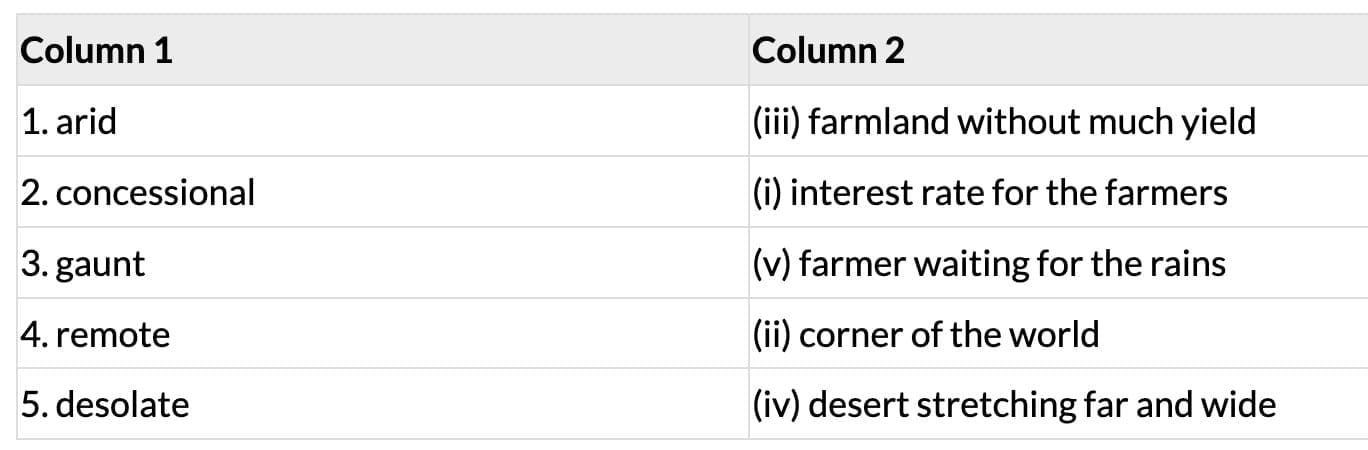
III. Match the words in Column 1 to what they suggest in Column 2 in the context of the chapter.
Ans (sentences):
- arid: The arid landscape of the Thar Desert stretches for hundreds of kilometres, with little vegetation in sight.
- concessional: The government announced concessional loans for farmers affected by the flood.
- gaunt: After months of drought and famine, the gaunt farmers prayed desperately for rain.
- remote: The GDS system was designed specifically to serve even the most remote corners of India.
- desolate: Walking through the desolate sands of the Thar at noon, Khetaram was truly alone in the world.
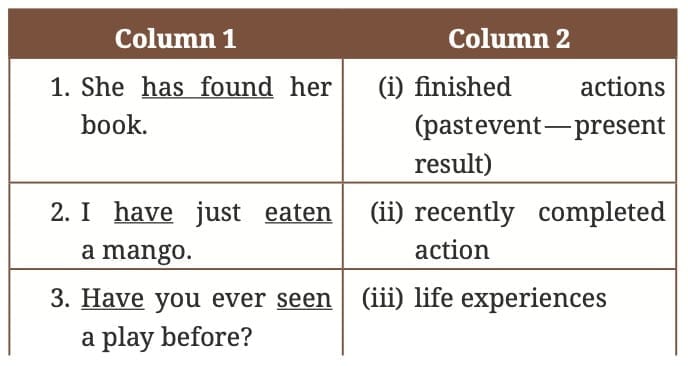
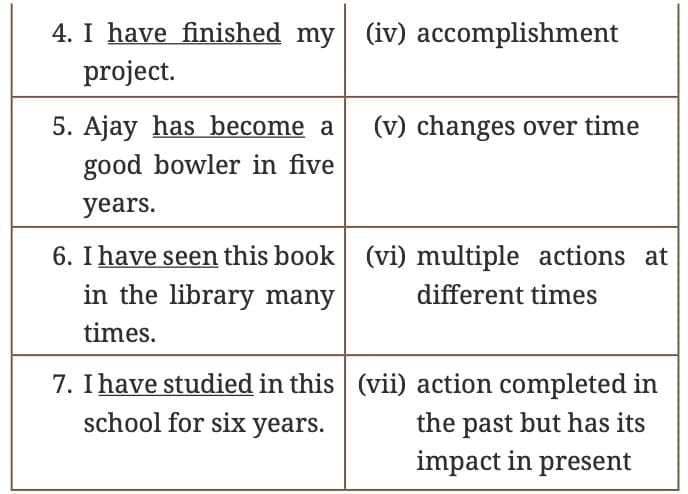
IV. Study the sentences and their functions. Then fill in the blanks using the present perfect form of the verbs given in brackets.
Now, fill in the blanks by using the present perfect form of the verbs given in the brackets to complete the following paragraph.
- I ________ (has/have) just ________ (get) a collection of postage stamps from my grandfather. He
- ________ (collect) these stamps over a period of 20 years. I
- ________ (study) most of the stamps in his collection and loved all of them. I
- ________ (begin) my own collection of postage stamps. Grandfather
- ________ truly ________ (inspire) me.
Ans: 1. I have just got a collection of postage stamps from my grandfather. He 2. has collected these stamps over a period of 20 years. I 3. have studied most of the stamps in his collection and loved all of them. I 4. have begun my own collection of postage stamps. Grandfather 5. has truly inspired me.
V. Active and Passive Voice — Complete the following paragraph about the advice given by Khetaram. One example has been done for you.
Given: “To begin with, a lot of stamina will be needed for this job.”
(i) You will need a lot of stamina for this job.
(ii) Practise reading clearly as some of the villagers will expect you to read out the letters.
(iii) Write words neatly as some villagers will ask you to draft replies.
(iv) Wear full-sleeved shirts and trousers to protect yourself from the heat.
To begin with, a lot of stamina will be needed for this job. Next, reading clearly A. ______________________, as you B. ______________________ to read out the letters by some of the villagers. Words C. ______________________ neatly as you D. ______________________ to draft replies by some villagers. Full sleeved-shirts and trousers E. ______________________ to protect yourself from the heat.
Ans: To begin with, a lot of stamina will be needed for this job. Next, reading clearly A. will need to be practised, as you B. may be expected to read out the letters by some of the villagers. Words C. must be written neatly as you D. may be asked to draft replies by some villagers. Full-sleeved shirts and trousers E. should be worn to protect yourself from the heat.
Speaking Activity
I. The postcard, inland letter, envelope, and money order form were engaged in a discussion on who the most important one was. In groups of four, select one each and reason with each other logically.Sample arguments for each:
Ans: Postcard:
It seems to me that I, the postcard, am the most important. I am the most cost-effective of all — anyone can afford to send me, even the poorest person. I need no envelope, no folding, and my message is open and honest. I have connected millions of families across generations.
Inland Letter:
I would like to point out that the inland letter is superior because it offers privacy — my contents are folded and sealed within myself. I provide enough space to write a longer, more personal message, and I cost less than a regular envelope with a stamp. That’s one way to look at it, but my privacy makes me far more personal.
Envelope:
Some people say the postcard is enough, but I totally agree that privacy and the possibility of enclosures make me the most important. I can carry not just letters, but also documents, photographs, and important papers. A postcard can carry only a few words, but I can carry an entire life’s news.
Money Order Form:
It seems to me that I am the most important of all. While you carry words, I carry sustenance. Khetaram himself says that families in the arid land survive on the money orders I carry. I bring food to hungry families, pay for children’s education, and fund medical treatment. No words can replace the value I deliver.
Writing Task
I. Read the condolence message that Sawant Singh sent to his cousin. Now, on behalf of your parents, draft an imaginary condolence message for your aunt on the recent passing away of her father.
Ans: – Sample Condolence Message
18 March 2026
Dear Kamla Chachi,
We were deeply saddened to learn of the passing of your dear father, our Nana ji. Words fall short at a time like this, but we want you to know that our hearts are with you and your family.
He was a man of great strength and warmth, and the memories he leaves behind will forever be a source of comfort and inspiration for all of us. We are grateful for the love and wisdom he shared with each one of us over the years.
Please accept our heartfelt condolences. May God grant eternal peace to his soul, and may He give your family the courage and strength to bear this irreplaceable loss. We are here for you — please do not hesitate to reach out whenever you need us.
Yours lovingly,
[Your Parents’ Names]