Reflect and Respond
I. Read the questions given below and share your answers with your classmates and teacher.
1. What is your dream?
Ans (Sample): My dream is to become a software engineer who develops technology solutions to help rural communities access education and healthcare — bridging the digital divide in India.
2. Who inspires you to dream?
Ans (Sample): I am inspired by Dr. A. P. J. Abdul Kalam, who rose from a humble background to become one of India’s greatest scientists and President. His life proves that vision, dedication, and hard work can overcome any obstacle. My parents and teachers also inspire me daily.
3. What qualities should you have in order to fulfil your dream?
Ans (Sample): Passion, determination, discipline, resilience, patience, willingness to sacrifice short-term comforts, and a support network of mentors, family, and friends who believe in you.
4. Abdul Kalam said, “Dream is not that you see in sleep, dream is something that does not let you sleep.” Discuss.
Ans: A dream you “see in sleep” is a passive, temporary fantasy requiring nothing. A dream that “does not let you sleep” is an active, consuming aspiration — so alive within you that it drives and motivates you, filling your waking hours with purpose and ideas. As Ming’s mother writes, such a dream is “burning in your blood,” and it is this kind of dream that leads to greatness.
II. What role can parents and community play to help children achieve their dreams?
Ans:
Parents can: provide emotional encouragement; help assess the child’s strengths; make financial investments in education; share their own life experiences; and offer balanced advice without dampening enthusiasm.
Community can: provide mentors and role models; create opportunities through workshops and competitions; build support networks; celebrate achievements to inspire others; and offer scholarships to those who cannot afford to pursue their aspirations.
III. Complete the given web chart. Why is it important to follow a dream?
Ans: It gives life a sense of purpose and direction; motivates hard work and skill development; builds resilience; leads to personal fulfilment; inspires others; and contributes to society through innovation and achievement.
Check Your Understanding
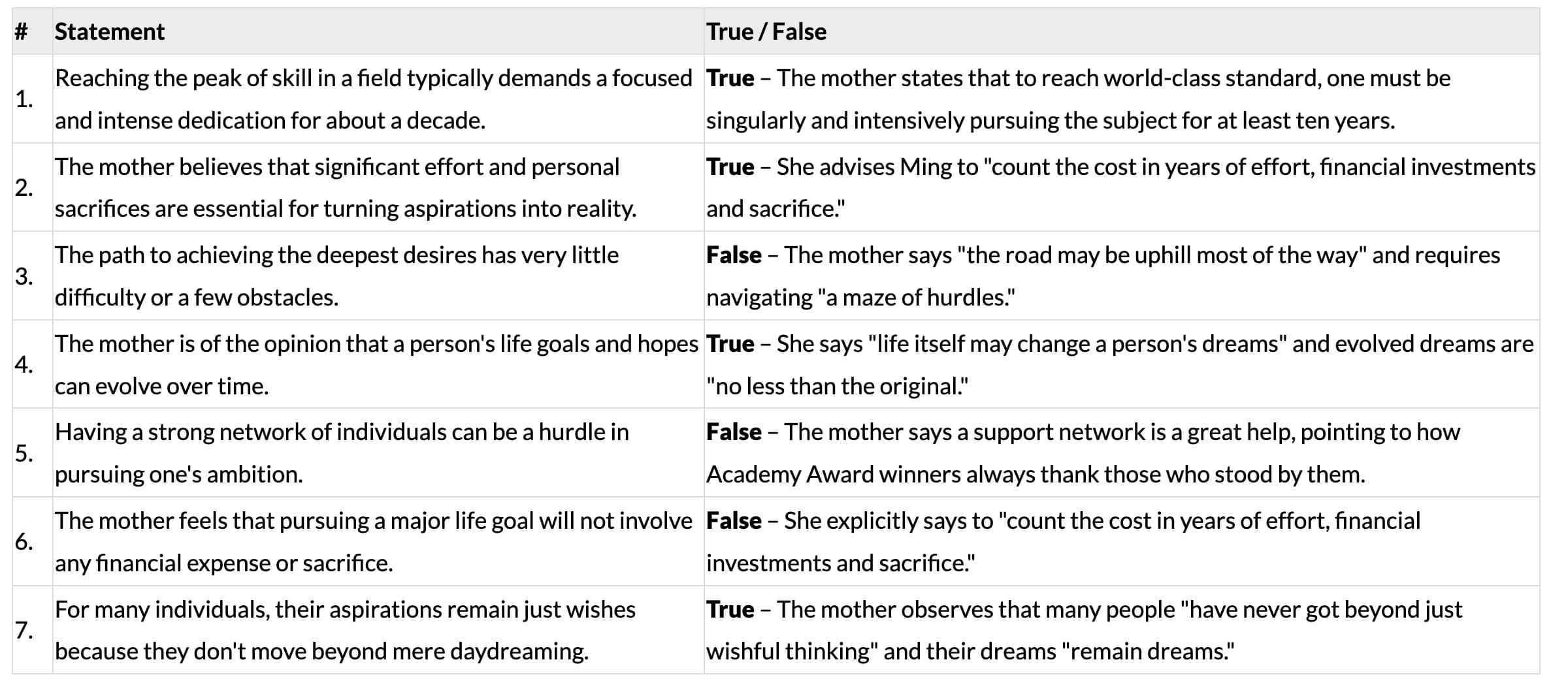
I. State whether the following sentences are true or false.
Critical Reflection
I. Read the extracts given below and answer the questions that follow.Extract 1:
It starts with a passion for a particular interest, then comes the conviction that it is imperative to realise it. Count the cost in years of effort, financial investments and sacrifice. Then if it is still burning in your blood and you are ready to commit yourself to the task, plunge. It could be in any field—sports, science, arts, business, or design. The road may be uphill most of the way and often you are buoyed up only by the knowledge that you are doing what you love best and are doing the right thing. When stamina is running out, the prospect of success will keep you on track.
(i) Complete the analogy with a suitable word from the extract.
enthusiasm : passion :: belief : _____________
Ans: enthusiasm : passion :: belief : conviction — just as enthusiasm and passion are synonyms, belief and conviction both denote a firm, deeply held certainty.
(ii) Choose the correct option to complete the following sentence appropriately.
The author says that a realistic assessment of effort, investment and sacrifice is crucial for preventing _____________.
A. the need for external support network
B. an early abandonment of the dream
C. initial excitement from fading over time
D. others from questioning one’s commitment
Ans: B. an early abandonment of the dream. Counting the cost upfront means a person enters the pursuit with realistic expectations and is not caught off guard by hardships, preventing early abandonment.
(iii) Complete the following with the correct option from those given in brackets.
The word ‘plunge’ as used in the extract indicates a _____________ (complete/gradual) involvement in a task.
Ans: complete — “plunge” means to throw oneself fully and immediately into something, suggesting total, wholehearted commitment rather than a slow, tentative approach.
(iv) Complete the sentence with an appropriate reason.
The author’s emphasis on ‘when you are doing what you love best and are doing the right thing’ works as a form of intrinsic motivation because _____________.
Ans: …because it comes from within the person rather than from external rewards. The sense of personal fulfilment and alignment with one’s own values sustains effort far more powerfully than external incentives, especially during long periods of difficulty when stamina is low.
(v) Mention one motivating factor besides ‘prospect of success’, that might keep a person on track, despite running out of stamina.
Ans: The support and encouragement of loved ones — knowing that family, mentors, or friends believe in you and have invested in your journey can renew resolve even when personal stamina is exhausted. Another factor could be reconnecting with the original passion — remembering why you started.
Extract 2:
From my own experience, life itself may change a person’s dreams. These hopes and aspirations are no less than the original dream of younger days. To fulfil them you will need to negotiate a path through a maze of hurdles. The dream will take a much longer time to realise, and the people who are participants in your dreamscape would be many more.
(i) Complete the sentence appropriately.
The phrase ‘life itself may change a person’s dreams’ suggests that dreams are not static but rather__________. (evolving/dynamic)
Ans: evolving — dreams gradually and naturally change shaped by life’s experiences, responsibilities, and circumstances, as the mother describes with her own dream of publishing a book.
(ii) What does the author mean by, ‘hopes and aspirations are no less than the original dream of younger days’?
Ans: When life causes an original dream to change, the new aspirations are not inferior in value — they carry the same emotional weight, require the same commitment, and are equally worthy of pursuit. A changed dream is not a failed dream; it has simply grown and adapted along with the person.
(iii) Identify the phrase from the extract that indicates a complex and challenging journey.
Ans: “negotiate a path through a maze of hurdles” — a maze is a complex, confusing network of paths where one can easily get lost. Combined with “hurdles” — obstacles to overcome — the phrase vividly captures a journey requiring constant navigation, problem-solving, and persistence.
(iv) Complete the sentence with an appropriate reason.
The author says, ‘people who are participants in your dreamscape would be many more’ because _________________.
Ans: …because as time passes and the dream evolves, the journey becomes longer and more complex, requiring greater support from more people — teachers, mentors, colleagues, and family — at different stages. A larger dreamscape naturally has more participants.
(v) What is the tone of the author in this extract?
A. appreciative and celebratory
B. excited and cheerful
C. optimistic and encouraging
D. eager and inquisitive
Ans: C. optimistic and encouraging. The mother acknowledges challenges realistically but consistently frames them hopefully — evolved dreams are “no less than the original,” and she ends by wishing Ming’s dream comes true. The tone is one of hope, support, and belief in Ming’s ability to succeed.
II. Answer the following questions.
1. The letter begins thus, ‘By all means follow that dream’. What do you think Ming must have written to her mother about?
Ans: Ming most likely wrote about a particular dream or ambition — perhaps an unconventional career path — sharing her excitement but also uncertainty about its practicality, seeking her mother’s approval or advice before committing. The mother’s enthusiastic endorsement combined with balanced guidance suggests Ming expressed both passion and hesitation about her aspiration.
2. How can one attain an international level of skill in any field? Mention any two ways.
Ans:
- Singularly and intensively pursuing the subject for at least ten years — deep, consistent, long-term dedication with great focus on the chosen field.
- Starting with passion and backing it with conviction — a burning love for the subject combined with the firm belief that one must realise one’s potential in it, sustaining the years of effort and sacrifice required.
3. What differentiates the mere dreamers from actual achievers?
Ans:
- Action vs. wishful thinking: Mere dreamers say “I wish I could” but never move beyond that. Achievers translate desires into concrete plans and actions.
- Effort and sacrifice: Achievers count the cost — in years, money, and sacrifice — and willingly pay it. Dreamers are unwilling to make this investment.
- Commitment: Achievers “plunge” fully into the task. Dreamers remain on the edge, never diving in.
- Perseverance: Achievers are sustained by the prospect of success and love of the work when stamina runs out. Dreamers give up when the going gets hard.
4. How does Ming’s mother use critical questions and personal anecdotes to persuade Ming and convey her message effectively?
Ans:
Critical questions: She poses a thought-provoking question — “Do you know that to reach world-class standard in any field, one has to be singularly and intensively pursuing the subject for at least ten years?” — more powerful than a direct statement because it invites Ming to arrive at the conclusion herself.
Personal anecdotes: She shares examples of people whose dreams were shattered by the Japanese invasion, siblings who gave up school to support family, and most personally, her own dream of publishing a book that took ten years and differed from her original aspiration. These ground her advice in lived reality, creating emotional connection and lending authenticity to her counsel.
5. How does Ming’s mother balance encouragement with caution in her advice?
Ans:
Encouragement: She opens with “By all means follow that dream,” reminds Ming that great people “pursue their dream till it comes true,” explicitly says she will not “put a wet blanket on your dreams,” and closes by sharing her own excitement about her evolving dream.
Caution: She is honest about the costs — years of intensive work, financial sacrifice, and personal dedication. She gives real examples of dreams permanently derailed by circumstances and asks Ming to “count the cost” before committing.
This balance treats Ming as an intelligent adult capable of making an informed, passionate, and realistic decision.
6. In the letter, Ming’s mother specifically addresses the challenges people face in pursuing their dreams. Do you think this advice is still relevant in contemporary society? If yes, why? If no, why not?
Ans: Yes, this advice is absolutely relevant today:
- The ten-year rule still applies — world-class expertise in any field still requires years of focused dedication. Social media creates the illusion of overnight success, but sustained effort remains essential.
- Wishful thinking is still common — in today’s age of instant gratification, many young people dream big but are unwilling to invest sustained effort.
- Circumstances still derail dreams — financial constraints, family obligations, economic uncertainty, and social pressures still prevent people from pursuing ambitions.
- Support networks remain essential — mentors and communities are still vital to success.
- Dreams still evolve — the reassurance that evolved dreams are equally valid is as comforting today as it was in 1995.
7. What ‘costs’ in terms of effort, sacrifice, and time are you willing or unwilling to invest to pursue your goals?
Ans (Sample):
Willing: Daily study and practice; forgoing short-term entertainment; facing failure without giving up; seeking and learning from criticism.
Difficult to accept: Sacrificing time with family and friends during intense preparation; financial burden on family for quality education.
However, as the mother says, if the conviction is still burning after considering all these costs, one must go ahead and pursue the dream.
Vocabulary and Structures in Context

I. Find the meanings of the ‘-scape’ compound words and fill in the blanks in the dialogue.
1. Fill in the blanks in the dialogue between Sneha and Kiran.
Ans:
Sneha: Your Goa pictures were beautiful! That (i) seascape was dreamy.
Kiran: Thanks! It was way better than our usual (ii) cityscape, so peaceful.
Sneha: I get that. But sometimes the city lights have their own charm.
Kiran: True, but I’m craving a quiet (iii) landscape. Forests, hills — something real.
Sneha: Yes, nature clears the (iv) mindscape, doesn’t it?
II. Read each sentence carefully and choose the best meaning for the underlined expression. Then, use that expression in a sentence of your own.
1. She had a dream that seemed to burn in her blood, and she wasn’t going to give up on it easily.
(i) make her angry (ii) have a passionate desire (iii) cause physical pain (iv) become violent
Ans: (ii) have a passionate desire. Own sentence: The desire to serve the nation has always burned in his blood, ever since he watched soldiers march past his school as a child.
2. Preparing for the final exam without proper notes felt like an uphill task.
(i) a tough challenge (ii) a slow progress (iii) a hard routine (iv) a difficult choice
Ans: (i) a tough challenge. Own sentence: Convincing the entire committee to approve the new policy proved to be an uphill task, but she persisted and eventually succeeded.
3. The team was buoyed up by their recent victory and felt confident about the next game.
(i) energised by success (ii) encouraged by the result (iii) motivated to improve (iv) lifted in spirit
Ans: (iv) lifted in spirit. Own sentence: The standing ovation buoyed her up, giving her the confidence to pursue her dream of becoming a professional dancer.
4. He thought he could ace the exam without studying, but that was just wishful thinking.
(i) a clever shortcut but no real effort (ii) a confident guess lacking knowledge (iii) a hopeful belief but unlikely to be true (iv) a strong desire based on facts
Ans: (iii) a hopeful belief but unlikely to be true. Own sentence: Thinking that years of training can be replaced by talent alone is just wishful thinking — consistent practice is irreplaceable.
5. Don’t be a wet blanket — we’re trying to have fun!
(i) spoil-sport (ii) latecomer (iii) rule-breaker (iv) daydreamer
Ans: (i) spoil-sport. Own sentence: She was so excited about the science fair project, but her partner’s constant doubts made him a real wet blanket.
6. Excitement was coursing through her veins as she stepped onto the stage for the first time.
(i) hiding deep inside (ii) flowing through her body (iii) lingering in her thoughts (iv) causing numbness
Ans: (ii) flowing through her body. Own sentence: When the results were announced and he heard his name, joy was coursing through his veins as he rushed to collect the award.
III. First Conditional with Imperative – Complete the sentences using your own words (imperatives).
Ans:
- If the idea excites you, pursue it with all your heart and start planning today.
- If you hear strange noises, stay calm, switch on the lights, and alert an adult immediately.
- If this seems too hard, break it into smaller steps and take it one day at a time.
- If you care about the issue, speak up, take action, and inspire others to do the same.
- If you finish early, use the extra time to revise, help a classmate, or explore something new.
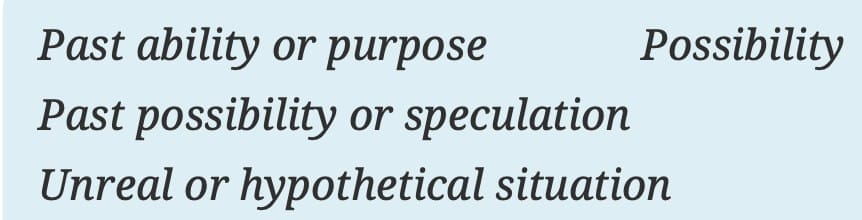
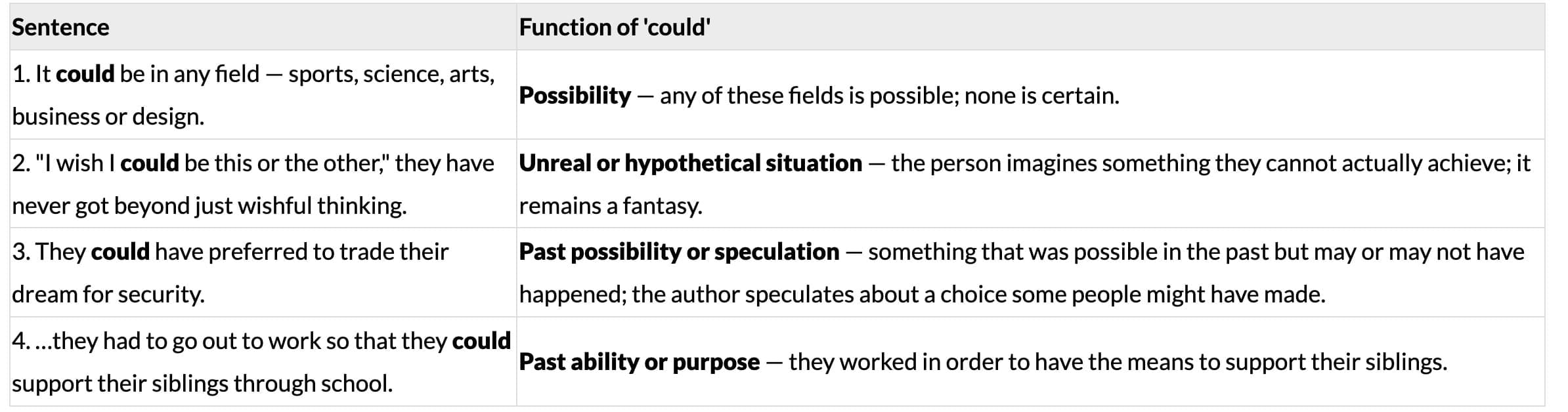
IV. Analyse the usage of ‘could’ and match the sentences with their functions.
V. Complete the following sentences using ‘could’ with the functions mentioned within brackets.
- I wish __________ without worrying about money. (unreal or hypothetical)
- They __________ the shorter route, but they didn’t know about it. (past possibility or speculative)
- When I was younger, I __________ without stopping. (past ability)
- She __________ the library right now—she had mentioned it. (possibility)
- __________ repeat the question? I didn’t hear it clearly. (formal/polite request)
Ans:
- I wish I could travel the world without worrying about money.
- They could have taken the shorter route, but they didn’t know about it.
- When I was younger, I could run for hours without stopping.
- She could be at the library right now — she had mentioned it.
- Could you repeat the question? I didn’t hear it clearly.
VI. Fill in the blanks with suitable grammatical forms of the words given in brackets.
Ans: Experiential learning is an approach to education that focuses on learning through experience, action and reflection. It 1. helps (help) students gain practical knowledge and develop real-world skills. Traditionally, students 2. learned / learnt (learn) by listening to lectures and memorising facts, but experiential learning has changed this process.
In an experiential setting, students 3. work (work) on projects, solve problems, and take part in activities that reflect real-life challenges. They 4. apply (apply) what they have learned in class to new and unfamiliar situations. For example, a student studying science 5. conducts (conduct) experiments to test a theory, while a business student 6. analyses (analyse) a case study to understand market trends.
Reflection is key to this process. After completing a task, learners 7. must reflect (must/reflect) on what went well and what could be improved. This reflection 8. helps (help) them build a deeper understanding of the topic.
Educators believe that experiential learning 9. is (be) more effective than passive learning methods because it is engaging and meaningful. In the future, more schools and universities 10. will incorporate (incorporate) experiential learning into their curriculum to prepare students for the real world.
Speaking Activity
I. Work in groups of four. Each member takes one role. Use the sentence prompts to present your role play. (Sample: Dream — becoming a trekking guide)
Role 1 — The Dreamer (wants to be a trekking guide)
Dreamer: “I know this might sound challenging, but I have always felt most alive in the mountains. Ever since I was a child, I’ve dreamed of guiding people through nature, helping them discover what I discovered — that the wilderness teaches you things no classroom can. I understand it’s not a usual path, but I believe there is a growing demand for certified trekking guides and eco-tourism professionals. It’s an uphill journey — quite literally — but I’m ready for it because I have been training for two years, I know the terrain, and I love every aspect of it.”
Role 2 — A Parent (worried about financial stability)
Parent: “I know you’re passionate, but I worry about your financial future. I only want what’s best for you, and I’m not sure trekking can give you a stable income. You can always pursue your dream later — perhaps after completing a degree that gives you something to fall back on. What if it doesn’t work out? What will you do then? The mountains will still be there after your education.”
Role 3 — A Mentor or Teacher (offers balanced advice)
Mentor: “Remember, dreams need planning. Let’s look at the long-term view — eco-tourism and adventure sports are genuinely growing fields in India. There are ways to combine your dream and a stable livelihood: you could pursue a certification in adventure tourism, which many reputed institutes offer. Are you ready to make that commitment and build your skills systematically? Because if yes, I think this dream has real potential.”
Role 4 — A Friend / Sibling (supportive voice)
Friend: “You’ve always been good at navigation, first aid, and connecting with people — don’t give up now. I don’t want to be a wet blanket, but what’s your backup plan if things are slow initially? If anyone can do this, it’s you, so maybe start by doing weekend treks and building a reputation and client base while you’re still studying. If this dream makes you happy and you’re working seriously toward it, then it’s worth every effort.”
Writing Task
I. Write an email to the Director of a reputed design institute enquiring about a summer workshop and expressing your interest in joining it.
From: priya.sharma.student@gmail.com
To: director@designinstitute.edu.in
Cc: admissions@designinstitute.edu.in
Bcc: (left blank)
Date: 18 March 2026
Subject: Enquiry Regarding Summer Workshop on Designing – Expression of Interest
Message:
Respected Director,
I am writing to you with great interest regarding the Summer Workshop on Designing that I came across on your institute’s official website. I am Priya Sharma, a student of Class IX at Government Senior Secondary School, Sector 21, Chandigarh. I have a deep passion for visual design and creative arts, and I aspire to pursue a professional course in designing in the future.
I would be grateful if you could provide me with the following details about the workshop:
1. The exact dates and duration of the summer workshop.
2. The topics and modules that will be covered during the programme.
3. The eligibility criteria and any prerequisites for participation.
4. The registration process, fees, and payment details.
5. Whether any certificate or portfolio guidance will be provided upon completion.
I am sincerely interested in joining this workshop as it aligns perfectly with my academic interests and future career goals. I believe the opportunity to learn from experienced professionals at your esteemed institute would be an invaluable experience for me.
I would appreciate an early response at your earliest convenience. Please feel free to reach me at the contact details provided below.
Thanking you in anticipation of your kind reply.
Yours sincerely,
Priya Sharma
Student, Class IX
Government Senior Secondary School, Sector 21, Chandigarh – 160022
Mobile: 98XXXXXXXX
Email: priya.sharma.student@gmail.com