Reflect and Respond
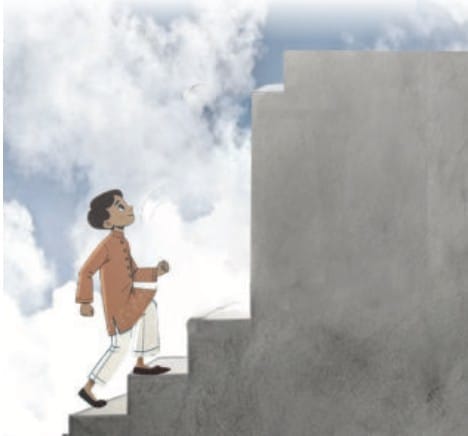
I. Imagine that you are the person in the image (standing at the base of a difficult task).
1. What emotions do you feel standing at the base of a difficult task?
Ans (Sample): A complex mix of excitement and possibility on one hand, and nervousness and self-doubt on the other — a sense of awe at the size of the challenge, mixed with a quiet fear of failure, and a flutter of anticipation.
2. What might make you take the first step?
Ans (Sample):
- A deep belief that the effort is worth it.
- The memory of someone who believed in me.
- The thought of regret if I never try — regret is often more painful than failure.
- Reminding myself that every great journey started with a single step.
II. Think about a time when you had to face a challenge.
1. What was it, and how did you feel at the start of the journey?
Ans (Sample): Delivering a speech at the annual day function. At the start, I felt terrified — trembling hands, dry mouth, convinced I would forget my lines.
2. How did you feel once you made the decision to move forward?
Ans (Sample): Once I decided to go ahead, something shifted — I had practised for weeks and backing down meant giving fear the victory. By the end, I felt a rush of pride and confidence I had never experienced before.
III. What does the phrase ‘believe in yourself’ mean to you? Write some words or phrases you associate with believing in yourself.
Ans: Trusting your own abilities, accepting imperfections, and having the courage to try even when the outcome is uncertain.
Associated words: Inner strength, self-trust, courage, resilience, confidence, “I can do this,” positive self-talk, growth mindset, perseverance, rising after failure.
IV. Select the correct meaning of ‘status quo’ based on the given sentence.
“Even though some kids wanted to try new activities, most of them were happy with the status quo and didn’t want any changes.”
1. A plan to make things more exciting.
2. A situation to keep things the same.
3. A decision where everything is completely different.
4. A choice to change things quickly without thinking.
Ans: 2. A situation to keep things the same. ‘Status quo’ is a Latin phrase meaning ‘the existing state of affairs’ — the children were comfortable with how things were and did not want anything to change.
Check Your Understanding
I. Based on your understanding of the poem, select the correct central idea for each stanza.
Stanza 1 — “Step up to the challenge / There is no crowd to see…”
(i) Facing challenges requires personal responsibility and a clear focus on one’s future.
(ii) Facing challenges is a journey best taken with support and guidance from others.
Ans: (i). The stanza emphasises that facing a challenge is a personal, solitary act — “There is no crowd to see, it’s just you and the future.” The responsibility lies entirely with the individual.
Stanza 2 — “Will it pull you forward / Or push you back in fear?…”
(i) Fear and uncertainty make it difficult to make choices as the future approaches.
(ii) Facing the future with confidence makes choices easier and more straightforward.
Ans: (i). The poet presents two opposing forces — the pull of the future and the push of fear — acknowledging the internal conflict one faces when at a crossroads.
Stanza 3 — “There is such ease in comfort / To maintain the status quo…”
(i) Personal growth involves finding balance between comfort and change.
(ii) Personal growth requires leaving behind comfort and embracing change.
Ans: (ii). The poet is clear: “This isn’t what we are made for / This isn’t how we grow.” Comfort and status quo are easy but insufficient — true growth demands stepping out of familiarity.
Stanza 4 — “The first step is the hardest / There is no turning back…”
(i) The first step towards change may feel easy if you place your trust in others to guide you.
(ii) The first step towards change is difficult, but having self-belief and confidence helps you stay on track.
Ans: (ii). The poem ends with the first step being hardest, but once taken there is no going back — and the key is self-belief: “You just need to believe in yourself / For your future to be on track.”
II. Rhyme Scheme — Fill in the blank to complete the following sentence.
The poem follows a simple, yet effective rhyme scheme __________ that flows steadily through each stanza.
Ans: ABCB — in each stanza, the second and fourth lines rhyme (e.g., “see” and “be” in Stanza 1), giving the poem its smooth, steady musical quality.
III. Tone — State whether the following statements are true or false.
Ans:
1. The overall tone of the poem is motivational and encouraging. → TRUE — The speaker consistently urges the reader to face challenges, step out of comfort zones, and believe in themselves.
2. The tone shifts from thoughtful in the beginning to one of determination by the end of the poem. → TRUE — The poem begins with a reflective, questioning tone and by the final stanza shifts decisively to determination, culminating in the confident call to “believe in yourself.”
IV. Speaker — Fill in the blanks with the correct options.
The speaker in this poem is not distant; rather, he/ she comes across as a ________ (stranger/guide) who understands the struggle and is encouraging the reader to take ________ (interest in/control of) his/her own future.
The use of direct address ‘You’ creates a close connection, as though the speaker is ________ (talking directly to the reader/addressing the reader from a distance).
Ans: The speaker comes across as a guide who is encouraging the reader to take control of his/her own future. The use of ‘You’ creates a close connection, as though the speaker is talking directly to the reader.
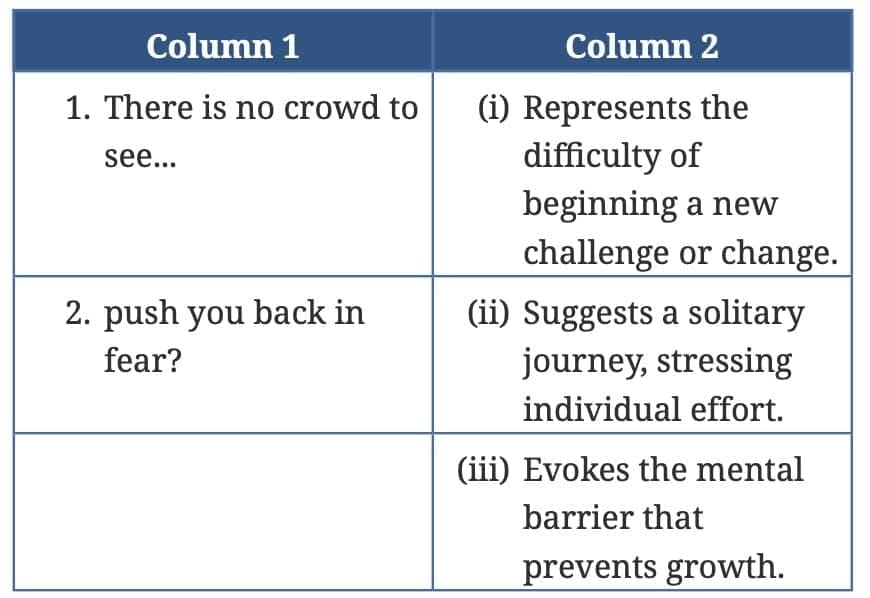

V. Imagery — Match the phrases from the poem in Column 1 with the imagery they represent in Column 2.
VI. Symbolism — Select the words/phrases from the box to complete the given sentences.

Ans:
- Comfort and the status quo represent stagnation and fear of change, symbolising the comfort zone that holds one back.
- The future symbolises the unknown, the potential for change and success that requires courage to step into.
- The first step symbolises the initial leap of faith required to begin the journey of self-improvement or personal development.
VII. Metaphor — The poet uses a metaphor in the line, ‘The first step is the hardest’. Explain why this is metaphorical.
Ans: “The first step is the hardest” does not literally mean that a physical step is more difficult than all those that follow. Instead, “first step” metaphorically represents the act of beginning — making the initial decision to face a challenge or commit to a goal. This beginning is emotionally and psychologically the most challenging part because it requires overcoming inertia, self-doubt, and fear of the unknown. Once the first step is taken, momentum builds and subsequent steps become progressively easier.
VIII. Antithesis — Identify the lines from the poem that show antithesis and explain why.
Ans:
Example 1: “Will it pull you forward / Or push you back in fear?”
Two directly opposite forces — “pull forward” and “push back” — are placed in parallel structure. “Forward” and “back” are directional opposites, capturing the internal conflict between courage and fear, progress and retreat.
Example 2: “There is such ease in comfort / … But this isn’t what we are made for / This isn’t how we grow.”
“Ease in comfort” (passive stagnation) is contrasted with “how we grow” (active transformation). The antithesis highlights that what feels safe is not what makes us better, and what makes us grow is not what feels safe — driving home the poem’s central message.
Critical Reflection
I. Read the extract and answer the questions.
“Step up to the challenge / There is no crowd to see, / It’s just you and the future / And where you want to be.”
(i) What does the line, ‘There is no crowd to see’ suggest about facing challenges?
Ans: It suggests that facing a challenge is a deeply personal and solitary act — without an audience to judge or cheer, the motivation must come from within. It also removes the pressure of performance: free from a watching crowd, we can simply try, fail, learn, and grow.
(ii) Complete the following suitably.
The line ‘It’s just you and the future’ suggests that _________.
Ans: …the responsibility for shaping one’s destiny rests entirely with the individual. No one else can take the journey for you. The future holds both promise and uncertainty, and only your own willingness to step forward determines where you end up.
(iii) Fill in the blank with the appropriate word/phrase from the extract.
Latha will ________ her efforts to improve her vocal performance by practising harder each day.
Ans: Latha will step up her efforts — from the opening line “Step up to the challenge,” meaning to increase effort or rise to meet a demand.
(iv) Select the most suitable title for the extract.
A. The Struggles of Change B. Facing the Future Alone C. A Journey of Growth D. The Power of Fear
Ans: C. A Journey of Growth. The extract emphasises stepping up to a challenge, taking personal ownership of one’s future, and moving toward where one wants to be — all elements of personal growth. “Facing the Future Alone” (B) is overly negative, while the poem’s tone is empowering.
(v) Complete the analogy by using a word from the extract.
achieve : goal :: face : _________
Ans: achieve : goal :: face : challenge — just as one “achieves” a “goal,” one “faces” a “challenge.”
II. Answer the following questions.
1. What is the significance of the metaphor, ‘The first step is the hardest’ in the context of personal growth?
Ans: The metaphor captures the psychological truth that the greatest obstacle to growth is not the journey itself but the beginning. Personal growth requires leaving behind familiarity and stepping into the unknown — overcoming inertia, self-doubt, and fear. Once the first step is taken, a psychological shift occurs: the paralysis dissolves and forward momentum builds. Each subsequent step becomes less daunting because the hardest thing — beginning — has already been done. The metaphor also implies that growth is a series of steps, and the most courageous, defining moment is always the first one.
2. What message does the antithesis in the poem convey about the nature of personal development?
Ans: The antithesis — “pull you forward / push you back in fear” and comfort versus growth — conveys that personal development is inherently a battle between two opposing forces: the desire to grow and the pull of fear and comfort. The message is that these forces are mutually exclusive — you cannot remain in your comfort zone and grow simultaneously. “This isn’t how we grow” is the poet’s firm verdict. Growth requires choosing the difficult path over the easy one, courage over fear. The parallel structure of the antithesis makes this message feel both balanced and urgent.
3. Do you think the poet’s message is realistic in the context of real-world struggles? (Evaluate whether simply ‘believing in yourself’ is enough to overcome obstacles or other factors are also necessary.)
Ans: The poet’s message is inspiring but presents a partial picture. Self-belief is foundational — without it, no effort is truly sustained — but it is not sufficient alone.
- External circumstances matter — socioeconomic barriers, lack of access to education, or systemic inequality can limit opportunities regardless of self-belief.
- Skill and preparation are essential — believing you can do something is not the same as being able to do it. Self-belief must be backed by deliberate practice and willingness to fail and improve.
- A support network helps — even great achievers have mentors, family, and peers who contribute to their success.
Conclusion: Self-belief is the spark that ignites action, but in the real world it must be backed by hard work, the right skills, access to opportunities, and a supportive environment.
4. Consider a situation where you or someone you know had to take a difficult first step towards a goal. How does the poem’s message about the importance of self-belief apply to this situation?
Ans (Sample): A classmate wanted to apply for a national mathematics competition but had never competed outside school. Like the person at the base of a difficult task, she stood at the edge of a new challenge with no guarantee of success. The “ease in comfort” of staying within familiar school competition was tempting. But she took the first step: she applied. That was the hardest part. She did not win, but she reached the final round — and the experience transformed her confidence and ambitions. Her self-belief that she was capable of stepping up was what made the journey possible.
Vocabulary in Context
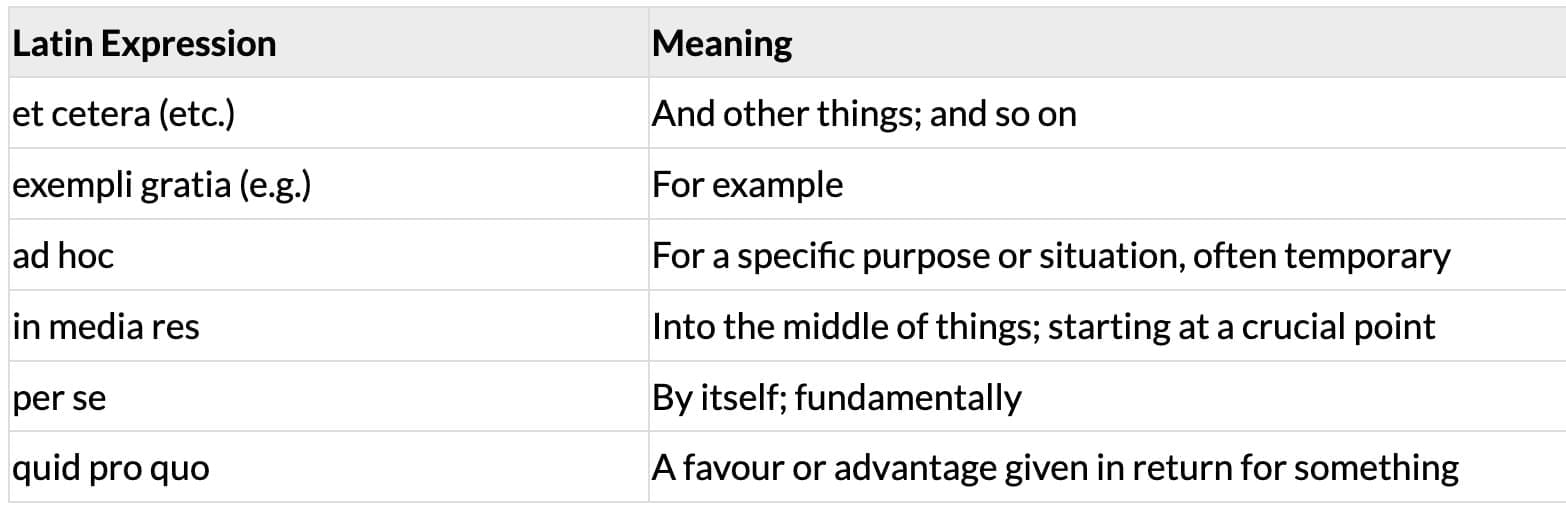
I. Latin Expressions used in English — fill in the blanks in the given sentences.
Ans:
- I enjoy reading fantasy books, e.g. Harry Potter and Magical Paint Brush.
- After helping Tanya with the homework, Ritu asked for a quid pro quo to borrow her notes next time.
- I love all kinds of outdoor activities, such as trekking, hiking, biking, etc.
- The park is not very special per se; it becomes more fun when you visit with friends.
- We created an ad hoc team to organise the school festival.
- The movie started in media res, with the hero already fighting the villain in a huge battle.
II. Rhetorical Questions
1. Read the following rhetorical questions and state what they intend to achieve.
(i) Isn’t it obvious that we must act now? Don’t we all have a responsibility to make a change?
(ii) Will we let fear control us, or will we rise above it?
Ans:
(i) These questions create a sense of urgency and collective moral responsibility. By framing the need for action as “obvious” and responsibility as shared (“we all”), the speaker makes it difficult to disagree — pushing the audience toward action without giving a logical basis to refuse.
(ii) This question presents a binary choice — fear or courage — framing courage as the clearly superior option. It involves the audience emotionally, making them feel they must personally decide. It also implies confidence that the audience is capable of rising above fear — simultaneously a challenge and an affirmation.
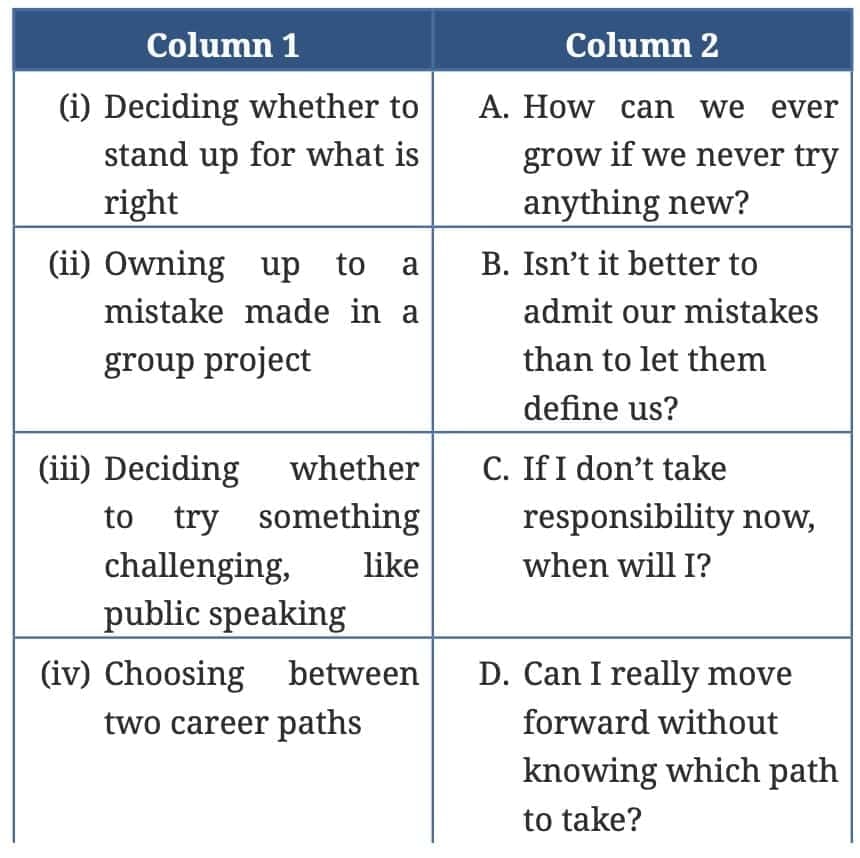
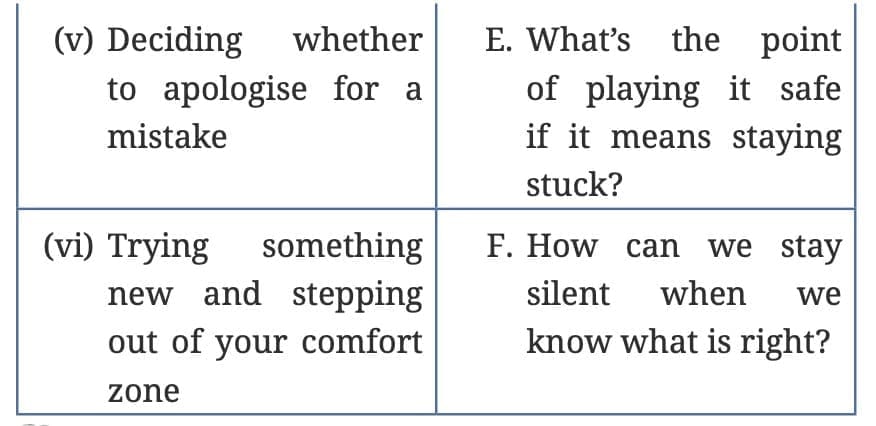
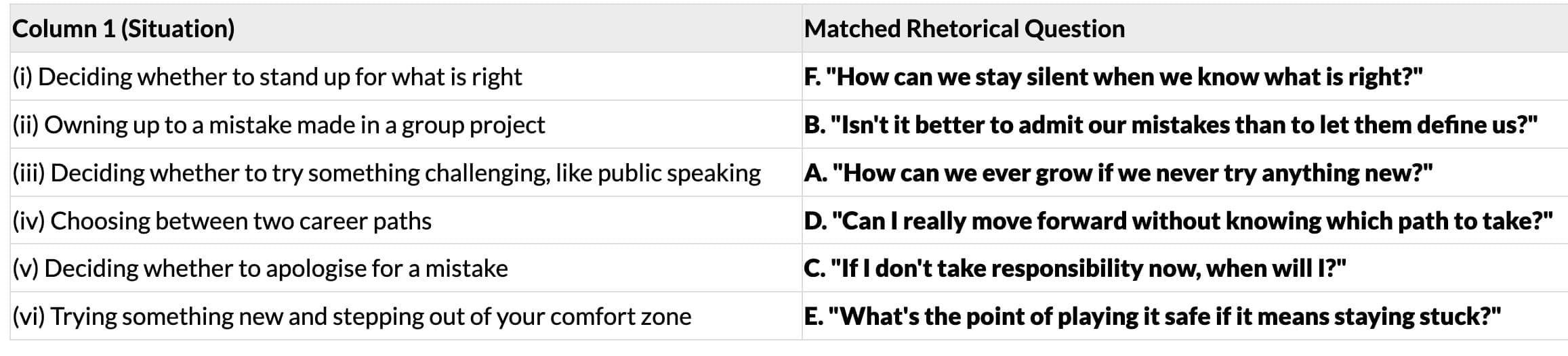
2. Match the situations in Column 1 to the rhetorical questions in Column 2.
Speaking Activity
I. Work in pairs. For each saying/proverb, explain its meaning, describe a situation, and present a role play.
Proverb 1: “Don’t judge a book by its cover.”
Meaning: Do not form an opinion about a person, thing, or situation based only on their outward appearance. What is inside — their character, skills, or true nature — may be very different from what is visible at first.
Situation: A new student joins the class wearing simple, unfashionable clothes and speaking very softly. Some classmates assume she is boring or unintelligent. Later, she turns out to be the most creative student in the class, winning the inter-school art competition.
Sample Role-play Dialogue:
Student A (judgmental): “Did you see the new girl? She barely said a word during introduction. I don’t think she’ll be interesting to talk to.”
Student B (open-minded): “Really? I sat next to her in art class, and her sketchbook is incredible. She’s been painting for five years.”
Student A: “Seriously? I had no idea. I shouldn’t have assumed.”
Student B: “Exactly — don’t judge a book by its cover. The most interesting people are often the quietest ones.”
Conclusion: This proverb teaches us the importance of reserving judgement until we truly get to know a person. First impressions, based on appearance or behaviour, can be very misleading.
Proverb 2: “Actions speak louder than words.”
Meaning: What a person actually does is far more meaningful and trustworthy than what they say they will do. Promises and intentions carry little weight without the follow-through of action.
Situation: Two students both say they want to improve their science grades before the annual exams. One talks about it constantly but continues to play games on his phone. The other quietly revises every evening, takes extra notes, and seeks help from the teacher.
Sample Role-play Dialogue:
Student A (talks, no action): “I’m going to study science every day from now. I’m definitely getting above 90% this time.”
Student B (takes action): “Same here. I’ve already finished two chapters and I’m attending the extra class on Saturdays.”
Student A: “Oh wow, you started already? I’ve been meaning to…”
Student B: “It’s not about meaning to. Actions speak louder than words — you have to actually do it.”
Conclusion: This proverb reminds us that effort and consistency are what truly count. Speaking about improvement without backing it with action is meaningless.
Proverb 3: “When the going gets tough, the tough get going.”
Meaning: When a situation becomes difficult or challenging, strong, resilient people do not give up — they rise to the occasion and push harder.
Situation: Two students are working on a science project with a very tight deadline. Halfway through, their data gets accidentally deleted and they must redo two days of work.
Sample Role-play Dialogue:
Student A (wants to give up): “This is hopeless. We’ve lost everything. I think we should just submit what we have and accept a bad grade.”
Student B (perseveres): “No way. We still have two days. We know exactly what we did — we can redo it even better this time.”
Student A: “But it’ll take all night!”
Student B: “Then we stay all night. When the going gets tough, the tough get going. We didn’t work this hard to quit at the last hurdle.”
[They redo the project and submit on time, earning an excellent grade.]
Conclusion: This proverb teaches that resilience — the ability to keep going when things get difficult — is the quality that separates those who succeed from those who don’t. Challenges are not signals to stop; they are invitations to push harder.
Writing Task
I. Draft a speech on ‘Turning Challenges into Opportunities’ for the morning assembly.
Speech: Turning Challenges into Opportunities
Opening:
Good morning, Respected Principal, teachers, and my dear schoolmates,
I am [Your Name], a student of Class IX. I would like to begin with a thought that has always inspired me: “Challenges are what make life interesting; overcoming them is what makes life meaningful.” Today, I have the honour of speaking to you on the topic — Turning Challenges into Opportunities. I believe this is not merely a topic for a school assembly — it is a life skill, a mindset, and a choice that each one of us must make every single day.
Body — Paragraph 1: The Nature of Challenges
We have all, at some point, stood at the base of something that seemed impossible. A difficult exam, a new school, a public performance, a family difficulty — something that made us want to step back rather than step up. Don’t you agree that fear of failure often stops us before we even begin? Research tells us that most people regret the things they never tried far more than the things they tried and failed at. This is because every challenge, when faced, teaches us something — about the subject, about others, and most importantly, about ourselves. Dr. B. R. Ambedkar faced crippling discrimination and poverty, yet he chose to see every obstacle as a reason to study harder, argue more powerfully, and fight more fiercely for justice. His challenges became the foundation of his greatness — isn’t that remarkable?
Body — Paragraph 2: How Challenges Become Opportunities
In addition to building character, challenges open doors we never expected. When Dr. A. P. J. Abdul Kalam’s family could not fully support his education, he took up a job delivering newspapers before school. That “challenge” gave him discipline, a sense of independence, and the understanding of hard work that would define his entire career as a scientist and statesman. Consequently, what looked like a setback became a launchpad. For instance, many of India’s greatest innovators and entrepreneurs began their journeys in the face of rejection, failure, and resource constraints. They did not wait for perfect conditions — they worked with what they had. Finally, it is this willingness to keep moving forward, to “step up to the challenge,” as the poet Robert Langley says, that turns difficulty into opportunity.
Conclusion:
In conclusion, my dear friends, challenges are not roadblocks — they are stepping stones. They build the skills, determination, and confidence that are essential for success. The next time you face something difficult, I want you to remember that you are not alone in your fear — every person who has ever achieved something great has stood exactly where you are standing. The only difference is that they chose to take the first step anyway. As the poem we studied says, “You just need to believe in yourself / For your future to be on track.” Believe in yourself, step forward with courage, and watch how your greatest challenges transform into your greatest opportunities. Thank you.