Short Answer Type Questions
Ques 1: Define displacement. How is displacement different from the total distance travelled?
Ans: Displacement is the net change in the position of an object between two given instants of time. Its magnitude is the distance between the object’s positions at the two instants, and its direction is specified from the position at the first instant towards the position at the second instant. The SI unit of displacement is the metre (m).
Distance travelled is the total length of the path covered by an object during its motion, while displacement only measures the straight-line change in position from start to end. For example, if an athlete runs 100 m forward and then 60 m back, the total distance travelled is 160 m but the displacement is only 40 m in the forward direction. Displacement requires both magnitude and direction (it is a vector), whereas total distance only requires a numerical value (it is a scalar).
Ques 2: What is average speed? Write its formula and state its SI unit.
Ans: The average speed of an object is the total distance travelled divided by the time interval during which this distance is covered. It tells us how fast or slow an object is moving. Since distance has no direction, average speed is also a scalar quantity – it has no direction, only a numerical value. The formula for average speed is:
The SI unit of average speed is metre per second ( or m/s).
It is also commonly measured in kilometre per hour ().An object moving with uniform speed covers equal distances in equal intervals of time. If the distances covered in successive equal intervals are unequal, the object is moving with non-uniform (changing) speed.
Ques 3: Define average velocity. Under what condition is the magnitude of average velocity equal to average speed?
Ans: The average velocity of an object in a time interval is the change in its position (or displacement) divided by the time interval in which the change in position occurs. If displacement is represented by and time interval by , then:
The direction of velocity is the same as the direction of displacement and is indicated by a ‘+’ or ‘-‘ sign. The SI unit of average velocity is .
The magnitude of average velocity is equal to average speed when the object moves in one direction only (without turning back), because in that case the total distance travelled and the magnitude of displacement are equal.
Ques 4: What is average acceleration? Write its formula and SI unit. What does a negative sign in acceleration indicate?
Ans: The average acceleration of an object over a time interval is the change in its velocity divided by the time interval. If the initial velocity is at time and final velocity is at time , the average acceleration is:
The SI unit of average acceleration is or .
A negative sign in acceleration indicates that the acceleration is acting in the direction opposite to the direction of velocity, i.e., the object is slowing down (decelerating). For example, when brakes are applied to a moving vehicle, the velocity decreases and acceleration is negative (opposite to the direction of motion).
Ques 5: Distinguish between uniform motion and non-uniform motion in a straight line.
Ans: If an object moving in a straight line travels equal distances in equal intervals of time (for all possible choices of time intervals), it is said to be in uniform motion in a straight line. In this case, the object moves at a constant speed and the acceleration is zero.
On the other hand, if an object travels unequal distances in equal intervals of time, it is said to be in non-uniform motion in a straight line. In this case, the object moves with increasing or decreasing speed, or a combination of both, meaning the object has a non-zero acceleration. If the distances travelled in successive equal intervals of time are increasing, its speed is increasing, and vice versa.
Ques 6: What information can be obtained from a position-time graph? What does the slope of a position-time graph represent?
Ans: From a position-time graph, the following information can be obtained:
(a) The position of an object at any instant of time can be directly read from the graph.
(b) The nature of motion can be identified – a straight-line graph indicates constant velocity (uniform motion), while a curved graph indicates changing velocity (accelerated motion). (c) A straight line parallel to the time axis represents a stationary object.
The slope of the straight line on a position-time graph gives the magnitude of the average velocity of the object. Geometrically, the slope is the ratio of the change in position to the change in time:
A steeper slope indicates a higher velocity. The slope of the velocity-time graph gives the acceleration of the object.
Ques 7: What are scalars and vectors? Classify the following as scalar or vector: distance, displacement, speed, velocity, acceleration.
Ans: Physical quantities which can be specified by just their numerical value (with units) are called scalars. Physical quantities which require specifying both their direction and magnitude (numerical value with units) are called vectors.
The numerical value (with units) of a physical quantity is called its magnitude. For example, the magnitude of displacement is the distance between the object’s positions at two instants of time.
Classification:
(a) Distance – Scalar (only numerical value required, no direction)
(b) Displacement – Vector (both magnitude and direction are required)
(c) Speed – Scalar (calculated from distance, has no direction)
(d) Velocity – Vector (direction is the same as the direction of displacement)
(e) Acceleration – Vector (direction is the same as the direction of change in velocity)
Ques 8: State the three kinematic equations for motion in a straight line with constant acceleration and identify the symbols used.
Ans: For the motion of an object in a straight line with constant acceleration, the five physical quantities – displacement , time interval , initial velocity , final velocity and acceleration – can be related by the following kinematic equations:
Where: = initial velocity, = final velocity, = acceleration (constant), = time interval, = displacement. These equations are valid only when the acceleration is constant throughout the motion.
Ques 9: What is uniform circular motion? Why is an object in uniform circular motion considered to be accelerated even though its speed is constant?
Ans: When an object moves in a circular path with constant (uniform) speed, its motion is called uniform circular motion. Examples include the motion of the tip of a clock hand, a satellite in a circular orbit, and a child on a merry-go-round.
Even though the speed of the object is constant in uniform circular motion, the object is still considered to be accelerated. This is because acceleration depends not only on the change in the magnitude of velocity but also on the change in its direction. In uniform circular motion, the direction of velocity continuously changes at every point on the circular path, even though the magnitude (speed) remains the same. Since the velocity is changing (in direction), the object is accelerated. This acceleration results from the continuous change in direction of motion.
Ques 10: What is the average speed of an object in uniform circular motion? Write the formula and explain the terms.
Ans: In uniform circular motion, if an object takes time to complete one revolution along a circular path of radius , the distance covered in one revolution is equal to the circumference of the circle, which is . The displacement, however, is zero since the object returns to its original position.
Using the formula for average speed:
Where is the average speed, is the radius of the circular path, and is the time taken to complete one revolution (time period). The average velocity during one complete revolution is zero, since the displacement is zero.
Ques 11: What is a reference point? When is an object said to be in motion and when is it said to be at rest?
Ans: To describe the position of an object, we first need to specify a fixed point called the reference point (also called the origin). The distance and direction of the object with respect to the reference point, at any instant of time, describes the position of the object at that instant.
An object is said to be in motion if its position with respect to the reference point changes with time. On the other hand, an object is said to be at rest if its position with respect to the reference point does not change with time.
For motion in a straight line, the object can move only in one of two directions – forward and backward. The direction is represented by plus (+) and minus (-) signs, with positions to the right of the reference point generally taken as positive and positions to the left as negative. It is important to note that whether an object is in motion or at rest depends on the choice of reference point – the same object can appear to be moving with respect to one reference point and at rest with respect to another.
Ques 12: A ball is thrown vertically upward from point O, goes up to point B and falls back to O. State whether the total distance travelled and the magnitude of displacement are equal or different. Give reasons.
Ans: The total distance travelled and the magnitude of displacement are different in this case. When the ball is thrown upward from O to B and then returns to O, it travels the path OB going up and BO coming down. So the total distance travelled is . However, the displacement, which is the net change in position from the starting point O to the final point O, is zero, since the ball returns to its original position.
This shows that the magnitude of displacement is less than the total distance travelled. In general, for straight-line motion, the magnitude of displacement is less than or equal to the total distance travelled. They are equal only when the object moves in one direction without turning back.
Long Answer Type Questions
Ques 1: Derive the three kinematic equations for motion in a straight line with constant acceleration using the velocity-time graph.
Ans: Consider an object moving in a straight line with constant acceleration . Let be the initial velocity at s and be the final velocity at time . The velocity-time graph for this motion is a straight line (Fig. ).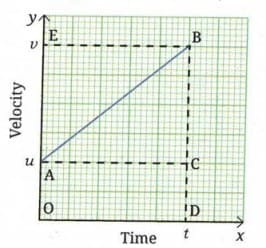 Velocity-time graph where the initial velocity of object is not zero(i) First equation – :
Using the definition of average acceleration:
Rearranging:
(ii) Second equation – :
The displacement is equal to the area enclosed by the velocity-time graph and the time axis (area of trapezium OABD, which equals area of rectangle OACD + area of triangle ABC):
Substituting , and :
(iii) Third equation – :
From equation (4.4a), we get . Substituting this into equation (4.4b):
These three equations are called kinematic equations and provide a complete mathematical description of motion in a straight line with constant acceleration.
Ques 2: What is the rate of change? How is average velocity the rate of change of position? The position-time graphs of two objects A and B moving in the same direction are straight lines. If the line for B is steeper than for A, what can you conclude about their velocities? Explain with a formula.
Ans: The ratio of change in one quantity to the corresponding change in time is called the rate of change. It tells us how fast a physical quantity is changing with time. To calculate average velocity, we find the ratio of change in position to the time taken. Therefore, average velocity is the average rate of change of position of an object with respect to time:
Comparing velocities of objects A and B from a position-time graph:
On a position-time graph, the slope of the line connecting two points gives the average velocity of the object between those two instants. The slope is calculated as:
If the position-time graph line for object B is steeper than for object A, then for the same time interval, the displacement of B is greater than that of A. This means:
Therefore, the object B has a higher magnitude of average velocity than object A. A steeper position-time graph always indicates a higher velocity. This method can be used to compare the velocities of two objects directly from their position-time graphs without calculating each value separately – the object whose graph line makes a larger angle with the time axis is moving faster.Special case – equal velocity:
If the two lines are parallel (same slope), both objects have equal velocities even if they start from different positions. If the lines intersect at a point, both objects have the same position at that instant of time, but their velocities (slopes) may still differ.
Ques 3: Describe the velocity-time graph for three different types of motion. What two physical quantities can be calculated from a velocity-time graph?
Ans: A velocity-time graph represents the change in velocity of a moving object with time. It provides information about the type of motion and can be used to calculate acceleration and displacement.(i) Constant velocity (zero acceleration):
When an object moves with constant velocity, the velocity does not change with time. The velocity-time graph is a straight line parallel to the time axis. The slope of this line is zero, so acceleration is zero. For example, a car moving at a steady 20 m s on a straight highway gives a horizontal velocity-time graph.(ii) Uniformly increasing velocity (constant positive acceleration):
When the velocity increases by equal amounts in equal intervals of time, the velocity-time graph is a straight line inclined upward (positive slope). The slope of this line gives the constant acceleration in the direction of velocity. For example, a car starting from rest and accelerating uniformly shows an upward-sloping straight line.(iii) Uniformly decreasing velocity (constant negative acceleration):
When the velocity decreases by equal amounts in equal time intervals, the velocity-time graph is a straight line inclined downward (negative slope). The acceleration is constant and opposite to the direction of velocity. For example, when brakes are applied to a car moving at 15 m s, the velocity decreases uniformly to zero, giving a downward-sloping straight line.Two quantities calculated from a velocity-time graph:
1. Acceleration: The slope of the straight line on the velocity-time graph gives the acceleration of the object:
2. Displacement: The area enclosed by the velocity-time graph line and the time axis for a given time interval gives the displacement of the object in that interval:
Ques 4: Give five points of difference between distance and displacement, and between speed and velocity.
Ans:
(A) Distance vs. Displacement:
| S.No. | Distance | Displacement |
|---|---|---|
| 1. | It is the total length of the path covered by the object during its motion. | It is the net change in position of an object between two given instants of time. |
| 2. | It is a scalar quantity (only magnitude, no direction). | It is a vector quantity (requires both magnitude and direction). |
| 3. | It can never be negative or zero (unless the object is at rest). | It can be positive, negative or zero. |
| 4. | Distance is always greater than or equal to displacement. | Magnitude of displacement is always less than or equal to total distance. |
| 5. | For a round trip, the total distance is non-zero. | For a complete round trip (returning to starting point), displacement is zero. |
(B) Speed vs. Velocity:
| S.No. | Speed | Velocity |
|---|---|---|
| 1. | Average speed = total distance / time interval. | Average velocity = displacement / time interval. |
| 2. | It is a scalar quantity. | It is a vector quantity. |
| 3. | Speed can never be zero for a moving object. | Average velocity can be zero even when the object is moving (e.g., round trip). |
| 4. | Speed is always positive. | Velocity can be positive or negative depending on direction. |
| 5. | Speed gives no information about direction of motion. | Velocity gives information about both the rate and direction of change of position. |
Ques 5: A car starts from rest and accelerates uniformly to reach a velocity of 20 m s−1 in 5 s. It then moves at this constant velocity for 10 s. Finally, the brakes are applied and the car decelerates uniformly to stop in 4 s. Using kinematic equations, find: (i) the acceleration during the first phase, (ii) the distance covered in the first phase, (iii) the distance covered during constant velocity, and (iv) the distance covered during braking. Also find the total distance travelled.
Ans: The motion has three phases. Let us analyse each phase using the kinematic equations , , and .Phase 1 – Uniform acceleration (0 to 5 s):
Given: m s (starts from rest), m s, s.
(i) Acceleration during Phase 1:
(ii) Distance covered in Phase 1 (using ):
Phase 2 – Constant velocity (5 s to 15 s):
Given: m s, s, .
(iii) Distance covered during constant velocity:
Phase 3 – Uniform deceleration (braking, 4 s):
Given: m s, m s (comes to rest), s.
Acceleration during braking:
(iv) Distance covered during braking (using ):
Total distance travelled:
The total distance travelled by the car is 290 m.
Note: These kinematic equations are valid only when the acceleration is constant in each phase. The sign of acceleration during braking is negative because it acts opposite to the direction of velocity.