Page No. 3
Figure it Out
Q1:Check if the two figures are congruent.

Ans: Although both figures have the same arm lengths, the angle between the arms is different in the two figures. For two figures made from line segments to be congruent, all corresponding sides and angles must be equal. Here, the included angles are not equal. Therefore, the figures cannot coincide exactly by translation, rotation or reflection, and they are not congruent.

Q2: Circle the pairs that appear congruent.
Ans:
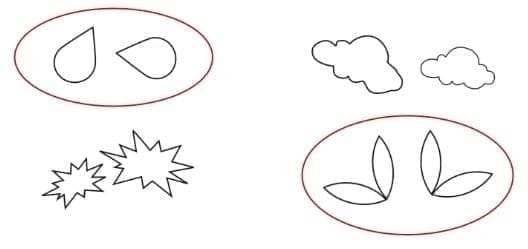
1. Droplet Shapes (Top Left Pair)
These two shapes are congruent because they have exactly the same size and the same outline. One shape is a rotated copy of the other, so the two shapes can be made to overlap perfectly.
2. Leaf Shapes (Right-Side Pair)
The leaf shapes are congruent because they have the same length, curvature and overall dimensions. One leaf can be rotated or translated to overlap exactly with the other.
Why the Other Shapes Are Not Congruent:
- The cloud shapes are of different sizes, so their corresponding points cannot all match. Hence, they are not congruent.
- The starburst shapes differ in size and in the number of spikes. Therefore, their corresponding parts are not identical, and they are not congruent.
Q3: What measurements would you take to create a figure congruent to a given:
(a) Circle
(b) Rectangle
Using this, state how would you check if two –
(a) Circles are congruent?
(b) Rectangles are congruent?
Ans:
(a) To make or check a circle congruent to a given circle, measure its radius or diameter.
(b) To make or check a rectangle congruent to a given rectangle, measure its length and breadth.
(a) Two circles are congruent if they have equal radii or equal diameters. This can also be checked by placing one circle over the other. If they coincide exactly, they are congruent.
(b) Two rectangles are congruent if their corresponding lengths and breadths are equal. Since all angles of rectangles are right angles, equal corresponding sides are sufficient for checking congruence. Superposition will also show exact overlap.
Q4: How would we check if two figures like the one below are congruent?
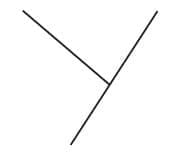
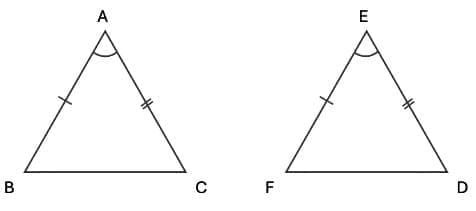
Ans: Measure the lengths of the corresponding line segments and the angle between the two segments that meet. If the corresponding lengths and the included angle are equal, the figures are congruent by the SAS criterion.
Use this to identify whether each of the following pairs are congruent.
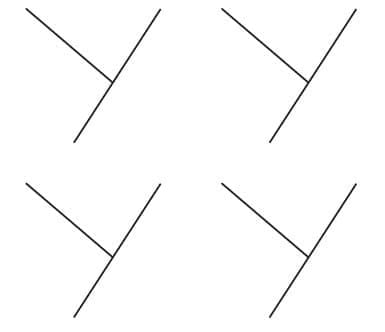
Ans: Yes, each shown pair is congruent. In every pair, the corresponding side lengths are equal, and the included angles are equal. Therefore, the figures can coincide under rigid motions and are congruent.
Page 8
Figure it Out
Q1: Suppose ∆HEN is congruent to ∆BIG. List all the other correct ways of expressing this congruence.
Ans:
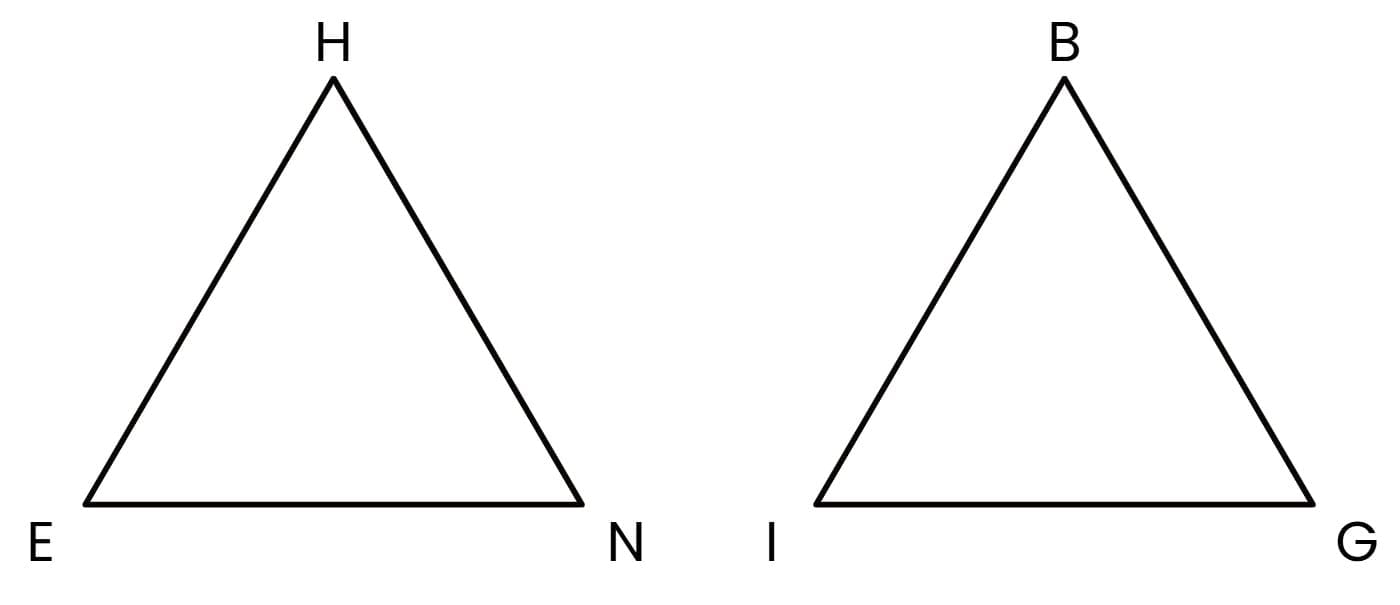
The statement △HEN≅△BIG means that H corresponds to B, E corresponds to I, and N corresponds to G. The six correct orders that preserve this correspondence are:
(i) △HEN≅△BIG
(ii) △HNE≅△BGI
(iii) △EHN≅△IBG
(iv) △ENH≅△IGB
(v) △NHE≅△GBI
(vi) △NEH≅△GIB
Q2: Determine whether the triangles are congruent. If yes, express the congruence.
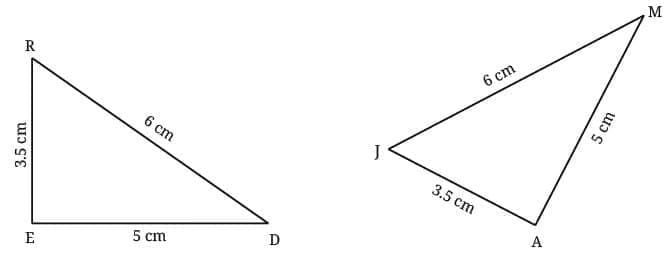
Ans: The side lengths of the two triangles are:
RE=3.5 cm, ED=5 cm, RD=6 cm
JA=3.5 cm, AM=5 cm, JM=6 cm
Thus, RE=JA, ED=AM, and RD=JM. All three corresponding sides are equal. Therefore, the triangles are congruent by the SSS criterion.
Hence, △RED≅△JAM.
Q3: In the figure below, AB = AD, CB = CD. Can you identify any pair of congruent triangles? If yes, explain why they are congruent. Does AC divide ∠BAD and ∠BCD into two equal parts? Give reasons.
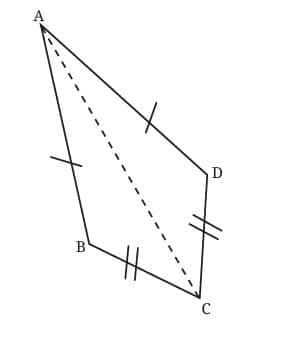
Ans: In △ABC and △ADC, AB=AD and BC=CD are given. Also, AC=AC because it is common to both triangles.
Therefore, △ABC≅△ADC by the SSS criterion.
By corresponding parts of congruent triangles, ∠BAC=∠DAC and ∠BCA=∠DCA. Hence, AC bisects both ∠BAD and ∠BCD.
Q4: In the figure below, are ΔDFE and ΔGED congruent to each other? It is given that DF = DG and FE = GE.
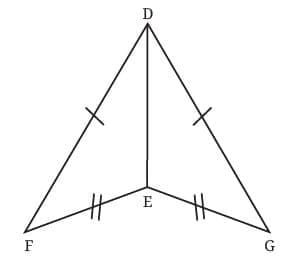
Ans: In △DFE and △DGE, DF=DG and FE=GE are given. Also, DE=DE because it is common to both triangles.
Thus, all three corresponding sides are equal. Therefore, △DFE≅△DGE by the SSS criterion.
The order of the vertices in a congruence statement must preserve the correspondence between the vertices.
Page 10
Measuring Two Sides and a Non-included Angle
What if two sides and a non-included angle are equal?
We are given two triangles △ABC and △XYZ such that:
- AB=XY=6 cm
- AC=XZ=4 cm
- ∠B=∠Y=30∘
The question is: Are these triangles congruent?
The given angle, ∠B in △ABC and ∠Y in △XYZ, is not the angle included between the two given sides.
- In △ABC, the known sides are AB and AC, but the included angle between them is ∠A, not ∠B.
- In △XYZ, the known sides are XY and XZ, but the included angle between them is ∠X, not ∠Y.
Therefore, the given information represents an SSA condition. SSA does not guarantee congruence.
It may produce two different triangles, one triangle, or no triangle. Hence, two sides and a non-included angle being equal does not ensure that the triangles are congruent.
Therefore, △ABC and △XYZ are not necessarily congruent.
Q: Can there exist non-congruent triangles having these measurements? Construct and find out.
Ans: Construct two sides of the given lengths from a common vertex. Then use the given angle at the known vertex to locate the third vertex. Depending on the lengths and the angle, there may be two possible positions for the third vertex, one position, or no position. Thus, two non-congruent triangles can exist in the SSA case.
Page 13
Figure it Out
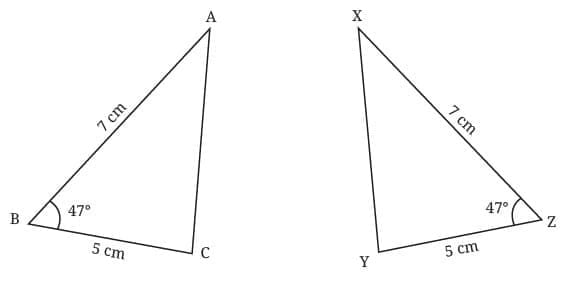
Q1: Identify whether the triangles below are congruent. What conditions did you use to establish their congruence? Express the congruence.
Ans:
BC=ZY=5 cm
BA=ZX=7 cm
∠ABC=∠XZY=47∘
Two corresponding sides and the included angle are equal. Therefore, the triangles satisfy the SAS condition.
Hence, △ABC≅△XZY.
Q2: Given that CD and AB are parallel, and AB = CD, what are the other equal parts in this figure? (Hint: When the lines are parallel, the alternate angles are equal. Are the two resulting triangles congruent? If so, express the congruence.)
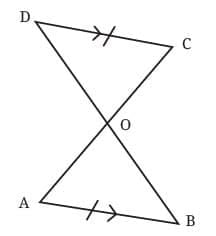
Ans: Since AB∥CD, the transversal lines AC and BD form equal alternate interior angles.
∠OAB=∠OCD and ∠OBA=∠ODC.
Also, AB=CD is given.
Therefore, △OAB and △OCD have two equal angles and the corresponding included side equal. Hence, they are congruent by the ASA criterion:
△OAB≅△OCD
Therefore, corresponding parts are equal:
OA=OC, OB=OD, and ∠AOB=∠COD.
Q3: Given that ∠ABC = ∠DBC and ∠ACB = ∠DCB, show that ∠BAC = ∠BDC. Are the two triangles congruent?
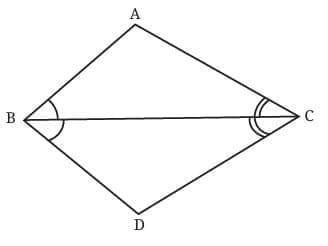
Ans: In △ABC and △DBC, ∠ABC=∠DBC and ∠ACB=∠DCB are given. Also, BC=BC because it is common to both triangles.
Thus, the triangles have two equal angles and the included side equal. Therefore, △ABC≅△DBC by the ASA criterion.
By corresponding parts of congruent triangles, ∠BAC=∠BDC.
Q4: Identify the equal parts in the following figure, given that ∠ABD = ∠DCA and ∠ACB = ∠DBC.
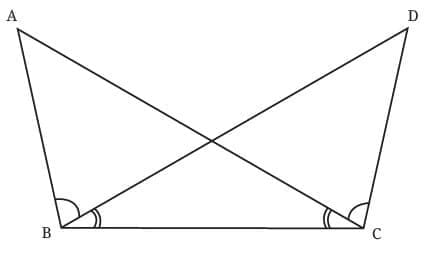
Ans: Given ∠ABD=∠DCA and ∠ACB=∠DBC.
Adding the equal angles gives:
∠ABD+∠DBC=∠ABC
∠DCA+∠ACB=∠DCB
Therefore, ∠ABC=∠DCB.
Also, BC=CB because BC is common, and ∠ACB=∠DBC is given.
Thus, △ABC≅△DCB by the ASA criterion.
Hence, the corresponding equal parts are:
AB=DC, AC=DB, and ∠BAC=∠CDB.
Page No. 20
Figure it Out
Q1:∆AIR ≅ ∆FLY. Identify the corresponding vertices, sides and angles.
Ans: Given △AIR≅△FLY, the correspondence is:
Corresponding vertices: A↔F, I↔L, R↔Y
Corresponding sides: AI↔FL, IR↔LY, AR↔FY
Corresponding angles: ∠A↔∠F, ∠I↔∠L, ∠R↔∠Y
Q2: Each of the following cases contains certain measurements taken from two triangles. Identify the pairs in which the triangles are congruent to each other, with reason. Express the congruence whenever they are congruent.
(a) AB = DE
BC = EF
CA = DF
(b) AB = EF
∠A =∠E
AC = ED
(c) AB = DF
∠B = ∠D = 90°
AC = FE
(d) ∠A = ∠D
∠B = ∠E
AC = DF
(e) AB = DF
∠B = ∠F
AC = DE
Ans:
(i) AB=DE, BC=EF, and CA=DF. All three corresponding sides are equal, so the triangles satisfy the SSS condition. Hence, △ABC≅△DEF.
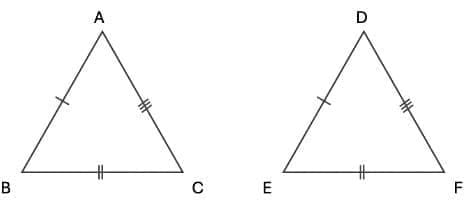
(ii) AB=EF, ∠A=∠E, and AC=ED. The two sides and the included angle are equal. Therefore, by SAS, △ABC≅△EFD.
(iii) AB=DF, ∠B=∠D=90∘, and AC=FE. The triangles have equal right angles, equal hypotenuses and one equal corresponding side. Therefore, they satisfy the RHS condition, and △ABC≅△FDE.

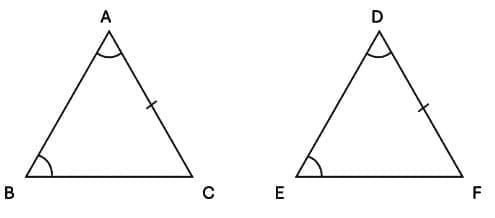
(iv) ∠A=∠D, ∠B=∠E, and AC=DF. Two angles and a corresponding non-included side are equal. Therefore, by AAS, △ABC≅△DEF.
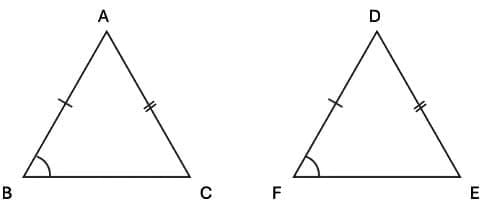
(v) AB=DF, ∠B=∠F, and AC=DE. This is an SSA condition because the given angle is not included between the two given sides. SSA is not a valid congruence rule in general. Hence, the triangles need not be congruent.
Q3:It is given that OB = OC, and OA = OD. Show that AB is parallel to CD.
[Hint: AD is a transversal for these two lines. Are there any equal alternate angles?]
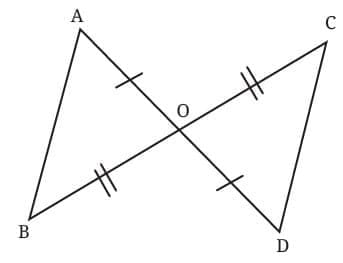
Ans: Consider △AOB and △DOC.
OA=OD (given)
OB=OC (given)
∠AOB=∠DOC (vertically opposite angles)
Therefore, △AOB≅△DOC by the SAS criterion.
Hence, corresponding angles are equal:
∠OAB=∠ODC and ∠OBA=∠OCD.
These are alternate interior angles formed when AD is a transversal. Therefore, AB∥CD.
Q4: ABCD is a square. Show that ∆ABC ≅ ∆ADC. Is ∆ABC also congruent to ∆CDA?
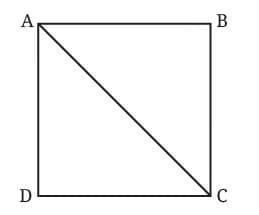
Give more examples of two triangles where one triangle is congruent to the other in two different ways, as in the case above. Can you give an example of two triangles where one is congruent to the other in six different ways?
Ans: In square ABCD, all sides are equal. Consider △ABC and △ADC.
AB=AD, BC=CD, and AC=AC because AC is common. Therefore, △ABC≅△ADC by the SSS criterion.
Also, AB=CD, BC=DA, and AC=CA. Hence, △ABC≅△CDA as well, again by the SSS criterion.
Now consider two congruent triangles △HEN and △BIG.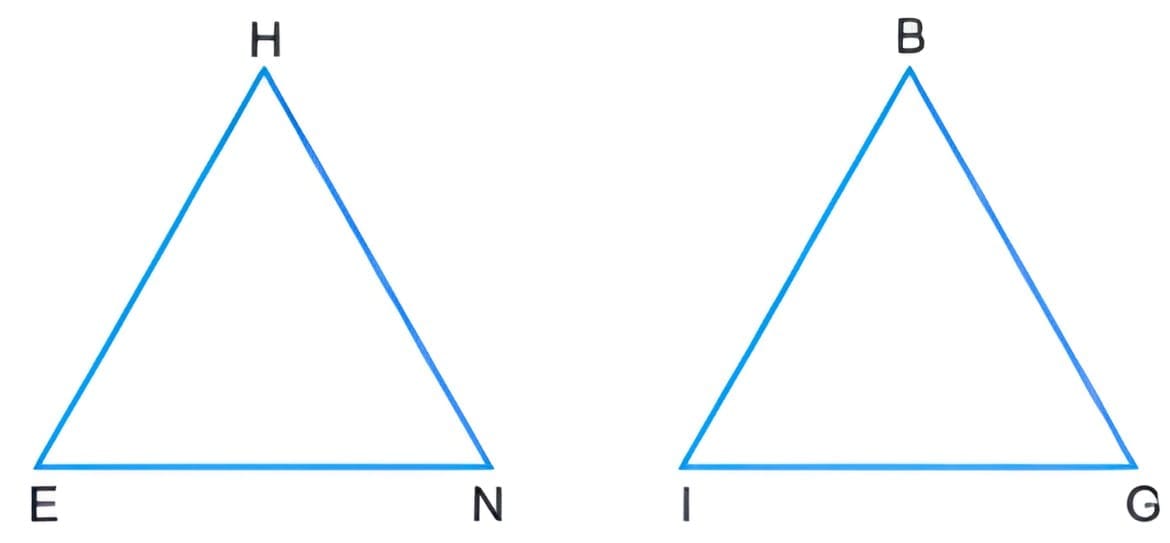
There are six ways to write a congruence statement for two congruent triangles by listing corresponding vertices in the same order:
(i) △HEN≅△BIG
(ii) △HNE≅△BGI
(iii) △EHN≅△IBG
(iv) △ENH≅△IGB
(v) △NHE≅△GBI
(vi) △NEH≅△GIB
Q5: Find ∠B and ∠C, if A is the centre of the circle.
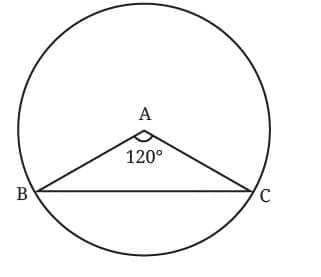
Ans: Since A is the centre of the circle, AB=AC because both are radii. Therefore, ∠B=∠C.
Given ∠BAC=120∘.
Let ∠B=∠C=x.
x+x+120∘=180∘
2x=60∘
x=30∘
Therefore, ∠B=∠C=30∘.
Q6: Find the missing angles. As per the convention that we have been following, all line segments marked with a single ‘|’ are equal to each other and those marked with a double ‘|’ are equal to each other, etc.
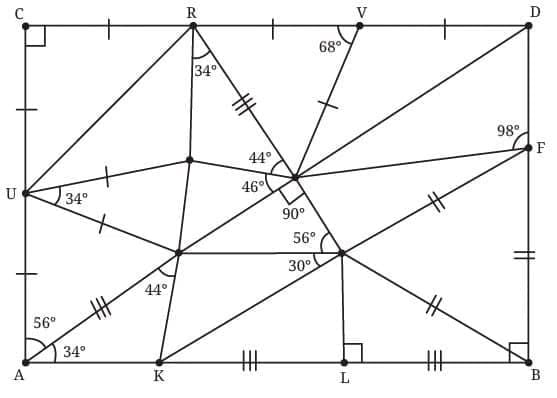
Ans:In △CUR
CU=CR (given)
Therefore, ∠CUR=∠CRU.
Let each angle be x.
x+x+90∘=180∘
2x=90∘
x=45∘
Thus, ∠CUR=∠CRU=45∘.In △VRN
VR=VN (given)
Therefore, ∠VRN=∠VNR.
Let each angle be a.
a+a+68∘=180∘
2a=112∘
a=56∘
Thus, ∠VRN=∠VNR=56∘.In △AUP
AU=AP (given)
Therefore, ∠UAP=∠UPA.
Given ∠UPA=56∘.
56∘+56∘+∠AUP=180∘
∠AUP=68∘.In △BOF
OB=OF=BF (given by the markings).
Therefore, △BOF is equilateral.
∠FOB=∠FBO=∠OFB=60∘.At point V
∠RVN+∠DVN=180∘ (linear pair)
68∘+∠DVN=180∘
∠DVN=112∘.In △VND
VN=VD (given)
Therefore, ∠VND=∠VDN.
Let each angle be c.
c+c+112∘=180∘
2c=68∘
c=34∘
Thus, ∠VND=∠VDN=34∘.In △OLB
∠OBL=90∘−60∘=30∘.
Since LO∥BF and OB is a transversal, ∠LOB=∠OFB=60∘.In △OPN
∠OPN+∠PON+∠PNO=180∘
∠OPN+56∘+90∘=180∘
∠OPN=34∘.At point P
∠APK+∠KPO+∠OPN lie on a straight line.
44∘+∠KPO+34∘=180∘
∠KPO=102∘.In △KPO
∠KPO+∠POK+∠PKO=180∘
102∘+30∘+∠PKO=180∘
∠PKO=48∘.In △KAP
∠KAP+∠KPA+∠AKP=180∘
34∘+44∘+∠AKP=180∘
∠AKP=102∘.In △KOL
∠AKP+∠PKO+∠OKL=180∘
102∘+48∘+∠OKL=180∘
∠OKL=30∘.