Have you ever wondered about time? How we measure days, months, and years? Or why some years have an extra day?
Let’s join Parv, who is celebrating his birthday with his friends, and explore the fascinating world of clocks and calendars!
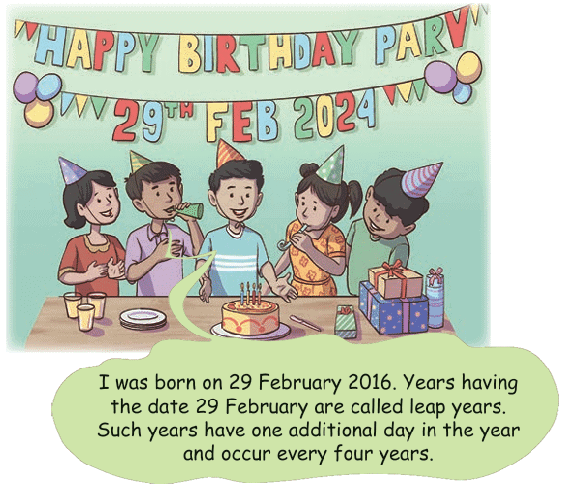
Parv shares something interesting: “I was born on 29 February 2016. Years having the date 29 February are called leap years. Such years have one additional day in the year and occur every four years.”
Isn’t that cool?
Let’s dive deeper into leap years and how calendars work.
Calendars and Leap Years
Imagine you have a special book that helps you know what day it is, plan events, and remember important dates like birthdays and holidays. This special book is called a calendar!
Days and Months
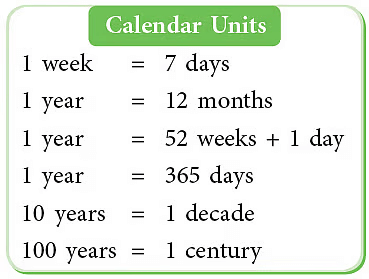
A year has 365 days, but a leap year has 366 days (every fourth year).
In a leap year, February has 29 days instead of 28.
There are 12 months in a year and they may have 28,29,30 or 31 days.
Months with 31 days are: January, March, May, July, August, October, and December.
Months with 30 days are: April, June, September, and November.
February: 28 days (29 days in a leap year).
A year has 52 weeks.
Each week has 7 days:Sunday, Monday, Tuesday, Wednesday, Thursday, Friday, Saturday.
Writing Dates
When we write a date, we first write the number of the day, then the name of the month, and finally the year.
We call this the day-month-year format.
We can use dots or slashes to separate them. For example, if it’s May 6, 2024, we can write it as 6.05.2024 or 6/05/2024.
Examples
If someone tells you to meet them on 25th June, you’ll know it’s the 25th day of June.
On your birthday, your family might write the date like this: 10.12.2013 (10th December 2013) to remember your special day!
Isn’t it cool how the calendar helps us keep track of time and remember special moments?
Try yourself:
What is the special feature of leap years?
A.They have 12 months.
B.They only have February 28.
C.They have 365 days.
D.They have 366 days.
View Solution
Checking Expiry Dates
Have you ever looked at the dates on a biscuit packet or a milk carton? These are important!
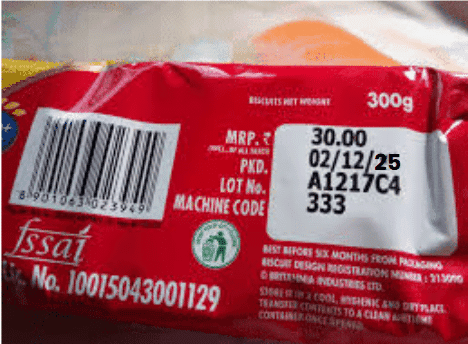
Packet of Biscuit showing Manufacturing date
In the given picture, a biscuit packet was manufactured on 02/12/2025 and expires on 01/07/2026.
a) How old is the packet of biscuits?(Assuming today is April 29, 2025)
From Dec 2 to April 29 is roughly 4 months.
b) How many more days are the biscuits safe to eat?
From April 29 to July 1. April has 1 more day (30th). May has 31 days. June has 30 days. July has 1 day.
Total = 1 + 31 + 30 + 1 = 63 days
Months and Years
We know that 12 months equals 1 year.
We can convert 1 year 7 months into just months like this: 1 year is 12 months. Adding 7 months gives us a total of 19 months.
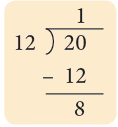
We can also convert 20 months into years and months: 20 months includes 12 months. This leaves us with 8 months, which can be stated as 1 year 8 months.
Example 1: If 10 April 2018 was a Tuesday, what was the day on 30 April, 2018?
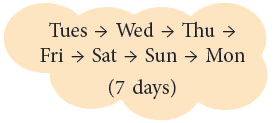
The same day is repeated after every 7 days. After 10 April, the next Tuesday fell on 17 April and then on 24 April. Therefore, counting ahead from 24 April, 30 April, 2018 was a Monday.
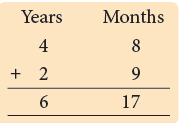
Example 2: Rahul is 4 years 8 months old. His sister Divya is 2 years 9 months elder to him. How old is she?
Divya’ s age = Rahul’s age + 2 years 9 months = 4 years 8 months + 2 years 9 months = 6 years 17 months = 6 years + 12 months + 5 months = 6 years + 1 year + 5 months (12 months = 1 year) = 7 years 5 months.
How many hours in a day?
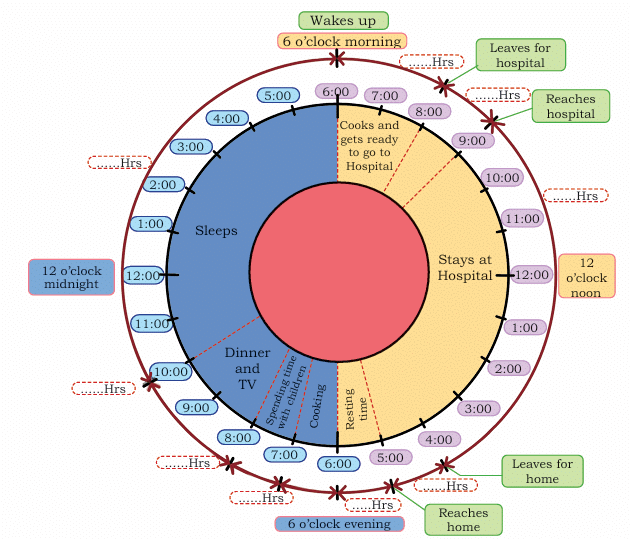
We know days turn into nights, but how long is a full day? Let’s look at a doctor’s schedule to figure it out.
Doctor’s Daily Schedule
Look at the picture above. It shows the time spent on different activities by a doctor.
Let’s try to count the hours:
Wakes up (6 AM) to Leaves for hospital (7 AM): 1 hour
Leaves for hospital (7 AM) to Reaches hospital (8 AM): 1 hour
Stays at Hospital (8 AM to 1 PM, then 2 PM to 5 PM): 5 hours + 3 hours = 8 hours (Assuming 1 hour lunch break)
Leaves for home (5 PM) to Reaches home (6 PM): 1 hour
Reaches home (6 PM) to Resting time (7 PM): 1 hour
Resting time (7 PM) to Cooking (8 PM): 1 hour
Cooking (8 PM) to Spending time with children/Dinner/TV (10 PM): 2 hours
Dinner/TV (10 PM) to Sleeps (12 AM): 2 hours
Sleeps (12 AM to 6 AM): 6 hours
If we add up all the hours from 6 o’clock morning to 6 o’clock morning the next day:
Hmm, let’s re-examine the chart. The chart shows a full circle representing the day.
The chart visually represents a 24-hour cycle.
From 6 o’clock morning to 6 o’clock evening is 12 hours. From 6 o’clock evening back to 6 o’clock morning the next day is another 12 hours.
The total number of hours in a day is 12 + 12 = 24 hours.
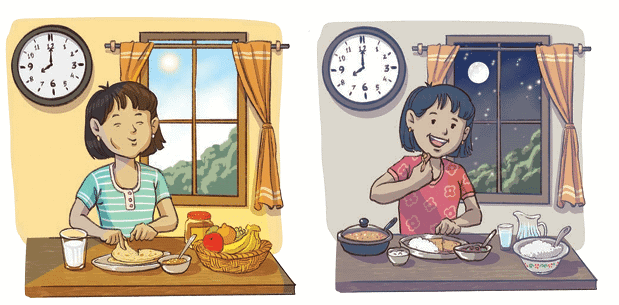
Look at the two pictures! In both of them, the clock shows 8:00, but something is different. One shows a girl having breakfast in the morning and the other shows a girl having dinner at night.
So how do we know whether it’s morning or night?We use AM and PM!
AM means morning time (from midnight to lunchtime).
PM means evening and night time (from lunchtime to midnight).
So:
8:00 AM = Morning = Breakfast time
8:00 PM = Night = Dinner time
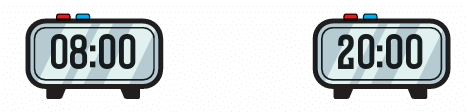
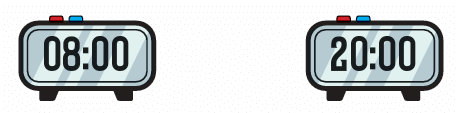
Now look at the digital clocks:
08:00 means 8:00 in the morning (AM).
20:00 means 8:00 in the evening (PM). This is called 24-hour time.
To change PM time into 24-hour time, we add 12 to the number. So 8 PM = 8 + 12 = 20:00
Understanding more about A.M. and P.M. Time
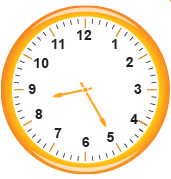
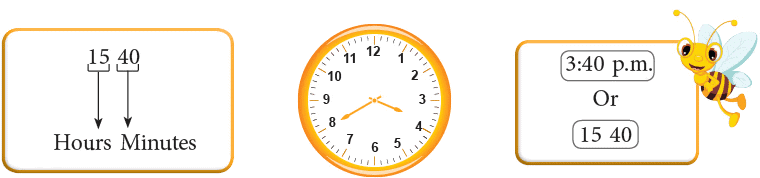
The time shown on the clock given alongside is 8:25, but we are not able to determine whether it is 8:25 in the morning or evening.
A day consists of 24 hours.
In a 12-hour clock system, the hour hand makes two complete rotations around the clock face.
This means that the same time appears twice a day.
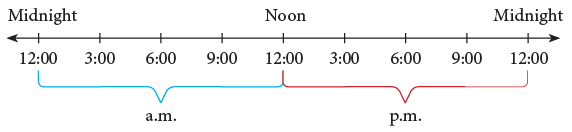
To tell the difference between these times, we use a.m. and p.m..
a.m. stands for ante meridian, which refers to the time from midnight until noon.
p.m. stands for post meridian, covering the time from noon until midnight.
For example, 8:25 in the morning is written as 8:25 a.m.
The same time in the evening is expressed as 8:25 p.m.
Note: A day begins at 12 midnight and ends at 12 midnight of the following day.
Try yourself:
What does a.m. stand for?
A.Ante meridian
B.After midday
C.Any moment
D.All morning
View Solution
Digital Clocks and the 24-Hour Format
In both the pictures we see 8:00 on the clock. But one is morning and the other is night time. We add AM and PM to show this difference.
Digital clocks help us read the time more clearly.
Here are some units for measuring time:
24-Hour Time Notation
We have already learned about the 24-hour clock in Class 3.
The 24-hour time system is also known as the “24-hour clock”.
This clock shows the time from 12 midnight to 12 midnight the next day, covering 1 full day.
The time is written as 0000 hours to 2400 hours.
In this format, the first two digits indicate the hours, while the last two digits show the minutes.
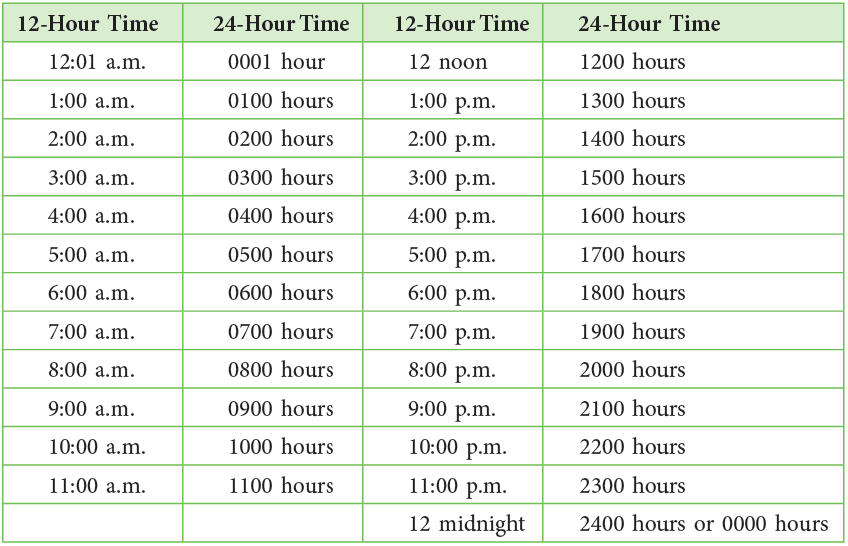
The table given below shows the 24-hour time equivalent to12-hour time:
Thus,
8:35 a.m. = 0835 hours;
3:15 p.m. = 1515 hours;
11:40 a.m. = 1140 hours;
11:50 p.m. = 2350 hours.
Hours and minutes
How long does an activity take? We measure this using hours and minutes.
Raghav brings milk from the market every morning.
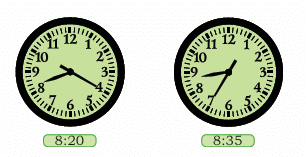
Raghav leaves home at 8:20 AM and returns back at 8:35 AM.
How much time has he taken?
From 8:20 AM to 8:35 AM, the hour hasn’t changed, only the minutes.
The difference in minutes is 35 – 20 = 15 minutes.
He has taken 15 minutes.
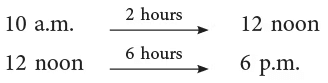
Example 3: Mr Verma’s office starts at 10 a.m. and closes at 6 p.m. How many hours does the office remain open?
Thus, Mr Verma’s office remains open for 2 hours + 6 hours = 8 hours.
Example 4: Find the time using a 24-hour clock. (a) 4 hours 25 minutes after 2040 hours (b) 8 hours 15 minutes before 2:35 p.m.
(a) Add 4 hours 25 minutes to 2040 hours to find the required time. 20 h 40 min + 4 h 25 min = 24 h 65 min = 24 h + 1 h + 5 min = 1:05 a.m. (It becomes next day.) 1 h 5 min after 12:00 midnight. (b) 2:35 p.m. = 1435 hours = 14 h 35 min ∴ Required time = 14 h 35 min – 8 h 15 min = 6 h 20 min = 0620 hours or 6:20 a.m.
Remember, time is precious! Keep exploring clocks and calendars – they are everywhere around us, helping us keep track of our wonderful journey through life!
 Sunday, Monday, Tuesday, Wednesday, Thursday, Friday, Saturday.