A. Answer the following.
Q 1: Describe the Braille alphabet.
Ans: The Braille alphabet is a way of reading through touch. It uses raised dots for each letter of the English alphabet. Each letter has a different pattern of dots, but the letters need more space and cannot be too close together.
Q2: Why was ‘Night Writing’ not a success?
Ans: ‘Night Writing’ was not a success because it was too difficult. It used raised dots and dashes, but soldiers found it hard to read with their fingers in the dark.
Q3: What did Louis Braille do to make reading easier for the blind?
Ans: Louis Braille simplified ‘Night Writing’ and made the Braille alphabet. He created an easier way with raised dots for each letter, so blind people could read by touching the patterns.
B. Think and discuss.
Q4: You may have seen people with blindness walking with a white cane. Why is the cane always white-coloured?
Ans: The cane is white-coloured so that people can easily see it and know that the person using it is blind. It helps others be careful and make way for them.
Q5: Imagine that the world becomes dark for a day and there is no light. What difficulties might one face on such a day?
Ans: If the world becomes dark for a day with no light, we might face difficulties like not seeing where to walk, bumping into things, or not finding our way. It would be hard to do things like read, cook, or play safely.
Let us Speak
Close your eyes. Pick an object. Keep the object back. Now complete the sentences and share them with the class.
Q1: The object in my hand was ___ in shape.
Ans: The object in my hand was round in shape.
Q2: The object in my hand was (longer/shorter) than my forefinger.
Ans: The object in my hand was longer than my forefinger.
Q3: The object in my hand was a ___.
Ans: The object in my hand was a pencil.
Now add two more lines to describe the object.
Ans:
- The pencil felt smooth and hard.
- It had a pointy end for writing.
Let us Write
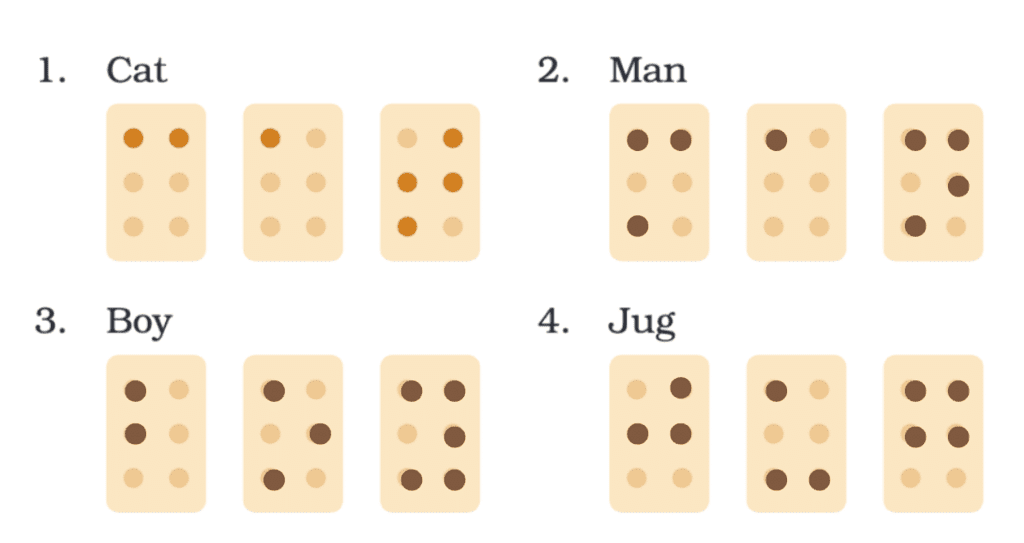
A. Write these words using the Braille alphabet. You can paste “bindis”.
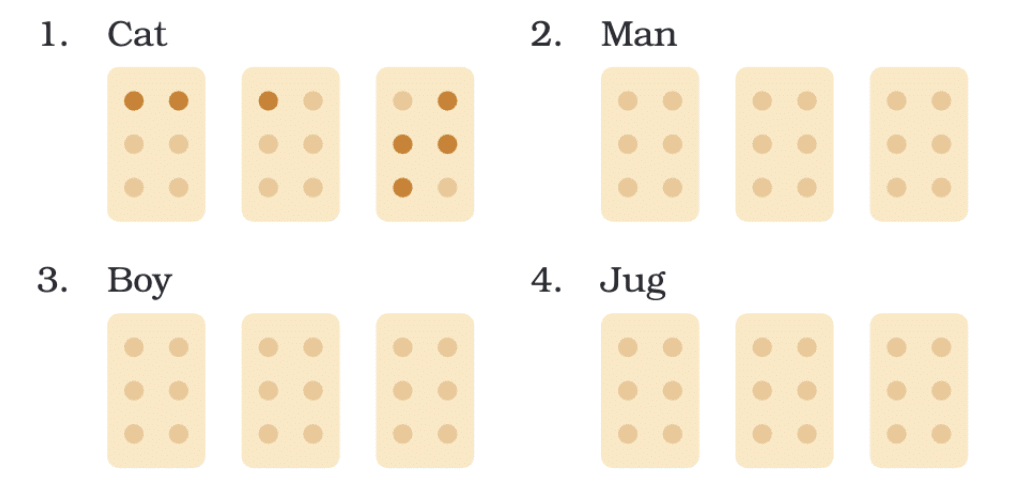
Ans:
B. Louis Braille lost his eyesight in an accident. Some time ago, a newspaper reported that a child lost one eye while lighting firecrackers. List the precautions that should be taken to protect eyes from harm.
Ans:
- Do not play with sharp things like tools or sticks.
- Wear safety glasses when doing experiments or playing with things that can hurt.
- Do not light firecrackers without an adult’s help.
- Keep away from bright lights or fire that can burn your eyes.
- Wash your hands before touching your eyes to keep them clean.
C. Read the following sentences and notice the underlined words.
• Long ago, in France, a little boy named Louis Braille was playing near his home.
• The cats were sleeping when I reached home.
• Sameer was playing hopscotch last evening.
All the above sentences are examples of events that started in the past and continued for some time. If the sentence is about one person, animal or bird, we use ‘was + action word + ing.’
Example: The student was writing in his notebook. If the sentence is about more than one person, animal or bird, we use ‘were + action word + ing.’
Example: The students were writing in their notebooks.
The following sentences describe actions in the present. Change them to the past as shown in the examples.
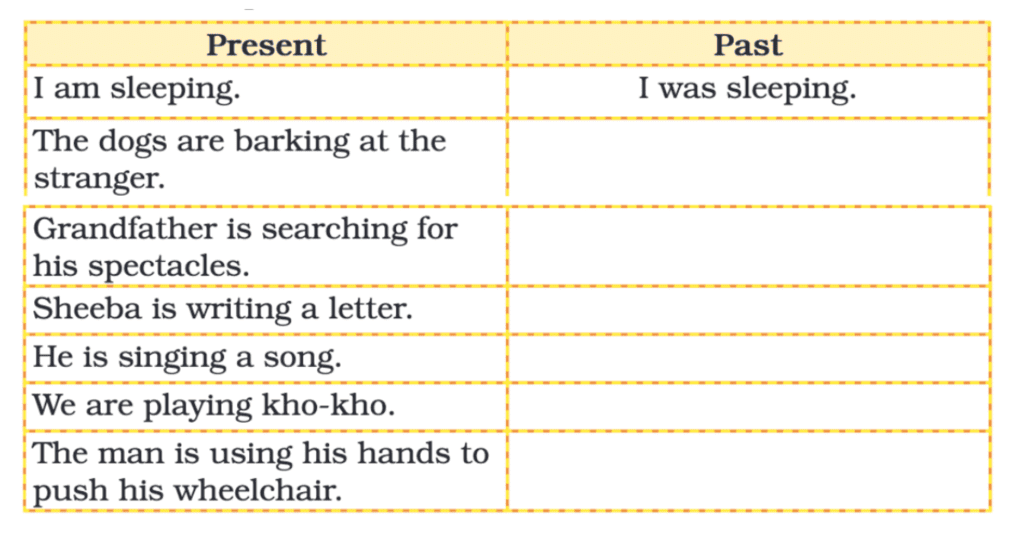
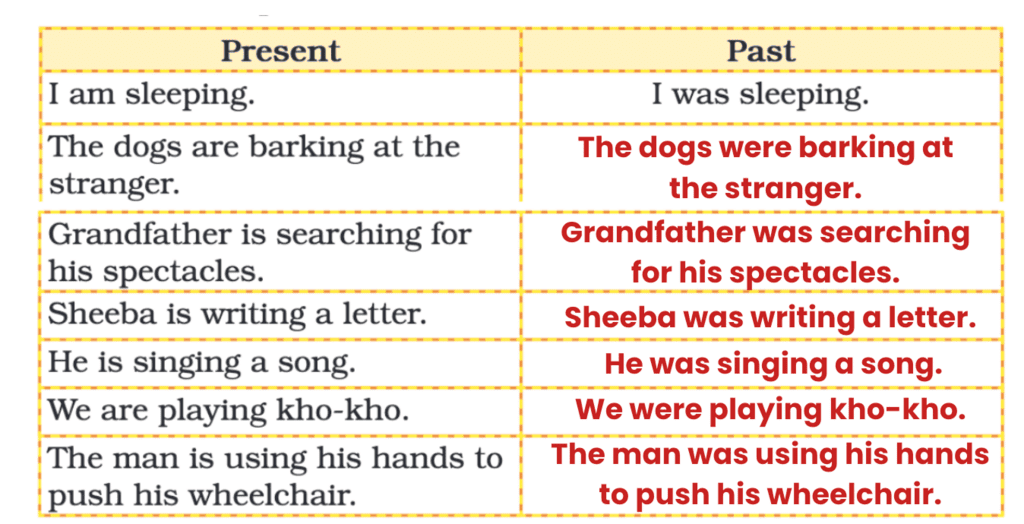
Ans:
D. Look at the picture story.
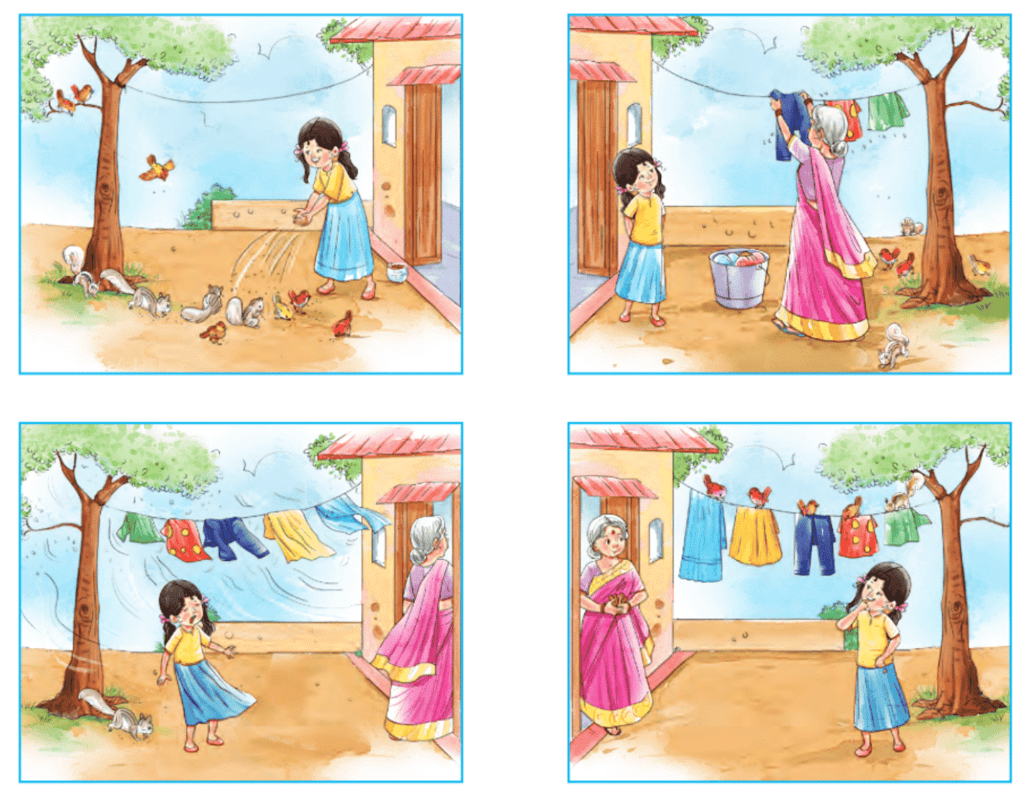
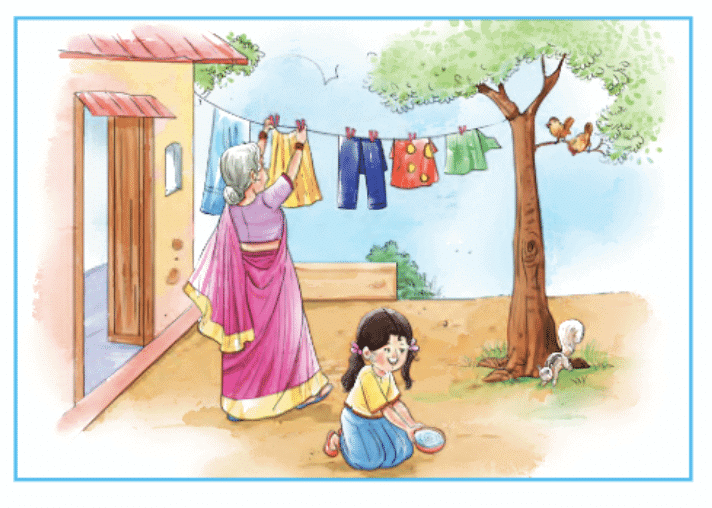
Now fill in the blanks from the suitable options.
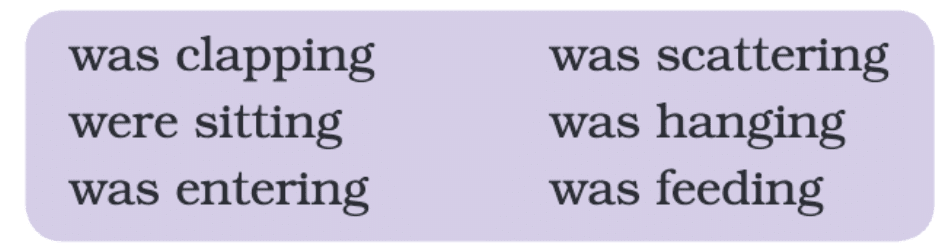
Ans:
My friend Tarandeep told me an interesting thing yesterday. She was feeding her friends, the squirrels and the sparrows. She was scattering grains for them. Her grandmother was hanging out the clothes to dry on a clothesline. Grandmother was entering the house when a strong wind began to blow. When she returned with the clothes pegs, she saw a wonderful scene! The sparrows and squirrels were sitting on the clothes to prevent them from falling. Tarandeep was clapping her hands with joy. Grandmother put the pegs on the clothes, and Tarandeep set down a bowl of water for her friends.
Let us Do
Q1: Take a piece of paper. With the help of a matchstick, or the back of a pencil, press hard on the paper to ‘draw’ a circle, a plus sign, or a letter of the alphabet. Now, close your eyes, turn the page over, and run your finger on the raised surface on the paper. Can you make out what the shape or outline is? Now, try the same activity with your friend. You may also use white clay for the same.
Ans:
(Note: This is an activity, this answer is only for reference.)
I took a piece of paper and used the back of a pencil to press hard and draw a circle. Then, I closed my eyes, turned the paper over, and ran my finger on the raised surface. I could feel the round shape and guessed it was a circle. I tried this with my friend, and she drew a plus sign. I felt the lines crossing and knew it was a plus sign. We also used white clay to make shapes, and it was fun to feel them with our eyes closed.
Q2: There are some children with low vision (e.g., wearing thick glasses or holding a book too close to their eyes). Being a classmate and friend, how can you assist them?
Ans:
- I can read aloud to them so they don’t strain their eyes.
- I can help them find things they might not see easily, like their pencil or book.
- I can share my notes in big writing to make it easier for them to read.
- I can walk with them and tell them if there are obstacles in the way.
- I can sit with them and explain things they might not see clearly on the board.