Multiple Choice Questions
Q1: What is the upper neighboring hundreds of 334?
(a) 200
(b) 250
(c) 300
(d) 400
Q2: Which of the following represents the number 556 as a sum of its place values?
(a) 500 + 50 + 6
(b) 400 + 60
(c) 450 + 6
(d) 500 – 44
Q3: What is the rule for the sequence: 600, 570, 540, 510?
(a) Add 30
(b) Subtract 30
(c) Add 50
(d) Subtract 20
Q4: Which number has two zeroes as digits and is very close to 99?
(a) 90
(b) 100
(c) 200
(d) 300
Q5: What is the lower neighboring 10 of 646?
(a) 620
(b) 630
(c) 640
(d) 600
Fill in the Blanks
Q1: The neighboring 50s of 234 are __________ and __________.
Q2: The number 789 can be represented by __________ hundreds, __________ tens, and __________ ones.
Q3: In the sequence starting from 450 with a rule of adding 20, the first three numbers are __________, __________, and __________.
Q4: The number 150 can be formed by adding __________ and __________.
Q5: To create the number 525, I need __________ hundreds, __________ tens, and __________ ones.
True or False
Q1: The neighboring hundreds of 839 are 800 and 900.
Q2: 985 can be represented as 900 + 50 + 8.
Q3: The sequence 800, 760, 720 is formed by adding 40.
Q4: The number 100 has two zeroes and is close to 99.
Q5: The rule for the pattern 450, 470, 490 is to subtract 20.
Match the Following
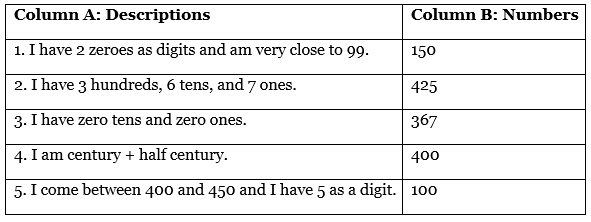
Q: Match each description in Column A with the correct number in Column B. Write the correct number next to each description.
1. I have 2 zeroes as digits and am very close to 99.
2. I have 3 hundreds, 6 tens, and 7 ones.
3. I have zero tens and zero ones.
4. I am century + half century.
5. I come between 400 and 450 and I have 5 as a digit.
You can access the worksheet solutions, here.