Story Time: Grouping
Hey kids! Let’s learn a math trick from Rahul.
- One sunny day, Rahul and Disha were playing in the garden.
- Disha spotted colorful butterflies fluttering near the flowers.

- She got excited and started counting, “1, 2, 3, 4…” Rahul, curious about what Disha was doing, asked her.
- Disha explained, “I’m counting the total number of wings all the butterflies have.”
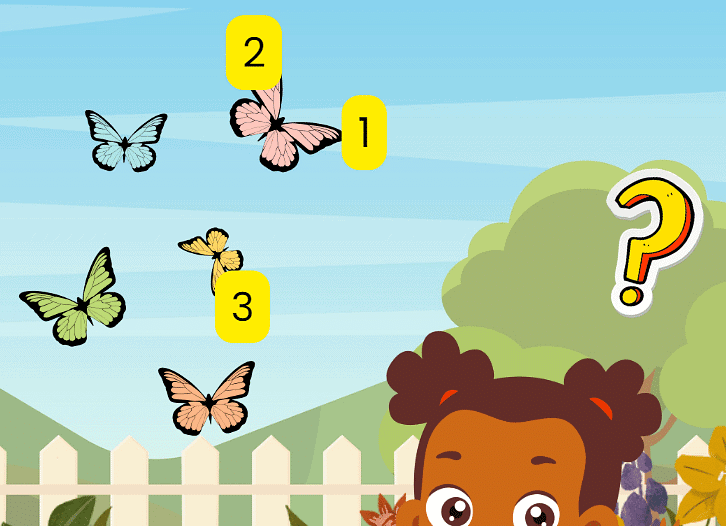
- But as Disha counted, she realized it was tricky because the butterflies kept moving.
- Seeing her struggle, Rahul came up with a clever idea.
- He said, “Disha, I have a trick that will help you find the total number of wings quickly using math. Are you ready?”
- Disha nodded eagerly, curious to learn Rahul’s trick.
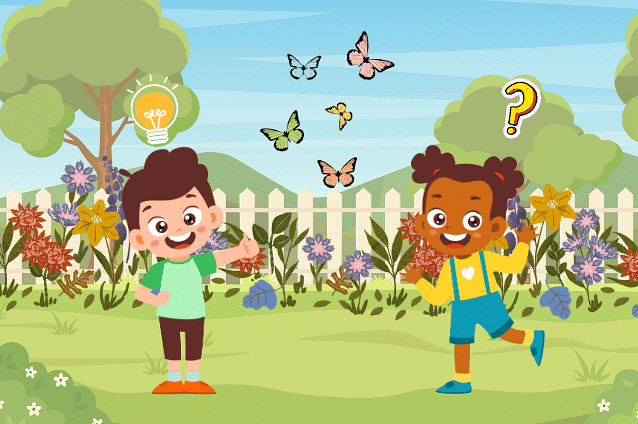
Step One: “First, tell me how many butterflies are there?” Rahul asked.
- Disha counted and replied, “There are 5 butterflies.“
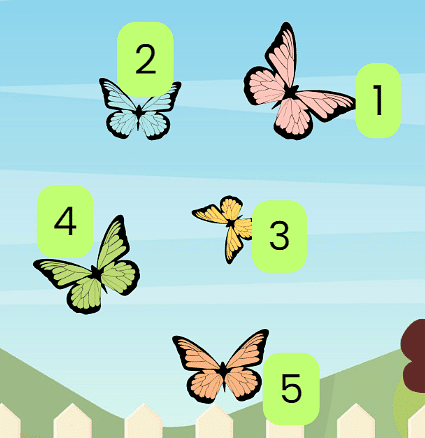
Counting Butterflies
Step Two: Rahul observed that each butterfly has 2 wings.
- He said, “Good! Now, remember that each butterfly has 2 wings.”
Step Three: Rahul explained to Disha, “If there are 5 butterflies and each butterfly has 2 wings, you can add 2, 5 times to know the total number of wings.
- “He showed her how to do it: 2 + 2 + 2 + 2 + 2 = 10 wings.
- Disha’s eyes lit up as she understood the trick.
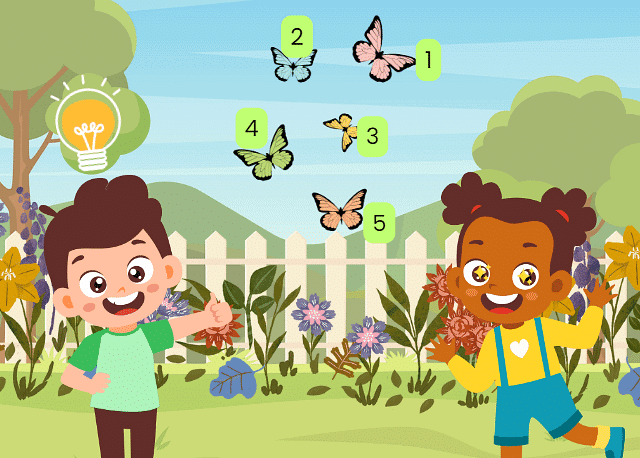
- “So, 5 times 2 is 10 wings!” she exclaimed happily.
- Rahul smiled and said, “Exactly! You can use this trick to quickly find the total number of wings when you know how many butterflies there are and how many wings each butterfly has.”
Just how Rahul and Disha solved the mistry of butterfly wings, we can use this tick to calculate so many other things. Let’s try to help Tanya using the same trick.
Learn by Practicing- 1
Tanya is a sweet girl and organising her things. She had different boxes of pencils and each box had multiple pencils. Let’s help Tanya in finding how many pencils she has.

Step 1: Let’s count the number of boxes.
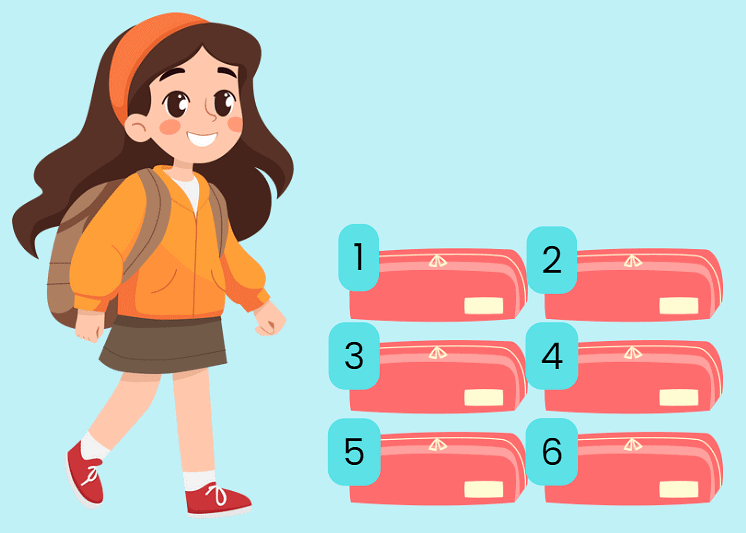
There are 6 boxes.
Counting Boxes
Step 2: Count the number of pencils in each box.
Each box has 8 pencils.
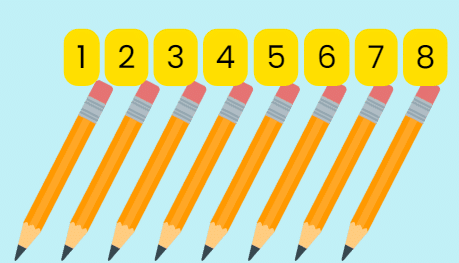
Counting pencils
Step 3: Now, let’s see how many pencils Tanya has in total:
- Total pencils = 8 + 8 + 8 + 8 + 8 + 8 = 48
- We are adding 8 for 6 times.
- So, 6 times 8 is also 48 or 6 groups of 8 give 48.
- Also, ‘times’ can be written as ‘x’.
- So, 6 x 8 = 48.
MultiplicationAs you observed in our example, we used “times” and “x” above. In math, this concept is called multiplication. Let understand what this means:
- When we say “6 x 8,” we are using ‘x‘ as a way to show multiplication. It means we are taking 6 groups of 8 and adding them together to find the total.
- For example, imagine you have 6 groups of 8 pencils each.
- To find out how many pencils you have in total, you can count them one by one, or you can use multiplication.

Sign of Multiplication
- So, when we write “6 x 8,” it’s like saying “6 groups of 8” or “8 pencils repeated 6 times.” We use ‘x’ to show this grouping or repetition.
- In simple terms, multiplication helps us quickly find out the total when we have the same number repeated several times. And in math, we write “times” as ‘x’ to represent this idea of groups or repetitions.
- So, “6 x 8” means you have 6 groups of 8 pencils each, which gives you a total of 48 pencils.
This is why we study tables. Let’s see what are Tables
Tables
They are sets of calculations that we study to make our calculations easy and quick.
Let’s try to understand the table of 2.
Table of 2
The “table of 2” is a list of numbers that we get when we multiply 2 by other numbers, like 1, 2, 3, and so on, up to 10. It helps us quickly figure out the answers when we do multiplication with the number 2.
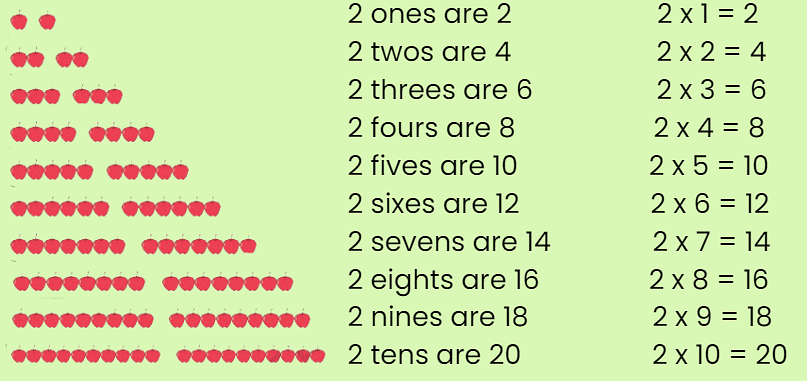
When we say “2 ones are 2,” it means that if we have 2 groups, each with just 1 thing in it (like 2 groups of 1 cookie each), we have a total of 2 things. It’s like saying that when we count 1 thing twice (2 times), we get 2.
We have a “table” for each number, just like we have a table of 2. This table helps us quickly find out the answers when we do multiplication with that number. Here are the tables for 3, 4, 5, and 10:
Table of 3
Just like Table of 2, we have table of 3, Let’s see how it looks like:
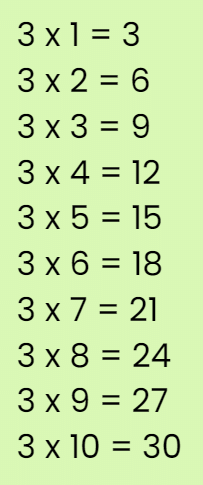
This table is read like :
- 3 ones are 3
- 3 twos are 6
- 3 threes are 9
- 3 fours are 12
- 3 fives are 15
- 3 sixes are 18
- 3 sevens are 21
- 3 eights are 24
- 3 nines are 27
- 3 tens are 30
Table of 4
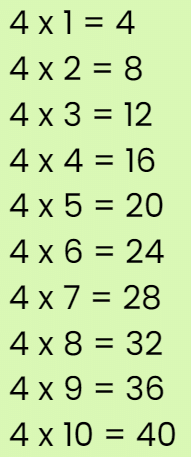
This table is read like :
- 4 ones are 4
- 4 twos are 8
- 4 threes are 12
- 4 fours are 16
- 4 fives are 20
- 4 sixes are 24
- 4 sevens are 28
- 4 eights are 32
- 4 nines are 36
- 4 tens are 40
Table of 5
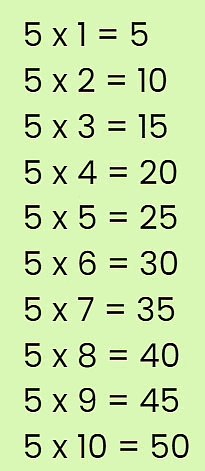
This table is read like :
- 5 ones are 5
- 5 twos are 10
- 5 threes are 15
- 5 fours are 20
- 5 fives are 25
- 5 sixes are 30
- 5 sevens are 35
- 5 eights are 40
- 5 nines are 45
- 5 tens are 50
Table of 10
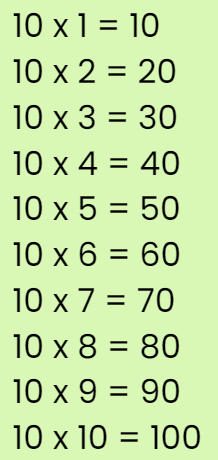
This table is read like :
- 10 ones are 10
- 10 twos are 20
- 10 threes are 30
- 10 fours are 40
- 10 fives are 50
- 10 sixes are 60
- 10 sevens are 70
- 10 eights are 80
- 10 nines are 90
- 10 tens are 100
Story Time: Magic of Multiplication
- Once upon a time, there were three friends named Sam, Lily, and Max.
- They loved playing with marbles in their backyard.

Sam, Lily & Max
- One sunny day, they decided to arrange their marbles in rows to count them easily.
- Sam put 4 marbles in each row, making 3 rows in total.

3 rows of 4 marbels in each row
- Lily, being curious, asked Sam, “How many marbles are there in all three rows?” Sam replied, “Let’s count them together.”
- They counted each marble in the rows and found out there were 12 marbles in total.
- Excited by this, Max wanted to try something different.
- He arranged his marbles in columns instead of rows.
- He put 3 marbles in each column and made 4 columns.

- Lily asked Max, “How many marbles are there in all four columns?” Max smiled and said, “Let’s count them like we did before.”
- They counted each marble in the columns and were surprised to find out that there were also 12 marbles in total!
- Sam, Lily, and Max were amazed and realized that no matter how they arranged the marbles, whether in rows or columns, the total number of marbles remained the same at 12.
They learned that 3 times 4 is 12, just like 4 times 3 is also 12, because multiplication is about grouping things together in different ways but getting the same total amount in the end.
Making Table from Tables
Did you know that we can create new tables by adding the values from two existing multiplication tables? Let’s take an example with the tables of 2 and 3.
Table of 2:
- 2 ones are 2
- 2 twos are 4
- 2 threes are 6
- 2 fours are 8
- 2 fives are 10 …
Table of 3:
- 3 ones are 3
- 3 twos are 6
- 3 threes are 9
- 3 fours are 12
- 3 fives are 15 …
Now, let’s add these two tables together to create a new table. We’ll add the values of the same number from both tables.
Table of 2 + Table of 3:
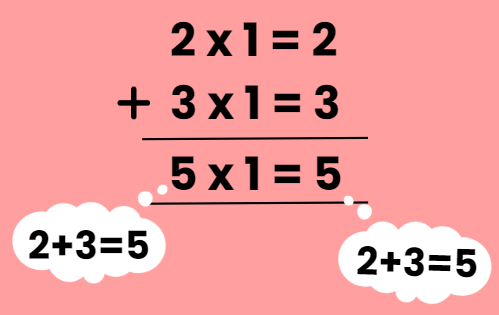
- 2 ones (from Table of 2) + 3 ones (from Table of 3) = 5 ones
- 2 twos (from Table of 2) + 3 twos (from Table of 3) = 5 twos
- 2 threes (from Table of 2) + 3 threes (from Table of 3) = 5 threes
- 2 fours (from Table of 2) + 3 fours (from Table of 3) = 5 fours
- 2 fives (from Table of 2) + 3 fives (from Table of 3) = 5 fives …
By adding the values from the Table of 2 and the Table of 3, we created a new table where each number is the sum of the corresponding numbers from the original tables. This is how we can make tables from tables in mathematics!Story Time: Sharing
- Once upon a time, there was a girl named Jaya.
- She had two younger twin brothers, Rohan and Aryan.
- One day, Jaya’s mother baked yummy cookies and put them on a plate.
- She asked Jaya to share the cookies equally with her brothers.
- Let’s see how Jaya did it step by step in a very easy way.
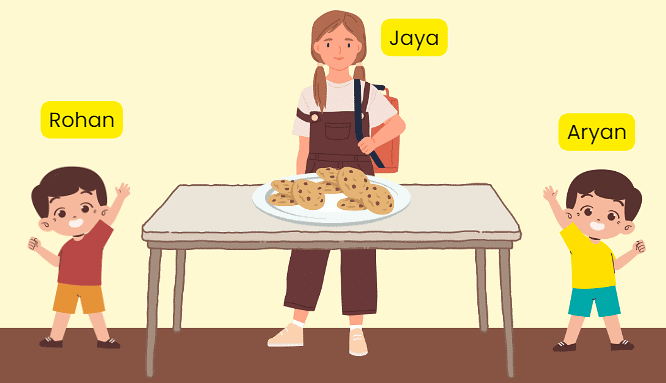
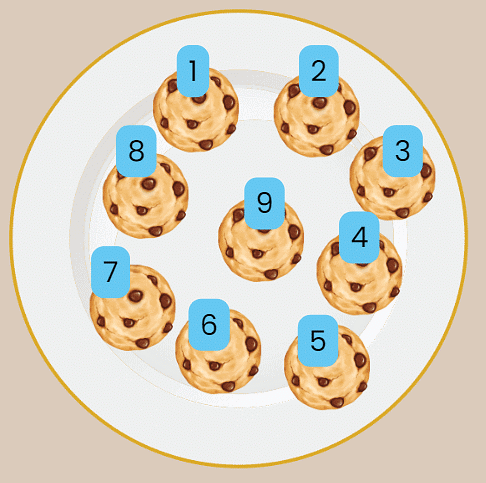
Step 1: Jaya looked at the plate and counted cookies, there were nine cookies.
Step 2: She thought, “I have to give some cookies to Rohan and Aryan so that we all have the same.“
Step 3: Jaya took three cookies from the plate and gave one cookie to Rohan, one to Aryan, and kept one for herself. Now each of them had one cookie.
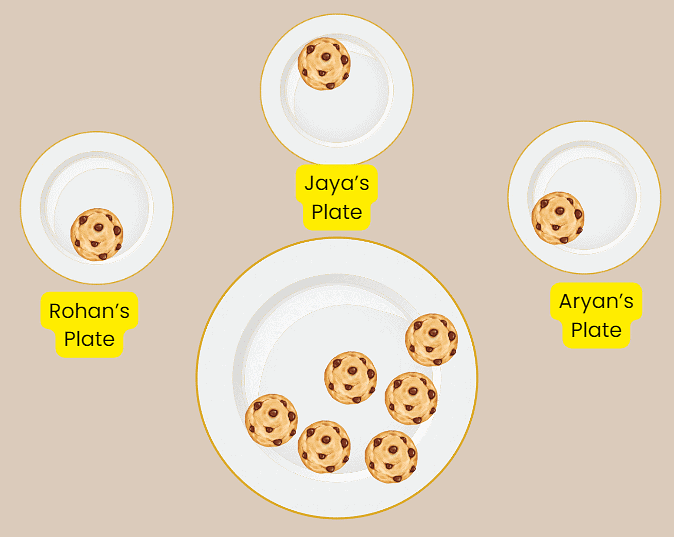
Dividing one cookie each
Step 4: Next, Jaya took two more cookies from the plate and gave one to Rohan and one to Aryan. She kept one cookie for herself again. Now each of them had two cookies.
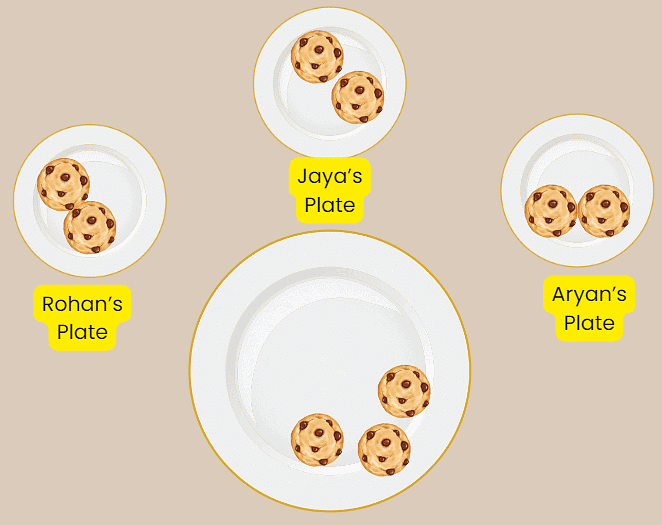
Dividing 2 cookies each
Step 5: Finally, Jaya saw that there were four cookies left on the plate. She gave one cookie to Rohan, one to Aryan, and kept two cookies for herself. Now each of them had three cookies.
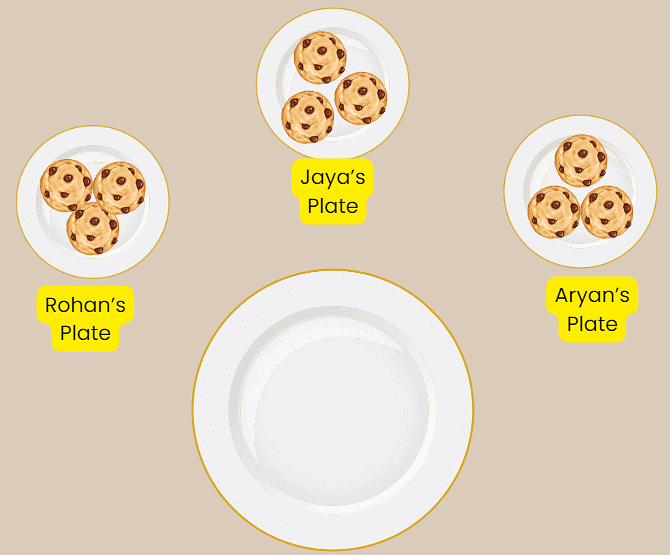
Everyone getting 3 cookies
Jaya smiled and said, “Look, Rohan, Aryan, and I each have three cookies. We all have the same number of cookies, and everyone is happy!”
- Jaya’s mother was very proud of her for sharing the cookies equally and making sure everyone got their fair share.
- Jaya learned that sharing is caring, and dividing things equally makes everyone happy.