Section A: Multiple Choice Questions (MCQs)
Q1: Which of the following sets of side lengths can form a triangle?
a) 2 cm, 3 cm, 6 cm
b) 4 cm, 5 cm, 7 cm
c) 1 cm, 1 cm, 3 cm
d) 5 cm, 10 cm, 16 cm
Q2 : If two angles of a triangle are 80° and 60°, what is the measure of the third angle?
a) 30°
b) 40°
c) 50°
d) 60°
Q3: In triangle ABC, the exterior angle at B is 130°, and ∠A = 50°. The measure of ∠C is
a) 85°
b) 70°
c) 75°
d) 80°
Q4: In a triangle PQR, if ∠P = 45° and ∠Q = 75°, can a triangle be formed with these angles and an included side of 5 cm?
a) Yes, because the sum of angles is less than 180°
b) No, because the sum of angles is equal to 180°
c) No, because the sum of angles is greater than 180°
d) Yes, but only if the side length is greater than 5 cm
Section B: Match the Following
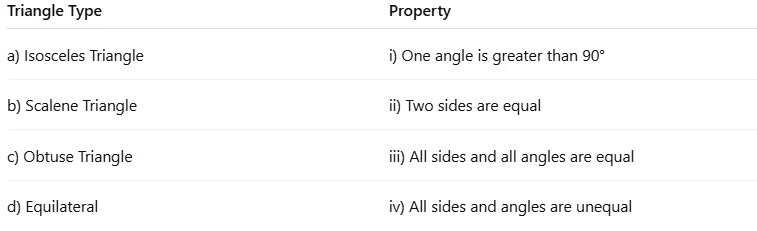
Section C: Spot the Error
Q1: Isha wrote the following steps to construct a triangle:
- Step 1: Draw AB = 6 cm
- Step 2: At A, draw a 120° angle
- Step 3: Mark a point C on the ray such that AC = 5 cm
- Step 4: Join BC
She claims the triangle formed is equilateral.
Is she correct? Explain the mistake.
Section D: Think and Answer
Q1: A triangle has angles measuring 30°, 60°, and 90°.
a) Name the triangle based on its angles.
b) Will this triangle have an altitude inside or outside?
Q2: A triangle has exactly one line of symmetry.
What kind of triangle is it and why?
a) All angles obtuse?
b) Two right angles?
Explain your answers.