It is raining. Afreen watches raindrops sliding on the window and asks Jyoti where water comes from and where it goes.
Most of the Earth’s surface is covered with water, but most of this water is salty ocean water.
Only a very small amount of water on Earth is freshwater, found in rivers, lakes, groundwater, and rain.
Freshwater is essential for people, animals, birds, and plants to live, drink, and grow food
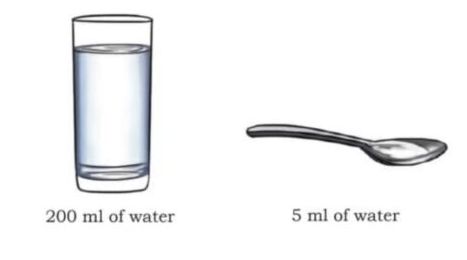
Imagine if all Earth’s water was in one glass — the freshwater would fill only a teaspoo
Do you know? Salt pans in Gujarat are large flat areas where seawater is dried to get salt.
Water has Different Forms
Jyoti was curious, “Is there water in the air too?”. Let’s find out.
Water exists in three forms: Liquid: like rain and river water Solid: like ice and snow Gas or vapour: like steam or water vapour in the air
Ice melts into water when heated. Heating water produces steam (water vapour).
Water vapour cools and forms clouds, which later produce rain or snow.
Water Cycle
Water is always on the move, travelling in a big circle, let us see how.
How Water Travels
The Sun heats water from oceans, rivers, and lakes, turning it into water vapour (evaporation).
Water vapour rises and cools to form clouds (condensation).
Clouds become heavy and water falls as rain, snow, or hail (precipitation).
Water then flows into rivers, lakes, oceans, or soaks into the ground.
This continuous movement of water in nature is called the water cycle.
Groundwater
When it rains, some water soaks into the soil and travels deep underground, filling empty spaces between soil and rocks. This water is called groundwater.
We get groundwater by digging wells, borewells, or using pumps.
In cities, many cemented roads and paved areas prevent rainwater from soaking into the ground, so groundwater does not get refilled easily.
How to help groundwater recharge:
Plant more trees.
Build soak pits and ponds.
Avoid covering large areas with cement or pavement.
Do you know? Open, uncovered areas allow water to seep into the ground. Soak pits, ponds, human-made lakes, and planting more trees help rainwater return underground.
Surface Water
The water you see in rivers, lakes, and ponds is called surface water. It’s out in the open, sparkling under the sun!
Surface water includes rivers, ponds, lakes, and tanks.
Rivers usually begin in mountains and flow downhill. The shape of hills and valleys guides their path.
Water flows according to the shape of the land and may curve, slow down, or collect in lakes.
Do you know? The Luni River in Rajasthan does not flow into a sea but ends in the marshy lands of the Rann of Kutch in Gujarat.
Our Lifeline—Rivers in India
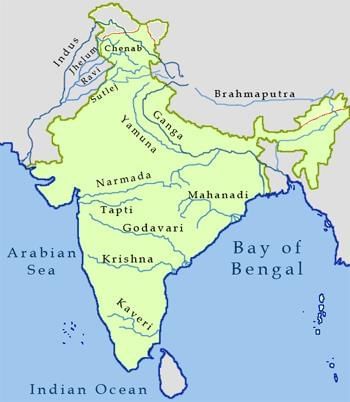
Rivers are like the veins of our country, bringing life wherever they flow. India has many amazing rivers that help people, animals, and plants thrive.
Rivers are very important because they provide water for drinking, farming, and living plants and animals.
Indian rivers mainly flow into two seas: the Bay of Bengal and the Arabian Sea. Examples: – Godavari flows into the Bay of Bengal. – Narmada flows into the Arabian Sea. – Ganga flows into the Bay of Bengal.
Rivers have many smaller rivers joining them called tributaries, and all these together form river basins.
Life in water
Afreen noticed that the rain had filled up the pond near the school grounds. She called out to Jyoti. Let’s see what they noticed.
Many animals and plants live in freshwater bodies like ponds, lakes, and rivers.
Animals living in water usually have fins to swim, and some have gills to breathe underwater.
Animals on LandAnimals in WaterBreathe air with lungsBreathe using gillsWalk on legsSwim with fins or tailsCannot live underwaterLive wholly or partly underwater
Examples of aquatic life:
Dragonfly: lays eggs near water and eats mosquitoes.
Water Scorpion: an insect that lives underwater and breathes using a tail tube.
Pond Heron: a bird that stands still in water to catch fish.
Freshwater Turtle: lives in ponds and slow-moving rivers.
Water Hyacinth: a fast-growing floating plant that spreads quickly on water.
Types of plants in water
There is a rich variety of plants and animals that live in freshwater habitats.
Freshwater plant types: Floating plants: Leaves float on the water surface, roots are in water (e.g., Water Lily, Lotus). Rooted floating plants: Flowers float, but roots are fixed in the soil underwater. Free-floating plants: Float freely on the water surface without roots (e.g., Water Hyacinth).
This reminds us how essential freshwater is for supporting life on Earth.
Leaves have a waxy coating that keeps too much water from soaking in, protecting the plant.