Probe and Ponder
1. Why does it feel harder to pedal a bicycle when going uphill than on flat ground?
Ans:
When cycling uphill, a bicycle has to move against gravity, which pulls both the cycle and the rider downward. More muscular force has to be applied to push the bicycle up the slope as compared to flat ground, where gravity does not resist the forward motion as much. That is why pedaling feels much harder going uphill.
2. Why is it easier to slip on a wet surface?
Ans:
Wet surfaces have less friction compared to dry surfaces. Friction is the force that helps in gripping the ground when walking or moving. When a surface is wet, the thin layer of water reduces the irregularities between the surfaces of shoes and the floor, causing the friction to decrease. With less friction, it is easy to slip and fall.
3. Why do we feel ‘light’ or like we are ‘floating’ just after our swing reaches its highest point and begins to come down?
Ans: At the highest point of a swing’s motion, the swing (and the person on it) stops for a moment before starting to move back down. For that brief moment, the pull of gravity is almost balanced by the upward force of the swing, making a sensation similar to floating or feeling “light.” This happens because, at that instant, the only force acting is gravity and the person is in a state called “free fall.”
4. Share your questions
Ans:
- Why does sliding work better on ice than on sand?
- What would happen if friction did not exist at all?
- Why do heavier objects sink more in water than lighter ones of the same size?
- Does air also provide friction to moving objects?
- Why can some birds fly easily for long periods without getting tired?
Keep the curiosity alive
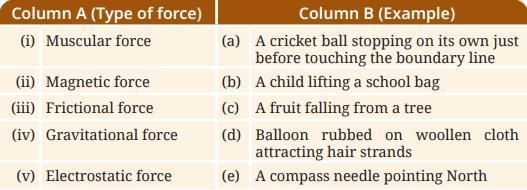
1. Match items in Column A with the items in Column B.
Ans: Column A (Type of force)Column B (Example)(i) Muscular force(b) A child lifting a school bag(ii) Magnetic force(e) A compass needle pointing North(iii) Frictional force(a) A cricket ball stopping on its own just before touching the boundary line(iv) Gravitational force(c) A fruit falling from a tree(v) Electrostatic force(d) Balloon rubbed on woollen cloth attracting hair strands
2. State whether the following statements are True or False.
(i) A force is always required to change the speed of motion of an object.
Ans: True (Force changes speed, direction, or shape).
(ii) Due to friction, the speed of the ball rolling on a flat ground increases.
Ans: False (Friction slows down or stops moving objects).
(iii) There is no force between two charged objects placed at a small distance apart.
Ans: False (Electrostatic force acts between charged objects without contact).
3. Two balloons rubbed with a woollen cloth are brought near each other. What would happen and why?
Ans:
- The two balloons will repel each other.
- This happens because rubbing with woollen cloth gives both balloons the same type of static charge, and like charges push each other away due to electrostatic force.
4. When you drop a coin in a glass of water, it sinks, but when you place a bigger wooden block in water, it floats. Explain.
Ans:
- The coin sinks because its density is higher than water, so the gravitational force pulling it down is stronger than the buoyant force from water pushing it up.
- The wooden block floats because its density is lower than water, making the buoyant force equal to or greater than gravity, keeping it on the surface.
5. If a ball is thrown upwards, it slows down, stops momentarily, and then falls back to the ground. Name the forces acting on the ball and specify their directions.
Ans:
(i) During its upward motion: Gravitational force pulls the ball downward, slowing it down, while the initial throwing force acts upward but weakens.
(ii) During its downward motion: Only gravitational force pulls the ball downward, making it speed up.
(iii) At its topmost position: Gravitational force pulls downward; the ball stops momentarily before falling, with zero speed at that instant.
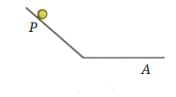
6. A ball is released from the point P and moves along an inclined plane and then along a horizontal surface as shown in the Fig. 5.16. It comes to stop at the point A on the horizontal surface. Think of a way so that when the ball is released from the same point P, it stops
(i) before the point A
(ii) after crossing the point A.
Ans:
(i) To stop before point A, make the surface rougher to increase frictional force, which slows the ball down faster.
(ii) To stop after crossing point A, make the surface smoother to reduce frictional force, allowing the ball to roll farther.
7. Why do we sometimes slip on smooth surfaces like ice or polished floors? Explain.
Ans: We slip on smooth surfaces because there is very little friction between our feet and the surface. Without enough friction to grip and oppose sliding, it’s easy to lose balance and fall.
8. Is any force being applied to an object in a non-uniform motion?
Ans: Yes, a force is applied to an object in non-uniform motion (when speed or direction changes). Force causes these changes, like speeding up, slowing down, or turning.
9. The weight of an object on the Moon becomes one-sixth of its weight on the Earth. What causes this change? Does the mass of the object also become one-sixth of its mass on the Earth?
Ans: The change happens because the Moon’s gravitational force is weaker than Earth’s (about one-sixth). Weight depends on gravity, so it’s less on the Moon. The mass stays the same everywhere, as it’s the amount of matter in the object.
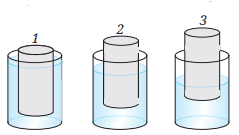
10. Three objects 1, 2, and 3 of the same size and shape but made of different materials are placed in water. They dip to different depths as shown in Fig. 5.17. If the weights of the three objects 1, 2, and 3 are w1, w2, and w3, respectively, then choose the correct relation.
Fig.5.17
(i) w1 = w2 = w3
(ii) w1 > w2 > w3
(iii) w2 > w3 > w1
(iv) w3 > w1 > w2
Ans: (ii) w1 > w2 > w3
Heavier objects sink deeper because their weight overcomes buoyant force more, while lighter ones float higher.
Discover, design, and debate
1. Collect objects made of different materials, such as plastic, wool, silk, rubber, polythene sheet, paper, and metals. Rub one material with another and check if it attracts small pieces of paper or not, that is, whether it gets charged or not. Record your observations in a systematic manner and write a research paper.
Ans:
Collecting and Rubbing Materials: Research on Electrostatic Charging
Experiment Steps:
- Gather materials: plastic scale, wool, silk cloth, rubber balloon, polythene sheet, paper, and metals like an iron key or a coin.
- Rub one material (for example, a plastic scale) with another material (like wool or silk).
- Bring the rubbed object close to small pieces of paper and observe if they are attracted.
Observation Table Example:Material RubbedMaterial Used for RubbingAttracts Paper? (Yes/No)Plastic scaleWoolen clothYesBalloonSilk clothYesPlastic scalePolytheneYesMetal coinWoolen clothNoRubberDry paperNo
Conclusion:
Objects made of plastic, wool, or silk become electrically charged when rubbed together and can attract small pieces of paper. Metals usually do not get charged in this way. This is because some materials transfer electrons when rubbed, creating static electric charges.
2. Imagine a scenario where the gravity disappears. Develop a story. Create a cartoon strip to present your story. z Organise a discussion in your class on the topic: Friction—a necessity or a problem? Make a note of the discussion and state where friction is a necessity and when it is a problem.
Ans:
Story:
One morning, everyone wakes up to find that gravity has vanished! The moment a ball is thrown, it rises up and never comes down. People start floating off their beds and must grab tightly to the doors and furniture. Water in glasses begins to float around in little blobs, and food hovers above plates. Birds try to fly but end up floating higher and higher. Cars and cycles no longer grip the road, and everyone must wear heavy boots to avoid floating away. Animals and plants on Earth start floating as well. Without gravity, life becomes very difficult, and people must come up with clever ways to stay on the ground or inside their houses.
Cartoon Strip:
- Panel 1: A boy throws a ball and it floats up, surprised expression!
- Panel 2: Breakfast cereal and milk floating in the air in a kitchen.
- Panel 3: The family tying themselves to the sofa to watch TV.
- Panel 4: A cat and dog floating among furniture, while the phone, keys, and homework papers hover around.
3. Make your own spring balance with the help of your teacher and calibrate it using standard weights. Now measure the weights of different objects and calculate the ratio of the weight and mass of different objects. Do you observe a pattern?
Ans:
Necessity:
- Friction helps us walk without slipping.
- Allows cars, bicycles, and buses to move and stop safely.
- Needed to write with a pencil or pen.
- Helps in holding and gripping objects.
Problem:
- Friction wastes energy as heat (machines get hot).
- Causes wear and tear of parts in machines, shoes, and tires.
- Makes it harder to move heavy objects.
Conclusion:
Friction is necessary in daily life for grip and safety, but too much friction can make tasks difficult and can damage objects or waste energy.
4. An electroscope is a device which can determine whether an object is electrically charged. You can make your own electroscope (Fig. 5.18) in your class with the help of your teacher, test the device. Explore in what other ways you may use this electroscope.
Ans:
Steps:
- Create a spring balance with help from a teacher, calibrate it using known weights (like 100g, 200g).
- Hang objects (eraser, pencil box, water bottle, stone) and note their weights.
- Measure the mass of the same objects using a digital or beam balance.
Table:ObjectMeasured Mass (g)Measured Weight (N)Weight/Mass (N/g)Eraser500.50.01Pencil box1501.50.01Water bottle30030.01
Pattern:
The ratio of weight to mass is nearly the same for all objects (about 0.01N/g), showing that weight depends on mass and gravity.
5. An electroscope is a device which can determine whether an object is electrically charged. You can make your own electroscope (Fig. 5.18) in your class with the help of your teacher, test the device. Explore in what other ways you may use this electroscope.
Ans:
Steps to Make an Electroscope:
- Use a clean, dry jar with a plastic or cardboard lid.
- Insert a metal wire through the lid; attach thin strips of aluminium foil to the inside end of the wire.
- Charge a plastic scale by rubbing with wool, then bring it close to the exposed end of the wire.
Observation:
When a charged object is brought near the wire, the aluminium strips repel each other and move apart. This indicates the presence of an electric charge.
Other Uses:
- To check if an object is electrically charged or not.
- Can be used to show that charges can transfer from one object to another.
- Can help detect static electricity in different classroom experiments.