Multiple Choice Questions (MCQs)
Instruction: Select the correct option for each question.
 According to this chapter, what starts every good scientific investigation?
a) Expensive lab equipment
b) Memorising facts
c) Asking focused “Why?” and “How?” questions
d) Copying others’ experiments
Answer: c) Asking focused “Why?” and “How?” questions
Curiosity drives science; good questions lead to investigations.- What does “controlling variables” mean in an experiment like puffing a puri?
a) Changing many things at once
b) Changing nothing at all
c) Changing only one factor while keeping others the same
d) Ignoring measurements
Answer: c) Changing only one factor while keeping others the same
This helps identify which factor causes the observed effect. 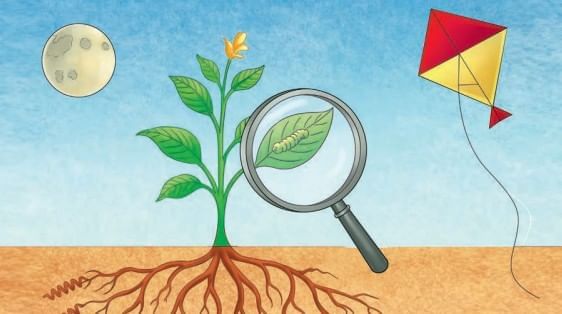 In the “roots and kites” symbol, roots mainly remind us to:
a) Fly kites higher
b) Rely only on imagination
c) Stay grounded in careful observations and facts
d) Ignore data
Answer: c) Stay grounded in careful observations and facts
Roots = solid observations; kites = creative ideas.
Roots and Kites- Which topic best illustrates “the invisible world”?
a) Moon phases
b) Microbes in a drop of water
c) Cyclones
d) Mirrors and lenses
Answer: b) Microbes in a drop of water
They are unseen without microscopes. - Which is NOT a correct match of topic to key idea?
a) Health — immunity and vaccines help prevent disease
b) Electricity — only lighting bulbs, not heating
c) Forces — change speed/direction of objects
d) Pressure and winds — air moves from high to low pressure
Answer: b) Electricity — only lighting bulbs, not heating
Electricity also has heating and magnetic effects. - What is the main reason for doing “one change at a time” in an experiment?
a) To finish faster
b) To make it more exciting
c) To clearly link cause and effect
d) To avoid writing observations
Answer: c) To clearly link cause and effect
This makes conclusions reliable. - Which tool of science is most directly used when you record time to puff a puri?
a) Classifying
b) Measuring
c) Predicting without testing
d) Guessing
Answer: b) Measuring
Measurement turns observations into usable data. - Why do we learn about Moon phases and eclipses under “keeping time with the skies”?
a) For decoration
b) To ignore calendars
c) Because celestial motions helped humans define days, months, years
d) To stop using watches
Answer: c) Because celestial motions helped humans define days, months, years
Sky observations underpin calendars.
Fill in the Blanks
Instruction: Fill in the blanks with the correct word based on the chapter.
- Writing down what you see is called __________.
Answer: recording (or observation)
Notes make results reliable and comparable. - Health is complete physical, mental, and __________ well-being.
Answer: social
This is the WHO view of health. - Air moves from high pressure to __________ pressure to form winds.
Answer: low
Pressure differences drive air flow. - All matter is made of tiny __________ that behave differently in solids, liquids, and gases.
Answer: particles
Arrangement and motion vary by state. - Light can __________ from mirrors and __________ through lenses.
Answer: reflect; refract
These behaviors help us see and focus images. - Watching the Sun and Moon helped humans create __________ to track days and months.
Answer: calendars
Sky motions define time units. - Science balances careful observation with __________ thinking.
Answer: creative
Both are needed for discovery.

Very Short Answer Questions
Instruction: Answer the following questions in one line.
- What two words best start a scientific investigation?
Answer: “Why?” and “How?” - In an experiment, what do we call the factor we deliberately change?
Answer: The variable (independent variable). - Name one measurement you could take in the puri experiment.
Answer: Time taken to puff (in seconds). - Give one reason to keep a science notebook.
Answer: To record observations and compare results later.
Short Answer Questions
Instruction: Answer the following questions in 2–3 lines.
- Why is changing only one variable at a time important?
Answer: It isolates cause and effect. If only one factor changes, we can confidently link any outcome difference to that factor. - How does this chapter connect small observations to big ideas?
Answer: It moves from simple experiments (like puris puffing) to major topics (health, forces, climate), showing the same scientific method applies everywhere. - What skills are highlighted as core to doing science well?
Answer: Asking focused questions, controlling variables, careful observation, measurement, recording, and reasoning from evidence. - Give two example variables for the puri activity.
Answer: Oil temperature and dough thickness (keep other factors constant while testing one).
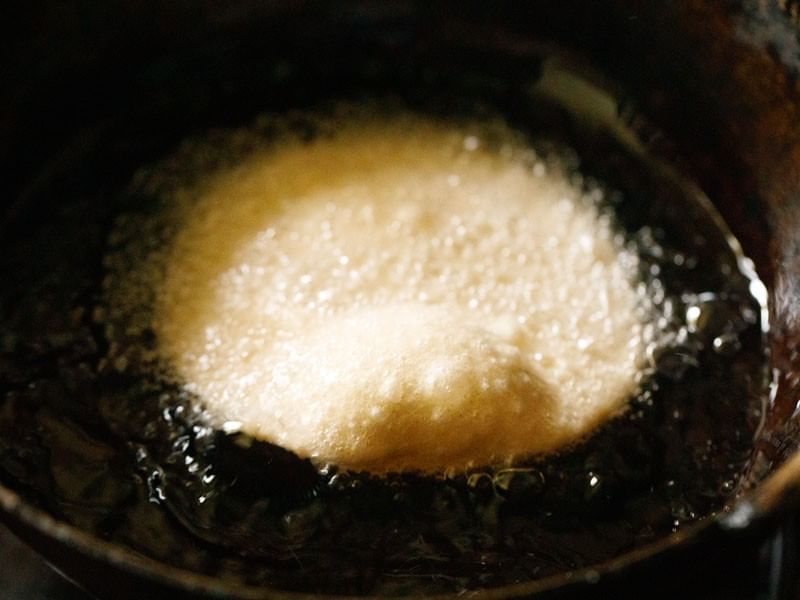
Poori puffing up in Oil
Match the Following
Instruction: Match Column A with the correct option in Column B.
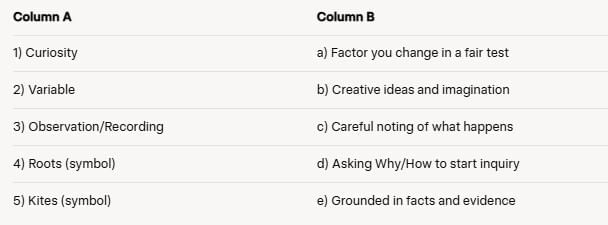
Ans:
- Curiosity — d) Asking Why/How to start inquiry
Explanation: Questions trigger investigations. - Variable — a) Factor you change in a fair test
Explanation: Only one variable changes at a time. - Observation/Recording — c) Careful noting of what happens
Explanation: Data makes conclusions reliable. - Roots (symbol) — e) Grounded in facts and evidence
Explanation: Stay connected to observations. - Kites (symbol) — b) Creative ideas and imagination
Explanation: Let thinking soar to new possibilities.