Multiple Choice Questions (MCQs)
Instruction: Select the correct option for each question.
- Pressure is defined as:
a) Force × area
b) Force / area
c) Area / force
d) Mass × acceleration
Answer: b) Force / area
Pressure is the force applied per unit area (only the perpendicular component counts). - Why do broader bag straps feel more comfortable than narrow ones for the same load?
a) They reduce the force
b) They increase pressure
c) They decrease pressure by increasing area
d) They change the weight
Answer: c) They decrease pressure by increasing area
Same force spread over a larger area gives lower pressure. - SI unit of pressure is:
a) Newton (N)
b) Joule (J)
c) Pascal (Pa)
d) Watt (W)
Answer: c) Pascal (Pa)
1 Pa = 1 N/m². - Liquid pressure at a point depends mainly on:
a) Shape of container
b) Color of liquid
c) Height (depth) of the liquid column
d) Total volume of liquid
Answer: c) Height (depth) of the liquid column
Greater height above the point means greater pressure. - Which activity shows that liquids exert pressure on the walls?
a) Balloon inflating
b) Water jetting sideways from holes in a bottle
c) Magnet attracting iron
d) Ice melting
Answer: b) Water jetting sideways from holes in a bottle
Sideways jets show lateral pressure on walls. 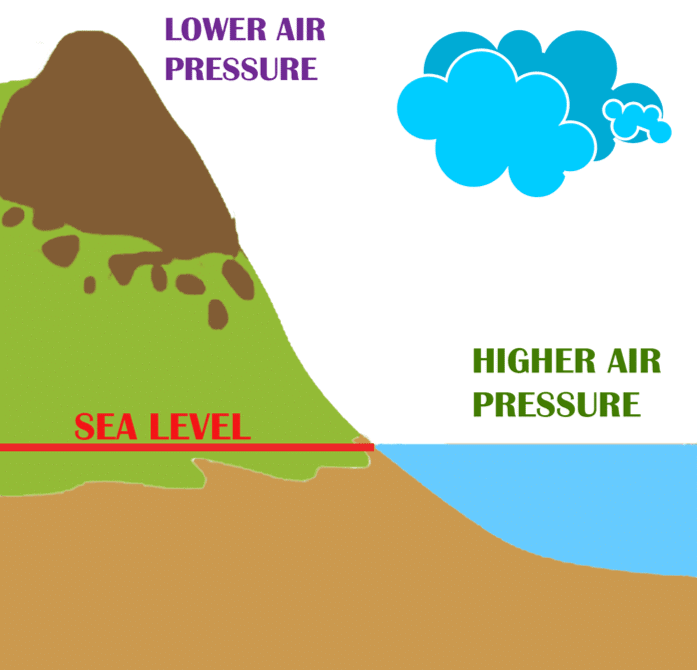 Atmospheric pressure is the pressure exerted by:
a) Water only
b) Rocks of Earth
c) Air around us in all directions
d) Only wind
Answer: c) Air around us in all directions
Air molecules press on surfaces from every side.
Atmospheric Pressure- Air moves from a region of:
a) Low pressure to high pressure
b) High pressure to low pressure
c) High temperature to low temperature only
d) Low density to high density only
Answer: b) High pressure to low pressure
Wind is air flowing from high to low pressure. - During the day at the coast, a sea breeze blows because:
a) Sea heats faster than land
b) Land heats faster; air rises over land creating low pressure
c) Air pressure over sea is always low
d) Earth stops rotating
Answer: b) Land heats faster; air rises over land creating low pressure
Cooler, high-pressure air from sea flows toward land. - High-speed winds between two hanging balloons make them move closer because:
a) Gravity increases
b) Pressure between them increases
c) Pressure between them decreases due to fast air
d) They gain electric charge
Answer: c) Pressure between them decreases due to fast air
Outside higher pressure pushes them together. - Lightning is produced when:
a) Sun heats clouds
b) Charges in clouds and ground discharge suddenly
c) Wind speed becomes zero
d) Air becomes very cold
Answer: b) Charges in clouds and ground discharge suddenly
Charge separation in clouds leads to a bright discharge (lightning).
Fill in the Blanks
Instruction: Fill in the blanks with the correct word based on the chapter.
- Pressure = __________ / area.
Answer: force
Only the perpendicular (normal) force is used for pressure. - Overhead water tanks are placed high to increase water __________ in the pipes.
Answer: pressure
Greater height of water column gives higher outlet pressure. - 1 pascal (Pa) equals 1 __________ per square metre.
Answer: newton
1 Pa = 1 N/m². - Liquids exert pressure at the bottom and also on the __________ of a container.
Answer: walls
Pressure acts in all directions. - At sea level, typical atmospheric pressure is about 1,013 __________ or 1,013 __________.
Answer: mb; hPa
1 mb = 1 hPa = 100 Pa. - Air flows from regions of high pressure to regions of __________ pressure.
Answer: low
This movement is wind; it stops when pressures equalize. - Daytime coastal wind from sea to land is called a __________ breeze.
Answer: sea
Nighttime reverse flow is land breeze. - Lightning conductors safely carry electric charge into the __________.
Answer: ground
They protect buildings by providing a safe path. - The calm, low-pressure center of a cyclone is called the __________.
Answer: eye
Surrounded by a ring of strongest winds and rain. - A sudden rise of sea water pushed by cyclone winds onto land is called a storm __________.
Answer: surge
It can flood coastal areas severely.
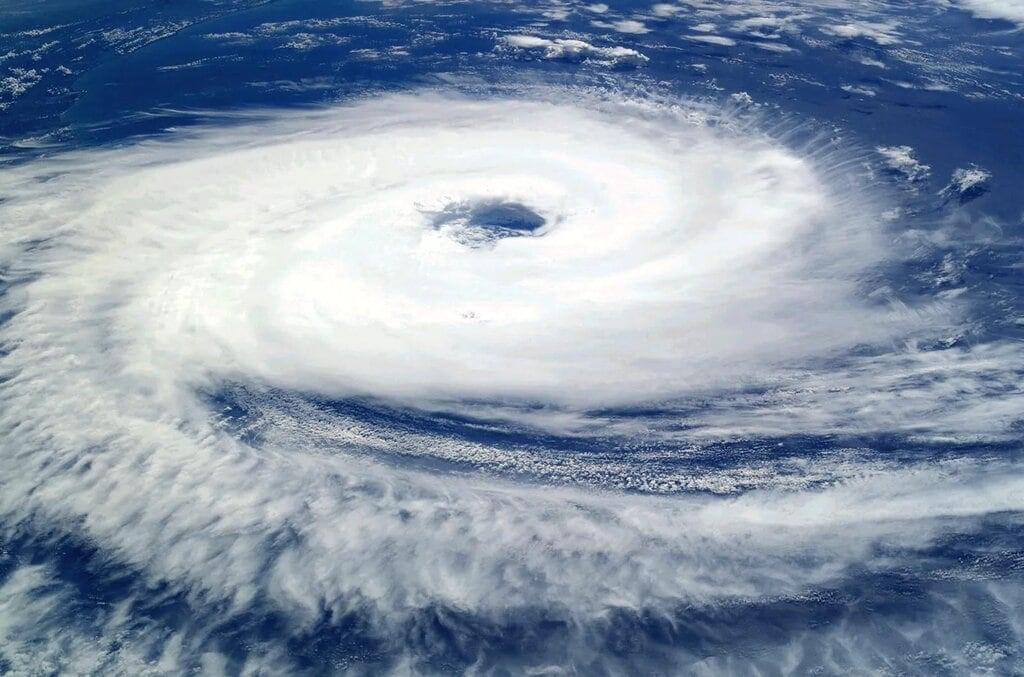
Cyclone
Very Short Answer Questions
Instruction: Answer the following questions in one line.
- Why are dam walls broader at the base?
Answer: Because water pressure increases with depth, so the base must withstand greater sideways pressure. - Why aren’t we crushed by atmospheric pressure?
Answer: Internal body fluids and gases exert equal pressure outward, balancing outside pressure. - What causes a sea breeze?
Answer: Low pressure over warmer land draws in cooler, high-pressure air from the sea. - What simple safety rule helps prevent roofs from blowing off in storms?
Answer: Keep some doors/windows open to equalize inside and outside pressure. - What is a thunderstorm?
Answer: A storm with thunder and lightning due to charge separation in tall clouds.
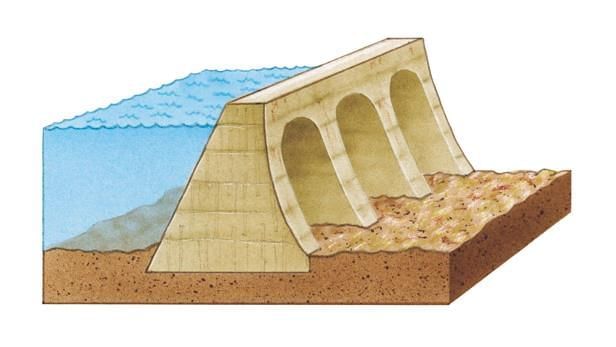
Dams are build borader at Base
Short Answer Questions
Instruction: Answer the following questions in 2–3 lines.
- Explain, with an example, how area affects pressure in daily life.
Answer: Narrow bag straps exert higher pressure (same force on smaller area) causing discomfort, while broad straps reduce pressure and feel comfortable. - How does height of a liquid column affect pressure? Mention one application.
Answer: Greater height gives greater pressure at the bottom (P ∝ depth). Overhead tanks are placed high to supply good water pressure. - Describe briefly how winds are formed.
Answer: Uneven heating creates pressure differences; air flows from high to low pressure. Larger pressure differences produce stronger winds. - How does lightning form inside storm clouds?
Answer: Updrafts and downdrafts make ice and water drops rub and separate charges; a sudden discharge between regions (or to ground) produces lightning. - Why are cyclones dangerous? Give two reasons.
Answer: They bring high-speed winds that damage structures and a storm surge that floods coasts; heavy rains also cause floods and landslides.
Match the Following
Instruction: Match Column A with the correct option in Column B.
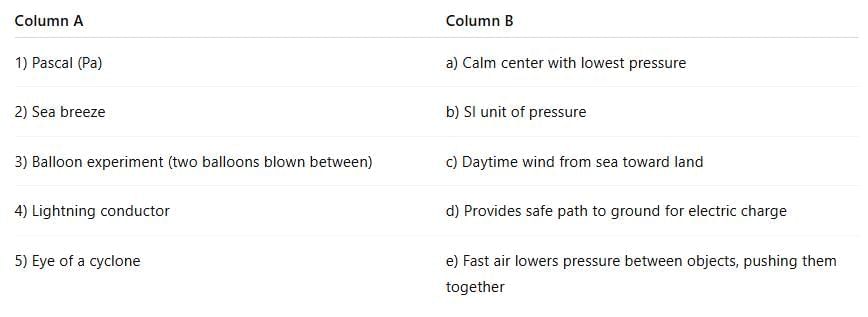
Correct Matches:
- Pascal (Pa) — b) SI unit of pressure
Explanation: 1 Pa = 1 N/m². - Sea breeze — c) Daytime wind from sea toward land
Explanation: Due to lower pressure over warm land. - Balloon experiment — e) Fast air lowers pressure between objects, pushing them together
Explanation: High-speed air reduces pressure; outside pressure moves balloons inward. - Lightning conductor — d) Provides safe path to ground for electric charge
Explanation: Protects buildings during lightning strikes. - Eye of a cyclone — a) Calm center with lowest pressure
Explanation: Surrounding eyewall has strongest winds and rain.