Multiple Choice Questions (MCQs)
Q1: Who is the poet of “Paper Boats”?
a) Anita Rau Badami
b) Rabindranath Tagore
c) G.C. Thornley
d) Natalie Joan
Ans: b) Rabindranath Tagore
The poem is written by Rabindranath Tagore.
Q2: What does the child write on the paper boats?
a) A poem
b) Their name and village
c) A story
d) The names of flowers
Ans: b) Their name and village
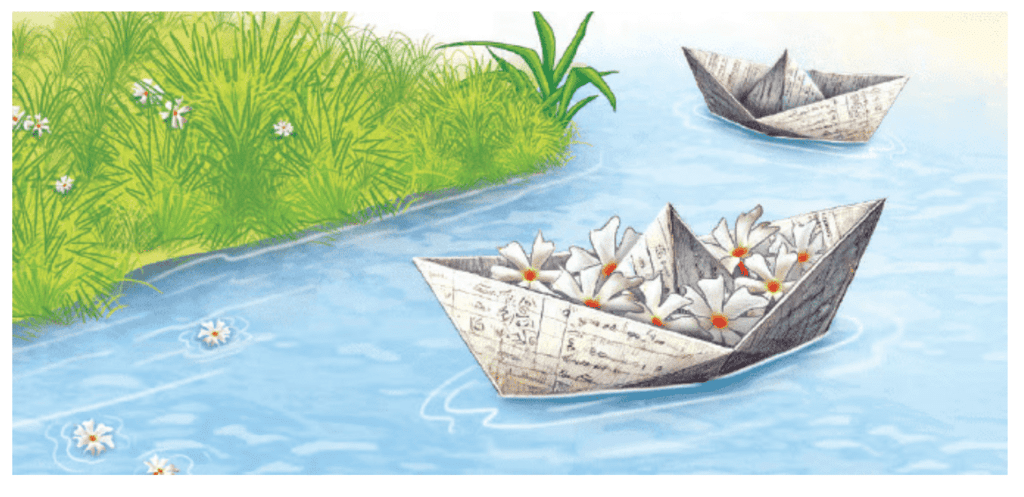
The child writes their name and the name of their village on the paper boats, as described in stanza 2.
Q3: What does the child load onto the paper boats?
a) Shiuli flowers
b) Small stones
c) Letters
d) Clouds
Ans: a) Shiuli flowers
The child loads the paper boats with shiuli flowers from their garden, as stated in stanza 3.
Q4: What does the child see in the sky that looks like sails?
a) Stars
b) Birds
c) Clouds
d) Kites
Ans: c) Clouds
In stanza 4, the child sees clouds in the sky that resemble “white bulging sails,” not stars, birds, or kites.
Q5: What does the word “lading” mean in the poem?
a) A type of flower
b) The load carried
c) A small stream
d) A magical fairy
Ans: b) The load carried
The word “lading” is defined as the load carried, referring to the fairies’ baskets of dreams in the boats.
Fill in the Blank
Q1: The child floats paper boats down a _______ stream.
Ans: running
Q2: The child hopes someone in a _______ land will find the boats.
Ans: strange
Q3: The paper boats carry _______ flowers from the garden.
Ans: shiuli
Q4: In the child’s dream, _______ sail in the boats at night.
Ans: fairies
Q5: The word “blooms” refers to _______.
Ans: flowers
True or False
Q1: The child floats paper boats only once a week.
Ans: False
The child floats paper boats “day by day,” not just once a week.
Q2: The child writes in small letters on the boats.
Ans: False
The child writes in “big black letters” on the boats.
Q3: The poem shows the child’s imagination and dreams.
Ans: True
The poem highlights the child’s imaginative play and dreams, like fairies sailing.
Q4: The clouds in the sky race with the paper boats.
Ans: True
The child imagines the clouds racing with their boats, as described in stanza 4.
Q5: The word “shiuli” means a type of cloud.
Ans: False
“Shiuli” refers to small, white flowers, not clouds.
Very Short Answer Questions
Q1: What is the name of the flower the child puts in the boats?
Ans: Shiuli

Q2: What does the child hope someone will learn from the boats?
Ans: Their name and village
Q3: Who does the child imagine sends the clouds to race with the boats?
Ans: A playmate in the sky
Q4: What is the meaning of the word “launch” in the poem?
Ans: To set in motion
Q5: What is one moral of the poem?
Ans: Small actions carry big dreams
Long Answer Questions
Q1: How does the child’s act of floating paper boats reflect their hopes and dreams?
Ans: The child’s act of floating paper boats reflects their hopes and dreams by serving as a small but meaningful way to reach out to the world. By writing their name and village on the boats, the child dreams of connecting with someone in a “strange land” who will learn about them, showing a longing for recognition and friendship. Loading the boats with shiuli flowers expresses their hope to share beauty and joy with others. The child’s dream of the boats sailing under midnight stars with fairies carrying dreams further reveals their imaginative vision of their creations travelling far, embodying their curiosity and desire to touch distant lives through simple acts.
Q2: Describe the role of nature in the poem and how it connects to the child’s imagination.
Ans: Nature plays a central role in the poem, acting as both a setting and a partner in the child’s imagination. The “running stream” carries the paper boats, symbolising a pathway for the child’s hopes to travel. The shiuli flowers from the garden add natural beauty to the boats, connecting the child’s actions to the earth’s cycles of dawn and growth. The clouds, seen as “white bulging sails,” become playful companions racing with the boats, blending the sky with the child’s game. These natural elements—the stream, flowers, and clouds—fuel the child’s imaginative world, transforming a simple activity into a magical adventure that links their dreams to the broader universe.
Q3: Explain the significance of the fairies and dreams in the final stanza.
Ans: In the final stanza, the fairies of sleep sailing in the paper boats with baskets full of dreams are significant because they elevate the child’s simple act into a magical, eternal journey. The fairies symbolise the gentle, imaginative spirit of childhood, carrying the child’s hopes through a dreamy, starlit night. The “baskets full of dreams” suggest that the boats now hold limitless possibilities, spreading wonder beyond the physical world. This imagery creates a peaceful, hopeful conclusion, showing that the child’s small creations continue to inspire and connect with others in a fantastical realm, even as they sleep.
Q4: What is the moral of the poem, and how does the child’s actions illustrate it?
Ans: The moral of the poem is that small actions can carry big dreams and inspire connections with others. The child’s actions illustrate this through their daily ritual of floating paper boats, each marked with their name and village, symbolising a hope to be known by someone far away. Loading the boats with shiuli flowers shows their desire to share beauty, a small but heartfelt gesture. Their imaginative vision of clouds racing and fairies sailing the boats under stars reflects how their simple play carries grand dreams of adventure and connection, demonstrating that even modest efforts can have far-reaching, meaningful impact.
Q5: Discuss how the poem uses simple actions to create a sense of wonder and connection.
Ans: The poem uses the child’s simple action of floating paper boats to create a sense of wonder and connection by infusing it with imagination and hope. Writing their name and village on the boats turns a playful act into a message to the world, sparking wonder about who might find them. Adding shiuli flowers connects the child’s small world to nature’s beauty, inviting distant strangers to share in it. Imagining clouds as racing playmates and fairies sailing the boats under stars transforms the act into a magical adventure, linking the child to the sky and a dreamlike realm. These straightforward actions evoke a profound sense of curiosity, joy, and connection, showing how small deeds can bridge the child’s heart to faraway places and people.