1. MCQs
Q1: In the Roman numeral system, what number does MCMXLIV represent?
a) 1944
b) 1444
c) 1949
d) 1494
Answer: a) 1944
Q2: If the base of a number system is 7, what is the 4th landmark number after 1?
a) 28
b) 49
c) 343
d) 7
Answer: b) 49
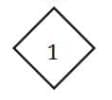
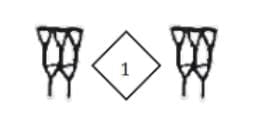
Q3: Symbolis representation for which number?
a) 60
b) 360
c) 3600
d) any multiple of 60
Answer: a) 60
Q4: In a base-8 system, what is the value of the number 345 (base 8) in base-10?
a) 229
b) 228
c) 230
d) 231
Answer: a) 229
Q5: In a base-5 system, the third landmark number after 1 is:
a) 15
b) 25
c) 20
d) 30
Answer: b) 25
2. True / False
Q1: The Bakhshali manuscript contains the earliest known example of the number zero written as a dot.
Ans: True
Q2: Roman numerals can easily be used for multiplication and division.
Ans: False
Q3:The Gumulgal people counted numbers in groups of 2.
Ans: True
Q4: The Lebombo bone is believed to be younger than the Ishango bone.
Ans: False
Q5: In the Egyptian number system, each landmark number is 10 times the previous one.
Ans: True
3. Fill in the blanks
Q1: The ancient counting device made of a frame with rods and beads is called an __________.
Ans: abacus
Q2: In the Roman numeral system, C represents the number __________.
Ans: 100
Q3: The Roman numeral for 1000 is represented as __________.
Ans: M
Q4: The Roman numeral for 50 is represented as __________.
Ans: L
Q5: A number system in which each landmark number is obtained by multiplying the previous landmark number by a fixed number n is called a __________ system.
Ans: base-n
4. Answer the following Questions
Q1. Represent the following numbers in the Roman system.
(i) 1444
Ans: Break it down:
1000 + 400 + 40 + 4 = M + CD + XL + IV
Answer: MCDXLIV
(ii) 1867
Ans: Break it down:
1000 + 800 + 60 + 7 = M + DCCC + LX + VII
Answer: MDCCCLXVII
(iii) 2539
Ans: Break it down:
2000 + 500 + 30 + 9 = MM + D + XXX + IX
Answer: MMDXXXIX
(iv) 948
Ans: Break it down:
900 + 40 + 8 = CM + XL + VIII
Answer: CMXLVIII
Q2. Consider the extension of the Gumulgal number system beyond 6 in the same way of counting by 2s. Come up with ways of performing the different arithmetic operations (+, –, ×, ÷) for numbers occurring in this system, without using Hindu numerals. Use this to evaluate the following:
(i) (ukasar-ukasar-ukasar-urapon) + (ukasar-urapon)
Ans:Break it down:
(2 + 2 + 2 + 1) + (2 + 1) = 7 + 3 = 10
(Gumulgal): ukasar-ukasar-ukasar-ukasar-ukasar
(= ukasar repeated 5 times → 2×5 = 10)
(ii) (ukasar-ukasar-ukasar-ukasar-urapon) − (ukasar-ukasar-urapon)
Ans: Break it down:
(2+2+2+2+1) − (2+2+1) = 9 − 5 = 4
(Gumulgal): ukasar-ukasar
(= 2 + 2 = 4)
(iii) (ukasar-ukasar-ukasar) × (ukasar-urapon)
Ans: Break it down:
(2+2+2) × (2+1) = 6 × 3 = 18
(Gumulgal): (ukasar repeated 9 times)
= 9×2 = 18 → write ukasar nine times:
ukasar-ukasar-ukasar-ukasar-ukasar-ukasar-ukasar-ukasar-ukasar
(iv) (ukasar-ukasar-ukasar-ukasar-ukasar-ukasar) ÷ (ukasar-ukasar)
Break it down:
(2+2+2+2+2+2) ÷ (2+2) = 12 ÷ 4 = 3
(Gumulgal): ukasar-urapon
(= 3)
Q3: Represent the following numbers in the Egyptian system:
(i) 54321
(ii) 8888
(iii) 26005
Ans:

(i)
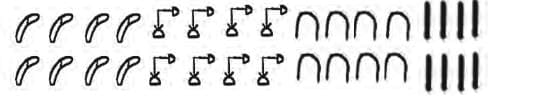
(ii)

(iii)
Q4: Express the number 87 in this base-5 symbolic system.
Ans: Start grouping with the largest landmark number smaller than 87, which is 5² = 25.
We get:
87 = 25 + 25 + 25 + 5 + 5 + 1 + 1
Using the standard symbols:
- 5⁰ = 1 → ▲
- 5¹ = 5 → ■
- 5² = 25 → ⬡
So the number 87 in the new system is:
⬡ ⬡ ⬡ ■ ■ ▲ ▲
Q5: Add : XLVIII + XXXVI
Ans: Step 1: Write all symbols together:
X + L + V + I + I + I + X + X + X + V + I
Step 2: Group and simplify:
- I + I + I + I = IV → but keep as V when grouped
- V + V = X
- X + X + X + X = XL
So the final result is LXXXIV.
Q6: Write Mesopotamian symbol representation for each number.
(i) 58
(ii) 214
(iii) 305
(iv) 499
(v) 7,281
Ans:
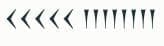
(i) 58
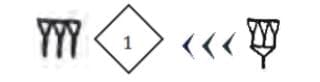
(ii) 214
(iii) 305
Q7: Convert the decimal number 150 to its base-7 representation. Show your working and write the answer using digits from 0 to 6.
Ans: To convert decimal 150 to base-7 :
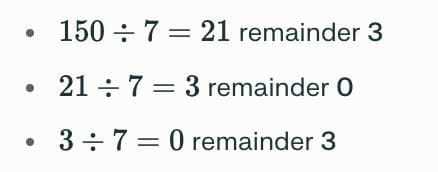
Write the remainders in reverse order: 3 0 3
Q8: Express the number 999 in this new system.
Ans: Largest landmark number smaller than 999 is 5⁴ = 625.
We get:
999 = 625 + 125 + 125 + 125 + (–1) + … wait, no, careful:
Step-by-step:
999 – 625 = 374
Largest ≤ 374 is 125:
374 – 125 = 249
Another 125:
249 – 125 = 124
Largest ≤ 124 is 25:
124 – 25 = 99
Another 25:
99 – 25 = 74
Another 25:
74 – 25 = 49
Another 25:
49 – 25 = 24
Largest ≤ 24 is 5:
24 – 5 = 19
Another 5:
19 – 5 = 14
Another 5:
14 – 5 = 9
Another 5:
9 – 5 = 4
Largest ≤ 4 is 1:
4 – 1 = 3
Another 1:
3 – 1 = 2
Another 1:
2 – 1 = 1
Another 1:
1 – 1 = 0
So:
625 (5⁴) + 125 (5³) × 2 + 25 (5²) × 4 + 5 (5¹) × 4 + 1 (5⁰) × 4
Symbols:
~ ○ ○ ⬡ ⬡ ⬡ ⬡ ■ ■ ■ ■ ▲ ▲ ▲ ▲

Q9. Add the following numerals that are in the base-5 system that we created:
Remember that in this system, 5 times a landmark number gives the next one!
Ans: Let’s convert this to numerals
First numeral (left side)
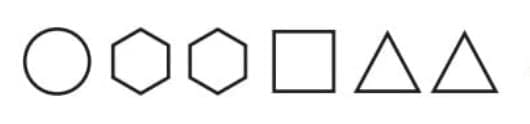
This is: 1 circle, 2 hexagons, 1 square, 2 triangles
Value:
- 1 × 125 = 125
- 2 × 25 = 50
- 1 × 5 = 5
- 2 × 1 = 2
Sum: 125 + 50 + 5 + 2 = 182
Second numeral (right side):

Value:
- 3 × 125 = 375
- 1 × 25 = 25
- 2 × 5 = 10
- 2 × 1 = 2
Sum: 375 + 25 + 10 + 2 = 412
Q10: How would the Mesopotamians have written 20, 50, 100?
Ans: The Mesopotamian (Babylonian) system was a base-60 positional system using symbols for 1 (⟐) and 10 (⟐). Numbers were grouped into powers of 60, with a placeholder for zero in later periods.
Assuming the simplified notation from Section 3.4:
- 20: 20 = 20 × 1 = ⟐⟐ (two 10s).
- 50: 50 = 5 × 10 = ⟐⟐⟐⟐⟐ (five 10s).
- 100: 100 = 1 × 60 + 40 × 1 = ⟐,⟐⟐⟐⟐ (one 60 and four 10s).