1. Multiple Choice Questions (MCQs)Q1: Which of the following is not a property of a square?
(a) All angles are 90°
(b) Opposite sides are parallel
(c) Only one pair of sides is equal
(d) Diagonals bisect each other at 90°
Ans: (c)
Q2: What will be the sum of interior angles of a polygon having 8 sides?
(a) 720°
(b) 1080°
(c) 1260°
(d) 1440°
Ans: (d)
Q3: Which quadrilateral has exactly two distinct consecutive pairs of equal sides?
(a) Kite
(b) Rhombus
(c) Trapezium
(d) Square
Ans: (a)
Q4: The sides of a quadrilateral are in the ratio of 2:5:4:1. Find out the sum of the smallest and largest angles.
(a) 120°
(b) 180°
(c) 240°
(d) 360°
Ans: (c)
Q5: If the area of a square field is 144 sq m, then find the perimeter.
(a) 24 m
(b) 36 m
(c) 48 m
(d) 60 m
Ans: (a)
Q6: If the base of a triangle is 3 cm and the height is 6 cm, then find the area.
(a) 6 sq cm
(b) 9 sq cm
(c) 12 sq cm
(d) 18 sq cm
Ans: (b)
Q7: An isosceles trapezium has:
(a) Both pairs of opposite sides parallel
(b) Non-parallel sides equal in length
(c) Diagonals equal and perpendicular
(d) All sides equal in length
Ans: (b)
Q8: In a parallelogram:
(a) Only one pair of sides is parallel
(b) Opposite sides are equal
(c) Diagonals are always equal in length
(d) All angles are 90°
Ans: (b)
Q9: If the three angles of a quadrilateral are 70°, 90° and 120°, then find the measure of the fourth angle.
(a) 100°
(b) 75°
(c) 80°
(d) 60°
Ans: (c) 80°
Sum of all angles of a quadrilateral = 360°
Let fourth angle = x°
70° + 90° +120° + x = 360°
⇒ 280° + x = 360°
⇒ x = 360° – 280°
Q10: The measure of two adjacent angles of a parallelogram are in the ratio 2:3. Find the measure of each of the angles of a parallelogram.
(a) 72°, 108°
(b) 54°, 112°
(c) 68°, 99°
(d) 86°, 114°
Ans: (a) 72°, 108°
Let the two adjacent angles of parallelogram be 2x, and 3x
Sum of adjacent angles of a parallelogram, 2x + 3x = 180°
⇒ 5x = 180°
⇒ x = 36°
First angle = 2 × 36° = 72°
Second angle = 3 × 36° = 108°
Third angle = 72° and fourth angle = 108°
2. True/False
Q1: A kite has all four sides equal.
Ans: False
Q2: A square is a special type of rectangle and parallelogram.
Ans: True
Q3: The sum of the smallest and largest angles of a quadrilateral, with sides in the ratio 2:5:4:1, is 240°.
Ans: True
Q4: The perimeter of a square field, with an area of 144 sq m, is 48 m.
Ans: True
Q5: The area of a triangle with a base of 3 cm and height of 6 cm is 9 sq cm.
Ans: True3. Fill in the Blanks
Q1: A polygon in which all sides and all angles are equal is called a __________ polygon.
Ans: regular
Q2: The diagonals of a rectangle are equal in length and __________ each other.
Ans: bisect
Q3: In a parallelogram, adjacent angles are __________.
Ans: supplementary
Q4: The diagonals of a rhombus bisect each other at __________ degrees.
Ans: 90
Q5: A trapezium has at least __________ pair of opposite sides parallel.
Ans: one
4. Very Short Answer QuestionsQ1: Can all the angles of a quadrilateral be right angles?
Ans: Yes, all the angles of a quadrilateral can be right angles.
Q2: The sum of all angles in a quadrilateral is equal to_____ right angles.
Ans: 4
Q3: Name the quadrilateral whose diagonals are equal.
Ans: Square, rectangles
Q4: Each angle of a square measures ___°.
Ans: 90°
Q5: How many parallel lines are in a trapezium?
Ans: 2
Q6: Which figure is equiangular and equilateral polygons?
Ans: Square
Q7: It rhombus also satisfied the properties of a_______.
Ans: Parallelogram
Q8: If the diagonals of a quadrilateral are perpendicular bisectors of each other then it is always a______.
Ans: Rhombus
5. Answer the following questions: Q1: A room has a length of 10 m, breadth of 5m and height of 8 m. Find out the area of the room.
Ans: 2×(10+15)×8 sq m
= 400 cm sq
Q2: The length of one side of a rhombus is 6.5 centimeters and its altitude is 10 centimeter. if the length of one side of its diagonals is 26 centimeter find the length of the other diagonal.
Ans: Area = 6.5 × 10 cm sq
= 65sq. Cm
Let, other diagonal = x cm
So, ½ × x ×26 = 65
X=5cm.
Q3: If three angles of a trapezium is 50°, 130° and 120°. Then find the other angle.
Ans: 360°- (50+130+120)°
= 60°
Q4: If two adjacent angles of a parallelogram are in the ratio 2:3 Find all the angles of the parallelogram.
Ans: P = 2x
Q = 3x
So, 5x = 180°
Therefore x = 36°
So, P = 72° and Q = 108°
So R = 72° {opposite of P}
S = 108° {opposite of Q}
Q5: if the angles of a quadrilateral are in the ratio 3 : 6 : 8 : 13. The largest angle is?
Ans: 3x + 6x + 8x + 13x = 360
13X = 150°
Q6: diagonals of a quadrilateral ABCD bisect each other. If A=45°. Then B=?
Ans: A + B = 180°
45° + B = 180°
So, B = 135°
Q7: The angles of a quadrilateral are x°, x+5°, x+10°, x+25°. Then find the value of x.
Ans: X + (x + 5) + (x + 10) + (x + 25) = 360
X=80°
Q8: ABCD is a trapezium such that AB || CD, ∠A : ∠D = 2 : 1, ∠B : ∠C = 7 : 5, find the angles of the trapezium.
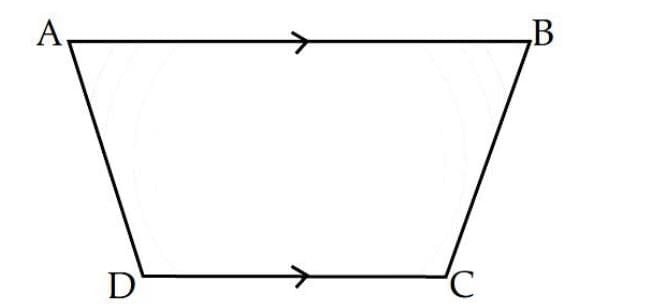
Ans: Let angles ∠A and ∠D be 2x and x.
2x + x = 180°
⇒ 3x = 180°
⇒ x = 60°
∴ ∠A = 2x = 120°
and ∠D = x = 60°
Now, ∠B : ∠C = 7:4
Let ∠A and ∠C be 7x and 5x.
7x + 5x = 180°
⇒ 12x = 180/12 = 15°
∴ ∠B = 7 × 15° = 105°
and ∠C = 5 × 15° = 75°
Q9: ABCD is a parallelogram where m∠A = (2x + 50°) and m∠C = (3x + 40°).
(i) Find the value of x.
(ii) Find the measure of each angle.
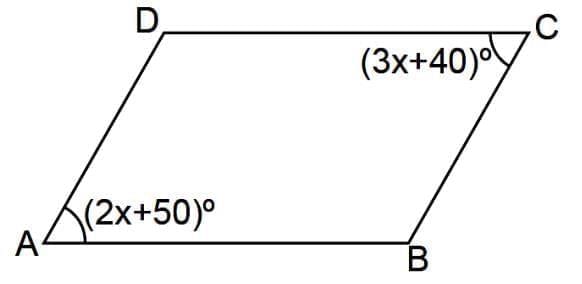
Ans: (i) We know that opposite angles of a parallelogram are equal in measure.
∴ m∠A = m∠C
⇒ 2x + 50° = 3x + 40°
⇒ 2x – 3x = 40° – 50°
⇒ -x = -10° ⇒ x = 10°
(ii) Since x = 10°, then m∠A = 2x + 50° = 2(10°) + 50° = 20° + 50° = 70°
m∠C = 3x + 40° = 3(10°) + 40° = 30° + 40° = 70°
Also m∠A + m∠B = 180° [∵ Sum of the interior angles on the same side of the transversal is 180°]
⇒ 70° + m∠B = 180°
⇒ m∠B = 180° – 70° = 110°
Now m∠B = m∠D [∵ Opposite angles of a parallelogram are equal]
As m∠B = 110°, so m∠D = 110°
Q10: In the below figure, ABCD is a rectangle. Its diagonals meet at O. Find x, if OA = 3x + 1 and OB = 2x + 4.
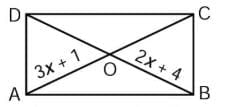
Ans: Since, the diagonals of a rectangle are equal, therefore, AC = BD. ..(i)
The diagonals of a rectangle bisect each other at O.
Therefore, OA = 1/2 × AC and OB = 1/2 × BD …(ii)
From (i) and (ii), we get OA = OB
⇒ 3x + 1 = 2x + 4
⇒ 3x – 2x = 4 – 1 ⇒ x = 3