Q1: What is a Resource? Give two examples.
Ans: Everything available in our environment which can be used to satisfy our needs, provided, it is technologically accessible, economically feasible and culturally acceptable can be termed as a resource. Coal, water, air, minerals etc. are some examples of resources.
Q2: What is the role of humans in resource development?
Ans: (i) Human beings interact with nature through technology and create institutions to accelerate their economic development.
(ii) Human beings transfer material available in our environment into resources and use them.
Q3: How can the resources be classified on the basis of origin?
Ans: Biotic and Abiotic.
- Resources obtained from the biosphere, like forests, wildlife, fisheries, livestock, human beings, etc., which have life, are called biotic resources.
- Resources which are obtained from non-living things are called abiotic resources. Iron, copper, gold and lead are abiotic resources.
Q4: What are abiotic resources?
Ans: All those things which are composed of non–living things are called abiotic resources.
Q5: A gas reserve has been discovered in an Ocean. The reserve is 19 km from the coast of the nation. Will it be considered an international resource or a national resource?
Ans: Resources within 12 nautical miles (22.2 km) from a nation’s coast are considered national resources. Since the gas reserve is 19 km (approximately 10.3 nautical miles) from the coast, it is a national resource.
Q6: “There is enough for everybody’s need and not for anybody’s greed”. Who said these words?
Ans: Mahatma Gandhi
Gandhi believed that Mother Nature offers enough resources for everyone, but human greed leads to unequal distribution, causing socio-economic disparities. He suggested that sharing resources equally could eliminate hunger and thirst for all.
Q7: It is important to use the available land for various purposes with careful planning”. Give reason.
Ans: It is important to use the available land for various purposes with careful planning because land is an asset of a finite resource.
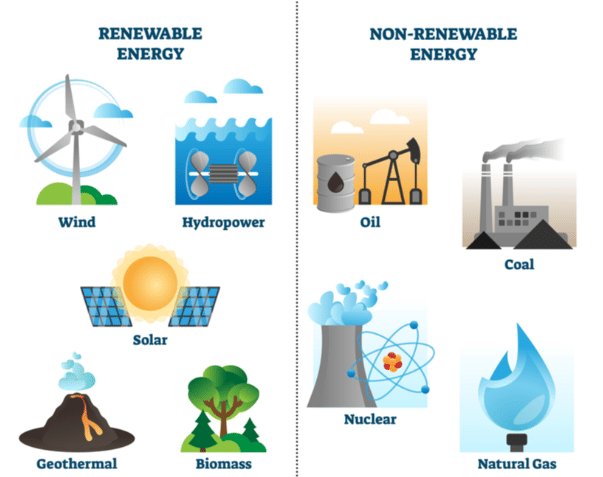
Q8: How can the resources be divided on the basis of exhaustibility?
Ans: Renewable and Non-renewable.
Renewable resources: These resources are unlimited. They are not going to get exhausted, for example, air, light, and wind. These resources get renewed quickly.
Non-renewable resources: The resources which have a limited stock and which take thousands of years to renew or replenish are called non-renewable resources.
Q9: Classify the following resources as biotic and abiotic.
(i) Metals
(ii) Fauna
Ans: (i) Metals – abiotic (ii) Fauna – biotic
Q10: Give a single word for the following :
(i) Materials which have the potential to satisfy human needs but human beings do not have the appropriate technology.
(ii) The resources which can be renewed or reproduced by physical, chemical or mechanical processes.
Ans: (i) Stock
(ii) Renewable
Q11: Name any two states of India which are well endowed with solar energy.
Ans: Gujarat and Rajasthan.
Q12: Name any two factors on which resource development depends.
Ans: (i) Technology
(ii) Quality of human resources.
Q13: What is the total geographical area of India?
Ans: 3.28 million s km.
Q14: Mention any two factors which determine the land use pattern of a nation.
Ans: (i) Topography (ii) Population
Others can be Soil type, Climate
Q15: What is wasteland?
Ans: An unused area of land, like rocky, arid and desert areas.
Q16: What is net sown area?
Ans: The Area sown once a year is known as the net sown area.
Q17: What is gross sown area?
Ans: This represents the total sown area once/or more than once in a particular year, i.e. the area is counted as many times as there are sowings in a year.
Q18: Name any two states which have a high percentage of net sown area.
Ans: Punjab and Haryana
Q19: Name any two states Which have a very low percentage of net sown area.
Ans: Arunachal Pradesh and Mizoram
Q20: How much degraded land is present in India ?
Ans: 130 million hectares.