Q1: Give three reasons for the civil war in Sri Lanka.
Ans: The following were the reasons for the civil war in Sri Lanka:
- Language discrimination: Sinhala was declared the only official language, which ignored the Tamil language.
- Employment bias: Preference was given to Sinhala speakers for government jobs and military positions.
- Religious favouritism: Buddhism was established as the official religion, marginalising other faiths.
Q2: Why is power-sharing desirable in a democracy or any other system of government?
Ans: Power-sharing is desirable in a democracy and other systems of government for several reasons:
- Reduces conflict: Distributing power among various social groups lowers the risk of conflict.
- Ensures stability: It contributes to a stable political order, promoting national unity.
- Encourages participation: Involving citizens in governance makes them feel invested in the system, enhancing the government’s legitimacy.
Q3: Describe the power-sharing in Lebanon.
Ans: Power-sharing in Lebanon is characterised by a complex system designed to maintain balance among various religious communities:
- The President must be a Maronite Christian.
- The Prime Minister is always a Sunni Muslim.
- The Deputy Prime Minister is allocated to the Orthodox Christian sect.
- The Speaker of Parliament is reserved for Shia Muslims.
Furthermore:
- Christians agreed to forfeit French protection.
- Muslims agreed to refrain from pursuing unification with Syria.
Q4: Why is power sharing essential for a democracy?
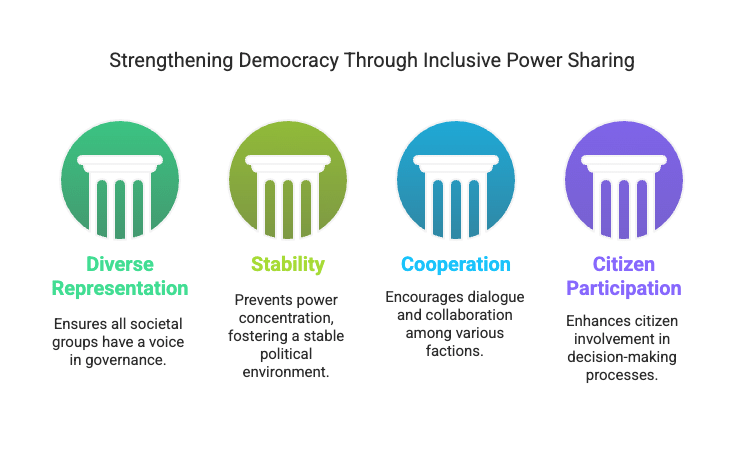
Ans: Power sharing is vital for democracy because it:
- Ensures representation of diverse groups in society.
- Promotes stability by preventing the concentration of power.
- Encourages cooperation and dialogue among different factions.
- Enhances citizen participation in governance.
By distributing power, democracy becomes more inclusive and responsive to the needs of all citizens.
Q5: In the Flemish region which language did the majority of the people speak?
Ans: The majority of people in the Flemish region speak the Dutch language.
Q6: What is the power of the community government in Belgium?
Ans: The community government in Belgium has significant powers in several key areas:
- Cultural matters: Manages cultural institutions and promotes activities.
- Education: Oversees the education system, including schools and curricula.
- Language: Regulates language use and policies within its jurisdiction.
This decentralisation enables communities to effectively address local needs.
Q7: In a democracy power sharing is ensured in the presence of political parties and pressure groups. Explain.
Ans: In a democracy, political parties are essential for distributing power. Here’s how they contribute:
- Competition: Political parties compete for power, allowing each a fair chance to govern.
- Coalitions: When no party achieves a clear majority, parties may form coalition governments to share power.
- Interest Groups: Various groups, including workers and business owners, influence government decisions, enhancing power sharing.
This system ensures that diverse voices and interests are represented in governance.
Q8: Can dividing power lead to the weakening of a country?
Ans: No, dividing power cannot lead to the weakening of a country.
In fact, the division of power:
- Protects the rights of minorities.
- Prevents the tyranny of the majority.
- Promotes national integration.
- Increases citizens’ sense of safety and security.
Overall, a system of divided power supports a more democratic society.
Q9: Describe any three forms of power sharing in modern democracies.
Ans: Three forms of power sharing in modern democracies:
- Separation of Powers: Power is divided among the different branches of government, including the legislature, executive, and judiciary.
- Federalism: Authority is shared between a central government and regional or provincial governments, promoting local governance.
- Social Group Representation: Different social groups, such as religious and linguistic communities, share power. For instance, Belgium has a community government to represent these groups.
Q10: Write one prudential and one moral reason for power sharing.
Ans: Prudential reason for power sharing: Power sharing helps to:
- Reduce social conflicts between groups with different interests.
- Avoid violence and political instability.
- Maintain a stable political order.
Moral reason for power sharing: Power sharing reflects the essence of:
- Democracy by involving those affected by decisions.
- Allowing people to have a say in governance.