About the Poet
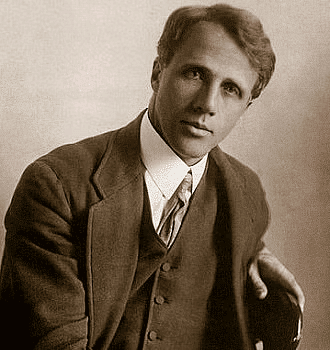
Robert Lee Frost (March 26, 1874 – January 29, 1963) was an American poet. His work was initially published in England before it was published in the United States. Known for his realistic depictions of rural life and his command of American colloquial speech, Frost frequently wrote about settings from rural life in New England in the early 20th century, using them to examine complex social and philosophical themes.
Key Points of the Poem
- The poem consists of 2 stanzas. Each of these stanzas is made up of 4 lines. Thus, the entire poem consists of 8 lines in total.
- The poem describes a very simple happening in very simple words.
- It tells us that sometimes even a small incident may prove to be of a larger significance.
- The poet is upset at the beginning of the poem but a small incident of falling of snow changes his mood totally.
- In the end of the poem the poet feels relaxed and thankful to nature for saving his day from being wasted.
Detailed Summary
Stanza 1
The way a crow
Shook down on me
The dust of snow
From a hemlock tree
In this poem, the poet is talking about a winter’s day when all the treetops were covered with snowflakes. The poet was walking under one such snow-covered tree. This was a Hemlock tree. The hemlock tree is usually associated with poison and toxicity as a poison named hemlock is also derived from it. Thus, this tree cannot be associated with anything positive. However, a crow came and sat down on this tree suddenly, and because of this sudden motion, the mass of snowflakes from the top fell on the poet like rain. The snowflakes were so light and small that the poet thought they looked like white and immaculate dust particles, though usually not white. This shower of snowflakes from the hemlock tree is the subject matter of this poem since it touched the poet in some way.

Stanza 2
Has given my heart
A change of mood
And saved some part
Of a day I had rued.
Now in the second stanza, the poet explains exactly in what way the shower of snowflakes had an effect on him. He says that it changed his mood. Earlier, he had been in a despairing mood but the shower of the snowflakes falling on him all of a sudden gladdened his heart. In addition to this, there was another effect that the shower of snowflakes had on the poet. He says that particular day was one he hadn’t been looking forward to, and it hadn’t been going well either.
He had decided, in his mind, that that particular day would go to waste. However, the shower of dust like snow on his shoulder changed his mind. It made him feel that the day had not been a complete waste. At least some part of that day had been pleasant since it had given him a new experience that he could treasure as well as the material for another one of his wonderful poetic compositions.
Try yourself:
What effect did the shower of snowflakes have on the poet?
- A.It reminded him of summer.
- B.It changed his mood.
- C.It made him cold.
- D.It made him angry.
View Solution
Theme/ Message
Theme
- Nature’s Influence: The poem explores the transformative power of nature.
- Unexpected Redemption: A seemingly mundane incident, like a crow shaking snow on the poet, leads to a positive change.
- Symbolism: The dust of snow symbolizes a moment of clarity or inspiration that changes the speaker’s perspective.
- Simplicity and Beauty: The poem highlights the beauty in simple, everyday moments and the potential for these moments to bring joy.
- Escape from Melancholy: The poem suggests that even a small event in nature can lift one’s spirits and provide a respite from life’s difficulties.
Message
- This poem conveys the message that nothing in life is small. Even trivial things can bring positive changes in our life.
- If we take things positively in life, situations do change for better. Even the small help or good gestures we do for others make large differences.
Literary Devices
- Rhyme Scheme– ababcdcd
- Imagery: Visual images like the crow shaking snow from a hemlock tree and the ‘dust of snow’ falling on the poet highlight nature’s impact on mood.
- Alliteration: Repetition of initial consonant sounds in closely placed words, e.g.,
Has given my heart
And saved some part - Symbolism: The crow and hemlock tree, usually seen as negative, symbolize sorrow and death but are used to show how even grim elements of nature can uplift the mood.
- Inversion: When the structure of a sentence is changed by the poet to create a rhyme, the poetic license is called inversion. In stanza 1, the poetic device ‘inversion’ is used.
- Enjambment: In enjambment, the same sentence continues to the next line without the use of any punctuation marks.
This poem is very good example of this poetic device. It is used throughout the poem. The lines of stanzas flow to the next line without any punctuation. - Metaphor: “Dust of snow” metaphorically compares snowflakes to dust, symbolizing a small but meaningful event.
- Synecdoche: The word “heart” is used to represent the poet’s entire emotional state.
- Assonance: Repetition of vowel sounds, e.g., the ‘o’ sound in
“Shook down on me.”
Difficult Words
- Way—manner
- Dust—very small particles
- Dust of snow— small white flakes falling on earth
- Shook – to move with short quick movements from side to side or up and down
- Shook down—shook the snow dust down
- Hemlock—a poisonous plant with fernlike leaves and white flowers
- Give heart – make happy and confident
- Has given my heart – has created impact on my heart and made me feel happy and confident
- Mood—state of mind
- A change of mood—a change in the present condition of mind
- Saved—saved from being wasted
- Part—portion, fraction
- Rued—regretted deeply, felt sad deeply, lamented