Exponential Notation
Definition: Shorthand for repeated multiplication of the same number.
Examples:
- n² = n × n
- n³ = n × n × n
- n⁴ = n × n × n × n
Algebra:
- a³ × b² = a × a × a × b × b
- a² × b⁴ = a × a × b × b × b × b
Important Note: Addition is not exponent:
- 4 + 4 + 4 = 3 × 4 = 12
- 4 × 4 × 4 = 4³ = 64
Prime Factorization and Exponential Form
Prime factorization is expressing a number as a product of its prime numbers.
Exponential form is writing repeated prime factors using powers.
Steps to Express in Exponential Form
- Find the prime factors of the number.
- Group the same factors together.
- Write each group as a power.
- Combine to get the exponential form.
Example: Express 32,400 in exponential form
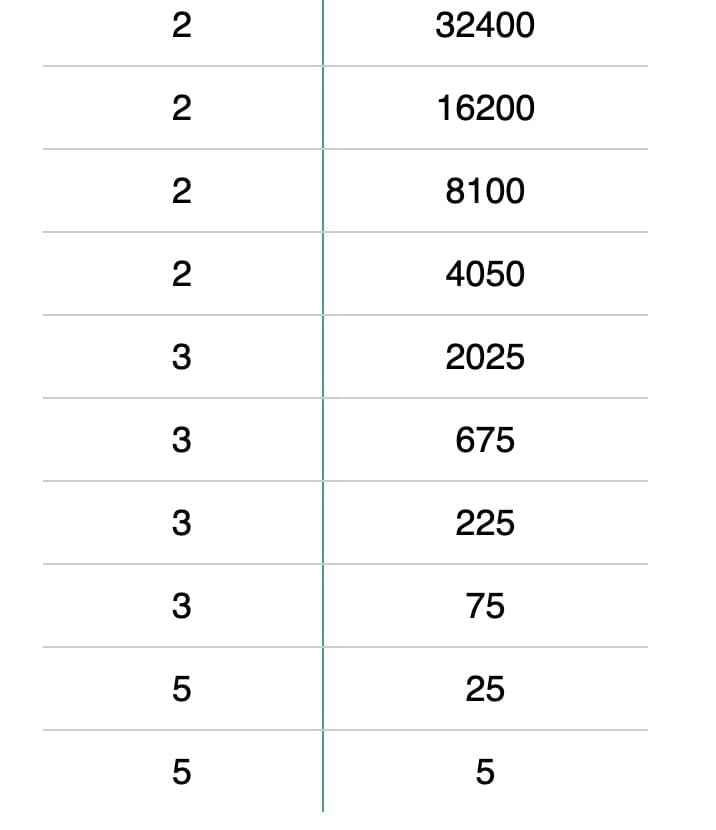
1. Prime Factorization:
32,400 = 2 × 2 × 2 × 2 × 3 × 3 × 3 × 3 × 5 × 5
2. Group factors:
- 2 × 2 × 2 × 2 = 2⁴
- 3 × 3 × 3 × 3 = 3⁴
- 5 × 5 = 5²
3. Exponential Form:
32,400 = 2⁴ × 3⁴ × 5²
Quick Tip: Prime factorization is useful for finding HCF, LCM, and simplifying roots of numbers.
Laws of Exponents: Multiplication and Division of Powers
1. Multiplying Same Bases
- Rule: Add the exponents
- Formula: nᵃ × nᵇ = nᵃ⁺ᵇ
- Example: p⁴ × p⁶ = p¹⁰
2. Power of a Power
- Rule: Multiply the exponents
- Formula: (nᵃ)ᵇ = nᵃ×ᵇ
- Example: (2⁵)² = 2¹⁰
3. Dividing Powers with Same Base
- Rule: Subtract the exponents (denominator from numerator)
- Formula: nᵃ ÷ nᵇ = nᵃ⁻ᵇ, n ≠ 0
- Example: 2⁴ ÷ 2³ = 2¹
4. Negative Powers
- Rule: Reciprocal of the positive power
- Formula: n⁻ᵃ = 1 ÷ nᵃ
- Example: 3⁻² = 1 ÷ 3² = 1/9
5. Zero Exponent
- Rule: Any non-zero number to the power 0 is 1
- Formula: x⁰ = 1, x ≠ 0
- Example: 7⁰ = 1
6. Multiplying Different Bases with Same Exponent
- Rule: Multiply the bases, keep the exponent
- Formula: mᵃ × nᵃ = (m × n)ᵃ
- Example: 2³ × 5³ = (2 × 5)³ = 10³
7. Dividing Different Bases with Same Exponent
- Rule: Divide the bases, keep the exponent
- Formula: mᵃ ÷ nᵃ = (m ÷ n)ᵃ
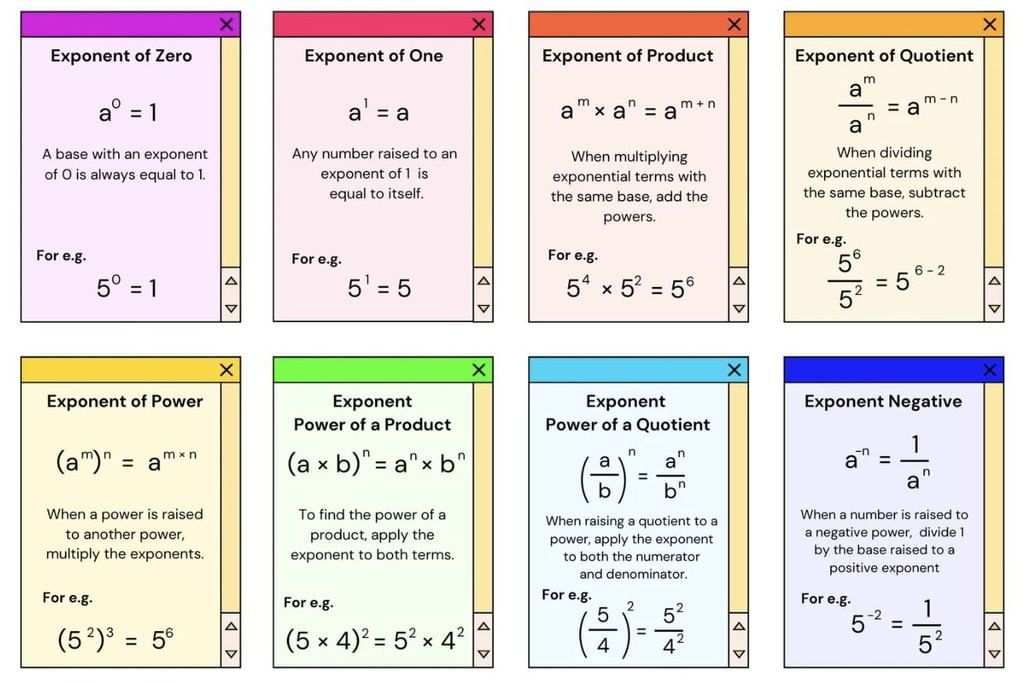 Example: 8² ÷ 2² = (8 ÷ 2)² = 4²
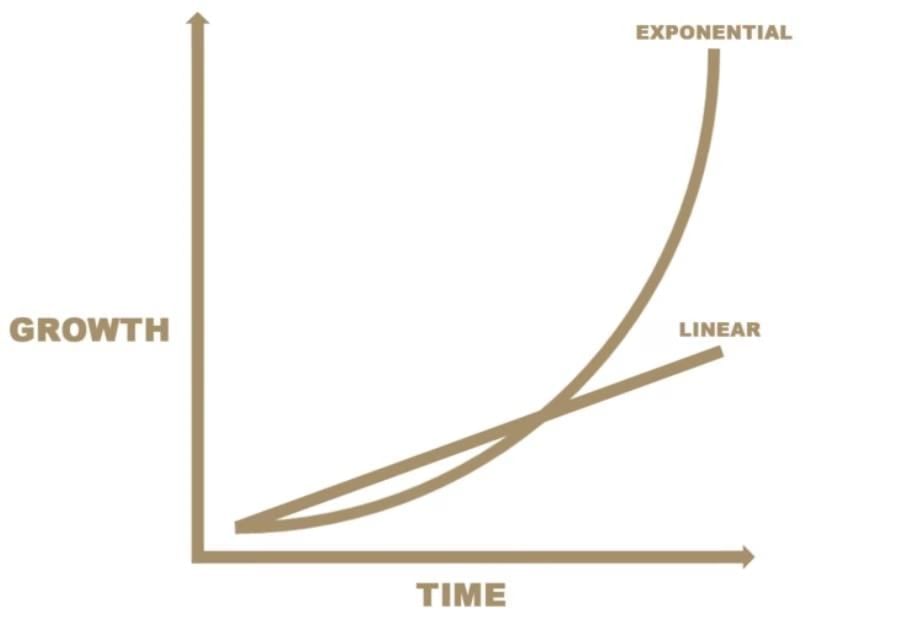
Linear vs. Exponential Growth
1. Linear Growth
Description: Adds a fixed amount per step.
Example:
- Distance to the Moon: 384,400 km = 384,400,000 m
- Step size: 20 cm = 0.2 m
- Number of steps:
384,400,000 / 0.2 = 1,922,000,000 steps = 1.922 × 10⁹
2. Exponential Growth
Description: Multiplies by a fixed factor per step.
Example: Paper folding to the Moon:
- Initial thickness: 0.001 cm
- Number of folds: 46
- Thickness:
T = 0.001 × 2⁴⁶ ≈ 7,036,874,841,600 cm ≈ 703,687.48 km
Powers of 10 and Scientific Notation
1. Expanded Form Using Powers of 10
For Whole Numbers:
Example: 47,561
- Expanded form:
4 × 10⁴ + 7 × 10³ + 5 × 10² + 6 × 10¹ + 1 × 10⁰
For Decimals:
Example: 561.903
- Expanded form:
5 × 10² + 6 × 10¹ + 1 × 10⁰ + 9 × 10⁻¹ + 0 × 10⁻² + 3 × 10⁻³
2. Scientific Notation
Any number can be written as: x × 10ʸ, where:
- x = coefficient (usually between 1 and 10)
- y = exponent (shows the scale of the number)
Examples:
- 5,900 → 5.9 × 10³
- 8,000,000 → 8 × 10⁶
Importance of Exponent: Determines scale; coefficient adjusts precision.

Importance of the Exponent
- Exponent (y) determines the scale or magnitude of the number.
- Coefficient (x) adjusts precision for significant digits.
Large Numbers in Nature
- Human population (2025) = 8 × 10⁹
- African elephants = 4 × 10⁵ → ~20,000 people per elephant
- Grains of sand on Earth ≈ 10²¹
- Stars in observable universe ≈ 2 × 10²³
- Drops of water on Earth ≈ 2 × 10²⁵
Fun Fact:
- 10⁶ seconds ≈ 11.6 days
- 10⁹ seconds ≈ 31.7 years