Previous Year Questions 2025
Q1: If (-1)n + (-1)8 = 0, then n is: (2025)
(a) any positive integer
(b) any negative integer
(c) any odd number
(d) any even number
Ans: (c)
We have,
(-1)n + (-1)8 = 0 ⇒ (-1)n + 1 = 0 ⇒ (-1)n = (-1)
On comparing the powers, we get n = 1, 3, 5, ……….
∴ Hence, n is any odd number.
Q2: Which of the following cannot be the unit digit of 8n, where n is a natural number? (2025)
(a) 4
(b) 2
(c) 0
(d) 6
Ans: (c)
8n = (2 × 2 × 2)n
Since, factors of 8n do not contain 5 in it.
So, 8n can’t ends with 0.
⇒ 0 can’t be the unit digit of 8n.
Q3: If x is the LCM of 4, 6, 8 and y is the LCM of 3, 5, 7 and p is the LCM of x and y, then which of the following is true? (2025)
(a) p = 35x
(b) p = 4y
(c) p = Bx
(d) p = 16y
Ans: (a)
LCM (4, 6, 8) = x = 24
LCM (3, 5, 7) = y= 105
LCM (x, y) = p = LCM (24, 105) = 840
∴ p = 840 = 35 × 24 = 35x
Q4: If HCF (98, 28) = m and LCM (98, 28) = n, then the value of n – 7m is: (2025)
(a) 0
(b) 28
(c) 98
(d) 198
Ans: (c)
98 = 2 × 72, 28 = 22 × 7
∴ LCM (98, 28) = 22 × 72 = 196
⇒ n = 196
HCF (98, 28) = 2 × 7 = 14
⇒ m = 14
∴ n – 7m = 196 – 7 × 14 = 196 – 98 = 98
Q5: The greatest number which divides 70 and 125, leaving remainders 5 and 8 respectively, is: (2025)
(a) 13
(b) 65
(c) 875
(d) 1750
Ans: (a)
We have to find the H.C.F of 70 – 5 = 65 and 125 – 8 = 117.
∴ 65 = 5 × 13, 117 = 32 × 13
⇒ HCF (65, 117) = 13
∴ Required greatest number = 13.
Q6: Assertion (A): For any two prime numbers p and q, their HCF is 1 and LCM is p + q.
Reason (R): For any two natural numbers, HCF x LCM = product of numbers.
(a) Both Assertion (A) and Reason (R) are true and Reason (R) is correct explanation of Assertion (A).
(b) Both Assertion (A) and Reason (R) are true, but Reason (R) is not the correct explanation of Assertion (A).
(c) Assertion (A) is true, but Reason (R) is false.
(d) Assertion (A) is false, but Reason (R) (ii) is true. (2025)
Ans: (d)
Clearly, reason is true.
For any two primes p and q.
HCF (p, q) = 1
LCM (p, q) = p × q
∴ Assertion is false.
Q7: Find the smallest number that is divisible by both 644 and 462. (2025)
Ans:
The smallest number divisible by both 644 and 462 is LCM of 644 and 462.
644 = 2 × 2 × 7 × 23
462 = 2 × 3 × 7 × 11
∴ LCM (644,462) = 2 × 2 × 3 × 7 × 11 × 23 = 21252
Q8: Two numbers are in the ratio 4: 5 and their HCF is 11. Find the LCM of these numbers. (2025)
– Ans: Let two numbers be 4x and 5x.
HCF (4x, 5x) = 11
∴ Numbers are 4 × 11 = 44 and 5 × 11 = 55
Since, product of two numbers= HCF × LCM
⇒ 44 × 55 = 11 × LCM 
Q9: Three sets of Physics, Chemistry and Mathematics books have to be stacked in such a way that all the books are stored subject-wise and the height of each stack is the same. The number of Physics books is 144, the number of Chemistry books is 180 and the number of Mathematics books is 192. Assuming that the books are of same thickness,determine the number of stacks of Physics, Chemistry and Mathematics books. (2025)
Ans:
Number of Physics books = 144
Number of Chemistry books = 180
Number of Mathematics books = 192
Since, 180 = 2 × 2 × 3 × 3 × 5
144 = 2 × 2 × 2 × 2 × 3 × 3
192 = 2 × 2 × 2 × 2 × 2 × 2 × 3
∴ HCF(180, 144, 192) = 2 x 2 x 3 = 12
∴ Number of stacks of Physics books = 144/12 = 12
Number of stacks of Chemistry books = 180/12 = 15
Number of stacks of Mathematics books = 192/12 = 16
Q10: Let p, q and r be three distinct prime numbers.
Check whether p·q·r + q is a composite number or not.
Further, give an example for 3 distinct primes p, q, r such that
(i) p·q·r + 1 is a composite number.
(ii) p·q·r + 1 is a prime number. (2025)
Ans:
Given: p, q, r be distinct prime numbers.
We have, pqr + q = q(pr + 1)
Here, q is a prime number and pr+ 1 > 1,
Thus, pqr + q has factors 1, q, (pr+ 1) and q(pr + 1).
Hence, pqr + q is a composite number. …(i)
(i) Take p = 3, q = 5 and r = 7, we have
pqr + 1 = 3 × 5 × 7 + 1 = 105 + 1 = 106
Thus, pqr + 1 is a composite number for p = 3, q = 5 and r = 7.
(ii) Take p = 2, q = 3 and r = 5, we have
pqr + 1 = 2 × 3 × 5 + 1 = 30 + 1 = 31
Thus, pqr + 1 is a prime number for p = 2, q = 3 and r = 5.
Q11:is a/an (2025)
(a) natural number
(b) integer
(c) rational number
(d) irrational number
Ans: (d)
∵ 2 is a rational number and
 is an irrational number.
 ∴
 is an irrational number.
Q12: Which of the following is a rational number between √3 and √5? (2025)
(a) 1.4142387954012. …
(b)
(c) π
(d) 1.857142
Ans: (d)
√3 is approximately equals to 1.7320.
√5 is approximately equals to 2.2360.
Here 1.857142 lies between √3 and √5.
Q13: Prove thatis an irrational number given that √3 is an irrational number. (2025)
Ans: It is given that, √3 is an irrational number.
We have to prove that  is an irrational number. 3
Let us assume  be a rational number.
Then,  where b ≠ 0 and a, b are co-prime integers.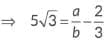
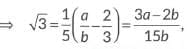 which is a rational number.
⇒ √3 is a rational number.
But √3 is an irrational number. So, our assumption is wrong.
Hence,  is an irrational number.
Q14: Prove thatis an irrational number given that √2 is an irrational number. (2025)
Ans:
It is given that, √2 is an irrational number.
We have to prove that  is an irrational number.
Let us assume  be a rational number.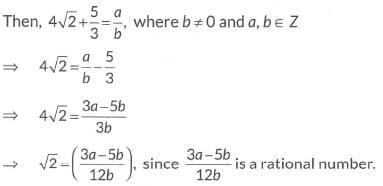
⇒√2 is a rational number.
But √2 is an irrational number. So, our assumption is wrong.
Hence, is an irrational number.
Previous Year Questions 2024
Q1: The smallest irrational number by which √20 should be multipled so as to get a rational number, is: (CBSE 2024)
(a) √20
(b) √2
(c) 5
(d) √5
Ans: (d)

Q2: The LCM of two prime numbers p and q (p > q) is 221. Then the value of 3p – q is: (CBSE 2024)
(a) 4
(b) 28
(c) 38
(d) 48
Ans: (c)
The numbers p and q are prime numbers,
∴ HCF (p, q) = 1
Here, LCM(p, q) = 221
∴ As, p > q
p = 17, q = 13
(As p × q = 221)
Now, 3p – q = 3 × 17 – 13
= 51 – 13
= 38
Q3: A pair of irrational numbers whose product is a rational number is (CBSE 2024)
(a) (√16, √4)
(b) (√5, √2)
(c) (√3, √27)
(d) (√36, √2)
Ans:(c)
Here √3 and √27 both are irrational numbers.
The product of √3 x √27 = √3 x 27
= √81
= 9 ,= pq;q ≠ 0
∴ 9 is a rational number.
Q4: Given HCF (2520, 6600) = 40, LCM (2520, 6600) = 252 × k, then the value of k is: (CBSE 2024)
(a) 1650
(b) 1600
(c) 165
(d) 1625
Ans:(a)
HCF(2520, 6600) = 40
LCM(2520, 6600) = 252 × k
∴ HCF × LCM = Ist No. × IInd No.
∴ 40 × 252 × k = 2520 × 6600
⇒ k = 2520 x 660040 x 252
⇒ k = 1650
Q5: Teaching Mathematics through activities is a powerful approach that enhances students’ understanding and engagement. Keeping this in mind, Ms. Mukta planned a prime number game for class 5 students. She announced the number 2 in her class and asked the first student to multiply it by a prime number and then pass it to the second student. The second student also multiplied it by a prime number and passed it to the third student. In this way by multiplying by a prime number, the last student got 173250.
Now, Mukta asked some questions as given below to the students: (CBSE 2024)
(A) What is the least prime number used by students?
(B) How many students are in the class?
OR
What is the highest prime number used by students?
(C) Which prime number has been used maximum times?
Ans:
(A)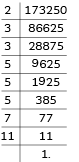
So least prime no. used by students = 3(because 2 is announced by the teacher, so the least number used by the students is 3)
(B)As the last student got 173250 = 2 × 3 × 3 × 5 × 5 × 5 × 7 × 11
there are 7 factors other than 2, which is announced by teacher. So, Number of student = 7
OR
Highest prime number used by student = 11
(C)Prime number 5 is used maximum times i.e., 3 times.
Q6: LCM (850, 500) is: (CBSE 2024)
(a) 850 × 50
(b) 17 x 500
(c) 17 x 52 x 22
(d) 17 × 53 × 2
Ans: (b) 17 x 500 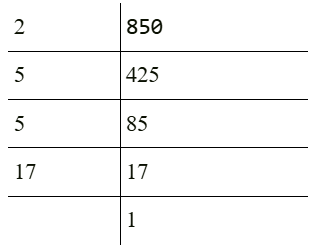
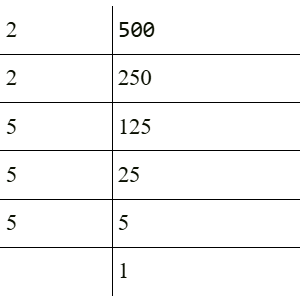
850 = 17 × 52 × 2
500 = 53 × 22
LCM (850, 500) = 17 × 53 × 22
= 17 × 500
=8500
Q7: Prove that 6 – 4√5 is an irrational number, given that √5 is an irrational number. (CBSE 2024)
Ans: Let us assume that 6 – 4√5 be a rational number
Let 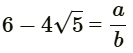 …[b ≠ 0; a and b are integers]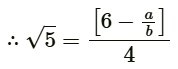
We know that, is a rational number.
But this contradicts the fact that √5 is an irrational number.
So, our assumption is wrong.
Therefore, 6 – 4√5 is an irrational number.
Q8: Show that 11 × 19 × 23 + 3 × 11 is not a prime number. (CBSE 2024)
Ans: We have
11 × 19 × 23 + 3 × 11
⇒ 11(19 × 23 + 3)
⇒ 11(437 + 3)
⇒ 11(440)
⇒ 11(2 × 2 × 2 × 5 × 11)
⇒ 2 × 2 × 2 × 5 × 11 × 11
As it can be represented as a product of more than two primes (1 and number itself). So, it is not a prime number.
Q9: If two positive integers p and q can be expressed as p = 18 a²b¹ and q=20 a³b², where a and b are prime numbers, then LCM (p, q) is: (CBSE 2024)
(a) 2 a²b²
(b) 180 a²b²
(c) 12 a²b²
(d) 180 a³b²
Ans: (d) 180 a3b2
Given,
p = 18 a2b1 and
q = 20 a3b2
LCM (p, q) = LCM (18 a2b1, 20 a3b2)
= 180 a3b2
Q10: Prove that 5 – 2√3 is an irrational number. It is given that √3 is an irrational number. (CBSE 2024)
Ans: Assuming 5 – 2√3 to be a rational number. 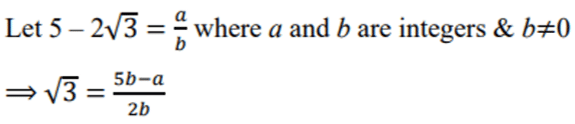
Here RHS is rational but LHS is irrational.
Therefore our assumption is wrong.
Hence, 5 – 2√3 is an irrational number.
Q11: Show that the number 5 × 11 × 17 + 3 × 11 is a composite number. (CBSE 2024)
Ans: The numbers are prime numbers and composite numbers.
Prime numbers can be divided by 1 and itself. A composite number has factors other than 1 and itself.
(5 × 11 × 17) + (3 × 11)
= (85 × 11) + (3 × 11)
= 11 × (85 + 3)
= 11 × 88
= 11 × 11 × 8
= 2 × 2 × 2 × 11 × 11
The given expression has 2 and 11 as its factors. Therefore, it is a composite number.
Q12: In a teachers’ workshop, the number of teachers teaching French, Hindi and English are 48, 80 and 144 respectively. Find the minimum number of rooms required if in each room the same number of teachers are seated and all of them are of the same subject. (CBSE 2024)
Ans: The number of rooms will be minimum if each room accommodates a maximum number of teachers. Since in each room the same number of teachers are to be seated and all of them must be of the same subject. Therefore, the number of teachers in each room must be HCF of 48, 80, and 144.
The prime factorisations of 48, 80 and 144 are as under
48 = 24 × 31
80 = 24 × 51
144 = 24 × 32
∴ HCF of 48, 80 and 144 = 16
Therefore, in each room 16 teachers can be seated.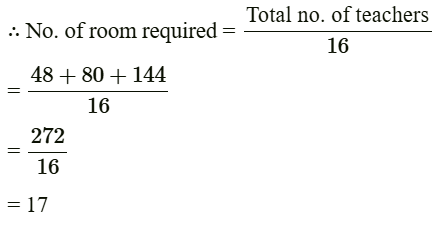
Q13: Directions: Assertion (A) is followed by a statement of Reason (R). Select the correct option from the following options:
(a) Both, Assertion (A) and Reason (R) are true. Reason (R) explains Assertion (A) completely.
(b) Both, Assertion (A) and Reason (R) are true. Reason (R) does not explain Assertion (A).
(c) Assertion (A) is true but Reason (R) is false.
(d) Assertion (A) is false but Reason (R) is true.
Assertion (A): If the graph of a polynomial touches x-axis at only one point, then the polynomial cannot be a quadratic polynomial.
Reason (R): A polynomial of degree n(n >1) can have at most n zeroes. (CBSE 2024)
Ans: Assertion (A): “If the graph of a polynomial touches the x-axis at only one point, then the polynomial cannot be a quadratic polynomial.”
A quadratic polynomial is of the form ax2 + bx + c. It can have two real roots, one real root (if the discriminant is zero), or no real roots (if the discriminant is negative).
If the graph of a quadratic polynomial touches the x-axis at exactly one point, this means it has a repeated real root (a double root), which is possible for quadratic polynomials. Hence, the assertion is false.
Reason (R): “A polynomial of degree n (n > 1) can have at most n zeroes.”
A polynomial of degree n can have at most n real or complex zeroes. This is a true statement, so the reason is true.
Given the above analysis, the correct answer is: (d) Assertion (A) is false but Reason (R) is true.
 | Get additional INR 200 off today with EDUREV200 coupon. | Avail Offer |
Previous Year Questions 2023
Q1: The ratio of HCF to LCM of the least composite number and the least prime number is (2023)
(a) 1 : 2
(b) 2 : 1
(c) 1 : 1
(d) 1 : 3
Ans:(a)
Sol: Least composite number = 4
Least prime number = 2
∴ HCF = 2, LCM = 4
∴ Required ratio = HCF / LCM = 2/4
i.e. 1 : 2
Q2: Find the least number which when divided by 12, 16, and 24 leaves the remainder 7 in each case. (2023)
Ans: 55
Given, least number which when divided by 12, 16 and 24 leaves remainder 7 in each case
∴ Least number = LCM(12, 16, 24) + 7
= 48 + 7
= 55
Q3: Two numbers are in the ratio 2 : 3 and their LCM is 180. What is the HCF of these numbers? (2023)
Ans:30
Let the two numbers be 2x and 3x
LCM of 2x and 3x = 6x, HCF(2x, 3x) = x
Now, 6x = 180
⇒ x = 180/6
x = 30
Q4: Prove that √3 is an irrational number. (2023)
Ans: Let us assume that √3 is a rational number.
Then √3 = a/b; where a and b ( ≠ 0) are co-prime positive integers.
Squaring on both sides, we get
3 = a2/b2
⇒ a2 = 3b2
⇒ 3 divides a2
⇒ 3 divides a _________(i)
= a = 3c, where c is an integer
Again, squaring on both sides, we get
a2 = 9c2
⇒3b2 = 9c2
⇒b2 = 3c2
⇒ 3 divides b2
⇒ 3 divides b _________(ii)
From (i) and (ii), we get 3 divides both a and b.
⇒ a and b are not co- prime integers.
This contradicts the fact that a and b are co-primes.
Hence, √3 is an irrational number.
| Also read: Short Answer Questions: Real Numbers – 1 |
Previous Year Questions 2022
Q1: Two positive numbers have their HCF as 12 and their product as 6336. The number of pairs possible for the numbers is (2022)
(a) 2
(b) 3
(c) 4
(d) 1
Ans:(a)
Sol: Given, HCF = 12
Let two numbers be 12a and 12b
So. 12a x 12b = 6336
⇒ ab = 44
We can write 44 as product of two numbers in these ways:
ab = 1 x 44 = 2 x 22 = 4x 11
Here, we will take a = 1 and b = 44 ; a = 4 and b = 11.
We do not take ab = 2 x 22 because 2 and 22 are not co-prime to each other.
For a = 1 and b = 44, 1st no. = 12a = 12, 2nd no. = 12b = 528
For a = 4 and b = 11, 1st no. = 12a = 48, 2nd no. = 12b = 132
Hence, we get two pairs of numbers, (12, 528) and (48, 132).
Q2: If ‘n’ is any natural number, then (12)n cannot end with the digit (2022)
(a) 2
(b) 4
(c) 8
(d) 0
Ans: (d)
Sol:
- For any natural number n, the expression (12)n cannot end with the digit 0.
- This is because the number 12 does not contain the prime factor 5, which is necessary for a number to end in 0.
- Thus, regardless of the value of n, (12)n will never end with 0.
Q3: The number 385 can be expressed as the product of prime factors as (2022)
(a) 5 x 11 x 13
(b) 5 x 7 x 11
(c) 5 x 7 x 13
(d) 5 x 11 x 17
Ans: (b)
Sol: We have,

∴ Prime factorisation of 385 = 5 x 7 x 11
Previous Year Questions 2021
Q1: Explain why 2 x 3 x 5 + 5 and 5 x 7 x 11 + 7 x 5 are composite numbers. (2021)
Ans: We have, 2 x 3 x 5 + 5 and 5 x 7 x 11 + 7 x 5.
We can write these numbers as:
2 x 3 x 5 + 5 = 5(2 x 3 + 1)
= 1 x 5 x 7
and 5 x 7 x 11 + 7 x 5 = 5 x 7(11 + 1)
= 5 x 7 x 12 = 1 x 5 x 7 x 12
Since, on simplifying. we find that both the numbers have more than two factors.
So. these are composite numbers.
Previous Year Questions 2020
Q1: The HCF and the LCM of 12, 21 and 15 respectively, are (2020)
(a) 3, 140
(b) 12, 420
(c) 3, 420
(d) 420, 3
Ans: (c)
Sol:We have,
12 = 2 x 2 x 3 = 22 x 3
21= 3 x 7
15 = 3 x 5
∴ HCF (12, 21, 15) = 3
and LCM (12, 21 ,15 ) = 22 x 3 x 5 x 7
= 420
Q2: The LCM of two numbers is 182 and their HCF is 13. If one of the numbers is 26. find the other. (2020)
Ans: Let the other number be x
As, HCF (a, b) x LCM (a, b) = a x b
⇒ 13 x 182= 26x
⇒ x = 13 x 182 / 26
= 91
Hence, other number is 91.
Q3: Given that HCF (135, 225) = 45, find the LCM (135, 225). (CBSE 2020)
Ans: We know that
LCM × HCF = Product of two numbers
∴ LCM (135, 225) = Product of 135 and 225 / HCF(135, 225)
= 135 x 225 / 45
= 675
So, LCM (135, 225) = 675
| Also read: Short Answer Questions: Real Numbers – 1 |
Previous Year Questions 2019
Q1: If HCF (336, 54) = 6. find LCM (336, 54). (2019)
Ans: Using the formula: HCF (a, b) x LCM (a, b) = a x b
∴ HCF (336, 54) x LCM (336, 54) = 336 x 54
⇒ 6 x LCM(336, 54) = 18144
⇒ LCM (336, 54) = 18144 / 6
= 3024
Q2: The HCF of two numbers a and b is 5 and their LCM is 200. Find the product of ab. (2019)
Ans: We know that HCF (a, b) x LCM (a, b)=a x b
⇒ 5 x 200 = ab
⇒ ab = 1000
Q3: If HCF of 65 and 117 is expressible in the form 65n – 117, then find the value of n. (2019)
Ans: Since, HCF (65 ,117) = 13
Given HCF ( 65, 117 ) = 65n – 117
13 = 65n – 117
⇒ 65n = 13 +117
⇒ n = 2
Q4: Find the HCF of 612 and 1314 using prime factorization. (2019)
Ans: Prime factorisation of 612 and 1314 are
612 = 2 x 2 x 3 x 3 x 17
1314 = 2 x 3 x 3 x 73
∴ HCF (612, 1314) = 2 x 3 x 3
= 18
Q5: Prove that √5 is an irrational number. (2019)
Ans: Let us assume that √5 is a rational number.
Then √5 = a/b where a and b (≠ 0} are co-prime integers,
if Squaring on both sides, we get
5 = a2b2 ⇒ a2 = 5b2
⇒ 5 divides a2
⇒ 5 divides a ———-(i)
⇒ a = 5c, where c is an integer
Again, squaring on both sides, we get
a2 = 25c2
⇒ 5b2 = 25c2
⇒ b2 = 5c2
⇒ 5 divides b2 ———-(ii)
⇒ 5 divides b
From (i) and {ii), we get 5 divides both a and b.
⇒ a and b are not co-prime integers.
Hence, our supposition is wrong.
Thus, √5 is an irrational number.
Q6: Prove that √2 is an irrational number. (2019)
Ans: Let us assume √2 be a rational number.
Then, √2 = p/q where p, q (q ≠ 0) are integers and co-prime. ;
On squaring both sides. we get
2 = p2q2 ⇒ p2 = 2q2 ————(i)
⇒ 2 divides p2
⇒ 2 divides p ———–(ii)
So, p = 2a, where a is some integer.
Again squaring on both sides, we get
p2 = 4a2
⇒ 2q2 = 4a2 (using (i))
⇒ q2 = 2a2
⇒ 2 divides q2
⇒ 2 divides q ———–(iii)
From (ii) and (iii), we get
2 divides both p and q.
∴ p and q are not co-prime integers.
Hence, our assumption is wrong.
Thus √2 is an irrational number.
Q7: Prove that 2 + 5√3 is an irrational number given that √3 is an irrational number. (2019)
Ans: Suppose 2 + 5√3 is a rational number.
We can find two integers a, b (b ≠ 0) such that
2 + 5√3 = a/b, where a and b are co -prime integers.
5√3 = ab – 2 ⇒ √3 = 15 [ a b – 2]
⇒ √3 is a rational number.
[ ∵ a, b are integers, so 15 [ a b – 2] is a rational number]
But this contradicts the fact that √3 is an irrational number.
Hence, our assumption is wrong.
Thus, 2 + 5√3 is an irrational number.
Q8: Write the smallest number which is divisible by both 306 and 657. (CBSE 2019)
Ans: Given numbers are 306 and 657.
The smallest number divisible by 306 and 657 = LCM(306, 657)
Prime factors of 306 = 2 × 3 × 3 × 17
Prime factors of 657 = 3 × 3 × 73
LCM of (306, 657) = 2 × 3 × 3 × 17 × 73
= 22338
Hence, the smallest number divisible by 306 and 657 is 22,338.