Q1: Look at the number grid and answer the questions.
| 461 | 462 | 463 |
| 471 | 472 | 473 |
| 481 | 482 | 483 |
(a) What is the difference between 462 and 472?
(b) What number will come just below 463?
Ans:
(a) The difference between 462 and 472 is 10.
(b) The number just below 463 is 473.
Q2: Write the expanded form of 506 and explain why.
Ans: 506 = 500 + 0 + 6. There is no tens value because the tens digit is 0. 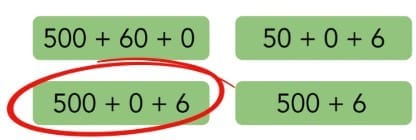
Q3: Complete the table to show different ways of making the same amount.
| Total Amount | One Way | Another Way |
|---|---|---|
| ₹100 | ₹50 + ₹50 | ? |
Ans: ₹100 can also be made using ₹20 + ₹20 + ₹20 + ₹20 + ₹20.
Q4: Fill the table and answer the question.
| Number | After adding 10 | After adding 100 |
|---|---|---|
| 375 | 385 | 475 |
Ans: Adding 10 increases the tens place, and adding 100 increases the hundreds place.
Q5: Arrange the following numbers from smallest to greatest using place value reasoning: 709, 790, 700, 770.
Ans: 700, 709, 770, 790.
Q6: With ₹100, Riya can buy 2 packets of biscuits. With the same ₹100, Aman can buy 5 pencils.(a) Which item costs more: one packet of biscuits or one pencil?
(b) Explain your answer using numbers.
Ans:
(a) One packet of biscuits costs 50 rupees so it costs more.
(b) ₹100 buys only 2 biscuit packets, but it buys 5 pencils. So, each biscuit packet costs more than one pencil.
Q7: Estimate the answer to the nearest hundred: 456 + 138.
Ans: 456 ≈ 500 and 138 ≈ 100. Estimated answer = 600.
Q8: Without calculating, find which is more and explain: 500 − 48 or 500 − 52.
Ans: 500 − 48 is more because a smaller number is being subtracted.
Q9: Fill the table and answer.
| Amount in the morning | Amount in the evening | Money earned |
|---|---|---|
| ₹ 385 | ₹ 620 | ? |
Ans: Money earned = 620 − 385 = ₹235.
Q10: Using the digits 2, 5, and 8 only once, make two 3-digit numbers such that their difference is the smallest.
Ans: 258 and 285 give the smallest difference of 27.