06. Short Answer Type Questions: Lines & Angles

Q.1. If P, Q, and R are three collinear points, then name all the line segments determined by them.

Ans.Short Answer Type Questions: Lines & Angles

We can have the following line segments:

Short Answer Type Questions: Lines & Angles


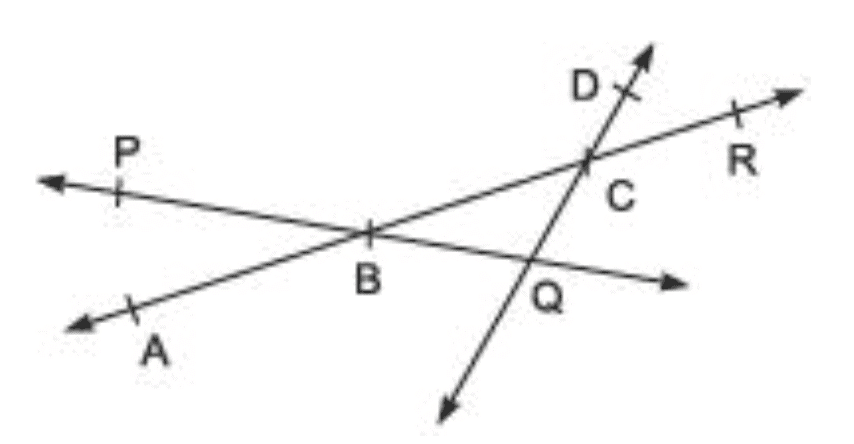
Q.2. In the adjoining figure, identify at least four collinear points.
Short Answer Type Questions: Lines & Angles

Ans. The four collinear points are A, B, C, and R.
 

Q.3. Find the complement of 36°.
Ans. ∵ 36° + [Complement of 36°] = 90°
⇒ Complement of 36°= 90° – 36° = 54°

Q.4. Find the supplement of 105°.
Ans.  105° + [Supplement of 105°] = 180°
⇒ Supplement of 105° = 180° – 105° = 75°


Q.5. Angles ∠ P and 100° form a linear pair. What is the measure of ∠ P?
Ans. 
∵ The sum of the angles of a linear pair equal to 180°.
∴ ∠ P + 100° = 180° ⇒ ∠ P = 180° – 100 = 80°.

Q.6. In the adjoining figure, what is the measure of p?Ans. ∵ p and 120° form a linear pair.
∴ p + 120° = 180° ⇒ p = 180° – 120° = 60°

Q.7. In the adjoining figure, AOB is a straight line. Find the value of x.Ans. ∵ AOB is a straight line.
∴ ∠AOC + ∠COB = 180°
⇒ 63° + x = 180° ⇒ x = 180° – 63° = 117°


Q.8. In the given figure, AB, CD, and EF are three lines concurrent at O. Find the value of y.Ans. ∵ ∠AOE and ∠BOF and vertically opposite angles.
∴ ∠AOE = ∠BOF = 5y ….. (1)
Now, CD is a straight line,
⇒ ∠COE + ∠EOA + ∠AOD = 180°
⇒ 2y + 5y + 2y = 180° [From (1)]
⇒ 9y = 180°⇒ y = (180°/2)= 20°
Thus, the required value of y is 20°.
 

Q.9. In the adjoining figure, AB || CD and PQ is transversal. Find x.Ans. ∵ AB || CD and PQ is a transversal.
∴ ∠ BOQ = ∠ CQP [∵ Alternate angles are equal]
⇒ x = 110° [∵ ∠ CQP = 110°]
 

Q.10. Find the measure of an angle that is 26° more than its complement.
Ans. 
Let the measure of the required angle be x.
∴ Measure of the complement of x° = (90° – x)
⇒ x° – (90° – x) = 26°
⇒ x – 90° + x = 26°
⇒ 2x = 26° + 90° = 116°
⇒ x = (116°/2) = 58°
Thus, the required measure = 58°.


Q.11. Find the measure of an angle if four times its complement is 10° less than twice its supplement.
Ans. Let the measure of the required angle be x.
∴ Its complement = (90° – x) and Its supplement = (180° – x)
According to the condition:

4(Complement of x) = 2(Supplement of x) – 10

⇒ 4(90° – x) = 2(180° – x) – 10°
⇒ 360° – 4x = 360° – 2x – 10°
⇒ 4x – 2x = 360° – 360° + 10°
⇒ 2x = 10° ⇒ x = (10°/2)= 5°
Thus, the measure of the required angle is 5°.


Q.12. Two supplementary angles are in the ratio 3:2. Find the angles.
Ans. Let the measure of the two angles be 3x and 2x.
∵ They are supplementary angles.
∴ 3x + 2x = 180°
⇒ 5x = 180° ⇒ x = (180°/5) = 36°
∴ 3x = 3 x 36° = 108° and 2x = 2 x 36° = 72°
Thus, the required angles are 108° and 72°.


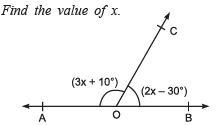
Q.13. In the adjoining figure, AOB is a straight line.
Short Answer Type Questions: Lines & Angles

Ans. ∵ AOB is a straight line.
∴ ∠ AOC + ∠ BOC = 180°
⇒ (3x + 10°) + (2x – 30°) = 180° [Linear pair]
⇒ 3x + 2x + 10° – 30° = 180°
⇒ 5x – 20° = 180°
⇒ 5x = 180° + 20° = 200° ⇒ x = (200°/5) = 40°
Thus, the required value of x is 40°.


Q.14. In the adjoining figure, find ∠ AOC and ∠ BOD.Ans. ∵ AOB is a straight line.
∴ ∠AOC + ∠COD + ∠DOB =180°
⇒ x + 70° + (2x – 25°) = 180°
⇒ x + 2x = 180° + 25° – 70°
⇒ 3x = 205° – 70° = 135° ⇒ x = (135°/3) = 45°
∴ ∠ AOC = 45°
⇒ ∠ BOD = 2x – 25° = 2 (45°) – 25° = 90° – 25° = 65°


Q.15. In the adjoining figure, AB || CD. Find the value of x.Ans. Let us draw EF || AB and pass through point O.
∴ EF || CD and CO is a transversal.
⇒ ∠ 1 = 25° [Alternate angles]
Similarly, ∠ 2 = 35°
Adding, ∠ 1 + ∠ 2 = 25° + 35° ⇒ x = 60°
Thus, the required value of x is 60°.
05. Short Question Answer: Introduction to Euclid’s Geometry

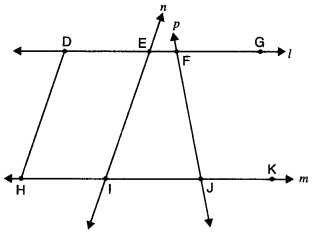
Q1:In the given figure, name the following :
(i) Four collinear points
(ii) Five rays
(iii) Five line segments
(iv) Two-pairs of non-intersecting line segments.

Ans:
(i) 
Four collinear points are D, E, F, G and H, I, J, K
(ii) Five rays are DG, EG, FG, HK, IK.
(iii) Five line segments are DH, EI, FJ; DG, HK.
(iv) Two-pairs of non-intersecting line segments are (DH, EI) and (DG, HK).

Q2: In figure, it is given that AD=BC. By which Euclid’s axiom it can be proved that AC = BD?
Ans:
 
We can prove it by Euclid’s axiom 3. “If equals are subtracted from equals, the remainders are equal.”
We have AD = BC
⇒ AD – CD = BC – CD
⇒ AC = BD

Q3: In the beow figure, if AB = PQ, PQ = XY, then AB = XY. State True or False. Justify your answer.
Ans:
True.
∵ By Euclid’s first axiom “Things which are equal to the same thing are equal to one another”.
∴ AB = PQ and XY = PQ ⇒ AB = XY

Q4: In the given figure, AC = XD, C is mid-point of AB and D is mid-point of XY. Using an Euclid’s axiom, show that AB = XY.
Ans:
 
∵ C is the mid-point of AB
AB = 2AC
Also, D is the mid-point of XY
XY = 2XD
By Euclid’s sixth axiom “Things which are double of same things are equal to one another.”
∴ AC = XD = 2AC = 2XD
⇒ AB = XY

Q5: In the figure, we have BX and 1/2 AB = 1/2 BC. Show that BX = BY.
Ans:

Here, BX = 1/2 AB and BY = 1/2 BC …(i) [given]
Also, AB = BC [given]
⇒ 1/2AB = 1/2BC …(ii)
[∵ Euclid’s seventh axiom says, things which are halves of the same thing are equal to one another]
From (i) and (ii), we have
BX = BY

Q6: In the given figure, if ∠1 = ∠3, ∠2 = ∠4 and ∠3 = ∠4, write the relation between ∠1 and ∠2, using an Euclid’s axiom.
Ans:

Here, ∠3 = ∠4, ∠1 = ∠3 and ∠2 = ∠4. Euclid’s first axiom says, the things which are equal to equal thing are equal to one another. So ∠1 = ∠2.,

Q7: In the given figure, AB = BC, BX = BY, show that AX = CY.
Ans:

Given that AB = BC and BX = BY
By using Euclid’s axiom 3, equals subtracted from equals, then the remainders are equal, we have
AB – BX = BC – BY
AX = CY

Q8: In the given figure, AC = DC and CB = CE. Show that AB = DE. Write the Euclid’s axiom to support this.
Ans:

We have
AC = DC
CB = CE
By using Euclid’s axiom 2, if equals are added to equals, then wholes are equal.
⇒ AC + CB = DC + CE
⇒ AB = DE.

Q9: Define : (a) a square (b) perpendicular lines.
Ans:

(a) A square : A square is a rectangle having same length and breadth. Here, undefined terms are length, breadth and rectangle.
(b) Perpendicular lines : Two coplanar (in a plane) lines are perpendicular, if the angle between them at the point of intersection is one right angle. Here, the term one right angle is undefined.

Q10: If A, B and C are any three points on a line and B lies between A and C (see figure), then prove that AB + BC = AC.
Ans: 
In the given figure, AC coincides with AB + BC. Also, Euclid’s axiom 4, states that things which coincide with one another are equal to one another. So, it is evident that:
AB + BC = AC.

04. Short Answer Type Questions: Linear Equations in Two Variables

Question 1. Is (3, 2) a solution of x + y = 6?
Solution: (3, 2) means x = 3 and y = 2
∴ Substituting x = 3 and y = 2 in x + y = 6,
we have 3 + 2 = 6
⇒ 5 = 6 which is not correct Since
L.H.S. ≠ R.H.S.
∴ (3, 2) is not a solution of x + y = 6.


Question 2. Is  a solution of 2x + 3y = 12?
Solution: The given equation is 2x + 3y = 12  …(1)

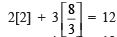
Here Solution = 

⇒ x = 2 and y = (8/3)
Substituting x = 2 and y =(8/3)  in (1), we get


⇒ 4 + 8 = 12
⇒ 12 = 12
∵ L.H.S. = R.H.S

 is a solution of 2x + 3y = 12.


Question 3. Express in the form of ax + by + c = 0 and write the value of a, b and c. 
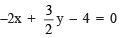
Solution: We have 
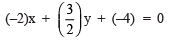
⇒     …(1)

Comparing (1) with ax + by + c = 0, we have
a = –2, b = (3/2) and c = –4.

Question 4. Express 2x = 5 in the form ax + by + c = 0 and find the value of a, b and c.
Solution: 2x = 5 can be written as 2x – 5 = 0
⇒ 2x + (0)y – 5 = 0
⇒ 2x + (0)y + (–5) = 0                                …(1)
Comparing (1) with ax + by + c = 0, we get
a = 2,  b = 0 and  c = –5.


Question 5. Write two solutions of 3x + y = 8.
Solution: We have 3x + y = 8
For x = 0, we have 3(0) + y = 8
⇒ 0 x y= 8 ⇒ y = 8

  .e. (0, 8) is a solution.
For x = 1, we have 3(1) + y = 8
⇒ 3 + y = 8
⇒ y = 8 – 3 = 5 

    i.e. (1, 5) is another solution.


Question 6. If x = –1 and y = 2 is a solution of kx + 3y = 7, find the value k.
Solution: We have kx + 3y = 7                          …(1)
∴ Putting x = –1 and y = 2 in (1), we get
k(–1) + 3(2) = 7
⇒ –k + 6 = 7
⇒ –k = 7 – 6 = 1
⇒ k= –1
Thus, the required value of k = –1.

Question 7. Show that x = 2 and y = 1 satisfy the linear equation 2x + 3y = 7.
Solution: We have 2x + 3y = 7                       …(1)
Since, x = 2 and y = 1 satisfy the equation (1).
∴ Substituting x = 2 and y = 1 in (1), we get
L.H.S. = 2(2) + 3(1) = 4 + 3 = 7
= R.H.S.
Since, L.H.S. = R.H.S.
∴ x = 2 and y = 1 satisfy the given equation.

Question 8. Write four solutions of 2x + 3y = 8.
Solution: We have 2x + 3y = 8   …(1)
Let us assume x = 0.
∴ Substituting x = 0 in (1), we get
2(0) + 3y = 8
⇒ 0 + 3y = 8
⇒ y= (8/3)

∴  is a solution of (1)

Again assume y = 0.
∴ From (1), we have
2x + 3(0) = 8
⇒ 2x = 8
⇒   x= (8/2)  = 4

∴ (4, 0) is a solution of (1).
Again assume x = 1.
∴ From (1), we have
2(1) + 3y = 8
⇒ 3y = 8 – 2 = 6
⇒ y = (6/3) = 2
∴ (1, 2) is a solution of (1).
Again assume x = 2.
∴ From (1), we have
2(2) + 3y = 8
⇒ 4 + 3y = 8
⇒ 3y = 8 – 4 = 4
⇒ y = (4/3)

 is a solution of (1).

∴ The required four solutions are:,  (4, 0), (1, 2) and

03. Short Answer Type Questions: Coordinate Geometry

Question 1. What are the coordinates of A, B, C and D in the following figure?

Solution: The coordinates of A are (–4, 3).
The coordinates of B are (4, 2).
The coordinates of C are (–3, –2).
The coordinates of D are (4, –2).
 

Question 2. Look at the following figure and answer the following:
(i) What is the abscissa of P?
(ii) What is the ordinate of Q?
(iii) What is the ordinate of R?
(iv) What is the abscissa of S?

Solution: (i) The abscissa of P is –3.
(ii) The ordinate of Q is –2.
(iii) The ordinate of R is 2.
(iv) The abscissa of S is –5.
 

Question 3. Look at the following figure and answer the following:

(i) Which point is having its ordinate as (–5)?
(ii) Which point is having abscissa as 4?
(iii) What are the coordinates of origin?
(iv) Which point is having abscissa as (–3)?
Solution: (i) The point B is having its ordinate as (–5).
(ii) The point C is having its abscissa as 4.
(iii) The coordinates of O are (0, 0).
(iv) The point A is having abscissa as (–3).


Question 4. Look at the following figure and answer the following:
(i) Which two points have the same abscissa?

(ii) Which two points have the same ordinate?

Solution: (i) ∵ The abscissa of the point Q is 6.  
The abscissa of the point R is 6.
∴The points Q and R have the same abscissa.
(ii) ∵ The ordinate of P is (–3).  
The ordinate of R is (–3).
∴ The points P and R have the same ordinate.

Question 5. Read the coordinates of the vertices of the triangle ABC in the following figure:

Solution: The vertices of the triangle are A, B and C.
The coordinates of A are (–6, 4).
The coordinates of B are (–3, –3).
The coordinates of C are (2, 2).
 

Question 6. Write the coordinates of quadrilateral PQRS as shown in the following figure:

Solution: The vertices of the quadrilateral are P, Q, R and S.
The coordinates of P are (–4, 4).
The coordinates of Q are (8, 2).
The coordinates of R are (6, –3).
The coordinates of S are (–2, –2).
 

Question 7. Write the vertices of the following quadrilateral OBCD.

Solution: The vertices of the quadrilateral are O, B, C and D.
The coordinates of O are (0, 0).
The coordinates of B are (4, 2).
The coordinates of C are (8, 0).
The coordinates of D are (4, –2).

02. Short Answer Type Questions: Polynomials

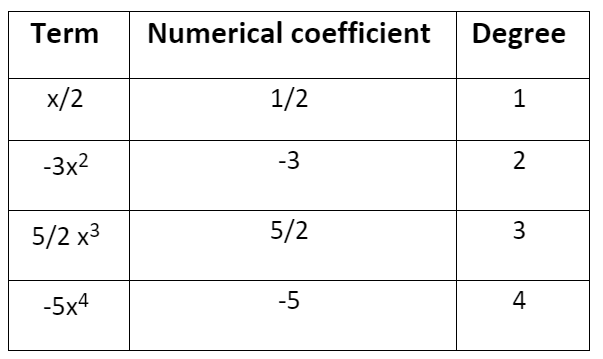
Q1. Write the numerical co-efficient and degree of each term of: x2 − 3x2 + 52 x3 − 5x4

Sol:Short Answer Type Questions: Polynomials


Q2. Write the coefficient of x2 in each of the following:
(i) 9 – 12x + x3
(ii) ∏/6 x2 – 3x + 4
(iii) √3x – 7

Sol:
(i)
 9 – 12x + x3
Coefficient of x=0
(ii)
 ∏/6 x2 – 3x + 4
Coefficient of x= ∏/6
(iii)
 √3x – 7
Coefficient of x= 0

Q3. Factorise z2  – 4z –12

Sol: To factorize this expression, we need to find two numbers α and β such that α + β = -4 and αβ = -12

z2 – 6z + 2z – 12

z(z – 6) + 2(z – 6)

(z + 2)(z – 6)


Q4. (a) For what value of k, the polynomial x2 + (4 – k)x + 2 is divisible by x – 2?
(b) For what value of ‘m’ is x3 – 2mx2 + 16 is divisible by (x + 2)?

Sol: (a) Here p(x) = x+ 4x – kx + 2
If p(x) is exactly divisible by x – 2, then p(2) = 0
i.e. (2)2 + 4(2) – k(2) + 2 = 0
⇒ 4 + 8 – 2k + 2 = 0
⇒ 14 – 2k = 0
⇒ 2k = 14
⇒ k= 14/2 = 7
Thus, the required value of k is 7.

(b) Here, p(x) = x3 – 2mx2 + 16
∴ p(–2) = (–2)3 –2(–2)2m + 16
⇒ –8 –8m + 16
⇒ –8m + 8
Since, p(x) is divisible by x + 2
∴ p(–2) = 0
or –8m + 8 = 0
⇒ m = 1

Q5. Factorize x2 – x – 12.

Sol: We have  x2 – x – 12
⇒ x– 4x + 3x – 12
⇒ x(x – 4) + 3(x – 4)
⇒ (x – 4)(x + 3)
Thus, x– x – 12 = (x – 4)(x + 3)


Q6.Verify whether the indicated numbers are zeros of the polynomials corresponding to them in the following cases:
(i) f(x) = 3x + 1, x = −1/3
(ii) f(x) = x2 – 1, x = 1,−1

Sol: (i) f(x) = 3x + 1, x = −1/3

f(x) = 3x + 1
Substitute x = −1/3 in f(x)
f( −1/3) = 3(−1/3) + 1
= -1 + 1
= 0
Since, the result is 0, so x = −1/3 is the root of 3x + 1

(ii) f(x) = x2 – 1, x = 1,−1

f(x) = x2 – 1
Given that x = (1 , -1)
Substitute x = 1 in f(x)
f(1) = 12 – 1
= 1 – 1
= 0
Now, substitute x = (-1) in f(x)
f(-1) = (−1)2 – 1
= 1 – 1
= 0
Since , the results when x = 1 and x = -1 are 0, so (1 , -1) are the roots of the polynomial f(x) = x– 1


Q7. Check whether (x – 1) is a factor of the polynomial x3 – 27x2 + 8x + 18.

Sol: Here, p(x) = x– 27x2 + 8x + 18, (x – 1) will be a factor of p(x) only if (x – 1) divides p(x) leaving a remainder 0.
For  x – 1 = 0
⇒ x = 1
∴ p(1) = (1)3 – 27(1)2 + 8(1) + 18
⇒ 1 – 27 + 8 + 18
⇒ 27 – 27
⇒ 0
Since, p(1) = 0
∴ (x – 1) is a factor of p(x).
Thus, (x – 1) is a factor of x3 – 27x2 + 8x + 18.


Q8.Evaluate each of the following using identities:
(i) (2x – 1/x)2
(ii) (2x + y) (2x – y)

Sol:
(i) 
(2x – 1/x)2
[Use identity: (a – b)2 = a2 + b2 – 2ab ]
(2x – 1/x)= (2x)2 + (1/x)– 2 (2x)(1/x)
= 4x+ 1/x– 4
(ii) 
(2x + y) (2x – y)
[Use identity: (a – b)(a + b) = a2 – b2 ]
(2x + y) (2x – y) = (2x )– (y)2
= 4x– y2


Q9. Find the value of k, if (x – k) is a factor of x6 – kx5 + x4 – kx3 + 3x – k + 4.

Sol: Here, p(x) = x6 – kx5 + x– kx3 + 3x – k + 4
If (x – k) is a factor of p(x), then p(k) = 0
i.e (k)6 – k(k5) + k4 – k(k3) + 3k – k + 4 = 0
⇒ k– k6 + k4 – k4 + 3k – k + 4 = 0
⇒ 2k + 4 = 0
⇒ 2k = – 4
⇒ k = (-4/2) = –2
Thus, the required value of k is –2.


Q10. Factorize: 9a2 – 9b2 + 6a + 1

Sol: 9a2 – 9b2 + 6a + 1
⇒ [9a2 + 6a + 1] – 9b
⇒ [(3a)2 + 2(3a)(1) + (1)2] – (3b)
⇒ (3a + 1)2 – (3b)2
⇒ [(3a + 1) + 3b][(3a + 1) – 3b] {using x– y2 = (x – y)(x + y)}
⇒ (3a + 1 + 3b)(3a + 1 – 3b)

01. Short Question Answers: Number System

Q1. Find a rational number between 1 and 2.

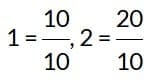
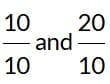
Sol: Express 1 and 2 as rational numbers with the same denominator:
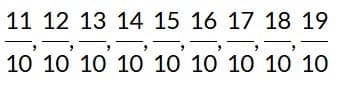
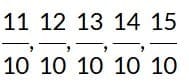
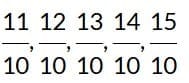
Now, the rational numbers between  are:Out of these, select any five:

Answer: The five rational numbers between 1 and 2 are:

Q2. Find two rational numbers between 0.1 and 0.3.

Sol:  Express 0.1 and 0.3 as rational numbers with the same denominator:0.1=1100.3=310

Now, the rational numbers between 110 and 310 can be written with a larger denominator to find numbers in between.
Let us express them with a denominator of 100100:0.1=10100 ,0.3=30100  .

The rational numbers between 10100 and 30100 are:11100,12100,13100,,29100.

any two:12100,25100.


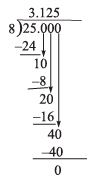
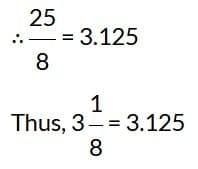
Q3. Express   in the form of a decimal.

We have, Now, dividing 25 by 8,
 

Since, the remainder is 0.
∴ The process of division terminates.


Q4. Express   as a rational number.

Multiplying (1) by 100, we have 100x = 100 x 0.3333…
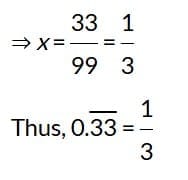
⇒ 100x = 33.3333              …(2)
Subtracting (2) from (1), we have
100x – x = 33.3333… – 0.3333…
⇒ 99x = 33

Q5. Simplify: (4+ √3) (4 −3)

∵ (a + b)(a – b) = a2 – b2
(4 +√3) (4 −√3) = (4)2 – ( √3)2 = 16 – 3 = 13
Thus, (4 +√3) (4 −√3) = 13


Q6. Simplify: (√3 +√2)2

∵ (a + b)2 = a+ 2ab + b2
(√3 +√2)2 = (√3)2 + √2 ( √3 ×2) + (√2)2 = 3 + 2 √6 + 2 = 5 + 2 √6
Thus, (√3 +√2)2 = 5 + 2√6


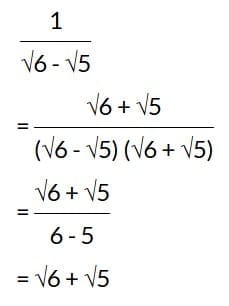
Q7. Rationalise the denominator of  

Multiply and divide the given number by √6 + √5

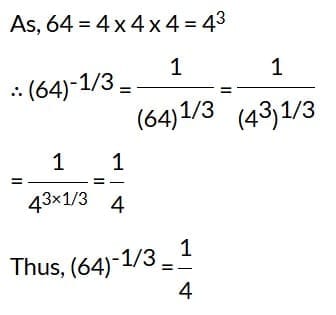
Q8. Find (64)-1/3


Q9. Find a rational number lying between 1/5  and  1/2.

Rational numbers between   1/2 and  1/5 are infinite. Some of them are  3/10 ,   4/10 ,   45/100 ,  35/100 .
Step-by-step explanation:
As per the question, We need to find drational numbers lying between   1/5  and  1/2  As we know,

  • Rational Numbers are numbers that can be expressed in the form of p/q where q is not equal to zero.
  • Now, we know that  1/5 = 0.2 and 1/2  = 0.5
  • So, numbers between 0.2 and 0.5 are infinite. Some of them are 0.3,0.4,0.45,0.35 etc.
  • And these may be written as  310 ,   410 ,   45100 ,  35100  etc.

Hence, Rational numbers between 15  and  12 are infinite. Some of them are 3/10 ,   4/10 ,   45/100 ,  35/100


Q10. Express  0.245  as a fraction in the simplest form.

We know that

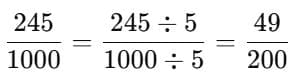
0.245=2451000

because 0.245 means 245 thousandths.

Now we simplify the fraction.

First, divide both numerator and denominator by 5:

Next, check if 49 and 200 have any common factor.
49 = 7 × 7
200 = 2 × 2 × 2 × 5 × 5

There is no common factor, so the fraction is already in simplest form.

∴ The simplest form of 0.245 is

49200

12. Very Short Answers Type Questions: Statistics

Question 1. The marks obtained by 17 students in a mathematics test (out of 100) are given below:
48, 66, 68, 49, 91, 72, 64, 46, 90, 79, 76, 82, 65, 96, 100, 82, 100
Find the range of the data.
Solution: 
Lowest observation = 46  
Highest observation = 100
∴ Range = 100 –46 = 54


Question 2. The class-mark of the class 130 – 150 is:
Solution: 
Class-mark =  ((130+150)/2)
 = (280/2)
  = 140
 

Question 3. The median of the following numbers arranged in descending order is 25. Find the value of
x: 40, 38, 35, 2x + 10, 2x + 1, 15, 11, 8, 5
Solution: 
Number of observations = 9

∴ The median is the  ((n+1)/2)th  term i.e. ((9+1)/2) th or the 5th term.
⇒ 2x + 1 = 25
⇒ x= (25-1)/2= 12


Question 4. If the mean of 6, x, 4, and 12 is 8, then find the value of x.
 Solution: 

 ∴        = 8 or 22 + x = 32
or  x = 32 – 22 = 10


Question 5. Find the range of the data 9, 7, 5, 7, 9, 9, 6, 18, 9 and 8.
Solution: 
 Highest data = 18
Lowest data = 5
⇒ Range = 18 – 5 = 13


Question 6. Calculate the median of : 152, 155, 160, 144, 145, 148, 147, 149, 150
Solution
:  Writing the given data in ascending order, we get: 144, 145, 147, 148, 149,  150, 152, 155, 160
Here, n = 9

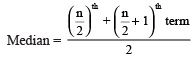
∴ Median =   term =  term = 5th term

⇒ Median = 149


Question 7. What is the median of 70, 40, 50, 100, 75, 75, 65 and 95?
Solution:
  In ascending order, the given data is:
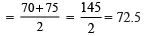
40, 50, 65, 70, 75, 75, 95, 100
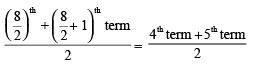
Here, n = 8 (Even number)

⇒ Median =   

11. Very Short Answer Type Questions: Surface Areas & Volumes

Q1. What is the longest pole that can be put in a room of dimensions l = 10 cm, b = 10 cm and h = 5 cm?
Ans: 
The longest diagonal of a cuboid =Very Short Answer Type Questions: Surface Areas & Volumes

∴ The length  of the required pole (diagonal) = Very Short Answer Type Questions: Surface Areas & Volumes

Q2. The total surface area of a cube is 96 cm2. What is its volume?
Ans: 
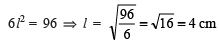
Total surface area of the cube = 6l2

∴   Very Short Answer Type Questions: Surface Areas & Volumes

Thus, the volume of the cube = l3 = 43 = 64 cm


Q3. The radius of a sphere doubled. What percent of its volume is increased?
Ans: 
Original volume = (4/3)πr3

Increased volume = (4/3)π(2r)3 = 32/3πr3

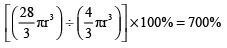
Increase in volume =  32/3πr3 –  4/3πr3 = 28/3πr3

∴ Percent increase in volume = Very Short Answer Type Questions: Surface Areas & Volumes

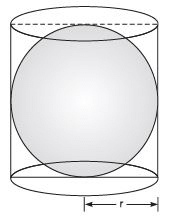
Q4. Write ‘True or False’ for the following statements: (i) A right circular cylinder just encloses a sphere of radius r as shown in the figure. The area of the sphere is equal to the curved surface area of the cylinder.
Ans: 
True.

∵ [Radius of the sphere] = [Radius of the cylinder] = r

Very Short Answer Type Questions: Surface Areas & Volumes

∴ The diameter of the sphere = 2r
⇒ Height of the cylinder (h) = 2r
Now, the surface area of the sphere = 4πr
And curved surface area of the cylinder = 2πrh = 2πr (2r) = 4πr2


(ii) An edge of a cube measures ‘r’ cm. If the largest possible right circular cone is cut out of this cube, then the volume of the cone (in cm3) is 1/6πr3
Ans: False.
∵ Height of the cone = r cm
∴ The diameter of the base of the cone = r cm

⇒ Radius of the base of the cone = (r/2) cm

Now volume of the cone Very Short Answer Type Questions: Surface Areas & Volumes

Q5. If the total surface area of a sphere is 154 cm2. Find its total volume.
Ans: 
Let ‘r’ be the radius of the sphere
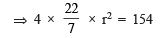
∴ Total S.A. = 4 π r2 = 154 cm2

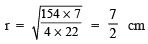
Very Short Answer Type Questions: Surface Areas & Volumes

or        Very Short Answer Type Questions: Surface Areas & Volumes

Now,                 Very Short Answer Type Questions: Surface Areas & Volumes

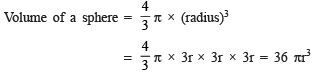
Q6. If the radius of a sphere is 3r then what is its volume?
Ans: 

Very Short Answer Type Questions: Surface Areas & Volumes

10. Very Short Answers Type Questions- Heron’s Formula

Q1.Find the area of a triangle whose sides are 5 cm, 6 cm, and 7 cm.

Sol:

s = 5 + 6 + 72 = 9 cm.

Heron’s formula for the area of the triangle:

Area = √s(s − 5)(s − 6)(s − 7) cm2

Area = √(9)(9 − 5)(9 − 6)(9 − 7) cm2

Area = √(9 × 4 × 3 × 2) cm2

Area = √216 cm2

Area = 14.7 cm2


Q2. Find the area of a triangle whose sides are 3 cm, 4 cm and 5 cm.

Sol:

s = 3 + 4 + 52 = 6 cm

Heron’s formula for the area of the triangle:

Area = √s(s − 3)(s − 4)(s − 5) cm2

Area = √(6)(6 − 3)(6 − 4)(6 − 5) = √(6 × 3 × 2 × 1)

Area = √36 cm2

The area of the triangle is 6 cm2.


Q3.  Find the area of a triangle whose two sides are 18 cm and 10 cm and the perimeter is 42cm.

Sol: Assume that the third side of the triangle to be “x”.

Now, the three sides of the triangle are 18 cm, 10 cm, and “x” cm

It is given that the perimeter of the triangle = 42cm

So, x = 42 – (18 + 10) cm = 14 cm

∴ The semi perimeter of triangle = 42/2 = 21 cm

Using Heron’s formula,

Area of the triangle,

= √[s (s-a) (s-b) (s-c)]

= √[21(21 – 18) (21 – 10) (21 – 14)] cm2

= √[21 × 3 × 11 × 7] m2

= 21√11 cm2

Q4.If the perimeter of an equilateral triangle is 180 cm. Then its area will be ?

Solution. Given, Perimeter = 180 cm

3a = 180 (Equilateral triangle)

a = 60 cm

Semi-perimeter = 180/2 = 90 cm

Now as per Heron’s formula,

= √s (s-a)(s-b)(s-c)

In the case of an equilateral triangle, a = b = c = 60 cm

Substituting these values in the Heron’s formula, we get the area of the triangle as:

A = √[90(90 – 60)(90 – 60)(90 – 60)]

= √(90× 30 × 30 × 30)

A = 900√3 cm2

Q5.The sides of a triangle are 122 m, 22 m and 120 m respectively. The area of the triangle is ?

Sol: Given,

a = 122 m

b = 22 m

c = 120 m

Semi-perimeter, s = (122 + 22 + 120)/2 = 132 m

Using heron’s formula:

= √s (s-a)(s-b)(s-c)

= √[132(132 – 122)(132 – 22)(132 – 120)]

= √(132 × 10 × 110 × 12)

= 1320 sq.m

Q6. The sides of a triangle are in the ratio 12: 17: 25 and its perimeter is 540 cm. The area is:

Sol: The ratio of the sides is 12: 17: 25

Perimeter = 540 cm

Let the sides of the triangle be 12x, 17x and 25x.

Hence,

12x + 17x + 25x = 540 cm

54x = 540 cm

x = 10

Therefore,

a = 12x = 12 × 10 = 120

b = 17x = 17 × 10 = 170

c = 25x = 25 × 10 = 250

Semi-perimeter, s = 540/2 = 270 cm

Using Heron’s formula:𝐴= √s (s-a)(s-b)(s-c)

= √[270(270 – 120)(270 – 170)(270 – 250)]

= √(270 × 150 × 100 × 20)

= 9000 sq.cm

Q7. Find the area of an equilateral triangle having side length equal to √3/4 cm (using Heron’s formula)

Sol: Here, a = b = c = √3/4

Semiperimeter = (a + b + c)/2 = 3a/2 = 3√3/8 cm

Using Heron’s formula,𝐴= √s (s-a)(s-b)(s-c)

= √[(3√3/8) (3√3/8 – √3/4)(3√3/8 – √3/4)(3√3/8 – √3/4)]

= 3√3/64 sq.cm

Q8. A rhombus-shaped field has green grass for 18 cows to graze. If each side of the rhombus is 30 m and its longer diagonal is 48 m, how much area of grass field will each cow be getting?

Sol: Draw a rhombus-shaped field first with the vertices as ABCD. The diagonal AC divides the rhombus into two congruent triangles which are having equal areas. The diagram is as follows.

Consider the triangle BCD,

Its semi-perimeter = (48 + 30 + 30)/2 m = 54 m

Using Heron’s formula,

Area of the ΔBCD =

Area = √[s(s − a)(s − b)(s − c)]

= √[54(54 − 48)(54 − 30)(54 − 30)] m2

= √[54 × 6 × 24 × 24] m2

= 432 m2

∴ Area of field = 2 × area of the ΔBCD = (2 × 432) m2 = 864 m2

Thus, the area of the grass field that each cow will be getting = (864/18) m2 = 48 m2

Q9. The area of an isosceles triangle having a base 2 cm and the length of one of the equal sides 4 cm, is

Solution: Given that a = 2 cm, b= c = 4 cm 

s = (2 + 4 + 4)/2 = 10/2 = 5 cm

By using Heron’s formula, we get:

A =√[5(5 – 2)(5 – 4)(5 – 4)] = √[(5)(3)(1)(1)] = √15 cm2.

Q10. The perimeter of an equilateral triangle is 60 m. The area is

Solution:

Given: Perimeter of an equilateral triangle = 60 m

3a = 60 m (As the perimeter of an equilateral triangle is 3a units)

a = 20 cm.

We know that area of equilateral triangle = (√3/4)a2square units

A = (√3/4)202

A = (√3/4)(400) = 100√3 m2.

09. Very Short Answer Type Questions: Circles

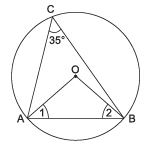
Q1. In the figure, if ∠ ACB = 35°, then find the measure of ∠ OAB.

Ans: ∠AOB = 180° –  (∠1 + ∠2)
= 180° – (35° + 35°)                     [∵ AO = OB ∴ ∠1 = ∠2]
= 110°
∠ACB = (1/2)(∠AOB) = (1/2) (110°) = 55°


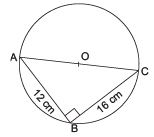
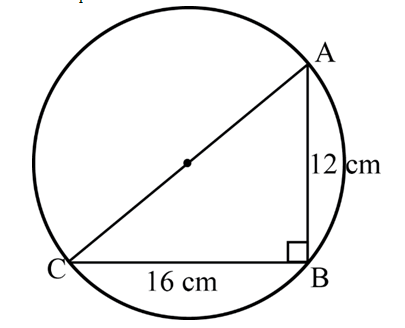
Q2. If points A, B and C are such that AB ⊥ BC and AB = 12 cm, BC = 16 cm. Find the radius of the circle passing through the points A, B and C.
Ans:
 ∵ AB ⊥ BC
∴ ∠B = 90°                  [Angle in a semicircle]
⇒ AC is a diameter 

AC = 20

Radius = 10cm


Q3. The angles subtended by a chord at any two points of a circle are equal. Write true or false for the above statement and justify your answer.
Ans:
 False. If two points lie in the same segment only, then the angles will be equal otherwise they are not equal.


Q4. Two chords of a circle of length 10 cm and 8 cm are at the distance 8.0 cm and 3.5 cm, respectively from the centre, state true and false for the above statement.
Ans:
 False. As the larger chord is at a smaller distance from the centre.


Q5. If AB = 12 cm, BC = 16 cm and AB is perpendicular to BC, then the radius of the circle passing through the points A, B and C is 

Ans: 

Assuming that AB = 12 cm and BC = 16 cm

If BC and AB are in a circle, then AC will be the circle’s diameter.

[circular’s diameter forms a right angle to the circle]

Apply the Pythagorean theorem to the ABC right angle.

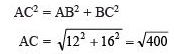
AC2=AB2+BC2

AC2=(12)2+(16)2

AC2=144+256⇒ AC2=400

⇒ AC2=√400=20 cm

[using the square root of a positive number since the diameter is always positive]

∴ Circle radius = 1/2(AC)=1/220=10 cm

As a result, the circle’s radius is 10 cm.


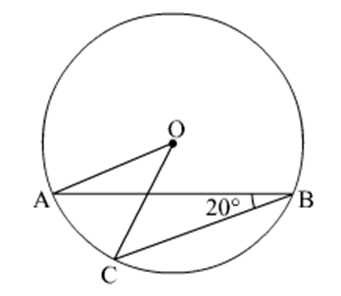
Q6. In Figure, if ∠ABC = 20º, then ∠AOC is equal to:  

Ans: Assumed: ABC = 20°…(1)

We are aware that an arc’s angle at the circle’s center is twice as large as its angle at the rest of the circle.

= ∠AOC = 2(20°) (From (1))

=  ∠AOC = 40°

∠AOC thus equals 40°


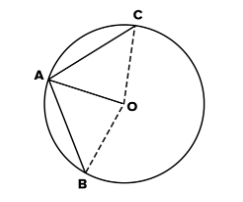
Q7. Two chords AB and AC of a circle with center O are on the opposite sides of OA. Then ∠OAB = ∠OAC. 

Write true or false for the above statement and justify your answer.

Ans:

Two chords are used: AB and AC.

Join us, OB and OC.

Specifically, triangle OAC and OAB

OA (common side) = OA

Triangles OAB and OAC are not congruent, therefore it is impossible to prove that any third side or angle is equivalent. OC = OB (radius of the circle).

<OAC and <OAB

The claim is untrue as a result.

Q8. ABCD is a cyclic quadrilateral such that ∠A = 90°, ∠B = 70°, ∠C = 95° and∠D = 105°.

Write true or false for the above statement and justify your answer.

Ans: Given that ABCD is a cyclic quadrilateral with angles of 90°, 70°, 95°, and 105°,

We are aware that the sum of the opposite angles in a cyclic quadrilateral is 180°.

It can be expressed mathematically as follows: A + C = 90° + 95° = 185° 180°

B + D = 70° + 105° = 175° 

The sum of the opposing angles in this situation is not 180°.

It is therefore not a cyclic quadrilateral.

The claim is false as a result.


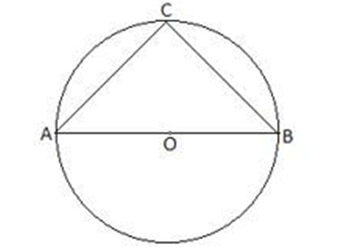
Q9. In Fig, if AOB is the diameter of the circle and AC = BC, then ∠CAB is equal to: 

Ans: We are aware that the circle’s diameter forms a right angle.

∠BCA = 90 ……(i)

AC = BC, and (ii) <ABC=<CAB (the angle opposite to equal sides is equal)

In △ ABC, ∠CBA+∠ABC+∠BCA=180 [Triangle’s angle-sum attribute]]
 ∠CAB+∠CAB+90=180
 2 ∠CAB=90
 ∠CAB=45


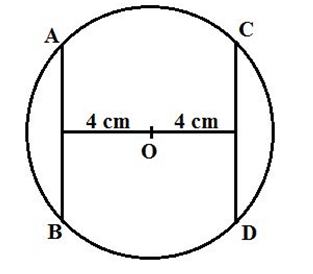
Q10.  Two chords AB and CD of a circle are each at distances 4 cm from the center. Then AB = CD.

Write true or false for the above statement and justify your answer. 

Ans: The right answer is True.

The above assertion is accurate since chords that are equally spaced from a circle’s center have equal lengths.

AB=CD 


Q11.  If A, B, C, and D are four points such that ∠BAC = 30° and ∠BDC = 60°, then D is the center of the circle through A, B and C. 

Write true or false for the above statement and justify your answer. 
Ans: False
Because there are numerous places D where ∠BDC=60°, none of which can be the center of the circle formed by points A, B, and C.