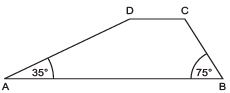
Question 1. In the adjoining figure, ABCD is a trapezium in which AB || DC. If ∠A = 35º and ∠B = 75º, then find ∠C and ∠D. Solution: AB || DC and AD is a transversal. Therefore, ∠A + ∠D = 180° (co-interior angles on the same side of the transversal). ∴ ∠D = 180° – ∠A = 180° – 35° = 145°.
Similarly, since AB || DC and BC is a transversal, ∠B + ∠C = 180° (co-interior angles). ∴ ∠C = 180° – ∠B = 180° – 75° = 105°. Thus, ∠C = 105° and ∠D = 145°.
Question 2. Fill in the blanks: (i) In a parallelogram, opposite angles are ____.(ii) A ____ of a parallelogram divides it into two congruent triangles. (iii) The sum of the angles of a quadrilateral is ____. (iv ) In a parallelogram, the opposite sides are parallel and _____. Solution:Ans: (i) equal (ii) diagonal (iii) 360° (iv) equal
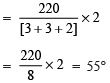
Question 3. One angle of a quadrilateral is 140° and other three angles are in the ratio of 3 : 3 : 2. Find the measure of the smallest angle of the quadrilateral. Solution: Remaining three angles = 360° – 140° = 220°. Ratio of the three angles = 3 : 3 : 2. Sum of ratio parts = 3 + 3 + 2 = 8. ∴ One part = 220° ÷ 8 = 27.5°. ∴ The smallest angle = 2 × 27.5° =
= 55°. Hence, the smallest angle of the quadrilateral is 55°.
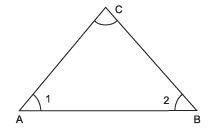
Q.1. In a ΔABC, BC = CA and ∠ A = 50°, which is longer BC or AB? Sol. ∵ ∠ 1 = ∠ 2 [∵ AC = BC] and ∠A = ∠1 = 50°
⇒ ∠ 2 = 50°
⇒ ∠1+ ∠2+ ∠3= 180 [ angle sum property ] ∴ ∠ C = 180º – [50° + 50°] = 80° ⇒ Since, ∠C > ∠A ⇒ AB > BC Thus, AB is greater. [The greatest side is opp. to the greatest angle.]
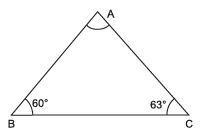
Q.2. In ΔABC, ∠ B = 60° and ∠ C = 63°. Name the greatest side. Sol. In ΔABC, ∠ B = 60° and ∠ C = 63°
⇒ ∠A+ ∠B+ ∠C= 180 [ angle sum property ]
⇒ ∠ A = 180º – (60° + 63°) = 57° ⇒ The greatest side is opp. to the greatest angle, i.e., 63° ∴ Side AB is the greatest.
Q.3. In ΔABC, if BC = AB and ∠ B = 80°, then find the measure of∠ A. Sol. BC = AB ⇒ ∠A = ∠C
Q.4.Which of the following is not the criterion for congruence of triangles?
(i) SAS (ii) SSA (iii) ASA (iv) RHS
Ans: SSA is not the criterion for congruency.
Q.5. If two angles are (30 – a)º and (125 + 2a)º and they are supplement of each other. Find the value of ‘a’. Sol. ∵ (30 – a)º and (125 + 2a)º are supplement to each other. ∴ (30 – a + 125 + 2a)º = 180º ⇒ a = 180º – 125º – 30º = 25º ⇒ Value of a = 25°
Q.6. Each of the equal angles of an isosceles triangle is 38°. What is the measure of the third angle? Sol. Let the third angle = x ∴ x + 38° + 38° = 180° ⇒ x = 180° – 38° – 38° = 104º
Q.7. In an isosceles ΔABC, AB = AC and ∠ A= 80°. What is the measure of ∠ B? Sol. We have AB = AC ⇒ ∠ B = ∠ C [∵ Angles opposite to equal sides are equal] ∴ ∠A + ∠B + ∠C = 180° ⇒ ∠A + ∠B + ∠B = 180° ⇒ ∠A + 2∠B = 180° ⇒ 80° + 2∠B = 180° ⇒ 2∠B = 180°- 80° = 100 ⇒ ∠B= (100o/2) = 50°
Q.8. Find the measure of each acute angle in a right angle isosceles triangle. Sol. Let the measure of each of the equal acute angle of the Δ be x ∴ We have: x + x + 90° = 180° ⇒ x + x = 180° – 90° = 90° ⇒ x= (90o/2)= 45°
Q.1. What is the measure of an angle whose measure is 32° less than its supplement? Sol. Let the required angle be x ∴ x = (180°- x) – 32° ⇒ x = 74°
Q.2. If the supplement of an angle is 4 times its complement, find the angle. Sol. Let the required angle be x ∴ (180°- x) = 4 (90° – x) ⇒ x = 60°
Q.3. An exterior angle of a Δ is 110° and its two opposite interior angles are equal. What is the measure of each angle? Sol. Let each of the interior opposite angle be x ∴ x + x = 110° ⇒ x = 55°
Q.4. In a rt. ΔABC, ∠A = 90° and AB = AC. What are the values of ∠B and ∠C? Sol. ∵ AB = AC ⇒ ∠B = ∠C Also, ∠A = 90° ⇒ ∠B + ∠C = 90° ⇒ ∠B = ∠C = (90o/2) = 45°
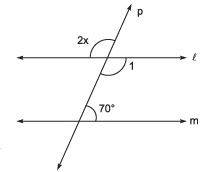
Q.5. In the figure, what is the value of x? Sol. ∵ ℓ || m and p is a transversal
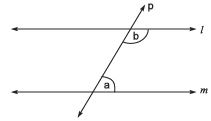
Q.6. If two interior angles on the same side of a transversal intersecting two parallel lines are in the ratio 2 : 3 then, what is the smaller angle? Sol. ℓ || m and p is the transversal ∴ ‘a’ and ‘b’ are interior angles on the same side of the transversal p.
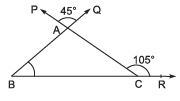
Let a = 2x and b = 3x ∴ a + b = 180° ⇒ 2x + 3x = 180° ⇒ 5x = 180° ⇒ x = (180/5)= 36° ∴ smaller angle = 2x = 2 x 36 = 72° Q.7. In the figure, what is the measure of ∠ ABC? Sol. ∠PAQ = ∠BAC [vertically opp. angles]
Q.1. What is the measure of an angle whose measure is 32° less than its supplement? Sol. Let the required angle be x ∴ x = (180°- x) – 32° ⇒ x = 74°
Q.2. If the supplement of an angle is 4 times its complement, find the angle. Sol. Let the required angle be x ∴ (180°- x) = 4 (90° – x) ⇒ x = 60°
Q.3. An exterior angle of a Δ is 110° and its two opposite interior angles are equal. What is the measure of each angle? Sol. Let each of the interior opposite angle be x ∴ x + x = 110° ⇒ x = 55°
Q.4. In a rt. ΔABC, ∠A = 90° and AB = AC. What are the values of ∠B and ∠C? Sol. ∵ AB = AC ⇒ ∠B = ∠C Also, ∠A = 90° ⇒ ∠B + ∠C = 90° ⇒ ∠B = ∠C = (90o/2) = 45°
Q.5. In the figure, what is the value of x? Sol. ∵ ℓ || m and p is a transversal
Q.6. If two interior angles on the same side of a transversal intersecting two parallel lines are in the ratio 2 : 3 then, what is the smaller angle? Sol. ℓ || m and p is the transversal ∴ ‘a’ and ‘b’ are interior angles on the same side of the transversal p.
Let a = 2x and b = 3x ∴ a + b = 180° ⇒ 2x + 3x = 180° ⇒ 5x = 180° ⇒ x = (180/5)= 36° ∴ smaller angle = 2x = 2 x 36 = 72° Q.7. In the figure, what is the measure of ∠ ABC? Sol. ∠PAQ = ∠BAC [vertically opp. angles]
Question 1. What is the Euclid’s second axiom? Solution: The 2nd axiom is: “If equals be added to equals, the wholes are equal.”
Question 2. What is a theorem? Solution: A mathematical statement whose truth has been logically established is called a theorem.
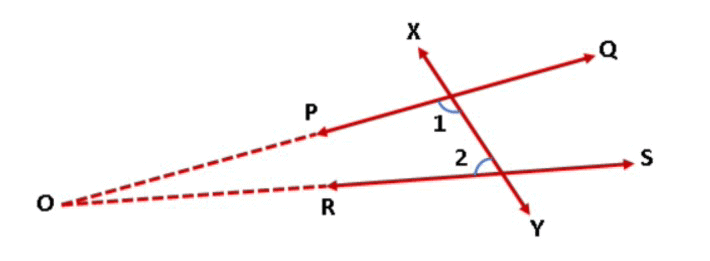
Question 3. What is the Euclid’s fifth postulate? Solution: It states that: “If a straight line falling on two straight lines make the interior angles on the same side of it taken together less than two right angles, then the two straight lines, if produced indefinitely, meet on the side on which the sum of the angles is less than two right angles.”
Euclid’s fifth postulate
Question 4. Is the following statement correct? “The axioms are Universal truths in all branches of Mathematics.” Solution: Yes.
Question 5. Complete the following statement: The things which are double of the same thing are ………………….. .
Solution: The things which are double of the same thing are equal.
Question 6. In how many chapters Euclid divided his famous treatise, “The Elements”? Solution: 13 Chapters.
Question 7. J, M and R are friends, J is of the same age as M. R is also of the same age as M. Which Euclid’s axiom illustrates the relative age of J and R? Solution: First Axiom.
Question 8. If a straight line falling on two straight lines makes the interior angles on the same side of it, whose sum is 120°, then on which side the two straight lines meet, if produced indefinitely? Solution: They meet on the side on which the sum of angles is less than 120°.
Question 9. How many dimensions does a solid has? Solution: A solid has 3 dimensions.
Question 10. How many dimensions does a surface has? Solution: A surface has 2 dimensions.
Question 11. How many dimensions does a point has? Solution: A point has zero (0) dimensions.
Question 12. Which of the following are the boundaries of a surface: lines; curves; surfaces? Solution: The boundaries of a surface are curves.
Question 13. Johan is of the same age as Mohan. Raghu is also of the same age as Mohan. State Euclid’s axiom that illustrate the relative ages of Johan and Raghu. Solution: The first axiom explains the above statement.
Question 14. Which of the following is the 5th postulate of Euclid? (i) The whole is greater than the part. (ii) If a straight line falling on two straight lines make the interior angles on the same side of it taken together less than two right angles then the two straight lines if produced indefinitely meet on that side on which the sum of angles is less than two right angles. (iii)“all right angles are equal to one another.” Solution: The option (ii) is the Euclid’s fifth postulate.
Question 15. Which of the following are assumed as axioms? (i) Universal Truths in all branches of Mathematics. (ii) Universal Truths specific to geometry. (iii) Theorems (iv) Definitions. Solution: (i) The universal truths in all branches of Mathematics.
Question 16. Complete the following statement: Pythagoras was a student of …………………………….. . Solution: Pythagoras was the student of ‘Thales’.
Question 17. What do we call a closed figure formed by three line segments Solution: A triangle.
Question 18. What do we call a figure formed by two straight lines having a common point? Solution: An angle.
Question 19. What is the minumum number of lines required to make a closed figure? Solution: Three lines.
Question 20. How many straight lines can be drawn through two given points Solution: Only one line.
Question 1. Show that x = 1, y = 3 satisfy the linear equation 3x – 4y + 9 = 0. Ans: The ordered pair (1, 3) satisfies the equation. We have 3x – 4y + 9 = 0. Putting x = 1 and y = 3, L.H.S. = 3(1) – 4(3) + 9 = 3 – 12 + 9. L.H.S. = 0 = R.H.S. Therefore, x = 1 and y = 3 satisfy the given linear equation.
Question 2. Write whether the following statements are True or False? Justify your answers. (i) ax + by + c, where a, b and c are real numbers, is a linear equation in two variables.
(ii) A linear equation 2x + 3y = 5 has a unique solution.
(iii) All the points (2, 0), (-3, 0), (4, 2) and (0, 5) lie on the x-axis.
(iv) The line parallel to y-axis at a distance 4 units to the left of y-axis is given by the equation x = -4.
(v) The graph of the equation y = mx + c passes through the origin. Solution.
(i) Ans: False. Explanation: For an equation to be a linear equation in two variables of the form ax + by + c = 0, both x and y must appear; thus the coefficients a and b should not be zero simultaneously. If one of them is zero, the equation reduces to a single-variable equation, not a linear equation in two variables.
(ii) Ans:False. Explanation: The equation 2x + 3y = 5 represents a straight line in the xy-plane. A single linear equation in two variables has infinitely many solutions (all the points on that line), not a unique solution. A unique solution would require two independent linear equations.
(iii) Ans: False. Explanation: Points on the x-axis have y = 0. Here (2, 0) and (-3, 0) lie on the x-axis, but (0, 5) lies on the y-axis and (4, 2) lies in the first quadrant, so not all the given points lie on the x-axis.
(iv) Ans: True. Explanation: The line x = -4 is a vertical line four units to the left of the y-axis. Any vertical line parallel to the y-axis at a fixed distance is given by x = constant, so x = -4 is correct.
(v) Ans: False. Explanation: The line y = mx + c passes through the origin (0, 0) only when c = 0. Substituting x = 0 gives y = c, so for the origin to lie on the line we must have c = 0. In general, when c ≠ 0 the graph does not pass through the origin.
Question 3. Write whether the following statement is True or False? Justify your answer. The coordinates of points given in the table:
Represent some of the solutions of the equation 2x + 2 = y. Ans: True. Explanation: Each pair in the table satisfies y = 2x + 2 because every y-coordinate equals two times the x-coordinate plus two. Therefore the given points are solutions of the equation.
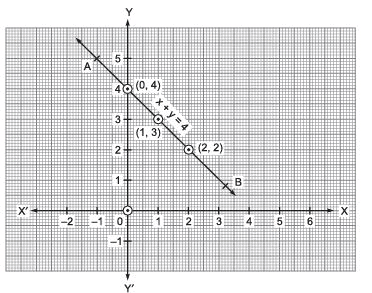
Question 4. Look at the following graphical representation of an equation. Which of the points (0, 0) (0, 4) or (-1, 4) is a solution of the equation?
Ans: (0, 4) is a solution of the equation. Explanation: On the graph the point (0, 4) lies on the line, while (0, 0) and (-1, 4) do not lie on that line.
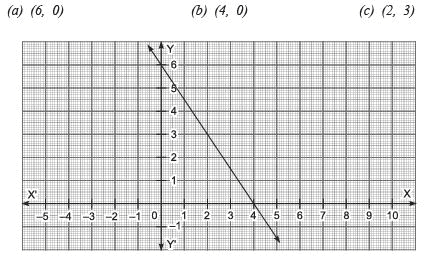
Question 5. Look at the following graphical representation of an equation. Which of the following is not its solution?
Ans: The point (6, 0) is not a solution of the equation.
Explanation: The point (6, 0) does not lie on the plotted graph, so it does not satisfy the equation. All other listed points lie on the graph and therefore satisfy the equation.
Question 1. A point (other than zero) is such that [The abscissa of the point] = [The ordinate of the point] In which quadrants can the point lie? Solution: ∵ abscissa = ordinate ⇒ x = y. For a non-zero point x and y must have the same sign. ∴ The point lies in I (both positive) or III (both negative) quadrant.
Question 2. A line ∠M is drawn parallel to X-axis at a distance of 5 units from it. On ∠M a point P is marked at a distances of 3 units from the Y-axis. What are the coordinates of P? Solution: The line ∠M is at a distance 5 units from the x-axis, so it may be at y = 5 or y = -5. The point P is at a distance 3 units from the y-axis, so x = 3 or x = -3. Therefore the possible coordinates of P are (3, 5), (-3, 5), (3, -5) or (-3, -5).
Question 3. Which of the following statements are true? (i) The point (0, -4) lies on y-axis (ii) The perpendicular distance of the point (5, 7) from the x-axis is 5. (iii) Point (1, -1) and (-1, 1) lie in the same quadrant. Solution: Only the statement (i) is true. Explanation: (i) (0, -4) has x = 0, so it lies on the y-axis – True. (ii) Distance from the x-axis = |y| = |7| = 7, not 5 – False. (iii) (1, -1) lies in IV quadrant while (-1, 1) lies in II quadrant – False.
Question 4. What are the coordinates of origin? Solution: (0, 0) are the coordinates of the origin; it is the point of intersection of the x-axis and y-axis.
Question 5. What is the sign of y-coordinate below the x-axis? Solution: It is always negative (y < 0).
Question 6. What is the x-coordinate of a point on y-axis? Solution: It is always 0.
Question 7. In which quadrant the point (-2, 5) lies? Solution: (-2, 5) lies in the II quadrant because x is negative and y is positive.
Question 8. What is the sign of the y-coordinate of a point lying in the III-quadrant? Solution: The y-coordinate of a point in III quadrant is always negative (y < 0); both x and y are negative in III quadrant.
Question 9. If the two points are A(-2, 7) and B(-3, 4) then what is (abscissa of A) – (abscissa of B)? Solution: ∵ abscissa of A = -2 and abscissa of B = -3 ∴ (-2) – (-3) = -2 + 3 = 1
Question 10. If the y-coordinate of a point is zero, then where does this point lie? Solution: It lies on the x-axis (because y = 0).
Question 11. What are the coordinates of a point lying on the y-axis at negative 3 units? Solution: (0, -3)
Question 12. What are the coordinates of a point whose ordinate is 5 and lying on the y-axis. Solution: (0, 5).
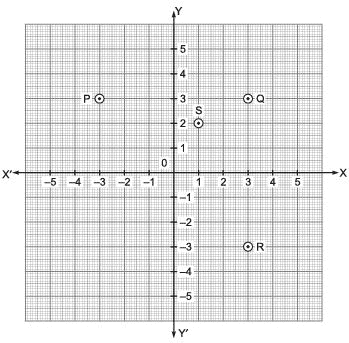
Question 13. In the following figure, which point has its abscissa as -3 Solution: The point p(-3, 3) has its abscissa as -3 because abscissa means the x-coordinate.
Question 14. Name the collinear points in the above figure? Solution: The points P, O and R are collinear because they lie on the same straight line.
Question 15. What is the distance of the point (3, – 4) from x-axis? Solution: The distance from the x-axis equals |y| = |-4| = 4 units.
Question 16. The origin lies on which of the following? x-axis only, both axis, none of the axes Solution: The origin lies on both the axes.
Question 17. The abscissa of a point is 5 and it lies on the x-axis. What are its coordinates? Solution: (5, 0) since y = 0 on the x-axis.
Question 18. A point lies on the x-axis as well as on the y-axis. What are its coordinates? Solution: (0, 0)
Question 19. In which quadrants x and y coordinates have different sign Solution: II and IV quadrants, because there x and y have opposite signs.
Question 20. In which quadrants x and y coordinate have same sign? Solution: I and III quadrants, because there x and y have the same sign.
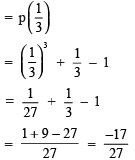
Q.4. Show that p(x) is not a multiple of g(x), when p(x) = x3 + x – 1 g(x) = 3x – 1
Solution. g(x) = 3x – 1 = 0 ⇒ x = 1/3
∴ Remainder
Since remainder ≠ 0, so p(x) is not a multiple of g(x).
Q.5. (a) Find the value of ‘a’ if x – a is a factor of x3 – ax2 + 2x + a – 5. (b) Find the value of ‘a’, if (x – a) is a factor of x3 – ax2 + 2x + a – 1 [NCERT Exemplar] (c) If x + 1 is a factor of ax3 + x2 – 2x + 4a – 9 find the value of ‘a’. [NCERT Exemplar]
Solution. (a) Let p(x) = x3 – ax2 + 2x + a – 5 since x – a is a factor of p(x), so p(a) = 0 ⇒ (a)3 – a(a)2 + 2(a) + a – 5 = 0 ⇒ (a)3 – a(a)2 + 2(a) + a – 5 = 0 ⇒ 3a – 5 = 0 ⇒ a =
(b) Here, p(x) = x3 – ax2 + 2x + a – 1 ∵ x – a is a factor of p(x) ∴ p(a) = 0 ⇒ a3 – a(a)2 + 2(a) + a – 1 = 0 ⇒ a3 – a3 + 2a + a – 1 = 0 ⇒ 3a – 1 = 0 ⇒ a = 1/3
Q.6. Without finding the cubes factorise (a – b)3 + (b – c)3 + (c – a)3.
Solution. If x + y + z = 0 then x3 + y3 + z3 = 3xyz Here, (a – b) + (b – c) + (c –a) = 0 ∴ (a – b)3 + (b – c)3 + (c – a)3 = 3(a – b)(b – c)(c – a)
Q.7. What is zero of a non-zero constant polynomial? Solution. A non-zero constant polynomial has no zero.
Q.8. What is the coefficient of a zero polynomial? Solution. A zero polynomial has all coefficients zero.
Q.9. What is the degree of a biquadratic polynomial? Solution. ∵ The degree of a quadratic polynomial is 2. ∴ The degree of a biquadratic polynomial is 4.
Q.10. Is the statement: ‘0’ may be a zero of polynomial, true? Solution. Yes, this statement is true.
Q.11. What is the value of (x + a) (x + b)? Solution. The value of (x + a) (x + b) = x2 + (a + b) x + ab.
Q.12. What is the value of (x + y + z)2 – 2[xy + yz + zx]? Solution. ∵ (x + y + z)2 = x2 + y2 + z2 + 2 xy + 2 yz + 2 zx = x2 + y2 + z2 + 2[xy + yz + zx] ∴ (x + y + z)2 – 2[xy + yz + zx] = x2 + y2 + z2
Q.13. What is the value of (x + y)3 – 3xy (x + y)? Solution. ∵ (x + y)3 = x3 + y3 + 3xy (x + y) ∴ [x3 + y3 + 3xy (x + y)] – [3xy (x + y)] = x3 + y3 ⇒ (x + y)3 – 3xy(x + y) = x3 + y3 Thus, value of x3 + y3 is (x + y)3 – 3xy (x + y)
Q.14. Write the value of x3 – y3. Solution. The value of x3 – y3 is (x – y)3 + 3xy (x – y)
Q.15. Write the degree of the polynomial 4x4 + ox3 + ox5 + 5x + 7? Solution. The degree of 4x4 + 0x3 + 0x5 + 5x + 7 is 4.
Q.16. What is the zero of the polynomial p(x) = 2x + 5? Solution. ∵ p(x) = 0 ⇒ 2x + 5 = 0
⇒ x =
∴ zero of 2x + 5 is
Q.17. Which of the following is one of the zero of the polynomial 2x2 + 7x – 4 ? 2, -2 ?
Solution. ∵ 2x2 + 7x – 4 = 2x2 + 8x – x – 4 ⇒ 2x (x + 4) – 1 (x + 4) = 0 ⇒ (x + 4) (2x – 1) = 0 ⇒ x = – 4, x = 1/2, ∴ One of the zero of 2x2 + 7x – 4 is 1/2.
Q.18. If a + b + 2 = 0, then what is the value of a3 + b3 + 8.
Solution. ∵ x + y + z = 0 ⇒ x3 + y3 + z3 = 3xyz ∴ a + b + 2 = 0 ⇒ (a)3 + (b)3 + (2)3 = 3(a × b × 2) = 6ab ⇒ The value of a3 + b3 + 8 is 6ab
Q.19. If 49x2 – p =, what is the value of p? Solution.
Q2:How many rational numbers can be found between two distinct rational numbers? (i) Two (ii) Ten (iii) Zero (iv) Infinite Ans: (iv) Infinite Between any two distinct rational numbers, an infinite number of rational numbers can be found. This is because rational numbers are dense on the number line, meaning between any two rational numbers a and b (a<b), you can always find another rational number by calculating the average: New rational number = a+b/2
Q3: Identify a rational number among the following numbers : 2 + √2, 2√2, 0 and π Ans: 0 is a rational number.
Q4: √8 is an (i) natural number (ii) rational number (iii) integer (iv) irrational number
Ans: (D) √8 is an irrational number
Q5: Find the value of √(3)– 2. Ans: Q6: Is zero a rational number? Can you write it in the form pq, where p and q are integers and q≠0?
Ans: Consider the definition of a rational number. A rational number is the one that can be written in the form , where p and q are integers and
Zero can be written as
So, we arrive at the conclusion that 0 can be written in the form , where p is any integer.
Therefore, zero is a rational number.
Q7: A terminating decimal is
(i) a natural number (ii) a rational number (iii) a whole number (iv) an integer.
Ans: (ii) a rational number
Q8: Find 641/2 Ans:
Q9: Simplify Ans:
The LCM of 3 and 4 is 12.
Q10: The sum of rational and an irrational number (i) may be natural (ii) may be irrational (iii) is always irrational (iv) is always rational
Ans: (iii) is always rational Example: Rational number: 3 Irrational number: Sum: √ The sum √ cannot be expressed as , so it is irrational.
Q1: A histogram has a class interval 40-60, and its rectangle height is 8 units. Another class interval 60-70 has rectangle height 16 units. If the intervals are unequal, which class has higher frequency density?
(a) 40-60 (b) 60-70 (c) Both equal (d) Cannot be determined
Ans: (b)
Explanation: In a histogram with unequal class widths, the height of each rectangle represents the frequency density (frequency ÷ class width) according to the chosen vertical scale. Here the given rectangle heights are 8 and 16 units. Comparing these heights shows that the rectangle for 60-70 is taller (16 > 8), so its frequency density is larger. If one instead treats the given numbers as raw frequencies, dividing by class widths (40-60 has width 20, 60-70 has width 10) gives densities 8/20 = 0.4 and 16/10 = 1.6, and again the class 60-70 has the higher density. Thus 60-70 has the higher frequency density.
Q2: In a frequency polygon, if two consecutive class midpoints are incorrectly taken as 2 units closer, what happens to the polygon?
(a) Only the height changes (b) Only the width changes (c) Slope becomes steeper or flatter (d) It becomes impossible to draw
Ans: (c)
Explanation: Points of a frequency polygon are plotted at class midpoints on the x-axis. If two consecutive midpoints are taken 2 units nearer than they should be, the x-coordinates of those plotted points shift. This changes the slopes of the line segments joining them, making the segment between those points either steeper or flatter compared with the correct plot. Heights (frequencies) remain the same, but the slope is distorted.
Q3: A bar graph compares profit for 12 months. If the scale is changed from 1 cm = ₹5000 to 1 cm = ₹10,000, the effect is:
(a) Bar widths double (b) Bar heights become half (c) Bars shift left (d) Gaps disappear
Ans: (b)
Explanation: The vertical scale determines how much height represents a given amount. Changing the scale from 1 cm = ₹5,000 to 1 cm = ₹10,000 makes each amount occupy half the previous height on the graph. Bar widths and horizontal positions are unaffected; only the bar heights change, becoming half as tall.
Q4: A histogram is used for: (a) Discrete data (b) Continuous grouped data (c) Favourite colours (d) Names of students
Ans: (b)
Explanation: A histogram represents continuous grouped data arranged in class intervals. Adjacent bars touch, and the height of each bar gives frequency density (frequency ÷ class width). Discrete categories such as favourite colours or names use bar graphs, not histograms.
Q5: A bar graph is drawn using:
(a) Bars of equal width (b) Bars of unequal width (c) Bars touching each other (d) No bars at all
Ans: (a)
Explanation: A bar graph uses bars of equal width with gaps between them to represent distinct categories; the heights show the values (frequency, amount, etc.). Histograms, by contrast, have touching bars because they represent continuous intervals.
Short Answer Questions
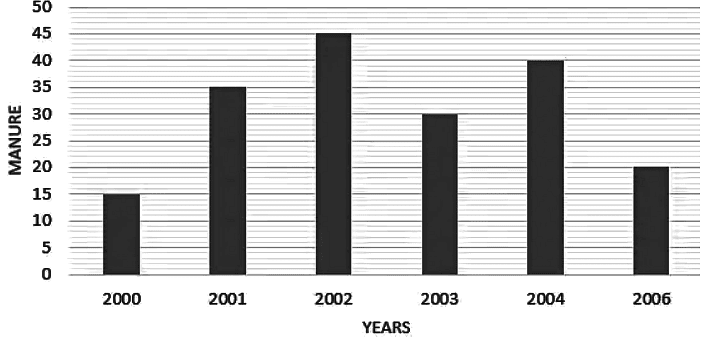
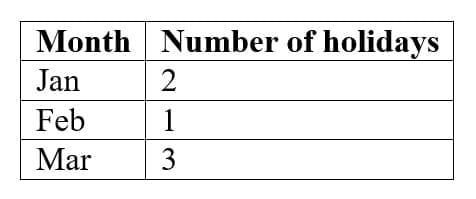
Q1: The following data gives the amount of manure (in tones) manufactures by a company during some years.
Represent it with a bar graph.
Indicate with help of bar graph in which year, the amount of manufactured by company was maximum.
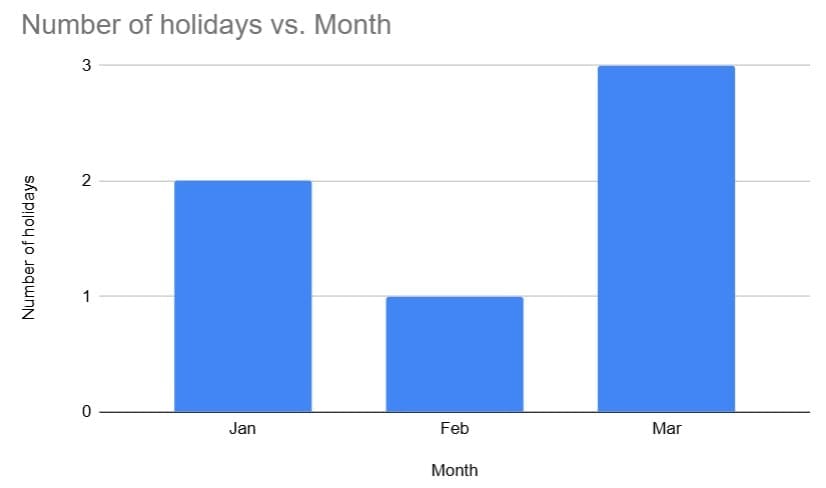
Ans: The bar graph representing the given data is shown below. The year with the highest production is the year having the tallest bar in the graph.
Q2: Draw a bar graph for the following data:
Ans:
The bar graph above shows the given data; read the tallest or shortest bar to compare values across categories.
Q3: Find the class mark of 20-30.
Ans: Class mark = (Lower limit + Upper limit) ÷ 2 = (20 + 30) ÷ 2 = 25
Long Answer Questions
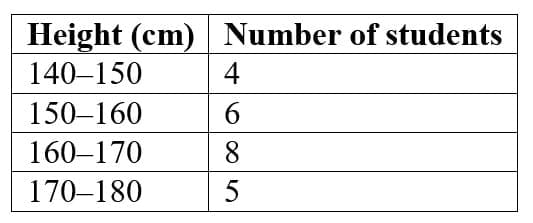
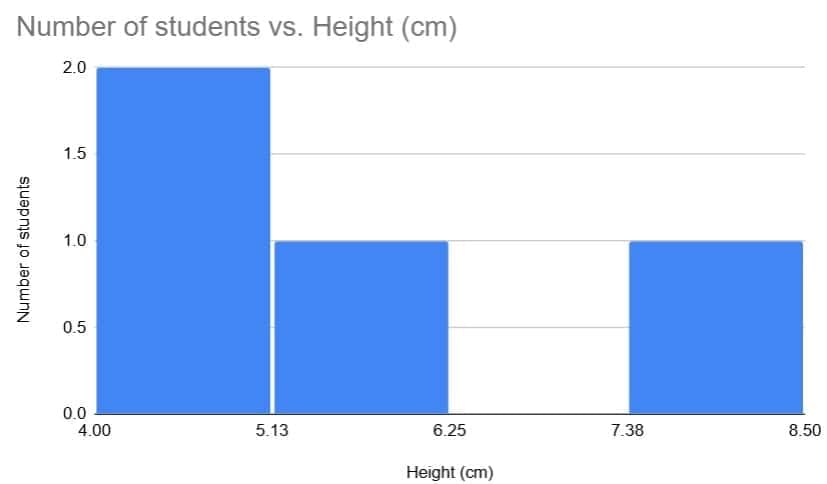
Q1: Draw a histogram for this data:
Ans:
When drawing the histogram, ensure that each class interval is represented by a bar whose width equals the class width and whose height equals the frequency density (frequency ÷ class width) so that areas of bars represent frequencies correctly.
Q2: You are given the following mid-points of a frequency polygon: 20, 30, 40, 50, 60 The polygon rises from (20, 6) to (40, 18), then falls to (60, 4).
(a) Reconstruct the class intervals. (b) Draw a rough shape description of the polygon. (c) Explain where the distribution has its “peak” and what it means.
Ans:
(a) To find class intervals from midpoints, use half the class width on either side of each midpoint. Midpoints: 20, 30, 40, 50, 60 Difference between consecutive midpoints = 10, so class width = 10. Each interval = midpoint ± 5, giving:
15-25 25-35 35-45 45-55 55-65
(b) Shape
Plot points at (20, 6), (30, y₂), (40, 18), (50, y₄), (60, 4) where y₂ and y₄ are the intermediate frequencies consistent with the rise and fall described.
The polygon rises steeply from (20, 6) up to (40, 18), then falls sharply toward (60, 4). This produces a clear single-peaked shape with a steep ascent followed by a descent.
(c) Peak at midpoint 40, frequency 18. Meaning: The highest point of the polygon is at midpoint 40, so most observations fall in the class with midpoint 40, that is the class 35-45. This class therefore contains the largest frequency compared with the other classes.
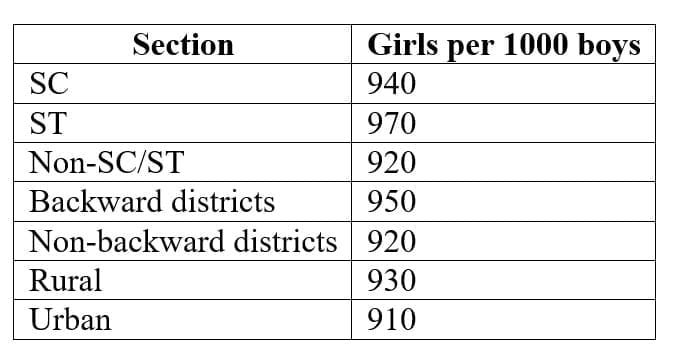
Q3: Below is data of girls per 1000 boys in different sections of society:
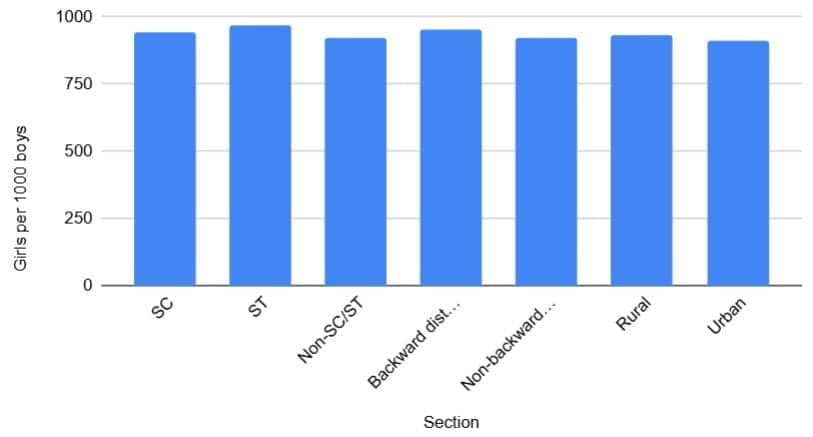
(i) Draw a bar graph for the data. (ii) Which section shows the highest value? (iii) Comment on the trend.
Ans: (i)
(ii) The ST (Scheduled Tribe) section shows the highest value with 970 girls per 1000 boys.
(iii) From the bar graph we observe the following trend:
ST has the highest girls-per-1000-boys ratio.
Backward districts and SC also show relatively better gender ratios compared with some other sections.
Urban areas show the lowest value (910), indicating a poorer gender ratio in urban regions compared with several rural or tribal sections.
Overall, the gender ratio varies across sections; tribal and certain backward areas perform better than urban and some other groups.
Q1: Surface area of bowl of radius r cm is (a) 4πr2 (b) 2πr2 (c) 3πr2 (d) πr2 Ans: (c)
Sol: The area of a circle of radius r is πr2 Thus if the hemisphere is meant to include the base then the surface area is 2πr2 + πr2 = 3πr2
Q2: A conical tent is 10 m high and the radius of its base is 24 m then slant height of the tent is (a) 26 (b) 27 (c) 28 (d) 29 Ans: (a)
Sol: Height (h) of conical tent = 10 m Radius (r) of conical tent = 24 m Let the slant height of the tent be l l2 = h2 + r2 l2 = (10)2 + (24)2 l2 = 100 + 576 l2 = 676 l = √676
l = √262 l = 26 m Therefore, the slant height of the tent is 26 m.
Q3: Diameter of the base of a cone is 10.5 cm and its slant height is 10 cm . then curved surface area. (a) 155 cm2 (b) 165 cm2 (c) 150 cm2 (d) none of these Ans: 165 cm2
Sol: Diameter of the base of the cone is 10.5 cm and slant height is 10 cm. Curved surface area of a right circular cone of base radius, [‘r’]and slant height, l is πr. Diameter, d = 10.5 cm Radius, r = 10.5 / 2 cm= 5.25 cm Slant height, l = 10 cm Curved surface area = πrl = 3.14 × 5.25 × 10 = 165 cm Thus, curved surface area of the cone = 165 cm2.
Q4: The surface area of a sphere of radius 5.6 cm is (a) 96.8π cm2 (b) 94.08π cm2 (c) 90.08π cm2 (d) none of these Ans: (b)
Sol: Given radius of sphere = 5.6 cm Surface area of sphere = 4πr2 = 4 × 3.14 × (5.6)2 Surface area of sphere = 393.88 cm2
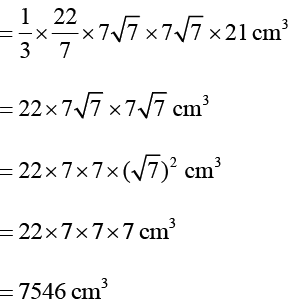
Q5: The height and the slant height of a cone are 21 cm and 28 cm respectively then volume of cone (a) 7556 cm3 (b) 7646 cm3 (c) 7546 cm3 (d) None of these Ans: (c)
Sol: Volume of the cone = 1/3 πr2h Given Slant height = l= 28 cm Height of cone = h= 21 cm Let radius of cone = r cm l2 = h2 + r2 282 = 212 + r2 282 – 212 = r2 r2 = 282 – 212 r2 = (28 – 21)(28 + 21) r2 =(7)(49) r = √7(49) r = √7(7)2 r = 7√7 cm Volume of the cone = 1/3 πr2 h
Fill in the blank
Q1: Surface area of sphere of diameter 14cm is____________. Ans: 616cm2
Sol: Given Diameter of sphere =14cm radius =7cm surface area of sphere = 4πr2 = 4π(7)2 = 4 × 3.14 × 49 surface area of sphere = 616cm2
Q2: Volume of hollow cylinder is ______________. Ans: π(R2−r2)h
Sol: The formula to calculate the volume of a hollow cylinder is given as, Volume of hollow cylinder =π(R2−r2)h cubic units, where, ‘R′ is the outer radius, ‘ r ‘ is the inner radius, and, ‘ h ‘ is the height of the hollow cylinder.
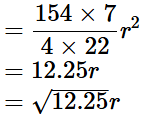
Q3: Find the volume of a sphere whose surface area 154cm2 is_________________. Ans: 179.67cm3
Sol: Given surface area of sphere =154cm2 Let radius of the sphere = r cm 4πr2 = 1544 × 227 × r2 =154r2 Volume of sphere =4/3πr3 =179.67cm3
Q4: A hemispherical bowl has a radius of 3.5cm. What would be the volume of water it would contain__________. Ans: 89.8cm3
Sol: The volume of water the bowl contain =2/3πr3 Radius of hemisphere =r=3.5cm The volume of water the bowl can contain =2/3πr3 = 2/3 × 22/7 × 3.5 × 3.5 × 3.5cm3 = 89.8cm3
Q5: The formula for the volume of a cone is __________.
Ans: 13 π r2 h
Sol: The formula for the volume of a cone is: 13 π r2 h
True / False
Q1: The volume of a sphere is equal to two-third of the volume of a cylinder whose height and diameter are equal to the diameter of the sphere. Ans: True
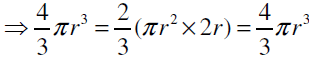
Sol: Let the radius of the sphere = r. According to the question, height and diameter of cylinder = diameter of sphere. So, the radius of the cylinder = r And, the height of the cylinder = 2r We know that, Volume of sphere = 2/3 volume of cylinder Hence, the given statement “the volume of a sphere is equal to two-third of the volume of a cylinder whose height and diameter are equal to the diameter of the sphere” is true.
Q2: If the radius of a right circular cone is halved and height is doubled, the volume will remain unchanged. Ans: False
Sol: Let the original radius of the cone = r Let height of the cone = h. The volume of cone = 1/3 πr2h Now, when radius of a height circular cone is halved and height is doubled, then We can observe that the new volume = half of the original volume. Hence, the given statement “if the radius of a right circular cone is halved and height is doubled, the volume will remain unchanged” is false.
Q3: If the radius of a cylinder is doubled and its curved surface area is not changed, the height must be halved. Ans: True
Sol: Let radius of the cylinder = r Height of the cylinder = h Then, curved surface area of the cylinder, CSA = 2πrh According to the question, Radius is doubled and curved surface area is not changed. New radius of the cylinder, R = 2r New curved surface area of the cylinder, CSA’ = 2πrh …(i) Alternate case: When R = 2r and CSA’ = 2πrh But curved surface area of cylinder in this case, CSA’= 2πRh = 2π(2r)h = 4πrh …(ii) Comparing equations (i) and (ii), We get, Since, 2πrh ≠ 4πrh equation (i) ≠ equation (ii) Thus, if h = h/2 (height is halved) Then, CSA’ = 2π(2r)(h/2) = 2πrh Hence, the given statement “If the radius of a cylinder is doubled and its curved surface area is not changed, the height must be halved” is true.
Q4: Doubling the radius of a sphere will double its volume. Ans: False
Sol: Formula for the volume of a sphere:
V = 43 π r3
If the radius is doubled (i.e., r becomes 2r), then the new volume V’ is:
V’ = 43 π (2r)3 = 43 π 8r3 = 8 × 43 π r3
Thus, doubling the radius increases the volume by a factor of 8, not 2.
Q5: The total surface area of a cone is the sum of its lateral surface area and the area of its circular base. Ans: True
Sol: The total surface area of a cone is the sum of its lateral surface area and the area of its circular base:
Lateral Surface Area = π r l
Area of Circular Base = π r2
Total Surface Area = π r l + π r2
For a cone with radius r and slant height l, the total surface area A is given by:
A = π r l + π r2
Subjective Type Questions
Q1: Diameter of the base of a cone is 10.5 cm and its slant height is 10 cm . Find its curved surface area and its total surface area.
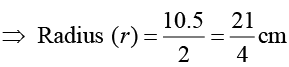
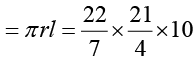
Ans: Diameter = 10.5 cm Slant height of cone (l ) = 10 cm Curved surface area of cone, =165 cm2 Total surface area of cone,
Q2: A Joker’s cap is in the form of a right circular cone of base radius 7 cm and height 24 cm. Find the area of the sheet required to make 10 such caps.
Ans: Radius of cap (r) = 7cm, Height of cap (h) =24 cm Slant height of the cone (l)
Area of sheet required to make a cap = CSA of cone = πrl
∴ Area of sheet required to make 10 caps = 10 × 550 = 5500 cm2
Q3: Find the surface area of a sphere of diameter: (i) 14cm
Ans: (i) Diameter of sphere = 14cm, Therefore, Radius of sphere = 14/2 = 7cm Surface area of sphere = 4πr2 = 4 × 22/7 × 7 × 7 = 616cm2
(ii) 21cm
Ans: Diameter of sphere = 21cm ∴ Radius of sphere =21/2cm Surface area of sphere = 4πr2 = 4 × 22/7 × 21/2 × 21/2 =1386cm2
(iii) 3.5cm
Ans: Diameter of sphere = 3.5cm ∴ Radius of sphere =3.5/2 = 1.75cm Surface area of sphere = 4πr2 = 4 × 22/7 × 1.75 × 1.75 = 38.5cm2
Q4: A hemispherical bowl is made of steel, 0.25cm thick. The inner radius of the bowl is 5cm . Find the outer curved surface area of the bowl.
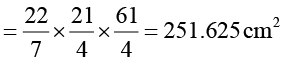
Ans: Inner radius of bowl (r)= 5cm Thickness of steel (t) = 0.25cm ∴ Outer radius of bowl (R) = r + t = 5 + 0.25 = 5.25cm ∴ Outer curved surface area of bowl = 2πR2 = 2 × 22/7 × 5.25 × 5.25 = 2 × 22/7 × 21/4 × 21/4 = 693/4 =173.25cm2
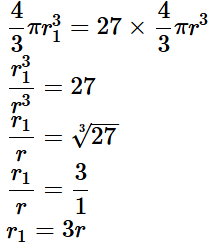
Q5: Twenty-seven solid iron spheres, each of radius r and surface area S are melted to form a sphere with surface area S ‘. Find the: (i) radius r ‘ of the new sphere.
Ans: Volume of 1 sphere, V = 4/3πr3 Volume of 27 solid sphere = 27 × 4/3πr3 Let r1 is the radius of the new sphere. Volume of new sphere = Volume of 27 solid sphere
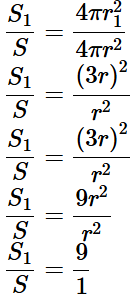
(ii) ratio of S and S ‘.
Ans: S1 : S = 9 : 1 S : S1 = 1 : 9
Q6: A capsule of medicine is in the shape of a sphere of diameter 3.5mm . How much medicine (in mm3) is needed to fill this capsule?
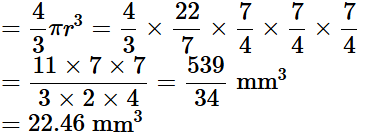
Ans: Diameter of spherical capsule = 3.5mm ∴ Radius of spherical capsule (r) = 3.5/2 = 35/20 = 7/4mm Medicine needed to fill the capsule = Volume of sphere
 ⇒ ∠ 2 = 50°
 ⇒ ∠A+ ∠B+ ∠C= 180 [ angle sum property ]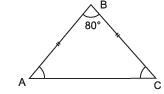
 Euclid’s fifth postulate

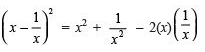
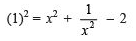
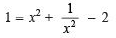
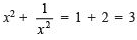


 -2 ?
-2 ?  = 1, then what is the value of
  ?
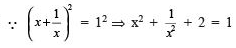
?
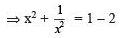
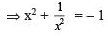

 Q6: Is zero a rational number? Can you write it in the form pq, where p and q are integers and q≠0?
 Volume of sphere =4/3πr3
  =179.67cm3
 Hence, the given statement “the volume of a sphere is equal to two-third of the volume of a cylinder whose height and diameter are equal to the diameter of the sphere” is true.
 We can observe that the new volume = half of the original volume.
 Slant height of cone (l ) = 10 cm
 =165 cm2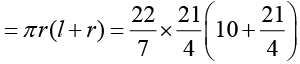




 S1 : S = 9 : 1