11. Worksheet: Surface Areas and Volume

Multiple Choice Questions

Q1: Surface area of bowl of radius r cm is 
(a) 
4πr2
(b) 
2πr2
(c) 
3πr2
(d) 
πr

Q2: A conical tent is 10 m high and the radius of its base is 24 m then slant height of the tent is
(a) 
26
(b) 
27
(c)
 28
(d) 
29

Q3: Diameter of the base of a cone is 10.5 cm and its slant height is 10 cm . then curved surface area. 
(a) 
155 cm
(b) 
165 cm
(c) 
150 cm
(d)
 None of these

Q4: The surface area of a sphere of radius 5.6 cm is 
(a) 
96.8π cm2
(b) 
94.08π cm2
(c)
 90.08π cm2
(d) 
None of these

Q5: The height and the slant height of a coneare 21 cm and 28 cm respectively then volume of cone 
(a) 
7556 cm
(b) 
7646 cm
(c)
 7546 cm
(d)
 None of these

Fill in the blank

Q1: Surface area of sphere of diameter 14cm is____________.

Q2: Volume of hollow cylinder is ______________.

Q3: Find the volume of a sphere whose surface area 154cm2 is_________________.

Q4: A hemispherical bowl has a radius of 3.5cm. What would be the volume of water it would contain__________.

Q5: The formula for the volume of a cone is __________.

True / False

Q1: The volume of a sphere is equal to two-third of the volume of a cylinder whose height and diameter are equal to the diameter of the sphere.

Q2: If the radius of a right circular cone is halved and height is doubled, the volume will remain unchanged.

Q3: If the radius of a cylinder is doubled and its curved surface area is not changed, the height must be halved.

Q4: Doubling the radius of a sphere will double its volume.

Q5: The total surface area of a cone is the sum of its lateral surface area and the area of its circular base.

Subjective Type Questions

Q1: Diameter of the base of a cone is 10.5 cm and its slant height is 10 cm . Find its curved surface area and its total surface area.

Q2: A Joker’s cap is in the form of a right circular cone of base radius 7 cm and height 24 cm. Find the area of the sheet required to make 10 such caps.

Q3: Find the surface area of a sphere of diameter:
(i) 14cm
(ii) 21cm
(iii) 3.5cm

Q4: A hemispherical bowl is made of steel, 0.25cm thick. The inner radius of the bowl is 5cm . Find the outer curved surface area of the bowl.

Q5: Twenty-seven solid iron spheres, each of radius r and surface area S are melted to form a sphere with surface area S ‘. Find the:
(i) radius r ‘ of the new sphere.
(ii) ratio of S and S ‘.

Q6: A capsule of medicine is in the shape of a sphere of diameter 3.5mm . How much medicine (in mm3) is needed to fill this capsule?

10. Worksheet: Heron’s Formula

Multiple Choice Questions

Q1: The difference between sides at right angles in a right-angled triangle is 14 cm. The area of the triangle is 120 cm2. The perimeter of the triangle is
(a)
 80
(b) 45
(c) 60
(d) 64

Q2: ABCD is a trapezium with AB  = 10cm, AD = 5 cm, BC = 4 cm and DC = 7 cm. Find the area of the ABCD?
(a) 34 cm2
(b) 28cm2
(c) 20 cm2
(d) None of these

Q3: Find the area and perimeter of the right angle triangle whose hypotenuse is 5 cm and Base is 4 cm.
(a) 
6 cm2 ,12 cm
(b) 12 cm2 ,14 cm
(c) 4 cm2, 6 cm
(d) 12 cm2 ,6 cm

Q4: In an isosceles triangle ABC with AB = AC = 13 cm. D is mid point on BC. Also BC=10 cm. Which of the following is true?
(a) 
Area of Triangle ABD and ADC are equal
(b) Area of triangle ABD is 30 cm2
(c) Area of triangle ABC is 60 cm2
(d) All the above

Q5: A triangle and a parallelogram have the same base and the same area. The sides of the triangle are 26 cm and 30 cm and parallelogram stands on the base 28 cm. Calculate the height of the parallelogram.
(a)
 12 cm
(b) 14 cm
(c) 10cm
(d) 13 cm

True/False

(i) Heron formula for area of triangle is not valid for all triangles.
(ii) 
If each side of the triangles is tripled, the area will becomes 9 times.
(iii) 
Base and corresponding altitude of the parallelogram are 8 and 5 cm respectively. The area of the parallelogram is 40 cm².
(iv)
 If each side of triangle is doubled, the perimeter will become 4 times.
(v) 
If p is the perimeter of the triangle of sides a,b,c ,the area of triangle is
True/False
(vi) 
When two triangles are congruent, there areas are same.
(vii)
 Heron’s belongs to America.
(viii) 
If the side of the equilateral triangle is a rational number, the area would always be irrational number.

Conceptual Questions

Q1: Calculate the area in each case
(i) 
Triangle have sides as a=5 cm ,b=4 cm, c=3 cm.
(ii) Equilateral triangle having side a=2 cm.
(iii) Right angle triangle have base=4 cm and Height =3 cm.
(iv) Square whose diagonal is 10 cm.
(v) Rectangle whose length and breath are 6 and 4 cm.
(vi) Parallelogram whose two sides are 10 cm and 16 cm and diagonal is 14 cm.
(vii) Parallelogram whose base is 10 cm and height is 14 cm.
(viii) Rhombus of diagonals to 10 and 24 cm.
(ix) Two sides of trapezium are 36 and 24 cm and its altitude is____.

09. Worksheet Solutions: Circles

Worksheet Solutions: Circles

True and False

Q1: If two arc of a circle are congruent. Then corresponding chord are unequal.
Ans:
 False (Corresponding chords are equal)

Q2:  Two perpendicular bisector of chord intersect at center of circle.
Ans:
 True ( each perpendicular bisector of chord passes through the center so center is common point for the two perpendicular bisectors of the chords)

Q3: The line joining the mid-point of a chord to centre perpendicular to chord. 
Ans:
 True (A line joining the mid-point of a chord to the centre of circle, perpendicular to the chord)

Q4: It is possible to draw two circles from three non-collinear points.
Ans: False (One and only one circle can be passed through three co-linear points in a plane.)

Answer the following Questions

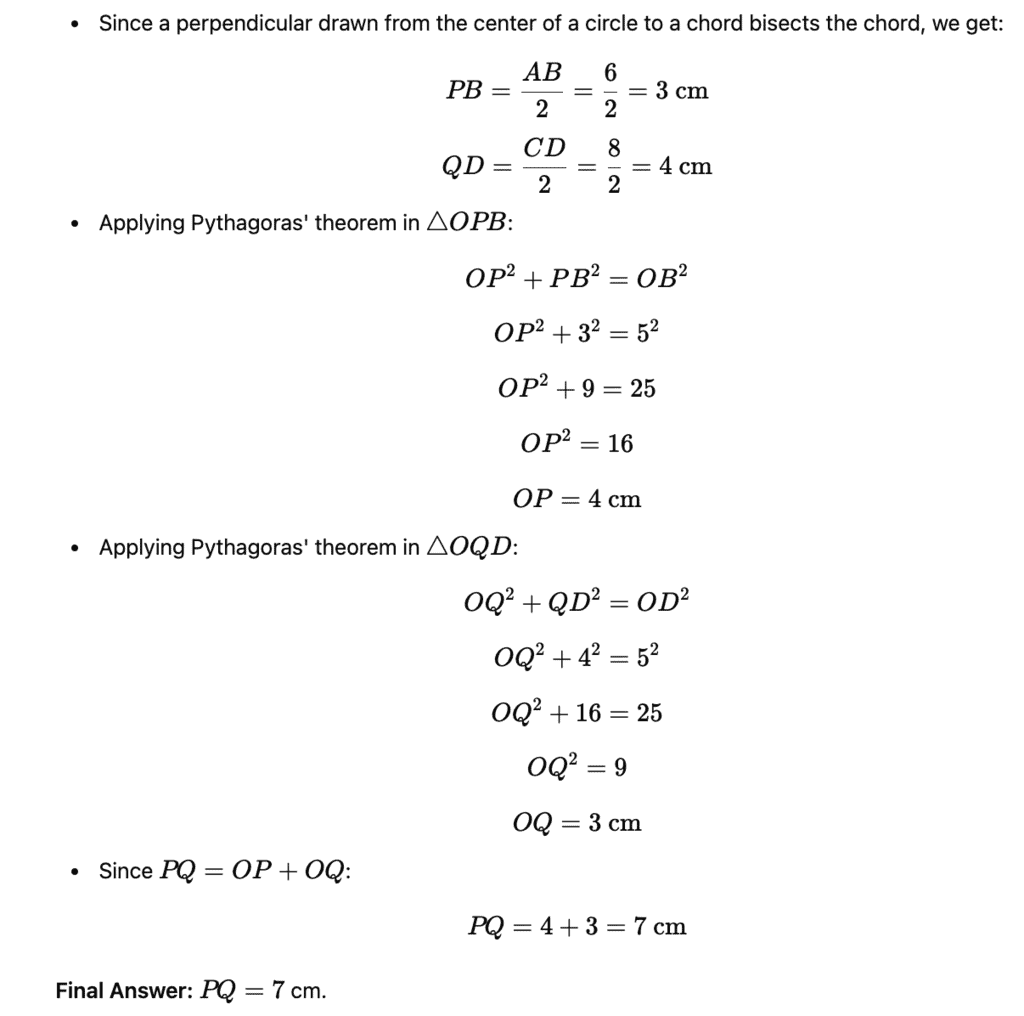
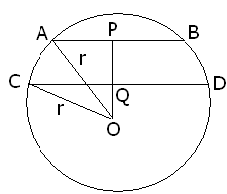
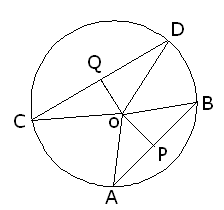
Q1: If O is the center of circle of radius 5 cm OP perpendicular to AB and OQ perpendicular to CD, AB||CD, AB = 6cm and CD = 8 cm. Determine PQ.
Ans:

Answer the following QuestionsAnswer the following Questions

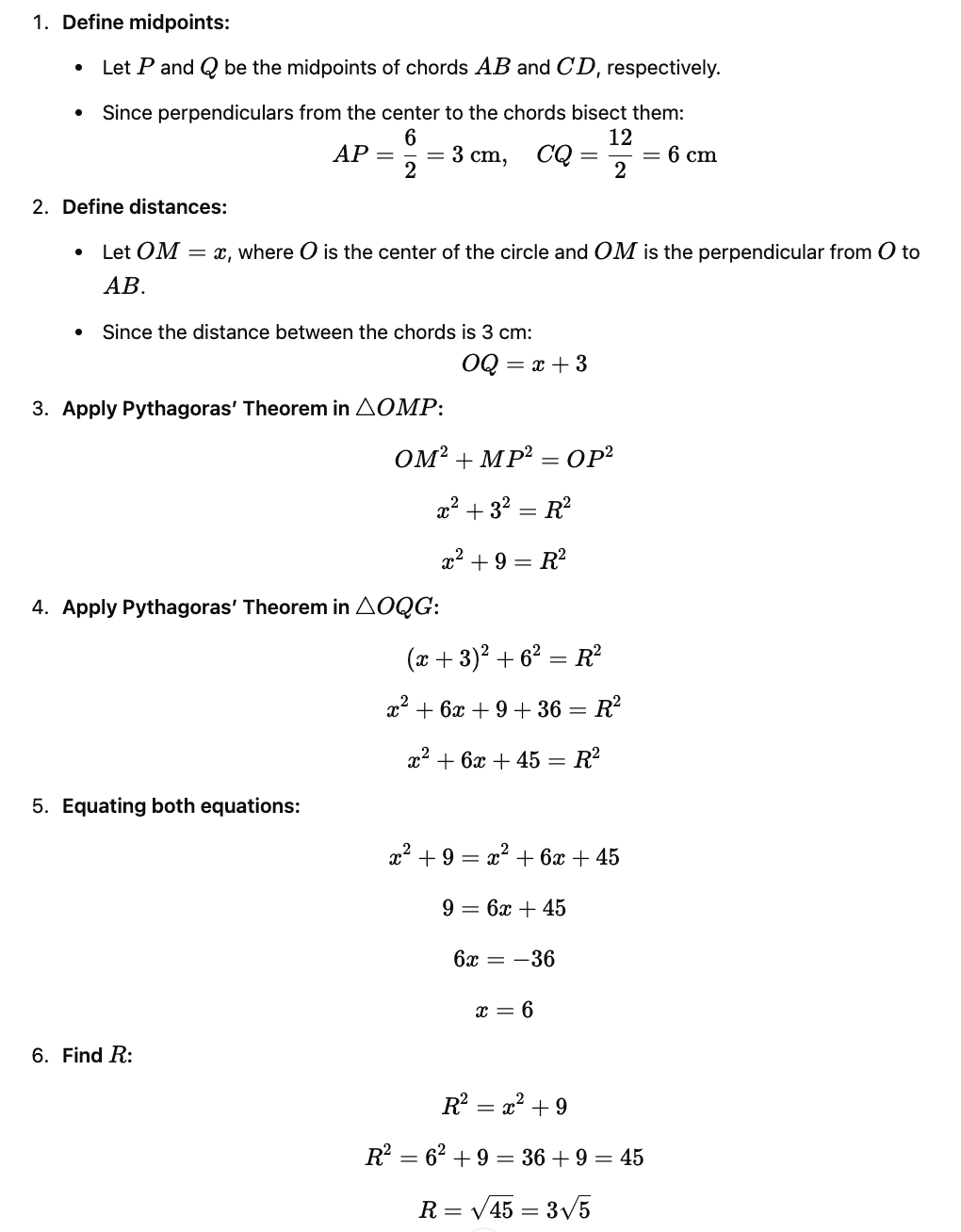
Q2: AB and CD are the two chords of the circle such that AB = 6 cm, CD = 12 cm and AB||CD, if the distance between AB and CD is 3 cm, find the radius of the circle.
Ans:

Answer the following Questions

Q3: Prove that the line joining to the centre of circle to the mid-point of a chord, is perpendicular to the chord.
Ans:

Answer the following Questions

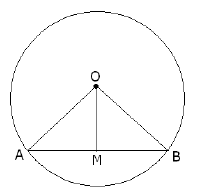
O is the centre of the circle and AB is the Chord ,OM is the line segment intersecting at M , Mid point of AB

In ΔAMO and ΔBMO

AM = BM (M is the mid point of AB)

OA = OB (radius of circle)

OM = OM (Same side)

Hence

ΔAMO ≌ ΔBMO (By SSS)

∠AMO = ∠BMO ( BY C.P.C.T)

∠AMO +∠ BMO = 180 (linear pair angles)

∠AMO = 90

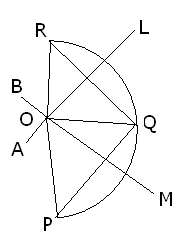
Q4: Given an arc of circle how you will find its centre and complete the circle.
Ans:

Answer the following QuestionsConstruction : 

Step 1: Take 3 points P,Q,R on circumference of arc join P to Q and R to Q

Step 2: Draw Perpendicular bisector of line PQ and RQ these intersect at point O

Step 3: join O to P , O to Q and O to R

O is the centre of given arc where OQ and OR and OP are the radius of circle

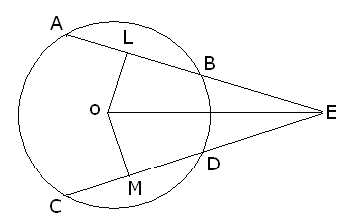
Q5: Two equal chord AB and CD of circle with center O, when produced meet at a point E, proving that BE=DE and AE=CE
Ans:

Answer the following Questions

Let OL and OM be two perpendiculars from centre O to chord AB and CD respectively so L and M are the mid points of Chord AB and CD

Since AB = CD (Given)

AB/2 = CD/2 or LB = MD

In ΔOLE and ΔOME

OL = OM (Equal Chords having equal distance from the centre)

<OLE = <OME (both 90 degrees)

OE = OE (common side)

So BY R.H.S

ΔOLE ≌ ΔOME

So LE = ME ( by C.P.C.T)

LE = LB+BE

ME = MD+DE

LB+BE = MD+DE

But LB = MD (proved above)

So BE = DE

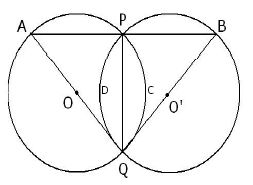
Q6: Two equal circles intersect in P and Q. A straight line through P meets the circles in A and B. prove that QA=QB
Ans:

Answer the following Questions

Let O and O’ be the centre of the circle where C(o, r) ≌ C(o’, r) circles are equal

So PQ is the common arc in both the circle

arc(PDQ) = arc(PCQ)

<QAP = <QBP (equal chords make equal angles on the circles)

in triangle ABQ <A = <B

so

Side AQ = Side BQ (Sides opposite to equal sides are equal)

09. Worksheet: Circles

True and False

Q1: If two arc of a circle are congruent. Then corresponding chord are unequal.

Q2:  Two perpendicular bisector of chord intersect at center of circle.

Q3: The line joining the mid-point of a chord to centre perpendicular to chord.

Q4: It is possible to draw two circles from three non-collinear points.

Answer the following Questions

 Q1: If O is the center of circle of radius 5 cm OP perpendicular to AB and OQ perpendicular to CD, AB||CD, AB = 6cm and CD = 8 cm. Determine PQ.

Q2: AB and CD are the two chord of the circle such that AB = 6 cm , CD = 12 cm and AB||CD, if the distance between AB and CD is 3 cm, find the radius of the circle.

Q3: Prove that the line joining to the centre of circle to the mid-point of a chord, is perpendicular to the chord.

Q4: Given an arc of circle how you will find its centre and complete the circle.

Q5: Two equal chord AB and CD of circle with center O, when produced meet at a point E, prove that BE=DE and AE=CE

Q6: Two equal circles intersect in P and Q. A straight line through P meets the circles in A and B. Prove that QA=QB.

08. Worksheet Solutions: Quadrilaterals

Multiple Choice Questions

Q1: ABCD is a parallelogram and AP and CQ are perpendiculars from vertices A and C on diagonal BD
Which of the following is true based on given information
(a) AP = CQ
(b) QD = PB
(c) DP = QB
(d) ΔPAD ≅ ΔQCB
Ans:
 (a, b, c, d)

Sol: All are correct In Triangle ΔPAD and ΔQCB
AD = CB
∠P = ∠Q = 90º
∠CBQ = ∠ADP (Alternate interior angles of AB||CD)
So AAS congruence
Also as they are congruent, we get AP = CQ and DP = QB
Now Let’s see the triangles ΔAPB and ΔCQD
AB = CD
∠P = ∠Q = 90º (Alternate interior angles of AB||CD)
So QD = PB

Q2: The angles of the quadrilateral are in the ratio 2 : 5 : 4 : 1? Which of the following is true?
(a) Largest angle in the quadrilateral is 150º
(b) Smallest angle is 30º
(c) The second largest angle in the quadrilateral is 80º
(d) None of these
Ans: 
(a, b)

Sol: Angles are 2 x , 5 x , 4 x , x
Now
2x + 5x + 4x + x = 360
Or x = 30
Angles are 30º, 60º, 120º, 150º

Q3: Two adjacent angles in a parallelogram are in the ratio 2 : 4. Find the values?
(a) 80, 100
(b) 40, 140
(c) 60, 120
(d) None of the above
Ans: 
(c)

Sol: Adjacent angles 2x + 4x = 180
x = 30
60, 120 are adjacent angles

Q4: ABCD is a trapezium with AB = 10cm, AD = 5 cm, BC = 4 cm and DC = 7 cm?
Find the area of the ABCD
(a) 34 cm2
(b) 28cm2
(c) 20 cm2
(d) None of these
Ans:
 (a)

Sol: BC is the altitude between the two parallel sides AB and DC
So Area of trapezium will be given by
A = 1/2 BC (AB + DC) = 34cm2 

Q5: ABCD is a trapezium where AB||DC. BD is the diagonal and E is the mid point of AD. A line is draw from point E parallel to AB intersecting BC at F. Which of these is true?
(a) BF = FC
(b)  EA = FB
(c) CF = DE
(d) None of these
Ans: 
(a)

Sol: Let’s call the point of intersection at diagonal as G
Then in triangle DAB
EG||AB and E is the mid point of DA, So by converse of Midpoint Theorem,
G is the mid point of BD
Now in triangle DBC
GF||CD
G is the mid point of DB
So by converse of mid point theorem
F is the mid point of BC

True or False

Q1: The diagonals of a parallelogram bisect each other.
Ans: True. It is by definition

Q2: In a parallelogram, opposite sides and angle are equal.
Ans: True. It is by definition

Q3: A diagonal of a parallelogram divides it into two congruent triangles.
Ans: True. This can be proved easily using SSS congruence

Q4: The bisectors of the angles of parallelogram create a rectangle.
Ans: True

Q5: Sum of all the internal angles is 360.
Ans: True. This can easily proved by drawing one diagonal and summing all the angles based on triangle angle sum.

Q6: Sum of all the exterior angles is 180.
Ans: False

Q7: Square, rectangle and rhombus are all parallelogram.
Ans: True

Q8: Consecutive angles are supplementary.
Ans: True

Answer the following Questions

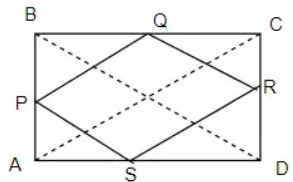
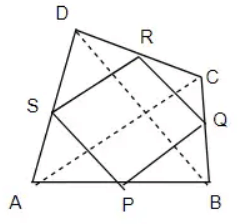
Q1: Show that the quadrilateral formed by joining the mid- points of adjacent sides of rectangle is a rhombus.
Ans:
 The figure is shown as below
Answer the following Questions

To Prove: quadrilateral PQRS is a rhombus
Proof:
In Δ ABC
P and Q are mid points of sides AB and BC
By Mid point theorem
PQ = 1/2 AC and PQ || AC -(X)
In Δ ACD
S and R are mid points of sides AD and DC
By Mid point theorem
SR = 1/2 AC and SR || AC –(Y)
From (X) and (Y), we have
PQ = SR
PQ ||SR
Hence PQRS is a parallelogram
Now in Δ BCD
Q and R are mid points of sides BC and DC
By Mid point theorem
QR = 1/2 BD
Nowe AC = BC
Hence
PQ = SR = QR
Now a parallelogram whose adjacent sides are equal is a rhombus.
Hence proved

Q2: P, Q, R and S are respectively the mid-point of sides AB, BC, CD and DA of a quadrilateral ABCD such that AC = BD. Prove that PQRS is a rhombus.

Ans:
Answer the following QuestionsGiven AC = BD
Proof:
In Δ ABC
P and Q are mid points of sides AB and BC
By Mid point theorem
PQ = 1/2 AC and PQ || AC -(X)
In Δ ACD
S and R are mid points of sides AD and DC
By Mid point theorem
SR = 1/2 AC and SR || AC –(Y)
From (X) and (Y), we have
PQ = SR = 1/2 AC —-(1)
Similarly in Δ BCD
Q and R are mid point of BC and CD
By Mid point theorem
QR = 1/2 BD
Similarly in Δ ADB
S and P are mid point of AD and AB
By Mid point theorem
SP = 1/2 BD
Therefore
SP = QR = 1/2 BD —(2)
AC = BD
So from (1) and (2)
PQ = SR = SP = QR
Hence PQRS is a rhombus

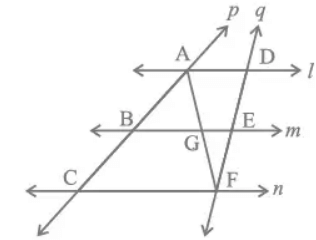
Q3: l, m and n are three parallel lines intersected by transversal’s p and q such that l, m and n cut off equal intercepts AB and BC on p. Show that l, m and n cut off equal intercepts DE and EF on q also.

Ans:
Answer the following QuestionsGiven:
AB = BC
To Prove:
DE = EF
Proof:
Let us join A to F intersecting m at G
The trapezium ACFD is divided into two triangles namely Δ ACF and & Δ AFD
In Δ ACF, it is given that B is the mid-point of AC (AB = BC) and BG || CF (since m || n).
So, G is the mid-point of AF (by Mid Point Theorem)
Now, in Δ AFD, we can apply the same argument as G is the mid-point of AF,
GE || AD and so by by Mid Point Theorem, E is the mid-point of DF,
i.e., DE = EF.
In other words, l, m and n cut off equal intercepts on q also.

Q4. Find all the angles of a parallelogram if one angle is 80°.

Ans: For a parallelogram ABCD, opposite angles are equal.

So, the angles opposite to the given 80° angle will also be 80°.

It is also known that the sum of angles of any quadrilateral = 360°.

So, if ∠A = ∠C = 80° then,

∠A + ∠B + ∠C + ∠D = 360°

Also, ∠B = ∠D

Thus,

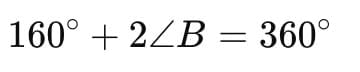
80° + ∠B + 80° + ∠D = 360°
Answer the following Questions

Answer the following Questions

Hence, 2∠B = ∠D = 200°/2Answer the following Questions

Now, all angles of the quadrilateral are found which are:

∠A = 80°

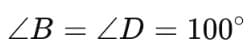
∠B = 100°

∠C = 80°

∠D = 100°

Q5: In a trapezium ABCD, AB//CD. Calculate C and D if A = 55° and B = 70°

Ans: In a trapezium ABCD, ∠A + ∠D = 180° and ∠B + ∠C = 180°

So, 55° + ∠D = 180°

Or, ∠D = 125°

Similarly,

70° + ∠C = 180°

Or, ∠C = 110°

08. Worksheet: Quadrilaterals

Multiple Choice Questions

Q1: ABCD is a parallelogram and AP and CQ are perpendiculars from vertices A and C on diagonal BD
Which of the following is true based on given information
(a) 
AP = CQ
(b) 
QD = PB
(c) 
DP = QB
(d) 
ΔPAD ≅ ΔQCB

Q2: The angles of the quadrilateral are in the ratio 2 : 5 : 4 : 1? Which of the following is true?
(a) 
Largest angle in the quadrilateral is 150º
(b) 
Smallest angle is 30º
(c) 
The second largest angle in the quadrilateral is 80º
(d) 
None of these

Q3: Two adjacent angles in a parallelogram are in the ratio 2 : 4. Find the values?
(a) 
80, 100
(b) 
40, 140
(c) 
60, 120
(d) 
None of the above

Q4: ABCD is a trapezium with AB = 10cm, AD = 5 cm, BC = 4 cm and DC = 7 cm?
Find the area of the ABCD
(a)
 34 cm2
(b) 
28cm2
(c) 
20 cm2
(d) 
None of these

Q5: ABCD is a trapezium where AB||DC. BD is the diagonal and E is the mid point of AD. A line is draw from point E parallel to AB intersecting BC at F. Which of these is true?
(a) 
BF = FC
(b) 
EA = FB
(c) 
CF = DE
(d) 
None of these

True or False

Which are these is true or false about parallelogram
Q1: The diagonals of a parallelogram bisect each other.

Q2: In a parallelogram, opposite sides and angle are equal.

Q3: A diagonal of a parallelogram divides it into two congruent triangles.

Q4: The bisectors of the angles of parallelogram create a rectangle.

Q5: Sum of all the internal angles is 3600.

Q6: Sum of all the exterior angles is 1800.

Q7: Square, rectangle and rhombus are all parallelogram.

Q8: Consecutive angles are supplementary.

Answer the following Questions

Q1: Show that the quadrilateral formed by joining the mid-points of adjacent sides of rectangle is a rhombus.

Q2: P, Q, R and S are respectively the mid- point of sides AB, BC, CD and DA of a quadrilateral ABCD such that AC = BD. Prove that PQRS is a rhombus.

Q3: l, m and n are three parallel lines intersected by transversal’s p and q such that l, m and n cut off equal intercepts AB and BC on p. Show that l, m and n cut off equal intercepts DE and EF on q also.

Q4. Find all the angles of a parallelogram if one angle is 80°.

Q5: In a trapezium ABCD, AB∥CD. Calculate ∠C and ∠D if ∠A = 55° and ∠B = 70°

07. Worksheet Solutions: Triangles

Multiple Choice Questions

Q1: If AD = BC and ∠ BAD = ∠ ABC, then ∠ ACB is equal to
(a) ∠ABD
(b) ∠ BAD 
(c) ∠BAC 
(d) ∠BDA 
Ans: (d)
In △ABC and △ABD
AD =BC     (given)
∠ BAD = ∠ ABC    (Given)
AB = AB   (Common side)
∴ △ABC ≅ △ABD  (by SAS congruency)
By CPCT theorem, ∠ACB=∠BDA.

Q2: If O is a midpoint of AB and ∠BQO = ∠APO, then ∠OAP is equal to
(a) ∠QPA
(b) ∠OQB
(c) ∠QBO
(d) ∠BOQ
Ans: 
(c)
In △AOP and △BOQ,
AO = BO (O is the midpoint of AB)
∠APO = ∠BQO (given)
∠AOP = ∠BOQ (vertically opposite angles)
∴ △AOP ≅ △BOQ (by AAS congruency)
By CPCT, ∠OAP = ∠QBO.

Q3: If △ABC is an isosceles triangle, AB = AC,∠ B = 65º, then find ∠ A.
(a) 60º
(b) 70º
(c) 50º
(d) none of these
Ans: 
(c)
Since △ABC is an isosceles triangle,
∴ ∠B = ∠C
∴ ∠B = 65°
∴ ∠C = 65°
Using the angle sum property of a triangle,
∠A + ∠B + ∠C = 180°
∴ ∠A + 65° + 65° = 180°
∴ ∠A + 130° = 180°
∴ ∠A = 180° − 130° = 50°

Q4: An angle is 14º more than its complement. Find its measure.
(a) 42
(b) 32
(c) 52
(d) 62
Ans:
 (c)
Two angles whose sum is 90° are called complementary angles.
Let the first angle be x.
Its complement = 90° − x.
According to the question,
x = 14° + (90° − x)
x = 104° − x
⇒ 2x = 104°
⇒ x = 52°
∴ The angle is 52°.

Q5: If ABCD is a quadrilateral where AD = CB, AB = CD, and ∠ D = ∠ B, then ∠CAB is equal to
(a) ∠ACD
(b) ∠CAD
(c) ∠ACD 
(d) ∠BAD
Ans:
 (c)
In △ABC and △CDA,
CB = AD (given)
AB = CD (given)
∠B = ∠D (given)
∴ △ABC ≅ △CDA (by SAS congruency)
By CPCT theorem,
∠CAB = ∠ACD.

Q6: If AB ⊥BC and ∠A =∠C, then the correct statement will 
(a) AB ≠ AC
(b) AB = BC 
(c) AB = AD 
(d) AB = AC
Ans:
 (b)
In △ABC, ∠A = ∠C.
Opposite sides to equal angles are also equal.
Therefore, AB = BC.

Q7: If AB = AC and ∠BAC = 120°, find ∠B.
(a) 50°
(b) 60°
(c) 70°
(d) none of these
Ans:
 (b)
Given AB = AC,
Therefore, ∠ABC = ∠ACB = x.
In △ABC,
∠A + ∠B + ∠C = 180° (sum of angles of a triangle)
120° + x + x = 180°
2x = 60°
x = 30°
Then, ∠B = ∠C = 30°.

Answer the following questions

Q1: AD and BC are equal perpendiculars to a line segment AB. Show that CD bisects AB.

Ans: In ΔAOD and ΔBOC,
BC = AD (given)
∠OAD = ∠OBC = 90°
Since BC || AD 
∠ODA = ∠OCB  (alternate angles are equal)
So, ΔAOD ≅ ΔBOC (by the ASA congruence rule) 
OD = OC (CPCT)
AO = OB  (CPCT)
Therefore, CD bisects AB.

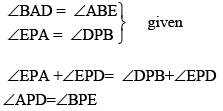
Q2: AB is a line segment and P is its mid-point. D and E are points on the same side of AB such that ∠BAD = ∠ABE and ∠EPA = ∠DPB. Show that
(i) ΔDAP ≌ ΔEBP
(ii) AD = BE

Ans. (i) ΔIn DAP and ΔEBP
Answer the following questions
P is its mid-point of AB
∴ AP = PB
So, ΔDAP ≌ ΔEBP(by the ASA congruence rule)
(ii) AD = BE(CPCT)

Q3: In an isosceles triangle ABC with AB = AC, D and E are points on BC such that BE = CD. Show that AD = AE.
Ans: 
In ΔABD and ΔACE,
AB = AC (Given) ..(1)
∠B = ∠C (Angles opposite to equal sides) ..(2)
Also, BE = CD..(3)
So, BE – DE = CD – DE
That is, BD = CE (3)
So, ΔABD ≌ ΔACE  by SAS rule
(Using (1), (2), (3) and SAS rule).
This gives AD = AE (CPCT)

Q4: In Figure OA = OB and OD = OC.
Show that
(i) ΔAOD ≅ ΔBOC
(ii) AD || BC
Ans:
 (i) In ΔAOD and ΔBOC,
OA = OB (given)
OD = OC (given)
∠AOD = ∠BOC (pair of vertically opposite angles)
So, ΔAOD ≅ ΔBOC(by the SAS congruence rule)
(ii) ∠OAD = ∠OBC (CPCT)
and these form a pair of alternate angles for line segments AD and BC.
Therefore, AD || BC.

Q5: In Fig, AC = AE, AB = AD and ∠BAD = ∠EAC. Show that BC = DE.

Ans. In ΔABC and ΔADE,
AB = AD (given)
AC = AE (given)
∠BAD = ∠EAC (given)
∠ADC+ ∠BAD = ∠ADC + ∠EAC
∠BAC = ∠DAE
So, ΔABC ≌ ΔADE (by the SAS congruence rule)
BC = DE (CPCT)

Q6: In ΔABC, the bisector AD of ∠A is perpendicular to side BC. Show that AB = AC and ΔABC is isosceles.
Ans:
 In ΔABD and ΔADC
AD bisects ∠A
⇒ ∠BAD = ∠CAD
∠ADC = ∠ADB 90º
AD = AD (Common Side)
So, ΔABD ≌ ΔADC (by the SAS congruence rule)
AB = AC(CPCT)
∴ ΔABC is isosceles

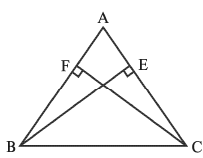
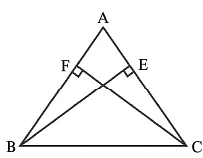
Q7: ABC is a triangle in which altitudes BE and CF to sides AC and AB are equal. Show that
(i) ΔABE ≌ ΔACF
(ii) AB = AC, i.e., ABC is an isosceles triangle.
Answer the following questionsAns: In ΔABE and ΔACF,
BE = CF (given)
∠A = ∠A (common angle)
∠ABE = ∠ACF (both are right angles)
So, ΔABE ≅ ΔACF (by ASA congruence rule).
This gives AB = AC (CPCT).
∴ ABC is an isosceles triangle.

07. Worksheet: Triangles

Multiple Choice Questions

Q1: If AD = BC and ∠ BAD = ∠ ABC, then ∠ ACB is equal to
(a) 
∠ABD
(b) 
∠ BAD
(c) 
∠BAC
(d) 
∠BDA

Q2: If O is a midpoint of AB and ∠BQO = ∠APO, then ∠OAP is equal to
(a)
 ∠QPA
(b) 
∠OQB
(c) 
∠QBO
(d)
 ∠BOQ

Q3: If △ABC is an isosceles triangle, ∠ B = 65º, AB = AC,∠ B = 65º, then find ∠ A.
(a) 
60º
(b) 
70º
(c) 
50º
(d) 
none of these

Q4: An angle is 14​º more than its complement. Find its measure.
(a) 
42º
(b) 
32º
(c)
 52º
(d)
 62º

Q5: If ABCD is a quadrilateral where AD= CB, AB=CD, and ∠ D= ∠ B, then ∠CAB is equal to
(a) 
∠ACD
(b)
 ∠CAD
(c) 
∠ACD
(d) 
∠BAD

Q6: If AB ⊥BC and ∠A =∠C, then the correct statement will
(a)
 AB ≠ AC
(b) 
AB = BC
(c) 
AB = AD
(d) 
AB = AC

Q7: If AB = AC and ∠ ACD = 120º, find ∠A.
(a) 
50º
(b) 
60º
(c) 
70º
(d)
 None of these

Answer the following questions

Q1: AD and BC are equal perpendiculars to a line segment AB. Show that CD bisects AB.

Q2: AB is a line segment and P is its mid-point. D and E are points on the same side of AB such that ∠BAD = ∠ABE and ∠EPA = ∠DPB. Show that
(i) 
ΔDAP ≌ ΔEBP
(ii) 
AD = BE

Q3: In an isosceles triangle ABC with AB = AC, D and E are points on BC such that BE = CD. Show that AD = AE.

Q4: In Figure OA = OB and OD = OC.
Show that
(i) ΔAOD ≅ ΔBOC
(ii) AD || BC

Q5: In Fig, AC = AE, AB = AD and ∠BAD = ∠EAC. Show that BC = DE.

Q6: In ΔABC, the bisector AD of ∠A is perpendicular to side BC. Show that AB = AC and ΔABC is isosceles.

Q7: ABC is a triangle in which altitudes BE and CF to sides AC and AB are equal. Show that
(i) 
ΔABE ≌ ΔACF
(ii) 
AB = AC, i.e., ABC is an isosceles triangle

06. Worksheet Solutions: Lines & Angles

Multiple Choice Questions

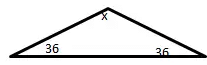
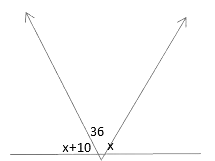
Q1: Find the value of xMultiple Choice Questions(a) 98º

(b) 100º

(c) 108º

(d)96º

Ans: (c)

x + 36 + 36 = 180 ⇒ x = 108º

Q2: A pair of angles is called linear pair if the sum of two adjacent angles is?

(a) 180º

(b) 90º

(c) 270º

(d) 360º

Ans: (a)

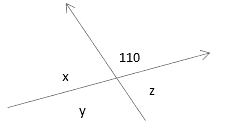
Q3: Find the value of x, y and zMultiple Choice Questions(a) x = 110º , y = 70º, z = 80º(b) x = 70º , y = 110º, z = 60º(c) x = 70º, y = 100º, z = 70º(d) x = 70º, y = 110º, z = 70º
Ans: (d)

Vertically opposite angle theorem and linear pair axiom can be used to find the answer

Q4: An exterior angle of the triangle is 110º. And its two opposite interior angles are in the ratio 5:6. What are the values of those angles?

(a) 50º, 60º

(b) 25º, 30º

(c) 35º, 42º

(d) 40º, 48º

Ans: (a)

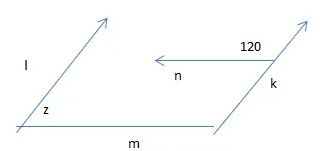
Q5: Lines l || k and m || n. Find the value of angle zMultiple Choice Questions(a) 45º

(b) 60º

(c) 70º

(d) 50º

Ans: (b)

Q6:Multiple Choice QuestionsFind the value of x(a) 67º(b) 71º(c) 57º(d) None of these
Ans: (a)

Q7: The side BC, AB and AC of the triangle ABC are produced in order forming exterior angles ∠ACD = x, ∠BAE = y and ∠CBF = z then the value of 2x + 2y + 2z is

(a) 180°

(b) 360°

(c) 540°

(d) 720°

Ans: (d)

Let a, b,c be the angles of triangle, then a + b + c = 180Now x = a + b, y = b + c, z = a + cTherefore 2x + 2y + 2z = 4(a + b + c) = 720

Q8: The angles of the triangles are in the ratio 1 : 2 : 3. Then the triangle is

(a) scalene

(b) obtuse angled

(c) acute angled

(d) right angles

Ans: (d)

Let x, 2x, 3x be the angles of triangle, then x + 2x + 3x = 180Therefore x = 30So angles are 30, 60 and 90

True or False

Q1: Pairs of vertically opposite angles is always equal

Ans: True

Q2: The sum of the angles of a triangle is 180º

Ans: True

Q3: If the sum of two adjacent angles is 45º, then two adjacent angles are acute angles

Ans: True

Q4: If a line is perpendicular is one of two parallel lines, then it is also perpendicular to the other

Ans: True

Q5: Two lines are intersected by the transversal, and then the corresponding angles are equal

Ans: False

Q6: Can we have a triangle where all the interior angles are more than 60º

Ans: False

Q7: Sum of two complimentary angles is equal to 90º

Ans: True

Q8: Sum of all the exterior angles of any polygon is always 360º

Ans: True

Fill in the blanks 

Q1: Sum of two supplementary angles is ______.

Ans: 180º

Q2: Two lines parallel to the same line is ____ each other.

Ans: parallel

Q3: An acute angle is always less than _____.

Ans: 90º

Q4: Angles forming a linear pair are ______.

Ans: supplementary

Q5: If one angle of triangle is equal to the sum of other two angles, then the triangle is ______.

Ans: right angle triangle

Q6: If two straight lines intersect, the adjacent angles are ______.

Ans: supplementary

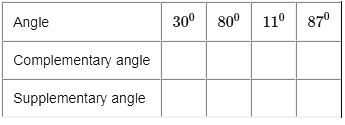
Table Type Question

Table Type QuestionAns: Complementary = 90 − xSupplementary = 180 − x

Short Answer Type Questions

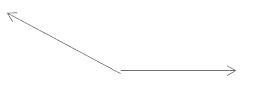
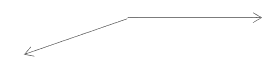
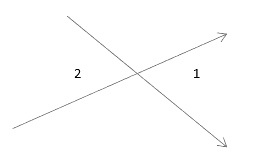
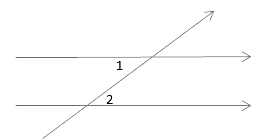
Q: Write the type of angles

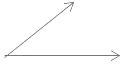
(i) Short Answer Type Questions

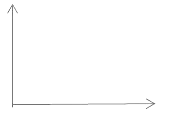
(ii) Short Answer Type Questions

(iii) Short Answer Type Questions

(iv) Short Answer Type Questions

(v) Short Answer Type Questions

(vi) Short Answer Type Questions

(vii) Short Answer Type Questions

Ans:

(i) Acute angle

(ii) Right angle

(iii) Obtuse angle

(iv) Straight angle

(v) Reflex angle

(vi) Vertically opposite angle

(vii) Alternate interior angles

06. Worksheet: Lines & Angles

Multiple Choice Questions

Q1: Find the value of xMultiple Choice Questions(a) 98º

(b) 100º

(c) 108º

(d) 96º

Q2: A pair of angles is called linear pair if the sum of two adjacent angles is?

(a) 180º

(b) 90º

(c) 270º

d) 360º

Q3: Find the value of x, y and zMultiple Choice Questions(a) x = 110º , y = 70º, z = 80º

(b) x = 70º , y = 110º, z = 60º(c) x = 70º, y = 100º, z = 70º(d) x = 70º, y = 110º, z = 70ºQ4: An exterior angle of the triangle is 110º. And its two opposite interior angles are in the ratio 5:6. What are the values of those angles?(a) 50º, 60º(b) 25º, 30º(c) 35º, 42º(d) 40º, 48ºQ5: Lines l || k and m || n. Find the value of angle zMultiple Choice Questions(a) 45º

(b) 60º

(c) 70º

(d) 50ºQ6:Multiple Choice QuestionsFind the value of x

(a) 67º

(b) 71º

(c) 57º

(d) None of these

Q7: The side BC, AB and AC of the triangle ABC are produced in order forming exterior angles ∠ACD = x, ∠BAE = y and ∠CBF = z then the value of 2x + 2y + 2z is

(a) 180°

(b) 360°

(c) 540°

(d) 720°

Q8: The angles of the triangles are in the ratio 1 : 2 : 3. Then the triangle is

(a) scalene

(b) obtuse angled

(c) acute angled

(d) right angles

True or False

Q1: Pairs of vertically opposite angles is always equal

Q2: The sum of the angles of a triangle is 180º

Q3: If the sum of two adjacent angles is 45º, then two adjacent angles are acute angles

Q4: If a line is perpendicular is one of two parallel lines, then it is also perpendicular to the other

Q5: Two lines are intersected by the transversal, and then the corresponding angles are equal

Q6: Can we have a triangle where all the interior angles are more than 60º

Q7: Sum of two complimentary angles is equal to 90º

Q8: Sum of all the exterior angles of any polygon is always 360º

Fill in the blanks 

Q1: Sum of two supplementary angles is ______.

Q2: Two lines parallel to the same line is ____ each other.

Q3: An acute angle is always less than _____.

Q4: Angles forming a linear pair are ______.

Q5: If one angle of triangle is equal to the sum of other two angles, then the triangle is ______.

Q6: If two straight lines intersect, the adjacent angles are ______.

Table Type QuestionTable Type QuestionShort Answer Type Questions

Q: Write the type of angles

(i) Short Answer Type Questions

(ii) Short Answer Type Questions

(iii) Short Answer Type Questions

(iv) Short Answer Type Questions

(v) Short Answer Type Questions

(vi) Short Answer Type Questions

(vii) Short Answer Type Questions