A circle is a unique figure; it is everywhere around us. We see the dials of clocks, buttons of shirts, coins, wheels of a vehicle, etc. All these are in the shape of a circle.
Terms related to circles 1. Chord: The chord of a circle is a straight line segment whose endpoints lie on the circle.
2. Diameter: The chord, which passes through the center of the circle is called a diameter of the circle. Diameter is the longest chord and all diameters have the same length, which is equal to two times the radius of the circle.
The length of the complete circle is called its circumference.
Try yourself:What is the theorem that states the sum of either pair of opposite angles of a cyclic quadrilateral?
A.The perpendicular from the center of a circle to its chord
B.Chords equidistant from the center of a circle are equal in length
C.The angle subtended by an arc of a circle at the center is double the angle subtended by it at any point on the circle
D.The sum of either pair of opposite angles of a cyclic quadrilateral is 180°
3. Arc: The arc of a circle is a portion of the circumference of a circle.Or
A piece of a circle between two points is also called an arc.
Two points lying on the circle define two arcs: The shorter one is called a minor arc and the longer one is called a major arc.
The minor arc AB is also denoted by and the major arc AB by where D is some point on the arc between A and B. When A and B are ends of a diameter, then both arcs are equal and each is called a semicircle.
4. Segment: The region between a chord and either of its arc is called a segment of the circle. There are two types of segments also: which are the major segment and the minor segment.
Angle Subtended by a Chord at a Point
Theorem 1: Equal chords of circle subtend equal angles at the centre.
Given:
A circle with centre H.
Two chords KL and JI are equal
To Prove: ∠KHL = ∠JHI Proof: We are given two chords KL and JI. We need to prove that ∠KHL = ∠JHI. In triangles KHL and JHI, HK = HJ —- radii of the same circle HL = HI—- radii of the same circle KL = JI – given So, ∆ KHL≅ ∆ JHI,
Thus, ∠KHL = ∠JHI —- by CPCT. Hence, proved.
Theorem 2: If the angles subtended by two chords at the centre are equal, then the two chords are equal
Given:
A circle with centre O.
∠COD = ∠AOB are equal
To Prove: AB=CD
Proof:
We are given two chords AB and CD. We need to prove that two chords AB and CD are equal
OA = OB = OC= OD (Radii of the same circle) ……………(2)
From eq. 1 and 2, we get;
∆AOB ≅ ∆COD (SAS Axiom of congruency)
Since,
OA = OB = OC= OD
AB = CD ……… (By CPCT)
Also read: PPT: Circles
Perpendicular from the Centre to a Chord
Theorem 3: The perpendicular from the centre of a circle to a chord bisects the chord
Given: A circle with centre O.
PQ is a chord such that OM is perpendicular to PQ
To Prove: OM bisects chord PQ i.e. PM=MQ
Constructions: Join O to Q and O to P. Proof: Given, in ∆QMO and ∆PMO, ∠OMP = ∠OMQ = 90° (OM ⊥ PQ) ………(1) OP = OQ (Radii of the circle) ……….(2) OM = OM (Common side) ………….(3) From eq. (1), (2) and (3), we get; ∆QMO ≅ ∆PMO (R.H.S Axiom of congruency) Hence, PM=MQ (By CPCT)
Theorem 4: The line drawn through the centre of a circle to bisect a chord is perpendicular to the chord
Given:
A circle with centre O.
OM bisects chord PQ i.e. PM=MQ
To Prove: PQ is a chord such that OM is perpendicular to PQ i.e ∠OMQ = 90°.
Constructions: Draw PQ be the chord of a circle and OM be the line from the centre that bisects the chord such that M is the mid point of the chord
Also, Join O to Q and O to P. Proof: In triangles ΔPMO and ΔQMO
PM = MQ (given, OM bisects PQ) OP = OQ (radius of the same circle) OM = OM (common side of both the triangles) So, ∆PMO≅ ∆QMO Therefore, ∠OMQ = ∠OMP —(CPCT)—–(i) but ∠OMQ +∠OMP = 180 ° — linear pair Substituting equation (i) in above equation ∠OMQ + ∠OMQ = 180 ° Therefore,
∠OMQ = 90 °
This gives, angles ∠OMQ and ∠OMP as 90° Hence proved
Equal Chords and Distance from the Centre
If two chords of a circle are equal, then their corresponding arcs are congruent and conversely, if two arcs are congruent, then their corresponding chords are equal. Similar to the case of chords, equal arcs also subtend equal angles at the centre.
Theorem 5: Equal chords of a circle are equidistant (equal distance) from the centre of the circle.
Given:
A circle with centre O.
AB and CD are two equal chords of a circle i.e. AB=CD and OM and ON are perpendiculars to AB and CD respectively.
Constructions: Join O to B and O to D Draw perpendicular bisector of both chords from center O (OM ⊥ AB and ON ⊥ CD) . To Prove: OM=ON
Proof:
Since AB = CD
BM = 1/2 AB (Perpendicular to a chord bisects it) ……..(1)
DN = 1/2 CD (Perpendicular to a chord bisects it) ……..(2) Therefore, BM = DN
In ∆OMB and ∆OND
BM = DN (proved as above)
OB = OD (Radii of the same circle)
∠OMB = ∠OND = 90° (OM ⊥ AB and ON ⊥ CD)
∆OMB ≅ ∆OND ( By R.H.S Axiom of Congruency)
OM = ON ( By CPCT) Hence proved
Theorem 6: Chords of a circle, which are at equal distances from the centre are equal in length
Given:
A circle with centre O.
AB and CD are at equal distance from the circle, OM and ON are perpendiculars to AB and CD respectively.
OM=ON
To Prove: AB=CD
Proof: In ∆OMB and ∆OND, OM = ON ………….(1)
∠OMB = ∠OND = 90° ………..(2)
OB = OD (Radii of the same circle) ………..(3)
Therefore, from eq. 1, 2 and 3, we get;
∆OMB ≅ ∆OND (By R.H.S Axiom of Congruency)
BM = DN ( By CPCT)
1/2 AB = 1/2 CD (Perpendicular from center bisects the chord)
Therefore, AB = CD Hence Proved
Theorem 7: The angle subtended by an arc at the centre is double the angle subtended by it at any point on the remaining part of the circle.
Given: An arc PQ of a circle subtending angles POQ at the centre O and PAQ at a point A on the remaining part of the circle.
To Prove :∠POQ = 2∠PAQ.
Proof:
Let’s consider three cases,
Arc PQ is major arc.
Arc PQ is minor arc.
Arc PQ is semi-circle.
Let’s join AO and extend it to B. In all three cases, ∠BOQ = ∠OAQ + ∠OQA. (Exterior angle of a triangle is equal to the sum of the two interior opposite angles). Also in triangle ΔOAQ, OA = OQ (Radii of Circle) Therefore, ∠ OAQ = ∠ OQA this gives, ∠ BOQ = 2∠OAQ —(i) ∠ BOP = 2∠OAP—-(ii) from (i) and (ii) we get, ∠ BOP + ∠ BOQ = 2(∠ OAP + ∠ OAQ) ∠POQ = 2 ∠PAQ Hence Proved For the case (iii), where PQ is the major arc, (3) is replaced by Reflex angle POQ = 2∠PAQ
Example 2: What is the value of ∠ABC?
Solution: According to the above theorem (The angle subtended by an arc at the centre is double the angle subtended by it at any point on the remaining part of the circle), ∠AOC = 2 ∠ABC Therefore, ∠ABC = 60°/2 = 30° line segment joining two points subtends equal angles at two other points lying on the same side of the line containing the line segment, the four points lie on a circle (i.e., they are concyclic).
Some other properties
Angles in the same segment of a circle are equal.
If a line segment joining two points subtends equal angles at two other points lying on the same side of the line containing the line segment, the four points lie on a circle (i.e. they are concyclic).
Theorem 8: Angles in the same segment of a circle are equal.
Given: A circle with centre O
Points P and Q on this circle subtends ∠PAQ = ∠PBQ at points A and B respectively.
To Prove : ∠PAQ = ∠PBQ
Proof: Let P and Q be any two points on a circle to form a chord PQ, A and C any other points on the remaining part of the circle and O be the centre of the circle. Then,
∠POQ = 2∠PAQ …… (i)
And ∠POQ = 2∠PBQ ……. (ii)
From above equations, we get
2∠PAQ = 2∠PBQ
Therefore, ∠PAQ = ∠PBQ Hence Proved
Theorem 9:If a line segment joining two points subtend equal angles at two other points lying on the same side of the line containing the line segment the four points lie on a circle.
Given:
AB is a line segment, which subtends equal angles at two points C and D. i.e., ∠ACB = ∠ADB.
To Prove:
The points A, B, C and D lie on a circle.
Proof:
Let us draw a circle through the points A, C and B.
Suppose it does not pass through the point D.
Then it will intersect AD (or extended AD) at a point, say E (or E’).
If points A,C,E and B lie on a circle,
∠ACB = ∠AEB [∴ Angles in the same segment of circle are equal]
But it is given that ∠ACB = ∠ADB
Therefore, ∠AEB = ∠ADB
This is possible only when E coincides with D. [As otherwise ∠AEB >∠ADB]
Similarly, E’ should also coincide with D. So A, B, C and D are concyclic.
Hence Proved.
Cyclic Quadrilaterals
A quadrilateral is called cyclic if all the four vertices of it lie on a circle.
They are also called inscribed quadrilaterals.
Theorem 10: The sum of either pair of opposite angles of a cyclic quadrilateral is 180º.
Given: PQRS is a cyclic quadrilateral with centre O.
To Prove:
∠PSR + ∠PQR = 180º.
∠SPQ + ∠QRS =180º. Proof:
For chord AB, angles in same segment are equal. ∠5=∠8 Similarly, in chords BC, CD, and AD ∠1=∠6 ∠2=∠4 ∠7=∠3 Angle sum property of quadrilateral gives ∠A+∠B+∠C+∠D=360 ∠1+∠2+∠3+∠4+∠5+∠6+∠7+∠8=360 2(∠1+∠2+∠7+∠8)=360 ∠1+∠2+∠7+∠8=180 ∠BAD+∠BCD=180 Similarly we can prove that, ∠ABC+∠ADC=180
Example 3: In the figure below, BC is the diameter of the circle, ED is a chord equal to the radius of the circle. BE and CD when extended intersect at a point F. Prove that ∠BFC = 60°. Solution: In the figure, join AE, AD and EC. Triangle AED is an equilateral triangle. Therefore, ∠EAD = 60°. Now, ∠ECD becomes 30°. We know that ∠BEC = 90°. So, by the property of exterior angles of triangle, ∠BEC = ∠ECD + ∠BFC, 90° = 30° + ∠BFC ⇒ 60° = ∠BFC Hence, Proved.
Theorem 11: If the sum of a pair of opposite angles of a quadrilateral is 180º, the quadrilateral is cyclic.
Given: ABPQ is a quadrilateral, such that ∠ ABP + ∠ AQP =180 degree and ∠ QAB + ∠ QPB = 180 degree
To prove: The points A, B, P and Q lie on the circumference of a circle.
Proof: Assume that point P does not lie on a circle drawn through points A, B and Q.
Let the circle cut QP at point R. Join BR. ∠ QAB + ∠ QRB = 180 degree [given,sum of a pair of opposite angles of a quadrilateral is 180º]
∠ QAB + ∠ QPB = 180 degree [given]
∴ ∠ QRB = ∠ QPB
But this cannot be true since ∠ QRB = ∠ QPB + ∠ RBP (exterior angle of the triangle)
∴ Our assumption that the circle does not pass through P is incorrect and A, B, P and Q lie on the circumference of a circle.
Quadrilaterals are shapes with four sides. QuadrilateralsImagine the following examples:
Square: All four sides are equal, and all angles are right angles.
Rectangle: Opposite sides are equal, and all angles are right angles.
Parallelogram: Opposite sides are parallel and equal in length.
Rhombus: All four sides are equal, but angles are not necessarily right angles.
Examples of Quadrilaterals in Daily Life: Windows, Blackboard, Study table top, Computer screens, Mobile phone screens, Pages in a book
Definition
A quadrilateral is a closed, two-dimensional figure formed by four line segments. For instance, in quadrilateral , the line segments are , , , and .
The term “quadrilateral” comes from Latin, where “quad” means “four” and “lateral” means “side.”
Sides: Four segments (e.g., , , , )
Angles: Four angles (e.g., , , , )
Vertices: Four points (e.g., , , , )
Diagonals: Two segments that connect opposite vertices (e.g., and )
Properties of a Parallelogram
In geometry, a quadrilateral is a four-sided polygon with four angles and four vertices. A specific type of quadrilateral is a parallelogram, characterized by having both pairs of opposite sides parallel. Let’s explore some properties of parallelograms.
Theorem 1: A diagonal of a parallelogram divides it into two congruent triangles.
Proof: Consider parallelogram ABCD with diagonal AC. Diagonal AC divides the parallelogram into triangles ∆ABC and ∆CDA. By the alternate interior angles, we have ∠BCA = ∠DAC and ∠BAC = ∠DCA. Also, AC = AC (common side). Therefore, by the ASA rule, ∆ABC ≅ ∆CDA, and the diagonal AC divides the parallelogram into congruent triangles.
Example: In the figure, quadrilateral ABCD is a rectangle in which BD is diagonal. Show that ∆ ABD ≅ ∆ CDB.
Given: ABCD is a rectangle in which BD is diagonal. To prove: ∆ ABD ≅ ∆ CDB. Proof: Quadrilateral ABCD is a rectangle. Therefore, ABCD is also a parallelogram. Since a diagonal of a parallelogram divides it into two congruent triangles. Hence, ∆ ABD ≅ ∆ CDB.
Try yourself:
Which of the following shapes is NOT a quadrilateral?
A.Square
B.Triangle
C.Rhombus
D.Parallelogram
Theorem 2: In a parallelogram, opposite sides are equal.
Proof: Measure the opposite sides AB and DC of parallelogram ABCD. You will find AB = DC.
In ΔABC and ΔCDA
AC=AC [Common/transversal]
∠BCA=∠DAC [alternate angles]
∠BAC=∠DCA [alternate angles]
ΔABC≅ΔCDA [ASA rule]
Hence, AB=DC and AD=BC [ C.P.C.T.C]
Theorem 3: If each pair of opposite sides of a quadrilateral is equal, then it is a parallelogram.
Given: ABCD is a parallelogram. To prove: AB = CD and AD = CB. Construction: Join BD. Proof: Since ABCD is a parallelogram. Therefore, AB ∥ DC and BC ∥ AD. Now, AB ∥ DC and transversal BD intersects them at B and D respectively. ∴ ∠ ABD = ∠ CDB ……………… (I) [Alternate interior angles] Again, BC ∥ AD and transversal BD intersects them at B and D respectively. ∴ ∠ ADB = ∠ DBC ……………… (II) [Alternate interior angles] Now, in ∆ ABD and ∆ BDC, we have ∠ ABD = ∠ CDB [From (I)] BD = DB [Common side] ∠ ADB = ∠ DBC [From (II)] Therefore, ∆ ABD ≅ ∆ CDB (By ASA-criterion of congruence) By using corresponding parts of congruent triangles ⇒ AB = CD and AD = CB.
Theorem 4:In a parallelogram, opposite angles are equal.
Proof: Measure the angles of a parallelogram; you will find that each pair of opposite angles is equal.
In parallelogram ABCD
AB‖CD; and AC is the transversal
Hence, ∠1=∠3….(1) (alternate interior angles)
BC‖DA; and AC is the transversal
Hence, ∠2=∠4….(2) (alternate interior angles)
Adding (1) and (2)
∠1+∠2=∠3+∠4
∠BAD=∠BCD
Similarly,
∠ADC=∠ABC
Theorem 5: If in a quadrilateral, each pair of opposite angles is equal, then it is a parallelogram.
Given: In the quadrilateral, the opposite angles are equal. Let the quadrilateral be , where and .
Verification of Parallel Sides:
Since (sum of angles in a quadrilateral equals , and opposite pairs add up), the adjacent angles are supplementary.
This implies that and due to the converse of the consecutive angles property.
Conclusion: If both pairs of opposite sides of a quadrilateral are parallel, it is a parallelogram.
Theorem 6: The diagonals of a parallelogram bisect each other.
Proof: Draw diagonals AC and BD of parallelogram ABCD. Measure the lengths of OA, OB, OC, and OD. You will observe that OA = OC and OB = OD, or O is the midpoint of both diagonals.
In ΔAOB and ΔCOD,
∠3=∠5 [alternate interior angles]
∠1=∠2 [vertically opposite angles]
AB=CD [opp. Sides of parallelogram]
ΔAOB≅ΔCOD [AAS rule]
OB=OD and OA=OC [C.P.C.T]
Hence, proved
Conversely,
If the diagonals of a quadrilateral bisect each other, then it is a parallelogram.
Theorem 7: If the diagonals of a quadrilateral bisect each other, then it is a parallelogram.
Example 1: Show that each angle of a rectangle is a right angle.
Solution: Consider rectangle ABCD with ∠A = 90°. By proving that ∠B = ∠C = ∠D = 90°, it establishes that each angle of a rectangle is a right angle.
Example 2: Prove that the diagonals of a rhombus bisect each other at right angles.
Solution: Consider rhombus ABCD. Let AC and BD be the diagonals, intersecting at point E. In triangles ABE and CDE, we observe that AE = CE (since ABCD is a rhombus). Similarly, BE = DE (opposite sides of a rhombus are equal). Thus, triangles ABE and CDE are congruent by the Side-Side-Side congruence criterion. Therefore, ∠AEB = ∠CED. Now, ∠AEB + ∠CED = 180° (linear pair on straight line AECD). So, each angle measures 90°. Hence, the diagonals AC and BD bisect each other at right angles.
Try yourself:Which statement is true about a parallelogram?
A.A parallelogram has all sides equal.
B.A parallelogram has opposite sides parallel.
C.A parallelogram has all angles equal.
D.A parallelogram has all diagonals equal.
The Mid-point Theorem
In geometry, the Mid-point Theorem relates to the midpoints of the sides of a triangle. The theorem establishes a relationship between the line segment joining the midpoints of two sides of a triangle and the third side.
The Midpoint Theorem of a triangle states that if you connect the midpoints of two sides of a triangle with a line segment, that line segment will be parallel to the third side of the triangle, and its length will be half the length of the third side.
Let’s explore this theorem and its converse.
Theorem 8: The line segment joining the mid-points of two sides of a triangle is parallel to the third side.
Activity Observation:
Draw a triangle and mark mid-points E and F of two sides.
Join E and F to form line segment EF.
Measure EF and BC. You will observe that EF = 1/2 BC.
Measure ∠AEF and ∠ABC. You will find that ∠AEF = ∠ABC.
Therefore, EF is parallel to BC.
Proof: Consider triangle ABC with midpoints E and F of sides AB and AC, respectively. Draw CD parallel to BA. By the ASA rule, ∆AEF ≅ ∆CDF. This implies EF = DF and BE = AE = DC. Hence, BCDE is a parallelogram, leading to EF || BC.
Theorem 9: The line drawn through the mid-point of one side of a triangle, parallel to another side, bisects the third side.
Proof: E is the mid-point of AB, and line l is parallel to BC with CM || BA. Prove AF = CF using the congruence of ∆AEF and ∆CDF.
Conclusion:
The Mid-point Theorem and its converse provide a useful geometric relationship involving midpoints and parallel lines in triangles.
These theorems are valuable tools for proving various properties and relationships within triangles.
Some Solved Examples:
Q.1. If the diagonals of a parallelogram are equal, then show that it is a rectangle.
Solution: Given that, AC = BD To show that ABCD is a rectangle if the diagonals of a parallelogram are equal To show ABCD is a rectangle, we have to prove that one of its interior angles is right-angled. Proof, In ΔABC and ΔBAD, AB = BA (Common) BC = AD (Opposite sides of a parallelogram are equal) AC = BD (Given) Therefore, ΔABC ≅ ΔBAD [SSS congruency] ∠A = ∠B [Corresponding parts of Congruent Triangles] also, ∠A+∠B = 180° (Sum of the angles on the same side of the transversal) ⇒ 2∠A = 180° ⇒ ∠A = 90° = ∠B Therefore, ABCD is a rectangle. Hence Proved.
Q.2. Show that the diagonals of a square are equal and bisect each other at right angles.
Solution: Let ABCD be a square and its diagonals AC and BD intersect each other at O. To show that, AC = BD AO = OC and ∠AOB = 90° Proof, In ΔABC and ΔBAD, AB = BA (Common) ∠ABC = ∠BAD = 90° BC = AD (Given) ΔABC ≅ ΔBAD [SAS congruency] Thus, AC = BD [CPCT] diagonals are equal. Now, In ΔAOB and ΔCOD, ∠BAO = ∠DCO (Alternate interior angles) ∠AOB = ∠COD (Vertically opposite) AB = CD (Given) ΔAOB ≅ ΔCOD [AAS congruency] Thus, AO = CO [CPCT]. Diagonal bisect each other. Now, In ΔAOB and ΔCOB, OB = OB (Given) AO = CO (diagonals are bisected) AB = CB (Sides of the square) ΔAOB ≅ ΔCOB [SSS congruency] also, ∠AOB = ∠COB ∠AOB+∠COB = 180° (Linear pair) Thus, ∠AOB = ∠COB = 90° Diagonals bisect each other at right angles
Q.3. ABCD is a rhombus. Show that diagonal AC bisects ∠A as well as ∠C and diagonal BD bisects ∠B as well as ∠D.
Solution:
Given that, ABCD is a rhombus. AC and BD are its diagonals. Proof, AD = CD (Sides of a rhombus) ∠DAC = ∠DCA (Angles opposite of equal sides of a triangle are equal.) also, AB || CD ⇒∠DAC = ∠BCA (Alternate interior angles) ⇒∠DCA = ∠BCA AC bisects ∠C. Similarly, We can prove that diagonal AC bisects ∠A. Following the same method, We can prove that the diagonal BD bisects ∠B and ∠D.
A triangle, a closed figure formed by three intersecting lines, is characterized by three sides, three angles, and three vertices.
The term ‘triangle’ is derived from ‘tri,’ signifying ‘three.’ For instance, in triangle ABC (denoted as ∆ ABC), AB, BC, and CA represent the three sides, while ∠ A, ∠ B, ∠ C are the corresponding angles, and A, B, and C are the vertices.
Congruence of Triangles
In our daily experiences, we encounter identical objects like photographs, bangles, and ATM cards, which are called congruent figures. The term ‘congruent’ implies equality in all respects, indicating figures with identical shapes and sizes. When two circles, squares, or equilateral triangles of the same dimensions overlap, we observe complete coverage, confirming them as congruent circles, congruent squares, and congruent equilateral triangles, respectively.
Real-life Applications
The study of congruence extends beyond theoretical concepts. For example:
In ice trays, the molds for making ice are congruent, facilitating uniformity.
The concept of congruence is applied in creating casts for identical objects, ensuring consistency.
A triangle has three sides, three angles, and three vertices.
For example, in the triangle PQR, PQ, QR, and RP are the three sides, ∠QPR, ∠PQR, ∠PRQ are the three angles and P, Q and R, are the three vertices.
A triangle is a unique figure; it is everywhere around us. We can see the sandwiches in the shape of a triangle, traffic signals, cloth anger, set squares, etc. All these are in the shape of a triangle.
Try yourself:
What does the term ‘congruent’ imply?
A.Equality in all respects
B.A triangle with three sides, angles, and vertices
C.Intersection of three lines
D.The study of shapes and sizes
Correspondence Importance
When establishing congruence, correct correspondence between vertices is essential. For example:
In ∆ FDE ≅ ∆ ABC, FD ↔ AB, DE ↔ BC, and EF ↔ CA.
However, writing ∆ DEF ≅ ∆ ABC is incorrect due to improper correspondence.
Note: In congruent triangles, corresponding parts are equal. The acronym CPCT (Corresponding Parts of Congruent Triangles) is often used to denote this equality.
Symbolic Representation
Symbolically, ∆ PQR ≅ ∆ ABC is expressed as:
PQ covers AB, QR covers BC, RP covers CA.
∠ P covers ∠ A, ∠ Q covers ∠ B, ∠ R covers ∠ C.
Vertices correspond: P ↔ A, Q ↔ B, R ↔ C.
In the figures shown above, each pair is identical to each other. Such figures are called congruent (they are similar and fit over one another exactly).
Also read: NCERT Solutions: Triangles (Exercise 7.1-7.3)
Criteria for Congruence of Triangles
Axiom 1: Side-Angle-Side (SAS) congruence rule (An axiom is a mathematical statement that is assumed to be true without proof.) Two triangles are congruent if two sides and the included angle of one triangle are equal to the two sides and the included angle of the other triangle.
Given: Two triangles ABC and PQR such that AB = PQ, AC = PR and ∠BAC = ∠QPR. To prove: ∆ ABC ≅ ∆ PQR. Proof: This result cannot be proved with help of previously known results. So, this rule is accepted as an axiom. Another way to check whether the given two triangles are congruent or not, we follow a practical approach. Place ∆ABC over ∆PQR such that the side AB falls on side PQ, vertex A falls on vertex P and B on Q. Since ∠BAC = ∠QPR. Therefore, AC will fall on PR. But AC = PR and A falls on P. therefore, C will fall on R. Thus, AC coincides with PR. Now, B falls on Q and C falls on Therefore, BC coincides with QR. Thus, ∆ ABC when superposed on ∆ PQR, covers it exactly. Hence, by the definition of congruence, ∆ ABC ≅ ∆ PQR.
Example 1: Check whether ∆ABC and ∆PQR are congruent or not.
Solution: In ∆ ABC and ∆ PQR, we have AB = PQ = 5 cm (Given) ∠ BAC = ∠QPR = 40o (Given) AC = PR = 4 cm (Given) Therefore, ∆ ABC ≅ ∆ PQR (By SAS criterion of congruence)
Example 2: In the figure below, R is the mid-point of PT and SQ. Prove that ∆ PQR ≅ ∆ TSR.
Given: PR = RT and SR = RQ. To prove: ∆ PQR ≅ ∆ TSR. Proof: In ∆ PQR and ∆ TSR, we have PR = TR (R is the mid-point of PT) ∠PRQ = ∠TRS (Vertically opposite angles are equal) QR = SR (R is the mid-point of SQ) Therefore, Δ PQR ≅ Δ TSR (By SAS-criterion of congruence)
Example 3: In the figure, it is given that PT = PU and QT = RU. Prove that ΔPTR ≅ ΔPUQ
Given: PT = PU and QT = RU. To prove: Δ PTR ≅ Δ PUQ. Proof: We have, PT = PU ……….. (I) And, QT = RU ………. (II) Adding equation (I) and (II), We get, PT + QT = PU + RU ⇒ PQ = PR ……….. (III) Now, in ∆ PTR and ∆ PUQ, we have PT = PU [Given] ⇒ ∠ TPR = ∠UPQ [Common] ⇒ PQ = PR [From (III)] Therefore, Δ PTR ≅ Δ PUQ [By SAS-criterion of congruence]
Theorem 1: Angle-Side-Angle (ASA) Congruence rule Two triangles are congruent if two angles and the included side of one triangle are equal to two angles and the included side of the other triangle.
Given: ΔPQR and ΔMNO such that ∠PQR = ∠MNO, ∠PRQ = ∠MON and QR = NO. To prove: Δ PQR ≅ Δ MNO. Proof: There are three possibilities that arise. CASE I: When PQ = MN In this case, we have PQ = MN ∠PQR = ∠MNO (Given) QR = NO (Given) Therefore, Δ PQR ≅ Δ MNO (By SAS-criterion of congruence) CASE II: PQ < MN Construction: Join OS such that NS = PQ. In Δ PQR and Δ SNO, we have PQ = SN
∠PQR = ∠MNO (Given) QR = NO (Given) Therefore, Δ PQR ≅ Δ SNO (By SAS-criterion of congruence) By using corresponding parts of congruent triangles ⇒ ∠PRQ = ∠SON. But, ∠PRQ = ∠MON. (Given) This is possible only when ray SO coincides with ray MO or S coincides with M. Therefore, PQ must be equal to MN. ∴ ∠SON = ∠MON. Thus, in Δ PQR and Δ MNO, we have PQ = MN ⇒ ∠PQR = ∠MNO (Given) ⇒QR = NO (Given) Therefore, Δ PQR ≅ Δ MNO (By SAS-criterion of congruence) CASE III: PQ > MN.
Construction: Join SO such that NS = PQ. In Δ PQR and Δ SNO, we have PQ = SN ∠PQR = ∠MNO (Given) QR = NO (Given) Therefore, Δ PQR ≅ Δ SNO (By SAS-criterion of congruence) By using corresponding parts of congruent triangles ⇒ ∠PRQ = ∠SON. But, ∠PRQ = ∠MON. (Given) This is possible only when ray SO coincides with ray MO or S coincides with M. Therefore, PQ must be equal to MN. ∴ ∠SON = ∠MON. Thus, in Δ PQR and Δ MNO, we have PQ = MN ⇒ ∠PQR = ∠MNO (Given) ⇒ QR = NO (Given) Therefore, Δ PQR ≅ Δ MNO (By SAS-criterion of congruence Hence, in all the three cases, we have Δ PQR ≅ Δ MNO.
Example 4: Check whether ∆ABC ≅ ∆PQR?
Solution: In ∆ABC and ∆PQR, we have ∠ABC = ∠PQR = 40° (Given) BC = QR = 5 cm (Given) ∠BCA = ∠QRP = 60° (Given) Therefore, ∆ ABC ≅ ∆ PQR (By ASA-criterion of congruence)
Example 5: In the figure, ST ∥ QP and R is the mid-points of SQ, proving that R is also the mid-point of PT.
Given: ST ∥ QP and R is the mid-point of SQ. To prove: PR = RT. Proof: Since QP ∥ ST and transversal PT cuts them at P and T respectively. ∴ ∠RTS = ∠RPQ. (Alternate interior angles) ……… (I) Similarly, ∠RST = ∠RQP. (Alternate interior angles) ……… (II) Since PT and SQ intersect at R. ∴ ∠QRP = ∠SRT. (Vertically opposite angles) ……….. (III) Thus, in Δ PQR and Δ SRT, we have ∠ PQR = ∠ RST [From (II)] ⇒ QR = RS [Given] ⇒ ∠ QRP = ∠ SRT [From (III)] Therefore, Δ PQR ≅ Δ SRT [By ASA-criterion of congruence] By using corresponding parts of congruent triangle. ⇒ PR = RT. Hence, R is the mid-point of PT.
Some Properties of a Triangle
Theorem 2: Angles opposite to equal sides of an isosceles triangle are equal. Given: ∆PQR is an isosceles triangle in which PQ = PR.
To prove: ∠ PQS = ∠PRS. Construction: Draw the bisector PS of ∠QPR which meets QR in S. Proof: In ∆ PQS and ∆ PRS, we have PQ = PR (Given) ⇒ ∠ QPS = ∠ RPS (By construction) ⇒ PS = PS (Common) Therefore, ΔPQS ≅ ΔPRS (By SAS-criterion of congruence) By using corresponding parts of congruent triangles ⇒ ∠PQS = ∠PRS.
Example 6: In Δ PQR, ∠ QPR = 80° and PQ = PR. Find ∠RQP and ∠PRQ.
Given that: ∠QPR = 80° and PQ = PR. Solution: We have PQ = PR Since angles opposite to equal sides are equal. ⇒ ∠RQP = ∠PRQ In Δ PQR, We have ∠QPR + ∠RQP + ∠PRQ = 180°. ⇒ ∠QPR + ∠RQP + ∠RQP = 180°. (∵ ∠ RQP = ∠PRQ) ⇒ 80° + 2 ∠RQP = 180° ⇒ 2 ∠RQP = 180° – 80° ⇒ 2 ∠RQP = 100° ⇒ ∠RQP = 100°/2 ⇒ ∠RQP = 50° Hence, ∠RQP = ∠PRQ = 50°
Example 7: In figure, PQ = PR and ∠PRS = 110°. Find ∠P.
Theorem 3: The sides opposite to equal angles of a triangle are equal.
Given: In triangle PQR, ∠PQR = ∠PRQ. To prove: PQ = PR. Construction: Draw the bisector of ∠QPR and let it meet QR at S. Proof: In ∆ PQS and ∆ PRS, we have ∠PQR = ∠PRQ (Given) ⇒ ∠QPS = ∠RPS (By construction) ⇒ PS = PS (Common) Therefore, ΔPQS ≅ ΔPRS ( By AAS-criterion of congruence) By using corresponding parts of congruent triangles ⇒ PQ = PR.
Example 8: Check whether two triangles ABC and PQR are congruent.
Solution: In ∆ ABC and ∆ PQR, we have ∠ABC = ∠PQR = 40o (Given) ∠BCA = ∠QRP = 60o (Given) AC = PR = 3 cm (Given) Therefore, ∆ ABC ≅ ∆ PQR (By AAS-criterion of congruence)
Example 9: PQ and RS are perpendiculars of equal length, to a line segment PS. Show that QR bisects PS.
Given: PQ = RS, PQ ⊥ PS and RS ⊥ PS. To prove: OP = OS. Proof: In triangles OPQ and ORS, we have ∠POQ = ∠SOR [Vertically opposite angles] ∠OPQ = ∠OSR [Each equal to 90°] PQ = RS [Given] Therefore, Δ POQ ≅ ΔSOR [By AAS-criterion of congruence] By using corresponding parts of congruent triangles ⇒ OP = OS. Hence, O is the mid-point of PS.
Some More Criteria for Congruence of Triangles
Theorem 4: Side-Side-Side (SSS) Congruence rule If three sides of one triangle are equal to the three sides of another triangle, then the two triangles are congruent.
Given that: Two Δ ABC and Δ DEF such that AB = DE, BC = EF and AC = DF. To prove: Δ ABC ≅ Δ DEF. Construction: Suppose BC is the longest side. Draw EG such that ∠ FEG = ∠ ABC and EG = AB. Join GF and GD Proof: In ΔABC and ΔGEF, we have BC = EF [Given] AB = GE [By Construction] ∠ABC = ∠GEF [By Construction] Therefore, Δ ABC ≅ Δ GEF [By SAS-criterion of congruence] By using corresponding parts of congruent triangles ⇒ ∠BAC = ∠EGF and AC = GF Now, AB = DE and AB = GE ⇒ DE = GE ……………… (I) Similarly, AC = DF and AC = GF ⇒ DF = GF ……………… (II) In Δ EGD, we have DE = GE [From (I)] Since angles opposite to equal sides of an isosceles triangle are equal. ⇒ ∠EDG = ∠EGD ……………. (III) In Δ FGD, we have DF = GF [From (II)] Since angles opposite to equal sides of an isosceles triangle are equal. ⇒ ∠FDG = ∠FGD ……………. (IV) From (III) and (IV), we have, ∠EDG + ∠FDG = ∠EGD + ∠FGD ⇒ ∠EDF = ∠EGF But, ∠BAC = ∠EDF …………….. (V) In Δ ABC and Δ DEF, we have AC = DF [Given] ⇒ ∠BAC = ∠EDF [From (V)] And, AB = DE [Given] Therefore, ΔABC ≅ ΔDEF [By SAS-criterion of congruence]
Example 10: Check whether two triangles ABC and PQR are congruent.
Solution: In ∆ ABC and ∆ PQR, we have BC = QR (Given) ⇒ AB = PQ (Given) ⇒ AC = PR (Given) Therefore, ∆ ABC ≅ ∆ PQR (By SSS-criterion of congruence)
Example 11: In the figure, it is given that PR = QS and PS = RQ. Prove that Δ SPR ≅ Δ RQS.
Proof: In triangles SPR and RQS, we have PR = QS [Given] ⇒ PS = QR [Given] ⇒ RS = SR [Given] Therefore, Δ SPR ≅ ΔRQS [By SSS-criterion of congruence]
Theorem 5: Right angle -Hypotenuse-Side (RHS) Congruence rule If in two right triangles the hypotenuse and one side of one triangle are equal to the hypotenuse and one side of the other triangle, then the two triangles are congruent.
Proof:
Consider two right triangles, △ABC and △PQR, where:
∠B=∠Q=90∘ (Both triangles are right-angled)
AC is the hypotenuse of △ABC
PR is the hypotenuse of △PQR
AB=PQ (One side is equal)
AC=PR (Hypotenuse is equal)
The triangles ABC and PQR both have right angles at B and Q, respectively. The hypotenuses AC and PR are given to be equal. The sides AB and PQ are also given to be equal.
Using the RHS Congruence Rule:
Since AB=PQ, and AC=PR, and both ∠B and ∠Q are right angles, the two triangles must be congruent by the RHS criterion. Therefore, △ABC≅△PQR.
Example 12: In the figure, two right triangles △PQR and △SUT are given such that ∠PQR=∠SUT=90∘, PR=ST, and QR=UT. If SU is extended to V such that UV=PQ and VT is joined, prove that △PQR≅△SUT and show that VT=ST.
Given that: Two right triangles PQR and SUT in which ∠PQR = ∠SU = 90°, PR = ST, QR = UT. To prove: ΔPQR ≅ ΔSUT. Construction: Produce SU to V so that UV = PQ. Join VT. Proof: In Δ PQR and Δ SUT, we have PQ = VU [By construction] ∠PQR = ∠VUT [Each equal to 90°] QR = UT [Given] Therefore, ΔPQR ≅ ΔSUT [By SAS-criterion of congruence] By using corresponding parts of congruent triangles ⇒ ∠QPR = ∠UVT ………….. (I) And, PR = VT ⇒ PR = ST ………… (II) ∴ VT = ST Since, angles opposite to equal sides in Δ STV are equal. ⇒ ∠UST = ∠TVS …………. (III) From (I) and (III), we get, ∠QPR = ∠UST ………….. (IV) And given that, ∠RQP = ∠TUS ………….. (V) Adding (IV) & (V), we get, ∠QPR + ∠RQP = ∠UST + ∠TUS …………. (VI) ∵ ∠PRQ + ∠RQP + ∠QPR = 180° ∴ ∠QPR + ∠RQP = 180 – ∠PRQ ……….. (VII) Similarly, ∠UST + ∠TUS = 180° – ∠STU ………… (VIII) From equation (VI), (VII) & (VIII), we have 180° – ∠PRQ = 180° – ∠STU ⇒ ∠PRQ= ∠STU. …………. (IX) Now, in Δ PQR and Δ SUT QR = UT [Given] ⇒ ∠PRQ = ∠STU. [From (IX)] And, PR = ST [Given] Therefore, ΔPQR ≅ ΔSUT [By SAS-criterion of congruence]
Example 13: Check whether two triangles ABC and PQR are congruent.
Solution: In ∆ ABC and ∆ PQR, we have ∠ ABC = ∠ PQR = 90° (Given) AC = PR (Given) AB = PQ (Given) Therefore, ∆ ABC ≅ ∆ PQR (By RHS-criterion of congruence)
Example 14: In the figure below, it is given that LM = MN, BM = MC, ML ⊥ AB and MN ⊥ AC. Prove that AB = AC.
Proof: In right-angled Δ BLM and Δ CNM, we have BM = MC [Given] ⇒ LM = MN [Given] Therefore, Δ BLM ≅ Δ CNM [By RHS-criterion of congruence] By using corresponding parts of congruent triangles ⇒ ∠LBM = ∠NCM Since, sides opposite to equal angles are equal. Therefore, AB = AC.
Try yourself:
Which criterion of congruence states that two right triangles are congruent if the hypotenuse and one side of one triangle are equal to the hypotenuse and one side of the other triangle?
A.Side-Angle-Side (SAS) criterion
B.Angle-Side-Angle (ASA) criterion
C.Side-Side-Side (SSS) criterion
D.Right Angle-Hypotenuse-Side (RHS) criterion
Some more Rules
1. Angle-Angle-Angle (AAA) Rule
In ΔABC and ΔPQR, we have ∠BAC = ∠QPR (Given) ∠ACB = ∠PRQ (Given) ∠CBA = ∠RQP (Given) But, Δ ABC and Δ PQR are similar but not congruent because their sizes are different.
2. Angle-Side-Side (ASS or SSA) Rule
We have a triangle ABD. We draw AC such that AC = AD. Now, consider the two triangles, Δ ABD and Δ ABC
Now, let us check whether we can use ASS criteria for the congruency of two triangles or not. In Δ ABD and Δ ABC, we have ∠ABD = ∠ABC (Given) AB = AB (Common) AD = AC (Given) So, the corresponding Angle-Side-Side of the two triangles are equal but, these two figures are different in shape. So, we can conclude that this method is not a universal method for proving triangles congruent.
We see lines and angles all around us in different objects. In our daily life, we come across different types of angles formed between the edges of different surfaces.
An architect applies the knowledge of lines and angles for drawing a plan of a multi-storied building. In science, lines are extensively used to represent the properties of light using the ray diagrams. We can easily find the height of a tower or a tall building if we know the angle formed between the horizontal line and the line of sight.
Basic Terms and Definitions
Line: It is a collection of points which has only length, no breadth or thickness and is endless in both directions. Line AB is denoted by
Line segment: A portion of a line with two endpoints is called a line segment. Line segment AB is denoted by
Ray: A part of a line with one endpoint is called a ray. Ray AB is represented by
Collinear Points: If three or more points lie on the same line, they are called collinear points otherwise they are called non-collinear points.
Angle: When two rays originate from the same endpoint, they form an angle. The rays making an angle are called the arms and the endpoint is called the vertex of the angle.
Try yourself:
Which of the following correctly defines a line?
A.A portion of a line with two endpoints.
B.A part of a line with one endpoint.
C.A collection of points which has only length, no breadth or thickness and is endless in both directions.
D.If three or more points lie on the same line, they are called collinear points.
Types of Angles
Acute Angle is an angle whose measure is more than 0°but less than 90° 0° < x < 90°
A right angle is an angle whose measure is90°. y = 90°
An obtuse angle is an angle whose measure is greater than 90° but less than 180°. 90° < z < 180°
A straight angle is an angle whose measure is 180°. Thus, a straight angle looks like a straight line. u = 180°
A reflex angle is an angle whose measure is more than 180° but less than 360° 180° < v < 360°
Complementary and Supplementary Angles
A pair of angles are said to be complementary if the sum of the angles is equal to 90°
∠AOB + ∠BOC =50° + 40° = 90° ∠AOB + ∠BOC =90° ∴∠AOB and ∠BOC are complementary angles. A pair of angles are said to be supplementary if the sum of the angles is equal to 180°
∠AOB + ∠BOC = 135° + 45° = 180° ∠AOB + ∠BOC= 180° ∴ ∠AOB and ∠BOC are supplementary angles.
Example 1: If (2x − 20°) and (x + 5°) are complementary angles, find the angles.
A pair of angles is said to be complementary if the sum of the angles is equal to 90°. If (2x − 20°)and (x + 5°) are complementary angles then their sum will be equal to 90°. (2x − 20°) + (x + 5°) = 90° 2x − 20° + x + 5° = 90° 2x + x − 20° + 5° = 90 3x − 15° = 90° ⇒ 3x = 15° + 90° 3x = 105° ⇒ x = 105°/3 = 35° (2x − 20°) = (2 × 35° − 20°) ⇒ 70° − 20° = 50° (2x − 20°) = 50° (x + 5°) = 35° + 5° = 40° (x + 5°) = 40°
Example 2: Two supplementary are in the ratio 3: 6, find the angles.
Let the two supplementary angles be 3x and 6x, 3x + 6x = 180°
A pair of angles are said to be supplementary if the sum of the angles is equal to 180° 9x = 180°⇒ x = 180/9 = 20° x = 20° 3x = 3 × 20 = 60° 6x = 6 × 20° = 120°
Adjacent Angles
Two angles are adjacent if (i) they have a common vertex (ii) they have a common arm (iii) their non-common arms are on different sides of the common arm.
Here, ∠AOB and ∠BOC are adjacent angles because these angles have a common vertex O. Ray OB is the common arm. Rays AO and CO are the non-common arms. When two angles are adjacent, then their sum is always equal to the angle formed by the two non–common arms.
Therefore, ∠AOC = ∠AOB + ∠BOC We see that ∠AOC and ∠AOB are not adjacent as their non-common arms OB and OC are on the same side of the common arm AO.
Also read: Short Answer Type Questions: Lines & Angles
Linear pair of Angles
If the non-common arms of two adjacent angles are two opposite rays, then these angles are called linear pairs of angles.
Here, OA and OB are two opposite rays and ∠AOC, ∠BOC are adjacent angles. Therefore, ∠AOC and ∠BOC form a linear pair.
Vertically Opposite Angles
When two lines AB and CD intersect each other at point O, then there are two pairs of vertically opposite angles.
Here, (i) ∠ AOC and ∠ BOD are vertically opposite angles. (ii) ∠ AOD and ∠ BOC are vertically opposite angles
Intersecting and non-intersecting lines
Intersecting Lines: Two lines are said to be intersecting when the perpendicular distance between the two lines is not the same everywhere and they intersect at one point.
Here, lines AB and CD are intersecting lines. Non-Intersecting Lines
Two lines are said to be non–intersecting when the perpendicular distance between them is the same everywhere and they do not meet.
The lengths of the common perpendiculars at different points on these lines are the same and so these lines are parallel. This equal length is called the distance between two parallel lines. Two lines in a plane will either intersect at one point or do not intersect at all, that is they are parallel.
Pairs of Angles
Axiom 1: If a ray stands on a line, then the sum of two adjacent angles so formed is 180°.
Here, ray OC stands on line AB, then ∠AOC and ∠COB are adjacent angles. Therefore, ∠AOC + ∠COB = 180° In Axiom 1, it is given that a ray stands on a line and we concluded that the sum of two adjacent angles so formed is 180°. Now, if we do the reverse and take the ‘conclusion’ of Axiom 1 as ‘given’ and ‘given’ as ‘conclusion’ then it becomes:
Statement A: If the sum of two adjacent angles is 180° then a ray stands on a line.
We see that Axiom 1 and Statement A are converse of each other. If we place a ruler along with one of the non-common arms we see that the other non-common arm also lies along the ruler. Therefore, points A, O and B lie on the same line and ray OC stands on it. ∠ AOC + ∠COB = 115°+ 65°= 180° Therefore, statement A is true. The given statement can be stated in the form of an axiom as follows:
Axiom 2: If the sum of two adjacent angles is 180°, then the non-common arms of the angles form a line. Axiom 1 and 2, together are called the linear pair axiom. Theorem 1: If two lines intersect each other, then the vertically opposite angles are equal.
Given: Lines AB and CD intersect each other at point O. So, two pairs of vertically opposite angles are formed, i) ∠ AOC and ∠BOD ii) ∠ AOD and ∠COB To prove: ∠AOC = ∠BOD and ∠AOD=∠COB Proof: Here, ray AO stands on line CD. ∴ ∠AOC +∠AOD = 180° (by Linear Pair axiom) ….. (1) Similarly, ray DO stands on line AB. ∴ ∠AOD+∠BOD = 180° (by Linear Pair axiom) ….. (2) Using Eq 1 and 2 we get, ∠AOC +∠AOD = ∠AOD+∠BOD
Subtracting ∠AOD from both sides we get, ∠AOC +∠AOD – ∠AOD = ∠AOD+∠BOD – ∠AOD (Euclid’s axiom 3 states that if equals are subtracted from equals, the remainders are equal) ∠AOC +∠AOD – ∠AOD = ∠BOD + ∠AOD – ∠AOD ∴ ∠ AOC = ∠ BOD Now, we know ray AO stands on line CD. ∴ ∠AOC +∠AOD = 180° (by Linear Pair axiom) ….. (1) Similarly, ray CO stands on line AB. ∴ ∠AOC+∠BOC = 180° (by Linear Pair axiom) ….. (2) Using Eq 1 and 2 we get, ∠AOC +∠AOD = ∠AOC+∠BOC Subtracting ∠AOC from both sides we get, ∠AOC +∠AOD – ∠AOC = ∠AOC+∠BOC – ∠AOC (Using Euclid’s axiom 3 states which that if equals are subtracted from equals, the remainders are equal) ∠AOD + ∠AOC – ∠AOC = ∠BOC + ∠AOC- ∠AOC
∴ ∠ AOD = ∠ BOC We see that two pairs of vertically opposite angles are equal.
Example 1: In the given figure AB and CD intersect at O. If ∠AOC+∠DOE = 60° and ∠BOD = 35°, find ∠DOE and reflex ∠AOE.
We know, (i) ∠AOC + ∠DOE = 60° (ii) ∠BOD = 35° Here, lines AB and CD intersect each other at O. So, ∠AOC = ∠BOD = 35° (If two lines intersect each other, then the vertically opposite angles are equal) ∠AOC + ∠DOE = 60° 35° + ∠DOE = 60° (∵ ∠AOC = 35°) ∠DOE = 60° − 35° = 25° ∠DOE = 25°
We see that COD is a straight line, that is the measure of the ∠COD is equal to 180°. ∠AOC+ ∠AOE +∠EOD = 180° ∠AOE + (∠AOC+ ∠EOD) = 180° ∠AOE + 60°= 180° (∵ ∠AOC + ∠DOE = 60°) ∠AOE = 180° – 60° ∠AOE =120°
Reflex ∠ AOE = 360°- 120°= 240° (reflex angle is an angle whose measure is greater than 180° but less than 360°)
Example 2: In the figure given below, lines PQ, RS and TU meet at point O. Find the value of x, hence find all the three indicated angles.
Here, lines PQ and TU intersect each other at O. So, ∠POT = ∠UOQ = 5x (If two lines intersect each other, then the vertically opposite angles are equal)
We see that ROS is a straight line, that is the measure of the ∠ROS is equal to 180°. ∠ROP+ ∠POT +∠TOS = 180° 4x + 5x + 3x = 180° 12x = 180° x = 180°/12 x = 15° ∠POR = 4x = 4 × 15° = 60° ∠UOQ = 5x = 5 × 15° = 75° ∠TOS = 3x = 3 × 15° = 45°
Example 3: Lines AB and CD intersect each other at O. If ∠AOD:∠AOC = 2: 4, find all the angles x, y and z .
We know, ∠AOD : ∠AOC = 2 : 4 Let, ∠AOD = 2a and ∠AOC = 4a Ray AO stands on line CD. ∠AOD +∠AOC = 180°
(If a ray stands on a line, then the sum of two adjacent angles so formed is 1800 ) 2a + 4a = 180° 6a = 180° a = 180°/6 = 30° ∠ AOD = x = 2a = 2 × 30°= 60° ∠ AOC = z = 4a = 4 × 30°= 120° x = y = 60° (Vertically opposite angles are equal) So, x = 60°, y = 60° and z = 120°
Lines parallel to the same line
If two lines are parallel to the same line then they are parallel to each other.
We draw a transversal t for the lines l, m and n, where line l is parallel to line n and line m is parallel to line n. Now, ∠1 = ∠3(corresponding angles axiom) → Eq 1 Similarly, ∠2 = ∠3 (corresponding angles axiom) → Eq 2 Using Eq 1 and 2 we get, ∠1 = ∠2 ∠1 and ∠2 are corresponding angles. The converse of corresponding angles axiom states that if a transversal intersects two lines such that a pair of corresponding angles are equal, then the two lines are parallel to each other Therefore, line l is parallel to line m ( l || m )
Example 1: In the given figure, show that AB || CD.
∠BCD = ∠BCE + ∠ECD ∠BCD = 25° + 55° = 80° We see that ∠ABC and ∠BCD are alternate interior angles. ∠ABC = ∠BCD = 80° If a transversal intersects two lines such that a pair of alternate interior angles are equal, then the two lines are parallel. ∴ AB ||CD OR ∠ FEC + ∠ECD = 125° + 55° = 180° If a transversal intersects two lines, in such a way that each pair of interior angles on the same side of the transversal is supplementary, then the lines are parallel. ∴ CD ||EF……… (1) Now let us extend EF till it intersects BC at M and extend it till M’. Then since CD ||EF We can find the remaining angles. The remaining angles are as shown:
Now, ∠ CMM’ = ∠ DCM = 80° – (Interior alternate angles) ∠ BMM’ + ∠ CMM’ = 18° – Linear Pair of angles ∠ BMM’ = 100° ∠ BMM’ + ∠MBA = 100° + 80° = 180° If a transversal intersects two lines, in such a way that each pair of interior angles on the same side of the transversal is supplementary, then the lines are parallel. ∴ AB ||EF……… (2) From eq (1) and (2), we get AB ||CD
Example 2: In the figure p||q||r. From the figure, find the ratio of (a + b): (b − a).
50° + b + 30° = 180° b + (50° + 30°) = 180° b + 80° = 180° b = 180° − 80° b = 100° We know that p||q .
If a transversal intersects two parallel lines, then each pair of interior angles on the same side of the transversal is supplementary.
So, 110° + a = 180° a = 180° − 110° = 70° a = 70° a + b = 70° + 100° = 170° b − a = 100° − 70° = 30° (a + b) : ( b − a) = 170°: 30°= 17°∶ 3°
Example 3: In the figure, PQ||RS, RS||TU, and TP⊥ PQ. If ∠STU = 65°, find the value of a, b and c.
We know, PQ||RS, RS||TU, and TP⊥ PQ. ∠ STU = 65° b + 65° = 180° (If a transversal intersects two parallel lines, then each pair of interior angles on the same side of the transversal is supplementary) b = 180° − 65° = 115° b = c = 115° (corresponding angles) a + 65° = 90° (∵ TP⊥ PQ) a = 90° − 65° = 25° So,a = 25°, b = c = 115°
Angle sum property of a triangle (Old Syllabus)
We know that the sum of all the angles of a triangle is 180°.
A triangle is a plane figure formed by three intersecting lines.
∠A, ∠B, and ∠C are called interior angles of the triangle.
When side BC is produced to D then we get an exterior angle,∠ACD.
∠BAC and ∠ABC are called its interior opposite angles.
Theorem 1: The sum of the angles of a triangle is 180°
Here, ∠1, ∠2 and ∠3 are the angles of ∆ABC. To prove: ∠1 + ∠2 + ∠3 = 180°
Construction: We draw a line XAY parallel to BC through the vertex A. (If we draw parallel lines then we can use the properties of parallel lines)
Here, XAY is a straight line. ∴ ∠4 + ∠1 + ∠5 = 180° → Eq 1 We see that XAY is parallel to BC, so, AB and AC are transversals. So, ∠4 = ∠2 (Alternate Angles) ∠3 = ∠5 (Alternate Angles) Putting∠4 = ∠2, and ∠3 = ∠5 in Eq 1 we get, ∠2 + ∠1 + ∠3 = 180° → Eq 2 ∠1 + ∠2 + ∠3 = 180° Thus, the sum of three angles of a triangle is 180°.
Theorem 2: If a side of a triangle is produced, then the exterior angle so formed is equal to the sum of the two interior opposite angles.
In ∆ABC, side BC is produced to D to form the exterior angle, ∠ACD.
To prove: ∠A + ∠B = ∠ACD In ∆ABC, ∠A + ∠B + ∠ACB = 180° (Angle sum property of triangle) → Eq 1 Here, BCD is a straight line. ∴ ∠ACB + ∠ACD = 180° → Eq 2 From Eq 1 and 2 we get, ∠A + ∠B + ∠ACB = ∠ACB + ∠ACD Subtracting ∠ACB from both sides we get, ∠A + ∠B + ∠ACB – ∠ACB = ∠ACB + ∠ACD – ∠ACB ∠A + ∠B + ∠ACB – ∠ACB = ∠ACB – ∠ACB+ ∠ACD ∠A + ∠B = ∠ACD Thus, the exterior angle is equal to the sum of the two interior opposite angles.
Example 1: The measure of the exterior angle, ∠PRS of ∆PQR is 100°.If one of the interior angles is 20°, find the measure of the other two angles of ∆PQR.
Exterior angle, ∠PRS = 100° One of the interior angles = 20° Let ∠Q = 20° then the other interior opposite angle will be ∠P. So,∠PRS = ∠Q + ∠P (exterior angle of a triangle is equal to the sum of the two interior opposite angles) 100° = 20° + ∠P ∠P = 100° − 20° = 80° Now, ∠P + ∠Q + ∠PRQ = 180° (Angle sum property of triangle states that the sum of the angles of a triangle is 180°) 80° + 20° + ∠PRQ = 180° 100° + ∠PRQ = 180° ∠PRQ = 180° − 100° ∠PRQ = 80° Therefore, the measures of the three angles of ∆PQR are ∠P = 80° ∠Q = 20° ∠PRQ = 80°
Example 2: In the figure given below, PY || SZ, PS ⊥ QR, and PY bisect∠XPR. If ∠XPR = 110° then find the measure of ∠PQR and ∠PRZ.
Now, ∠XPR = 110° ∠XPY = ∠YPR (∵ PY is the bisector which bisects ∠XPR) ∴ ∠XPY = ∠YPR = 110°/2 = 55°
We know that PY is parallel to SZ. ∠YPR = ∠PRS = 55° (alternate angles) Here, SRZ is a straight line. ∴ ∠ PRS + ∠PRZ = 180° 55°+ ∠PRZ = 180° ∠PRZ = 180°- 55° ∠PRZ = 125°
Now, ∠ XPR = ∠PRQ + ∠PQR (exterior angle of a triangle is equal to the sum of the two interior opposite angles) 110° = 55° + ∠PQR ∠PQR = 110° − 55° = 55° ∠PQR = 55° and ∠PRZ = 125°
Example 3: In the figure given below, PR || QS. If ∠PRS = 50° and ∠SUT = 30° then find ∠STU.
We know, PR||QS and so ∠PRQ and ∠QSU are a pair of corresponding angles. ∴ ∠PRQ = ∠QSU =50°
We see that ∠QSU is an exterior angle of the ∆ STU. ∠QSU = ∠SUT + ∠STU (exterior angle of a triangle is equal to the sum of the two interior opposite angles) 50° = 30° + ∠STU ∠STU = 50° − 30° = 20° ∠STU = 20°
Example 4: In the figure, ∠BPC = 40°, ∠ABQ = 65° and lines m and n are parallel to each other. Find x, y, and z.
∠ABQ = ∠PBC = 65° (Vertically opposite angle) Here, x is an exterior angle of ∆PBC. ∴ x = ∠PBC + ∠BPC x = 65° + 40° = 105° Line m || line n. So, ∠ABQ = ∠BQC = y = 65° (Alternate angles) In ∆ PQR, ∠P + ∠ Q + ∠R = 180°(Angle sum property of triangle states that the sum of the angles of a triangle is 180°) 40° + y + z = 180° 40° + 65° + z = 180° 105° + z = 180° z = 180° − 105°= 75° x = 105°, y = 65° and z = 75°
Parallel Lines and Transversal Lines (Old Syllabus)
If two lines in the same plane do not intersect, when produced on either side, then such lines are said to be parallel to each other.
Here, lines l and m are parallel to each other. A line that intersects two or more straight lines at distinct points is called a transversal line.
Here, line l intersects lines m and n at points A and B respectively. We see that four angles are formed at each point A and B, namely ∠1, ∠2, ∠3, ∠4, ∠5, ∠6, ∠7 and ∠8.
The pairs of angles formed, when a transversal intersects two lines are as follows:
Corresponding Angles: The angles on the same side of a transversal are known as corresponding angles if both lies either above or below the lines. ∠1 & ∠5 ∠2 & ∠6 ∠4 & ∠8 ∠3 & ∠7
Alternate Interior Angles: The pairs of interior angles on opposite sides of the transversal are called alternate interior angles. ∠4 & ∠6 ∠3 & ∠5
Alternate Exterior Angles: The pairs of exterior angles on opposite sides of the transversal are called alternate exterior angles. ∠1 & ∠7 ∠2 & ∠8
Interior angles on the same side of the transversal: They are also referred to as consecutive interior angles or allied angles or co-interior angles. ∠4 & ∠5 ∠3 & ∠6
Here, we see that the lines m and n are not parallel. Can you tell what will happen if line l intersects two parallel lines m and n? When a transversal l intersects two parallel lines m and n, then the relation between angles formed are obtained as axioms and theorems.
Axiom 1: If a transversal intersects two parallel lines, then each pair of corresponding angles is equal. This axiom is known as a corresponding angle axiom.
When line l intersects two parallel lines m and n, then we see that each pair of corresponding angles is equal. ∴ ∠ 1 = ∠5, ∠2 = ∠6, ∠4 = ∠8 and ∠3 = ∠7 The converse of this axiom is as follows: Axiom 2 (Converse of axiom 1): If a transversal intersects two lines such that a pair of corresponding angles are equal, then the two lines are parallel to each other. Theorem 1: If a transversal intersects two parallel lines, then each pair of alternate angles is equal.
Here, line VW intersects two parallel lines RS and TU at points A and B respectively. The two pairs of alternate interior angles are∠SAB and ∠TBA, ∠RAB and ∠ABU To prove: (i) ∠SAB = ∠TBA (ii) ∠RAB = ∠ABU We know, ∠VAR = ∠SAB (Vertically opposite angles) → Eq 1 ∠VAR = ∠TBA (Corresponding angles axiom) Eq → 2 Using Eq 1 and 2 we see that, ∠VAR = ∠SAB and∠VAR = ∠TBA. Therefore, ∠SAB = ∠TBA Similarly, ∠SAV = ∠RAB (Vertically opposite angles) Eq → 3 ∠SAV = ∠ABU (Corresponding angles axiom) Eq → 4 Using Eq 3 and 4 we get, ∠SAV = ∠RAB and ∠SAV = ∠ABU. Therefore, ∠RAB = ∠ABU So,∠SAB = ∠TBA and ∠RAB = ∠ABU
Therefore, the pairs of alternate interior angles are equal.
Theorem 2 (Converse of theorem 1): If a transversal intersects two lines such that a pair of alternate interior angles are equal, then the two lines are parallel.
Here, line VW intersects two parallel lines RS and TU at points A and B respectively in such a way that,∠SAB = ∠TBA and ∠RAB = ∠ABU. To prove: RS is parallel to TU We know, ∠SAB = ∠TBA (alternate interior angles) Eq → 1 ∠SAB = ∠RAV (vertically opposite angles) Eq → 2 Using Eq 1 and 2 we see that, ∠SAB = ∠TBA and ∠SAB = ∠RAV. Therefore, ∠TBA = ∠RAV. We know that∠TBA and ∠RAV are corresponding angles.
According to the converse of corresponding angles axiom, if a transversal intersects two lines such that a pair of corresponding angles are equal, then the two lines are parallel to each other. So, RS and TU are parallel lines, that are RS || TU.
Theorem 3: If a transversal intersects two parallel lines, then each pair of interior angles on the same side of the transversal is supplementary.
Here, line UV intersects two parallel lines AB and CD at points X and Y respectively. So, two pairs of interior angles are formed; ∠AXY and ∠CYX, ∠BXY and ∠XYD.To prove: ∠AXY + ∠CYX = 180° and ∠BXY + ∠XYD = 180° (pair of interior angles on the same side of the transversal is supplementary) Here, ray XY stands on line AB. Therefore, ∠AXY and ∠BXY are adjacent angles. So, ∠AXY + ∠BXY = 180° → Eq 1 (linear pair axiom states that if a ray stands on a line, then the sum of two adjacent angles so formed is 180°) Now, ∠BXY = ∠CYX (alternate interior angles) → Eq 2 On putting ∠BXY = ∠CYX in Eq 1 we get, ∠AXY + ∠CYX = 180° Similarly, ray XY stands on line CD. Therefore, ∠CYX and ∠XYD are adjacent angles. So, ∠CYX + ∠XYD = 180° (linear pair axiom) Eq → 3 But, ∠CYX = ∠BXY (alternate interior angles) Eq → 4 On putting ∠CYX = ∠BXY in Eq 1 we get, ∠BXY + ∠XYD = 180° Therefore, ∠AXY + ∠CYX = 180° ∠BXY + ∠XYD = 180°
Theorem 4 (Converse of theorem 4): If a transversal intersects two lines, in such a way that each pair of interior angles on the same side of the transversal is supplementary, then the lines are parallel.
Here, line UV intersects two parallel lines AB and CD at points X and Y respectively in such a way that two pairs of interior angles on the same side of the transversal are ∠AXY and ∠CYX, ∠BXY and ∠XYD. We know, ∠AXY + ∠CYX = 180° ∠BXY + ∠XYD = 180° To prove: AB || CD Here, ray XB stands on line UV. Therefore, ∠BXU and ∠BXY are adjacent angles. So, ∠BXU + ∠BXY = 180° (linear pair axiom) → Eq 3 (linear pair axiom states that if a ray stands on a line, then the sum of two adjacent angles so formed is 180°) It is given that, ∠BXY + ∠XYD = 180° → Eq 4 Using Eq 3 and 4 we get, ∠BXU + ∠BXY = ∠BXY + ∠XYD On subtracting ∠BXY from both sides we get, ∠BXU + ∠BXY – ∠BXY = ∠BXY + ∠XYD – ∠BXY ∠BXU + ∠BXY – ∠BXY = ∠BXY – ∠BXY + ∠XYD So, ∠BXU = ∠XYD Now, ∠BXU and ∠XYD are corresponding angles.
Try yourself:According to the angle sum property of a triangle, what is the sum of the interior angles of a triangle?
A.90º
B.120º
C.180º
D.360º
According to the converse of corresponding angles axiom, if a transversal intersects two lines such that a pair of corresponding angles are equal, then the two lines are parallel to each other. So, AB || CD.
Example 1: In the figure given below, PQ ||RS, find the value of a and ∠PAB and ∠ABR.
Now, ∠PAB = ∠ABS (Alternate interior angles) a + 220 = 2a + 10° 22° − 10° = 2a − a a = 12° ∠PAB = a + 22° ∠PAB = 12° + 22°(∵ a = 12°)
∠PAB = 34° We know, ∠PAB = ∠ABS = 34° Ray AB stands on line RS. Therefore, ∠ABR and ∠ABS are adjacent angles. So, ∠ABR + ∠ABS = 18° (linear pair axiom) ∠ABR +34° = 180°(∵ ∠PAB = 34°) ∠ABR = 180° − 34°= 126° ∠ABR = 126°
Example 2: In the figure, PQ ||RS ||TU and a ∶ b = 1 : 2, find c.
Let, a = 1x and b = 2x Now, a and b are interior angles on the same side of the transversal.
If a transversal intersects two parallel lines, then each pair of interior angles on the same side of the transversal is supplementary. Therefore, a + b = 180° x + 2x = 180° (∵ a = 3x, b = 2x) 3x = 180° x = 180°/3 = 60° Now, a = x = 60° b = 2x = 2 × 60° = 120° a = c = 60° (Alternate interior angle) c = 60°
Example 3: In the figure PQ || RS, ∠PQX = 35° and ∠RSX = 40°, find a.
The word ‘geometry’ comes from the Greek word ‘geo’, meaning the ‘earth’, and ‘metron’, meaning ‘to measure’. Thus, the word ‘geometry’ means ‘earth measurement’.
Geometry seems to have started from the need to measure land and was explored in various ways by ancient civilisations, including Egypt.
The Egyptians created several geometric methods and rules to calculate simple areas and to perform basic constructions. They used geometry to calculate the volumes of granaries and for building canals and pyramids.
Excavations in the Indian subcontinent, such as in Harappa and Mohenjo-Daro, show that the Indus Valley Civilization (around 3000 BC) made extensive use of geometry. This society was highly organised, with well-planned cities featuring parallel roads and an underground drainage system.
Thales, a Greek mathematician, is known for providing the first proof that a circle is bisected by its diameter.
Around 300 BC, Euclid, a mathematics teacher in Alexandria, Egypt, compiled all existing knowledge into his well-known work, called ‘Elements’. He organised it into thirteen chapters, referred to as books.
Euclid’s Definitions, Axioms and Postulates
In Euclid’s era, mathematicians developed the concepts of a point, line, and plane from observing the space and solids around them. This led to a more abstract understanding of solid objects.
A solid has a shape, size, and position, and can be moved about. Therefore, a solid has three dimensions.
Its edges are called surfaces.
These surfaces separate different parts of space and are considered to have no thickness.
The edges of the surfaces consist of curves or straight lines, which end in points.
Try yourself:
What is the meaning of the word ‘geometry’?
A.The study of shapes and figures
B.The measurement of the earth
C.The study of ancient civilizations
D.The development of mathematical techniques
Some of the other assumptions or definitions listed by Euclid’s are:
(i) A point is that which has no part.
(ii) A line is a breadthless length.
(iii) The ends of a line are points.
(iv) A straight line is a line which lies evenly with the points on itself.
(v) A surface is that which has length and breadth only.
(vi) The edges of a surface are lines.
(vii) A plane surface is a surface which lies evenly with the straight lines on itself.
Now, let’s look at the first definition of a point. Here, we need to explain what a ‘part’ is. If we say that a ‘part’ occupies ‘area’, then we must also explain what ‘area’ means. This leads to a never-ending series of definitions. For this reason, mathematicians decide to leave some geometric terms undefined. However, we have a basic understanding of what a point is, even if the definition doesn’t fully capture it. We often represent a point as a dot, even though a dot has some size.
Similarly, the second definition of a line talks about length and width, which are also not defined. Because of this, some terms remain undefined as a study progresses. In geometry, we consider a point, a line, and a plane (which Euclid calls a plane surface) as undefined terms. The important thing is that we can represent them in a straightforward way or describe them using ‘physical models’.
Starting from his definitions, Euclid made certain assumptions that were not meant to be proven. These assumptions are called ‘obvious universal truths’. He categorised them into two types: axioms and postulates. Common notions, often known as axioms, are used throughout mathematics and are not specifically related to geometry. For these reasons, mathematicians agree to leave some geometric terms undefined.
He divided them into two types:
Some Euclid’s axioms
(1) Things which are equal to the same thing are equal.
So,
If line segment PQ is equal to line segment RS and line segment RS is equal to line segment TU, then line segment PQ is equal to line segment TU.
(2) If equals are added to equals, the wholes are equal. Two jars, A and B have the same quantity of sugar, which is 2 kg. Now, we add 1 kg of sugar to both the jars, A and B.
We see that the final quantity of sugar is the same in both the jars.
(3) If equals are subtracted from equals, the remainders are equal. We again take the example of two jars having the same quantity of sugar (2 kg).
In this case, we remove 1 kg of sugar from both the jars, A and B.
We see that the final quantity of sugar in both the jars remains the same.
(4) Things which coincide with one another are equal. Two pages of the same book coincide with each other and hence are equal.
(5) The whole is greater than the part.
Here, we see that a whole cake is greater than a slice (part) of the cake.
(6) Things which are double of the same things are equal. If x = 2y and z = 2y then x = z . Suppose there are three jars of sugar, A, B, and C. Jars, A and B have an equal quantity of sugar, that is 2 kg and jar C has 1 kg of sugar. So, we see that the quantity of sugar in jar A and B is equal to twice the quantity of sugar in jar C or we can also say that both the jars A and B, have the same quantity of sugar as their quantities are also equal to twice the quantity of sugar in jar C.
(7) Things that are halves of the same things are equal. If x = y/2 and z = y/2 then x = z. Suppose there are three jars of sugar, A, B, and C. Jars, A and B have an equal quantity of sugar, that is 1 kg and jar C has 2 kg of sugar. So, we see that the quantity of sugar in jar A and B is equal to half the quantity of sugar in jar C or we can also say that both the jars A and B, have the same quantity of sugar as their quantities are also equal to half the quantity of sugar in jar C.
Example 1: Solve the equation y − 10 = 13 and state Euclid’s axioms used here.
y − 10 = 13 Adding 10 to both sides, y − 10 + 10 = 13 + 10 y = 23 Here we have used Euclid’s axiom 2 which states that if equals are added to equals, the wholes are equals.
Example 2: In the given figure PT = QT, TR = TS, show that PR = QS. Write Euclid’s axiom to support this.
It is given that, PT = QT Eq → 1 TR = TS Eq → 2 To show, PR = QS Adding Eq 1 and Eq 2 we get, PT + TR = QT + TS PR = QS Here, we have used Euclid’s axiom 2 which states that if equals are added to equals, the wholes are equals.
Example 3: In the given figure, we have BD = BC and AC = BC. State Euclid’s axiom to support this.
If BD = BC and AC = BC, then BD = AC Here, we have used Euclid’s axiom 1 which states that things which are equal to the same thing are equal.
Example: Eric and David have the same weight. If both of them lose 5 kg weight, how will you compare their new weights?
Let x kg be the initial weight of both Eric and David. On losing 5 kg, the weight of Eric and David will be (x − 5) kg. According to Euclid’s axiom 3, if equals are subtracted from equals, the remainders are equal. So, even after losing 5 kg, both Eric and David will have the same weight as their initial weights are also equal.
Try yourself:
Which Euclid’s axiom states that if equals are added to equals, the wholes are equal?
A.Axiom 1
B.Axiom 2
C.Axiom 3
D.Axiom 4
Euclid’s Five Postulates
Postulate 1: A straight line may be drawn from any one point to any other point
This postulate states that at least one straight line passes through two distinct points, but it does not say that there cannot be more than one such line. However, Euclid has frequently assumed that there is a unique line joining two distinct points. This result can be stated as an axiom given below: Axiom: Given two distinct points, there is a unique line that passes through them. Here, we see that only one line, AB is passing through A and also through B. Now can you tell how many lines are passing through B and also through A? We see that the same line, i.e. AB is passing through B and A. The above statement is self-evident and so, it is called an axiom.
Postulate 2: A terminated line can be produced indefinitely.
Postulate 2 states that a line segment can be extended on either side to form a line.
Postulate 3: A circle can be drawn with any center and any radius. Here, AB = r is the radius of circle 1 and CD = R is the radius of circle 2.
Postulate 4: All right angles are equal. Here, ∠ABC = 90° ∠XYZ = 90° ∠TUV = 90° So, all the right angles are equal.
Postulate 5: If a straight line falling on two straight lines makes the interior angles on the same side of it taken together less than two right angles (180°), then the two straight lines, if produced indefinitely, meet on that side on which the sum of angles is less than two right angles. Suppose a straight line XY falls on two straight lines, PQ and RS in such a way that the interior angles ∠1 + ∠2 <180° on the left side of XY. The two lines PQ and RS, when produced indefinitely, will eventually intersect at point O on the left side of PQ. If we see the five postulates, we notice that postulate 5 is more complex than any other postulate. The postulates 1 through 4 are so simple and obvious that these are taken as ‘self – evident truths’. As it is not possible to prove these statements, they are accepted without any proof. Euclid used his postulates and axioms to prove other results. Then using these results, he proved some more results by applying deductive reasoning. The statements that were proved are called propositions or theorem. Euclid deduced 465 propositions in a logical chain using his axioms, postulates, definitions, and theorems proved earlier in the chain.
Example: If S, T, and U are three points on a line, and T lies between S and U, then prove that ST + TU = SU.
We see that SU coincides with ST + TU. According to Euclid’s axiom 4, things that coincide with one another are equal. Therefore, SU = ST + TU Now, in this solution, it has been assumed that there is a unique line passing through two points.
Example: Prove that an equilateral triangle can be constructed on any given line segment. (1) We first draw a line segment PQ of length 1 cm. (2) Next, we draw a circle with point Q as center and QP as the radius. (Using Euclid’s postulate 3 – A circle can be drawn with any center and any radius) (3) Similarly, we draw another circle with P as center and radius equal to PQ. (4) The two circles meet at point R. Now draw the line segments, RP and RQ to form the ∆ RPQ. To prove:∆ RPQ is an equilateral triangle Here, PQ = PR = 1 cm (Radii of the same circle) PQ = QR = 1 cm (Radii of the same circle) Using these two facts and Euclid’s axiom 1 (things which are equal to the same thing are equal) we conclude that, PQ = PR = QR = 1 cm Therefore, ∆ RPQ is an equilateral triangle as all the sides are equal. Here, we see that Euclid has assumed that the two circles drawn with centers P and Q will meet each other at a point.
Theorem Two distinct lines cannot have more than one point in common. To prove: Lines l and m have only one point in common. Proof: Let us suppose that the two lines intersect at two distinct points A and B which means that two lines are passing through two distinct points A and B. According to the axiom, only one line can pass through two distinct points. Therefore, the assumption that the two lines can pass through two distinct points is wrong. So, two distinct lines cannot have more than one point in common.
Try yourself:
Which postulate states that a straight line can be extended indefinitely?
A.Postulate 1
B.Postulate 2
C.Postulate 3
D.Postulate 4
Summary
Euclid’s definition A point is that which has no part.
A line is a breadthless length. The ends of a line are points and the straight line is a line which lies evenly with the points on itself.
A surface is that which has length and breadth only. The edges of a surface are lines.Euclid’s axiom (i) Things which are equal to the same thing are equal.
Example: If = and = , then =
(ii) If equals are added to equals, the wholes are equal.
Example: If x = y then x + z = y + z
(iii) If equals are subtracted from equals, the remainders are equal.
Example: If x = y then x − z = y − z
(iv) Things which coincide with one another are equal.
Example: Two pages of the same book
(v) The whole is greater than the part.
Example: A whole cake is greater than a slice (part) of the cake.
(vi) Things which are double of the same things are equal to one another.
Example: If x = 2y and z = 2y then x = z
(vii) Things which are halves of the same things are equal to one another.
Example: If x = y/2 and z = y/2 then x = z.
In geometry, a point, a line and a plane (or a plane surface) are considered as undefined terms.
Euclid used the term ‘postulate’ for the assumptions that were specific to geometry.
Common notions or axioms were assumptions used throughout mathematics and were not specifically linked to geometry.
Euclid’s postulate Postulate 1: A straight line may be drawn from any one point to any other point. Postulate 2: A terminated line can be produced indefinitely. Postulate 3: A circle can be drawn with any centre and any radius. Postulate 4: All right angles are equal. Postulate 5: If a straight line falling on two straight lines makes the interior angles on the same side of it taken together less than two right angles (180°), then the two straight lines, if produced indefinitely, meet on that side on which the sum of angles is less than two right angles Equivalent Versions of Euclid’s Fifth Postulate ‘For every line l and for every point P not lying on l, there exist a unique line m passing through P and parallel to l.
In Euclid’s era, mathematicians developed the concepts of a point, line, and plane from observing the space and solids around them. This led to a more abstract understanding of solid objects.
A solid has a shape, size, and position, and can be moved about. Therefore, a solid has three dimensions.
We know that a linear equation in one variable x is an equation in the form of ax + b = 0, where a, b are real numbers such that a ≠ 0.
The value of the variable which satisfies a given linear equation is known as its solution.
The solution of a linear equation is also known as its root.
If ax – b = 0 is a linear equation, then x = b/a is its solution or root.
The linear equation in one variable has a unique solution. Also, it gives a straight line when plotted on a graph.
Let us consider a simple example of a linear equation in one variable (i) 2x = 8 Here, x = 8/2 = 4 (Unique solution) If we plot the solution of this equation on the graph we get a straight line.
In this chapter, we recall our previous knowledge and extend it to that of the linear equation in two variables.
Try yourself:What is the solution to the linear equation 3x + 5 = 14?
A.x = 3
B.x = 4
C.x = 7
D.x = 9
Linear Equations
An equation in which the maximum power of the variable is one is called a linear equation.
Example: x – 2 = 5, x + y = 15 and 3x – 3y = 5 are some linear equations.
Linear equations can be used to solve real-life problems such as (i) To know the cost of five pencils if the cost of one pencil is known. (ii) Weather predictions (iii) To express cricket score (iv) To know how many chocolates and balloons we can buy for the money we have (v) Government surveys.
(1) Linear Equation in one variable
The equation of the form ax + b = 0, where a and b are real numbers such that a ≠ 0 and x is a variable, is called a linear equation in one variable. Example:
(i) 3x + 3 = 12, (ii) t + 2t = 7 – t
(2) Linear Equation in two variables
An equation of the form ax + by + c = 0, where a, b and c are real numbers, such that, (a and b are not both zero), and x and y are the two variables, is called as a linear equation in two variables. Example:
(i) 3x + 2y − 5 = 0, (ii) x − 4 = √3y
Let us consider another example of linear equation in two variables,
One day, Richa and Pranita went to Mango orchard. They both started collecting mangoes, after two hours they got tired and sat under a tree. After some time they started counting the number of mangoes collected and found that they have collected 79 mangoes in 2 hours. If we have to represent a situation in the form of an equation it is written as x + y = 79 Here, x: Number of mangoes collected by Richa y: Number of mangoes collected by Pranita We don’t know how many mangoes are collected by each one of them i.e., there are two unknown quantities. Hence, we used x and y to denote them. So, x + y = 79 This is the required equation.
The solution of a linear equation is not affected when: (i) The same number is added (or subtracted) from both sides of the equation. Example: (i) 4 + 2 = 2 × 3
When we subtract 5 from both sides of the given equation we get; (4 + 2) − 5 = (2 × 3) − 5 6 − 5 = 6 − 5 1 = 1 LHS = RHS Hence, we can conclude that the solution of a linear equation is not affected when the same number is subtracted from both sides of the equation.
Example: (ii) 4 + 2 = 2 × 3
Added 5 to both sides of given equation and we get; (4 + 2) + 5 = (2 × 3) + 5 6 + 5 = 6 + 5 11 = 11 LHS = RHS Hence, we can conclude that the solution of a linear equation is not affected when the same number is added to both sides of the equation.
(ii) The same non-zero number is multiplied or divided both sides of the equation.
Example: (i) 4 + 2 = 9 − 3
Multiplied by 5 to the both sides of given equation and we get; (4 + 2) × 5 = (9 − 3) × 5 ⇒ 6 × 5 = 6 × 5 30 = 30 LHS = RHS Hence, we can conclude that the solution of a linear equation is not affected when we multiply both sides of the equation by the same non-zero number.
Example: (ii) 4 + 2 = 9 − 3
Divide by 3 to both sides of the given equation and we get; (4 + 2) / 3 = (9 – 3) / 3 (6) / 3 = (6) / 3 2 = 2 LHS = RHS Hence, we can conclude that the solution of a linear equation is not affected when we divide both sides of the equation by the same non- zero number.
Let’s solve some examples on Linear equations: Example: Write each of the following equations in the form ax + by + c = 0 and indicate the values of a, b and c in each case. (i) 3x + 4y = 7, (ii) 2x – 8 = √3y,
(i) 3x + 4y = 7
The above equation can be re-written as 3x + 4y − 7 = 0 On comparing with ax + by + c = 0, we get a = 3, b = 4, and c = −7
(ii) 2x – 8 = √3y
The above equation can be re-written as 2x – √3y − 8 = 0 On comparing with ax + by + c = 0, we get a = 2, b = −√3, , and c = − 8
Example: Write each of the following as an equation in two variables x and y (i) x = −5 (ii) 7y = 2
(i) x = −5
x + 5 = 0 1 x + 0 y + 5 = 0
(ii) 7y = 2
7y – 2 = 0 0x + 7y – 2 = 0
Example: The cost of one book is thrice the cost of a pencil. Write the linear equation in two variables to represent this statement.
Let the cost of a book be Rs. x and that of a pen to be Rs.y.
Then according to the given statement, we have x = 3y [OR] 1x – 3y + 0 = 0
Example: The bus fare is as follows: For the first kilometre the fare is Rs. 6 and for the subsequent distance it is Rs. 4 per km. Taking the distance covered as m km and total
fare is Rs. n. Write a linear equation for this information.
Total distance covered = m km Fare for the first km = 6 Rs. Fare for rest of the distance = Rs. (m – 1)4 We already know the total fare given is n Total fare = [6 + (m – 1)4] n = 6 + 4m – 4 n = 4m + 6 – 4 n = 4m + 2 4m – n + 2 = 0 This is the linear equation for this information.
Example: John and Jimmi are two friends they are studying in class 9. Together they contributed 8 dollars for flood victims. Write a linear equation that satisfies the given data. Also, draw a graph for that.
Let the amount that John and Jimmi contributed to be x and y respectively. Amount contributed by John + Amount contributed by Jimmi = 8.
So, x + y = 8 This is a linear equation that satisfies the data. To draw a graph we need to find a x and y co-ordinate which satisfy the equation x + y = 8 ……….(1) Put y = 0 in the equation (1) x + 0 = 8 x = 8 x + y = 8……….(1) Put x = 0 in the equation (1) 0 + y = 8 y = 8 So, it can be observed that (8, 0), (0, 8) satisfy the equation 1. Therefore these are the solution of the above equation. The graph is constructed as follow:
Solution of a Linear Equation
“The values of variable involved in a linear equation which satisfy the equation i.e., the equation of LHS and RHS are equal, is called the solution of the linear equation.”
1. Solution of Linear Equations in One Variable
“Any value of the variable that satisfies the given equation in x is called a solution or roots of the equation. We know the Linear equation in one variable has a unique solution. Example: (i) 3x + 3 = 12
3x = 12 – 3 3x = 9 x = 9/3 x = 3 is a solution of the given equation, which is unique.
(ii) 2x – 7 = 0
i. e. , 2x = 7 x = 7/2 is a solution of the given equation, which is unique.
2. Solution of Linear Equations in two Variables
There are two variables in the equation, a solution means a pair of values, one for x and one for y which satisfy the given equation. A linear equation in two variables has infinitely many solutions. Example: x + 3y = 5
LHS = x + 3y If we put x = 2 and y = 1 in the LHS of the equation we get, LHS = x + 2y = 3 + 3(1) = 5 Here, LHS = RHS So, we can say that x = 2 and y = 1 is a solution of the equation x + 3y = 5
Let us consider one more value of x and y.
Putting x = 1 and y = 2 in the LHS of the equation we get, LHS = x + 3y LHS = x + 3y = 1 + 3(2) = 7 Now, LHS ≠ RHS Therefore, we can say that x = 1 and y = 2 is not a solution of the equation x + 3y = 5.
Write Find the value of k in the following case, if x = 2, y = 1 is a solution of the equations: (i) 3x + 2y = k
Put x = 2, y = 1,then 3(2) + 2(1) = k 6 + 2 = k k = 8
(ii) x4 + y3 = 5k
Put x = 2, y = 1, then
24 + 13 = 5k
2 × 3 + 1 × 44 × 3 = 5k
6 + 412 = 5k
1012 = 5k
56 = 5k
5k1 = 56
k = 16
Conclusion
A linear equation in two variables is an equation that can be written in the form ax + by + c = 0, where a, b, and c are real numbers, and a and b are not both zero.
A linear equation in two variables does not have just one solution, but infinitely many solutions. This is because there are countless combinations of x and y values that can satisfy the equation.
Every point that lies on the graph of a linear equation in two variables is a solution to that equation. Conversely, every solution of the equation corresponds to a point on its graph. This means that the graph visually represents all possible solutions to the equation.
Suppose I put a small dot on a sheet of paper with a pen. Can you locate this dot on the paper if I tell you that the dot is at the lower right corner of the paper?
Now, you are able to see the dot but, can you tell me the exact position of the dot? You will see that the information given above is not sufficient to fix the position of the dot.
Now, if I tell you that the point is nearly 2 cm away from the bottom line of the paper then this will give some idea but still is not sufficient because this would mean that the point could be anywhere, which is 2 cm away from the bottom line. Therefore, to fix the position of the dot we have to specify its distance from two fixed lines, the right edge and the bottom line of the paper. Therefore, if I say that the dot is also 1 cm away from the right edge of the paper, then we can easily fix the position of the dot. We see that position of any object lying in a plane can be represented with the help of two perpendicular lines.
Coordinate geometry is the branch of mathematics where we study the position of an object on a plane with reference to two mutually perpendicular lines in the same plane.
Cartesian System
Number Line
The number line is used to represent the numbers by marking points on a line at equal distances.
On a number line distances from the fixed point are marked in equal units positively in one direction and negatively in the other.
This fixed point from which the distances are marked is called the origin. In the figure 0 denotes the origin.
3 on number line is located at a distance of 3 units on the right side of origin 0. Similarly, -3 is located at the same distance from origin but on its left side.
In Cartesian system, two perpendicular lines are used, one of them is horizontal (XX’) and the other is vertical (YY’).
The horizontal line X’X is called the x — axis and the vertical line Y’Y is called the y — axis.
The point where X’X and Y’Y intersect is called the origin (denoted by O).
Directions OX and OY are the positive directions of X – axis and Y – axis, respectively.
Similarly, directions OX’ and OY’ are the negative directions of X -axis and Y – axis, respectively.
Quadrant
The axes (plural of the word ‘axis’) divide the plane into four parts. These four parts are called the quadrants (1/4), numbered I, II, III and IV anticlockwise from OX.
The plane consists of the axes and the four quadrants. We call the plane, the Cartesian plane, or the coordinate plane, or the xy-plane. The axes are called the coordinate axes. A plane is a flat surface that goes infinitely in both directions.
Try yourself:Which statement is true about the number line?
A. It represents only positive numbers.
B. It is a horizontal line with evenly spaced points.
C.Numbers to the left are greater than numbers to the right.
D. It represents only integers.
Also read: NCERT Exemplar Solutions: Coordinate Geometry
Coordinates of a Point in Cartesian Plane
The coordinates of a point are written as (x, y)
The perpendicular distance of a point from the y axis measured along the x-axis is called its x coordinate, or abscissa. For point A (3,-10) and point B (-1,5) value of abscissa is +3 and for B, it is -1.
The perpendicular distance of a point from the x axis measured along the y axis is called its y coordinate, or ordinate. For point A (3,-10) and point B (-1,5) value of ordinate is -10 and for B, it is 5 .
In stating the coordinates of a point in the coordinate plane, the x -coordinate comes first, and then the y – coordinate. We place the coordinates in brackets. Therefore, coordinates of A are (3,2) and B are (-1, -2).
Example 1: Point P is on the x-axis and is at a distance of 3 units from the y-axis to its left. Write the coordinates of point P.
Sol: Point P is at a distance of 3 units towards left, from y-axis. Coordinates of point P are (-3, 0).
Example 2: Find distances of points C (-3, -2) and D (2, 1) from x-axis and y-axis.
C (-3, -2)
Sol: Distance from x − axis = 2 units Distance from y − axis = 3 units D (2, 1) Distance from x − axis = 1 units Distance from y-axis = 2 unit
Example 3: Locate and write the coordinates of a point: (a) lying on the x-axis to the left of origin at a distance of 4 units. b) above x-axis lying on the y-axis at a distance of 4 units from the origin. b) above x- axis lying on y- axis at a distance of 4 units from origin.
Sol: (a) The given point is at a distance of 4 units towards left from the y-axis and at a zero distance from the x-axis. Therefore, the x − coordinate of the point is -4 and the y − coordinate is 0. Hence, the coordinates of the given point are (-4, 0). Coordinates of a point on the x-axis are of the form (x, 0) as every point on the x-axis has zero perpendicular distance from the x-axis. (b) The given point is at a zero distance from the y-axis at a distance of 4 units from the x-axis. Therefore, the x − coordinate of the point is 0 and the y − coordinate is 4. Hence, the coordinates of the given point are (0, -4). Coordinates of a point on the y-axis are of the form (0, y) as every point on the y-axis has zero perpendicular distance from the y-axis.
Signs of Coordinates in different Quadrants
Example 4: Write the quadrant in which each of the following points lie: (i) (-2, -4) (ii) (1, -4) (iii) (-3, 2)
Sol: (i) (-2, -4)
Here, x coordinate = -2 and y coordinate = -4 As x coordinate and y coordinate both are negative (x < 0, y < 0) ,the given point lies in III quadrant.
(ii) (1, -4)
Here, x coordinate = 1 and y coordinate = -4 As x coordinate is positive and y coordinate is negative (x > 0, y < 0 ) the given point lies in IV quadrant.
(iii) (-3, 2)
Here, x coordinate = -3 and y coordinate = 2 As x coordinate is negative and y coordinate is positive (x < 0, y < 0 ) the given point lies in II quadrant.
Example 5: If the coordinates of a point M are (-2, 9) which can also be expressed as (1 + x, y2) and y > 0, then find in which quadrant do the following points lie: P(y, x), Q(2, x), R(x2, y − 1), S(2x,−3y)
Sol: We know, (-2, 9) = (1 + x , y2) ∴ -2 = 1 + x ⇒ x = -2 – 1 x = -3 9 = y2 ⇒ y = ± 3 Now, it is given that y > 0, so we choose the positive value of y. So, y = 3 Therefore, x = -3 and y = 3 (i) P (y, x) P (y, x) = P (3, -3) (∵ y = 3 and x = -3) As x coordinate is positive and y coordinate is negative (x > 0, y < 0 ) the given point lies in IV quadrant. (ii) Q (2, x) Q (2, x) = Q (2, -3) (∵ x = -3) The x coordinate is positive and y coordinate is negative (x > 0, y < 0 ) so the given point lies in IV quadrant. (iii) R (x2, y −1) x2 = (−3)2 = 9; y −1 = 3 – 1 = 2 R (x2, y −1) = (9, 2) As x coordinate and y coordinate both are positive (x > 0, y > 0) ,the given point lies in I quadrant. (iv) S (2x, −3y) 2x =2 × (-3) = -6; -3y = -3 × 3 = -9 S (2x, −3y)= S (-6, -9) As x coordinate and y coordinate both are negative (x < 0, y < 0),the given point lies in III quadrant.
Try yourself:n the Cartesian coordinate system, which of the following points lies in the first quadrant?
A.(3, -2)
B.(-3, -2)
C. (-3, 2)
D.(3, 2)
Summary
Coordinate System Basics: To determine the position of a point in a plane, two perpendicular lines are necessary: one horizontal and one vertical.
Cartesian Plane: The plane defined by these two lines is known as the Cartesian or coordinate plane. The lines themselves are referred to as the coordinate axes.
Axes Names: The horizontal line is called the x-axis, and the vertical line is called the y-axis.
Quadrants: The coordinate axes divide the plane into four sections, each called a quadrant.
Origin: The point where the x-axis and y-axis intersect is known as the origin.
Coordinates Definition: The distance of a point from the y-axis is called its x-coordinate, or abscissa. The distance from the x-axis is called its y-coordinate, or ordinate.
Coordinate Notation: The coordinates of a point are denoted as where is the abscissa and is the ordinate.
Axis Points: Points on the x-axis have coordinates of the form and points on the y-axis have coordinates .
Origin Coordinates: The coordinates of the origin are .
Quadrant Coordinates: Points in the first quadrant have coordinates , in the second quadrant , in the third quadrant , and in the fourth quadrant , where and denote positive and negative real numbers, respectively.
Coordinate Uniqueness: If , then the coordinates are not equal to . However, if , then .
Welcome to the intriguing world of polynomials! These mathematical expressions, made up of numbers and variables, are essential in algebra and help us model real-life situations.
In this chapter, we’ll explore what polynomials are, their different types, and their significance. You’ll learn how to add, subtract, and multiply them, as well as how to factor them.
Get ready to discover the power of polynomials and how they can enhance your understanding of mathematics!
A polynomial is made up of one or more terms. Each term typically includes:
A coefficient (a numerical value),
A variable (like x, y, etc.),
And an exponent (a power of the variable).
For example, in the polynomial:
4x3 – 3x2 + 2x -5
The terms are 4x3 3x2 + 2x -5
Variable is denoted by a symbol that can take any real value, often represented by letters such as x, y, z, etc
Coefficient: the coefficient is simply the number that multiplies the variable in any given term of a polynomial. Each term of the polynomial has a coefficient.
Algebraic expressions are the mathematical equations consisting of variables, constants, terms and coefficients.
Expressions like 2x, 3x, -x, and -½ x are examples of algebraic expressions. Specifically in the form (a constant) x. When the constant is unknown, it is denoted as a, b, c, etc.
Polynomial
A polynomial is an algebraic expression consisting of variables, coefficients, and exponents, combined using addition, subtraction, and multiplication operations.
Example:2�3−5�2+3�−72x3−5x 2+ 3x −7 is a polynomial.
“The expression which contains one or more terms with non – zero coefficient is called polynomial”
Understanding Expressions with Examples
Consider a square of side 3 units, where the perimeter is given by the sum of the lengths of its four sides.
If each side is x units, the perimeter is expressed as 4x units, showcasing how the value of the variable influences the result.
The area of the square, denoted as x² square units, is an example of an algebraic expression.
Try yourself:Which of the following is an example of a polynomial expression in one variable ?
A.2x + 3y
B.5xy – 7
C.3x2 + 2x – 5
D.x + 4 + y
Polynomials in One Variable
Polynomials are algebraic expressions with variables, coefficients, and exponents. When the exponents are whole numbers, the expressions are termed polynomials in one variable.
Example: x³ – x² + 4x + 7 and 3y² + 5y.
Terms and Coefficients
In a polynomial like x² + 2x, x² and 2x are referred to as terms. Each term has a coefficient—in -x³ + 4x² + 7x – 2, coefficients are -1, 4, 7, and -2. The term x⁰ (where x⁰ = 1) is also present.
Constant Polynomials and Zero Polynomials
Constants like 2, -5, and 7 are examples of constant polynomials. The constant polynomial 0 is termed the zero polynomial, a significant concept in polynomial theory.
Non-Polynomial Expressions
Expressions like x + 2/x, x⁻¹, and x + 3√(x) aren’t polynomials due to non-whole number exponents.
Notation for Polynomials
Polynomials can be denoted by symbols like p(x), q(x), or r(x), where the variable is x. Examples include:
�(�)=2�2+5�−3p(x) = 2x 2+ 5x−3
�(�)=�3−1q(x) = x 3−1
�(�)=�3+�+1r(y) = y 3+ y + 1
�(�)=2−�−�2+6�5s(u) = 2−u −u 2+ 6u 5
Degree of a Polynomial
The degree of a polynomial is the highest power of its variable. For example, in 3x⁷ – 4x⁶ + x + 9, the degree is 7. Constant polynomials have a degree of 0.
Examples:
�(�)=�5−�4+3
Try yourself:
What is a polynomial?
A.An algebraic expression consisting of variables, coefficients, and exponents, combined using addition, subtraction, and multiplication operations.
B.An algebraic expression consisting of variables and constants, combined using addition, subtraction, and division operations.
C.An algebraic expression consisting of variables, coefficients, and exponents, combined using addition, subtraction, and division operations.
D.An algebraic expression consisting of variables and constants, combined using addition, subtraction, and multiplication operations.
Linear, Quadratic, and Cubic Polynomials
Linear Polynomial: Degree 1, written as ��+�ax+b where �≠0a is not equal to 0.
Examples:2�−12x−1, 2�+12y+1, 2−�2−u
Quadratic Polynomial: Degree 2, expressed as ��2+��+�ax2+bx+c where �≠0a is not equal to 0.
Examples: 5−�25−y2, 4�+5�24y+5y2, 6−�−�26−y−y2
Cubic Polynomial: Degree 3, in the form ��3+��2+��+�ax3+bx2+cx+d where �≠0a is not equal to zero 0.
Examples: 4�34x3, 2�3+12x3+1, 5�3+�25x3+x2
General Form of a Polynomial
A polynomial in one variable x of degree n is an expression of the form
Also read: Worksheet: Polynomials
Zero Polynomial and Beyond
The zero polynomial, denoted as 0, has an undefined degree. Polynomials can extend to more than one variable,
like �2+�2+���x2+y2+xyz in three variables.
Zeroes of a Polynomial
Consider the polynomial �(�)=5�3−2�2+3�−2p(x)=5x3 − 2x2 + 3x −2. To find the value of �(�)p(x) at different points, we substitute the given values for �x.
In summary, for the given polynomial �(�)=5�3−2�2+3�−2p(x)=5x3−2x2+3x−2:
�(1)=4p(1)=4
�(0)=−2p(0)=−2
�(−1)=−12p(−1)=−12
These values are found by substituting the respective values of �x into the polynomial expression.
Example: Value of Polynomials at Given Points
(i) For �(�)=5�2−3�+7p(x)=5x2−3x+7 at �=1x=1: �(1)=5(1)2−3(1)+7=9p(1)=5(1)2−3(1)+7=9
(ii) For �(�)=3�3−4�+11q(y)=3y3−4y+11 at �=2y=2: �(2)=3(2)3−4(2)+11=27−8+11=30q(2)=3(2)3−4(2)+11=27−8+11=30
(iii) For �(�)=4�4+5�3−�2+6p(t)=4t4+5t3−t2+6 at �=�t=a: �(�)=4�4+5�3−�2+6p(a)=4a4+5a3−a2+6
Identifying Zeros of Polynomials
When evaluating �(�)=�−1p(x)=x−1 at �=1x=1, we find that �(1)=0p(1)=0. In general, if �(�)=0p(c)=0, we say that �c is a zero of the polynomial �(�)p(x). For example, for �(�)=�−1p(x)=x−1, �=1x=1 is a zero.
Zero Polynomial and Constant Polynomials
Constant polynomials like 55 have no zeros since replacing �x by any number in 5�05x0 still gives 55. The zero polynomial, denoted by 00, has every real number as its zero by convention.
Try yourself:What is the degree of the polynomial 3x4 – 2x2 + 5?
A.Degree 0
B.Degree 2
C.Degree 3
D.Degree 4
Factorization of Polynomials
Factor Theorem
If p(x) is a polynomial of degree �>1n>1 and �a is any real number, then (i) �−�x−a is a factor of �(�)p(x) if �(�)=0p(a)=0, and (ii) �(�)=0p(a)=0 if �−�x−a is a factor of �(�)p(x).
Proof: By the Remainder Theorem, �(�)=(�−�)�(�)+�(�)p(x)=(x−a)q(x)+p(a).
(i) If �(�)=0p(a)=0, then �(�)=(�−�)�(�)p(x)=(x−a)q(x), showing that �−�x−a is a factor.
(ii) Since �−�x−a is a factor of �(�)p(x), �(�)=(�−�)�(�)p(x)=(x−a)g(x) for some polynomial �(�)g(x). In this case, �(�)=(�−�)�(�)=0p(a)=(a−a)g(a)=0.
Example: Examining Factors
Examine whether �+2x+2 is a factor of �3+3�2+5�+6x3+3x2+5x+6 and of 2�+42x+4. Let �(�)=�3+3�2+5�+6p(x)=x3+3x2+5x+6 and �(�)=2�+4s(x)=2x+4.
Solution: For �(−2)p(−2): �(−2)=(−2)3+3(−2)2+5(−2)+6=0p(−2)=(−2)3+3(−2)2+5(−2)+6=0, so �+2x+2 is a factor.
For �(−2)s(−2): �(−2)=2(−2)+4=0s(−2)=2(−2)+4=0, so �+2x+2 is a factor.
In fact, 2�+4=2(�+2)2x+4=2(x+2), confirming the result without the Factor Theorem
Also read: Worksheet: Polynomials
Algebraic Identities
Algebraic identities are equations that hold true for all values of the variables involved. You may be familiar with several identities from earlier classes:
The identity �3+�3+�3−3���=(�+�+�)(�2+�2+�2−��−��−��)x3+y3+z3−3xyz=(x+y+z)(x2+y2+z2−xy−yz−zx) expresses a factorization involving the sum and product of cubes.
Example: Factorization of 8�3+�3+27�3−18���8x3+y3+27z3−18xyz
Given the expression 8�3+�3+27�3−18���8x3+y3+27z3−18xyz, we can factorize it using Identity VIII:
Try yourself:Which of the following identities represents the cube of a binomial?
A.Identity VI
B.Identity IV
C.Identity VII
D.Identity VIII
Summary
1. Definition of a Polynomial:
A polynomial p(x) in one variable x is an algebraic expression written as, , where are constants andand an The term an is the leading coefficient and n is the degree of the polynomial.
2. Types of Polynomials:
Monomial: A polynomial with one term.
Binomial: A polynomial with two terms.
Trinomial: A polynomial with three terms.
Linear Polynomial: A polynomial of degree one.
Quadratic Polynomial: A polynomial of degree two.
Cubic Polynomial: A polynomial of degree three.
3. Zeros of Polynomials:
A real number a is a zero of a polynomial p(x) if p(a) = 0. Such a number is also called a root of the equation p(x) = 0.
4. Uniqueness and Existence of Zeros:
Every linear polynomial has a unique zero.
A non-zero constant polynomial has no zeros.
Every real number is a zero of the zero polynomial (polynomial where all coefficients are zero).
5. Factor Theorem:
x – a is a factor of the polynomial p(x) if p(a) = 0. Conversely, if x – a is a factor of p(x), then p(a) = 0.
Number system is a writing system used for expressing numbers. A number is a mathematical object used to count, label and measure.
Types of Numbers
Natural numbers: All counting numbers are called natural numbers. It is denoted by “N”.
Example: N = {1, 2, 3, 4 … .}
Natural numbers are represented on the number line as follows:
Whole numbers: The group of natural numbers including zero is called whole numbers. It is denoted by “W”. Zero is a very powerful number because if we multiply any number with zero it becomes zero. All natural numbers along with zero are called whole numbers.
Example: W = {0, 1, 2, 3, 4 … .}
Whole numbers are represented on number line as follows:
Integers: The collection of all whole numbers and negatives of all natural numbers or counting numbers are called integers. They are denoted by “Z” or “I”. All whole numbers are integers, but all integers are not whole numbers
Example: Z or I = {… − 3, −2, −1, 0, 1, 2, 3 … . .}
Integers represented on number line as follow:
Real numbers
The collection of rational & irrational numbers together forms real numbers. The set of real numbers is denoted by symbol R. How do you know whether any number is real number or not?
If that number can be shown on number line then that number is a real number. So, any number which can be shown on the number line is real number.
Example: √2 , √3, −5, 0 , 1/5 5 etc…. All rational numbers are real numbers but all the real numbers are not rational numbers. Also, all irrational numbers are real numbers, but the reverse is not true
Rational numbers: Numbers that can be represented in the form of p/q where p & q are integers & q ≠ 0 are called rational numbers. The word rational came from the word ‘ratio’. It is denoted by letter Q and Q is taken from the word quotient. All integers are rational numbers.
Example: Q ={1/2, 3, -4, 3/2 etc ….}
Rational numbers also include natural numbers, whole numbers and integers. This can be explained using following example:
Example: –16 can also be written as -16/1 Here p = – 16 and q = 1. Therefore, the rational numbers also include the natural numbers, whole numbers and integers.
Equivalent rational numbers: The equivalent rational numbers are numbers that have same value but are represented differently.
Example: If a/b is equivalent to c/d and a/b = x then c/d = x
Also, if a/b = c/d, then a x d = b x c.
Irrational numbers: A number which can’t be expressed in the form of p/q and its decimal representation is non-terminating and non-repeating is known as irrational numbers. It is denoted by “S”.
Methods to determine rational number between two numbers
We know that there are infinitely many rational numbers between any given rational numbers. Hence, for determining one or more than one rational number between two given rational numbers we use the following methods
(i) When one rational number is to be determined: Let a and b be two rational numbers, such that b > a. Then, is a rational number lying between a and b
Example: Find a rational number between 4 and 5 Here, 5 > 4
We know that, if a and b are two rational numbers, such that b > a. Then, is a rational number lying between a and b. So, a rational number between 4 and 5 =
(ii) When more than one rational number are to be determined: Let a and b be two rational numbers, such that b > a and we want to find n rational numbers between a and b. Then, n rational numbers lying between a and b are (a + b), (a + 2d ), (a + 3d), ……….(a + nd), where, d = ( b -a ) / (n + 1) Here, a and b are two rational numbers n is the number of rational numbers between a and b
Example (i): Find six rational numbers between 3 and 4
Here, 4 > 3 So, let a = 3 and b = 4 and n = 6 Since, d = b -a / n + 1 Now, Hence, the required six rational numbers lying between 3 and 4 are
Example (ii): Find four rational numbers between − 6 and– 7.
Here, −6 > −7 Let a = − 7, b = − 6 and n = 4 Now, d = b -a / n + 1 = So, four rational numbers between – 6 and − 7 are (a + d), (a + 2d), (a + 3d) and (a + 4d) i.e., and = and = and The above rational numbers are the rational numbers which lie between – 6 and – 7.
Try yourself:Which of the following is an example of a rational number?
A.π
B.√2
C. 3/4
D.e
Irrational number
A number which can’t be expressed in the form of p/q and its decimal representation is non-terminating and non-repeating is known as irrational numbers. The set of irrational numbers is denoted by “S”.
Example: S = √2 ,√3 , π, etc. ..
Locate an irrational number on the number line: We see how to locate an irrational number on number line with the help of following example:
Example: Locate √17 on the number line
Here, 17 = 16 + 1 = (4)2 + (1)2 (Sum of squares of two natural numbers) So, we take a = 4 and b = 1 Now, draw OA = 4 units on the number line and then draw AB = 1 join OB.
By using Pythagoras theorem, in ∆OAB Taking O as the centre and radius equal to OB, draw an arc, which cuts the number line at C. Hence, OC represents √17.
Real Numbers and their Decimal Expansion
Real numbers: The collections of rational & irrational numbers together form real numbers. They are denoted by R. Every point on the number line is a real number.
Rational and Irrational numbers are Subsets of Real Numbers
Example: √2, √3, −5, 0, 1/5, 5 etc…. All rational numbers are real number but all real numbers are not rational numbers. Also, all irrational numbers are real number, but the reverse case is not true.
Real numbers and their decimal expansion: The decimal expansion of real numbers can be either terminating or non – terminating, repeating or non – terminating non – repeating. With the help of decimal expansion of real numbers, we can check whether it is rational or irrational. (i) Decimal expansion of rational numbers: Rational numbers are present in the form of p/q, where q ≠ 0, on dividing p by q, two main cases occur, (a) Either the remainder becomes zero after few steps (b) The remainder never becomes zero and gets repeating numbers.
Case I: Remainder becomes zero On dividing p by q, if remainder becomes zero after few steps, and then the decimal expansion terminates or ends after few steps. Such decimal expansion is called terminating decimal expansion.
Example:
On dividing we get exact value 0.625 and remainder is zero. So, we say that is a terminating decimal expansion. On dividing we get exact value 0.625 and remainder is zero. So, we say that is a terminating decimal expansion.
Case II: Remainder never becomes zero On diving p by q, if remainder never becomes zero and the sets of digits repeats periodically or in the same interval, then the decimal expansion is called non – terminating repeating decimal expansion. It is also called non – terminating recurring decimal expansion. Example (i):
= 0.333… . . or = 0. 3= [The block of repeated digits is denoted by bar ‘– ‘over it] On dividing we get the repeated number 3 and remainder never becomes zero. Hence, 1 by 3 has a non – terminating repeating decimal expansion.
Example (ii):
Hence, = 0.On dividing 4 by 13 we get the repeated numbers 0.30769230 again and again, and remainder never becomes zero. Hence, 4 by 13 has a non – terminating repeating decimal expansion.
Methods to Convert Non – Terminating Repeating Decimal Expansion in the form of p by q
Suppose the number is in the form of ( and we have to convert the given number in the form of p by q. Follow the following steps: Step I: Firstly, transform the non – repeated digits between decimal point and repeating number to left side of decimal by multiplying both sides by 10n Where n = number of digits between decimal points and repeating numbers. i.e., . (In the above expression we see that one digit “b” exist between decimal point and repeating number. Hence,we multiply both side by 101. We get, Step II: Count the number of digits in repeating number and then multiply equation (1) by that power of 10 and the equation becomes
Step III: Subtract equation (1) from equation (2) we get,
Example (i): Express in the form of p by q
Assume the given decimal expansion as x Let, x = x = 0.666 … … . . (i) Here, only 1 digit is repeating. Hence, multiplying both side of equation (i) by 10 we get, 10x = 6.66… … … (ii) Subtracting equation (i) from (ii) we get, 10x – x = 6.66 – 0.66 9x = 6.66 – 0.66 9x = 6 x = 6/9 = 2/3 Hence,
Example (ii): Express 0.4 in the form, where p and q are integers and q ≠ 0
Let, x = 0.43535 ……(i) Here, we see that one digit exit between decimal point and recurring number So, we multiply both sides of equation (i) by 10, we get 10x = 4.3535 …… (ii) Here we see that two digits are repeated in the recurring number So, we multiply equation (ii) by 100, we get 1000x = 435.3535 …… (iii) Subtracting equation (ii) from equation (iii), we get 1000x − 10x = 435.3535 − 4.3535 990x = 431 x = Hence,
Example (iii): Express 0.00232323…. in the form, where p and q are integers and q ≠ 0
Let, x = 0.00232323 = 0.00 ……(i) Here, we see that two digits exist between decimal point and recurring number So, we multiply both sides of equation (i) by 100, 100x = 0.232323…… (ii) Here we see that two digits are repeated in the recurring number So, we multiply equation (ii) by 100, we get 10000x = 23.2323 …… (iii) Subtracting equation (ii) from equation (iii), we get 10000x − 100x = 23.2323 − 0.232329 990x = 23 x = Hence, 0.002323 =
Decimal Expansion of Irrational Numbers
The decimal expansion of an irrational numbers is non-terminating non-recurring or a number whose decimal expansion is non – terminating and non-recurring is called irrational. Example: √3 and π are the examples of irrational numbers because, the values of √3 = 1.7320508075688772…. and π = 3.14592653589793 are non-terminating non-recurring.
Example (i): Find the irrational number between and
∴ Now, Thus, It means that the required rational numbers will lie between and . Also, we know that the irrational numbers have non-terminating non-recurring decimals. Hence, one irrational number between and is 0.20101001000… . .
Example (ii): Find the two irrational numbers between and
If = 0.333 (Given) We have, = 0.333 (Given) Hence, = 2 × = 2 × 0.333 = 0.666 So, the two rational numbers between and may be 0.357643… and 0.43216 (In this solution we can write infinite number of such irrational numbers)
Example (iii): Find two irrational numbers between √2 and √3 .
We know that, the value of √2 = 1. 41421356237606 and √3 = 1.7320508075688772 From the above value we clearly say that √2 and √3 are two irrational numbers because the decimal representations are non-terminating non-recurring. Also, √3 > √2 Hence, the two irrational numbers may be 1.501001612 and 1.602019
Try yourself: Which of the following numbers is an irrational number?
A.0.121212…
B.0.3333…
C.√9
D.√5
Operations on Real Numbers
We know that, “The collection of rational & irrational numbers together forms Real numbers”.
Both Rational & irrational numbers satisfy commutative law, associative law, and distributive law for addition and multiplication. However, the sum, difference, quotients and products of irrational numbers are not always irrational. If we add, subtract, multiply or divide (except by zero) two rational numbers, we still get a rational number. But this statement is not true for irrational numbers. We can see the example of this one by one
Rational Number + Rational Number = Rational Number
Let, a = (rational) and b = (rational), = = = = (rational number)
Rational Number – Rational Number = Rational Number
Let, a = (rational) and b = (rational) = = = (rational number)
Rational Number X Rational Number = Rational Number
Example:
Let, a = (rational) and b = (rational) Hence, × = (rational)
Rational Number / Rational Number = Rational Number
Let, a = (rational) and b = (rational) divided by i.e., Hence, ÷ = x = x 3
The sum and difference of a rational number and an irrational number is an irrational number.
Example:
Let, a = (rational) and b = √3 (irrational) then, a + b = + √3 = (irrational) a − b = − √3 = (irrational)
The multiplication or division of a non-zero rational number with an irrational number is an irrational number.
Example:
Let, a = (rational) and b = √2 (irrational) then,
ab = × √2 = (irrational)
= = × = (irrational)
If we add, subtract, multiply or divide two irrational numbers, we may get an irrational number or rational number.
Example:
Let two irrational numbers be a = 3 + √2 and b = 3 − √2 then a + b = ( 3 + √2 ) + ( 3 − √2 ) = 3 + √2 + 3 − √2 = 3 + 3 = 6 (rational) Let two irrational numbers be a = √3 + 1 and b = √3 − 1 then A + b = (√3 + 1 ) + (√3 − 1) = √3 + 1 + √3 − 1 = 2√3 (irrational)
Examples: Write which of the following numbers are rational or irrational.
(a) π − 2
(b) (3 + √27 ) − (√12 + √3) (c)
(a) π − 2
We know that the value of the π = 3.1415 Hence, 3.1415 – 2 = 1.1415 This number is non-terminating non-recurring decimals.
(b) (3 + √27 ) − (√12 + √3)
On simplification, we get ( 3+ ) – ( + ) = 3 + 3√3 − 2√3 − √3 = 3 + √3 − √3 = 3, which is a rational number.
(c)
Here, 4 is a rational number and √5 is an irrational number. Now, we know that division of rational number and irrational number is always an irrational number.
Try yourself:What is the value of the product of two irrational numbers?
A. Always irrational
B.Always rational
C.Can be rational or irrational
D. None of the above
Representation of √x for any positive integer x on the number line geometrically
We understand this method with the help of following steps. This construction shows that √x exists for all real numbers x > 0
Step I: Firstly mark the distance x from fixed point on the number line i.e. PQ = x
Step II: Mark a point R at a distance 1 cm from point Q and take the mid-point of PR.
Step III: Draw a semicircle, taking O as centre and OP as a radius.
Step IV: Draw a perpendicular line from Q to cut the semi-circle to find √x
Step V: Take the line QR as a number line with Q as zero.
Step VI: Draw an arc having centre Q and radius QS to represent √x on number line.
We can see this method with the help of example
Example: let us find it for x = 4.5, i.e., we find √4.5
(i) Firstly, draw a line segment AB = 4.5 units and then extend it to C such that BC = 1 unit. (ii) Let O be the Centre of AC. Now draw the semi- circle with centre O and radius OA. (iii) Let us draw BD from point B, perpendicular to AC which intersects semi-circle at point D. Hence, the distance BD represents √4.5 ≈ 2.121 geometrically. Now take BC as a number line, draw an arc with centre B and radius BD from point BD, meeting AC produced at E. So, point E represents √4.5 on the number line.
Radical Sign: Let a > 0 be a real number and n be a positive integer, such that
(a) = is a real number, then n is called exponent, and a is called radical and “√ ” is called radical sign. The expression is called surd.
Example: If n = 2 then (4) = is called square root of 2.
Identities
Now we will list some identities which are related to square roots. You are familiar with these identities, which hold good for positive real number a and b. Let a and b be positive real numbers. Then,
Let’s solve some examples on the basis some of identities:
Looking at the value can you tell where this value will lie on the number line? It is a little bit difficult. Because the value containing square roots in their denominators and division is not easy as addition, subtraction, multiplication and division are convenient if their denominators are free from square roots. To make the denominators free from square roots i.e. they are whole numbers, we multiply the numerator and denominators by an irrational number. Such a number is called a rationalizing factor.
Note: Conjugate of is , and conjugate of ,
Let’s solve some examples on rationalizing the denominators:
Examples: Rationalise the denominator of the following
(a)
(b)
(c)
(d)
(a)
Rationalization factor for Here, we need to rationalise the denominator i.e., remove root from the denominator. Hence, multiplying and dividing by ∴
(b)
We know that the conjugate of 4 + √2 = 4 – √2 ∴
(c)
We know that the conjugate of √3 – √5 = √3 + √5 ∴
(d)
We know that the conjugate of 5 + 3√2 = 5 – 3√2
Laws of Exponent for Real Numbers
Now we will list some laws of exponents, out of these some you have learnt in your earlier classes. Let a (> 0) be a real number and m, n be rational numbers.
(i) am X an = am+n
(ii) (am)n = amn
(iii) = am-n
(iv) am X bm = (ab)m
(v)a-m =
(vi) () -m = ()m
Note: The value of zero exponent i.e. a° =1
Let us now discuss the application of these laws in simplifying expression involving rational exponents of real numbers. Examples: Simplify each of the following (i) (2)5 x (2)3 (ii) (43)2 (iii) (iv) 72 × 62 (v) 6-2 (vi) (vii) 33/2
(i) (2)5 x (2)3
We know that, am x an = am+n Hence, (2)5 × (2)3 = (2)5+3 = (2)8
(ii) (43)2
We know that, (am)n = amn (43)2 = (4)3 ×2 = (4)6
(iii)
We know that, am/an = am-n = = 53-2 = 51
(iv) 72 × 62
We know that, am x bm = (ab)m (7)2 × (6)2 = (7 × 6)2 = (42)2
(v) 6-2
We know that, a-m =1/am 6-2 = 1/62 = 1/36
(vi)
We know that
(vii) 33/2
We know that
Try yourself:Which of the following best describes a number with a decimal representation like 0.3333…?
A.Finite decimal
B.Non-terminating non-repeating decimal
C. Terminating decimal
D.Non-terminating repeating decimal
Summary
1. Rational Numbers:
A number is classified as rational if it can be expressed as a fraction p/q where p and q are integers and q ≠ 0.
The decimal expansion of a rational number is either terminating or non-terminating but recurring.
2. Irrational Numbers:
A number is classified as irrational if it cannot be expressed as p/q, where both p and q are integers and q ≠ 0.
The decimal expansion of an irrational number is non-terminating and non-recurring.
3. Real Numbers:
The set of all rational and irrational numbers combined forms the collection of real numbers.
4. Operations with Rational and Irrational Numbers:
If r is rational and s is irrational, then:
r + s and r – s are irrational.
r × s and r / s (given r≠ 0) are irrational.
5. Identities for Positive Real Numbers:
For any positive real numbers a and b:
6. Rationalizing the Denominator:
To rationalize the denominator in terms like 1 / a + b multiply by the conjugate a – b / a – b.
7. Exponential Properties:
Let a > 0 be a real number and p and q be rational numbers. Then:

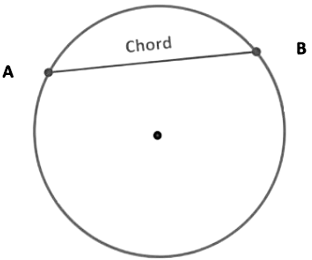
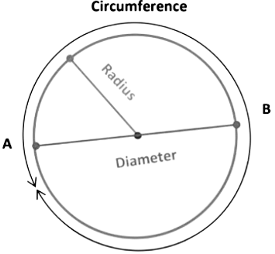
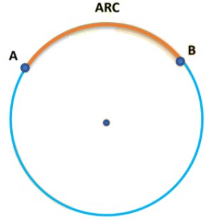
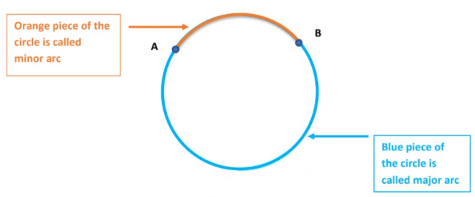
 and the major arc AB by
  where D is some point on the arc between A and B. When A and B are ends of a diameter, then both arcs are equal and each is called a semicircle.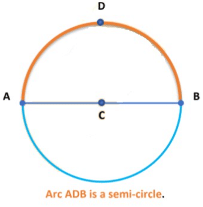
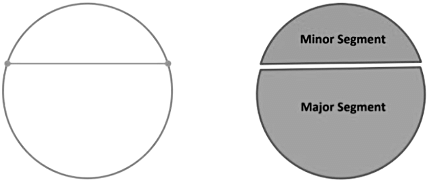
In triangles KHL and JHI,
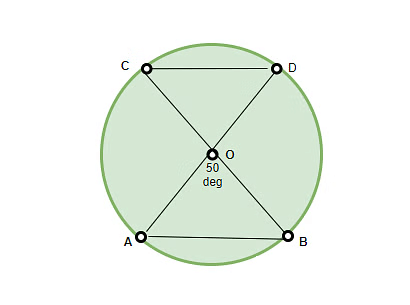
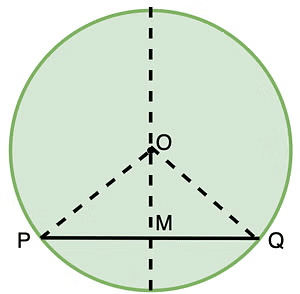
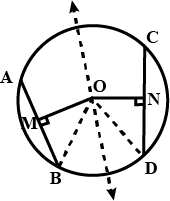
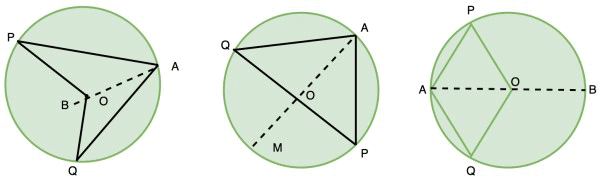
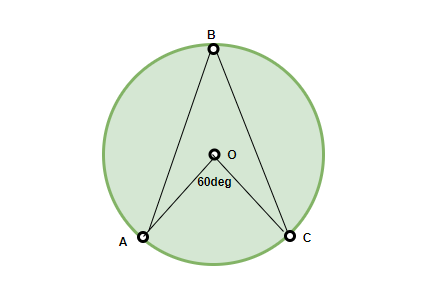
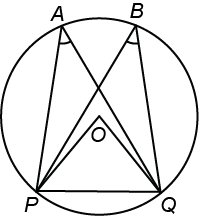
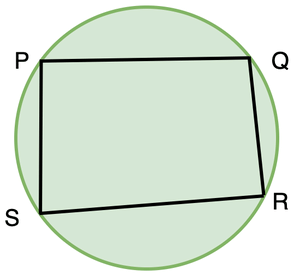
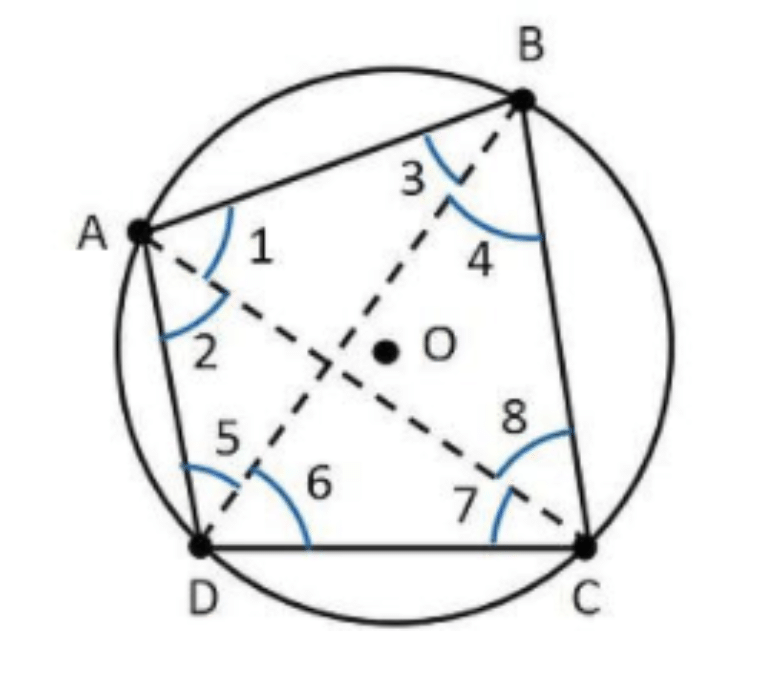
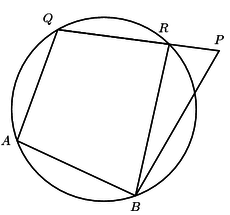
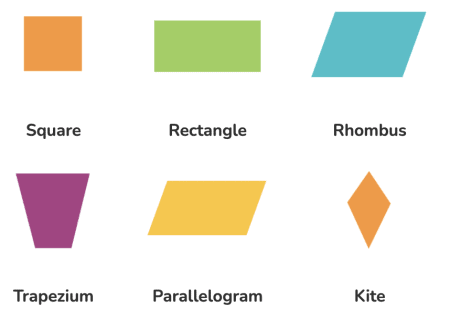 QuadrilateralsImagine the following examples: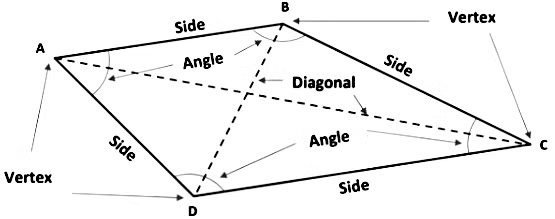
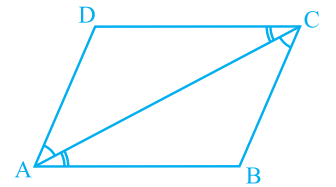
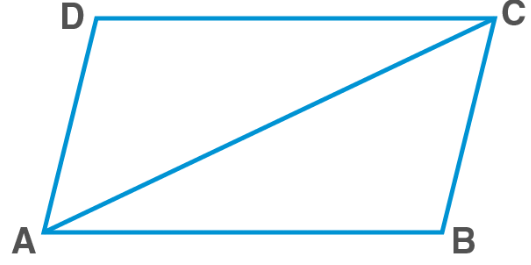
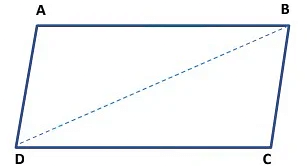
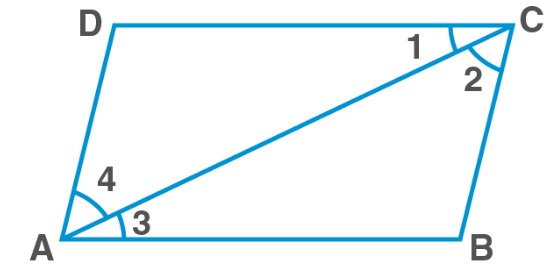
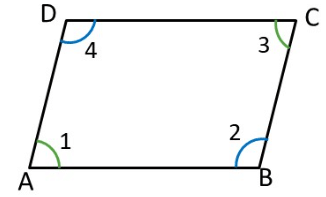
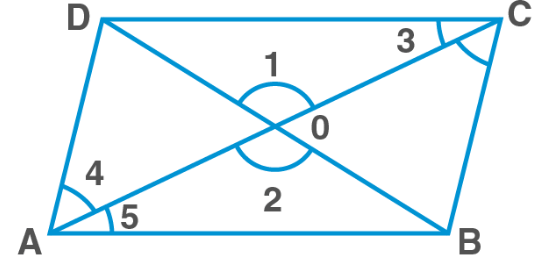
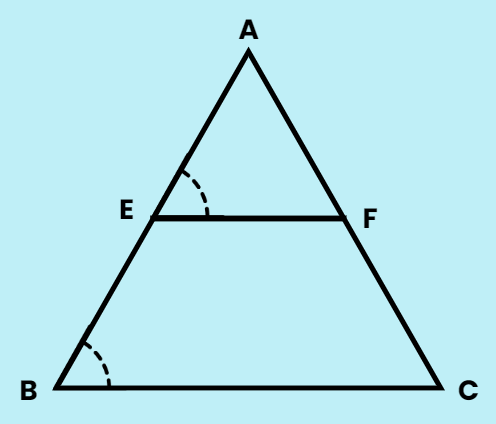
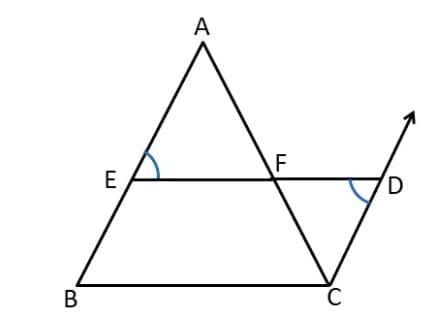
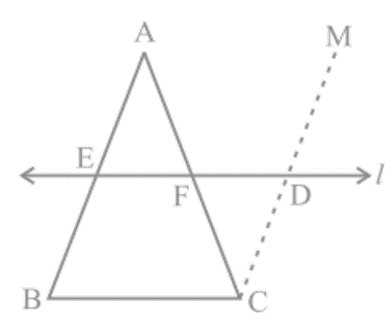
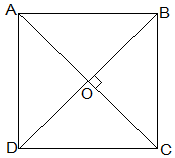
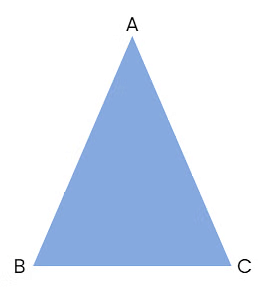 The term ‘triangle’ is derived from ‘tri,’ signifying ‘three.’ For instance, in triangle ABC (denoted as ∆ ABC), AB, BC, and CA represent the three sides, while ∠ A, ∠ B, ∠ C are the corresponding angles, and A, B, and C are the vertices.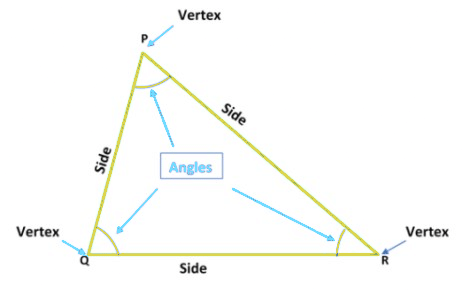
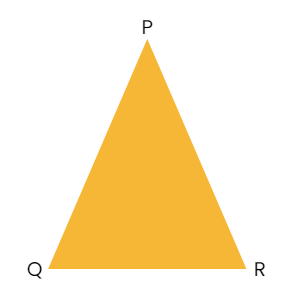
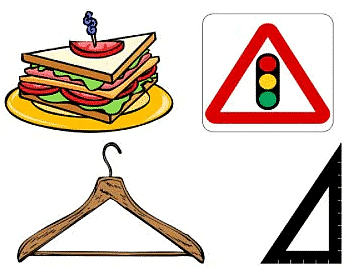
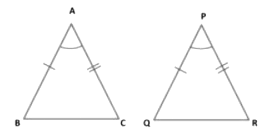
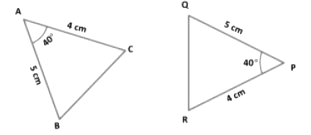
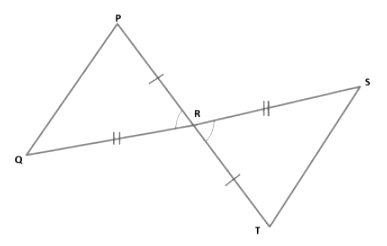
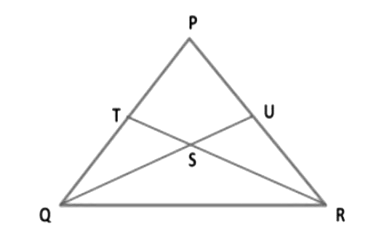
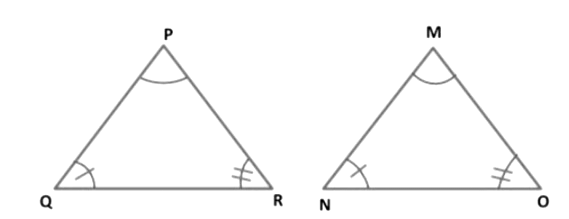
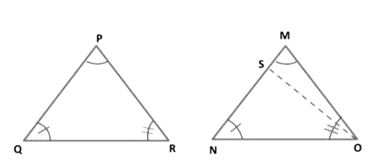
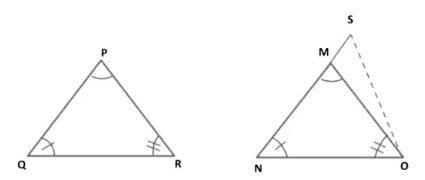
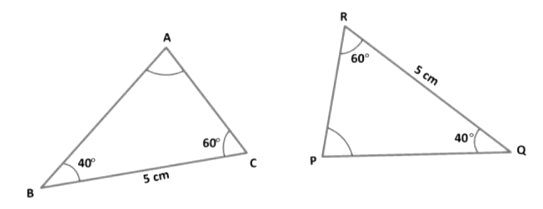
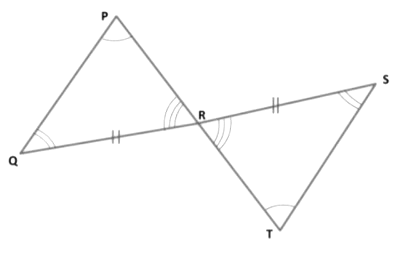
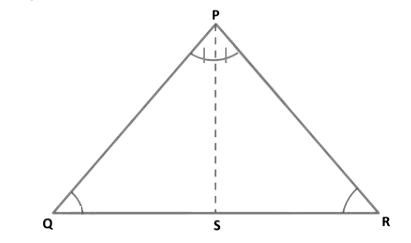
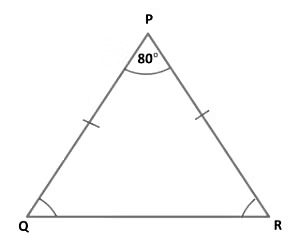
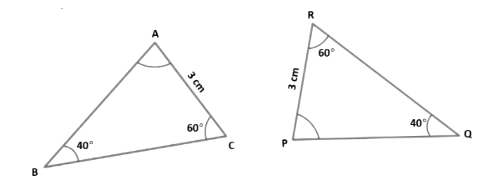
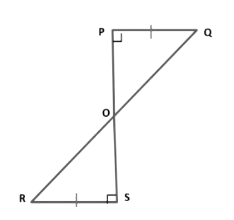
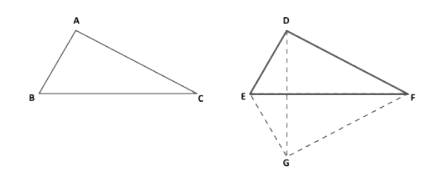
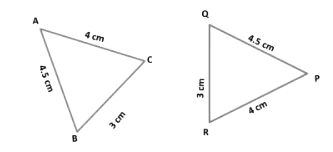
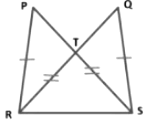
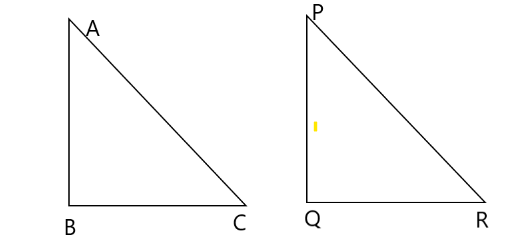
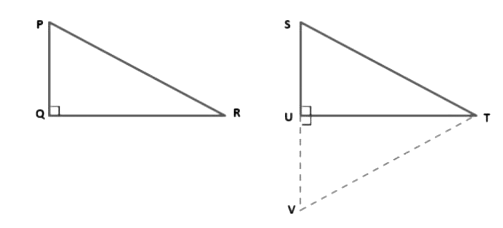
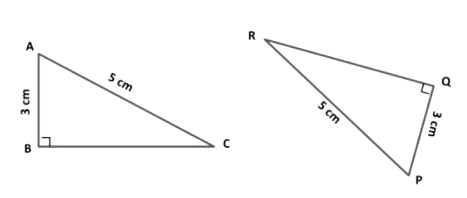
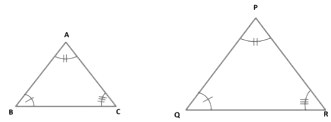
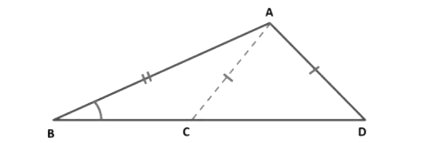
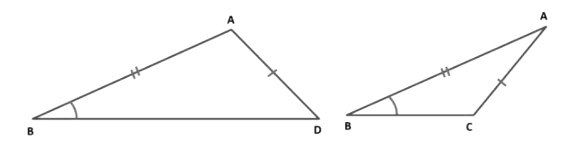
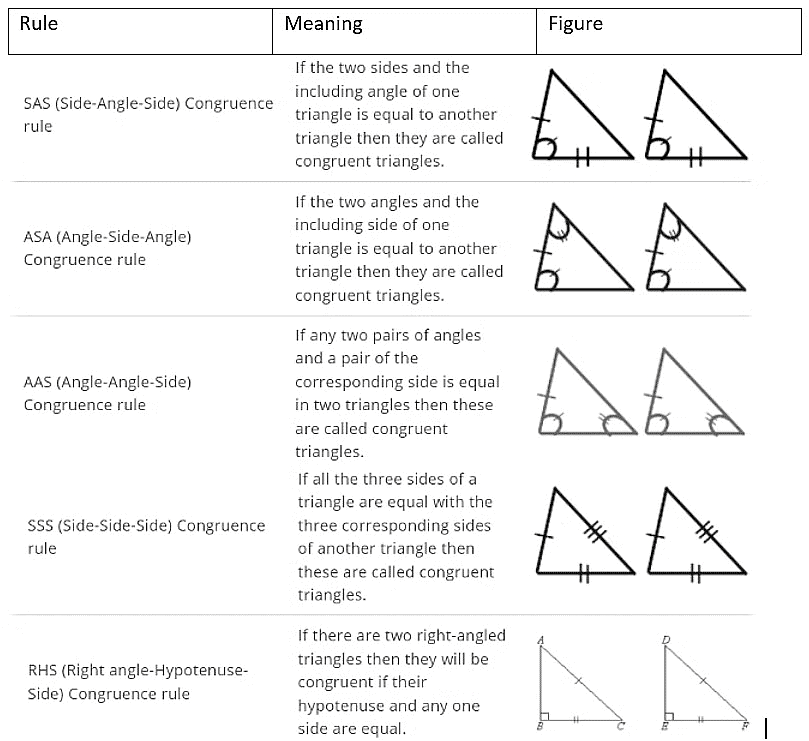
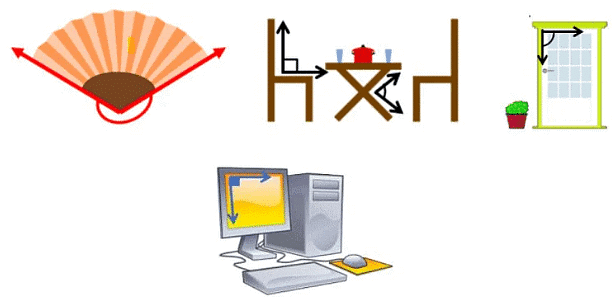
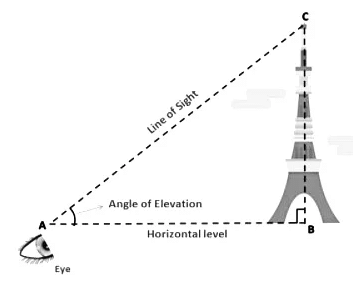

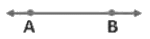

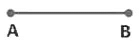

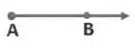
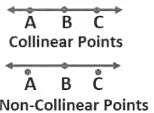
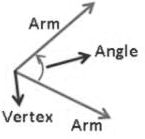
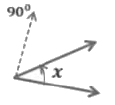

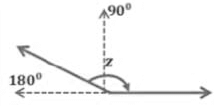
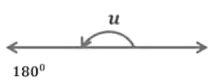
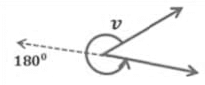
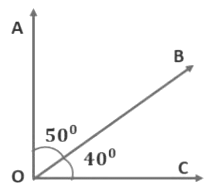
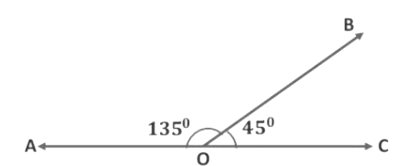
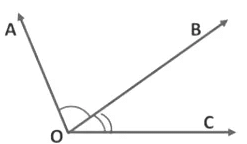
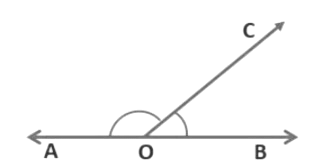
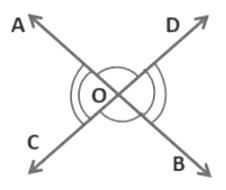
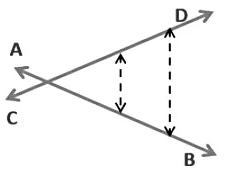
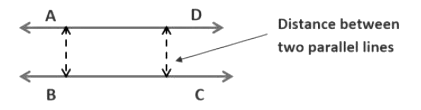
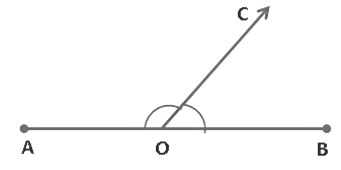
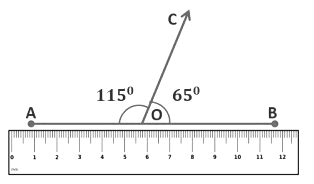
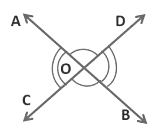
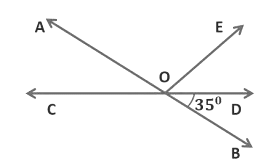
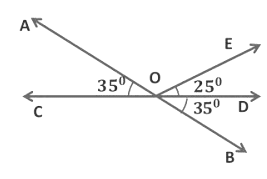
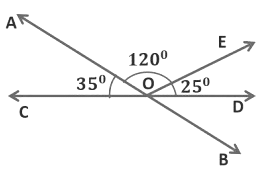
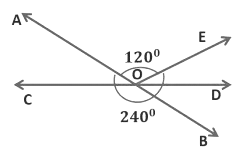
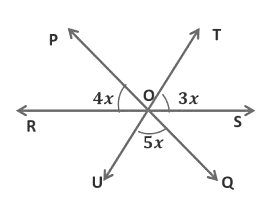
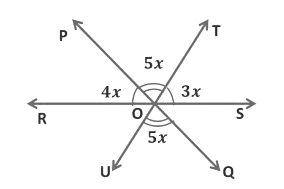
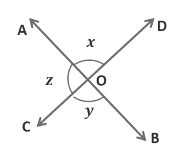
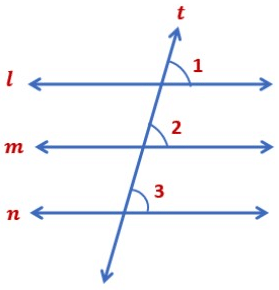
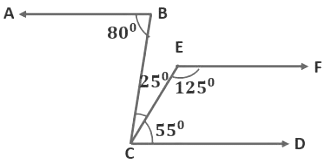
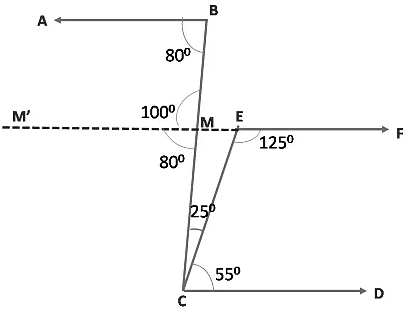
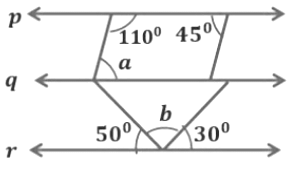
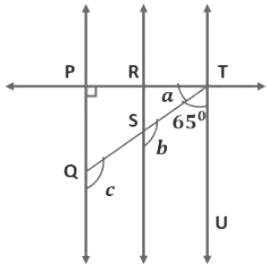
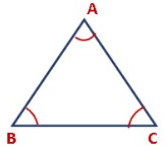
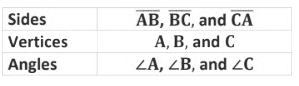
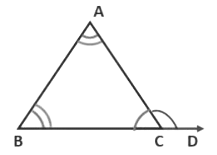
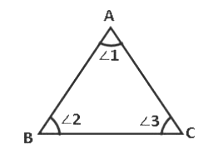
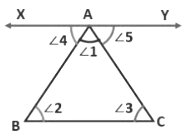
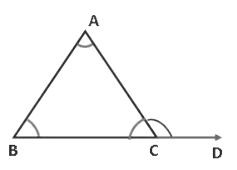
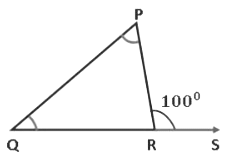
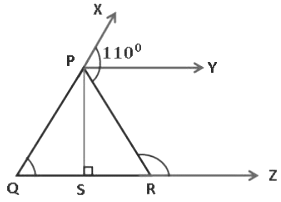
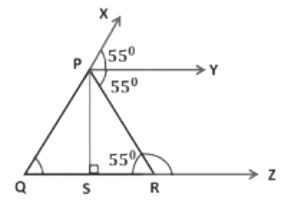
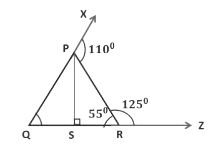
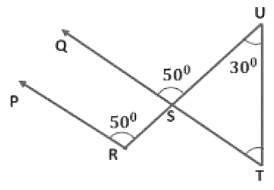
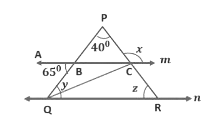
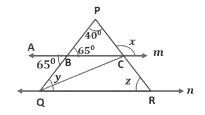 Line m || line n.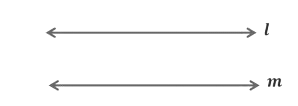
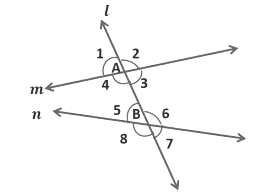

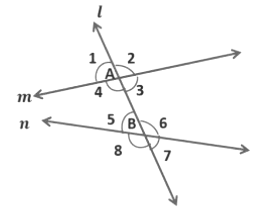
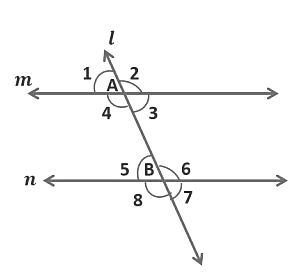
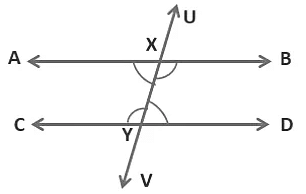
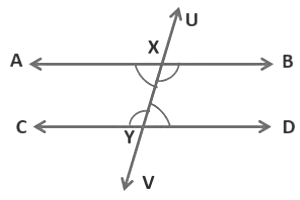
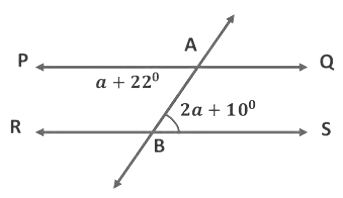
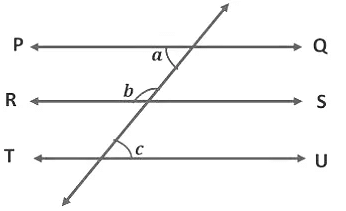
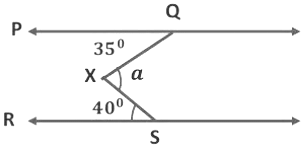
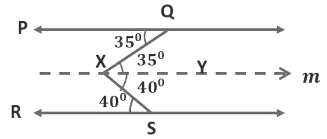
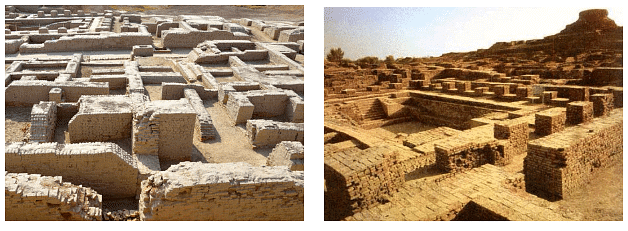
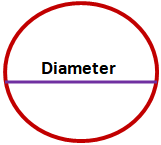
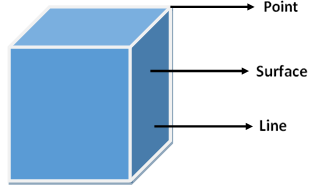

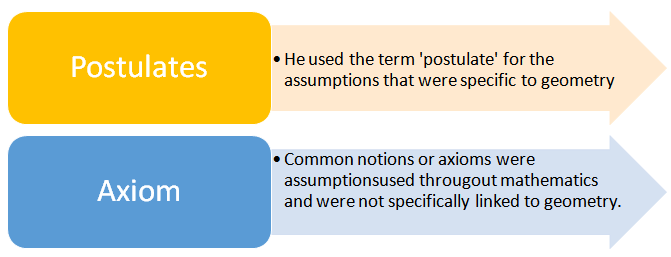

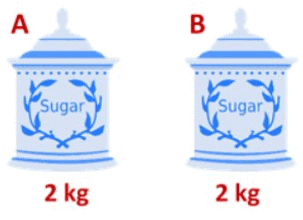
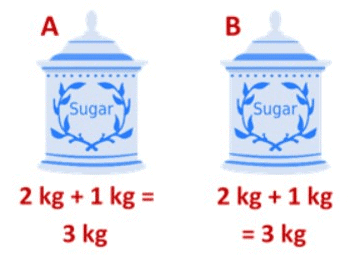
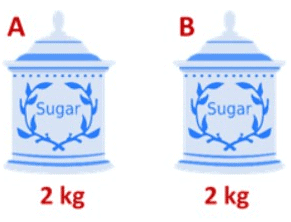
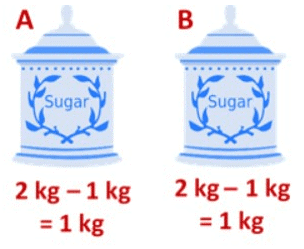



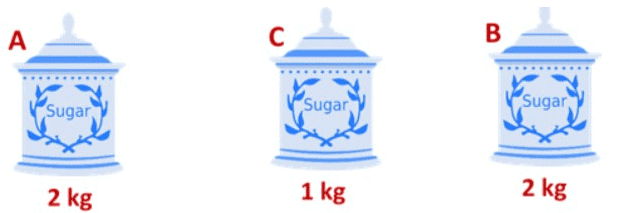 So, we see that the quantity of sugar in jar A and B is equal to twice the quantity of sugar in jar C or we can also say that both the jars A and B, have the same quantity of sugar as their quantities are also equal to twice the quantity of sugar in jar C.
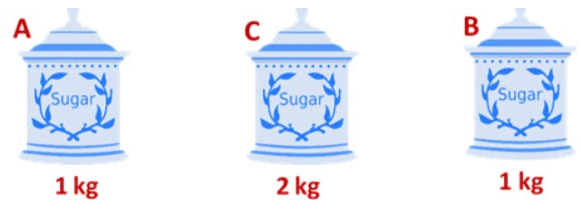 So, we see that the quantity of sugar in jar A and B is equal to half the quantity of sugar in jar C or we can also say that both the jars A and B, have the same quantity of sugar as their quantities are also equal to half the quantity of sugar in jar C.
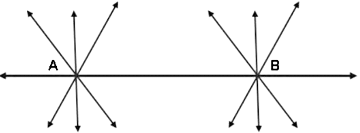 Here, we see that only one line, AB is passing through A and also through B. Now can you tell how many lines are passing through B and also through A?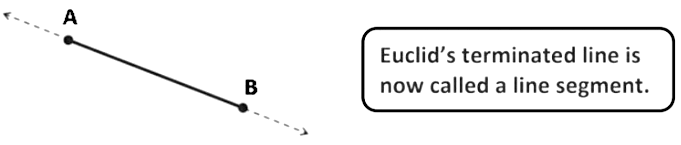
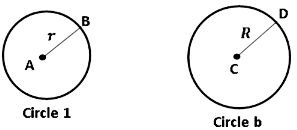 Here, AB = r is the radius of circle 1 and CD = R is the radius of circle 2.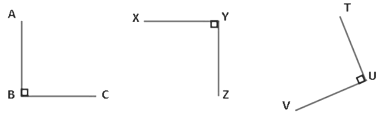
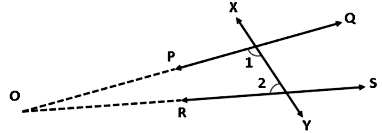 Suppose a straight line XY falls on two straight lines, PQ and RS in such a way that the interior angles ∠1 + ∠2 <180° on the left side of XY. The two lines PQ and RS, when produced indefinitely, will eventually intersect at point O on the left side of PQ.
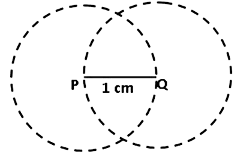 (4) The two circles meet at point R. Now draw the line segments, RP and RQ to form the ∆ RPQ.
 A line is a breadthless length. The ends of a line are points and the straight line is a line which lies evenly with the points on itself.
 A surface is that which has length and breadth only. The edges of a surface are lines.Euclid’s axiom
 =
=  and
and  =
=  , then
  =
= 
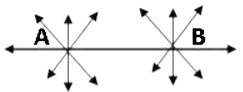 Postulate 2: A terminated line can be produced indefinitely.
 Postulate 3: A circle can be drawn with any centre and any radius.
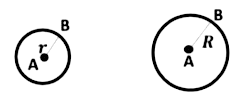 Postulate 4: All right angles are equal.
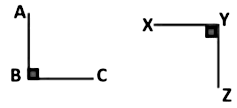 Postulate 5: If a straight line falling on two straight lines makes the interior angles on the same side of it taken together less than two right angles (180°), then the two straight lines, if produced indefinitely, meet on that side on which the sum of angles is less than two right angles
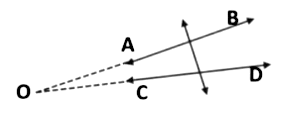 Equivalent Versions of Euclid’s Fifth Postulate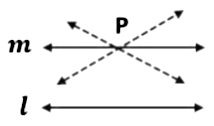
 The linear equation in one variable has a unique solution. Also, it gives a straight line when plotted on a graph.
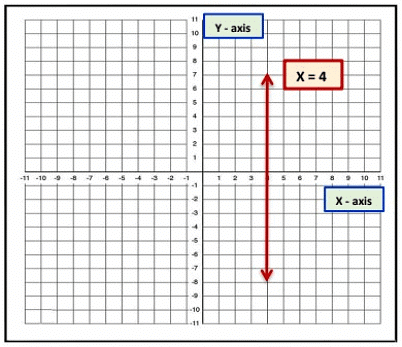 In this chapter, we recall our previous knowledge and extend it to that of the linear equation in two variables.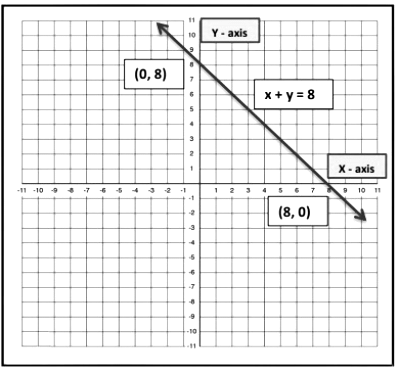
 Now, you are able to see the dot but, can you tell me the exact position of the dot?
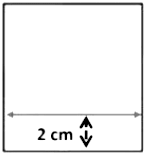 Therefore, to fix the position of the dot we have to specify its distance from two fixed lines, the right edge and the bottom line of the paper. Therefore, if I say that the dot is also 1 cm away from the right edge of the paper, then we can easily fix the position of the dot.
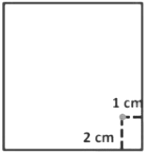 We see that position of any object lying in a plane can be represented with the help of two perpendicular lines.
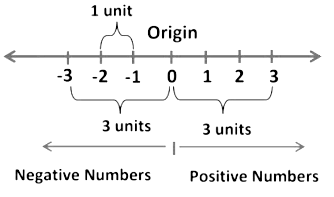

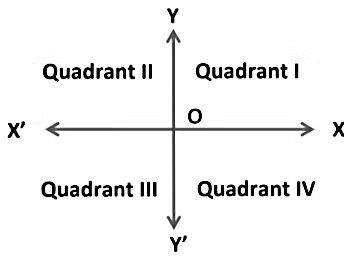
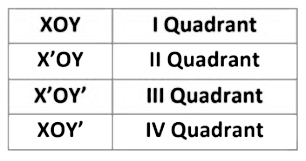
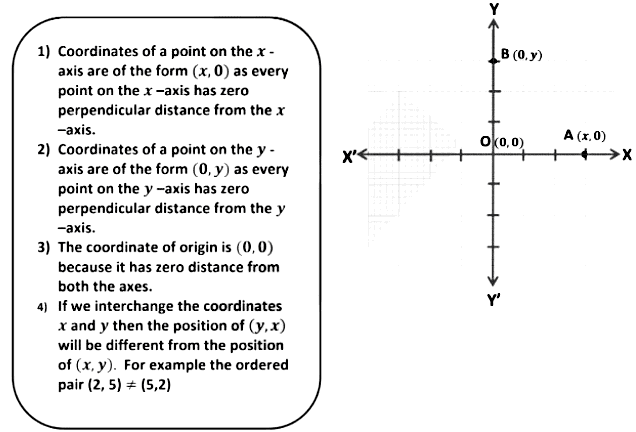
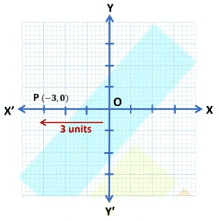 Coordinates of point P are (-3, 0).
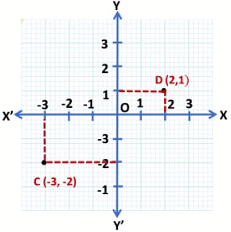 D (2, 1)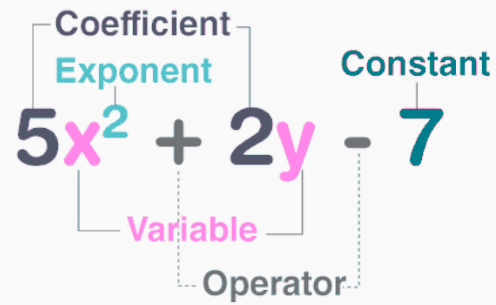

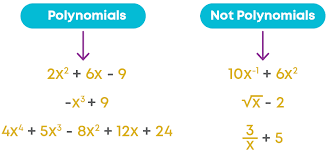
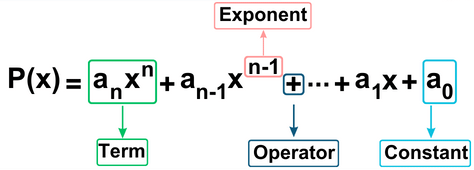
 , where are constants and
 and an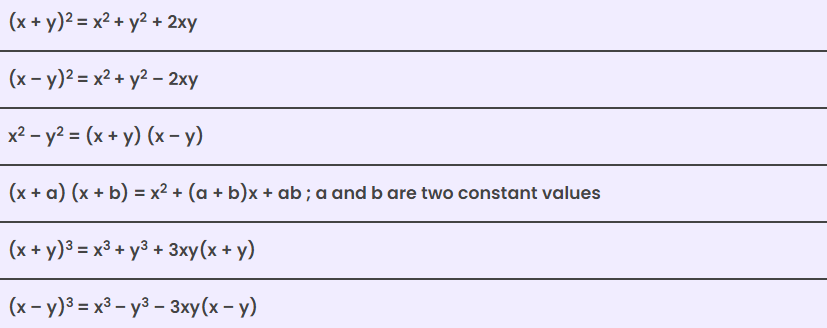

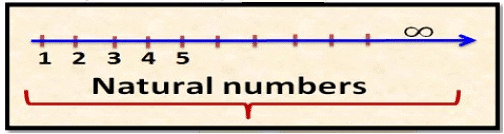
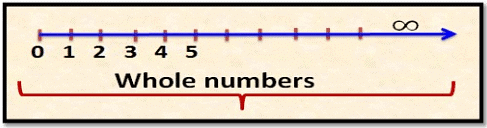
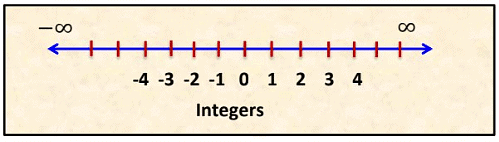
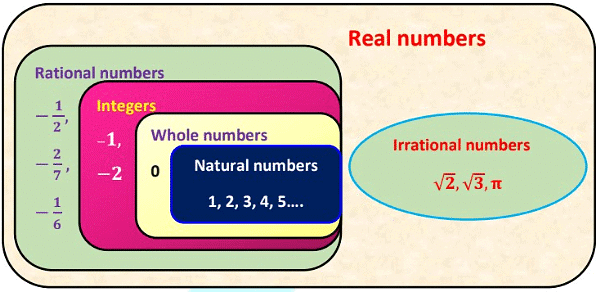
 is a rational number lying between a and b
 is a rational number lying between a and b.
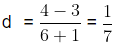
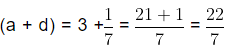
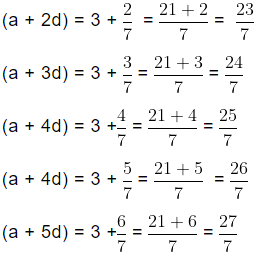
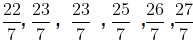
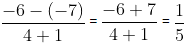
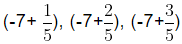 and
and 
 and
and 
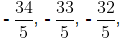 and
and 
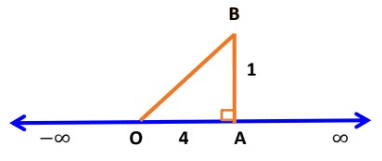
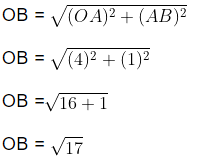
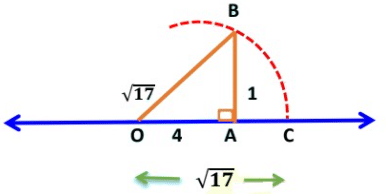
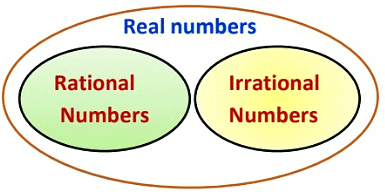

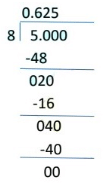 On dividing
  we get exact value 0.625 and remainder is zero.
 is a terminating decimal expansion.
 we get exact value 0.625 and remainder is zero. So, we say that
  is a terminating decimal expansion.
 = 0.333… . . or
  = 0. 3= [The block of repeated digits is denoted by bar ‘– ‘over it]
 we get the repeated number 3 and remainder never becomes zero. Hence, 1 by 3 has a non – terminating repeating decimal expansion.
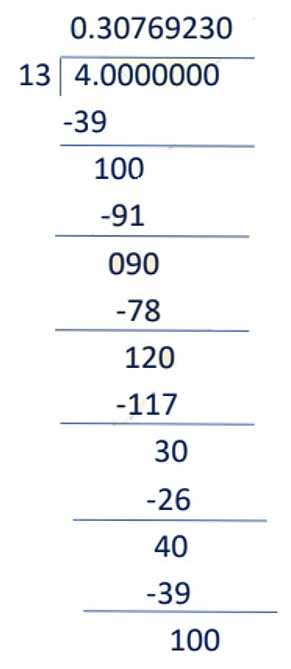
 = 0.
= 0. On dividing 4 by 13 we get the repeated numbers 0.30769230 again and again, and remainder never becomes zero. Hence, 4 by 13 has a non – terminating repeating decimal expansion.
 ( and we have to convert the given number in the form of p by q. Follow the following steps:
 . (In the above expression we see that one digit “b” exist between decimal point and repeating number. Hence,we multiply both side by 101. We get,
 Step II: Count the number of digits in repeating number and then multiply equation (1) by that power of 10 and the equation becomes
 Step III: Subtract equation (1) from equation (2) we get,
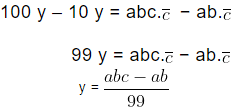 Example (i): Express in the form of p by q


 ……(i)
……(i)


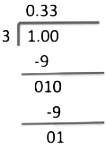 Thus,
Thus, 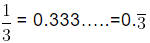
 and
and  . Also, we know that the irrational numbers have non-terminating non-recurring decimals. Hence, one irrational number between
  and
and  is 0.20101001000… . .
 = 0.333 (Given)
 = 0.333 (Given)
 = 2 ×
= 2 ×  = 2 × 0.333 = 0.666
 and
and  may be 0.357643… and 0.43216 (In this solution we can write infinite number of such irrational numbers)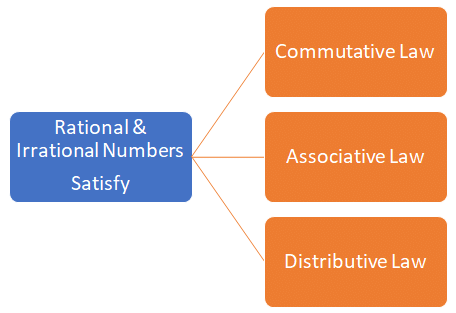
 (rational) and b =
  (rational),


 (rational number)
 (rational) and b =
  (rational)

 (rational number)
 (rational) and b =
  (rational)
 ×
×  =
=  (rational)
 (rational) and b =
  (rational)
 divided by
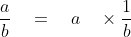
 ÷
÷  =
=  x
x  =
=  x 3
x 3 
 (rational) and b = √3 (irrational) then,
 + √3 =
 (irrational)
 − √3 =
 (irrational)
 (rational) and b = √2 (irrational) then,
 × √2 =
 (irrational)
 =
=  =
=  ×
×  =
= (irrational)
 ) – (
) – ( +
+  )
)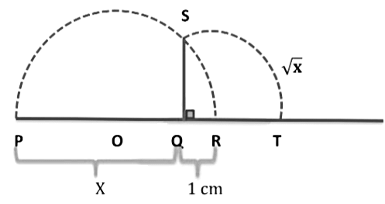
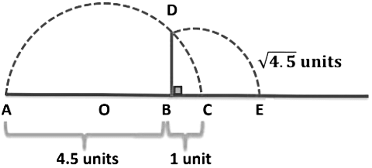 Hence, the distance BD represents √4.5 ≈ 2.121 geometrically. Now take BC as a number line, draw an arc with centre B and radius BD from point BD, meeting AC produced at E. So, point E represents √4.5 on the number line.
 =
=  is a real number, then n is called exponent, and a is called radical and “√ ” is called radical sign.
 is called surd.
 =
=  is called square root of 2.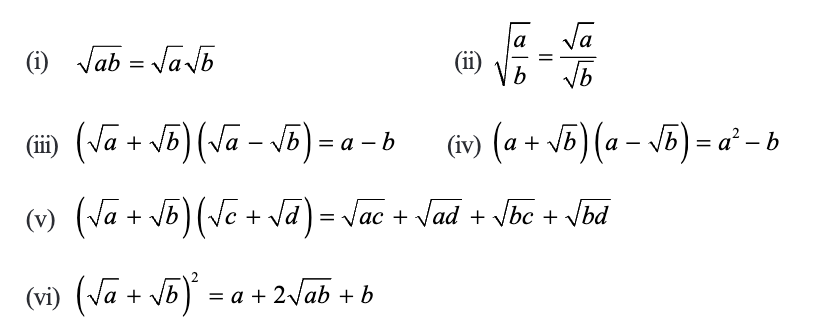
 x
x  =
= 

 =
=  2
2 =
= 

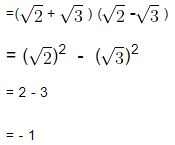
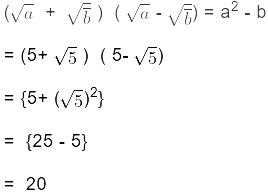
 can you tell where this value will lie on the number line? It is a little bit difficult. Because the value containing square roots in their denominators and division is not easy as addition, subtraction, multiplication and division are convenient if their denominators are free from square roots. To make the denominators free from square roots i.e. they are whole numbers, we multiply the numerator and denominators by an irrational number. Such a number is called a rationalizing factor.
 is ,
is ,  and conjugate of ,


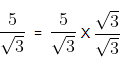
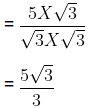
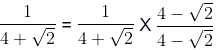
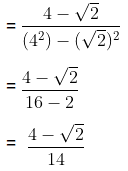

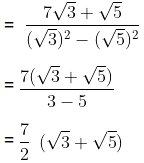

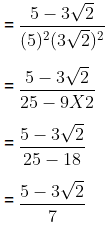

 ) -m = (
 )m
)m

 = 53-2 = 51