Q.1. Rearrange the following jumbled words/phrases to make meaningful sentences: (3 marks) (a) for many/on/relied/dogs/people have/generations (b) companionship/used/they/for hunting/have been/and (c) very/a dog’s/are/and ears/sensitive/nose Ans. (a) For many generations people have relied on dogs./People have relied on dogs for many generations. (b) They have been used for hunting and companionship. (c) A dog’s nose and ears are very sensitive.
Q.2. Rearrange the following jumbled words/phrases to make meaningful sentences : (3 marks) (a) inside/grandeur/the palace hall/it was/all (b) interwoven/pearls/were/flower garlands/sparkling/with (c) wooden stage/painted backcloth/the/decorated/with a/was Ans. (a) It was all grandeur inside the palace hall. (b) Flower garlands were interwoven with sparkling pearls. (c) The wooden stage was decorated with a painted backcloth.
Q.3. Rearrange the following words to make meaningful sentences: (3 marks) (a) children/ kept/ heart/ for/ young/ writing/ has/ me/ at (b) writing/ children/ when/ seventeen/ I/ took/ was/ for/ to/ I (c) fiction/ children/ hooked/ today/ are/ to/ edgy Ans. (a) Writing has kept me young at heart for children. (b) I took to writing for children when I was seventeen. (c) Children are hooked to edgy fiction today.
Q.4. Rearrange the following to make meaningful sentences. The first one has been done as an example: (3 marks) Example: England/good/many/lived/a/years/king/ago/wise/there/and/in Many years ago there lived a wise and good king in England. (a) so much/man/his country/did/other/ever/for/for/as he/no/did (b) the world/speak/Alfred/people/of/all over/the Great/now/as/him (c) have/life/in/easy/those/did not/very/days/a/a king Ans. (a) No other man ever did so much for his country as he did. (b) People all over the world now speak of him as Alfred the Great. (c) A king did not have a very easy life in those days.
Q.5. Rearrange the following to make meaningful sentences. The first one has been done as an example: (3 marks) Example: stands/a/at/population/tiger/in/slim 1411/India/the/today The tiger population stands at a slim 1411 in India today. (a) concemed/ the/ really/ Indian/ are/ authorities (b) tigers/ the/ of/ population/ falling/ is/ sharply (c) considered/ was/ tigers,/ Sariska,/ for/ sanctuary/ a/ which/ tigers left/ have/ any/ does not Ans. (a) The Indian authorities are really concerned. (b) The population of tigers is falling sharply. (c) Sariska, which was considered a sanctuary for tigers, does not have any tigers left.
Q.6. Rearrange the following jumbled words and phrases to make meaningful sentences : (3 marks) (a) teeth/one/ the/ neglected / of/body / the / are/of / most/parts (b) brushing/ teeth/ remove/ 50%/ your/ wbes/ can/ almost/ of/ dental (c) good/ and/ oral/ health/ dental/ hygiene/ need/ inculcated/ to/ atanearlyage/be Ans. (a) The teeth are one of the most neglected parts of the body. (b) Brushing teeth can remove almost 50% of your dental woes. (c) Good oral health and dental hygiene need to be inculcated at an early age.
Q.7. Rearrange the following jumbled words/phrases to make meaningful sentences : (3 marks) (a) vast space/ a multitude of/ about/ wandering/stars/is/ in the (b) majority/a few/ are/ form groups/ but the/ solitary/ of them (c) a/ they/ universe/ travel/ very/ through/ spacious Ans. (a) A multitude of stars is wandering about in the vast space. (b) A few of them form groups but the majority are solitary. (c) They travel through a very spacious universe.
Q.8. Rearrange the following jumbled words/phrases to make meaningful sentences: (3 marks) Example, many Indians sandal wood/to be/is considered/sacred by Sandalwood is considered to be sacred by many Indian (a) the Sandalwood/comes/oil/tree/the sandal/of Mysore/from (b) of sandalwood/the commercial/Tipu Sultan/recognized/significance (c) for the/monopolized/he then/the trade/state Ans. (a) The sandal oil comes from the Sandalwood tree of Mysore. (b) Tipu Sultan recognized the commercial significance of Sandalwood. (c) He then monopolized the trade for the state.
Q.9. Rearrange the jumbled words/phrases to form meaningful sentences. The first one has been done for you: (3 marks) e.y have/area/potential/kills/species/road/endemic to the/entire/wipe out Road kills have the potential to wipe out entire species endemic to the area. (a) entirely/blame the/we/public/cannot (b) them/educate/have/we/to (c) its life/an animal/could/cost/road/the/on/candy/throwing/a/even Ans. (a) We cannot blame the public entirely. (b) We have to educate them. (c) Even throwing a candy on the road could cost an animal its life.
Q.10. Rearrange the following words/phrases to make meaningful sentences: (3 marks) (a) have been/ by/ infuriated/ I/ of/ etiquette/ lack/ people’s (b) cannot/ freedom/ away/ be/ taken/ one/ from/ of speech (c) cannot/ speaking/ yet one/ all the time/ keep on Ans. (a) I have been infuriated by people’s lack of etiquette. (b) Freedom of speech cannot be taken away from one. (c) Yet one cannot keep on speaking all the time.
Q.11. Rearrange the following words/phrases to make meaningful sentences: (3 marks) (a) is/basic/change/of/truth/existence/the (b) every/ entire/is/ the/ cosmos/ changing/ moment (c) shows/ Tagore/ path of/ the/ taking/ pride/ love/in the/God/of Ans. (a) Change is the basic truth of existence. (b) Every moment the entire cosmos is changing. (c) Tagore shows the path of taking pride in the love of God.
Q.12. Rearrange the following jumbled words/phrases to make meaningful sentences and write the same in the answer sheet: (3 marks) (a) elephant/land animal/largest/is/today/the (b) mild/peace loving/is/animal/it/a/and (c) more easily/that is why/domesticated/be/can/it Ans. (a) Elephant is the largest land animal today. (b) It is a mild and peace-loving animal. (c) That is why it can be domesticated more easily.
What is Sentence Reordering? It is one of the important chapters of Class 10 English Grammar. By going through the name it is not difficult to understand the meaning of these words. It concentrates on the arrangement of a few jumbled sentences. The students are usually asked to arrange a bunch of sentences and the way you arrange it determines their performance in the final exam. This is usually known by various names like rearranging of words, rearranging sentences, jumbled words, word order exercises, making a sentence with the word, but the words in the correct order to make sentences, sentence order, sentence formation. A student has to be extra careful while rearranging sentences because it can be tricky. A student has to be a good observer to analyze a sentence. A well-constructed sentence adds meaning to a story and hence sentence rearrangement is an important element.
Types of Sentence Rearrangement Questions:
The questions which are asked in the board exam usually follow some patterns. There are basically 4 formats
The Basic Format: This is the format where all the statements are presented in a jumbled form and students need to reshape all the statements correctly.
Static First Statement: In the second type the first statement is given as static and candidates have to arrange the other statements logically. The first statement must remain unaffected.
Static Last Statement: Just like a static first statement, the last statement given can also be static and candidates need to arrange the other sentences to make the paragraph logical with the last sentence constant
Static First and Last Statement: The first and last statement can be static and candidates are required to arrange the leftover sentences between these two statements to make them logically correct
Examples/Practice Questions: Look at the words and phrases below. Rearrange them to form meaningful sentences: 1. the / of / plight / Tanzanians / would / like / know / the /you / about / to 2. is / the / receiver / lifted 3. think / why / preferred / the / you / to land / dinosaurs / water / do 4. can result / or fire / electrical faults / in shock 5. the / there / numberless / are / sky / stars / in 6. stories / loved / my grandfather / telling me 7. retailer / ice cream / to tell / the Swad / has a story 8. years trying / to perfect / Elias Howe spent / a sewing machine 9. is one / summer visitors / the / of the / swallow / best-known 10. friends / I / my / were / grandmother / and / good 11. only 26 / of relativity, which / Albert Einstein is / for his / when he was / best known / he first advanced / theory 12. of / animals / with / concerned / large / children’s books / proportion / are / a 13. why / you / don’t / bothering / instmead / of / me / play / go / and 14. important / it / is / to observe / rules / traffic 15. beach vacations / was / an attraction / coconut water / long ago / during 16. bird / in the / the / world / largest / at / cant’ / fly / all 17. person / physically / a / was / Kitty / handicapped 18. gets / tender coconuts / 10-15 truckloads / Delhi / of / daily 19. came / months / me / for eight / to teach / he 20. Sudha Chandran / a national icon / famous dancer, / a / is / for the desabled Ans.
1. Would you like to know about the plight of the Tanzanians? 2. The receiver is lifted. 3. Why do you think the dinosaurs preferred water to land ? 4. Electrical faults can result in shock or fire. 5. There are numberless stars in the sky. 6. My grandfather loved telling me stories. 7. The Swad ice cream retailer has a story to tell. 8. Elias Howe spent years trying to perfect a sewing machine. 9. The swallow is one of the best-known summer visitors. 10. My grandmother and I were good friends. 11. Albert Einstein is best known for his theory of relativity, which he first advanced when he was only 26. 12. A large proportion of children’s books are concerned with animals. 13. Why don’t you go and play instead of bothering me ? 14. It is important to observe traffic rules. 15. Long ago, coconut water was an attraction during beach vacations. 16. The largest bird in the world can’t fly at all. 17. Kitty was a physically handicapped person. 18. Delhi gets 10-15 truckloads of tender coconuts daily. 19. For eight months, he came to teach me. 20. Sudha Chandran, a famous dancer, is a national icon for the disabled.
Q.1. Which of the following is the correct definition of a command? (a) A polite way to ask someone to do something. (b) A statement that expresses a strong request or directive. (c) A sentence that ends with a question mark. (d) A type of question that seeks information.
Ans: (b) Explanation: A command is a type of sentence that expresses a strong request or directive, indicating what someone should do.
Q.2. What is the main difference between a command and a request? (a) A command is more polite than a request. (b) A request is a question, whereas a command is a statement. (c) A command is a directive, whereas a request seeks cooperation. (d) There is no difference; the terms can be used interchangeably.
Ans: (c) Explanation: A command is a direct instruction or order, while a request seeks cooperation or permission.
Q.3. Which of the following sentences is an example of a command? (a) Could you please pass the salt? (b) Can you tell me the time? (c) Shut the door before leaving. (d) Would you like a cup of tea?
Ans: (c) Explanation: This sentence is an example of a command as it gives a direct instruction without seeking cooperation or permission.
Q.4. In a command, the subject of the sentence is usually ___________. (a) You (b) I (c) They (d) He/She
Ans: (a) Explanation: In commands, the subject of the sentence is usually “You,” indicating the person who is being addressed.
Q.5. Which punctuation mark is typically used at the end of a command? (a) Period (.) (b) Comma (,) (c) Exclamation mark (!) (d) Question mark (?)
Ans: (a) Explanation: Commands typically end with a period (full stop) to indicate a firm directive rather than a question or exclamation.
Section B: Short Questions
Q.1. Define a request in the context of communication.
Ans: A request is a form of communication where someone asks for something, seeks permission, or solicits assistance.
Q.2. Give an example of a command that can be used in a classroom setting.
Ans: Example answer: “Please bring your textbooks to class tomorrow.”
Q.3. Explain the importance of using polite language while making requests.
Ans: Using polite language while making requests is important as it shows respect, consideration, and enhances the likelihood of cooperation.
Q.4.What is the role of body language in conveying commands effectively?
Ans: Body language plays a crucial role in conveying commands effectively as it can emphasize the directive, establish authority, and convey confidence.
Q.5. How can commands and requests be used to establish authority and influence?
Ans: Commands and requests can be used to establish authority and influence by expressing expectations clearly, setting boundaries, and motivating others to take specific actions.
Section C: Fill in the Blanks
Q.1. A command is a type of _______ that expresses a request or directs someone to do something.
Ans: A command is a type of sentence that expresses a request or directs someone to do something. Explanation: A command is a type of sentence that gives an order, instruction, or request to someone.
Q.2. In a command, the subject is usually _______.
Ans: In a command, the subject is usually implied. Explanation: In a command, the subject is often not explicitly stated but is understood to be “you” or the person being addressed.
Q.3.A command usually ends with a _______.
Ans: A command usually ends with aperiod (full stop). Explanation: A command is typically punctuated with a period at the end, indicating a complete sentence.
Q.4. A _______ command is a polite way of making a request or giving an order.
Ans: A indirect command is a polite way of making a request or giving an order. Explanation: An indirect command is a more polite or courteous way of making a request or giving an order.
Q.5. A _______ command is a direct and forceful way of giving an order or making a request.
Ans: A imperative command is a direct and forceful way of giving an order or making a request. Explanation: An imperative command is a direct and forceful way of giving an order or making a request.
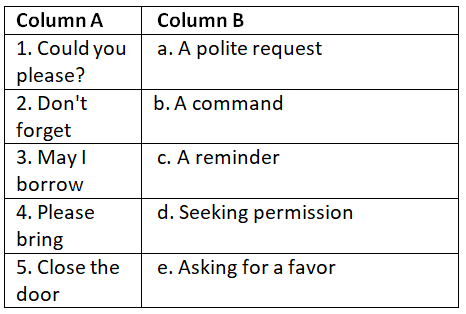
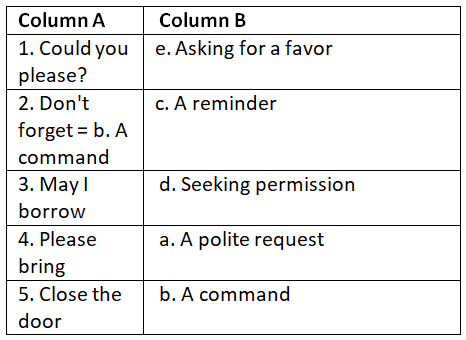
Section D: Match the Column
Match the words/phrases in Column A with their corresponding meanings in Column B.
Ans:
Section E: True or False
Q.1. A command always ends with an exclamation mark.
Ans: False Explanation: A command usually ends with a period (full stop), not an exclamation mark.
Q.2. An indirect command is a more polite way of giving an order.
Ans: True Explanation: An indirect command is a polite way of making a request or giving an order.
Q.3. The subject of a command is always explicitly stated.
Ans: False Explanation: The subject of a command is often implied and not explicitly stated.
Q.4. “May I have some water, please?” is an example of an imperative command.
Ans: False Explanation: “May I have some water, please?” is an example of an indirect command, not an imperative command.
Q.5. “Stop talking!” is an example of an imperative command.
Ans: True Explanation: “Stop talking!” is a direct and forceful way of giving an order, making it an imperative command.
Q.1. Which of the following is the correct definition of a command? (a) A polite way to ask someone to do something. (b) A statement that expresses a strong request or directive. (c) A sentence that ends with a question mark. (d) A type of question that seeks information.
Q.2. What is the main difference between a command and a request? (a) A command is more polite than a request. (b) A request is a question, whereas a command is a statement. (c) A command is a directive, whereas a request seeks cooperation. (d) There is no difference; the terms can be used interchangeably.
Q.3. Which of the following sentences is an example of a command? (a) Could you please pass the salt? (b) Can you tell me the time? (c) Shut the door before leaving. (d) Would you like a cup of tea?
Q.4. In a command, the subject of the sentence is usually ___________. (a) You (b) I (c) They (d) He/She
Q.5. Which punctuation mark is typically used at the end of a command? (a) Period (.) (b) Comma (,) (c) Exclamation mark (!) (d) Question mark (?)
Section B: Short Questions
Q.1. Define a request in the context of communication.
Q.2. Give an example of a command that can be used in a classroom setting.
Q.3. Explain the importance of using polite language while making requests.
Q.4. What is the role of body language in conveying commands effectively?
Q.5. How can commands and requests be used to establish authority and influence?
Section C: Fill in the Blanks
Q.1. A command is a type of _______ that expresses a request or directs someone to do something.
Q.2. In a command, the subject is usually _______.
Q.3. A command usually ends with a _______.
Q.4. A _______ command is a polite way of making a request or giving an order.
Q.5. A _______ command is a direct and forceful way of giving an order or making a request.
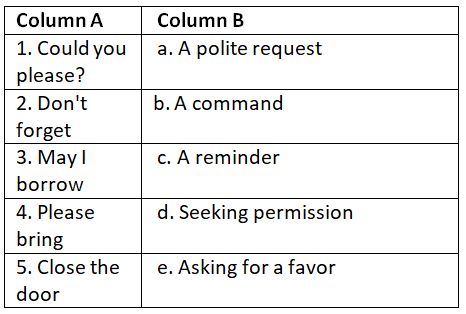
Section D: Match the Column
Match the words/phrases in Column A with their corresponding meanings in Column B.
Section E: True or False
Q.1. A command always ends with an exclamation mark.
Q.2. An indirect command is a more polite way of giving an order.
Q.3. The subject of a command is always explicitly stated.
Q.4. “May I have some water, please?” is an example of an imperative command.
Q.5. “Stop talking!” is an example of an imperative command.
You can access the solutions to this worksheet here.
The chapter titled “Commands and Requests” delves into the usage of imperativesand modal verbs for issuing commands and making requests. Imperatives are employed for direct orders, while modal verbs convey varying degrees of necessity or politeness in requests. The formality of these commands and requests can be influenced by the context.
Imperatives
Imperatives are sentences that express commands, instructions, or requests.
They are formed using the base form of the verb (without “to”).
Examples: “Close the door.” “Please sit down.” “Don’t talk during the class.”
Types of Imperative Sentences with Examples 1. Positive Imperatives
Positive imperatives are used to give direct orders or commands.
They usually begin with the base form of the verb.
Examples: “Bring me a glass of water.” “Clean your room.” “Finish your homework.”
2. Negative Imperatives
Negative imperatives are used to prohibit or forbid actions.
They are formed by adding “do not” or “don’t” before the base form of the verb.
Examples: “Don’t touch the hot stove.” “Do not enter without permission.” “Don’t run in the corridor.”
Polite Requests using Modal Verbs
Modal verbs are used to make polite requests or to express varying degrees of necessity.
Modal verbs include “can,” “could,” “may,” “might,” “would,” “should,” etc.
Examples: “Can you please pass me the salt?” “Could you lend me your pen?” “Would you mind closing the window?”
Try yourself:
Which of the following sentences is a negative imperative?
A.Please bring me a book.
B.Don’t forget to call me later.
C.Can you help me with this?
D.Finish your dinner before watching TV.
View SolutionExpressing Commands and Requests in Different Situations
Commands and requests can vary based on the situation and the relationship between the speaker and the listener.
In formal situations, it is common to use indirect commands and requests using phrases such as “Would you be so kind as to…” or “Could I ask you to…”
In informal situations, direct imperatives and polite requests using modal verbs are more commonly used.
Changing Commands and Requests into Indirect Speech
In imperative sentences that convey commands, the reporting verb is altered to reflect a command, such as “order,” “tell,” “allow,” “request,” etc.
The imperative mood is transformed into the infinitive form by prefixing “to” before the verb.
In negative sentences, the auxiliary verb “do” is omitted, and “to” is positioned after “not.”
Examples:
Direct: She said to me, “Open the window.” Indirect: She ordered me to open the window.
Direct: The captain said to the soldiers, “Attack the enemy.” Indirect: The captain commanded the soldiers to attack the enemy.
Direct: I said to him, “Leave this place at once.” Indirect: I told him to leave that place at once.
Direct: The teacher said to the students, “Listen to me attentively.” Indirect: The teacher asked the students to listen to him attentively.
Direct: The Principal said to the peon, “Ring the bell.” Indirect: The Principal ordered the peon to ring the bell.
Direct: The master said to the servant, “Fetch me a glass of water.” Indirect: The master ordered the servant to fetch him a glass of water.
Direct: I said to him, “Please bring me a glass of water.” Indirect: I requested him to bring me a glass of water.
Direct: I said to my friend, “Please lend me your book.” Indirect: I requested my friend to lend me his book.
Sentences with ‘Let’.
‘Let’ is used in various meanings.
(i) ‘Let’ is used to make a proposal:
First change the reporting verb into ‘proposed’ or ‘suggested’.
Use ‘should’ instead of ‘let’. Example: Direct: He said to me, “Let us go home.” Indirect: He suggested to me that we should go home.
(ii) ‘Let’ is used as ‘to allow’:
In Indirect Speech, we change the reporting verb to ‘requested’ or ‘ordered’.We start Reported Speech with ‘to’. Example: Direct: Ram said to Mohan, “Let him do it.” Indirect: Ram ordered Mohan to let him do that. Or Ram told Mohan that he might be allowed to do that.
Difference between commands and requests
It’s important to note that commands and requests are different sentence types.
A request is a polite way of asking someone to do something, whereas a command is a more direct way of telling someone what to do.
For example, “Could you please pass the salt?” is a request, while “Pass me the salt” is a command. In the first sentence, the speaker is asking for a favor, while in the second sentence, the speaker is giving a direct order.
Given below are sets of information. Use the information in each of them to complete the following paragraphs. Do not add any new information. Write the answers in your answer sheet against the correct blank number. Do not copy the whole sentence. The Arctic region is quite different from the Antarctic. It is not very far from the other continents, so more animals have settled there. There is also more plant life. The weather in the Arctic region is much less cold, and there are not as many storms. Q.1. The Antarctic region is quite different from the Arctic. It is farther from the other continents, so (a) ______ have settled there. There is also (b) ______ The weather in the Antarctic region is (c) ______ and there are (d) ______ also. Solution. (a) very few animals (b) less plant life (c) much colder / far colder (d) many storms.
Given below are sets of information. Use the information in each of them to complete the following paragraphs. Do not add any new information. Write the answers in your answer sheet against the correct blank number. Do not copy the whole sentence. — games keep us healthy — develop mental discipline — make us wise, confident, courageous — learn to co-operate — fight in a healthy spirit — no ill-will against the rivals — promote qualities of citizenship — can channelise the energy of our young men and women. Q.2. Games are very necessary to keep us in good health. They discipline our (a) ______ and keep us physically fit. They give us wisdom, (b) ______ and courage. They teach us the spirit of (c) ______ . A player fights with his (d) ______ in a healthy spirit. Thus games make us good (e) ______ . In order to channelise the energy of our (f) ______ , we must pay attention to the development of sports. Solution. (a) mind (b) confidence (c) co-operation (d) rival (e) citizens (f) youth.
Given below are sets of information. Use the information in each of them to complete the following paragraphs. Do not add any new information. Write the answers in your answer sheet against the correct blank number. Do not copy the whole sentence. 1. Choose a site for your garden that has good soil and light. 2. Dig the soil to make it loose, so that air can get into it. 3. Add manure to the soil. 4. Rake the soil to make it fine. 5. Feed, water and weed regularly. Q.3. First of all, a site having good soil and light was chosen for the garden. Then the soil (a) ______ air could get into it. Manure (b) ______ and then (c) ______ . Feeding, watering and weeding (d) ______. Solution. (a) was dug to make it loose so that (b) was added to the soil (c) the soil was raked to make it fine (d) were done regularly.
Given below are sets of information. Use the information in each of them to complete the following paragraphs. Do not add any new information. Write the answers in your answer sheet against the correct blank number. Do not copy the whole sentence. 1. Remove the thermometer from its tube. 2. Look at the column of mercury to make sure it stands a few degrees below normal; shake down the column of mercury, if required. 3. Place the bulb of the thermometer inside the patient’s mouth, below the tongue, for about 3 minutes. 4. Ask the patient to keep his mouth closed when the thermometer is in his mouth. 5. Remove the thermometer from his mouth and read the temperature. 6. Put the thermometer back in its tube. Q.4. After removing the thermometer from its tube, I (a) ______ . I found that it stood a little above normal, so it (b) ______ . Then the bulb (c) ______ for about 3 minutes. He was asked (d) ______ . Then the thermometer (e) ______ was read. And after that, the thermometer (f ) ______ tube. Solution. (a) looked at the column of mercury (b) was shaken down (c) of the thermometer was placed inside the patient’s mouth (d) to keep his mouth closed (e) was removed from his mouth and it (f ) was put back in its.
Given below are sets of information. Use the information in each of them to complete the following paragraphs. Do not add any new information. Write the answers in your answer sheet against the correct blank number. Do not copy the whole sentence. — Police rescued three-year-old girl — mother found her missing — informed police — DSP supervised probe — interviewed residents — Danny admitted and disclosed hiding place Q.5. A three-year-old girl was rescued by the police last Tuesday. She had been kidnapped by a neighbour for ransom. The mother informed the police about the missing girl. A probe (a) ______ by the DSP himself. More than 50 residents (b) ______. Ultimately, Danny, one of the residents of the colony, admitted the crime and disclosed where the girl (c) ______ . Solutions: (a) was supervised (b) were interviewed (c) had been hidden.
Given below are sets of information. Use the information in each of them to complete the following paragraphs. Do not add any new information. Write the answers in your answer sheet against the correct blank number. Do not copy the whole sentence.
House — symbol — safe and secure — construct — lot of time and effort — buy — best-quality materials — ability to identify and purchase good materials — lay — strong foundation. Q.6. A house (a) ______ for a family. When a house is (b) ______ . The best-quality materials (c) ______. You should be (d) ______ . For the house to last long, (e) ______ . Solution. (a) is a symbol of safety and security (b) being constructed, a lot of time and effort has to be put in (c) should be bought (d) able to identify and purchase good materials (e) a strong foundation must be laid.
Type – II
Read the conversations and complete the report given below each. Do not add any new information. Write the answers in your answer sheet against the correct blank number. Do not copy the whole sentence. Patient : Can I have an appointment with the doctor this evening ? Receptionist : I’m sorry. I can’t fit you in for at least two weeks. Patient : But I could be dead by then ! Receptionist : No problem. If your wife informs me, I can cancel the appointment.
Q.1. A patient went to his doctor’s clinic and asked the receptionist if he could have an appointment with the doctor. The receptionist (a) ______ , saying that (b) ______ for at least two weeks. The disappointed patient (c) ______ by then. The receptionist calmly replied that (d) ______ and reassured him that (e) ______ cancel the appointment. Solution. (a) expressed her re g r et (b) she couldn’t fit him in (c) ex claimed that he could be dead (d) in that case it would be no problem for her (e) if his wife informed her, she could.
Read the conversations and complete the report given below each. Do not add any new information.Write the answers in your answer sheet against the correct blank number. Do not copy the whole sentence. Husband : Did you talk to Dr Barnard ? Wife : Yes, but it is important for you to rest. Husband : What is it ? Wife : (Silence.) Husband : Is it one or two ? Wife : No. Husband : Is it three or four ? Wife : Yes. Q.2. Tom was admitted in a hospital with a complaint of tumour. He was resting. A few minutes later, he opened his eyes and asked his wife (a) ______ . She (b) ______ . He asked her if it was one or two. She (c) ______ . Finally, he wanted to know if it (d) ______ and she agreed with him. Solution. (a) if she had spoken to Dr Barnard (b) said that she had and told him it was important for him to rest (c) replied that it was neither one nor two (d) was three or four.
Read the conversations and complete the report given below each. Do not add any new information.Write the answers in your answer sheet against the correct blank number. Do not copy the whole sentence. Sanju : I’ve lost my lucky bat with which I made all my runs. Tomorrow we are playing against a Delhi school and I will be out for a duck. Father : You can still make all the runs you want. Sanju : What do you mean ? Father : It is the batsman and not the bat that matters. What you need is confidence, not a bat. Q.3. Sanju told his father that (a) ______ . He was all the more upset because (b) ______. His father assured him that (c) ______ . When Sanju failed to understand, his father explained that (d) ______ and that it was confidence that one needed. Solution. (a) he had lost his lucky bat (b) the next day they were playing against a Delhi school and he was afraid he would be out for a duck (c) he could still make all the runs he wanted (d) it was the batsman and not the bat that mattered.
Read the conversations and complete the report given below each. Do not add any new information. Write the answers in your answer sheet against the correct blank number. Do not copy the whole sentence. Mother : You seem so tired. Take some rest. Suraj : I can’t think of relaxing. I have lots of homework to do. Rahul : You should not take so much of stress. Suraj : Don’t worry. Please give me a hot cup of tea. Q.4. Mother said to Suraj that (a) ______ . Suraj replied that (b) ______ . The mother advised (c) ______ . Suraj asked Mother not to worry and requested her to give him a hot cup of tea. Solution. (a) he seemed very tired and she advised him to take some rest (b) he couldn’t think of relaxing because he had lots of homework to do (c) Suraj not to take so much of stress.
Read the conversations and complete the report given below each. Do not add any new information.Write the answers in your answer sheet against the correct blank number. Do not copy the whole sentence. Anup : Where can we meet tomorrow ? Atul : I may not be able to meet you tomorrow. Anup : Are you going to be busy ? Atul : Yes, I will be travelling tomorrow. Q.5. Anup asked Atul (a) ______ . Atul replied (b) ______ . Anup asked if he was going to be busy. Atul said that he (c) ______ . Solution. (a) where they could meet the next day (b) that he might not be able to meet him (Anup) the next day (c) would be travelling the next day.
Type – III
Look at the comic strips / diagrams given below. Complete the passages according to the information given. Write the answers in your answer sheet against the correct blank number. Do not copy the whole sentence.
Q.1. Moose informed his wife Molly (a) ______. Molly said (b) ______. She added (c) ______ . She advised Moose (d) ______ as Harry (e) ______ . Solution. (a) that he was going to fly out to Arizona to visit his sister Martha and her husband Harry (b) that Harry was very cranky (c) that he would be finding a lot of fault with Moose (d) to buy a one-way ticket only (e) would be glad to pay his way back.
Look at the comic strips / diagrams given below. Complete the passages according to the information given. Write the answers in your answer sheet against the correct blank number. Do not copy the whole sentence.
Q.2. A customer in a restaurant complained that (a) ______. The waiter told (b) ______ . When the customer asked (c) ______ , the waiter replied that they (d) ______ . Solution. (a) there were flies in the food (b) the customer respectfully that they were fresh flies (c) what he meant (d) had arrived that morning only.
Look at the comic strips / diagrams given below. Complete the passages according to the information given. Write the answers in your answer sheet against the correct blank number. Do not copy the whole sentence.Q.3. Dear Uma I’ve passed my interview ! It wasn’t as bad as I’d feared. First of all, the M.D. asked me what my name was and then he wanted to know (a) ______ my schooling. There was a kind-looking lady. I feel I’ve seen her at one of our school functions. She asked me (b) ______ to become a teacher and also (c) ______ to teach. Then the secretary asked me (d) ______ to work in a village. Of course, I said, I would work anywhere ! How are your Mum and Dad ? I hope you will be coming over for the summer holidays. Do let me know. Yours affectionately Sheela Solution. (a) where I had done (b) why I wanted (c) what subject I wanted (d) if (whether) I was willing.
Look at the comic strips / diagrams given below. Complete the passages according to the information given. Write the answers in your answer sheet against the correct blank number. Do not copy the whole sentence.
Q.4. John asked his children (a) ______ supposed to have a quiet Sunday morning. Jack agreed saying that (b) ______ Lucy added (c) ______ and asked his father whether they were not well-behaved. Solution. (a) why they were watching TV when they were (b) they had forgotten about it (c) they were nice and quiet.
Look at the comic strips / diagrams given below. Complete the passages according to the information given. Write the answers in your answer sheet against the correct blank number. Do not copy the whole sentence.
Q.5. Archie’s teacher, Miss Grundy, told him that (a) ______ A pleased Archie (b) ______ and asked her (c) ______ To that, an angry Miss Grundy replied that what she meant was (d) ______. Solution. (a) he had spent time on that homework assignment and it really showed (b) thanked his teacher (c) if / whether she meant it was that good (d) that it was covered with stains from a whole evening’s worth of snacks.
Sentence transformation involves changing the form or structure of a sentence without altering its meaning. This skill is essential in English grammar for various purposes, including paraphrasing, improving sentence variety, and enhancing writing style. Sentence transformation can also help in understanding different grammatical structures and in preparing for language exams that test this skill.
Sentence transformation is a fundamental aspect of mastering English grammar, allowing for versatility and creativity in communication. By transforming sentences, one can convey the same idea using different words, structures, or styles, which is crucial for effective writing and speaking. This process involves rephrasing sentences to achieve a desired effect, whether it be to emphasize a particular point, avoid repetition, or adapt to different contexts and audiences. Mastering sentence transformation enhances language proficiency and provides a deeper understanding of the nuances of English grammar.
Key Techniques for Sentence Transformation
Use Synonyms and Antonyms:
Replace words with their synonyms or antonyms to change the structure while keeping the meaning intact.
Example: “He is happy.” → “He is pleased.”
Change the Voice:
Transform active sentences into passive voice or vice versa.
Example: “The cat chased the mouse.” → “The mouse was chased by the cat.”
Use Different Tenses:
Change the tense of the sentence to convey the same meaning in a different time frame.
Example: “She writes a letter.” → “She wrote a letter.”
Use Modals:
Add or replace modals to change the formality or tone of the sentence.
Example: “You must finish your homework.” → “You have to finish your homework.”
Use Conditional Sentences:
Transform simple sentences into conditional forms.
Example: “If you heat water, it boils.” → “Water boils when you heat it.”
Combine Sentences:
Combine two or more simple sentences into a compound or complex sentence.
Example: “He is rich. He is not happy.” → “Although he is rich, he is not happy.”
Use Infinitives and Gerunds:
Replace clauses with infinitives or gerunds.
Example: “I want to eat.” → “I have a desire to eat.”
Importance of Sentence Transformation
Sentence transformation is a critical skill in English grammar as it enables clear and varied expression of ideas. It aids in avoiding redundancy, enhancing clarity, and adapting to different tones or formalities in communication.
Additionally, this skill is essential for academic and professional writing, creative storytelling, and everyday communication.
Mastering sentence transformation also helps in understanding and using complex grammatical structures, improving overall language fluency and comprehension.
Reported Speech (Solved Questions)
Q1: Read the conversation given below and complete the paragraph that follows: (3 marks) Principal : Why were you absent last week? Student : I was absent because I was not well. Principal : What will happen to your studies now? Student : I will work hard to complete them.
The Principal asked the student (a) _____ The student replied (b) _____ The Principal was concerned and asked (c) _____ The student replied that he would study hard to complete them. Ans: (a) why he had been absent the previous week. (b) that he had been absent because he had not been well. (c) what would happen to his studies then.
Q2: Read the following conversation and complete the passage given below: (3 marks) Mrs. Jadav : Can I have a small bottle of cranberry jam ? Shopkeeper : Sorry, I have only big bottles. Mrs. Jadav : When will it be available ? Shopkeeper : I can give it to you tomorrow. Mrs. Jadav : Thank you, then I will get it tomorrow.
Mrs. Jadav asked the shopkeeper (a) _____ The shopkeeper said that he only had big bottles of cranberry jam. Mrs. Jadav wanted to know (b) _____ The shopkeeper said that he could give it to her (the following day). Mrs. Jadav thanked him and said that (c) _____ Ans: (a) if she could have a small bottle of cranberry Jam. (b) when it would be available. (c) she would get it the following day.
Q3: Read the conversation given below and complete the paragraph that follows: (3 marks) Haiku : The landlord has come. Take out the money you have set aside. Wife : But there are only three’ hundred rupees. If you give them to him, where is the blanket going to come from ? Haiku : Don’t worry. I will figure out some other plan.
Haiku told his wife that the landlord had come, she should take out (a) _____ His wife said that (b) _____ and asked him if he gave them to him (c) _____ Ans: (a) the money she had set aside. (b) that there were only three hundred rupees. (c) where the blanket was going to come from.
Q4: Read the conversation given below and complete the passage that follows: (3 marks) Ali : Omar, why don’t you leave this place? I can drop you on my way back home. Omar : I have no home. Ali : Where have you come from ? Omar : From Tunisia.
Ali asked Omar (a) _____ and offered to (b) _____ Omar replied that he had no home. Then Ali asked (c) _____ Omar told him that he had come from Tunisia. Ans: (a) why he didn’t leave that place. (b) drop him on his way back home. (c) where he had come from.
Q5: Read the following conversation between a mother and son and then complete the paragraph that follows: (3 marks) Mother : You seem so tired. Take some rest. Suraj : I can’t even think of relaxing. I have lots of homework to do. Mother : You should not take so much of stress. Suraj : Don’t worry. Please give me a hot cup of tea.
Mother said to Suraj that (a) _____ Suraj replied that (b) _____ The mother advised him not to take so much of stress. Suraj told his mother (c) _____ Ans: (a) he seemed so tired and advised him to take rest. (b) he could not even think of relaxing as he had lots of home work to do. (c) not to worry and requested her to give him a hot cup of tea.
Q6: Read the conversation given below and complete the paragraph that follows: (3 marks) Customer : Can I have a bottle of juice? Shopkeeper : Sorry, we only have milk bottles. Customer : When will it be available ? Shopkeeper : I can give it to you tomorrow. Customer : Thank you, then I will come tomorrow.
The customer asked the shopkeeper (a) _____ The shopkeeper apologized and said (b) _____ The customer wanted to know (c) _____ . The shopkeeper said that he could give that to him the next day. The customer thanked him and said that he would come the following day. Ans: (a) if he could have a bottle of juice (b) they only had milk bottles (c) when that would be available
Q7: Read the conversation given below and complete the paragraph that follows: (3 marks) Raju : Do you know Varun was hit by a two – wheeler yesterday? Arun : Oh no ! When did it happen? Raju : He was hit by a scooter on his way back from school. Arun : Is he badly hurt?
Raju asked Arun (a) _____ Arun was shocked and wanted to know when (b) _____ Raju replied that (c) _____ Arun enquired if he was badly hurt. Ans: (a) if he knew that Varun had been hit by a two-wheeler the previous day. (b) it had happened. . (c) he had been hit by a scooter on his way back from school.
Q8: Read the conversation given below and complete the paragraph that follows: (3 marks) Vani : Harika, are you going to join the Dramatics Club with me ? Harika : No, I am going to join the Adventure Club. Vani : I too would have joined the Adventure Club, but I am very scared of heights. Harika : If that is the case, join the Dramatics Club.
Vani asked Harika (a) _____ Harika said that (b) _____ Adventure Club. To this Vani replied (c) _____ Adventure Club, but she was very scared of heights. Harika advised her to join the Dramatics Club. Ans. (a) if she was going to join the Dramatics Club with her. (b) she was going to join the (c) she too would have joined the
Q9: Read the conversation given below and complete the paragraph that follows: Pig : See how strong and hefty I am. Even the Jumbo was afraid of me. Animals : Jumbo, was it out of horror ? Jumbo : I could have happily crushed the dirty pig under my heels but I avoided it, so that I do not become dirty.
The jaunty pig said (a) _____ He further added (b) _____ All the animals enquired of Jumbo if that had been out of horror. Jumbo replied that he could have happily crushed the dirty pig under his heels but he (c) _____ Ans: (a) that he was very strong and hefty (b) that even the Jumbo had been afraid of him. (c) had avoided it so that he did not become dirty.
Q10: Read the conversation given below and complete the paragraph that follows: (3 marks) Rohan : When is the fancy dress competition in your school ? Seema : It is after two weeks. Rohan : Are you taking part in it ? Seema : Yes, I am taking part as caterpillar. Rohan : Why have you chosen that ? Seema : So that I can reach late.
Rohan asked Seema (a) _____ Seema replied (b) _____ Rohan enquired (c) _____ Seema said that she was taking part as a caterpillar. Rohan asked why she had chosen that. Seema answered so that she could reach late. (Board Term-12012, Set EC2,048) Ans: (a) when the fancy dress competition in her school was. (b) that it was after two weeks. (c) whether she was taking part in that
Q11: Read the conversation given below and complete the paragraph that follows : (3 marks) Customer : Why is the meal so sour? Waiter : Nobody has complained for five days sir, about the meal. Customer : What! Where is the Manager? Waiter : He has gone to some other hotel to take dinner, sir.
One day a customer was taking dinner in a hotel. He asked the waiter why (a) _____ The waiter told him (b) _____ At this the customer was shocked and wanted to know where the Manager was. The waiter replied (c) _____ Ans: (a) the meal was so sour. (b) that nobody had complained for five days about the meal. (c) that he had gone to some other hotel to take dinner.
Q12: Read the conversation given below and complete the paragraph that follows : (3 marks) Teacher : Did you brush your hair this morning ? Asha : Yes, I did, but the wind blew it about while I was coming to school. Teacher : Wear a hair band tomorrow.
The teacher asked Asha (a) _____ Asha replied that she had, but the wind (b) _____ while she had been coming to school. The teacher instructed her (c) _____ Ans: (a) if she had brushed her hair that morning. (b) had blown it about. (c) to wear a hair band the next day.
Q13: Read the following conversation and complete the paragraph that follows : (3 marks) Mother : Rita, finish your food. Rita: I don’t want to have this food. You never give me a pizza or burger. Mother: They are not good for health. You had pizza at your friend’s birthday party last evening. Rita: OK, then give me French fries and shake. ‘ Mother : If you live only on junk food, you will spoil your health.
Mother told Rita (a) _____ Rita replied that (b) _____ and told her mother that she never gave her a pizza or burger. Mother said that they were not good for health and reminded her (c) _____ Rita then asked her mother to give her french fries and shake. Mother warned her that if she lived only on junk food, she would spoil her health. Ans: (a) to finish her food. (b) she did not want to have that food (c) that she had pizza at her friend’s birthday party the evening before.
Q14: Read the conversation/dialogue given below and complete the paragraph that follows: (3 marks) Patient : I want an appointment with the doctor for this evening. Receptionist : I’m sorry, I can’t give you an appointment before the 20th. Patient : But I could be dead by then! Receptionist : That’s all right. I’ll ring up your wife and cancel the appointment in that case.
The patient (a) _____ evening. The receptionist (b) _____ an appointment before the 20th. The patient (c) _____ The receptionist replied that it was all right as she would ring up his wife and cancel the appointment in that case. Ans: (a) told the receptionist that he wanted an appointment with the doctor for that (b) replied that she was sorry but she could not give him (c) exclaimed that he could be dead by then
Q15: Read the conversation given below and complete the paragraph that follows: (3 marks) Patient : Good afternoon. I need to get an E.C.G. done. . Receptionist : Sorry. Our machine is not working. You can come tomorrow. Patient : What! But I think I’m having a heart attack now. Receptionist : Oh! In that case 1 will book you for a bypass and inform our Senior Cardiologist.
A patient went to the doctor’s clinic, greeted the receptionist and said that (a) _____ The receptionist apologized and told him (b) _____ She also added that (c) _____ The patient reacted angrily and said he thought he was having a heart attack. To this the receptionist replied that in that case she could book him for a bypass and inform their Senior Cardiologist. Ans: (a) he needed to get an E.C.G. done. (b) that their machine was not working. (c) he could come the next day.
Q. As receptionist at a hotel you had the following conversation with Miss Neha Dixit, the HR Manager of a publishing House:
Neha Dixit : Hello! Is it Hotel Pearl Regency, Rajouri Garden, New Delhi? Receptionist : Yes, it is. What can I do for you? I am Receptionist here. Neha Dixit : Hi, this is Neha, HR Manager from Glorious Publishers Ltd, Delhi. So, I just wanted to know that we have planned to organise a two day conference at Rajouri Garden. Do you have any Conference Hall? Receptionist : Of course, Ma’am, we have. Neha Dixit : Could you please E-mail or FAX me your tariff ASAP so that we can discuss and finalise it sooner. Receptionist : Oh, sure Ma’am. Please tell me your E-mail ID or FAX No. Neha Dixit : My E-mail ID is hr@gloriouspublishers.in, and my FAX No. is 011-40211XXX. Receptionist : OK Ma’am, I’ll do it ASAP. It would be our pleasure to serve your company. Neha Dixit : That’s OK.
As your shift is over now leave a message for the Manager for the follow-up action in not more than 50 words.
Ans.
MESSAGE
10th June, 20XX 6:00 pm Dear Sir
There was a call from one Ms Neha Dixit, the HR Manager of the publishing house Glorious Publishers Ltd. at Delhi. She has asked for the quotation of tariff for a two days conference arrangement of her company at our Hotel. She has asked to E-mail or FAX it ASAP so that she could decide at the earliest. Her E-mail ID is hr@gloriouspublishers.in and her FAX no. is 011-40211XXX.
Q. You are Muskan. Your father is on tour. Today morning he called upon your mother. As your mother was not at home, you received the call and had the following conversation with him:
Father: Hello! Who is speaking? Yourself: Muskan here. Father: Well Muskan, I am now in Bengaluru. Where is your Mom? Yourself: Papa, she has gone to the market and will be back in an hour. Have you any message for her? Father: Oh, yes! Please tell her that my meeting may prolong for two more days. In that case I may be back on the 12th. Otherwise I’ll return as per scheduled programme. After coming back we will go to Manali. So be ready for that. Yourself: Thank you Papa. I‘ll convey it to Mom.
As you are leaving for your dance class, leave a message for your mother in not more than 50 words.
Ans.
MESSAGE
8th August, 20XX 2:00 pm Dear mom
Father had called upon you when you were out in the market. He has left a message that his meeting may be extended by two days more. In that case he will be back on 12th, otherwise he will be back as per schedule. When he returns, he has a programme to take us to Manali. So be ready for that.
Akshita: Hello ! is it 98629500XX? Raina: Yes, please. Who’s it there? Akshita: I’m Akshita, a friend of Nisha. Where is she? Raina : Oh! Sorry. Actually she has forgotten her mobile here. She has gone to the market. Can I help you, please ? Akshita: Oh, sure. In fact, I wanted to convey her that today’s music classes shall be suspended because the teacher is not well. Instead it will be held tomorrow. Could you please pass this message to her? Rama: Oh! Sure. Why not. Akshita: Thank you. Raina: It’s my pleasure.
As Raina is going to her tution she needs to reproduce the message for Nisha. Write the message on her behalf with every detail.
Ans.
MESSAGE
5th May, 20XX 3:00 pm Dear Nisha
Today your friend Akshita had called upon you when you had been to market. In fact she had to tell you that your music classes shall remain suspended because your teacher is not well. Instead it would be held tomorrow. If you like you may talk to her.