1. Reading Comprehension – practice Questions -1

Passage 1

Read the passage given below:

1. Every time a child takes a soft drink, he’s laying the groundwork for a dangerous bone disease. No, fizzy and sugary drinks don’t cause Osteoporosis. But, because they are often a substitute for a glass of milk, kids are not getting the Calcium and Vitamin D they need to build a strong skeleton. Many of them also lead a sedentary lifestyle, so they aren’t getting the bone-building benefits of vigorous exercise either. These children aren’t just in jeopardy for brittle bones and fractures decades down the road. They could be at risk of Osteoporosis at a younger age than ever before.
2. The Indian Society for Bone and Mineral Research, a body of Osteoporosis experts, is trying to spread awareness about this bone-crippling disease. Osteoporosis starts in childhood but has consequences later in life. The condition causes bones to become riddled with holes, like the framework of a house that’s been attacked by termites. That can lead to broken bones, which in turn can cause deformity, chronic pain or disability. Osteoporosis can be fatal; up to 25 percent of older people who suffer a broken hip die within a year. Osteoporosis isn’t just your grandmother’s health threat. Although it strikes over 50 million women in India. It also threatens over 12 million men. Osteoporosis causes loss of height, pain in joints and back, fractures and a fear of fractures and can be very depressing. So we must adopt preventive measures, to save millions of people.
There is a new medical understanding of the best ways to protect ourselves and our children. “Simple lifestyle changes and nutrition will help save your bones”, say Dr. Mittal. To get us moving in the right direction, he says, “It’s never too late to adopt bone-friendly habits exercise, get enough sunlight, and have adequate Calcium. This way, we can keep our bones healthy and prevent Osteoporosis.”

On the basis of your understanding of the passage, answer the following questions that follow:
Q.1. Builds the skeleton for children: 
(a) Fizzy drinks
(b) Minerals
(c) Calcium and vitamin D
(d) Sugary drinks
Ans: c

Q.2. A sedentary lifestyle leads to _____: 
(a) Healthy life
(b) Brittle bones
(c) Fractures
(d) Unhealthy life
Ans: d

Q.3. Osteoporosis may result in _____:
(a) Deformed bones
(b) Chronic pain
(c) Disability
(d) All of these
Ans: d

Q.4. _____ can not make our bones healthy: 
(a) Enough sunlight
(b) Calcium
(c) Sedentary life style
(d) Vigorous exercise
Ans: c

Q.5. Osteoporosis affect _____ in India:
(a) Children
(b) Women
(c) Men
(d) All of these
Ans: d

Q.6. _______ Causes Osteoporosis. 
(a) Fizzy and sugary drinks
(b) Avoiding milk in diet
(c) Both (a) and (b)
(d) None
Ans: c

Q.7.  …………… is trying to spread awareness about this bone crippling disease. 
(a) American Health Club
(b) Indian Society for Bone & Mineral Research
(c) Indian Society for Cancer Research
(d) Indian Society for General Research
Ans: b

Q.8. Find the same meaning words/phrase which means ‘Prepare the foundation’. 
(a) deformation
(b) later in life
(c) laying the ground work
(d) both (a) and (c)
Ans: c

Q.9. Find the word which is the synonym of ‘peril’. 
(a) jeopardy
(b) decades
(b) substitute
(d) frame work
Ans: a

Q.10. How many people who are old, suffer a broken hip? 
(a) 24 percent
(b) 12 million
(c) 25 percent
(d) 50 million
Ans: c

Q.11. Osteoporosis can sometimes be fatal. 
(a) Not sure
(b) Yes
(c) No
(d) Possibly
Ans: b

Q.12. The human body structure is compared with the frame work of house and disease is compared with…… 
(a) animals
(b) insects
(c) termites
(d) beetles
Ans: c

Passage 2

Read the passage given below

Mind Your Language 

1. Change is often met with suspicion, and the rapidly raging SMS culture is no exception. As the world and its children went ‘mobile’, the cell phone’s most loved feature Message Service (SMS) became the handiest tool of communication.
Besides convenient templates like ‘I’ll be late,’ ‘I’m busy right now, and even Tm sorry1 SMS is now used to convey all kinds of emotions, jokes, SOS alerts, News and entertainment information. The languages, which converted ‘too’ to ‘2’, ‘you are’ to ‘ur’ and ‘take care’ ‘tc’, among the million other sms’ isms, may well have begun to save space and cost. However, the conundrum of figuring out newly coined short forms caught on with such fervour that despite the rapidly declining rates offered by phone companies, the trend continues.
2. Students and young professionals often employ this ‘half-baked’ language in almost all aspects of their lives. “Five out of 10 resumes I see are peppered with SMS languages”, reveals an HR executive adding, “Besides coming across as highly unprofessional, these CVs are instantly rejected, even though the qualifications may be up to the mark.
3. SMS lingo has also invaded the usually meticulous examination system with students of ail 250 classes almost subconsciously using short forms in their answer papers. “We have made it a policy to cut half a mark per short form in class and unit tests. Children have failed, but the the trend continues” laments an English teacher at a suburban school.
4. But are the youths pay heed to these complaints ? “I don’t see any harm in using short forms, as long as the message is clear, and these days everyone does understand the commonly used SMS language,” claims a 22 year-old young professional.
5. Most English words are twice as long as they need be, staggering under a weight of unvoiced vowels and surplus consonants. Surely pupil are saving paper and helping examiners with their brevity. All change must start somewhere and already a million fingers are tapping out a revolution.
6. Sitting firmly on the other side of the fence, a journalist asserts that English is a funny language is the biggest cliche of all, but to lambast the rules of spelling in the manner that SMS does, is immature and despicable. We already have more forms of English than we can account for. Here we are trying to confer a common language on the globalising world in order to get all people to speak an understandable variety of the same basic language. And instead, we have to waste time and energy convincing people that further fragmentation of words would be taking a long step back, and not forward.”

On the basis of your understanding of the passage, answer the following questions that follow:
Q.1. What is the point of argument in the given passage? 
(a) SMS led to fragmentation of words
(b) SMS is immature
(c) SMS is contemptible
(d) All of the above
Ans: a

Q.2. The shortened forms of English words used in SMS is called: 
(a) Java
(b) C++
(c) None
(d) Half baked language
Ans: d

Q.3. Half baked language is used by young professionals in: 
(a) Resume
(b) Formal task
(c) Official
(d) All of the above
Ans: d

Q.4. ‘SMS’ affect in ……….. field. 
(a) Study & examinations
(b) Official and formal
(c) Love & informal
(d) All of the above
Ans: d

Q.5. A journalist asserts that English is a …………… 
(a) difficult language
(b) easy language
(c) funny language
(d) useless language
Ans: c

Q.6. ‘I’ll be late’, ‘I’m busy’ etc. are called ………… 
(a) message
(b) sender
(c) templates
(d) challenge
Ans: c

Q.7. “Students are using short forms in their answer papers”, laments the……. teacher in suburban school. 
(a) Hindi
(b) German
(c) French
(d) English
Ans: d

Q.8. The drawback of most English words are ………. 
(a) twice as long as needed
(b) unvoiced vowels
(c) surplus consonants
(d) all of the above
Ans: d

Q.9. In para 1 …………. means a confusing and difficult problem. 
(a) suspicion
(b) exception
(c) conundrum
(d) fervour
Ans: c

Q.10. A synonym for ‘Staggering’ (para 5) is: 
(a) Confounding
(b) Slithering
(c) Conveying
(d) Deviating
Ans: a

Q.11. Meticulous’ in para 3 means: 
(a) careful
(b) messy
(c) inaccurate
(d) false
Ans: a

Q.12. ‘Criticising harshly’ is the meaning of ……. word from the para 6, 
(a) staggering
(b) lambast
(c) fragmentation
(d) cliche
Ans: b

Passage 3

Read the passage given below:

I was born in the small but beautiful mountain village of Nakuri near Uttarkashi in Garhwal, with the gurgling, playful Bhagirathi river flowing nearby. My parents were a hard-working and extremely self-contained couple. Even though our family was poor, barely managing the essentials, my father taught us how to live and maintain dignity and self-respect – the most treasured family value till today. At the same time my parents also practised the creed, “Kindness is the essence of all religion.” They were large-hearted, inviting village folk passing by to have tea at our home, and gave grain to the sadhus and pandits who came to the house. This characteristic has been ingrained in me so deeply that I am able to reach out to others and make a difference in their lives – whether it is in my home, in society or at the workplace.
I was the third child in the family – girl, boy, girl, girl and boy in that order – and quite a rebel. I developed a tendency to ask questions and was not satisfied with the customary way of life for a girl-child. When I found my elder brother, Bachchan, encouraging our youngest brother, Raju, to take up mountaineering I thought, why not me ? I found that my brothers were always getting preferential treatment and all opportunities and options were open to them. This made me even more determined to not only do what the boys were doing, but to do it better.
The general thinking of mountain people was that mountaineering as a sport was not for them. They considered themselves to be born mountaineers as they had to go up and down mountain slopes for their daily livelihood and even for routine work. On the other hand, as a student, I would look curiously at foreign backpackers passing by my village and wonder where they were going. I would even invite them to my house and talk to them to learn more about their travels. The full significance of this came to me later when I started working. The foreigners took the trouble to come all the way to the Himalayas in order to educate themselves on social, cutural and scientific aspects of mountaineering, as well as to seek peace in nature’s gigantic scheme of things.

On the basis of your understanding of the passage, answer the following questions that follow:
Q.1. Which of this does not tell us about the real financial condition of the author’s parents ? 
(a) poor
(b) barely managing the essentials
(c) well off
(d) not good
Ans: c

Q.2. The most treasured value of the author’s family was: 
(a) to maintain dignity
(b) to maintain self respect
(c) both (a) and (b)
(d) none of these
Ans: c

Q.3. The author’s parents were not……… 
(a) kind hearted
(b) selfish
(c) generous
(d) hospitable
Ans: b

Q.4. The author was the…….. child in the family. 
(a) third
(b) second
(c) first
(d) fourth
Ans: a

Q.5. Which of these is not true? 
(a) The author was a rebel
(b) The author was not satisfied with the customary ways
(c) The author’s parents were hard working
(d) The author was not determined
Ans: d

Q.6. Which word in the passage means the same as ‘favoured’? 
(a) preferential
(b) extremely
(c) practised
(d) developed
Ans: a

Q.7. Many foreigners came to the Himalayas to know the different aspects of mountaineering. 
(a) False
(b) True
Ans: b

Q.8. The author invited the mountaineers to her home to ….. 
(a) help them
(b) feed them
(c) learn more about their travels
(d) get earnings
Ans: c

Q.9. Which of the following statements are true? 
1. Money is the most transferred part of life. 
2. Hard work is the essence of all success. 
3. Kindness is the essence of all religion. 
4. Self-centeredness is the highest attributes of life.

(a) 1 and 4
(b) 3 and 4
(c) 1 and 3
(d) 2 and 3
Ans: d

Q.10. Which river flows near the mountain village, Nakuri? 
(a) The Yamuna
(b) The Ganga
(c) The Bhagirathi
(d) The Brahmaputra
Ans: c

Q.11. Which character traits of the writer is reflecting in this passage? 
(a) Rebel
(b) Submissive
(c) Introvert
(d) Self-centered
Ans: a

Q.12. Find the same meaning word “(huge)” in the last paragraph: 
(a) backpackers
(b) considered
(c) wonder
(d) gigantic
Ans: d
1. Reading Comprehension – How to answer

Introduction

Reading is a mental process. It involves looking at the text and then understanding its meaning. Reading a piece of writing more than once ensures a thorough understanding of the text as to interpret its inner meaning. Comprehension in general means ‘understanding’. It thus largely depends on the vocabulary skill of a person, with which he is able to understand a given text.

Unseen Passages

Unseen passages are those extracts taken from texts which student are not familiar with. The comprehension capacity of a student can be judged by means of questions based on the passages. The questions may be direct or indirect and for these, the students may be able to find answer from the passage in one reading and interpret. Sometimes, they may also need to draw an inference and / or to understand how different parts of a text are related to each other, or things they might have already known.

Objectives

The main objectives of a comprehension exercise are to test the student’s ability to:

  • the local and global understanding of a text
  • identify the main subjects of the text
  • identify the inferences of the text
  • comprehend and as well express the given ideas in the passage in clear, concise words
  • critically think
  • derive conclusions by understanding the text Besides these, exercise also assesses the vocabulary level of students.

Type of Passages

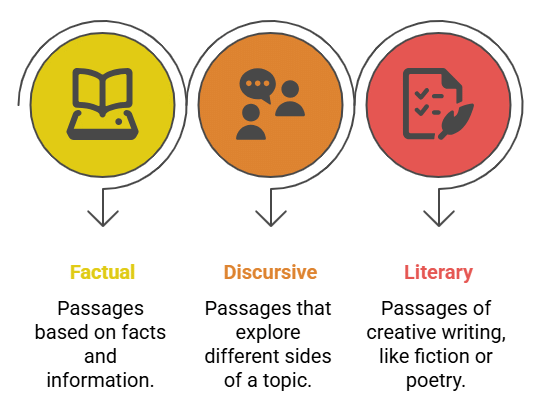
There are three types of passages:

  • Factual
  • Discursive
  • Literary

Factual Passage

  • A factual passage is based on some facts already proven by research or known universally. So there is very little scope for drawing out inferences or conclusions in such passages.
  • The questions based on the passage may require the students to give short answers – in one or two sentences. Sometimes, it may also be in the form of sentence completion and multiple choice questions. 
  • In multiple choice questions, the students may need to read and re-read the passage before choosing the correct option. Sometimes, there may also be questions based on vocabulary. Such questions require the students to have a strong language skill of his/ her level.

Discursive Passage 

  • The passage will largely be based on the opinion of the writer. The passage proceeds by reasoning or arguments based on a fact rather than the fact itself. 
  • The students’ comprehension here is tested by means of short questions – to be required to answer in one or two sentences. There may also be questions based on the vocabulary. 
  • The main objective is to test the vocabulary skills of the students in the form of finding the meaning of a word given in the passage, finding the words from the passage from the given meanings, finding the synonyms or antonyms of the words from the passage.

Literary Passage 

  • The passage under this category is a piece of writing taken from a literary work of art, like fiction or a novel, or a short story. 
  • There is no scope for inferences or opinions in this type of passage, for whatever the author has written need to be understood and rewritten in own words for answers.

Points to Remember

  • There will be explicit information in the text about the subject dealt with in the passage.
  • If the passage is factual, it may be a real-life incident or some information about a place, person, a thing or any thing already known to the students or something new.
  • If discursive, the passage may be from a narrative essay, a speech, a realistic fiction or the like.
  • There may be the use of figurative language in some parts of the text. It means words or expressions that mean something other than what they state literally. The students need to go deep into the text and relate matters to decipher them.
  • The questions are generally in a logical sequence of the text presented in the passage. But some questions require an overall understanding or analysis based on the tense.
  • Very often the first or the last sentence of a paragraph gives you the main idea of the passage.

Some Smart Tips & Tricks to Score Good in Reading Section

  • Read the passage thoroughly; it would give a deeper understanding of the text.
  • Underline the relevant details, if need be.
  • Write your answers in short, simple sentences.
  • Do not pick out the sentences from the passages as they are, without any relevance, for answering the questions.
  • A word or phrase that is very much needed may be used from the passage for answering questions.
  • While answering ‘what’, where’, ‘who’, ‘when’, ‘how’ questions, do not give facts that are not in the passage.
  • While answering the ‘why’ questions, you may begin your answer with ‘This is because…’ and avoid repeating the question.
  • Use the same parts of speech used in the text for giving your answers.
  • If asked to give a title, you can take an idea from the first or last sentence of the passage.
  • To find answer to the vocabulary based questions like synonyms etc., replace the given word with the word you have found in the passage, and if you find that it is the same in meaning, your answer is correct.

Practice Question

Read the passage given below:

On June 24, 1859, Emperors Napoleon III and Franz Joseph I engaged in the Battle of Solferino, commanding a com The choices we make on a daily basis-wearing a seatbelt, lifting heavy objects correctly or purposely staying out of any dangerous situation-can either ensure our safety or bring about potentially harmful circumstances.
You and I need to make a decision that we are going to get our lives in order. Exercising self-control, self-discipline and establishing boundaries and borders in our lives are some of the most important things we can do. A life without discipline is one that’s filled with carelessness.
We can think it’s kind of exciting to live life on the edge. We like the image of “Yeah! That’s me! Living on the edge! Woo-hoo!” It’s become a popular way to look at life. But if you see, even highways have lines, which provide margins for our safety while we’re driving. If we go over one side, we’ll go into the ditch. If we cross over the line in the middle, we could get killed. And we like those lines because they help to keep us safe. Sometimes we don’t even realize how lines help to keep us safe.
I’m not proud of this, but for the first 20 years of my life at work, I ignored my limits. I felt horrible, physically, most of the time. I used to tell myself “I know I have limits and that I’ve reached them, but I’m going to ignore them and see if or how long I can get by with it.” I ran to doctors, trying to make myself feel better through pills, vitamins, natural stuff and anything I could get my hands on. Some of the doctors would tell me, “It’s just stress.” That just made me mad. I thought stress meant you don’t like what you do or can’t handle life, and I love what I do. But I kept pushing myself, travelling, doing speaking engagements and so on—simply exhausting myself.
Finally, I understood I was living an unsustainable life and needed to make some changes in my outlook and lifestyle.
You and I don’t have to be like everyone else or keep up with anyone else. Each of us needs to be exactly the way we are, and we don’t have to apologize for it. We’re not all alike and we need to find a comfort zone in which we can enjoy our lives instead of making ourselves sick with an overload of stress and pressure.

On the basis of your understanding of the passage, answer the following questions that follow:
Q1: The reason why living on the edge has become popular, is because of the: 
(a) constant need for something different
(b) population being much younger
(c) exhausting effort to make changes
(d) strong tendency to stay within our limits

Ans: a
The passage suggests that the excitement and thrill associated with living on the edge contribute to its popularity. The phrase “kind of exciting to live life on the edge” implies a constant need for something different, which aligns with option (a).

Q2: Choose the option that best captures the central idea of the passage from the given quotes:
(a) “Sometimes we don’t even realize how lines help to keep us safe.”
(b) “You and I don’t have to be like everyone else or keep up with anyone else.
(c) “Each of us needs to be exactly the way we are, and we don’t have to apologize for it.”
(d) “A life without discipline is one that’s filled with carelessness

Ans: c
The central idea of the passage revolves around accepting oneself and not needing to conform to others’ expectations. Option (c) “Each of us needs to be exactly the way we are, and we don’t have to apologize for it” best encapsulates this idea of individuality and self-acceptance.

Q3: Which of the characteristics are apt about the writer in the following context : “I know I have limits and that I’ve reached them, but I’m going to ignore them and see if or how long I can get by with it ?” 
1. negligent
2. indecisive 
3. spontaneous
4. reckless 
5. purposeless 
6. patient
 
(a) 2 and 5
(b) 3 and 6
(c) 1 and 4
(d) 2 and 3

Ans: c
The writer admits to knowing their limits but choosing to ignore them, which shows recklessness and negligence. Options (1) and (4) are correct because the writer’s behavior is both negligent (ignoring limits) and reckless (pushing limits excessively).

Q4: Which of the following will be the most appropriate title for the passage? 
(a) Much too soon
(b) Enough is enough
(c) How much is too much?
(d) Have enough to do?

Ans: c
The passage discusses the consequences of ignoring personal limits and the need for change. The title “How much is too much?” best reflects the theme of the passage, focusing on the concept of limits and boundaries.

Q5: The phrase “potentially harmful circumstances” refers to circumstances that can: 
(a) certainly be dangerous
(b) be fairly dangerous
(c) be possibly dangerous
(d) seldom be dangerous

Ans: 
c
“Potentially harmful circumstances” suggests situations that have the possibility of being dangerous but are not necessarily so. Option (c) “be possibly dangerous” accurately captures this meaning.

Q6: The author uses colloquial words such as “yeah” and “Woo-hool”. Which of the following is NOT a colloquial word? 
(a) hooked
(b) guy
(c) stuff
(d) stress

Ans: d
Colloquial words are informal and conversational. Words like “hooked,” “guy,” and “stuff” are colloquial, while “stress” is a more formal term and not typically used in informal conversation.

Q7: What does the author mean when he says, “To get our lives in order ?” 
(a) To resume our lives.
(b) To organize our lives.
(c) To rebuild our lives.
(d) To control our lives.

Ans: b
The phrase “to get our lives in order” means to organize or structure our lives properly. This is best represented by option (b) “To organize our lives.”

Q8: Choose the option that correctly states the two meanings of ‘outlook’, as used in the passage. 
1. A person’s evaluation of life 
2. A person’s experiences in life 
3. A person’s point of view towards life 
4. A person’s regrets in life 
5. A person’s general attitude to life
 
(a) (1) and (4)
(b) (2) and (3)
(c) (3) and (5)
(d) (4) and (5)

Ans: c
In the passage, ‘outlook’ refers to both a person’s point of view towards life and their general attitude towards life. Hence, option (c) “A person’s point of view towards life” and “A person’s general attitude to life” are the correct meanings.

Q9: The author explains the importance of discipline and boundaries in our lives using the example of: 
(a) road accidents
(b) traffic rules
(c) lines on the highway
(d) safe driving

Ans: c
The author uses the example of “lines on the highway” to illustrate the importance of discipline and boundaries for safety. Therefore, option (c) is correct.

Q10: What is the message conveyed in the last paragraph of the passage? 
(a) Love what you do.
(b) Love yourself to love others.
(c) Be the best version of yourself.
(d) Be yourself.

Ans: c
The last paragraph emphasizes the importance of being true to oneself rather than trying to conform to others. Option (d) “Be yourself” best conveys this message.