11. Diary Entry – Practice Example – 1

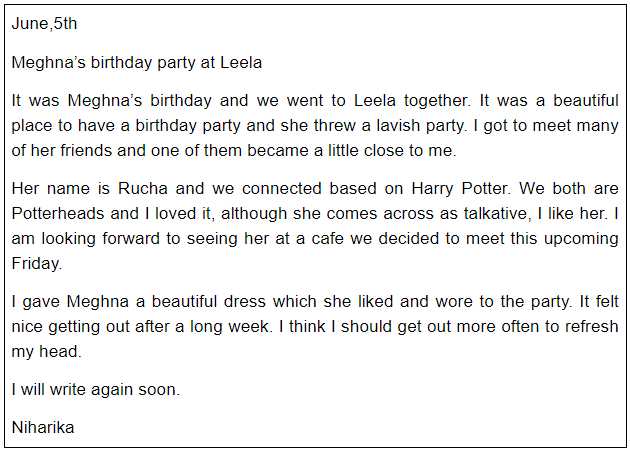
Q. You celebrated your 16th birthday on a grand scale. All your near and dear ones were present. Write a diary entry to express your feelings.

Ans.

Saturday, 22nd June 20XX

Dear Diary

I am so happy today that I have no words to express my feelings. On the ocassion of my 16th birthday, we arranged for a function in the hotel Mount View. I was so excited. All my friends and relatives were there. Everyone had brought a present for me. All the guests had a wonderful time. They would not stop dancing.


My parents were happy to receive guests and were having a gala time. The dinner was delicious and to everybody’s taste. People relished the food. Oh! what a nice day. I thanked my parents for the joyful evening.

11. Diary Entry – Overview – How to Write a Diary Entry

Introduction

Had a rough day and want to note down something significant that happened? Writing a diary entry is a great way to express yourself or simply document your life’s events. Diary writing allows you to record, reflect, and express your experiences and emotions. Keeping a diary can be therapeutic, providing a mental break from the busyness of daily life.

Diary Writing Format

Getting Started with Diary Writing

Starting diary writing can be challenging, especially if you’re not used to writing regularly.
Here’s how you can begin:

  • Decide What You Want to Write: Determine what you want to include in your diary entries. Diaries typically capture personal thoughts and experiences, but you can also use them to track daily events or specific aspects of your life.
  • Design a Schedule: To develop a writing habit, establish a schedule for your diary entries. Decide how often you want to write and choose a specific day or time to do so. Setting a time limit for your writing can also help you manage how much you write and the duration of your sessions.
  • Date Your Entries: Including the date in each entry is crucial. It helps you keep track of your progress and review how much you’ve written over time.
  • Give It a Name: Some people name their diaries to create a sense of intimacy, as if speaking to a friend. Feel free to choose a name for your diary or simply start with “Dear Diary” to guide your writing.
  • Be Comfortable While Writing: It’s okay if you don’t write in your diary every day. Writing will be easier if you are comfortable and enjoying the process. Focus on making the experience pleasant, and it will become a more natural part of your routine.

Why Write a Diary?

  • Effective Catharsis: When it’s hard to find someone to confide in, a diary can act as a trusted friend, allowing you to express your feelings freely and without fear of judgment or misunderstanding. Since only you have access to it, you can share anything in any way you choose.
  • Recapture Memories: A diary helps you revisit past memories, whether joyful or challenging, and observe how you’ve grown or what mistakes you’ve made. Reading past entries can evoke laughter or revive nearly forgotten moments.
  • Recording Events: Some people use their diaries to chronologically record daily events, ensuring they don’t miss important details. This method helps keep track of occurrences for future reference.
  • Problem-Solving: Writing in a diary can help manage overthinking by making problems seem less daunting. As you write, you may gain clarity and discover solutions by reflecting on the issues in a structured way.

Tips on Diary Entry

  • Include a Date: Adding a date to each diary entry helps you track when events occurred and provides a timeline of your experiences. This can be particularly useful for reflecting on past events and understanding how time has passed. Simply placing the date in the corner of the page, consistently formatted, is sufficient.
  • Mention a Subject: Including a brief subject or dominant emotion at the beginning of your entry can provide a quick reference to the main focus of your writing. For instance, if your entry is about feeling upset due to a conversation with your brother, you might write “Feeling Sad” as a summary.
  • Express Yourself Freely: The essence of diary writing is to convey your emotions privately and authentically. Write with an open heart and without concern for anyone else reading it. Your diary is a personal space where you can be completely yourself.
  • Write More Often: Establishing a regular writing routine might require setting reminders initially. Over time, writing will become a natural habit. The more frequently you write, the more your diary will become a trusted friend and a therapeutic outlet for self-expression.
  • Be Honest: Honesty is crucial when writing in a diary. If you censor yourself out of fear that someone might read it, the diary loses its purpose. Be truthful in your reflections to achieve genuine catharsis and gain a deeper understanding of your thoughts and feelings.
  • Aligning Your Thoughts: Before you begin writing, take a moment to organize your thoughts. This can help clear any mental fog and make your writing more coherent. A brief brainstorming session can assist in expressing your emotions and ideas more clearly and effectively.

Benefits of Diary Writing- How to Write, Format, Tips and Examples 

Diary writing offers numerous benefits. Before you start your own diary, consider these tips and examples to guide you through beginning your journal entries.
Here are some advantages of diary writing, including how to write, format, and tips:

  • By understanding how to write, format, and applying tips and examples for diary writing, you’ll become familiar with the essential elements of keeping a diary.
  • This knowledge will help you start your journal confidently and ensure you are on the right track.
  • Learning the format and rules of diary writing will provide structure and clarity in your entries.
  • By using these guidelines, you’ll gain insights into what you can write about and how to effectively express your thoughts and experiences in your diary.

10. Reported Speech – Integrated Grammar Solved Exercises

Q1: Given below are instructions for opening a bank account. Use these to complete the paragraph that follows.

  • obtain form from the bank
  • fill in the form with all the relevant details
  • ask an account-holder to countersign your form
  • submit two passport-size photographs
  • deposit the minimum amount required

First a form must be (a) __ . All relevant details (b) __. The form must then (c) __. Two passportsize photographs along with proof of residence (d) __. Finally the minimum amount required (e) __. 

Answer:
First a form must be (a) _obtained from the bank_ . All relevant details (b) _should be filled in the form_. The form must then (c) _be counter-signed by an account-holder_. Two passportsize photographs along with proof of residence (d) _should be submitted_. Finally the minimum amount required (e) _must be deposited_. 

Q2: Given below are a few news headlines. Using information from the same, complete the sentences that follow.

1. India Allows Airspace to Pak 
In the first public move to diffuse tension between the two countries, India ________ through Indian airspace.
Ans. In the first public move to diffuse tension between the two countries, India _has allowed Pak planes to fly_  through Indian airspace.

2. Research Work at AIIMS Stalled for Want of Animals 
More than 50 research projects at the prestigious All India Institute of Medical Sciences _______ to conduct experiments on.  
Ans. More than 50 research projects at the prestigious All India Institute of Medical Sciences _have been stalled owing to non-availability of animals_ to conduct experiments on.

3. After making Toilets, MCD Looks for Users 
About 250 toilet complexes constructed by the Municipal Corporation of Delhi with Japanese aid have turned into liabilities as apparently  ____________ 
Ans. About 250 toilet complexes constructed by the Municipal Corporation of Delhi with Japanese aid have turned into liabilities as apparently there are no users that MCD is looking for.

4. Selling Kidneys to make a Living 
Starving Tribals of Idduki district _________ to make a living.  
Ans. Starving Tribals of Idduki district _are selling kidneys/are forced to sell kidneys_ to make a living.

5. Kidneys Donated without Medical Inspection 
Most of the kidney donation procedures  ______________ the required medical examination in Indian hospitals.
Ans. Most of the kidney donation procedures (are performed without)/(done lacked) the required medical examination in Indian hospitals.

Q3: The following passage has not been edited. There is one error in each of the lines. Write the incorrect word and the correction in the space provided.–    Error           CorrectionTraditionally the festival of Holi is told to(a)  mark a beginning of summer. While(b)  there are some people who rise a cheer(c)  at that prospect, the rest of us neither sigh(d)  resignedly or contemplate suicide, and began to             (e)  hunt out our cottons, servicing all our cooling(f)  devices, hang in the chiks, and prepare to(g)  endure the season for heat, dust and sweat(h)  

Answer:–    Error           CorrectionTraditionally the festival of Holi is told to(a) told saidmark a beginning of summer. While(b) a thethere are some people who rise a cheer(c) rise raiseat that prospect, the rest of us neither sigh(d) that thisresignedly or contemplate suicide, and began to             (e) began beginhunt out our cottons, servicing all our cooling(f) servicing servicedevices, hang in the chiks, and prepare to(g) in upendure the season for heat, dust and sweat(h) for of

Q4: Complete the following paragraph on one of the earlier voyages of Columbus by choosing the correct options.
Christopher Columbus , (a) ______________________________ born in 1451 AD. Unlike the people of his time, (b) ______________________________. In order to prove his belief he said (c) ______________________________, he could reach Japan. Queen Isabella of Spain supported him. Columbus sailed west (d)______________________________three ships. Unfortunately, one of the ships waswrecked. Columbus returned to Spain (e) ______ ________________________ to form a colony.

Answer:
(a) (i) a skilled sailor and an explorer, was ✓
     (ii) was skilled sailor and an explorer
    (iii) being a skilled sailor and an explorer was
    (iv) a skilled sailor and an explorer is

(b) (i) but Columbus believed that the Earth was round
     (ii) Columbus had believed that the Earth was round
    (iii) but Columbus believed that the Earth is round
    (iv) Columbus believed that the Earth was round ✓

(c) (i) if he sails west from Europe
    (ii) if he is sailing west of Europe
   (iii) if he sailed west from Europe  ✓
   (iv) if he sailed west to Europe

(d) (i) with a crew of ninety men on ✓
    (ii) having a crew of ninety men in
   (iii) with a crew of ninety men having
   (iv) going with a crew of ninety men on

(e) (i) left behind forty men in the island of Hispaniola
    (ii) leaving behind forty men on the island of Hispaniola ✓
   (iii) has left forty men on the island of Hispaniola
   (iv) is leaving forty men on the island of Hispaniola 

Q5: Complete the following passage by choosing the correct options from those given below.

Electronic commerce, it seems, still has (a) __________ limits, even in the Silicon Valley. For all the feverish excitement (b) __________ the tripling of electronic shopping last holiday season, the total money (c) __________ by American consumers online still (d) __________ to only about one percent of its total sales barely a tenth (e) __________ the revenues from (f) __________ method of distance selling that has been (g) __________ for a century; the catalogue. This may be because electronic shopping (h) __________ on quite a narrow range of goods, mainly books, toys and music. Worse, there (i) _________ many stories of failed and late deliveries. And, more recently, a string of hackers’ attacks (j) __________ temporarily disabled some of the best-known e-commerce websites.

Answer:
(a) (i) their
     (ii) a
     (iii) the
     (iv) its 

(b) (i) about ✓
     (ii) of
    (iii) in
    (iv) for

(c)  (i) spend
     (ii) spending
    (iii) spent ✓
    (iv) being spent

(d) (i) amount
     (ii) amounted
    (iii) amounts ✓
    (iv) amounting

(e) (i) of ✓
    (ii) for
   (iii) by
    (iv) for

(f) (i) another ✓
    (ii) other
   (iii) some
   (iv) the other

(g) (i) user
     (ii) used
    (iii) uses
     (iv) in use ✓

(h) (i) concentrated
     (ii) is concentrating
    (iii) was concentrated
    (iv) had concentrated ✓

(i) (i) were ✓
   (ii) have been
   (iii) has been
   (iv) was

(j) (i) has
    (ii) have ✓
    (iii) having
    (iv) had 

Q6: In the passage given below, one word has been omitted in each line. Write the missing word along with the word that comes before and the word that comes after it in your answer sheet against the correct blank number. Ensure that the word that forms your answer is underlined.It was my second year boarding- school—and was sitting on platform No.8 at—Ambala station waiting the north-bound train.             —I think I was about twelve at time. My—parents considered me old to travel alone,—and I arrived by bus Ambala early in—the evening; now there was a wait midnight—before my train arrived. Most the time I had been pacing up and down the platform.—

Ans.It was my second year boarding- schoolyear in boardingand was sitting on platform No.8 atand I wasAmbala station waiting the north-bound train.             waiting for theI think I was about twelve at time. Myat that timeparents considered me old to travel alone,old enough toand I arrived by bus Ambala early inbus at Ambalathe evening; now there was a wait midnightwait till midnightbefore my train arrived. Most the time I had
been pacing up and down the platform.Most of the

9. Story Writing –

Introduction

Introduction

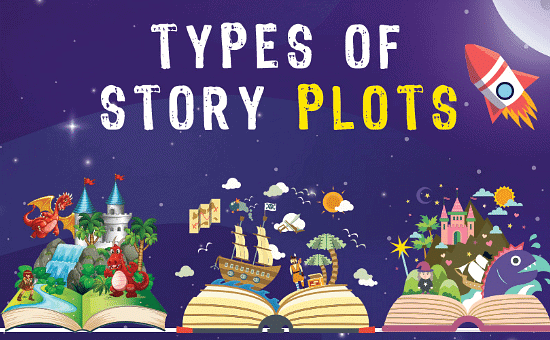
Storytelling is one of the oldest and most powerful forms of communication. Across cultures and generations, stories have been used to entertain, teach lessons, preserve history, and express emotions. Whether passed down orally or written in books, stories connect people by sharing experiences, values, and imagination.

From ancient myths to modern science fiction, stories come in countless forms. Each type introduces readers to different worlds, ideas, and characters, helping them explore unfamiliar cultures, question societal norms, or simply enjoy a well-told tale. Understanding the different kinds of stories—and how they are crafted—can deepen our appreciation for literature and strengthen our own writing skills.

There are various kinds of stories, such as folktaleslegendsmythsfairy talesshort storiesepicshistorical fictionfantasy novelsscience fiction bookscrime novels, and autobiographies. Each type may have its own subgenres with distinct characteristics. For instance, a short story can be either fiction or non-fiction, and its length is not always the most important factor.Different Types of Stories

  1. Fairy Tales: These are traditional stories involving magical creatures, enchanted lands, and often a moral lesson. They usually begin with “Once upon a time” and end happily.
    Example: Cinderella, Snow White
  2. Legends: Legends are stories rooted in historical events or characters, often exaggerated over time. They may include supernatural elements.
    Example: Robin Hood, King Arthur
  3. Myths: Myths are ancient stories that explain natural events, cultural beliefs, or the origins of the world. They often involve gods, goddesses, or heroes.
    Example: Greek mythology—The Myth of Hercules
  4. Epics: Epics are long, detailed stories—often written in poetic form—that describe the heroic deeds of a character or a nation’s past.
    Example: The Ramayana, The Odyssey
  5. Historical Fiction: These are stories set in the past that include real events or people, but also involve fictional characters and plots.
    Example: A novel set during World War II with made-up characters
  6. Science Fiction (Sci-Fi): Sci-fi stories are based on imagined future technologies, space exploration, time travel, or alien life. They explore the effects of science on society.
    Example: Star Wars, The Martian
  7. Crime or Detective Fiction: These stories involve solving a mystery or crime. A detective or investigator uncovers clues and catches the criminal.
    Example: Sherlock Holmes series
  8. Autobiographies and Biographies: These are true stories about a person’s life. Autobiographies are written by the person themselves, while biographies are written by someone else.
  9. Comic Books and Graphic Novels: These use a combination of text and visuals to tell stories, often involving superheroes, fantasy, or real-life issues.

Try yourself:

What are fairy tales usually about?

  • A.Real historical events
  • B.Magical creatures and moral lessons
  • C.Future technologies
  • D.Solving mysteries

View SolutionElements of Story Writing

  1. Setting: The setting of a story refers to the time and place in which the events occur. This includes the geographical location, the time period (whether in the past, present, or future), and the cultural and social context of the characters. A well-crafted setting engages all five senses—sight, smell, taste, touch, and sound—to effectively immerse the reader in the story’s world.
  2. Characters: Characters are the heart of a story. They can be humans, animals, or any entity endowed with human-like qualities. The focus of the story may be on one or multiple main characters, depending on the author’s choice. Readers experience the narrative through the perspectives of these characters.
  3. Plot: The plot is the organised sequence of events that constitute the story, serving as its backbone. It underpins the actions and developments of the characters. 
    The plot is typically divided into five parts:
    Exposition: Introduces the characters, setting, and the primary conflict.
    Rising Action: Details the events that stem from the main conflict.
    Climax: Represents the peak of tension and drama in the story.
    Falling Action: Describes the diminishing conflict as the story nears its conclusion.
    Resolution: Resolves the conflict and addresses any remaining issues.
  4. Conflict: Conflict is the struggle between opposing forces in a story, forming the core around which the plot revolves. It can be external, arising from outside forces, or internal, occurring within a character’s mind.
  5. Theme: The theme is the central idea or underlying message of the story, conveying what the author intends to teach or express. It often reflects the lesson or insight that the reader gains from the narrative. Understanding the broader message the author conveys may require readers to interpret the actions and thoughts of the characters.

Mastering the Art of Story Writing

  • Storytelling is for Everyone: Storytelling is a skill that everyone possesses, even if some are naturally better at it. We tell stories every day when we share experiences, talk about others, describe movies, or repeat jokes. With a little thought and preparation, anyone can tell a story effectively.
  • Structure of a Story: Like any piece of writing, a story has a clear structure with a beginning, middle, and end. It draws you in, takes you through the plot, and leaves you satisfied at the end.
  • Importance of the Beginning: The beginning of a story is crucial as it grabs the reader’s attention and sets the scene and mood. While starting at the very beginning is common, jumping into the action can also be effective if the timeline is clear.
  • Narration of Action:. story is essentially a narration of events, usually presented in the order they occur, with one event logically following another.
  • Clusters of Events: Events in a story often fall into clusters, each with unity in time, place, and action. Each cluster should be presented in its own paragraph, focusing on a specific part of the story.
  • Setting the Background: The background of a story is essential and is usually established at the beginning through vivid descriptions of the setting, season, and time. This helps readers immerse themselves in the story’s atmosphere.
  • Characters:. story revolves around characters, showing their actions, feelings, and words. Characters should be realistic, with unique traits that set them apart, making them relatable to readers.
  • Quoting Characters: While a storyteller usually paraphrases what characters say, using their actual words occasionally can make the narrative more lively and engaging.
  • Natural and Definite Ending:. story must have a clear and natural ending, providing closure to the reader. An abrupt ending can leave the reader confused or dissatisfied, so the conclusion should tie up the narrative like the final knot on a garland of flowers.

Try yourself:

What does the beginning of a story do?

  • A.Ends the story
  • B.Sets the scene
  • C.Lists events
  • D.Describes characters

View Solution

8. Discursive Passage – 10

Read the following passage carefully:

1. Crash dieting may help you lose weight, in the short term, but, ultimately it can hinder weight loss in the long term, as most of the weight that you have lost with crash dieting will bounce back, meaning you will gain all the weight that you have lost and more. Crash dieting not only removes fat but also leans muscle and tissue. Contrary to the belief of many who start this diet, this form of dieting is neither healthy nor successful in achieving long term weight loss as it induces the slowing down of the body’s basal metabolic rate – the body seeks to conserve every calorie and so weight loss becomes increasingly difficult. Basal metabolic rate is the amount of calories your body needs on a daily basis, to maintain its regular activities. This means your body will need fewer calories than it did previously, making weight gain more likely once you stop dieting.

2. Most crash diets involve eating low–calorie foods for several weeks or eating the same food or food groups for several weeks. Even if you’re only trying the diet for a week or two, eating such a strict diet of the same foods can cause nutritional deficiencies. Eliminating one or more food groups will not provide you with adequate, long–term nutrition. Nutritional deficiencies such as this can have multiple immediate side effects such as haggard look, dark under eyes, dull skin, sloppy posture and less stamina.

3. This is also why exercise is recommended in any weight–loss plan to build muscle and maintain your metabolic rate. Again common mistakes that are observed with exercise are joining the gym only till the New Year, so that you can lose weight and once the party is over, the party for not exercising continues. On the other hand, we have some who make New Year resolutions and with the gym memberships which are so tempting during the New Year, take up annual memberships, which is not bad, What is bad is to break the resolution. It is good to take up an exercise programme during the new year and to make a resolution about exercise, provided you do not break your resolution, and continue exercising year long. What is important is consistency.

4. It’s strongly recommended not to go on a Crash Diet, even if you are motivated to lose weight to fit into clothes a couple of sizes smaller. What is good is to make a conscious effort to lead a healthy lifestyle. This in the long run will help you achieve normal weight and help you be energetic and cheerful. Safe weight loss is considered to be no more than half a kilogram to one kilogram per week. No single food can be considered good or bad. A single meal does not make or break a healthy diet, as all foods can fit into a good diet when consumed in moderation.

10.1. On the basis of your reading of the passage, answer the following questions in 30–40 words each:

(a) What harm does crash dieting do? Mention any two.

Firstly, crash dieting weakens muscle and tissue along with removing fat. The weight that you have lost with crash dieting will bounce back. Secondly, it induces the slowing of basal metabolic rate. The body seeks to conserve every calorie and so weight loss becomes increasingly difficult.

(b) There is a basic flaw in diet plans What is it?

All the diet plans recommend same food or food groups. This can cause nutritional deficiency in the longer run. Eliminating one or more food groups will not provide you with adequate, long–term nutrition.

(c) Why is exercise important?

Exercise is recommended in any weight–loss plan as it increases metabolic rate and helps in building muscle mass. It should be made a habit of one’s lifestyle. Make a resolution to continue exercising year long. Consistency is very important.

(d) What is the writer’s view on gym membership?

According to the writer people get tempted before New Year and take memberships to lose weight and then do not bother to continue with them. Secondly there are people who take membership because gyms announce a discount during New Year. Both these category people are not interested in the exercise or fitness.

10.2. On the basis of your reading of the passage, answer of the following:

(a) In para 2, the synonym of ‘sufficient is __________.
(i) adequate
(ii) high
(iii) less
(iv) equal

Correct Option is (i) adequate

(b) In para 3, the antonym of ‘opposed’ is ___________.
(i) observed
(ii) tempting
(iii) resolution
(iv) recommended

Correct Option is (iv) recommended

(c) According to the passage, one should make a conscious efforts to lead a healthy lifestyle instead of going on a crash diet. (True/False)

True

(d) The amount of calories, our body needs on a daily basis to maintain its regular activities is called _________.

basal metabolic rate

8. Discursive Passage – 8

Read the following passage carefully:

1. Music is perhaps one of the most popular and widely practised forms of Fine Arts, transcending all kinds of cultural and linguistic barriers. Any form of fine art is difficult to master and almost impossible to perfect and music is no exception.

2. Nature, it is learnt, has blessed almost two thirds of the human race with musical ability of some sort. Music has the power to bring out the deepest emotions. It can make one cry or bring a smile on one’s face. In fact it is a magic medicine and many seek refuge in it when they are depressed or stressed. It is this intimacy that makes us listen to music or even hum or sing sometimes. This singing, or realistically speaking, expressing one’s emotion musically, sometimes takes a serious. turn. This desire to showcase musical expression in public domain then transforms into serious business profession. And from here the musical journey begins.

3. This desire to sing before an audience is innocent and beautiful and indeed it is perfectly alright to have such a genuine desire. But it is also important to understand that singing is an intricate art – a highly refined one at that, which requires systematic, prolonged and rigorous training, even to pass muster. This is an aspect we forget in our keen desire to reach the stage and perform. It is almost like preparing a formal meal for some specially invited guests, without even having learnt and experienced the basic aspects of cooking. This is why we have more noise and less music in the present.

4. These days almost everyone sings and it does not stop here. Most of us want to become professional singers. Result, a complete disregard for and ignorance of the training part, as the need is never felt to go through one and the urge to get to the stage and perform overpowers the slight inclination to learn, if any. If at all, somewhere along the way one feels the need to gain some knowledge and training, it leads to hurried shortcuts and half–hearted attempts, best described as “Crash Courses.”

5. It is observed that those who have attained the so called partial success, suddenly feel that they lack the required knowledge and are not learned enough. But it is too late by then. It should be understood here that the stage or a performance brings in a different mindset within the artist. It is always recommended and rightly so, that while on stage, cover the mistakes and weaknesses if any, and get along. But the contrary is true when it comes to acquiring knowledge and during the learning process. While under training, the student is expected to make mistakes but then rectify those mistakes under the supervision and guidance of the teacher. Therefore it is good to make mistakes and then be corrected during the process of learning as this subsequently makes one flawless and educated. This is a different mindset. And these two mindsets discussed above, (those of a performer and that of a student) cannot co–exist.

8.1. On the basis of your reading of the passage, answer the following questions in 30–40 words each:

(a) How can we say that music is magic?

Music can lift the spirits of sad people and it can make people laugh and cry as well. It has the power to bring out the deepest emotions. In fact, it is a magical medium and many seek refuge in it when they are depressed or stressed.

(b) How do people get transformed from humming tunes to becoming professional musicians?

From humming music, in the case of some people it takes a serious turn and they develop the desire to perform in public and make it their profession, and from here the musical journey begins.

(c) The desire to sing in public overpowers singing capability Elaborate.

In their urge to sing in public people fail to understand that it requires hours of practice and training to gain expertise in this fine art. And they end up becoming mere performers not good singers.

(d) Why cannot the mindset of a performer and a student co–exist?

The mindset of a performer and a student cannot co–exist because a performer is told to make amends if a mistake happens while presenting on the stage whereas a student is told that it is o.k. to make mistakes as they help us to learn better.

8.2. On the basis of your reading of the passage, answer of the following:
(a) The synonym of ‘exceeding’ in para 1 is __________.
(i) 
limiting
(ii) transcending
(iii) crossing
(iv) believing

Correct Option is (ii) transcending

(b) In para 4, the antonym of ‘aversion’ is ___________.
(i) disregard
(ii) urge
(iii) inclination
(iv) training

Correct Option is (iii) inclination

(c) Music has neither the power to bring out the deepest emotions nor can make people laugh and cry. (True/False)

False

(d) The writer says that music is perhaps one of the widely practised forms of Fine Arts, going beyond all kinds of __________.

cultural and linguistic barriers

8. Discursive Passage – 7

Read the following passage carefully:

1. Science and technology not only dominate the psyche of humanity but also the whole biosphere. How does science influence civilisation and how is it related to human happiness?

2. The original, cosmic evolution of the biosphere was one that promoted, supported, nourished, sustained and enhanced life. Life went on adding to the evolution with newer species and ecosystems, even more beautiful and vibrant than the ones before. Our biosphere accommodated a pleasant weather cycle and climate system to support these newer species, keeping everything in dynamic equilibrium.

3. Now the biosphere is overburdened and ailing. Some of our ecosystems have already collapsed, while others are at death’s door. Ever increasing pollution coupled with over–exploitation of natural resources and greenhouse gas emissions is driving several species towards extinction. This phenomenon that has occurred by itself, and neither has it been caused by, human beings alone. But it definitely has been spurred by so–called advances in technology.

4. In this millennium, we no longer live in a, biosphere – we are inhabitants of a technosphere. A technosphere is an impaired biosphere that has no affinity with values of life nor with sustainability and evolution of life. Although technology has empowered civilisation, it has also reduced it to being a mere tool of science and technology. And when the whole civilisation turns technocratic, science and technology are bound to dominate, causing life to shrink. The intensifying climate crisis is but a symptom of the biosphere’s illness and life’s gradual collapse.

5. We’ve reached a point where we are intolerant of anything remotely “unscientific” in our contemporary world. Scientists look for alternatives, but even these solutions are sought in the same domain that has caused these problems. In short, we are stewing in a soup of our own making.

6. So, what would be meaningful for the welfare of humans? Naturally, something that would enhance life, serve to integrate ecosystems and cleanse our environment. Enhancement of lit includes betterment of human life and vice versa. If life shrinks, we cannot blossom.

7. Science and technology by themselves are neutral; it is the way we use them that has either a positive or negative impact on our lives and environment. And when we use science in a manner that increases unsustainability and unhappiness in our lives, how can we rely blindly on science for our happiness?

7.1. On the basis of your reading of the passage, answer the following questions in 30–40 words each:
(a) How did the biosphere evolve over a period of time?

Originally when cosmic evolution happened, biosphere supported and promoted the growth of species. As life continued more and more species evolved. Our biosphere also evolved and created the right weather and climate to support the new species.

(b) How has this equilibrium got disturbed now?

Today many of the ecosystems have collapsed, many species have disappeared from the face of the earth. This has happened due to increasing pollution, deforestation and over exploitation of natural resources.

(c) What is the difference between biosphere and technosphere?

Biosphere is nature’s creation with plants, animals and the climat and animals live in harmony with the climate around. A technosphere is a biosphere that has been destroyed by the advancement of technology.

(d) Man needs to use ‘science and technology’ in a sensible manner. Explain.

By itself science and technology is neither good nor bad. It is how we use them. If we use it to increase instability, then we are creating unhappiness around us. Also the environment around us gets polluted.

7.2. On the basis of your reading of the passage, answer of the following:
(a) In para 3, the synonym of ‘disappeared is ___________.
(i) disintegrated
(ii) settle
(iii) ailing
(iv) collapsed

Correct Option is (iv) collapsed

(b) In para 5, the antonym of ‘nearly’ is __________.
(i) sought
(ii) remotely
(iii) stewing
(iv) domain

Correct Option is (ii) remotely

(c) A biosphere that has been destroyed by the advancement of technology is called an ecosystem. (True/False)

False

(d) Today many of the ecosystems have collapsed due to increasing _________.

pollution and over exploitation of natural resources.

8. Discursive Passage – 6

Read the following passage carefully:

1. Overpowering prey is a challenge for limbless creatures. Some species inject venom like Russell’s viper. Some others opt for an alternative non–chemical method – rat snakes, for instance, grab and push their prey against the ground, while pythons use their brawn to squeeze their quarry to death. But snakes can’t be neatly divided into venomous and non–venomo.

2. Even species listed as non–venomous aren’t completely devoid of venom. The common sand boa, for instance, produces secretions particularly toxic to birds. So the species doesn’t hedge its bets – it constricts its prey and injects venom for good measure.

3. Do vipers need venom potent enough to kill hundreds of rats with just one drop? After all, they eat only one or two at a time.

4. While predators try their darndest to kill most efficiently, their prey use any trick to avoid becoming a meal, such as developing immunity to venom. For instance, Californian ground squirrels are resistant to Northern Pacific rattlesnake venom.

5. Competition with prey is not the only thing driving snakes to evolve more and more toxic venom. Snakes also struggle to avoid becoming prey themselves.

6. Some snake predators have partial immunity to venom. Famously, mongooses are highly resistant to cobra venom, and with their speed and agility, kill snakes with impunity. It would be the death of cobras as a species if they didn’t evolve more toxic venom to immobilise mongooses.

7. Venom has another important role. It’s an extreme meat tenderiser; specific enzymes disintegrate the innards of prey. Normally, a reptile depends on the sun’s warm rays to aid digestion. Venomous snakes have an advantage: enzymes in venom digest the meal from the inside before it rots in their guts.

8. But I wonder if we, cannot use venom in our favour. In remote parts of India, local hospitality often involves leather–tough meat. I chew and chew until my jaws ache. If I spit it out or refuse, our hosts would be offended. Eventually, I swallow like a python stuffing a deer down its throat and hope I don’t choke. If only I had venom.

6.1. On the basis of your reading of the passage, answer the following questions in 30–40 words each:

(a) Russel viper and Rat snake have different methods to attack its prey. Explain.

Russels viper is a venomous snake. It injects venom into its prey, whereas rat snakes use an alternative non–chemical method–push and grab their prey against the ground immobilising it.

(b) How does sand boa kill its prey?

The sand boa first captures its prey and then injects venom. Though it belongs to the non venomous category but it does secrete some venom which is enough to kill the prey.

(c) There is a constant tussel between the predators of the prey. Why?

This is but natural because the predator has to kill and the prey has to protect itself. The ground squirrels in California are resistant to the venom of rattle snake. They develop immunity from the venom. The predator has to then think of other ways.

(d) Snakes have to guard themselves against their predators as well. How do they do this?

Snakes use their venom not only to kill their prey but also to prevent their predators from reaching them. Some of their predators, for example, mongooses are resistant to the venom. Therefore the snakes have to constantly evolve more toxic venom.

6.2. On the basis of your reading of the passage, answer of the following:
(a) The synonym of another’, in para 1 is __________.
(i) squeeze
(ii) alternative
(iii) similar
(iv) quarry

Correct option is (ii) alternative

(b) The opposite word of ‘full in para 2 is ____________.
(i) complete
(ii) measure
(iii) completely
(iv) devoid

Correct option is (iv) devoid

(c) Snakes use their venom not only to kill their prey but also to prevent their predators from reaching them. (True/False)

True

(d) Mongooses, who are highly resistant to cobra venom, kill snakes __________.

with their speed, agility and impunity

8. Discursive Passage – 5

Read the following passage carefully:

1. What is Discipline? Is it absolute freedom to do what a person wants? Is freedom regardless of consequences? Does it mean corrective action after a problem occurs or a wrong is done? Is it imposition? Is it abuse? Does it take away freedom?

2. The answer is none of the above. Discipline does not mean that a person takes a belt and beats up kids. That is madness. Discipline is loving firmness. It is direction. It is prevention before a problem arises. It is harnessing and channelising energy for great performance. Discipline is not something you do to but you do for those you care about.

3. Discipline is an act of love. Sometimes you have to be unkind to be kind: Not all medicine is sweet, not all surgery is painless, but we have to take it. We need to learn from nature. We are all familiar with that big animal, the–giraffe. A mama giraffe gives birth to a baby giraffe, standing. All of a sudden, the baby falls on a hard surface from the cushion of mama’s womb, and sits on the ground. The first thing mama does is to get behind the baby and give him a hard kick. The baby gets up, but his legs are weak and Wobbly and the baby falls down. Mama goes behind again and gives him one more kick. The baby gets up but sits down again. Mama keeps kicking till the baby gets on its feet and starts moving. Why? Because mama knows that the only chance of survival for the baby in the jungle is to get on its feet. Otherwise it will be eaten up by wildcats and become dead meat.

4. Children brought up in a loving, disciplined environment end up respecting their parents more and become law–abiding citizens. The reverse is just as true. Good parents are not afraid of momentary dislikes by children to enforce the subject. Allowing a child to eat a box of chocolate could lead to sickness. At the same time, the discipline of eating one or two pieces a day can be an enjoyable experience for a longer time. Our instinct makes us do whatever we want regardless of the consequences. Freedom is not procured by a full enjoyment of what is desired but controlling the desire.

5.1. On the basis of your reading of the passage, answer the following questions in 30–40 words each:

(a) What according to the writer is not discipline?

Discipline is not giving absolute freedom. It is also not hitting or abusing a child. Discipline is not force either.

(b) How can we prevent a problem from Surfacing?

We can prevent a problem from surfacing by taking steps before the problem occurs. We need to anticipate and take precautionary steps rather than correcting it after the problem occurs.

(c) Why do you think a mama giraffe kicks her baby immediately after birth?

A mama giraffe knows the harsh ways of the world. It knows that if the baby does not stand up then the wild animals of the forest will eat it up. So it does this in the interest of the child.

(d) What is the role played by parents in creating law–abiding citizens?

Good parents instil good habits and discipline in their children without worrying for their momentary dislikes. The children brought up this way become respectful and law–abiding citizens.

5.2. On the basis of your reading of the passage, answer of the following:
(a) In para 1, the word ‘corrective’ means _________.
(i) improve
(ii) remedial
(iii) medicinal
(iv) therapeutic

Correct Option is (ii) remedial

(b) In para 4, the opposite of ‘incapacity is __________.
(i) enforce
(ii) procured
(iii) instinct
(iv) controlling

Correct Option is (ii) procured

(c) Discipline means not only absolute freedom but also a corrective action after a problem occurs. (True/False)

False

(d) Discipline brings true freedom by __________.

controlling the desires.

8. Discursive Passage – 4

Read the following passage carefully:

1. Frankness may be among the most overrated of virtues! And here’s why. Because unrestricted and unfiltered frankness is a recipe for breaking relationships, even the closest ones. Such frankness is understandable, acceptable and even ‘cute’ only in children under the age of five.

2. Thinking before one speaks and using restraint are hallmarks of growing maturity and preparation for life. Learning to put a filter between thought and spoken word (and, even more importantly, written word) is an important life skill. Think is a popular acronym for Trúe, Helpful, Inspiring, Necessary and Kind. This would do wonderfully well as a filter in our minds.

3. It is good to speak what’s true, but only along with the other attributes in the acronym, particularly the last one, kindness. In the righteous glow of speaking what we see as the truth, we often forget to be kind. We blurt out ‘truths’ even when it is totally unhelpful and unnecessary to do so, let alone inspiring! Too often, such truth–telling is destructive rather than noble. Only those who do not care about the consequences can afford the luxury of ‘speaking their minds’ whenever and wherever they please. When relationships are at stake, it is essential to choose the time, place and words appropriately when imparting unpleasant truths. And even then, only when absolutely necessary and with the utmost kindness.

4. Speaking without forethought can be even more dangerous in other circumstances, for example, when someone has entrusted us with a secret. A sign of maturity is the ability to keep a secret. Very young children are incapable of understanding the concept of a secret. To them, every piece of information is interesting, new and meant to be shared. As we grow older, we all learn how to keep a secret, but too often we keep only our own secrets and not those that others confide in us. We may blurt out something a friend told us in confidence, perhaps carelessly but often to appear important in other people’s estimation. It gives us a sense of power to know something that our friends don’t, and it requires conscious effort to keep the information to ourselves.

5. But this is the real test of an important life skill: self–restraint. Revealing a friend’s secret is to betrayal of the friendship. Indeed, the consequences may well spread way beyond the friendship alone. It may lead to gossip spreading like a forest fire, destroying peace of mind and even lives.

6. Words have power to hurt or heal. They are not mere tools for tweeting and messaging. Before the tongue speaks, before the fingers fly over the keyboard, it is important to pause and apply the THINK acronym filter. Is this True, Helpful, Inspiring, Necessary and Kind?

7. Of course it is important to communicate. But it is far more important to be considerate and compassionate. Speaking well is a skill: speaking kindly is a life skill.

4.1. On the basis of your reading of the passage, answer the following questions in 30–40 words each:
(a) How much of frankness is acceptable?

One should be frank to the extent that it does not affect relationships. Complete frankness looks good only in small children. As we grow old we should be smart and filter information.

(b) What does the term ‘put a filter’ mean in this context?

In this context ‘to put a filter’ means before speaking, a sensible person will filter whatever he wishes to say. He will think through his thoughts before uttering a word.

(c) According to the writer what is the best way to reveal the truth”?

The writer says that one must ensure that the place, time and the words are chosen with care. In addition to this, one must use very kind words to convey the truth.

(d) Why is it important to keep secrets?

It is very important to keep secrets. We mayblurtout something a friend toldus in confidence, in a careless manner but often to appear important in other people’s estimation. So, it requires conscious effort to keep the information to ourselves.

4.2. On the basis of your reading of the passage, answer of the following:
(a) The term “acronym’ used in para 2 denotes a/an ________.
(i) bitter truth
(ii) acrobat
(ii) abbreviation of the title/phrase
(iv) phrase

Correct Option is (ii) acrobat

(b) The antonym of ‘cruelty’, used in para 3 is
(i) kindness
(ii) utter suddenly
(iii) speak softly
(iv) wipe out

Correct Option is (i) kindness

(c) The writer says that it is not necessary to use very kind words to convey the truth. (True/False)

False

(d) Words are not mere tools for tweeting and messaging, but they also have power to

hurt or heal