1. Corruption, terrorism, communalism, greed for power and wealth and the list of ailments that affect modem society continue. More than half the population of India is below the age group of 25 and the future of the country will only be bright if youngsters are equipped to deal with these ailments.
2. A child is a storehouse of potential and it is important to nurture and develop these attributes s’ince a very young age. Since they spend much of the time in school, the curriculum in school should be such that it enables children to understand, care and practise ethical values like respect, justice and civic sense. Education should aim to develop a sense of rights and duties as well as moral values like honesty, responsibility and respect for others.
3. Moral education should be directed towards enhancing a child’s ability to critically analyse situations, make decisions, empathise with people and work in cooperation towards a common goal.
4. Asa means of direct instmction to students, schools are very influential in the character development of a child and the methods of education affect the development of morally upright citizens who can bring about the much needed change in the country.
5. The youth of today have to face a lot of problems like drug abuse, violent behaviour and family issues. If they are not taught morals, they would fail to differentiate between good and bad values. Hence, they would be incapable in dealing with different types of issues. A sound moral base would help a child make the right decisions, especially in an era where the youth is increasingly coming under the negative influence of the media.
6. Schools in India have introduced moral education as part of their curriculum because they realise that morally sound citizens are the need of the hour. Since most children look up to their teachers as role models, it is most appropriate that they be the facilitators of moral values.
7. Thus schools should focus more on the personality development of children since it is one of the most important responsibilities of a school. Schools should take the initiative to mould children into better human beings so that they can make the world a better place to live in.
3.1 Answer the following questions with facts from the passage given above. (a) Aim of a school should be to
(i) develop qualities of (ii) __________. (iii) __________.
(b) What are the negativities influencing children? (i) drug abuse (ii) __________. (iii) __________. (iv) __________.
(c) What is the role of the school curriculum? (i) to enable children to understand and practise values like (ii) __________. (iii) __________.
(d) What is the role of teachers? (i) __________. (ii) to nurture students into good human beings
1. During our growing up years we as children were taught–both at home and school–to worship the photos and idols of the gods of our respective religions. When we grow a little older, we were I holy books like The Bhagwad Gita, Bible and Quran; we were told that there are a lot of life lessons to be learnt from these holy books. We were then introduced to stories from ou mythologies which taught us about ethics and morality–what is good and what is bad.
2. I also learnt to be respectful towards my parents who made my life comfortable with their hard work, love and care, and my teachers who guided me to become a good student and a responsible citizen. Much later in life, I realised that though we learn much from our respective holy books, there is a lot to learn from our surroundings. This realisation dawned upon me when I learnt to enquire and explore. Everything around us–the sun, the moon, the stars, rain, rivers, stones, rocks, birds, plants and animals–teach us many valuable life lessons.
3. No wonder that besides the scriptures in many cultures nature is also worshipped. The message that we get is to save our environment and maintain ecological balance. People are taught to live in harmony with nature and recognise that there is God in all aspects of nature.
4. Nature is a great teacher. A river never stops flowing. If it finds an obstacle in its way in the form of a heavy rock, the river water fights to remove it from its path or finds an alternative path to move ahead. This teaches us to be progressive in life, and keep the lighting spirit alive.
5. Snakes are worshipped as they eat insects in the field that can hurt our crops, thus protecting the grains for us. In fact, whatever we worship is our helper and makes our lives easy for us. There are many such examples in nature, but we are not ready to learn a lesson. Overcome with greed, we are destroying nature. As a result we face natural disasters like drought, flood and landslides. We don’t know that nature is angry with us.
6. However, it is never too late to learn. If we learn to respect nature the quality of our life will improve.
2.1. On the basis of your reading of the passage, answer the following questions in 30–40 words each:
(a)What are we taught in our childhood and growing up years?
We are taught in our childhood to worship the photos and idols. We are taught in our growing up years to read holy books like the Bhagwat Gita, Bible and Quran. We were taught that there are a lot of life lessons to be learnt from these holy books.
(b) Why should we respect our parents and teacher.
We should respect our parents because they have made our life comfortable with their hard work, love and care. We should respect our teachers because they have guided us in becoming a good student and a responsible citizen.
(c)What message do we get when we worship nature?
When we worship nature the message we get is to save our environment and maintain ecological balance.
(d)How does a river face an obstacle that comes in its way?
When an obstacle comes in its way, the water in the river fights to remove it from its path. The river water can also find an alternative path to move ahead.
2.2.On the basis of your reading of the passage, answer of the following: (a) In para 5, the synonym of ‘catastrophe’ is __________. (i) overcome (ii) greed (iii) disaster (iv) drought
Correct Option is(iii) disaster
(b) In para 3, the antonym of ‘discordance’ is __________. (i) scriptures (ii) harmony (iii) recognise (iv) discomfort
Correct Option is (ii) harmony
(c) When we worship nature, the message we get is to save our environment and maintain ecological balance. (True/False)
True
(d) The stories from our mythologies taught us about _________.
Discursive writing is a style of writing that looks at a topic from different sides, often in a fair and balanced way. It can inform, discuss, or persuade by showing various viewpoints, using evidence and reasoning. Instead of always taking a firm position, it encourages the reader to think critically and explore the issue in depth.
Balanced Discussion – Considers more than one point of view, showing advantages and disadvantages or different opinions.
Neutral Tone – Uses calm and fair language, avoiding strong emotional or biased words.
Clear Organisation – Ideas are arranged logically, often starting with an introduction, then body paragraphs for different viewpoints, and ending with a conclusion.
Fact-Based – Supports points with examples, facts, and reasoning.
Flexible Ending – May leave the reader to decide or give a balanced conclusion.
Types
For and Against – Discusses pros and cons.
Opinion-Based – Shows various views but may lean toward the writer’s opinion.
Discussion – Explores different perspectives without trying to convince.
How to Answer Discursive Passage Questions
Read the passage carefully to understand the topic and viewpoints.
Identify key ideas and the author’s purpose (inform, discuss, persuade).
Scan for details like examples, evidence, and comparisons.
Answer in your own words, unless asked to quote.
Be concise and accurate, sticking to the information in the passage.
Pay attention to tone, as it may help with inference questions.
Solved Examples
Passage – 1
Read the passage given below and answer the following Questions:
Cardamom, known as the queen of all spices, boasts a history as ancient as the human race itself. It is the dried fruit of a herbaceous perennial plant. A warm, humid climate, loamy soil rich in organic matter, distributed rainfall, and specialised cultivation and processing methods all combine to render Indian cardamom truly unique in aroma, flavour, size, and its distinct parrot green colour.
Two types of cardamom are produced in India. The first type, the larger variety, holds less significance as it is not traded in the futures market. It is cultivated in the northeastern regions of the country. The second type, produced in the southern states, is actively traded in the futures market. This variety is primarily cultivated in Kerala, Tamil Nadu, and Karnataka. As per the futures market rules, only the 7 mm quality was initially traded in exchanges. However, the norms were relaxed, and now the 6 mm quality is also traded.
Cardamom is an expensive spice, second only to saffron. Indian cardamom is known in two main varieties: Malabar and Mysore. The Mysore variety, containing high levels of cineol and limonene, is more aromatic. India has emerged as the world’s largest producer and exporter of cardamom.
The main harvest season for cardamom in India spans from August to February. Cardamom reaches the yielding stage two years after plantation. The primary physical markets for cardamom include Kumily, Vandiperiyar, Thekkady, Puliyarmala in Kerala, and Bodinayakanur and Cumbum in Tamil Nadu.
Kerala is the principal producer of cardamom, contributing up to 60% of the total production. Karnataka accounts for around 25% of the production. In Tamil Nadu, Ooty is the major producer, contributing approximately 10-15% of the total output. Besides India, Guatemala also produces around 1,000-2,000 tons of cardamom annually. However, due to its lower quality, Guatemalan cardamom is available at cheaper rates.
Q1: Why does the passage describe cardamom as the “queen of all spices”? (a) Due to its ancient history. (b) Because of its versatile usage in cooking. (c) Owing to its unique aroma and flavour. (d) Because it is the most expensive spice.
Q2: What does the passage imply about the role of climate and soil in the cultivation of Indian cardamom? (a) They are essential but not unique to India. (b) They uniquely contribute to the quality of Indian cardamom. (c) They have little impact on the cultivation process. (d) They are more important for cardamom than other spices.
Q3: According to the passage, why might the larger variety of cardamom be less significant in the market? (a) It has a weaker aroma and flavour. (b) It is not traded in the futures market. (c) It is only cultivated in limited areas. (d) It is more expensive than the smaller variety.
Q4: What does the passage suggest about the global production of cardamom? (a) India and Guatemala are the only producers of cardamom. (b) Guatemala rivals India in the quality of cardamom. (c) India leads in quality, while Guatemala competes in price. (d) Indian cardamom is less expensive than its global counterparts.
Q5: Which of the following titles would be the most appropriate for the passage? (a) “The Global Spice Trade: A Comprehensive Overview” (b) “Cardamom: The Queen of Spices and Its Journey” (c) “Agricultural Practices in India: A Case Study” (d) “The Economic Impact of Spices in the International Market”
Throughout human history, the leading causes of death have been infection and trauma. Modern medicine has achieved significant victories against both, and the major causes of ill health and death are now chronic degenerative diseases, such as coronary artery disease, arthritis, cataracts, and cancer. These diseases have a long latency period before symptoms appear and a diagnosis is made. It follows that the majority of apparently healthy people are actually pre-ill.
Many national surveys reveal that malnutrition is common in developed countries. This is not the calorie or micronutrient deficiency associated with developing nations; rather, it is a depletion of multiple micronutrients, often combined with caloric balance or excess. The incidence and severity of Type B malnutrition would likely be shown to be worse if newer micronutrient groups, such as essential fatty acids and flavonoids, were included in the surveys.
However, the pharmaceutical model has also created an unhealthy dependency culture, in which relatively few of us accept responsibility for maintaining our own health. Instead, we have handed over this responsibility to health professionals who know very little about health maintenance or disease prevention.
Based on pharmaceutical thinking, most intervention studies have attempted to measure the impact of a single micronutrient on the incidence of disease. The classical approach contends that if you give a compound formula to test subjects and obtain positive results, you cannot know which ingredient is exerting the benefit, so you must test each ingredient individually.
So, do we need to analyse each individual’s nutritional status and then tailor a formula specifically for him or her? While we do not have the resources to analyse millions of individual cases, there is no need to do so. The vast majority of people consume suboptimal amounts of most micronutrients, and most of these micronutrients are very safe. Accordingly, a comprehensive and universal program of micronutrient support is probably the most cost-effective and safest way to improve the general health of the nation.
Q1: What does the passage suggest about modern medicine’s impact on health? (a) It has eliminated all diseases. (b) Only focuses on chronic diseases. (c) Shifted focus from infection to chronic diseases. (d) Neglected the importance of nutrition.
Q2: According to the passage, what is a major health issue in developed countries? (a) Caloric excess only. (b) General malnutrition. (c) Multiple micronutrient depletion. (d) Over-reliance on medication.
Q3: What is implied about individuals’ roles in their own health care? (a) Fully self-reliant. (b) Dependent on professionals. (c) Balanced with professional care. (d) Irrelevant in modern healthcare.
Q4: What does the passage indicate about the effectiveness of a universal micronutrient program? (a) Ineffective and costly. (b) Necessary for individual cases. (c) Most effective and safe for general health. (d) Limited to specific groups.
Q5: Which of the following titles would be the most appropriate for the passage? (a) “Nutritional Health Trends” (b) “Modern Medicine’s Impact” (c) “Micronutrients in Health” (d) “Health Dependency Issues”
Subjects and verbs must agree with each other in number for a sentence to make sense. Even though grammar can be a bit quirky from time to time, there are 20 rules of subject-verb concord that sum up the topic quite concisely. Most of the concepts of the subject-verb concord are straightforward, but exceptions to the rules can make it more complicated. For example, would you say, “They are fun” or “They is fun”? Since “they” is plural, you’d opt for the plural form of the verb, “are”.
Rules of Subject-Verb Concord:
1. Subjects and verbs must agree in number. This is the cornerstone rule that forms the background of the concept. Example: The dog growls when he is angry.
2. Subordinate clauses that come between the subject and verb don’t affect their agreement. Example: The dog, who is chewing on my jeans, is usually very good.
3. Prepositional phrases between the subject and verb usually do not affect agreement. Example: The colors of the rainbow are beautiful.
4. When sentences start with “there” or “here,“ the subject will always be placed after the verb. Some care needs to be taken to identify each part correctly. Example: There is a problem with the balance sheet.
5. Subjects don’t always come before verbs in questions. Make sure you accurately identify the subject before deciding on the proper verb form to use. Example: Where are the pieces of this puzzle?
6. If two subjects are joined by “and,” they typically require a plural verb form. Example: The cow and the pig are jumping over the moon.
7. The verb is singular if the two subjects separated by “and” refer to the same person or thing as a whole. Example: Red beans and rice is my mom’s favorite dish.
8. If one of the words “each,” “every,” or “no” comes before the subject, the verb is singular. Example: No smoking or drinking is allowed.
9. If the subjects are both singular and are connected by the words “or,” “nor,”“neither/nor,” “either/or,” or “not only/but also,” the verb is singular. Example: Either Jessica or Christian is to blame for the accident.
10. The only time the object of the preposition decides plural or singular verb forms is when noun and pronoun subjects like “some,” “half,” “none,” “more,” or “all” are followed by a prepositional phrase. Then the object of the preposition determines the form of the verb. Example: All of the chicken is gone.
11. The singularverb form is usually reserved for units of measurement or time. Example: Four quarts of oil was required to get the car running.
12. If the subjects are both plurals and are connected by the words “or,” “nor,” “neither/nor,” “either/or,” or “not only/but also,” the verb is plural. Example: Not only dogs but also cats are available at the animal shelter.
13. If one subject is singular and the other is plural, and the words are connected by the words “or,” “nor,” “neither/nor,” “either/or,” or “not only/but also,” use the verb form of the subject that is nearest the verb. Example: Either the bears or the lion has escaped from the zoo.
14. Indefinite pronouns typically take singular verbs (with some exceptions). Example: Everybody wants to be loved.
15. The exceptions to the above rule include the pronouns “few,” “many,” “several,” “both,” “all,” and “some.” These always take the plural form. Example: Few were left alive after the flood.
16. If two infinitives are separated by “and,” they take the plural form of the verb. Example: To walk and to chew gum require great skill.
17. When gerunds are used as the subject of a sentence, they take the singular form of the verb. However, when they are linked by “and,” they take the plural form. Example: Standing in the water was a bad idea.
18. A collective noun, such as “team” or “staff,” can be either singular or plural depending upon the rest of the sentence. Typically, they take the singular form, as the collective noun is treated as a cohesive single unit. Example: The herd is stampeding.
19. Titles of books, movies, novels, and other similar works are treated as singular and take a singular verb. Examples: The Burbs is a movie starring Tom Hanks.
20. Final rule: Remember, only the subject affects the verb! Nothing else matters. Example: Jacob, who owns sixteen houses, is on his way to becoming a billionaire.
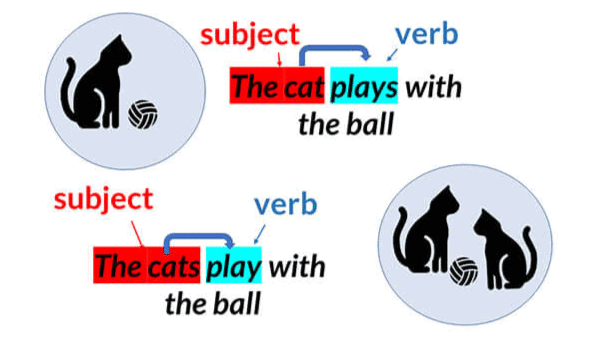
Subject-verb concord, also known as subject-verb agreement, is an essential aspect of English grammar. It ensures that the subject and the verb in a sentence agree in number and person. In other words, a singular subject should have a singular verb, and a plural subject should have a plural verb. This chapter focuses on understanding and applying subject-verb concord correctly.
A verb must agree with its Number and Person. In other words, the Verb of a sentence agrees with the number and person of the Subject of that sentence.Steps to solve Subject – Verb Agreement
Error of Proximity
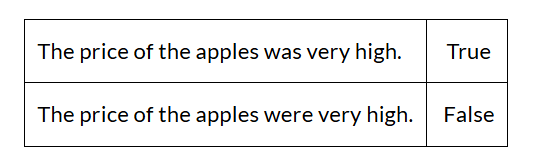
Often, the ‘Verb’ is made to agree in number with a norm near it instead of its proper Subject. It is an error. This common error is called the ‘Error of Proximity’. It should be avoided. The verb must agree with its proper Subject.
Sentence 2 is incorrect because the verb ‘were’ wrongly agrees with the nearby noun ‘apples’ instead of its proper subject. It is an Error of Proximity.
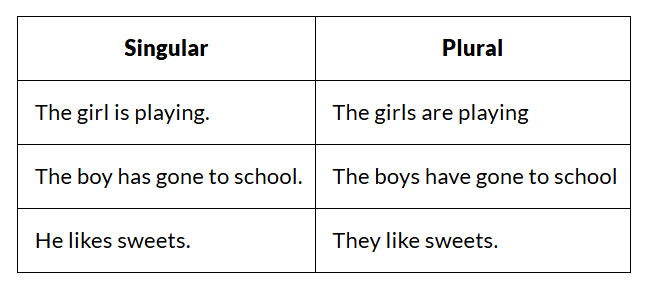
1. Number
The basic principle of Subject-Verb agreement is that singular subjects need singular verbs. Plural subjects need plural verbs:
2. Person:
The rules regarding the person are as follows:
(i) The first person singular or plural takes a singular verb:
I like this scenery.
We like this scenery.
(ii) The second person singular or plural takes a singular verb:
You like this scenery.
(iii) The third person singular takes a singular verb:
He likes this scenery.
(iv) The third person plural takes a plural verb:
They like this scenery.
3. Uncountable Noun:
When we use an uncountable noun as the subject of a verb, we use a singular form of the verb:
Honesty is the best policy.
Fear begins to haunt him.
Try yourself:Which of the following sentences demonstrates correct subject-verb agreement?
A.The cat is playing with its toys.
B.The cats is playing with their toys.
C.The cat are playing with its toys.
D.The cat are playing with their toys.
View Solution
4. Singular and Plural Nouns:
When we use a singular noun as the subject of a verb, we use a singular verb. Plural nouns take a plural verb:
The moon was shining in the sky.
The sun is about to set.
The children were swimming.
The farmers were ploughing.
5. One of + Plural Noun:
When the subject consists of ‘one of + plural noun’, the verb is singular:
One of the girls was singing.
One of the students was talking.
One of the birds was chirping.
6. Long Subject:
When a clause or a long group of words is the subject, we have to be careful to make the verb agree with the subject:
The chairs which I bought yesterday are very costly.
The woman whom I met in the market was my friend’s sister.
7. Introductory ‘there’:
The verb has to agree with the real subject that follows the introductory there. If the subject is singular, then ‘there’ will be followed by a singular verb. If the real subject is plural, then ‘there’ will be followed by a plural verb:
There is no chair in the room.
There are no chairs in the room.
There are fifty boys in the class.
There is one girl in the class.
8. Two or More Nouns:
When two or more nouns function as a subject, a plural verb is used:
Satish and his sister have gone to see a movie.
My friend and his father are meeting us tomorrow.
9. Distances, Weight, etc:
For distances, weight, height or amounts of money, we use a singular verb even when the subject is plural:
Ten thousand rupees is not a small sum.
Three kilometres is a small distance.
Five hundred feet above sea level is not a great height.
10. Plural Names:
The title of a book, the name of a house or a hotel in plural takes a singular verb:
“The Arabian Nights” has interesting stories.
“The Hotel Brewers” is a five-star hotel.
11. Plural Nouns with Singular Meaning:
Nouns which are plural in form but singular in meaning usually take a singular verb:
Mathematics is not an easy subject.
Economics is a dull subject.
Measles is an infectious disease.
The latest news is that the criminal has been arrested.
12. Singular Nouns with Plural Verb:
Some nouns which appear to be singular in form take a plural verb:
The police have arrested three terrorists.
The Indian cricket team won the match.
13. Collective nouns like group, crowd, flock, regiment,etc. are generally followed by a singular verb:
A group of boys was playing in the ground.
A crowd of people rushes into the hall.
A regiment of soldiers was marching towards the town.
14. ‘Class’ nounssuch as food, furniture, clothing, etc., take a singular verb:
This furniture is very old.
This imported cutlery is very costly.
His clothing consists of a bulletproof jacket, a pair of blue trousers and some other items.
15. Some nouns which appear to be pluralin form when preceded by a pair take a singular verb, for example, shoes, scissors, trousers, etc.
A pair of scissors was taken out of the drawer.
A pair of trousers was washed by the servant.
A pair of shoes was bought by him.
But when these nouns are used without ‘a pair of’, they take a plural verb:
His shoes have worn out.
My scissors do not cut well.
16. Some nouns are preceded by a lot of, a plenty of, a great deal of, etc.
These nouns take a singular verb when they refer to an amount or quantity. But they take a plural verb when they refer to a number:
A lot of people visit the exhibition.
Plenty of water was supplied to the villagers.
17. When a singular subject is joined by as well as, in addition to, except, etc., with another noun or pronoun, we use a singular verb.
Sohan, as well as his brother, has come.
My father, in addition to our neighbour, has gone out for a walk.
Everyone except Satish was present.
18. A singular verb is used with singular pronouns,
Examples: each, either, neither, anyone, etc.
Each of the boys was given a prize.
Neither of the students was absent.
Everybody has helped her.
19. When two or more subjects are connected by nor or or, the verb is used according to the number of the noun nearest to it:
Neither she nor her sisters visit the temple.
Either they or he is telling a lie.
20. A collective noun, such as jury, committee, family, etc., takes a singular verb when it is considered one unit. But when they are regarded as individuals, they take a plural verb:
The jury is about to give its decision.
The jury are divided in their opinion.
The committee is meeting tomorrow.
The committee have decided to raise the membership fee.
Our family has decided to visit Shimla this summer.
The family now live in London.
Try yourself:
Which of the following is true about using a singular verb with a plural noun?
A.Singular nouns take a singular verb.
B.The verb has to agree with the real subject that follows the introductory “there”.
C.Plural nouns with a singular meaning usually take a singular verb.
D.Distances, weight, height, or amounts of money take a singular verb even when the subject is plural.
View Solution
21. When some nouns are regarded as one unit, they take a singular verb:
Bread and butter is a wholesome food.
Brick and stone is lying scattered all over the place.
Below mentioned is the use of Indefinite Adjectives along with formulas and examples-
Some The indefinite adjective ‘Some’ is generally used in affirmative sentences with uncountable and plural countable nouns. Examples: There is some proof that he is guilty.
It can also be used in questions where ‘Yes’ is expected as an answer. Examples: Would you like some tea?
Any It is used in questions when you want to ask whether something exists or not. It is also used in negative sentences where we want to say that something does not exist. Examples: I don’t need any help.
It is also used in affirmative sentences before plural nouns and uncountable nouns when it refers to a quantity of something which may or may not exist. Examples: You can stop at any point you like.
Little and Much These are used to refer to amount or quantity. Little is used to emphasize that there is a small amount of something, whereas ‘Much’ is used to emphasize large quantities. Both of them are used with uncountable nouns. Little is also used in reference to a small amount of something without any emphasis. Examples: I want to spend a little time in Dubai.
Few and Many These are mostly used to refer to a number. They are used before plural countable nouns. Few emphasize a smaller number, and many refer to more numbers. Example: A few students came to the class today.
More, Less and Fewer They are mostly used as comparative determiners. ‘More’ is used before plural and uncountable nouns (with than) to refer to a quantity or amount which is greater than another quantity or amount. It is also used to refer to an additional quantity of something. Less is used to refer to an amount that is less than another amount. Fewer is used where we refer to a group of things that are smaller than another group before plural nouns. Example: He does much more cardio than I do.
Others
There are many other determiners that are used in the English language and can not be put under any fixed category. So we have put them all one by one and then given their rules for using them in sentences along with examples.
All All is mostly used with a plural verb when followed by a countable plural noun. It includes all the persons or things of a particular kind. Another rule for it is that it requires a singular verb when it is followed by an uncountable noun. Example: All children cannot be treated in the same manner.
Both This determiner is mostly used to talk about two things of the same kind. It is used to show that two persons or things are involved rather than one and is often followed by ‘and’. Example: Both Raman and Raghav went out for a movie.
Either and Neither These determiners usually refer to two persons or things but show that one out of the two is or is not involved in a situation. Neither is used mostly with singular nouns, and by either, it can mean both of two things, especially when it is used with ‘end’ or ’side’. Example: Take either side of the bed, both are the same.
Each and Every These determiners are used to refer to all members of a group, persons or things. When we talk about members as individuals, we use ‘each’, and when we make a statement about all of them, we use ‘every’. They are to be prefixed before a singular countable noun, and the verb attached to them should be singular. Example: Each and every board member was present in the meeting.
One This determiner is used when we are talking or writing about a group, and we want to say something about a particular member of the group. It is used in place of ‘a’ or ‘an’, and it explains things more clearly. Example: I know one restaurant where you can get amazing Chinese food.
Another It can be used with a singular countable noun to talk about an additional person or thing of the same type. Example: Can I have another cup of coffee?
Other This determiner is used with plural nouns or sometimes with uncountable nouns. Example: Other people might not have thought like this.
Enough The determiner ‘enough’ is used before uncountable nouns or plural nouns to say that there is something that is sufficient and enough as much as needed. Example: The hotel had enough rooms for all the guests.
Most ‘Most’ is used to indicate nearly all of an amount or of a group. Example: Most of the people do not recover from this fatal disease.
Several It is usually used to indicate an imprecise number that is not very large but more than two. Example: There were several deaths during the floods in the U.P.
Exercise
Fill in the blanks with suitable determiners:
1) ________ house is not mine.
2) I have ________ more files to complete.
3) She doesn’t like him ________.
4) Nidhi answered ________ the questions wrong.
5) ________ the girls had to carry their own luggage.
6) I shall not buy ________ oranges. These are rotten.
7) I have bought ________ cycle.
8) I drive 10 Kms ________ day to reach my school.
9) We are expecting ________ guests tonight.
10) ________ of my answers were correct. So I passed.
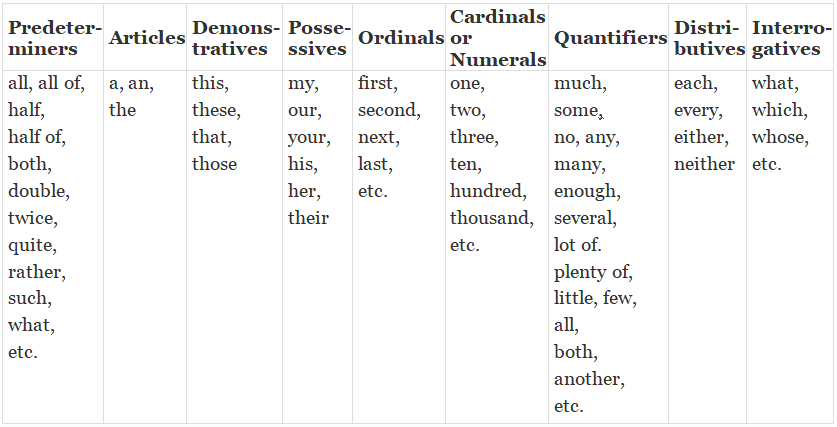
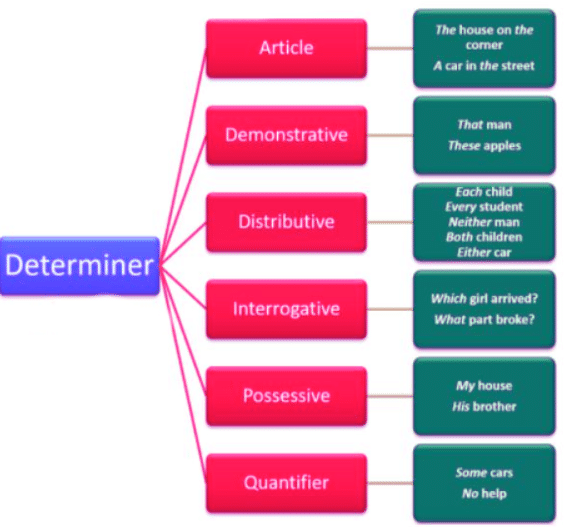
Definition: Determiners are those words that are prefixed before nouns to determine their meaning. They can be divided into the following types:
1) Articles: a, an, the
2) Demonstratives: this, that, these, those
3) Possessives: my, your, our, his, her, its, their
4) Indefinite Adjectives: some, any, much, many, little, few, less
5) Others: all, each, every, both, neither, either, other, another, enough, most, several, one, two, etc.
Let us discuss each of them one by one –
Articles
The two indefinite articles in the English language are ‘a’ and ‘an’. The definite article in the English language is ‘the’. For indefinite articles, you can use either of them depending on the sound of the first letter of the next word. This is done for pronunciation reasons.
Use of ‘a’ takes place in the following instances:
In places where the following word starts with a consonant sound, the determiner ‘a’ is used.
Also, ‘a’ is used where the following word is a singular countable noun.
The determiner ‘an’ also does the same work as ‘a’ but is used in the following instances:
Places where the following word is a singular countable noun and starts with a vowel sound (a, e, i, o, u).
‘The’ is mostly used before both singular and plural nouns. Its main function is to specify a person, place, or thing.
Uses of Articles with Rules and Examples:
‘a’ and ‘an’ (Indefinite Determiners) are used before the following-
A singular countable noun which is being mentioned for the first time. The rule can be understood with the help of the following example sentences – 1. I have never seen a gun. 2. I saw a sports bike at the store today.
A singular countable noun or adjective begins with a consonant sound. The rule can be understood with the help of the following example sentences – 1. I ate a banana. 2. I saw a tall girl today.
A singular, countable noun which is an example of a class of things. The rule can be understood with the help of the following example sentences – 1. A pet needs love. (Class of things is pets. 2. A father deserves to be respected by his children.
The noun to express a quantity. The rule can be understood with the help of the following example sentences – 1. I need a dozen bananas. 2. I need to buy a couple of books.
The units of price, speed, ratio, weight etc. The rule can be understood with the help of the following example sentences – 1. This bike gives 35 kilometres a litre. 2. You can run a mile in just 5 minutes.
Certain numbers or monetary units. The rule can be understood with the help of the following example sentences – 1. I want to earn a billion dollars by the age of 40. 2. Can you lend me a hundred rupees?
The expression of frequency. The rule can be understood with the help of the following example sentences – 1. Put these ear drops twice a day. 2. Wash your face three times a day in the summer.
Certain exclamatory expressions. The rule can be understood with the help of the following example sentences – 1. What a beautiful morning! 2. What a cute dog!
Here are a few Important rules to remember about the use of indefinite determiners:
The spelling of the word following the determiner is not important. Only the sound is important. A few words given below start with vowel letters but do not have vowel sounds. So, the determiner ‘a’ is attached to them. For example: A union, A one rupee coin, etc
There are a few words that start with consonant letters but have vowel sounds. They are preceded by the determiner ‘an’. For example: An honest man, An honour.
Indefinite determiners are mostly prefixed before nouns that do not refer to any particular person, place, or thing. For example: A cat, a boy, an hour
Indefinite determiners can be used before uncountable nouns if the noun is used in a particular sense. For example, I always have tea after my lunch. She is a great pianist.
An indefinite determiner can be attached before the adjective if the adjective is followed by a countable noun. For example: It is a red colored T-shirt.
‘The’ (Definite Determiners) is used before the following-
A singular noun when it refers to a particular class or group. Example: The luxury car is a rich man’s vehicle.
Names of rivers, ranges of mountains, gulfs, seas, oceans, groups, islands, ships, etc.
Countries with plural names. Examples: The Philippines
Books of religion (Religious books). Examples: The Shreemad Bhagavad Gita
Names of hotels, museums, and certain building names. Examples: The Oberoi Group of Hotels
Last names of families in the plural. Examples: The Madans
Names of newspapers and magazines. Examples: The Top Gear
Superlatives of adjectives. Examples: The best boy in the class.
Descriptive adjectives refer to a whole group or class. Examples: The working class.
The names of races and communities. Examples: The Hindu
Few expressions of the English language. Examples: All the colleagues.
Demonstratives
The demonstrative determiners in the English language are this, that, these, and those. The demonstrative determiner ‘That’ (Plural- Those) is used to avoid repetition of a preceding noun. Examples: My shorts are better than those of my brother.
The demonstrative determiner ‘This (Plural- These)’ is used to refer to a person/ persons or thing/ things near to the speaker. Examples: This is the best coffee I have had.
The demonstrative determiner ‘That (Plural- Those)’ refers to a person/ persons or thing/ things far from the speaker. Examples: Get that dog out of the house.
Possessives:
The possessive determiners in the English language are my, your, our, his, her, its, their. These are used to show or determine the ownership of a certain thing.
A and an are used before countable Singular Nouns. A is used before a word beginning with a consonant sound, while an is used before with a vowel sound ; as, A pen is to write with. An elephant is a huge animal. Our hen laid an egg today. The is a weakened form of that : The is used to particularise a person or a thing ; as, Bring me the book lying on the table. The dish you prepared was very delicious.
2. This, That, These, Those
This, that, these and those point to objects denoted by the Nouns that follow them ; as,
This man is a raw villager. That horse runs very fast. These mangoes are very sweet. Those girls must be rewarded.
This and these point to the objects which are near, while that and those point to the distant objects.
3. My, Our, Your, His, Her, Its, Their, One’s
These are Possesive forms of Pronouns. They can be used before Singular and PluralNouns ; as,
My father was a famous physician. Our school shows brilliant results every year. Your sister is absent today. Her books lie scattered in the room. Their houses are newly built. One must do one’s duty.
4. One, Two, Three… etc.
He is blind in one eye. She has two daughters. Only three boys are sitting in the room.
5. Each and Every
Each is used for two or more persons (definite) while every is used for more than two persons or things (indefinite) ; as, Each boy must have his own book. Every man is expected to do his best.
6. No, Any and Some
No and Any are used in Negative and Interrogative sentences, while Some is generally used in Affirmative sentences ; as,
There is no high school in this village. He didn’t buy any thing from the market.
Some is used in Affirmative sentences while any is used in Negative sentences. Each of them can, however, be used in Interrogative sentences ; as,
Some We never use some in Negative sentences. (i) In affirmative sentences: Please lend me some money.
(ii) In a question which shows some request or invitation : Will you have some milk? Will you show me some pens?
Study the use of some in Negative Interrogation sentences. Didn’t I give you some money yesterday? Won’t you give me some more books?
Any We can use any with countable or uncountable Nouns both in the Singular and Plural numbers.
(i) In negative sentences: I haven’t any spare pen. She did’t send me any reply.
(ii) In interrogative sentences: Is there any news? Didn’t you lend him any money?
(iii) After ‘hardly’, ‘scarcely’ and ‘barely’ : There is hardly any milk in the milk pot. She had scarcely any body to fall back upon. I had gone hundred yards barely, any one could give me the news.
(iv) After ‘if’ when there is some doubt : If you have any difficulty in solving the questions, come to me. If there is any danger, blow the whistle.
7. (a) All and Both
All denotes the total of many units together, while Both shows the total of two units together. He gave me all the mangoes. Both Vijay and Vinay are adept in painting.
7. (b) All and Whole
The is used after all but before whole. All the boys played traunt. The whole class was out.
All is used with both countable and uncountable nouns. All my books have been lost. All her milk was sold in no time.
8. Either and Neither
Either means one of the two persons or things. Neither is the opposite of Either.
I can speak on either (neither) side. You may buy either of these two pens. Neither of them could speak on the stage.
9. (a) Many, Much, Few, A Few, Less and Several
Many denotes number, while Much denotes quantity. Few is the opposite of ‘Many’ and Less is the opposite of Much, Several means Many.
There are many flowers in this garden. There is much sugar in stock. We have few holidays in school. A few students came to attend the lecture. You devoted less time to your studies. Several people paid homage to the independent leader.
9. (b) Study the use of many, many a, much, few, a few, the few, little, a little, and the little.
(i) Many, many a, much : Many is followed by a plural number while many a by a singular number ; as, Many students were absent yesterday. Many a man has died of cholera.
Much denotes quantity while many denotes number. I have much work to do.
(ii) Few, a few, the few : Few means not many, hardly any ; a few means some ; the few means not many but all of them ; as, I have few friends. He is a man of few words. I shall return this book in a few days. I have read the few books I had. (shows number).
(iii) Little, a little, the little : Little means not much, hardly any ; a little means some ; the little means not much but all of that much ; as, There is little milk in the jug. (hardly any) A little knowledge is a dangerous thing. I spent the little money I had.
‘Determiner’ is a word used before a noun to indicate which things or people we are talking about. The words ‘a’, ‘the’, ‘my’, ‘this’, ‘some’, ‘many’, etc., are called determiners.
The boy you met is my friend.
This novel is very interesting.
I have some information about the accident.
There were many people at the station.
All the Bold words are determiners and they further limit or modify the meaning of the nouns that follow them.
Kinds of Determiners
Pre-determiners
Pre-determiners are the words that occur before a determiner to limit the meaning of a noun:
All the boys joined the race.
He drank half of the milk.
You will get all the information.
She stayed there all of the time.
Both the boys were present.
He gets twice the pay that I get.
He has a ratherpleasant personality.
What a mess you have made!
I paid double the sum for this bed.
It was quite a shock.
He has such a beautiful wife.
Articles
The article system in English consists of the definite article ‘the’ and the indefinite article ‘a’ or ‘an’. We can think of nouns in a specific or general way. When we refer to particular people or things or something that has already been mentioned or can be understood, we use the definite article ‘the.’ When we refer to singular nouns for the first time or refer to things generally, we use the indefinite article ‘a’ or ‘an’.
The Definite Article ‘The’:
We can use the definite article before any common noun:
He threw the ball into the river.
The boys were not in the class.
We use the definite article to refer to specific persons or things:
I want to meet the principal of the school.
The tourists crossed the river in a boat.
The definite article is used to refer to the things that are only one in the world:
The moon and stars were shining in the sky.
The sun sets in the west.
The Earth revolves round the sun.
We use the definite article with the words such as school, university, prison when we are referring to a particular building:
They will visit the school on Monday.
I met him at the university.
The definite article may be used with the countable nouns that are used in the singular to refer to things more general:
If you break the law, you will be punished.
He played the violin for half an hour.
The definite article is used to refer to the parts of the body:
Smoking is harmful to the lungs.
He caught him by the neck.
There was an injury in the right eye.
The definite article is used with time expressions:
I met her in the evening.
She came here in the morning.
We use the definite article before something that has already been mentioned:
I met a man at the station.
The man belonged to Tamil Nadu.
The definite article is used before a noun that is followed by a relative clause or a prepositional phrase:
The man I met at the station belonged to Haryana.
He put the sweater on the table.
The definite article is used to refer to familiar things we use regularly:
She looked at the ceiling.
Suddenly the lights went out.
The definite article is used before dates or periods:
We met on the 15th of October.
It is a popular music of the 1940s.
The definite article is generally used before a noun which is followed by ‘of’:
This led to the destruction of the whole village.
The burning of houses rendered people homeless.
The definite article is used before the names of seas, rivers, deserts, mountains,
The ship crossed the Pacific Ocean.
Delhi stands on the banks of the Yamuna.
The Sahara is a famous desert.
They came across the Himalayas.
The definite article is used before the names of large public buildings:
They visited the Taj Mahal.
They went to the Town Hall.
The definite article is used before the superlative adjectives:
He is the best boy in the class.
She is the most beautiful girl in the school.
The definite article is used before adjectives such as rich, poor, deaf, dumb, and blind, to use them as nouns:
The rich and the poor went to the fair.
We should help the blind.
We use the definite article before the nationals of a country or continent:
The Indians are very religious.
Some of the Europeans live here.
We use the definite article before the names of trains and ships:
The Rajdhani Express is a very fast train.
The Queen Elizabeth is a famous ship.
The Indefinite Articles-‘a’, ‘an’:
The indefinite articles (‘a’, ‘an’) are used when we talk about people in a general or indefinite way. The article ‘a’ is used before the words begin with consonant sounds, and ‘an’ is used before the words begin with vowel sounds. However,
Some words start with a vowel letter but begin with a consonant sound. So we use the article ‘a’ before these words:
He is a European.
Theirs is a one parent family.
This is a unique idea.
He is teaching at a university.
We use ‘an’ before words that begin with a vowel sound:
The girl bought an orange.
He is an Indian.
He had an umbrella in his hand.
Some words begin with a silent consonant, So we use ‘an’ before them:
He is an honest man.
He is an heir to the throne.
I met him an hour ago.
We use ‘a’ or ‘an’ before singular countable nouns:
Kolkata is a big city.
The dog is an animal.
We use ‘a’ or ‘an’ before the names of occupations and professions:
His father is an engineer.
He is a pilot.
When we use ‘a’ before ‘little’ and few’, there is a change in the meaning of these words. ‘A few’ is used with plural countable nouns, and ‘a little’ with uncountable nouns. ‘Few’ means not many, while ‘a few’ means a small number. ‘Little’ means not much, while ‘a little’ means some:
Few people visit this temple now.
I know a few students of this school.
There is little water in the bucket.
There is a little milk in the bottle.
We use ‘a’, ‘an’ before an adjective in a noun phrase:
She is a good girl.
She told me an interesting story.
We use ‘an’ with abbreviations beginning with the following letters: A, F, H, I, L, M, N, O, R, S, and X (They should have vowel sounds).
For example: His father is an M.P. He is an N.R.I. She got an X-Ray done.
We use the indefinite article before certain nouns considered as a single unit:
She bought a knife and fork.
The old lady had a cup and saucer in her hand.
Demonstratives
This, These, That, Those
The demonstrative determiners are used to talk about persons or things already mentioned.
This and These refer to the things that are near and can be seen. ‘That’ and ‘Those’ refer to the things that are at a distance but can be seen.
We lived in this house for four years.
She bought these books.
Those boys are very mischievous.
I like this school.
I met her this week.
‘This’ and ‘that’ are used for singular nouns and ‘‘these’’ and ‘those’ for plural nouns.
Can you lift that box?
Would you like to buy those books?
These boys have done their work.
I have already met that man.
Possessives
My, our, your, his, her, its, their
The possessives are used to show possession.
He is my uncle.
Our neighbour is a rich man.
Your daughter is beautiful.
What is her age?
What is his name?
Do you know its value?
Their house is very big.
Try yourself:
Which of the following determiners is used to refer to specific persons or things?
A.This
B.A
C.The
D.Those
View Solution
Ordinals
First, second, next, last, etc.
The ordinals show what position something has in a series.
He is the first boy who has joined this school.
I shall meet him next week.
He is the last man to help you.
Cardinals
One, two, three, hundred, etc.
Cardinals are ordinary numbers like one, two, three, etc. They show how many of something there are:
There were only ten boys in the class.
She lived for eighty years.
He has two daughters.
I met three young men at the station.
He balanced himself on one foot.
Quantifiers
Much, some, several, a lot of, both, all, etc.
Quantifiers refer to the quantity of things or the amount of something.
There were some people at the airport.
Plenty of people would like to have your job.
They didn’t make much progress.
There is no milk in the bottle.
There is enough powder in the can.
I have forgotten some of the details.
They had enough guests already.
All children enjoyed the show.
There was little water in the jug.
It has not made any difference to me. He drank a lot of water.
Distributives
Each, every, either, neither
Distributive determiners refer to each single member of a group.
Each is used when we talk about the members of a group individually and every when we make a general statement. A singular countable noun follows both:
He met each guest.
The minister visited every flood-affected area.
I agree with every word he says.
Each request will be considered.
Either is used to talk about two things but usually indicates that only one of the two is involved. Either of the two girls should come here.
Neither is the negative of Neither member came to attend the meeting.
Either can also mean People stood on either side (both sides) of the road. Neither is followed by a singular noun.
Neither boy said anything. Neither answer is correct.
Interrogatives
What, which, whose, etc.
The interrogative determiners are used for asking questions:
What subjects are you studying?
Which color do you like the most?
Whose house is this?
Try yourself:
Which determiner is used to talk about two things but usually indicates that only one of the two is involved?
The rule for the use of Modal ‘Might’ is that it is used to express less possibility, permission or a guess.
Example of Modal Might are given below: 1) It might rain today. (Less possibility) 2) Might I go to get the files? (Permission) 3) That might be the new guard. (Guess)
⇨ Uses of Modal ‘Can’:
The rule for the use of Modal ‘Can’ is that it is used to express permission, possibility, ability or capacity.
Examples of Modal ‘Can’ are given below: 1) Can I go to the market? (Permission) 2) Anyone can be the thief. (Possibility) 3) He can stay awake for 2 days. (Ability/ Capacity)
⇨ Uses of Modal ‘Could’:
The rule for the use of Modal ‘Could’ is that it is used to express ability or capacity in the past, polite request or a possibility under certain circumstances.
Examples of Modal ‘Could’ are given below: 1) He could run very fast in his youth. (Ability/ Capacity in the past) 2) Could you wait for him? (Polite request) 3) If we had money, we could have bought a house. (Possibility under certain conditions)
⇨ Uses of Modal ‘Must’:
The rule for use of Modal ‘Must’ is that it is used to express obligation/ duty, necessity, compulsion, prohibition, emphatic advice, determination, assumption, conclusion/ interference, certainty/ strong probability.
Examples of Modal ‘Must’ are given below: 1) The children must obey their parents. (Duty) 2) We must not steal money from anyone. ( Duty) 3) You must follow the orders of your boss. (Obligation) 4) I must reach work on time. (Necessity) 5) He must do as I say. (Compulsion) 6) You must not smoke in public places. (Prohibition) 7) You must see a dentist at once. (Emphatic advice) 8) We must not go before they come back. (Determination) 9) The students must be in their classes at this time. (Strong Probability) 10) He must be 40 years old. (Assumption) 11) He must have left by now. (Certainty)
⇨ Uses of Modal ‘Have to’:
The rule for the use of Modal ‘Have to’ is that it is used in the sense of must, to give advice or to recommend something.
Examples of Modal ‘Have to’ are given below: 1) I have to reach there by 9:30 pm. (in the sense of Must) 2) You have to start working soon. (Advice)
⇨ Uses of Modal ‘Need’:
The main rule for the use of Modal ‘Need’ is that it chiefly shows the absence of necessity or compulsion in the negative and interrogative sentences.
Examples of the Modal Need are given below: 1) You need not worry about work. 2) Need I talk to her.
⇨ Uses of Modal ‘Ought’:
The rule for the use of Modal ‘Will’ is that it is used to express the subjects obligation or duty and also it is used to give advice.
Examples of Modal ‘Ought’ are given below: 1) I ought to love my parents. (Obligation/ Duty) 2) We ought not to cheat anyone. (Duty) 3) You ought to practise for more than 2 hours a day if you want to clear the exam.
⇨ Uses of Modal ‘Dare’:
The rule for using the Modal ‘Dare’ is that it is used at places where we need to show courage. It is generally used in negative and interrogative way.
Examples of Modal Dare are given below: 1) I dare not fail in my exams. (Negative) 2) How dare you interrupt us? (Interrogative)
⇨ Uses of Modal ‘Used to’
The rule for the usage of Modal ‘Used to’ is that it is used to express past habits and to express the existence of something in the past.
Examples of the Modal ‘Used to’ are given below: 1) I used to go swimming every morning. (Past Habits) 2) There used to be a door at this place long ago.(Existence of something in the past)
Exercise
Fill in the blanks with correct modals.
1) He knew that he _______ (Would/ must) be able to reach office in time. 2) You ______ (dare/ could) not enter my house again. 3) I thought he ______ (should/ would) be at school. 4) Raman _____ (can/ should) speak in two voices. 5) I _____ (can’t/ couldn’t) write what you spoke. 6) You _____ (should/ can) have told me earlier. 7) _____ (Can/ Should) i get something to drink, please? I am very thirsty. 8) _______ (Can/ Should) I use your car, please? 9) You ______ (can/ would) go in now and meet the doctor. 10) I _______ (would/ should) love to teach these children. 11) I ______ (could/ can) eat 5 bananas at a time when i was young. 12) You _____ (must/ will) see the lawyer at once. 13) ______ (May/ Might) god protect you from the pain and agony. 14) My mother ______ (can/ could) watch T.V for hours even now. 15) It _______ (would/ may) be cold in the evening, who knows?
Answers:
1) Would 2) Dare 3) Would
4) Can
5) Couldn’t
6) Should 7) Can 8) Can 9) Can 10) Would 11) Could 12) Must 13) May 14) Can 15) May