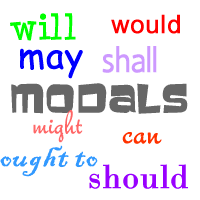
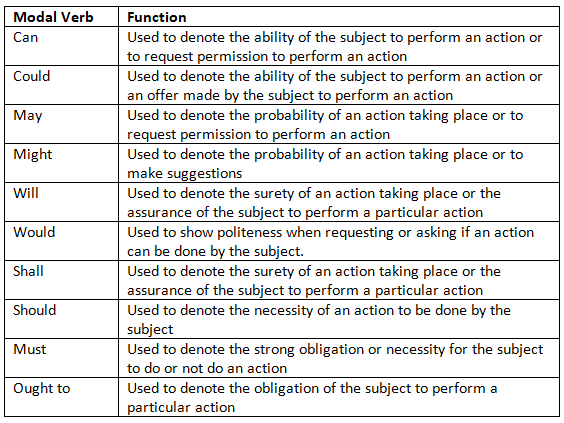
Definition: Modals are special verbs that are different from normal verbs. They are never used alone and are always followed by a principal verb. They provide additional information about the principal verb. They are used to express certainty, possibility, willingness, obligation, necessity and ability.
The List of the Modals with their Positive and Negative forms is given below:
Positive
Negative
Will
Will Not/ Won’t
Would
Would Not/ Wouldn’t
Shall
Shall Not/ Shan’t
Should
Should Not/ Shouldn’t
May
May Not/ Mayn’t
Might
Might Not/ Mightn’t
Can
Can Not/ Can’t
Could
Could Not/ Couldn’t
Must
Must Not/ Mustn’t
Have To
Don’t Have To
Need
Need Not/ Needn’t
Ought
Ought Not To/ Oughtn’t To
Dare
Dare Not/ Daren’t
Used To
Used Not To/ Didn’t Use to
⇨ Uses of Modal ‘Will’:
The first rule for the use of Modal ‘will’ is that it expresses pure future with second and third person as subjects.
The second rule for use of Modal ‘will’ is that it shows willingness, intention, promise, determination with the first person as a subject.
The third and last use of Modal ‘will’ is that it tells about the characteristic, habit, assumption, invitation or request and insistence.
Examples of Modal ‘Will’ are given below: 1) You will die of a heart attack. (Pure Future) 2) The prime minister will hoist the flag. (Pure Future) 3) I will meet you again. (Promise) 4) I will need your help. (Willingness/ intention) 5) He will achieve his goals. (Determination) 6) A child will usually obey his parents. (Characteristic habit) 7) He will be here at any moment. (Assumption) 8) Will you go with me. (Request) 9) He will not listen to his teacher’s advice. (Insistence)
⇨ Uses of Modal ‘Would’:
The rule for the use of Modal ‘would’ is that it expresses past habits, polite request, wish/ preference or an imaginary condition.
Examples of Modal ‘Would’ are given below: 1) He would wake up early in the morning and go to work. (Past habits) 2) My mother would always make me my favourite dishes. (Past habits) 3) Would you get me a glass of water, please? (Polite request) 4) I would like to see the owner. (Polite request) 5) I wish you would be here. (Wish) 6) I would rather have food at home than outside. (Preference) 7) I would buy a house if I won the lottery. (Preference)
⇨ Uses of Modal ‘Shall’:
The first rule for the use of Modal ‘Shall’ is that it expresses pure future with the first person as the subject.
The second rule for the use of Modal ‘Shall’ is that it is used to ask for advice, suggestions, requests, etc. with the first person in the interrogative.
The third rule for the use of Modal ‘Shall’ is that it is used to express command, threat, warning, promise, assurance, determination, etc. with the second and third person as the subjects.
Examples of Modal ‘Shall’ are given below: 1) We shall go to school tomorrow. (Pure Future) 2) I shall teach you to dance. (Pure Future) 3) Shall I bring a glass of fresh juice for you? (Request) 4) Shall I close the door? (Advice) 5) Shall we go to the market tomorrow? (Suggestion) 6) You shall get a reward for your achievement. (Promise/ Assurance) 7) You shall go to your room. (Command) 8) They shall win the match. (Determination)
⇨ Uses of Modal ‘Should’:
The first rule for the use of Modal ‘Should’ is that it is used to express duty, obligation, advisability or desirability.
The second rule for the use of Modal ‘Should’ is that it is used to express logical interference, supposition, assumption, possibility or probability.
The third rule for the use of Modal ‘Should’ is that it is used to express a purpose after ‘lest’.
Examples of Modal ‘Should’ are given below: 1) We should go to school every day. (Duty) 2) You should not be late for work. (Obligation/ Desirability) 3) You should exercise more often. (advisability) 4) He should be at the office by now. (Possibility) 5) If he should see me there, he will be happy. (Probable Condition) 6) Leave on time, lest you should miss the train. (should after lest)
⇨ Uses of Modal ‘May’:
The rule for the use of Modal ‘May’ is that it is used to express possibility, permission, wish, faith, hope or a purpose.
Examples of Modal ‘May’ are given below: 1) It may snow in the evening. (Possibility) 2) May I go now, sir? (Permission) 3) May God always be with you. (Wish, faith or hope) 4) He is working hard so that he may get an appraisal. (Purpose)
Modal auxiliaries are verbs such as can, must, could, would, etc. which are used with main verbs to express such ideas as possibility, permission, necessity, obligation, etc.
Characteristics of Modal Verbs
The modal verbs have several characteristics. They are –
They are auxiliary (helping) verbs.
They are always used with the base form of a main verb (without “to”), except for ought to.
They do not change form according to subject number or tense (no “s” in third person singular).
They do not take infinitive, present participle, or past participle forms (e.g., not used as “to must”, “musting”, “musted”).
They do not form questions or negatives using do/does/did (except need in certain contexts).
They express meanings like obligation, possibility, necessity, deduction, advice, etc.
Their form remains the same across all subjects.
Some have equivalents or substitutes for past tense (e.g., have to → had to, can → could).
The Functions of Modals
Must and have to
Must is used for all persons in the present and the future tenses.
The negative is must not (mustn’t).
The interrogative form is must I?
Must has no infinitive and no past tense. It is followed by the infinitive without ”to’.
(i) Must is used to express obligation:
You must obey your parents.
You must go to school in time.
(ii) It is used to express compulsion, e.g. ordering someone to do something because it is necessary or important to do so:
You must answer all questions.
You must return by the evening.
(iii) It is used for saying that something is probably true because nothing else seems possible:
You must be tired after your long journey (inference).
There must be some mistakes.
(iv) The negative form of must (must not) is used for prohibition:
You must not come here.
You must not use the office phone for private calls.
(v) It is used to give emphatic advice:
She must consult a doctor at once.
You must work hard if you want to get good marks.
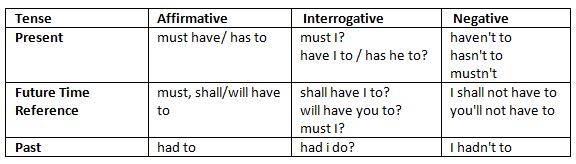
Have to, like must, expresses obligation in the present while had to does so in the past. Must expresses an obligation imposed by the speaker. Have to/Had to expresses external obligations—an obligation by some authority or circumstances.
I must reach there in time (the speaker himself feels so).
You have to reach in time (ordered to do so by some external authority).
Had to is used when describing something belonging to the past.
He had to go early to catch the train.
These two verbs have the following forms:
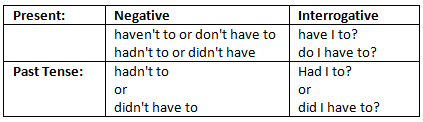
Have to and had to have alternative negative and interrogative forms:
Have to/Had to
(i) Have to expresses obligation and necessity in the present. Had to does so in the past:
She has to look after her mother.
He had to finish his work before 5 p.m.
(ii) Have to and had to are used for giving advice:
First you have to mix the water and the sugar.
She had to take those pills to get better.
(iii) Have to and had to are used to draw a logical conclusion:
There has to be some reason for his mischief.
This has to be a part of the whole plan.
(iv) Have to is used for supposition or to describe something based on possible ideas or situations:
You will have to work very hard to stand first.
If she has to choose, she won’t marry him.
(v) Have to is used to indicate that something is very important or necessary:
We have to be more careful in future.
They will have to clear all their debts before December.
Should
(i) Should is the past tense of shall. In indirect form of speech ‘shall’ changes into should:
I said, “I shall go to school tomorrow.”
I said that I should go to school the next day.
(ii) Should is used to express obligation, duty, etc.
You should look after your old parents.
You should pay all your taxes.
(iii) Should is used to give advice or suggestion:
You should consult a doctor.
She should do yoga exercises daily.
He should learn English if he wants to get a good job.
(iv) Should is used to express purpose:
Mohan walked fast so that he should catch the train.
Satish worked hard so that he should stand first in the class.
(v) Should is used to state imaginary results:
He should get angry if he comes to know about it.
(vi) Should is used to express polite requests:
I should be thankful if you give me some money.
Need
As a modal verb, need is usually followed by an infinitive without ‘to’:
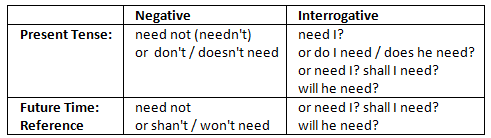
The modal verb need is mainly used in questions and negatives, which are formed without ‘do’:
Need I go now? You need not go.
The negative need not is often shortened to needn’t in conversation and informal writing. Need does not change its form, so the third person singular of the present tense does not end in’ —s’:
He need not go there.
The modal verb need has no past tense. But it can be used in the pattern followed by a past participle:
Need not have/needn’t have.
You needn’t have waited for me.
The negative and interrogative forms of the past tense are:
Did not (didn’t) need and did I need?
In the present and future tenses, the negative and interrogative can be formed in either of the two ways:
(i) The negative need expresses absence of obligation:
They need not send the letter now.
You need not go. (i.e., It is not necessary for you to go).
He need not come now.
(ii) Need is used to express obligation or necessity:
Need I attend the class today?
Need he solve all the sums?
(iii) Need not + perfect infinitive is used to express an unnecessary action which was performed:
You needn’t have gone to see the doctor. He was on leave today.
You needn’t have carried an umbrella as it was not raining.
Ought
(i) Ought is usually followed by ‘to’ and an infinitive:
You ought to tell the truth.
(ii) It does not change its form so that the third person singular form does not end in ‘-s’:
She ought to work a little harder.
It can be used as a present, past, or future tense.
(iii) The negative is ought not (oughtn’t) and the interrogative is ought I?, Ought you?, Ought he?, etc:
Ought I to do it at once?
He ought not to disobey his teachers.
(iv) Ought to is used for expressing what is the right or sensible thing to do, or the right way to behave:
You ought to get up earlier.
We ought to exercise daily.
Teachers ought not to smoke before students.
(v) Ought to is used when we believe strongly or expect that something will happen:
The Indian team ought to win.
Satish ought to pass.
The meeting ought to have finished by 2 o’clock.
(vi) Ought to see/hear/meet, is used for emphasising how good, impressive or unusual something or someone is:
You ought to see their new house.
You ought to meet his elder brother.
(vii) Ought to have is used when we realise that we did not do the right thing in the past:
You ought to have listened to my advice.
She ought to have taken the money.
Ought, must, have to, and should
Ought can be used in exactly the same way as should:
You ought to/should obey your parents.
Note: Ought is used to express the subject’s obligation or duty. But it indicates neither the speaker’s authority as with must, nor an outside authority as with have to. The speaker is only reminding the subject of his duty. Besides this, he is giving advice or indicating a correct or sensible action.
Have to and must
You have to be regular. (These are the rules.)
You must obey your teachers. (The speaker insists on it.)
You have to take this medicine. (The doctor insists on it.)
You must take this medicine. (The speaker insists on it or It is the speaker’s emphatic advice.)
You mustn’t drink this, it is poison. (prohibition)
You ought not to smoke so much. (It is not right or sensible.)
Examples of Modal Verbs
Let us look at some examples of modal verbs used as auxiliary verbs and their functions:
Try yourself:
Which modal verb is used to express obligation imposed by the speaker?
Writing on a particular topic assists students in articulating their thoughts, demonstrating creativity, and conveying ideas in a clear and comprehensible manner.
To improve writing skills, students should participate in various activities from an early age, including composing articles, messages, and letters. Regular practice is crucial for development.
Writing a page or two daily—whether about personal experiences or new information—can significantly contribute to refining writing capabilities.
Objectives of Writing
Evaluate students’ proficiency in using verbal input for coherent writing and assess their grammatical accuracy.
Assess students’ ability to present ideas concisely and coherently.
Evaluate their skill in writing clear descriptions focused on the main topic.
Assist in developing ideas around a given topic, including a structured introduction and conclusion.
Ensure appropriate style and format in elaborating ideas.
Evaluate argumentative and analytical capabilities.
Evaluation Criteria
Emphasis on clarity, fluency, and grammatical correctness of expressed ideas.
Coherence in planning, organizing, and presenting ideas with proper introductions, developments, and summaries.
Skills in comparing and contrasting ideas and drawing conclusions.
Ability to present arguments with supporting examples using suitable styles and formats.
Capacity to expand notes into comprehensive writings expressed creatively in appropriate styles and language.
Use of vocabulary, grammar, punctuation, and spelling.
Ways to Practice Writing
Regular writing to improve skills.
Engaging in various writing formats to gain diverse experience.
Seeking feedback to enhance writing quality.
LettersLetters are an important means of communication between individuals and organizations. While methods like SMS, social messaging apps, and emails have become popular and often replace letters, they still hold significance. Letters foster strong relationships and can be kept as mementos or records. There are two types of letter :
1. Formal Letter 2. Informal Letter
Formal Letters
Formal letters are generally written to a higher authority like an official, or to the editor of a newspaper or magazine. The language and format are of utmost importance in writing formal letters. For students, letter writing has long term purposes. The students learn how to formally write a letter, and in what language and format should he/she present his/ her ideas/views. Here’s what to include:
From: This section should include the name provided in the question. If no name is given, students can use ‘ABC’ or ‘XYZ.’ It should also include the date and address, which can be fictitious or as specified.
To: This should be directed to a higher authority or official. For instance, if a student is writing to a teacher or principal, a specific format must be followed, varying based on the letter’s purpose, such as a complaint or inquiry.
Subject: This line should clearly indicate the letter’s main purpose, such as ‘Request for,’ ‘Complaint about,’ or ‘Order for.’
Salutation: This is how the recipient is addressed, for example, ‘Respected Sir,’ ‘Dear Sir,’ or ‘Madam.’
The Body: This is the main content of the letter, which may consist of two or three paragraphs. The opening should briefly state the letter’s purpose, using phrases like ‘I write this letter to…’ or ‘This is to bring to your notice…’. The second paragraph should elaborate on the main topic, and if it’s an order, a list of items with their quantities should be included. The concluding paragraph should prompt action from the recipient, such as ‘I hope…’ or ‘I request you…’.
Subscription: This is how the letter is signed off. In formal letters, use phrases like ‘Yours truly,’ ‘Yours sincerely,’ or ‘Yours obediently,’ followed by the writer’s signature. In some cases, it’s also appropriate to add ‘Thanking you’ before the signature.
Informal Letters
These letters are written to someone close to you. It may be your kith and kin or a friend to whom you like to share your joy/sorrow about an event that happened to you or to the person to whom the letter is addressed. The language in these letters is informal and in fact conversational.
Address: Start the letter with your address, then write the date. You can leave out the subject line, but include it if it helps explain what the letter is about.
Salutation: Always begin with “Dear…” followed by the person’s name.
The Body: Begin by asking how the person is doing, like saying “How are you?” or “I hope you’re well.” After that, get to the main point, whether you’re congratulating them or offering condolences. Adding a personal touch at the end, like “Please send my regards to…” makes the letter feel warmer.
Subscription: Close the letter with phrases like “yours lovingly,” “Your loving son,” or “Your dearest friend,” and then write your name.
Diary
A diary is simply a record of the daily events in your life. Instead of writing in a dull way, diary entries can be made more interesting by adding a good style, a bit of humour, and personal opinions when needed. Unlike other types of writing, a diary does not need a specific topic; it just requires you to express your thoughts and feelings about what happened that day.
Steps to follow :
Begin the entry with a general introduction, describing the day or momentary feelings.
In the body, you may discuss an event of the day that inspired or influenced you.
Conclude with a final remark.
Article Writing
Writing an article can be challenging as it demands creativity , a strong vocabulary, subject knowledge, and the ability to organize thoughts. An article is a type of non-fiction writing focused on a particular topic. Besides presentation skills, students need basic knowledge about the subject they are writing on. They might also need to incorporate facts along with their personal opinions. Unlike diary entries, article writing is generally objective , relying more on information gathered from various sources rather than individual experiences.
Debate
A debate is a formal discussion or argument about a specific topic where participants hold differing views. The primary objective of a debate is to evaluate the skills and ability to present an argument effectively. When writing a debate, one must take either a supportive or opposing stance on the issue at hand, meaning you are either for or against the topic mentioned in the question. It’s crucial to maintain a strong position to back up your views effectively.
Importance of Critical Thinking
Debates require students to think critically and understand how to present arguments from both sides. For example, if asked to debate whether “computers are a boon or a bane,” a student should be able to argue that computers are a “boon” while also understanding their potential drawbacks.
Knowing both sides of the argument allows for a more assertive and convincing debate.
Engaging the Audience
When presenting a debate, it’s essential to imagine addressing an audience. Starting with phrases like “I am here to put forth…” or “I am here to argue that…” helps engage the listeners.
Incorporating opposing views in the main part of the debate strengthens the argument and demonstrates a well-rounded understanding of the topic.
Speech
A speech is typically crafted to share ideas with the public. When writing a speech, it’s important to start in a way that reflects how it will be delivered. Addressing the audience is crucial; for a student’s speech, beginning with “Respected…” is suitable. Since most speeches are formal, choosing words carefully when addressing the audience is essential.
After the greeting, the purpose of the speech should be introduced with phrases like “I am here to speak…” or “Let me first introduce…”. The main content should express thoughts clearly in straightforward language, focusing on the central topic.
Short Story
Writing a short story requires a strong imagination. It becomes easier if you have clues like hints, a starting point, or a specific topic. Without these, it can be challenging to come up with a creative idea. For some, storytelling is a natural talent, while others find inspiration from their surroundings or by reading various stories.
To make a short story engaging, you might start in the middle of an action with lines like “I never expected that…”, “Finally, I got the…”, or “The news was a shock…”. Other narrative styles could include beginnings like “The other day, I happened to see…” or “That man whom I used to find near the bus stand…”. For students writing a story with a provided beginning or ending, the best approach is to jot down hints such as characters and situations before weaving them into a complete narrative.
Hint-expansion can simplify story writing since the hints outline the plot, allowing students to create connecting sentences. Observing events around you and using them as inspiration can help improve storytelling skills, which develop with practice.
Tips and Tricks for Writing
Start with an engaging introduction—this could include a catchy title or an interesting quote if it’s an article, or an introduction for a debate or speech.
Brush up on your grammar skills and keep new words handy for use when possible.
Use clear and simple language, ensuring that your sentences are grammatically correct.
Keep sentences short and precise to effectively convey your ideas. Long sentences can be confusing and may lose the reader’s interest.
Use figurative language sparingly to enhance the richness of your writing.
Stay focused on the topic you are writing about.
If possible, jot down your points as hints first, which you can refine before writing your main piece.
Ending with a cliffhanger can make your writing more impactful, perhaps by posing a thought-provoking question or leaving the reader contemplating your topic.
Finally, practice daily to develop strong writing skills naturally.
All of us read newspapers. Sometimes an item of news or an article evokes a strong feeling or reaction in us, and we want to express it through the newspaper. Then we write a letter to the newspaper which is called Letter to the Editor. All letters meant to be published in a newspaper are addressed to the Editor of that paper. The proper form of salutation in such letters is Sir (not Dear Sir) and the complimentary close should be Yours truly. Below are given some examples of Letters to the Editor.
(1) Alarming Unhygienic Conditions Of Your City
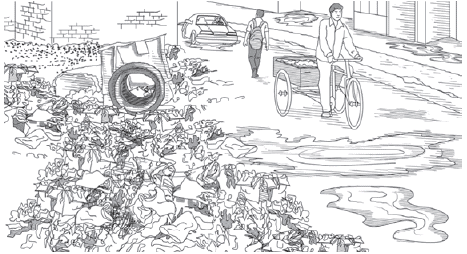
Write a letter to the Editor, Hindustan Times, Surat, registering your protest against government / local body’s apathy towards cleanliness in the city during the days of reported outbreak of cholera in the city and migration of people to other cities. Look at the picture below and write your letter.
Ans.
To The Editor Hindustan Times Surat
Date: 10th July 20_ _
Subject: Protest Against Apathy Towards Cleanliness During Cholera Outbreak
Sir/Madam,
Through the columns of your esteemed newspaper, I wish to express my strong protest and deep concern regarding the negligence shown by the government and local authorities in maintaining cleanliness across Surat, especially during the recent cholera outbreak.
It is disheartening to witness heaps of garbage left unattended, overflowing drains, and stagnant water collecting in residential areas. These unhygienic conditions have not only worsened the outbreak but also led to panic and distress among citizens. As a result, many families are migrating to other cities in search of safety and better living conditions.
Despite repeated complaints and reports, there has been little to no action from the responsible bodies. The public health system appears unprepared and indifferent, and this lack of urgency in addressing the issue is both shocking and dangerous.
I strongly urge the concerned authorities to take immediate action: clean the garbage dumps, fumigate affected areas, repair drainage systems, and run awareness campaigns about sanitation and cholera prevention.
Your newspaper has always been a voice for the people. I hope this letter will draw attention to this pressing issue and prompt authorities to act before the situation worsens further.
Yours sincerely, [Your Full Name] [Your Address] [Your Contact Number]
(2) About Improvement In Teaching Of English
Write a letter to the Editor of a newspaper, stressing the need for qualitative improvement in the teaching of English, in view of its significantly increasing role and importance.
Ans.
To The Editor The Times of India New Delhi
Date: 10th July 2025
Subject: Need for Qualitative Improvement in the Teaching of English
Sir/Madam,
Through the columns of your widely read newspaper, I wish to draw the attention of educators and authorities towards the urgent need for qualitative improvement in the teaching of English in our schools and colleges.
In today’s globalized world, English has emerged as a vital tool of communication, academic growth, and professional success. Proficiency in English opens doors to international education, employment, and digital resources. However, despite its increasing importance, the quality of English teaching in many institutions remains inadequate and outdated.
The focus is often on rote learning and grammar drills, while communication skills, vocabulary development, and practical usage are neglected. Students lack confidence in speaking and writing effectively in English, which limits their academic and career opportunities.
To address this, there is a pressing need to upgrade teaching methods. Teachers should be trained in modern, interactive techniques that emphasize listening, speaking, reading, and writing (LSRW) skills. Use of multimedia tools, exposure to English literature, and real-life communication exercises can make learning more engaging and effective.
It is time for education boards, schools, and the government to acknowledge the critical role English plays in shaping the future of our youth and take meaningful steps to ensure its proper teaching.
Yours sincerely, [Your Full Name] [Your Address] [Your Contact Information]
(3) Beggar Turns Out A Robber
Amit Khosla is a resident of Gandhi Nagar Colony. After reading the following report in a local newspaper, he writes to the Editor of the newspaper, ‘Daily Reporter’ pointing out the problem of begging. Write this letter, using your own ideas.
Ans.
12 Gandhi Nagar Colony New Delhi 16 May 20_ _ The Editor Daily Reporter New Delhi Subject: Problem of Begging Sir I have read a report in your newspaper dated 15 May, 20 regarding a case of burglary committed by a ‘beggar’. I am writing to express my views on this problem of beggars. Beggars have become a great nuisance these days. They pester people for alms in trains, buses, bazaars and streets. They are handicapped. They are unable to earn their living. But the pity is that most of the beggars are able-bodied. Begging has become a profession with them. They find it the easiest way to earn their living. Some of them are criminals. They beg only to conceal their crimes. I think begging in public places should be made a punishable offence. The government should open asylums for those beggars who are really helpless. Able-bodied beggars should be forced to work. If they go without work, they must also go without food. We should have no sympathy for such impostors. We should not encourage them by giving alms. People can thus play a big role in eradicating this evil. Also the members of every family, especially the old people and women folk, should be warned against the strangers trying to gain entry into the houses. The people coming in the garb of beggars should be treated with well-deserved suspicion and caution. Yours truly Amit Khosla
(4) Consequences Of Sedentary Lifestyle
You are Arpita or Ashwin. You came across the following extract in a magazine article. After reading this article, you realized that awareness has to be created among people on the need for health care and the consequences of a sedentary lifestyle. Taking ideas from the unit, ‘’Health and Medicine’’, along with your own ideas, write a letter to the Editor of a daily.
Ans. 115 Arjun Nagar Movayya Lucknow 8 August 20_ _ The Editor The UP Times Lucknow Subject : Consequences of Sedentary Lifestyle Sir We are living in the machine age. We have made machines our slaves. We make machines do all the work for us. We don’t have to use our legs. There are machines to carry us. We don’t have to use our hands. There are machines to work for us. We have just to sit and press the remote-control buttons. Thus our lifestyle has become altogether sedentary. Whatever we eat adds to our weight because we don’t take proper exercise to digest it and convert it into energy. Adding to one’s weight means inviting such diseases as diabetes and heart problems. The kind of food we eat further adds to the problem. We have taken to fast foods and junk foods. They are not balanced foods. They create a deficiency of essential vitamins and minerals in our body. Thus there is an urgent need that awareness should be created among the people on the need of health care. They should be educated about the consequences of sedentary lifestyle and motivated to take regular exercise. Public parks should be provided where people can have their morning or evening walk and also take some light exercise. There should be health programmes on TV and radio to tell people how they can live a healthy and long life. Without good health, we all will become a nation of underachievers. Yours truly Arpita
(5) Problem Of Global Warming
Write a letter to the Editor of ‘The Times’, showing concern on the problem of Global Warming. Give reasons for the increase in global temperature and suggest means to curb it.
Ans. 1820 Civil Lines ABC City 17 January 20_ _ The Editor The Times New Delhi Subject:Problem of Global Warming Sir During the last decade, it has been observed that the level of carbon dioxide in the atmosphere has increased alarmingly. A significant property of carbon dioxide is that, like glass, it allows more heat to pass into the earth’s atmosphere than to pass out. And since the carbon dioxide content in the air is increasing sharply, the earth’s atmosphere is becoming hotter and hotter. This is what is called global warming. Because of this global warming, the polar ice caps have started melting and the level of seas is rising gradually. If all this goes on unchecked and all the polar ice caps melt down into the seas, there will be such a deluge that only high peaks of mountains would be left peeping out of the waters. The presence of too much carbon dioxide in the atmosphere is harmful for our health also. The government must take urgent and stringent steps to stop the excessive flow of carbon dioxide into the air. A general awareness in this regard has also to be developed, if we want human beings to continue living on this beautiful planet of ours. Yours truly Nalin
(6) Growing Crime Of Child Abuse
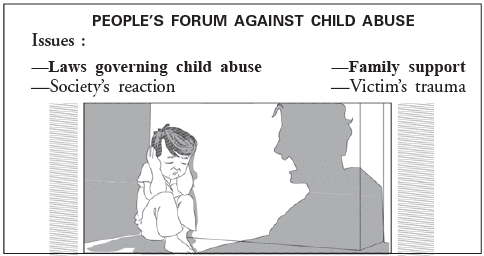
Deepika Lal sees the poster given below on child abuse. She decides to write to the Editor of a local newspaper, voicing her concern about the growing crime. Write the letter for Deepika.
Ans. 66-Model Town Ghaziabad 18 March 20_ _ The Editor Lok Jagaran Ghaziabad Subject: Concern about the growing crime
Sir In most human families, children are loved and well cared for. But sometimes, they are very badly treated by adults, even by those who are directly responsible for them. The most serious problems arise when children are maltreated by their parents or close relatives. Such cases of abuse may not be noticed by the people outside the home until it is too late. Abuse can take a number of forms. A child may be beaten, burned, terrorized or forced to accept a series of humiliating ‘punishments’. Or a child may be neglected — left alone for days in a locked room or left unfed and unwashed. The worst form of child abuse is sexual abuse. The victim has to undergo a trauma that can end in serious results. This last form of child abuse is the most common these days. The problem is made more difficult by the fact that many cases are never reported. Though there are laws against child abuse, the law can take its course only when a case is reported. And even if it is reported, the harm that has been done to the child can’t be undone. Its bitter memory leaves an indelible impression on the young mind. It is like trampling a flower before it has blossomed. Yours truly Deepika Lal
(7) The Plight Of Slum Dwellers
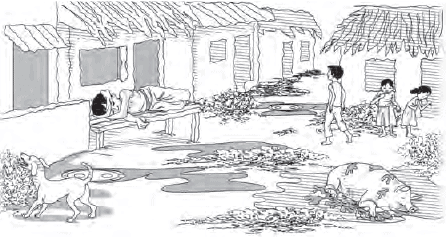
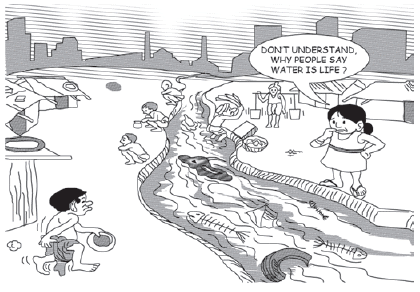
The fact that many of the young children of today live and grow up in unhygienic surroundings, are ill-nourished and illiterate, upsets you. You write a letter to a newspaper Editor on the problems faced by them and suggest ways of rehabilitating them so that they can have a better future. Taking ideas from the picture, along with your own ideas, write the letter.
Ans.
To The Editor The Hindu New Delhi
Date: 10th July 2025
Subject: Urgent Need to Rehabilitate Underprivileged Children for a Better Future
Sir/Madam,
Through the columns of your esteemed newspaper, I wish to express my deep concern over the alarming condition of many young children in our country who are forced to live and grow up in unhygienic surroundings, without proper nutrition, education, or healthcare.
It is heartbreaking to see children begging on streets, working in hazardous conditions, or simply wandering without guidance or support. Most of them are victims of poverty, homelessness, or broken families. They remain malnourished, illiterate, and highly vulnerable to exploitation. Their dreams and potential fade away before they even get a chance to blossom.
The government and society must act urgently and collectively to rehabilitate these children. Some suggestions are:
Establish more shelter homes with basic amenities and safety.
Provide free and compulsory education with mid-day meals to combat illiteracy and malnutrition.
Set up mobile schools and health camps in slum areas and construction sites.
Enforce laws strictly against child labour and child trafficking.
Encourage NGOs and citizens to participate in child welfare drives.
If we truly wish to build a strong and inclusive nation, we cannot ignore the plight of these innocent souls. Let us give them the care, opportunity, and dignity they deserve.
Yours sincerely, [Your Full Name] [Your Address]
(8) Cruelty To Animals
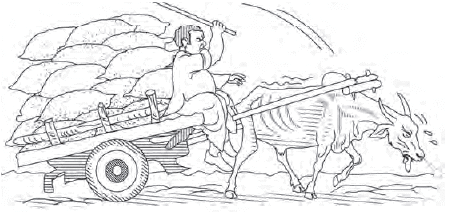
Neha Bhasin is an active member of the Youth Wing of the SPCA (Society for the Prevention of Cruelty to Animals). She saw the following scene on one of the roads. She decided to write a letter to the Editor of a newspaper, protesting against cruelty to animals. Using the information in the picture, together with your own ideas, write the letter.
Ans.
To The Editor The Times of India New Delhi
Date: 10th July 2025
Subject: Protest Against Growing Cruelty to Animals
Sir/Madam,
Through the columns of your respected newspaper, I wish to raise my voice against the growing incidents of cruelty towards animals, which continue to go unnoticed and unpunished. As an active member of the Youth Wing of SPCA, I recently witnessed a disturbing scene on a city road where a stray dog was being mercilessly beaten, and a bull was overloaded with goods and whipped repeatedly to move faster.
Such acts are not only inhumane but also a violation of the Animal Welfare Act. Animals, like humans, have the right to live with dignity and without suffering. Unfortunately, many people treat them as objects of use or nuisance rather than as living beings capable of pain and fear.
It is high time we, as a society, become more compassionate and responsible. I strongly urge the authorities and public alike to:
Enforce stricter laws against cruelty to animals and ensure strict punishment for offenders.
Create awareness through campaigns and school programs about kindness to animals.
Encourage adoption of stray animals and support for animal shelters.
Install CCTV cameras in areas known for such abuses to monitor and deter offenders.
I sincerely hope your newspaper will highlight this issue and influence public opinion and policy in favour of voiceless animals. A civilized society must be judged not only by how it treats its people but also by how it treats its animals.
Write a letter to the Editor of a local newspaper, expressing your views on the lack of job opportunities and the need of counselling to the youth after class X. You may refer to the unit, ‘Education’.
Ans. 123 Parika Street Delhi 20 June 20 The Editor Jaago Bharat New Delhi Subject : Lack of Job Opportunities and Proper Counselling after Class X Sir It is very unfortunate that no guidance or counselling is available to students after they have passed their 10th class examination. A large number of students pass the Class X examination every year. But there is hardly any organization or institution to counsel them about higher studies or any job opportunities that are open to them. The result is that they plunge into traditional courses in arts or sciences. They come out with degrees and diplomas that can serve them no more than useless pieces of paper. It results in so much wastage of time, money and energy. Out of frustration, some of the youth then take to undesirable activities. So it is very important that sufficient guidance should be made available in all educational institutions, especially in all high schools. It will help the students to know from the very beginning what courses of study they should opt for, or what profession they should adopt in their life. Yours truly Ved Prakash
(10) Lack Of Proper Sanitation And Hygiene
India is a highly populated country. People lack in maintaining proper sanitation and hygiene. As a result, they suffer from various diseases. India has a serious sanitation challenge; around 60 per cent of the world’s open defecation takes place in India. Poor sanitation causes health hazards including diarrheoa, particularly in children under 5 years of age, malnutrition and deficiencies in physical development and cognitive ability. You are Nitish / Nikita, head boy / girl of Anand Public School, Jaipur. Write a letter to the editor of a national daily, highlighting the problem and suggesting practical ways to ensure public sanitation and the right to dignity and privacy (Sample Paper 2018-19)
Ans. Anand Public School Jaipur 20 July 20_ _ The Editor Hindustan Times New Delhi Subject : Poor Maintenance of Proper Sanitation and Hygiene Sir India is facing a grave sanitation challenge. Millions of people go for relieving themselves in the open. India accounts for about sixty per cent of the world’s open defecation. Here people, especially rural people, lack the knowledge of proper sanitation and hygiene. They consequently fall a victim to a number of diseases. This lack of knowledge of hygiene and sanitation poses several health hazards, viz diarrhoea (especially in children below five years), malnutrition, physical development problems and cognitive ability. The health authorities should ensure that the people should be made aware about the Swachh Bharat Abhiyaan and should be told about the importance of proper sanitation and hygiene and the right to dignity and privacy. For this, the services of the media can be utilised. People should be encouraged to avail themselves of the free toilet scheme being offered by the Government of India. Yours truly Nikita Bhandari (Head Girl)
Often we have to write letters to various public and government officers to draw their attention to our civic and other problems. For example, we write to the Health Officer about the problem of insanitation, to the Postmaster about the unsatisfactory delivery of our letters, to the Police Department about the law and order problems, and so on. Such letters are called official letters, and they must be very polite and respectful in their tone and language. They are usually addressed to the Heads of the concerned departments.
(1) Complaint About Increasing Thefts You are Tarun Jain of 15, Nehru Park, Karnal. Write a letter to the Police Commissioner, complaining about the increasing number of thefts in your area. (2016) Ans. 15 Nehru Park Karnal 7 April 20_ _
The Police Commissioner Karnal
Subject: Increasing Incidents of Thefts in Nehru Park Area
Respected Sir
Recently there has been an alarming increase in the number of thefts in Nehru Park area of the city. Hardly a day passes when there is no theft or burglary. Cases are regularly reported to the nearest Police Divisions but no headway has so far been made in apprehending the culprits. To be quite frank, people have started doubting that the policemen are mixed up with these thefts and burglaries. Though it is a wild charge, the fact remains that the culprits always go scot-free. There is a danger to the life of the residents also since the burglars come armed with knives and pistols. It is requested that night patrolling in this area should be intensified and all-out efforts should be made to nab the culprits.
Yours faithfully Tarun Jain
(2) Insanitary Condition Of The Locality The insanitary condition has made life in your locality miserable. Write a letter to the Sanitary Inspector of your M.C., requesting him to take the necessary steps before it is too late. Ans. 775 Jahangir Puri Panipat
14 Nov. 20_ _ The Sanitary Inspector Municipal Corporation Panipat
Subject : Insanitary Condition of Jahangir Puri
Sir
I beg to draw your attention to the insanitary condition of the Jahangir Puri area of this city. Mainly poor people live in this area. There are very few proper drains here. The drains are not cleaned regularly. These are never flushed with water. No dustbins have been provided. People throw all their refuse here and there. Flies and mosquitoes buzz about. All this gives this area a very dirty look. I hope you will take suitable measures to improve the sanitary condition of this area.
Thanking you Yours faithfully Harish
(3) Enquiries About Course In Spoken English You are PQR. You saw an advertisement in a newspaper about a course in Spoken English, conducted by ‘A to Z in English’, 22, Gandhi Nagar, Chennai. You wish to join the course. Write a letter to the advertiser, inquiring about all the details that you require. Ans. 43 King’s Street Dream City 18 June 20_ _
The Director A to Z in English 22 Gandhi Nagar Chennai.
Subject : Inquiring about all the details of Course
Dear Sir I have read your advertisement in the New India Times dated 17 June, 20_ _ , regarding a course in Spoken English. I am willing to join this course, but before that I would like to know the following details with respect to this course : 1.The duration of the course. 2.The day and date on which you intend to begin this course. 3.The timings of the lessons. 4.The different ingredients of the course — viz. lectures, discussions, audio-visual aids, etc. 5.Approximate number of participants in each group. 6.The schedule of fees to be paid. Please supply me all the above details so that I can make up my mind about joining this course, which I would very much like to.
Yours faithfully PQR
(4) Enquiries About Course In Leadership Your sister has just passed the All India Secondary School Examination of CBSE. She is keen on joining some institute which may help her in her personality development. She consults her language teacher on the subject who advises her to join ‘The Centre for Creativity and Development’ for this purpose. Write a letter to the Director of the Centre, seeking necessary information about her admission to their 8-week summer course in leadership. Ans. 416 The Mall New Delhi 20 December 20 __
The Director The Centre for Creativity and Development Teen Murti New Delhi
Subject : Your 8-Week Summer Course in Leadership
Dear Sir
I have gone through your advertisement on the above course in the ‘Hindustan Times’ of 18 December. My sister has just passed the All India Secondary School Examination of CBSE. She is keen on joining some institute which may help her in her personality development. She consulted her language teacher on the subject who advised her to join your centre for this purpose. Please let me have the following information about this course : 1. The charges for the course. 2. Whether to be paid in lump sum or in instalments. 3. Timings of the classes. 4. Whether a diploma or a certificate is issued. 5.Whether there is still time to join the course this year. 6.Whether the course is residential. A self-addressed and duly stamped envelope is enclosed for the reply.
Thanking you Yours faithfully Naveen Chaudhri
(5) Enquiries About TOEFL Course You are PQR. You saw an advertisement in a newspaper regarding a course for training and preparing students for the TOEFL — Test of English as a Foreign Language. You wish to join the course. Write a letter to the Course Director of ‘A to Z in English’, 22, Gandhi Nagar, Chennai-20, inquiring about all the details that you require. Ans. 147 Maharani Lane Mysore-18 17 April 20_ _
The Course Director A to Z in English 22 Gandhi Nagar Chennai-20__
Respected Sir
I have seen an advertisement in the local newspaper regarding a course that you are running to train and prepare students for the TOEFL (Test of English as a Foreign Language). I want to join this course since I have to clear this Test before I can apply for a student visa to the USA. Could you please furnish me the following details so as to help me make up my mind about joining this course ? 1. The day and date when the course begins. 2. Duration of the course. 3. Daily timings of the classes. 4. The staff, their qualifications and experience. 5. The amount and schedule of fees to be paid. 6. Certificates on the successful completion of the course, if any. 7. Course recognised by a Board / University or not? Please supply me the above-mentioned details at your earliest and help me make up my mind.
Yours sincerely PQR
(6) Complaint About Poor Police Patrolling
Write a letter to the Superintendent of Police of your district, complaining about poor patrolling by the police in your area, resulting in petty crimes. Sign yourself as ABC. Ans. 16 Railway Road Kurukshetra 30 March 20_ _ The Superintendent of Police Kurukshetra
Subject: Crimes Due to Poor Police Patrolling
Respected Sir
It pains me to bring to your kind notice the poor patrolling by the police in this area. I think there is nobody to check whether the policemen on duty are doing their job honestly. Two or three policemen are often seen in the early hours of the night. They move about here and there with long sticks in their hands. They harass the labourers going back home after their day’s work. They extort money from them on one pretext or the other. This so-called patrolling party disappears after about 10 p.m. There is no night watchman also in this area. The thieves and burglars have a free time to enter any house they choose. Hardly a day passes when there is no case of theft. Sir, I request you to put some honest policemen on patrol duty in this area. All the residents shall feel obliged to you.
Yours faithfully ABC
(7) Placing an OrderYou are the owner of Jatin & Brothers Ltd. You have received a lot of orders from various customers. Write a letter to one of the customers informing them about delay in fulfillment of their order in less than 150 words. Ans. Jatin & Brothers Ltd. Lajpat Nagar New Delhi- 110045 14 January 2025
To The Manager Krishna Production Jaipur, Rajasthan- 450008
Subject- Regarding delay in order
Sir
We hereby write to inform you that your order no. 582/JPL which was due for delivery on 12 March 2021 would be late by a few days. Due to the peak season, we have received orders in bulk. Some of these are urgent and need to be completed without any delay. With reference to our previous conversation, we think you will not have a problem with the delay since you do not have an urgency. We will update you regarding the confirmed date of delivery soon, however, I assure you that it will be delivered to you before 20 March 2021. We apologise for the inconvenience caused. Looking forward to your cooperation.
Thanking you Yours truly Jatin Sharma
(8) Cancelling an OrderYou are in-charge of purchase for Turbo Automobiles Ltd. Last week you made an order which is still pending. Write a letter to the manager of ‘Tools & Spares’ for the cancellation of the aforementioned order in less than 150 words.
Ans.
Turbo Automobiles Ltd. Pahar Ganj, Central Delhi Delhi- 110055
3 January 2025
To The Manager Tools & Spares Delhi- 110065
Subject- Cancellation of order no. TS/948 dated 6 September 2020
Sir
I want to draw your attention to an order made with you on 6 February 2020 w.r.t order number TS/948. I hereby make a kind request to cancel this order.
Our company had undertaken a project for which this order was made. However, we are no longer doing the project and hence we do not require the items that we ordered from you. Since the order cancellation request is made within 10 days of the order placement, it is in compliance with your firm policies. No payment had been made and thus, there are no outstanding balances and the accounts stand clear.
Please confirm the cancellation of the order at the earliest. I shall make the cancellation payment after cancellation is confirmed. I have enclosed a copy of the original order receipt.
Thanking you Yours faithfully Sarvesh Purchase in-charge
A personal letter is simple, sincere, and friendly (i.e. informal) in tone. A business letter (Complaints, Enquiries, Placing Orders) on the other hand, is formal and matter-of-fact. It aims to transact some particular business. These letters are written to or by offices, business firms, etc. The business letter differs from the personal letter in two ways : 1. The form of the business letter differs from that of the personal letter. 2. The language of the business letter is more formal than that of the personal letter. The intimate, chatty style which is appropriate to a personal letter is generally not used in a business letter.
(1) Replacement of Defective Washing Machine
You are Geeta / Mohit of 26, Urban Estate, Sector 13, Kurukshetra. Last week, you bought an automatic Samsung washing machine from Messrs Gupta Electronic Stores, Main Bazaar, Panipat. The machine has turned out to be a defective piece. Pointing out the defects, write a letter of complaint to the dealer with a request to replace the machine with a new piece at the earliest. Ans. 26 Urban Estate Sector 13 Kurukshetra 16 March 20 Messrs Gupta Electronic Stores Main Bazaar Panipat Subject : Replacement of ‘Samsung’ Washing Machine Dear Sir I bought from your store an automatic ‘Samsung’ washing machine last week, against cash memo No. 11562 dated 10-03-20 . I regret to inform you that the machine doesn’t work satisfactorily. It doesn’t wash the clothes properly, and makes an unbearably loud noise. I think there is something gravely wrong with its motor or ball bearings. The first wash in the machine came as a great dismay to all in the family who stood expectantly around it. I bought the machine on your assurances of its excellent working which have all proved untrue. I think it is only a freak case of manufacturing defect. I request you to replace the machine at the earliest since it is difficult for us to do without it. A written one year’s warranty on this machine has been given by you. Yours faithfully Geeta
(2) Trade Inquiry About Readymade Garments
Write a letter of enquiry to Messrs Khanna Exports, Mumbai, enquiring about various kinds of readymade garments. Ans. Modern Fashion Store Railway Road Rohtak-124001 28 October 20 Messrs Khanna Exports Andheri East, Mumbai
Subject : Enquiring about readymade garments
Dear Sir We wish to place a bulk order in respect of items mentioned below, and want them delivered at our premises latest by the end of the next month.
Kindly let us know the minimum price for these items and also the rate of trade discount allowed onthem. An immediate reply would be appreciated so that the order can be finalised. Yours faithfully Pawan Aggarwal (Partner)
(3) Placing Order For Steel Furniture
Write a letter to a firm placing an order for the steel furniture for your office. Ans. Gopal Estate G.T. Road Hissar-125001 10th April, 20 Messrs Bhogal Steel Fabricators G-14 Industrial Area Panipat-132103
Subject: Placing an order for the steel furniture
Dear Sir Kindly arrange to supply to us the following items of steel furniture for our new office on the G.T. Road. The quotations in respect of their prices have already been sent by you in response to our inquiry dated 29th May, 20__.
Please see that the items supplied are free of any manufacturing defect and are nicely polished. Yours faithfully Ashok Goel (Office Superintendent)
(4) Placing Order For Medical Items
You are the in-charge of the Medical Section of Gyanodaya Public School, Nehru Vihar, Alwar. Your stock of medicines is about to finish. Write a letter to the Director of Jambo Medicare, Delhi, ordering medical items like glucose, crocin, bandages, tincture, pain-healers, ointments, etc. Ask for discount on bulk order. Invent other necessary details. Ans. Gyanodaya Public School Nehru Vihar Alwar (Rajasthan) 26 August 20 The Director Jambo Medicare Delhi Subject : Supply of Medical Items for the School Sir The following medical items are running out of stock. Kindly supply the same as soon as possible. The list is given below :
All the items should bear long expiry dates. The payment will be made by the school as soon as the supply is received. I hope you will not forget to give the maximum discount you usually give on bulk orders. Yours sincercely Rajdev Singla (In-charge Medical Section)
(5) Inability To Execute An Order In Time
You are unable to execute an order by due date. Write a letter to your customer, expressing regret and explaining why the delay is unavoidable. Ask for an extension of seven days’ time. Ans. XYZ Cotton Mills Ltd. 84 Industrial Estate Surat 26 April 20_ _ Messrs ABC & Co. Railway Road Panipat Subject : Inability to Execute Order in Time Dear Sir Your order No. 00642, dated 14 March, 20 was due to be executed by April 30. But we regret to inform you that due to some unavoidable reasons, we won’t be able to supply you the ordered items in time. There have been labour problems in the entire cotton industry and as such production has almost come to a standstill in all the mills over here. However, in our mill the production is going on, though at a subdued speed. We are indeed sorry for not being able to execute the order in time and request you to allow us to extend the period of delivery by a week at least. We hope you will bear with us and not mind the inconvenience. Yours faithfully V.K. Ohri (Manager)
(6) Complaint About A Tv Set
Ravi Sundram of 28, Civil Lines, Sonepat, bought a colour TV set from Messrs Ram Electronics, 14, Bazaar Marg, Sonepat, a month ago. Now he finds that the sound is not clear and the picture changes to black and white from time to time. He writes a letter to the dealer, complaining about the same and requesting him to attend to it at the earliest. Write the letter for Ravi Sundram. Ans. 28 Civil Lines Sonepat 28 March 20_ _ Messrs Ram Electronics 14 Bazaar Marg Sonepat Subject : A Recently-bought Colour TV Set Dear Sir I bought a Venus Colour TV set from your shop against cash memo No. 1786, dated 17.02.20 . I regret to inform you that the set is not working properly, to the great dismay of each one in the house. The sound is not clear and the volume keeps fluctuating automatically. The picture also changes to black and white from time to time. The set is still under warranty, and I request you to attend to it at your earliest. I hope you’ll enable us to watch on our TV the one-day Singer World Cup cricket matches going to commence next Monday. Thanking you Yours faithfully Ravi Sundram
(7) Complaint About Video Camera
You are Anshuman, staying at 8, Netaji Nagar, Hissar. Last month, you bought a video camera from Ultra Modern Electronic House, Prince Road, Hissar, against a warranty of 2 years. Now you find that there is something wrong with this camera. It doesn’t work for more than 30-40 seconds at a stretch. Write a letter to the dealer, complaining about this problem. Also request him to replace the defective piece against the warranty that goes with it. Ans. 8 Netaji Nagar Hissar 19 Dec. 20_ _ Messrs Ultra Modern Electronic House Prince Road Hissar Subject : Defects in the Recently-bought Video Camera Dear Sir I bought a video camera from your Electronic House last month. I bought it against cash memo no.1786, dated 17.11.20_ _, and it has a two-year warranty. It is hardly one month since I bought the camera and have used it only a couple of times. But now I find that there is something gravely wrong with this camera. It doesn’t work for more than 30-40 seconds at a stretch. I’ve to keep pushing the button again and again to have it going on. It is requested that the defective piece should be replaced immediately since I’ve to cover some important functions with it in the coming week. Please have the camera replaced at your earliest and oblige. Yours faithfully Anshuman
(8) Poor Arrangements By The Travel Agency
You are Sujal / Sujata of Pragya Public School, Nangal, Punjab, who had arranged a trip for fifty students to Nanital during summer vacation for ten days with ‘Mount Travels and Tourism’. The arrangements done by the travel agency were far below standard. The accommodation and food facilities were inferior in quality. Write a letter of complaint to the director of the agency to stop duping tourists with false promises as it tarnishes the image of locals. (Sample Paper 2018-19) Ans. Pragya Public School Nangal (Punjab) 20 June 20_ _ The Director Mount Travels and Tourism Nangal Sir We had organized a tour to Nanital for as many as fifty students during the summer vacation. It was a ten-day tour. For this, the arrangements were made by your Agency. But I am very sorry to say that the arrangements done by your Agency were not up to the mark. They were far below standard. The board and lodging facilities were of a very poor quality. Why do you people put up tall claims if you are unable to come up to customers’ expectations? Kindly stop duping tourists, for it mars the image of locals. Improve your services, otherwise we will not like to avail ourselves of the services of your Agency next time. Yours sincerely Sujata (Head Teacher)
(9) For Booking A Room In A Five Star Hotel
This summer vacation, you are planning to visit Shimla. Write a letter to a travel agency in Shimla, requesting them to book you a room in a five-star hotel. Give the details of your stay and the facilities you require there. Sign your name as Leela / Mohan, C/5, Nehru Nagar, Dibrugarh, Assam. Ans. C/5 Nehru Nagar Dibrugarh Assam 09 February 20_ _ Messrs Goel Travel Agents The Mall, Shimla
Subject: Requesting to book a room in a five-star hotel
Dear Sir I intend to visit Shimla during the coming summer vacation. I shall be staying there for a fortnight, i.e. from 15.6.20_ _ to 28.6.20_ _. So I request you to have a room booked for me in Hotel Savoy. I shall be reaching Shimla in the afternoon of June 15 th. Please have a taxi, preferably a Maruti Zen, reserved for me for all the days of my stay at Shimla. Also arrange for a good guide who can take me around all the places worth seeing in and around Shimla. Please let me know when you have made all the arrangements for me. Yours truly Mohan
(10) Cancelling An Order
You placed an order with Messrs Readymade Garments, Hissar, for the supply of cotton shirts. But they have delayed the execution of the order. Write a letter to them, canceling the order. Ans. R.N Cotton and Synthetic Garments, Gaziabad Telephone: 2754002 04 April 20_ _ Messrs Readymade Garments Rohtak Road, Hissar
Subject: Canceling the order
Sir We placed an order with you on 5th March for 100 pieces of cotton shirts to be delivered by 20th March. But till now we have received neither the goods nor any letter from you. The time of delivery has long expired and we are compelled to cancel the order, and should the goods arrive, they will now be refused. Yours faithfully Ram Nath Jindal (Proprietor)
Letter Writing Questions on the following types of letters can be asked in the examination. (1) Business Letters — asking for and giving some information — placing orders and sending replies. (2) Official Letters — making enquiries — registering complaints. (3) Letters to the Editor — giving suggestions on an issue.
The Form of a Letter A letter has usually the following seven parts. 1. SENDER’S ADDRESS AT THE TOP RIGHT-HAND CORNER : 9, Mahatma Gandhi Road, Adayar, Chennai—600 020. This is written at the top right-hand (or nowadays left-hand) corner of the page. Look at the punctuation shown above. At the end of each line of the address, there is a comma. There is a full stop at the end of the last line of the address. In recent times, there has been a change in the style of punctuation. The commas and full stops at the end of the lines are omitted. The address can be written as shown below : 9 Mahatma Gandhi Road Adayar Chennai—600 020
2. DATE : The date is written below the sender’s address. There are many ways of writing the date. Here is an example : 9, Mahatma Gandhi Road, Adayar, Chennai—600 020. September 12th, 20. If you omit commas in the address, the date also must be written in the same manner : 9 Mahatma Gandhi Road Adayar Chennai—600 020 12 September 20 Other ways of writing the date are : 12th September 20 12th Sept. 20 12 Sept. 20
3. RECEIVER’S ADDRESS : In a business letter, the Name and Designation of the addressee is placed on the left, two or three lines below the line of the date (which is on the right). Each line of the inside address begins on the left margin. Here is an example : Shenai and Shenai Auditors Court Chambers Mumbai—400 020 Another Example : The Divisional Superintendent Central Railway Vijayawada—520 001
4. SALUTATION : Sir or Dear Sir for an individual. Sirs or Dear Sirs for a firm or company. If the letter is addressed to a woman, the form is : Madam If the person who will read the letter is known to you, you can address him by name : Dear Mr Reddy
5. BODY OF THE LETTER : A business letter must be very brief and to the point. Nothing except things related to business should be written in it. All unnecessary details should be avoided.
6. SUBSCRIPTION OR THE COMPLIMENTARY CLOSE : The following phrases are used in the ending of a business letter — Yours truly or Yours faithfully In very formal letters such as to high dignitaries, we can write — Yours respectfully If we have used a personal name in the salutation, the subscription should be — Yours sincerely
7. SIGNATURE : A formal business letter requires your full signature. Below the signature, the name and designation of the person are written or typed. For example, Yours faithfully Satinder Sikka Manager These seven parts will be found in every business letter. But in some letters you will find a few more parts. When there is a long correspondence on a particular subject and the letters have to be filed for future reference, they are given reference numbers above the inside address. With the help of these reference numbers, the receiver of the letter will be able to trace the previous correspondence on the subject and gather the information necessary for making decisions. After the signature at the close of the letter, there is a mention (on the left-hand margin) of the papers enclosed with the letter. You can mention the number of papers enclosed, or give a list of the enclosures.
Examples
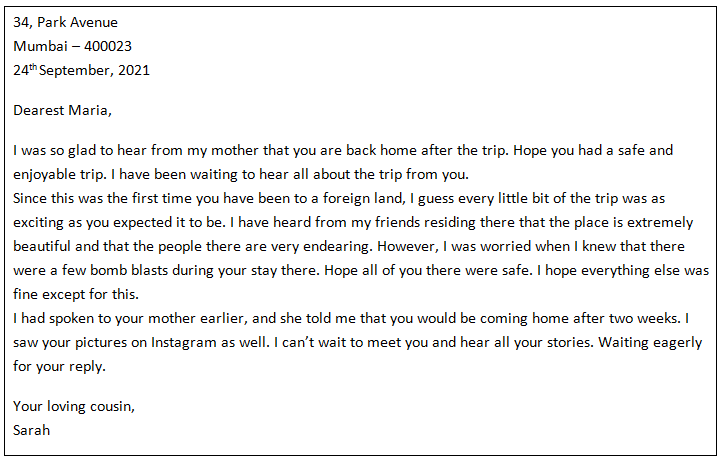
Example 1: Informal Letter: Letter to Your Cousin Enquiring about Her First Visit to Ethiopia
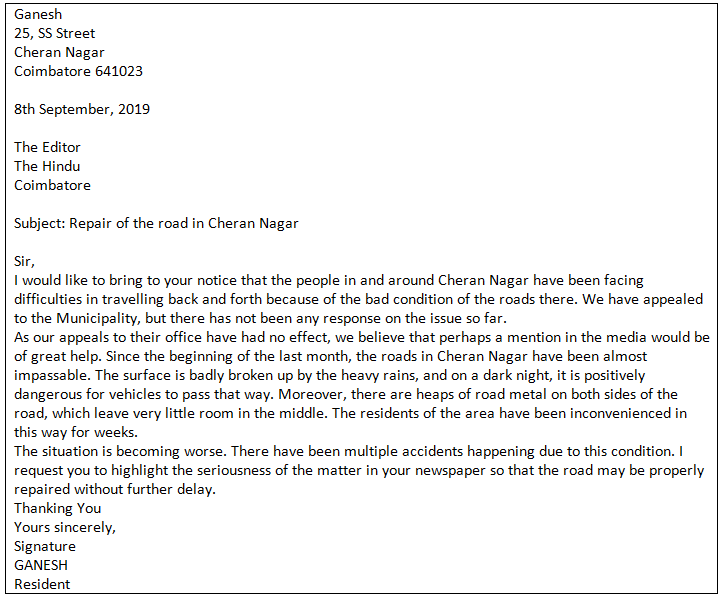
Example 2: Formal Letter: Letter to the Editor about a road that needs repair
The Future Perfect Continuous Tense is used to describe actions that will be ongoing up until a certain point in the future. This tense emphasizes the duration of an action that will continue until a specific time in the future.
Use of since and for
Since gives the starting point of actions, events or states. It refers to when things began.
Since + a point in time (in the past), until now.
We use For when we measure the duration – when we say how long something lasts.
For + a period of time.
Future Perfect Continuous Tense Formula for First Person Singular/ Plural, Second Person and Third Person Singular/Plural
The formula for Future Perfect Continuous Tense is as follows: I / We/ You/ They/ Common Noun/ Proper Noun + Will/ Shall + have been + verb (1st form) with ‘ing’+ object (optional)
Let us see some example sentences with formula for Future Perfect Continuous Tense:
1) I shall have been studying hard for my exam since Sunday. मैं रविवार से अपनी परीक्षा के लिए कड़ी मेहनत कर रहा हूँगा ।
2) We will have been going to work for 2 weeks. हम दो सप्ताह से काम पर जा रहे होंगे।
3) Ram will have been sleeping at 11 p.m since Saturday. राम शनिवार से रात ११ बजे सो रहा होगा ।
4) He will have been shopping for four hours. वह चार घंटे तक खरीदारी करता रहा होगा।
Negative Sentences For converting these sentences into negative sentences the formula is that you add ‘not’ before have been and the rest of the rule remains the same. I / We/ You/ They/ Common Noun/ Proper Noun + Will/ Shall + not + have been + verb (1st form) with ‘ing’+ object (optional)
Let us see some examples of negative sentences with the formula for Future Perfect Continuous Tense:
1) I shall not have been studying hard for my exam since Sunday. मैं रविवार से अपनी परीक्षा के लिए कठिन अध्ययन नहीं कर रहा हूँगा।
2) We will not have been going to work for 2 weeks. हम 2 सप्ताह से काम पर नहीं जा रहे होंगे ।
3) Ram will not have been sleeping at 11 p.m since Saturday. राम शनिवार से रात ११ बजे नहीं सो रहा होगा ।
Interrogative Sentences For converting these sentences into interrogative sentences the formula is that you add Will/ Shall at the start of the sentence followed by the subject and the rest of the rule remains the same. The sentence ends with a question mark (?).
Will/ Shall + I / We/ You/ They/ Common Noun/ Proper Noun + have been + verb (1st form) with ‘ing’+ object (optional)?
Let us see some examples of interrogative sentences with the formula for Future Perfect Continuous Tense:
1) Shall I have been studying hard for my exam since Sunday? क्या मैं रविवार से अपनी परीक्षा के लिए मेहनत कर रहा हूँगा?
2) Will we have been going to work for 2 weeks? क्या हम 2 सप्ताह से काम पर जा रहे होंगे?
3) Will Ram have been sleeping at 11 p.m since Saturday? क्या राम शनिवार से रात ११ बजे सो रहा होगा?
Negative Interrogative Sentences For converting these sentences into negative interrogative sentences the formula is that you add Will/ Shall at the start of the sentence, then the subject and then ‘not’ and the rest of the rule remains the same. The sentence ends with a question mark (?).
Will/ Shall + I / We/ You/ They/ Common Noun/ Proper Noun + not + have been + verb (1st form) with ‘ing’+ object (optional)?
Let us see some examples of interrogative sentences with the formula for Future Perfect Continuous Tense:
1) Shall I not have been studying hard for my exam since Sunday? क्या मैं रविवार से अपनी परीक्षा के लिए कठिन अध्ययन नहीं कर रहा हूँगा?
2) Will we not have been going to work for 2 weeks? क्या हम 2 सप्ताह से काम पर जा नहीं रहे होंगे?
3) Will Ram not have been sleeping at 11 p.m since Saturday? क्या राम शनिवार से रात ११ बजे नहीं सो रहा होगा?
Future Perfect Continuous Tense Exercises
Q. Translate the following sentences using the future perfect continuous tense exercises and check the answers. 1. स्वाति तीन घंटे से काम कर रही होगी। 2. वे सुबह से कड़ी मेहनत कर रहे होंगे। 3. वह दस दिनों से ऑफिस नहीं आ रही होगी? 4. क्या वे पंद्रह मिनट से नाच रहे होंगे? 5. क्या वह दो दिन से खा रहा होगा?
Answers: 1. Swati will have been working for three hours. 2. They will have been working hard since morning. 3. She will not have been coming to the office for ten days. 4. Will they have been dancing for fifteen minutes? 5. Will he have been eating for the last two days?
Future Perfect Tense indicates that an action will have been completed (finished or “perfected”) at some point in the future. It also denotes actions which will start and complete at defined point of time in the future.
Future Perfect Tense Formula for First Person Singular/ Plural, Second Person and Third Person Singular/ Plural
The formula for Future Perfect Tense is as follows: I / We/ You/ They/ Common Noun/ Proper Noun + Will/ Shall + have + verb (past participle form)+ object (optional)
Let us see some example of Future Perfect Tense sentences with a formula:
1) I shall have studied hard for my exam. मैंने अपनी परीक्षा के लिए कठिन अध्ययन कर लिया होगा ।
2) You will have gone to work. आप काम पर चले गए होंगे।
3) They will have slept at 11 p.m. वे 11 बजे सो गए होंगे।
Negative Sentences For converting these sentences into negative sentences the formula is that you add ‘not’ before the verb and the rest of the rule remains the same.
I / We/ You/ They/ Common Noun/ Proper Noun + Will/ Shall +have not + verb (3rd form) + object (optional)
Let us see some examples of negative sentences with the formula for Future Perfect Tense:
1) I shall have not studied hard for my exam. मैंने अपनी परीक्षा के लिए कठिन अध्ययन नहीं किया होगा ।
2) You will have not gone to work. आप काम पर नहीं गए होंगे।
3) They will have not slept at 11 p.m. वे रात 11 बजे नहीं सोए होंगे।
Interrogative Sentences For converting these sentences into interrogative sentences the formula is that you add ‘Will/ Shall’ at the start of the sentence followed by the subject and the rest of the rule remains the same. The sentence ends with a question mark (?).
Will/ Shall + I / We/ You/ They/ Common Noun/ Proper Noun + have + verb (3rd form) + object (optional)? Let us see some examples of interrogative sentences with the formula for Future Perfect Tense:
1) Shall I have studied hard for my exam? क्या मैंने अपनी परीक्षा के लिए कठिन अध्ययन कर लिया होगा ?
2) Will you have gone to work? क्या आप काम पर चले गए होंगे?
3) Will they have slept at 11 p.m? क्या वे 11 बजे सो गए होंगे?
Negative Interrogative Sentences For converting these sentences into negative interrogative sentences the formula is that you add Will/ Shall at the start of the sentence, then the subject and then ‘not be’ and the rest of the rule remains the same. The sentence ends with a question mark (?).
Will/ Shall + I / We/ You/ They/ Common Noun/ Proper Noun + not have + verb (3rd form) + object (optional)?
Let us see some examples of interrogative sentences with the formula for Future Perfect Tense:
1) Shall I not have studied hard for my exam? क्या मैंने अपनी परीक्षा के लिए कठिन अध्ययन नहीं कर लिया होगा?
2) Will you not have gone to work? क्या आप काम पर नहीं गए होंगे?
3) Will they not have slept at 11 p.m.? क्या वे रात 11 बजे नहीं सोए होंगे?
Future Perfect Tense Exercise
Q. Translate the following using the future perfect tense exercise and check answers. 1. वह खाना बना चुका होगा |
2. क्या हम सोमवार तक नये मकान में शिफ्ट कर चुके होंगे?
3. शाम अमेरिका से लौट चुका होगा।
4. कल उसने राम को तोहफ़ा दे दिया होगा।
5. तुम चार साल बाद विशेषज्ञ बन चुके होगे।
Answers: 1. He will have cooked food.
2. Shall we have shifted into the new house by Monday?
3. Sham will have returned from America.
4. He will have given the gift to Ram tomorrow.
5. You will have become a scientist after four years.
The future continuous tense indicates an action that will be ongoing at a specific point in the future. This tense is exclusively used with action verbs , which describe activities that occur over a period of time. Examples of action verbs include:
Running
Thinking
Seeing
Future Continuous Tense Formula for First Person Singular/ Plural, Second Person and Third Person Singular/Plural
The formula for Future Continuous Tense is as follows: I / We/ You/ They/ Common Noun/ Proper Noun + Will/ Shall + be + verb (1st form) with ‘ing’ + object (optional)
Let us see some example sentences with formula for Future Continuous Tense:
1) I shall be studying hard for my exam. मैं परीक्षा के लिए कठिन अध्ययन कर रहा हूँगा ।
2) He will be going to work next week. वह अगले सप्ताह काम करने जा रहा होगा ।
3) They will be sleeping till late on Saturday. वे शनिवार की देर रात तक सो रहे होंगे।
Negative Sentences For converting these sentences into negative sentences the formula is that you add ‘not’ before the verb and the rest of the rule remains the same.
I / We/ You/ They/ Common Noun/ Proper Noun + Will/ Shall + not be + verb (1st form) with ‘ing’ + object (optional)
Let us see some examples of negative sentences with the formula for Future Continuous Tense:
1) I shall not be studying hard for my exam on Sunday. मैं रविवार को अपनी परीक्षा के लिए कठिन अध्ययन नहीं कर रहा हूँगा।
2) He will not be going to work next week. वह अगले हफ्ते काम पर नहीं जा रहा होगा।
Interrogative Sentences For converting these sentences into interrogative sentences the formula is that you add Will/ Shall at the start of the sentence followed by the subject and the rest of the rule remains the same. The sentence ends with a question mark (?).
Will/ Shall + I / We/ You/ They/ Common Noun/ Proper Noun + be + verb (1st form) with ‘ing’ + object (optional)?
Let us see some examples of interrogative sentences with the formula for Future Continuous Tense:
1) Shall I be studying hard for my exam on Sunday?
क्या मैं रविवार को अपनी परीक्षा के लिए कठिन अध्ययन कर रहा हूँगा?
2) Will he be going to work next week? क्या वह अगले हफ्ते काम करने जा रहा होगा?
3) Will they be sleeping till late on Saturday? क्या वे शनिवार को देर रात तक सोते रहेंगे?
Negative Interrogative Sentences For converting these sentences into negative interrogative sentences the formula is that you add Will/ Shall at the start of the sentence, then the subject and then ‘not be’ and the rest of the rule remains the same. The sentence ends with a question mark (?).
Will/ Shall + I / We/ You/ They/ Common Noun/ Proper Noun + not be + verb (1st form) with ‘ing’ + object (optional)?
Let us see some examples of interrogative sentences with the formula for Future Continuous Tense:
1) Shall I not be studying hard for my exam on Sunday? क्या मैं रविवार को अपनी परीक्षा के लिए मेहनत नहीं कर रहा हूँगा?
2) Will he not be going to work next week? क्या वह अगले हफ्ते काम पर नहीं जा रहा होगा?
3) Will they not be sleeping till late on Saturday? क्या वे शनिवार को देर रात तक सोते नहीं रहेंगे?
Difference between ‘Will’ and ‘Shall’ The earlier rule of the American English was that ‘shall’ was used with the first person rules of tenses whereas ‘will’ was used with second and third person rules of tenses. For example:
1) I shall be going to the gym tomorrow. 2) They will be leaving for Delhi tomorrow.
But when a strong determination for something is to be expressed the use of ‘will’ and ‘shall’ is reversed. For example: 1) I will not go to the market. 2) You shall go to the party.
Although use of both these is interchangeable but ‘Shall’ is now used very rarely as ‘will’ has replaced its use.
Future Continuous Tense Exercise
Q. Translate the following sentences using future continuous tense exercise and check the answers. 1. क्या मोहन नहा रहा होगा?
2. चौकीदार रात को सो रहा होगा।
3. वह कल मिठाई बाँट रहा होगा।
4. सोहन अगले महीने इम्तेहान की तैयारी कर रहा होगा।