2. Tenses – Simple future Indefinite Tense

Definition: Simple Future Tense is used to express an action that will occur or happen in the future. The simple future tense refers to a time later than now, and expresses facts or certainty.

Simple Future Indefinite Tense Formula for First Person Singular/ Plural

The formula for Simple Future Indefinite Tense when the First Person is Singular or Plural is that the sentence starts with the subject i.e I/ We, then a verb in its 1st form, followed by an object which is optional.

So, we can say that the formula for Simple Future Indefinite Tense for First Person Singular is as follows: I/ We + shall + verb (1st form)+ object (optional)

Let us see some example sentences with formula for Simple Future Indefinite Tense when the First Person is Singular/ Plural:

1) I shall study hard for exams.
मैं परीक्षा के लिए कठिन अध्ययन करूँगा।

2) I shall go to work every day.
मैं हर दिन काम पर जाऊँगा।

3) We shall sleep late on Saturdays.
हम शनिवार को देर से सोएंगे।

For converting these sentences into negative sentences the formula is that you add ‘shall not’ before the root form of the verb and the rest of the rule remains the same.

I/ We + shall not + verb (1st form)+ object (optional)

Let us see some examples of negative sentences with the formula for Simple Future Tense when the First Person is Singular /Plural:

1) I shall not study hard for exams.
मैं परीक्षा के लिए कठिन अध्ययन नहीं करूँगा।

2) I shall not go to work everyday.
मैं रोज काम पर नहीं जाऊँगा।

For converting these sentences into interrogative sentences the formula is that you add Shall at the start of the sentence followed by Subject and the rest of the rule remains the same.

Shall + I/ We + verb (1st form)+ object (optional)?

Let us see some examples of interrogative sentences with the formula for Simple Future Tense when the Person is Singular/ Plural:

1) Shall I study hard for exams?
क्या मैं परीक्षा के लिए कठिन अध्ययन करूंगा?

2) Shall I go to work everyday?
क्या मैं रोज़ काम पर जाऊंगा?

3) Shall we sleep late on Saturdays?
क्या हम शनिवार को देर से सोएंगे ?

For converting these sentences into negative interrogative sentences the formula is that you add ‘Shall’ at the start of the sentence, then the subject and then ‘not’ and the rest of the rule remains the same.

Shall + I/ We + not + verb (1st form)+ object (optional)?

Let us see some examples of interrogative sentences with the formula for Simple Future Tense when the Person is Singular/ Plural:

1) Shall I not study hard for exams?
क्या मैं परीक्षा के लिए कठिन अध्ययन नहीं करूंगा?

2) Shall I not go to work everyday?
क्या मैं रोज़ काम पर नहीं जाऊंगा?Simple Future Tense Formula for Second Person, Third Person Singular/ Plural

The formula for Simple Future Tense when the Second Person, Third Person Singular/ Plural are involved is that the sentence starts with You/ He/ She/ Common or proper nouns/ They, with will and  then a verb in its 1st form followed by an object which is optional. So, we can say that the formula for Simple Future Tense for Second Person, Third Person Singular/ Plural is as follows: You/ He/ She/ Common or proper nouns/ They + will + verb (1st form)+ object (optional)

Let us see some example sentences with formula for Simple Future Tense when the Second Person, Third Person Singular/ Plural are involved:

1) You will study hard for exams.
आप परीक्षा के लिए कठिन अध्ययन करेंगे।

2) He will go to work every day.
वह प्रतिदिन काम पर जाएगा।

For converting these sentences into negative sentences the formula is that you add ‘not’ before the verb and the rest of the rule remains the same.

You/ He/ She/ Common or proper nouns/ They + will + not + verb (1st form)+ object (optional)

Let us see some examples of negative sentences with the formula for Simple Future Tense when the Second Person, Third Person Singular/Plural are involved:

1) You will not study hard for exams.
आप परीक्षा के लिए कठिन अध्ययन नहीं करेंगे।

2) He will not go to work everyday.
वह रोज काम पर नहीं जाएगा।

3) She will not sleep late on Saturdays.
वह शनिवार को देर से नहीं सोएगा।

For converting these sentences into interrogative sentences the formula is that you add ‘Will’  at the start of the sentence followed by the subject and the rest of the rule remains the same.

Will + [subject] + verb (root form) + object(optional)?

Let us see some examples of interrogative sentences with the formula for Simple Future Tense when the Second Person, Third Person Singular/Plural are involved:

1) Will you study hard for exams?
क्या आप परीक्षा के लिए कठिन अध्ययन करेंगे?

2) Will he go to work everyday?
क्या वह रोज़ काम पर जाएगा?

For converting these sentences into negative interrogative sentences the formula is that you add ’Will’ at the start of the sentence, then the subject and then ‘not’ and the rest of the rule remains the same.

Will + [subject] + not + verb (root form) + object (optional)?

Let us see some examples of interrogative sentences with the formula for Simple Future Tense when Second Person, Third Person Singular/Plural are involved:

1) Will you not study hard for exams?
क्या आप परीक्षा के लिए कठिन अध्ययन नहीं करेंगे?

2) Will he not go to work everyday?
क्या वह रोज़ काम पर नहीं जाएगा?

2. Tenses – Past Perfect Continuous Tense

Understanding the Past Perfect Continuous Tense

The Past Perfect Continuous Tense describes an action that began before a specific moment in the past and continued up until that moment.

Past Perfect Continuous Tense Formula for First Person Singular

The formula for Past Perfect Continuous Tense when the First Person is Singular is that the sentence starts with ‘I’ and ‘had been’, then a verb in its 1st form with ‘ing’, followed by an object which is optional.

So, we can say that the formula for Past Perfect Continuous Tense for First Person Singular is as follows: ‘I’ + had + been+ verb (1st  form) with ‘ing’ + object (optional)

Let us see some example sentences with formula for Past Perfect Continuous Tense when the First Person is Singular:

1) I had been studying hard for exams at that time.
तब मैं परीक्षा के लिए कठिन अध्ययन कर रहा था।

2) I had been eating food when she came .
जब वह आई तब मैं खाना खा रहा था।

3) I  had been sleeping when the bell rang.
जब घंटी बजी मैं सो रहा था।

Negative Sentences
For converting these sentences into negative sentences the formula is that you add ‘not’ before the 1st form of the verb and the rest of the rule remains the same.

‘I’ + ‘had’ + not + been + verb ( 1 st form) with ‘ing’ + object (optional)

Let us see some examples of negative sentences with the formula for Past Perfect Continuous Tense when the First Person is Singular:
1) I had not been studying hard for exams at that time.
तब मैं परीक्षा के लिए कठिन अध्ययन नहीं कर रहा था।

2) I had not been eating food when she came .
जब वह आई तब मैं खाना नहीं खा रहा था।

3) I  had not been sleeping when the bell rang.
जब घंटी बजी मैं नहीं सो रहा था ।

Interrogative Sentences
For converting these sentences into interrogative sentences the formula is that you add ‘Had’ at the start of the sentence followed by the subject  and the rest of the rule remains the same.

Had + [subject] + been + verb (1st form) with+ object (optional)?

Let us see some examples of interrogative sentences with the formula for Past Perfect Continuous Tense when the Person is Singular:

1) Had I been studying hard for exams?
क्या मैं परीक्षा के लिए कठिन अध्ययन कर रहा था?

2) Had I been eating food when she came?
क्या जब वह आई तब मैं खाना खा रहा था?

3) Had I been sleeping when the bell rang?
क्या जब घंटी बजी, मैं सो रहा था?

Negative Interrogative Sentences
For converting these sentences into negative interrogative sentences the formula is that you add ‘Had ’at the start of the sentence, then the subject and then ‘not’ and the rest of the rule remains the same.

had + [subject] + not  been+ verb (1st form) with ing+ object (optional)?

Let us see some examples of interrogative sentences with the formula for Past Perfect Continuous Tense when the Person is Singular:

1) Had I not been studying hard for exams?
क्या मैं परीक्षा के लिए कठिन अध्ययन नहीं कर रहा था?

2) Had I not been eating food when she came?
क्या जब वह आई तब मैं खाना नहीं खा रहा था?

3) Had I not been sleeping when the bell rang?
क्या जब घंटी बजी, मैं सो नहीं रहा था?

Past Perfect Continuous Tense Formula for First Person Plural

The formula for Past Perfect Continuous Tense when the First Person is Plural are that the sentence starts with ‘We’ and had been, then a verb in its 1st form followed by an object which is optional. So, we can say that the formula for Past Perfect Continuous Tense for First Person Plural is as follows –

‘We’ + had + been+ verb(1st  form) with ‘ing’ + object (optional)

Let us see some example sentences with formula for Past Perfect Continuous Tense when the First Person is Plural:

1) We had been studying hard for exams at that time.
तब हम  परीक्षा के लिए कठिन अध्ययन कर रहे थे।

2) We had been eating food when she came .
जब वह आई तब हम खाना खा रहे थे।

3) We had been sleeping when the bell rang.
जब घंटी बजी हम सो रहे थे ।

Negative Sentences
For converting these sentences into negative sentences the formula is that you add ‘not been’ before the verb and the rest of the rule remains the same.

‘We’ + had + not been + verb (1st  form) with ‘ing’ + object (optional).

Let us see some examples of negative sentences with the formula for Past Perfect Continuous Tense when the First Person is Plural:

1) We had not been studying hard for exams at that time.
तब हम परीक्षा के लिए कठिन अध्ययन नहीं कर रहे थे।

2) We had not been eating food when she came .
जब वह आई तब हम खाना नहीं खा रहे थे।

3) We had not been sleeping when the bell rang.

जब घंटी बजी, हम सो नहीं रहे थे ।

Interrogative Sentences
For converting these sentences into interrogative sentences the formula is that you add ‘had’  at the start of the sentence followed by the subject and the rest of the rule remains the same.

had +  We been + verb (1st  form) with ‘ing’ + object (optional)?

Let us see some examples of interrogative sentences with the formula for Past Perfect Continuous Tense when the Third Person is Plural:

1) Had we been studying hard for exams at that time?
क्या तब हम परीक्षा के लिए कठिन अध्ययन कर रहे थे?

2) Had we been eating food when she came?
क्या  जब वह आई तब हम खाना खा रहे थे?

3) Had we been sleeping when the bell rang?
क्या जब घंटी बजी, हम सो रहे थे ?

Negative Interrogative Sentences
For converting these sentences into negative interrogative sentences the formula is that you add ’had’ at the start of the sentence, then the subject and then ‘not been’ and the rest of the rule remains the same.

Had + [subject] + not been+ verb (1st form) with ing+ object (optional)?

Let us see some examples of negative interrogative sentences with the formula for Past Perfect Continuous Tense when the Third Person is Plural:

1) Had we not been studying hard for exams at that time?
क्या तब हम परीक्षा के लिए कठिन अध्ययन नहीं कर रहे थे?

2) Had we not been eating food when she came?
क्या जब वह आई तब हम खाना नहीं खा रहे थे?

3) Had we not been sleeping when the bell rang?
क्या जब घंटी बजी, हम सो नहीं रहे थे?

Past Perfect Continuous Tense Formula for Second Person

The formula for Past Perfect Continuous Tense when there is a Second Person involved are that the sentence starts with ‘you’ and ‘had been’, then a verb in its 1st  form with ing, followed by an object which is optional.

So, we can say that the formula for Past Perfect Continuous Tense when a Second Person is involved is as follows:

‘You’ + had + been+ verb (1st  form) with ‘ing’ + object (optional)

Let us see some example sentences with formula for Past Perfect Continuous Tense when a Second Person is involved:

1) You had been studying hard for exams at that time.
तब आप परीक्षा के लिए कठिन अध्ययन कर रहे थे।

2) You had been eating food when she came .
जब वह आई तब आप खाना खा रहे थे।

3) You had been sleeping when the bell rang.
जब घंटी बजी आप सो रहे थे ।

Negative Sentences
For converting these sentences into negative sentences the formula is that you add ‘had not’ before the verb and the rest of the rule remains the same.

‘You’ + had + not been+ verb (1st  form) with ‘ing’ + object (optional)

Let us see some examples of negative sentences with the formula for Past Perfect Continuous Tense when there is a second person:

1) You had not been studying hard for exams at that time.
तब आप परीक्षा के लिए कठिन अध्ययन नहीं कर रहे थे।

2) You had not been eating food when she came .
जब वह आई तब आप खाना नहीं खा रहे थे।

3) You had not been sleeping when the bell rang.
जब घंटी बजी आप सो नहीं रहे थे ।

Interrogative Sentences
For converting these sentences into interrogative sentences the formula is that you add ‘had’  at the start of the sentence followed by ‘you been’ and the rest of the rule remains the same.

Had + you + been+ verb (1st  form) with ‘ing’ + object (optional)?

Let us see some examples of interrogative sentences with the formula for Past Perfect Continuous Tense when there is a Second Person Involved:

1) Had you been studying hard for exams?
क्या आप परीक्षा के लिए कठिन अध्ययन कर रहे थे?

2) Had you been eating food when she came?
क्या जब वह आई तब आप खाना खा रहे थे?

3) Had you been sleeping when the bell rang?
क्या जब घंटी बजी, आप सो रहे थे?

Negative Interrogative Sentences
For converting these sentences into negative interrogative sentences the formula is that you add ‘Had’ at the start of the sentence, then the subject and then ‘not’ and the rest of the rule remains the same.

Had + you + not been + verb(1st  form) with ing+ object (optional)?

Let us see some examples of interrogative sentences with the formula for Past Perfect Continuous Tense when there is a second person involved:

1) Had you not been studying hard for exams?
क्या आप परीक्षा के लिए कठिन अध्ययन नहीं कर रहे थे?

2) Had you not been eating food when she came?
क्या जब वह आई तब आप खाना नहीं खा रहे थे?

3) Had you not been sleeping when the bell rang?
क्या जब घंटी बजी, आप सो नहीं रहे थे?

Past Perfect Continuous Tense Formula for Third Person Singular

The formula for Past Perfect Continuous Tense when the Third Person is Singular are that the sentence starts with He, She, Common noun or proper noun with ‘had’, then a verb in its 1st form with ing  followed by an object which is optional.

So, we can say that the formula for Past Perfect Continuous Tense for Third Person Singular is as follows:

He/ She/ Common Nouns/ Proper Nouns + had + been+ verb(1st  form) with ‘ing’ + object (optional)

Let us see some example sentences with formula for Past Perfect Continuous Tense when the Third Person is Singular:

1) He had been studying hard for exams at that time.
तब वह परीक्षा के लिए कठिन अध्ययन कर रहा था।

2) Ram had been eating food when she came .
जब वह आई तब राम खाना खा रहा था।

3) She had been sleeping when the bell rang.
जब घंटी बजी वह सो रही थी ।

Negative Sentences
For converting these sentences into negative sentences the formula is that you add ‘not’ before the verb and the rest of the rule remains the same.

He/ She/ Common Nouns/ Proper Nouns + had + not been+ verb (1st  form) with ‘ing’ + object (optional)

Let us see some examples of negative sentences with the formula for Past Perfect Continuous Tense when the Third Person is Singular:

1) He had not been studying hard for exams at that time.
तब वह परीक्षा के लिए कठिन अध्ययन नहीं कर रहा था।

2) Ram had not been eating food when she came .
जब वह आई तब राम खाना नहीं खा रहा था।

3) She had not been sleeping when the bell rang.
जब घंटी बजी वह सो नहीं रही थी ।

Interrogative Sentences
For converting these sentences into interrogative sentences the formula is that you add ‘had’ at the start of the sentence followed by He/ She/ Common Nouns/ Proper Nouns and the rest of the rule remains the same.

Had + subject( He/ She / Common Nouns / Proper Nouns) + been + verb (1st form) with ‘ing’+ object (optional)?

Let us see some examples of interrogative sentences with the formula for Past Perfect Continuous Tense when the Third Person is Singular:

1) Had he been studying hard for exams at that time?
क्या तब वह परीक्षा के लिए कठिन अध्ययन कर रहा था?

2) Had Ram been eating food when she came?
क्या जब वह आई तब राम खाना खा रहा था?

3) Had she been sleeping when the bell rang?
क्या जब घंटी बजी वह सो रही थी ?

Negative Interrogative Sentences

For converting these sentences into negative interrogative sentences the formula is that you add ‘Had’ at the start of the sentence, then the subject and then ‘not’ and the rest of the rule remains the same.

Had + subject (He/ She/ Common Nouns/ Proper Nouns) + not been + verb (1st form) with ‘ing’+ object (optional)?

Let us see some examples of negative interrogative sentences with the formula for Past Perfect Continuous Tense when the Third Person is Singular:

1) Had he not been studying hard for exams at that time?
क्या तब वह परीक्षा के लिए कठिन अध्ययन नहीं कर रहा था?

2) Had Ram not been eating food when she came?
क्या जब वह आई तब राम खाना नहीं खा रहा था?

3) Had she not been sleeping when the bell rang?
क्या जब घंटी बजी वह सो नहीं रही थी ?

Past Perfect Continuous Tense Formula for Third Person Plural

The formula for Past Perfect Continuous Tense when the Third Person is Plural are that the sentence starts with ‘They’ or common nouns and ‘had’, then a verb in its 1st form followed by an object which is optional

So, we can say that the formula for Past Perfect Continuous Tense for Third Person Plural is as follows: They/ Common Nouns + had been + verb (1st form) with ‘ing’+ object (optional)

Let us see some example sentences with formula for Past Perfect Continuous Tense when the Third Person is Plural:

1) They had been studying hard for exams at that time.
तब वे  परीक्षा के लिए कठिन अध्ययन कर रहे थे।

2) Boys had been eating food when she came .
जब वह आई तब लड़के खाना खा रहे थे।

3) They had been sleeping when the bell rang.
जब घंटी बजी वे  सो रहे थे ।

Negative Sentences
For converting these sentences into negative sentences the formula is that you add ‘not been’ before the verb and the rest of the rule remains the same.

They/ Common Nouns + had + not been + verb (1st form) with ‘ing’+ object (optional)

Let us see some examples of negative sentences with the formula for Past Perfect Continuous Tense when the Third Person is Plural:

1) They had not been studying hard for exams at that time.
तब वे  परीक्षा के लिए कठिन अध्ययन नहीं कर रहे थे।

2) Boys had not been eating food when she came.
जब वह आई तब लड़के खाना नहीं खा रहे थे।

3) They had not been sleeping when the bell rang.
जब घंटी बजी वे  सो नहीं रहे थे ।

Interrogative Sentences
For converting these sentences into interrogative sentences the formula is that you add ‘Had’ at the start of the sentence followed by ‘They/ Common nouns’ and the rest of the rule remains the same.

Had + they/ common nouns + been+ verb (1st form) with ing + object (optional)?

Let us see some examples of interrogative sentences with the formula for Past Perfect Continuous Tense when the Third Person is Plural:

1) Had they been studying hard for exams at that time?
क्या तब वे  परीक्षा के लिए कठिन अध्ययन कर रहे थे?

2) Had boys been eating food when she came?
क्या जब वह आई तब लड़के खाना खा रहे थे?

3) Had they been sleeping when the bell rang?
क्या जब घंटी बजी वे  सो रहे थे?

Negative Interrogative Sentences
For converting these sentences into negative interrogative sentences the formula is that you add ‘Had’ at the start of the sentence, then the subject and then ‘not’ and the rest of the rule remains the same.

Had + they/ common nouns + not  been+ verb (1st form) with + object (optional)?

Let us see some examples of negative interrogative sentences with the formula for Past Perfect Continuous Tense when the Third Person is Plural:

1) Had they not been studying hard for exams at that time?
क्या तब वे  परीक्षा के लिए कठिन अध्ययन नहीं कर रहे थे?

2) Had boys not been eating food when she came?
क्या जब वह आई तब लड़के खाना नहीं  खा रहे थे?

3) Had they not been sleeping when the bell rang?
क्या जब घंटी बजी वे  सो नहीं  रहे थे?

PAST PERFECT CONTINUOUS TENSE EXERCISES

Q. Translate the following sentences in past perfect continuous tense exercises and check the answers.
1. क्या मैं चार बजे से सो रही थी?

2. हम चार दिनों से रोटी नहीं खा रहे थे।

3. सुबह से बारिश हो रही थी।

4. रीटा पाँछ वर्षों से नृत्य सीख रही थी।

5. वे १९८४ से इस घर में रह रहे थे।

 Answers:
1. Had I been sleeping since four o’clock?

2. We had not been eating food for four days.

3. It had been raining since morning.

4. Rita had been learning dance for five years.

5. They had been living in this house since 1984.

2. Tenses – Past Perfect Tense

Understanding the Past Perfect Tense

The Past Perfect Tense is used to indicate that an action was completed at a certain point in the past before another action took place.

Past Perfect Tense Formula for First Person Singular

The formula for Past Perfect Tense when the First Person is Singular is that the sentence starts with ‘I’ and ‘had’ , then a verb in its 3rd form, followed by an object which is optional.

So, we can say that the formula for Past Perfect Tense for First Person Singular is as follows: ‘I’ + had + verb(3rd  form) + object (optional)

Let us see some example sentences with formula for Past Perfect Tense when the First Person is Singular:

1) I had studied hard for exams.
मैं परीक्षा के लिए कड़ी मेहनत कर चुका था।

2) I had gone to work.
मैं काम पर जा चुका था ।

3) I  had slept late on Saturday.
मैं शनिवार को देर से सोया था।

Negative Sentences
For converting these sentences into negative sentences the formula is that you add ‘not’ before the 3rd form of the verb and the rest of the rule remains the same.

‘I’ + ‘had’+ not + verb (3rd form) + object (optional)

Let us see some examples of negative sentences with the formula for Past Perfect Tense when the First Person is Singular:

1) I had not studied hard for exams.
मैं परीक्षा के लिए कड़ी मेहनत नहीं कर चुका था।

2) I had not gone to work.
मैं काम पर नहीं जा चुका था ।

Interrogative Sentences
For converting these sentences into interrogative sentences the formula is that you add ‘was’ at the start of the sentence followed by the subject and the rest of the rule remains the same.

Had + [subject] + verb (3rd form)+ object(optional)?

Let us see some examples of interrogative sentences with the formula for Past Perfect Tense when the Person is Singular:
1) Had I studied hard for exams?

क्या मैंने परीक्षा के लिए कठिन अध्ययन किया था?

2) Had I gone to work every day?
क्या मैं हर दिन काम करने गया था?

Negative Interrogative Sentences
For converting these sentences into negative interrogative sentences the formula is that you add ‘Had ’at the start of the sentence, then the subject and then ‘not’ and the rest of the rule remains the same.

had + [subject] + not + verb (3rd form) + object (optional)?

Let us see some examples of interrogative sentences with the formula for Past Perfect Tense when the Person is Singular:

1) Had I not  studied hard for exams?
क्या मैंने परीक्षा के लिए कठिन अध्ययन नहीं किया था?

2) Had I not  gone to work?

क्या मैं काम पर नहीं गया था?

3) Had I not slept late on Saturday?
क्या मैं शनिवार को देर से नहीं सोया था?

Past Perfect Tense Formula for First Person Plural

The formula for Past Perfect Tense when the First Person is Plural are that the sentence starts with ‘We’ and had, then a verb in its 3rd form followed by an object which is optional. So, we can say that the formula for Past Perfect Tense for First Person Plural is as follows: ‘We’ + had + verb (3rd form) + object (optional)

Let us see some example sentences with formula for Past Perfect Tense when the First Person is Plural:
1) We had studied hard for exams.

हमने परीक्षा के लिए कठिन अध्ययन किया था।

2) We had gone to work.
हम काम पर गए थे।

3) We had slept late on Saturday.
हम शनिवार को देर से सोए थे।

Negative Sentences
For converting these sentences into negative sentences the formula is that you add ‘not’ before the verb and the rest of the rule remains the same.

We’ + had + not + verb(3rd  form) + object (optional)

Let us see some examples of negative sentences with the formula for Past Perfect Tense when the First Person is Plural:

1) We had not studied hard for exams.
हमने परीक्षा के लिए कठिन अध्ययन नहीं किया था।

2) We had not gone to work.
हम काम पर नहीं गए थे।

Interrogative Sentences
For converting these sentences into interrogative sentences the formula is that you add ‘had’  at the start of the sentence followed by the subject and the rest of the rule remains the same.

Had + [subject] + verb (3rd form) + object (optional)?

Let us see some examples of interrogative sentences with the formula for Past Perfect Tense when the Third Person is Plural:
1) Had we studied hard for exams?
क्या हमने परीक्षा के लिए कड़ी मेहनत की थी?

2) Had we gone to work?
क्या हम काम पर गए थे?

Negative Interrogative Sentences
For converting these sentences into negative interrogative sentences the formula is that you add ’had’ at the start of the sentence, then the subject and then ‘not’ and the rest of the rule remains the same.

Had + [subject] + not + verb (3rd  form)+ object (optional)?

Let us see some examples of interrogative sentences with the formula for Past Perfect Tense when the Third Person is Plural:
1) Had we not studied hard for exams?

क्या हमने परीक्षा के लिए कठिन अध्ययन नहीं किया था?

2) Had we not gone to work?
क्या हम काम पर नहीं गए थे?

3) Had we not slept late on Saturday?
क्या हम शनिवार को देर से नहीं सोए  थे?

Past Perfect Tense Formula for Second Person

The formula for Past Perfect Tense when there is a Second Person involved are that the sentence starts with ‘you’ and ‘had’, then a verb in its 3rd form, followed by an object which is optional.

So, we can say that the formula for Past Perfect Tense when a Second Person is involved is as follows: ‘You’ + had + verb (3rd form) + object (optional)

Let us see some example sentences with formula for Past Perfect Tense when a Second Person is involved:

1) You had studied hard for exams.
आपने परीक्षा के लिए कठिन अध्ययन किया था।

2) You had gone to work.
तुम काम पर गए थे।

3) You had slept late on Saturday.
आप शनिवार को देर से सोए थे।

Negative Sentences
For converting these sentences into negative sentences the formula is that you add ‘had not’ before the verb and the rest of the rule remains the same.

‘You’ + had + not + verb (3rd  form) + object (optional)

Let us see some examples of negative sentences with the formula for Past Perfect Tense when there is a second person:
1) You had not studied hard for exams
आपने परीक्षा के लिए कठिन अध्ययन नहीं किया था

2) You had not gone to work.
आप काम पर नहीं गए थे।

3) You had not slept late on Saturday.
आप शनिवार को देर से नहीं सोए थे।

Interrogative Sentences 
For converting these sentences into interrogative sentences the formula is that you add ‘had’  at the start of the sentence followed by ‘you’ and the rest of the rule remains the same.

Had + you + verb (3rd  form) + object (optional)?

Let us see some examples of interrogative sentences with the formula for Past Perfect Tense when there is a Second Person Involved:

1) Had you studied hard for exams?
क्या आपने परीक्षा के लिए कठिन अध्ययन किया था?

2) Had you gone to work?
क्या आप काम पर गए थे?

3) Had you slept late on Saturday?
क्या आप शनिवार को देर से सोए थे?

Negative Interrogative Sentences
For converting these sentences into negative interrogative sentences the formula is that you add ‘Had’ at the start of the sentence, then the subject and then ‘not’ and the rest of the rule remains the same.

Had + you + not + verb(3rd  form) + object (optional)?

Let us see some examples of interrogative sentences with the formula for Past Perfect Tense when there is a second person involved:

1) Had you not studied hard for exams?
क्या आपने परीक्षा के लिए कठिन अध्ययन नहीं किया था?

2) Had you not gone to work?
क्या आप काम पर नहीं गए थे?

Past Perfect Tense Formula for Third Person Singular

The formula for Past Perfect Tense when the Third Person is Singular are that the sentence starts with He, She, Common noun or proper noun with ‘had’, then a verb in its 3rd form with   followed by an object which is optional.

So, we can say that the formula for Past Perfect Tense for Third Person Singular is as follows: He/ She/ Common Nouns/ Proper Nouns + had + verb (3rd  form) + object (optional)

Let us see some example sentences with formula for Past Perfect Tense when the Third Person is Singular:

1) He had studied hard for exams.
उन्होंने परीक्षा के लिए कड़ी मेहनत से पढ़ाई की थी।

2) Father had gone to work.
पिता काम पर गए थे।

Negative Sentences
For converting these sentences into negative sentences the formula is that you add ‘not’ before the verb and the rest of the rule remains the same.

He/ She/ Common Nouns/ Proper Nouns + had + not + verb(3rd form) + object (optional)

Let us see some examples of negative sentences with the formula for Past Perfect Tense when the Third Person is Singular:

1) He had not studied hard for exams
उन्होंने परीक्षा के लिए कठिन अध्ययन नहीं किया था

2) He had not gone to work.
वह काम पर नहीं गया था।

Interrogative Sentences
For converting these sentences into interrogative sentences the formula is that you add ‘had’ at the start of the sentence followed by He/ She/ Common Nouns/ Proper Nouns and the rest of the rule remains the same.

Had + subject (He/ She/ Common Nouns/ Proper Nouns) + verb (root form) + object(optional)

Let us see some examples of interrogative sentences with the formula for Past Perfect Tense when the Third Person is Singular:

1) Had he studied hard for exams?
क्या उसने परीक्षा के लिए कठिन अध्ययन किया था?

2) Had father gone to work?
क्या पिताजी काम पर गए थे?

Negative Interrogative Sentences
For converting these sentences into negative interrogative sentences the formula is that you add ‘Had’ at the start of the sentence, then the subject and then ‘not’ and the rest of the rule remains the same.

Had+ [subject] + not + verb (3rd form)  + object(optional)

Let us see some examples of interrogative sentences with the formula for Past Perfect Tense when the Third Person is Singular:

1) Had he not studied hard for exams?
क्या उसने परीक्षा के लिए कठिन अध्ययन नहीं किया था?

2) Had father not gone to work?
क्या पिताजी काम पर नहीं गए थे?

Past Perfect Tense Formula for Third Person Plural

The formula for Past Perfect Tense when the Third Person is Plural are that the sentence starts with ‘They’ or common nouns and had , then a verb in its 3rd form followed by an object which is optional

So, we can say that the formula for Past Perfect Tense for Third Person Plural is as follows: They/ Common Nouns + had + verb (3rd  form) + object (optional)

Let us see some example sentences with formula for Past Perfect Tense when the Third Person is Plural:

1) They had studied hard for exams.
उन्होंने परीक्षा के लिए कठिन अध्ययन किया था।

2) Boys had gone to work.
लड़के काम पर गए थे।

Negative Sentences
For converting these sentences into negative sentences the formula is that you add ‘not’ before the verb and the rest of the rule remains the same.

They/ Common Nouns + had + ‘not’ + verb(3rd  form) + object (optional)

Let us see some examples of negative sentences with the formula for Past Perfect Tense when the Third Person is Plural:

1) They had not studied hard for exams

उन्होंने परीक्षा के लिए कठिन अध्ययन नहीं किया था

2) They had not gone to work.
वे काम पर नहीं गए थे।

3) They had not slept late on Saturday.
वे शनिवार को देर से नहीं सोए थे।

Interrogative Sentences
For converting these sentences into interrogative sentences the formula is that you add ‘Had’ at the start of the sentence followed by ‘They/ Common nouns’ and the rest of the rule remains the same.

Had + they/ common nouns + verb (3rd form) + object (optional) ?

Let us see some examples of interrogative sentences with the formula for Past Perfect Tense when the Third Person is Plural:

1) Had they studied hard for exams?

क्या उन्होंने परीक्षा के लिए कठिन अध्ययन किया था?

2) Had they gone to work?

क्या वे काम पर गए थे?

Negative Interrogative Sentences
For converting these sentences into negative interrogative sentences the formula is that you add ‘Had’ at the start of the sentence, then the subject and then ‘not’ and the rest of the rule remains the same.
Had + they/ common nouns + not + verb (3rd form) + object (optional)?

Let us see some examples of interrogative sentences with the formula for Past Perfect Tense when the Third Person is Plural:
1) Had they not studied hard for exams?
क्या उन्होंने परीक्षा के लिए कठिन अध्ययन नहीं किया था?

2) Had they not gone to work?
क्या वे काम पर नहीं गए थे?Past Perfect Tense Exercises

Q. Translate the following sentences using the Past Perfect Tense exercises and the answers follow:
1. मैं टेलीविज़न  देख  चुकी  थी।
2. हम खाना पहले ही खा चुके थे
3.  वह मेरे उठने से पहले ही  जा चुका था।
4. वे गाना गा  चुके थे।
5. क्या हम कपड़े धो चुके थे?

Answers:
1. I had watched television.
2. We had already eaten our meal.
3. He had left before I woke up.
4. They had sung the song.
5. Had we washed the clothes?

2. Tenses – Simple Past Indefinite Tense

Understanding the Simple Past Tense

The  simple past tense  is used to describe actions that were completed in the past, before the present time. This tense is the fundamental way to express past actions in English.

Simple Past Indefinite Tense Formula for First Person Singular

The formula for Simple Past Tense when the First Person is Singular is that the sentence starts with ‘I’ , then a verb in its 3rd form, followed by an object which is optional.

So, we can say that the formula for Simple Past Tense for First Person Singular is as follows: ‘I’ + verb(3rd form)+ object (optional).

Let us see some example sentences with formula for Simple Past Tense when the First Person is Singular:
1) I studied hard for exams.
मैंने परीक्षा के लिए कड़ी मेहनत की।

2) I went to work every day.
मैं हर दिन काम पर गया।

Negative Sentences
For converting these sentences into negative sentences the formula is that you add ‘did not’ before the root form of the verb and the rest of the rule remains the same.

‘I’ + did not + verb (root form) + object (optional)

Let us see some examples of negative sentences with the formula for Simple Past Tense when the First Person is Singular:
1) I did not study hard for exams.
मैंने परीक्षा के लिए कठिन अध्ययन नहीं किया।

2) I did not go to work everyday.
मैं रोज काम पर नहीं जाता था।

Interrogative Sentences
For converting these sentences into interrogative sentences the formula is that you add ‘did’ at the start of the sentence followed by ‘I’ and the rest of the rule remains the same. The sentence ends with a question mark ‘?’.

did + [subject] + verb (root form) + object(optional)?

Let us see some examples of interrogative sentences with the formula for Simple Past Tense when the Person is Singular:

1) Did I study hard for exams?
क्या मैंने परीक्षा के लिए कठिन अध्ययन किया?

2) Did I go to work everyday?
क्या मैं रोज़ काम पर जाता था?

Negative Interrogative Sentences
For converting these sentences into negative interrogative sentences the formula is that you add ‘did’ at the start of the sentence, then the subject and then ‘not’ and the rest of the rule remains the same. The sentence ends with a question mark ‘?’.

did + [subject] + not + verb (root form) + object(optional)?

Let us see some examples of interrogative sentences with the formula for Simple Past Tense when the Person is Singular:

1) Did I not study hard for exams?
क्या मैंने परीक्षा के लिए कठिन अध्ययन नहीं किया?

2) Did I not go to work everyday?
क्या मैं रोज़ काम पर नहीं जाता था?

Simple Past Tense Formula for First Person Plural

The formula for Simple Past Tense when the First Person is Plural are that the sentence starts with ‘We’, then a verb in its 3rd form  followed by an object which is optional.

So, we can say that the formula for Simple Past Tense for First Person Plural is as follows:

‘We’+ verb (3rd form) + object (optional)

Let us see some example sentences with formula for Simple Past Tense when the First Person is Plural:

1) We studied hard for exams.
हमने परीक्षा के लिए कड़ी मेहनत की।

2) We went to work every day.
हम हर दिन काम पर गए।

Negative Sentences
For converting these sentences into negative sentences the formula is that you add ‘not’ before the verb and the rest of the rule remains the same.

‘We’ + did not + verb (root form) + object (optional).
Let us see some examples of negative sentences with the formula for Simple Past Tense when the First Person is Plural:

1) We did not study hard for exams.
हमने परीक्षा के लिए कठिन अध्ययन नहीं किया।

2) We did not go to work everyday.
हम रोज़ काम पर नहीं जाते थे।

Interrogative Sentences
For converting these sentences into interrogative sentences the formula is that you add ‘did’  at the start of the sentence followed by ‘we’ and the rest of the rule remains the same. The sentence ends with a question mark ‘?’.

did + [subject] + verb (root form) + object(optional)?

Let us see some examples of interrogative sentences with the formula for Simple Past Tense when the Third Person is Plural:

1) Did we study hard for exams?
क्या हमने परीक्षा के लिए कठिन अध्ययन किया?

2) Did we go to work everyday?
क्या हम रोज़ काम पर जाते थे?

Negative Interrogative Sentences
For converting these sentences into negative interrogative sentences the formula is that you add ’did’ at the start of the sentence, then the subject and then ‘not’ and the rest of the rule remains the same. The sentence ends with a question mark ‘?’.

Did + [subject] + not + verb (root form) + object(optional)?

Let us see some examples of interrogative sentences with the formula for Simple Past Tense when the Third Person is Plural:

1) Did we not study hard for exams?
क्या हमने परीक्षा के लिए कठिन अध्ययन नहीं किया?

2) Did we not go to work everyday?
क्या हम रोज़ काम पर नहीं जाते थे?

Simple Past Tense Formula for Second Person

The formula for Simple Past Tense when there is a Second Person involved are that the sentence starts with ‘you’, then a verb in its 3rd form, followed by an object which is optional.

So, we can say that the formula for Simple Past Tense when a Second Person is involved is as follows: ‘you’+ verb(3rd form)+ object (optional)

Let us see some example sentences with formula for Simple Past Tense when a Second Person is involved:

1) You studied hard for exams.
आपने परीक्षा के लिए कठिन अध्ययन किया।

2) You went to work every day.
आप हर दिन काम पर गए।

Negative Sentences
For converting these sentences into negative sentences the formula is that you add ‘did not’ before the verb and the rest of the rule remains the same.

‘You’ + did not + verb (root form) + object (optional)

Let us see some examples of negative sentences with the formula for Simple Past Tense when there is a second person:

1) You did not study hard for exams
आपने परीक्षा के लिए कठिन अध्ययन नहीं किया।

2) You did not go to work everyday.
आप रोज काम पर नहीं जाते थे।

3) You did not sleep late on Saturdays.
आप शनिवार को देर से नहीं सोते थे ।

Interrogative Sentences
For converting these sentences into interrogative sentences the formula is that you add did  at the start of the sentence followed by ‘you’ and the rest of the rule remains the same. The sentence ends with a question mark “?”.

Did + [subject] + verb (root form) + object(optional)?

Let us see some examples of interrogative sentences with the formula for Simple Past Tense when there is a Second Person Involved:

1) Did you study hard for exams?
क्या आपने परीक्षा के लिए कठिन अध्ययन किया?

2) Did you go to work everyday?
क्या आप रोज़ काम पर जाते थे?

Negative Interrogative Sentences
For converting these sentences into negative interrogative sentences the formula is that you add ‘Did’ at the start of the sentence, then the subject and then ‘not’ and the rest of the rule remains the same. The sentence ends with a question mark “?”.

Did + [subject] + not + verb (root form) + object(optional)?

Let us see some examples of interrogative sentences with the formula for Simple Past Tense when there is a second person involved:

1) Did you not study hard for exams?
क्या आपने परीक्षा के लिए कठिन अध्ययन नहीं किया?

 2) Did you not go to work everyday?
क्या आप रोज़ काम पर नहीं जाते थे?

Simple Past Tense Formula for Third Person Singular

The formula for Simple Past Tense when the Third Person is Singular  is that the sentence starts with He, She, Common noun or proper noun, then a verb in its 3rd form followed by an object which is optional.

So, we can say that the formula for Simple Past Tense for Third Person Singular is as follows: He/ She/ Common Nouns/ Proper Nouns + verb(3rd form)+ object (optional)

Let us see some example sentences with formula for Simple Past Tense when the Third Person is Singular:

1) He  studied hard for exams.
उन्होंने परीक्षा के लिए कड़ी मेहनत की।

2) Father went to work every day.
पिता रोज काम पर जाते थे।

3) Ram slept late on Saturdays.
राम शनिवार की देर रात को सोया था।

Interrogative Sentences
For converting these sentences into interrogative sentences the formula is that you add did  at the start of the sentence followed by He/ She/ Common Nouns/ Proper Nouns and the rest of the rule remains the same. The sentence ends with a question mark ‘?’.

Did + subject( He/ She/ Common Nouns/ Proper Nouns) + verb (root form) + object(optional)?

Let us see some examples of interrogative sentences with the formula for Simple Past Tense when the Third Person is Singular:

1) Did he study hard for exams?
क्या उसने परीक्षा के लिए कठिन अध्ययन किया?

2) Did father go to work everyday?
क्या पिता रोज काम पर जाते थे?

Negative Interrogative Sentences
For converting these sentences into negative interrogative sentences the formula is that you add ‘did’ at the start of the sentence, then the subject and then ‘not’ and the rest of the rule remains the same.

Did + [subject] + not + verb (root form) + object (optional)?

Let us see some examples of interrogative sentences with the formula for Simple Past Tense when the Third Person is Singular:

1) Did he not study hard for exams?
क्या उसने परीक्षा के लिए कठिन अध्ययन नहीं किया था?

2) Did  father not go to work everyday?
क्या पिता रोज काम पर नहीं जाते थे?

Simple Past Tense Formula for Third Person Plural

The formula for Simple Past Tense when the Third Person is Plural are that the sentence starts with ‘They’ or common nouns and ‘are’, then a verb in its 3rd  form followed by an object which is optional

So, we can say that the formula for Simple Past Tense for Third Person Plural is as follows: They/ Common Nouns + verb(3rd form)+ object (optional)

Let us see some example sentences with formula for Simple Past Tense when the Third Person is Plural:

1) They Studied hard for exams.
उन्होंने परीक्षा के लिए कठिन अध्ययन किया।

2) Boys went to work every day.
लड़के रोज काम पर जाते थे।

Negative Sentences
For converting these sentences into negative sentences the formula is that you add ‘did not’ before the verb and the rest of the rule remains the same.

They/ Common nouns + did not + verb (root form) + object (optional)

Let us see some examples of negative sentences with the formula for Simple Past Tense when the Third Person is Plural:

1) They did not study hard for exams
उन्होंने परीक्षा के लिए कठिन अध्ययन नहीं किया।

2) They did not go to work everyday.
वे रोज काम पर नहीं जाते थे।

Interrogative Sentences
For converting these sentences into interrogative sentences the formula is that you add ‘did’ at the start of the sentence followed by ‘They/ Common nouns’ and the rest of the rule remains the same.

did + [subject] + verb (root form) + object(optional)

Let us see some examples of interrogative sentences with the formula for Simple Past Tense when the Third Person is Plural:

1) Did they study hard for exams?

क्या उन्होंने परीक्षा के लिए कठिन अध्ययन किया?

2) Did they go to work everyday?
क्या वे रोज़ काम पर जाते थे?

Negative Interrogative Sentences
For converting these sentences into negative interrogative sentences the formula is that you add ‘did’ at the start of the sentence, then the subject and then ‘not’ and the rest of the rule remains the same.

did + [subject] + not + verb (root form) + object(optional)?

Let us see some examples of interrogative sentences with the formula for Simple Past Tense when the Third Person is Plural:

1) Did they not study hard for exams?
क्या उन्होंने परीक्षा के लिए कठिन अध्ययन नहीं किया था?

2) Did they not go to work everyday?
क्या वे रोज़ काम पर नहीं जाते थे?SIMPLE PAST TENSE EXERCISES

Q. Translate the following sentences in simple past tense and check the answers that follow. 
1. मैंने बचपन में चॉक्लेट खाई।

2. राम डेली गया।

3. माँ ने बच्चे को प्यार किया ।

4. हम क्रिकेट खेलते थे।

5. हम ने सवाल हल किये।

 Answers:

1. I ate chocolate in my childhood.

2. Ram went to Delhi.

3. Mother loved the child.

4. We played cricket.

5. We solved the sums.

2. Tenses – Present Perfect Tense

Understanding the Present Perfect Tense

  • The Present Perfect Tense is used to describe actions or habits that started in the past and continue to the present, as well as actions that have happened at some point in a person’s life.
  • It often answers the question of ‘how long’ and requires the words ‘since’ or ‘for.’

Present Perfect Tense Formula for First Person Singular

The present perfect tense formula for First Person Singular is that the sentence starts with ‘I’ followed by  ‘have’, then the verb in its past participle form, followed by an object which is optional. So, we can say that the present perfect tense formula for First Person Singular is as follows: I + have + verb (past participle form) + object (optional)

Let us see some example sentences with formula for present perfect tense when the First Person is Singular:

1) I have studied hard for the exams for the last two months.
मैंने पिछले दो महीनों से  परीक्षा के लिए कड़ी मेहनत की है।

2) I have gone to work.
मैं काम पर जा चुका  हूं।

3) I have slept till late this weekend.
मैं इस सप्ताहांत देर तक सोया हूँ|

Negative Sentences
For converting these sentences into negative sentences the formula is that you add have not before the past participle form of the verb and the rest of the rule remains the same.

I + have not + verb (past participle form) + object (optional)

Let us see some examples of negative sentences with the formula for present perfect tense when the First Person is Singular:

1) I have not studied hard for the exams for the last two months.
मैंने पिछले दो महीनों से परीक्षा के लिए कठिन अध्ययन नहीं किया है।

2) I have not gone to work.
मैं काम पर नहीं गया हूं।

3) I have not slept till late this weekend.
मैं इस सप्ताहांत देर तक नहीं सोया हूं।

Interrogative Sentences
For converting these sentences into interrogative sentences the formula is that you add Have at the starting of the sentence and the rest of the rule remains the same. The sentence ends with a question mark (?).

Have + I + verb (past participle form) + object (optional)?

Let us see some examples of interrogative sentences with the formula for present perfect tense when the First Person is Singular:
1) Have I studied hard for the exams for the last two months?
क्या मैंने पिछले दो महीनों से परीक्षा के लिए कठिन अध्ययन किया है?

2) Have I gone to work?
क्या मैं काम करने गया हूँ?

3) Have I slept till late this weekend?
क्या मैं इस सप्ताहांत देर तक सोया हूं?

Negative Interrogative Sentences 
For converting these sentences into negative interrogative sentences the formula is that you add ‘have’ at the starting of the sentence and ‘not’ after the subject. The rest of the rule remains the same. The sentence ends with a question mark (?).

Have + I + not + verb (past participle form) + object (optional)?

Let us see some examples of negative interrogative sentences with the formula for present perfect tense when the First Person is Singular:

1) Have I  not studied hard for the exams for the last two months?
क्या मैंने पिछले दो महीनों से परीक्षा के लिए कठिन अध्ययन नहीं किया है?

2) Have I not gone to work?
क्या मैं काम पर नहीं गया हूँ?

3) Have I not slept till late this weekend?
क्या मैं इस सप्ताहांत देर तक नहीं सोया हूँ?

Present Perfect Tense Formula for First Person Plural

The formula for present perfect tense when the First Person is Plural are that the sentence starts with ‘We’ and ‘have’, then a verb in its past participle form followed by an object which is optional. So, we can say that the formula for present perfect tense for First Person Plural is as follows: We + have + verb (past participle form) + object (optional)

Let us see some example sentences with formula for present perfect tense when the First Person is Plural:

1) We have studied hard for the exams for the last two months.
हमने पिछले दो महीनों से परीक्षा के लिए कड़ी मेहनत की है।

2) We have gone to work.
हम काम पर गए हैं।

3) We have slept till late this weekend.
हम इस सप्ताहांत देर तक सो चुके हैं।

Negative Sentences
For converting these sentences into negative sentences the formula is that you add have not before the past participle form of the verb and the rest of the rule remains the same.

We + have not + verb (past participle form) + object (optional)

Let us see some examples of negative sentences with the formula for present perfect tense when the  First Person is Plural:

1) We have not studied hard for the exams for the last two months.
हमने पिछले दो महीनों से परीक्षा के लिए कठिन अध्ययन नहीं किया है।

2) We have not gone to work.
हम काम पर नहीं गए हैं।

3) We have not slept till late this weekend.
हम इस सप्ताहांत देर तक नहीं सोए हैं।

Interrogative Sentences
For converting these sentences into interrogative sentences the formula is that you add Have at the starting of the sentence and the rest of the rule remains the same. The sentence ends with a question mark (?).

Have + we + verb (past participle form) + object (optional)?

Let us see some examples of interrogative sentences with the formula for present perfect tense when the First Person is Plural:

1) Have we studied hard for the exams for the last two months?
क्या हमने पिछले दो महीनों से परीक्षा के लिए कड़ी मेहनत की है?

2) Have we gone to work?
क्या हम काम पर गए हैं?

3) Have we slept till late this weekend?
क्या हम इस सप्ताहांत देर तक सोए हैं?

Negative Interrogative Sentences
For converting these sentences into negative interrogative sentences the formula is that you add have at the starting of the sentence and ‘not’ after the subject. The rest of the rule remains the same.

Have + ‘we’ + not + verb (past participle form) + object (optional)?

Let us see some examples of negative interrogative sentences with the formula for present perfect tense when the First Person is Singular:

1) Have we not studied hard for the exams for the last two months?
क्या हमने पिछले दो महीनों से परीक्षा के लिए मेहनत नहीं की है?

2) Have we not gone to work?
क्या हम काम पर नहीं गए हैं?

3) Have we not slept till late this weekend?
क्या हम इस सप्ताहांत देर तक नहीं सोए हैं?

Present Perfect Tense Formula for Second Person

The formula for present perfect tense when there is a Second Person involved are that the sentence starts with ‘you’ and ‘have’, then a verb in its past participle form followed by an object which is optional. So, we can say that the formula for present perfect tense when a Second Person is involved is as follows:

You + have + verb (past participle form) + object (optional)

Let us see some example sentences with formula for present perfect tense when a Second Person is involved:

1) You have studied hard for the exams for the last two months.
आपने पिछले दो महीनों से परीक्षा के लिए कड़ी मेहनत की है।

2) You have gone to work.

आप काम पर गए हैं।

3) You have slept till late this weekend.
आप इस सप्ताहांत देर तक सो चुके हैं।

Negative Sentences
For converting these sentences into negative sentences the formula is that you add have not  before the past participle form of the verb and the rest of the rule remains the same: you + have not + verb (past participle form) + object (optional)

Let us see some examples of negative sentences with the formula for present perfect tense when there is a second person involved:

1) You have not studied hard for the exams for the last two months.
आपने पिछले दो महीनों से परीक्षा के लिए कठिन अध्ययन नहीं किया है।

2) You have not gone to work.
आप काम पर नहीं गए हैं।

3) You have not slept till late this weekend.
आप इस सप्ताहांत देर तक नहीं सोए हैं।

Interrogative Sentences
For converting these sentences into interrogative sentences the formula is that you add Have at the starting of the sentence and the rest of the rule remains the same.

Have + you + verb (past participle form) + object (optional)?

Let us see some examples of interrogative sentences with the formula for present perfect tense when there is a Second Person Involved:
1) Have you studied hard for the exams for the last two months?
क्या आपने पिछले दो महीनों से परीक्षा के लिए कठिन अध्ययन किया है?

2) Have you gone to work?
क्या आप काम करने गए हैं?

3) Have you slept till late this weekend?
क्या आप इस सप्ताहांत देर तक सो गए हैं?

Negative Interrogative Sentences 
For converting these sentences into negative interrogative sentences the formula is that you add have/ has at the starting of the sentence and ‘not’ after the subject. The rest of the rule remains the same.

Have + you + not + verb (past participle form) + object (optional)?

Let us see some examples of negative interrogative sentences with the formula for present perfect tense when there is a second person involved:

1) Have you not studied hard for the exams for the last two months?
क्या आपने पिछले दो महीनों से परीक्षा के लिए कठिन अध्ययन नहीं किया है?

2) Have you not gone to work?
क्या आप काम करने नहीं गए हैं?

3) Have you not slept till late this weekend?
क्या आप इस सप्ताहांत देर तक नहीं सोए हैं?

Present Perfect Tense Formula for Third Person Singular

The formula for present perfect tense when the Third Person is Singular are that the sentence starts with He, She, proper noun and ‘has’, then a verb in its past participle form followed by an object which is optional.

So, we can say that the formula for present perfect tense for Third Person Singular is as follows: He/ She/ Proper Nouns + has + verb (past participle form) + object (optional)

Let us see some example sentences with formula for present perfect tense when the Third Person is Singular:

1) He has studied hard for the exams for the last two months.
उन्होंने पिछले दो महीनों से परीक्षा के लिए कड़ी मेहनत की है।

2) Father has gone to work.
पिता काम पर गए हैं।

3) She has slept till late this weekend.
वह इस सप्ताहांत देर तक सोया है।

Negative Sentences
For converting these sentences into negative sentences the formula is that you add has not  before the past participle form of the verb and the rest of the rule remains the same.

He/ She/ Proper Nouns + has not + verb (past participle form) + object (optional)

Let us see some examples of negative sentences with the formula for present perfect tense when the Third Person is Singular:

1) He has not studied hard for the exams for the last two months.
उन्होंने पिछले दो महीनों से परीक्षा में कड़ी मेहनत नहीं की है।

2) Father has not gone to work.
पिता काम पर नहीं गए हैं।

3) She has not slept till late this weekend.
वह इस सप्ताह देर तक नहीं सोई  है।

Interrogative Sentences
For converting these sentences into interrogative sentences the formula is that you add Has at the starting of the sentence and the rest of the rule remains the same.

Has + He/ She/ Proper Nouns + verb (past participle form) + object (optional)?

Let us see some examples of interrogative sentences with the formula for present perfect tense when the Third Person is Singular:

1) Has he studied hard for the exams for the last two months?
क्या उसने पिछले दो महीनों से परीक्षा के लिए कड़ी मेहनत की है?

2) Has Father gone to work?
क्या पिता काम पर गए हैं?

3) Has she slept till late this weekend?
क्या वह इस सप्ताहांत देर तक सोई है?

Negative Interrogative Sentences
For converting these sentences into negative interrogative sentences the formula is that you add has at the starting of the sentence and ‘not’ after the subject. The rest of the rule remains the same.

Has +  He/ She/ Proper Nouns + not + verb (past participle form) + object (optional)?

Let us see some examples of negative interrogative sentences with the formula for present perfect tense when the Third Person is Singular:

1) Has he not studied hard for the exams for the last two months?
क्या उसने पिछले दो महीनों से परीक्षा के लिए मेहनत नहीं की है?

2) Has Father not gone to work?
क्या पिता काम पर नहीं गए हैं?

3) Has she not slept till late this weekend?
क्या वह इस सप्ताह के अंत देर तक नहीं सोई है?

Present Perfect Tense Formula for Third Person Plural

The formula for present perfect tense when the Third Person is Plural are that the sentence starts with ‘They’ or common nouns and ‘have’, then a verb in its past participle form  followed by an object which is optional

So, we can say that the formula for present perfect tense for Third Person Plural is as follows: They/ Common Nouns + have + verb (past participle form) + object (optional)

Let us see some example sentences with formula for present perfect tense when the Third Person is Plural:

1) They have studied hard for the exams for the last two months.
उन्होंने पिछले दो महीनों से परीक्षा के लिए कड़ी मेहनत की है।

2) Girls have gone to work.
लड़कियां काम पर चली गई हैं।

3) Boys have slept till late this weekend.
लड़के इस सप्ताह के अंत  देर तक सोए हैं।

Negative Sentences
For converting these sentences into negative sentences the formula is that you add have not  before the past participle form of the verb and the rest of the rule remains the same.

They/ Common Nouns + have not + verb (past participle form) + object (optional)

Let us see some examples of negative sentences with the formula for present perfect tense when the Third Person is Plural:

1) They have not studied hard for the exams for the last two months.
उन्होंने पिछले दो महीनों से परीक्षा के लिए कठिन अध्ययन नहीं किया है।

2) Girls have not gone to work.
लड़कियां काम पर नहीं गई हैं।

3) Boys have not slept till late this weekend.
इस सप्ताहांत लड़के देर तक नहीं सोए हैं।

Interrogative Sentences
For converting these sentences into interrogative sentences the formula is that you add Have at the starting of the sentence and the rest of the rule remains the same.

Have + They/ Common Nouns + verb (past participle form) + object (optional)?

Let us see some examples of interrogative sentences with the formula for present perfect tense when the Third Person is Plural:

1) Have they studied hard for the exams for the last two months?
क्या उन्होंने पिछले दो महीनों से परीक्षा के लिए कड़ी मेहनत की है?         

2) Have girls gone to work?
क्या लड़कियां काम पर गई हैं?

3) Have boys slept till late this weekend?
क्या इस सप्ताह के अंत तक लड़के सो गए थे?

Negative Interrogative Sentences
For converting these sentences into negative interrogative sentences the formula is that you add have/ has at the starting of the sentence and ‘not’ after the subject. The rest of the rule remains the same.

Have/ has + They/ Common Nouns + not + verb (past participle form) + object (optional)

Let us see some examples of negative interrogative sentences with the formula for present perfect tense when the Third Person is Plural:

1) Have they not studied hard for the exams for the last two months?
क्या उन्होंने पिछले दो महीनों से परीक्षा के लिए मेहनत नहीं की है?

2) Have girls not gone to work?
क्या लड़कियां काम पर नहीं गई हैं?

3) Have boys not slept till late this weekend?
क्या इस सप्ताह के अंत तक लड़कों को नींद नहीं आई है?Present Perfect Tense Exercises

Q. Translate the following using the present perfect tense. The questions are followed by the answers.
1. क्या राधा ने फ़ोन नहीं किया है ?
2. धोबी ने कपड़े इस्त्री कर दिए हैं।

3. मैंने सफाई कर दी है।

4. क्या कार्यक्रम ख़त्म हो चुका  है ?

5. उन्होंने काम ख़त्म कर दिया है।

 Answers:
1. Has Radha not called up?
2. Dhobi has ironed clothes.
3. I have done cleaning.
4. Has the programme finished?
5. They have finished the work.

2. Tenses – Present Continuous Tense

Present Continuous Tense

 Definition:  The present continuous tense is used to describe actions that are occurring right now.

  • It is used for actions happening at the moment of speaking.
  • It is also used for actions that are certain to happen in the future.

Present Continuous Tense Formula for First Person Singular

The formula for present continuous tense when the First Person is Singular is that the sentence starts with ‘I’ and  ‘am’, then a verb in its 1st form with ‘ing’, followed by an object which is optional.

So, we can say that the formula for present continuous tense for First Person Singular is as follows: ‘I’ + ‘am’ + verb (1st form) with ‘ing’ + object (optional)
Let us see some example sentences with formula for present continuous tense when the First Person is Singular:
1) I am studying hard for exams.
मैं परीक्षा के लिए कड़ी मेहनत कर रहा  हूं।

2) I am going to work every day.
मैं हर दिन काम करने के लिए जा रहा हूँ।

3) I am sleeping late on Saturdays.
मैं शनिवार को देर से सो रहा हूं।

4) I am watching a movie every week.
मैं हर हफ्ते एक फिल्म देख रहा हूं।

5) I am swimming on Sundays.        
मैं रविवार को तैराकी कर रहा हूं।

Negative Sentences
For converting these sentences into negative sentences the formula is that you add ‘not’ before the the verb and the rest of the rule remains the same.
I + am +  not + verb (1st form) with ‘ing’ + object (optional)

Let us see some examples of negative sentences with the formula for present continuous tense when the First Person is Singular:
1) I am not studying hard for exams
मैं परीक्षा के लिए कठिन अध्ययन नहीं कर रहा हूँ।

2) I am not going to work everyday.
मैं रोज काम पर नहीं जा रहा हूं।

3) I am not sleeping late on Saturdays.
मैं शनिवार को देर से नहीं सो रहा हूँ।

4) I am not watching a movie every week.
मैं हर हफ्ते एक फिल्म नहीं देख रहा हूं।

5) I am not swimming on Sundays.
मैं रविवार को तैराकी नहीं कर रहा हूँ ।

Interrogative Sentences
For converting these sentences into interrogative sentences the formula is that you add is/ am/ are at the starting of the sentence followed by ‘I’ and the rest of the rule remains the same. The sentence ends with a question mark (?).
am + I + verb (1st form) with ‘ing’ + object (optional) ?

Let us see some examples of interrogative sentences with the formula for present continuous tense when the Person is Singular:

1) Am I studying hard for exams?
क्या मैं परीक्षा के लिए कड़ी मेहनत कर रहा हूँ?

2) Am I going to work everyday?
क्या मैं रोज़ काम करने जा रहा हूँ?
3) Am I sleeping late on Saturdays?
क्या मैं शनिवार को देर से सो रहा हूँ?

4) Am I watching a movie every week?
क्या मैं हर हफ्ते एक फिल्म देख रहा हूँ?

5) Am I swimming on Sundays?
क्या मैं रविवार को तैराकी कर रहा हूँ?

Negative Interrogative Sentences
For converting these sentences into negative interrogative sentences the formula is that you add is/ am/ are at the starting of the sentence, then the subject and then ‘not’ and the rest of the rule remains the same. The sentence ends with a question mark (?).

am + I + not + verb (1st form) with ‘ing’ + object (optional)?

Let us see some examples of interrogative sentences with the formula for present continuous tense when the Person is Singular:

1) Am I not studying hard for exams?
क्या मैं परीक्षा के लिए कठिन अध्ययन नहीं कर रहा हूँ?

2) Am I not going to work everyday?
क्या मैं रोज़ काम पर नहीं जा रहा हूँ?

3) Am I not sleeping late on Saturdays?
क्या मैं शनिवार को देर से नहीं सो रहा हूँ ?

4) Am I not watching a movie every week?
क्या मैं हर हफ्ते फिल्म नहीं देख रहा हूँ?

5) Am I not swimming on Sundays?
क्या मैं रविवार को तैराकी नहीं कर रहा हूँ?

Present Continuous Tense Formula for First Person Plural

The formula for present continuous tense when the First Person is Plural are that the sentence starts with ‘We’ and ‘are’, then a verb in its 1st form with ‘ing’ followed by an object which is optional.

So, we can say that the formula for present continuous tense for First Person Plural is as follows – We + are + verb (1st form) with ‘ing’ + object (optional)

Let us see some example sentences with formula for present continuous tense when the First Person is Plural:

1) We are studying hard for exams.
हम परीक्षा के लिए कड़ी मेहनत कर रहे हैं।

2) We are going to work every day.
हम हर दिन काम करने के लिए जा रहे हैं।

3) We are sleeping late on Saturdays.
हम शनिवार को देर से सो रहे हैं।

4) We are watching a movie every week.
हम हर हफ्ते एक फिल्म देख रहे हैं।

5) We are swimming on Sundays.
हम रविवार को तैराकी कर रहे हैं।

Negative Sentences
For converting these sentences into negative sentences the formula is that you add ‘not’ before the the verb and the rest of the rule remains the same.

We + are +  not + verb (1st form) with ‘ing’ + object (optional)

Let us see some examples of negative sentences with the formula for present continuous tense when the First Person is Plural:

1) We are not studying hard for exams
हम परीक्षा के लिए कठिन अध्ययन नहीं कर रहे हैं।

2) We are not going to work everyday.
हम रोज काम पर नहीं जा रहे हैं।

3) We are not sleeping late on Saturdays.
हम शनिवार को देर से नहीं सो रहे हैं।

4) We are not watching a movie every week.
हम हर हफ्ते एक फिल्म नहीं देख रहे हैं।

5) We are not swimming on Sundays.
हम रविवार को तैराकी नहीं कर रहे हैं।

Interrogative Sentences
For converting these sentences into interrogative sentences the formula is that you add is/ am/ are at the starting of the sentence followed by ‘we’ and the rest of the rule remains the same. The sentence ends with a question mark (?).

are + we + verb (1st form) with ‘ing’ + object (optional)?

Let us see some examples of interrogative sentences with the formula for present continuous tense when the Third Person is Plural:

1) Are we studying hard for exams?
क्या हम परीक्षा के लिए कठिन अध्ययन कर रहे हैं?

2) Are we going to work everyday?
क्या हम रोज़ काम करने वाले हैं?

3) Are we sleeping late on Saturdays?
क्या हम शनिवार को देर से सो रहे हैं?

4) Are we watching a movie every week?
क्या हम हर हफ्ते एक फिल्म देख रहे हैं?

5) Are we swimming on Sunday’?
क्या हम रविवार को तैराकी कर रहे हैं?

Negative Interrogative Sentences
For converting these sentences into negative interrogative sentences the formula is that you add is/ am/ are at the starting of the sentence, then the subject and then ‘not’ and the rest of the rule remains the same. The sentence ends with a question mark (?).

are + we + not + verb (1st form) with ‘ing’ + object (optional)?

Let us see some examples of interrogative sentences with the formula for present continuous tense when the Third Person is Plural:

1) Are we not studying hard for exams?
क्या हम परीक्षा के लिए कठिन अध्ययन नहीं कर रहे हैं?

2) Are we not going to work everyday?
क्या हम रोज़ काम पर नहीं जा रहे हैं?

3) Are we not sleeping late on Saturdays?
क्या हम शनिवार को देर से नहीं सो रहे हैं?

4) Are we not watching a movie every week?
क्या हम हर हफ्ते फिल्म नहीं देख रहे हैं?

5) Are we not swimming on Sundays?
क्या हम रविवार को तैराकी नहीं कर रहे हैं?

Present Continuous Tense Formula for Second Person

The formula for present continuous tense when there is a Second Person involved are that the sentence starts with ‘you’ and ‘are’, then a verb in its 1st form with ‘ing’ followed by an object which is optional.

So, we can say that the formula for present continuous tense when a Second Person is involved is as follows: You + are + verb (1st form) with ‘ing’ + object (optional)

Let us see some example sentences with formula for present continuous tense when a Second Person is involved:

1) You are studying hard for exams.
आप परीक्षा के लिए कड़ी मेहनत कर रहे हैं।

2) You are going to work every day.
आप हर दिन काम करने जा रहे हैं।

3) You are sleeping late on Saturdays.
आप शनिवार को देर से सो रहे हैं।

4) You are watching a movie every week.
आप हर हफ्ते एक फिल्म देख रहे हैं।

5) You are swimming on Sundays.
आप रविवार को तैराकी कर रहे हैं।

Negative Sentences
For converting these sentences into negative sentences the formula is that you add ‘not’ before the the verb and the rest of the rule remains the same.

You + are +  not + verb (1st form) with ‘ing’ + object (optional)

Let us see some examples of negative sentences with the formula for present continuous tense when there is a second person:

1) You are not studying hard for exams
आप परीक्षा के लिए कठिन अध्ययन नहीं कर रहे हैं

2) You are not going to work everyday.
आप रोज काम पर नहीं जा रहे हैं।

3) You are not sleeping late on Saturdays.
आप शनिवार को देर से नहीं सो रहे हैं।

4) You are not watching a movie every week.
आप हर हफ्ते एक फिल्म नहीं देख रहे हैं।

5) You are not swimming on Sundays.
आप रविवार को तैराकी नहीं कर रहे हैं।

Interrogative Sentences
For converting these sentences into interrogative sentences the formula is that you add is/ am/ are at the starting of the sentence followed by ‘you’ and the rest of the rule remains the same. The sentence ends with a question mark (?).

‘is/ am/ are’ + ‘you’ + verb (1st form) with ‘ing’ + object (optional)?

Let us see some examples of interrogative sentences with the formula for present continuous tense when there is a Second Person Involved:

1) Are you studying hard for exams?
क्या आप परीक्षा के लिए कठिन अध्ययन कर रहे हैं?

2) Are you going to work everyday?
क्या आप रोज़ काम करने जा रहे हैं?

3) Are you sleeping late on Saturdays?
क्या आप शनिवार को देर से सो रहे हैं?

4) Are you watching a movie every week?
क्या आप हर हफ्ते फिल्म देख रहे हैं?

5) Are you swimming on Sundays?
क्या आप रविवार को तैराकी कर रहे हैं?

Negative Interrogative Sentences
For converting these sentences into negative interrogative sentences the formula is that you add is/ am/ are at the starting of the sentence, then the subject and then ‘not’ and the rest of the rule remains the same. The sentence ends with a question mark (?)

are + you + not + verb (1st form) with ‘ing’ + object (optional)?

Let us see some examples of interrogative sentences with the formula for present continuous tense when there is a second person involved:

1) Are you not studying hard for exams?
क्या आप परीक्षा के लिए कठिन अध्ययन नहीं कर रहे हैं?

2) Are you not going to work everyday?
क्या आप रोज काम पर नहीं जा रहे हैं?

3) Are you not sleeping late on Saturdays?
क्या आप शनिवार को देर से नहीं सो रहे हैं?

4) Are you not watching a movie every week?
क्या आप हर हफ्ते फिल्म नहीं देख रहे हैं?

5) Are you not swimming on Sundays?
क्या आप रविवार को तैराकी नहीं कर रहे हैं?

Present Continuous Tense Formula for Third Person Singular

The formula for present continuous tense when the Third Person is Singular are that the sentence starts with He, She, Common noun or proper noun and ‘is’, then a verb in its 1st form with ‘ing’ followed by an object which is optional.

So, we can say that the formula for present continuous tense for Third Person Singular is as follows: He/ She/ Common Nouns/ Proper Nouns + is + verb (1st form) with ‘ing’ + object (optional) 

Let us see some example sentences with formula for present continuous tense when the Third Person is Singular:

1) He is studying hard for exams.
वह परीक्षा के लिए कड़ी मेहनत कर रहा है।

2) Father is going to work every day.
पिता रोज काम पर जा रहे हैं।

3) Ram is sleeping late on Saturdays.
राम शनिवार को देर से सो रहा है।

4) She is watching a movie every week.
वह हर हफ्ते एक फिल्म देख रही है।

5) Sham is swimming on Sundays.
शाम रविवार को  तैर रहा है।

Negative Sentences
For converting these sentences into negative sentences the formula is that you add ‘not’ before the the verb and the rest of the rule remains the same.

He/ She/ Common Nouns/ Proper Nouns + is + not + verb (1st form) with ‘ing’ + object (optional) 

Let us see some examples of negative sentences with the formula for present continuous tense when the Third Person is Singular:

1) He is  not studying hard for exams
वह परीक्षा के लिए कठिन अध्ययन नहीं कर रहा है।

2) He is  not going to work everyday.
वह रोज काम पर नहीं जा रहा है।

3) He is  not sleeping late on Saturdays.
वह शनिवार को देर से नहीं सो रहा है।

4) He is  not watching a movie every week.
वह हर हफ्ते एक फिल्म नहीं देख रहा है।

5) He is  not swimming on Sundays.
वह रविवार को तैराकी नहीं कर रहा है।

Interrogative Sentences
For converting these sentences into interrogative sentences the formula is that you add ‘is’ at the starting of the sentence followed by He/ She/ Common Nouns/ Proper Nouns and the rest of the rule remains the same. The sentence ends with a question mark (?)

is + He/ She/ Common Nouns/ Proper Nouns + verb (1st form) with ‘ing’ + object (optional)?

Let us see some examples of interrogative sentences with the formula for present continuous tense when the Third Person is Singular:

1) Is he studying hard for exams?
क्या वह परीक्षा के लिए मेहनत कर रहा है?

2) Is father going to work everyday?
क्या पिता रोज काम पर जा रहा है?

3) Is Ram sleeping late on Saturdays?
क्या राम शनिवार को देर से सो रहे हैं?

4) Is she watching a movie every week?
क्या वह हर हफ्ते एक फिल्म देख रही है?

5) Is Sham swimming on Sundays?
क्या रविवार को शाम तैरने जा रहा है?

Negative Interrogative Sentences
For converting these sentences into negative interrogative sentences the formula is that you add ‘is’ at the starting of the sentence, then the subject and then ‘not’ and the rest of the rule remains the same. The sentence ends with a question mark (?)

is + He/ She/ Common Nouns/ Proper Nouns + not + verb (1st form) with ‘ing’ + object (optional) ?

Let us see some examples of interrogative sentences with the formula for present continuous tense when the Third Person is Singular:

1) Is he not studying hard for exams?
क्या वह परीक्षा के लिए कठिन अध्ययन नहीं कर रहा है?

2) Is father not going to work everyday?
क्या पिता रोज काम पर नहीं जा रहा है?

3) Is Ram not sleeping late on Saturdays?
क्या राम को शनिवार को देर से नींद नहीं आ रही है?

4) Is she not watching a movie every week?
क्या वह हर हफ्ते फिल्म नहीं देख रही है?

5) Is Sham not swimming on Sundays?
क्या रविवार को शाम तैर नहीं रही है?

Present Continuous Tense Formula for Third Person Plural

The formula for present continuous tense when the Third Person is Plural are that the sentence starts with ‘They’ or common nouns followed by ‘are’, then a verb in its 1st form with ‘ing’ followed by an object which is optional

So, we can say that the formula for present continuous tense for Third Person Plural is as follows: They/ Common Nouns + are + verb (1st form) with ‘ing’ + object (optional)

Let us see some example sentences with formula for present continuous tense when the Third Person is Plural:

1) They are studying hard for exams.
वे परीक्षा के लिए कड़ी मेहनत से पढ़ाई कर रहे हैं।

2) Boys are going to work every day.
लड़के रोज काम पर जा रहे हैं।

3) They are sleeping late on Saturdays.
वे शनिवार को देर से सो रहे हैं।

4) They are watching a movie every week.
वे हर हफ्ते एक फिल्म देख रहे हैं।

5) Girls are swimming on Sundays
लड़कियां रविवार को तैराकी कर रही हैं।

Negative Sentences
For converting these sentences into negative sentences the formula is that you add ‘not’ before the the verb and the rest of the rule remains the same.

They/ Common nouns + are +  not + verb (1st form) with ‘ing’ + object (optional)

Let us see some examples of negative sentences with the formula for present continuous tense when the Third Person is Plural:

1) They are not studying hard for exams
वे परीक्षा के लिए कठिन अध्ययन नहीं कर रहे हैं।

2) They are not going to work everyday.
वे रोज काम पर नहीं जा रहे हैं।

3) They are not sleeping late on Saturdays.
वे शनिवार को देर से नहीं सो रहे हैं।

4) They are not watching a movie every week.
वे हर हफ्ते एक फिल्म नहीं देख रहे हैं।

5) They are not swimming on Sundays.
वे रविवार को तैराकी नहीं कर रहे हैं।

Interrogative Sentences
For converting these sentences into interrogative sentences the formula is that you add is/ am/ are at the starting of the sentence followed by ‘They/ Common nouns’ and the rest of the rule remains the same. The sentence ends with a question mark (?).

are + they/ Common nouns + verb (1st form) with ‘ing’ + object (optional)?

Let us see some examples of interrogative sentences with the formula for present continuous tense when the Third Person is Plural:

1) Are they studying hard for exams?
क्या वे परीक्षा के लिए कठिन अध्ययन कर रहे हैं?

2) Are they going to work everyday?
क्या वे रोज़ काम पर जा रहे हैं?

3) Are they sleeping late on Saturdays?
क्या वे शनिवार को देर से सो रहे हैं?

4) Are they watching a movie every week?
क्या वे हर हफ्ते एक फिल्म देख रहे हैं?

5) Are they swimming on Sundays?
क्या वे रविवार को तैराकी कर रहे हैं?

Negative Interrogative Sentences
For converting these sentences into negative interrogative sentences the formula is that you add is/ am/ are at the starting of the sentence, then the subject and then ‘not’ and the rest of the rule remains the same. The sentence ends with a question mark (?).

are + ‘they/ Common noun’ + not + verb (1st form) with ‘ing’ + object (optional)?

Let us see some examples of interrogative sentences with the formula for present continuous tense when the Third Person is Plural:

1) Are they not studying hard for exams?
क्या वे परीक्षा के लिए कठिन अध्ययन नहीं कर रहे हैं?

2) Are they not going to work everyday?
क्या वे रोज़ काम पर नहीं  जा रहे  हैं?

3) Are they not sleeping late on Saturdays?
क्या वे शनिवार को देर से नहीं सो रहे हैं?

4) Are they not watching a movie every week?
क्या वे हर हफ्ते एक फिल्म नहीं देख रहे हैं?

5) Are they not swimming on Sundays?
क्या वे रविवार को तैराकी नहीं कर रहे हैं?

PRESENT CONTINUOUS TENSE EXERCISES

Q. Translate the following sentences in English using the Present Continuous Tense

1. क्या वे नौकरी ढूंढ रहे हैं ?

2. शाम चित्र नहीं बना रहा है।

3. फूल खिल रहे हैं।

4. माँ पूजा नहीं कर रही है।

5. वह बनारस कब जा रहा है ?

Answers:

1. Are they searching for a job?

2. Sham is not drawing a picture.

3. Flowers are blooming.

4. Mother is not doing prayer.

5. When is he going to Banaras?
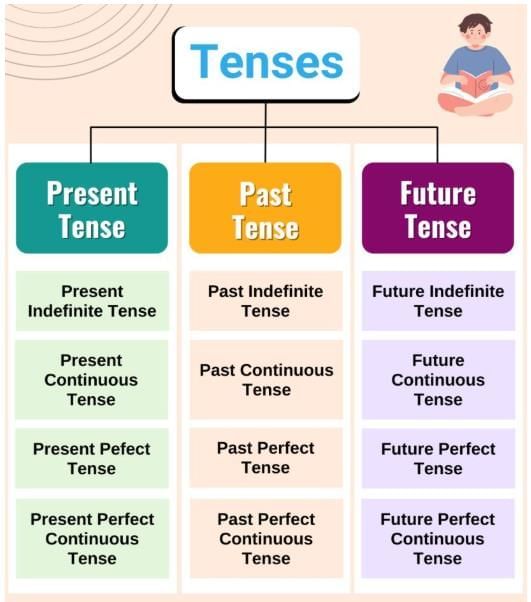
2. Tenses – Present Indefinite Tense

Understanding the Simple Present Tense

The simple present tense is used to describe actions that are habitual, universal truths, or experiences. This tense conveys actions that are routine, general truths, or facts that are accepted universally. It is typically employed for factual or habitual actions—events that occur in the present but may not be happening at this exact moment. Additionally, the simple present tense can indicate scheduled events, whether determined by nature or arranged by individuals.

Key Points about the Simple Present Tense

  • The simple present tense signifies habitual actions that occur regularly.
  • It is used to express universal truths and general facts that are always valid.
  • This tense commonly conveys actions that are factual or habitual in nature.
  • The simple present tense can also denote scheduled events set by natural cycles or human arrangements.

Simple Present Tense Formula for First Person Singular

The formula for the simple present tense in the first person singular involves starting with “I,” followed by a verb in its base form, and optionally including an object. This can be summarized as: “I” + verb (base form) + object (optional)

Examples of Simple Present Tense in First Person Singular

  • 1) I study hard for exams.
  • 2) I go to work every day.
  • 3) I sleep late on Saturdays.
  • 4) I watch a movie every week.
  • 5) I swim on Sundays.

Transforming into Negative Sentences

  • To change these sentences into negative form, insert “do not” or “does not” before the verb in its base form, while keeping the rest of the structure intact.
  • Structure: “I” + do not/does not + verb (base form) + object (optional)

Examples of Negative Sentences

  • 1) I do not study hard for exams.
  • 2) I do not go to work every day.
  • 3) I do not sleep late on Saturdays.

Formulating Interrogative Sentences

  • To create interrogative sentences, begin with “do” or “does,” keeping the rest of the structure the same. These sentences conclude with a question mark (?).
  • Structure: Do/Does + “I” + verb (base form) + object (optional)?

Examples of Interrogative Sentences

  • 1) Do I study hard for exams?
  • 2) Do I go to work every day?
  • 3) Do I sleep late on Saturdays?

Creating Negative Interrogative Sentences

  • To form negative interrogative sentences, add “do” or “does” at the beginning, followed by “not” after the subject. The rest of the structure remains the same. These sentences also end with a question mark (?).
  • Structure: Do/Does + “I” + “not” + verb (base form) + object (optional)?

Examples of Negative Interrogative Sentences

  • 1) Do I not study hard for exams?
  • 2) Do I not go to work every day?
  • 3) Do I not sleep late on Saturdays?

Simple Present Tense Formula for First Person Plural

The simple present tense formula for the first-person plural subject ‘we’ is: ‘We’ + verb (base form) + object (optional)

Examples of Affirmative Sentences:

  • We study hard for exams.
  • We go to work every day.
  • We sleep late on Saturdays.

Negative Sentences: To form negative sentences, add “do not” before the base form of the verb. Formula: ‘We’ + do not + verb (base form) + object (optional)

  • We do not study hard for the exams.
  • We do not go to work every day.
  • We do not sleep late on Saturdays.

Interrogative Sentences: To create interrogative sentences, start with “do” followed by “we” and keep the rest of the structure the same. Formula: Do + ‘we’ + verb (base form) + object (optional)?

  • Do we study hard for the exams?
  • Do we go to work every day?
  • Do we sleep late on Saturdays?

Negative Interrogative Sentences: For negative interrogative sentences, add “do” at the beginning and “not” after the subject. Formula: Do + ‘we’ + ‘not’ + verb (base form) + object (optional)?

  • Do we not study hard for the exams?
  • Do we not go to work every day?
  • Do we not sleep late on Saturdays?

Simple Present Tense Formula for Second Person

The formula for the simple present tense in the second person is structured as follows: ‘You’ + verb (base form) + object (optional).

Examples of Simple Present Tense in the Second Person

  • 1) You study hard for exams.
  • 2) You go to work every day.
  • 3) You sleep late on Saturdays.

 Negative Sentences 

To form negative sentences in the simple present tense for the second person, use the formula: ‘You’ + do/does not + verb (base form) + object (optional).

Examples of Negative Sentences

  • 1) You do not study hard for the exams.
  • 2) You do not go to work every day.
  • 3) You do not sleep late on Saturdays.

 Interrogative Sentences 

To create interrogative sentences in the simple present tense for the second person, use the formula: Do/Does + ‘you’ + verb (base form) + object (optional)?

Examples of Interrogative Sentences

  • 1) Do you study hard for the exams?
  • 2) Do you go to work every day?
  • 3) Do you sleep late on Saturdays?

Negative Interrogative Sentences

To form negative interrogative sentences in the simple present tense for the second person, use the formula: Do/Does + ‘you’ + ‘not’ + verb (base form) + object (optional)?

Examples of Negative Interrogative Sentences

  • 1) Do you not study hard for the exams?
  • 2) Do you not go to work every day?
  • 3) Do you not sleep late on Saturdays?

Understanding the Simple Present Tense for Third Person Singular

In the simple present tense for the Third Person Singular, we typically start with subjects like HeShe, a Common Noun, or a Proper Noun. The verb follows in its base form, but with an ‘s’ or ‘es’ added, depending on the verb. An object can be included, but it’s optional.

To summarize, the formula is:

  • He/ She/ Common Noun/ Proper Noun + verb (base form) + s/es + object (optional)

Examples of Simple Present Tense for Third Person Singular

  • 1) He studies hard for exams.
  • 2) Father goes to work every day.
  • 3) Ram sleeps late on Saturdays.

Negative Sentences in Simple Present Tense

To transform these sentences into negative forms, we add “do” or “does not” before the base form of the verb, keeping the rest of the sentence unchanged.

The formula is:

  • He/ She/ Proper Noun/ Common Noun + do/ does not + verb (base form) + object (optional)

Examples of negative sentences:

  • 1) He does not study hard for exams.
  • 2) Father does not go to work every day.
  • 3) Ram does not sleep late on Saturdays.

Interrogative Sentences in Simple Present Tense

To form interrogative sentences, we place “do” or “does” at the beginning of the sentence and keep the structure the same, ending with a question mark.

The formula is:

  • Do/ Does + he/ she/ common noun/ proper noun + verb (base form) + object (optional)?

Examples of interrogative sentences:

  • 1) Does he study hard for the exam?
  • 2) Does father go to work every day?
  • 3) Does Ram sleep late on Saturdays?

Negative Interrogative Sentences in Simple Present Tense

For negative interrogative sentences, we start with “do” or “does” and add “not” after the subject, keeping the rest of the structure the same. The sentence ends with a question mark.

The formula is:

  • Do/ Does + he/ she/ proper noun/ common noun + “not” + verb (base form) + object (optional)?

Examples of negative interrogative sentences:

  • 1) Does he not study hard for the exam?
  • 2) Does father not go to work every day?
  • 3) Does Ram not sleep late on Saturdays?

Simple Present Tense Formula for Third Person Plural

The structure for forming sentences in the simple present tense for the third person plural involves starting with “They” or a common noun, followed by a verb in its base form, and an optional object. This can be represented as: They/ Common Noun + verb (base form) + object (optional)

Here are some example sentences using this formula:

  • 1) They study hard for exams.
  • 2) Boys go to work every day.
  • 3) They sleep late on Saturdays.

To make these sentences negative, add “do not” or “does not” before the verb while keeping the rest of the structure the same:

  • They/ common noun + do/does not + verb (base form) + object (optional)

Here are examples of negative sentences:

  • 1) They do not study hard for the exams.
  • 2) Boys do not go to work every day.
  • 3) They do not sleep late on Saturdays.

For interrogative sentences, start with “do” or “does” followed by the subject and the rest of the sentence: Do/ Does + They/common noun + verb (base form) + object (optional)?

  • 1) Do they study hard for the exams?
  • 2) Do boys go to work every day?
  • 3) Do they sleep late on Saturdays?

To form negative interrogative sentences, place “do” or “does” at the beginning and “not” after the subject: Do/ Does + They/ common noun + ‘not’ + verb (base form) + object (optional)?

  • 1) Do they not study hard for the exams?
  • 2) Do boys not go to work every day?
  • 3) Do they not sleep late on Saturdays?

Exercise on the Simple Present Tense

Question: Translate the following sentences into English using the correct form of the Simple Present Tense. Afterward, compare your answers with the ones provided below.

  • 1.. eat a mango.
  • 2. He memorises the lesson.
  • 3. The dhobi irons clothes.
  • 4. Students make noise.
  • 5. Mohan plays cricket.

Answers:

  • 1.. eat a mango.
  • 2. He memorises the lesson.
  • 3. The dhobi irons clothes.
  • 4. Students make noise.
  • 5. Mohan plays cricket.

2. Tenses – Integrated Grammar Solved Exercises

1. Complete the passage by choosing the correct options from those given below.
Answer:
Pleasure and pain are the inseparable facets of human existence. While the experience of our well-being is rather vague and intangible, experience of pain is real, and affects our body, mind and spirit, altering our lives in more ways than one. Pain is an unpleasant sensory and emotional experience caused by tissue damage that resultsfrom physical trauma, burns, illness, injury or surgery. Despite the agony caused by pain, it is essential for our survival. Pain rings an alarm bell, alerting you to pay immediate attention and take quick action.

2. Geetika is learning about China in her Geography classes. She has to give a short talk to her class about Shanghai. Read the notes she has made and then complete the speech she prepares for her class. Do not add any new information. Write only the correct answers against the correct blank numbers in your answer sheets.

SHANGHAI

  • largest Chinese port city
  • handles 50% Chinese exports and imports
  • most heavy population in the world
  • industrial-number of industries present
  • 1842-important after Treaty of Nanking

Shanghai (a) ……………………. and 50% of all Chinese exports and imports (b) ………………….. It has also become famous (c) ………………….. in the world. It can be called (d) …………………… number of industries present here. (e) ………………….. after the Treaty of Nanking was signed here.

Options:-

(a) (i) is the largest port city of China
(ii) is a largest port city of China
(iii) was a largest port city in China
(iv) was the largest port city in China

(b) (i) was handled there
(ii) has been handled here
(iii) are handled here
(iv) are being handled there

(c) (i) has the more population
(ii) as the most populous city
(iii) has the heavy population
(iv) is the most populated city

(d) (i) an industrial city because of the
(ii) the industrial city because a
(iii) a industrial city as there is the
(iv) an industrial city that has the

Answer:
(a) (i) is the largest port city of China
(b) (iii) are handled here
(c) (ii) as the most populous city
(d) (i) an industrial city because of the
(e) (ii) It gained historic importance

3. The following passage has not been edited. There is ONE error in each of the first nine lines. Write the incorrect word and the correction as given in the example against the correct blank number in the space provided. Also underline the correct word you have supplied as shown.

Error Correction

Malaria, caused by the bite of a female Anopheles           

e.g a….. the

mosquito will become dangerous if care was not taken.

a) …………………….

The bite of the mosquito transfer the parasite into

b) ……………………

the human system. Malaria is accompanied with high

c) …………………….

fever and shivering. This mosquitoes breed in

d) ……………………

stagnant water, in puddles, on coolers etc. It is

e) …………………….

important to take care that water do not collect

f) ……………………

in and around the houses. Garbage can also

g) ……………………

be regularly removed so that mosquitoes will not breed in such damp wastes.

h) ……………………

Answer: Malaria, caused by the bite of a female Anopheles  a – themosquito will become dangerous if care was not taken.(a) was -isThe bite of the mosquito transfer the parasite into(b) transfer – transfersthe human system. Malaria is accompanied with high(c) with – byfever and shivering. This mosquitoes breed in(d) This – Thesestagnant water, in puddles, on coolers etc. It is(e) on – inimportant to take care that water do not collect(f) do – doesin and around the houses. Garbage can also      (g) can – shouldbe regularly removed so that mosquitoes will not   breed in such damp wastes.  (h) will – do

4. Rearrange the following words and phrases to make meaningful sentences.

1. always/ the same/ Earth’s/ climate/ stayed/ hasn’t
Ans. Earth’s climate hasn’t stayed always the same.

2. an/ a period/ periodically/ of/ cold weather/ called /the/ goes through/especially / Earth/ ice age
 Ans.
Periodically the Earth goes through a period of cold weather called an ice age.

3. an/ during/ ice age,/ polar glaciers/ grow/ the/ bigger.
 Ans.
 The polar glaciers grow bigger during an ice age.

4. an ice age,/ at/ of/ glaciers/ the peak/ may cover/ a third/ as much as/the Earth/ of
 Ans.
Glaciers of an ice age, at the peak, may cover as much as a third of the Earth.

5. Read the news items given below. Use the information in the headlines to complete the sentences.

1. Ambala police to hire private detectives ___
Ans.Private detectives will be hired to help the Ambala police force in better investigation.

2. Plea against IT officer dismissed____
Ans.The Haryana High Court had dismissed the plea filed by Coca Cola India Inc. against the assistant commissioner of income tax, Gurgaon, and other respondents. 

3. Three IAS officers transferred___
Ans.The Haryana government has transferred Three IAS officers and 11 Superintendents of Police, including the Bhiwani SP along with the Deputy Commissioner.

4. Property dealer shot dead___
Ans.A property was dealer shot dead inside the premises of a hospital by armed gangsters here today.

6. Read the following conversation carefully and complete the following passage by filling in the blank spaces appropriately. Do not add any new information. Write the answers in your answer sheet against the correct blank number.

Patient: Doctor, I have a terrible toothache.
Doctor: Well, sit down. I need to examine your teeth. Please open your mouth wide.
Patient : Is there any serious problem, doctor?

The patient told the doctor (a) _. The doctor told him to sit down as (b) __. He also requested the patient (c) _ . The patient then enquired (d) __.

Ans,
The patient told the doctor (a) _that he had a terrible toothache_. The doctor told him to sit down as (b) _he needed to examine his teeth_. He also requested the patient (c) _to open his mouth_ . The patient then enquired (d) _if there was any serious problem_.

7. Given below is a description of what happened during a fire. One word has been omitted in each line. Mark the place where you think a word has been omitted using ‘/’. Write the word you think is missing in the space provided. aThere was a fire our street yesterday morning.                          —-bWhen I woke up, I looked of the window and saw—-csmoke pouring out of house opposite. Then I—-dsaw fire engines arriving their sirens—-eblaring. First one turned  the corner and stopped outside—-fthe house. All the firemen dashed  the house and—-gran upstairs to the bedrooms. A woman  screaming—-hfrom an upstairs window. She shouted that she  locked—-iin the room and  not get out. By this time a second—-jfire engine arrived and the firemen  held a blanket—-kfor her to jump into. The chief shouted that she  to jump.—lYou could see that  was terrified but suddenly she—-mmade the decision and with  great scream, she jumped.—-nShe landed safely. Afterwards she said that it had  the—-omost frightening experience of  life.—-

Ans.aThere was a fire our street yesterday morning.                          inbWhen I woke up, I looked of the window and sawoutcsmoke pouring out of house opposite. Then Ithedsaw fire engines arriving their sirenswitheblaring. First one turned  the corner and stopped outsidetofthe house. All the firemen dashed  the house andintogran upstairs to the bedrooms. A woman  screamingwashfrom an upstairs window. She shouted that she  lockedwasiin the room and  not get out. By this time a secondcouldjfire engine arrived and the firemen  held a blankethadkfor her to jump into. The chief shouted that she  to jump.hadlYou could see that  was terrified but suddenly sheshemmade the decision and with  great scream, she jumped.anShe landed safely. Afterwards she said that it had  thebeenomost frightening experience of  life.her

02. Tenses – English Grammar Tenses

How would you define the term ‘Tense’?

The term ‘Tense’ denotes the form of a verb which shows the time at which an action happened.

So, the tense shows two things:

  • the time of the action
  • state expressed by the verb.

Look at these sentences:

  • Reshma goes to school.
  • Reshma went to school.
  • Reshma will go to school.

In the above sentences (i) ‘goes’ (ii) ‘went’ and (iii) ‘will go’ are verbs.

  • In sentence (i), the verb ‘goes’ denotes the present tense and refers to the present time.
  • In sentence (ii), the verb ‘went’ denotes the past tense and refers to the past time.
  • In sentence (iii), the verb ‘will go’ denotes the future tense and refers to the future time.

By ‘Tense’ we can understand the correspondence between the form of the verb and our concept of time (past, present and future).

‘Time’ and ‘Tense’ are not the same thing

‘Time’ is a universal concept. It has three divisions: past, present and future. ‘Tense’ is related only to the verb.
It is not necessary that if the verb is in the present tense, it will show only the present time. It is also not necessary that if the verb is in the past tense, it will show the past time.
Look at the sentences:

  • The match takes place on Sunday.

Here the verb ‘takes place’ is in simple present tense but expresses an action that will take place in the future time.

  • Mohan is about to come.

Here ‘present tense’ expresses the near future time.

  • The Sun sets in the west.

It is a universal truth. Here, it stands for all the three times: past, present and future.
Modern grammarians believe that there is no future tense in English to express future time. We use the modal auxiliaries ‘shall’ and ‘will’, with the present tense, etc. to express future time. But we are following the traditional grammarians.
According to them English has three tenses,

  • Present Tense
  • Past Tense and
  • Future Tense

Different forms of Verb

Forms of Present Simple Tense

  • Thus we have seen that the Simple Present Tense is formed by using the plain infinitive. But -s or -es are added to the bare infinitive (i.e. infinitive without ‘to’) for the third person singular (He, She) and singular noun (Nitu)
  • We form the negative sentences by using doesn’t or don’t before the main verb.
  • The interrogative sentences are formed by using do or does before the subject.
  • The negative interrogative sentences are formed by using do or does before the subject and not after the subject.

But the short forms don’t and don’t come before the Subject. 

Uses of Present Simple Tense

The Simple Present Tense is used

(i) to express universal truths, facts, customs:

  • The sun sets in the west.
  • The earth revolves around the sun.
  • Water freezes at 0° centigrade.
  • The Hindus cremate their dead.

(ii) to express habitual actions: 

  • I go to temple daily.
  • My father goes for a walk in the evening.
  • He gets up at 4 a.m. daily.
  • She walks to the office every day.

(iii) to express a permanent state:

  • My house faces west.
  • Delhi stands on the bank of the Yamuna.
  • NH-1 (National Highway) leads to Amritsar.
  • The house has four rooms.

(iv) in exclamatory sentences:

  • Look out!
  • Here comes the bus!
  • There goes the train!

(v) in subordinate clauses beginning with ‘if and when’:

  • If you request him, he will help you.
  • If he works hard, he will pass.
  • When you go there, try to meet him.

(vi) in imperative sentences:

  • Let us go out for a walk.
  • Obey your elders.
  • Shut the door.
  • Please, give me a glass of water.

(vii) to indicate a planned future action or series of actions when they refer to a journey:

  • He comes here tomorrow
  • This aeroplane flies for London next week.
  • Our examination commences on next Monday.
  • We leave Delhi at 9 a.m and reach Amritsar at 3 p.m.

(viii) for narrative events in a dramatic way:

  • The sound of firing is heard.
  • Lights are switched on.
  • The hero is seen lying dead on the stage.

(ix) in running commentaries on sports events:

  • Mohit passes the ball to Rohit.
  • Rohit hits the ball straight into the goal.

(x) to introduce quotations:

  • Our teacher says, “Slow and steady wins the race.
  • My father says, “Hard work is the key to success.

Note: We generally use the following adverbs or adverbial phrases in the present tense: always, often, daily, generally, usually, everyday, every week, frequently, etc.

Present Progressive Tense Form

(i) The Present Progressive Tense is formed by adding present participle (verb + ing) to the present forms of the auxiliary,
be: am/is/are + present participle:

  • She is singing.
  • I am working.
  • They are sleeping.

(ii) The negative is formed by putting not after the auxiliary:

  • She is not singing, (isn’t)
  • I am not working, (ain’t)
  • They are not sleeping, (aren’t)

(iii) The negative interrogative is formed by placing the auxiliary verbs before the subject and by placing not after the subject:

  • Is she not singing? (Isn’t she … ?)
  • Am I not working? (Ain’t I… ?)
  • Are they not sleeping? (Aren’t they … ?)

Note: The negative interrogative form of ‘I am’ is Am I not? But the contracted form is: Ain’t I?

Uses of the Present Progressive Tense

(i) The Present Progressive Tense is used for an action that is in progress at the time of speaking:

  • He is reading a newspaper.
  • The children are playing football.
  • The girl is singing a song.
  • I am doing my work.

(ii) It is used for an action that is in progress and will continue in future. It may not be going on at the time of speaking:

  • He is learning English.
  • My neighbour is writing a novel.

(iii) It is used to describe an action that is planned to take place in the near future:

  • I am meeting him tomorrow.
  • He is going to England next week.
  • They are not coming here on Monday.

(iv) It is used to express disapproval of a persistent habit or something done again and again. We generally use adverbs such as always, constantly, repeatedly, etc:

  • She is continually watching movies on T.V.
  • He is always doing one mischief or the other.
  • He is repeatedly making the same mistakes.
  • They are constantly changing their statements.

Note: Verbs of perception and some other verbs are not generally used in the present progressive tense, for example see, smell, hear, taste, know, understand, hate, like, want, wish, etc.

Present Perfect Tense Form

(i) The present perfect tense has the form ‘have/has +past participle’, be verb + ed/en. Has is used with the third person singular and singular nouns and have is used with plural forms and I, we, you, they:

  • She has written this essay.
  • I have completed my work.
  • They have helped me.

(ii) The negative sentences have the form ‘have/has + not’ or haven’t, hasn’t in contracted form:

  • We haven’t made any mistake.
  • He hasn’t played with us.

(iii) The interrogative sentences have the form ‘have/has + subject’:

  • Have you packed all your books?

(iv) The negative interrogative sentences are formed by putting have/has before the subject and not after it or haven’t, hasn’t before the subject:

  • Have you not finished your homework so far?

Uses of Present Perfect

The present perfect tense is used

(i) to express an action that has been recently completed:

  • He has just left the place.
  • Our team has won the match.
  • She has finished her work.

(ii) for past actions whose time is not given:

  • He has been to Agra.
  • Has she cooked lunch?
  • I have met him before.

(iii) with adverbs like already, often, recently, yet,

  • I have already read this novel.
  • He has recently met the Prime Minister.
  • She has not replied to my letter yet.

(iv) for an action which began in the past and is still continuing:

  • They have lived in this city for a long time.
  • He has been ill since Tuesday. I have always helped him.

Try yourself:

Which of the following sentences uses the Present Progressive Tense correctly?

  • A.She sings a song.
  • B.They are go to the park.
  • C.He is playing football.
  • D.I have finished my homework.

View SolutionPresent Perfect Progressive Tense Form

(i) The Present Perfect Progressive Tense has the form ‘have/has+present participle’ (verb+ing):

  • The farmers have been ploughing their fields since morning.
  • The children have been playing for the last two hours.

(ii) The negative sentences are formed by placing ‘not ’ after ‘have/has ’ and before ‘been’:

  • He has not been doing his work.
  • I have not been going there.

(iii) The interrogative sentences are formed by putting have/has before the:

  • Has he been doing his work?
  • Have you been going there?

(iv) The negative interrogative sentences have the form: ‘have/has + subject + not’ or ‘haven ’t/hasn ’t + subject:

  • Hasn’t he been doing his work?
  • Have you not been going there?

Uses of the Present Perfect Progressive Tense

The Present Perfect Progressive Tense is used
(i) to express an action which began at some time in the past and is still continuing:

  • It has been raining since morning.
  • The farmers have been working for the last five days.

Simple Past Tense Form

(i) The Simple Past Tense is formed by using the past tense form of the verb:

  • She sang.
  • The children played.
  • I wrote a letter.

(ii) The negative sentences have the form ‘did not/didn’t + the main verb’:

  • She did not sing.
  • The children didn’t play.
  • I did not write a letter.

(iii) The interrogative sentences are formed by placing ‘did before the subject and the base form of the verb after the subject:

  • Did she sing?
  • Did the children play?
  • Did I write a letter?

(iv) The negative interrogative sentences are formed by placing ‘did’ before the subject and not ’ before the verb:

  • Did she not sing? or Didn’t she sing?
  • Didn’t the children play?

Uses of the Simple Past

The Simple Past Tense is used
(i) to indicate an action that was completed in the past. Generally the adverbials of the past time are used:

  • I went to Delhi yesterday.
  • He wrote a letter to her last week.
  • She met us two days ago.

(ii) sometimes without adverbials of time:

  • My father congratulated me on my brilliant success.
  • Our team won the match.

(iii) for an activity done in the past:

  • Satish studied for three hours.
  • I swam for half an hour.
  • We talked for five minutes,

(iv) to express a habitual or regular action in the past:

  • My father always got up at 4 a.m.
  • She visited the temple every day.
  • He worked in his garden every Sunday.

(v) in conditional clauses:

  • If you went there, you should meet him.
  • If she worked hard, she would pass.
  • If he accepted my advice, he would overcome his difficulty.

(vi) in the indirect form of speech:

  • He said, “I work for eight hours every day.”
  • He said that he worked for eight hours every day.
  • My teacher said, “I pray to God for your success.”
  • My teacher said that he prayed to God for our success.

Past Progressive Tense Form

(i) The Past Progressive Tense has the form ‘‘was/were + present participle’ (verb + ing):

  • He was writing a letter.
  • The children were playing.
  • The girls were singing.

(ii) The negative sentences are formed by placing not between was/were and the present participle:

  • He was not writing a letter.
  • The children were not playing.
  • The girls were not singing.

(iii) The interrogative sentences are formed by placing was/were before the subject:

  • Was he writing a letter?
  • Were the children playing?
  • Were the girls singing?

(iv) The negative interrogative sentences are formed by putting was/were before the subject and not before the present participle. In contracted forms, we write wasn’t/weren’t:

Uses of the Past Progressive Tense

The Past Progressive Tense is used
(i) to express a state or an action that was continuing at a certain point of time in the past. It had begun before that point and was probably continuing after it. We use adverbials of time:

  • She was cooking at 8 a.m.
  • I was going to college in the morning.
  • Was the farmer returning from his fields in the evening?

(ii) to express an action that was in progress in the past:

  • He was sleeping.
  • She was singing.
  • I was reading a newspaper.

(iii) to express an action in progress at some point of time in the past when another event took place:

  • She was watching T.V. when he came.
  • He was reading a novel when the doorbell rang.
  • I was sleeping when my father came from his office.

(iv) to describe two or more actions continuing at the same time:

  • While I was bathing, my sister was washing clothes.
  • While he was doing homework, his brother was listening to songs.

(v) to indicate a frequently repeated action or persistent habit in the past:

  • He was constantly complaining about something or the other.
  • She was always finding fault with my work.
  • Sohan was always smoking whether at home or in the office.

Past Perfect Tense Form

(i) The Past Perfect Tense has the form ‘had+past participle’:

  • He had taken his lunch.
  • I had read this book before.
  • She had never been to Agra.

(ii) The negative sentences are formed by placing ‘not’ after ‘had’. The contracted form is ‘hadn’t:

  • He had not taken his lunch.
  • I hadn’t read this book before.
  • She had not been to Agra.

(iii) The interrogative sentences are formed by using had before the subject:

  • Had he taken his lunch?
  • Had I read this book before?
  • Have you ever been to Agra?

(iv) The negative interrogative sentences are formed by placing ‘had’ before the subject and ‘not’ before the past participle:

  • Had he not taken his lunch?
  • Had you not read this book before?
  • Have you ever been to Agra?

Uses of Past Perfect Tense

The Past Perfect Tense is used:
(i) for an action that had been completed before another action began in the past:

  • I had done my work before he came.
  • The guests had already left when she reached there.

(ii) to describe an action taking place before a particular time in the past:

  • By 2 p.m. all the students had left the school.
  • By 6 a.m. he had left for Delhi.

(iii) to describe an action in the past which became the cause of another action:

  • The child was crying because the father had beaten him.
  • Sonu was weeping because he had lost his bag.

(iv) to describe an action in the past using the time adverbials such as already, since, before, etc:

  • He had already left for Ludhiana.
  • She had not come here since 1960.
  • They had not met each other before.

(v) to express an unfulfilled wish:

  • If you had worked hard, you would have passed.
  • If they had left early, they would have caught the train.

Past Perfect Progressive Tense Form

(i) The Past Perfect Progressive Tense has the form ‘had + been + present participle’:

  • They had been waiting here since morning.
  • She had been dancing for half an hour.

(ii) The negative sentences are formed by using ‘not’ between ‘had’ and ‘been’ (had not been):

  • They had not been doing any work.
  • She had not been dancing.

(iii) The interrogative sentences are formed by using ‘had’ before the subject:

  • Had they been doing any work?
  • Had she been dancing for half an hour?

(iv) The negative interrogative sentences are formed by placing ‘had’ before the subject and ‘not’ before ‘been’:

  • Had they not been waiting for us?
  • Had she not been dancing for half an hour?

Uses of Past Perfect Progressive Tense

The Past Perfect Progressive Tense is used
(i) to describe an action in the past that had begun and had been going on for sometime before another action took place in the past:

  • She had been dancing for half an hour when we reached there.
  • The match had been going on for several hours.

(ii) to express a repeated action in the past:

  • She had always been asking us for help.
  • They had been trying to meet the Prime Minister.

(iii) to describe an action which began before the time of speaking in the past. The action either stopped before that time or continued upto it:

  • The farmer had been ploughing since morning.
  • The children had been playing for the last one hour.

Future Time Reference

Future time in English can be expressed in the following ways:
(i) Simple Present Tense
(ii) Present Progressive Tense
(iii) to be/be to
(iv) be about to
(v) be going to.

The Simple Present Tense can be used to express a series of planned actions in the future, especially a journey.

  • The meeting starts at 10 a.m.
  • He goes to Delhi tomorrow.

The Present Progressive Tense is used when the planned action for the future is definite.

  • They are leaving for Japan next week.
  • We are visiting the Taj on Monday.

To be/be to: ‘To be/be to’ is used to express a necessity or duty or something planned for the future:

  • We are to be in the school at 8 a.m.
  • I am to attend the meeting at 10 a.m.

Be about to: ‘Be about to’ may be used to express events or actions which are likely to happen in a very short time.

  • The train is about to leave.
  • the headmaster is about to come.
  • The bell is about to ring.

Be going to: ‘Be going to’ is used to refer to express events or actions that happen in the future as a result of present intention or situation:

  • She is not going to give us money.
  • Prices are going to rise.
  • Do you think it is going to rain?

Note: We generally use the modals ‘shall’ and ‘will’ to express future time.

Simple Future Tense Form

(i) The future time is expressed by using “shall’ or ‘well’ with the base form of the verb:

  • I shall go there tomorrow.
  • They will come here in the evening.

(ii) The negative sentences are formed by placing ‘not ‘ after ‘shall ’ or ‘will’:

  • I shall not go there tomorrow.
  • They will not come here in the evening.

(iii) The interrogative sentences are formed by putting ‘shall’ or ‘will’ before the subject:

  • Shall I go there?
  • Will he come here?

(iv) The negative interrogative sentences have the form: ‘shall/will + subject + not’:

  • Shall I not go there?
  • Will he not come here?

Uses of the Simple Future

(i) Shall is used with the second and the third persons to express determination, promise, intention, etc.

  • I shall not apologise, whatever may happen.
  • You shall get a reward if you win the race.
  • He shall be fined if he does not attend classes.

(ii) Shall is used with the first person to express an offer or suggestion:

  • Shall I open the door?
  • Which dress shall I wear?

(iii) Will is used with the first person to express willingness, determination, etc:

  • I will do it myself.
  • I will help you.
  • We will never commit such a mistake again.

(iv) The simple future is used to express the speaker’s opinion, for something to be done in the future. We use such verbs believe, know, suppose, think, etc. We also use such adverbs as perhaps, possibly, surely, etc:

  • We think he will reach there in time.
  • They suppose that he will never help them,

(v) It is used to express habitual action:

  • They will abuse you again and again.
  • He will go to church daily.

(vi) It is used for an action that is yet to take place:

  • I shall help him.
  • He will come here tomorrow.

Future Progressive Form

(i) The Future Progressive has the form shall/will + be + present participle:

  • I shall be doing this work tomorrow.
  • He will be going to Delhi tomorrow.

(ii) The negative sentences are formed by placing not after shall/will:

  • I shall not be doing this work tomorrow.
  • He will not be going to Delhi tomorrow.

(iii) The interrogative sentences are formed by placing shall/will before the subject:

  • Shall I be doing this work tomorrow?
  • Will he not be going to Delhi tomorrow?

(iv) The negative interrogative sentences are formed by putting shall/will before the subject and not before be:

  • Shall I not be doing this work tomorrow?
  • Will he not be going to Delhi tomorrow?

Uses of the Simple Future:

(i) The Future Progressing Tense is used to express an action that will be in progress at a given fine in future:

  • From 5 pm to 6 pm, we will be playing cricket tomorrow.

(ii) The Future Progressive Tense is used to express an action which will take place in the normal course:

  • The air conditioner will be running in the month of June.

Future Perfect Form

(i) The future perfect has the form: ‘Shall/will + have + past participle ’:

  • We shall have reached there.
  • He will have done this work.

(ii) The negative sentences are formed by putting ‘not’ between ‘shall/will’ and ‘have’:

  • We shall not have reached there.
  • He will not have done this work.

(iii) The interrogative sentences are formed by placing ‘shall/will’ before the ‘subject’:

  • Shall we have reached there?
  • Will he have done this work?

(iv) The negative interrogative sentences are formed by putting ‘shall/will ’before the ‘subject’ and ‘not’after it:

  • Shall we not have reached there?
  • Will he not have done this work?

Uses of Future Perfect

(i) The Future Perfect expresses an action that is expected to be completed by a certain time in the future:

  • They will have reached the station in half an hour.
  • He will have finished his homework by this time.

(ii) It is used to express the speaker’s belief that something has taken place:

  • He will have known the Sharmas.
  • She will have read “The Tempest.”

Future Perfect Progressive Form

(i) The Future Perfect Progressive has the form: shall/will + have + been + present participle:

  • She will have been cooking now.
  • I shall have been preparing for my examination

(ii) The negative sentences are formed by putting ‘not’ between ‘shall/will ’ and ‘have’:

  • She will not have been cooking now.
  • I shall not have been preparing for my examination.

(iii) The interrogative sentences are formed by placing ‘shall/will’ before the ‘subject’:

  • Shall I have been preparing for my examination?
  • Will she have been cooking now?

(iv) The negative interrogative sentences are formed by placing ‘shall/will’ before the subject and ‘not’ after it:

  • Will she not have been cooking now?
  • Shall I not have been preparing for my examination?

Uses of Future Perfect Progressive

The Future Perfect Progressive expresses an action as being in progress over a period of time that will end at some point in the future.

  • By next June, I shall have been completing my studies.

Try yourself:

Which tense is used to express an action that began at some time in the past and is still continuing?

  • A.Simple Past Tense
  • B.Present Perfect Progressive Tense
  • C.Past Perfect Tense
  • D.Past Progressive Tense

View Solution

1. Reading Comprehension – Practice Questions – 2

Passage 1

Read the passage given below:
Orangutans require less food than humans. When they do eat, orangutans nibble mostly on ripe fruit, along with smaller portions of leaves and seeds. Even in captivity, this diet doesn’t diminish and orangutan’s get up and go attitude. They wake up early, after a long night’s sleep, Then they spend the day socializing, exploring their indoor and outdoor enclosures. They also regularly engage in games with researchers. These activities of the orangutans taken together add up to the same level of exercise performed by humans in physically demanding agricultural lifestyles. In the wild, orangutans live in the rain forests of Borneo and Sumatra where food availability is highly variable and unpredictable. Like fresh fruits from the garden, the pickings are often feast or famine. But the trade-off is, that low energy, means, less energy is available to do things like grow and reproduce. So orangutans grow slowly and reproduce slowly, which is evolutionarily risky because an orangutan might die before it passes on its genes. Human mothers can have a child every two to four years, but orangutans in the wild only reproduce every seven to eight years.
Orangutans are among the most intelligent primates; they use a variety of sophisticated tools and construct elaborate sleeping nests each night from branches and foliage. These apes have been extensively studied for their learning abilities. There may even be distinctive cultures within populations. Both orangutan species are considered to be endangered, with the Sumatran orangutans being critically endangered. Human activities have caused severe decline in the populations and ranges of both species. Threats to wild orangutan populations include poaching, habitat destruction, and the illegal pet trade. Several conservation and rehabilitation organizations are dedicated to the survival of orangutans in the wild. We will lose much information about our closest relatives and our own evolutionary history if we let them get extinct.

On the basis of your understanding of the passage, answer the following questions that follow: 
Q.1. Orangutans live in ______.
(a)
 gardens
(b) forests
(c) rain forests
(d) anywhere
Ans. c

Q.2. The word ‘unpredictable’ in the passage means:
(a)
 which cannot be seen
(b) which cannot be eaten
(c) which cannot be known in advance
(d) which can be changed
Ans. c

Q.3. We do not want the orangutans to become extinct as:
(a)
 we will lose information about our closest relative
(b) we will lose information about our evolution history
(c) they are very intelligent
(d) both (a) and (b)
Ans. d

Q.4. Orangutans are considered to be______ Species.
(a)
 endangered
(b) extinct
(c) healthy
(d) unhealthy
Ans. ​a

Q.5. Human activities like poaching, illegal pet trade are leading to______ in the Orangutan population.
(a)
 decline
(b) increase
(c) no effect
(d) healthy life
Ans. a

Q.6. Orangutans are away______ primates.
(a) 
unintelligent
(b) sleeping
(c) unsophisticaled
(d) intelligent
Ans. d

Q.7. Several conservation organisation are dedicated to the survival of Orangutans.
(a) True
(b) False
Ans. a

Q.8. According to Pontzer, Orangutans mostly eat ______.
(a) 
human diet
(b) ripe fruits with leaves and seeds
(c) cake
(d) carrot
Ans. b

Q.9. How to they spend the day ______.
(a) 
engage in games
(b) research
(c) socializing and indoor, outdoor enclosures, explore
(d) doing nothing
Ans. c

Q.10. Human mothers can have a child every two to four years but Orangutans reproduce ______.
(a)
 ten years
(b) every year
(c) five years
(d) seven to eight years
Ans. d

Q.11. Orangutans live in the rain forests of ______.
(a) 
India
(b) Africa
(c) Borneo and Sumatra
(d) America
Ans. c

Q.12. Which quality of Apes and Orangutans are similar to human?
(a) 
construct nests
(b) learning abilities
(c) intelligent
(d) all of the above
Ans. d

Passage 2
Read the passage given below:
1. I was shopping in my home town, when I heard a young voice boom from across the aisle, “Mum, come here, there’s a lady my size.” The mortified mother rushed to the boy who looked about seven; then she turned to me to apologies. I smiled and told her, “It’s okay.” Then I looked at her wide-eyed son. He studied me from head to toe and asked, “Why are you so little?” It’s the way God made me. Some people are little, some are tall,” I’m just not going to grow any bigger.” After about five minutes of questioning he returned to his mother.
2. My life as a little person is filled with stories like that I enjoy talking to children and explaining why I look different from their parents. It has taken many years of developing my confidence to be able to do that. It takes only one glance to see my uniqueness. I stand three feet nine inches tall. I am an achondroplasia dwarf, which is a person having very short limbs. When I was born, my mother was told I was a dwarf. Not knowing a lot about dwarfism my mum’s main concern was my health. Our family doctor put her mind at ease when he told her that I would not have any major medical concerns. He was right.
3. When I was growing up, my parents encouraged me to do all the things the kids around me did. So when my neighbours got two-wheel bicycles, I got a two wheel bicycle. When they roller-skated, I roller-skated. Our neighbours treated me as a normal person. I did’nt realise how short I was until I started school. There a few kids picked on me calling me names. After that I began to hate the first day of school each year. I didn’t know who was new and would state as I struggled to climb up the school-bus stairs. Some of the kids would point out and say, “Look at the kid. Look at her.” Boys could be especially mean.
4. As time went on I tried to smile and accept the fact that I was going to be noticed all my life. I was determined to make my uniqueness an advantage rather than a disadvantage. My friends became increasingly protective. What I lacked in height I made up for in personality. I had the ability to laugh, even at myself. I am 47 now, and stares have not diminished, as I’ve grown older. People ask my friend if I live in a dollhouse. They look in disbelief when they see me get out of my car on the driver’s side. During those times I try to keep a good attitude. When people are rude I remind myself, “Look what else I have-a great family, nice friends.” Children’s questions make my life special. “Why are you so short? How old are you? Are you a mummy?” When I talk to children they leave content that their questions have been answered. My hope is that in taking time with them I will encourage them to accept their peers, whatever size and shape they come in, and treat them with respect.

On the basis of your understanding of the passage, answer the following questions that follow:
Q.1. What difficulties the author had to face in school due to her size?
(a) 
honoured
(b) an object of fun
(c) every year new students stare at her
(d) both (b) and (c)
Ans. d

Q.2. What strength of the writer compensated for her size?
(a)
 fighting
(b) good speaker
(c) ability to laugh at herself
(d) none
Ans. c

Q.3. What is the height of the writer?
(a) 
two feet
(b) three feet nine inches
(c) seven feet
(d) six feet
Ans. b

Q.4. How did the Parents of the writer behave?
(a)
 hate her
(b) discourage her
(c) heglect her
(d) encorage her
Ans. d

Q.5. Where was she considered to live in by people?
(a) 
Bunglow
(b) Doll house
(c) Hotel
(d) Boxes
Ans. b

Q.6. How was she grown up normally like other child?
(a) 
She also got two wheel bicycles.
(b) Got roller skates
(c) Both (a) and (b)
(d) None
Ans. c

Q.7. The synonym of mortified in para 1 is:
(a)
 aisle
(b) humiliated
(c) apologies
(d) boom
Ans. b

Q.8. ______ word in para 4 means the quality of being one of a particular kind.
(a)
 Glance
(b)  Achondroplasia
(c) Dwarf
(d) Uniqueness
Ans. d

Q.9. Find a word from para 1 which means the same as ‘reduced’:
(a) 
determined
(b) diminished
(c) disbelief
(d) lacked
Ans. b

Q.10. A synonym for the word “apologies” in para 1 is ______.
(a)
 short
(b) scorn
(c) regret
(d) refuse
Ans. c

Q.11. Find the antonym word of ‘decreasing’ in para 4 ______.
(a)
 increasingly
(b) diminish
(c) none
(d) all
Ans. a

Q.12. What is the age of the writer?
(a) 
74 years
(b) 47 years
(c) 17 years
(d) 37 years
Ans. b



