Life Without Rights
- Guantanamo Bay: A controversial detention facility near Cuba, controlled by the American Navy, where detainees, including alleged terrorists, were held without trial or access to legal representation, sparking international human rights concerns.
- Amnesty International: An international human rights organization that monitors and advocates for the protection of human rights worldwide, including documenting and condemning abuses in places like Guantanamo Bay.
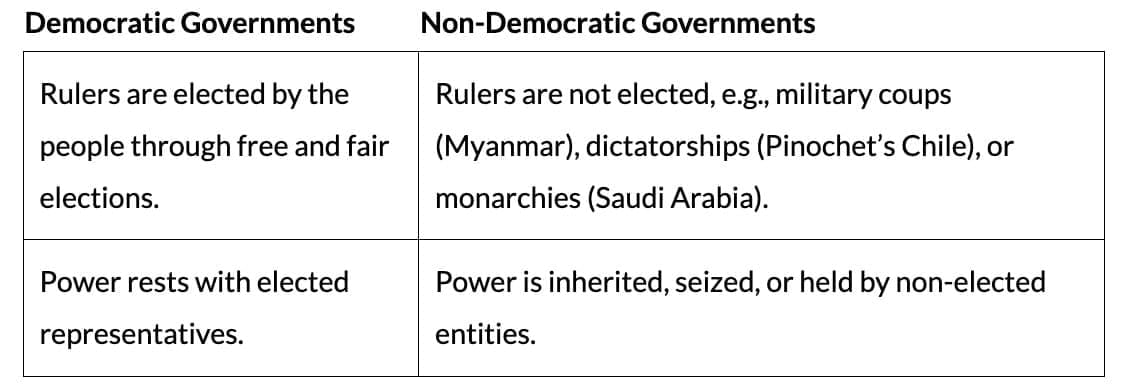
- Saudi Arabia: An absolute monarchy where citizens have limited political rights, restrictions on freedom of religion, and gender-based inequalities, with a hereditary king holding significant power.
- Ethnic Massacre in Kosovo: Refers to the violent conflict in Kosovo, where Serbian forces, led by Slobodan Milosevic, targeted ethnic Albanians, resulting in atrocities and human rights violations, despite Kosovo being part of Yugoslavia.
- Slobodan Milosevic: A Serbian nationalist leader who rose to power through democratic elections but later orchestrated ethnic cleansing campaigns, leading to his trial for crimes against humanity by the International Court of Justice.
Try yourself:What international organization is known for monitoring and advocating for the protection of human rights worldwide, including condemning abuses in places like Guantanamo Bay?
- A.United Nations
- B.NATO
- C.Amnesty International
- D.Red Cross
View Solution
Rights in a Democracy
- Rights: Claims that individuals have over society and government to ensure their security, dignity, and fair treatment, while also respecting the rights of others.
- Obligation: The responsibility to respect the rights of others when exercising one’s own rights, ensuring that claims are reasonable and do not harm or hurt others.
- Social Recognition: The process by which claims become rights when they are acknowledged and accepted by society as rightful and just.
- Legal Recognition: When socially recognized claims are codified into law, giving them legal force and making them enforceable in courts.
- Violation: The act of infringing upon or disregarding an individual’s rights, which can lead to legal consequences and the need for protection.
- Democracy: A form of government in which citizens have the right to vote, be elected, express their opinions, and participate in political activities, with rights playing a crucial role in safeguarding minority interests.
- Minority Rights: Protections for individuals or groups in a democracy to prevent the majority from oppressing or dominating them.
- Government Protection: The role of the government in safeguarding citizens’ rights and preventing violations, especially when the majority seeks to infringe upon minority rights.
- Constitutional Rights: Basic rights of citizens that are enshrined in the constitution and placed above the government’s authority to ensure they are not violated in a democracy.
Rights in the Indian Constitution
- Fundamental Rights: These are the basic rights guaranteed by the Constitution of India to all its citizens, ensuring equality, liberty, and justice.
- Right to Equality: The principle that all individuals are equal before the law, and no one is above the law, regardless of their status or background.
- Rule of Law: The concept that every citizen, including government officials and leaders, is subject to and must obey the same laws.
- Right to Freedom: The freedom to express oneself, assemble peacefully, form associations, move freely, reside anywhere in the country, and pursue any profession or occupation, with reasonable restrictions for public interest.
- Freedom of Speech and Expression: The right to express one’s opinions, thoughts, and ideas freely, with limitations on inciting violence or defaming others.
- Right against Exploitation: The prohibition of practices such as human trafficking, forced labor, and child labor to protect citizens from exploitation.
- Right to Freedom of Religion: The freedom to practice, profess, and propagate one’s religion, with restrictions on forceful conversion and harmful religious practices.
- Cultural and Educational Rights: The protection of the cultural and educational rights of minority communities, ensuring they can preserve their language and establish educational institutions.
- Right to Constitutional Remedies: The right to seek legal remedies in courts when Fundamental Rights are violated, considered the “heart and soul” of the Indian Constitution.
- Public Interest Litigation (PIL): A legal mechanism that allows citizens or groups to approach the courts to protect public interests against government actions or laws.
Try yourself:Which Fundamental Right in the Constitution of India allows citizens to seek legal remedies in courts when their Fundamental Rights are violated and is considered the “heart and soul” of the Indian Constitution?
- A.Right to Equality
- B.Right to Freedom of Religion
- C.Right to Constitutional Remedies
- D.Right against Exploitation
View Solution
Expanding Scope of Rights
- Expansion of Rights: The broadening of citizens’ rights beyond Fundamental Rights, often through court judgments, legislative actions, and evolving societal needs.
- Right to Education: A constitutional right in India that mandates free and compulsory education for all children up to the age of 14, ensuring access to quality schooling.
- Right to Information: A legal right derived from the Fundamental Right to freedom of thought and expression, allowing citizens to request information from government offices.
- Right to Food: An expanded interpretation of the right to life, ensuring citizens’ access to adequate food, recognized by the Supreme Court as a fundamental right.
- Human Rights: Universal moral claims that may or may not be recognized by law, expanding as societies develop and democratic pressure increases.
- International Covenants: Agreements at the international level contributing to the expansion of rights, often influencing domestic legislation.
- Constitutional Right to Property: A constitutional right in India, not classified as a Fundamental Right, which governs property ownership and rights related to it.
- Right to Vote: An essential constitutional right allowing citizens to participate in elections and shape the democratic process.
- Rights in the Constitution of South Africa: Examples of expanded rights in South Africa’s constitution, including the right to privacy, a healthy environment, adequate housing, and access to healthcare and food.
- Proposed Fundamental Rights in India: The debate about making the right to work, right to health, right to minimum livelihood, and right to privacy into Fundamental Rights in India, reflecting changing societal priorities and needs.