5. Democratic Rights – HOTS Question and answer – 2

108) Why do we need rights in a democracy?

Answer: Rights are very essential part for the very sustenance of a democracy. Without rights democracy will became meaningless and ineffective. For democratic elections, it is necessary that citizens should have the right to express their opinions, from political parties and take part in political activities. Rights protect minorities from the oppression of majority. They ensure the majority cannot do whatever it likes. The government is expected to protect citizen’s rights. But sometimes elected government may not protect or  may even attack the rights of their own citizens. So, g some rights need to be placed higher than the government so that it cannot violate them. 

109) Write any four features of the Right to Equality as a Fundamental Right. Or Explain the main provisions of the Right to Equality.

Answer: Right to Equality is an important right provided for in Article 14-18 of Indian Constitution. It guarantees
(i) Equality   Before   Law Article   14   of  the Constitution guarantees that all citizens shall be equally protected by the laws of the country. It means that the state cannot discriminate any of the Indian citizen on the basis of their caste, creed, colour, sex, gender, religion or place of birth.
(ii) Social Equality and Equal Access to Public Areas Article 15 states that every person shall have equal access to public places like public parks, museums, wells, bathing ghats, temples, etc.
(iii) Equality in Matters of Public Employment Article 16 states that all citizen can apply for government jobs. But this right shall not be conferred to overseas citizens of India.
(iv) Abolition of un touch ability Article 17 of the Constitution   abolishes   the   practice   of un touch ability and anyone doing so is punishable by law. 

110)   (a) Right to Constitutional Remedies is very special right. What is so special about this right? 
(b) What values/lesson you have learnt from the given constitutional right?

Answer:  (a) Right to Constitutional Remedies is very special Right because it is through this Right that all other Fundamental Rights are safeguarded and arbitrary action of the state is checked. This right makes other rights effective. It is possible that sometimes our rights may be violated by fellow citizens, private bodies or by the government. If it is a Fundamental Right, we can directly approach the Supreme Court or the High Court of a State. The Supreme Court and High Courts have the power to issue directions, orders or writs for the enforcement of the Fundamental Rights. Most eminent of the writs are?Habeas corpus, Mandamus,  Prohibition,  Quo-warranto  and Cerdorari. They award compensation for the violation for Fundamental Rights. Thus, without the Right to Constitutional Remedies, the other Fundamental Rights become meaningless. (b) From the given constitutional right I have learnt, that everyone should respect the Constitutional Rights. 

111) List out any four characteristics of Fundamental Rights.

Answer:Some rights which are fundamental to our life are given a special status in our Constitution, these are called Fundamental Rights. Some features of Fundamental Rights are as follow
(i) Fundamental Rights are the promotion and enhancement of Human Rights.
(ii) Fundamental    Rights    primarily    protect individuals from any arbitrary state action. But some rights are enforceable against individuals. For  instance,   the  Constitution  abolishes un touch ability and also prohibits ‘begar’.
(iii) These rights are not absolute or uncontrolled and are subject to reasonable restrictions.
(iv) Fundamental Rights given in the Constitution are universal, justiciable and comprehensive. Universal means they are for all the citizens of India without any discrimination. Justiciable means individual can move to the court if his rights are violated, comprehensive means these rights safeguard our social, economic, cultural and religious interest. 

112) What was the Amnesty International’s report regarding the prisoners in Guantanamo Bay? State the condition of prisoners according to the report of Amnesty International in Guantanamo Bay. 

Answer:The Amnesty International reported that the prisoners were being tortured in ways that violated the US laws. They were being denied the treatment that even prisoners of war must get as per international treaties. Prisoners were not released even after they were officially declared not guilty, Condition of prisoners in Guantanamo Bay
(i) About 600 people were secretly picked up by the US forces from all over the world and put in a prison in Guantanamo Bay. The America government said they were enemies of the US and linked to the attack on the US.
(ii) In most cases the governments of their countries were not asked or even informed about their imprisonment.
(iii) Families of prisoners, media or even UN representatives were not allowed to meet them.
(iv) The US army arrested them, interrogated them and decided whether to keep them.
(v) There was no trial before any magistrate in ins US. Even the prisoners could not approach courts in their own country.  

113) ‘Go to the playground of the school or any stadium and watch a 400 metre race on any track. Why are the competitors in the outer lane placed ahead of those in the inner lane at the starting point of the race’? Read the above passage and answer the following questions (a) What would happen if all the competitors start the race from the same line? Which of these would be an equal and fair race? Apply this example to a competition for jobs. (b) What values do you learn from the above passage?

Answer:(a) Since, the outer lane has a bigger circumference than the inner lane, more than 400 metre distance will be covered in one round of the track. Thus competitors in the outer lane are placed ahead, so that they are given an equal opportunity compared to the person in the inner lane. If all the competitors start at the same line, the outer track competitors will have to run a longer distance, which will not be fair. So, in the first case, it will be a fair race. Similarly, in a competition for jobs, if the Scheduled Castes are given reservations, they can compete on an equal basis, because they are educationally and culturally backward, although they may be fit, for the job, for which they have applied. (b) From the above passage I have learnt, the values like impartiality and equality. 

114)  Observe any big public building. Is there a ramp for physically handicapped? Are there any other facilities that make it possible for physically handicapped to use the building in the same way as any one else? Should these special facilities be provided, if it leads to extra expenditure on the building? Do these special provisions go against the principle of equality?

Answer: In many public buildings like hospitals and big offices, there are such ramps. Some airports have special toilets for the physically handicapped. These special provisions do not go against the Right to Equality, as handicapped persons also have the same rights as normal citizens and the government must provide for them accordingly.

115)   Are these cases instances of violation of the Right to Freedom? If yes, which constitutional provision does each violate? (a) The Government of India banned Salman Rushdie’s book “the Satanic Verses’ on the ground that it was disrespectful to Prophet Muhammed and was likely to hurt the feelings of the Muslim community. (b) Every film has to be approved by the Censor Board of the Government before it can be shown to the public. But, there is no such restriction if the same story is published in a book or a magazine. (c) The government is considering a proposal that there will be industrial zones or sectors of the economy, where workers will not be allowed to form unions or go on strike. (d) City administration has imposed a ban on use of public microphones after 10pm in view of the approaching secondary school examinations.

Answer:(a) Yes, this violates the Right to Freedom of Thought and Expression.
(b) Yes, this violates the Right to Freedom of Thought and Expression.
(c) Yes, this violates the Right to Freedom to form associations and unions.
(d) No, this is not a violation of the Right to Freedom because the Constitution restricts freedom to a group of people (who are likely to use public microphones after (10 PM) as long as that freedom does not affect or hamper freedom of anyone else. Also the ban is imposed in the larger interests of the people. 

116)   Which of these statements about the, relationship between democracy and rights is more valid? Give reasons for your preference. (a) Every country that is a democracy gives; rights to its citizens. (b) Every country that gives rights to its citizens is a democracy. (c) Giving rights is good, but it is not necessary for a democracy.

Answer:Statement (a) is the most valid statement, democracy is a system of government elected by the people, g which works for the people and so a democracy must provide rights to the citizens. 

117)   Read the following news reports and identify the right that is being debated in each of these cases? (a) An emergency session of the Shiromani Gurdwara Prabandhak Committee (SGPC) rejected the proposal to form a separate body to manage the affairs of Sikh shrines in Haryana. It warned the government that the Sikh community would not tolerate any interference in their religious affairs (June 2005). (b) The Allahabad High Court quashed the Central Law, which gave Aligarh Muslim University its minority status and held illegal reservation of seats for Muslims in its post-graduate medical courses (January 2006). (c) The Rajasthan Government has decided to enact an anti-conversion law. Christian leaders have said that the Bill would aggravate the sense of insecurity and fear in the minds of minorities (March 2005).

Answer:(a) Here, it is the Right to Freedom of Religion.
(b) Here, it is the Right to Equality.
(c) Here, it is the Right to Freedom of Religion. 

118)   Name the Fundamental Right under which each of the following rights falls. (a) Freedom to propagate one’s religion (b) Right to life (c) Abolition of untouchability (d) Ban on bonded labour

Answer:  (a) Right to Freedom of Religion (b) Right to Freedom (c) Right to Equality (d) Right against Exploitation 

119)   Which of the following is not an instance of an exercise of a Fundamental Right? (a) Workers from Bihar go to the Punjab to work on the farms (b) Christian missions set up a chain of missionary schools (c) Men and women government employees get the same salary (d) Parents’ property is inherited by their children

Answer: (d) Parents’ property is inherited by their children. 

120)   Are these restrictions on the right to freedom justified? Give reasons for your answer. (a) Indian citizens need permission to visit some border areas of the country for reasons of security. (b) Outsiders are not allowed to buy property in some areas to protect the interest of the local population. (c) The government bans the publication of a book that can go against the ruling party in the next elections.

Answer:  (a) Statement (a) is justified to protect the interests of the nation and its people. (b) Statement
(b) is justified because it protects the interest of local people and help to maintain ecological balance.
(c) Statement (c) is not justified because it violates the Right to Freedom of Speech and Expression of citizens. 

121)   When Madhurima went to the property registration office, the Registrar told her’ You can’t write your name as Madhurima Bannerjee d/o AK Bannerjee’. You are married, so, you must give your husband’s name. Your husband’s surname is Rao. So, your name should be changed to Madhurima Rao. She did not agree. She said If my husband’s name has not changed after marriage, why should mine?’ In your opinion, who is right in this dispute? And why?

Answer:Madhurima is right. She has the right to use her either maiden surname or her husband’s surname. She cannot be forced to change her name. It will violate her Fundamental Right, Right to Equality. 

122) Which of the following freedoms is not available to an Indian citizen? (a) Freedom to criticise the government (b) Freedom to participate in armed revolution (c) Freedom to start a movement to change the government (d) Freedom to oppose the central values of the Constitution

Answer:  (b) Freedom to participate in armed revolution.

123) Name any four Political Rights,

Answer: Four Political Rights are                            
(i) Right to Vote              
(ii) Right to Assembly  
(iii) Right to Hold any Public Office;              
(iv) Right to Petition       

124) Which of the following rights is available under the Indian Constitution? (a) Right to Work (b) Right to Adequate Livelihood (c) Right to Protect One’s Culture (d) Right to Privacy

Answer: Right to protect one’s culture

125)   Draw a web interconnecting different rights discussed in this chapter i.e., right to freedom of movement is connected to the freedom of occupation. One reason for this is that freedom of movement enables a person to go to place of work within ones village or city or to another village, city or state. Similarly, this right can be used for pilgrimage, connected with freedom to follow one’s religion. Draw a circle for each right and mark arrows that show connection between or among different rights. For each arrow, give an example that shows the linkage.

Answer:The arrow labels details are given below
(i) In case, somebody is not allowed to work in a particular job even though selected, he can approach the court for restoring this right.
(ii) If somebody is not allowed access to a public place because of his caste, he can approach the court for restoring this right.
(iii) If a person is accused for a crime, he can engage a lawyer to defend him.
(iv) Freedom to work anywhere in the country.
(v) Establishing an educational institution for a minority community.
(vi) Somebody going for a pilgrimage.
(vii) We can conduct a peaceful demonstration in a group against some government policies, which affect us adversely. 

126) Read about the National Human Rights Commission and answer the given question. Do you notice references to the National Human Rights Commission (NHRC) in the news collage on this page? These references reflect the growing awareness of human rights and struggles for human dignity. Many cases of human rights violations in diverse fields, for instance, Gujarat riots, are being brought to the public notice from across India. Human rights organisations and the media often criticise government agencies for not seriously pursuing these cases or catching the culprits. Someone had to intervene on behalf of the victims. This is where the National Human Rights Commission stepped in. This is an independent commission set up by law in 1993. Like judiciary, the Commission is independent of the government. The Commission is appointed by the President and includes retired judges, officers and eminent citizens. Yet it does not have the burden of deciding court cases. So, it can focus on helping the victims secure their human rights. These include all the rights granted to the citizens by the Constitution. For NHRC, human rights also include the rights mentioned in the UN sponsored international treaties that India has signed. The NHRC cannot by itself punish the guilty. That is the responsibility of courts. The NHRC is there to make independent and credible inquiry into any case of violation of human rights. It also inquires into any case of abetment of such violation or negligence in controlling it by any government officer and takes other general steps to promote human rights in the country. The Commission presents its findings and recommendations to the government or intervene in the court on behalf of the victims. It has wide ranging powers to carry out its inquiry. Like any court, it can summon witnesses, question any government official, demand any official paper, visit any prison for inspection or send its own team for on the spot inquiry. Citizen of India can write a letter to this address to complain against the violation of Human Rights = National Human Rights Commission, Faridkot House, Copernicus Marg, New Delhi 110001. There is no fee or any formal procedure to approach the NHRC. Like NHRC, there are State Human Rights Commissions in 16 states of the country. Are the rights only for adults? Which of these rights are available to children? 

Answer: No, Fundamental Rights, are not only for the adults, they are available to all the citizens of the country without any discrimination. Right against exploitation is specially devoted to children because it protects the children from exploitation. These rights prohibit child labour.                                                                        
No one can employ a child below the age of 14 to work in any factory or mine or in any other hazardous work such as railways and s ports. Using this right as a basis, many laws have been made to prohibit children from working in industries such as beedi making, fire crackers, matches, printing and dyeing.
5. Democratic Rights – HOTS Question and answer – 1

81) Under which Article of the Constitution, ‘abolition of un touch ability’ lies in?

Answer:‘Abolition of un touch ability’ lies in Article 17, of Indian Constitution. 

82) How many Fundamental Rights does the Indian Constitution provide?

Answer: Indian Constitution provides six Fundamental Rights. 

83) What is meant by ‘Begar’?

Answer: ‘Begar’ is a practice where the worker is forced to render service to the ‘master’ free of charge or at a nominal remuneration. 

84) What is the meaning of ‘traffic in human beings’ as described in Indian Constitution?

Answer: In Indian Constitution, traffic means selling and buying of human beings, usually women, for immoral purposes. 

85) What is inspiration behind the Directive Principles of State Policy?

Answer:  The Directive Principles of State Policy have been inspired by the Directive Principles given   in the Constitution of Ireland and also by the principles of Gandhism. 

86) What is a secular state?

Answer: In a secular state, no religion can get any privilege or favour and there is no official religion.

87) In the Indian Constitution, the Right to Equality is granted by five articles. Which are these articles?

Answer:The Right to Equality is granted by Articles 14 to 18. 

88) Name any two political rights.

Answer:Two political rights are Right to Vote and Right to Fight Election. 

89) Give any two features of Fundamental Rights. 

Answer: Two important features of Fundamental Rights are that these are limited and these can be suspended during emergency.   

90) If you were a Serb, would you support what Milosevic did in Kosovo? Do you think this project of establishing Serb Dominance was good for the Serbs?

Answer:  If I were a Serb, I would not support what Milosevic did in Kosovo because what he did was very unjust and discriminatory towards the Albani This method of establishing Serb dominance was not good for the Serbs because this action of Milosevic led to conflict and hostility between the Serbs and the Albani The Albanians were massacred by the army of their own country. Ultimately, Milosevic lost power and was tried by the International Court of Justice for crimes against humanity. 

91) What are the examples of elected governments not protecting or even attacking the rights of their own citizens? Why do they do that?

Answer:  Examples of elected governments not protecting or even attacking the rights of their own citizens are
(i) Ethnic Massacre of Albanians in Kosovo.
(ii) Policy of apartheid in South Africa.
(iii) Rule of Augusto Pinochet in Chile.
(iv)Rule of Robert Mugabe in Zimbabwe. These rulers wanted to hold power and keep the people under their control so that they would not oppose them and they could rule without problems. 

92) Everyone knows that the rich can have better lawyers in the courts. What is the point in talking about equality before law?

Answer: It is true that the rich can have better lawyers in the courts, but the law is the same for everyone. Being rich or having good lawyers does not mean that equality of law also changes. Whether a person is rich or poor, the law remains the same for all citizens. The judiciary follows the rule of law for all without discriminating on grounds of religion, race, caste, sex or place of birth

93) Should the freedom of expression be extended to those who are spreading wrong and narrow minded ideas? Should they be allowed to confuse the public?

Answer: No, the freedom of expression should not be extended to those who are spreading wrong and narrow minded ideas, since it is harmful for society and democracy. No, they should not be allowed to confuse the public because it would be wrong to do so. Spreading wrong information for personal gains is wrong. Their views can instigate violence, which is dangerous for our society. Nobody can use freedom of speech and expression to incite people or rebel against government.

94) “Rights are not limited only to Fundamental Rights as enumerated in the Constitution.” Justify the statement. Or How is the scope of rights always expanding? Mention any five facts. Or How has the scope of rights expanded in the present scenario?

Answer: Our Constitution and law offer a wider range of rights. Over the year the scope of rights has expanded.  Sometimes it leads to expansion in the legal rights that the citizen can enjoy.  From time to time, the courts gave judgments to expand the scope of rights. Certain rights like right to freedom of press, right to information and right to education are derived from the Fundamental Rights. So, we can say that, rights are not limited only to  Fundamental  Rights  as  enumerated  in the Constitution. In fact, Constitution provides many more rights which may not be Fundament Riehts. 

95)  The Constitution does not give people their religion. Then, how can it give people the Right to Practice their Religion?

Answer: It is true that the Constitution does not give the people their religion. However, it does not prevent the people from the Right to Practice their Religion, because the Constitution provides every person has a right to profess, practice and propagate the religion he or she believes in. Every religious group or sect is free to manage its religious affairs. In this way, our Constitution gives people the Right to Practice their Religion. 

96) Can the President of India stop you from approaching the Supreme Court to secure your Fundamental Rights?

Answer: No, the President of India even cannot stop me from approaching the Supreme Court to secure my Fundamental Rights because the Fundamental Rights have been enshrined in our Constitution. This means that our Constitution provides and protects these rights and they can not be taken away or violated by any person or government action or law, which also includes the President of India. The Right to Constitutional Remedies is a Fundamental Right, according to which we have the right to approach the Supreme Court in case of violation of rights by any person or government, law. So, nobody can stop us from going to court to secure our Fundamental Rights. 

97) Mention the Fundamental Rights which have been provided to the citizens by the Constitution.

Answer:The Indian Constitution itself classifies the Fundamental Rights under seven groups as follow
(i) Right to Equality
(ii) Right to Freedom
(iii) Right against Exploitation
(iv) Right to Freedom of Religion
(v) Cultural and Educational Rights
(vi) Right to Property
(vii) Right to Constitutional Remedies Of these, the Right to Property has been eliminated by the 44th Amendment Act of the Constitution. The remaining six Fundamental Rights are necessary for the very sustenance of our democracy. These Fundamental Rights are given a special status in our Constitution.

98) What is the meaning of Fundamental Rights?

Answer:In Indian Constitution, some rights which are fundamental to our life are given a special status. These are called Fundamental Rights. The Preamble to our Constitution talks about securing for all its citizens equality, liberty and justice. Fundamental Rights put this promise into effect. Fundamental Rights are considered essential for the overall development of a person. Sometimes, even elected government may not protect these rights of their own citizens. That is why some rights need to be placed higher than the government, so that the government can not violate these. 

99) (a) When was National Human Rights Commission established? (b) Who appoints the commission? (c) What is its main objectives?

Answer: (a) National Human Rights Commission was established in 1993.
(b) The Commission is appointed by the President.
(c) The Commission focuses on helping the victims to secure their human rights. These include all the rights granted to the citizens by the Constitution. The Commission also consider the Human Rights mentioned in the UN sponsored international treatise that India has signed. The NHRC makes independent and credible inquiry into any case of violation of human rights. The Commission presents its findings and recommendations to the government. 

100)  Right to Freedom is the ‘cluster of freedoms’. Justify.

Answer: The Right to Freedom is considered as the ‘cluster of six freedoms’. Article 19 of Indian Constitution guarantees the following freedoms to all the citizens
(i) Freedom of speech and expression
(ii) Freedom to assemble in a peaceful manner without arms
(iii) Freedom to form associations or unions
(iv) Freedom to move freely throughout the territory of India
(v) Freedom to reside in any part of India
(vi) Freedom to practice any profession or to carry on any occupation, trade or business. 

101)   “The Right to Constitutional Remedy is the ‘heart and soul’ of the Indian Constitution” Justify the statement. Or Who said that the Right to Constitutional Remedies is the ‘heart and soul of our Constitution? What does this statement mean? Or Why is the Right to Constitutional Remedies considered the ‘heart and soul of our Constitution’? 

Answer:The Right to Constitutional Remedy is the ‘heart and soul’ of the Indian Constitution the following ways
(i) When any of our rights is violated, we can seek remedy through courts. If it is a fundamental right, we can directly approach the Supreme Court or the High Court of the state.
(ii) If any act of legislature or executive takes away or limits any of the fundamental rights, it will be invalid. We can challenge such laws of the central or the State Government in the court of law.
(iii) The Supreme Court and the High Courts have the power to issue directions, orders or writs for the enforcement of the Fundamental Rights.
(iv) Rights to Constitutional Remedies makes other rights effective. This right is the guardian of other rights.

102) Describe the features of Right against Exploitation.

Answer:Right against Exploitation, given in Articles 23 and 24 of Indian Constitution saves people from any type of exploitation. The Constitution prohibits ‘traffic in human beings’. Traffic means selling and buying of human beings, usually women for immoral purposes. The Constitution prohibits bonded labour, begar or forced labour. ‘Begar’ is a practice where the worker is forced to render service to the master free of charge or at a nominal remuneration. When this practice takes place on a life-long basis, it becomes ‘bonded labour’. The Constitution also prohibits child labour. No one can employ a child below the age of 14 to work in any factory or mine or any other hazardous work, such as railways and ports.

103) Discuss the position of the citizens of Saudi Arabia with regard to their government.

Answer:  Saudi Arabia is ruled by a hereditary king and the people have no role in electing or changing their rulers. The Saudi King rules as absolute monarch. The king governs according to Islamic law. He selects the legislature as well as executives. He appoints the judges and can change their decisions. Citizens are not allowed to form political parties on political organisations. Media cannot report anything that the monarch does not like. There is no freedom of religion. Every citizen is required to be Muslim. Non-Muslim residents can follow their religion in private, but not in public. Women are subjected to many public restrictions. The testimony of one man is considered equal to that of two women. 

104) How do the Right to Constitutional remedies ensures and guarantees the enforcement of our fundamental rights?

Answer:  The Fundamental Rights are enforceable. If it affected then Right to Constitutional remedies can save it. Fundamental Rights are guaranteed against the actions of the legislature/the executive or any other authorities instituted by the government. There can be no low or action that violates the Fundamental Rights. If any acts of the government takes away or limits any of the Fundamental Rights, it will be null and void. Under the Right to Constitutional Remedies, the courts have the power to enforce the Fundamental Rights against any private individuals or bodies. They have the power to issue direction orders or writ for the enforcement of Fundamental Right. The courts also award compensation to the victims and punishment to the violators. It exercises its jurisdiction Suo motu on the basis of Public Interest Litigation (PIL). 

105)   (a) Is Right to Education a Fundamental Right? Justify your answer. (b) What values/lesson you have learnt from the given constitutional right?

Answer: (a) On 1st April, 2010, India joined a group of few countries in the world with a historic law, making education a Fundamental Right of every child. This Right to Education is included in Article 21-A of Indian Constitution. This right makes elementary education is compulsory and a” entitlement for children in the 6-14 age group. The Right of Children to Free and Compulsory  Education Act will directly benefit children, who do not go to school at present. Children, who had either dropped out of schools or never been to any educational institution, will get elementary education as it is binding on the part of the local and State Government to ensure that all children in the 6-14 age group get schooling. The financial burden will be shared between the centre and the states. (b) From the given constitutional right I have learnt, that we should desire to bring everyone on the education platform. 

106) Write short notes on the following Fundamental Rights. (a) Right to Freedom of Religion (b) Cultural and Educational Rights

Answer:  (a) Right to Freedom of Religion Right to Freedom of Religion, covered in Articles 25, 26, 27 and 28 of our Constitution, which provides religious freedom to all citizens of India. The objective of this right is to sustain the principle of secularism in India. India is a secular state and there is no official religion in India. According to the Constitution, all religions are equal before the state. Every person has a right to profess, practice and propagate the religion of his choice.
(b) Cultural and Educational Rights As India is a country of many languages, religions and cultures, the Constitution provides special measures in Article 29-30, to protect the rights of the minorities. Here, the Constitution specifies the Cultural and Educational Rights of the minorities. Any section of citizens with a distinct language or culture have a right to conserve it. No citizen can be discriminated against for admission in state or state aided institution. All minorities, religious or linguistic can set up their own educational institutions to preserve and develop their own culture. 

107) Thousands of tribals and other forest dwellers gathered at Piparia in Hoshangabad district in Madhya Pradesh to protest against their proposed displacement from the Satpura National Park and Bori Wildlife Sanctuary. They argue that such a displacement is an attack on their livelihood and beliefs. Government claims that their displacement is essential for the development of the area and for protection of wildlife. Write a petition on behalf of the forest dwellers to the NHRC a response from the government and a report of the NHRC on this matter.

Answer: (i) The Petition should be as follows We, the tribal and the forest people have been living in and near the forests for hundreds of years and have earned our livelihood from the forests. The forests are our home and place of work. It is wrong to displace us from our traditional homes. By doing so, you are taking away our livelihood and traditions because we know no other work. We request the NHRC to take up our cause and prevent our displacement from the forest due to the setting up of the wildlife sanctuaries.
(ii) The Response of the Government The government, in order to protect the wildlife which is nearing extinction, has decided to set up wildlife parks and wildlife sanctuaries and provide natural habitats to the endangered species and other animals. For doing this, human interference has to be stopped and so the tribals and forest dwellers are to be displaced from these areas. However, keeping in mind the welfare of the tribals and ensuring a future for the, tribals will be rehabilitated in some other suitable place. (iii) NHRC Report The National Human Rights Commission gave its report on the proposed displacement of the tribals and the forest dwellers from the wildlife parks and sanctuaries like the Satpura National Park, Bori Wildlife Sanctuary and Panchmarhi Wildlife Sanctuary. NHRC said that the tribals and the forest dwellers have since ages lived in the forests and also earned their livelihood from the forests. However, realising the importance of the forests in their lives they have taken care not to harm it or damage it in any manner. They have co-existed in the forests with all the flora and fauna and they have many beliefs and traditions, which in fact protect the forests and the animals. Finally, they are not a threat to the flora and the fauna and they can help to protect, preserve and conserve the forest flora and fauna, so they should be allowed to live in the forests as a part of the forest.

4. Working of Institutions – HOTS Question and answer – 2

Q26: What is the role of the Cabinet Ministers in a democracy?
Ans: (i) Parliamentary democracy in most countries is often known as the Cabinet form of government.
(ii) The Cabinet works as a team.
(iii) The ministers may have different views and opinions, but everyone has to own up to every decision of the Cabinet.
(iv) No minister can openly criticise any decision of the government even if it is about another ministry or department.
(v) Every ministry has secretaries who are civil servants. The secretaries provide the necessary background information to the ministers to take decisions.
(vi) The Cabinet as a team is assisted by the Cabinet Secretariat. This includes many senior civil servants who try to coordinate the working of different ministries.  

Q27) ‘The Prime Minister is the real executive head of our country.’ Elucidate.
Ans:(i) As political parties have come to play a major role in politics, the Prime Minister controls the Cabinet and the Parliament through the party.
(ii) In India, we have a tendency towards the concentration of powers in the hands of the Prime Minister.
(iii) The President, who is the executive head of India, also takes decision as per the advice of the Prime Minister.
(iv) The extent of power wielded by a PM also depends on the personality of the person holding that position. For example, Indira Gandhi was a very powerful leader compared to her colleagues in the Cabinet.  

Q28: State the powers of the President.
Ans:  (i) All government activities take place in the name of the President.
(ii) All laws and major policy decisions of the government are issued in her name.
(iii) All major appointments are made in the name of the President. These include the appointment of the Chief Justice of India, the judges of the Supreme Court and High Courts of the states, the governors of the states, the Election Commissioners, and ambassadors to other countries, etc.
(iv) All international treaties and agreements are made in the name of the President.
(v) The President is the supreme commander of the defence forces of India.  

Q29: How are the judges of the Supreme Court and High Courts appointed and how can a judge be removed?
Ans:  Appointment: 
(i) The judges of the Supreme Court and High Courts are appointed by the President on the advice of the Prime Minister and in consultation with the Chief Justice of the Supreme Court.
(ii) The senior most judge of the Supreme Court is usually appointed by the Chief Justice. Removal: 
(i) Once a person is appointed as judge’ of the Supreme Court or the High Court, it is nearly impossible to remove him or her from that position. It  is as difficult as removing the President of India.
(ii) A judge can be removed only by an impeachment motion passed separately by two-third members of the two Houses of the Parliament.  

Q30: Explain any five powers of the Supreme Court of India. 
Ans: (i) The Supreme Court can take up disputes between governments, citizens and government, governments at the union and state level.
(ii) Highest Court of justice and hears appeals against High Court decisions, civil and criminal cases.
(iii) Guardian of our constitution and fundamental rights.
(iv) It can declare any law of the legislature or executive invalid.
(v) People can approach Supreme Court if their rights are violated.  

Q31: Suppose you are MLA of your area. What values would you follow to become popular in your area?
Ans: (i) Take up community service
(ii) Ensure hygiene
(iii) Solve water and electricity problems
(iv) Interact with people on a regular basis
(v) Try to solve grievances of people.  

Q32: You are elected a civil servant who is a permanent executive. What values would you idolise to serve as a public servant?
Ans:  (i) Follow integrity (ii) Be neutral (iii) Make policies oriented in public interest (iv) Serve people impartially (v) Not to be iron-hearted. Implement policies with full zeal and endeavor.  

Q33: A teacher has to organise a mock parliament. She can either hold a mock parliament of Rajya Sabha or Lok Sabha. Which one should the teacher choose and why?
Ans:  The teacher should choose to hold a session of Lok Sabha as it is the House of People. It represents people’s interests directly. The government enjoys majority in Lok Sabha and is responsible to it. The government can be removed by passing a no-confidence motion or rejecting a budget. These are rational grounds for conducting a mock session of Lok Sabha instead of Rajya Sabha.  

Q34: Imagine you witnessed the movie Nayak. In it, the chief minister portrayed by Anil Kapoor introduced changes in his one-day stint as a chief minister. Do you think this is possible? Comment. 
Ans: Yes, it is possible to have great change even in a short time. It is obviously not possible to change course of action in one day but things can be changed if politicians are willing to change them. For this what is required is a change in their attitude. This may not be an easy task but the role played by Anil Kapoor in Nayak reflects Nitish Kumar of Bihar, Shivraj Singh Chauhan of Madhya Pradesh and Bhupinder Singh Hooda of Haryana. These chief ministers have tried to implement pro-people decisions which have helped them to be re-elected.  

Q35: The full form of SEBC is
(a) Socially and Economically Backward Classes 
(b) Society of Economically Backward Classes 
(c) Socially and Enlisted Block Classes 
(d) Socially and Economically Benefitted Classes
Ans:  

Q36: Who is the real head of the government? 
(a) Defence Minister 
(b) President 
(c) Chief Justice 
(d) Prime Minister
Ans:  

Q37: In which year did the Mandal Commission give its Report? 
(a) 1979
(b) 1980
(c)1981 
(d) 1982
Ans:  

Q38: Which institution resolved the dispute regarding the Mandal Commission? 
(a) High Court
(b) Prime Minister, V.P. Singh 
(c) President of India 
(d) Supreme Court
Ans:  

Q39: The Prime Minister and the Cabinet are institutions that take care of 
(a) disputes between citizens and government 
(b) all important policy decisions 
(c) the functions assigned to them 
(d) the people of this country
Ans: B 

Q40: The Supreme Commander of the defence forces of India is the 
(a) Army Chief
(b) Air Force Chief 
(c) President 
(d) Naval Chief 
Ans: C   

Q41: Amnesty International is an international organisation for 
(a) human rights 
(b) world peace 
(c) restoring democracy
(d) justice
Ans:  

Q42: Kosova was a province of which of the following countries? 
(a) Czechoslovakia 
(b) Yugoslavia 
(c) Serbia
(d) Russia
Ans: B 

Q43:  Which one of the following is not a Fundamental Right? 
(a) Right to Equality (b) Right to Constitutional Remedies 
(c) Right to sacrifice animals under the Right to Freedom of Religion (d) Right against Exploitation
Ans:  

Q44:   A secular state is one (a) that does not establish any one religion as the official religion (b) that does not confer any privilege or favour on any particular religion (c) that which has to be neutral and impartial in dealing with all religions (d) all of the above
Ans:  

Q45:   In which year was the National Human Rights Commission set up in India? (a) 1991 (b) 1992 (c) 1993 (d) 1994 
Ans: C    

Q46: Amnesty International is an international organisation for (a) human rights (b) world peace (c) restoring democracy (d) justice
Ans:  

Q47: Kosova was a province of which of the following countries? (a) Czechoslovakia (b) Yugoslavia (c) Serbia (d) Russia
Ans:  

Q48: Which one of the following is not a Fundamental Right?
(a) Right to Equality 
(b) Right to Constitutional Remedies 
(c) Right to sacrifice animals under the Right to Freedom of Religion 
(d) Right against Exploitation
Ans:  

Q49: A secular state is one 
(a) that does not establish any one religion as the official religion
(b) that does not confer any privilege or favour on any particular religion 
(c) that which has to be neutral and impartial in dealing with all religions 
(d) all of the above
Ans:  

Q50: In which year was the National Human Rights Commission set up in India? (a) 1991 (b) 1992 (c) 1993 (d) 1994 
Ans: C 

Q51: Amnesty International is an international organisation for (a) human rights (b) world peace (c) restoring democracy (d) justice
Ans: A 

Q52: Kosova was a province of which of the following countries? 
(a) Czechoslovakia 
(b) Yugoslavia 
(c) Serbia 
(d) Russia
Ans:  

Q53: Which one of the following is not a Fundamental Right? 
(a) Right to Equality 
(b) Right to Constitutional Remedies 
(c) Right to sacrifice animals under the Right to Freedom of Religion 
(d) Right against Exploitation
Ans:  

Q54: A secular state is one 
(a) that does not establish any one religion as the official religion 
(b) that does not confer any privilege or favour on any particular religion 
(c) that which has to be neutral and impartial in dealing with all religions 
(d) all of the above
Ans:  

Q55: In which year was the National Human Rights Commission set up in India? 
(a) 1991
(b) 1992
(c) 1993 
(d) 1994 
Ans: C    

Q56: Which institution can make changes to an existing law of the country?
Ans:  The Parliament is the final authority for changing laws in our country.  

Q57: What is Lok Sabha?
Ans: Lok Sabha is the Lower House of the Indian Parliament, which is directly elected by the people and exercises the real power on behalf of the people.  

Q58: Who presides over the joint session of Parliament?
Ans:  Speaker of Lok Sabha presides over the joint session of Parliament.  

Q59: Who appoints the Judges of Supreme Court?
Ans: The Judges of the Supreme Court are appointed by the President on the advice of the Prime Minister and in consultation with the Chief Justice of the Supreme Court.  

Q60: Which is known as the Apex Court of India?
Ans: The Supreme Court is known as the Apex Court of India.  

Q61: How many members can be nominated by President in Rajya Sabha?
Ans: President can nominate 12 members of Rajya Sabha.  

Q62: Who is the Presiding Officer of the Lok Sabha?
Ans:  Speaker is the Presiding Officer of the Lok Sabha.  

Q63: What does SEBCs stand for?
Ans: SEBCs stands for Socially and Educationally Backward Classes.  

Q6: What is called ‘Upper Chamber’?
Ans: Rajya Sabha is called ‘Upper Chamber’. 

Q65: How are the members of the Rajya Sabha elected?
Ans: The members of the Rajya Sabha are elected indirectly by the Legislative Assemblies of the various States and Territorial Legislatures in accordance with the system of proportional representation by means of the single transferable vote.  

Q66: How many members are presently in Rajya Sabha?
Ans: There are 245 members in Rajya Sabha presently.  

Q67: Who was the first Chairman of Rajya Sabha?
Ans:  Dr S Radhakrishanan was the first Chairman of Rajya Sabha.  

Q68: When was the Council of States (Rajya Sabha) first constituted?
Ans: On 3rd April, 1952, the Council of States was first constituted.  

Q69: Who acts as the Chairman of Rajya Sabha?
Ans: The Vice President is the ex-officio Chairman of Rajya Sabha.  

Q70: How many members nominated in Lok Sabha and Rajya Sabha respectively?
Ans: Two members are nominated in Lok Sabha and twelve members are nominated in Rajya Sabha, 

Q71: How the Deputy Chairman of Rajya Sabha elected?
Ans: The Deputy Chairman of Rajya Sabha is elected by the members of the Rajya Sabha.  

Q72: A person who is not a Member of Parliament is appointed as minister. Within what time he has to get elected to one of the Houses of the Parliament?
Ans: Within six month, he has to get elected to one of the Houses of the Parliament.  

Q73: In which House of the Parliament a Money Bill can be introduced?
Ans: A Money Bill can be introduced only in Lok Sabha.  

Q74: Which House is better placed with regard to control over the Executive?
Ans: Lok Sabha is better placed with regard to control over the Executive.  

Q75: What is the age of retirement for the Judges of the Supreme Court?
Ans: The Judges of Supreme Court hold the office till the age of 65 years.  

Q76: Who is the Real Executive of the Indian Union?
Ans: The Prime Minister is the Real Executive of the Indian Union.  

Q77: In what ways Lok Sabha exercises supreme power over Rajya Sabha?
Ans: Lok Sabha exercises more powers on money matter and during the joint session final decision is taken by Lok Sabha because of its large number of members.  

Q78: Can the Houses of the Parliament be dissolved?
Ans: Rajya Sabha is a permanent House, so it cannot be dissolved whereas, Lok Sabha can be dissolved.  

Q79: Which types of Ministers are included in the Union Council of Ministers?
Ans:  Union Council of Ministers include Cabinet Ministers, Ministers of State and Ministers of State with independent charges. 

Q80: Why does the Political Executive have more powers than the Permanent Executive?
Ans: The Political Executive have more powers than the Permanent Executive because Political Executive consists of the direct representatives of the people.  

Q81: Why is the Prime Minister the most powerful man in the government? Explain.
Ans: Prime Minister is the most important political figure of the country. He is the head of the government. All the important decisions regarding the country are taken by him. He is the real executive head.  

Q82: How is the Prime Minister of India appointed? Explain the composition of the Union Council of Ministers?   
Ans:  The President appoints the leader of the majority party or coalition of parties that commands a majority in the Lok Sabha as the Prime Minister. The party or coalition which has the highest number of members in the Lok Sabha elects one of its member as the leader.

4. Working of Institutions – HOTS Question and answer  – 1

Q1: What is the role of the two Houses of Parliament?
Ans:  (i) In India, the Parliament consists of two Houses.
(ii) The two Houses are known as the Council of States (Rajya Sabha) and the House of the People (Lok Sabha).
(iii) The President of India is not a member of Parliament but no Bill can be passed without the assent of the President.  

Q2: In what ways does the Lok Sabha exercise more powers than the Rajya Sabha?
Ans:(i) Any ordinary law needs to be passed by both the Houses. But if there is a difference between the two Houses, the final decision is taken in a joint session. However, since the number of members in the Lok Sabha are more; their view or decision is more likely to prevail.
(ii) The Lok Sabha exercises more powers in money matters. Once the Lok Sabha passes the budget of the government or any other money related law, the Rajya Sabha cannot reject it. The Rajya Sabha can delay it only by 14 days or can suggest changes in it. The Lok Sabha may or may not accept the change.
(iii) The Lok Sabha controls the Council of Ministers. If the majority of the Lok Sabha members say that they have ‘no confidence’ in the Council of Ministers; all the ministers including the Prime Minister, have to quit. The Rajya Sabha does not have this power.  

Q3: Which two categories constitute the executive in a democratic country?
Ans:(i) Political Executive: One that is elected by the people for a specific period is called the ‘political executive’. Political leaders who take big decisions fall in this category. (ii) Permanent Executive: In this category, people are appointed on a long-term basis. This is called the permanent executive or civil services. They are the civil servants. They remain in office even when the ruling party changes. These officers work under ministers and assist them in carrying out the day-to-day administration.  

Q4: What is the importance of civil servants in running the government?
Ans: (i) The civil servants are usually more educated and have more expert knowledge of the subject.
(ii) The advisors working in the Finance Ministry know more about economics than the Finance Minister.
(iii) Sometimes, ministers may know very little about the technical matters that come under their ministry, but they are supported in all these matters by the civil servants. This could easily happen in ministries like the Defence, Industry, Health, Science and Technology, Mining, etc.  

Q5: How are the Council of Ministers categorised?
Ans: The Council of Ministers are classified as follows:
(i) Cabinet Ministers: They are usually top-level leaders of the ruling party or parties who are in charge of the major ministries. Usually, the Cabinet Ministers meet to take decisions in the name of the Council of Ministers.
(ii) Ministers of State with Independent Charge: They are usually in charge of smaller ministries. They participate in the cabinet meeting only when they are specially invited.
(iii) Ministers of State: They are attached to and are required to assist the Cabinet Ministers.  

Q6:   What powers rest with the Prime Minister of India?
Ans:  As head of the government, the Prime Minister has wide-ranging powers.
(i) He chairs the Cabinet meetings.
(ii) He coordinates the work of different departments.
(iii) He supervises different ministries.
(iv) decisions are final in case disagreements  arise between departments.
(v) He distributes and redistributes work to the ministers.
(vi) He also has the power to dismiss ministers. When the Prime Minister quits, the entire ministry quits.  

Q7:   What is the role of the Prime Minister in a coalition government?
Ans:  (i) The Prime Minister of a coalition government cannot take decisions as he likes.
(ii) He has to accommodate different groups and functions in his party, as well as among alliance partners.
(iii) He also has to heed to the views and positions of the coalition partners and other parties on whose support the survival of the government depends.  

Q8:   How is the President of India elected?
Ans:  (i) The President is not elected directly by the people.
(ii) All the Members of Parliament (MPs) and Members of State Legislative Assemblies (MLAs) elect the President.
(iii) A candidate contesting for the President’s post has to get a majority of votes to win the elections. This ensures that the President can be seen to represent the entire nation.  

Q9: Does the President exercise his powers on the advice of the Council of Ministers?
Ans:  (i) The President can ask the Council of Ministers to reconsider his or her advice. But if the same advice is given again, he or she is bound to act according to it. (ii) A Bill passed by the Parliament becomes a law only after the President gives assent to it. If the President wants, he or she can send back the Bill to the Parliament for reconsideration. But if the Parliament passes the Bill again, he or she has to sign it.  

Q10: What are the discretionary powers of the President?
Ans:  (i) The President appoints the Prime Minister. When a party or coalition of parties secures a clear majority in the elections, the President has to appoint the leader of the majority party or the coalition that enjoys majority support in the Lok Sabha.
(ii) When no party or coalition gets a majority in the Lok Sabha, the President exercises his or her discretion. The President appoints a leader who, in her opinion, can muster majority support in the Lok Sabha. In such a case, the President can ask the newly appointed Prime Minister to prove a majority support in the Lok Sabha within a specified time.  

Q11:   What does ‘independence of judiciary’ mean?

Ans:(i) The Judiciary is not under the control of the Legislature or the Executive.
(ii) The judges do not act on the directions of the government or according to the wishes of the party in power.
(iii) That is why, all modern democracies have units that are independent of the Legislature and the Executive.  

Q12: What does ‘integration of judiciary’ mean?
Ans:  It means that the Supreme Court controls the judicial administration in the country. Its decisions are binding on all the other courts of the country. It can take up any dispute:
(i) between the citizens of the country;
(ii) between citizens and the government;
(iii) between two or more state governments; and
(iv) between the union and state governments. It is the highest court of appeal in civil and criminal cases. It can hear appeals against the decisions of the high courts.  

Q13:   What do you understand by Public Interest Litigation?
Ans: (i) In recent years, the courts have given several judgements and directives to protect public interest and human rights.
(ii) Anyone can approach the courts, if public interest is hurt by the actions of the government. This is called Public Interest Litigation.
(iii) The courts intervene to prevent the misuse of the government’s power to make decisions. They check malpractices on the part of the public officials.  

Q14:   Which of the two Houses is more powerful?
Ans: (i) It might appear that the Rajya Sabha has more power, for it is called ‘Upper Chamber’ and the Lok Sabha the ‘Lower Chamber’.
(ii) But this does not mean that Rajya Sabha is more powerful than Lok Sabha. This is just an old style of speaking and not the language used in our constitution.
(iii) Our constitution does give the Rajya Sabha some special powers over the states. But on most of the matters the Lok Sabha exercises supreme power.  

Q15: What does executive mean?
Ans: (i) At different levels of any government, we find functionaries who take day-to-day decisions but do not exercise supreme powers on behalf of the people.
(ii) All those functionaries are collectively known as executive.
(iii) They are called executive because they are in charge of the ‘execution’ of the policies of the government. Thus, when we talk about ‘the government’ we usually mean ‘executive’.  

Q16:   How are ministers appointed?
Ans:  (i) The ministers are usually from the party or the coalition that has the majority in the Lok Sabha.
(ii) The Prime Minister is free to choose ministers as long as they are members of Parliament.
(iii) Sometimes, a person who is not a member of Parliament can also become a minister. But such a person has to get elected to one of the Houses of Parliament within six months of appointment as minister.  

Q17:  Who forms the cabinet?
Ans: (i) Cabinet is formed by the top-level leaders of the ruling party or parties who are in charge of the major ministries.
(ii) Usually the cabinet meets to take decisions in the name of the Council of Ministers. (iii) Cabinet is thus the inner ring of the Council of Ministers. It comprises about twenty ministers.  

Q18: What is Impeachment Motion? 
Ans:(i) A judge can be removed only by an impeachment motion passed separately by two-third members of the two Houses of the Parliament.
(ii) Similarly, with impeachment, even President of India can be removed. It is passed by both the Houses of Parliament by two-third members majority.  

Q19: What is the ‘Office Memorandum’? Give example.
Ans: (i) This order announced a major policy decision.
(ii) According to this, the Mandal Commission gave a recommendation for 27 per cent of the government jobs to be reserved for the Socially and Economically Backward Classes (SEBC) in India. (iii) SEBC is another name for all those people who belong to castes that are considered backward by the government.
(iv) The benefit of job reservation was till then available only to scheduled castes and scheduled tribes.
(v) Now a new third category called SEBC was introduced. Only persons who belonged to backward castes were eligible for this quota of 27 per cent government jobs. Others could not compete for these jobs.  

Q20: Why was the Mandal Commission appointed by the Indian government?
Ans:(i) The government of India had appointed the Second Backward Classes Commission in 1979. It was headed by B.P. Mandal.
(ii) Hence, it was popularly called the Mandal Commission.
(iii) It was asked to determine the criteria to identify the socially and educationally backward classes in India and recommend steps to be taken for their advancement.
(iv) The Commission gave a report in 1980 and made many recommendations. One of these was that 27 per cent of the government jobs to be reserved for the socially and economically backward classes.  

Q21:  What developments took place after the recommendations of the Mandal Commission?
Ans:(i) The President of India in his address to the Parliament announced the intention of the government to implement the recommendations of the Mandal Commission.
(ii) On 6 August 1990, the Union Cabinet took a formal decision to implement the recommendations.
(iii) Next day, the then Prime Minister V.P. Singh informed the Parliament about this decision through a statement in both the Houses of Parliament.
(iv) The decision of the Cabinet was sent to the Department of Personnel and Training. The senior officers of the department drafted an order in line with the Cabinet decision and took the minister’s approval. An officer signed the order on behalf of the Union government called the ‘Office Memorandum’.  

Q22:   Who resolved the dispute of the Mandal Commission? How did it materialise later on?
Ans:  (i) Some persons and associations opposed this order and filed a number of cases in the courts.
(ii) They appealed to the court’s to declare the order invalid and stop its implementation. (iii) The Supreme Court of India bunched all these cases together. This case was known as ‘Indira Sawhney and others Vs Union of India case’.
(iv) Eleven judges of the Supreme Court heard the arguments of both sides.
(v) By a majority, the Supreme Court judges in 1992 declared that this order of the Government of India was valid.
(vi) At the same time, the Supreme Court asked the government to modify its original order.
(vii)It said that well-to-do persons among the backward classes should be excluded from getting the benefit of reservation.
(viii) Accordingly, the Department of Personnel and Training issued another Memorandum on September 8, 1993. The dispute thus came to an end and this policy has been followed since then.  

Q23: Describe the functions and powers of the Parliament.
Ans:  Functions and powers of the Parliament:
(i) Final Authority for making laws. (ii) Power to amend the Constitution.
(iii) Controls and checks the Council of Ministers.
(iv) Can remove the President from office through the process of impeachment.
(v) Controls all the money that governments have.  

Q24:   Why should ministers have the final say in technical matters?
Ans: (i) In a democracy, the will of the people is supreme.
(ii) The minister is elected by the people and is thus, empowered to exercise the will of the people on their behalf.
(iii) The minister is finally answerable to the people for all the consequences of the decision taken by him or her. That is why, the minister takes all the final decisions.
(iv) The minister decides the overall framework and objectives in which decisions on a policy should be made.
(v) The minister takes the advice of experts on all the technical matters. But very often, experts hold different opinions or place before the minister more than one option. Depending on what the overall objective is, the minister decides.  

Q25:   How is the Prime Minister elected?
Ans:  (i) The Prime Minister is the most important institution in the country; yet there is no direct election to the post of the Prime Minister.
(ii) The President appoints the Prime Minister. He appoints the leader of the majority party or coalition of parties that commands a majority in the Lok Sabha, as the Prime Minister.
(iii) In case no single party or alliance gets a majority, the President appoints the person who is most likely to secure a majority support.
(iv) The Prime Minister does not have a fixed tenure. He continues in power so long as he remains the leader of the majority party or coalition.

3. Electoral Politics – HOTS Question and answer

Q.1. What is the age of a person who can contest the election for Lok Sabha in India?

Answer: The minimum age must be 25 years, who can contest for Lok Sabha in India.

Q.2. On which day is the Voters’ Day celebrated?

Answer: Voters’ Day is celebrated on 25th January.

Q.3. Who appoints Chief Electoral Officer?

Answer: Chief Election Commissioner in consultation with State Government appoints Chief Electoral Officer. 

Q.4. What is the official name of voters’ list?

Answer: Voters’ list is officially known as Electoral Roll. 

Q.5. How many seats are reserved for Scheduled Castes (SCs) in the Lok Sabha?

Answer: Currently, in the Lok Sabha, 84 seats are reserved for the Scheduled Castes. (SCs) 

Q.6. What is the Code of Conduct for election?

Answer: A set of norms and guidelines to be followed by political parties and contesting candidates during election time is known as the Code of Conduct. 

Q.7. What does the term rigging mean?

Answer: The term ‘rigging’ means fraud and malpractices indulged by a party or candidate to increase its votes. 

Q.8. When does the by-election occur?

Answer: When any vacancy occurs due to the death or resignation of a candidate, the election becomes necessary and it is known as a by-election. 

Q.9. What is the number of Lok Sabha constituencies at present?

Answer: The number of Lok Sabha constituencies at present is 543. 

Q.10. What is ‘Defection?

Answer: Changing party allegiance from the party for which a person got elected to a different party is called ‘Defection’. 

Q.11. What is a two-party system?

Answer: A country where two major political parties dominate voting in all election is known as a two-party system. 

Q.12. What do you mean by voters?

Answer: People who have the right to vote or participate in the election of representatives are known as voters. 

Q.13. What is a mid-term election?

Answer: If the Lok Sabha or any State Legislative Assembly is dissolved before the expiry of its normal term, the election held to constitute a new House is known as a mid-term election. 

Q.14. What is an election petition?

Answer: If any candidate or voter feels that election in his constituency has not been held properly or if he has any objection against the result he can file an election petition in the court.

Q.15. Which is the largest Legislative Assembly in India?

Answer: Uttar Pradesh is the largest Legislative Assembly in India. 

Q.16. What is the motive behind reserved constituencies?

Answer: The motive behind reserved constituencies is to ensure proper representation to the weaker sections like Scheduled Castes and Scheduled Tribes. 

Q.17. Which party gave the slogan ‘Garibi Hatao’?

Answer: The Congress Party led by Indira Gandhi gave the slogan of ‘Garibi Hatao’ (Remove Poverty) in the Lok Sabha election of 1971. 

Q.18. Who used the slogan of ‘Land to the Tiller’?

Answer: The Left Front used the slogan of ‘Land to the Tiller’ in the West Bengal elections held in 1977.

Q.19. Which states have more than 30 Lok Sabha constituencies?

Answer: The states which have more than 30 Lok Sabha constituencies are Bihar, Maharashtra, Tamil Nadu, Uttar Pradesh, West Bengal. 

Q.20. Why do some states have a large number of constituencies?

Answer: Some states have a large number of constituencies because of their population, i.e., a large number of voters. 

Q.21. What is a Democratic Election? 

Answer: Election should be conducted in a free and fair manner where people can choose as they really wish and this type of election is known as Democratic Election.

Q.22. Like in Panchayats should we not have at least one-third of seats in the Parliament and Assemblies reserved for women?

Answer: One-third of the seats are reserved for women in the Panchayats,  but unfortunately even today representation of women in the State Assemblies and Parliament is very low. Women constitute 50% of our society. So, we need to reserve at least one-third of the seats in the Assemblies and the Parliament for women. This helps them to uplift their status in society. 

Q.23. (a) What is a ballot paper? (b) Name the machine by which these papers have been replaced. (c) Why is there no educational qualification required for the candidates for contesting the election?

Answer:

(a) A ballot paper is a sheet of paper on which the names of the contesting candidates along with party name and symbols are listed. The voters put a stamp on the name of the candidate whom they want to elect.
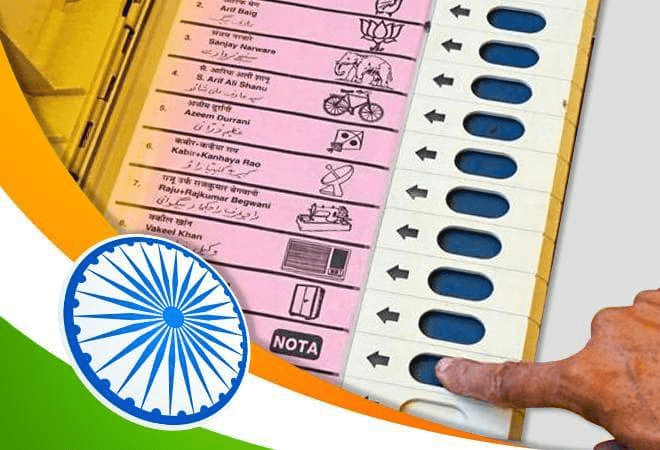
(b) Nowadays Electronic Voting Machines (EVMs) are used instead of ballot papers.
(c) The relevant qualification for being an MLA or an MP is the ability to understand people’s concerns, problems and to represent their interests. Educational qualification is not relevant to them. Fixed educational qualification will deprive a large section of people to contest the election. 

Q.24. “During elections many political parties and candidates take resort to illegal means to win.” In the light of the above statement, name the values and rights that are ignored.

Answer: The following values and rights are ignored in the above statement
(i) Moral values are ignored.
(ii) People are deprived of choosing a candidate of their choice.
(iii) Faith in democracy is affected. (iv) The spirit of a free and fair election is ignored.
(v) Provision to provide fair change to get elected is ignored.

Q.25. “One final test of the free and fairness of election lies in the outcome itself”. Justify the statement with the help of the outcomes of India’s elections.

Answer: Outcomes of India’s elections justify the statement in the following ways  
(i) The ruling parties routinely lose elections in India both at the national and state levels. In fact in every two out of the three elections held in the last fifteen years, the ruling party lost.
(ii) Candidates who are known to have spent a lot of money on ‘buying votes’ and those with known criminal connections often lose elections.  
(iii) Barring very few disputed elections, the electoral outcomes are usually accepted as ‘peoples’ verdict’ by defeated party,  

Q.26. Highlight any three issues which bring many limitations and challenges of Indian elections to our attention.

Answer: Important three issues are following
(i) Candidates and parties with a lot of money enjoy a big and unfair advantage over smaller parties or independent candidates.
(ii) Candidates with criminal records have been able to push others out of the electoral race and secure a ticket from major parties.
(iii) Some families tend to dominate political parties and secure tickets for their own family members. (iv) Smaller parties and independents suffer a huge disadvantage compared to bigger parties. 

Q.27. We have seen why democracies need to have elections. But why do rulers in non-democratic countries need to hold elections?

Answer: Rulers in non-democratic countries need to hold elections because they want to show the world that they are not unpopular and they have the support of the people of the country and so that their image improves in the eyes of the world. Secondly, they want to show that their government and position has been achieved legally and accordingly to the constitutional provisions. 

Q.28. Why are the candidates required to give a detailed statement of their property?

Answer: Candidates are required to give a detailed statement of their property at the time of election because the Election Commission is trying to control the misuse of money power in elections. The candidate has to give information about his assets movable and immovable, debts to a financial institution, tax status, income and wealth. With this information, the voters will be able to know more about the candidates and make their own choices. 

Q.29. What makes an election democratic?

Answer:  There are  as follows
(i)Election must be held regularly every few years.
(ii) Every eligible voter must have one vote with equal value.
(iii) There should be more than one party so that voters can get some real choice.
(iv) Elections should be conducted in a free and fair manner and people should have full freedom to vote for any candidate they like. 

Q.30. Mention any two provisions which ensure the independence of the Election Commission.

Answer:  In our country, the Election Commission has wide-ranging powers.
(i) Election Commission takes decisions of every aspect of conduct and control of elections from the announcement of elections to the declaration of results.
(ii) During the election time, the Election Commission can order the government to follow some guidelines to prevent the use and misuse of governmental power to enhance its chances to win elections or to transfer some government officials. 

Q.31. (a) What is the Election Manifesto? (b) What is an Election Symbol?

Answer:

(a) The booklet or pamphlet issued by a political party that tells people about their policies and programmes is known as Election Manifesto.
(b) All major political parties are allotted election symbols by the Election Commission. Independent candidates are also allotted symbols at the time of election. The symbols are allotted so that even the ordinary illiterate voters can recognise the different parties and candidates very easily can cast their vote according to their choice. 

Q.32. In our country, all the citizens aged 18 years and above can vote in an election. Every citizen has the right to vote, regardless of his or her caste, religion or gender. Some criminals and persons with an unsound mind can be denied the right to vote, but only in rare situations. It is the responsibility of the government to get the names of all the eligible voters put on the voters’ list. 
Read the passage and answer the following questions 
(a) Which fundamental political right is talked about in the passage? 
(b) Who are denied from casting their vote in rare situations? 
(c) What values you have learnt from the above passage?

Answer:  

(a) Right to Vote is talked about in this passage.          
(b) Some criminals and persons with an unsound mind can be denied from casting their vote in rare situations.                                        
(c) From the given passage I have learnt, the value of equality as every person in India has the right to vote, who attained the age of 18 years and every vote should have equal value.

Q.33. How has the interest of the voters in election-related activities increased in recent years in India?

Answer: The interest of the voters in election-related activities has been increasing over the year. During the 2004 elections, more than one-third of voters took part in a campaign-related activity. More than half of the people identified themselves as being close to one or the other political parties. One out of every seven voters is a member of a political party.

Q.34. (a) What is the importance of the election campaign? (b) Which values should contestants keep in mind during the election campaign 

Answer:  

(a) Election campaign is very important for election because.

  • It is a time period when free and open discussion takes place between different political parties.  
  • It is the time period when candidates contact their voters, political leaders address election meetings.
  • It is the time period when newspapers and television news are full of election-related stories and debates. 
  • This is also the period when people come to know the policies and programmes of various political parties. 

(b) Some values that the contestants should keep in mind are honesty, non-violence, patriotism, teamwork, etc. 

Q.35. Here are some facts on the Indian elections. Comment on each of these to say whether they reflect the strength or the weakness of our electoral system. The Lok Sabha has always had less than 10% women members. The Election Commission often refuses to accept the government’s advice about when the elections should be held. (c) The current Lok Sabha has more than 145 members whose assets are more than Rs. 1 crore. After losing an election the Chief Minister said. ‘I respect the people verdict’.

Answer: 
(a) It is the weakness of our electoral system which sends only 10% of women members to the Lok Sabha while the population of women is nearly 50% of the total population.
(b) It is the strength of our electoral system which has given the power to the Election Commission to refuse or to accept the advice of the ruling party about the election dates.
(c) This is the weakness of our electoral system, which does not give equal chance to both poor and rich. Those candidates, who are rich, have a better chance of winning than the poor in our country.
(d) This is the strength of our electoral system which enjoys the faith of both the defeated and winning candidates. Barring very few disputed elections, the electoral outcomes are usually accepted as ‘people’s verdict’ by the defeated party. 

Q.36. Surekha is an officer in charge of ensuring free and fair elections in an Assembly constituency in a state. Describe what should she focus on for each of the following stages of the election. Election Campaign (b) Polling Day (c) Counting Day

Answer:  

(a) Election Campaign During the election, Surekha should ensure that candidates or their supporters do not

  • use muscle power and threaten the voters.
  • use money power to influence the voters.
  • use government machinery and resources.
  • spend more money than the limit fixed by the Election Commission.
  • distribute money or other things (saris, sewing machines, umbrellas) among voters during the election campaign.
  • ask for votes in the name of caste or religion.

(b) Polling Day On polling day Surekha has to ensure that booth capturing does not take place.   

  • fake or bogus votes are not cast.
  • poor and weaker sections of society are able to cast their vote freely and without fear.
  • no unauthorised person should be allowed to enter the polling booth.

(c) Counting Day On the counting day, Surekha will have to ensure that

  • the voting machines are intact.
  • the counting should begin in the presence of the candidates and their agents.
  • counting should be done carefully and accurately.
  • no unauthorised person should be allowed into the counting centre.
  • after the counting, results are declared by the authorised official.

Q.37. What is a Universal Adult Franchise? Why has it been adopted in India?

Answer:  Right to express one’s choice by vote is called Franchise. When the right to vote or franchise is given to every adult in a state, it is known as the Universal Adult Franchise. In India, elections are held on the basis of Universal Adult Franchise. To elect their representatives, elections are held from time to time. In India, we have indirect democracy. The government is run by representatives, who are elected by the people. Every citizen of India, who has completed 18 years of age, has been given the right to vote irrespective of his caste, religion, sex, etc. Everybody, whether he is rich or poor, young or old, man or woman, learned or illiterate should have an equal voice in our democracy. One person, one vote makes our government responsible to all citizens.

Q.38. Here are some reports of malpractices in the Indian elections. Identify what the problem in each case is. What should be done to correct the situation? Following the announcement of elections, the minister promised to provide financial aid to reopen the closed sugar mill. Opposition parties alleged that their statements and campaign was not given due attention in Doordarshan and All India Radio. An inquiry by the Election Commission showed that the electoral rolls of a state contain the name of 20 lakh fake voters. The hoodlums of a political party were moving with guns, physically preventing supporters of other political parties to meet the voters and attacking meetings of other parties.

Answer:  

(a) The minister by promising to provide financial aid to the sugar mill broke the electoral code of conduct. According to the election law, no minister or member of the legislature can take decisions regarding projects which could influence the elections. The said minister should not be allowed to contest the election.
(b) All the parties should be given adequate time to express their views on Doordarshan and All India Radio. This has already been done by the Election Commission and time is fixed for different political parties.
(c) The electoral rolls of that state should be fully revised and names of all the fake voters should be removed from the voters’ list.
(d) This is also malpractice adopted by a certain candidate and even by political parties during the elections. The movement of people with guns and other arms should be strictly banned. The hoodlums should be arrested and the party that use them could be warned or banned from contesting elections for a certain period. The candidates must be provided with security by the state and steps should be taken to ensure that the meeting of other parties is not disturbed or attacked. 

Q.39. How does our election law regulate campaigns?

Answer: In a democracy, it is best to leave political parties and candidates free to conduct an election campaign. But it is also necessary to regulate campaign to ensure that every political party and candidate gets a fair and equal chance to compete. According to our election law, no party or candidate can
(i) bribe or threaten voters.
(ii) use any place of worship or appeal to the voters in the name of religion or caste.
(iii) use government resources, government vehicles, air crafts for elections.
(iv) spend more than Rs. 25 lakh in a constituency for a Lok Sabha election and Rs. 10 lakh in a constituency in an Assembly election.
(v) once elections are announced no minister can lay foundation stones of any project or take any policy decision. 

Q.40. (a) What are Reserved Constituencies? Why do we have this system in our country? What values of our Constitution makers are highlighted in creating this policy?

Answer:

(a) Our Constitution entitles every citizen to elect his representatives or to be elected as a representative. So, they thought of a special system of reserved constituencies for the weaker section i.e. Scheduled Castes  (SCs)  and  Scheduled  Tribes  (STs). This system of Reserved constituencies (79 seats for the Scheduled Castes and 41 for the Scheduled Tribes in Lok Sabha) makes our democracy a real representative democracy. Such classes in our society were victims of discrimination for centuries. So, if the representatives among them had not been elected, our Parliament and State Legislative Assemblies would have been deprived of the voice of a significant section of our society. (b) The values of our Constitution makers highlighted in creating this policy is their desire to bring everyone in the society on the same platform. Hence, they advocated the value ‘equality for all’.

2. Constitutional Design – HOTS Question and answer – 2

Q164. How was ‘apartheid’ practised in South Africa?
Ans: The system of apartheid in South Africa enforced strict racial segregation and discrimination. Key aspects of its practice included:

  • Racial Classification: People were categorised based on skin colour: ‘Blacks’ (native South Africans), ‘Coloured’ (mixed race), and ‘Indians’ (migrants from India).
  • Voting Rights: Non-Whites were denied the right to vote, treating them as inferiors.
  • Residential Restrictions: Non-Whites were prohibited from living in designated white areas.
  • Employment Permits: Non-Whites could only work in white areas if they obtained a special permit.
  • Segregation of Facilities: Public services, including transport, schools, and hospitals, were segregated by race.
  • Religious Restrictions: Blacks were not allowed to attend churches where whites worshipped.

This oppressive system was met with resistance from the affected communities, leading to significant struggles for equality.

Q165. What efforts were made to form a new constitution after independence in South Africa?
Ans: After the emergence of the new democratic South Africa:

  • Black leaders urged their communities to forgive whites for past atrocities.
  • They aimed to create a new South Africa founded on equality for all races and genders, embracing democratic values, social justice, and human rights.
  • The ruling party, known for oppression, and the party leading the freedom struggle collaborated to draft a shared constitution.
  • After two years of discussions and debates, they produced one of the finest constitutions in the world.
  • This constitution granted its citizens some of the most extensive rights available globally.

Q166. What are the main functions of a Constitution?
Ans: Main Functions of a Constitution

  • Trust and Coordination: It fosters trust and cooperation among diverse groups, enabling them to coexist peacefully.
  • Government Structure: It outlines how the government is formed and specifies who holds decision-making power.
  • Limits on Power: It establishes boundaries for government authority and defines citizens’ rights that must be respected.
  • Aspirations of Society: It reflects the people’s hopes for a just and equitable society.
  • Supreme Law: It serves as the highest legal framework, governing relationships among citizens and between citizens and the government.

Q167. Give a brief description about any five members of the Constituent Assembly.
Ans: Dr. Rajendra Prasad (1884-1963)

  • Born in Bihar.
  • Chairman of the Constituent Assembly.
  • A lawyer known for his role in the Champaran Satyagraha.
  • Served as President of the Indian National Congress three times.
  • First President of India.

H.C. Mookherjee (1887-1956)

  • Born in Bengal.
  • Vice Chairman of the Constituent Assembly.
  • A respected author and educationist.
  • Member of the All India Christian Council and Bengal Legislative Assembly.
  • Later became Governor of West Bengal.

Baldev Singh (1901-1961)

  • Born in Haryana.
  • Nominee of the Congress in the Constituent Assembly.
  • A successful entrepreneur.
  • Leader of the Panthic Akali Party in the Punjab Assembly.
  • Served as Defence Minister in the Union Cabinet.

Sarojini Naidu (1879-1949)

  • Born in Andhra Pradesh.
  • Member of the Constituent Assembly.
  • A poet, writer, and political activist.
  • One of the leading women in the Congress.
  • Later became Governor of Uttar Pradesh.

Jawaharlal Nehru (1889-1964)

  • Born in Uttar Pradesh.
  • Prime Minister of the interim government.
  • A lawyer and prominent Congress leader.
  • Advocate of socialism, democracy, and anti-imperialism.
  • First Prime Minister of Independent India.

Q168. How was the institutional design formed for the Indian Constitution?
Ans: The institutional design of the Indian Constitution was shaped through several key principles:

  • Values and Arrangements: A constitution embodies values into institutional arrangements.
  • Length and Detail: The Indian Constitution is a lengthy document that requires regular amendments to stay relevant.
  • Amendments: Provisions for constitutional amendments allow for necessary changes over time.
  • Legal Framework: It outlines institutional arrangements using legal language, making it a complex but essential document.
  • Governance Structure: The Constitution establishes procedures for selecting leaders and defines their powers.
  • Limits on Power: It also sets limits on government actions by granting certain rights to citizens that must not be violated.

Overall, the Indian Constitution is designed to reflect the aspirations of its people and adapt to societal changes.

Q169. Write a short note on the main features of the Preamble of the Indian Constitution.
Ans: Main Features of the Preamble of the Indian Constitution

  • We the People of India: The Constitution is created by the people through their representatives, not imposed by a king or foreign powers.
  • Sovereign: The people have the ultimate authority to make decisions on internal and external matters, free from external control.
  • Socialist: Wealth should be shared fairly within society. The government regulates land and industry to minimise socio-economic inequalities.
  • Secular: Citizens can follow any religion, with no official state religion. The government respects all beliefs equally.
  • Democratic: A system where everyone has equal political rights, can elect leaders, and hold them accountable.
  • Republic: The head of state is elected, not a hereditary position.
  • Justice: No discrimination based on caste, religion, or gender. The government aims to reduce social inequalities and support disadvantaged groups.
  • Liberty: Citizens have the freedom to think, express their thoughts, and act without unreasonable restrictions.
  • Equality: Everyone is equal before the law, and the government ensures equal opportunities for all.
  • Fraternity: Citizens should treat each other as family, promoting respect and unity.

Q170. How did South Africa get Independence?
Ans: The struggle for independence in South Africa was a long and challenging journey, primarily against the system of apartheid, which enforced racial segregation and discrimination. Here are the key points regarding how South Africa achieved its independence:

  • The African National Congress (ANC) led the fight against apartheid, advocating for the rights of black South Africans.
  • Protests, strikes, and international condemnation of apartheid increased pressure on the government.
  • In 1990, Nelson Mandela was released from prison after 27 years, symbolising hope for change.
  • Negotiations began between the ANC and the apartheid government to end racial segregation.
  • On 26 April 1994, South Africa held its first democratic elections, leading to the election of Nelson Mandela as the first black president.
  • The new constitution, adopted in 1996, established a framework for a multi-racial democracy and guaranteed extensive rights for all citizens.

This transition was marked by a commitment to peace and reconciliation, as leaders sought to unite a divided nation.

Q171. How was a new constitution of South Africa formed?
Ans: After the emergence of the new democratic South Africa, black leaders urged their communities to forgive the whites for past atrocities. They envisioned building a new South Africa founded on:

  • Equality of all races and genders
  • Democratic values
  • Social justice
  • Human rights

The ruling party, which had enforced oppression, and the party that led the freedom struggle collaborated to create a shared constitution. After two years of discussions, they produced one of the finest constitutions in the world, granting citizens extensive rights. In their quest for solutions, they agreed that:

  • No one should be excluded from the process.
  • No individual should be demonised for their past actions.
  • Everyone should contribute to the solution.

This spirit is encapsulated in the preamble of the South African Constitution, which inspires democrats globally. The transition from an undemocratic regime to a democratic government was marked by a commitment to work together, transforming painful experiences into a rainbow nation. Nelson Mandela, the first president of this new South Africa, emphasised the importance of mutual trust and the belief in the inherent goodness of people, which was crucial for this peaceful transition.

Q172. What problems were faced by the South Africans before the formation of the constitution?
Ans: The transition to a new democracy in South Africa posed significant challenges:

  • The oppressor and the oppressed had to learn to coexist as equals.
  • Trust was a major issue, with both sides harbouring fears about their future.
  • The black majority sought to ensure that the principle of majority rule was upheld.
  • They demanded substantial social and economic rights.
  • The white minority aimed to protect its privileges and property.

These conflicting interests made the formation of a constitution a complex process, requiring careful negotiation and compromise.

Q173. Is it true that the constitution of India expresses a broad consensus of its time?
Ans: Many countries have had to rewrite their constitutions because the basic rules were not accepted by all major social groups or political parties. In some nations, constitutions exist as mere pieces of paper, with no one following them. However, the experience of the Indian Constitution is different:

  • Over the last fifty years, various groups have questioned some provisions.
  • No major social group or political party has challenged the legitimacy of the Constitution itself.
  • This reflects a unique achievement for any constitution.

The Constituent Assembly also represented the people of India, despite the absence of universal adult franchise at that time. Although there were significant differences of opinion during the freedom struggle, some basic ideas were widely accepted:

  • In 1928, Motilal Nehru and other leaders drafted a constitution.
  • The 1931 Karachi session of the Indian National Congress outlined key principles, including:
    • Universal adult franchise
    • Rights to freedom and equality
    • Protection of minority rights

These foundational values were agreed upon long before the Constituent Assembly convened. The Constitution is not just a document of values; it embodies these values in institutional arrangements, making it a comprehensive and evolving framework.

Q174. What steps were taken by the Constituent Assembly to form the Indian Constitution? 
Ans: The Constituent Assembly followed a systematic and open approach to create the Indian Constitution. The key steps included:

  • Agreement on basic principles that would guide the constitution.
  • Formation of a Drafting Committee led by Dr. B.R. Ambedkar to prepare the initial draft.
  • Extensive discussions on the draft, examining it clause by clause.
  • Consideration of over 2000 amendments during the deliberations.
  • Members met for 114 days over a span of three years.
  • All proceedings and documents were meticulously recorded, resulting in 12 volumes of Constituent Assembly Debates.

The Assembly adopted the Constitution on 26 November 1949, which came into effect on 26 January 1950, now celebrated as Republic Day.

Q175. Nelson Mandela remained in prison for treason for about:
a) 25 years
b) 26 years
c) 28 years
d) 20 years
Ans: c) 28 years

Nelson Mandela was imprisoned for 27 years, from 1962 until his release in 1990. The closest option is 28 years, which accounts for the time he was in custody before the trial.


Q176. How many members were there in the Constituent Assembly that wrote the Indian Constitution?
a) 299 members
b) 101 members
c) 36 members
d) 206 members
Ans: a) 299 members

The Constituent Assembly of India had 299 members who were responsible for drafting the Constitution, making option a) the correct choice.


Q177. When was the Constitution of India completed or adopted?
a) 26 January, 1950
b) 26 November, 1949
c) 26 October, 1949
d) 17 December, 1947
Ans: c) 26 January, 1950

The Constitution of India was adopted on 26 November 1949, but it came into effect on 26 January 1950, which is why option a) is often highlighted as the date of adoption.


Q178. The Chairman of the drafting committee was:
a) Dr. Rajendra Prasad
b) Dr. B.R. Ambedkar
c) Pt. Jawaharlal Nehru
d) Mahatma Gandhi
Ans: b) Dr. B.R. Ambedkar

Dr. B.R. Ambedkar was appointed as the Chairman of the Drafting Committee of the Indian Constitution, making option b) the correct answer.


Q179. A form of government where people enjoy equal political rights is:
a) Socialist
b) Dictatorial
c) Democratic
d) Autocratic
Ans: c) Democratic

A democratic government ensures that all citizens have equal political rights, distinguishing it from other forms of government like dictatorial or autocratic regimes.

Q180. What is a constitution? Why do we need a constitution for a country?
Ans: The constitution of a country is a set of written rules accepted by all its citizens. It serves as the supreme law that defines the relationships among people within a territory and between the people and their government. Reasons for needing a constitution include:

  • Trust and Coordination: It fosters trust and cooperation among diverse groups, enabling them to live together harmoniously.
  • Government Structure: It outlines how the government is formed and who has the authority to make decisions.
  • Limits on Power: It sets boundaries on government powers and defines citizens’ rights.
  • Aspirations for Society: It reflects the people’s hopes for building a just and equitable society.

While not all countries with constitutions are democratic, every democratic nation has one. A constitution ensures that the rules governing society are agreed upon and respected, maintaining order and protecting individual rights.

Q181. ‘Most of the countries of the world keep changing their constitution as needed but Indian Constitutions is accepted even today.’ Is it an unusual achievement for any constitution? Give reasons in support of your answer.
Ans: Most of the countries of the world keep changing their constitution as needed but Indian Constitution is accepted even today. The Indian Constitution is indeed an unusual achievement for several reasons:

  • Broad Consensus: It reflects a wide agreement among various groups at the time of its creation, rather than just the views of its members.
  • Stability: Many countries have had to rewrite their constitutions because their basic rules were not accepted by all major social groups or political parties. In contrast, India’s Constitution has remained largely intact.
  • Representation: The Constituent Assembly, which drafted the Constitution, represented diverse groups in India, including various languages, castes, and religions. Although there was no universal adult franchise at that time, the Assembly was elected by existing provincial legislatures, ensuring a fair geographical representation.
  • Systematic Approach: The Assembly worked in a structured and open manner. They first established some basic principles, then a Drafting Committee led by Dr. B.R. Ambedkar prepared a draft for discussion. This draft underwent extensive debates and amendments.
  • Legitimacy: Over the decades, while some provisions have been questioned, no major social group or political party has ever challenged the Constitution’s legitimacy itself. This is a significant achievement compared to other nations.

In summary, the Indian Constitution’s ability to maintain its relevance and acceptance over time, despite challenges, marks it as a remarkable document in the world of governance.

Q182. Why Preamble is called the preface of the Indian constitution?
Ans: The Preamble of the Indian Constitution is often referred to as its preface because it outlines the fundamental principles and values that guide the Constitution. Here are the key reasons for this designation:

  • Introduction to Values: The Preamble introduces the core values of the Constitution, such as justice, liberty, equality, and fraternity, which reflect the aspirations of the Indian people.
  • Philosophical Foundation: It serves as a philosophical foundation, summarising the ideals that inspired the freedom struggle and the formation of a democratic nation.
  • Guiding Principles: The Preamble acts as a guiding light for interpreting the Constitution, helping to evaluate laws and government actions against these foundational values.
  • Symbol of Unity: It represents the unity of the nation, emphasising that the Constitution is created by the people of India for themselves.

Overall, the Preamble encapsulates the essence of the Constitution, making it a vital component that reflects the identity and values of the nation.

Q183. What are the exclusive features of the Indian constitution?
Ans: Exclusive features of the Indian Constitution:

  • Length and Detail: The Indian Constitution is notably long and detailed, requiring regular amendments to stay relevant.
  • Dynamic Nature: Its creators intended for it to reflect the aspirations of the people and adapt to societal changes, viewing it as a living document rather than a static law.
  • Amendments: Provisions for incorporating changes, known as amendments, are included to ensure it evolves over time.
  • Legal Language: The Constitution outlines institutional arrangements using formal legal terminology, which can be complex for first-time readers.
  • Citizen Rights: It establishes limits on government power by guaranteeing certain rights to citizens that cannot be infringed upon.

02. Constitutional Design – HOTS Question and answers – 1

Q116. What was ‘Constituent Assembly’?
Ans: The Constituent Assembly was an assembly of elected representatives responsible for drafting the country’s constitution. Key details include:

  • Elections were held in July 1946.
  • The first meeting took place in December 1946.
  • Following the partition, it was divided into the Assemblies for India and Pakistan.
  • The Indian Constituent Assembly had 299 members.
  • The Constitution was adopted on 26 November 1949 and came into effect on 26 January 1950.
  • This day is celebrated as Republic Day each year.

Q117. How was Constituent Assembly formed?
Ans: Elections for the Constituent Assembly took place in July 1946. The first meeting was held in December 1946. Following the partition of the country into India and Pakistan, the Assembly was divided into two separate bodies:

  • The Constituent Assembly of India
  • The Constituent Assembly of Pakistan

The Indian Constituent Assembly comprised 299 members and adopted the Constitution on 26 November 1949. It came into effect on 26 January 1950, which is celebrated as Republic Day each year.

Q118. How many members did the Constituent Assembly have?
Ans: The Constituent Assembly that drafted the Indian Constitution comprised 299 members.

Q119. When was the Constitution work completed and when did it come into effect?
Ans: The Constitution was adopted by the Assembly on 26th November 1949. It officially came into effect on 26th January 1950. This date is celebrated annually as Republic Day in India.

Q120. Why did the Constitution come into effect on 26th January 1950?
Ans: The Constitution came into effect on 26th January 1950 for several important reasons:

  • The date 26th January was significant as it marked the day when Jawaharlal Nehru declared India’s independence in 1931.
  • This choice aimed to honour the historical importance of the date in India’s struggle for freedom.
  • It symbolised the transition from colonial rule to a sovereign nation.

Q121. What is the unusual achievement of our Constitution?
Ans: No large social group or political party has ever questioned the legitimacy of the Constitution itself. This is an unusual achievement for any constitution.

Q122. In which manner Constituent Assembly worked?
Ans: The Constituent Assembly operated in a systematicopen, and consensual manner. Key aspects of its functioning include:

  • Initial agreement on basic principles.
  • Formation of a Drafting Committee led by Dr. B.R. Ambedkar to create the draft constitution.
  • Extensive discussions on the draft, examining it clause by clause.
  • Consideration of over two thousand amendments.
  • Deliberations lasted for 114 days over three years.
  • All proceedings and discussions were documented, known as the ‘Constituent Assembly Debates’.

Q123. Why was a drafting committee formulated? Who was its Chairman?
Ans: The Drafting Committee was established to create a draft of the Constitution for further discussion. Its Chairman was Dr. B.R. Ambedkar.

Q124. Who was the Chairman of the Constituent Assembly?
Ans: Dr. Rajendra Prasad served as the Chairman of the Constituent Assembly.

Q125. How many amendments were considered on the draft?
Ans: More than two thousand amendments were considered by the drafting Committee.

Q126. How much time it took to form the Constitution of India?
Ans: It took about 114 days over three years to document the Indian Constitution.

Q127. What are ‘Constituent Assembly Debates’?
Ans: Constituent Assembly Debates refer to the recorded discussions and documents from the Constituent Assembly, which was responsible for drafting the Constitution of India. Key points include:

  • Every word spoken and document presented during the Assembly’s sessions has been preserved.
  • These records are known as the Constituent Assembly Debates.
  • When printed, they comprise 12 volumes, detailing the rationale behind each provision of the Constitution.
  • The debates serve as a crucial resource for interpreting the Constitution’s meaning.

Q128. How these Constituent Assembly Debates are used?
Ans: Constituent Assembly Debates serve as a crucial resource for understanding the Indian Constitution. They are used for the following purposes:

  • Provide the rationale behind each provision of the Constitution.
  • Assist in interpreting the meaning of the Constitution.
  • Document the discussions and decisions made during the drafting process.

These debates are essential for grasping the context and intent of the Constitution’s framers.

Q129. What features formed the foundation for India’s democracy?
Ans: Values that inspired and guided the freedom struggle formed the foundation for India’s democracy. These values include:

  • Universal adult franchise: Ensuring every citizen has the right to vote.
  • Right to freedom: Protecting individual liberties.
  • Equality: Guaranteeing equal rights for all citizens.
  • Minority rights: Safeguarding the interests of minority groups.

These principles were embedded in the Preamble of the Indian Constitution and continue to guide the nation.

Q130. What is Preamble?
Ans: The Preamble serves as the introduction to the Indian Constitution, summarising its core principles. It is often described as the soul of the Constitution, as it:

  • Outlines the fundamental values of justicelibertyequality, and fraternity.
  • Sets the tone for the laws and actions of the government.
  • Acts as a guiding framework for evaluating legislation.

Overall, the Preamble encapsulates the essence of India’s democratic ideals.

Q131. What does ‘Sovereign’ mean?
Ans: The term sovereign refers to the idea that the people possess the highest authority to make decisions regarding both internal and external matters. This means:

  • People have the supreme right to govern themselves.
  • No outside power can dictate the actions of the government of India.
  • The constitution is created by the people through their representatives, not imposed by any external authority.

Q132. What does ‘Socialist’ in a democratic Constitution mean?
Ans: The term Socialist in a democratic Constitution signifies that:

  • Wealth is created collectively and should be shared fairly among all members of society.
  • The government aims to reduce socio-economic inequalities.
  • It regulates the ownership of land and industry to promote equity.

Q133. What is the meaning of the form ‘Secular’?
Ans: Secular refers to a system where:

  • Citizens have complete freedom to follow any religion.
  • There is no official religion endorsed by the state.
  • The government treats all religious beliefs and practices with equal respect.

Q134. What does ‘democratic’ mean?
Ans: Democratic refers to a type of government where:

  • People have equal political rights.
  • Citizens can elect their leaders.
  • Leaders are held accountable for their actions.
  • The government operates based on established rules.

Q135. What does ‘Republic’ mean?
Ans: A republic is a form of government where:

  • The head of the state is an elected official.
  • This position is not inherited, meaning it is not hereditary.

In a republic, the authority lies with the people, who choose their leaders through elections.

Q136. Why is the term ‘Justice’ included in our Preamble?
Ans: Justice is included in the Preamble to ensure that:

  • All citizens are treated equally, regardless of castereligion, or gender.
  • Social inequalities are addressed and reduced.
  • The government is responsible for the welfare of all, especially the disadvantaged.

Q137. What kind of liberty is given in the Preamble?
Ans: The Preamble guarantees liberty to citizens in several ways:

  • It ensures there are no unreasonable restrictions on what individuals can think.
  • Citizens have the freedom to express their thoughts as they wish.
  • People can act on their thoughts without facing undue limitations.

Q138. What does ‘Equality’ term mean in the Indian Constitution?
Ans: Equality

  • Everyone is equal before the law.
  • Traditional social inequalities must be eliminated.
  • The government should provide equal opportunities for all.

Q139. What does the term ‘Fraternity’ signify in the Preamble?
Ans: Fraternity signifies the idea that:

  • We should act as if we are part of the same family.
  • No one should treat a fellow citizen as inferior.

Q140. What are ‘Constitutional Amendments’?
Ans: Constitutional Amendments are changes made to the constitution to keep it relevant and aligned with the evolving needs of society.

  • They allow for updates and modifications to the legal framework.
  • These amendments reflect the aspirations of the people.
  • They ensure the constitution remains a living document, not a static one.

Q141. Why do we need to make amendments in our constitution?
Ans: Our Constitution is a lengthy and detailed document. It requires regular amendments to ensure it remains relevant and reflects current societal needs.

  • Amendments help keep the Constitution aligned with people’s aspirations.
  • They allow for adjustments in response to changes in society.
  • The Constitution is not seen as a fixed law; it is designed to evolve.

Q142. Name some of the members of the Constituent Assembly?
Ans:

  • Dr. Rajendra Prasad (1884-1963) – Chairman of the Constituent Assembly, lawyer, and later the first President of India.
  • Jaipal Singh (1903-1970) – A sportsman and educationist, he was the captain of India’s first national hockey team.
  • Baldev Singh (1901-1961) – An entrepreneur and leader of the Panthic Akali Party, he served as Defence Minister.
  • B.R. Ambedkar (1891-1956) – Chairman of the Drafting Committee and a social revolutionary, later became the Law Minister.
  • Jawaharlal Nehru – Prime Minister of the Interim Government and a key figure in India’s independence.
  • Sarojini Naidu (1879-1949) – A poet, writer, and political activist, she played a significant role in the freedom struggle.
  • Shyama Prasad Mukherjee (1901-1953) – An educationist and lawyer, he was influential in Indian politics.

Q143. What do you know about Nelson Mandela?
Ans: Nelson Mandela was a prominent South African leader known for his fight against the oppressive apartheid regime. Key points about his life include:

  • In 1964, he was sentenced to life imprisonment for opposing the apartheid government.
  • Mandela spent 27 years in Robben Island, a notorious prison.
  • He was released in 1990, after which South Africa began its transition to democracy.
  • On 26 April 1994, South Africa held its first democratic elections, and Mandela became the country’s first black President.

Q144. What do you understand by the term ‘apartheid’?
Ans: Apartheid was a system of racial discrimination in South Africa, enforced by the white government from 1948 to 1989. Key features include:

  • Official policy of racial separation and discrimination.
  • Black South Africans, who made up about three-fourths of the population, faced severe oppression.
  • Non-whites were denied voting rights and access to many public facilities.
  • Blacks could only live and work in designated areas with special permits.

This system led to widespread protests and resistance, ultimately contributing to its dismantling.

Q145. What basic rules are followed to form a Constitution?
Ans: The basic rules for forming a Constitution include:

  • Establishing trust: A constitution creates a framework that helps different groups coexist peacefully.
  • Defining government structure: It outlines how the government is formed and who holds decision-making power.
  • Limiting government power: It sets boundaries on what the government can do and clarifies the rights of citizens.
  • Reflecting societal values: It expresses the aspirations of the people for a just and equitable society.

These rules ensure that all citizens have a say in governance and that their rights are protected.

Q146. What documents were taken by the Constituent Assembly to form the Indian Constitution?
Ans: The documents used to create the Indian Constitution included:

  • Motilal Nehru and eight other leaders drafted a constitution in 1928.
  • A resolution from the Karachi Session of the Indian National Congress in 1931 outlined the desired features of an independent India’s constitution.

Both documents emphasised:

  • Inclusion of universal adult franchise.
  • Rights to freedom and equality.
  • Protection of minority rights.

Q147. Indian leaders were inspired by which countries to frame the Indian Constitution?
Ans: The countries that inspired the Indian Constitution include:

  • France: The ideals of the French Revolution, particularly liberty, equality, and fraternity, influenced Indian leaders.
  • Britain: The practice of Parliamentary democracy in Britain served as a model.
  • United States: The Bill of Rights was a significant source of inspiration.
  • Russia: The socialist revolution prompted thoughts on social and economic equality.

Q148. How was the Constituent Assembly formed?
Ans: The drafting of the Constitution was carried out by an assembly of elected representatives known as the Constituent Assembly.

  • Elections for the Constituent Assembly took place in July 1946.
  • The first meeting was convened in December 1946.
  • After the partition, the assembly was split into the Constituent Assemblies of India and Pakistan.
  • The Indian Constituent Assembly had 299 members and adopted the Constitution on 26 November 1949.
  • The Constitution came into effect on 26 January 1950, which is celebrated as Republic Day each year.

Q149. When was the Constitution completed and why was it imposed on 26 January 1950?
Ans: The Constitution of India was completed by the Constituent Assembly on 26 November 1949. However, it came into effect on 26 January 1950 for the following reasons:

  • This date was chosen to honour the significance of 26 January, which was already celebrated as Independence Day in 1930.
  • To commemorate this day, we celebrate it annually as Republic Day.

Q150. Give reasons for accepting the Constitution made by the Constituent Assembly more than 50 years ago.
Ans: Several reasons support the continued acceptance of the Constitution established by the Constituent Assembly over 50 years ago:

  • Broad Consensus: The Constitution reflects a wide agreement of its time, not just the views of its members.
  • Representation: The Constituent Assembly represented the people of India, despite the absence of universal adult franchise. It was elected mainly by members of Provincial Legislatures, ensuring fair regional representation.
  • Systematic Approach: The Assembly operated in a systematic, open, and consensual manner. Basic principles were agreed upon first, followed by detailed discussions on the draft constitution, which included over two thousand amendments.

Q151. What was the ‘Drafting Committee’?
Ans: The Drafting Committee was responsible for creating the initial draft of the Constitution. Key points include:

  • It was chaired by Dr. B.R. Ambedkar.
  • Members engaged in detailed discussions on the draft, examining it clause by clause.
  • The committee worked for 114 days over a span of three years.
  • After completion, the draft was presented to the public for feedback.

Q152. What are ‘Constituent Assembly Debates’?
Ans: Every document presented and every word spoken in the Constituent Assembly has been recorded and preserved. These records are known as the Constituent Assembly Debates. They serve several important purposes:

  • They provide the rationale behind every provision of the Constitution.
  • They are used to interpret the meaning of the Constitution.
  • When printed, these debates fill 12 bulky volumes.

Q153. In which two ways can the philosophy of the Indian Constitution be understood?
Ans: The philosophy of the Indian Constitution can be understood in two main ways:

  • Historical Context: It reflects the values that inspired the freedom struggle, which are embedded in the Preamble. These values guide the principles of democracy in India.
  • Institutional Framework: The Constitution outlines the structure of government, defining powers and responsibilities while ensuring the protection of citizens’ rights.

Q154. What is the role of Dr. B.R. Ambedkar in making the Constitution?
Ans: Dr. B.R. Ambedkar was the Chairman of the Drafting Committee of the Indian Constitution. His contributions included:

  • Advocating for political equality while emphasising the need to address social and economic inequalities.
  • Believing that true equality must extend beyond politics to all aspects of life.
  • Critiquing existing social structures that perpetuated inequality.

Ambedkar’s vision was crucial in shaping a Constitution that aimed to eliminate discrimination and promote justice for all.

Q155. How did the blacks of South Africa fight against the practice of apartheid?
Ans: Since 1950, black, coloured, and Indian South Africans have actively fought against the apartheid system. Their efforts included:

  • Organising protest marches and strikes.
  • Forming the African National Congress (ANC), which led the struggle against segregation policies.
  • Collaborating with various workers’ unions and the Communist Party.
  • Receiving support from sensitive white individuals who joined the ANC to oppose apartheid.

Additionally, many countries condemned apartheid as unjust and racist, although the white government continued to enforce its oppressive policies through violence.

Q156. What kind of inspiration do we get from South Africa?
Ans: The South African Constitution serves as a powerful source of inspiration for democrats worldwide. Once regarded as one of the most undemocratic states, South Africa has transformed into a model of democracy since 1994. This remarkable change was driven by the people’s determination to:

  • Work together to overcome past struggles.
  • Transform painful experiences into a unifying force for a rainbow nation.

Nelson Mandela highlighted that the Constitution is a commitment to never repeat the racism and repression of the past. It aims to create a society that truly belongs to all South Africans, regardless of race or gender.

Q157. What were Nelson Mandela’s views on the South African constitution?
Ans: Nelson Mandela’s views on the South African constitution highlight its significance in both historical and future contexts:

  • The Constitution serves as a solemn pact among South Africans, ensuring that the racist and brutal past is never repeated.
  • It acts as a charter for transformation, aiming to create a nation that is genuinely shared by all its people.
  • This includes everyone—black and white, women and men—in a country that belongs to all.

Mandela emphasised the importance of unity and collaboration in building a rainbow nation from their shared experiences.

Q158. What compromises were made by both ethnic groups of South Africa for their constitution?
Ans: The whites made several concessions:

  • Accepted the principle of majority rule and one person, one vote.
  • Agreed to recognise some basic rights for the poor and workers.

The blacks also made important compromises:

  • Agreed that majority rule would not be absolute.
  • Accepted that the majority would not confiscate the property of the white minority.

This compromise was significant, as it aimed to balance the interests of both groups in a new democratic South Africa.

Q159. Why are rules formed in the constitutions of countries?
Ans: The rules in a country’s constitution serve several important purposes:

  • They outline how leaders are selected in the future.
  • They define the powers and limitations of elected governments.
  • They establish the rights of citizens.

These fundamental rules are essential for maintaining order and trust within a society.

Q160. Which basic values were accepted by all leaders before the Constituent Assembly met to form the constitution?
Ans: Basic values accepted by leaders before the Constituent Assembly met:

  • Universal Adult Franchise: All citizens of India should have the right to vote and stand for elections.
  • Right to Freedom and Equality: Essential for a diverse country like India, ensuring everyone is treated equally.
  • Protection of Minority Rights: Safeguarding the rights of minorities in the constitution of independent India.

Q161. Who was Dr. B.R. Ambedkar? How did he play a key role in the making of Indian constitution?
Ans: Dr. B.R. Ambedkar was the chairman of the Drafting Committee of the Indian Constitution.

  • He was a social revolutionary and a thinker who fought against caste divisions and inequalities.
  • Ambedkar played a crucial role in shaping the Constitution, advocating for the removal of inequalities.
  • He had a different perspective on achieving equality compared to others, notably Mahatma Gandhi, whom he often criticised.

Q162. How values of freedom struggle were embedded in the Preamble of the Indian constitution?
Ans: Values that inspired and guided the freedom struggle form the basis of India’s democracy, as reflected in the Preamble of the Indian Constitution. Key points include:

  • The Preamble outlines the basic values of the Constitution.
  • It serves as a guiding principle for all articles within the Constitution.
  • These values include justicelibertyequality, and fraternity.
  • The Preamble acts as the soul of the Constitution, helping to evaluate laws and government actions.

Q163. What does the Indian Preamble on the constitution contain?
Ans: The Preamble of the Constitution serves as a guiding light for India’s democracy. It encapsulates the core philosophy upon which the entire Constitution is founded. Key points include:

  • It acts as a standard for assessing laws and government actions.
  • It reflects the essence and values of the Indian Constitution.
  • It emphasises the importance of justicelibertyequality, and fraternity among citizens.

In essence, the Preamble is the soul of the Indian Constitution, guiding the nation towards its democratic ideals.

1. What is Democracy? Why Democracy? – HOTS Question and answer – 2

Q1. State the main features of democracy.

Ans: The main features of democracy are:

  • Decision-making power lies with elected representatives.
  • It is based on free and fair elections, allowing current leaders a fair chance of losing.
  • Each adult citizen has one vote that carries equal weight.
  • A democratic government operates within the limits of constitutional law and respects citizens’ rights.
  • Democracy provides a way to manage differences and conflicts, enhancing the dignity of all citizens.

Q2. How can you say that Pakistan was not exercising democracy when General Musharraf was ruling?

Ans: General Musharraf led a military coup in October 1999, overthrowing a democratically elected government. He declared himself the ‘Chief Executive’ and later became President. In 2002, he held a referendum that extended his rule for five years.

Pakistan under General Musharraf cannot be classified as a democracy for several reasons:

  • Although people elected representatives to the national and provincial assemblies, these representatives did not hold real power.
  • The final decision-making authority rested with military officials and General Musharraf, none of whom were elected by the public.
  • Media, human rights organisations, and democracy activists claimed that the referendum was marred by malpractices and fraud.

In summary, the lack of genuine electoral power and the dominance of military authority demonstrate that Pakistan was not exercising true democracy during General Musharraf’s rule.

General Musharraf

Q3. Giving an example of Zimbabwe, show how laws were made by one single ruler.

Ans: Zimbabwe gained independence from White minority rule in 1980 and has been governed by the ZANU-PF party, which led the freedom struggle. Its leader, Robert Mugabe, ruled the country since independence.

  • Elections were held regularly, but ZANU-PF always won, often through unfair practices.
  • The government changed the constitution multiple times to enhance the President’s powers and reduce accountability.
  • Opposition party members faced harassment, and their meetings were often disrupted.
  • Public protests and demonstrations were declared illegal.
  • Laws restricted the right to criticise the President.
  • The government controlled television and radio, promoting only its own narrative.
  • Independent newspapers existed, but journalists who opposed the government faced harassment.

This situation illustrates that a government can be popular yet undemocratic. While public approval is necessary for democracy, it is not sufficient. Assessing democracy requires examining elections and the political environment both before and after them.

Robert Mugabe

Q4. How did Musharraf establish his rule in Pakistan?

Ans: Musharraf’s rise to power in Pakistan involved several key steps:

  • In October 1999, he led a military coup, overthrowing the democratically elected government.
  • He declared himself the Chief Executive and later became the President.
  • In 2002, he held a controversial referendum, which extended his term by five years. Critics, including media and human rights organisations, claimed the referendum involved malpractices and fraud.
  • In August 2002, he issued a Legal Framework Order that amended the constitution, allowing the President to dismiss national and provincial assemblies.
  • The civilian cabinet’s work was overseen by a National Security Council, primarily composed of military officers.

While elections were held, the real power remained with the military and Musharraf himself, raising questions about the democratic nature of his rule.

Q5. Why Pakistan may not be called a democracy under General Musharraf?

Ans: Pakistan under General Musharraf cannot be considered a democracy for several reasons:

  • Although people elected representatives to the national and provincial assemblies, these representatives did not hold true power.
  • The final decision-making authority rested with military officials and General Musharraf, none of whom were elected by the public.
  • This situation mirrors many dictatorships or monarchies, where an elected parliament exists, but real power lies with non-elected individuals.
  • In a genuine democracy, the ultimate decision-making power should be with those elected by the people.

Thus, despite having elections, the lack of genuine power among elected representatives means that Pakistan under General Musharraf does not fit the definition of a democracy.

Q6. How did China establish a Communist Government?

Ans: In China, elections are held every five years to elect the country’s parliament, known as the National People’s Congress (NPC).

  • The NPC has nearly 3,000 members elected from across China.
  • Some members are chosen by the army.
  • Candidates must receive approval from the Chinese Communist Party (CCP) before they can run for election.
  • In the elections of 2002-2003, only CCP members and those from eight smaller allied parties were allowed to contest.
  • The government is consistently formed by the Communist Party.

Symbol of Chinese Communist Party

Q7. What was PRI? What dirty tricks did it play to win elections in Mexico?

Ans: PRI was the Institutional Revolutionary Party of Mexico. It was known for using various unfair tactics to secure election victories, including:

  • Government employees were required to attend PRI party meetings.
  • Teachers pressured parents to vote for the PRI.
  • The media largely ignored opposition parties, focusing instead on criticism.
  • Polling booths were sometimes moved at the last minute, complicating voting for citizens.
  • The PRI invested heavily in campaign financing for its candidates.

These practices contributed to a political environment where genuine competition was stifled.

Q8. How did Robert Mugabe establish his dictatorial rule in Zimbabwe, after Independence?

Ans: Robert Mugabe established his dictatorial rule in Zimbabwe after independence through a series of strategic actions:

  • The country has been governed by ZANU-PF, the party that led the freedom struggle, since 1980.
  • Mugabe, as the leader, maintained power through regular elections, which were consistently won by ZANU-PF.
  • Although popular, Mugabe employed unfair practices during elections.
  • His government amended the constitution multiple times to enhance presidential powers and reduce accountability.
  • Opposition party members faced harassment, and their meetings were often disrupted.
  • Public protests against the government were declared illegal.
  • There were laws restricting the right to criticise the President.
  • The government-controlled television and radio, promoting only the ruling party’s narrative.
  • While independent newspapers existed, journalists faced harassment for opposing the government.

Q9. Under what conditions is a government-run after the elections?

Ans: democratic government must operate within certain limits, even after winning elections. Key conditions include:

  • The government must respect the rights of minorities.
  • Major decisions require a series of consultations.
  • Office bearers have specific rights and responsibilities defined by the constitution and law.
  • Each official is accountable to both the public and independent authorities.

Furthermore, citizens should enjoy basic rights, including:

  • The freedom to express opinions and engage in political activities.
  • The right to form associations and protest.
  • Equality before the law, protected by an independent judiciary.

Q10. Which Pakistan General led a military coup in October 1999?
(a) Nawaz Sharif 
(b) Parvez Musharraf 
(c) Ayub Khan 
(d) None of these
Ans: B 

General Pervez Musharraf led a military coup in October 1999. He overthrew the democratically elected government. Musharraf declared himself the ‘Chief Executive’ of Pakistan. Later, he changed his title to President. In 2002, he held a referendum to extend his rule. Thus, the answer is B.

Q11. The famous political party of Mexico was:

(a) People’s party 
(b) Institutional Revolutionary party 
(c) Revolutionary party 
(d) Chinese Communist party
Ans: B 

The famous political party of Mexico is the Institutional Revolutionary Party (PRI).

  • Opposition parties contested elections but rarely won.
  • The PRI employed various tactics to secure victories.
  • Government employees were often required to attend PRI meetings.
  • Teachers pressured parents to vote for the PRI.
  • The media largely ignored opposition parties, focusing on criticism instead.
  • Polling booths were sometimes moved last minute, complicating voting.
  • The PRI invested heavily in campaign funding.

Q12. Who did not have the right to vote in Saudi Arabia?

(a) Non-propertied men
(b) Non-residents
(c) Women 
(d) Propertied men
Ans: C 

The following groups did not have the right to vote in Saudi Arabia:

  • Women (until 2015)
  • Non-propertied men
  • Non-residents

Among these, the primary group that lacked voting rights was women.

Q13. Which party of Zimbabwe helped its country to gain independence?

(a) ZANU-PF 
(b) Popular party 
(c) Zimbabwe party 
(d) None of these
Ans: A 

The party that played a crucial role in Zimbabwe’s independence is ZANU-PF.

  • It led the struggle against White minority rule.
  • Robert Mugabe, its leader, governed Zimbabwe from independence in 1980.
  • ZANU-PF has consistently won elections since then.

Thus, the correct answer is: A.

Q14. During which period did China record its worst famines in the world’s history?

(a) 1935-39 
(b) 1958-61 
(c) 1952-55 
(d) 1943-46     

Ans: B  

The worst recorded famine in world history occurred in China between 1958 and 1961. During this period:

  • Approximately 30 million people died.
  • China’s government policies contributed significantly to the famine.
  • In contrast, India faced economic challenges but did not experience a famine of this scale.

This situation highlights the importance of democracy in responding to the needs of the population.

Q15. How many members are elected to the National People’s Congress from all over China?

Ans: The National People’s Congress has nearly 3,000 members elected from across China. Some members are chosen by the army, and candidates must receive approval from the Chinese Communist Party before running for election. Only members of the Communist Party or its allied parties were allowed to contest elections held in 2002-03.

  • Members are elected every five years.
  • The Congress has the authority to appoint the country’s President.
  • Election participation is limited to approved candidates.

Q16. Which party always won elections in Mexico since its independence in 1930 until 2000?

Ans: The party that consistently won elections in Mexico from its independence in 1930 until 2000 was the Institutional Revolutionary Party (PRI).

  • The PRI dominated the political landscape for decades.
  • Opposition parties contested but were unable to secure victories.
  • The PRI employed various tactics to maintain its power.

Q17. which of these features is/are necessary to provide the basic rights to the citizens?

Ans: Necessary features for citizens’ basic rights:

  • Freedom to think: Citizens should be able to form their own opinions.
  • Freedom to form associations: Individuals should have the right to join groups.
  • Freedom to protest: Citizens must be able to express their dissent.

Therefore, the answer is all of the above.

Q18. Some of the drawbacks of democracy is

Ans: Some of the drawbacks of democracy are:

  • Instability and delays in decision-making.
  • Corruption and hypocrisy among leaders.
  • Frequent conflicts among politicians.

Thus, the answer is all of the above.

Q19. Why do we need to define democracy accurately?

Ans: The simple definition of democracy as people’s rule is insufficient. Using this definition without thought could lead us to label nearly every government that holds elections as a democracy, which is misleading.

Many governments today wish to be seen as democracies, even if they are not. Therefore, it is essential to:

  • Clearly distinguish between a genuine democracy and a government that merely pretends to be one.
  • Define democracy accurately as a form of government where the rulers are elected by the people.

This careful definition helps us identify the key features of a democratic government and ensures we do not confuse it with non-democratic systems.

Q20. Why Pakistan under General Musharraf should not be called democracy as stated by President Musharraf?

Ans: Pakistan under General Musharraf should not be considered a democracy for several reasons:

  • Although people elected their representatives to the national and provincial assemblies, these representatives did not hold real power.
  • Final decision-making authority rested with military officials and General Musharraf, none of whom were elected by the public.
  • This situation is common in various countries where an elected parliament exists, but the true power lies with unelected individuals.

In summary, for a government to be deemed a democracy, the final decision-making power must be held by those elected by the people.

Q21. In which countries, even today, there is a denial of equal right to vote?

Ans: The principle of universal adult franchise is widely accepted, yet some countries still deny equal voting rights:

  • Saudi Arabia: Women were denied the right to vote until 2015 and are often discouraged from participating in politics.
  • Estonia: Citizenship rules make it challenging for the Russian minority to obtain voting rights.
  • Fiji: The electoral system values the vote of an Indigenous Fijian more than that of an Indian Fijian.

Q22. Once elected by the people, what kind of duties are needed to be performed by the office-bearers?

Ans: A democratic government must adhere to specific duties after being elected:

  • It cannot act arbitrarily; it must follow basic rules.
  • It must provide guarantees to minority groups.
  • Major decisions require a series of consultations.
  • Each office bearer has defined rights and responsibilities set by the constitution and law.
  • They are accountable to both the public and independent officials.

1. What is Democracy? Why Democracy? – HOTS Question and answer – 1

1) How democracy can enhance the dignity of the citizens?
Ans: (i) Democracy is based on the principle of political equality, on recognising that the poorest and the illiterate has the same status as rich and the educated.
(ii) People are not subjects of a ruler, they are the rulers themselves.
(iii) Even when they make mistakes, they are responsible for their conduct.   

2) What according to you is the broader meaning of democracy?
Ans: Democracy is a form of government in which representatives of an area in a country sit together to take decisions. Elections are held to choose the representatives and native people or citizens are allowed to  participate in the elections. Democracy is also a principle that can be applied to any sphere of life. 

3) What is democracy? Give examples of non-democratic countries.
Ans: Democracy is a form of government in which the rulers are elected by the people. Examples of non-democratic countries:
(i) The army rulers of Myanmar are not elected by the people. Those who happen to be in control of the army become the rulers of the country. People have no say in the decision making.
(ii) Dictators like Pinochet are not elected by the people.
(iii) The king of Nepal and Saudi Arabia rule, not because the people have chosen them to do so but because they happen to be born into the royal family. 

4) How does democracy provide a platform to deal with differences and conflicts?
Ans:  In any society people are bound to have differences of opinions and interests. These differences are particularly sharp in a country like ours which has an amazing social diversity. People of our country belong to different regions, speak different languages, practise different religions. So they look at the world very differently and have different preferences. Democracy provides the peaceful solution to this problem. In a diverse country like India, democracy keeps our country together and united. 

5) How does democracy enhance the dignity of the citizens
Ans: Democracy is based on the principle of political equality, on recognising that the poorest and the least educated has the same status as the rich and the educated. People are not subjects of a ruler, they are the rulers themselves. Even when they make mistakes, they are responsible for their conduct.

6) Give arguments in favour of democracy.
Ans: The arguments in favour of democracy are:
(i) A democratic government is a better government because it is a more accountable form of government.
(ii) Democracy improves the quality of decision-making.
(iii) Democracy provides methods to deal with differences and conflicts.
(iv) Democracy is better than other forms of government as it allows rulers to correct its own mistake. 

7) What does ‘referendum’ mean?
Ans: Referendum is a direct vote in which an entire electorate is asked to either accept or reject a particular proposal. This may be adoption of a new constitution, a law or a specific governmental policy. 

8) What was ‘Legal Framework Order’?
Ans: It was an order issued by President Musharaff in which the President can dismiss the national or provincial assemblies. The work of the civilian cabinet is supervised by a “National Security Council’ which is dominated by military officers. 

9) What happened after passing this legal framework order?
Ans: After passing this law, elections were held to the national and state assemblies. Representatives were elected by people and also exercised some powers. 

10) Who took the final decision in Pakistan even after elections?
Ans: The power to take final decision rested with army officials and with General Musharaff and none of them were elected by the people.

11) How People elect their representatives in China?
Ans: In China elections are regularly held after every five years for electing the country’s Parliament called National People’s Congress. 

12) How President of China is elected?
Ans: The National People’s Congress consisting of about 3,000 members, has the power to appoint the President of the country. 

13) Which members are allowed to contest for the elections in China?
Ans: Only those who are members of the Chinese Communist Party or eight smaller parties allied to it were allowed to contest elections held in 2002 – 03. The government is always formed by the Communist Party. 

14) What was PRI?
Ans: It was a political party of Mexico called as Institutional Revolutionary Party. 

15) Why were every elections won by PRI in Mexico?
Ans: PRI managed to win elections in Mexico every six years because they used many unfair means to win elections. Like they spent a large sum of money in the campaign for its candidates and forced people to vote for them. 

16) How can you say that people did not have any choice in democratic Mexico?
Ans: People seemed to have no choice. There was no way the ruling party PRI could be defeated, even if people were against it. There were no fair elections. 

17) What does the true democracy say?
Ans: A democracy must be based on a free and fair elections where those currently in power have a fair chance of losing.

18) In which country women do not have the right to vote?
Ans: Saudi Arabia. 

19) What is the electoral system in Fiji?
Ans: In Fiji, the vote of an indigenous Fiji has more value than that of an Indian Fijian.

20) When did Zimbabwe attain independence?
Ans: Zimbabwe attained independence from white minority rule in 1980. 

21) Which party is ruling over Zimbabwe since independence?
Ans: ZANU-PF is the party that is ruling over Zimbabwe since independence. 

22) Who is the President of Zimbabwe?
Ans: President Robert Mugabe. 

23) How President Mugabe changed the constitution of Zimbabwe?
Ans: President Mugabe has changed the constitution several times to increase the powers of the President and make him less accountable. Public protests and demonstrations against the government are declared illegal. There is a law that limits the right to criticise the President. 

24) What do you derive from democratic government like Zimbabwe’s?
Ans: Popular governments can be undemocratic and popular leaders can be autocratic. 

25) Give any one demerit of democracy.
Ans: Leaders keep changing in a democracy. This leads to instability. 

26) Give any one merit of democracy.
Ans:A democratic government is a better government because it is more accountable form of government and it enhances the dignity of citizens. 

27) How democracy allows us to correct its own mistakes?
Ans: In democracy there is space for public discussion on government’s or rulers’ mistakes and there is a room for correction. Either the rulers have to change their decisions, or the rulers can be changed. 

28) How does democracy enhance the dignity of citizens?
Ans: Democracy is based on the principle of political equality, on recognising that the poorest and the least educated has the same status as the rich and the educated. 

29) Why modem democracies are representatives democracies?
Ans: Modern democracies involve such a large number of people that it is physically impossible for them to sit together and take a collective decision. 

30) What is the basic sense behind a method of taking decision in democracy?
Ans: A democratic decision involves consultation with and consent of all those who are affected by that decision.   

31) Define the term ‘Democracy’.
Ans: Democracy is a form of government in which the rule over the country is of the people, for the people and elected by the people. E.g: India. 

32) Giving an example of Mexico, prove that although having a democratic system, they were not practising democracy.
Ans: (i) Since independence in 1930, Mexico holds elections every six years to elect their President.
(ii) But until 2000, every election was won by a party called PRI. Opposition parties did contest elections, but never managed to win.
(iii) The PRI was known to use many dirty tricks to win elections. The PRI spent large sums of money in the campaign for its candidates and booths were shifted from one place to another in the last minute, which made it difficult for the people to cast their votes. 

33) Compare the democratic system in China with Mexico.
Ans: China:
(i) In China, the elections do not offer people any choice.
(ii) They have to choose the ruling party and the candidates approved by it.
Mexico:
(i) In Mexico, the people seemed to have a choice but practically they did not have any choice.
(ii) There was no way that the ruling party could be defeated, even if the people were against it. 

34) Give examples of the countries which do not provide equal rights to vote.
Ans: There are many examples of countries which do not provide equal rights to vote.  
Examples:
(i) In Saudi Arabia, women do not have the right to vote.
(ii) Estonia has made its citizenship rules in such a way that people belonging to Russian minority find it difficult to get their right to vote.
(iii) In Fiji, the electoral system is such that the vote of the Fijian has more value than that of an Indian Fiji. 

35) Give arguments against democracy.
Ans:  The arguments against democracy are:
(i) Leaders keep changing in a democracy. This leads to instability.
(ii) Democracy is all about political competition and power play. There is no scope for morality.
(iii) So many people have to be consulted in a democracy that it leads to delays.
(iv) Elected leaders do not know the best interest of the people. It leads to bad decision-making.
(v) Democracy leads to corruption because it is based on electoral competition.
(vi) Ordinary people don’t know what is good for them, so they should not decide anything.