02. Is Matter Around Us Pure? – Textbook Solutions

Page No. 15

Q1. What is meant by a substance?
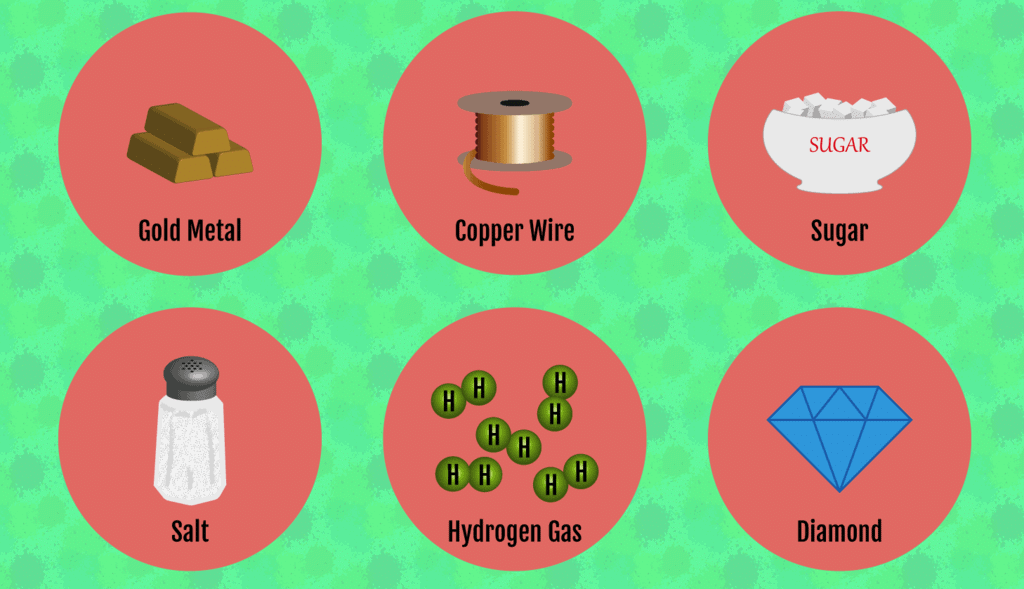
Ans: A pure substance is one that is made up of only one kind of particle, either atoms or molecules. It has definite composition and distinct properties.  Examples of Pure SubstancesA pure substance consists of only one type of particle, either atoms or molecules. It has a definite composition and distinct properties. Examples include:

  • Oxygen
  • Carbon

In contrast, a mixture contains two or more pure substances. For instance:

  • Sea water is a mixture of salt and water.
  • Soil contains various organic and inorganic materials.

Key points about mixtures:

  • Mixtures can be separated into their components through physical processes.
  • Each component retains its own properties.

Types of mixtures include:

  • Homogeneous mixtures have a uniform composition (e.g., sugar in water).
  • Heterogeneous mixtures have a non-uniform composition (e.g., sand and salt).

In summary, a pure substance has consistent properties, while a mixture contains multiple substances that can vary in composition.

Q2. List the points of differences between homogeneous and heterogeneous mixtures.
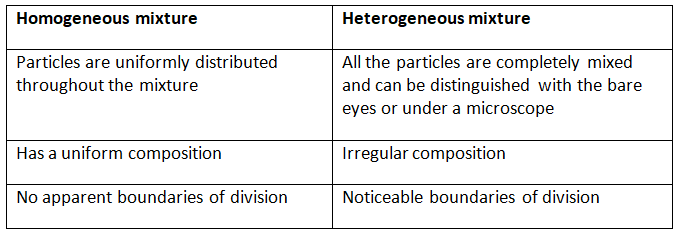
Ans:

Page No. 18
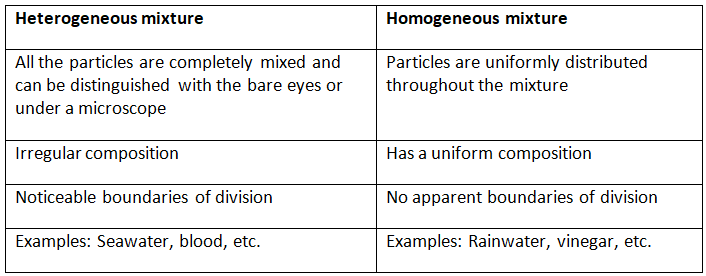
Q1. Differentiate between homogeneous and heterogeneous mixtures with examples.
Ans: The following are the differences between heterogeneous and homogenous mixtures.
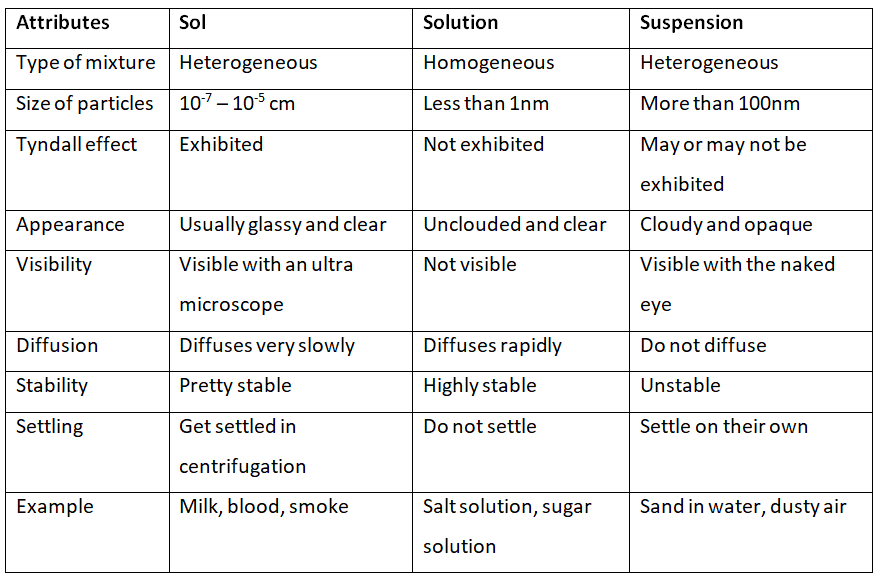

Q2. How are sol, solution and suspension different from each other?
Ans:


Q3. To make a saturated solution, 36g of sodium chloride is dissolved in 100 g of water at 293 K. Find its concentration at this temperature.

Ans: Mass of solute (NaCl): 36 g

Mass of solvent (H2O): 100 g

Mass of solution: 136 g (NaCl + H2O)

Concentration: Calculated as follows:

  • Concentration = (Mass of solute / Mass of solution) × 100
  • Concentration = (36 g / 136 g) × 100
  • Concentration = 26.47%

Thus, the concentration of the solution is 26.47%.Page No. 19

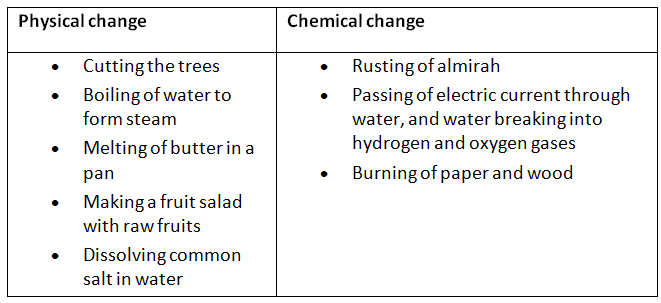
Q1. Classify the following as chemical or physical changes: 

  • cutting of trees, 
  • melting of butter in a pan, 
  • rusting of almirah, 
  • boiling of water to form steam, 
  • passing of electric current, through water and the water breaking down into hydrogen and oxygen gases, 
  • dissolving common salt in water, 
  • making a fruit salad with raw fruits, and
  • burning of paper and wood.

Ans: The following is the classification into physical and chemical change:
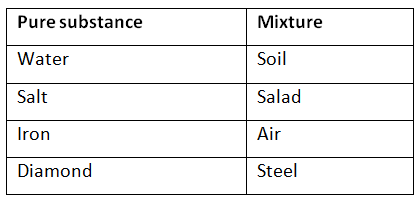

Q2. Try segregating the things around you as pure substances or mixtures.
Ans: Listed below are the classifications based on pure substances and mixtures:
 Page No. 22

Exercises

Q1. Which separation techniques will you apply for the separation of the following? 
(a) Sodium chloride from its solution in water. 
(b) Ammonium chloride from a mixture containing sodium chloride and ammonium chloride. 
(c) Small pieces of metal in the engine oil of a car. 
(d) Different pigments from an extract of flower petals.
(e) Butter from curd.
(f) Oil from water. 
(g) Tea leaves from tea.
(h) Iron pins from sand. 
(i) Wheat grains from husk. 
(j) Fine mud particles suspended in water.

Ans: (a) In water, sodium chloride in its solution can be separated through the process of evaporation (as well as crystallization). 
(b) The sublimation technique is appropriate as ammonium chloride supports sublimation. 
(c) Tiny metal pieces in the engine oil of a car can be filtered manually.
(d) Chromatography can be used to separate different pigments from an extract of flower petals.
(e) The technique of churning can be applied to separate butter from curd. It is based on the concept of difference in density. 
(f) To separate oil from water, which are two immiscible liquids which vary in their densities, using a funnel can be an effective method. 
(g) Tea leaves can be manually separated from tea using simple filtration methods. 
(h) Iron pins can be separated from sand either manually or with the use of magnets as the pins exhibit strong magnetic quality, which can be a key characteristic taken into consideration. 
(i) The differentiating property between husk and wheat is that there is a difference in their mass. If treated with a small amount of wind energy, a remarkable variation in the moving distance is noticed. Hence, to separate them, the sedimentation/winnowing procedure can be applied. 
(j) Due to the property of water, sand or fine mud particles tend to sink in the bottom as it is denser, provided they are undisturbed. Through the process of sedimentation/decantation, water can be separated from fine mud particles, as the technique is established on obtaining clear water by tilting it out.Page No. 23

Q2. Write the steps you would use for making tea. Use the words solution, solvent, solute, dissolve, soluble, insoluble, filtrate and residue.
Ans:  Steps for Making Tea

  • Heat a cup of milk, which acts as the solvent.
  • Add tea powder or leaves, the solute, to the boiling milk.
  • Observe that the tea powder remains insoluble while boiling.
  • Add sugar to the boiling solution and stir.
  • Sugar, being a solute, is soluble in the milk.
  • Continue stirring until the sugar completely dissolves, achieving saturation.
  • Once the raw smell of tea leaves disappears, remove the solution from heat.
  • Filter the mixture to separate the tea powder, which becomes the residue.
  • The liquid that passes through is the filtrate, containing the dissolved sugar and milk.
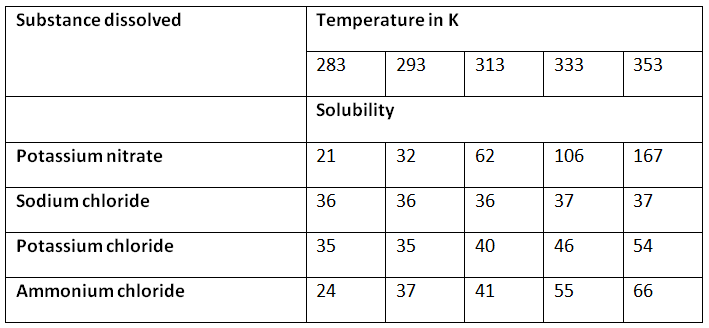

Q3. Pragya tested the solubility of three different substances at different temperatures and collected the data as given below (results are given in the following table, as grams of substance dissolved in 100 grams of water to form a saturated solution).

(a) What mass of potassium nitrate would be needed to produce a saturated solution of potassium nitrate in 50 grams of water at 313 K? 
(b) Pragya makes a saturated solution of potassium chloride in water at 353 K and leaves the solution to cool at room temperature. What would she observe as the solution cools? Explain. 
(c) Find the solubility of each salt at 293 K. Which salt has the highest solubility at this temperature? 
(d) What is the effect of change of temperature on the solubility of a salt?
Ans: 
(a) Given:
Mass of potassium nitrate required to produce a saturated solution in 100 g of water at 313 K = 62g
To find:
Mass of potassium nitrate required to produce a saturated solution in 50 g of water =?
Required amount = 62 x 50/100 = 31
Hence, 31 g of potassium nitrate is required.
(b) The solubility of potassium chloride in water is decreased when a saturated solution of potassium chloride loses heat at 353 K. Consequently, Pragya would observe crystals of potassium chloride, which would have surpassed its solubility at low temperatures.
(c) As per the given data, that is
Solubility of potassium nitrate at 293K = 32 g
Solubility of sodium chloride at 293K = 36 g
Solubility of potassium chloride at 293K = 35 g
Solubility of ammonium chloride at 293K = 37g
We can observe from this data that ammonium chloride has the highest solubility at 293K.
(d) Effect of change of temperature on the solubility of salts:
The table clearly depicts that the solubility of the salt is dependent upon the temperature and increases with an increase in temperature. With this, we can infer that when a salt arrives at its saturation point at a specific temperature, there is a propensity to dissolve more salt through an increase in the temperature of the solution.


Q4. Explain the following, giving examples. 
(a) Saturated solution 
(b) Pure substance 
(c) Colloid 
(d) Suspension

Ans: (a) Saturated solution: It is the state in a solution at a specific temperature when a solvent is no longer soluble without an increase in temperature. Example: Excess carbon leaves off as bubbles from a carbonated water solution saturated with carbon.
(b) Pure substance: A substance is said to be pure when it comprises only one kind of molecule, atom or compound without adulteration with any other substance or any divergence in the structural arrangement. Examples: Sulphur, diamonds etc.
(c) Colloid: A Colloid is an intermediate between solution and suspension. It has particles of various sizes that range between 2 to 1000 nanometers. Colloids can be distinguished from solutions using the Tyndall effect. Tyndall effect is defined as the scattering of light (light beam) through a colloidal solution. Examples: Milk and gelatin.
(d) Suspension: It is a heterogeneous mixture that comprises solute particles that are insoluble but are suspended in the medium. These particles that are suspended are not microscopic but visible to bare eyes and are large enough (usually larger than a micrometer) to undergo sedimentation.
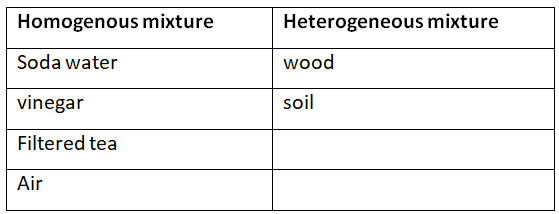

Q5. Classify each of the following as a homogeneous or heterogeneous mixture. 
soda water, wood, air, soil, vinegar, filtered tea.
Ans: The following is the classification of the given substances into homogenous and heterogenous mixtures.


Q6. How would you confirm that a colorless liquid given to you is pure water?
Ans: 
We can confirm if a colorless liquid is pure by setting it to boil. If it boils at 100°C, it is said to be pure. But if there is a decrease or increase in the boiling point, we infer that water has added impurities and, hence not pure.Page No. 24

Q7. Which of the following materials fall in the category of a “pure substance”? 
(a) Ice 
(b) Milk
(c) Iron 
(d) Hydrochloric acid 
(e) Calcium oxide 
(f) Mercury 
(g) Brick 
(h) Wood 
(i) Air

Ans: The following substances from the above-mentioned list are pure substances:

  • Iron
  • Ice
  • Hydrochloric acid
  • Calcium oxide
  • Mercury


Q8. Identify the solutions among the following mixtures.
(a) Soil
(b) Seawater
(c) Air
(d) Coal
(e) Soda water
Ans: 
The following are the solutions from the above-mentioned list of mixtures:

  • Sea water
  • Air
  • Soda water


Q9. Which of the following will show the “Tyndall effect”?
(a) Salt solution
(b) Milk
(c) Copper sulphate solution
(d) Starch solution
Ans:  
Milk and starch solution demonstrate the Tyndall effect because they are colloidal solutions. In these solutions, light is scattered, making its path visible.

  • The Tyndall effect occurs when light passes through a colloid.
  • Colloidal solutions contain particles that are small enough to scatter light.
  • Examples of colloids include milk and starch solutions.
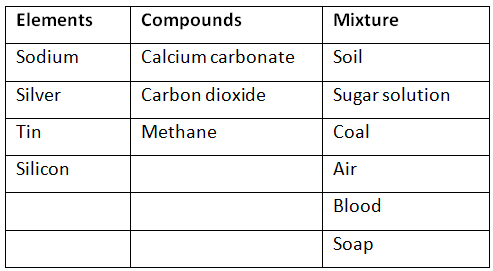
Q10. Classify the following into elements, compounds, and mixtures. 
(a) Sodium 
(b) Soil 
(c) Sugar solution 
(d) Silver 
(e) Calcium carbonate 
(f) Tin 
(g) Silicon 
(h) Coal 
(i) Air 
(j) Soap 
(k) Methane 
(i) Carbon dioxide 
(m) Blood
Ans:


Q11. Which of the following are chemical changes? 
(a) Growth of a plant 
(b) Rusting of iron 
(c) Mixing of iron filings and sand 
(d) Cooking of food 
(e) Digestion of food 
(f) Freezing of water 
(g) Burning of a candle
Ans: Among the options listed, the following are considered chemical changes:

  • Rusting of iron
  • Cooking of food
  • Digestion of food
  • Burning of a candle

The growth of a plant is a complex process involving both chemical and physical changes, while mixing iron filings and sand and freezing water are not chemical changes.
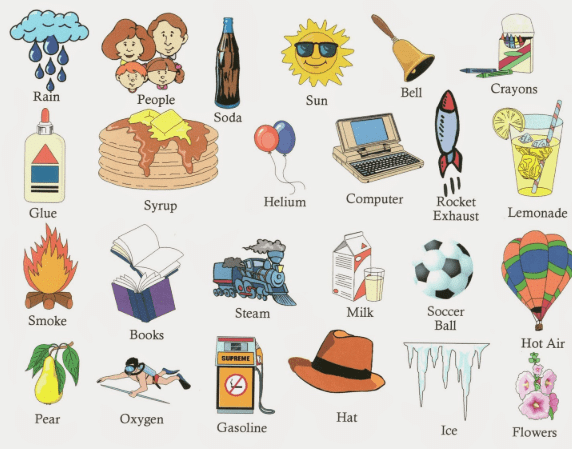
1. Matter in Our Surroundings – Textbook Solutions

Page No. 3

Q1. Which of the following are matter?
Chair, air, love, smell, hate, almonds, thought, cold, lemon water, the smell of perfume.
Ans: The following substances are matter: Chair, Air, Almonds, Lemon water, and the smell of perfume (The smell is caused by volatile substances which are matter, as they occupy space and have mass).

Matter around us

Q2. Give reasons for the following observation.
The smell of hot sizzling food reaches you several meters away, but to get the smell from cold food, you have to go close.
Ans: When the air is heated, the particles in it gain more kinetic energy and move faster. This is why the smell of hot food travels farther, allowing a person to sense it even from several meters away.

Q3. A diver is able to cut through water in a swimming pool. Which property of matter does this observation show?
Ans:
 The particles of every matter have a force of attraction between them. This force keeps the particles together in a matter. In the case of water, the force of attraction between particles is less in comparison to solids. Thus, water molecules flow easily, giving way to a diver.

Showing less intermolecular force between liquid molecules.

Q4. What are the characteristics of the particles of matter?
Ans:  The characteristics of particles of matter are:
(i) Presence of intermolecular spaces between particles.
(ii) Particles are in constant motion.
(iii) They attract each other.Page No. 6

Q1. The mass per unit volume of a substance is called density. 
(density=mass/volume). Arrange the following in the order of increasing density – air, exhaust from the chimneys, honey, water, chalk, cotton and iron.
Ans: The following substances are arranged in increasing density: Air < Exhaust from chimney <  Cotton < Water <  Honey < Chalk < Iron.


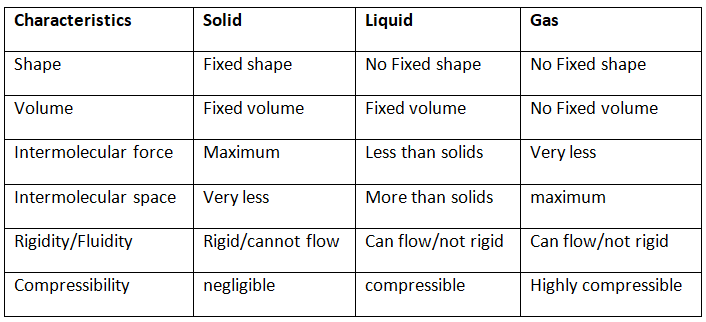
Q2. (a) Tabulate the differences in the characteristics of states of matter.
(b) Comment upon the following: rigidity, compressibility, fluidity, filling a gas container, shape, kinetic energy and density.
Ans:  
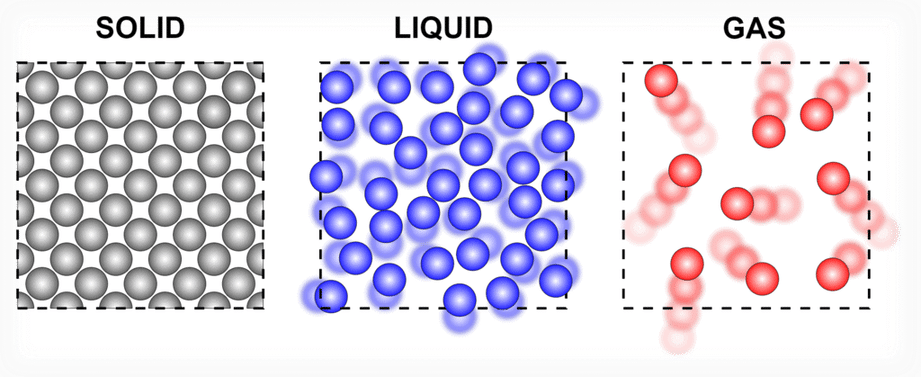
(a) The differences in the characteristics of the three states of matter solid, liquid and gas are:-

(b)
(i) Rigidity: It is the property of matter that continues to remain in its shape when treated with an external force.
(ii) Compressibility: Particles have the ability to reduce their intermolecular space when an external force is applied, which increases their density. This characteristic is called compressibility.
(iii) Fluidity: It is the ability of a substance to flow or move about freely.
(iv) Filling the gas container: The particles in a container take their shape as they randomly vibrate in all possible directions.
(v) Shape: It is the definite structure of an object within an external boundary.
(vi) Kinetic energy: Motion allows particles to possess energy, which is referred to as kinetic energy. The increasing order of kinetic energy possessed by various states of matter is Solids < Liquids < Gases.
Mathematically, it can be expressed as K.E = 1/2 mv2, where ‘m’ is the mass and ‘v’ is the velocity of the particle.
(vii) Density: It is the mass of a unit volume of a substance. It is expressed as d = M/V, where ‘d’ is the density, ‘M’ is the mass and ‘V’ is the volume of the substance


Q3. Give reasons 
(a) A gas fills completely the vessel in which it is kept. 
(b) A gas exerts pressure on the walls of the container.
(c) A wooden table should be called a solid. 
(d) We can easily move our hand in the air, but to do the same through a solid block of wood, we need a karate expert.
Ans: 

(a) There is a low force of attraction between gas particles. The particles in the filled vessel are free to move about.
(b) Gaseous particles have the weakest attraction force and move randomly in all directions. When a gas particle hits the walls of its container, it applies a force, creating pressure on the walls.
(c) The hardwood table has a clear shape and volume. The wood particles are tightly packed and do not change to fit the shape of a container. This gives the table its solid properties.
(d) The air particles are spread far apart with a lot of space between them, which is why we can move our hands freely through the air. However, in a solid block, the particles are held tightly together by a strong force of attraction, leaving little or no space between them. That’s why breaking a solid block would require the strength of a karate expert.


Q4. Liquids generally have lower density as compared to solids. But you must have observed that ice floats on water. Find out why?

Ans: 

  • The mass per unit volume of a substance is called density (density = mass/volume). 
  • As the volume of a substance increases, its density decreases. In general, solids have higher density than liquids. Water is also a liquid, so it should also have less density than that of a solid, which is ice.
  • Though ice is solid, it has a cage-like structure; hence, there are a large number of empty spaces between its particles. These spaces are larger than the spaces between the particles of water. Thus, for a given mass of water, the volume of ice is greater than that of water.
  • Hence, the density of ice is less than that of water. A substance with a lower density than water can float on water. Therefore, ice floats on water.

Page No. 9

Q1. Convert the following temperature to Celsius scale:
(a) 300 K 
(b) 573 K
Ans: To convert a temperature from the Kelvin scale to the Celsius scale, you simply subtract 273 from the given Kelvin temperature.

(a)  (300 – 273)°C = 27°C
(b) (573 – 273)°C = 300°C


Q2. What is the physical state of water at:
(a) 250°C 
(b) 100°C
Ans: 
(a) At 250°C, the physical state of water is gas as the temperature is beyond its boiling point.
(b) At 100°C, it is in the transition state (both liquid and gaseous states) as the water is at its boiling point. Hence, it would be present in both liquid and gaseous state.


Q3. For any substance, why does the temperature remain constant during the change of state?
Ans: It is due to the latent heat as the heat supplied to increase the temperature of the substance is used up to transform the state of matter of the substance; hence, the temperature stays constant. Latent heat is the heat energy needed to change a substance from one form to another without changing its temperature. For example, when ice melts into water, it absorbs heat (latent heat of fusion) without increasing in temperature. Similarly, when water evaporates into steam, it also absorbs heat (latent heat of vaporization) without a temperature change.

Q4. Suggest a method to liquefy atmospheric gases.
Ans: 
To transform a gas into a liquid, it is necessary to bring its constituent particles or molecules closer. This can be achieved with atmospheric gases by either increasing the pressure or lowering the temperature. Page No. 10

Q1. Why does a desert cooler cool better on a hot dry day?
Ans: A desert cooler works better on hot, dry days because the high temperature and low humidity increase the rate of evaporation. This greater evaporation results in more effective cooling.

Q2. How does the water kept in an earthen pot (matka) become cool during summer?
Ans:
 An earthen pot has tiny pores that allow water to seep through and evaporate from its surface. This evaporation requires energy, which is drawn from the water inside the pot, making the water cooler.

Q3. Why does our palm feel cold when we put some acetone or petrol or perfume on it?
Ans: 
Acetone, petrol, and perfume are highly volatile substances. When applied to our palm, they evaporate quickly, absorbing heat from the skin and making our palm feel cold.

Q4. Why are we able to sip hot tea or milk faster from a saucer rather than a cup?
Ans: A saucer has a larger surface area than a cup, which allows for faster evaporation. This rapid evaporation cools the tea or milk more quickly, enabling us to sip it faster.


Q5. What type of clothes should we wear in summer?
Ans: 
In summer, it is advisable to wear light-colored cotton clothes. Light colors reflect heat, and cotton is breathable, allowing sweat to evaporate and providing a cooling effect on the skin.

Exercises 

Q1. Convert the following temperature to Celsius scale.
(a) 293K 
(b) 470K
Ans: To convert a temperature from the Kelvin scale to the Celsius scale, you simply subtract 273 from the given Kelvin temperature because 0°C=273K.
(a) 293K= (293 – 273)°C = 20°C
(b) 470K= (470 – 273)°C = 197°C


Q2. Convert the following temperatures to the kelvin scale.
(a) 25°C 

(b) 373°C
Ans: 
0°C = 273K
(a) 25°C = (25+273)K = 298K
(b) 373°C = (373+273)K = 646K


Q3. Give reason for the following observations:
(a) Naphthalene balls disappear with time without leaving any solid.
(b) We can get the smell of perfume sitting several metres away.
Ans: 

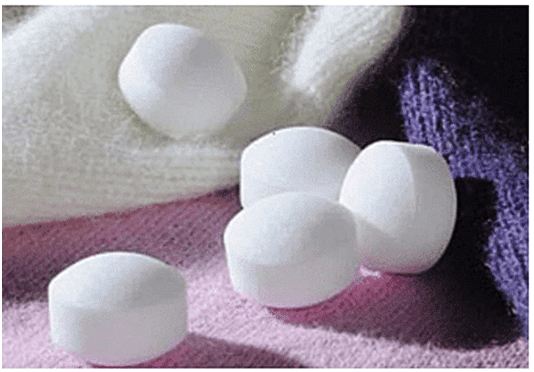
(a) At room temperature, naphthalene balls undergo sublimation, which means they change directly from a solid to a gaseous state without undergoing the intermediate state, i.e., the liquid state.

Naphthalene Balls

(b) It is because perfumes contain a volatile organic solvent that can easily diffuse through air and, hence, carry the fragrance to people sitting several metres away.


Q4. Arrange the following substances in increasing order of forces of attraction between the particles— water, sugar, oxygen.
Ans: 
Oxygen (gas) < Water (liquid) < Sugar (solid)


Q5. What is the physical state of water at: 
(a) 25°C, (b) 0°C, (c) 100°C?

Ans: The physical state of water at different temperatures is as follows:
(a) At 25°C, water is in a liquid state (typical room temperature).
(b) At 0°C, water is at its freezing point, so both solid (ice) and liquid (water) phases can be observed.
(c) At 100°C, water is at its boiling point, resulting in the presence of both liquid water and gaseous water (water vapor).

Q6. Give two reasons to justify.
(a) Water at room temperature is a liquid.
(b) An iron almirah is a solid at room temperature.
Ans:

(a) Water remains in a liquid state at room temperature for two main reasons:

  1. Its melting or freezing point is lower than room temperature, while its boiling point is higher (100°C).
  2. Water has no fixed shape and flows to take the shape of its container, which indicates that it occupies a fixed volume but does not have a defined shape.

(b) An iron almirah is a solid at room temperature for the following reasons:

  1. Both the melting and boiling points of iron are above room temperature, meaning it remains solid under these conditions.
  2. An iron almirah is rigid and maintains a definite shape, and metals typically have a high density, further confirming that it is solid at room temperature.

Q7. Why is ice at 273 K more effective in cooling than water at the same temperature?
Ans: At 273 K, ice will absorb heat energy or latent heat from the medium during melting to transform into water. As a result, ice has a greater cooling impact than water at the same temperature since water does not absorb the excess heat from the medium.

Q8. What produces more severe burns, boiling water or steam?
Ans:
 Steam produces severe burns. It is because it is an exothermic reaction that releases a high amount of heat, which it consumes during vaporization.

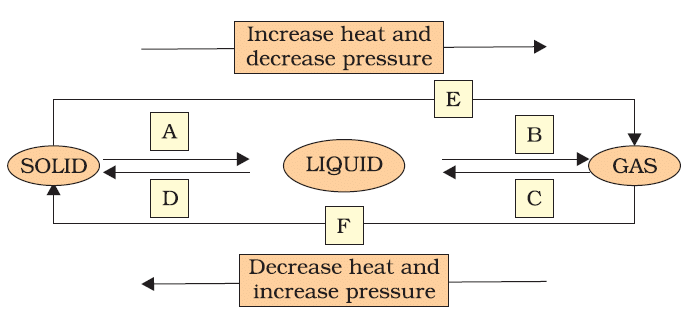
Q9. Name A, B, C, D, E and F in the following diagram showing change in its state.

Ans: Interconversion of three states of matter: Using temperature or pressure, any state of matter can be turned into another.
(A) Solid to Liquid → Melting (or) fusion (or) liquefaction
(B) Liquid to Gas → Evaporation (or) vaporization
(C) Gas to liquid → Condensation
(D) Liquid to Solid → Solidification
(E) Solid to Gas → Sublimation
(F) Gas to Solid → Deposition

04. The Word of Metal And Non – Metals Chapter Notes

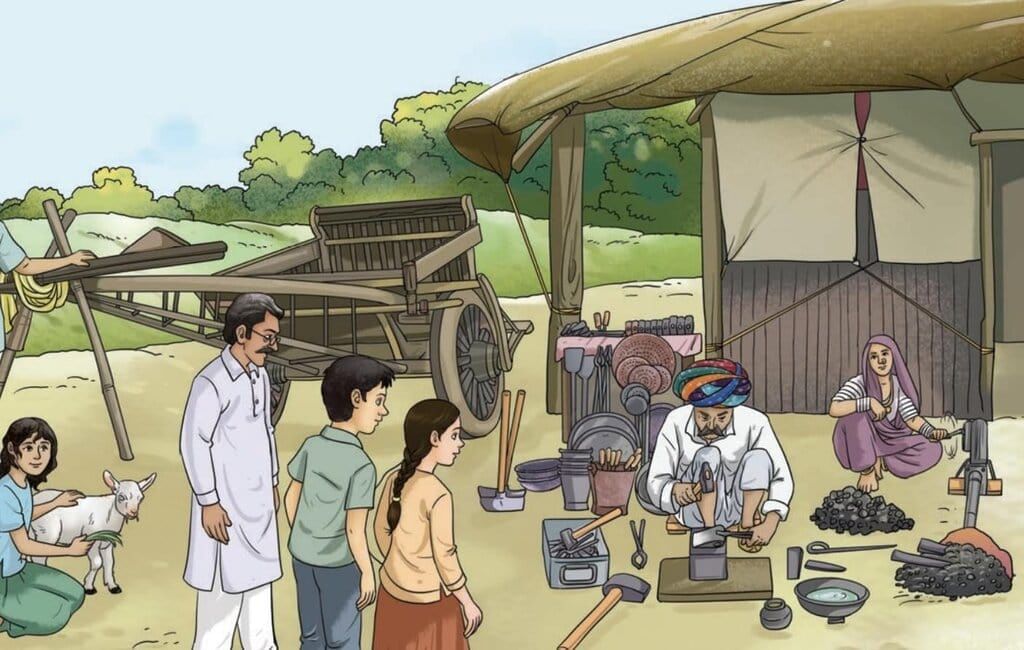
Yashwant and Anandi live in a village in Rajasthan. For their school project, they decided to learn about ironsmiths—people who make useful items from metals. With their grandfather’s help, they visit Sudarshan uncle, a local ironsmith, to see how he shapes iron into everyday tools like pans, buckets, and farming equipment.Curious and amazed, they begin exploring the fascinating world of metals and how they can be shaped and used.

Let’s explore the different ways metal can be used.

Properties of Materials

Properties are characteristics that help us identify and classify materials as metals or non-metals, such as their appearance, hardness, or ability to conduct heat.

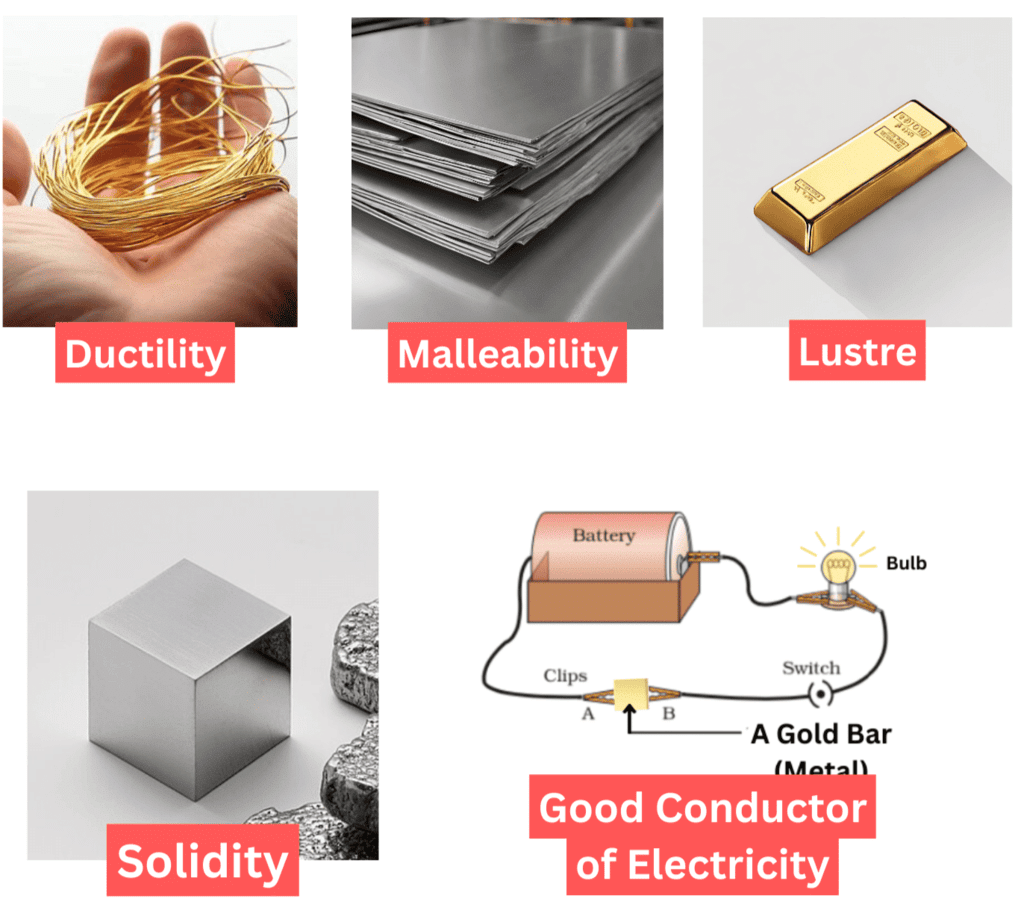
Malleability

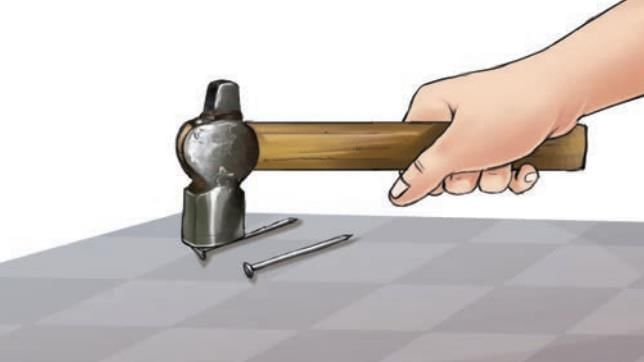
Malleability is the property of materials that allows them to be beaten into thin sheets without breaking. Beating an iron nail with a hammer

 Malleability of Metals

1. Most metals, like copper, aluminium, and iron, are malleable. For example, copper and aluminium can be flattened into sheets, and iron is shaped into tools like axes.

2. Malleability is very useful in everyday life.
For example:

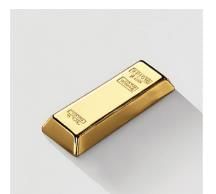
  • Silver foil used to decorate sweets is made by hammering silver into extremely thin sheets.
  • Aluminium foil, which is commonly used for wrapping food, is produced due to aluminium’s malleability.

3. Some metals, like gold and silver, are exceptionally malleable, allowing them to be made into very thin sheets called gold leaf or silver leaf.

Some Exceptions: Soft Metals and Unique States

  • Not all metals are hard; some metals, like sodium and potassium, are very soft and can be easily cut using a knife. These metals are much softer than copper or iron.
  • Another special metal is mercury, which is liquid at room temperature, unlike most metals that are solids.
  • Mercury’s liquid state makes it unique and useful in devices like thermometers and barometers.

Q: How does malleability benefit everyday life?  View Answer

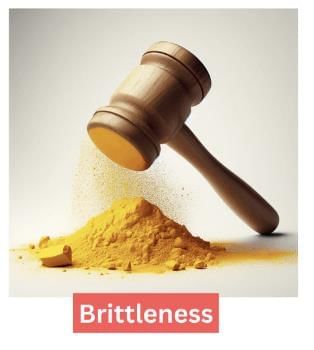
Brittleness in Non-Metals 

  • Unlike metals, non-metals such as coal and sulfur do not flatten when struck.
  •  Instead, they tend to break or shatter into pieces
  • This characteristic is called brittleness.
  • Brittle materials cannot be bent or shaped easily; they break under pressure or impact.

Behaviour of Wood 

Wood behaves differently from both metals and brittle non-metals:

  1. Wood does not flatten like metals when hit with a hammer.
  2. At the same time, wood does not break easily like brittle non-metals.
  3. Therefore, wood is considered neither malleable nor brittle, possessing some flexibility and toughness.

Some other properties of Metals and Non-Metals: 

  • Metals such as copper, aluminium, and iron have a characteristic shiny appearance known as metallic lustre. This means they reflect light well, giving them a bright, polished look.
  • These metals are generally hard, meaning they resist scratching or denting under normal conditions.
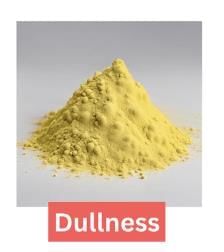
  • In contrast, non-metals like coal, sulfur, and wood do not have this shiny appearance. Instead, they look dull or matte because they do not reflect light like metals.
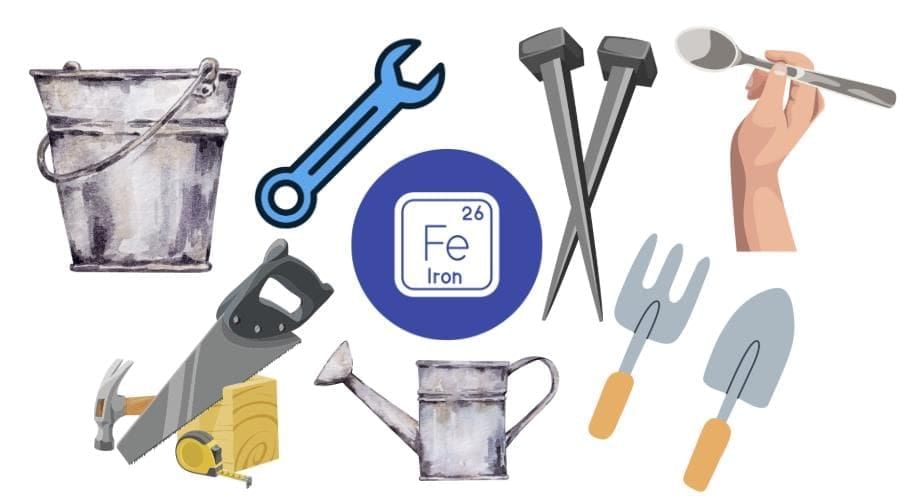
  • Non-metals are usually softer compared to metals, meaning they can be scratched or broken more easily.

HOLISTIC LENS: The impact of iron on the progress of civilisation of India

In ancient India, early civilizations like the Harappans used metals such as copper and gold to make tools and jewellery. However, the widespread use of iron came much later. Iron became important because of its strength and durability. Iron tools, especially agricultural implements like ploughs, greatly helped improve farming and contributed to the progress of Indian civilization.
Why do you think copper was discovered and used before iron?

Copper was discovered before iron because it occurs naturally in a pure form and has a lower melting point, making it easier to find and work with using early technology. Iron, found mostly as ore, requires higher temperatures and more advanced tools to extract and shape.

 Ductility

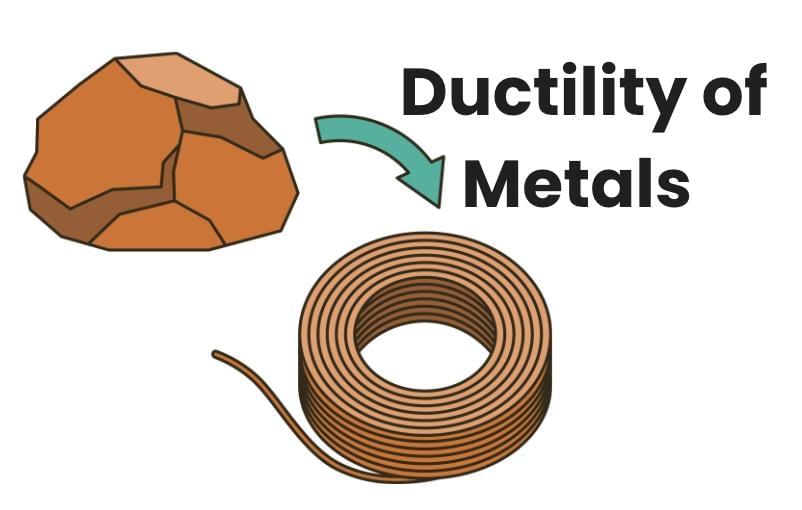
 Ductility is the property of materials that allows them to be drawn into thin wires.

 Ductility of Metals

  • Most metals, like copper and aluminium, are ductile, used in electrical wires and ornaments like bangles and necklaces.
  • Gold is highly ductile, with one gram drawable into a 2-kilometer-long wire.

Everyday Uses of Ductility of Metals

  • Electrical Fittings:
    Metal wires like copper and aluminium are commonly used in electrical wiring because they conduct electricity well. You might have seen them in homes, appliances, and other electrical devices.
  • Jewellery and Ornaments:
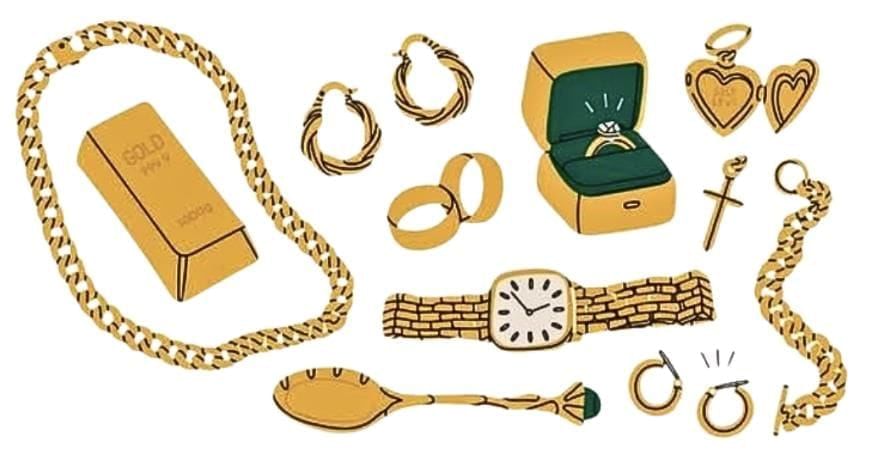
    Many ornaments such as banglesnecklaces, and earrings are made from metal wires. These wires are shaped and twisted to create beautiful designs.
  • Musical Instruments:
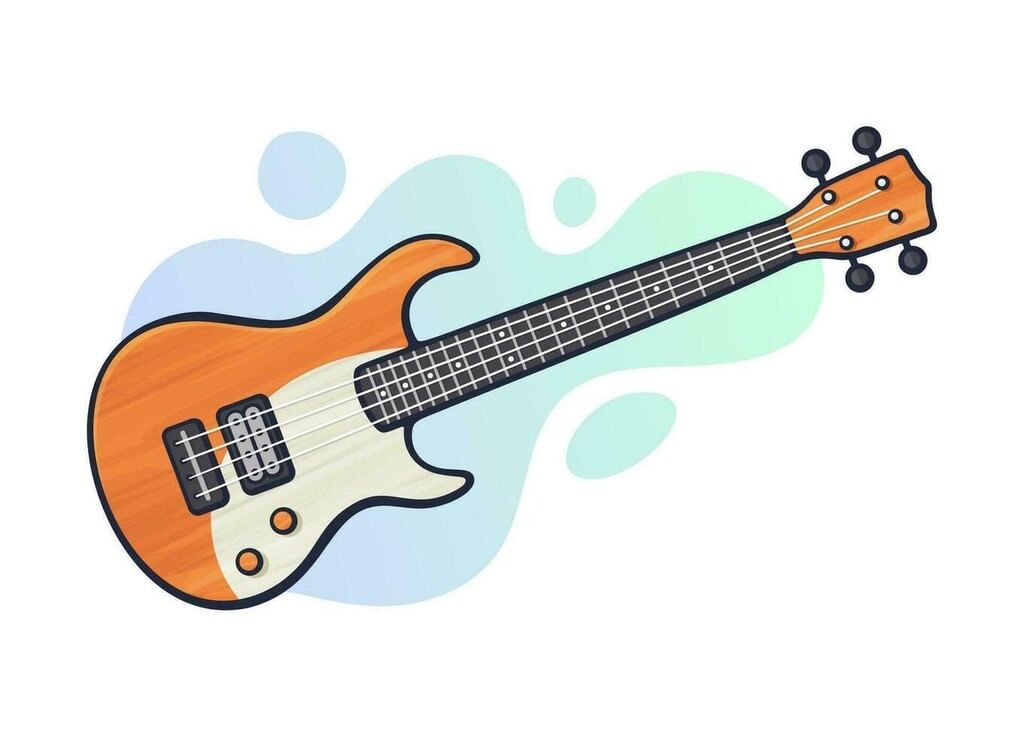
    Metal wires are also used in many stringed musical instruments like the veenasitarviolin, and guitar. The wires produce sound when plucked or bowed.

Dive Deeper: Steel Wires and Their Uses:

Steel is an alloy made from iron (metal) and carbon (non-metal). Steel wires are very strong and can support heavy loads. Due to their strength, steel wire ropes are used in important structures like suspension bridges. They are also used in cranes to lift heavy objects safely.

Q: What does ductility refer to in materials science?  View Answer

Sonority

This ability of metals to produce ringing sounds is called sonority. Metals are described as sonorous materials because they can create loud and resonant sounds.

  • Metals: Metals like those in spoons or coins produce a ringing sound, making them sonorous. This is why school bells and ghungroos (dance bells) ring.
  • Non-metals: Coal and wood produce dull sounds when dropped, so they are not sonorous.

Everyday Examples of Sonority

  • The ringing sound of ghungroos (the small bells worn by dancers) is because of the sonorous nature of metals.

  • The school bell produces its loud ringing sound due to the sonority of the metal it is made from.
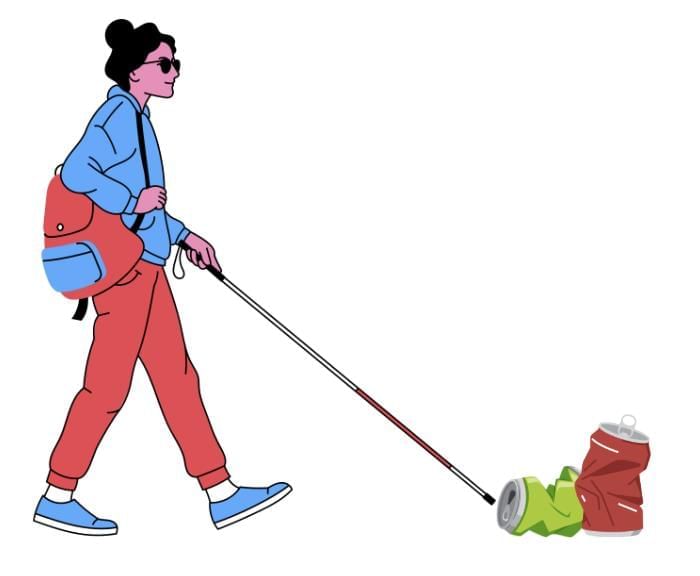
  • People can also use the difference in sound between hitting wood or metal to help navigate or identify objects, like using a stick to find their way by the sound it makes when it hits different materials.
Conduction of Heat

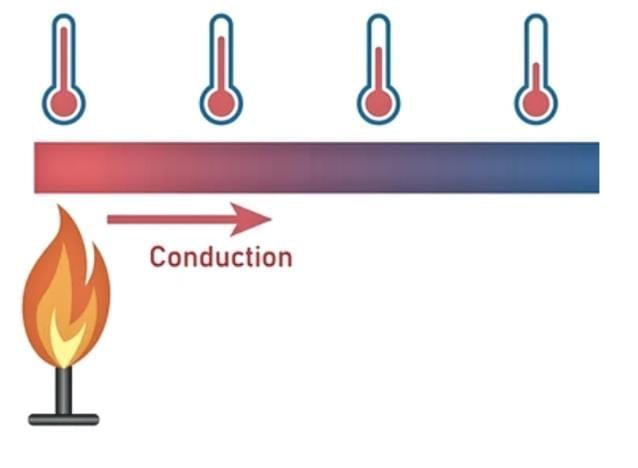
Conduction is the transfer of heat through a material from one point to another.

  • Metals: Metals like those used in cooking vessels (e.g., aluminium, copper, iron) are good conductors of heat, transferring heat quickly to cook food.
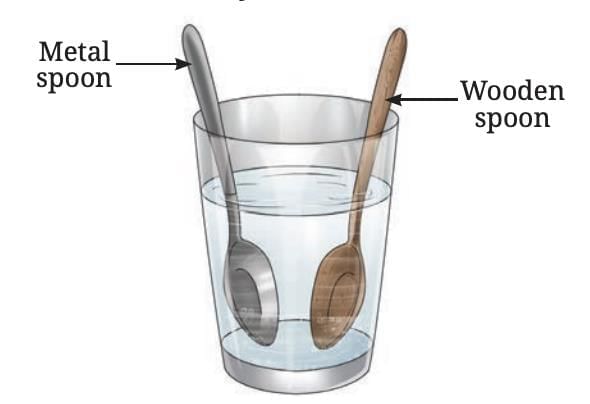
  • Non-metals: Wood is a poor conductor of heat, staying cooler than metal when placed in hot water, which is why vessel handles are made of wood or other poor conductors.

For example, if a metal spoon and a wooden spoon are both left in hot water for the same time, the metal spoon feels much hotter to the touch.

This is because the metal conducts heat faster from the hot water to your hand, while wood does not.

Metal and wooden spoons immersed in hot water

That’s why vessel handles are often made of wood or plastic—so that we can hold them safely without getting burned.

Conductors and Poor Conductors

  • The process of heat moving through a material from one point to another is called conduction.
  • Materials that allow heat to pass through them easily are known as conductorsMetals fall in this category.
  • On the other hand, materials like wood do not transfer heat well and are known as poor conductors or insulators.

Conduction of Electricity

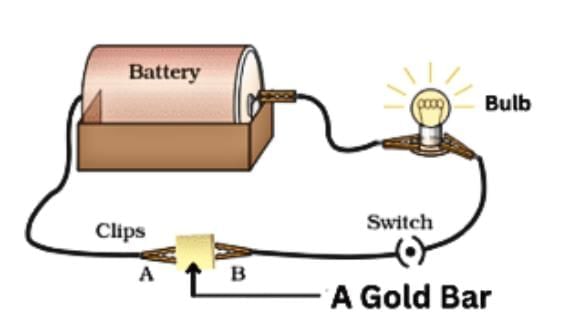
Materials that allow electricity to flow easily are good conductors of electricity, while those that don’t are poor conductors.

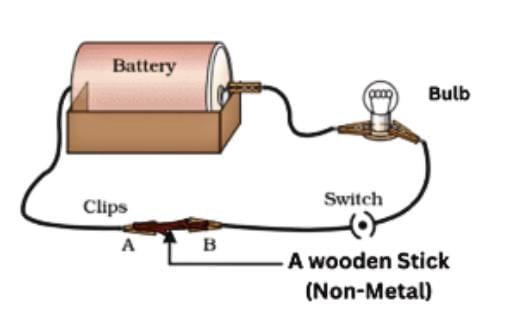
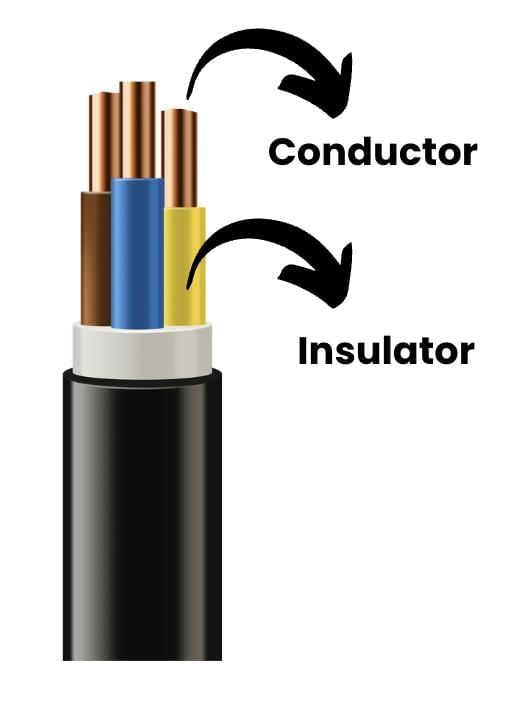
  • Metals: Aluminium, iron, and copper are good conductors, making bulbs glow in a tester circuit, used for electrical wires.
  • Non-metals: Sulfur, coal, wood, stone, rubber, and nylon are poor conductors, not allowing bulbs to glow, used for insulating materials like screwdriver handles and electrician’s gloves.

Electrical Conductivity and Safety

  • For example, the handle of a screwdriver used by electricians is often made of plastic or rubber, which are poor conductors of electricity.
  • Electricians also wear rubber gloves and rubber-soled shoes while working. This is because rubber does not allow electricity to pass through easily, protecting them from electric shocks.

Conductors and Insulators

  • Materials that allow electricity to flow through them easily are called good conductors of electricity.
  • Metals such as aluminium, iron, and copper are excellent conductors and are widely used in electrical wiring and devices.
  • On the other hand, materials like sulfur, coal, wood, stone, rubber, and nylon do not allow electricity to flow freely and are called poor conductors of electricity or insulators.
Try yourself:

What is the property of materials that allows them to be drawn into thin wires?

  • A.Conductivity
  • B.Malleability
  • C.Ductility
  • D.Sonority

View Solution

Effect of Air and Water on Metals: Iron

Rusting of Iron:

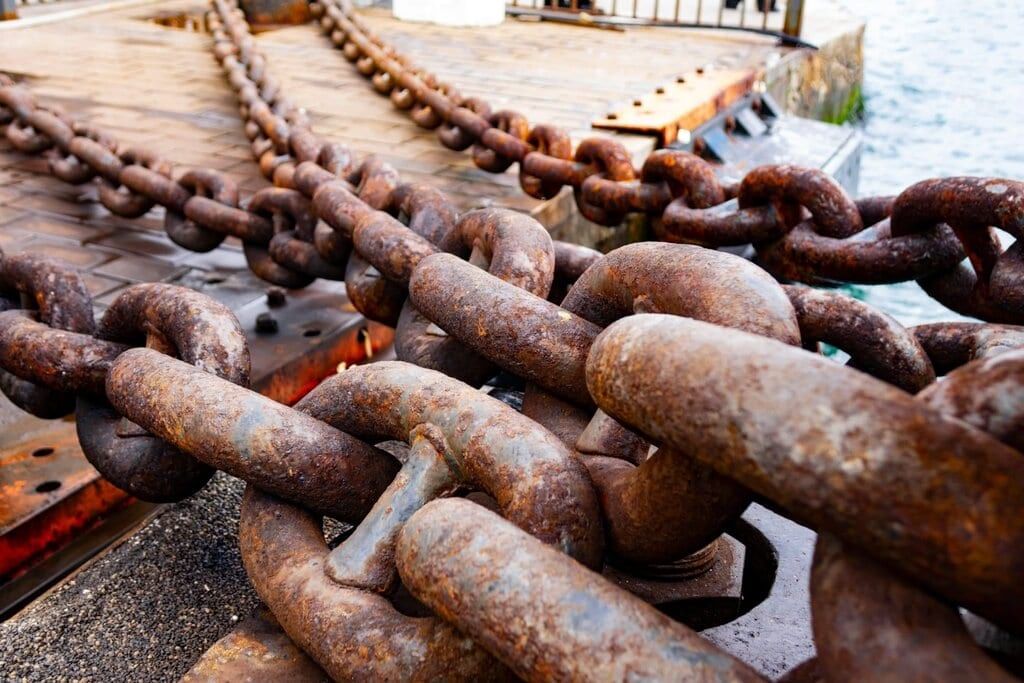
When iron objects are left exposed to the environment, they often develop brown deposits on their surface. This phenomenon is called rusting.Rusting Iron

  • The brown deposits that form on iron are called rust.
  • Rusting is a chemical reaction where iron reacts with oxygen and moisture in the air.
  • This reaction causes the iron to deteriorate and weaken over time.

Conditions for Rusting:

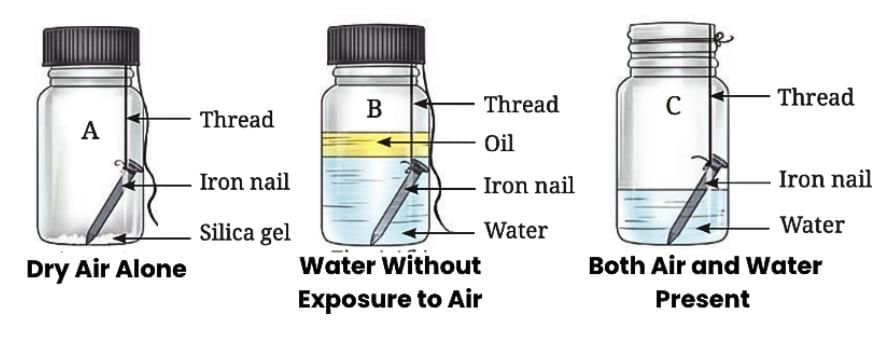
  • Rusting happens only when iron comes into contact with both air and water (moist air).
  • Iron does not rust if it is exposed to dry air alone.
  • Iron also does not rust if it is submerged in water without exposure to air.
  • Therefore the process of rust formation, called rusting, requires both air and water, making moist air the cause of the brown deposits.

Impact 

  • Rusting causes iron objects and structures to become weak and unsafe.
  • It leads to damage and decay of iron used in buildings, vehicles, bridges, and tools.
  • In many countries, including ours, a large amount of money is spent every year on repairing or replacing rusted iron.

Prevention of Iron from Rusting

Rusting can be prevented by several methods, such as:

  • Painting iron surfaces to keep air and moisture away.
  • Applying oil or grease to form a protective layer.
  • Galvanisation: Coating iron with a layer of zinc to protect it.

Q: What role do air and water play in the corrosion of iron?  View Answer

Corrosion

Corrosion is the gradual deterioration of metal surfaces due to air, water, or other substances.

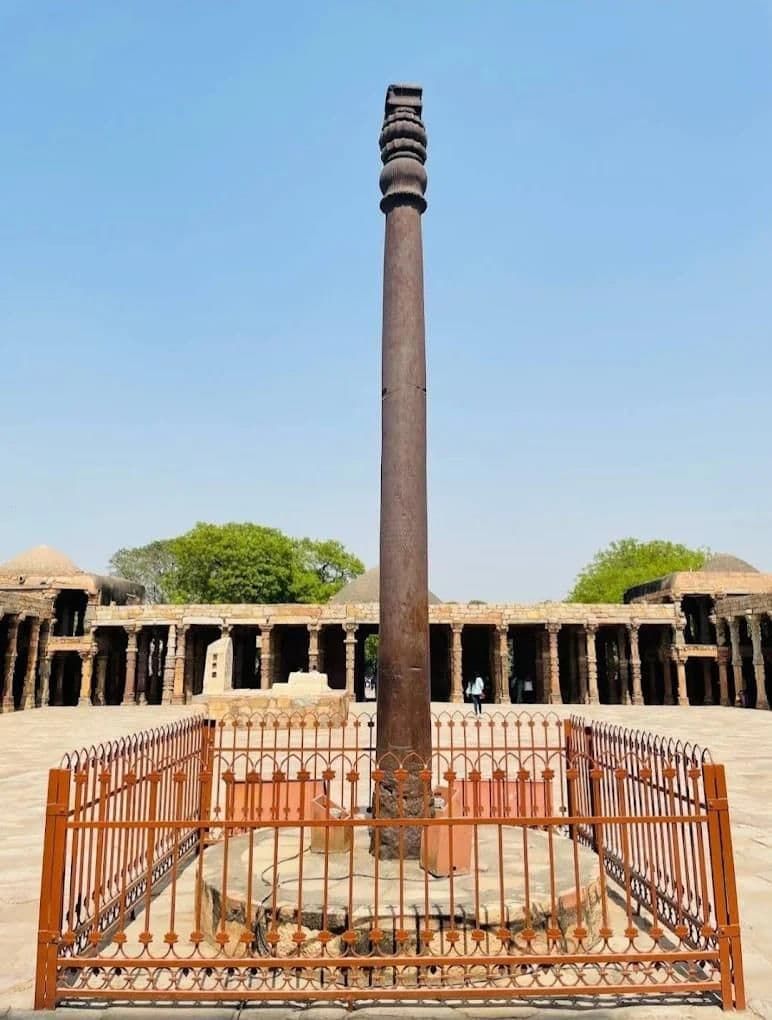
Fascinating Fact: The Iron Pillar of Delhi

The Iron Pillar of Delhi was built over 1600 years ago during Chandragupta II’s time. It is 8 metres tall and weighs more than 6000 kilograms. Despite facing rain, wind, and weather for centuries, it has hardly rusted. This shows how skilled ancient Indian metalworkers were in making strong and lasting iron.

Effect of Air and Water on Other Metals

1. Magnesium

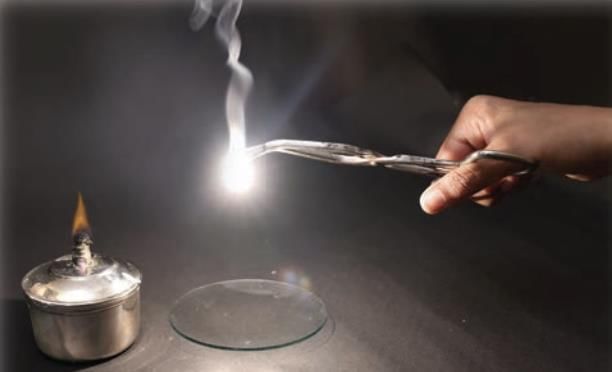
  • Reaction with Air: When a magnesium ribbon is burned, it produces a dazzling white flame and turns into a white powder called magnesium oxide.
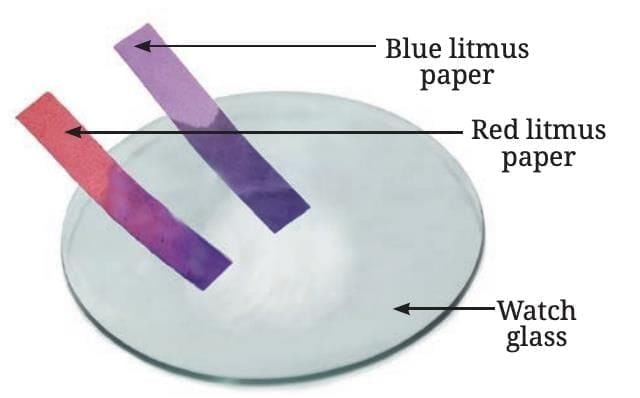
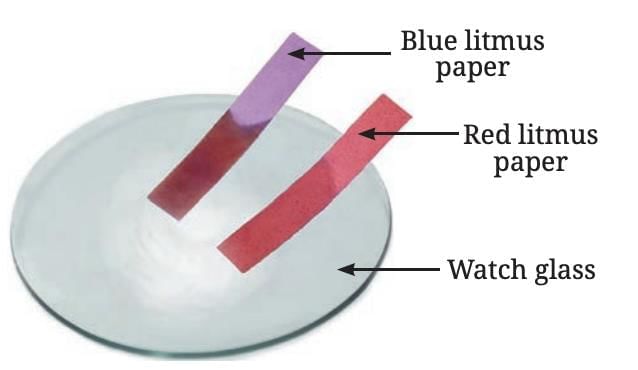
  • Nature of Oxide: Mixing magnesium oxide with warm water and testing with litmus shows it turns red litmus blue, indicating it is basic in nature.
  • General Rule: Oxides of metals are generally basic.

2. Sodium

  • Storage: Sodium is stored in kerosene to prevent it from reacting with oxygen and water in the air, as it reacts vigorously, producing a lot of heat.
  • Oxide Nature: Sodium oxide is basic, like other metal oxides.

Try yourself:

What causes rust to form on iron objects?

  • A.Exposure to sunlight
  • B.Exposure to water only
  • C.Exposure to both air and water
  • D.Exposure to air only

View Solution

Substances that Behave Differently from Metals in Air and Water

Certain substances, such as sulfur and phosphorus, behave very differently from metals when exposed to air and water.

Sulfur

  • Reaction with Air: When sulfur is burned, it produces sulfur dioxide gas, which, when dissolved in water, forms sulfurous acid.
  • Nature of Oxide: Testing the solution with litmus shows it is acidic, turning blue litmus red.
  • Reaction with Water: Sulfur does not react with water when mixed, unlike some metals.

Phosphorus

  • Storage: Phosphorus is stored in water because it catches fire when exposed to air.

Properties of Non-metals:

  • Usually soft and dull (non-lustrous) in appearance.
  • Not malleable or ductile, so they cannot be shaped into sheets or wires.
  • Not sonorous, producing dull sounds when struck.
  • Poor conductors of heat and electricity.
  • Oxides are acidic, unlike the basic oxides of metals.
  • Examples: Oxygen, hydrogen, nitrogen, carbon, chlorine, iodine.
  • Materials like plastic, glass, wood, rubber, and paper are not classified as metals or non-metals because they are not elements.

Dive Deeper: Elements (The Building Blocks of Matter)

  • Elements are pure substances that cannot be broken down into simpler substances by ordinary chemical methods.
  • Everything around us is made up of these elements.
  • There are currently 118 known elements.
  • Some elements occur naturally in the environment, such as oxygen, iron, and gold.
  • Others are artificially created in laboratories and do not exist naturally.
  • Metals and non-metals are two important sub-categories of elements.
  • You will learn more about elements and their properties in higher classes.

Are Non-metals Essential in Everyday Life?

While metals are very visible in daily life due to their shiny appearance, strength, and ability to conduct heat and electricity, non-metals play equally vital roles in our lives.

Importance of Non-metals

1. Oxygen is a non-metal that we breathe every day. Without oxygen, life on Earth would not survive.
Other uses of oxygen include:

  • Used in hospitals to assist patients who have difficulty breathing.
  • Used in welding and combustion processes.

2. Carbon is essential because it is the building block of all life forms.

  • It is a key part of proteins, fats, and carbohydrates which provide energy and help in growth.

3. Nitrogen is a non-metal widely used in the manufacture of fertilizers and chemicals.

  • It is a vital nutrient that helps plants grow healthy and strong.

4. Chlorine is commonly used in water purification to make drinking water safe.

5. Iodine solution is applied on wounds as an antiseptic to prevent infections.

Science and Society

1. Many metals and alloys (mixtures of two or more metals or metals with non-metals) are used daily in utensils, tools, and machines.

2. Metals are essential in modern technology and almost every industry, including special fields like:

  • Atomic energy (e.g., zirconium)
  • Aerospace (e.g., titanium)

3. In India, recycling metals like iron and aluminium is common and helps to reduce waste and promote sustainability.

Try yourself:

What happens when sulfur is burned in air?

  • A.It becomes a metal.
  • B.It turns blue litmus red.
  • C.It produces sulfur dioxide gas.
  • D.It reacts with water.

View Solution

Points to Remember

  • Metals are shiny, hard, bendable (malleable), stretchable (ductile), make ringing sounds (sonorous), and conduct heat and electricity well.
  • Non-metals are usually dull, soft or brittle, and do not conduct heat or electricity well.
  • Malleability lets metals like copper and gold be made into thin sheets (foils, tools).
  • Ductility lets metals be drawn into wires for electrical use and jewelry.
  • Metals produce clear ringing sounds used in bells, while non-metals produce dull sounds.
  • Metals conduct heat, so they are used for cooking pots; non-metals like wood are used for handles because they don’t conduct heat.
  • Metals like copper and aluminium conduct electricity, while non-metals like rubber and plastic act as insulators for safety.
  • Iron rusts when exposed to both air and water, forming reddish-brown rust.
  • Copper and silver also get coated when exposed to air and moisture (green and black coatings).
  • The Iron Pillar of Delhi (1600+ years old) shows how ancient Indians made iron that doesn’t rust easily.
  • Magnesium burns in air forming a basic oxide; sodium is stored in kerosene to prevent reaction with air.
  • Sulfur burns to form sulfur dioxide, which forms acidic sulfurous acid when dissolved in water, but sulfur alone doesn’t react with water.
  • Non-metals like phosphorus are stored in water to stop them catching fire in air; their oxides are acidic.
  • Non-metals are important: oxygen for breathing, carbon for life, nitrogen for fertilizers, chlorine to clean water, iodine as medicine.
  • There are 118 elements, divided into metals and non-metals, some natural and some made in labs.
  • Metals and alloys are used in tools, machines, and industries; recycling metals like iron and aluminium helps protect the environment.

Q: What properties of metals allow them to be used in making electrical wires and tools?  View Answer

Difficult Words and Their Meanings

  • Malleability: The ability of a material, like metal, to be beaten into thin sheets without breaking.
  • Ductility: The ability of a material, like metal, to be drawn into thin wires.
  • Sonority: The property of a material, like metal, to produce a ringing sound when struck.
  • Conduction: The transfer of heat or electricity through a material, like heat through a metal spoon.Metal Characteristics
  • Conductor: A material, like copper, that allows heat or electricity to flow easily.
  • Insulator: A material, like rubber, that does not allow heat or electricity to flow.
  • Rusting: The process where iron forms brown deposits (rust) when exposed to both air and water.
  • Corrosion: The gradual damage to a metal’s surface by air, water, or other substances, like rusting or green coating on copper.
  • Oxide: A substance formed when a metal or non-metal reacts with oxygen, like magnesium oxide or sulfur dioxide.
  • Element: A basic substance, like iron or oxygen, that cannot be broken into simpler substances, with 118 known types.

Try yourself:

Which property is NOT characteristic of metals?

  • A.Dull appearance
  • B.Sonorous
  • C.Good conductivity
  • D.Malleable

View Solution