A village baker in Goa is an important figure in the community.
Bakers have been around for generations, continuing their old ways of making bread.
People fondly remember the baker visiting their homes daily, creating happy memories.
Bread holds a special place in Goan culture, being a part of celebrations like weddings and festivals.
The baker’s clothes, the way they collected payments, and their comfortable lifestyle show how respected and successful they were.
Detailed Summary
In this captivating chapter, the author transports us to his cherished childhood memories in Goa, where the village baker occupied a cherished place in the hearts of all. Despite the evolving times and a decline in bread consumption, the time-honored tradition of village bakers remains alive in Goa. Though the Portuguese, renowned for their artistry in bread-making, departed long ago, the echoes of their legacy resonate in the skilled bakers of Goa today, affectionately known as ‘Pader.’
The author warmly reminisces about the baker who graced his village twice a day, playing a multifaceted role not only as a purveyor of bread but also as a trusted friend and mentor. The baker’s presence was announced by the rhythmic thud of his bamboo stick, creating a unique melody of ‘jhang, jhang’ as it struck the ground. Skillfully balancing a basket of bread on his head, he would make his rounds, catering to the households’ culinary needs. While other residents purchased loaves of bread, the author eagerly sought out the baker to acquire delectable bread bangles.
Try yourself:What role did the village baker play in the author’s childhood memories?
A.He was a skilled musician who played beautiful melodies.
B.He was a trusted friend and mentor to the author.
C.He was a renowned artist known for his bread-making skills.
D.He was a cheater of bread who catered to the shops needs.
View Solution
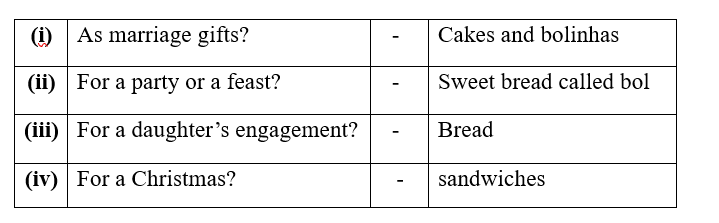
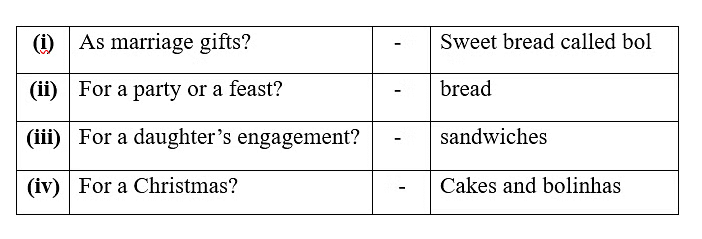
During those days, bread was not just sustenance; it held a certain fashionable allure, especially when paired with a steaming cup of tea. The author’s adoration for bread was so profound that he would gleefully forgo brushing his teeth in favor of indulging in its flavorsome delights. The village baker played an indispensable role in various celebrations, particularly for the exquisite sweet bread called ‘Bol.’ This delectable treat was an indispensable element in marriage gifts and festive occasions like Christmas. The baker’s traditional furnace was a vital asset in every village, as it facilitated the creation of an assortment of cakes and confections that could only be masterfully baked within its fiery confines.
Traditional Goan Bakery
The attire of the baker, or bread-seller, was equally distinctive, known as the ‘kabai’ – a knee-length, one-piece frock. In the author’s childhood, bakers donned trousers that fell between full-length and half-pants, occupying a unique sartorial niche. To this day, wearing half-pants evokes comparisons to being dressed “like pader.”
Traditionally, the baker would collect his dues at the end of each month, with accounts meticulously recorded in pencil on household walls. Baking proved to be a lucrative profession, as evidenced by the bakers’ well-nourished physiques, signifying prosperity and abundance. While the tradition of village bakers may have waned over time, their indelible memories persist, and their profound contributions to society should never be forgotten.
Try yourself:
What was the traditional attire of the village baker?
A.Kabai
B.Trousers
C.Half-pants
D.Frock
View Solution
Theme/Message
Cultural Heritage and Tradition: The story highlights the cultural significance of the traditional baker in Goan society, emphasizing the preservation of heritage.
Community Interactions: It portrays how the baker was not just a bread-seller but a familiar figure who played a social role, fostering connections within the community.
Importance of Small Businesses: The narrative underscores the importance of small-scale businesses like the village bakery in sustaining community life.
Glossary
Loaves: Bread in the form of a thick slice.
Bamboo staff: A long stick made of bamboo.
Furnaces: Enclosed structures where heat is produced.
Bangles: Bracelets, especially those worn in sets on the wrist.
Engagement: A formal agreement to get married.
Festivals: Celebrations or occasions of a particular type.
Peculiar: Unusual or distinctive in nature.
Physique: The form or structure of a person’s body.
Plump: Having a full and rounded shape.
Prosperous: Successful or flourishing, especially financially.
Q1. What does Chubukov at first suspect that Lomov has come for? Is he sincere when he later says “And I’ve always loved you, my angel, as if you were my own son”? Find reasons for your answer from the play. Ans: At first, Chubukov suspected that Lomov had come to borrow money. He was not sincere when he told Lomov that he had always loved him and that he was like his own son. He had decided that he would not give Lomov any money if he tried borrowing from him. If he truly meant what he said, then he would not have thought of not giving him money. He said so only because Lomov had come with the proposal to marry his daughter.
Q2. Chubukov says of Natalya: “… as if she won’t consent! She’s in love; egad, she’s like a lovesick cat…” Would you agree? Find reasons for your answer. Ans: Chubukov thought that Lomov was a good marriage prospect for his daughter. He had been waiting for this proposal. When Lomov expressed his doubt regarding Natalya’s consent to the proposal, Chubukov immediately told him that she was in love with him. However, this was not true. Natalya did not seem to be in love with Lomov at any point in the play. It seemed like she was more attached to her land, meadows and dogs than to Lomov. In fact, the way they kept getting into arguments about trivial matters suggests that neither Lomov nor Natalya was in love with the other.
Q3. (i) Find all the words and expressions in the play that the characters use to speak about each other, and the accusations and insults they hurl at each other. (For example, Lomov in the end calls Chubukov an intriguer; but earlier, Chubukov has himself called Lomov a “malicious, double faced intriguer.” Again, Lomov begins by describing Nayalya as “ an excellent housekeeper, not bad-looking, well-educated.”)
Ans: (i) Several words and expressions have been used by the characters to describe each other. Some of them are as follows: Chubukov: grabber; intriguer; old rat; Jesuit Natalya: a lovesick cat; an excellent housekeeper; not bad-looking, well-educated Lomov: a good neighbour; a friend; impudent; pettifogger; a malicious, double-faced intriguer; rascal; blind hen; turnip-ghost; a villain; a scarecrow; monster; the stuffed sausage; the wizen-faced frump; boy; pup; milksop; fool
Thinking about the Language
Q1. This play has been translated into English from the Russian original. Are there any expressions or ways of speaking that strike you as more Russian than English? For example, would an adult man be addressed by an older man as my darling or my treasure in an English play?
Ans: Read through the play carefully, and find expressions that you think are not used in contemporary English, and contrast these with idiomatic modern English expressions that also occur in the play.
Q3. Look up the following phrases in a dictionary to find out their meaning, and then use each in a sentence of your own. (i) You may take it that (ii) He seems to be coming round (iii) My foot’s gone to sleep
Ans:
1. Expressions not used in contemporary English
1. “my darling”, “my beauty”, “my precious”, “my angel”, “my beloved” (here, an older man is addressing an adult man) 2. “…and so on…” (here, it is used after a sentence in order to complete it) 3. “…and all that sort of thing.” (not explaining what it is, just leaving it as it is) 4. “…and all that.” (again leaving the sentence as it is) 5. “the scarecrow”, “the stuffed sausage”, “the wizen-faced frump” (In this way, they hurled insults at each other) 6. “And how may you be getting on?” (Here, Lomov is asking Chubukov about his well-being)
Modern English expressions
1. “Madam”, “my heart”, “honoured Natalya Stepanovna” (used by Lomov for Natalya) 2. “Honoured Stepan Stepanovitch” (used by Lomov for Chubukov) 3. “I beg your pardon…” 4. “My dear fellow” (Chubukov addressing Lomov) 5. “malicious, double-faced intriguer”, “fool” (Chubukov insulting Lomov)
3.
(i)You may take it that I am lying, but in fact it will help you in the long run. (ii) He seems to be coming round after the trauma of his father’s death. (iii) After the three hour long yoga session, my foot’s gone to sleep.
Page No: 136
II. You must have noticed that when we report someone’s exact words, we have to make some changes in the sentence structure. In the following sentences, fill in the blanks to list the changes that have occurred in the above pairs of sentences. One has been done for you. 1. To report a question, we use the reporting verb asked (as in Sentence Set 1).
2. To report a declaration, we use the reporting verb __________.
3. The adverb of place here changes to ___________.
4. When the verbs in direct speech is in the present tense, the verb in reported speech is in the ______________ tense (as in Sentence Set 3).
5. If the verb in direct speech is in the present continuous tense, the verb in reported speech changes to ______________tense. For example, ____________ changes to wasgetting.
6. When the sentences in direct speech contains a word denoting respect, we add the adverb _______________in the reporting clause (as in Sentence Set 1).
7. The pronouns I, me, our and mine, which are used in the first person in direct speech, change to third person pronouns such as____________, ___________, ___________ or __________in reported speech.
Ans:
1. To report a question, we use the reporting verb asked.
2. To report a statement, we use the reporting verb said.
3. The adverb of place here changes to there.
4. When the verbs in direct speech is in the present tense, the verb in reported speech is in the past tense.
5. If the verb in direct speech is in the present continuous tense, the verb in reported speech changes to past continuous tense. For example, am getting changes to was getting.
6. When the sentence in direct speech contains a word denoting respect, we add the adverb respectfully in the reporting clause.
7. The pronouns I, me, our and mine, which are used in the first person in direct speech, change to second person pronouns such as he/she, him/her, their or his/hers in reported speech.
Page No: 137
III. Here is an excerpt from an article from the Times of India dated 27 August 2006. Rewrite it, changing the sentences in direct speech into reported speech. Leave the other sentences unchanged.
“Why do you want to know my age? If people know I am so old, I won’t get work!” laughs 90-year-old A. K. Hangal, one of Hindi cinema’s most famous character actors. For his age, he is rather energetic. “What’s the secret?” we ask. “My intake of everything is in small quantities. And I walk a lot,” he replies. “I joined the industry when people retire. I was in my 40s. So I don’t miss being called a star. I am still respected and given work, when actors of my age are living in poverty and without work. I don’t have any complaints,” he says, adding, “but yes, I have always been underpaid.” Recipient of the Padma Bhushan, Hangal never hankered after money or materialistic gains. “No doubt I am content today, but money is important. I was a fool not to understand the value of money earlier,” he regrets.
Ans: 90-year-old A.K. Hangal, one of Hindi cinema’s most famous character actors, laughingly asked why we wanted to know his age. If people knew he was that old, he would not get work. For his age, he is rather energetic. We asked him what the secret was. He replied that his intake of everything was in small quantities and he walked a lot. He said that he had joined the industry when people retired. He had been in his 40s. So he did not miss being called a star. He was still respected and given work, when actors of his age were living in poverty and without work. He said he did not have any complaints, adding that he had always been underpaid. Recipient of the Padma Bhushan, Hangal never hankered after money or materialistic gains. He said that no doubt he was content at present, but money was important. He said regretfully that he was a fool not to understand the value of money before.
Q1: What does the young man mean by “great honey-coloured/Ramparts at your ear?” Why does he say that young men are “thrown into despair” by them? Ans: The “great honey-coloured/Ramparts at your ear” refers to the beautiful yellow-coloured hair that falls at the woman’s ear and cover it like a wall around a fort. He says that the young men are “thrown into despair” by them because they look so beautiful on the woman that her beauty gets thoroughly enhanced. The young men fall in love with her and feel despair. He says that it is not possible that someone would love her alone and not her yellow hair.
Q2: What colour is the young woman’s hair? What does she say she can change it to? Why would she want to do so? Ans: The young woman’s hair is of yellow colour. She says that she could get her hair dyed to brown, black or carrot colour. She would change the colour of her hair so that the young men in despair would love her only and not her yellow hair. She wanted them to love her for what she was and not for her appearance such as her hair colour.
Q3: Objects have qualities which make them desirable to others. Can you think of some objects (a car, a phone, a dress…) and say what qualities make one object more desirable than another? Imagine you were trying to sell an object: what qualities would you emphasise? Ans: i. A car – the basic quality or utility is that it makes an individual travel from one place to another as per his requirement/ desire. The best aspect is one doesn’t have to depend on public transport for commuting. Forget the pushes and jerks in the buses, trains etc travel conveniently.
ii. A phone – lets you connect with friends, relatives, colleagues, and so on. We can connect with people near and far, whether in another city or country, we can speak to them, chat with them, make a video call and feel that they are with us.
iii. A dress – serves the most basic need of covering one’s body and a dress lets you express yourself without saying anything. The colours, the style express our personality, vibe and choice. Different dresses for different occasions/purposes. Whether it is a friend’s birthday party, a cousin’s wedding or a congregation, a dress has to be appropriate and in accordance.
Q4: What about people? Do we love others because we like their qualities, whether physical or mental? Or is it possible to love someone “for themselves alone”? Are some people ‘more lovable’ than others? Discuss this question in pairs or in groups, considering points like the following. (i) a parent or caregiver’s love for a newborn baby, for a mentally or physically challenged child, for a clever child or a prodigy (ii) the public’s love for a film star, a sportsperson, a politician, or a social worker (iii) your love for a friend, or brother or sister (iv) your love for a pet, and the pet’s love for you. Ans: Every person has his/her own choices, likes and dislikes. Students are advised to answer the question based on their interpretation and personal experience. As humans, we all have our personal favourites based on our perception and situation in life. It is therefore, not wrong to like some person more than others. (i) A parent or caregiver’s love for a newborn baby, for a mentally or physically challenged child, for a clever child or a prodigy reflects their attentiveness and concern for them. (ii) The public’s love for a film star, a sportsperson, a politician or a social worker reflects our admiration and being awestruck about their personality. (iii) Your love for a friend or brother or sister reflects your love, compassion, empathy and a feeling of togetherness for them. (iv) Your love for a pet, and the pet’s love for you reflects the unconditional and selfless love towards each other.
Q5: You have perhaps concluded that people are not objects to be valued for their qualities or riches rather than for themselves. But elsewhere Yeats asks the question: How can we separate the dancer from the dance? Is it possible to separate ‘the person himself or herself’ from how the person looks, sounds, walks, and so on? Think of how you or a friend or member of your family has changed over the years. Has your relationship also changed? In what way? Ans: Yes, people do change their styles, habits and way of behaviour as per time and needs. When people adopt a good change, their relationship with others also get changed in a positive way. If people adopt negative changes and traits, they may lose the love of near and dear ones.
Q1. When her son dies, Kisa Gotami goes from house to house. What does she ask for? Does she get it? Why not? Ans: When Kisa Gotami’s son died, she went from house to house, asking if she could get some medicine that would cure her child. No, she did not get it because her child was dead and no medicine could have brought him back to life.
Q2. Kisa Gotami again goes from house to house after she speaks with the Buddha. What does she ask for, the second time around? Does she get it? Why not? Ans: When she met the Buddha, he asked her to get a handful of mustard seeds from a house where no one had lost a child, husband, parent, or friend. She went from house to house, but could not get the mustard seeds because there was not a single house where no one had died in the family.
Q3. What does Kisa Gotami understand the second time that she failed to understand the first time? Was this what the Buddha wanted her to understand? Ans: Kisa Gotami, after speaking with the Buddha, went from house to house seeking a handful of mustard seeds. She was instructed to find these seeds from a home where no one had experienced the loss of a child, husband, parent, or friend. However, she was unable to obtain the mustard seeds because every household she visited had suffered a death and people expressed their sympathy but reminded her of their own grief. This experience made her realise the universality of death and the shared nature of human suffering.
Q4. Why do you think Kisa Gotami understood this only the second time? In what way did the Buddha change her understanding? Ans: Kisa Gotami understood that death is common to all and that she was being selfish in her grief. She understood this only the second time because it was then that she found that there was not a single house where some beloved had not died.
First time round, she was only thinking about her grief and was, therefore, asking for a medicine that would cure her son. When she met the Buddha, he asked her to get a handful of mustard seeds from a house where no one had died. He did this purposely to make her realize that there was not a single house where no beloved had died and that death is natural. When she went to all the houses the second time, she felt dejected that she could not gather the mustard seeds. Then, when she sat and thought about it, she realized that the fate of men is such that they live and die. Death is common to all. This was what the Buddha had intended her to understand.
Q5. How do you usually understand the idea of ‘selfishness’? Do you agree with Kisa Gotami that she was being ‘selfish in her grief’? Ans: Selfishness is a preoccupation with I, me, and myself. Kisa Gotami was not in a position to think about other people’s grief. It is natural to feel sad over the death of near and dear ones. But most people carry on their next responsibility of performing proper last rites of the dead. People seldom carry a dead body in the hope of some miracle happening to that. The family and society always come to be with those in hours of grief. But later on the life goes on. But Kisa Gotami was so engrossed in her sorrow that she forgot to think about live members of her family and society.
Page No: 114
Thinking about the Language I. This text is written in an old-fashioned style, for it reports an incident more than two millennia old. Look for the following words and phrases in the text, and try to rephrase them in the more current language, based on how you understand them.
give thee medicine for thy child
Pray tell me
Kisa repaired to the Buddha
there was no house but someone had died in it
kinsmen
Mark!
Ans:
give thee medicine for thy child → “give you medicine for your child”
Pray tell me → “Please tell me”
Kisa repaired to the Buddha → “Kisa went to the Buddha”
there was no house but someone had died in it → “there wasn’t a single house where someone hadn’t died”
kinsmen → “relatives”
Mark! → “Listen!” or “Pay attention!”
II. You know that we can combine sentences using words like and, or, but, yet and then. But sometimes no such word seems appropriate. In such a case can use a semicolon (;) or a dash (−) to combine two clauses. She has no interest in music; I doubt she will become a singer like her mother.
The second clause here gives the speaker’s opinion on the first clause.
Here is a sentence from the text that uses semicolons to combine clauses. Break up the sentence into three simple sentences. Can you then say which has a better rhythm when you read it, the single sentence using semicolons, or the three simple sentences?
For there is not any means by which those who have been born can avoid dying; after reaching old age there is death; of such a nature are living beings.
Ans: The single sentence using semicolons has a better rhythm. This is because the three parts of the sentence are connected to each other in their meanings. The second clause gives further information on the first clause. The third clause is directly related to both the first and the second. Their meanings are better conveyed when they are joined by semicolons.
Q1. Who are the characters in this poem? List them with their pet names. Ans:The characters in this poem include:
Belinda – the main character
Blink – a little grey mouse
Mustard – a little yellow dog
Custard – a little pet dragon
The Pirate – the antagonist
Ink – a little black kitten
Q2. Why did Custard cry for a nice, safe cage? Why is the dragon called a “cowardly dragon”? Ans: Custard cried for a nice, safe cage because he felt afraid and wanted to feel secure. It is called a “cowardly dragon” because, unlike the other pets in the house, he lacked bravery. Belinda was as brave as a barrel of bears. Ink and Blink are described as so brave that they could chase lions down the stairs and Mustard was as brave as a tiger in a rage. Compared to them, Custard cried asking for a nice and safe cage, which is why it is called a coward.
Q3. “Belinda tickled him, she tickled him unmerciful…” Why? Ans: Belinda tickled the dragon unmercifully because it was very scared and cried for a safe cage. They all laughed at it as it was a coward.
Q4. The poet has employed many poetic devices in the poem. For example: “Clashed his tail like iron in a dungeon” − the poetic device here is a simile. Can you, with your partner, list some more such poetic devices used in the poem? Ans: The poet employs various poetic devices throughout the poem, enhancing its richness. Here are some notable examples:
Repetition: The word ‘little’ is repeated in the first stanza to highlight that everything, from the house to Belinda and her pets, is small.
Incorrect Spelling: In the seventh stanza, the poet uses ‘winda’ instead of ‘window’ to maintain the rhyme with ‘Belinda’.
Alliteration: In the tenth stanza, phrases like ‘Custard crashed’ and ‘clatter’ create a rhythmic sound.
Imagery: The poet uses vivid descriptions, such as the pirate ‘gaping’ and ‘gulping’ grog, to paint a clear picture.
Similes: The poet frequently uses similes, such as “clashed his tail like iron in a dungeon.”
Q5. Read stanza three again to know how the poet describes the appearance of the dragon.
Ans: The poet describes the appearance of the dragon, Custard as one which had big sharp teeth and spikes on top of its body and scales underneath. Its mouth was like a fireplace with a chimney-like nose and sharp dagger-like toes.
Q6. Can you find out the rhyme scheme of two or three stanzas of the poem? Ans: The rhyme scheme of each stanza of this poem is aabb.
Q7. Writers use words to give us a picture or image without actually saying what they mean. Can you trace some images used in the poem? Ans: Some use words used to give us a picture or image are:
chimney for a nose
brave as a barrel full of bears
brave as a tiger in a rage
went at the pirate like a robin at a worm
mouth like a fireplace
Q8. Do you find The Tale of Custard the Dragon to be a serious or a light-hearted poem? Give reasons to support your answer. Ans: The Tale of Custard the Dragon is a light-hearted poem. It is almost a parody. The names of the pets of Belinda are all rhyming and funny. Belinda has been compared to a barrel full of bears. The kitten and mouse, both little, could chase lions down the stairs. The little yellow dog was as brave as a tiger, while the dragon was a coward and they all teased him. However, when the pirate came to their little house, all of them were engulfed in fear and had hid themselves. Ironically, the ‘cowardly’ dragon came to their rescue and jumped snorting like an engine. It clashed its tail and charged at the pirate like a robin at a worm and ate him up. Even as everybody became happy to see the bravery of the dragon, they again came back to glorifying themselves that they could have been twice or thrice braver than the dragon. Finally, at the end of the poem, the situation again came back to the other pets being brave and the dragon being the coward.
Ans: Valli’s favourite pastime was standing in the front doorway of her house.
She enjoyed watching the activities happening in the street outside. This simple act brought her much joy and entertainment.
Q2. What was a source of unending joy for Valli? What was her strongest desire?
Ans: Valli’s unending joy came from watching the bus that travelled between her village and the nearest town. Each time it passed, it was filled with a new set of passengers, which fascinated her.
Her strongest desire was to ride on that bus herself.
Q3. What did Valli find out about the bus journey? How did she find out these details?
Ans: Valli discovered several key details about the bus journey:
The town is six miles from her village.
The one-way fare is thirty paise.
The journey takes forty-five minutes.
If she stays in her seat and pays another thirty paise, she can return home on the same bus.
Valli obtained this information by:
Listening to conversations between her neighbours.
Speaking with regular bus users.
Asking them a few questions.
Q4. What do you think Valli was planning to do?
Ans: Valli was planning to travel on that bus.
Page No: 122
Oral Comprehension Check
Q1. Why does the conductor call Valli ‘madam’?
Ans: Valli is attempting to act more mature than her age, presenting herself as confident and clever. The conductor finds her behaviour amusing and teases her by calling her ‘madam’.
Q2. Why does Valli stand up on the seat? What does she see now?
Ans: Valli stood up in her seat because her view was blocked by a canvas blind covering the lower part of her window. By standing, she could look over the blind.
From this position, she observed:
The road was very narrow.
On one side, there was a canal, with palm trees, grassland, distant mountains, and a blue sky beyond it.
On the other side, a deep ditch and many acres of green fields.
Q3. What does Valli tell the elderly man when he calls her a child?
Ans: When the elderly man called her a child, Valli replied that there was no one on the bus who was a child. She emphasised that she had paid her fare of thirty paise like everyone else.
Q4. Why didn’t Valli want to make friends with the elderly woman?
Ans: Valli didn’t want to befriend the elderly woman because:
The woman had large earlobes with noticeable holes.
She was chewing betel nut, with juice threatening to spill from her mouth.
Valli perceived her as unrefined and unattractive.
These factors influenced Valli’s decision to avoid friendship.
Page No: 125
Oral Comprehension Check
Q1. How did Valli save up money for her first journey? Was it easy for her?
Ans: Valli saved every coin she received by making significant sacrifices. She controlled her usual childhood desires for:
Candies
Toys
Joyrides
This was likely challenging for her, as children often struggle to resist the temptation for sweets and toys.
Q2. What did Valli see on her way that made her laugh?
Ans: Valli saw a young cow with its tail held high, running directly in front of the bus on the road. The bus slowed down, and the driver honked his horn loudly. However:
The more the driver honked, the more scared the cow became.
It kept running faster right in front of the bus.
Valli found this situation so amusing that she had tears in her eyes from laughing. Eventually, the cow moved off the road.
Q3. Why didn’t she get off the bus at the bus station?
Ans: She did not get off the bus at the bus station because she needed to return on the same bus. She took out another thirty paise from her pocket and handed the coins to the conductor. She simply wanted to continue riding the bus.
Q4. Why didn’t Valli want to go to the stall and have a drink? What does this tell you about her?
Ans: Valli did not want to go to the stall for a drink because she lacked the money to pay for it. Even when the conductor offered her a free cold drink, she refused, insisting that she only wanted her ticket.
This behaviour reveals that Valli possesses strong self-will and pride. She likely did not want to accept anything for free, especially from a stranger.
Page No: 127
Thinking about the Text
Q1. What was Valli’s deepest desire? Find the words and phrases in the story that tell you this.
Ans: Valli’s deepest desire was to ride on the bus she saw every day. This is illustrated in the story through the following points:
“Day after day she watched the bus.”
“Gradually a tiny wish crept into her head and grew there.”
“She wanted to ride on that bus, even if just once.”
“This wish became stronger and stronger until it was an overwhelming desire.”
Q2. How did Valli plan her bus ride? What did she find out about the bus, and how did she save up the fare?
Ans: Valli planned to take the one o’clock afternoon bus. Here’s how she organised her trip:
She aimed to reach the town by 1:45 PM and return home by 2:45 PM.
The town is six miles from her village.
The bus fare was thirty paise one way.
The journey took forty-five minutes.
Upon arriving in town, Valli discovered that:
If she stayed in her seat and paid another thirty paise, she could return home on the same bus.
To afford the fare, Valli:
Saved up stray coins she found.
Resisted buying peppermints, toys, and balloons.
Managed to save a total of sixty paise.
Q3. What kind of a person is Valli? To answer this question, pick out the following sentences from the text and fill in the blanks. The words you fill in are the clues to your answer.
(i) “Stop the bus! Stop the bus!” And a tiny hand was raised ________________. (ii) “Yes, I ____________ go to town,” said Valli, still standing outside the bus. (iii) “There’s nobody here ____________,” she said haughtily. “I’ve paid my thirty paise like everyone else.” (iv) “Never mind,” she said, “I can ___________. You don’t have to help me. “I’m not a child, I tell you,” she said, _____________. (v) “You needn’t bother about me. I _____________,” Valli said, turning her face toward the window and staring out. (vi) Then she turned to the conductor and said, “Well, sir, I hope ______________.”
Ans: (i) “Stop the bus! Stop the bus!” And a tiny hand was raised commandingly. (ii) Yes, I have to go to town,” said Valli, still standing outside the bus. (iii) “There’s nobody here who’s a child,” she said haughtily. I’ve paid my thirty paise like everyone else.” (iv) “Never mind,” she said, “I can get on by myself. You don’t have to help me. “I’m not a child, I tell you,” she said, irritably. (v) “You needn’t bother about me. I can take care of myself,” Valli said, turning her face toward the window and staring out. (vi) Then she turned to the conductor and said, “Well, sir, I hope to see you again.”
For Valli, the bus journey probably symbolized the adult world. Like anyone else, she spent her money to buy the ticket. She would have attained a great sense of pride and satisfaction in doing so. Therefore, though a child, Valli wanted to be treated as a grown-up on the bus. She had a great sense of self respect which prevented her from taking anyone’s help. She felt she was able to take care of herself very well, and was easily irritated when anyone treated her as a child.
Q4. Why does the conductor refer to Valli as ‘madam’?
Ans: When the conductor offered to help Valli onto the bus, she firmly stated that she could manage on her own and did not need assistance. This showed her maturity, prompting the conductor to address her as ‘madam’.
Additionally:
Valli responded to an elderly man who called her a child, insisting that no one on the bus was a child.
She emphasised that she had paid her fare like everyone else, asserting her right to be treated equally.
Q5. Find the lines in the text that tell you that Valli was enjoying her ride on the bus.
Ans: The following lines in the text show that Valli was enjoying her ride on the bus:
“Valli devoured everything with her eyes.”
“The canal, palm trees, grasslands, mountains, and the blue sky on one side; green fields stretching endlessly on the other. It was all so wonderful!”
“Everyone laughed, and Valli clapped her hands with glee.”
“She laughed until there were tears in her eyes.”
“Valli wasn’t the slightest bit bored, greeting everything with excitement.”
Q6. Why does Valli refuse to look out of the window on her way back?
Ans: Valli refused to look out of the window on her way back because she was upset by the sight of a young cow that had been killed by a fast-moving vehicle.
The cow was the same one that had run in front of their bus during the trip to the town.
Seeing the dead cow made her feel very sad.
The memory of the cow lingered in her mind, causing her to avoid looking out.
Q7. What does Valli mean when she says, ‘I was just agreeing with what you said about things happening without our knowledge.’
Ans:
Valli reflects on her mother’s comment that many things occur without our awareness. She had recently taken a bus ride to town alone and returned safely, all without her mother’s knowledge. This experience led her to agree with her mother’s perspective.
Valli’s mother emphasised that many events happen around us unnoticed.
Valli’s solo bus trip to town was an example of this.
She returned unharmed, highlighting her independence.
Her agreement with her mother shows her understanding of this concept.
Q8. The author describes the things that Valli sees from an eight-year-old’s point of view. Can you find evidence from the text for this statement?
Ans: The author describes Valli’s experiences from a child’s perspective. Key evidence includes:
Valli’s fascination with the bus, where she was thrilled by the constant flow of new passengers.
Her strong desire to ride the bus, saving money by giving up small pleasures like peppermints, toys, and merry-go-round rides.
The bus’s gleaming white colour, silver overhead bars, and soft, luxurious seats captivated her.
Through Valli’s eyes, vibrant colours such as the blue, blue sky and acres of green fields reflect her childlike wonder.
She laughed with delight at a cow running in front of the bus but felt deep sadness upon seeing it dead on her return.
Her refusal to look out afterward highlights a young child’s sensitivity.
Q1: What ‘experiment’ did Maxwell think Camusfearna would be suitable for?
Ans: Maxwell thought Camusfearna would be suitable for an experiment in rearing and taming an otter as a pet. He was looking for a natural, remote, and peaceful place where such an experiment could take place, as he believed the area’s environment was ideal for the otter’s habitat and his lifestyle.
Q2: Why does he go to Basra? How long does he wait there, and why?
Ans: Maxwell went to Basra to the Consulate-General to collect and respond to his mail from Europe. However, while his friend’s mail had arrived, his own hadn’t. He called England and even made a phone call three days later, which had to be scheduled 24 hours in advance. On the first day, the phone line was down; on the second day, the exchange was closed due to a religious holiday; and on the third day, there was another technical issue. Meanwhile, his friend left, and Maxwell arranged to meet him a week later. After five days, his mail finally arrived, so Maxwell had to wait five days to receive it.
Q3: How does he get the otter? Does he like it? Pick out the words that tell you this.
Ans: When the writer’s mail finally arrived, he took it to his bedroom to read. There, he noticed two Arabs sitting on the floor with a sack that occasionally moved. They handed him a note from his friend, which mentioned that he had sent him an otter. Maxwell was pleased with this, as indicated by his use of the phrase “An otter fixation” to describe his deep attachment to otters. He believed this phrase captured the strong bond that otter owners often feel. Zoologists sometimes referred to the otter as “Lutrogale Perspicillata Maxwelli,” which was commonly shortened to “Maxwell’s otter.”
Q4: Why was the otter named ‘Maxwell’s otter’?
Ans: Zoologists often referred to the otter as “Lutrogale Perspicillata Maxwelli,” giving rise to the shortened name “Maxwell’s otter.”
Q5: Tick the right answer. In the beginning, the otter was: (a) aloof and indifferent (b) friendly (c) hostile Ans: (c) In the beginning, the otter was aloof and indifferent.
In the beginning, the otter was aloof and indifferent because it was unfamiliar with Maxwell and its new surroundings. It showed no interest in interacting and kept to itself, displaying typical cautious behavior in a new environment.
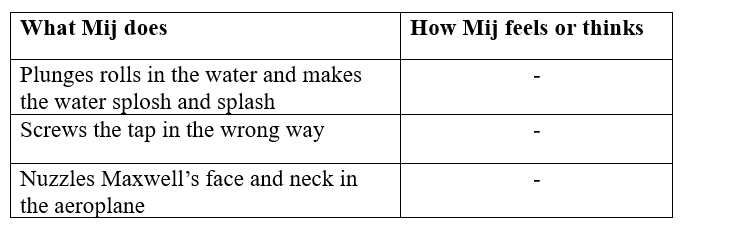
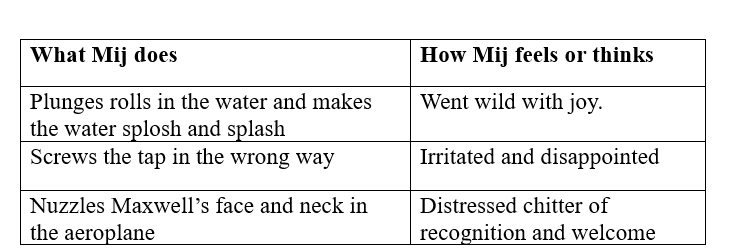
Q6: What happened when Maxwell took Mijbil to the bathroom? What did it do two days after that?
Ans: When Maxwell first introduced Mijbil to the bathroom, the otter displayed boundless excitement in the water for the first half-hour. He eagerly plunged in, rolled around, and darted up and down the bathtub, creating a splashy commotion reminiscent of a hippo. However, after two days, Mijbil mysteriously disappeared from Maxwell’s bedroom and made his way to the bathroom. There, he curiously perched at the edge of the bathtub and began fiddling with the chrome taps using his paws. The author watched in amazement as the small creature skillfully turned the tap, first producing a slow trickle of water, and eventually managing to release a full flow.
Oral Comprehension Check – Page No. 86
Q1: How was Mij to be transported to England? Ans: Maxwell booked a flight to Paris and from there he would go on to London. The airline insisted that Mij should be packed in a box (not more than eighteen inches square) that was to be placed on the floor, near his feet.
Q2: What did Mij do to the box? Ans: The box was lined with metal sheet. Mij didn’t find it comfortable to be there so tried to escape. In its attempt to escape Mij tore into the metal lining of the box. As a result, it hurt itself and started bleeding.
Oral Comprehension Check – Page No. 87
Q3: Why did Maxwell put the otter back in the box? How do you think he felt when he did this? Ans: Maxwell knew that there was no other way he could carry Mij to London, so he put the otter back into the box. He was anxious and felt sorry by looking at the otter’s condition as he hurt himself while trying to escape from the box.
Q4: Why does Maxwell say the air hostess was “the very queen of her kind”? Ans: The air hostess was exceptionally kind and compassionate toward Maxwell after hearing his story. She understood his feelings and concerns about the incident with the box and allowed him to take the otter out and keep it on his knee. This gesture made the author deeply admire her, leading him to refer to her as “the very queen of her kind.”
Q5: What happened when the box was opened? Ans: As soon as the box was opened, Mij jumped out and quickly disappeared, running all over the airplane and scaring the other passengers. The otter caused a lot of trouble, with people getting frightened by the little creature. A woman even stood up on her seat when Mij ran under the legs of a chubby man wearing a white turban. Maxwell tried to catch Mij but couldn’t. The air hostess told Maxwell not to worry and that she would help find the otter. Soon, Mijbil came back to the author, clung to his knee, and started nuzzling his face and neck.
Oral Comprehension Check – Page No. 88
Q1: What game had Mij invented?
Ans: Mij devised a playful game involving a ping-pong ball. Utilizing one of the author’s suitcases with a sloping lid, Mij would position the ball at the higher end of the inclined surface and then eagerly chase after it as it rolled down toward the lower end.
Q2: What are ‘compulsive habits’? What does Maxwell say are the compulsive habits of (i) school children (ii) Mij?
Ans: Compulsive habits often refer to unusual actions that a person repeats without a clear reason. For example, a child might choose to jump over a fence instead of using the regular path. This behavior is common in children because they tend to be playful by nature.
(i) In the story, Maxwell exhibits compulsive habits similar to those of children who, on their way to and from school, feel the need to step exactly in the center of each paving block, touch every seventh upright of the iron railings, or walk around every second lamp post.
(ii) Likewise, Mijbil also showed compulsive behavior. On his way home, he would leap over the boundary wall railing and race along its entire thirty-yard length, much to the distraction of both students and staff inside.
Q3: What group of animals do otters belong to?
Ans: Otters belong to a relatively small group of animals known as Mustellines. The other animals of this group are badger, mongoose, weasel, stoat, mink and others.
Q4: What guesses did the Londoners make about what Mij was?
Ans: Maxwell observed that the average Londoner often failed to correctly identify an otter. When Londoners caught sight of Mij, their guesses about his identity varied widely. Some speculated that he might be a baby seal, a squirrel, a walrus, a hippo, a beaver, a bear cub, a leopard, or even a brontosaur, highlighting the intriguing and diverse range of interpretations.
Thinking about the Text Q1: What things does Mij do that tell you that he is an intelligent, friendly and fun-loving animal who needs love?
Ans: Mij showed impressive intelligence by creating its own game with ping-pong balls and skillfully turning the tap to make water for playing and splashing. Initially, Mij was shy and distant, but it gradually formed a strong bond with Maxwell. It recognized and responded to its name when Maxwell called, showing a deep connection. Mij’s attachment was so strong that it became upset when left in a box, even injuring itself while trying to escape. When Maxwell returned, Mij clung to his feet, seeking comfort and reassurance. Mij’s joyful nature was clear in its love for play, enjoying various games with toys like ping-pong balls, marbles, rubber fruit, and a terrapin shell. It thrived on the love and care from Maxwell, easily forming a heartwarming connection.
Q2: What are some of the things we come to know about otters from this text?
Ans: Otters belong to a small animal group called Mustellines, which includes animals like badgers, mongooses, weasels, stoats, and minks. Maxwell’s otter, which was previously unknown, was later identified by zoologists as “Lutrogale perspicillata maxwelli” or Maxwell’s otter. These animals are commonly found in marshy areas and are often kept as pets by the Arab people. Otters have a unique habit of making sure that any water they find is spread around their environment. If there’s a bowl of water, they’ll either tip it over or sit in it and splash until it overflows. For otters, water always needs to be in motion, and they particularly enjoy playing games, especially with balls.
Q3: Why is Mij’s species now known to the world as Maxwell’s otter?
Ans: Maxwell’s otter was of a race previously unknown to science and was at length named by zoologistsLutrogale perspicillata maxwelli or Maxwell’s otter.Page No: 89 Q4: Maxwell in the story speaks for the otter, Mij. He tells us what the otter feels and thinks on different occasions. Given below are some things the otter does. Complete the column on the right to say what Maxwell says about what Mij feels and thinks.
Ans: Q5: Read the story and find the sentences where Maxwell describes his pet otter. Then choose and arrange your sentences to illustrate those statements below that you think are true. Maxwell’s description (i) makes Mij seem almost human, like a small boy. (ii) shows that he is often irritated with what Mij does. (iii) shows that he is often surprised by what Mij does. (iv) of Mij’s antics is comical. (v) shows that he observes the antics of Mij very carefully. (vi) shows that he thinks Mij is a very ordinary otter. (vii) shows that he thinks the otter is very unusual.
Ans: (i) True. The statement – “He spent most of his time in play.” (ii) False (iii) True. The statement – “I watched, amazed; in less than a minute he had turned the tap far enough to produce a trickle of water, and after a moment or two achieved the full flow.” (iv) True. The statement – “Marbles were Mij’s favourite toys for this pastime: he would lie on his back rolling two or more of them up and down his wide, flat belly without ever dropping one to the floor. (v) True. The statement – “A suitcase that I had taken to Iraq had become damaged on the journey home, so that the lid, when closed, remained at a slope from one end to the other. Mij discovered that if he placed the ball on the high end it would run down the length of the suitcase. He would dash around to the other end to ambush its arrival, hide from it, crouching, to spring up and take it by surprise, grab it, and trot off with it to the high end once more.” (vi) False (vii) True. The statement – “It is not, I suppose, in any way strange that the average Londoner should not recognize an otter, but the variety of guesses as to what kind of animal this might be came as a surprise to me.”
Thinking about the Language
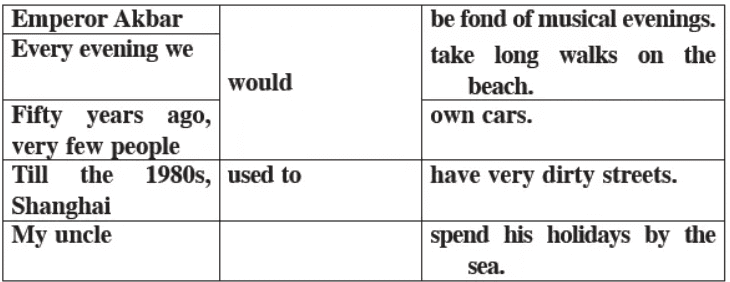
QI: From the table below, make as many correct sentences as you can using would and/or used to, as appropriate. (Hint: First decide whether the words in italics show an action, or a state or situation, in the past.) Then add two or three sentences of your own to it. Ans: (i) Emperor Akbar used to be fond of musical evenings. (ii) Every evening we used to take long walks on the beach. (iii) Fifty years ago, very few people used to own cars. (iv) Till the 1980s, Shanghai used to have very dirty streets. (v) My uncle would spend his holidays by the sea. (vi) My uncle used to take long walks on the beach. (vii) My uncle used to be fond of musical evenings
Page No: 90
II. Noun Modifiers Q1: Look at these examples from the text, and say whether the modifiers (in italics) are nouns, proper nouns, or adjective plus nouns. (i) An otter fixation (ii) The iron railings (iii) The Tigris marshes (iv) The London streets (v) soft velvet fur (vi) A four-footed soccer player Ans: (i) Noun (ii) Noun (iii) Proper noun (iv) Proper noun (v) Adjective plus noun (vi) Adjective plus noun
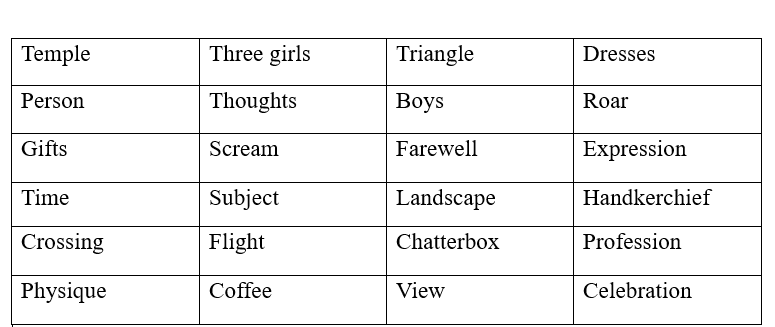
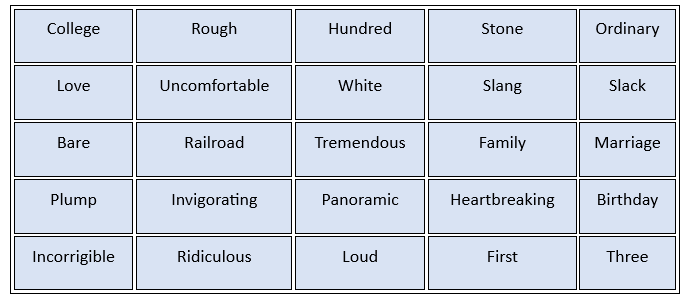
Q2: Given below are some nouns, and a set of modifiers (in the box). Combine the nouns and modifiers to make as many appropriate phrases as you can. (Hint: The nouns and modifiers are all from the texts in this book.)
Ans: Temple − white temple, stone temple, first temple Person − incorrigible person, ridiculous person Gifts − hundred gifts, ordinary gifts, birthday gifts Time − college time, rough time, first time Crossing − railroad crossing, first crossing Physique − plump physique, ordinary physique Three girls − first three girls, incorrigible three girls Thoughts − incorrigible thoughts, uncomfortable thoughts, ridiculous thoughts, heartbreaking thoughts, first thoughts, ordinary thoughts Scream − tremendous scream, scream Subject − college subject, ordinary subject Flight − rough flight, first flight Coffee − invigorating coffee, ordinary coffee Triangle − love triangle Boys − college boys, incorrigible boys, rough boys, hundred boys Farewell − college farewell, heartbreaking farewell Landscape − bare landscape, rough landscape, white landscape Chatterbox − incorrigible chatterbox View − tremendous view, panoramic view, ordinary view Dresses − hundred dresses, ordinary dresses, birthday dresses, marriage dresses Roar − tremendous roar, loud roar Expression − bare expression, slang expression, slack expression Handkerchief − white handkerchief, ordinary handkerchief Profession − family profession, first profession, ordinary profession Celebration − tremendous celebration, family celebration, birthday celebratio
Page No: 91
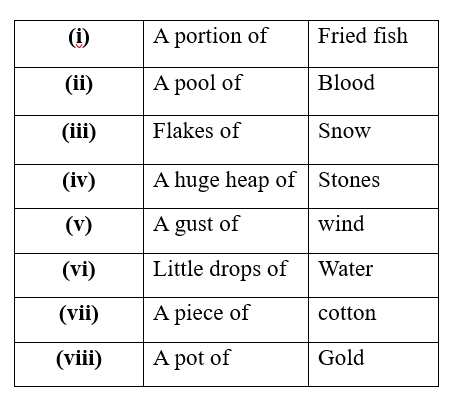
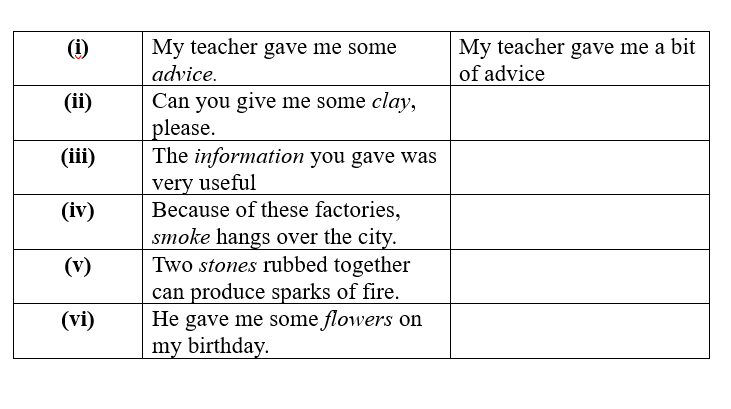
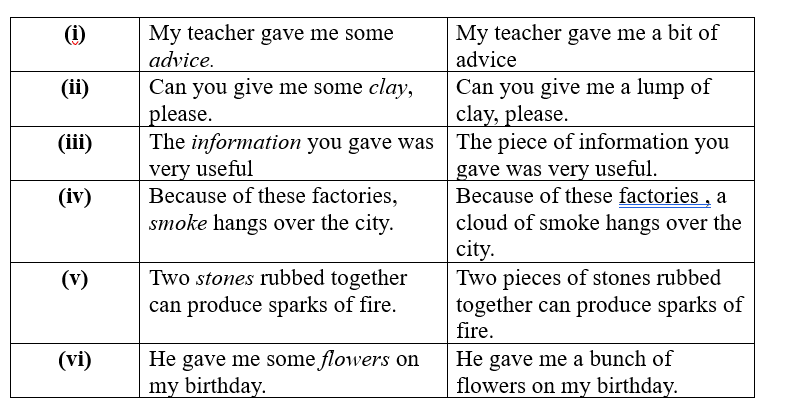
III. Q1: Match the words on the left with a word on the right. Some words on the left can go with more than one word on the right. (i) a portion of – blood (ii) a pool of – cotton (iii) flakes of – stones (iv) a huge heap of – gold (v) a gust of – fried fish (vi) little drops of – snow (vii) a piece of – water (viii) a pot of – win Ans: Q2: Use a bit of/a piece of/a bunch of/a cloud of/a lump of with the italicized nouns in the following sentences. The first has been done for you as an example.
Q1: (i) Find, in the first stanza, three things that cannot happen in a treeless forest. (ii) What picture do these words create in your mind: “… sun bury its feet in shadow…”? What could the poet mean by the sun’s ‘feet’?
Ans:
(i) The three things that cannot happen in a treeless forest are listed below: (a) the sitting of a bird on trees, (b) the hiding of insects on the trees, (c) the sun burying its feet in the shadow of the forest. (ii) The sun radiates heat and the given words create a picture of the hot, radiating sun cooling its feet in the cool shadow of the forest. The sun’s ‘feet’ refers to its rays that reach the earth.
Q2: (i) Where are the trees in the poem? What do their roots, their leaves and their twigs do? (ii) What does the poet compare their branches to?
Ans: (i) In the poem, the trees are in the poet’s house. Their roots work all night to disengage themselves from the cracks in the veranda floor. The leaves make efforts to move towards the glass, while the small twigs get stiff with exertion.
(ii) The poet compares the ‘long-cramped’ branches that have been shuffling under the roof to newly discharged patients who look half-dazed as they move towards the hospital doors after long illnesses and wait to get out of the hospital. The branches also have cramped under the roof and want to get out into the open to spread themselves in fresh air.
Q3:(i) How does the poet describes the moon: (a) at the beginning of the third stanza, and (b) at its end? What causes this change? (ii) What happens to the house when the trees move out of it? (iii) Why do you think the poet does not mention “the departure of the forest from the house” in her letters? (Could it be that we are often silent about important happenings that are so unexpected that they embarrass us? Think about this again when you answer the next set of questions.)
Ans: (i) In the beginning of the third stanza, the poet says that the whole moon is shining in the open sky in the fresh night. However, at the end of the stanza, she describes the moon as broken into many pieces such as a shattered mirror. This change is caused by the trees that have made their way from her home to outside. . The transformation occurs because the trees have moved outside, their branches rising into the sky and obscuring the moon. As a result, the moon appears broken, with its pieces glimmering atop the tallest oak tree.
(ii) When the trees move out of the house, the glass gets broken and the smell of the leaves and lichens still reaches the rooms of the house.
(iii) The poet scarcely mentions about “the departure of the forest from the house” in her letters because human beings generally don’t care for nature in the first place. Hence, she thinks that nobody would be interested to know how hard the trees are trying to set themselves free. She also mentions that if humans would have really cared for the trees, they would never think of destroying them. Therefore, we can understand that the poet could feel the whole beauty of trees moving back to the forest and she was immensely happy to realise it.
Q4: Now that you have read the poem in detail, we can begin to ask what the poem might mean. Here are two suggestions. Can you think of others? (i) Does the poem present a conflict between man and nature? Compare it with A Tiger in the Zoo. Is the poet suggesting that plants and trees, used for ‘interior decoration’ in cities while forests are cut down, are ‘imprisoned’, and need to ‘break out’? (ii) On the other hand, Adrienne Rich has been known to use trees as a metaphor for human beings: this is a recurrent image in her poetry. What new meanings emerge from the poem if you take its trees to be symbolic of this particular meaning?
Ans: The poem may connote different meanings to different readers. The poet tries to explain two different things using the same metaphors in the poem.
(i) Yes, the poem presents a conflict between man and nature. While nature is more free and unbounded, man prefers to live in bounded spaces and also wants to curb nature. He uses plants for interior decoration of houses, cuts trees to make a house for himself, kills animals for food or other purposes and cages them in zoos. In all these ways, man curbs nature and denies plants and animals the freedom in which they should live. The poem shows that trees and plants are rebelling against man as they strive to work their way out into the open. For instance, in the poem A Tiger in the Zoo, the poet presents the fact that animals feel bound by cages. They can only take a few steps inside the cage, whereas they really want to run and leap into the open. This signifies the fact that plants and animals feel caged by humans and want to break out from imprisonment at the hands of humans. (ii) If trees are symbolic of human beings, then it could be said that humans too want to break away from the shackles of the busy and selfish lives they lead. They also want to go out into nature and be free. They work all day and sometimes all night to try and achieve something even though they do not have the time to enjoy it. They keep striving hard in their routines as they feel cramped under the roofs of their homes and offices. Even if they want to break free and go out into the peaceful nature.
Page No: 64 Oral Comprehension Check Q1: What are the elders in Goa nostalgic about?
Ans: The elders in Goa are nostalgic about the good old Portuguese days and their love for the famous bread loaves. The writer also mentions that although the eaters of loaves have vanished, the bread makers still do exist.
Q2: Is bread-making still popular in Goa? How do you know?
Ans: Yes, bread-making is still popular in Goa. It is evident from the fact that the bread makers still exist, though the eaters have gone away. The presence of the mixers, moulders, the ones who bake the loaves and the time-tested furnaces are a proof of their existence
Q3: What is the baker called?
Ans: The bakers are known as pader.
Q4: When would the baker come every day? Why did the children run to meet him?
Ans: The baker came twice every day, once when he set out in the morning on his selling round, and then again when he returned after emptying his huge basket. The children ran to meet him not because of their love of the loaf, which was bought by the maid-servant of the house. They actually longed for the bread bangles, which they chose carefully. Sometimes, it was a sweet bread of special make.
Page No: 65 Oral Comprehension Check Q1: Match the following. What is a must Ans:Q2: What did the bakers wear: (i) in the Portuguese days? (ii) when the author was young?
Ans: (i) In the Portuguese days, the bakers had a peculiar dress known as the kabai. It was a single-piece long frock reaching down to the knees. (ii) When the author was young, he saw the bakers wearing a shirt and trousers, which were shorter than full-length ones and longer than half pants.
Q3: Who invites the comment − “he is dressed like a pader”? Why?
Ans: Anyone who wears a half-pant that reaches just below the knees invites the comment that “he is dressed like a pader”. This was so because the bakers were known as pader and they wore such half pants.
Q4: Where were the monthly accounts of the baker recorded?
Ans: The bakers usually collected their bills at the end of the month and their monthly accounts were recorded on some wall in the house with a pencil.
Q5: What does a ‘jackfruit-like appearance’ mean?
Ans: A ‘jackfruit-like appearance’ means a plump physique. Such a physique was linked to the bakers because they never starved. Baking was a profitable profession. The baker, his family, and his servants always looked happy and prosperous and had a ‘jackfruit-like appearance’.
Page No: 66 Thinking About the Text Q1: Which of these statements are correct? (i)The pader was an important person in the village in the old times. (ii) Paders still exist in Goan villages. (iii) The paders went away with the Portuguese. (iv) The paders continue to wear a single-piece long frock. (v) Bread and cakes were an integral part of Goan life in the old days. (vi) Traditional bread-baking is still a very profitable business. (vii) Paders and their families starve in the present times.
Ans: (i) Correct
(ii) Correct
(iii) Incorrect. The paders still exist in Goan villages.
(iv) Incorrect. The priests wear shirts and trousers that are shorter than full-length ones and longer than half pants.
(v) Incorrect. Bread and cakes are still an integral part of Goan life.
(vi) Correct
(vii) Incorrect. Baking is still a very profitable business in Goa.
Q2: Is bread an important part of Goan life? How do you know this?
Ans: Yes, bread is an important part of Goan life. It is often used for marriage gifts and feasts. Bread is also used by mothers for preparing sandwiches during their daughters’ engagement. The author mentions that the fragrance of fresh loaves is loved by everyone in Goa. The elders are served loaves and the youngsters long for bread-bangles. Therefore, it is necessary to have bread for all occasions in every household. Baking is therefore considered a profitable business in Goa as people have loved tasty bread since the Portuguese days.
Q3: Tick the right answer. What is the tone of the author when he says the following? (i)The thud and the jingle of the traditional baker’s bamboo can still be heard in some places. (nostalgic, hopeful, sad) (ii) Maybe the father is not alive but the son still carries on the family profession. (nostalgic, hopeful, sad) (iii) I still recall the typical fragrance of those loaves. (nostalgic, hopeful, naughty) (iv) The tiger never brushed his teeth. Hot tea could wash and clean up everything so nicely, after all. (naughty, angry, funny) (v) Cakes and bolinhas are a must for Christmas as well as other festivals. (sad, hopeful, matter-of-fact) (vi) The baker and his family never starved. They always looked happy and prosperous. (matter-of-fact, hopeful, sad)
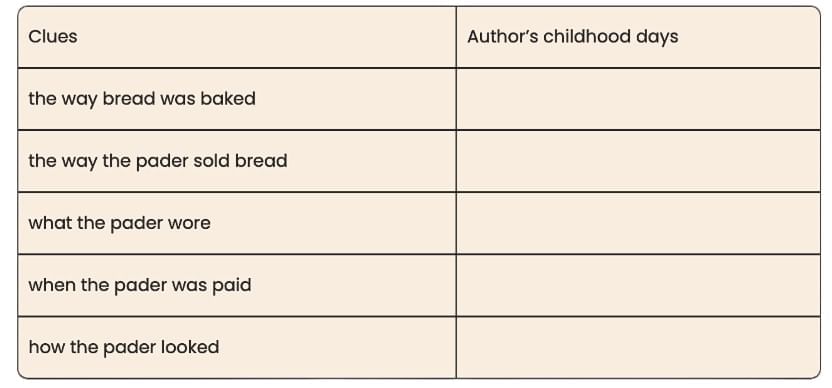
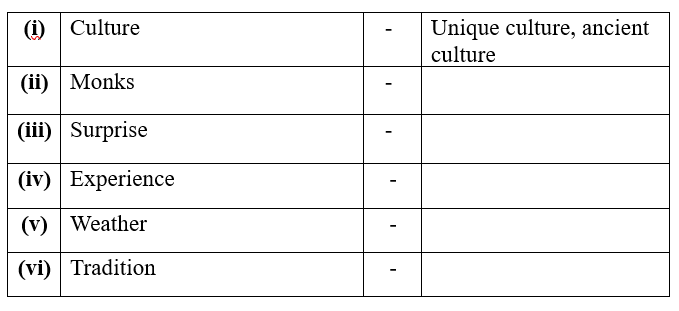
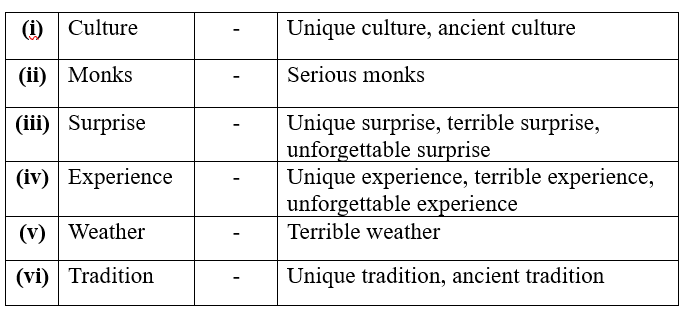
I. In this extract, the author talks about traditional bread-baking during his childhood days. Complete the following table with the help of the clues on the left. Then write a paragraph about the author’s childhood days.
Ans:
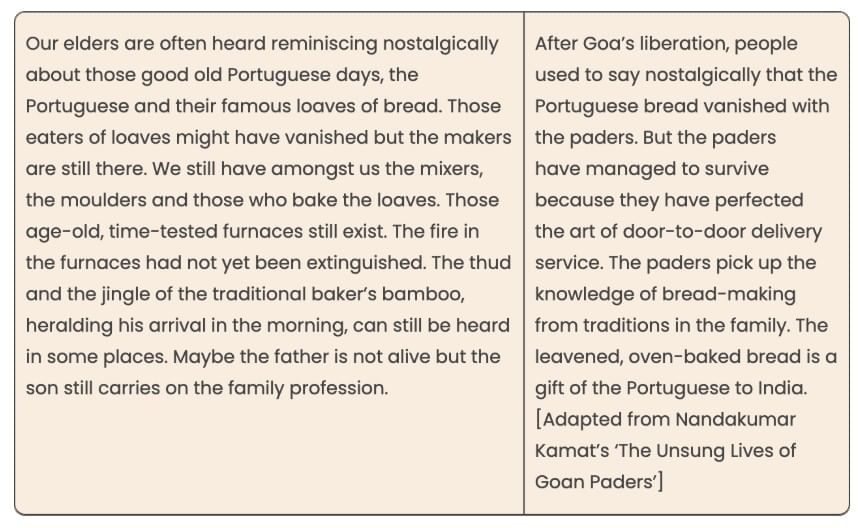
II. Q1: Compare the piece from the text (on the left below) with the other pieceon Goan bakers (on the right). What makes the two texts so different?Are the facts the same? Do both writers give you a picture of the baker?
Q2: Now find a travel brochure about a place you have visited. Look at thedescription in the brochure. Then write your own account, adding detailsfrom your own experience, to give the reader a picture of the place,rather than an impersonal, factual description.
Ans: Do it Yourself!
Page No: 70 Thinking about the Text Q1: Where is Coorg?
Ans: Coorg is the smallest district of Karnataka, located midway between Mysore and Mangalore.
Q2: What is the story about the Kodavu people’s descent? Ans: The fiercely independent people of Coorg are believed to be the descendants of people of Greek or Arabic origin. As the story goes, a section of Alexander’s army moved south along the coast and settled there when they could not return to their country. These people married amongst the locals and their culture is apparent in the martial traditions, marriage and religious rites, which are distinct from the Hindu mainstream. This is the beautiful story about the Kodavu people’s descent.
Q3: What are some of the things you now know about (i) the people of Coorg? (ii) the main crop of Coorg? (iii) the sports it offers to tourists? (iv) the animals you are likely to see in Coorg? (v) its distance from Bangalore, and how to get there?
Ans:
(i)The people of Coorg are independent. They are of Greek or Arabic descent. They have a tradition of hospitality. They enjoy recounting numerous tales of valor related to their sons and fathers. Kodavas are the only people in India permitted to carry firearms without a license. The author has described the people of Coorg as a proud race of martial men and beautiful women.
(ii) Coffee is the main crop of Coorg. The air smells of invigorating coffee. Coffee estates and colonial bungalows stand tucked under tree canopies in prime corners of the town.
(iii) The sports that Coorg offers to tourists are river rafting, canoeing, rappelling, rock climbing, mountain biking, and trekking.
(iv) The animals that you are likely to see in Coorg include Macaques, Malabar squirrels, langurs, slender lorises, wild elephants, etc. You can also see birds, bees and butterflies giving you company around the corner.
(v) By road, Coorg is around 250 – 260 kilometres from Bangalore and there are two routes to reach there. One route is via Mysore, which is the most frequented one. The other route is via Neelamangal, Kunigal and Chanrayanapatna.
Page No: 71 Q4: Here are six sentences with some words in italics. Find phrases from the text that have the same meaning. (Look in the paragraphs indicated) (i)During monsoons, it rains so heavily that tourists do not visit Coorg. (para 2) (ii) Some people say that Alexander’s army moved south along the coast and settled there. (para 3) (iii) The Coorg people are always ready to tell stories of their sons’ and fathers’ valor. (para 4) (iv) Even people who normally lead an easy and slow life get smitten by the high-energy adventure sports of Coorg. (para 6) (v) The theory of Arab origin is supported by the long coat with embroidered waist-belt they wear. (para 3) (vi) Macaques and Malabar squirrels observe you carefully from the tree canopy. (para 7) Ans: (i) Keep many visitors away
(ii) as one story goes
(iii) are more than willing to recount
(iv) The most laidback individuals become converts to
(v) draws support from
(vi) keep a watchful eye
Thinking about the Language Q1: Here are some nouns from the text.Work with a partner and discuss which of the nouns can collocate with which of the adjectives given below. The first one has been done for you.
Ans: Page No. 72 Q2: Complete the following phrases from the text. For each phrase, can you find at least one other word that would fit into the blank?
(i) tales of _______________
(ii) coastal _______________
(iii) a piece of ______________
(iv) evergreen ______________
(v) _____________ plantations
(vi) _____________bridge
(vii) wild __________________
You may add your own examples to this list. Ans: From the text (i) tales of valor (ii) coastal town (iii) a piece of heaven (iv) evergreenrainforests (v) coffee plantations (vi)rope bridge (vii) wildelephants
Other than the text (i) tales of morality (ii) coastal food (iii) a piece ofcake (iv) Evergreen hero (v)crop plantations (vi)sturdy bridge (vii) wild animals
Thinking about the LanguageQ1: Look at these words: upkeep, downpour, undergo, dropout, walk-in. They are built up from a verb (keep, pour, go, drop, walk) and an adverb or a particle (up, down, under, out, in). Use these words appropriately in the sentences below. You may consult a dictionary. (i) A heavy ___________ has been forecast due to low pressure in the Bay of Bengal. (ii) Rakesh will ___________major surgery tomorrow morning. (iii) My brother is responsible for the ______________of our family property. (iv) The ____________rate for this accountancy course is very high. (v) She went to the Enterprise Company to attend a _______________ interview.
Ans: (i) A heavy downpour has been forecast due to low pressure in the Bay of Bengal. (ii) Rakesh will undergo major surgery tomorrow morning. (iii) My brother is responsible for the upkeep of our family property. (iv) The dropout rate for this accountancy course is very high. (v) She went to the Enterprise Company to attend awalk-in-interview.
Q2: Now fill in the blanks in the sentences given below by combining the verb given in brackets with one of the words from the box as appropriate.
(i) The Army attempted unsuccessfully to ___________ the government. (throw) (ii) Scientists are on the brink of a major ___________in cancer research. (break) (iii) The State Government plans to build a ______________for Bhubaneswar to speed up traffic on the main highway. (pass) (iv) Gautama’s ____________on life changed when he realized that the world is full of sorrow. (look) (v) Rakesh seemed unusually _______________ after the game. (cast) Ans: (i) The Army attempted unsuccessfully to overthrow the Government. (ii) Scientists are on the brink of a major breakthrough in cancer research. (iii) The State Government plans to build a bypass for Bhubaneswar to speed up traffic on the main highway. (iv) Gautama’s outlookon life changed when he realized that the world is full of sorrow. (v) Rakesh seemed unusually downcastafter the game.
Page No: 75 Q1: Think of suitable −ing or −ed adjectives to answer the following questions. How would you describe (i) a good detective serial on television? ___________________ (ii) debate on your favorite topic ‘Homework Should Be Banned’?_______ (iii) how you feel when you stay indoors due to incessant rain?_____________ (iv) how do you feel when you open a present? __________________ (v) How did you feel when you watch your favorite program on television? _______________ (vi) the look on your mother’s face as you waited in a queue? ______________ (vii) how you feel when tracking a tiger in a tiger reserve forest?______________ (viii) the story you have recently read, or a film you have seen?______________ Ans: (i) a good detective serial on television? Interesting (ii) a debate on your favorite topic ‘Homework Should Be Banned’?Exciting (iii) how you feel when you stay indoors due to incessant rain? Bored (iv) how you feel when you open a present?Excited (v) how you feel when you watch your favorite program on television? Interested (vi) the look on your mother’s face as you waited in a queue? Tired (vii) how you feel when tracking a tiger in a tiger reserve forest? Thrilled (viii) the story you have recently read, or a film you have seen? Boring
Q1: How old do you think Amanda is? How do you know this?
Ans: Amanda is about a 9-10 year old school going girl. She is being scolded for things typical for that particular age. Her parents are trying to inculcate in her good manners and etiquettes. Amanda is very innocent and immature.
Q2: Who do you think is speaking to her?
Ans: Amanda is being spoken to by one of her parents. It is most likely that it’s her mother. Generally speaking, a mother is the first teacher for a child. She always tries to guide and instruct her child to follow the righteous path. Hence, from the range of instructions given to Amanda, it exhibits that the speaker is her mother.
Q3: Why are Stanzas 2, 4 and 6 given in parenthesis?
Ans: Stanzas 2, 4 and 6 are given in parenthesis because they exhibit the inner thoughts and reaction of Amanda as she receives instructions from her mother given in stanzas 1, 3 and 5. As there is an alternate sequence of scolding by Amanda’s mother, she gives a corresponding reaction to it on the following stanzas in parenthesis. Thus, the parenthesis is used by the poet to convey the friendly tone of the poem.
Q4: Who is the speaker in stanzas 2, 4 and 6? Do you think this speaker is listening to the speaker in stanzas 1, 3, 5 and 7?
Ans: The speaker of the stanzas 2, 4 and 6 is the child, Amanda herself. No, she is not listening or paying heed to her mother’s words in stanzas 1, 3 and 5 as she is lost in her own dream world. Her imagination lets her escape from reality as she is lost in her Sorry reality.
Q5: What could Amanda do if she were a mermaid?
Ans: If Amanda were a mermaid, she could drift away slowly and carelessly on a languid emerald sea. She wished if she could be the sole inhabitant of the green sea and would slowly move on it. manda longs for a place where she is all by herself as her happiness is not dependant on any other human being. Hence, she desires to be a mermaid because for a child, mermaid is a symbol of freedom and wonder.
Q6: Is Amanda an orphan? Why does she say so?
Ans: No, Amanda is not an orphan, though she wishes to be one. She is so much stressed with the continuous nagging of her parents that she imagines herself to be better without them. The mere presence of her parents around her depresses her. Amanda is a little girl who seeks ‘golden’ silence and ‘sweet’ freedom. She wishes to roam around streets and draw patterns with her bare feet. Indeed it is horribly depressing that Amanda expects being an orphan.
Q7: Do you know the story of Rapunzel? Why does she want to be Rapunzel? Ans: The story of Rapunzel revolves around her life on a high tower. She was locked in that tower by an evil witch. In due course of time, she got used to living there. She was very happy and content with her life in the tower. She had very long blonde hair which was used by the witch to climb the tall tower. One fine day, a prince came to meet her as he climbed the tower using her hair. When the witch came to know about it, she punished both of them by separating them. Finally, after many years the couple united together forever. Similarly, Amanda wishes to live her life like Rapunzel on a high tower on her own, away from everyone. She yearns for freedom, peace and harmony. Due to this reason, Amanda wants to be like Rapunzel. However, she also states that since she doesn’t want to be disturbed, she would never let her bright hair down for anyone to climb to her. She simply desires a happy and satisfied life with no disturbance from others.
Q8: What does the girl yearn for? What does this poem tell you about Amanda?
Ans: A girl like Amanda yearns for freedom and space for herself. She is incapable to fulfil the expectations of her parents. Amanda is no less than a symbol for all the children who face similar fate irrespective of class, colour or nationality. Traditional societies demand a certain type of behaviour from the individuals and the training to produce such begins at a very young age. Parents ignore the innocence and understanding level of their children and thereby the young ends up killing their imagination and thoughts.
Q9: Read the last stanza. Do you think Amanda is sulking and is moody?
Ans: No, Amanda is neither sulking nor moody. She simply longs for her freedom as she is fed up of following the instructions given by her parents. She has a strong imaginative power as she visualizes herself to the likes of Rapunzel’s story and she wants to lead a carefree life free from all nagging and scolding from her parents who are always trying to teach mannerisms and inculcate good habits in her.