Q1: What makes writing in a diary a strange experience for Anne Frank?
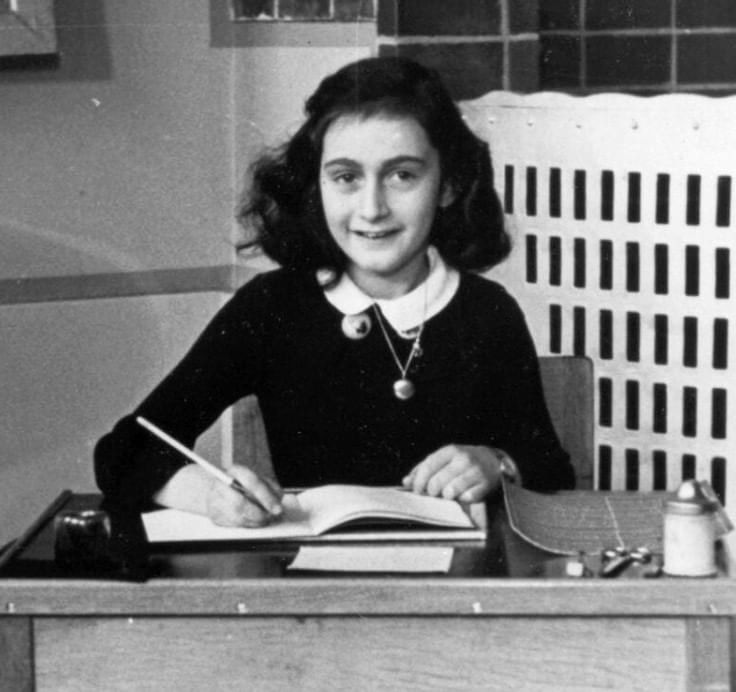
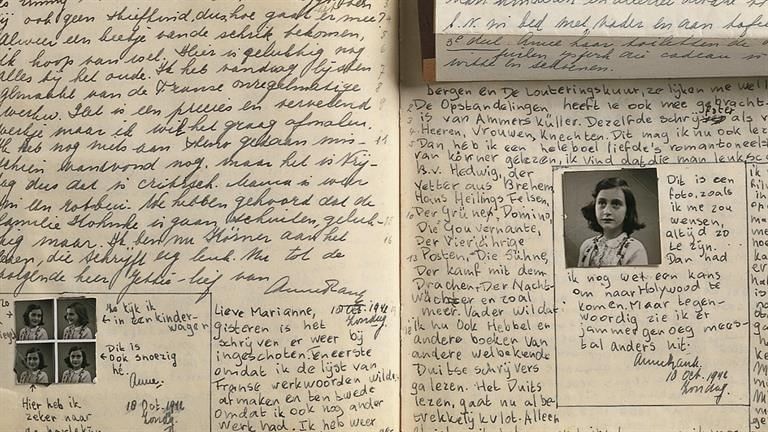
Ans: Writing in a diary was a strange experience for Anne Frank because she had never written anything before in a diary as she had received it as a gift on her thirteenth birthday. She considered the diary to be her best friend, where she could write all her thoughts and feelings. However, she also felt that no one would be interested in the musings of a thirteen-year-old schoolgirl. Hence she could write freely in the diary to get all her worries off her chest.
Q2: Why does Anne want to keep a diary?
Ans: Anne always used to feel lonely and upset as she had no friends. She wanted to get all the burdens and worries off her chest. Hence she decided to keep a diary where she could confide her secrets and treat it as a true friend.
Q3: Why did Anne think she could confide more in her diary than in people?
Ans: Anne believed that paper was more patient than people when it came to understanding her thoughts. She found it easier to write down everything she was thinking and feeling in her diary. For her, the diary became the perfect place to share her secrets, as it was her closest companion and wasn’t meant for anyone else to read.
Oral Comprehension Check
Q1: Why does Anne provide a brief sketch of her life?
Ans: Anne gave a short overview of her life because she wanted to introduce her family, school, and herself. By reading her diary, she hoped the reader would feel a connection with her and the events happening around her at that time.
Q2: What tells you that Anne loved her grandmother?
Ans: Anne lived at Aachen with her grandmother while her parents settled down in Holland. She was extremely close to her grandmother and wrote about her in her diary. However, when her grandmother died in January 1942, she said, “No one knows how often I think of her and still love her”. She wanted to convey through this message how dearly she loved her grandmother. On her thirteenth birthday, she lit up one candle along with the rest to express her love and gratitude for her beloved grandmother.
Page No. 54
Oral Comprehension Check
Q1: Why was Mr Keesing annoyed with Anne? What did he ask her to do?
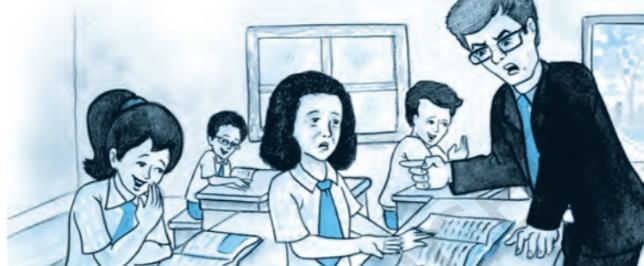
Ans: Mr. Keesing was annoyed with Anne because she talked very much in class. He punished her by giving her extra homework to write essays on the subject like ‘A Chatterbox’ to keep her silent and these topics always related to her nature.
Q2: How did Anne justify her being a chatterbox in her essay?
Ans: Anne defended her talkativeness in her essay by explaining that she got it from her mother, who was just as talkative, if not more. She also mentioned that inherited traits like this can’t really be changed.
Q3: Do you think Mr Keesing was a strict teacher?
Ans: No, Mr Keesing was not a bad or strict teacher because a teacher did something for the welfare of his students. Any teacher would be annoyed if children keep on talking in the class. Secondly, if he had been strict he would not have laughed at Anne’s funny arguments
Q4: What made Mr Keesing allow Anne to talk in class?
Ans: Anne’s final essay, titled ‘Quack, Quack, Quack, Said Mistress Chatterbox,’ was written as a poem and revealed her playful side to Mr. Keesing. He was impressed by how she expressed her points in a rhythmic way. This helped improve their relationship, and after that, he never gave her extra homework again.
Thinking about the Text Q1: Was Anne right when she said that the world would not be interested in the musings of a thirteen-year-old girl?
Ans: Yes, Anne was right in saying that, as many people tend to dismiss a child’s perspective, believing that children are too immature to understand the complexities of the world. Adults often don’t take children seriously. At just thirteen, Anne felt that most people would overlook a child’s view, assuming they lacked the maturity to grasp serious matters.
Yet, Anne Frank’s diary gained global recognition, was translated into numerous languages, and she became one of the most recognized and remembered victims of the Holocaust.
Q2: There are some examples of diary or journal entries in the ‘Before You Read’ section. Compare these with what Anne writes in her diary. What language was the diary originally written in? In what way is Anne’s dairy different?
Ans: Anne’s diary, originally written in Dutch, stood out from others in several ways. She named her diary ‘Kitty’ and wrote in a casual, informal style that reflected her carefree teenage spirit. She confided her feelings and secrets in it as she considered her diary to be her best friend. She wrote a lot of personal events and memories in her diary, which made it different from other diaries.
Q3: Why does Anne need to give a brief sketch of her family? Does she treat ‘Kitty’ as an insider or an outsider?
Ans: Anne Frank claims that paper has more patience than people. She usually sits depressed and all alone.
She claims to have no real friends. This lends the reader the perception that there isn’t anybody to take care of Anne Frank. To clear the clouds of doubt, Anne Frank gives the sketch of her adorable father, compassionate mother, kind grandmother, and loving sister. She treated Kitty as an insider because she called it her best friend and was ready to confide in it.
Q4: How does Anne feel about her father, her grandmother, Mrs Kuperus and Mr Keesing? What do these tell you about her?
Ans: Anne had fond memories of her adorable father, her grandmother, Mrs Kuperus, and Mr Keesing, her Maths teacher, who had left indelible impressions on her mind and had a major impact on her life. The way she wrote about all of them in her diary revealed that Anne was very attached to each of these people and was quite good at understanding people. She had developed an everlasting bond and a wonderful interpersonal relationship with each of them.
Q5: What does Anne write in her first essay?
Ans: Mr Keesing had asked Anne to write an essay on the topic ‘A Chatterbox’ as a punishment for her talkative nature. In the essay, she wrote about the effects of being talkative and also argued that she had inherited it from her mother, who was also very talkative. She justified this by saying that nobody could do anything about inherited traits. It was, therefore, difficult to give up a habit so easily, and it also formed a part of a student’s trait. Reading this, Mr Keesing also had a hearty laugh at the argument given by Anne.
Q6: Anne says teachers are most unpredictable. Is Mr Keesing unpredictable? How?
Ans: Anne cited the perfect example of Mr Keesing as an unpredictable teacher because she felt that Mr Keesing was indifferent towards her behaviour and always rebuked her for her talkative nature. Although he punished her initially by assigning extra homework, after reading her essays, he enjoyed a good laugh and thereafter never gave her such punishment and allowed Anne to talk in class.
Q7: What do these statements tell you about Anne Frank as a person? (i) We don’t seem to be able to get any closer, and that’s the problem. Maybe it’s my fault that we don’t confide in each other. (ii) I don’t want to jot down the facts in this diary the way most people would, but I want the diary to be my friend. (iii) Margot went to Holland in December, and I followed in February when I was plunked down on the table as a birthday present for Margot. (iv) If you ask me, there are so many dummies that about a quarter of the class should be kept back, but teachers are the most unpredictable creatures on earth. (v) Anyone could ramble on and leave big spaces between the words, but the trick was to come up with convincing arguments to prove the necessity of taking.
Ans:
(i) These lines show that Anne did not have any close friends in whom she could confide her secrets. Therefore, she blamed herself for her reserved nature. (ii) This line shows that Anne really considered her diary as a friend whom she could trust and narrate all her stories. She did not want just a diary in which she could write down the facts as others did. She considered it as her friend and named her Kitty. (iii) This statement implies the humorous nature of Anne. She had a witty personality and wrote the line in a funny tone. The words ‘plunked down’ exhibit her sense of humour. (iv) This statement shows that she had an opinion on everything. She thought that a quarter of her class was full of dummies, signifying that she herself was intelligent enough to make it to the next class. She thought of teachers as the most unpredictable creatures on earth because nobody could say which students they would fail and which students would be passed on to the next class. (v) This statement implies that Anne was talking about writing. She was given extra homework to write essays by Mr Keesing as a punishment for her talkative nature. Although that was extra work for her, she wanted to do it with full vigour. She did not want to leave big spaces between the words to make the essay look voluminous. She wanted to write convincing arguments to prove the essence of talking. That way, her approach to writing was different from others.
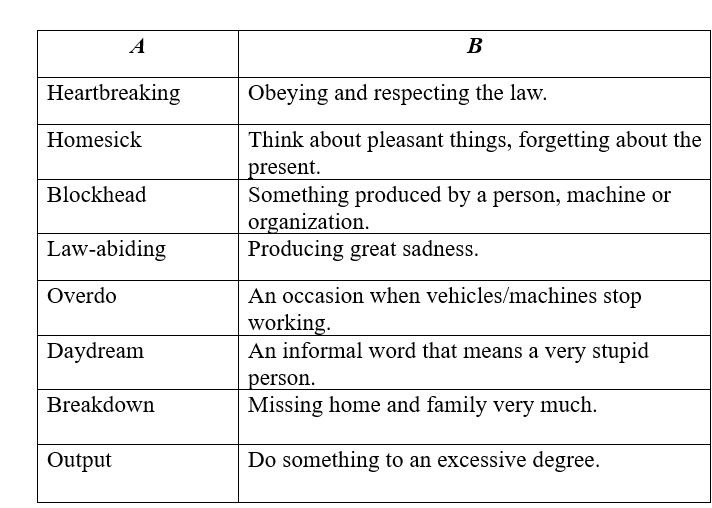
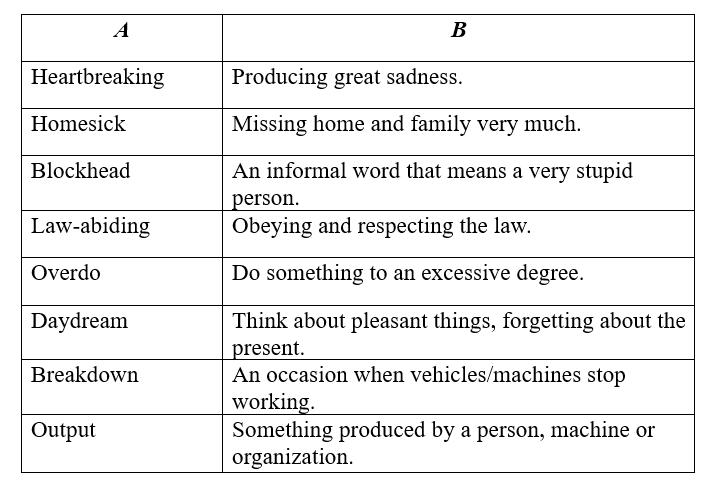
Page No. 55 Thinking about Language I. Match the compound words under ‘A’ with their meanings under ‘B’. Use each in a sentence.
Ans:
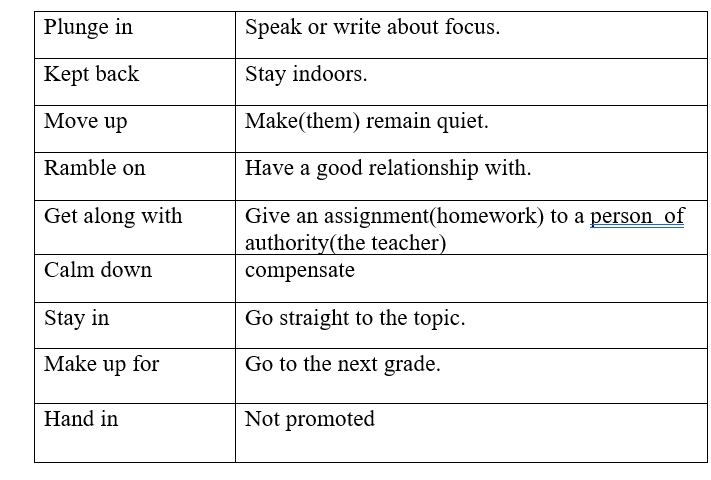
II. 2. Now find the sentences in the lesson that have the phrasal verbs given below. Match them with their meanings.
Ans: (i) Plunge in − go straight to the topic Sentence: Since no one would understand a word of my stories to Kitty if I were to plunge right in, I’d better provide a brief sketch of my life, much as I dislike doing so.
(ii) kept back − not promoted Sentence: The reason, of course, is the forthcoming meeting in which the teachers decide who’ll move up to the next form and who’ll be kept back.
(iii) move up − go to the next grade Sentence: The reason, of course, is the forthcoming meeting in which the teachers decide who’ll move up to the next form and who’ll be kept back.
(iv) ramble on − speak or write without focus Sentence: Anyone could ramble on and leave big spaces between the words, but the trick was to come up with convincing arguments to prove the necessity of talking.
(v) get along with − having a good relationship with Sentence: I get along pretty well with all my teachers.
(vi) calm down − make (them) remain quite Sentence: Even G.’s pleading advances and my angry outbursts can’t calm them down.
(vii) stay in − stay indoors Sentence: I thought of this saying on one of those days when I was feeling a little depressed and was sitting at home with my chin in my hands, bored and listless, wondering whether to stay in or go out.
(viii) make up for − compensate Sentence: This birthday celebration in 1942 was intended to make up for the other.
(ix) hand in − give an assignment (homework) to a person in authority (the teacher) Sentence: I handed it in, and Mr Keesing had nothing to complain about for two whole lessons.
Page No. 56 III. 1. Here are a few sentences from the text which have idiomatic expressions. Can you say what each means? (You might want to consult a dictionary first.) 1. Our entire class is quaking in its boots. ________________________ 2. Until then, we keep telling each other not to lose heart. ___________ 3. Mr Keeping was annoyed with me for ages because I talked so much.______________ 4. Mr Keeping was trying to play a joke on me with this ridiculous subject, but I’d make sure the joke was on him.______ Ans: 1. Our entire class is quaking in its boots. Shaking with fear and nervousness 2. Until then, we keep telling each other not to lose heart. Not to lose hope 3. Mr. Keeping was annoyed with me for ages because I talked so much. Since a long time 4. Mr. Keeping was trying to play a joke on me with this ridiculous subject, but I’d make sure the joke was on him. He was outwitted by her
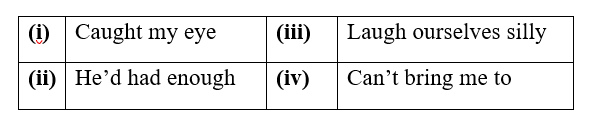
2. Here are a few more idiomatic expressions that occur in the text. Try to use them in sentences of your own.Ans: (i) caught my eye:A small red car passing by caught my eye. (ii)he’d had enough: Harry suffered a lot due to his illness. He’s had enough of mental trauma. (iii) laugh ourselves silly: One girl said something funny, and we laughed ourselves silly. (iv) can’t bring me to: I can’t bring myself to eat anything but chocolates.
Page No: 58 IV. You have read the expression ‘not to lose heart’ in this text. Now find out the meanings of the following expressions using the word ‘heart’. Use each of them in a sentence of your own. 1. break somebody’s heart 2. close/dear to the heart 3. from the (bottom of your) heart 4. have a heart 5. have a heart of stone 6. your heart goes out to somebody Ans: 1. break somebody’s heart − to upset somebody deeply Sentence: It has, unfortunately, become very easy these days to break somebody’s heart.
2. close/dear to heart − something or someone who is near and close to you Sentence: The drawing given to me by my little daughter is very close to my heart.
3. from the (bottom of your) heart − genuinely meaning or feeling something Sentence: He loved his son from the bottom of his heart.
4. have the heart − to evoke the feeling to help someone in distress Sentence: The poor beggar asked the rich man to have a heart and give him something to eat.
5. have a heart of stone − to not feel anything or any sentiment Sentence: The cruel landlady has a heart of stone as she beats up her children.
6. your heart goes out to somebody − to sympathize with someone else and understand his feelings and distress. Sentence: My heart goes out to the little girl who lost both her parents in a car accident. Page No. 58 V. Q1: Make a list of the contracted forms in the text. Rewrite them as full forms of two words. For example: I’ve = I have
Q2: We have seen that some contracted forms can stand for two different full forms: I’d = I had or I would Find in the text the contracted forms that stand for two different full forms, and say what these are. Ans: 1(i) I’ve − I have (ii) Doesn’t − does not (iii) Won’t − would not (iv) I’m − I am (v) Don’t − do not (vi) Can’t − cannot (vii) it’s − it is (viii) That’s − that is (ix) I’d − I would (x) Didn’t − did not (xi) Who’ll − who will (xii) You’re − You are (xiii) We’ll − We will (xiv) There’s − there is (xv) He’d − he had (xvi) Who’s − who is (xvii) Haven’t − have not
2 (i) I’d − I had or I would (ii) He’d − He had or he would
Q1: Why does the poet say, “I would not intrude on him”? Why doesn’t he offer him money to buy another ball?
Ans: The poet says, “I would not intrude on him” because he does not want to intervene in the natural process of learning. He wants the boy to learn the meaning of loss on his own. He also doesn’t offer him money to buy another ball because that would be worthless. He wants the boy to learn the lesson of responsibility.
Q2: “… staring down/All his young days into the harbor where/His ball went…” Do you think the boy has had the ball for a long time? Is it linked to memories of days when he played with it?
Ans: Yes, the boy has had the ball for a long time. When it bounced into the water, all his memories of the days of childhood flashed in front of him. This led to a realisation that those moments would not come back, just like the ball. He can buy new balls and can similarly create new moments, but those that are gone would not return
Q3: What does “in the world of possessions” mean?
Ans: In the world of possessions” means that the world is full of materialistic things. Here everything and every action is made to possess something, whether it is the possession of land, property, money, or any other thing. In the poem, the poet indicates that losing of the ball by the boy may be a very small thing, but this would give him a realization of loss and the experience of losing memories associated with it.
Q4: Do you think the boy has lost anything earlier? Pick out the words that suggest the answer.
Ans: No, it seems that the boy did not lose anything earlier. It is evident from the words ‘He senses first responsibility in a world of possessions’. This line suggests that the sense of loss gave him an experience of understanding how several precious moments are lost with the loss of a particular object.
Q5: What does the poet say the boy is learning from the loss of the ball? Try to explain this in your own words.
Ans: The poet tries to convey through his poem that the boy has learnt an important lesson to cope up with the loss of his ball. He is experiencing grief and sadness while he grows up in this world full of possessions. He learns that there are several important things in life that are lost and cannot be brought back. He also senses his first sense of responsibility as he loses the ball. The boy learns to stand up and leave the loss behind as he moves ahead in his life and understands the true meaning and nature of loss.
Q6:Have you ever lost something you liked very much? Write a paragraph describing how you felt then, and saying whether — and how — you got over your loss.
Ans: Yes, I had lost my pet dog in a road accident when he was just five years old. One day I was playing with my puppy with a ball in my garden. I threw the ball in the air while playing with him, my dog jumped to catch the ball but it bounced back and rolled to the street nearby. As my dog went to fetch the ball, a speeding car ran over my puppy and I could hear it crying in pain. I rushed to the spot and found my pup covered in blood. I rushed him to the hospital immediately but it was too late and he was bleeding profusely and succumbed to injuries. I was very upset and grief-stricken by this incident. With due course of time, I recovered with my loss, but that incident is fresh in my memories and I still love my dog and miss him dearly.
(Note: Students can write this answer as per their personal experiences.)
Q1: Does ‘dying’ really rhyme with ‘lion’? Can you say it in such a way that it does?
Ans: No, ‘dyin’ does not rhyme with ‘lion’. If we pronounce the word ‘lion’ as ‘lying’, then probably it would rhyme with the word ‘dyin’.
Q2: How does the poet suggest that you identify the lion and the tiger? When can you do so, according to him?
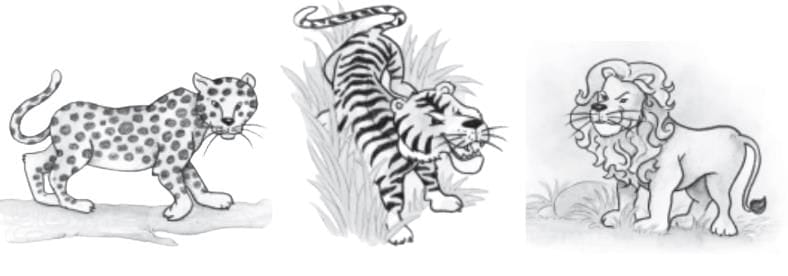
Ans: The poet suggests that if a large and tawny beast in the jungle in the east advances towards us, then it is an Asian lion. We can identify it when it roars at us while we are dying with fear. When while roaming we come across a wild beast that is yellow in colour with black stripes, it is a Bengal tiger. We can identify it when it eats us.
Q3: Do you think the words ‘lept’ and ‘lep’ in the third stanza are spelt correctly? Why does the poet spell them like this?
Ans: The poet intentionally spells the words ‘lept’ and ‘lep’ incorrectly to maintain the rhythm and flow of the poem. The correct spellings are ‘leapt’ and ‘leap,’ but by altering them, the poet adds a humorous twist to the verse. This playful misspelling emphasizes the word “leopard” in each line, making the description of the animal more memorable and fun, while also fitting the poem’s light-hearted tone. The deliberate choice to spell the words this way enhances the poem’s rhythm and comedic effect.
Q4: Do you know what a ‘bearhug’ is? It’s a friendly and strong hug — such as bears are thought to give, as they attack you! Again, hyenas are thought to laugh, and crocodiles to weep (‘crocodile tears’) as they swallow their victims. Are there similar expressions and popular ideas about wild animals in your own language(s)?
Ans: A ‘bearhug’ refers to the tight, powerful embrace of a bear, often used when it attacks its prey. Similarly, other animals have expressions linked to their behaviors or appearances. For example, a hyena doesn’t actually laugh, but its face appears as if it’s smiling. Crocodiles, on the other hand, don’t weep out of sadness, but they seem to shed tears when they swallow their prey, giving rise to the expression “crocodile tears.”
Q5: Look at the line “A novice might nonplus”. How would you write this ‘correctly’? Why is the poet’s ‘incorrect’ line better in the poem?
Ans: The line “A novice might nonplus” can be correctly written as “A novice might be nonplussed”. The poet’s incorrect line is better in the poem as it maintains the rhyme scheme of the poem. By writing it incorrectly, ‘nonplus’ rhymes with ‘thus’.
Q6: Can you find other examples of poets taking liberties with language, either in English or in your own language(s)? Can you find examples of humorous poems in your own language(s)?
Ans: Yes, poets often take liberties with language to ensure the poem flows smoothly and maintains a proper rhyme scheme. For example, a poet may use the word ‘rest’ to rhyme with ‘best’ or ‘ten’ to rhyme with ‘pen,’ even if the pairing doesn’t follow strict grammatical or linguistic rules.
Q1: Why was the young seagull afraid to fly? Do you think all young birds are afraid to make their first flight or are some birds more timid than others? Do you think a human baby also finds it a challenge to take its first steps?
Ans:
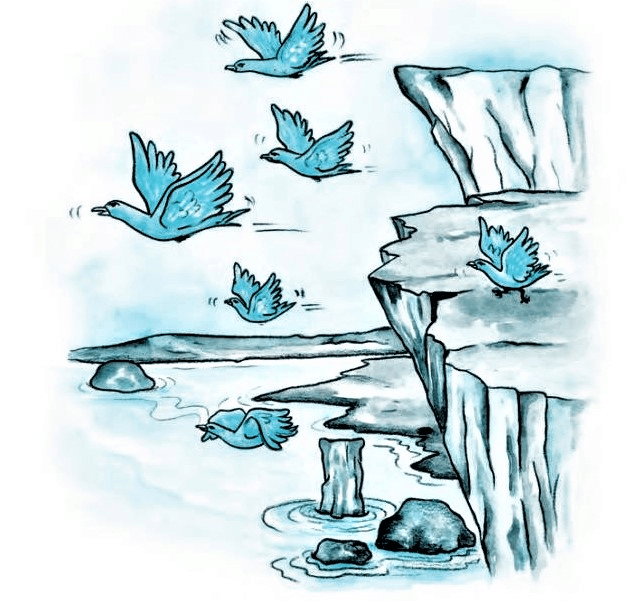
The young seagull was scared to fly because it was his first attempt, and he feared he might fall and get hurt. He doubted that his wings would hold him up during his first flight. It’s natural and understandable to feel scared when doing something for the first time. Surely, all birds must feel afraid before their first flight. Similarly, a human baby also feels fear and faces difficulty when taking its first steps or learning to crawl or walk without any support.
Q2: “The sight of the food maddened him.” What does this suggest? What compelled the young seagull to finally fly?
Ans: The young seagull couldn’t find the courage to take his first flight, even though his family kept scolding him and urging him to try. They left him alone on the ledge, waiting for him to be ready. After more than a day, he became very hungry. This hunger eventually pushed him to act. He became even more desperate when he saw his mother eating a fish nearby. He cried out, begging her to bring him food. When she came towards him with the fish, he was excited and full of hope, but she stopped before reaching him, leaving him confused. Overwhelmed by hunger, he jumped towards the food and fell off the ledge into the sea below. At first, he was terrified, but soon his wings opened up, and he realized that he could fly like the others. In the end, his hunger overcame his fear, and he joyfully made his first flight.
Q3: “They were beckoning to him, calling shrilly. “Why did the seagull’s father and mother threaten him and cajole him to fly?
Ans: The young seagull’s parents kept encouraging him, and he made several attempts to take his first flight. His two brothers and his sister had already flown away the day before. So he was left alone and hungry on the ledge. His father and mother were beckoning to him to fly shrilly. But the young seagull was too timid to fly. So they threatened to starve him on the ledge and cajoled him to fly because learning the art of flight was very necessary for a bird.
Q4: Have you ever had a similar experience, where your parents encouraged you to do something that you were too scared to try? Discuss this in pairs or groups.
Ans: Yes, I had a similar experience while trying to learn how to ride a bicycle when I was in the fourth standard. Initially, I found it difficult to balance myself and fell down often which developed a fear of cycling in me. Unable to overcome the fear, I gave up cycling, but my parents would always cajole me to try and practice cycling whenever I get time. My father would hold the bicycle from behind to help me balance myself, but whenever he left it, I would lose balance and fall down. Gradually as I practised every day, my cycling skills improved and I could ride it without my father’s support from behind and this also developed my confidence to a great extent. Thus, I overcame my fear of cycling and started riding a cycle confidently when I practiced it on a daily basis. Now, I use a cycle while going to and coming from school every day.
(Note: This answer can be written based on the individual’s personal experience.)
Q5: In the case of a bird flying, it seems a natural act and a foregone conclusion that it should succeed. In the examples you have given in answer to the previous question, was your success guaranteed, or was it important for you to try, regardless of the possibility of failure?
Ans: We face some problems in the initial stage while learning new skill. Due to the fear of failure, we hesitate to perform a task or to do something new. In case of the seagull his parents cajoled him to fly. In the example I have given in the answer of previous question, I was cajoled by my father to learn cycling. So, at that stage, I was to learn cycling as it was very important for me to overcome my fear. Yes, my success was guaranteed because if someone is determined to do something then success is assured. Moreover as said, practice, makes a man perfect.
II. The Black Aeroplane
Thinking about the Text (Page 40)
Q1: “I’ll take the risk.” What is the risk? Why does the narrator take it?
Ans: The pilot of the Dakota DS 088 was eager to get home to England to enjoy a holiday with his family. On his way, the plane was caught in a massive storm with dark clouds surrounding him. Despite the danger, he chose to fly straight into the storm because he didn’t want to miss the chance to be with his family for a proper English breakfast. Thus he took the risk of flying through the storm even though he could barely see anything.
Q2: Describe the narrator’s experience as he flew the aeroplane into the storm.
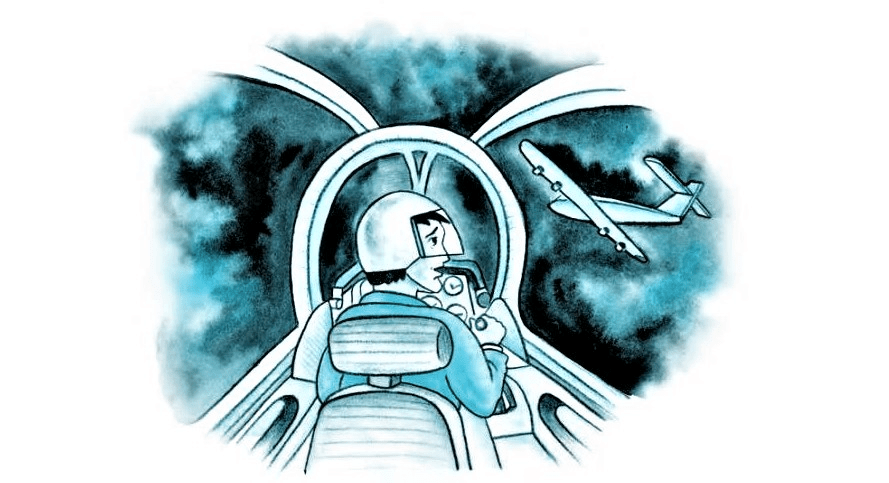
Ans: As the pilot (author) entered the storm, his plane started jumping and twisting. He could not see anything outside the plane as it was black. When he looked at compass and other instruments they had stopped to function due to storm. It was a terrible and fearsome experience for him. The fuel tank was almost empty and he could not fly more than ten minutes. Then he saw another black aeroplane by his side and the pilot of the plane signalled him to follow. It was a surprise for the narrator as the other black plane was having no light. He followed him without any choice and landed safely on the runway.
Q3: Why does the narrator say, “I landed and was not sorry to walk away from the old Dakota…”? Ans: The narrator took the risk of flying into the dark clouds. When there was a storm in the sky he didn’t have enough fuel to fly around the clouds. All the instruments of his plane had failed. It was difficult for him to land safely. However,the pilot of a strange black aeroplane guided him to the airport and the narrator was able to land safely. Thus his life was saved and he was not sorry to walk away from the old Dakota. He wanted to forget about this dangerous journey.
His heart was filled with gratitude towards the pilot of the mysterious black aeroplane, who had guided him during such a terrifying experience. However, he did feel a tinge of sadness for not being able to properly thank his unknown benefactor, who had helped him reach the runway safely.
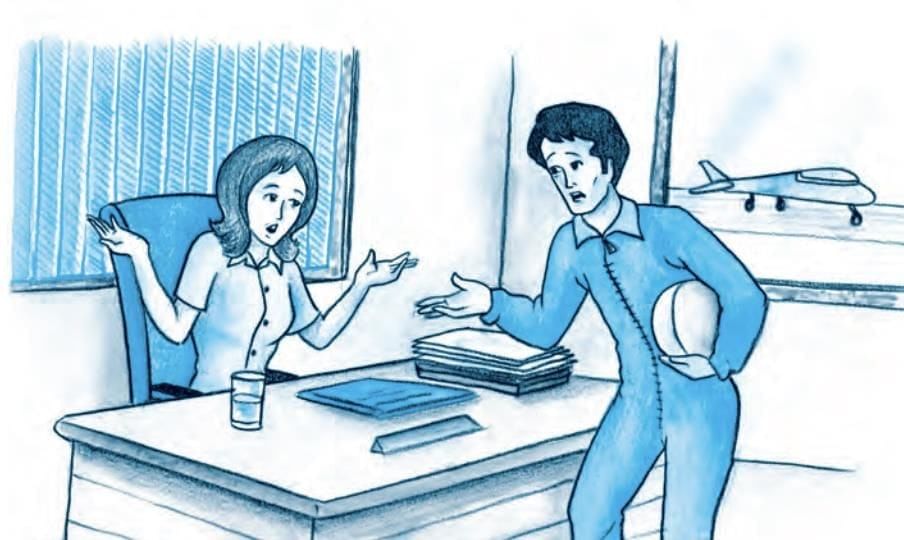
Q4: What made the woman in the control centre look at the narrator strangely? Ans: The woman at the control center gave the narrator a puzzled look when he mentioned the black aeroplane that had guided him safely to the runway. She appeared surprised and informed him that there had been no other planes in the sky during the storm. According to the radar, the narrator’s plane was the only one flying in the night sky at that time. Q5: Who do you think helped the narrator to reach safely? Discuss this among yourselves and give reasons for your answer. Ans: It is very difficult to say about the unknown pilot who helped the narrator. But probably it was the narrator himself that helped him to overcome the fear in the storm as no other plane was seen in the radar except the narrator’s Dakota plane. In that fearsome situation, he might have been hallucinating. He himself was a good pilot and brave enough who helped himself land safely.
Thinking about the Language
Q1. Try to guess the meanings of the word ‘black’ in the sentences given below. Check the meanings in the dictionary and find out whether you have guessed right. 1. Go and have a bath; your hands and face are absolutely black__________. 2. The taxi-driver gave Ratan a black look as he crossed the road when the traffic light was green. __________ 3. The bombardment of Hiroshima is one of the blackest crimes against humanity. __________ 4. Very few people enjoy Harold Pinter’s black comedy.__________ 5. Sometimes shopkeepers store essential goods to create false scarcity and then sell these in black. __________ 6. Villagers had beaten the criminal black and blue. __________ Ans: 1. The meaning of ‘black’ in this sentence is that the face and hands are dark with dust and heat. 2. Here, ‘black’ refers to an angry look. 3. Here, ‘blackest’ refers to the darkest and cruellest crime against humanity. 4. Here, ‘black’ refers to dark and gloomy comedy. 5. The meaning of ‘black’ in this sentence is that the shopkeepers sell the described goods ‘at a higher price’. 6. In this sentence, ‘black’ signifies that the criminal was severely beaten by the villagers.
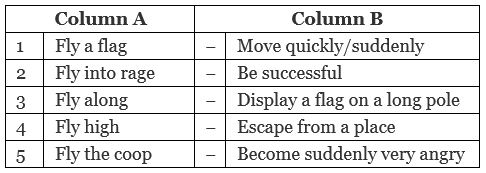
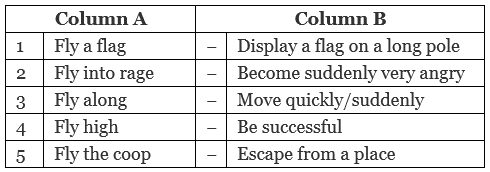
Page No: 41Q2. Match the phrases given under Column A with their meanings given under Column B:
Ans:
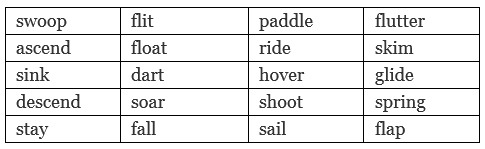
Q3. We know that the word ‘fly’ (of birds/insects) means to move through the air using wings. Tick the words which have the same or nearly the same meaning.
Ans: The words which have the same or nearly the same meaning as ‘fly’ are as follows: swoop, flit, flutter, ascend, float, skim, dart, hover, glide, soar, shoot, spring, sail, flap
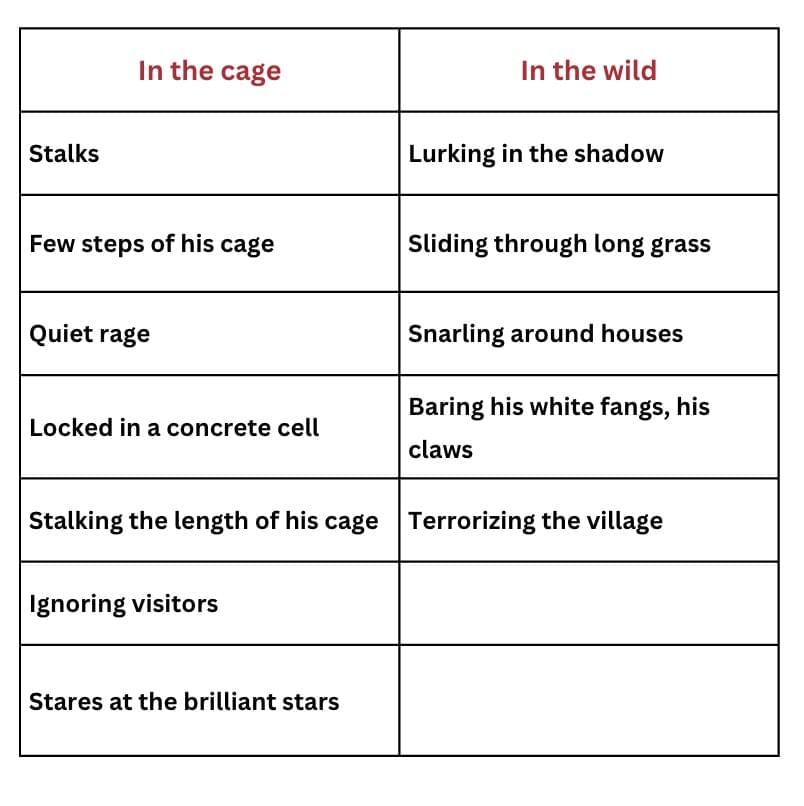
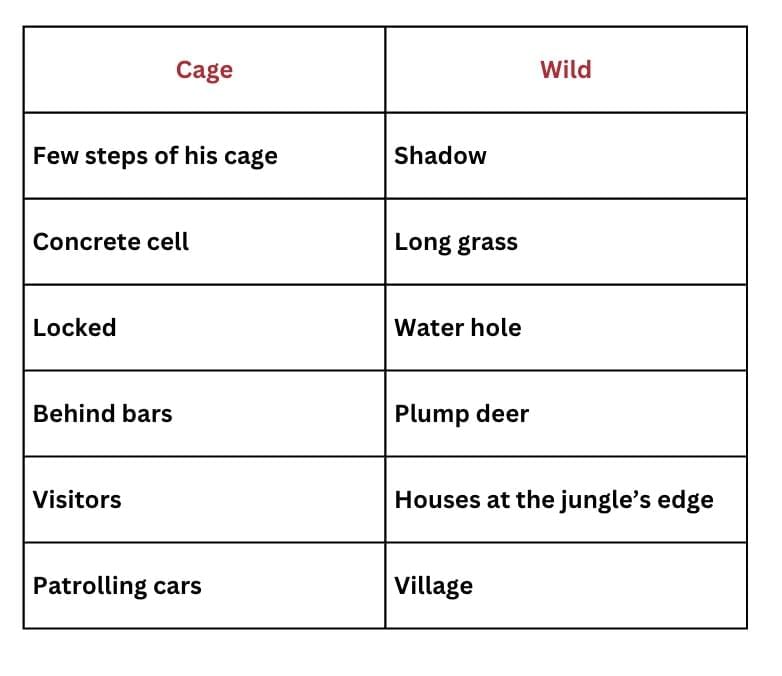
Q1. Read the poem again, and work in pairs or groups to do the following tasks. (i) Find the words that describe the movements and actions of the tiger in the case and in the wild. Arrange them in two columns. (ii) Find the words that describe the two places, and arrange them in two columns. Now try to share ideas about how the poet uses words and images to contrast the two situations. Ans: (i)
(ii)
Q2. Notice the use of a word repeated in lines such as these: (i) On pads of velvet quiet, In his quiet rage.
(ii) And stares with his brilliant eyes At the brilliant stars.
What do you think is the effect of this repetition? Ans: The poet uses repetition to create a poetic effect, highlighting the tiger’s growing anger and silent helplessness while trapped in his concrete cage. The phrase “velvet quiet” refers to the tiger’s soft paws, which are quiet and unable to run or leap. The tiger can only pace within the small space of his cage. “Quiet rage” represents the tiger’s inner anger and wild nature, which is building up as he longs to run freely in the forest and hunt. His rage remains quiet because he is locked in the cage and powerless. The repetition of “quiet” adds a musical quality to the poem. Likewise, using the word “brilliant” for both the tiger’s eyes and the stars emphasizes the majestic nature of both. The tiger looks at the brilliant stars with his brilliant eyes, dreaming of the free and beautiful life he could have had in the forest. This repetition gives the poem a rhythmic flow and a sense of grandeur.
Tiger
Q3. Read the following two poems − one about a tiger and the other about a panther. Then discuss: Are zoos necessary for the protection or conservation of some species of animals? Are they useful for educating the public? Are there alternatives to zoos? The Tiger The tiger behind the bars of his cage growls, The tiger behind the bars of his cage snarls, The tiger behind the bars of his cage roars. Then he thinks. It would be nice not to be behind bars all The time Because they spoil my view I wish I were wild, not on show. But if I were wild, hunters might shoot me, But if I were wild, food might poison me, But if I were wild, water might drown me. Then he stops thinking And… The tiger behind the bars of his cage growls, The tiger behind the bars of his cage snarls, The tiger behind the bars of his cage roars.
— By Peter Niblett
The Panther His vision, from the constantly passing bars, has grown so weary that it cannot hold anything else. It seems to him there are a thousand bars; and behind the bars, no world. As he paces in cramped circles, over and over, the movement of his powerful soft strides is like a ritual dance around a centre in which a mighty will stands paralysed. Only at times, the curtain of the pupils lifts, quietly. An image enters in, rushes down through the tensed, arrested muscles, plunges into the heart and is gone.
–By Rainer Maria Rilke
Ans: A zoo is a place where various species of animals, including some that are endangered or on the brink of extinction, are housed and cared for. These animals, such as tigers, lions, and other vulnerable species, often face significant threats in the wild due to poaching for illegal trade, habitat destruction, and human encroachment. Zoos play a crucial role in the conservation and protection of these species by offering a controlled and secure environment where they can be safeguarded from such dangers.
Beyond mere protection, zoos also serve an educational purpose by raising awareness among the public about the importance of wildlife and its essential role in maintaining the ecological balance of our environment. Visitors can learn about the behaviors, habitats, and threats faced by these animals, helping foster a deeper appreciation for their conservation.
However, while zoos provide a safe space for endangered animals, other alternatives such as wildlife sanctuaries, forest reserves, and national parks offer a more natural setting. These places not only protect and conserve the species but also allow animals to live in their natural habitat with minimal human interference. These alternatives are vital for long-term conservation efforts, ensuring that animals can thrive in the wild while being shielded from poaching and habitat loss.
Q1. Where did the ceremonies take place? Can you name any public buildings in India that are made of sandstone? Ans: The ceremonies took place in the lovely sandstone amphitheatre formed by the Union Buildings in Pretoria, which were attended by dignitaries and world leaders of several nations. In India, the Rashtrapati Bhavan and Red Fort are two public buildings that are made of red sandstone.
Rashtrapati BhavanQ2. Can you say how 10 May is an ‘autumn day’ in South Africa? Ans: South Africa lies in the Southern Hemisphere. Hence, in Southern Africa the autumn season falls in May. 10 May was the day of South Africa’s largest gathering, with many international leaders in attendance to witness the installation of the country’s first non-racial democratic government.
Oral Comprehension Check – Page 19
Q3. At the beginning of his speech, Mandela mentions “an extraordinary human disaster”. What does he mean by this? What is the “glorious … human achievement” he speaks of at the end? Ans: In Mandela’s speech ‘an extraordinary human disaster’, he wanted to express his strong feelings against the practice of Apartheid in South Africa. Under Apartheid, there was racial segregation of people based on colour, and the blacks suffered the most as they were discriminated against by the rest. They could not enjoy the right to freedom. Mandela was jailed for 18 years on the infamous ‘Robben Island’ where he was mistreated by the authorities. He considered it a “great glorious human achievement” that he became the first Black President of South Africa, where the blacks were deprived of basic needs and suffered different kinds of discrimination, and were treated badly.
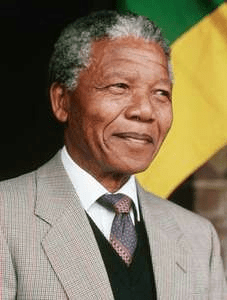
Q4. What does Mandela thank the international leaders for? Ans: Mandela felt extremely privileged to welcome the dignitaries and international leaders at the swearing-in ceremony because it was not too long ago when the South Africans were considered outlaws. He therefore, thanked all of them for having come from far and wide to witness the historical oath-taking ceremony of the first Black President of South Africa. This was a wonderful gesture of international recognition to a newly born free democratic nation. This event could be considered as a common victory for justice, peace and human dignity.Nelson Mandela
Q5. What ideals does he set out for the future of South Africa?
Ans:Mandela set the ideals of liberating the people of South Africa from the continuing bondage of poverty, deprivation, suffering, gender and other discrimination. He wanted the people of the country to enjoy the right to freedom from all forms of bondage and prejudice
Oral Comprehension Check – Page 21
1. What do the military generals do? How has their attitude changed, and why? Ans: The highest military generals of South African defence force saluted Mandela and pledged their loyalty which was of great significance as during apartheid era they would have arrested him. The change in their attitude was because of struggle and sacrifices put in by many heroes of South Africa. This struggle not only ensured the freedom of a nation struggling with apartheid, bur brought a change in mindsets of many. He believed that love can also be taught and human being is naturally inclined towards love rather than hate.
Q2. Why were two national anthems sung? Ans: On the auspicious occasion of the inauguration ceremony, two national anthems were sung. ‘Nkosi Sikelel iAfrika’, which was once the anthem of the black people who suffered under apartheid, and ‘Die Stem’, which was the anthem of the old Republic and was associated with the white community. Singing both anthems symbolized the unity and equality of all South Africans, regardless of race.
Q3. How does Mandela describe the systems of government in his country (i) in the first decade, and (ii) in the final decade, of the twentieth century? Ans: (i) In the first decade of the twentieth century, the white-skinned people of South Africa patched up their differences and erected a system of racial domination against the dark-skinned people of their own land, thus creating the basis of one of the harshest and most inhumane societies the world had ever known. (ii) In the final decade of the twentieth century, the previous system had been overturned forever and replaced by one that recognized the rights and freedoms of all peoples, regardless of the colour of their skin.
Q4. What does courage mean to Mandela? Ans: For Mandela courage does not mean the absence of fear but a victory over fear. According to him brave men need not be fearless but should be able to conquer fear.
Q5. Which does he think is natural, to love or to hate? Ans: Mandela thought that love comes more naturally to the human heart rather than hate.
Oral Comprehension Check – Page 241. What “twin obligations” does Mandela mention? Ans: Mandela mentions that every man has twin obligations. The first is to his family, parents, wife and children; the second obligation is to his people, his community and his country.
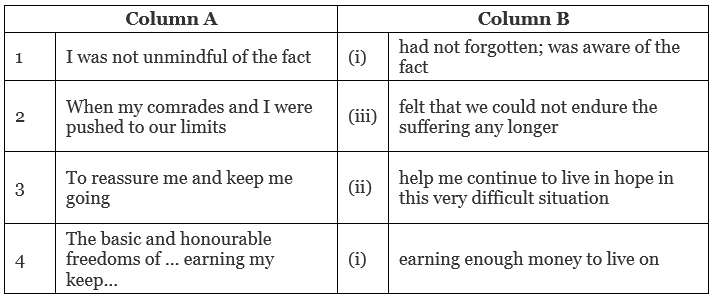
Q2. What did being free mean to Mandela as a boy, and as a student? How does he contrast these “transitory freedoms” with “the basic and honourable freedoms”? Ans: Like any other kid for Mandela also freedom meant the freedom to make merry and enjoy a blissful life. Once anybody becomes an adult, the antics of childhood looks transitory because most of the childish activity is wasteful from an adult’s perspective. Once you are an adult then someday you have to earn a livelihood to bring the bacon home, then only you get an honorable existence in the family and in the society.
Q3. Does Mandela think the oppressor is free? Why/Why not? Ans: Mandela does not feel that the oppressor is free because according to him an oppressor is a prisoner of hatred, who is locked behind the bars of prejudice and narrow-mindedness. He feels that both the oppressor and the oppressed are robbed of their humanity.
Thinking about the Text (Page 24)
Q1. Why did such a large number of international leaders attend the inauguration? What did it signify the triumph of? Ans: To be the part of the inauguration, international leaders showed a gesture of solidarity from international community to the idea of end of apartheid. It was the significance of the victory of good over evil and triumph of a tolerant society without any discrimination.
Q2. What does Mandela mean when he says he is “simply the sum of all those African patriots” who had gone before him? Ans: By saying that he is “simply the sum of all those African patriots”, Mandela offers his tribute to all the people who had sacrificed their lives in favour of the struggle for freedom. He says that he shall always remain grateful and thankful to those who had gone before him because those freedom fighters had paved the path of cooperation and unity for him. Therefore, Mandela felt that when he came to power, he would bring equality among his people with their support and cooperation.
Q3. Would you agree that the “depths of oppression” create “heights of character? How does Mandela illustrate this? Can you add your own examples to this argument? Ans: Yes, I agree with the statement that “depths of oppression” do create ‘heights of character”. Nelson Mandela illustrates this by citing examples of great heroes of South Africa such as Oliver Tambo, Walter Sisulu, Chief Luthulis, Yusuf Dadoos, Bram Fischers, and Robert Sobukwes, among others who inspired others by sacrificing their lives in the long struggle for freedom.
In India’s pre-Independence era, there was a galaxy of great leaders who didn’t bend their knees to the oppression of British rule, such as Netaji Subhash Chandra Bose, Mahatma Gandhi, Sardar Vallabhbhai Patel, Lala Lajpat Rai, Chandra Shekhar Ajad, Bhagat Singh and many more. Nelson Mandela seems to be absolutely right, if we compare them with the quality of political leaders that came later. It seems that great leaders are created in the crucible of oppression and suffering.
Q4. How did Mandela’s understanding of freedom change with age and experience? Ans: With age and experience, Mandela understood the real meaning of freedom. As a young boy, he thought that he was born free and believed that as long as he obeyed his father and abided by the customs of his tribe, he was free in every possible manner. As he grew older, freedom to raise a family and freedom to earn livelihood started dominating his thoughts. Gradually he realised that he was selfish during his boyhood. He slowly understood that it was not just his freedom that was being curtailed, but the freedom of all blacks. It was the freedom from fear and prejudice. Age and experience widened his perspective of freedom.
Q5. How did Mandela’s ‘hunger for freedom’ change his life? Ans: During his youth, Mandela realised that it was not just his freedom alone that was being curtailed, but the freedom of all Black people. The hunger for his own freedom became the hunger for freedom for all his fellow brothers and sisters. In the process, this changed the fearful man into a bold rebel. Mandela sacrificed the comforts of a settled family life to fight for the freedom of his countrymen. He joined the African National Congress, and this transformed him from a frightened young man into a fearless person who fought against racial prejudice and colour discrimination.
Thinking about Language
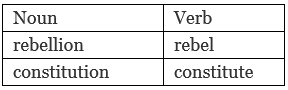
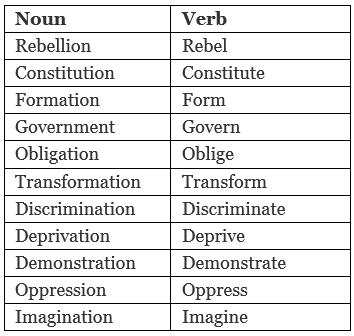
I. There are nouns in the text (formation, government) which are formed from the corresponding verbs (form, govern) by suffixing − (at)ion or ment. There may be a change in the spelling of some verb−noun pairs: such as rebel, rebellion; constitute, constitution. Q1. Make a list of such pairs of nouns and verbs in the text.
Ans:
Q2. Read the paragraph below. Fill in the blanks with the noun forms of the verbs in brackets. Martin Luther King’s __________ (contribute) to our history as an outstanding leader began when he came to the __________ (assist) of Rosa Parks, a seamstress who refused to give up her seat on a bus to a white passenger. In those days American Blacks were confined to positions of second class citizenship by restrictive laws and customs. To break these laws would mean __________ (subjugate) and __________ (humiliate) by the police and the legal system. Beatings, __________ (imprison) and sometimes death awaited those who defied the System. Martin Lither King’s tactics of protest involved non-violent __________ (resist) to racial injustice. Ans: Martin Luther King’s contribution (contribute) to our history as an outstanding leader began when he came to the assistance(assist) of Rosa Parks, a seamstress who refused to give up her seat on a bus to a white passenger. In those days American Blacks were confined to positions of second class citizenship by restrictive laws and customs. To break these laws would mean subjugation (subjugate) and humiliation (humiliate) by the police and the legal system. Beatings, imprisonment (imprison) and sometimes death awaited those who defied the System. Martin Luther King’s tactics of protest involved non-violent resistance (resist) to racial injustice.
Page No. 25
II.Here are some more examples of ‘the’ used with proper names. Try to say what these sentences mean. (You may consult a dictionary if you wish. Look at the entry for ‘the’) 1. Mr Singh regularly invites the Amitabh Bachchans and the Shah Rukh Khans to his parties. 2. Many people think that Madhuri Dixit is the Madhubala of our times. 3. History is not only the story of the Alexanders, the Napoleons and the Hitlers, but of ordinary people as well.
Ans: 1. This means that Mr Singh regularly invites famous personalities such as Amitabh Bachchan and Shah Rukh Khan to his parties. 2. This means that Madhuri Dixit is compared to a landmark in acting in the form of legendary actress Madhubala. 3. This means that history is not only the story of the great fighters and leaders such as Alexander, Napoleon and Hitler, but also of ordinary people.
Page No. 26
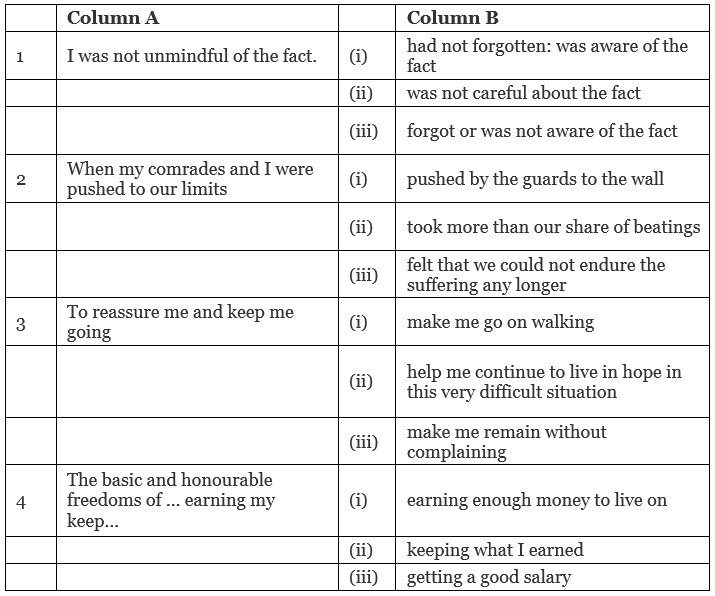
III.Match, the italicised phrases in Column A with the phrase nearest meaning in Column B. (Hint: First look for the sentence in the text in which the phrase in column A occurs.)
Q1. There are many ideas about how the world will ‘end’. Do you think the world will end someday? Have you ever thought what would happen if the sun got so hot that it ‘burst’, or grew colder and colder? Ans: Yes, I believe that this world will end someday but when nobody knows. Whether the sun gets hot or it gets colder in both situations end of this world is sure.
Q2. For Frost, what do ‘fire’ and ‘ice’ stand for? Here are some ideas:
Greed
Avarice
Cruelty
Lust
Conflict
Fury
Intolerance
Rigidity
Insensitivity
Coldness
Indifference
Hatred
Ans: For Frost, ‘fire’ and ‘ice’ stands for destructive powers. ‘Fire’ stands for greed, avarice, lust, conflict, and fury. ‘Ice’ stands for cruelty, intolerance, rigidity, insensitivity, coldness, indifference and hatred.
Q3. What is the rhyme scheme of the poem? How does it help in bringing out the contrasting ideas in the poem? Ans: The rhyme scheme of the poem is: a, b, a, a; b. c, b, c,b.
The contrasting ideas of ‘fire’ and ‘ice’ are presented using this rhyme scheme. He mentions that both fire and ice are probable ends of this world. While he talks about how fire represents desire and can, therefore, be a cause of the end of the world, he also mentions ice in between to symbolise that the coldness and indifference towards one another will also be enough to end the world.
In the second stanza, he says that he knows of enough hate in the world to be sure that even destruction through the ice would be sufficient to bring about the end of the world.
This poem presents a moment that seems simple, but has a larger significance.[Compare this other quotation from Robert Frost: “Always, always a larger significance… A little thing touches a larger thing.”)
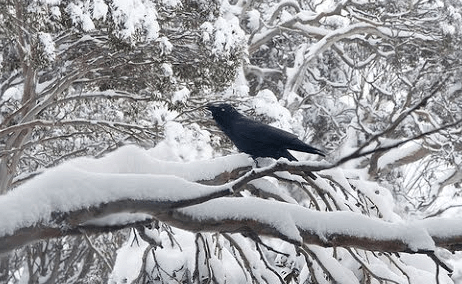
Q1. What is a “dust of snow”? What does the poet say has changed his mood? How has the poet’s mood changed? Ans: A “dust of snow” means the fine particles of snow. This “dust of snow” changed the poet’s mood. The poet’s mood changed from that of dismay to joy. He was holding the day in regret when this dust of snow fell on him and this simple little thing brought him some joy. Dust of SnowQ2. How does Frost present nature in this poem? The following questions may help you to think of an answer. (i) What are the birds that are usually named in poems? Do you think a crow is often mentioned in poems? What images come to your mind when you think of a crow? (ii) Again, what is “a hemlock tree”? Why doesn’t the poet write about a more ‘beautiful’ tree such as a maple, or an oak, or a pine? (iii) What do the ‘crow’ and ‘hemlock’ represent − joy or sorrow? What does the dust of snow that the crow shakes off a hemlock tree stand for? Ans: (i) Frost has presented nature in quite an unconventional manner. While in other nature poems we come across birds such as nightingales or sparrows, Frost has used a crow in this poem. A crow can be associated with something dark, black, and foreboding. That is why other poets usually mention singing nightingales or beautiful white doves in their poems.
(ii) The poet has written about a hemlock tree, which is a poisonous tree. He has not written about a more beautiful tree such as a maple, or oak, or pine because these trees symbolise beauty and happiness. Frost wanted to symbolise the feelings of sadness and regret, which is why he has used a hemlock tree.
(iii) The crow and the hemlock tree represent sorrow. The dust of snow that is shaken off the hemlock tree by the crow stands for joy that Frost experiences. He has, therefore, used an unconventional tree and bird in order to contrast them with joy in the form of snow.
Q3. Have there been times when you felt depressed or hopeless? Have you experienced a similar moment that changed your mood that day?
Ans: There have been innumerable times when I too have felt depressed and hopeless. Sometimes, such moments were aroused by other people’s behaviour and attitude and sometimes due to my own conduct. On one occasion when I was very upset. I went out for a walk. While walking in the park, I saw a girl playing with a puppy, embracing and feeding him. This little joy that they shared changed my mood and I felt very happy for the rest of the day. I also joined the two and played with them.
Q1. What did Lencho hope for? Ans: Lencho wasa farmer. He hoped for rain as the only thing that his field of ripe corn needed was a shower. Without rain, the crops would die, and he would suffer a big loss.
Q2. Why did Lencho say the raindrops were like ‘new coins’? Ans: Lencho compared the raindrops to ‘new coins’ because he believed they would help his crops grow, leading to a better harvest. This would bring him more prosperity. He imagined:
Big drops as ten cent pieces
Smaller drops as five cent pieces
This comparison reflected his hope for a fruitful yield and his optimism about the rain’s impact on his livelihood.
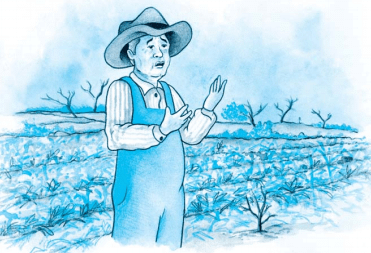
Q3. How did the rain change? What happened to Lencho’s fields? Ans: The rain initially poured down heavily. However, a strong wind soon picked up, bringing with it very large hailstones that fell alongside the rain. This hailstorm lasted for an hour, causing significant damage to Lencho’s fields:
The hailstones destroyed Lencho’s corn fields.
All the flowers were washed away from the plants.
The fields appeared white, resembling a layer of salt.
Not a single leaf remained on the trees.
Lencho felt deep sadness as he realised that this year, there would be no corn.
Lencho After Rain
Q4. What were Lencho’s feelings when the hail stopped? Ans: After the hailstorm, Lencho felt a deep sense of sadness. He realised that the storm had completely ruined his harvest. His thoughts were filled with:
A bleak future for himself and his family.
Worries about not having enough food for the coming year.
A feeling of despair, as he saw no hope left.
He stood in the middle of the field, reflecting on the devastation, and expressed to his sons, “A plague of locusts would have left more than this. The hail has left nothing. This year we will have no corn.”
That night was filled with sorrow, as Lencho lamented, “All our work, for nothing. There’s no one who can help us. We’ll all go hungry this year.”
Oral Comprehension – Page 6
Q1. Who or what did Lencho have faith in? What did he do? Ans: Lencho had strong faith in God. He believed that God could see everything, including what was in his heart. After a hailstorm destroyed his crops, he wrote a letter to God asking for one hundred pesos to replant his field.
When the postmaster read Lencho’s letter, he felt compelled to help. He:
Gathered money from his employees and contributed part of his own salary.
Managed to collect just over half of the requested amount.
Sent the money to Lencho in an envelope, signing it simply as “God”.
Lencho later expressed disappointment when he received only seventy pesos and accused the post office employees of stealing the rest.
Q2. Who read the letter? Ans: The Postmaster read the letter because the address on the letter was too absurd.
Q3. What did the postmaster do then? Ans:
Upon seeing the address, the postmaster initially laughed at what he thought was a foolish request. However, he soon realised it might be serious and read the letter with curiosity. Moved by the writer’s emotions, he decided to help.
He contributed part of his salary.
He collected money from friends, acquaintances, and relatives.
Ultimately, he sent the money to the letter’s writer.
Oral Comprehension – Page 7
Q1. Was Lencho surprised to find a letter for him with money in it? Ans: No, Lencho was not at all surprised to see the letter from God with money inside it. His confidence and faith in God were such that he had expected that reply from God.
Q2. What made him angry? Ans:
Lencho became angry after counting the money he received. He had requested one hundred pesos, but only seventy pesos arrived. Lencho was certain that God would not make a mistake or deny him what he asked for. This led him to believe that the post office employees must have taken the missing thirty pesos.
In response to his frustration, Lencho wrote a letter to God, expressing his disappointment:
He stated that he only received seventy pesos.
He requested the remaining amount, as he needed it urgently.
He accused the post office employees of being crooks.
Thinking about the Text
Q1. Who does Lencho have complete faith in? Which sentences in the story tell you this? Ans: Lencho had complete faith in God. The sentences in the story that show this are as follows: (a) But in the hearts of all who lived in that solitary (single) house in the middle of the valley, there was a single hope: help from God. (b) All through the night, Lencho thought only of his one hope: the help of God, whose eyes, as he had been instructed, see everything, even what is deep in one’s conscience (Inner sense of right or wrong). (c) “God,” he wrote, “if you don’t help me, my family and I will go hungry this year.” (d) He wrote ‘To God’ on the envelope, put the letter inside and, still troubled, went to town. (e) God could not have made a mistake, nor could he have denied Lencho what he had requested. (f) It said: “God: of the money that I asked for, only seventy pesos reached me. Send me the rest, since I need it very much.”
Q2. Why does the postmaster send money to Lencho? Why does he sign the letter ‘God’? Ans: The Postmaster was deeply touched by Lencho’s unwavering faith in God. He decided to send money to Lencho for the following reasons:
He wanted to support Lencho’s strong belief.
He aimed to preserve Lencho’s faith in God.
He signed the letter as ‘God’ to create the impression that it was a divine response.
This act was a thoughtful way to reinforce Lencho’s faith while helping him in his time of need.
Q3. Did Lencho try to find out who had sent the money to him? Why/Why not? Ans: No, Lencho did not try to find out who had sent the money to him. This is because he had great confidence in God and never suspected that it could be someone else other than God who would send him the money. His faith in God was so strong that he believed that God had sent him the money.
Q4. Who does Lencho think has taken the rest of the money? What is the irony in the situation? [Remember that the irony of a situation is an unexpected aspect of it. An ironic situation is strange or amusing because it is the opposite of what is expected.] Ans: Lencho believes that the post office employees have taken the rest of the money he requested. Ironically, it is these very employees who actually sent him the money.
The situation is ironic because:
Lencho suspects those who helped him during his crisis.
He does this to maintain his faith in God, despite receiving assistance.
His mistrust of the post office employees contradicts the help they provided.
Q5. Are there people like Lencho in the real world? What kind of a person would you say he is? You may select appropriate words from the box to answer the question. Ans: I don’t think there can be any such people in the real world. Lencho was literate and yet he didn’t know how his letter would reach God without any address. He was a naive and stupid farmer with blind faith in God and his powers.
Q6. There are two kinds of conflict in the story: between humans and nature, and between humans themselves. How are these conflicts illustrated? Ans:
The conflict between humans and nature is shown by the destruction of Lencho’s crops by the hailstorm (thunderstorm that produces hail). As the crops failed because of hail, Lencho started feeling sad and gloomy after the storm appropriately projected (predicted) the conflict (clash) between nature and man.
The story also shows another conflict among humans. The postmaster, along with the help of the other post office employees, sent Lencho the money that they could manage to collect. They were not related to Lencho in any manner. It was an act of kindness and selflessness on their part.
Although they did a good deed, Lencho blamed them for taking some of the money. This shows that man does not have faith in his fellow humans, thereby giving rise to this conflict.
Thinking about the Language
Q1. There are different names in different parts of the world for storms, depending on their nature. Can you match the names in the box with their descriptions below, and fill in the blanks? You may use a dictionary to help you.
(a) A violent tropical storm in which strong winds move in a circle: ____ c _____ (b) An extremely strong wind: _____ a _____ (c) A violent tropical storm with very strong winds: _____ p _____ (d) A violent storm whose centre is a cloud in the shape of a funnel: _____ n _____ (e) A violent storm with very strong winds, especially in the western Atlantic ocean: _____ r _____ (f) A very strong wind that moves very fast in a spinning movement and causes a lot of damage: _____ l _____ Ans: (a) Cyclone
(b) Gale
(c) Typhoon
(d) Tornado
(e) Hurricane
(f) Whirlwind
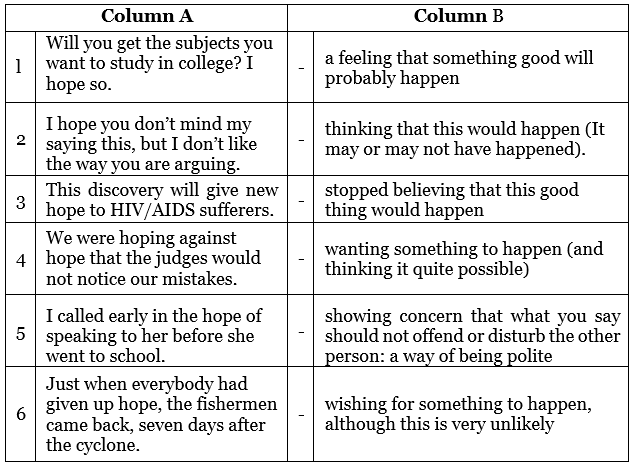
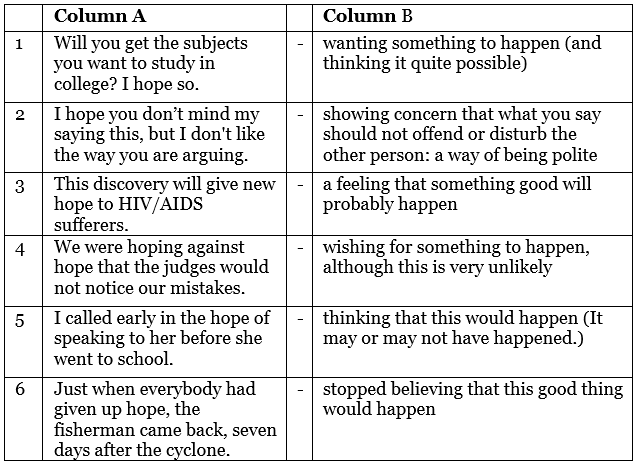
Q2. Match the sentences in Column A with the meanings of ‘hope’ in Column B.
Ans:
Q3. Join the sentences given below using who, whom, whose, which as suggested. (a) I often go to Mumbai. Mumbai is the commercial capital of India. (which) (b) My mother is going to host a TV show on cooking. She cooks very well. (who) (c) These sportspersons are going to meet the President. Their performance has been excellent. (whose) (d) Lencho prayed to God. His eyes see into our minds. (whose) (e) This man cheated me. I trusted him. (whom) Ans:
(a) I often go to Mumbai, which is the commercial capital of India. (b) My mother, who cooks very well, is going to host a TV show on cooking. (c) These sportspersons, whose performance has been excellent, are going to meet the President. (d) Lencho prayed to God, whose eyes see into our minds. (e) This man, whom I trusted, cheated me.
Q4. Find sentences in the story with negative words, which express the following ideas emphatically. (a) The trees lost all their leaves. _________________________________________ (b) The letter was addressed to God himself. _________________________________________ (c) The postman saw this address for the first time in his career. _________________________________________ Ans:
(a) The trees lost all their leaves. Not a leaf remained on the trees. (b) The letter was addressed to God himself. It was nothing less than a letter to God. (c) The postman saw this address for the first time in his career. Never in his career as a postman had he seen that address.
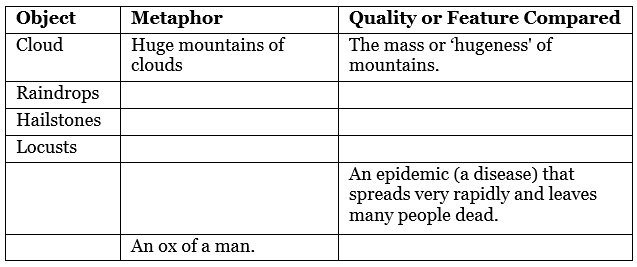
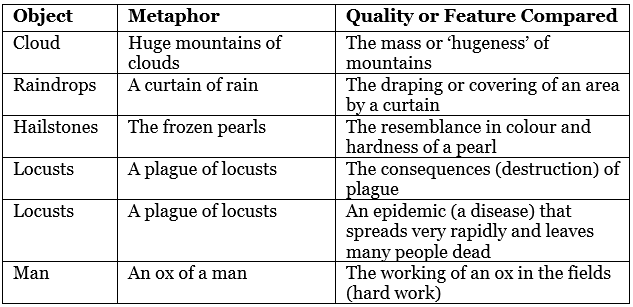
Q5.In pairs, find metaphors from the story to complete the table below. Try to say what qualities are being compared. One has been done for you.
Ans:
Although they did a good deed, Lencho blamed them for taking some of the money.