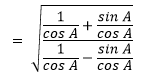
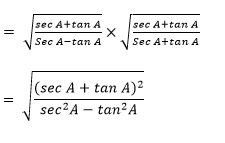
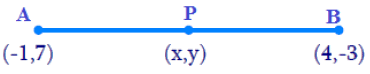
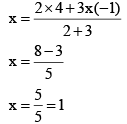
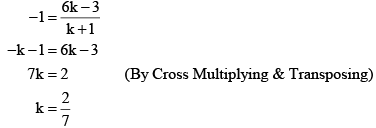
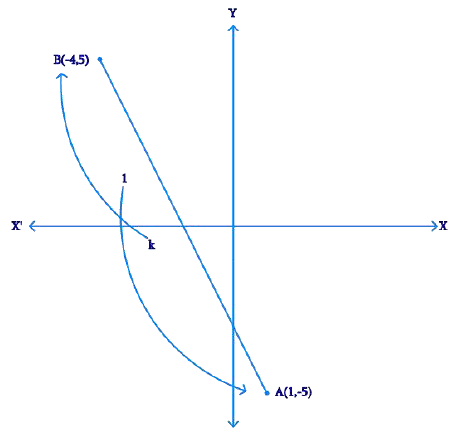
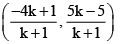
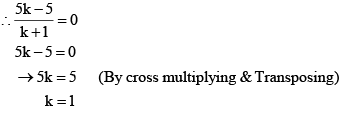
14. Probability- Textbooks Solutions

Exercise 14.1

Q1. Complete the following statements.
(i) Probability of an event E + Probability of the event ‘not E’ =  ________
(ii) The probability of an event that cannot happen is  ________. Such an event is called  ________.
(iii) The probability of an event that is certain to happen is  ________ Such an event is called  ________.
(iv) The sum of the probabilities of all the elementary events of an experiment is  ________.
(v) The probability of an event is greater than or equal to  ________ and less than or equal to  ________.

Ans:
(i) Probability of an event E + Probability of the event ‘not E’ = 1.
(ii) The probability of an event that cannot happen is 0. Such an event is called an impossible event.
(iii) The probability of an event that is certain to happen is 1. Such an event is called a sure or certain event.
(iv) The sum of the probabilities of all the elementary events of an experiment is 1.
(v) The probability of an event is greater than or equal to 0 and less than or equal to 1.

Q2. Which of the following experiments have equally likely outcomes? Explain. 
(i) A driver attempts to start a car. The car starts or does not start.
(ii) A player attempts to shoot a basketball. She/he shoots or misses the shot.
(iii) A trial is made to answer a true-false question. The answer is right or wrong.
(iv) A baby is born. It is a boy or a girl.

Ans:
(i) Since the car may or may not start, thus the outcomes are not equally likely.
(ii) The player may shoot or miss the shot.
∴ The outcomes are not equally likely.
(iii) In advance, it is known that the answer is to be either right or wrong.
 The outcomes right or wrong are equally likely to occur.
(iv) In advance, it is known the newly born baby has to be either a boy or a girl.
∴ The outcomes, either a boy or a girl are equally likely to occur.

Q3. Why is tossing a coin considered to be a fair way of deciding which team should get the ball at the beginning of a football game?
Ans: Since on tossing a coin, the outcomes ‘head’ and ‘tail’ are equally likely, the result of tossing a coin is completely unpredictable and so it is a fairway.

Q4. Which of the following cannot be the probability of an event?
(a) 2/3 
(b) − 1.5 
(c) 15% 
(d) 0.7

Ans: (b)
Solution: Since the probability of an event cannot be negative.
 Option (b) −1.5 cannot be the probability of an event.

Q5. If P(E) = 0.05, what is the probability of ‘not E’?
Ans: We know that,

P(E) + P(not E) = 1
∴ 0.05 + P(not E) = 1 ⇒ P(not E) = 1 − 0.05
= 0.95
Thus, the probability of ‘not E’ = 0.95.

Q6. A bag contains lemon flavoured candies only. Malini takes out one candy without looking into the bag. What is the probability that she takes out
(i) an orange flavoured candy?
(ii) a lemon flavoured candy?

Ans: 
(i) Since, there are lemon flavoured candies only in the bag,
∴ Taking out any orange flavoured candy is not possible.
⇒ Probability of taking out an orange flavoured candy = 0.
(ii) Also, the probability of taking out a lemon flavoured candy = 1.

Q7. It is given that in a group of 3 students, the probability of 2 students not having the same birthday is 0.992. What is the probability that the 2 students have the same birthday?
Ans: ∴ Let the probability of 2 students having same birthday = P(SB) And the probability of 2 students not having the same birthday = P(nSB)
∴ P(SB) + P(nSB)=1
⇒ P(SB) + 0.992 = 1
⇒ P(SB)=1 − 0.992 = 0.008
So, the required probability of 2 boys having the same birthday = 0.008.

Q8. A bag contains 3 red balls and 5 black balls. A ball is drawn at random from the bag. What is the probability that the ball drawn is (i) red? (ii) not red?
Ans:
Total number of balls = 3 + 5 = 8
∴ Number of all possible outcomes = 8
(i) For red balls
There are 3 red balls.
∴ Number of favourable outcomes = 3

(ii) For not red balls

Q9. A box contains 5 red marbles, 8 white marbles and 4 green marbles. One marble is taken out of the box at random. What is the probability that the marble taken out will be (i) red? and (ii) white? (iii) not green?
Ans:
Total number of marbles = 5 + 8 + 4 = 17
(i) For red marbles
∵ Number of red marbles = 5
∴ Number of favourable outcomes = 5
∴ Probability of red marbles, P(red) = 5/17
(ii) For white balls
∵ Number of white balls = 8
∴ Probability of white balls,
∴ P(white)= 8/17
(iii) For not green balls 
∵ Number of white balls = 4
∴ Number of ‘not green’ balls = 17 − 4 = 13
i.e., Favourable outcomes = 13
P(not green) = 13/17
OR
Number of green marbles = 4
∴ Number of ‘not green balls’ = 17 − 4 = 13
⇒ Favourable outcomes = 13
∴ P(not green) = 13/17

Q10. A piggy bank contains hundred 50p coins, fifty Rs 1 coins, twenty Rs 2 coins and ten Rs 5 coins. If it is equally likely that one of the coins will fall out when the bank is turned upside down, what is the probability that the coin (i) will be a 50p coin? and (ii) will not be Rs 5 coin?
Ans: 
Number of:
50 p coins = 100
Re 1 coins = 50
Rs 2 coins = 20
Rs 5 coins = 10
Total number of coins = 100 + 50 + 20 + 10 = 180
(i) For a 50 p coin:
Favourable events = 100
∴ P(50 p) = 100/180 = 5/9
(ii) For not a Rs 5 coin:
a Number of Rs 5 coins = 10
∴ Number of ‘not Rs 5’ coins = 180 − 10 = 170
⇒ Favourable outcomes = 170
∴ P(not 5 rupee coin) = 170/180 = 17/18.

Q11. Gopi buys a fish from a shop for his aquarium. The shopkeeper takes out one fish at random from a tank containing 5 male fish and 8 female fish (see Fig.). What is the probability that the fish taken out is a male fish?
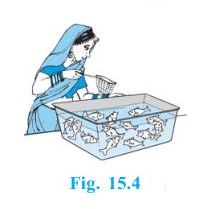
Ans: 
Number of:
Male fishes = 5
Female fishes = 8
∴ Total number of fishes = 5 + 8 = 13
⇒ Total number of outcomes = 13
For a male fish:
Number of favourable outcomes = 5
∴ P(male fish) = 5/13.

Q12. A game of chance consists of spinning an arrow which comes to rest pointing at one of the numbers 1, 2, 3, 4, 5, 6, 7, 8 (see figure), and these are equally likely outcomes. What is the probability that it will point at 
(i) 8?
(ii) an odd number?
(iii) a number greater than 2?
(iv) a number less than 9?
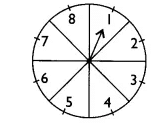
Ans: Total numbers marked = 8
(i) When pointer points at 8
Total number of outcomes = 8
Number of favourable outcomes = 1
∴ P(8)

= 1/8

(ii) When pointer points at an odd number
Number of odd numbers from 1 to 8 = 4
[∵ Odd numbers are 1, 3, 5 and 7]
⇒ Number of favourable outcomes = 4
∴ P(odd) = 

(iii) When pointer points at a number greater than 2 
Number of numbers greater than 2 = 6
[∴ The numbers 2, 3, 4, 5, 6, 7 and 8 are greater than 2]
⇒ Number of favourable outcomes = 6

∴ P(greater than 2) = 

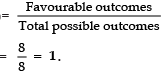
(iv) When pointer points a number less than 9: 
Number of numbers less than 9 = 8
[a The numbers 1, 2, 3, 4, 5, 6, 7 and 8 are less than 9]
∴ Number of favourable outcomes = 8

P(greater than 9)
Q13. A die is thrown once. Find the probability of getting
(i) a prime number.
(ii) a number lying between 2 and 6.
(iii) an odd number.

Ans: Since, numbers on a die are 1, 2, 3, 4, 5, and 6.
∴ Number of total outcomes = 6
(i) For prime numbers
Since 2, 3, and 5 are prime numbers,
∴ Favourable outcomes = 3
P(prime) =

(ii) For a number lying between 2 and 6 
Since the numbers between 2 and 6 are 3, 4 and 5
∴ Favourable outcomes = 3

(iii) For an odd number
Since 1, 3 and 5 are odd numbers.
⇒ Favourable outcomes = 3

Q14. One card is drawn from a well-shuffled deck of 52 cards. Find the probability of getting
(i) a king of red colour
(ii) a face card
(iii) a red face card
(iv) the jack of hearts
(v) a spade
(vi) the queen of diamonds 

Ans: Number of cards in deck = 52
∴ Total number of possible outcomes = 52
(i) For a king of red colour
∵ Number of red colour kings = 2
[∵ Kings of diamond and heart are red]
∴ Number of favourable outcomes = 2
E(red king)

(ii) For a face card 
∵ 4 kings, 4 queens and 4 jacks are face cards
∴ Number of face cards = 12
⇒ Number of favourable outcomes = 12
∴ P(face)

(iii) For a red face card
Since cards of diamond and heart are red
∴ There are [2 kings, 2 queens, 2 jacks] 6 cards are red
⇒ Favourable outcomes = 6
∴ P(red face)

 
(iv) For a jack of hearts 
Since there is only 1 jack of hearts.
∴ Number of favourable outcomes = 1
P(jack of hearts)

(v) For a spade
∵There are 13 spades in a pack of 52 cards:
∴ Favourable outcomes are 13.
P(spade)

(vi) For the queen of diamonds
∵ There is only one queen of a diamond.
∴ Number of favourable outcomes = 1
P(queen of diamonds)

Q 15: Five cards—the ten, jack, queen, king and ace of diamonds, are well-shuffled with their face downwards. One card is then picked up at random.
(i) What is the probability that the card is the queen?
(ii) If the queen is drawn and put aside, what is the probability that the second card picked up is (a) an ace? and (b) a queen?
Sol: We have five cards.
∴ All possible outcomes = 5
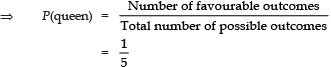
(i) For a queen:
∵ Number of queens = 1

(ii) The queen is drawn and put aside,
∴ Only 5 − 1 = 4 cards are left,
⇒ All possible outcomes = 4
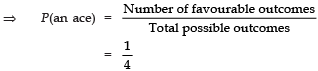
(a) For an ace:
∵ There is only one ace
∴ Number favourable outcomes = 1

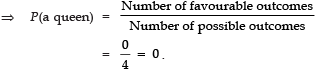
(b) For a queen:
Since, the only queen has already been put aside.
∴ Number of possible outcomes = 0


Q 16: 12 defective pens are accidentally mixed with 132 good ones. It is not possible to just look at a pen and tell whether or not it is defective. One pen is taken out at random from this lot. Determine the probability that the pen taken out is a good one.
Sol: We have
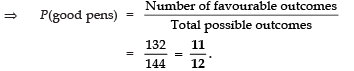
Number of good pens = 132
Number of defective pens = 1 2
∴ Total number of pens = 132 + 12 = 144
For good pens:
∵ There are 132 good pens
∴ Number of favourable outcomes = 132

Q 17: (i) A lot of 20 bulbs contain 4 defective ones. One bulb is drawn at random from the lot. What is the probability that this bulb is defective?
(ii) Suppose the bulb drawn in (i) is not defective and is not replaced. Now one bulb is drawn at random from the rest. What is the probability that this bulb is not defective?
Sol: Since, there are 20 bulbs in the lot.
∴ Total number of possible outcomes = 20
(i) ∵ Number defective bulbs = 4
i.e., Favourable outcomes = 4

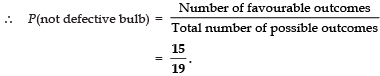
(ii) ∵ The bulb drawn above is not included in the lot.
∴ Remaining number of bulbs = 20 − 1 = 19.
⇒ Total number of possible outcomes = 19.
∵ Number of bulbs which are not defective = 19 − 4 = 15
⇒ Favourable number of outcomes = 15


Q 18: A box contains 90 discs which are numbered from 1 to 90. If one disc is drawn at random from the box, find the probability that it bears (i) a two-digit number, (ii) a perfect square number and (iii) a number divisible by 5.


Sol: We have:
Total number of discs = 90
∴ Total number of possible outcomes = 90
(i) For a two-digit number:
Since the two-digit numbers are 10, 11, 12, ….., 90.
∴ Number of two-digit numbers = 90 − 9 = 81
[∵ 1, 2, 3, 4, 5, 6, 7, 8, and 9 are 1-digit numbers]
⇒ Number of favourable outcomes = 81

(ii) For a perfect square:
Perfect squares from 1 to 90 are 1, 4, 9, 16, 25, 36, 49, 64, and 81
∴ Number of perfect numbers = 9
⇒ Number of favourable outcomes = 9

(iii) For a number divisible by 5:
Numbers divisible by 5 [from 1 to 90] are: 5, 10, 15, 20, 25, 30, 35, 40, 45, 50, 55, 60, 65, 70, 75, 80, 85, 90
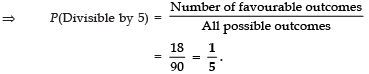
i.e. There are 18 number (1 to 90) which are divisible by 5.
∴ Number of favourable outcomes = 18


Q 19: A child has a die whose six faces show the letters as given below:

The die is thrown once. What is the probability of getting (i) A? and (ii) D?
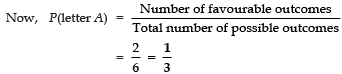
Sol: Since there are six faces of the given die and these faces are marked with letters

∴ Total number of letters = 6
⇒ Number of possible outcomes = 6
(i) For the letter A 
∵ Two faces are having the letter A.
∴ Number of favourable outcomes = 2

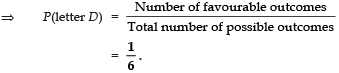
(ii) For the letter D:
∵ Number of D’s = 1
∴ Number of possible outcomes = 1
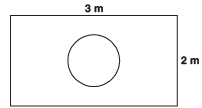

Q 20: Suppose you drop a die at random on the rectangular region shown in figure. What is the probability that it will land inside the circle with diameter 1 m?

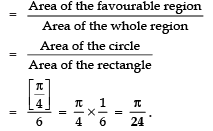
Sol: Here, Area of the rectangle = 3 m × 2 m = 6 m2
And, the area of the circle = πr2

∴ Probability for the die to fall inside the circle


Q 21: A lot consists of 144 ball pens of which 20 are defective and the others are good. Nuri will buy a pen if it is good, but will not buy if it is defective. The shopkeeper draws one pen at random and gives it to her. What is the probability that (i) She will buy it? (ii) She will not buy it?
Sol: Total number of ball pens = 144
⇒ All possible outcomes = 144
(i) Since there are 20 defective pens
∴ Number of good pens 144 − 20 = 124
⇒ Number of favourable outcomes = 124
∴ Probability that she will buy it

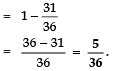
(ii) Probability that she will not buy it
=1 − [Probability that she will buy it]
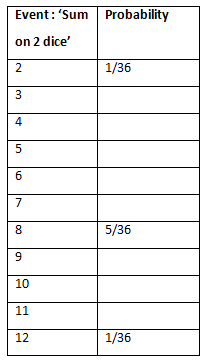

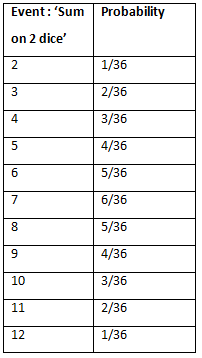
Q 22: Two dice one blue and one grey, are thrown at the same time. Now Complete the following table:

(ii) A student argues that there are 11 possible outcomes 2, 3, 4, 5, 6, 7, 8, 9, 10, 11 and 12. Therefore, each of them has a probability 1/11. Do you agree with this argument? Justify your answer.
Sol: 
∵ The two dice are thrown together.
∴ Following are the possible outcomes:
(1, 1); (1, 2); (1, 3); (1, 4); (1, 5); (1, 6).
(2, 1); (2, 2); (2, 3); (2, 4); (2, 5); (2, 6).
(3, 1); (3, 2); (3, 3); (3, 4); (3, 5); (3, 6).
(4, 1); (4, 2); (4, 3); (4, 4); (4, 5); (4, 6).
(5, 1); (5, 2); (5, 3); (5, 4); (5, 5); (5, 6).
(6, 1); (6, 2); (6, 3); (6, 4); (6, 5); (6, 6).
⇒ Number of all possible outcomes is 6 × 6 = 36.
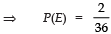
(i) Let the required probability be P(E).
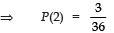
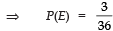
(a) ∵ The sum on two dice is 3 for: (1, 2) and (2, 1)
∴ Favourable outcomes = 2

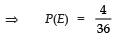
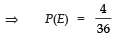
(b) a The sum on two dice is 4 for: (1, 3), (2, 2) and (3, 1).
∴ Number of favourable outcomes = 3

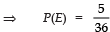
(c) ∵ The sum on two dice is 5 for:
(1, 4), (2, 3), (3, 2) and (4, 1)
∴ Number of favourable outcomes = 4

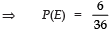
(d) The sum on two dice is 6 for:
(1, 5), (2, 4), (3, 3), (4, 2) and (5, 1)
∴ Number favourable outcomes = 5

(e) The sum on two dice is 7 for:
(1, 6), (2, 5), (3, 4), (4, 3), (5, 2) and (6, 1)
∴ Number of favourable outcomes = 6

(f) The sum on two dice is 9 for:
(3, 6), (4, 5), (5, 4) and (6, 3)
∴ Number of favourable outcome = 4

(g) The sum on two dice is 10 for:
(4, 6), (5, 5), (6, 4)
∴ Number of favourable outcomes = 3

(h) The sum on two dice is 11 for:
(5, 6) and (6, 5)
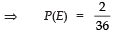
∴ Number of favourable outcomes = 2

Thus, the complete table is as under:

(ii) No. The number of all possible outcomes is 36 and not 11.
∴ The argument is not correct.
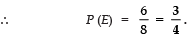
Q 23: A game consists of tossing a one rupee coin 3 times and noting its outcome each time. Hanif wins if all the tosses give the same result i.e., three heads or three tails, and loses otherwise. Calculate the probability that Hanif will lose the game.
Sol: Let T denotes the tail and H denotes the head.
∴ All the possible outcomes are:
HHH, HHT, HTT, TTT, TTH, THT, TTH, HTH
∴ Number of all possible outcomes = 8
Let the event that Hanif will lose the game be denoted by E.
∴ Favourable events are:
HHT, HTH, THH, THT , TTH, HTT
⇒ Number of favourable outcomes = 6
Q 24: A die is thrown twice. What is the probability that
(i) 5 will not come up either time?
(ii) 5 will come up at least once? 
[Hint: Throwing a die twice and throwing two dice simultaneously are treated as the same experiment.]
Sol: Since, throwing a die twice or throwing two dice simultaneously is the same.
∴ All possible outcomes are:
(1, 1); (1, 2); (1, 3); (1, 4); (1, 5); (1, 6)
(2, 1); (2, 2); (2, 3); (2, 4); (2, 5); (2, 6)
(3, 1); (3, 2); (3, 3); (3, 4); (3, 5); (3, 6)
(4, 1); (4, 2); (4, 3); (4, 4); (4, 5); (4, 6)
(5, 1); (5, 2); (5, 3); (5, 4); (5, 5); (5, 6)
(6, 1); (6, 2); (6, 3); (6, 4); (6, 5); (6, 6)
∴ All possible outcomes = 36
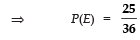
(i) Let E be the event that 5 does not come up either time, then
The favourable outcomes are [36 − (5 + 6)] = 25

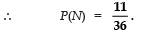
(ii) Let N be the event that 5 will come up at least once, then Number of favourable outcomes = 5 + 6 = 11
Q 25: Which of the following arguments are correct and which are not correct? Give reasons for your answer. (i) If two coins are tossed simultaneously there are three possible outcomes—two heads, two tails or one of each. Therefore, for each of these outcomes, the probability is 1/3.
(ii) If a die is thrown, there are two possible outcomes—an odd number or an even number.
Therefore, the probability of getting an odd number is 1/2.

Sol: (i) Argument is incorrect.
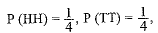
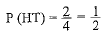
The possible outcomes are- (HH), (HT), (TH), (TT)
∴ 

(ii) Argument is correct.
Possible outcomes = 1, 2, 3, 4, 5, 6
Odd numbers are = 1, 3, 5,
Hence P (an odd number) = 3/6 = 1/2
Even numbers are = 2, 4, 6,
Hence P (an even number) = 3/6 = 1/2
13. Statistics- Textbooks Solutions (Exercise 13.1, 13.2 & 13.3)

Exercise 13.1

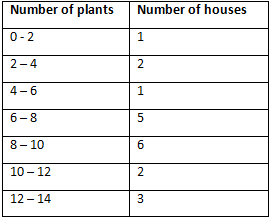
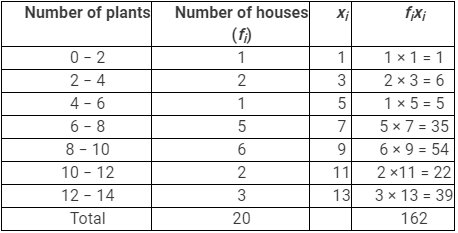
Q1. A survey was conducted by a group of students as a part of their environment awareness programme, in which they collected the following data regarding the number of plants in 20 houses in a locality. Find the mean number of plants per house.

Which method did you use for finding the mean, and why?
Sol. We can calculate the mean as:


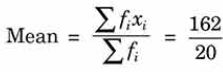
⇒ 
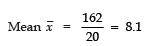
Thus, the mean number of plants per house is 8.1.
Since values of xi and fi are small
∴ We have used the direct method.

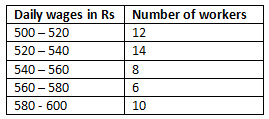
Q2. Consider the following distribution of daily wages of 50 workers of a factory. 

Find the mean daily wages of the workers of the factory by using an appropriate method.
Sol. 
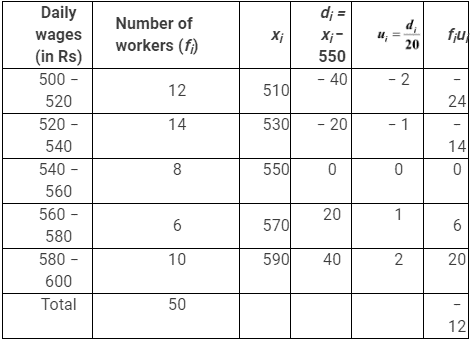
To find the class mark for each interval, the following relation is used.

Class size (h) of this data = 20
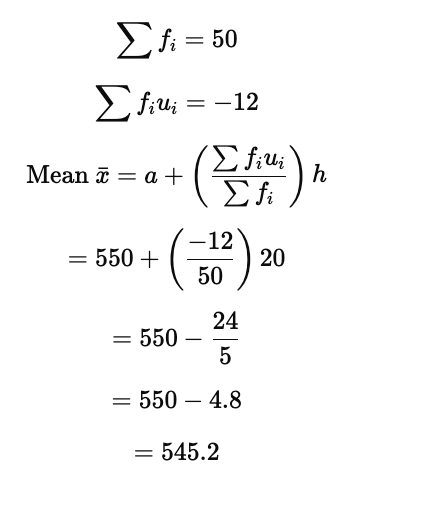
taking 550 as assured mean (a), di, uj and fiuj can be calculated as follows.

From the table, it can be observed that

Therefore, the mean daily wage of the workers of the factory is Rs 545.20

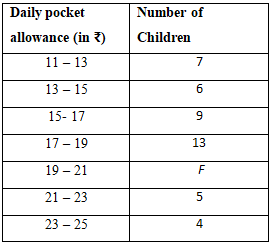
Q3. The following distribution shows the daily pocket allowance of children of a locality. The mean pocket allowance is Rs 18. Find the missing frequency f.

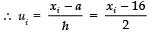
Sol. Let the assumed mean, a = 16
∵ Class interval h = 2

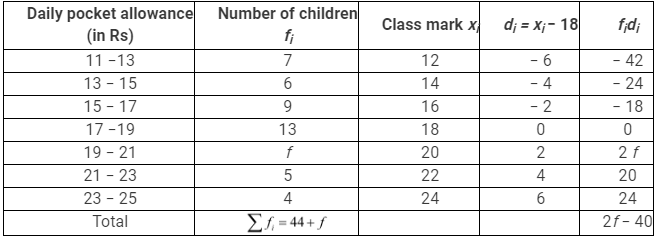
Now, we have the following table:

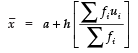
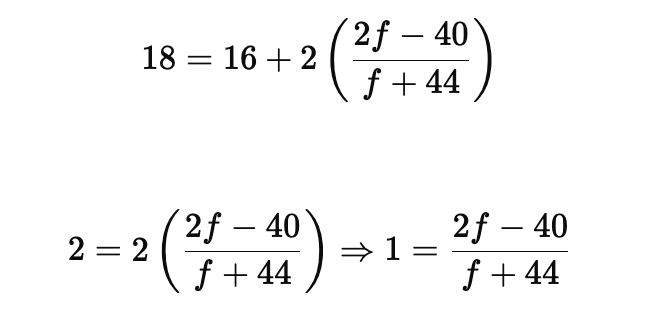
Since 
∴ 

Thus, the missing frequency is  84.

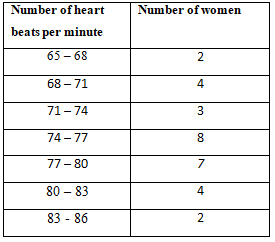
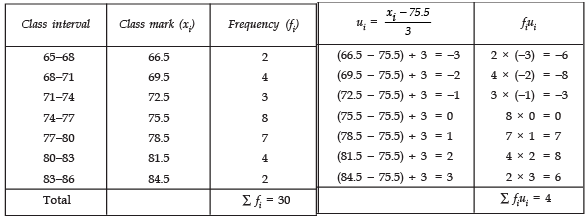
Q4. Thirty women were examined in a hospital by a doctor and the number of heartbeats per minute were recorded and summarised as follows. Find the mean heartbeats per minute for these women, choosing a suitable method.

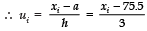
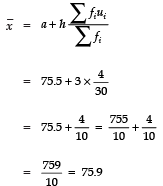
Sol. Let the assumed mean a = 75.5

∴ Class interval h = 3

Now, we have the following table:


Thus, the mean heartbeat per minute is 75.9.

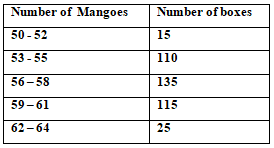
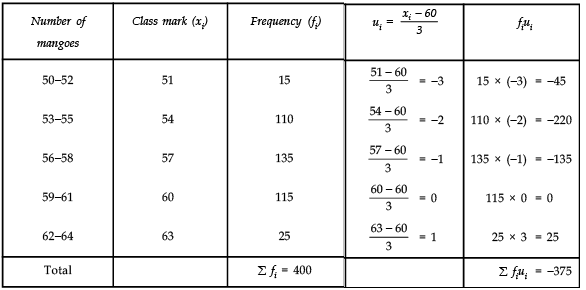
Q5. In a retail market, fruit vendors were selling mangoes kept in packing boxes. These boxes contained varying number of mangoes. The following was the distribution of mangoes according to the number of boxes.

Find the mean number of mangoes kept in a packing box. Which method of finding the mean did you choose?
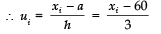
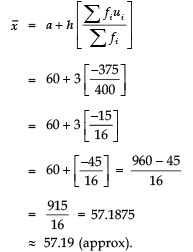
Sol. Let the assumed mean a = 60
Here, Class interval h = 3

Now, we have the following table:


Thus, the average number of mangoes per box = 57.19.

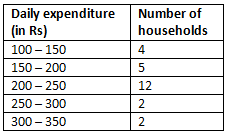
Q6. The table below shows the daily expenditure on food of 25 households in a locality.

Find the mean daily expenditure on food by a suitable method.
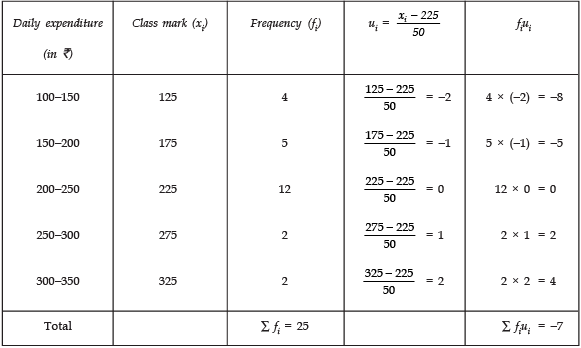
Sol. Let the assumed mean, a = 225
And class interval h = 50

∴ We have the following table:


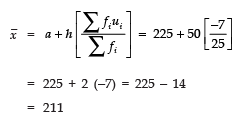
Thus, the mean daily expenditure of food is Rs 211.

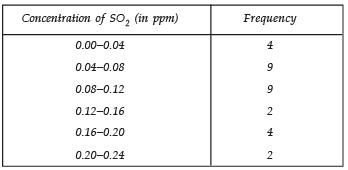
Q7. To find out the concentration of SO2 in the air (in parts per million, i.e., ppm), the data was collected for 30 localities in a certain city and is presented below:

Find the mean concentration of SO2 in the air.
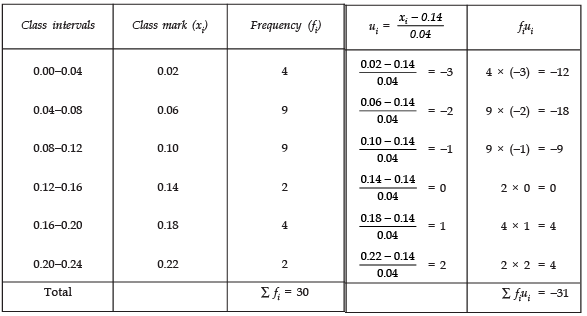
Sol. Let the assumed mean a = 0.14
Here, class interval h = 0.04

∴ We have the following table:


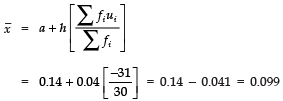
Thus, mean concentration of SO2 in air is 0.099 ppm.

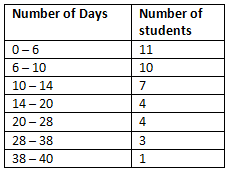
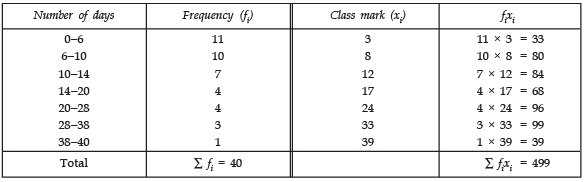
Q8. A class teacher has the following absentee record of 40 students of a class for the whole term. Find the mean number of days a student was absent.

Sol. Using the direct method, we have the following table:


Thus, mean number of days a student remained absent = 12.48 (Approx.)

Q9. The following table gives the literacy rate (in percentage) of 35 cities. Find the mean literacy rate.

Sol. Let  assumed mean a =70
∴ Class interval h =10

Now, we have the following table:


Thus, the mean literacy rate is 69.43%.


Exercise 13.2

Q1: The following table shows the ages of the patients admitted in a hospital during a year:

Find the mode and the mean of the data given above. Compare and interpret the two measures of central tendency.
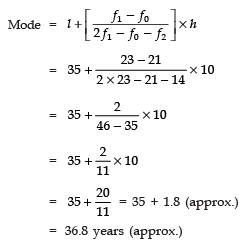
Sol: Mode:
Here, the highest frequency is 23.
The frequency 23 corresponds to the class interval 35 − 45.
∴ The modal class is 35 − 45
Now, Class size (h) = 10
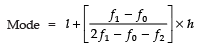
Lower limit (l) = 35 Frequency of the modal class (f1) = 23
Frequency of the class preceding the modal class f0 = 21
Frequency of the class succeeding the modal class f2 = 14

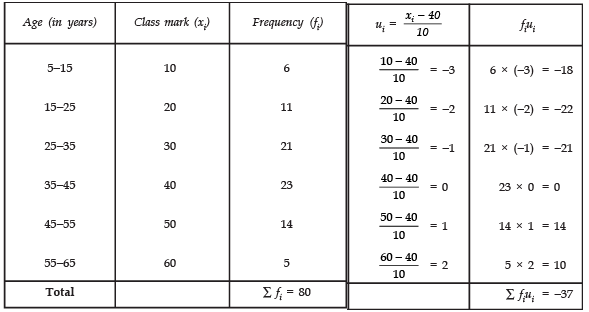
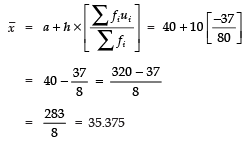
Mean
Let assumed mean a = 40
∵  h = 10


∴ Required mean = 35.37 years.

Q2: The following data gives the information on the observed lifetimes (in hours) of 225 electrical components:

Determine the modal lifetimes of the components.
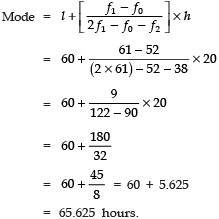
Sol: Here, the highest frequency = 61.
∵ The frequency 61 corresponds to class 60 − 80
∴ The modal class = 60 − 80
∴ We have: l = 60
h = 20
f1 = 61
f0 = 52
f2 = 38

Thus, the required modal life times of the components are 65.625 hours.

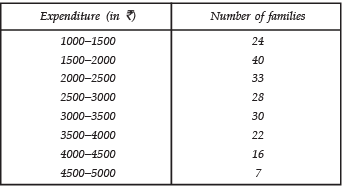
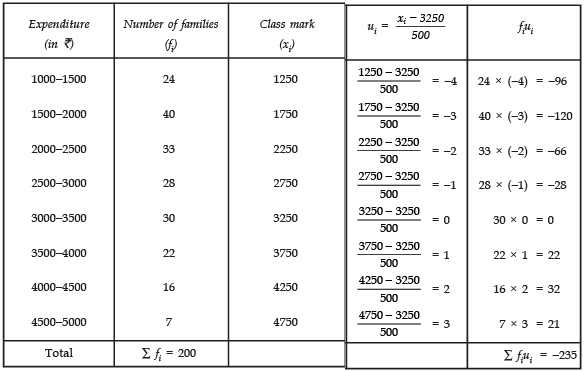
Q3: The following data gives the distribution of total monthly household expenditure of 200 families of a village. Find the modal monthly expenditure of the families. Also, find the mean monthly expenditure:

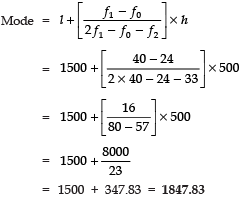
Sol: Mode: 
∵ The maximum number of families 40 have their total monthly expenditure is in interval 1500−2000.
∴ Modal class is 1500−2000.
l = 1500, h = 500
f1 = 40,   f0 = 24
f2 = 33

Thus, the required modal monthly expenditure of the families is Rs 1847.83.
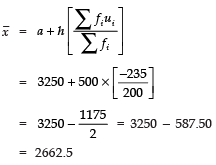
Mean: Let assumed mean (a) = 3250
∵ h = 500
∴ We have the following table:


Thus, the mean monthly expenditure = Rs 2662.50.

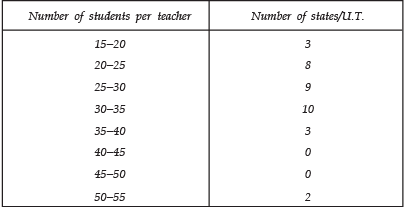
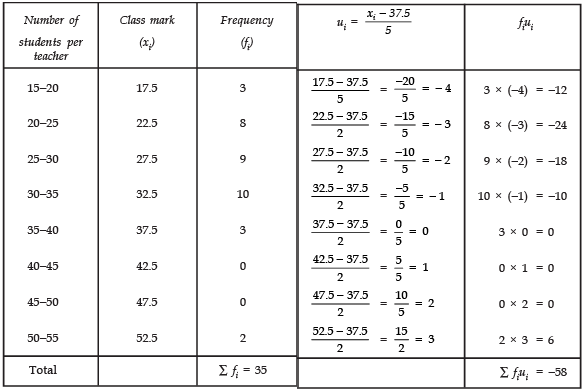
Q4: The following distribution gives the state-wise teacher-student ratio in higher secondary schools of India. Find the mode and mean of this data. Interpret the two measures.

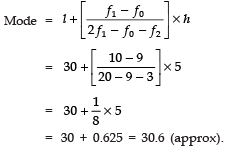
Sol: Mode: 
Since the class 30 − 35 has the greatest frequency and h = 5
l = 30
f1 = 10
f0 = 9
f2 = 3

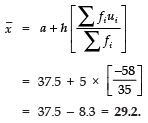
Mean:
Let the assumed mean (a) = 37.5
Since, h = 5
∴ We have the following table:


Thus ,the required mean is 29.2

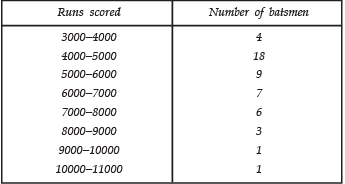
Q5: The given distribution shows the number of runs scored by some top batsmen of the world in one-day international cricket matches.

Find the mode of the data.
Sol: The class 4000−5000 has the highest frequency i.e., 18
∴ h = 1000
l = 4000
f1 = 18
f0 = 4
f2 = 9
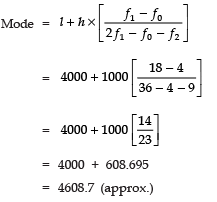
Now,

Thus, the required mode is 4608.7.

Q6: A student noted the number of cars passing through a spot on a road for 100 periods each of 3 minutes and summarised it in the table given below. Find the mode of the data:

Sol: ∵ The class 40 − 50 has the maximum frequency i.e., 20
∴ f1 = 20,
f0 = 12,
f2 = 11 and h = 10
Also
l = 40

= 40 + 4.7 = 44.7
Thus, the required mode is 44.7


Exercise 13.3

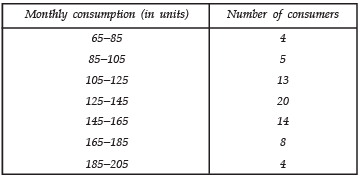
Q1: The following frequency distribution gives the monthly consumption of electricity of 68 consumers of a locality. Find the median, mean and mode of the data and compare them.

Sol: 
Median 
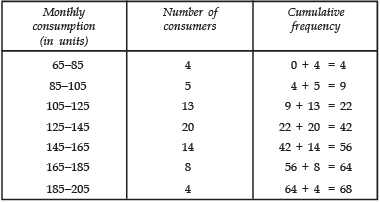
Let us prepare a cumulative frequency table:

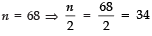
Now, we have  
∵ This observation lies in the class 125−145.
∴ 125−145 is the median class.
∴ l = 125, cf = 22
f = 20 and h = 20
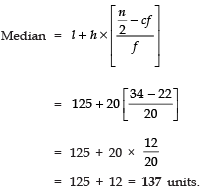
Using the formula,

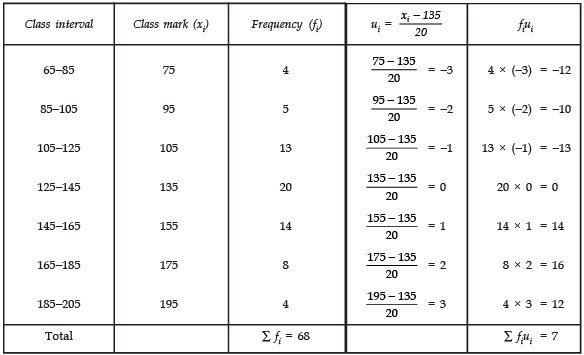
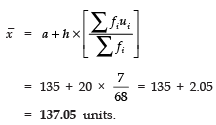
Mean Assumed mean (a) = 135
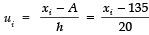
∵ Class interval (h) = 20

Now, we have the following table:


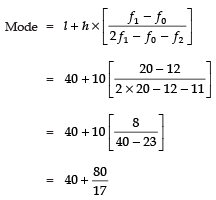
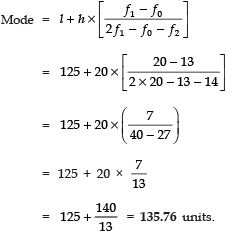
Mode 
∵ Class 125−145 has the highest frequency.
∴ This is the modal class.
We have:
h = 20
l = 125
f1 = 20
f0 = 13
f2 = 14

We observe that the three measures are approximately equal in this case.

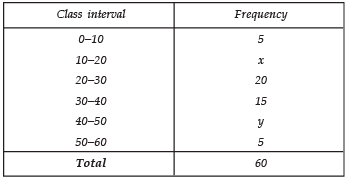
Q2: If the median of the distribution given below is 28.5, find the values of x and y.

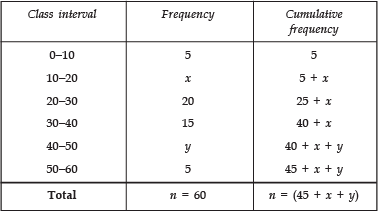
Sol: Here, we have n = 60 [∵ ∑fi = 60]
Now, cumulative frequency table is:

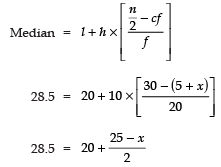
Since, median = 28.5
∴ Median class is 20 − 30
We have: l = 20
h = 10
f = 20
cf = 5 + x

⇒ 57 = 40 + 25 − x
⇒ x = 40 + 25 − 57 = 8
Also 45 + x + y = 60
⇒ 45 + 8 + y = 60
⇒ y = 60 − 45 − 8 = 7
Thus, x = 8
y = 7

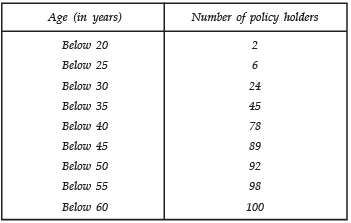
Q3: A life insurance agent found the following data for distribution of ages of 100 policy holders. Calculate the median age, if policies are given only to persons having age 18 years on wards but less than 60 years.

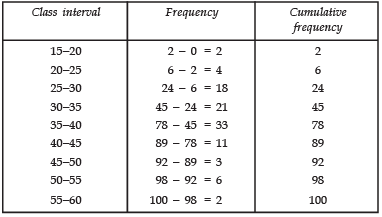
Sol: The given table is cumulative frequency distribution. We write the frequency distribution as given below:


∵ The cumulative frequency just greater than n/2 i.e., just greater than 50 is 78.
∴ The median class is 78.
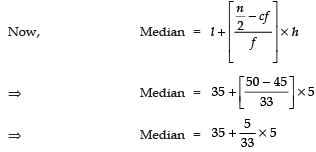
Now n/2 = 50, l = 35, cf = 45, f = 33 and h = 5


Thus, the median age = 35.76 years.

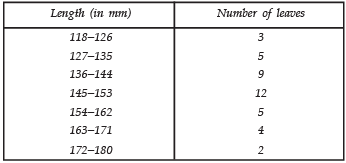
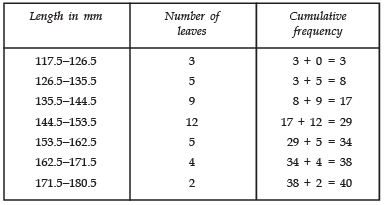
Q4: The lengths of 40 leaves of a plant are measured correct to the nearest millimetre, and the data obtained is represented in the following table:

Find the median length of the leaves.
[Hint: The data needs to be converted to continuous classes for finding the median, since the formula assumes continuous classes. The classes then change to 117.5−126.5, 126.5−135.5, …, 171.5−180.5]

Sol: After changing the given table as continuous classes we prepare the cumulative frequency table:

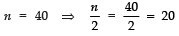
∑ fi =40 ⇒ n = 40
Now,

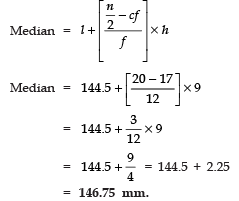
The cumulative frequency just above n/2 i.e., 20 is 29 and it corresponds to the class 144.5−153.5.
So, 144.5−153.5 is the median class.
We have:
n/2 = 20, l = 144.5, f = 12, cf = 17 and h = 9


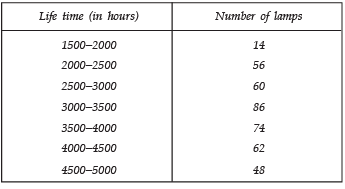
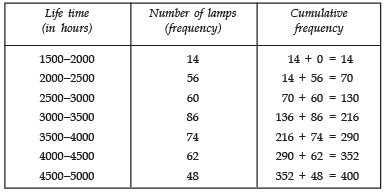
Q5: The following table gives the distribution of the life time of 400 neon lamps:

Find the median life time of a lamp

Sol: To compute the median, let us write the cumulative frequency distribution as given below:

∑ fi = 400 ⇒ n = 400

Since, the cumulative frequency just greater than n/2 i.e., greater than 200 is 216.
∴ The median class is 3000−3500
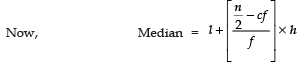
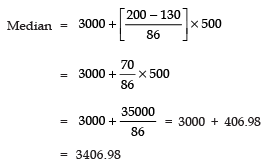
∴ l = 3000, cf = 130, f = 86, h = 500 and n/2 = 200


Thus, median life = 3406.98 hours.

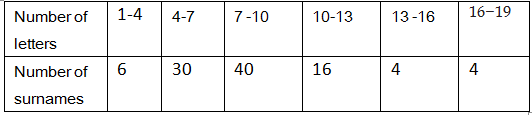
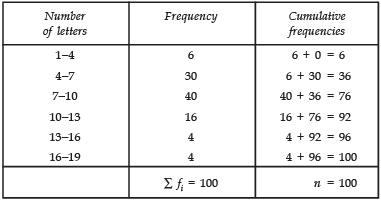
Q6: 100 surnames were randomly picked up from a local telephone directory and the frequency distribution of the number of letters in the English alphabets in the surnames was obtained as follows:

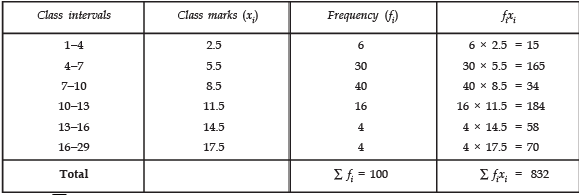
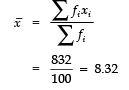
Determine the median number of letters in the surnames. Find the mean number of letters in the surnames? Also, find the modal size of the surnames.
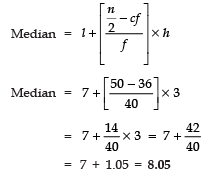
Sol: Median


Since, the cumulative frequency just greater than n/2 i.e., greater than 50 is 76.
∴ The class 7 − 10 is the median class,
We have 
l = 7
cf = 36
f = 40 and  h = 3


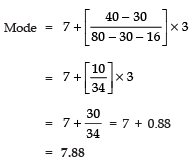
Mode
Since the class 7−10 has the maximum frequency.
∴ The modal class is 7−10
So, we have
l = 7, h = 3
f1 = 40,
f0 = 30
f2 = 16


Thus, the required Median = 8.05,
Mean = 8.32 and Mode = 7.88.

Q7: The distribution below gives the weights of 30 students of a class. Find the median weight of the students.

Sol: We have

Weight (in kg)

Frequency

(f)

Cumulative

frequency

40-45

2

2 + 0= 2

45-50

3

2 + 3= 5

50-55

8

5 + 8 = 13

55-60

6

13 + 6 = 19

60-65

6

19 + 6 = 25

65-70

3

25 + 3 = 28

70-75

2

28 + 2 = 30

Total

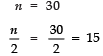
If  = 30

n = 30


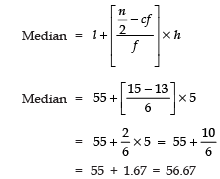
The cumulative frequency just more than n/2 i.e., more than 15 is 19, which corresponds to the class 55−60.
n/2 = 15.
l = 55
5f = 6
cf = 13 and h = 5

Thus, the required median weight = 56.67 kg.

12. Surface Areas and Volumes- Textbooks Solutions (12.1 & 12.2)

Exercise 12.1

Q1. 2 cubes each of volume 64 cm3 are joined end to end. Find the surface area of the resulting cuboid.
Sol.  Volume of each cube = 64 cm3
∴ Total volume of the two cubes = 2 × 64 cm3 = 128 cm3
Let the edge of each cube = x
∴ x3 = 64 = 43
⇒ x =4 cm
⇒ Now, the Length of the resulting cuboid ‘l’ = 2x cm = 8cm
⇒ Breadth of the resulting cuboid ‘b’ = x cm = 4 cm
⇒ Height of the resulting cuboid ‘h’ = x cm = 4 cm
∴ Surface area of the cuboid = 2 (lb + bh + hl)
= 2 [(8 × 4) + (4 × 4) + (4 × 8)]
= 2 [32 + 16 + 32] cm2 = 2 [80] cm2 = 160 cm2.

Q2. A vessel is in the form of a hollow hemisphere mounted by a hollow cylinder. The diameter of the hemisphere is 14 cm and the total height of the vessel is 13 cm. Find the inner surface area of the vessel.
Sol.  For the cylindrical part
 Radius (r) = 7 cm
 Height (h) = 6 cm
∴ Curved surface area
= 2πrh
= 2 × 227 × 7 × 6 cm2 = 264 cm2

For hemispherical part
  Radius (r) = 7 cm
∴ Surface area = 2πr2
= 2 × 227 × 7 × 7 cm2 = 308 cm2
∴ Total surface area = CSA of cylinder + CSA of hemisphere
= (264 + 308) cm2 = 572 cm2.

Q3. A toy is in the form of a cone of radius 3.5 cm mounted on a hemisphere of the same radius. The total height of the toy is 15.5 cm. Find the total surface area of the toy.
Sol. Here, r = 3.5 cm
∴ h = (15.5 − 3.5) cm = 12.0 cm
⇒ Surface area of the conical part = πrl
⇒ Surface area of the hemispherical part = 2πr2

∴ l2 = (12)2 + (3.5)2
l2 = 144 + 12.25 = 156.25
⇒ l = 12.5 cm

∴ Total surface area of the toy
= πr2 + 2πr2 = πr (l + 2r) cm2
= 227 × 3510 (12.5 + 2 × 3.5) cm2
= 11 × (12.5 + 7) cm2
= 11 × 19.5 cm2 = 214.5 cm2


Q4. A cubical block of side 7 cm is surmounted by a hemisphere. What is the greatest diameter the hemisphere can have? Find the surface area of the solid.
Sol. Side of the block = 7 cm
⇒ The greatest diameter of the hemisphere = 7 cm
Surface area of the solid:
= [Total S.A. of the cubical block] + [S.A. of the hemisphere] − [Base area of the hemisphere]
= (6 × l2) + 2πr2 − πr2

= [6(7)]2 + 2π(3.5)2 − π(3.5)2 cm2
= 6(7)2 + π(3.5)2
= 6 × 497 + 22 × 7 × 72 × 2 cm2
= 294 + 777 cm2 
= 332.5 cm2

 
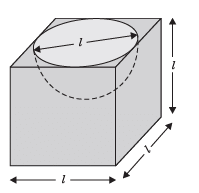
Q5. A hemispherical depression is cut out from one face of a cubical wooden block such that the diameter l of the hemisphere is equal to the edge of the cube. Determine the surface area of the remaining solid.
Sol. Let ‘l’ be the side of the cube.

Now, the diameter of the hemisphere = Edge of the cube = l

So, the radius of the hemisphere = l/2

∴ The total surface area of solid = surface area of cube + CSA of the hemisphere – Area of the base of the hemisphere

The surface area of the remaining solid = 6 (edge)2+2πr2-πr2

= 6l2 + πr2

= 6l2+π(l/2)2

= 6l2+πl2/4

= l2/4 (24+π) sq. units

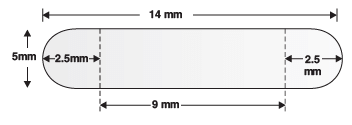
Q6. A medicine capsule is in the shape of a cylinder with two hemispheres stuck to each of its ends (see Fig.). The length of the entire capsule is 14 mm and the diameter of the capsule is 5 mm. Find its surface area.

Sol. Radius of the hemispherical part

= 5/2 mm = 2.5 mm

∴ Surface area of one hemispherical part = 2πr2

⇒ Surface area of both hemispherical parts
= 2 (2πr2) = 4 × 227 × 2510 2 mm2
= 4 × 227 × 2510 × 2510 mm2
Area of cylindrical part = 2πrh = 2 × 227 × 2.5 × 9 mm2 = 2 × 227 × 2510 × 9 mm2
.∴ Total surface area
= 2 × 22 × 25 × 10 × 97 + 4 × 22 × 25 × 25 × 107 mm2
= 2 × 22 × 25 × 107 × 9 + 5070 mm2 = 44 × 2510 mm2 = 44 × 52 cm2 
= 220 mm2


Q7. A tent is in the shape of a cylinder surmounted by a conical top. If the height and diameter of the cylindrical part are 2.1 m and 4 m respectively, and the slant height of the top is 2.8 m, find the area of the canvas used for making the tent. Also, find the cost of the canvas of the tent at the rate of Rs 500 per m2. (Note that the base of the tent will not be covered with canvas.)
Sol. 

For cylindrical part:
 Radius (r) = 4/2 m = 2 m
 Height (h) = 2.1 m
∴ Curved surface area = 2πrh = 2 × 227 × 2 × 2110 m2
For conical part:
Slant height (l) = 2.8 m
Base radius (r) = 2 m
.∴ Curved surface area = πrl = 227 × 2 × 2810 m2
.∴ Total surface area
= [Surface area of the cylindrical part] + [Surface area of conical part]
= 2 × 22 × 2 × 217 × 10 + 22 × 2 × 287 × 10 m2
= 2 × 22 × 2 × 217 × 10 × 42 + 2810 m2
= 2 × 22 × 257 × 10 m2 = 22 × 7010 m2 = 44 m2

Cost of the canvas used 
Cost of 1 m2 of canvas = Rs 500
∴ Cost of 44 m2 of canvas = Rs 500 × 44 = Rs. 22000

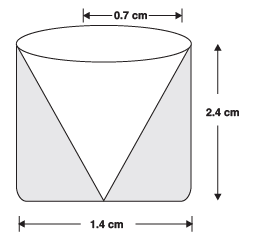
Q8. From a solid cylinder whose height is 2.4 cm and diameter 1.4 cm, a conical cavity of the same height and same diameter is hollowed out. Find the total surface area of the remaining solid to the nearest cm2.
Sol. 

For cylindrical part:
 Height = 2.4 cm
 Diameter = 1.4 cm
⇒ Radius (r) = 0.7 cm
For conical part:
 Base area (r) = 0.7 cm
 Height (h) = 2.4 cm
∴ Slant height (l) = √r2 + h2√(0.7)2 + (2.4)2 = √(0.49 + 5.76) = √6.25 = 2.5 cm
∴ Curved surface area of the conical part = πrl = 227 × 0.7 × 2.5 cm2 = 22 × 7 × 25100 cm2 = 550100 cm2
Base area of the conical part = πr2 = 227 × 7102 cm2 = 22 × 7100 cm2 = 154100 cm2
∴ Total surface area of the remaining solid:
= [Total SA of cylindrical part] + [Curved surface area of conical part] − [Base area of conical part]
= 1364 + 550100 + 154100 cm2
= 1914100 − 154100 = 1760100 cm2 = 17.6 cm2

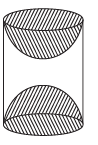
Q9. A wooden article was made by scooping out a hemisphere from each end of a solid cylinder, as shown in Fig. If the height of the cylinder is 10 cm, and its base is of radius 3.5 cm, find the total surface area of the article.

Sol. Radius of the cylinder (r) = 3.5 cm
Height of the cylinder (h) = 10 cm
∴ Total surface area = 2πrh + 2πr2 = 2πr (h + r)

= 2 × 227 × 3510 (10 + 3510) cm2
= 22 × 13510 cm2 = 297 cm2

Curved surface area of a hemisphere = 2πr2
.∴ Curved surface area of both hemispheres
= 2 × 2πr2 = 4 × 227 × 3510 × 3510 cm2 = 154 cm2

Base area of a hemisphere = πr2
.∴ Base area of both hemispheres = 2πr2
= 2 × 227 × (3.5)2 = 2 × 22 × 35 × 357 × 100 cm2 = 77 cm2

∴ Total surface area of the remaining solid
= 297 cm2 + 154 cm2 − 77 cm2
= (451 − 77) cm2 = 374 cm2.

Exercise 12.2

[Unless stated otherwise, take π = 22/7]
Q1. A solid is in the shape of a cone standing on a hemisphere with both their radii being equal to 1 cm and the height of the cone is equal to its radius. Find the volume of the solid in terms of π.
Sol. Here, r = 1 cm and h = 1 cm.
∵ Volume of the conical part = 1/3 πr2h
Volume of the hemispherical part =2/3 πr3
∴ Volume of the solid shape
= 13 πr2h + 23 πr3 = 13 πr2 [h + 2r]
= 13 π (1)2 [1 + 2 (1)] cm3 = 13 π × 1 × [3] cm3
= 3π3 cm3 = π cm3

Q2. Rachel, an engineering student, was asked to make a model shaped like a cylinder with two cones attached at its two ends by using a thin aluminium sheet. The diameter of the model is 3 cm and its length is 12 cm. If each cone has a height of 2 cm, find the volume of air contained in the model that Rachel made. (Assume the outer and inner dimensions of the model to be nearly the same.)
Sol. Here, diameter = 3 cm
⇒ Radius (r)= 3/2 cm
Total height = 12 cm
Height of a cone (h1) = 2 cm
∴ Height of both cones = 2 × 2 = 4 cm
⇒ Height of the cylinder (h2) = (12 − 4) cm = 8 cm.
Now, volume of the cylindrical part = πr2h2
Volume of both conical parts = 2 [ 13 πr2h1]
.∴ Volume of the whole model
= πr2h2 + 23 πr2h1 = π2 [h2 + 23 h1]
= 227 × (3/2)3 × 8 + 23 cm3 = 227 × 94 × 24 + 43 cm3
= 227 × 34 × 28 cm3 = 223 cm3 = 66 cm3

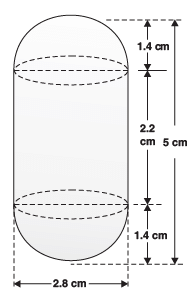
Q3. A gulab jamun contains sugar syrup up to about 30% of its volume. Find approximately how much syrup would be found in 45 gulab jamuns, each shaped like a cylinder with two hemispherical ends with length 5 cm and diameter 2.8 cm (see figure).

Sol. Since a gulab jamun is like a cylinder with hemispherical ends.
Total height of the gulab jamun = 5 cm.
Diameter = 2.8 cm
⇒ Radius = 1.4 cm
∴ Length (height) of the cylindrical part = 5 cm − (1.4 + 1.4) cm
= 5 cm − 2.8 cm = 2.2 cm
Now, volume of the cylindrical part
= πr2h
Volume of a hemispherical end = 2/3 πr3
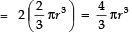
Volume of both the hemispherical ends 

∴ Volume of a gulab jamun

= πr2h + 43 πr3
= πr2 [h + 43]
= 227 × (1.4)2 [2.2 + 43 (1.4)] cm3
= 227 × 1.96 [2.2 + 43 (1.4)] cm3
= 22 × 2 × 147 × 10 [66 + 56] cm3
= 44 × 14100 cm3 = 122 cm3

⇒ Volume of 45 gulab jamuns = 45 × 44 × 14 × 14 × 122100 × 30 cm3 = 15 × 44 × 14 × 14 × 1221000 cm3
Since the quantity of syrup in gulab jamuns
= 30% of [volume] = 30% of 15 × 44 × 14 × 14 × 1221000 cm3 = 338.184 cm3
= 338 cm3 (approx.)


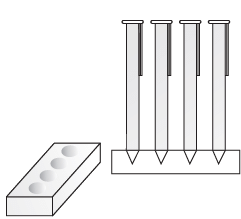
Q4. A pen stand made of wood is in the shape of a cuboid with four conical depressions to hold pens. The dimensions of the cuboid are 15 cm by 10 cm by 3.5 cm. The radius of each of the depressions is 0.5 cm and the depth is 1.4 cm. Find the volume of wood in the entire stand (see Fig.).

Sol. Dimensions of the cuboid are 15 cm, 10 cm and 3.5 cm.
∴ Volume of the cuboid = 15 × 10 × 3510 cm3 = 525 cm3
Since each depression is conical with base radius (r) = 0.5 cm and depth (h) = 1.4 cm,
.∴ Volume of each depression (cone)
= 13 πr2h = 13 × 227 × 5102 × 1410 cm3
Since there are 4 depressions,
.∴ Total volume of 4 depressions
= 4 × 1 × 22 × 5 × 5 × 143 × 7 × 10 × 10 × 10 cm3
= 4 × 1130 cm3 = 4430 cm3
Now, volume of the wood in the entire stand
= [Volume of the wooden cuboid] − [Volume of 4 depressions]
= 525 − 4430 cm3
= 15750 − 4430 cm3 = 1570630 cm3
= 523.53 cm3

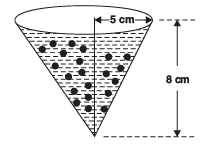
Q5. A vessel is in the form of an inverted cone. Its height is 8 cm and the radius of its top, which is open, is 5 cm. It is filled with water up to the brim. When lead shots, each of which is a sphere of radius 0.5 cm are dropped into the vessel, one-fourth of the water flows out. Find the number of lead shots dropped in the vessel.

Sol. Height of the conical vessel (h) = 8 cm
Base radius (r) = 5 cm
∴ Volume of the cone = 1/3 πr2h
= 13 × 227 × (5)2 × 8 cm3
= 440021 cm3
Since Volume of the cone = [Volume of water in the cone]
.∴ [Volume of water in the cone] = 440021 cm3
Now, Total volume of lead shots = 14 of [Volume of water in the cone]
= 14 × 440021 cm3 = 110021 cm3
Since, radius of a lead shot (sphere) (r) = 0.5 cm,
.∴ Volume of 1 lead shot = 43 πr3 = 43 × 227 × 510 × 510 × 510 cm3
.∴ Number of lead shots = Total volume of lead shotsVolume of 1 lead shot
= 110021 ÷ 4 × 22 × 5 × 5 × 53 × 7 × 1000
= 100
Thus, the required number of lead shots = 100.

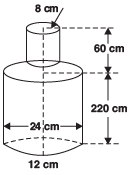
Q6. A solid iron pole consists of a cylinder of height 220 cm and base diameter 24 cm, which is surmounted by another cylinder of height 60 cm and radius 8 cm. Find the mass of the pole, given that 1 cm3 of iron has approximately 8 g mass. (Use π = 3.14) 

Sol. Height of the big cylinder (h) = 220 cm
Base radius (r) = 24/2 cm = = 12 cm
∴ Volume of the big cylinder = πr2h = π (12)2 × 220 cm3
Also, height of smaller cylinder (h1) = 60 cm
Base radius (r1) = 8 cm
∴ Volume of the smaller cylinder πr12h1 = π (8)2 × 60 cm3
∴ Volume of iron
= [Volume of big cylinder] + [Volume of the smaller cylinder]
= π × 220 × 122 + π × 60 × 82 cm3
= 3.14 [220 × 12 × 12 + 60 × 8 × 8] cm3 = 314/100 [20 × 144 + 60 × 64] cm3

= 314100 × [31680 + 3840] cm3 = 314100 × 35520 cm3
Mass of iron = 8 × 314 × 35520100 g = 89226240100 g = 892262410000 g
= 892.2624 kg 
= 892.26 kg.

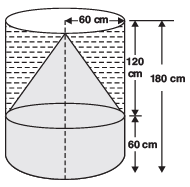
Q7. A solid consisting of a right circular cone of height 120 cm and radius 60 cm standing on a hemisphere of radius 60 cm is placed upright in a right circular cylinder full of water such that it touches the bottom. Find the volume of water left in the cylinder, if the radius of the cylinder is 60 cm and its height is 180 cm.
Sol. Height of the conical part = 120 cm.
Base radius of the conical part = 60 cm.
∴ Volume of the conical part = 13 × 227 × 602 × 120 cm3
Radius of the hemispherical part = 60 cm.
.∴ Volume of the hemispherical part = 23 × 227 × 603 cm3
.∴ Volume of the solid
= [Volume of conical part] + [Volume of hemispherical part]
= 13 × 227 × 602 × 120 + 23 × 227 × 603 cm3
= 2 × 22 × 60 × 60 × 407 cm3 = 63360007 cm3
Volume of the cylinder = πr2h
= 227 × 602 × 180 cm3 = 22 × 60 × 60 × 1807 cm3
= 142560007 cm3


⇒ Volume of water in the cylinder = 142560007 cm3
.∴ Volume of the water left in the cylinder
= 142560007 − 63360007 cm3
= 79200007 cm3
= 1131428.57142 cm3
= 1131428.571421000000 m3 [∵ 1000000 cm3 = 1 m3]
= 1.13142857142 m3 = 1.131 m3 (approx.)


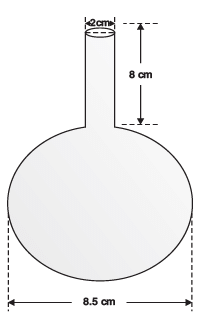
Q8. A spherical glass vessel has a cylindrical neck 8 cm long, 2 cm in diameter; the diameter of the spherical part is 8.5 cm. By measuring the amount of water it holds, a child finds its volume to be 345 cm3. Check whether she is correct, taking the above as the inside measurements, and π = 3.14.
Sol. Volume of the cylindrical part
= πr2h = 3.14 × 12 × 8 cm3 [∵ Radius = 2/3 = 1 cm, height (h) = 8 cm]
= 314100 × 8 cm3
Volume of the spherical part
= 43 πr13   | Here r1 = 8.52 cm
= 43 × 314100 × 8520 × 8520 × 8520 cm3
Total volume of the glass-vessel
= 314100 × 8 + 314100 × 43 × 85 × 85 × 858000
= 314100 [8 + 4 × 85 × 85 × 8524000] cm3
= 314100 [8 + 6141256000] cm3
= 314100 × 48000 + 6141256000 cm3
= 314100 × 6621256000 cm3
= 314100 × 529724 cm3
= 157100 × 529724 cm3 = 8316292400 cm3
≈ 346.51 cm3 (approx.)
⇒ Volume of water in the vessel = 346.51 cm3

Since the child finds the volume as 345 cm3
∴ The child’s answer is not correct
⇒ The correct answer is 346.51 cm3.

11.Areas Related to Circles- Textbooks Solutions (Exercise 11.1)

Page No 158

Use π = 22/7 (unless stated otherwise)
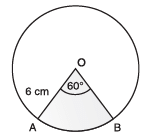
Q1: Find the area of a sector of a circle with radius 6 cm if angle of the sector is 60°.
Sol: Here,
r = 6 cm
θ = 60°

∴ Using, the Area of a sector =  
We have,
Area of the sector with r  = 6 cm and θ = 60°


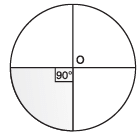
Q2: Find the area of a quadrant of a circle whose circumference is 22 cm.
Sol: Let the radius of the circle = r
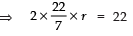
∴ 2πr = 22

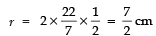
⇒  
Here θ = 90°

∴ Area of the quadrant  of the circle,


Q3: The length of the minute hand of a clock is 14 cm. Find the area swept by the minute hand in 5 minutes.
Sol: [Length of minute hand] = [radius of the circle]
⇒ r = 14 cm
∵ Angle swept by the minute hand in 60 minutes = 360°
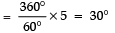
∴ Angle swept by the minute hand in 5 minutes =  
Now, area of the sector with r = 14 cm and θ = 30°

Thus, the required area swept by the minute hand by 5 minutes = 154/3 cm2.

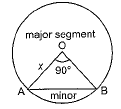
Q4: A chord of a circle of radius 10 cm subtends a right angle at the centre. Find the area of the corresponding (i) minor segment (ii) major sector. (Use π = 3.14)
Sol: Given the radius of the circle = 10 cm
Angle subtend by chord at centre = 90° …(i)
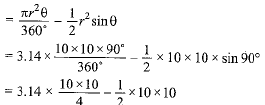
(i) Area of the minor segment = (Area of the sector OAB) – (Area of ΔAOB formed with radius and chord)


= 3.14 x 25 – 50 = 78.5 – 50 = 28.5 cm2 
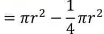
(ii) Area of major sector = Area of the circle – Area of the minor sector

=(1- 1/4) πr²

=3/4 πr²

=3/4 x π(10)2

= (3.14×10²)-78.5

= 235.5 cm2

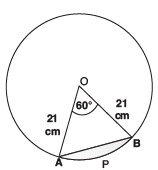
Q5: In a circle of radius 21 cm, an arc subtends an angle of 60° at the centre. Find:
 (i) the length of the arc
 (ii) area of the sector formed by the arc
 (iii) area of the segment formed by the corresponding 

Sol:
 
Here, radius = 21 cm and θ = 60°

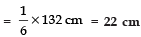
(i) Circumference of the circle = 2πr


(ii) Area of the sector with sector angle 60°

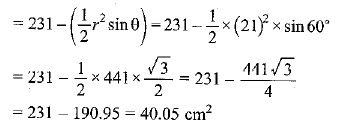
(iii)  Area of the segment formed by the corresponding chord – area of the sector – area of the Δ formed between chord and radius of the circle


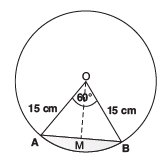
Q6:  A chord of a circle of radius 15 cm subtends an angle of 60° at the centre. Find the areas of the corresponding minor and major segments of the circle.  (Use π = 3.14 and √3 = 1.73)
Sol:  


 Radius of the circle = 15 cm
Central angle subtends by chord = 600
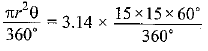
Area of sector = 
= 117.75 cm2

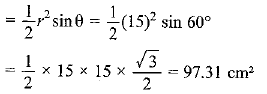
Area of the triangle formed by radii and chord

Area of the minor segment = Area of the sector -Area of the triangle formed by radii and chord
= 117.75-97.31 =20.44 cm2 
Area of the circle = πr2 
= 3.14 x 15 x 15 = 706.5 cm2 
Area of the major segment = Area of the circle – Area of the minor segment
= 706.5 – 20.44 = 686.06 cm2

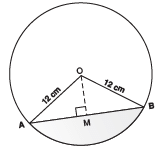
Q7: A chord of a circle of radius 12 cm subtends an angle of 120° at the centre. Find the area of the corresponding segment of the circle. (Use π = 3.14 and √3 = 1.73)
Sol:  Here, θ = 120° and r = 12 cm


In Δ OAB, ∠O = 120°
⇒∠A + ∠B = 180° − 120 = 60°
∵ OB = OA = 12 cm ⇒∠A = ∠B = 30°
So,  
⇒  

In right Δ AMO, 122 − 62 = AM2
⇒ 144 − 36 = AM2
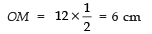
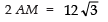
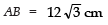
⇒ 108 = AM2
⇒ 
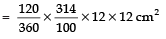
⇒ 
⇒ 

Now, from (2),

= 36 × 1.73 cm2 = 62.28 cm2     …(3)
From (1) and (3)
Area of the minor segment = [Area of minor segment] − [Area of Δ AOB]
= [150.72 cm2] − [62.28 cm2] = 88.44 cm2.

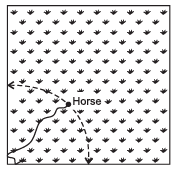
Q8:  A horse is tied to a peg at one corner of a square shaped grass field of side 15 m by means of a 5 m long rope (see figure). 
Find:
(i) the area of that part of the field in which the horse can graze.
(ii) the increase in the grazing area if the rope were 10 m long instead of 5 m. (Use π = 3.14)


Sol: Here, Length of the rope = 5 m
∴ Radius of the circular region grazed by the horse = 5 m

(i) Area of the circular portion grazed
     [∵ θ = 90° for a square field.]

(ii) When length of the rope is increased to 10 m,
∴ r = 10 m
⇒ Area of the circular region where θ = 90°.

∴ Increase in the grazing area = 78.5 − 19.625 m2 = 58.875 m2.

Page  No 159
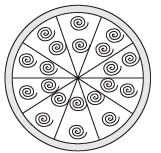
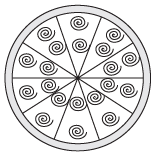
Q9:  A brooch is made with silver wire in the form of a circle with diameter 35 mm. The wire is also used in making 5 diameters which divide the circle into 10 equal sectors as shown in Fig. 
Find: 
(i) the total length of the silver wire required. 
(ii) the area of each sector of the brooch.

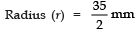
Sol: Diameter of the circle = 35 mm

∴  
(i) Diameter (D) = 35 mm

Total number of diameters to be considered= 5

Now, the total length of 5 diameters that would be required = 35×5 = 175

Circumference of the circle = 2πr

Or, C = πD 

= 22/7×35 = 110
∴ Total length of the silver wire = 110 + 175 mm = 285 mm

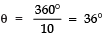
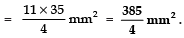
(ii) Since the circle is divided into 10 equal sectors,
∴ Sector angle 
⇒ Area of each sector  


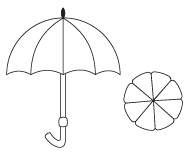
Q10: An umbrella has 8 ribs which are equally spaced (see figure). Assuming umbrella to be a flat circle of radius 45 cm, find the area between the two consecutive ribs of the umbrella.

Sol: Here, radius (r) = 45 cm
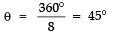
Since circle is divided in 8 equal parts,
∴ Sector angle corresponding to each part

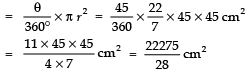
⇒ Area of a sector (part)

∴ The required area between the two ribs  

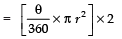
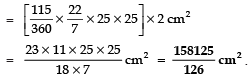
Q 11: A car has two wipers which do not overlap. Each wiper has a blade of length 25 cm sweeping through an angle of 115°. Find the total area cleaned at each sweep of the blades.
Sol:  Here, radius (r) = 25 cm
Sector angle (θ) = 115°
∴ Area cleaned by each sweep of the blades
   [∵ Each sweep will have to and fro movement]


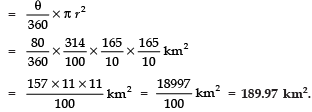
Q12: To warn ships for underwater rocks, a lighthouse spreads a red coloured light over a sector of angle 80° to a distance of 16.5 km. 
Find the area of the sea over which the ships are warned. (Use π = 3.14)
Sol: Here, Radius (r) = 16.5 km
Sector angle (θ) = 80°
∴ Area of the sea surface over which the ships are warned


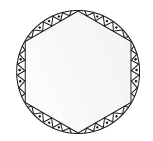
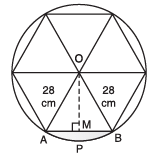
Q13: A round table cover has six equal designs as shown in Fig. If the radius of the cover is 28 cm, find the cost of making the designs at the rate of Rs 0.35 per cm2. (Use √3 = 1.7)

Sol:  Here,    r = 28 cm
Since, the circle is divided into six equal sectors.
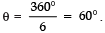
∴ Sector angle  
∴ Area of the sector with θ = 60° and r = 28 cm


Now, area of 1 design
= Area of segment APB
= Area of sector − Area of ΔAOB  …(2)
In ΔAOB, ∠AOB = 60°, OA = OB = 28 cm
∴   ∠OAB = 60° and ∠OBA = 60°
⇒ ΔAOB is an equilateral triangle.
⇒ AB = AO = BO
⇒ AB = 28 cm

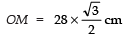
Draw OM ⊥ AB
∴ In right ΔAOM, we have

⇒ 
⇒ 

       …(3)

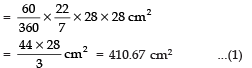
Now, from (1), (2) and (3), we have:
Area of segment APQ = 410.67 cm2 − 333.2 cm2 = 77.47 cm2
⇒ Area of 1 design = 77.47 cm2
∴ Area of the 6 equal designs = 6 × (77.47) cm2
= 464.82 cm2
Cost of making the design at the rate of Rs 0.35 per cm2,
= Rs 0.35 × 464.82
= Rs 162.68.

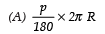
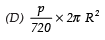
Q14: Tick the correct answer in the following: Area of a sector of angle p (in degrees) of a circle with radius R is


Sol: Here, radius (r)= R
Angle of sector (θ)= p°
∴ Area of the sector  
Thus, the option is correct.

10. Circles- Textbooks Solutions (Exercise 10.2)

In Q.1 to 3, choose the correct option and give justification.

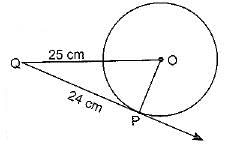
Q1. From a point Q, the length of the tangent to a circle is 24 cm and the distance of Q from the centre is 25 cm. The radius of the circle is 
(A) 7 cm 
(B) 12 cm 
(C) 15 cm 
(D) 24.5 cm
Sol. From figure
 
OQ2 = OP2 + PQ2
(25)2 = OP+ (24)2
⇒ 625 – 576 = OP2
⇒ 49 = OP2
⇒ 
OP = 7cm
Radius of the circle = 7cm.
Hence, correct option is (a).

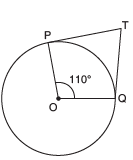
Q2. In figure, if TP and TQ are the two tangents to a circle with centre O so that ∠POQ = 110°, then ∠PTQ is equal to 
(A) 60° 
(B) 70° 
(C) 80° 
(D) 90°


Sol. ∠OPT = 90°; ∠OQT = 90°; ∠POQ = 1100
TPOQ is a quadrilateral
⇒ ∠PTQ + ∠POQ = 180°
⇒ ∠PTQ + 1100 = 1800
⇒ ∠PTQ  = 1800 – 1000 = 700

Hence, correct option is (b).

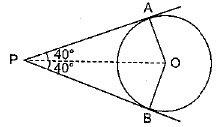
Q3. Choose the correct option: If tangents PA and PB from a point P to a circle with centre O are inclined to each other at an angle of 80°, then ∠POA is equal to
(A) 50° 
(B) 60° 
(C) 70° 
(D) 80°
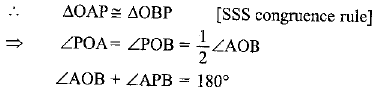
Sol. In ΔOAP and ΔOBP
OA = OB    [Radii]
PA = PB
[Length of tangents from an external point are equal]
OP = OP     [common]


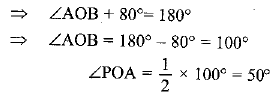
Hence, Option (a) is correct

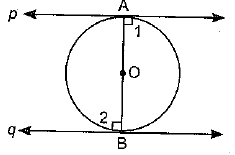
Q4. Prove that the tangents drawn at the ends of a diameter of a circle are parallel.
Sol. AB is the diameter of the circle, p and q are two tangents
OA ⊥ p and OB ⊥ q and ∠1 = ∠2 = 900
⇒ p q    [∠1 and ∠2 are alternate angles]

Q5. Prove that the perpendicular at the point of contact to the tangent to a circle passes through the centre.
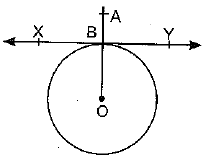
Sol. XY tangent to the circle C(O, r) at B and AB ⊥ XY

Join OB
∠ABY = 90º   
∠OBY = 90º
[Radius through the point of contact is ⊥ to the tangent]
∴ ∠ABY + ∠OBY = 1800
⇒ ABO is collinear.
∴ AB passes through the centre of the circle.

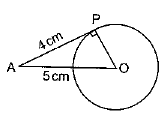
Q6. The length of a tangent from a point A at distance 5 cm from the centre of the circle is 4 cm. Find the radius of the circle.
Sol. OP = Radius of the circle
OA = 5 cm; AP = 4 cm

∠OPA = 90°   [Radius and tangent are ⊥ar]
OA2 = AP2 + OP2    [By Pythagoras theorem]
52 = 42 + OP2 
⇒ 25 = 16 + OP2
⇒ 25 – 16 = OP2
⇒ 9 = OP2
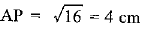
⇒ OP = √ 9 = 3
Radius = 3 cm

Q7. Two concentric circles are of radii 5 cm and 3 cm. Find the length of the chord of the larger circle which touches the smaller circle.
Sol. The radius of larger circle = 5 cm and the radius of a smaller circle = 3 cm
OP ⊥ AB    [Radius of the circle is perpendicular to the tangent]
AB is a chord of the larger circle
∴ OP bisect  AB   AP = BP
In ΔOAP     OA2 =    AP2 + OP2
⇒    (5)2 =   AP2 + (3)2
⇒    AP2 =   25 – 9 = 16
⇒  
AB = 2AP =   2 x 4 = 8 cm

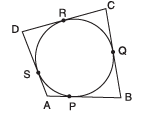
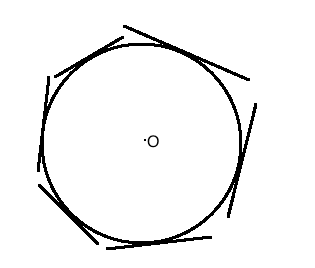
Q8. A quadrilateral ABCD is drawn to circumscribe a circle (see figure). Prove that: AB + CD = AD + BC

Sol. 
AP = AS    …(i)    [Lengths of tangents from an external point are equal]
BP = BQ    …(ii)
CR = CQ …(iii)
DR = DS   …(iv)
Adding equations (i), (ii), (iii) and (iv), we get
AP + BP + CR + DR = AS + BQ + CQ + DS
⇒ (AP + BP) + (CR + DR) = (AS + DS) +(BQ + CQ
⇒ AB + CD = AD + BC

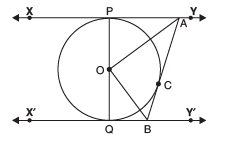
Q9. In the figure, XY and X′ Y′ are two parallel tangents to a circle with centre O and another tangent AB with point of contact C intersecting XY at A and X′Y′ at B. Prove that ∠AOB = 90°.


Sol. Given: Two parallel tangents to a circle with centre O. Tangent AB with point of contact C intersects XY at A and X’Y’ at B
To Prove: ∠AOB = 90°
Construction: Join OA, OB and OC
Proof: In ΔAOP and ΔAOC
AP = AC [Lengths of tangents]
OP = OC [Radii]
OA = OA
⇒ ΔAOP ≅ ΔAOC   [SSS congruence rule]
⇒ ∠PAO = ∠CAO    [C.P.C.T]
∠PAC = 2 ∠OAC    …(i)
Similarly ∠QBC = 2 ∠OBC    …(ii)
Adding (i) and (ii), we get
∠PAC + ∠QBC = 2      [∠OAC + ∠OBC]
∠PAC + ∠QBC = 180°
[interior consecutive angle on same side of transversal]
2 = 180° [∠OAC + ∠OBC]
⇒ ∠OAC + ∠OBC = 90°
In ΔAOB, ∠AOB + [∠OAC + ∠OBC] = 180°
⇒ ∠AOB + 90° = 180°
⇒ ∠AOB = 90°

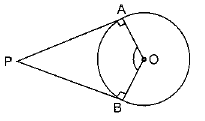
Q10. Prove that the angle between the two tangents drawn from an external point to a circle is supplementary to the angle subtended by the line-segment joining the points of contact at the centre.
Sol. PA and PB are two tangents, and A and B are the points of contact of the tangents.
OA ⊥ AP and OB ⊥ BP
∠OAP = ∠OBP = 90°
[Radius and tangent are perpendicular to each other]
In quadrilateral OAPB
(∠OAP + ∠OBP) + ∠APB + ∠AOB = 3600

⇒ 180° + ∠APB + ∠AOB = 360°
∠APB + ∠AOB = 360° – 180° = 180°

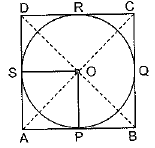
Q11. Prove that the parallelogram circumscribing a circle is a rhombus. 
Sol. Parallelogram ABCD circumscribing a circle with centre O.

OP⊥ AB and OS ⊥ AD
In ΔOPB and ΔOSD, ∠OPB = ∠OSD [Each 90°]
OB = OD
[Diagonals of ║gm bisect each other]
OP = OS    [Radii]
⇒  ΔOPB ≅ ΔOSD [RHS congruence rule]
PB = SD     [C.P.C.T] ...(i)
AP = AS [Lengths of tangents]... (ii)
Adding (i) and (ii)
AP + PB = AS + DS
⇒   AB AD
Similarly  AB = BC = CD = DA
∴ ║gm ABCD is a rhombus

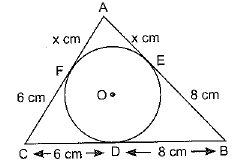
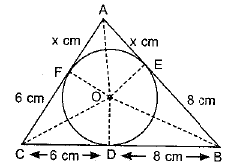
Q12. A triangle ABC is drawn to circumscribe a circle of radius 4 cm such that the segments BD and DC into which BC is divided by the point of contact D are of lengths 8 cm and 6 cm respectively (see figure). Find the sides AB and AC.

Sol. BD = 8 cm and DC = 6 cm
BE = BD = 8 cm; CD= CF = 6 cm;

Let AE=AF = x cm
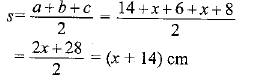
In ΔABC   a = 6 + 8 = 14 cm;
b = (x + 6) cm;
c = (x +8)


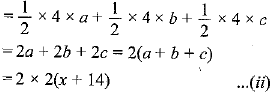
ar ΔABC = ar ΔOBC + ar ΔOCA + ar ΔOAB

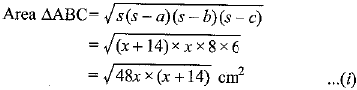
From (i) and (ii)

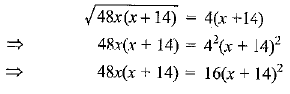
⇒ 3x(x+14) = (x + 14)2 
⇒ 3x2 + 42x = x2 + 196 + 28x
⇒ 2x2 + 14x – 196 = 0
⇒ x2 + 7x – 98 = 0
⇒ x2 + 14x – 7x – 98 = 0
⇒ x(x + 14) – 7(x + 14) = 0
⇒ (x – 7)(x + 14) = 0 ⇒ x = 7
AB = x + 8 = 7 + 8 = 15 cm
AC = x + 6 = 7 + 6 = 13 cm

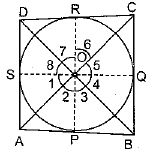
Q13. Prove that opposite sides of a quadrilateral circumscribing a circle subtend supplementary angles at the centre of the circle.
Sol. 

AB touches P and BC, and CD and DA touch the circle at Q, R and S.
Construction: Join OA, OB, OC, OD and OP, OO, OR, OS
∴ ∠1 = ∠2    [OA bisects ∠POS]
Similarly


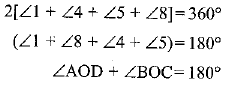
Similarly ∠AOB + ∠COD = 180°
Hence, opposite sides of quadrilateral circumscribing a circle subtend supplementary angles at the centre of a circle.

10. Circles- Textbooks Solutions (Exercise 10.1 & 10.2)

Exercise 10.1

Q1. How many tangents can a circle have?
Sol. 
A circle can have an infinite number of tangents.

Q2. Fill in the blanks 
(i) A tangent to a circle intersects it in ………. point(s).
(ii) A line intersecting a circle in two points is called a ………..
(iii) A circle can have ………. parallel tangents at the most.
(iv) The common point of a tangent to a circle and the circle is called ………..

Sol. 
(i) Exactly one
(ii) secant
(iii) two
(iv) point of contact.

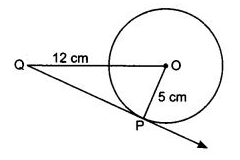
Q3. A tangent PQ at a point P of a circle of radius 5 cm meets a line through the centre O at a point Q so that OQ = 12 cm. Length of PQ is:
(a) 12 cm
(b) 13 cm
(c) 8.5 cm

(d) √119 cm

Ans. (d)
Sol. 

Radius of the circle = 5 cm
OQ = 12 cm
∠OPQ = 900
[The tangent to a circle is perpendicular to the radius through the point of contact]
PQ2 = OQ2 – OP[By Pythagoras theorem]
PQ= 12– 5= 144 – 25 = 119
PQ = √119 cm
Hence correct option is (d)


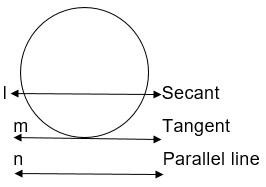
Q4. Draw a circle and two lines parallel to a given line such that one is a tangent and the other a secant to the circle.
Sol. A line ‘m’ is parallel to the given line ‘n’ and a line ‘l’ which is secant is parallel to the given line ‘n’.

Exercise 10.2

In Q.1 to 3, choose the correct option and give justification.

Q1. From a point Q, the length of the tangent to a circle is 24 cm and the distance of Q from the centre is 25 cm. The radius of the circle is 
(A) 7 cm 
(B) 12 cm 
(C) 15 cm 
(D) 24.5 cm
Sol. From figure
 
OQ2 = OP2 + PQ2
(25)2 = OP+ (24)2
⇒ 625 – 576 = OP2
⇒ 49 = OP2
⇒ 
OP = 7cm
Radius of the circle = 7cm.
Hence, correct option is (a).

Q2. In figure, if TP and TQ are the two tangents to a circle with centre O so that ∠POQ = 110°, then ∠PTQ is equal to 
(A) 60° 
(B) 70° 
(C) 80° 
(D) 90°


Sol. ∠OPT = 90°; ∠OQT = 90°; ∠POQ = 1100
TPOQ is a quadrilateral
⇒ ∠PTQ + ∠POQ = 180°
⇒ ∠PTQ + 1100 = 1800
⇒ ∠PTQ  = 1800 – 1000 = 700

Hence, correct option is (b).

Q3. Choose the correct option: If tangents PA and PB from a point P to a circle with centre O are inclined to each other at an angle of 80°, then ∠POA is equal to
(A) 50° 
(B) 60° 
(C) 70° 
(D) 80°
Sol. In ΔOAP and ΔOBP
OA = OB    [Radii]
PA = PB
[Length of tangents from an external point are equal]
OP = OP     [common]


Hence, Option (a) is correct

Q4. Prove that the tangents drawn at the ends of a diameter of a circle are parallel.
Sol. AB is the diameter of the circle, p and q are two tangents
OA ⊥ p and OB ⊥ q and ∠1 = ∠2 = 900
⇒ p q    [∠1 and ∠2 are alternate angles]

Q5. Prove that the perpendicular at the point of contact to the tangent to a circle passes through the centre.
Sol. XY tangent to the circle C(O, r) at B and AB ⊥ XY

Join OB
∠ABY = 90º   
∠OBY = 90º
[Radius through the point of contact is ⊥ to the tangent]
∴ ∠ABY + ∠OBY = 1800
⇒ ABO is collinear.
∴ AB passes through the centre of the circle.

Q6. The length of a tangent from a point A at distance 5 cm from the centre of the circle is 4 cm. Find the radius of the circle.
Sol. OP = Radius of the circle
OA = 5 cm; AP = 4 cm

∠OPA = 90°   [Radius and tangent are ⊥ar]
OA2 = AP2 + OP2    [By Pythagoras theorem]
52 = 42 + OP2 
⇒ 25 = 16 + OP2
⇒ 25 – 16 = OP2
⇒ 9 = OP2
⇒ OP = √ 9 = 3
Radius = 3 cm

Q7. Two concentric circles are of radii 5 cm and 3 cm. Find the length of the chord of the larger circle which touches the smaller circle.
Sol. The radius of larger circle = 5 cm and the radius of a smaller circle = 3 cm
OP ⊥ AB    [Radius of the circle is perpendicular to the tangent]
AB is a chord of the larger circle
∴ OP bisect  AB   AP = BP
In ΔOAP     OA2 =    AP2 + OP2
⇒    (5)2 =   AP2 + (3)2
⇒    AP2 =   25 – 9 = 16
⇒  
AB = 2AP =   2 x 4 = 8 cm

Q8. A quadrilateral ABCD is drawn to circumscribe a circle (see figure). Prove that: AB + CD = AD + BC

Sol. 
AP = AS    …(i)    [Lengths of tangents from an external point are equal]
BP = BQ    …(ii)
CR = CQ …(iii)
DR = DS   …(iv)
Adding equations (i), (ii), (iii) and (iv), we get
AP + BP + CR + DR = AS + BQ + CQ + DS
⇒ (AP + BP) + (CR + DR) = (AS + DS) +(BQ + CQ
⇒ AB + CD = AD + BC

Q9. In the figure, XY and X′ Y′ are two parallel tangents to a circle with centre O and another tangent AB with point of contact C intersecting XY at A and X′Y′ at B. Prove that ∠AOB = 90°.


Sol. Given: Two parallel tangents to a circle with centre O. Tangent AB with point of contact C intersects XY at A and X’Y’ at B
To Prove: ∠AOB = 90°
Construction: Join OA, OB and OC
Proof: In ΔAOP and ΔAOC
AP = AC [Lengths of tangents]
OP = OC [Radii]
OA = OA
⇒ ΔAOP ≅ ΔAOC   [SSS congruence rule]
⇒ ∠PAO = ∠CAO    [C.P.C.T]
∠PAC = 2 ∠OAC    …(i)
Similarly ∠QBC = 2 ∠OBC    …(ii)
Adding (i) and (ii), we get
∠PAC + ∠QBC = 2      [∠OAC + ∠OBC]
∠PAC + ∠QBC = 180°
[interior consecutive angle on same side of transversal]
2 = 180° [∠OAC + ∠OBC]
⇒ ∠OAC + ∠OBC = 90°
In ΔAOB, ∠AOB + [∠OAC + ∠OBC] = 180°
⇒ ∠AOB + 90° = 180°
⇒ ∠AOB = 90°

Q10. Prove that the angle between the two tangents drawn from an external point to a circle is supplementary to the angle subtended by the line-segment joining the points of contact at the centre.
Sol. PA and PB are two tangents, and A and B are the points of contact of the tangents.
OA ⊥ AP and OB ⊥ BP
∠OAP = ∠OBP = 90°
[Radius and tangent are perpendicular to each other]
In quadrilateral OAPB
(∠OAP + ∠OBP) + ∠APB + ∠AOB = 3600

⇒ 180° + ∠APB + ∠AOB = 360°
∠APB + ∠AOB = 360° – 180° = 180°

Q11. Prove that the parallelogram circumscribing a circle is a rhombus. 
Sol. Parallelogram ABCD circumscribing a circle with centre O.

OP⊥ AB and OS ⊥ AD
In ΔOPB and ΔOSD, ∠OPB = ∠OSD [Each 90°]
OB = OD
[Diagonals of ║gm bisect each other]
OP = OS    [Radii]
⇒  ΔOPB ≅ ΔOSD [RHS congruence rule]
PB = SD     [C.P.C.T] ...(i)
AP = AS [Lengths of tangents]... (ii)
Adding (i) and (ii)
AP + PB = AS + DS
⇒   AB AD
Similarly  AB = BC = CD = DA
∴ ║gm ABCD is a rhombus

Q12. A triangle ABC is drawn to circumscribe a circle of radius 4 cm such that the segments BD and DC into which BC is divided by the point of contact D are of lengths 8 cm and 6 cm respectively (see figure). Find the sides AB and AC.

Sol. BD = 8 cm and DC = 6 cm
BE = BD = 8 cm; CD= CF = 6 cm;

Let AE=AF = x cm
In ΔABC   a = 6 + 8 = 14 cm;
b = (x + 6) cm;
c = (x +8)


ar ΔABC = ar ΔOBC + ar ΔOCA + ar ΔOAB

From (i) and (ii)

⇒ 3x(x+14) = (x + 14)2 
⇒ 3x2 + 42x = x2 + 196 + 28x
⇒ 2x2 + 14x – 196 = 0
⇒ x2 + 7x – 98 = 0
⇒ x2 + 14x – 7x – 98 = 0
⇒ x(x + 14) – 7(x + 14) = 0
⇒ (x – 7)(x + 14) = 0 ⇒ x = 7
AB = x + 8 = 7 + 8 = 15 cm
AC = x + 6 = 7 + 6 = 13 cm

Q13. Prove that opposite sides of a quadrilateral circumscribing a circle subtend supplementary angles at the centre of the circle.
Sol. 

AB touches P and BC, and CD and DA touch the circle at Q, R and S.
Construction: Join OA, OB, OC, OD and OP, OO, OR, OS
∴ ∠1 = ∠2    [OA bisects ∠POS]
Similarly


Similarly ∠AOB + ∠COD = 180°
Hence, opposite sides of quadrilateral circumscribing a circle subtend supplementary angles at the centre of a circle.

09. Some Applications to Trigonometry- Textbooks Solutions (Exercise 9.1)

Page No 141

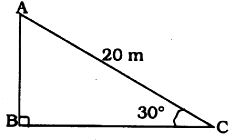
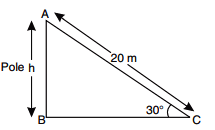
Q1: A circus artist is climbing a 20 m long rope, which is tightly stretched and tied from the top of a vertical pole to the ground. Find the height of the pole, if the angle made by the rope with the ground level is 30° (see figure).

Ans: Given: length of the rope (AC) = 20 m, ∠ACB = 30°
Let the height of the pole (AB) = h metre

⇒ h/20 = 1/2⇒ h = 20/2 = 10 m
Hence, height of the pole = 10 m

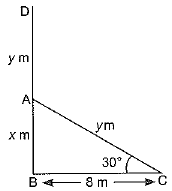
Q2: A tree breaks due to a storm and the broken part bends so that the top of the tree touches the ground making an angle 30° with it. The distance between the foot of the tree to the point where the top touches the ground is 8 m. Find the height of the tree.
Ans: Let DB is a tree and AD is the broken part of it that touches the ground at C.

Given: ∠ACB = 30º
and BC = 8m
Let AB = x m
and AD = y m
∴ Now, length of the tree
= (x + y) m
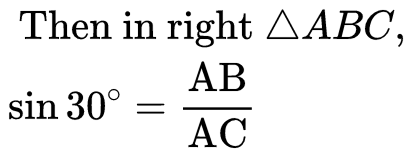
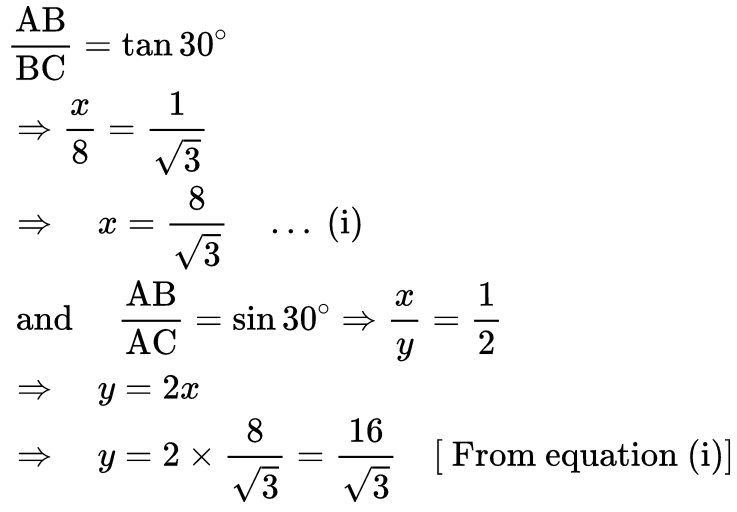
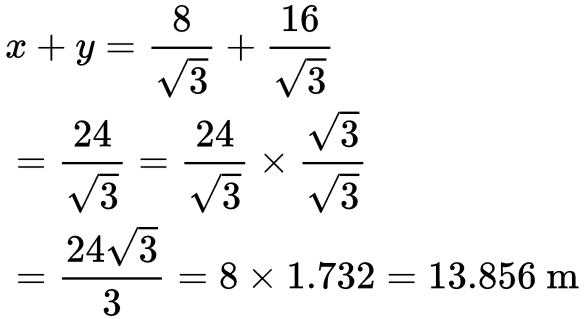
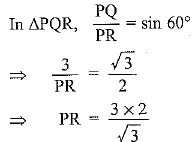
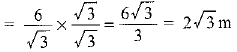
In Δ ABCHence, total height of the tree =

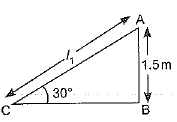
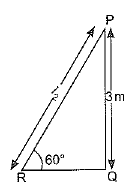
Q3: A contractor plans to install two slides for the children to play in a park. For the children below the age of 5 years, she prefers to have a slide whose top is at a height of 1.5 m, and is inclined at an angle of 30° to the ground, whereas for older children, she wants to have a steep slide at a height of 3 m, and inclined at an angle of 60° to the ground. What should be the length of the slide in each case?
Ans: Let l1 is the length of the slide for children below the age of 5 years and l2 is the length of the slide for elder children.
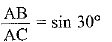
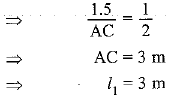
In ΔABC


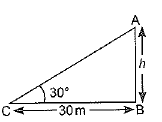
Q4: The angle of elevation of the top of a tower from a point on the ground, which is 30 m away from the foot of the tower, is 30°. Find the height of the tower.
Ans: Let h be the height of the tower
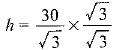
⇒ 
⇒ 

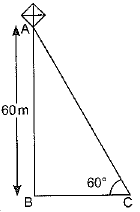
Q5: A kite is flying at a height of 60 m above the ground. The string attached to the kite is temporarily tied to a point on the ground. The inclination of the string with the ground is 60°. Find the length of the string, assuming that there is no slack in the string.
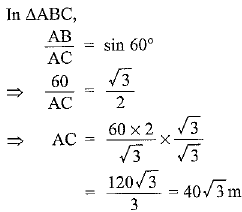
Ans: Given: height AB = 60 m, ∠ACB = 60°, AC = length of the string

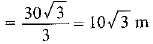
Hence, the length of the string = 40√3 m


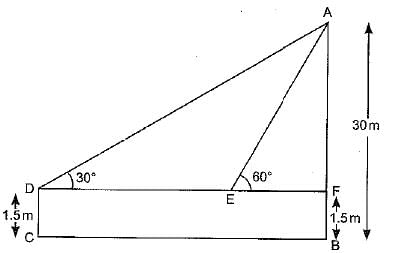
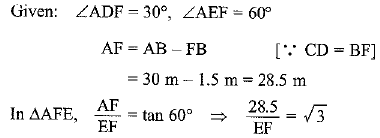
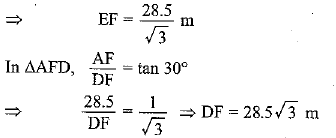
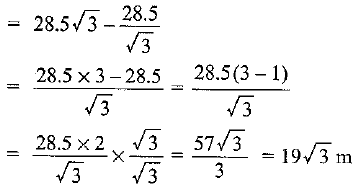
Q6: A 1.5 m tall boy is standing at some distance from a 30 m tall building. The angle of elevation from his eyes to the top of the building increases from 30° to 60° as he walks towards the building. Find the distance he walked towards the building.
Ans: Let  AB = height of the building


The distance walked by the boy towards building
DE = DF – EF

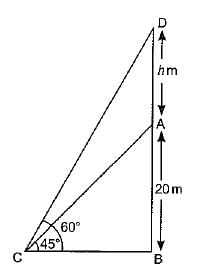
Q7: From a point on the ground, the angles of elevation of the bottom and the top of a transmission tower fixed at the top of a 20 m high building are 45° and 60° respectively. Find the height of the tower.
Ans: Given: AB = 20 m (Height of the building)
Let AD = h m (Height of the tower)


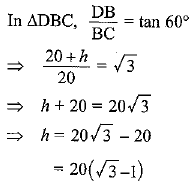
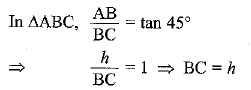
Hence, height of the tower 


Page No 142

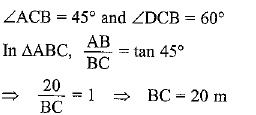
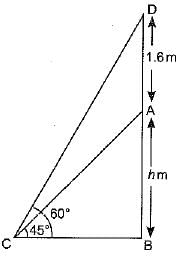
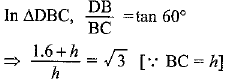
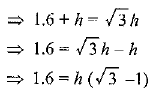
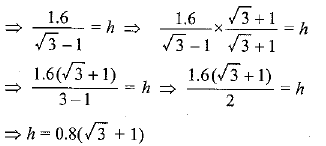
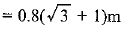
Q8: A statue, 1.6 m tall, stands on the top of a pedestal. From a point on the ground, the angle of elevation of the top of the statue is 60° and from the same point the angle of elevation of the top of the pedestal is 45°. Find the height of the pedestal.
Ans: Let the height of the pedestal AB = h m
Given: height of the statue = 1.6 m, ∠ACB = 45° and ∠DCB = 60°


Hence, height of the pedestal


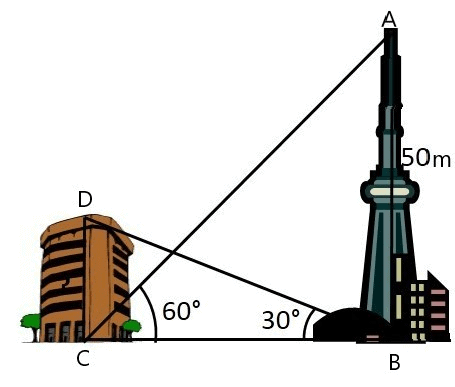
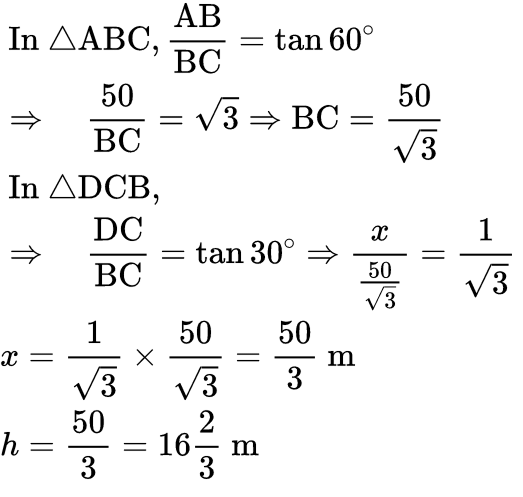
Q9: The angle of elevation of the top of a building from the foot of the tower is 30° and the angle of elevation of the top of the tower from the foot of the building is 60°. If the tower is 50 m high, find the height of the building.
Ans: Given: height of the tower AB = 50 m

∠ACB = 60°, ∠DBC = 30°
Let the height of the building
CD = x m


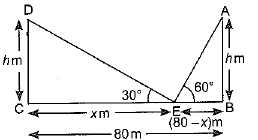
Q10: Two poles of equal heights are standing opposite each other on either side of the road, which is 80 m wide. From a point between them on the road, the angles of elevation of the top of the poles are 60° and 30° respectively. Find the height of the poles and the distances of the point from the poles.
Ans: Let AB = CD = h m [Height of the poles]
Given: BC = 80 m [Width of the road]
Let CE = x m
∴ BE = (80 – x) m
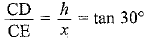
In ΔCDE,  

In ΔABE, 


      … (ii)
From equation (i) and (ii), we get

Substituting h in equation (i),

80 – x = 20 m
Hence, position of the point is at a distance of 60 m from pole CD and 20 m from pole AB.


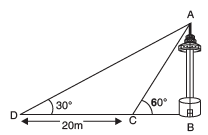
Q11: A TV tower stands vertically on a bank of a canal. From a point on the other bank directly opposite the tower, the angle of elevation of the top of the tower is 60°. From another point 20 m away from this point on the line joining this point to the foot of the tower, the angle of elevation of the top of the tower is 30° (see figure). Find the height of the tower and the width of the canal.

Ans: Let the height of the tower AB = h m and BC be the width of the canal.
Given: ∠ACB = 60° and ∠ADB = 30°


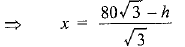
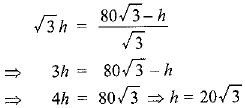
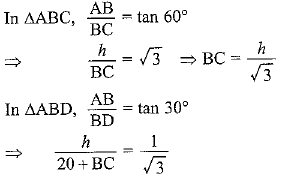
⇒ 
⇒ 
⇒ 

Hence, the height of the tower = 10√3 m and width of the canal = 10 m.


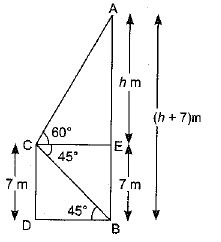
Q12: From the top of a 7 m high building, the angle of elevation of the top of a cable tower is 60° and the angle of depression of its foot is 45°. Determine the height of the tower.
Ans: Let height of the tower AB = (h + 7) m

Given: CD = 7m (height of the building),
∠ACE = 60°, and ∠ECB = 45°

⇒ ∠CBD = 45º

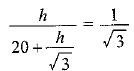
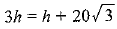
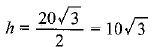
⇒ 
⇒ 


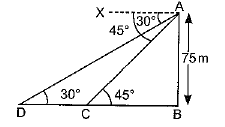
Q13: As observed from the top of a 75 m high lighthouse from the sea-level, the angles of depression of two ships are 30° and 45°. If one ship is exactly behind the other on the same side of the lighthouse, find the distance between the two ships.
Ans: Given: height of the lighthouse = 75 m
Let C and D are the positions of two ships.
We have ∠XAD = ∠ADB = 30°
and ∠XAC = ∠ACB = 45°

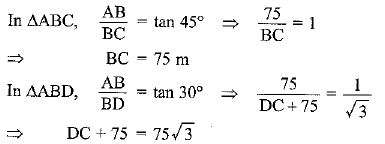
⇒ 

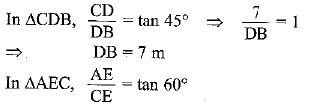
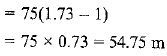
Hence, the distance between two ships is 54.75 m.


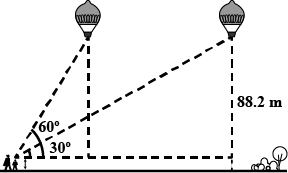
Q14: A 1.2 m tall girl spots a balloon moving with the wind in a horizontal line at a height of 88.2 m from the ground. The angle of elevation of the balloon from the eyes of the girl at any instant is 60°. After some time, the angle of elevation reduces to 30° (see figure). Find the distance travelled by the balloon during the interval.

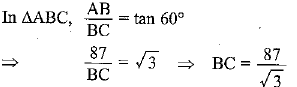
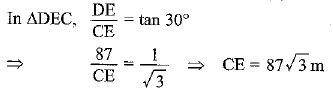
Ans: Let the first position of the balloon is A and after some time it will reach to the point D. The vertical height ED = AB = (88.2 – 1.2) m = 87 m.


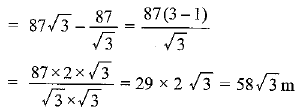
Distance travelled by the balloon from A to D is BE.
So, BE = CE – CB


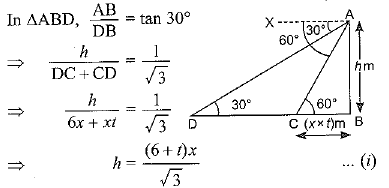
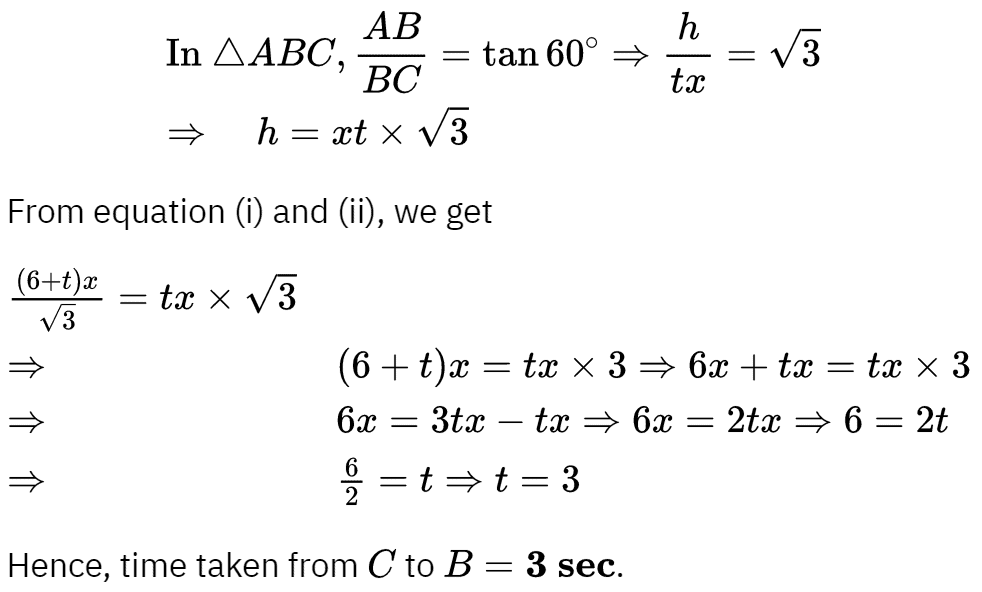
Q15: A straight highway leads to the foot of a tower. A man standing at the top of the tower observes a car at an angle of depression of 30°, which is approaching the foot of the tower with a uniform speed. Six seconds later, the angle of depression of the car is found to be 60°. Find the time taken by the car to reach the foot of the tower from this point.
Ans: Let the height of the tower AB = h m
Given: ∠XAD = ∠ADB = 30°
and ∠XAC – ∠ACB = 60°
Let the speed of the car = x m/sec

08. Introduction to Trigonometry- Textbooks Solutions

Exercise 8.1

Q1. In ∆ ABC, right-angled at B, AB = 24 cm, BC = 7 cm. Determine:
(i) sin A, cos A 
(ii) sin C, cos C
Ans:
In a given triangle ABC, right angled at B = ∠B = 90°
Given: AB = 24 cm and BC = 7 cm
According to the Pythagoras Theorem,
In a right-angled triangle, the squares of the hypotenuse side is equal to the sum of the squares of the other two sides.
By applying the Pythagoras theorem, we get
AC= AB+ BC2
AC2 = (24)2+72
AC2 = (576+49)
AC2 = 625cm2
AC = √625 = 25
Therefore, AC = 25 cm
(i) To find Sin (A), Cos (A)
We know that the sine (or) Sin function is equal to the ratio of the length of the opposite side to the hypotenuse side. So it becomes
Sin (A) = Opposite side /Hypotenuse = BC/AC = 7/25
Cosine or Cos function is equal to the ratio of the length of the adjacent side to the hypotenuse side and it becomes,
Cos (A) = Adjacent side/Hypotenuse = AB/AC = 24/25
(ii) To find Sin (C), Cos (C)
Sin (C) = AB/AC = 24/25
Cos (C) = BC/AC = 7/25

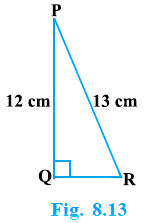
Q2. In Fig. 8.13, find tan P – cot R

Ans:
In the given triangle PQR, the given triangle is right-angled at Q and the given measures are:
PR = 13cm,
PQ = 12cm
Since the given triangle is right-angled triangle, to find the side QR, apply the Pythagoras theorem
According to Pythagoras theorem,
In a right-angled triangle, the squares of the hypotenuse side is equal to the sum of the squares of the other two sides.
PR2 = QR2 + PQ2
Substitute the values of PR and PQ
13= QR2+122
169 = QR2+144
Therefore, QR= 169−144
QR= 25
QR = √25 = 5
Therefore, the side QR = 5 cm
Now, tan P – cot R=?
According to the trigonometric ratio, the tangent function is equal to the ratio of the length of the opposite side to the adjacent sides, the value of tan (P) becomes
tan (P) = Opposite side /Adjacent side = QR/PQ = 5/12
Since cot function is the reciprocal of the tan function, the ratio of cot function becomes,
Cot (R) = Adjacent side/Opposite side = QR/PQ = 5/12
Therefore,
tan (P) – cot (R) = 5/12 – 5/12 = 0
Therefore, tan(P) – cot(R) = 0

Q3. If sin A = 3/4, Calculate cos A and tan A.
Ans:
Let us assume a right-angled triangle ABC, right-angled at B
Given: Sin A = 3/4
We know that Sin function is equal to the ratio of the length of the opposite side to the hypotenuse side.
Therefore, Sin A = Opposite side /Hypotenuse= 3/4
Let BC be 3k and AC will be 4k
where k is a positive real number.
According to the Pythagoras theorem, the squares of the hypotenuse side is equal to the sum of the squares of the other two sides of a right-angle triangle and we get,
AC2=AB+ BC2
Substitute the value of AC and BC
(4k)2=AB2 + (3k)2
16k2−9k=AB2
AB2=7k2
Therefore, AB = √7k
Now, we have to find the value of cos A and tan A
We know that,
Cos (A) = Adjacent side/Hypotenuse
Substitute the value of AB and AC and cancel the constant k in both numerator and denominator, we get
AB/AC = √7k/4k = √7/4
Therefore, cos (A) = √7/4
tan(A) = Opposite side/Adjacent side
Substitute the Value of BC and AB and cancel the constant k in both numerator and denominator, we get,
BC/AB = 3k/√7k = 3/√7
Therefore, tan A = 3/√7

Q4. Given 15 cot A = 8, find sin A and sec A.
Ans:
Let us assume a right-angled triangle ABC, right-angled at B
Given: 15 cot A = 8
So, Cot A = 8/15
We know that cot function is equal to the ratio of the length of the adjacent side to the opposite side.
Therefore, cot A = Adjacent side/Opposite side = AB/BC = 8/15
Let AB be 8k and BC will be 15k
Where k is a positive real number.
According to the Pythagoras theorem, the squares of the hypotenuse side is equal to the sum of the squares of the other two sides of a right-angle triangle and we get,
AC2=AB+ BC2
Substitute the value of AB and BC
AC2= (8k)2 + (15k)2
AC2= 64k2 + 225k2
AC2= 289k2
Therefore, AC = 17k
Now, we have to find the value of sin A and sec A
We know that,
Sin (A) = Opposite side /Hypotenuse
Substitute the value of BC and AC and cancel the constant k in both numerator and denominator, we get
Sin A = BC/AC = 15k/17k = 15/17
Therefore, sin A = 15/17
Since secant or sec function is the reciprocal of the cos function which is equal to the ratio of the length of the hypotenuse side to the adjacent side.
Sec (A) = Hypotenuse/Adjacent side
Substitute the Value of BC and AB and cancel the constant k in both numerator and denominator, we get,
AC/AB = 17k/8k = 17/8
Therefore sec (A) = 17/8

Q5. Given sec θ = 13/12 Calculate all other trigonometric ratios
Ans:
We know that sec function is the reciprocal of the cos function which is equal to the ratio of the length of the hypotenuse side to the adjacent side
Let us assume a right-angled triangle ABC, right-angled at B
sec θ =13/12 = Hypotenuse/Adjacent side = AC/AB
Let AC be 13k and AB will be 12k
Where k is a positive real number.
According to the Pythagoras theorem, the squares of the hypotenuse side is equal to the sum of the squares of the other two sides of a right-angled triangle and we get,
AC2=AB+ BC2
Substitute the value of AB and AC
(13k)2= (12k)2 + BC2
169k2= 144k2 + BC2
169k2= 144k2 + BC2
BC2 = 169k2 – 144k2
BC2= 25k2
Therefore, BC = 5k
Now, substitute the corresponding values in all other trigonometric ratios
So,
Sin θ = Opposite Side/Hypotenuse = BC/AC = 5/13
Cos θ = Adjacent Side/Hypotenuse = AB/AC = 12/13
tan θ = Opposite Side/Adjacent Side = BC/AB = 5/12
Cosec θ = Hypotenuse/Opposite Side = AC/BC = 13/5
cot θ = Adjacent Side/Opposite Side = AB/BC = 12/5

Q6. If ∠A and ∠B are acute angles such that cos A = cos B, then show that ∠ A = ∠ B.
Ans:
Let us assume the triangle ABC in which CD⊥AB
Give that the angles A and B are acute angles, such that
Cos (A) = cos (B)
As per the angles taken, the cos ratio is written as
AD/AC = BD/BC
Now, interchange the terms, we get
AD/BD = AC/BC
Let take a constant value
AD/BD = AC/BC = k
Now consider the equation as
AD = k BD …(1)
AC = k BC …(2)
By applying Pythagoras theorem in △CAD and △CBD we get,
CD2 = BC2 – BD… (3)
CD=AC−AD2 ….(4)
From the equations (3) and (4) we get,
AC2−AD= BC2−BD2
Now substitute the equations (1) and (2) in (3) and (4)
K2(BC2−BD2)=(BC2−BD2) k2=1
Putting this value in equation, we obtain
AC = BC
∠A=∠B (Angles opposite to equal side are equal-isosceles triangle)

Q7. If cot θ = 7/8, evaluate:
(i) (1 + sin θ)(1 – sin θ)/(1+cos θ)(1-cos θ)
(ii) cot2 θ
Ans:
Let us assume a △ABC in which ∠B = 90° and ∠C = θ
Given:
cot θ = BC/AB = 7/8
Let BC = 7k and AB = 8k, where k is a positive real number
According to the Pythagoras theorem in △ABC we get.
AC= AB2+BC2
AC= (8k)2+(7k)2
AC= 64k2+49k2
AC= 113k2
AC = √113 k
According to the sine and cos function ratios, it is written as
sin θ = AB/AC = Opposite Side/Hypotenuse = 8k/√113 k = 8/√113 and
cos θ = Adjacent Side/Hypotenuse = BC/AC = 7k/√113 k = 7/√113
Now apply the values of sin function and cos function:


Q8. If 3 cot A = 4, check whether (1-tanA)/(1+tan2 A) = cos2 A – sin A or not.
Ans:
Let △ABC in which ∠B=90°
We know that cot function is the reciprocal of tan function and it is written as
cot(A) = AB/BC = 4/3
Let AB = 4k and BC =3k, where k is a positive real number.
According to the Pythagoras theorem,
AC2=AB2+BC2
AC2=(4k)2+(3k)2
AC2=16k2+9k2
AC2=25k2
AC=5k
Now, apply the values corresponding to the ratios
tan(A) = BC/AB = 3/4
sin (A) = BC/AC = 3/5
cos (A) = AB/AC = 4/5
Now compare the left-hand side(LHS) with right-hand side(RHS)

Since, both the LHS and RHS = 7/25
R.H.S. = L.H.S.
Hence, (1-tanA)/(1+tan2 A) = cos2 A – sin A  is proved

Q9. In triangle ABC, right-angled at B, if tan A = 1/√3 find the value of:
(i) sin A cos C + cos A sin C
(ii) cos A cos C – sin A sin C
Ans:
Let ΔABC in which ∠B=90°
tan A = BC/AB = 1/√3
Let BC = 1k and AB = √3 k,
Where k is the positive real number of the problem
By Pythagoras theorem, in ΔABC we get:
AC2=AB2+BC2
AC2=(√3 k)2+(k)2
AC2=3k2+k2
AC2=4k2
AC = 2k
Now find the values of cos A, Sin A
Sin A = BC/AC = 1/2
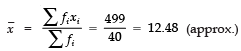
Cos A = AB/AC = √3/2
Then find the values of cos C and sin C
Sin C = AB/AC = √3/2
Cos C = BC/AC = 1/2

Now, substitute the values in the given problem
(i) sin A cos C + cos A sin C = (1/2) ×(1/2 )+ √3/2 ×√3/2 = 1/4 + 3/4 = 1
(ii) cos A cos C – sin A sin C = (3/2 )(1/2) – (1/2) (3/2 ) = 0

Q10. In ∆ PQR, right-angled at Q, PR + QR = 25 cm and PQ = 5 cm. Determine the values of sin P, cos P and tan P
Ans:
In a given triangle PQR, right angled at Q, the following measures are
PQ = 5 cm
PR + QR = 25 cm
Now let us assume, QR = x
PR = 25-QR
PR = 25- x
According to the Pythagoras Theorem,
PR2 = PQ2 + QR2
Substitute the value of PR as x
(25- x) 2 = 5+ x2
252 + x2 – 50x = 25 + x2
625 + x2-50x -25 – x= 0
-50x = -600
x= -600/-50
x = 12 = QR
Now, find the value of PR
PR = 25- QR
Substitute the value of QR
PR = 25-12
PR = 13
Now, substitute the value to the given problem
(1) Sin P = Opposite Side/Hypotenuse = QR/PR = 12/13
(2) Cos P= Adjacent Side/Hypotenuse = PQ/PR = 5/13
(3) Tan P =Opposite Side/Adjacent side = QR/PQ = 12/5

Q11. State whether the following are true or false. Justify your answer.
(i) The value of tan A is always less than 1.
(ii) sec A = 12/5 for some value of angle A.
(iii) cos A is the abbreviation used for the cosecant of angle A.
(iv) cot A is the product of cot and A.
(v) sin θ = 4/3 for some angle θ.
Ans:
(i) The value of tan A is always less than 1.
False
Justification: In ΔMNC in which ∠N = 90∘,
MN = 3, NC = 4 and MC = 5
Value of tan M = 4/3 which is greater than 1.
The triangle can be formed with sides equal to 3, 4 and hypotenuse = 5 as it will follow the Pythagoras theorem.
MC= MN+ NC2
5= 3+ 42
25 = 9 + 16
25 = 25

(ii) sec A = 12/5 for some value of angle A
True
Justification: Let a ΔMNC in which ∠N = 90º,
MC=12k and MB=5k, where k is a positive real number.
By Pythagoras theorem we get,
MC2=MN2+NC2
(12k)2=(5k)2+NC2
NC2+25k2=144k2
NC2=119k2
Such a triangle is possible as it will follow the Pythagoras theorem.
(iii) cos A is the abbreviation used for the cosecant of angle A.
False
Justification: Abbreviation used for cosecant of angle M is cosec M.  Cos M is the abbreviation used for cosine of angle M.
(iv) cot A is the product of cot and A.
False
Justification: cot M is not the product of cot and A. It is the cotangent of ∠A.
(v) sin θ = 4/3 for some angle θ.
False
Justification: sin θ = Height/Hypotenuse
We know that in a right-angled triangle, Hypotenuse is the longest side.
∴ sin θ will always be less than 1 and it can never be 4/3 for any value of θ.


Exercise 8.2

Q1. Evaluate the following:
(i) sin 60° cos 30° + sin 30° cos 60°
(ii) 2 tan2 45° + cos2 30° – sin60


Solution:
(i) The values of the given trigonometric ratios:
sin 30° = 1/2, cos 30° = √3/2, sin 60° = 3/2, cos 60°= 1/2
Now, substitute the values in the given problem
sin 60° cos 30° + sin 30° cos 60° = √3/2 ×√3/2 + (1/2) ×(1/2 ) = 3/4+1/4 = 4/4 = 1
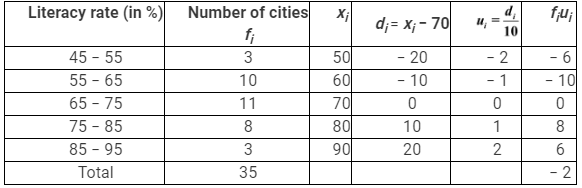
(ii) The values of the trigonometric ratios:
sin 60° = √3/2, cos 30° = √3/2, tan 45° = 1
Substitute the values in the given problem
2 tan2 45° + cos2 30° – sin2 60 = 2(1)+ (√3/2)2-(√3/2)2 = 2 + 0 = 2

(iii) We know that:

cos 45° = 1/√2, sec 30° = 2/√3, cosec 30° = 2

Substitute the values, we get

Now, multiply both the numerator and denominator by √2, we get

Therefore, cos 45°/(sec 30°+cosec 30°) = (3√2 – √6)/8


We know that,
sin 30° = 1/2, tan 45° = 1, cosec 60° = 2/√3, sec 30° = 2/√3, cos 60° = 1/2, cot 45° = 1
Substitute the values in the given problem, we get


We know that,
cos 60° = 1/2, sec 30° = 2/√3, tan 45° = 1, sin 30° = 1/2, cos 30° = √3/2
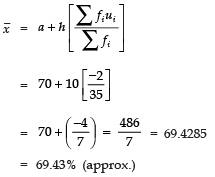
Now, substitute the values in the given problem, we get
(5cos260° + 4sec230° – tan245°)/(sin30° + cos30°)
= 5(1/2)+ 4(2/√3)– 12/(1/2)+ (√3/2)2 = (5/4 + 16/3 – 1)/(1/4 + 3/4) = {(15 + 64 – 12)/12}/(4/4) = 67/12

Q2. Choose the correct option and justify your choice:
(i) 
(a) sin 60°            
(b) cos 60°          
(c) tan 60°            
(d) sin 30°
Ans. (A) is correct
Justification: Substitute tan 30° = 1/√3 in the given equation

∵ √3/2 = sin 60°
The obtained solution is equivalent to the trigonometric ratio sin 60°

(a) tan 90°            
(b) 1       
(c) sin 45°            
(d) 0

Ans. (D) is correct
Justification:

(iii)  sin 2A = 2 sin A is true when A =
(a) 0°                   
(b) 30°                  
(c) 45°                 
(d) 60°
Ans. (A) is correct.
Justification: To find the value of A, substitute the degree given in the options one by one
sin 2A = 2 sin A is true when A = 0°
As, sin 2A = sin 0° = 0 and 2 sin A = 2 sin 0° = 2 × 0 = 0
or,
Apply the sin 2A formula, to find the degree value
sin 2A = 2sin A cos A
⇒ 2sin A cos A = 2 sin A
⇒ 2cos A = 2 ⇒ cos A = 1
Now, we have to check, to get the solution as 1, which degree value has to be applied.
When 0 degree is applied to cos value, i.e., cos 0 = 1
Therefore, ⇒ A = 0°


(iv) 
(a) cos 60°            
(b) sin 60°          
(c) tan 60°            
(d) sin 30°

Ans. (C) is correct.
Justification: 

Q3. If tan (A + B) = √3 and tan (A – B) = 1/√3 ,0° < A + B ≤ 90°; A > B, find A and B.
Solution:
tan (A + B) = √3
Since √3 = tan 60°
Now substitute the degree value
⇒ tan (A + B) = tan 60°
(A + B) = 60° … (i)
The above equation is assumed as equation (i)
tan (A – B) = 1/√3
Since 1/√3 = tan 30°
Now substitute the degree value
⇒ tan (A – B) = tan 30°
(A – B) = 30° … equation (ii)
Now add the equation (i) and (ii), we get
A + B + A – B = 60° + 30°
Cancel the terms B
2A = 90°
A= 45°
Now, substitute the value of A in equation (i) to find the value of B
45° + B = 60°
B = 60° – 45°
B = 15°
Therefore A = 45° and B = 15°

Q4. State whether the following are true or false. Justify your answer.
(i) sin (A + B) = sin A + sin B. 
Ans. False
Justification: Let us take A = 30° and B = 60°, then
Substitute the values in the sin (A + B) formula, we get
sin (A + B) = sin (30° + 60°) = sin 90° = 1 and,
sin A + sin B = sin 30° + sin 60°
= 1/2 + √3/2 = 1+√3/2
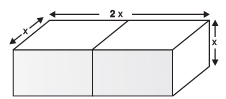
Since the values obtained are not equal, the solution is false.

(ii) The value of sin θ increases as θ increases.
Ans. True
Justification: According to the values obtained as per the unit circle, the values of sin are: sin 0° = 0, sin 30° = 1/2, sin 45° = 1/√2, sin 60° = √3/2, sin 90° = 1
Thus the value of sin θ increases as θ increases. Hence, the statement is true

(iii) The value of cos θ increases as θ increases.
Ans. False
Justification: According to the values obtained as per the unit circle, the values of cos are: cos 0° = 1, cos 30° = √3/2, cos 45° = 1/√2, cos 60° = 1/2, cos 90° = 0
Thus, the value of cos θ decreases as θ increases. So, the statement given above is false.

(iv) sin θ = cos θ for all values of θ.
Ans. False
Justification: sin θ = cos θ, when a right triangle has 2 angles of (π/4). Therefore, the above statement is false.

(v) cot A is not defined for A = 0°.
Ans. True
Justification: Since cot function is the reciprocal of the tan function, it is also written as:
cot A = cos A/sin A
Now substitute A = 0°
cot 0° = cos 0°/sin 0° = 1/0 = undefined.
Hence, it is true


Exercise 8.3

Q1. Express the trigonometric ratios sin A, sec A and tan A in terms of cot A.
Solution:
To convert the given trigonometric ratios in terms of cot functions, use trigonometric formulas
We know that,
cosec2A – cot2A = 1
cosec2A = 1 + cot2A
Since cosec function is the inverse of sin function, it is written as
1/sin2A = 1 + cot2A
Now, rearrange the terms, it becomes
sin2A = 1/(1+cot2A)
Now, take square roots on both sides, we get
sin A = ±1/(√(1+cot2A)
The above equation defines the sin function in terms of cot function
Now, to express sec function in terms of cot function, use this formula
sin2A = 1/ (1+cot2A)
Now, represent the sin function as cos function
1 – cos2A = 1/ (1+cot2A)
Rearrange the terms,
cos2A = 1 – 1/(1+cot2A)
⇒cos2A = (1-1+cot2A)/(1+cot2A)
Since sec function is the inverse of cos function,
⇒ 1/sec2A = cot2A/(1+cot2A)
Take the reciprocal and square roots on both sides, we get
⇒ sec A = ±√ (1+cot2A)/cotA
Now, to express tan function in terms of cot function
tan A = sin A/cos A and cot A = cos A/sin A
Since cot function is the inverse of tan function, it is rewritten as
tan A = 1/cot A

Q2. Write all the other trigonometric ratios of ∠A in terms of sec A.
Solution:
Cos A function in terms of sec A:
sec A = 1/cos A
⇒ cos A = 1/sec A
sec A function in terms of sec A:
cos2A + sin2A = 1
Rearrange the terms
sin2A = 1 – cos2A
sin2A = 1 – (1/sec2A)
sin2A = (sec2A-1)/sec2A
sin A = ± √(sec2A-1)/sec A
cosec A function in terms of sec A:
sin A = 1/cosec A
⇒cosec A = 1/sin A
cosec A = ± sec A/√(sec2A-1)
Now, tan A function in terms of sec A:
sec2A – tan2A = 1
Rearrange the terms
⇒ tan2A = sec2A + 1
tan A = √(sec2A + 1)
cot A function in terms of sec A:
tan A = 1/cot A
⇒ cot A = 1/tan A
cot A = ±1/√(sec2A + 1)

Q3. Choose the correct option. Justify your choice.
(i) 9 sec2A – 9 tan2A =
(a) 1                 
(b) 9              
(c) 8                
(d) 0
(ii) (1 + tan θ + sec θ) (1 + cot θ – cosec θ)
(a) 0                 
(b) 1              
(c) 2                
(d) – 1
(iii) (sec A + tan A) (1 – sin A) =

(a) sec A           
(b) sin A        
(c) cosec A      
(d) cos A

(iv) 1+tan2A/1+cot2A = 
(a) secA                 
(b) -1             
(c) cot2A                
(d) tan2A
Solution:
(i) (B) is correct.
Justification:
Take 9 outside, and it becomes
9 sec2A – 9 tan2A
= 9 (sec2A – tan2A)
= 9×1 = 9             (∵ sec2 A – tan2 A = 1)
Therefore, 9 sec2A – 9 tan2A = 9
(ii) (C) is correct
Justification:
(1 + tan θ + sec θ) (1 + cot θ – cosec θ)
We know that, tan θ = sin θ/cos θ
sec θ = 1/ cos θ
cot θ = cos θ/sin θ
cosec θ = 1/sin θ
Now, substitute the above values in the given problem, we get
= (1 + sin θ/cos θ + 1/ cos θ) (1 + cos θ/sin θ – 1/sin θ)
Simplify the above equation,
= (cos θ +sin θ+1)/cos θ × (sin θ+cos θ-1)/sin θ
= (cos θ+sin θ)2-12/(cos θ sin θ)
= (cos2θ + sin2θ + 2cos θ sin θ -1)/(cos θ sin θ)
= (1+ 2cos θ sin θ -1)/(cos θ sin θ) (Since cos2θ + sin2θ = 1)
= (2cos θ sin θ)/(cos θ sin θ) = 2
Therefore, (1 + tan θ + sec θ) (1 + cot θ – cosec θ) =2
(iii) (D) is correct.
Justification:
We know that,
Sec A= 1/cos A
Tan A = sin A / cos A
Now, substitute the above values in the given problem, we get
(secA + tanA) (1 – sinA)
= (1/cos A + sin A/cos A) (1 – sinA)
= (1+sin A/cos A) (1 – sinA)
= (1 – sin2A)/cos A
= cos2A/cos A = cos A
Therefore, (secA + tanA) (1 – sinA) = cos A
(iv) (D) is correct.
Justification:
We know that,
tan2A =1/cot2A
Now, substitute this in the given problem, we get
1+tan2A/1+cot2A
= (1+1/cot2A)/1+cot2A
= (cot2A+1/cot2A)×(1/1+cot2A)
= 1/cot2A = tan2A
So, 1+tan2A/1+cot2A = tan2A


Q4. Prove the following identities, where the angles involved are acute angles for which the expressions are defined.
(i) (cosec θ – cot θ)= (1-cos θ)/(1+cos θ)
(ii) cos A/(1+sin A) + (1+sin A)/cos A = 2 sec A
(iii) tan θ/(1-cot θ) + cot θ/(1-tan θ) = 1 + sec θ cosec θ     
[Hint : Write the expression in terms of sin θ and cos θ]
(iv) (1 + sec A)/sec A = sin2A/(1-cos A)  
[Hint : Simplify LHS and RHS separately]
(v) ( cos A–sin A+1)/( cos A +sin A–1) = cosec A + cot A, using the identity cosec2A = 1+cot2A.

(vii) (sin θ – 2sin3θ)/(2cos3θ-cos θ) = tan θ
(viii) (sin A + cosec A)+ (cos A + sec A)2 = 7+tan2A+cot2A
(ix) (cosec A – sin A)(sec A – cos A) = 1/(tan A+cotA)
[Hint : Simplify LHS and RHS separately]
(x) (1+tan2A/1+cot2A) = (1-tan A/1-cot A)2 = tan2
Solution:
(i) (cosec θ – cot θ)= (1-cos θ)/(1+cos θ)
To prove this, first take the Left-Hand side (L.H.S) of the given equation, to prove the Right Hand Side (R.H.S)
L.H.S. = (cosec θ – cot θ)2
The above equation is in the form of (a-b)2, and expand it
Since (a-b)2 = a2 + b2 – 2ab
Here a = cosec θ and b = cot θ
= (cosec2θ + cot2θ – 2cosec θ cot θ)
Now, apply the corresponding inverse functions and equivalent ratios to simplify
= (1/sin2θ + cos2θ/sin2θ – 2cos θ/sin2θ)
= (1 + cos2θ – 2cos θ)/(1 – cos2θ)
= (1-cos θ)2/(1 – cosθ)(1+cos θ)
= (1-cos θ)/(1+cos θ) = R.H.S.
Therefore, (cosec θ – cot θ)= (1-cos θ)/(1+cos θ)
Hence proved.
(ii)  (cos A/(1+sin A)) + ((1+sin A)/cos A) = 2 sec A
Now, take the L.H.S of the given equation.
L.H.S. = (cos A/(1+sin A)) + ((1+sin A)/cos A)
= [cos2A + (1+sin A)2]/(1+sin A)cos A
= (cos2A + sin2A + 1 + 2sin A)/(1+sin A) cos A
Since cos2A + sin2A = 1, we can write it as
= (1 + 1 + 2sin A)/(1+sin A) cos A
= (2+ 2sin A)/(1+sin A)cos A
= 2(1+sin A)/(1+sin A)cos A
= 2/cos A = 2 sec A = R.H.S.
L.H.S. = R.H.S.
(cos A/(1+sin A)) + ((1+sin A)/cos A) = 2 sec A
Hence proved.
(iii) tan θ/(1-cot θ) + cot θ/(1-tan θ) = 1 + sec θ cosec θ
L.H.S. = tan θ/(1-cot θ) + cot θ/(1-tan θ)
We know that tan θ =sin θ/cos θ
cot θ = cos θ/sin θ
Now, substitute it in the given equation, to convert it in a simplified form
= [(sin θ/cos θ)/1-(cos θ/sin θ)] + [(cos θ/sin θ)/1-(sin θ/cos θ)]
= [(sin θ/cos θ)/(sin θ-cos θ)/sin θ] + [(cos θ/sin θ)/(cos θ-sin θ)/cos θ]
= sin2θ/[cos θ(sin θ-cos θ)] + cos2θ/[sin θ(cos θ-sin θ)]
= sin2θ/[cos θ(sin θ-cos θ)] – cos2θ/[sin θ(sin θ-cos θ)]
= 1/(sin θ-cos θ) [(sin2θ/cos θ) – (cos2θ/sin θ)]
= 1/(sin θ-cos θ) × [(sin3θ – cos3θ)/sin θ cos θ]
= [(sin θ-cos θ)(sin2θ+cos2θ+sin θ cos θ)]/[(sin θ-cos θ)sin θ cos θ]
= (1 + sin θ cos θ)/sin θ cos θ
= 1/sin θ cos θ + 1
= 1 + sec θ cosec θ = R.H.S.
Therefore, L.H.S. = R.H.S.
Hence proved
(iv)  (1 + sec A)/sec A = sin2A/(1-cos A)
First find the simplified form of L.H.S
L.H.S. = (1 + sec A)/sec A
Since secant function is the inverse function of cos function and it is written as
= (1 + 1/cos A)/1/cos A
= (cos A + 1)/cos A/1/cos A
Therefore, (1 + sec A)/sec A = cos A + 1
R.H.S. = sin2A/(1-cos A)
We know that sin2A = (1 – cos2A), we get
= (1 – cos2A)/(1-cos A)
= (1-cos A)(1+cos A)/(1-cos A)
Therefore, sin2A/(1-cos A)= cos A + 1
L.H.S. = R.H.S.
Hence proved
(v) (cos A–sin A+1)/(cos A+sin A–1) = cosec A + cot A, using the identity cosec2A = 1+cot2A.
With the help of identity function, cosec2A = 1+cot2A, let us prove the above equation.
L.H.S. = (cos A–sin A+1)/(cos A+sin A–1)
Divide the numerator and denominator by sin A, we get
= (cos A–sin A+1)/sin A/(cos A+sin A–1)/sin A
We know that cos A/sin A = cot A and 1/sin A = cosec A
= (cot A – 1 + cosec A)/(cot A+ 1 – cosec A)
= (cot A – cosec2A + cot2A + cosec A)/(cot A+ 1 – cosec A) (using cosec2A – cot2A = 1
= [(cot A + cosec A) – (cosec2A – cot2A)]/(cot A+ 1 – cosec A)
= [(cot A + cosec A) – (cosec A + cot A)(cosec A – cot A)]/(1 – cosec A + cot A)
=  (cot A + cosec A)(1 – cosec A + cot A)/(1 – cosec A + cot A)
=  cot A + cosec A = R.H.S.
Therefore, (cos A–sin A+1)/(cos A+sin A–1) = cosec A + cot A
Hence Proved

First divide the numerator and denominator of L.H.S. by cos A,

We know that 1/cos A = sec A and sin A/ cos A = tan A and it becomes,
= √(sec A+ tan A)/(sec A-tan A) 
Now using rationalization, we get

= (sec A + tan A)/1
= sec A + tan A = R.H.S
Hence proved
(vii) (sin θ – 2sin3θ)/(2cos3θ-cos θ) = tan θ
L.H.S. = (sin θ – 2sin3θ)/(2cos3θ – cos θ)
Take sin θ as in numerator and cos θ in denominator as outside, it becomes
= [sin θ(1 – 2sin2θ)]/[cos θ(2cos2θ- 1)]
We know that sin2θ = 1-cos2θ
= sin θ[1 – 2(1-cos2θ)]/[cos θ(2cos2θ -1)]
= [sin θ(2cos2θ -1)]/[cos θ(2cos2θ -1)]
= tan θ = R.H.S.
Hence proved
(viii) (sin A + cosec A)+ (cos A + sec A)2 = 7+tan2A+cot2A
L.H.S. = (sin A + cosec A)+ (cos A + sec A)2
It is of the form (a+b)2, expand it
(a+b)2 =a2 + b2 +2ab
= (sin2A + cosec2A + 2 sin A cosec A) + (cos2A + sec2A + 2 cos A sec A)
= (sin2A + cos2A) + 2 sin A(1/sin A) + 2 cos A(1/cos A) + 1 + tan2A + 1 + cot2A
= 1 + 2 + 2 + 2 + tan2A + cot2A
= 7+tan2A+cot2A = R.H.S.
Therefore, (sin A + cosec A)+ (cos A + sec A)2 = 7+tan2A+cot2A
Hence proved.
(ix) (cosec A – sin A)(sec A – cos A) = 1/(tan A + cotA)
First, find the simplified form of L.H.S
L.H.S. = (cosec A – sin A)(sec A – cos A)
Now, substitute the inverse and equivalent trigonometric ratio forms
= (1/sin A – sin A)(1/cos A – cos A)
= [(1-sin2A)/sin A][(1-cos2A)/cos A]
= (cos2A/sin A)×(sin2A/cos A)
= cos A sin A
Now, simplify the R.H.S
R.H.S. = 1/(tan A+cotA)
= 1/(sin A/cos A +cos A/sin A)
= 1/[(sin2A+cos2A)/sin A cos A]
= cos A sin A
L.H.S. = R.H.S.
(cosec A – sin A)(sec A – cos A) = 1/(tan A+cotA)
Hence proved
(x)  (1+tan2A/1+cot2A) = (1-tan A/1-cot A)2 = tan2A
L.H.S. = (1+tan2A/1+cot2A)
Since cot function is the inverse of tan function,
= (1+tan2A/1+1/tan2A)
= 1+tan2A/[(1+tan2A)/tan2A]
Now cancel the 1+tan2A terms, we get
= tan2A
(1+tan2A/1+cot2A) = tan2A
Similarly,
(1-tan A/1-cot A)2 = tan2A
Hence proved

07. Coordinate Geometry- Textbooks Solutions (Exercise 7.2)

Q1. Find the coordinates of the point which divides the join of (-1, 7) and (4, -3) in the ratio 2 : 3.
Ans: Given,
Let P(x, y) be the required point.
Let A(−1, 7) and B(4, −3)
m: n = 2:3
Hence
x1 = −1
y1 = 7
x2 = 4
y2 = −3
By Section formula

By substituting the values in the Equation (1)


Therefore, the co-ordinates of point P are (1, 3).

Q2. Find the coordinates of the points of trisection of the line segment joining (4, -1) and (-2, -3).
Ans:  

Given,
Let line segment joining the points be A(4, −1) and B(−2, −3).
Let P (x1, y1) and Q (x2, y2) be the points of trisection of the line segment joining the given points i.e., AP = PQ = QB
By Section formula

Therefore, by observation point P divides AB internally in the ratio 1:2.
Hence m: n = 1:2
By substituting the values in the Equation (1)

Therefore,
Therefore, by observation point Q divides AB internally in the ratio 2:1.
Hence m:n = 2:1
By substituting the values in the Equation (1)

Therefore, 
Hence the points of trisection are P(x1, y1) = 


Q3. To conduct Sports Day activities, in your rectangular shaped school ground ABCD, lines have been drawn with chalk powder at a distance of 1 m each. 100 flower pots have been placed at a distance of 1 m from each other along AD, as shown in the figure. Niharika runs 1/4 th the distance AD on the 2nd line and posts a green flag. Preet runs 1/5 th the distance AD on the eighth line and posts a red flag. What is the distance between both the flags? If Rashmi has to post a blue flag exactly halfway between the line segment joining the two flags, where should she post her flag?Ans: From the Figure,
Given,

  • By observation, that Niharika posted the green flag at of the distance P i.e., from the starting point of 2nd line. Therefore, the coordinates of this point P is (2, 25).
  • Similarly, Preet posted red flag at 1/5 of the distance from the starting point of 8th line. Therefore, the coordinates of this point Q are (8, 20)

We know that the distance between the two points is given by the Distance Formula,

To find the distance between these flags PQ by substituting the values in Equation (1),

  • The point at which Rashmi should post her blue flag is the mid-point of the line joining these points. 
  • Let this point be M (x, y).

By Section formula


Therefore, Rashmi should post her blue flag at 22.5 m on 5th line

Q4. Find the ratio in which the line segment joining the points (-3, 10) and (6, -8) is divided by (-1, 6).
Ans: From the figure,
Given, 

  • Let the ratio in which the line segment joining A(−3, 10) and B(6, −8) is divided by point P(−1, 6) be k:1.

By Section formula

Therefore,

Hence the point P divides AB in the ratio 2:7


Q5. Find the ratio in which the line segment joining A (1, -5) and B (-4, 5) is divided by the x-axis. Also find the coordinates of the point of division.
Ans: From the Figure,Given, 

  • Let the ratio be k : 1. 
  • Let the line segment joining A (1, −5) and B (−4, 5)

By Section formula

By substituting the values in Equation (1)
Therefore, the coordinates of the point of division is 
We know that y-coordinate of any point on x-axis is 0.

Therefore, x-axis divides it in the ratio 1:1.

Division point

Q6. If (1, 2), (4, y), (x, 6) and (3, 5) are the vertices of a parallelogram taken in order, find x and y.
Ans: From the Figure,

Given, 

  • Let A (1, 2), B (4, y), C(x, 6), and D (3, 5) are the vertices of a parallelogram ABCD.
  • Since the diagonals of a parallelogram bisect each other, Intersection point O of diagonal AC and BD also divides these diagonals

Therefore, O is the mid-point of AC and BD.
If O is the mid-point of AC, then the coordinates of O are


If O is the mid-point of BD, then the coordinates of O are


Since both the coordinates are of the same point O,

Q7. Find the coordinates of a point A, where AB is the diameter of a circle whose centre is (2, -3) and B is (1, 4).
Ans: From the Figure,

Given, 

  • Let the coordinates of point A be (x, y). 
  • Mid-point of AB is C (2, −3), which is the center of the circle.

Therefore, the coordinates of A are (3, −10)

Q8. If A and B are (-2, -2) and (2, -4), respectively, find the coordinates of P such that  and P lies on the line segment AB.
Ans: From the Figure,
Given,

  • The coordinates of point A and B are (−2, −2) and (2, −4) respectively.
  • AP = 3/7AB

Hence AB/AP = 7/3
We know that AB = AP + PB from figure,

Therefore, AP:PB = 3:4
Point P(x, y) divides the line segment AB in the ratio 3:4. Using Section Formula,

Q9. Find the coordinates of the points which divide the line segment joining A (-2, 2) and B (2, 8) into four equal parts.
Ans: From the Figure,

By observation, that points P, Q, R divides the line segment A (−2, 2) and B (2, 8) into four equal parts
Point P divides the line segment AQ into two equal parts
Hence, Coordinates of P = 

Point Q divides the line segment AB into two equal parts
Coordinates of Q

Point R divides the line segment BQ into two equal parts
Coordinates of R


Q10. Find the area of a rhombus if its vertices are (3, 0), (4, 5), (-1, 4) and (-2, -1) taken in order. [Hint: Area of a rhombus = 1/2 (product of its diagonals)]
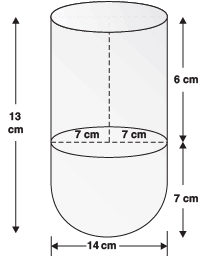
Ans: From the Figure,

Given, 

  • Let A(3, 0), B(4, 5), C(−1, 4) and D(−2, −1) are the vertices of a rhombus ABCD.

We know that the distance between the two points is given by the Distance Formula,
Therefore, distance between A (3, 0) and C (−1, 4) is given by

Therefore, distance between B (4, 5) and D (−2, −1) is given by

Area of the rhombus ABCD  = 1/2 x (Product of lengths of diagonals)
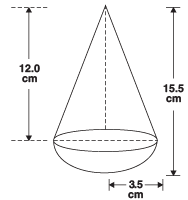
= 1/2 AC x BD
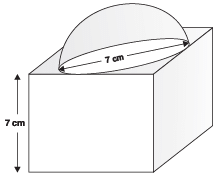
Therefore, area of rhombus

= 24 Square units

07.Coordinate Geometry- Textbooks Solutions (Exercise 7.1)

Q1. Find the distance between the following pairs of points:
(i) (2, 3), (4, 1) 

Ans: Let P(2, 3) and Q(4, 1)


(ii) (-5, 7), (-1, 3) 

Ans: Let P (-5, 7) and Q (-1, 3)

(iii) (a, b), (-a, -b)

Ans: Let P (a, b) and Q (-a, -b)

Q2. Find the distance between the points (0, 0) and (36, 15). Can you now find the distance between the two towns A and B discussed in Section 7.2?
Ans: Let points be A (0, 0) and B (36, 15)
The distance between the two points is:

The distance between towns A and B will be 39 km.

Q3. Determine if the points (1, 5), (2, 3) and (-2, -11) are collinear.
Ans: Let points be A(1, 5), B(2, 3) and C(-2, -11)

AB + BC ≠ AC
Hence, the given points are not collinear.

Q4. Check whether (5, -2), (6, 4) and (7, -2) are the vertices of an isosceles triangle.
Ans: Since two sides of any isosceles triangle are equal. To check whether the given points are vertices of an isosceles triangle, we will find the distance between all the points.

Let the points be A (5, -2), B (6, 4) and C (7, -2).

Here AB = BC
∴ Δ ABC is an isosceles.

Q5. In a classroom, 4 friends are seated at the points A, B, C and D as shown in Fig. Champa and Chameli walk into the class and after observing for a few minutes Champa asks Chameli, ‘‘Don’t you think ABCD is a square?’’ Chameli disagrees. Using distance single formula, find which of them is correct.

Ans: Points A (3, 4), B (6, 7), C (9, 4) and D (6, 1)

 ABCD is a square.
Hence, Champa is correct.

Q6. Name the type of quadrilateral formed, if any, by the following points, and give reasons for your answer:
(i) (-1, -2), (1, 0), (-1, 2), (-3, 0)
Ans: Let the points be: A (-1, -2), B (1, 0), C (-1, 2) and D (-3, 0).

Here AC = BD, AB = BC = CD = AD
Hence, the quadrilateral ABCD is a square.
(ii) (-3, 5), (3, 1), (0, 3), (-1, – 4) 
Let points be A (-3, 5), B (3, 1), C (0, 3) and D (-1, -4)

It is seen that points A, B and C are collinear.

So, the given points can only form 3 sides i.e, a triangle and not a quadrilateral that has 4 sides.

Therefore, the given points do not form any quadrilateral.
(iii) (4, 5), (7, 6), (4, 3), (1, 2)
Let points be A (4, 5), B (7, 6), C (4, 3) and D (1, 2)

Here, AB = CD, BC = AD and AC ≠ BD
 The quadrilateral ABCD is a parallelogram.

Q7. Find the point on the x-axis which is equidistant from (2, -5) and (-2, 9).
Ans: Let points be A (2, -5) and B (-2, 9)
Let P (x, 0) be the point on the x-axis.
PA = PB
 Then, PA= PB2
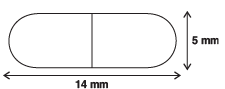
⇒ (x – 2)2 + (0 + 5)2 = (x + 2)2 + (0 – 9)2
⇒ (x – 2)2 –  (x + 2)2 = 81 – 25
⇒ (x – 2 + x + 2)(x – 2 – x – 2) = 56
⇒ (2x)(-4) = 56
⇒ -8x = 56
⇒ x = -7
Hence, the required point is (-7, 0).


Q8. Find the values of y for which the distance between the points P(2, -3) and Q(10, y) is 10 units.
Ans: Points P (2, -3), Q (10, y) and PQ = 10 units
The distance between the two points is:


⇒ y – 3 = 0 or y + 9 = 0
⇒ y = 3 or – 9

Q9. If Q (0, 1) is equidistant from P (5, -3) and R (x, 6), find the values of x. Also, find the distances QR and PR.
Ans: PQ = QR


Therefore, point R is (4, 6) or (−4, 6).
When point R is (4, 6),


Q10. Find a relation between x and y such that the point (x, y) is equidistant from the point (3, 6) and (-3, 4).
Ans: Points A (3, 6), B (-3, 4) are given and point P(x, y) is equidistant from points A and B.