06. Triangles- Textbooks Solutions (Exercise 6.1 & 6.3)

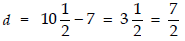
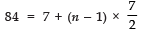
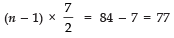
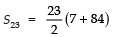
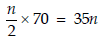
Exercise 6.1

Q1: Fill in the blanks using the correct word given in brackets.
(i) All circles are _______(congruent, similar).
(ii) All squares are _______ (similar, congruent).
(iii) All _______ triangles are similar. (isosceles, equilateral).
(iv)Two polygons of the same number of sides are similar, if (a) their corresponding angles are _______ and (b) their corresponding sides are _______ (equal, proportional).
Ans:
(i) All circles are similar.
(ii) All squares are similar.
(iii) All equilateral triangles are similar.
(iv) Two polygons of the same number of sides are similar if:
(a) Their corresponding angles are equal and
(b) Their corresponding sides are proportional.

Q2: Give two different examples of pair of:
(i) similar figures 
(ii) non-similar figures.
Ans: 
(i).
(a) Any two circles are similar figures.
(b) Any two squares are similar figures.
(ii).
(a) A circle and a triangle are non-similar figures.
(b) An isosceles triangle and a scalene triangle are non-similar figures.

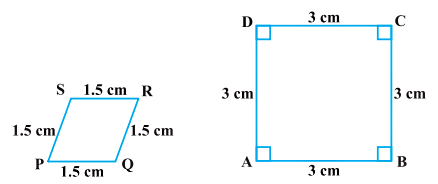
Q3: State whether the following quadrilaterals are similar or not.

Ans: No, the sides of quadrilateral PQRS and ABCD are proportional but their corresponding angles are not equal.
∴ These are not similar.Exercise 6.2

Q1. In figures (i) and (ii), DE || BC. Find EC in (i) and AD in (ii).
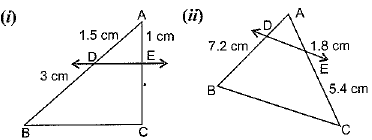
Sol. 

(i) Given, in △ ABC, DE∥BC
∴ AD/DB = AE/EC [Using Basic proportionality theorem]
⇒ 1.5/3 = 1/EC

⇒ EC = 3/1.5
EC = 3×10/15 = 2 cm
Hence, EC = 2 cm.

(ii) Given, in △ ABC, DE∥BC
∴ AD/DB = AE/EC [Using Basic proportionality theorem]
⇒ AD/7.2 = 1.8 / 5.4
⇒ AD = 1.8 ×7.2/5.4 = (18/10)×(72/10)×(10/54) = 24/10
⇒ AD = 2.4
Hence, AD = 2.4 cm.


Q2. E and F are points on the sides PQ and PR respectively of a ΔPQR. For each of the following cases, state whether EF || QR:
(i) PE = 3.9 cm, EQ = 3 cm, PF = 3.6 cm and FR = 2.4 cm
(ii) PE = 4 cm, QE = 4.5 cm, PF = 8 cm and RF = 9 cm
(iii) PQ = 1.28 cm, PR = 2.56 cm, PE = 0.18 cm and PF = 0.36 cm
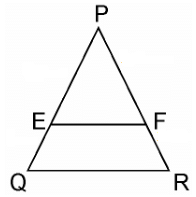
Sol. 
Given, in ΔPQR, E and F are two points on side PQ and PR respectively. See the figure below;

(i) Given, PE = 3.9 cm, EQ = 3 cm, PF = 3.6 cm and FR = 2,4 cm
Therefore, by using Basic proportionality theorem, we get,
PE/EQ = 3.9/3 = 39/30 = 13/10 = 1.3
And PF/FR = 3.6/2.4 = 36/24 = 3/2 = 1.5
So, we get, PE/EQ ≠ PF/FR
Hence, EF is not parallel to QR.

(ii) Given, PE = 4 cm, QE = 4.5 cm, PF = 8cm and RF = 9cm
Therefore, by using Basic proportionality theorem, we get,
PE/QE = 4/4.5 = 40/45 = 8/9
And, PF/RF = 8/9
So, we get here,
PE/QE = PF/RF
Hence, EF is parallel to QR.

(iii) Given, PQ = 1.28 cm, PR = 2.56 cm, PE = 0.18 cm and PF = 0.36 cm
From the figure,
EQ = PQ – PE = 1.28 – 0.18 = 1.10 cm
And, FR = PR – PF = 2.56 – 0.36 = 2.20 cm
So, PE/EQ = 0.18/1.10 = 18/110 = 9/55…………. (i)
And, PE/FR = 0.36/2.20 = 36/220 = 9/55………… (ii)
So, we get here,
PE/EQ = PF/FR
Hence, EF is parallel to QR.
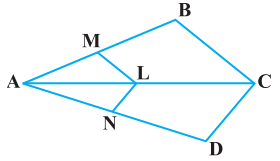
Q3.In the figure, if LM || CB and LN || CD, prove that 
AM/AB = AN/AD
Sol. 
In the given figure, we can see, LM || CB,
By using basic proportionality theorem, we get,
AM/AB = AL/AC……………………..(i)
Similarly, given, LN || CD and using basic proportionality theorem,
∴ AN/AD = AL/AC……………………………(ii)
From equation (i) and (ii), we get,
AM/AB = AN/AD
Hence, proved.

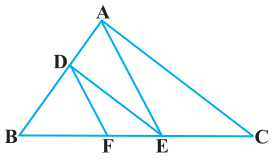
Q4. In the figure, DE||AC and DF||AE. Prove that BF/FE = BE/EC
Sol.
In ΔABC, given as, DE || AC
Thus, by using Basic Proportionality Theorem, we get,
∴ BD/DA = BE/EC ………………………………………………(i)
In  ΔABC, given as, DF || AE
Thus, by using Basic Proportionality Theorem, we get,
∴ BD/DA = BF/FE ………………………………………………(ii)
From equation (i) and (ii), we get
BE/EC = BF/FE
Hence, proved.
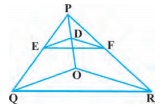
Q5. In the figure, DE || OQ and DF || OR. Show that EF || QR.
Sol.
Given,
In ΔPQO, DE || OQ
So by using Basic Proportionality Theorem,
PD/DO = PE/EQ……………… ..(i)
Again given, in ΔPQO, DE || OQ ,
So by using Basic Proportionality Theorem,
PD/DO = PF/FR………………… (ii)
From equation (i) and (ii), we get,
PE/EQ = PF/FR
Therefore, by converse of Basic Proportionality Theorem,
EF || QR, in ΔPQR.

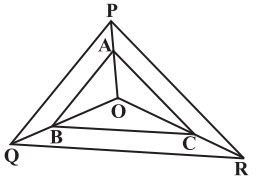
Q6. In the figure, A, B and C are points on OP, OQ and OR respectively such that AB || PQ and AC || PR. Show that BC || QR.
Sol. 
Given here,
In ΔOPQ, AB || PQ
By using Basic Proportionality Theorem,
OA/AP = OB/BQ…………….(i)
Also given,
In ΔOPR, AC || PR
By using Basic Proportionality Theorem
∴ OA/AP = OC/CR……………(ii)
From equation (i) and (ii), we get,
OB/BQ = OC/CR
Therefore, by converse of Basic Proportionality Theorem,
In ΔOQR, BC || QR.
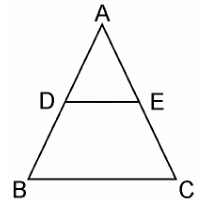
Q7. Using Basic proportionality theorem, prove that a line drawn through the mid-points of one side of a triangle parallel to another side bisects the third side.  
Sol.
Given, in ΔABC, D is the midpoint of AB such that AD=DB.
A line parallel to BC intersects AC at E as shown in above figure such that DE || BC.
We have to prove that E is the mid point of AC.
Since, D is the mid-point of AB.
∴ AD=DB
⇒ AD/DB = 1 ………… (i)
In ΔABC, DE || BC,
By using Basic Proportionality Theorem,
Therefore, AD/DB = AE/EC
From equation (i), we can write,
⇒ 1 = AE/EC
∴ AE = EC
Hence, proved, E is the midpoint of AC.

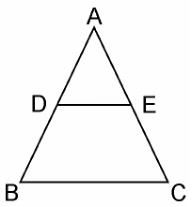
Q8.  Using Converse of basic proportionality theorem, prove that the line joining the mid-points of any two sides of a triangle is parallel to the third side.
Sol. 
Given, in ΔABC, D and E are the mid points of AB and AC respectively, such that,
AD=BD and AE=EC.
We have to prove that: DE || BC.
Since, D is the midpoint of AB
∴ AD=DB
⇒ AD/BD = 1…………. (i)
Also given, E is the mid-point of AC.
∴ AE=EC
⇒ AE/EC = 1
From equation (i) and (ii), we get,
AD/BD = AE/EC
By converse of Basic Proportionality Theorem,
DE || BC
Hence, proved.
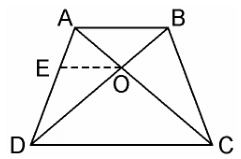

Q9. ABCD is a trapezium in which AB || DC and its diagonals intersect each other at the point O. Show that AO/BO = CO/DO.
Sol. Given, ABCD is a trapezium where AB || DC and diagonals AC and BD intersect each other at O.

We have to prove, AO/BO = CO/DO
From the point O, draw a line EO touching AD at E, in such a way that,
EO || DC || AB
In ΔADC, we have OE || DC
Therefore, By using Basic Proportionality Theorem
AE/ED = AO/CO ……………..(i)
Now, In ΔABD, OE || AB
Therefore, By using Basic Proportionality Theorem
DE/EA = DO/BO…………….(ii)
From equation (i) and (ii), we get,
AO/CO = BO/DO
⇒ AO/BO = CO/DO
Hence, proved.


Q10. The diagonals of a quadrilateral ABCD intersect each other at the point O such that AO/BO = CO/DO. Show that ABCD is a trapezium.
Sol. 
Given, Quadrilateral ABCD where AC and BD intersects each other at O such that,
AO/BO = CO/DO.
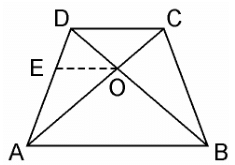
We have to prove here, ABCD is a trapezium
From the point O, draw a line EO touching AD at E, in such a way that,
EO || DC || AB
In ΔDAB, EO || AB
Therefore, By using Basic Proportionality Theorem
DE/EA = DO/OB ………(i)
Also, given,
AO/BO = CO/DO
⇒ AO/CO = BO/DO
⇒ CO/AO = DO/BO
⇒ DO/OB = CO/AO ………….(ii)
From equation (i) and (ii), we get
DE/EA = CO/AO
Therefore, By using converse of Basic Proportionality Theorem,
EO || DC also EO || AB
⇒ AB || DC.
Hence, quadrilateral ABCD is a trapezium with AB || CD.Exercise 6.3

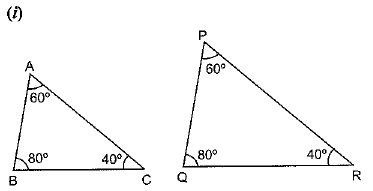
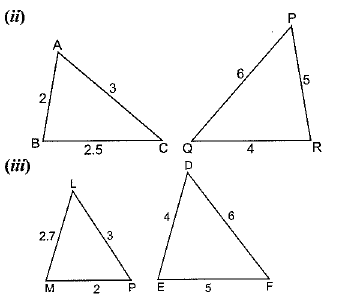
Q1. State which pairs of triangles in Figure, are similar. Write the similarity criterion used by you for answering the question and also write the pairs of similar triangles in the symbolic form:
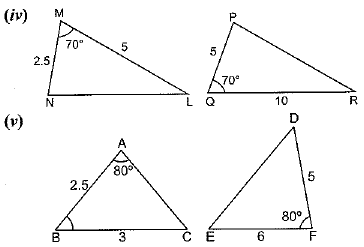
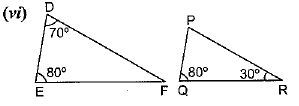

Sol. 
(i) Given, in ΔABC and ΔPQR,
∠A = ∠P = 60°
∠B = ∠Q = 80°
∠C = ∠R = 40°
Therefore by AAA similarity criterion,
∴ ΔABC ~ ΔPQR

(ii) Given, in  ΔABC and ΔPQR,
AB/QR = BC/RP = CA/PQ
By SSS similarity criterion,
ΔABC ~ ΔQRP

(iii) Given, in ΔLMP and ΔDEF,
LM = 2.7, MP = 2, LP = 3, EF = 5, DE = 4, DF = 6
MP/DE = 2/4 = 1/2
PL/DF = 3/6 = 1/2
LM/EF = 2.7/5 = 27/50
Here , MP/DE = PL/DF ≠ LM/EF
Therefore, ΔLMP and ΔDEF are not similar.

(iv) In ΔMNL and ΔQPR, it is given,
MN/QP = ML/QR = 1/2
∠M = ∠Q = 70°
Therefore, by SAS similarity criterion
∴ ΔMNL ~ ΔQPR

(v) In ΔABC and ΔDEF, given that,
AB = 2.5, BC = 3, ∠A = 80°, EF = 6, DF = 5, ∠F = 80°
Here , AB/DF = 2.5/5 = 1/2
And, BC/EF = 3/6 = 1/2
⇒ ∠B ≠ ∠F
Hence, ΔABC and ΔDEF are not similar.

(vi) In ΔDEF, by sum of angles of triangles, we know that,
∠D + ∠E + ∠F = 180°
⇒ 70° + 80° + ∠F = 180°
⇒ ∠F = 180° – 70° – 80°
⇒ ∠F = 30°
Similarly, In ΔPQR,
∠P + ∠Q + ∠R = 180 (Sum of angles of Δ)
⇒ ∠P + 80° + 30° = 180°
⇒ ∠P = 180° – 80° -30°
⇒ ∠P = 70°
Now, comparing both the triangles, ΔDEF and ΔPQR, we have
∠D = ∠P = 70°
∠F = ∠Q = 80°
∠F = ∠R = 30°
Therefore, by AAA similarity criterion,
Hence, ΔDEF ~ ΔPQR
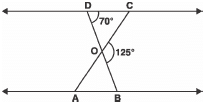

Q2. In the figure, ΔODC ~ ΔOBA, ∠BOC = 125° and ∠CDO = 70°. Find ∠DOC, ∠DCO and ∠OAB.

Sol. 
As we can see from the figure, DOB is a straight line.
Therefore, ∠DOC + ∠ COB = 180°
⇒ ∠DOC = 180° – 125° (Given, ∠ BOC = 125°)
= 55°
In ΔDOC, sum of the measures of the angles of a triangle is 180º
Therefore, ∠DCO + ∠ CDO + ∠ DOC = 180°
⇒ ∠DCO + 70º + 55º = 180°(Given, ∠ CDO = 70°)
⇒ ∠DCO = 55°
It is given that, ΔODC ∝ ¼ ΔOBA,
Therefore, ΔODC ~ ΔOBA.
Hence, Corresponding angles are equal in similar triangles
∠OAB = ∠OCD
⇒ ∠ OAB = 55°
∠OAB = ∠OCD
⇒ ∠OAB = 55°
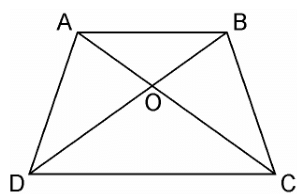

Q3. Diagonals AC and BD of a trapezium ABCD with AB || DC intersect each other at the point O. Using a similarity criterion for two triangles, show that AO/OC = OB/OD
Sol. 

In ΔDOC and ΔBOA,
AB || CD, thus alternate interior angles will be equal,
∴ ∠CDO = ∠ABO
Similarly,
∠DCO = ∠BAO
Also, for the two triangles ΔDOC and ΔBOA, vertically opposite angles will be equal;
∴ ∠DOC = ∠BOA
Hence, by AAA similarity criterion,
ΔDOC ~ ΔBOA
Thus, the corresponding sides are proportional.
DO/BO = OC/OA
⇒ OA/OC = OB/OD
Hence, proved.
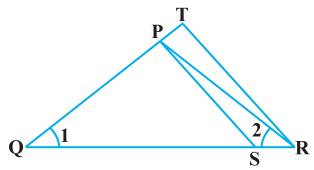

Q4. In the figure, QR/QS = QT/PR and ∠1 = ∠2. Show that ΔPQS ~ ΔTQR.
Sol.
In ΔPQR,
∠PQR = ∠PRQ
∴ PQ = PR ……(i)
Given,
QR/QS = QT/PR Using equation (i), we get
QR/QS = QT/QP……….(ii)
In ΔPQS and ΔTQR, by equation (ii),
QR/QS = QT/QP
∠Q = ∠Q
∴ ΔPQS ~ ΔTQR [By SAS similarity criterion]


Q5. S and T are points on sides PR and QR of ΔPQR such that ∠P = ∠RTS. Show that ΔRPQ ~ ΔRTS.
Sol.
Given, S and T are point on sides PR and QR of ΔPQR
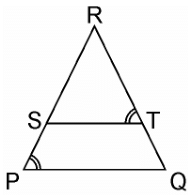
And ∠P = ∠RTS.
In ΔRPQ and ΔRTS,
∠RTS = ∠QPS (Given)
∠R = ∠R (Common angle)
∴ ΔRPQ ~ ΔRTS (AA similarity criterion)
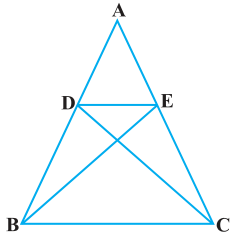
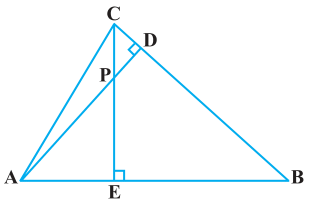
Q6. In the figure, if ΔABE ≌ ΔACD, show that ΔADE ~ ΔABC.
Sol.
Given, ΔABE ≅ ΔACD.
∴ AB = AC [By CPCT] …………….(i)
And, AD = AE [By CPCT] ………(ii)
In ΔADE and ΔABC, dividing eq.(ii) by eq(i),
AD/AB = AE/AC
∠A = ∠A [Common angle]
∴ ΔADE ~ ΔABC [SAS similarity criterion]

Q7. In the figure, altitudes AD and CE of ΔABC intersect each other at the point P. Show that:

(i) ΔAEP ~ ΔCDP 
(ii) ΔABD ~ ΔCBE 
(iii) ΔAEP ~ ΔADB 
(iv) ΔPDC ~ ΔBEC
Sol. 
Given, altitudes AD and CE of ΔABC intersect each other at the point P.
(i) In ΔAEP and ΔCDP,
∠AEP = ∠CDP (90° each)
∠APE = ∠CPD (Vertically opposite angles)
Hence, by AA similarity criterion,
ΔAEP ~ ΔCDP
(ii) In ΔABD and ΔCBE,
∠ADB = ∠CEB ( 90° each)
∠ABD = ∠CBE (Common Angles)
Hence, by AA similarity criterion,
ΔABD ~ ΔCBE
(iii) In ΔAEP and ΔADB,
∠AEP = ∠ADB (90° each)
∠PAE = ∠DAB (Common Angles)
Hence, by AA similarity criterion,
ΔAEP ~ ΔADB
(iv) In ΔPDC and ΔBEC,
∠PDC = ∠BEC (90° each)
∠PCD = ∠BCE (Common angles)
Hence, by AA similarity criterion,
ΔPDC ~ ΔBEC
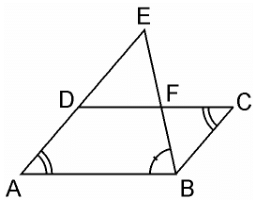

Q8. E is a point on the side AD produced of a parallelogram ABCD and BE intersects CD at F. Show that Δ ABE ~ ΔCFB.
Sol. 
Given, E is a point on the side AD produced of a parallelogram ABCD and BE intersects CD at F. Consider the figure below,

In ΔABE and ΔCFB,
∠A = ∠C (Opposite angles of a parallelogram)
∠AEB = ∠CBF (Alternate interior angles as AE || BC)
∴ ΔABE ~ ΔCFB (AA similarity criterion)
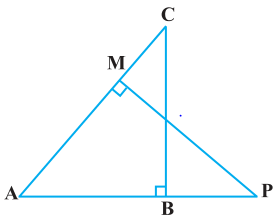
Q9. In the figure, ABC and AMP are two right triangles, right angled at B and M respectively. Prove that:
(i) Δ ABC ~ Δ AMP 
(ii) CA/PA = BC/MP
Sol. 
Given, ABC and AMP are two right triangles, right angled at B and M respectively.
(i) In ΔABC and ΔAMP, we have,
∠CAB = ∠MAP (common angles)
∠ABC = ∠AMP = 90° (each 90°)
∴ ΔABC ~ ΔAMP (AA similarity criterion)
(ii) As, ΔABC ~ ΔAMP (AA similarity criterion)
If two triangles are similar then the corresponding sides are always equal,
Hence, CA/PA = BC/MP

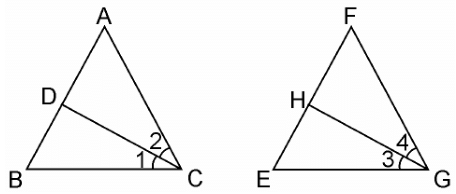
Q10. CD and GH are respectively the bisectors of ∠ACB and ∠EGF such that D and H lie on sides AB and FE of Δ ABC and Δ EFG respectively. If ΔABC ~ ΔFEG, show that:
 (i) CD/GH = AC/FG
 
(ii) ΔDCB ~ ΔHGE
(iii) ΔDCA ~ ΔHGF                       
Sol. Given, CD and GH are respectively the bisectors of ∠ACB and ∠EGF such that D and H lie on sides AB and FE of ΔABC and ΔEFG respectively.

(i) From the given condition,
ΔABC ~ ΔFEG.
∴ ∠A = ∠F, ∠B = ∠E, and ∠ACB = ∠FGE
Since, ∠ACB = ∠FGE
∴ ∠ACD = ∠FGH (Angle bisector)
And, ∠DCB = ∠HGE (Angle bisector)
In ΔACD and ΔFGH,
∠A = ∠F
∠ACD = ∠FGH
∴ ΔACD ~ ΔFGH (AA similarity criterion)
⇒ CD/GH = AC/FG
(ii) In ΔDCB and ΔHGE,
∠DCB = ∠HGE (Already proved)
∠B = ∠E (Already proved)
∴ ΔDCB ~ ΔHGE (AA similarity criterion)

(iii) In ΔDCA and ΔHGF,
∠ACD = ∠FGH (Already proved)
∠A = ∠F (Already proved)
∴ ΔDCA ~ ΔHGF (AA similarity criterion)


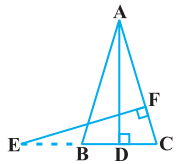
Q11. In the figure, E is a point on side CB produced of an isosceles triangle ABC with AB = AC. If AD ⊥BC and EF ⊥AC, prove that ΔABD ~ ΔECF.
Sol. 
Given, ABC is an isosceles triangle.
∴ AB = AC
⇒ ∠ABD = ∠ECF
In ΔABD and ΔECF,
∠ADB = ∠EFC (Each 90°)
∠BAD = ∠CEF (Already proved)
∴ ΔABD ~ ΔECF (using AA similarity criterion)
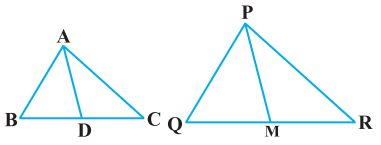
Q12. Sides AB and BC and median AD of a triangle ABC are respectively proportional to sides PQ and QR and median PM of Δ PQR (see figure). Show that Δ ABC ~ ΔPQR.
Sol. 
Given, ΔABC and ΔPQR, AB, BC and median AD of ΔABC are proportional to sides PQ, QR and median PM of ΔPQR
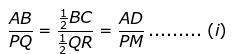
i.e. AB/PQ = BC/QR = AD/PM
We have to prove: ΔABC ~ ΔPQR
As we know here,
AB/PQ = BC/QR = AD/PM

⇒ AB/PQ = BC/QR = AD/PM (D is the midpoint of BC. M is the midpoint of QR)
⇒ ΔABD ~ ΔPQM [SSS similarity criterion]
∴ ∠ABD = ∠PQM [Corresponding angles of two similar triangles are equal]
⇒ ∠ABC = ∠PQR
In ΔABC and ΔPQR
AB/PQ = BC/QR ………………………….(i)
∠ABC = ∠PQR ……………………………(ii)
From equation (i) and (ii), we get,
ΔABC ~ ΔPQR [SAS similarity criterion]
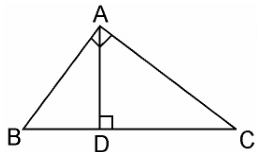

Q13. D is a point on the side BC of a triangle ABC such that ∠ADC = ∠BAC. Show that CA2 = CB.CD.
Sol. 
Given, D is a point on the side BC of a triangle ABC such that ∠ADC = ∠BAC.

In ΔADC and ΔBAC,
∠ADC = ∠BAC (Already given)
∠ACD = ∠BCA (Common angles)
∴ ΔADC ~ ΔBAC (AA similarity criterion)
We know that corresponding sides of similar triangles are in proportion.
∴ CA/CB = CD/CA
⇒ CA2 = CB.CD.
Hence, proved.


Q14. Sides AB and AC and median AD of a triangle ABC are respectively proportional to sides PQ and PR and median PM of another triangle PQR. Show that ΔABC ~ ΔPQR.
Sol. 
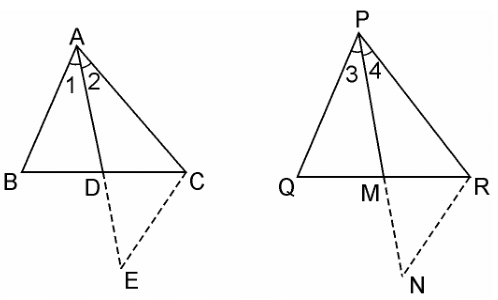
Given: Two triangles ΔABC and ΔPQR in which AD and PM are medians such that;
AB/PQ = AC/PR = AD/PM
We have to prove, ΔABC ~ ΔPQR
Let us construct first: Produce AD to E so that AD = DE. Join CE, Similarly produce PM to
N such that PM = MN, also Join RN.
In ΔABD and ΔCDE, we have
AD = DE  [By Construction.]
BD = DC [Since, AP is the median]
and, ∠ADB = ∠CDE [Vertically opposite angles]
∴ ΔABD ≅ ΔCDE [SAS criterion of congruence]
⇒ AB = CE [By CPCT] …………………………..(i)
Also, in ΔPQM and ΔMNR,
PM = MN [By Construction.]
QM = MR [Since, PM is the median]
and, ∠PMQ = ∠NMR [Vertically opposite angles]
∴ ΔPQM = ΔMNR [SAS criterion of congruence]
⇒ PQ = RN [CPCT] ……………(ii)
Now, AB/PQ = AC/PR = AD/PM
From equation (i) and (ii),
⇒ CE/RN = AC/PR = AD/PM
⇒ CE/RN = AC/PR = 2AD/2PM
⇒ CE/RN = AC/PR = AE/PN [Since 2AD = AE and 2PM = PN]
∴ ΔACE ~ ΔPRN [SSS similarity criterion]
Therefore, ∠2 = ∠4
Similarly, ∠1 = ∠3
∴ ∠1 + ∠2 = ∠3 + ∠4
⇒ ∠A = ∠P …………….(iii)
Now, in ΔABC and ΔPQR, we have
AB/PQ = AC/PR (Already given)
From equation (iii),
∠A = ∠P
∴ ΔABC ~ ΔPQR [ SAS similarity criterion]


Q15. A vertical pole of length 6 m casts a shadow 4 m long on the ground and at the same time a tower casts a shadow 28 m long. Find the height of the tower.
Sol. 

Given, Length of the vertical pole = 6m

Shadow of the pole = 4 m

Let Height of tower = h m

Length of shadow of the tower = 28 m
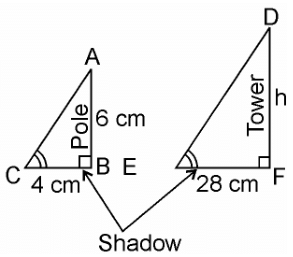
In ΔABC and ΔDEF,
∠C = ∠E (angular elevation of sum)
∠B = ∠F = 90°
∴ ΔABC ~ ΔDEF (AA similarity criterion)
∴ AB/DF = BC/EF (If two triangles are similar corresponding sides are proportional)
∴ 6/h = 4/28
⇒ h = (6×28)/4
⇒ h = 6 × 7
⇒ h = 42 m
Hence, the height of the tower is 42 m.
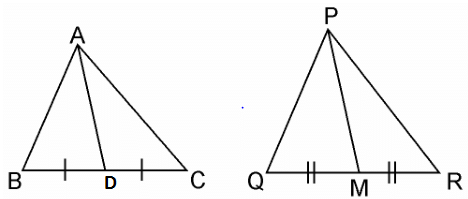

Q16. If AD and PM are medians of triangles ABC and PQR, respectively where ΔABC ~ ΔPQR, prove that AB/PQ = AD/PM..
Sol. 
Given, ΔABC ~ ΔPQR
We know that the corresponding sides of similar triangles are in proportion.
∴ AB/PQ = AC/PR = BC/QR……………………………(i)
Also, ∠A = ∠P, ∠B = ∠Q, ∠C = ∠R ………….…..(ii)
Since AD and PM are medians, they will divide their opposite sides.
∴ BD = BC/2 and QM = QR/2 ……………..………….(iii)
From equations (i) and (iii), we get
AB/PQ = BD/QM ……………………….(iv)
In ΔABD and ΔPQM,
From equation (ii), we have
∠B = ∠Q
From equation (iv), we have,
AB/PQ = BD/QM
∴ ΔABD ~ ΔPQM (SAS similarity criterion)
⇒ AB/PQ = BD/QM = AD/PM
05.Arithmetic Progression- Textbooks Solutions (Exercise 5.3 & 5.4)

Exercise 5.3

Formula for Sum of an AP

Q1: Find the sum of the following APs:
(i) 2, 7, 12, …, to 10 terms. 

Here, a = 2
d = 7 – 2 = 5
n = 10
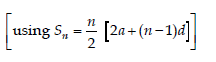
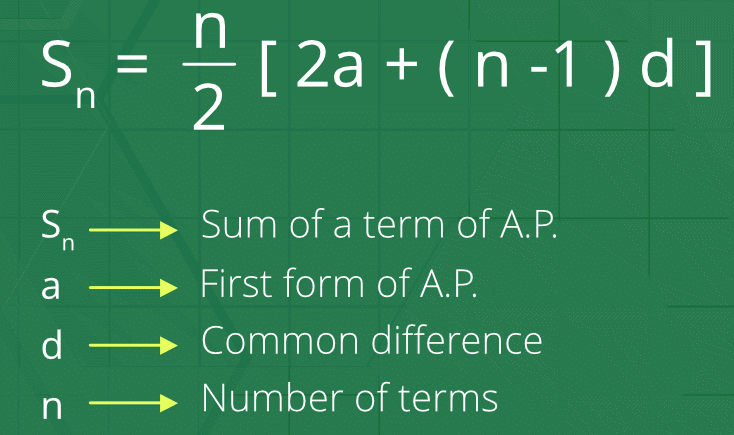
Since, Sn = n/2 [2a + (n – 1) d]
∴ S10 = [2 × 2 + (10 – 1) × 5]
⇒ S10 = 5 [4 + 9 × 5]
⇒ S10 = 5 [49] = 245
Thus, the sum of first 10 terms is 245.

(ii) – 37, – 33, – 29, …, to 12 terms.

We have:
a = – 37
d = – 33 – (- 37) = 4
n = 12
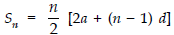
∴ Sn = n/2 [2a + (n – 1) d]
⇒ S12 = 12/2 [2 (- 37) + (12 – 1) × 4]
= 6 [- 74 + 11 × 4]
= 6 [- 74 + 44]
= 6 × [- 30] = – 180
Thus, sum of first 12 terms = -180.

(iii) 0.6, 1.7, 2.8, …, to 100 terms. 

Here, a = 0.6
d = 1.7 – 0.6 = 1.1
n = 100
∴ Sn = n/2 [2a + (n – 1) d]
S100 = 100/2 [2 (0.6) + (100 – 1) × 1.1]
= 50 [1.2 + 99 × 1.1]
= 50 [1.2 + 108.9]
= 50 [110.1]
= 5505
Thus, the required sum of first 100 terms is 5505.

(iv) Solve the following
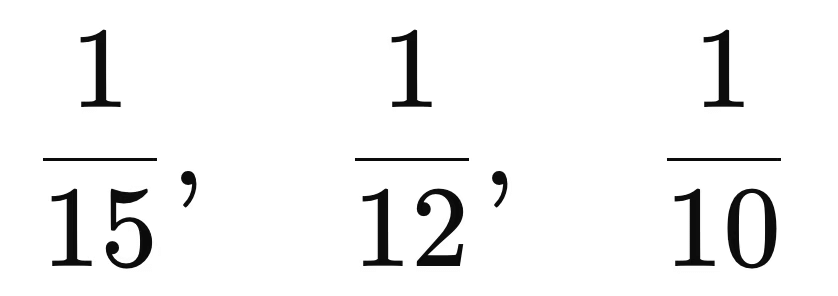
, …, to 11 terms.

Here,
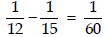
a = 1/15
d = 
n = 11
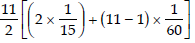
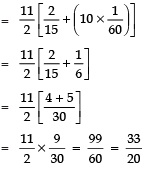
∴ Sn = n/2 [2a + (n – 1) d]
S11 = 

Thus, the required sum of first 11 terms = 33/20.

Q2: Find the sums given below:
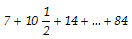
(i)   

Here, a = 7

l = 84
Let n be the number of terms
∴ Tn = a + (n – 1) d
⇒ 
⇒ 
⇒ n = 22 + 1 = 23
Now, 
⇒ 

Thus, the required sum = 

(ii) 34 + 32 + 30 + … + 10

Here, a = 34
d = 32 – 34 = – 2
l = 10
Let the number of terms be n
∴ Tn = 10
Now Tn = a + (n – 1) d
⇒ 10 = 34 + (n – 1) × (- 2)
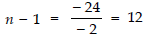
⇒ (n – 1) × (- 2) = 10 – 34 = – 24
⇒ 
⇒ n = 13

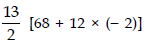
⇒ 
Now, 
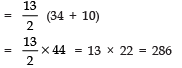
⇒ 


= 13 × 22 = 286
OR
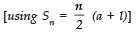
S13 = n/2  (a + l)

Thus, the required sum is 286.

(iii) – 5 + (- 8) + (- 11) + … + (- 230)

Here, a = – 5
d = – 8 – (- 5) = – 3
l = – 230
Let n be the number of terms.
∴ Tn = – 230
⇒ – 230 = – 5 + (n – 1) × (- 3)
⇒ (n – 1) × (- 3) = – 230 + 5 = – 225
⇒ n – 1 = -225/-3 = 75
⇒ n = 75 + 1 = 76
Now, 
= 38 × (- 235)
= – 8930
∴ The required sum = – 8930.


Q3: In an AP:
(i) given a = 5, d = 3, an = 50, find n and Sn.

Here, a = 5, d = 3 and an = 50 = l
∵ an = a + (n – 1) d
∴ 50 = 5 + (n – 1) × 3
⇒ 50 – 5 = (n – 1) × 3
⇒ (n – 1) × 3 = 45
⇒ (n – 1) = 45/3 =15
⇒ n = 15 + 1 = 16
Now Sn = n/2 (a + l)
= 16/2 (5 + 50)
= 8 (55) = 440
Thus, n = 16 and Sn = 440

(ii) given a = 7, a13 = 35, find d and S13.

(ii) Here, a = 7 and a13 = 35 = l

∴ an = a + (n – 1) d
⇒ 35 = 7 + (13 – 1) d
⇒ 35 – 7 = 12d
⇒ 28 = 12d
⇒ d = 28/12 = 7/3
Now, using
Sn = n/2 (a + l)
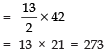
S13 = 13/2 (7 + 35)

Sn = 273 and d = 7/3

(iii) given a12 = 37, d = 3, find a and S12.

Here, a12 = 37 = l and d = 3
Let the first term of the AP be ‘a’.
Now a12 = a + (12 – 1) d
⇒ 37 = a + 11d
⇒ 37 = a + 11 × 3
⇒ 37 = a + 33
⇒ a = 37 – 33 = 4
Now, Sn = n/2 (a + l)
⇒ S12 = 12/2 (4 + 37)
⇒ S12 = 6 × (41) = 246
Thus, a = 4 and S12 = 246

(iv) given a3 = 15, S10 = 125, find d and a10.

Here, a3 = 15 = l
S10 = 125
Let first term of the AP be ‘a’ and the common difference = d
∴ a3 = a + 2d
⇒ a + 2d = 15   …(1)
Again Sn = n/2 [2a + (n – 1) d]
⇒ S10 = 10/2 [2a + (10 – 1) d]
⇒ 125 = 5 [2a + 9d]
⇒ 2a + 9d = 125/5 = 25
⇒ 2a + 9d = 25     …(2)
Multiplying (1) by 2 and subtracting (2) from it, we get
2 [a + 2d = 15] – [2a + 9d = 25]
⇒ 2a + 4d – 2a – 9d = 30 – 25
⇒ – 5d = 5
⇒ d =5/-5 = -1
∴ From (1), a + 2 (- 1) = 15 ⇒ a = 15 + 2 ⇒ a = 17
Now, a10 = a + (10 – 1) d
= 17 + 9 × (- 1)
= 17 – 9 = 8
Thus, d = – 1 and a10 = 8

(v) given d = 5, S9 = 75, find a and a9.

Here, d = 5, S9 = 75
Let the first term of the AP is ‘a’.
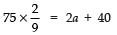
∴ S9 = 9/2 [2a + (9 – 1) × 5]
⇒ 75 = 9/2 [2a + 40]
⇒ 
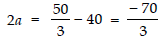
⇒ 50/3 = 2a + 40
⇒ 
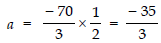
⇒ 
Now, a9 = a + (9 – 1) d
=
=

Thus, 

(vi) given a = 2, d = 8, Sn = 90, find n and an.

Here, a = 2, d = 8 and Sn = 90
∵ Sn = n/2 [2a + (n – 1) d]
∴ 90 = n/2 [2 × 2 + (n – 1) × 8]
⇒ 90 × 2 = 4n + n (n – 1) × 8
⇒ 180 = 4n + 8n2 – 8n
⇒ 180 = 8n2 – 4n
⇒ 45 = 2n2 – n
⇒ 2n2 – n – 45 = 0
⇒ 2n2 – 10n + 9n – 45 = 0
⇒ 2n (n – 5) + 9 (n – 5) = 0
⇒ (2n + 9) (n – 5) = 0
∴ Either 
or   n – 5 = 0 ⇒ n = 5
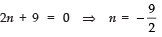
But is not required. ∴n = 5
Now, an = a + (n – 1) d
⇒ a5 = 2 + (5 – 1) × 8
= 2 + 32 = 34
Thus, n = 5 and a5 = 34.

(vii) given a = 8, an = 62, Sn = 210, find n and d.

Here, a = 8, an = 62 = l and Sn = 210
Let the common difference = d
Now, Sn = 210
⇒ 210 = n/2 (a + l)
⇒ 210 = n/2 (8 + 62) = 
∴ n = 210/35 = 6
Again an = a + (n – 1) d
⇒ 62 = 8 + (6 – 1) × d
⇒ 62 – 8 = 5d
⇒ 54 = 5d ⇒ d = 54/5
Thus, n = 6 and d = 54/5 .

(viii) given an = 4, d = 2, Sn = – 14, find n and a.

Here, an = 4, d = 2 and Sn = – 14
Let the first term be ‘a’.
∵ an = 4
∴ a + (n – 1) 2 = 4
⇒ a + 2n – 2 = 4
⇒ a = 4 – 2n + 2
⇒ a = 6 – 2n    …(1)
Also Sn = – 14
⇒ n/2 (a + l) = – 14
⇒ n/2 (a + 4) = – 14
⇒ n (a + 4) = – 28   …(2)
Substituting the value of a from (1) into (2),
n [6 – 2n + 4] = – 28
⇒ n [10 – 2n] = – 28
⇒ 2n [5 – n] = – 28
⇒ n (5 – n) = – 14 [Dividing throughout by 2]
⇒ 5n – n2 + 14 = 0
⇒ n2 – 5n – 14 = 0
⇒ n2 – 7n + 2n – 14 = 0
⇒ n (n – 7) + 2 (n – 7) = 0
⇒ (n – 7) (n + 2) = 0
∴ Either n – 7 = 0 ⇒ n = 7
or n + 2 = 0 ⇒ n = – 2
But n cannot be negative,
∴ n = 7
Now, from (1), we have
a = 6 – 2 × 7 ⇒ a = – 8
Thus, a = – 8 and n = 7

(ix) given a = 3, n = 8, S = 192, find d.

Here, a = 3, n = 8 and Sn = 192
Let the common difference = d.
∵ Sn = n/2 [2a + (n – 1) d]
∴ 192 = 8/2 [2 (3) + (8 – 1) d]
⇒ 192 = 4 [6 + 7d]
⇒ 192 = 24 + 28d
⇒ 28d = 192 – 24 = 168
⇒ d = 168/28 =6
Thus, d = 6.

(x) given l = 28, S = 144, and there are total 9 terms. Find a.

(x) Here, l = 28 and S9 = 144
Let the first term be ‘a’.
Then Sn = n/2 (a + l)
⇒ S9 = 9/2 (a + 28)
⇒ 144 = 9/2 (a + 28)
⇒ 
⇒ a = 32 – 28 = 4
Thus, a = 4.


Q4: How many terms of the AP: 9, 17, 25, … must be taken to give a sum of 636?

Here, a = 9
d = 17 – 9 = 8
Sn = 636
∵ Sn = n/2 [2a + (n – 1) d] = 636
∴ n/2 [(2 × 9) + (n – 1) × 8] = 636
⇒ n [18 + (n – 1) × 8] = 1272
⇒ n (8n + 10) = 1272
⇒ 8n2 + 10n – 1272 = 0
⇒ 4n2 + 5n – 636 = 0
⇒ 4n2 + 53n – 48n – 636 = 0
⇒ n (4n + 53) – 12 (4n + 53) = 0
⇒ (n – 12) (4n + 53) = 0
⇒ n = 12 and 
Rejecting , we have n = 12.


Q5: The first term of an AP is 5, the last term is 45 and the sum is 400. Find the number of terms and the common difference.

Here, a = 5
l = 45 = Tn
Sn = 400
∵ Tn = a + (n – 1) d
∴ 45 = 5 + (n – 1) d
⇒ (n – 1) d = 45 – 5
⇒ (n – 1) d = 40 …(1)
Also S= n/2 (a + l)
⇒ 400 = n/2 (5 + 45)
⇒ 400 × 2 = n × 50
⇒ 
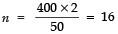
From (1), we get
(16 – 1) d = 40
⇒ 15d = 40
⇒ d = 40/15 = 8/3

Q6: The first and the last terms of an AP are 17 and 350 respectively. If the common difference is 9, how many terms are there and what is their sum

We have,
First term a = 17
Last term l = 350 = Tn
Common difference d = 9
Let the number of terms be ‘n’
∵ Tn = a + (n – 1) d
∴ 350 = 17 + (n – 1) × 9
⇒ (n – 1) × 9 = 350 – 17 = 333
⇒ n – 1 = 333/9 = 37
⇒ n = 37 + 1 = 38
Since, Sn = n/2 (a + l)
∴ S38 = 38/2 (17 + 350)
= 19 (367) = 6973
Thus, n = 38 and Sn = 6973

Q7: Find the sum of first 22 terms of an AP in which d = 7 and 22nd term is 149.

Here, n = 22, T22 = 149 = l
d = 7
Let the first term of the A.P. be ‘a’.
∴ Tn = a + (n – 1) d
⇒ Tn = a + (22 – 1) × 7
⇒ a + 21 × 7 = 149
⇒ a + 147 = 149
⇒ a = 149 – 147 = 2
Now, S22 = n/2 [a + l]
⇒ S22 = 22/2 [2 + 149]
= 11 [151] = 1661
Thus S22 = 1661

Q8: Find the sum of first 51 terms of an AP whose second and third terms are 14 and 18 respectively.

Here, n = 51, T2 = 14 and T3 = 18
Let the first term of the A.P. be ‘a’ and the common difference is d.
∴We have:
T2 = a + d ⇒ a + d = 14    …(1)
T3 = a + 2d ⇒ a + 2d = 18   …(2)
Subtracting (1) from 2, we get
a + 2d – a – d = 18 – 14
⇒ d = 14
From (1), we get
a + d = 14 ⇒ a + 4 = 14
⇒ a = 14 – 4 = 10
Now, Sn = n/2 [2a + (n – 1) d]
⇒ S51 = 51/2 [(2 × 10) + (51 – 1) × 4]
= 51/2 [20 + 200]
= 51/2 [220]
= 51 × 110 = 5610
Thus, the sum of 51 terms is 5610.

Q9: If the sum of first 7 terms of an A.P. is 49 and that of 17 terms is 289, find the sum of first n terms.

Here, we have:
S7 = 49 and S17 = 289
Let the first term of the A.P. be ‘a’ and ‘d’ be the common difference, then
Sn = n/2 [2a + (n – 1) d]
⇒ S7 = 7/2 [2a + (7 – 1) d] = 49
⇒ 7 (2a + 6d) = 2 × 49 = 98
⇒ 2a + 6d = 98/7 = 14
⇒ 2 [a + 3d] = 14
⇒ a + 3d = 14/2 = 7
⇒ a + 3d = 7 …(1)
Also, S17 = 17/2[2a + (17 – 1) d] = 289
⇒ 17/2 (2a + 16d) = 289
⇒ a + 8d = 289/17 = 17
⇒ a + 8d = 17 …(2)
Subtracting (1) from (2), we have:
a + 8d – a – 3d = 17 – 7
⇒ 5d = 10
⇒ d =10/5 = 2
Now, from (1), we have
a + 3 (2) = 7
⇒ a = 7 – 6 = 1
Now, Sn = n/2 [2a + (n – 1) d]
= n/2 [2 × 1 + (n – 1) × 2]
= n/2 [2 + 2n – 2]
= n/2 [2n]
= n × n = n2
Thus, the required sum of n terms = n2.

Q10: Show that a1, a2, …, an, … form an A.P. where an is defined as below:
(i) an = 3 + 4n 
(ii) an = 9 – 5n
Also find the sum of the first 15 terms in each case.

(i) Here, an = 3 + 4n
Putting n = 1, 2, 3, 4, ….. n, we get:
a1 = 3 + 4 (1) = 7
a2 = 3 + 4 (2) = 11
a3 = 3 + 4 (3) = 15
a4 = 3 + 4 (4) = 19
…..  ….. …..
an = 3 + 4n
∴ The A.P. in which a = 7 and d = 11 – 7 = 4 is:
7, 11, 15, 19, ….., (3 + 4n).
Now S15 = 15/2 [(2 × 7) + (15 – 1) × 4]
= 15/2 [14 + (14 × 4)]
= 15/2 [14 + 56]
= 15/2[70]
= 15 × 35 = 525
(ii) Here, an = 9 – 5n
Putting n = 1, 2, 3, 4, ….., n, we get
a1 = 9 – 5 (1) = 4
a2 = 9 – 5 (2) = – 1
a3 = 9 – 5 (3) = – 6
a4 = 9 – 5 (4) = – 11
 ….. …..
∴ The A.P. is:
4, – 1, – 6, – 11, ….. 9 – 5 (n) [having first term as 4 and d = – 1 – 4 = – 5]
∴ S15 = 15/2 [(2 × 4) + (15 – 1) × ( – 5)]
= 15/2[8 + 14 × (- 5)]
= 15/2[8 – 70]

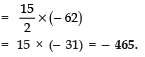
Q11: If the sum of the first n terms of an AP is 4n – n2, what is the first term (that is S1)? What is the sum of first two terms? What is the second term? Similarly, find the 3rd, the 10th and the nth terms.

We have:
Sn = 4n – n2
∴ S1 = 4 (1) – (1)2
= 4 – 1 = 3 ⇒ First term = 3
S2 = 4 (2) – (2)2
= 8 – 4 = 4 ⇒ Sum of first two terms = 4
∴ Second term (S2 – S1) = 4 – 3 = 1
S3 = 4 (3) – (3)2
= 12 – 9 = 3 ⇒ Sum of first 3 terms = 3
∴ Third term (S3 – S2) = 3 – 4 = – 1
S9 = 4 (9) – (9)2
= 36 – 81 = – 45
S10 = 4 (10) – (10)2
= 40 – 100 = – 60
∴ Tenth term = S10 – S9 = [- 60] – [- 45] = – 15
Now, Sn = 4 (n) – (n)2 = 4n – n2
Also Sn – 1 = 4 (n – 1) – (n – 1)2
= 4n – 4 – [n2 – 2n + 1]
= 4n – 4 – n2 + 2n – 1
= 6n – n2 – 5
∴ nth term = Sn – Sn – 1
= [4n – n2] – [6n – n2 – 5]
= 4n – n2 – 6n + n2 + 5 = 5 – 2n
Thus,
S1 = 3 and a1 = 3
S2 = 4 and a2 = 1
S3 = 3 and a3 = – 1
a10 = – 15 and an = 5 – 2n

Q12: Find the sum of the first 40 positive integers divisible by 6.

The first 40 positive integers divisible by 6 are:
6, 12, 18, ….., (6 × 40).
And, these numbers are in A.P. such that
a = 6
d = 12 – 6 = 6 and an = 6 × 40 = 240 = l
∴ S40 = 40/2 [(2 × 6) + (40 – 1) × 6]
= 20 [12 + 39 × 6]
= 20 [12 + 234]
= 20 × 246 = 4920
OR
Sn = n/2 [a + l]
S40 = 40/2[6 + 240]
= 20 × 246 = 4920
Thus, the sum of first 40 multiples of 6 is 4920.

Q13: Find the sum of the first 15 multiples of 8.

The first 15 multiples of 8 are:
8, (8 × 2), (8 × 3), (8 × 4), ….., (8 × 15)
or 8, 16, 24, 32, ….., 120.
These numbers are in A.P., where
a = 8 and l = 120
∴ S15 = 15/2 [a + l]
= 15/2 [8 + 120]

Thus, the sum of first positive 15 multiples of 8 is 960.

Q14: Find the sum of the odd numbers between 0 and 50.

Odd numbers between 0 and 50 are:
1, 3, 5, 7, ….., 49
These numbers are in A.P. such that
a = 1 and l = 49
Here, d = 3 – 1 = 2
∴ Tn = a + (n – 1) d
⇒ 49 = 1 + (n – 1) 2
⇒ 49 – 1 = (n – 1) 2
⇒ (n – 1) = 48/2 = 24
∴ n = 24 + 1 = 25
Now, S25 = 25/2[1+49]

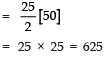
Thus, the sum of odd numbers between 0 and 50 is 625.

Q15: A contract on construction job specifies a penalty for delay of completion beyond a certain date as follows: ₹ 200 for the first day, ₹ 250 for the second day, ₹ 300 for the third day, etc., the penalty for each succeeding day being ₹ 50 more than for the preceding day. How much money the contractor has to pay as penalty, if he has delayed the work by 30 days?

Here, penalty for delay on
1st day = ₹ 200
2nd day = ₹ 250
3rd day = ₹ 300
……………
……………
Now, 200, 250, 300, ….. are in A.P. such that
a = 200, d = 250 – 200 = 50
∴ S30 is given by
S30 = 30/2 [2 (200) + (30 – 1) × 50]  

= 15 [400 + 29 × 50]
= 15 [400 + 1450]
= 15 × 1850 = 27,750
Thus, penalty for the delay for 30 days is ₹ 27,750.

Q16: A sum of ₹ 700 is to be used to give seven cash prizes to students of a school for their overall academic performace. If each prize is ₹ 20 less than its preceding prize, find the value of each of the prizes. 

Sum of all the prizes = ₹ 700
Let the first prize = a
∴ 2nd prize = (a – 20)
3rd prize = (a – 40)
4th prize = (a – 60)
………………………………….
Thus, we have, first term = a
Common difference = – 20
Number of prizes, n = 7
Sum of 7 terms Sn = 700
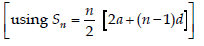
Since, Sn = n/2 [2a + (n – 1) d]
⇒ 700 = 7/2 [2 (a) + (7 – 1) × (- 20)]
⇒ 700 = 7/2 [2a + (6 × – 20)]
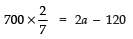
⇒ 
⇒ 200 = 2a – 120
⇒ 2a = 200 + 120 = 320
⇒ a = 320/2 = 160
Thus, the values of the seven prizes are:
₹ 160, ₹ (160 – 20), ₹ (160 – 40), ₹ (160 – 60), ₹ (160 – 80), ₹ (160 – 100) and
₹ (160 – 120)
⇒ ₹ 160, ₹ 140, ₹ 120, ₹ 100, ₹ 80, ₹ 60 and ₹ 40.

Q17: In a school, students thought of planting trees in and around the school to reduce air pollution. It was decided that the number of trees that each section of each class will plant, will be the same as the class, in which they are studying, e.g., a section of Class I will plant 1 tree, a section of Class II will plant 2 trees and so on till Class XII. There are three sections of each class. How many trees will be planted by the students?

Number of classes = 12
∵ Each class has 3 sections.
∴ Number of plants planted by class I = 1 × 3 = 3
Number of plants planted by class II = 2 × 3 = 6
Number of plants planted by class III = 3 × 3 = 9
Number of plants planted by class IV = 4 × 3 = 12
………………………………………………………………………………………….
Number of plants planted by class XII = 12 × 3 = 36
The numbers 3, 6, 9, 12, ……….., 36 are in A.P.
Here, a = 3 and d = 6 – 3 = 3

∵ Number of classes = 12
i.e., n = 12
∴ Sum of the n terms of the above A.P., is given by
S12 = 12/2 [2 (3) + (12 – 1) 3]
 
= 6 [6 + 11 × 3]
= 6 [6 + 33]
= 6 × 39 = 234
Thus, the total number of trees = 234.

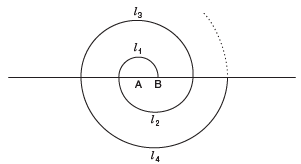
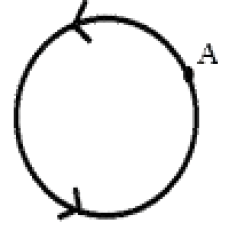
Q18: A spiral is made up of successive semi-circles, with centres alternately at A and B, starting with centre at A, of radii 0.5 cm, 1.0 cm, 1.5 cm, 2.0 cm, ….. as shown in figure. What is the total length of such a spiral made up of thirteen consecutive semi-circles? (Take π =22/7)

[Hint: Length of successive semi-circles is l1, l2, l3, l4, … with centres at A, B, A, B, …, respectively.]

Length of a semi-circle = semi-circumference
= 1/2 (2πr)
= πr
∴ l1 = π r1 = 0.5 π cm = 1 × 0.5 π cm
l2 = π r2 = 1.0 π cm = 2 × 0.5 π cm
l3 = π r3 = 1.5 π cm = 3 × 0.5 π cm
l4 = π r4 = 2.0 π cm = 4 × 0.5 π cm
…… …………… ………………….
l13 = π r13 cm = 6.5 π cm = 13 × 0.5 π cm
Now, length of the spiral
= l1 + l2 + l3 + l4 + ….. + l13
= 0.5 π [1 + 2 + 3 + 4 + ….. + 13] cm …(1)
∵ 1, 2, 3, 4, ….., 13 are in A.P. such that
a = 1 and l = 13
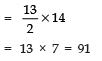
∴ S13 = 13/2 [1+13] 

∴ From (1), we have:
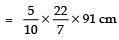
Total length of the spiral
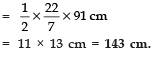
 =  1.5 π [91] cm
   

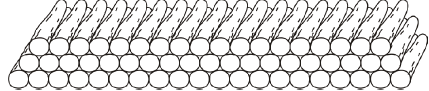
Q19: 200 logs are stacked in the following manner: 20 logs in the bottom row, 19 in the next row, 18 in the row next to it and so on (see figure). In how many rows are the 200 logs placed and how many logs are in the top row?

We have:
The number of logs:
1st row = 20
2nd row = 19
3rd row = 18
obviously, the numbers
20, 19, 18, ….., are in A.P. such that
a = 20
d = 19 – 20 = – 1
Let the numbers of rows be n.
∴ Sn = 200
Now, using, Sn =  [2a + (n – 1) d], we get
Sn = n/2 [2 (20) + (n – 1) × (- 1)]
⇒ 200 = n/2 [40 – (n – 1)]
⇒ 2 × 200 = n × 40 – n (n – 1)
⇒ 400 = 40n – n2 + n
⇒ n2 – 41n + 400 = 0
⇒ n2 – 16n – 25n + 400 = 0
⇒ n (n – 16) – 25 (n – 16) = 0
⇒ (n – 16) (n – 25) = 0
Either
⇒ n – 16 = 0 ⇒  n = 16
or n – 25 = 0 ⇒  n = 25
Tn = 0 ⇒  a + (n – 1) d = 0 ⇒  20 + (n – 1) × (- 1) = 0
⇒ n – 1 = 20 ⇒  n = 21
i.e., 21st term becomes 0
∴ n = 25 is not required.
Thus, n = 16
∴ Number of rows = 16
Now, T16 = a + (16 – 1) d
= 20 + 15 × (- 1)
= 20 – 15 = 5
∴ Number of logs in the 16th (top) row is 5.

Q20: In a potato race, a bucket is placed at the starting point, which is 5 m from the first potato, and the other potatoes are placed 3 m apart in a straight line. There are ten potatoes in the line.

A competitor starts from the bucket, picks up the nearest potato, runs back with it, drops it in the bucket, runs back to pick up the next potato, runs to the bucket to drop it in, and she continues in the same way until all the potatoes are in the bucket. What is the total distance the competitor has to run?
[Hint: To pick up the first potato and the second potato, the total distance (in metres) run by a competitor is 2 × 5 + 2 × (5 + 3)]

Here, number of potatoes = 10
The up-down distance of the bucket:
From the 1st potato = [5 m] × 2 = 10 m
From the 2nd potato = [(5 + 3) m] × 2 = 16 m
From the 3rd potato = [(5 + 3 + 3) m] × 2 = 22 m
From the 4th potato = [(5 + 3 + 3 + 3) m] × 2 = 28 m
……………………………. ………………………
∵ 10, 16, 22, 28, ….. are in A.P. such that
a = 10 and d = 16 – 10 = 6
∴ Using S= n/2 [2a + (n – 1) d], we have:
S10 = 10/2[2 (10) + (10 – 1) × 6]
= 5 [20 + 9 × 6]
= 5 [20 + 54]
= 5 [74]
= 5 × 74 = 370
Thus, the sum of above distances = 370 m.
⇒ The competitor has to run a total distance of 370 m.

Exercise 5.4

Q1: Which term of the AP: 121, 117, 113, . . ., is its first negative term? [Hint: Find n for an < 0]

Given the AP series is 121, 117, 113, . . .,

Thus, first term, a = 121

Common difference, d = 117-121= -4

By the nth term formula,

an = a+(n −1)d

Therefore,

an = 121+(n−1)(-4)

= 121-4n+4

=125-4n

To find the first negative term of the series, a< 0

Therefore,

125-4n < 0

125 < 4n

n>125/4

n>31.25

Therefore, the first negative term of the series is 32nd term.

Q2: The sum of the third and the seventh terms of an AP is 6 and their product is 8. Find the sum of first sixteen terms of the AP.

From the given statements, we can write,

a3 + a7 = 6 …………………………….(i)

And

a×a= 8 ……………………………..(ii)

By the nth term formula,

an = a+(n−1)d

Third term, a= a+(3 -1)d

a= a + 2d………………………………(iii)

And Seventh term, a7= a+(7-1)d

a= a + 6d ………………………………..(iv)

From equation (iii) and (iv), putting in equation(i), we get,

a+2d +a+6d = 6

2a+8d = 6

a+4d=3

or

a = 3–4d …………………………………(v)

Again putting the eq.(iii) and (iv), in eq. (ii), we get,

(a+2d)×(a+6d) = 8

Putting the value of a from equation (v), we get,

(3–4d +2d)×(3–4d+6d) = 8

(3 –2d)×(3+2d) = 8

3– 2d2 = 8

9 – 4d2 = 8

4d2 = 1

d = 1/2 or -1/2

Now, by putting both the values of d, we get,

a = 3 – 4d = 3 – 4(1/2) = 3 – 2 = 1, when d = 1/2

a = 3 – 4d = 3 – 4(-1/2) = 3+2 = 5, when d = -1/2

We know, the sum of nth term of AP is;

Sn = n/2 [2a +(n – 1)d]

So, when a = 1 and d=1/2

Then, the sum of first 16 terms are;

S16 = 16/2 [2 +(16-1)1/2] = 8(2+15/2) = 76

And when a = 5 and d= -1/2

Then, the sum of first 16 terms are;

S16 = 16/2 [2.5+(16-1)(-1/2)] = 8(5/2)=20

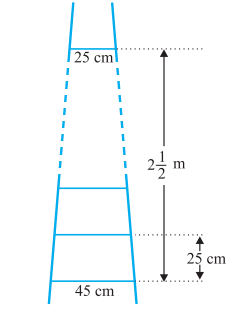
Q3: A ladder has rungs 25 cm apart. (see Fig. 5.7). The rungs decrease uniformly in length from 45 cm at the bottom to 25 cm at the top. If the top and the bottom rungs are  apart, what is the length of the wood required for the rungs? [Hint: Number of rungs = -250/25 ].

Given,

Distance between the rungs of the ladder is 25cm.

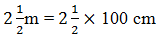
Distance between the top rung and bottom rung of the ladder is =

 = 5/2 ×100cm

= 250cm

Therefore, total number of rungs = 250/25 + 1 = 11

As we can see from the figure, the ladder has rungs in decreasing order from top to bottom. Thus, we can conclude now, that the rungs are decreasing in an order of AP.

And the length of the wood required for the rungs will be equal to the sum of the terms of AP series formed.

So,

First term, a = 45

Last term, l = 25

Number of terms, n = 11

Now, as we know, sum of nth terms is equal to,

Sn= n/2(a+ l)

Sn= 11/2(45+25) = 11/2(70) = 385 cm

Hence, the length of the wood required for the rungs is 385cm.

Q.4. The houses of a row are numbered consecutively from 1 to 49. Show that there is a value of x such that the sum of the numbers of the houses preceding the house numbered x is equal to the sum of the numbers of the houses following it. Find this value of x. [Hint :Sx – 1 = S49 – Sx ]

Given,

Row houses are numbers from 1,2,3,4,5…….49.

Thus we can see the houses numbered in a row are in the form of AP.

So,

First term, a = 1

Common difference, d=1

Let us say the number of xth houses can be represented as;

Sum of nth term of AP = n/2[2a+(n-1)d]

Sum of number of houses beyond x house = Sx-1

= (x-1)/2[2.1+(x-1-1)1]

= (x-1)/2 [2+x-2]

= x(x-1)/2 ………………………………………(i)

By the given condition, we can write,

S49 – Sx = {49/2[2.1+(49-1)1]}–{x/2[2.1+(x-1)1]}

= 25(49) – x(x + 1)/2 ………………………………….(ii)

As per the given condition, eq.(i) and eq(ii) are equal to each other;

Therefore,

x(x-1)/2 = 25(49) – x(x-1)/2

x = ±35

As we know, the number of houses cannot be a negative number. Hence, the value of x is 35.

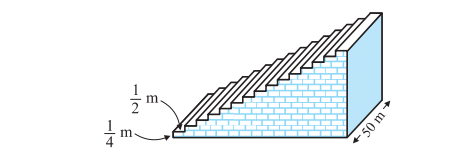
Q5: A small terrace at a football ground comprises of 15 steps each of which is 50 m long and built of solid concrete. Each step has a rise of 1 4 m and a tread of 1 2 m. (see Fig. 5.8). Calculate the total volume of concrete required to build the terrace. [Hint : Volume of concrete required to build the first step = ¼ ×1/2 ×50 m3.]

As we can see from the given figure, the first step is ½ m wide, 2nd step is 1m wide and 3rd step is 3/2m wide. Thus we can understand that the width of step by ½ m each time when height is ¼ m. And also, given length of the steps is 50m all the time. So, the width of steps forms a series AP in such a way that;

½ , 1, 3/2, 2, ……..

Volume of steps = Volume of Cuboid
= Length × Breadth Height

Now,

Volume of concrete required to build the first step = ¼ ×1/2 ×50 = 25/4
Volume of concrete required to build the second step =¼ ×1/×50 = 25/2
Volume of concrete required to build the second step = ¼ ×3/2 ×50 = 75/2

Now, we can see the volumes of concrete required to build the steps, are in AP series;
25/4 , 25/2 , 75/2 …..

Thus, applying the AP series concept,
First term, a = 25/4

Common difference, d = 25/2 – 25/4 = 25/4

As we know, the sum of n terms is;

Sn = n/2[2a+(n-1)d] = 15/2(2×(25/4 )+(15/2 -1)25/4)

Upon solving, we get,

Sn = 15/2 (100)

Sn750

Hence, the total volume of concrete required to build the terrace is 750 m3.

05. Arithmetic Progressions- Textbooks Solutions (Exercise 5.1 & 5.2)

Exercise 5.1

Q1. In which of the following situations, does the list of numbers involved make an arithmetic progression and why?
(i) The taxi fare after each km when the fare is Rs 15 for the first km and Rs 8 for each additional km.

We can write the given condition as:

  • Taxi fare for 1 km = 15
  • Taxi fare for first 2 kms = 15+8 = 23
  • Taxi fare for first 3 kms = 23+8 = 31
  • Taxi fare for first 4 kms = 31+8 = 39 and so on……

Thus, 15, 23, 31, 39 … forms an A.P. because every next term is 8 more than the preceding term.

(ii) The amount of air present in a cylinder when a vacuum pump removes 1/4 of the air remaining in the cylinder at a time.

Let the volume of air in a cylinder, initially, be  litres.

  • In each stroke, the vacuum pump removes 1/4th of air remaining in the cylinder at a time. 
  • Or we can say, after every stroke, 1-1/4 = 3/4th part of air will remain.
  • Therefore, volumes will be V, 3V/4 , (3V/4)2, (3V/4)3…and so on

Clearly, we can see here, the adjacent terms of this series do not have a common difference between them. Therefore, this series is not an A.P.

(iii) The cost of digging a well after every metre of digging, when it costs Rs 150 for the first metre and rises by Rs 50 for each subsequent metre.

We can write the given condition as:

  • Cost of digging a well for first metre = Rs.150
  • Cost of digging a well for first 2 metres = Rs.150+50 = Rs.200
  • Cost of digging a well for first 3 metres = Rs.200+50 = Rs.250
  • Cost of digging a well for first 4 metres =Rs.250+50 = Rs.300 and so on.

Clearly, 150, 200, 250, 300 … forms an A.P. with a common difference of 50 between each term.

(iv) The amount of money in the account every year, when Rs 10000 is deposited at compound interest at 8% per annum.

We know that if Rs. P is deposited at r% compound interest per annum for n years, the amount of money will be:

  • P(1+r/100)n
    Therefore, after each year, the amount of money will be;
    10000(1+8/100), 10000(1+8/100)2, 10000(1+8/100)3……

Clearly, the terms of this series do not have a common difference between them. Therefore, this series is not an A.P.

Q2. Write first four terms of the A.P. when the first term a and the common difference are given as follows:
(i) a = 10, d = 10

Let us consider, the Arithmetic Progression series be a1, a2, a3, a4, a5 …
a1 = a = 10
a2 = a1+d = 10+10 = 20
a3 = a2+d = 20+10 = 30
a4 = a3+d = 30+10 = 40
a5 = a4+d = 40+10 = 50
And so on…
Therefore, the A.P. series will be 10, 20, 30, 40, 50 …
And First four terms of this A.P. will be 10, 20, 30, and 40.

(ii) a = – 2, d = 0

Let us consider, the Arithmetic Progression series be a1, a2, a3, a4, a5 …
a1 = a = -2
a2 = a1+d = – 2+0 = – 2
a3 = a2+d = – 2+0 = – 2
a4 = a3+d = – 2+0 = – 2
Therefore, the A.P. series will be – 2, – 2, – 2, – 2 …
And, First four terms of this A.P. will be – 2, – 2, – 2 and – 2.

(iii) a = 4, d = – 3

Let us consider, the Arithmetic Progression series be a1, a2, a3, a4, a5 …
a1 = a = 4
a2 = a1+d = 4-3 = 1
a3 = a2+d = 1-3 = – 2
a4 = a3+d = -2-3 = – 5
Therefore, the A.P. series will be 4, 1, – 2 – 5 …
And, first four terms of this A.P. will be 4, 1, – 2 and – 5.

(iv) a = – 1, d = 1/2

Let us consider, the Arithmetic Progression series be a1, a2, a3, a4, a5 …
a2 = a1+d = -1+1/2 = -1/2
a3 = a2+d = -1/2+1/2 = 0
a4 = a3+d = 0+1/2 = 1/2
Thus, the A.P. series will be-1, -1/2, 0, 1/2
And First four terms of this A.P. will be -1, -1/2, 0 and 1/2.

(v) a = – 1.25, d = – 0.25

Let us consider, the Arithmetic Progression series be a1, a2, a3, a4, a5 …
a1 = a = – 1.25
a2 = a1 + d = – 1.25-0.25 = – 1.50
a3 = a2 + d = – 1.50-0.25 = – 1.75
a4 = a3 + d = – 1.75-0.25 = – 2.00
Therefore, the A.P series will be 1.25, – 1.50, – 1.75, – 2.00 ……..
And first four terms of this A.P. will be – 1.25, – 1.50, – 1.75 and – 2.00.

Q3. For the following A.P.s, write the first term and the common difference.
(i) 3, 1, – 1, – 3 …
(ii) -5, – 1, 3, 7 …
(iii) 1/3, 5/3, 9/3, 13/3 ….
(iv) 0.6, 1.7, 2.8, 3.9 …

Ans.

(i) Given series, 3, 1, – 1, – 3 …

First term, a = 3
Common difference, d = Second term – First term
⇒  1 – 3 = -2
  d = -2

(ii) Given series, – 5, – 1, 3, 7 …

First term, a = -5
Common difference, d = Second term – First term
⇒ ( – 1)-( – 5) = – 1+5 = 4 =d

(iii) Given series, 1/3, 5/3, 9/3, 13/3 ….

First term, a = 1/3
Common difference, d = Second term – First term
⇒ 5/3 – 1/3 = 4/3 = d

(iv) Given series, 0.6, 1.7, 2.8, 3.9 …

First term, a = 0.6
Common difference, d = Second term – First term
⇒ 1.7 – 0.6
⇒ 1.1 = d

Q4. Which of the following are APs? If they form an A.P. find the common difference d and write three more terms.
(i) 2, 4, 8, 16 …
(ii) 2, 5/2, 3, 7/2 ….
(iii) -1.2, -3.2, -5.2, -7.2 …
(iv) -10, – 6, – 2, 2 …
(v) 3, 3 + √2, 3 + 2√2, 3 + 3√2
(vi) 0.2, 0.22, 0.222, 0.2222 ….
(vii) 0, – 4, – 8, – 12 …
(viii) -1/2, -1/2, -1/2, -1/2 ….
(ix) 1, 3, 9, 27 …
(x) a, 2a, 3a, 4a …
(xi) aa2a3a4 …
(xii) √2, √8, √18, √32 …
(xiii) √3, √6, √9, √12 …
(xiv) 12, 32, 52, 72 …
(xv) 12, 52, 72, 73 …

Ans.
(i) Given, 2, 4, 8, 16 …

Here, the common difference is:
a2 – a1 = 4 – 2 = 2
a3 – a2 = 8 – 4 = 4
a4 – a3 = 16 – 8 = 8
Since, an+1 – aor the common difference is not the same every time.
Therefore, the given series are not forming an A.P.

(ii) Given, 2, 5/2, 3, 7/2 ….

Here,
a2 – a1 = 5/2-2 = 1/2
a3 – a2 = 3-5/2 = 1/2
a4 – a3 = 7/2-3 = 1/2
Since, an+1 – an or the common difference is same every time.
Therefore, d = 1/2 and the given series are in A.P.
The next three terms are;
a5 = 7/2+1/2 = 4
a6 = 4 +1/2 = 9/2
a7 = 9/2 +1/2 = 5

(iii) Given, -1.2, – 3.2, -5.2, -7.2 …

Here,
a2 – a1 = (-3.2)-(-1.2) = -2
a3 – a2 = (-5.2)-(-3.2) = -2
a4 – a3 = (-7.2)-(-5.2) = -2
Since, an+1 – an or common difference is same every time.
Therefore, d = -2 and the given series are in A.P.
Hence, next three terms are;
a5 = – 7.2-2 = -9.2
a6 = – 9.2-2 = – 11.2
a7 = – 11.2-2 = – 13.2

(iv) Given, -10, – 6, – 2, 2 …

Here, the terms and their difference are;
a2 – a1 = (-6)-(-10) = 4
a3 – a2 = (-2)-(-6) = 4
a4 – a3 = (2 -(-2) = 4
Since, an+1 – an or the common difference is same every time.
Therefore, d = 4 and the given numbers are in A.P.
Hence, next three terms are;
a5 = 2+4 = 6
a6 = 6+4 = 10
a7 = 10+4 = 14

(v) Given, 3, 3+√2, 3+2√2, 3+3√2

Here,
a2 – a1 = 3+√2-3 = √2
a3 – a2 = (3+2√2)-(3+√2) = √2
a4 – a3 = (3+3√2) – (3+2√2) = √2
Since, an+1 – an or the common difference is same every time.
Therefore, d = √2 and the given series forms a A.P.
Hence, next three terms are;
a5 = (3+√2) +√2 = 3+4√2
a6 = (3+4√2)+√2 = 3+5√2
a7 = (3+5√2)+√2 = 3+6√2

(vi) 0.2, 0.22, 0.222, 0.2222 ….

Here,
a2 – a1 = 0.22-0.2 = 0.02
a3 – a2 = 0.222-0.22 = 0.002
a4 – a3 = 0.2222-0.222 = 0.0002
Since, an+1 – an or the common difference is not same every time.
Therefore, and the given series doesn’t forms a A.P.

(vii) 0, -4, -8, -12 …

Here,
a2 – a1 = (-4)-0 = -4
a3 – a2 = (-8)-(-4) = -4
a4 – a3 = (-12)-(-8) = -4
Since, an+1 – an or the common difference is same every time.
Therefore, d = -4 and the given series forms a A.P.
Hence, next three terms are;
a5 = -12-4 = -16
a6 = -16-4 = -20
a7 = -20-4 = -24

(viii) -1/2, -1/2, -1/2, -1/2 ….

Here,
a2 – a1 = (-1/2) – (-1/2) = 0
a3 – a2 = (-1/2) – (-1/2) = 0
a4 – a3 = (-1/2) – (-1/2) = 0
Since, an+1 – an or the common difference is same every time.
Therefore, d = 0 and the given series forms a A.P.
Hence, next three terms are;
a5 = (-1/2)-0 = -1/2
a6 = (-1/2)-0 = -1/2
a7 = (-1/2)-0 = -1/2

(ix) 1, 3, 9, 27 …

Here,
a2 – a1 = 3-1 = 2
a3 – a2 = 9-3 = 6
a4 – a3 = 27-9 = 18
Since, an+1 – an or the common difference is not same every time.
Therefore, and the given series doesn’t form a A.P.

(x) a, 2a, 3a, 4a …

Here,
a2 – a1 = 2aa
a3 – a2 = 3a-2a = a
a4 – a3 = 4a-3a = a
Since, an+1 – an or the common difference is same every time.
Therefore, d = a and the given series forms a A.P.
Hence, next three terms are;
a5 = 4a+a = 5a
a6 = 5a+a = 6a
a7 = 6a+a = 7a

(xi) aa2a3a4 …

Here,
a2 – a1 = a2a = a(a-1)
a3 – a2 = a aa2(a-1)
a4 – a3 = a4 – aa3(a-1)
Since, an+1 – an or the common difference is not same every time.
Therefore, the given series doesn’t forms a A.P.

(xii) √2, √8, √18, √32 …

Here,
a2 – a1 = √8-√2  = 2√2-√2 = √2
a3 – a2 = √18-√8 = 3√2-2√2 = √2
a4 – a3 = 4√2-3√2 = √2
Since, an+1 – an or the common difference is same every time.
Therefore, d = √2 and the given series forms a A.P.
Hence, next three terms are;
a5 = √32+√2 = 4√2+√2 = 5√2 = √50
a6 = 5√2+√2 = 6√2 = √72
a7 = 6√2+√2 = 7√2 = √98

(xiii) √3, √6, √9, √12 …

Here,
a2 – a1 = √6-√3 = √3×√2-√3 = √3(√2-1)
a3 – a2 = √9-√6 = 3-√6 = √3(√3-√2)
a4 – a3 = √12 – √9 = 2√3 – √3×√3 = √3(2-√3)
Since, an+1 – an or the common difference is not same every time.
Therefore, the given series doesn’t form a A.P.

(xiv) 12, 32, 52, 72 …

Or, 1, 9, 25, 49 …..
Here,
a2 − a1 = 9−1 = 8
a3 − a= 25−9 = 16
a4 − a3 = 49−25 = 24
Since, an+1 – an or the common difference is not same every time.
Therefore, the given series doesn’t form an A.P.

(xv) 12, 52, 72, 73 …

Or 1, 25, 49, 73 …
Here,
a2 − a1 = 25−1 = 24
a3 − a= 49−25 = 24
a4 − a3 = 73−49 = 24
Since, an+1 – an or the common difference is same every time.
Therefore, d = 24 and the given series forms a A.P.
Hence, next three terms are:
a5 = 73+24 = 97
a6 = 97+24 = 121
a= 121+24 = 145

Exercise 5.2

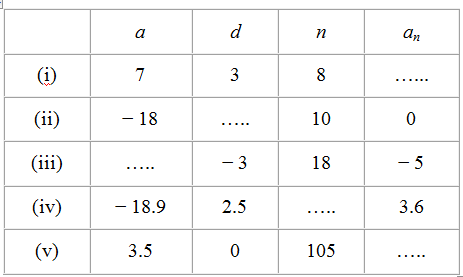
Q1: Fill in the blanks in the following table, given that a is the first term, d is the common difference and an the nth term of the A.P.

Sol: 
(i) Given:

First term, a = 7
Common difference, d = 3
Number of terms, n = 8,
We have to find the nth term, an = ?
As we know, for an A.P.,
an = a+(n−1)d
Putting the values:
⇒  7+(8 −1) 3
⇒  7+(7) 3
⇒  7+21 = 28
Hence, an = 28

(ii) Given:

First term, a = -18
Common difference, d = ?
Number of terms, n = 10
Nth term, an = 0
As we know, for an A.P.,
an = a+(n−1)d
Putting the values,
⇒ 0 = − 18 +(10−1)d
⇒ 18 = 9d
⇒ d = 18/9 = 2
Hence, common difference, = 2

(iii) Given:

First term, a = ?
Common difference, d = -3
Number of terms, n = 18
Nth term, an = -5
As we know, for an A.P.,
an = a+(n−1)d
Putting the values,
⇒ −5 = a+(18−1) (−3)
⇒ −5 = a+(17) (−3)
⇒ −5 = a−51
⇒ a = 51−5 = 46
Hence, a = 46

(iv) Given:

First term, a = -18.9
Common difference, d = 2.5
Number of terms, n = ?
Nth term, an = 3.6
As we know, for an A.P.,
⇒ an = a +(n −1)d
Putting the values,
⇒ 3.6 = − 18.9+(n −1)2.5
⇒ 3.6 + 18.9 = (n−1)2.5
⇒ 22.5 = (n−1)2.5
⇒ (n – 1) = 22.5/2.5
⇒ n – 1 = 9
⇒ n = 10
Hence, n = 10

(v) Given:

First term, a = 3.5
Common difference, d = 0
Number of terms, n = 105
Nth term, an = ?
As we know, for an A.P.,
an = a+(n −1)d
Putting the values,
⇒ an = 3.5+(105−1) 0
⇒ an = 3.5+104×0
⇒ an = 3.5
Hence, an = 3.5

Q2: Choose the correct choice in the following and justify:
(i) 30th term of the A.P: 10,7, 4, …, is
(a) 97 
(b) 77 
(c) −77 
(d) −87 

Sol:
Given here:

A.P. = 10, 7, 4, …
Therefore, we can find,
First term, a = 10
Common difference, d = a2 − a= 7−10 = −3
As we know, for an A.P.,
an = a +(n−1)d
Putting the values;
⇒ a30 = 10+(30−1)(−3)
⇒ a30 = 10+(29)(−3)
⇒ a30 = 10−87 = −77
Hence, the correct answer is option c.

(ii) 11th term of the A.P. -3, -1/2, ,2 …. is
(a) 28 
(b) 22 
(c) – 38 
(d) 

Given here:

A.P. = -3, -1/2, ,2 …
Therefore, we can find,
First term a = – 3
Common difference, d = a2 − a1 = (-1/2) -(-3)
⇒ (-1/2) + 3 = 5/2
As we know, for an A.P.,
an = a+(n−1)d
Putting the values;
⇒ a11 = 3+(11-1)(5/2)
⇒ a11 = 3+(10)(5/2)
⇒ a11 = -3+25
⇒ a11 = 22
Hence, the answer is option B.

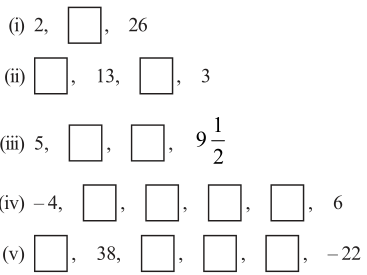
Q3: In the following APs find the missing term in the boxes.

Sol:
(i) For the given A.P., 2, 2, 26

The first and third term are;
a = 2
a3 = 26
As we know, for an A.P.,
an = a+(n −1)d
Therefore, putting the values here,
⇒ a3 = 2+(3-1)d
⇒ 26 = 2+2d
⇒ 24 = 2d
⇒ d = 12
⇒ a2 = 2+(2-1)12
⇒ a= 14
Therefore, 14 is the missing term.

(ii) For the given A.P., , 13, ,3

a2 = 13 and
a4 = 3
As we know, for an A.P.,
an = a+(n−1) d
Therefore, putting the values here,
⇒  a2 = a +(2-1)d
⇒  13 = a+d ………………. (i)
⇒  a4 = a+(4-1)d
⇒  3 = a+3d ………….. (ii)
On subtracting equation (i) from (ii), we get,
⇒  – 10 = 2d
⇒  d = – 5
From equation (i), putting the value of d,we get
⇒  13 = a+(-5)
⇒  a = 18
⇒  a3 = 18+(3-1)(-5)
⇒  18+2(-5) = 18-10 = 8
Therefore, the missing terms are 18 and 8 respectively.

(iii) For the given A.P.,

a = 5 and
a4 = 19/2
As we know, for an A.P.,
an = a+(n−1)d
Therefore, putting the values here,
⇒  a4 = a+(4-1)d
⇒  19/2 = 5+3d
⇒  (19/2) – 5 = 3d
⇒  3d = 9/2
⇒  d = 3/2
⇒  a2 = a+(2-1)d
⇒  a2 = 5+3/2
⇒  a2 = 13/2
⇒  a3 = a+(3-1)d
⇒  a3 = 5+2×3/2
⇒  a3 = 8
Therefore, the missing terms are 13/2 and 8 respectively.

(iv) For the given A.P.,

a = −4 and
a6 = 6
As we know, for an A.P.,
an = a +(n−1) d
Therefore, putting the values here,
⇒  a6 = a+(6−1)d
⇒  6 = − 4+5d
⇒  10 = 5d
⇒  d = 2
⇒  a2 = a+d = − 4+2 = −2
⇒  a3 = a+2d = − 4+2(2) = 0
⇒  a4 = a+3d = − 4+ 3(2) = 2
⇒  a5 = a+4d = − 4+4(2) = 4
Therefore, the missing terms are −2, 0, 2, and 4 respectively.

(v) For the given A.P.,

a2 = 38
a6 = −22
As we know, for an A.P.,
an = a+(n −1)d
Therefore, putting the values here,
⇒  a2 = a+(2−1)d
⇒  38 = a+d ……………………. (i)
⇒  a6 = a+(6−1)d
⇒  −22 = a+5d …………………. (ii)
On subtracting equation (i) from (ii), we get
⇒  − 22 − 38 = 4d
⇒  −60 = 4d
⇒  d = −15
⇒  a = a2 − d = 38 − (−15) = 53
⇒  a3 = a + 2d = 53 + 2 (−15) = 23
⇒  a4 = a + 3d = 53 + 3 (−15) = 8
⇒  a5 = a + 4d = 53 + 4 (−15) = −7
Therefore, the missing terms are 53, 23, 8, and −7 respectively.

Q4: Which term of the A.P. 3, 8, 13, 18, … is 78?

Sol:
Given the A.P. series as3, 8, 13, 18, …
First term, a = 3
Common difference, d = a2 − a1 = 8 − 3 = 5
Let the nth term of given A.P. be 78. Now as we know,
an = a+(n−1)d
Therefore,
⇒  78 = 3+(n −1)5
⇒  75 = (n−1)5
⇒  (n−1) = 15
⇒  n = 16
Hence, 16th term of this A.P. is 78.

Q5: Find the number of terms in each of the following A.P.
(i) 7, 13, 19, …, 205

Given, 7, 13, 19, …, 205 is the A.P

Therefore,
The first term, a = 7
Common difference, d = a2 − a1 = 13 − 7 = 6
Let there are n terms in this A.P.
an = 205
As we know, for an A.P.,
⇒  an = a + (n − 1) d
Therefore, 205 = 7 + (n − 1) 6
⇒  198 = (n − 1) 6
⇒  33 = (n − 1)
⇒  n = 34
Therefore, this given series has 34 terms in it.

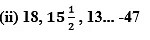
First term, a = 18
Common difference, d = a2-a=

⇒  d = (31-36)/2 = -5/2
Let there are n terms in this A.P.
an = 205
As we know, for an A.P.,
an = a+(n−1)d
⇒  -47 = 18+(n-1)(-5/2)
⇒  -47-18 = (n-1)(-5/2)
⇒  -65 = (n-1)(-5/2)
⇒  (n-1) = -130/-5
⇒  (n-1) = 26
⇒  n = 27
Therefore, this given A.P. has 27 terms in it.

Q6. Check whether -150 is a term of the A.P. 11, 8, 5, 2, …

For the given series, A.P. 11, 8, 5, 2..
First term, a = 11
Common difference, d = a2−a1 = 8−11 = −3
Let −150 be the nth term of this A.P.
As we know, for an A.P.,
an = a+(n−1)d
⇒  -150 = 11+(n -1)(-3)
⇒  -150 = 11-3n +3
⇒  -164 = -3n
⇒  n = 164/3
Clearly, n is not an integer but a fraction.
Therefore, – 150 is not a term of this A.P.

Q7. Find the 31st term of an A.P. whose 11th term is 38 and the 16th term is 73.

Sol:
Given that,
11th term, a11 = 38
and 16th term, a16 = 73
We know that,
an = a+(n−1)d
⇒  a11 = a+(11−1)d
⇒  38 = a+10d ………………………………. (i)
In the same way,
⇒  a16 = a +(16−1)d
⇒  73 = a+15d ………………………………………… (ii)
On subtracting equation (i) from (ii), we get
⇒  35 = 5d
⇒  d = 7
From equation (i), we can write,
⇒  38 = a+10×(7)
⇒  38 − 70 = a
⇒  a = −32
a31 = a +(31−1) d
⇒  − 32 + 30 (7)
⇒  − 32 + 210
⇒   178
Hence, 31st term is 178.

Q8: An A.P. consists of 50 terms of which 3rd term is 12 and the last term is 106. Find the 29th term.

Sol:
Given that,
3rd term, a3 = 12
50th term, a50 = 106
We know that,
an = a+(n−1)d
a3 = a+(3−1)d
12 = a+2d ……………………………. (i)
In the same way,
a50 = a+(50−1)d
106 = a+49d …………………………. (ii)
On subtracting equation (i) from (ii), we get
94 = 47d
d = 2 = common difference
From equation (i), we can write now,
12 = a+2(2)
a = 12−4 = 8
a29 = a+(29−1) d
a29 = 8+(28)2
a29 = 8+56 = 64
Therefore, 29th term is 64.

Q9: If the 3rd and the 9th terms of an A.P. are 4 and − 8 respectively. Which term of this A.P. is zero?

Sol:
Given that,
3rd term, a3 = 4
and 9th term, a9 = −8
We know that,
an = a+(n−1)d
Therefore,
a3 = a+(3−1)d
4 = a+2d ……………………………………… (i)
a9 = a+(9−1)d
−8 = a+8d ………………………………………………… (ii)
On subtracting equation (i) from (ii), we will get here,
−12 = 6d
d = −2
From equation (i), we can write,
4 = a+2(−2)
4 = a−4
a = 8
Let nth term of this A.P. be zero.
a= a+(n−1)d
0 = 8+(n−1)(−2)
0 = 8−2n+2
2n = 10
n = 5
Hence, 5th term of this A.P. is 0.

Q10: The 17th term of an A.P. exceeds its 10th term by 7. Find the common difference.

Sol: 

We know that, for an A.P series:
an = a+(n−1)d
a17 = a+(17−1)d
a17 = a +16d
In the same way,
a10 = a+9d
As it is given in the question,
a17 − a10 = 7
Therefore,
(a +16d) − (a+9d) = 7
7d = 7
d = 1
Therefore, the common difference is 1.

Q11: Which term of the A.P. 3, 15, 27, 39,.. will be 132 more than its 54th term?

Sol:
Given A.P. is 3, 15, 27, 39, …
first term, a = 3
common difference, d = a2 − a1 = 15 − 3 = 12
We know that,
an = a+(n−1)d
Therefore,
a54 = a+(54−1)d
⇒ 3+(53)(12)
⇒ 3+636 = 639
a54 = 639
We have to find the term of this A.P. which is 132 more than a54, i.e.771.
Let nth term be 771.
an = a+(n−1)d
771 = 3+(n −1)12
768 = (n−1)12
(n −1) = 64
n = 65
Therefore, 65th term was 132 more than 54th term.
Or another method is;
Let nth term be 132 more than 54th term.
n = 54 + 132/2
= 54 + 11 = 65th term

Q12: Two APs have the same common difference. The difference between their 100th term is 100, what is the difference between their 1000th terms?

Sol:
Let, the first term of two APs be a1 and a2 respectively
And the common difference of these APs be d.
For the first A.P.,we know,
an = a+(n−1)d
Therefore,
a100 = a1+(100−1)d
= a1 + 99d
a1000 = a1+(1000−1)d
a1000 = a1+999d
For second A.P., we know,
an = a+(n−1)d
Therefore,
a100 = a2+(100−1)d
= a2+99d
a1000 = a2+(1000−1)d
= a2+999d
Given that, difference between 100th term of the two APs = 100
Therefore, (a1+99d) − (a2+99d) = 100
a1−a2 = 100……………………………………………………………….. (i)
Difference between 1000th terms of the two APs
(a1+999d) − (a2+999d) = a1−a2
From equation (i),
This difference, a1−a= 100
Hence, the difference between 1000th terms of the two A.P. will be 100.

Q13: How many three-digit numbers are divisible by 7?

Sol:
First three-digit number that is divisible by 7 are;
First number = 105
Second number = 105+7 = 112
Third number = 112+7 =119
Therefore, 105, 112, 119, …
All are three digit numbers are divisible by 7 and thus, all these are terms of an A.P. having first term as 105 and common difference as 7.
As we know, the largest possible three-digit number is 999.
When we divide 999 by 7, the remainder will be 5.
Therefore, 999-5 = 994 is the maximum possible 3-digit number that is divisible by 7.
Now the series is as follows.
105, 112, 119, …, 994
Let 994 be the nth term of this A.P.
first term, a = 105
common difference, d = 7
an = 994
n = ?
As we know,
an = a+(n−1)d
994 = 105+(n−1)7
889 = (n−1)7
(n−1) = 127
n = 128
Therefore, 128 three-digit numbers are divisible by 7.

Q14: How many multiples of 4 lie between 10 and 250?

Sol:
The first multiple of 4 that is greater than 10 is 12.
Next multiple will be 16.
Therefore, the series formed as;
12, 16, 20, 24, …
All these are divisible by 4 and thus, all these are terms of an A.P. with first term as 12 and common difference as 4.
When we divide 250 by 4, the remainder will be 2. Therefore, 250 − 2 = 248 is divisible by 4.
The series is as follows, now;
12, 16, 20, 24, …, 248
Let 248 be the nth term of this A.P.
first term, a = 12
common difference, d = 4
an = 248
As we know,
an = a+(n−1)d
248 = 12+(n-1)×4
236/4 = n-1
59  = n-1
n = 60
Therefore, there are 60 multiples of 4 between 10 and 250.

Q15: For what value of n, are the nth terms of two APs 63, 65, 67, and 3, 10, 17, … equal?

Sol:
Given two APs as; 63, 65, 67,… and 3, 10, 17,….
Taking first AP,
63, 65, 67, …
First term, a = 63
Common difference, d = a2−a1 = 65−63 = 2
We know, nth term of this A.P. = an = a+(n−1)d
an= 63+(n−1)2 = 63+2n−2
an = 61+2n ………………………………………. (i)
Taking second AP,
3, 10, 17, …
First term, a = 3
Common difference, d = a2 − a1 = 10 − 3 = 7
We know that,
nth term of this A.P. = 3+(n−1)7
an = 3+7n−7
an = 7n−4 ……………………………………………………….. (ii)
Given, nth term of these A.P.s are equal to each other.
Equating both these equations, we get,
61+2n = 7n−4
61+4 = 5n
5n = 65
n = 13
Therefore, 13th terms of both these A.P.s are equal to each other.

Q16: Determine the A.P. whose third term is 16 and the 7th term exceeds the 5th term by 12.

Sol:
Given,
Third term, a3 = 16
As we know,
a +(3−1)d = 16
a+2d = 16 ………………………………………. (i)
It is given that, 7th term exceeds the 5th term by 12.
a7 − a5 = 12
[a+(7−1)d]−[a +(5−1)d]= 12
(a+6d)−(a+4d) = 12
2d = 12
d = 6
From equation (i), we get,
a+2(6) = 16
a+12 = 16
a = 4
Therefore, A.P. will be 4, 10, 16, 22, …

Q17: Find the 20th term from the last term of the A.P. 3, 8, 13, …, 253.

Sol:
Given A.P. is3, 8, 13, …, 253
Common difference, d= 5.
Therefore, we can write the given AP in reverse order as;
253, 248, 243, …, 13, 8, 5
Now for the new AP,
first term, a = 253
and common difference, d = 248 − 253 = −5
n = 20
Therefore, using nth term formula, we get,
a20 = a+(20−1)d
a20 = 253+(19)(−5)
a20 = 253−95
a = 158
Therefore, 20th term from the last term of the AP 3, 8, 13, …, 253 is 158.

Q18: The sum of 4th and 8th terms of an A.P. is 24 and the sum of the 6th and 10th terms is 44. Find the first three terms of the A.P.

Sol:
We know that, the nth term of the AP is;
an = a+(n−1)d
a4 = a+(4−1)d
a4 = a+3d
In the same way, we can write,
a8 = a+7d
a6 = a+5d
a10 = a+9d
Given that,
a4+a8 = 24
a+3d+a+7d = 24
2a+10d = 24
a+5d = 12 …………………………………………………… (i)
a6+a10 = 44
a +5d+a+9d = 44
2a+14d = 44
a+7d = 22  …………………………………………………… (ii)
On subtracting equation (i) from (ii), we get,
2d = 22 − 12
2d = 10
d = 5
From equation (i), we get,
a+5d = 12
a+5(5) = 12
a+25 = 12
a = −13
a2 = a+d = − 13+5 = −8
a3 = a2+d = − 8+5 = −3
Therefore, the first three terms of this A.P. are −13, −8, and −3.

Q19: Subba Rao started work in 1995 at an annual salary of Rs 5000 and received an increment of Rs 200 each year. In which year did his income reach Rs 7000?

Sol:
It can be seen from the given question, that the incomes of Subba Rao increases every year by Rs.200 and hence, forms an AP.
Therefore, after 1995, the salaries of each year are:
5000, 5200, 5400, …
Here, first term, a = 5000
and common difference, d = 200
Let after nth year, his salary be Rs 7000.
Therefore, by the nth term formula of AP,
an = a+(n−1) d
7000 = 5000+(n−1)200
200(n−1)= 2000
(n−1) = 10
n = 11
Therefore, in 11th year, his salary will be Rs 7000.

Q20: Ramkali saved Rs 5 in the first week of a year and then increased her weekly saving by Rs 1.75. If in the nth week, her weekly savings become Rs 20.75, find n.

Sol:
Given that, Ramkali saved Rs.5 in first week and then started saving each week by Rs.1.75.
Hence,
First term, a = 5
and common difference, d = 1.75
Also given,
a= 20.75
Find, n = ?
As we know, by the nth term formula,
an = a+(n−1)d
Therefore,
20.75 = 5+(n -1)×1.75
15.75 = (n -1)×1.75
(n -1) = 15.75/1.75 = 1575/175
= 63/7 = 9
n -1 = 9
n = 10
Hence, n is 10.

04.Quadratic Equations- Textbooks Solutions

Exercise 4.1

Q1. Check whether the following are quadratic equations:

(i) (x + 1)2 = 2(x−3)
We have:
(x + 1)2 = 2 (x − 3)
⇒ x+ 2x + 1 = 2x − 6
⇒ x2 + 2x + 1 − 2x + 6 = 0
⇒ x2 + 7 = 0
On comparing x2 + 7 to ax+ bx+ c=0 we find x2 + 7 = 0 is a quadratic polynomial
∴ (x + 1)2 = 2(x − 3) is a quadratic equation.

(ii) x2−2x = (− 2) (3 −x)
We have:
x2 − 2x = (− 2) (3 − x)
⇒ x2 − 2x = − 6 + 2x
⇒ x2 − 2x − 2x + 6 = 0
⇒ x2 − 4x + 6 = 0

On comparing x− 4x + 6 to ax+ bx+ c=0 we find x− 4x + 6 is a quadratic polynomial
Since x− 4x + 6 is a quadratic polynomial
∴ x2 − 2x = (−2) (3 − x) is a quadratic equation.

(iii) (x−2) (x + 1) = (x−1) (x + 3)
We have:
(x − 2) (x + 1) = (x − 1) (x + 3)
⇒ x2 − x − 2 = x2 + 2x − 3
⇒ x2 − x − 2 − x2 − 2x + 3 = 0
⇒ −3x + 1 = 0

On comparing −3x + 1 = 0 to ax+ bx+ c=0 we find −3x + 1 = 0 is a quadratic polynomial
Since −3x + 1 is a linear polynomial
∴ (x − 2) (x + 1) = (x − 1) (x + 3) is not quadratic equation.

(iv) (x−3) (2x + 1) = x(x + 5)
We have:
(x − 3) (2x + 1) = x (x + 5)
⇒ 2x2 + x − 6x −3= x+ 5x
⇒ 2x2 − 5x − 3 − x2 − 5x =0
⇒ x2 + 10x − 3= 0

On comparing x2 + 10x − 3= 0 to ax+ bx+ c=0 we find  x2 + 10x − 3= 0 is a quadratic polynomial
Since x2 + 10x − 3 is a quadratic polynomial
∴ (x − 3) (2x + 1) = x(x + 5) is a quadratic equation.

(v) (2x−1) (x−3) = (x + 5) (x−1)
We have:
(2x − 1) (x − 3) = (x + 5) (x − 1)
⇒ 2x2 − 6x − x + 3 = x2 − x + 5x − 5
⇒ 2x2 − x2 − 6x − x + x − 5x + 3 + 5 = 0
⇒ x2 − 11x + 8 = 0

On comparing  to x2 − 11x + 8 = 0 ax+ bx+ c=0 we find x2 − 11x + 8 = 0 is a quadratic polynomial
Since x2 − 11x + 8 is a quadratic polynomial
∴ (2x − 1) (x − 3) = (x + 5) (x − 1) is a quadratic equation.

(vi) x2 + 3x + 1 = (x−2)2
We have:
x2 + 3x + 1 = (x − 2)2
⇒ x2 + 3x + 1 = x2 − 4x + 4
⇒ x2 + 3x + 1 − x+ 4x −4= 0
⇒ 7x − 3 = 0

On comparing 7x − 3 = 0 to ax+ bx+ c=0 we find 7x − 3 = 0 is a quadratic polynomial
Since 7x − 3 is a linear polynomial
∴ x2 + 3x + 1 = (x − 2)is not a quadratic equation.

(vii) (x + 2)3 = 2x(x2−1)
We have:
(x + 2)3 = 2x(x2 − 1)
⇒ x3 + 3x2(2) + 3x(2)2 + (2)3 = 2x3 − 2x
⇒ x3 + 6x2 + 12x + 8 = 2x3 − 2x
⇒ x3 + 6x2 + 12x + 8 − 2x3 + 2x = 0
⇒− x3 + 6x2 + 14x + 8 = 0

On comparing− x3 + 6x2 + 14x + 8 = 0 to ax+ bx+ c=0 we find − x3 + 6x2 + 14x + 8 = 0 is  NOT a quadratic polynomial
Since −x3 + 6x2 + 14x + 8 is a polynomial of degree 3
∴ (x + 2)3 = 2x(x2 − 1) is not a quadratic equation.

(viii) x3−4x2−x + 1 = (x− 2)3
We have:
x3 − 4x2 − x + 1 = (x − 2)3
⇒ x3 − 4x2 − x + 1 = x3 + 3x2(− 2) + 3x(− 2)2 + (− 2)3
⇒ x3 − 4x2 − x + 1 = x3 − 6x2 + 12x − 8
⇒ x3 − 4x2 − x − 1 − x3 + 6x2 − 12x + 8 = 0
⇒ 2x2 − 13x + 9 = 0

On comparing 2x2 − 13x + 9 = 0 to ax+ bx+ c=0 we find 2x2 − 13x + 9 = 0  is a quadratic polynomial
Since 2x2 − 13x + 9 is a quadratic polynomial
∴ x3 − 4x2 − x + 1 = (x − 2)3 is a quadratic equation.

Q2. Represent the following situations in the form of quadratic equations:
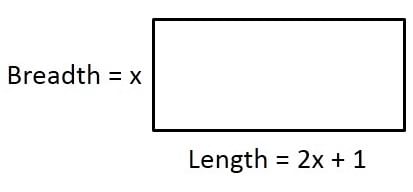
(i) The area of a rectangular plot is 528 m2. The length of the plot (in metres) is one more than twice its breadth. We need to find the length and breadth of the plot.

 Let the breadth = x metres
∵ Length = 2 (Breadth) + 1
∴ Length = (2x + 1) metres

Since Length × Breadth = Area
∴ (2x + 1) × x = 528
⇒ 2x2 + x = 528
⇒ 2x2 + x − 528 = 0
Thus, the required quadratic equation is 2x2 + x− 528 = 0

(ii) The product of two consecutive positive integers is 306. We need to find the integers.

Let the two consecutive numbers be x and (x + 1).
∵Product of the numbers = 306
∴ x (x + 1) = 306
⇒ x2 + x = 306
⇒ x2 + x − 306 = 0
Thus, the required quadratic equation is x2 + x − 306 = 0

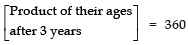
(iii) Rohan’s mother is 26 years older than him. The product of their ages (in years) 3 years from now will be 360. We would like to find Rohan’s present age.

Let the present age = x
∴ Mother’s age = (x + 26) years
After 3 years
His age = (x + 3) years
Mother’s age = [(x + 26) + 3] years
=(x + 29) years
According to the condition,

⇒ (x + 3) × (x + 29) = 360

 ⇒ x(x+29) + 3(x+29)  = 360
⇒ x2 + 29x + 3x + 87 = 360
⇒ x2 + 29x + 3x + 87 − 360 = 0
⇒ x2 + 32x − 273 = 0
Thus, the required quadratic equation is x2 + 32x − 273 = 0

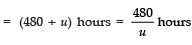
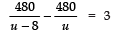
(iv) A train travels a distance of 480 km at a uniform speed. If the speed had been 8 km/h less, then it would have taken 3 hours more to cover the same distance. We need to find the speed of the train.

In the first case,
Let the speed of the train = u km/hr
Distance covered = 480 km
Time taken = Distance ÷ Speed


In the second case,

Speed = (u − 8) km/hour


According to the condition,

⇒ 480u − 480(u − 8) = 3u(u − 8)
⇒ 480u − 480u + 3840 = 3u2 − 24u
⇒ 3840 − 3u2 + 24u =0
⇒ 1280 − u+ 8u =0
⇒ − 1280 + u2 − 8u =0
⇒ u2 − 8u − 1280 = 0
Thus, the required quadratic equation is u2 − 8u – 1280 = 0

Exercise 4.2

FactorisationQ1. Find the roots of the following quadratic equations by factorisation:
Solutions:
(i) x2 – 3x – 10 = 0
Taking LHS,
⇒x2 – 5x + 2x – 10
⇒x(x – 5) + 2(x – 5)
⇒(x – 5)(x + 2)
The roots of this equation, x2 – 3x – 10 = 0 are the values of x for which (x – 5)(x + 2) = 0
Therefore, x – 5 = 0 or x + 2 = 0
 x = 5 or x = -2

(ii) 2x2 + x – 6 = 0
Taking LHS,
⇒ 2x2 + 4x – 3x – 6
⇒ 2x(x + 2) – 3(x + 2)
⇒ (x + 2)(2x – 3)
The roots of this equation, 2x2 + x – 6=0 are the values of x for which (x – 5)(x + 2) = 0
Therefore, x + 2 = 0 or 2x – 3 = 0
⇒ x = -2 or x = 3/2

(iii) √2 x2 + 7x + 5√2 = 0
Taking LHS,
⇒ √2 x+ 5x + 2x + 5√2
⇒ x (√2x + 5) + √2(√2x + 5)= (√2x + 5)(x + √2)
The roots of this equation, √2 x2 + 7x + 5√2=0 are the values of x for which (x – 5)(x + 2) = 0
Therefore, √2x + 5 = 0 or x + √2 = 0
 x = -5/√2 or x = -√2

(iv) 2x2 – x +1/8 = 0
Taking LHS,
⇒1/8 (16x2  – 8x + 1)
⇒ 1/8 (16x2  – 4x -4x + 1)
⇒1/8 (4x(4x  – 1) -1(4x – 1))
⇒1/8 (4x – 1)2
The roots of this equation, 2x2 – x + 1/8 = 0, are the values of x for which (4x – 1)2= 0
Therefore, (4x – 1) = 0 or (4x – 1) = 0
⇒ x = 1/4

(v) Given, 100x2 – 20x + 1=0
Taking LHS,
⇒100x2 – 10x – 10x + 1
⇒10x(10x – 1) -1(10x – 1)
⇒(10x – 1)2
The roots of this equation, 100x2 – 20x + 1=0, are the values of x for which (10x – 1)2= 0
∴ (10x – 1) = 0 or (10x – 1) = 0
⇒x = 1/10


Q2. Solve the problems given in Example 1.
Represent the following situations mathematically:
(i) John and Jivanti together have 45 marbles. Both of them lost 5 marbles each, and the product of the number of marbles they now have is 124. We would like to find out how many marbles they had to start with.
(ii) A cottage industry produces a certain number of toys in a day. The cost of production of each toy (in rupees) was found to be 55 minus the number of toys produced in a day. On a particular day, the total cost of production was Rs 750. We would like to find out the number of toys produced on that day.
Solutions:
(i) Let us say, the number of marbles John has = x.

Therefore, the number of marble Jivanti have = 45 – x
After losing 5 marbles each,
Number of marbles John have = x – 5
Number of marble Jivanti have = 45 – x – 5 = 40 – x
Given that the product of their marbles is 124.
∴ (x – 5)(40 – x) = 124
⇒ x2 – 45x + 324 = 0
⇒ x2 – 36x – 9x + 324 = 0
⇒ x(x – 36) -9(x – 36) = 0
⇒ (x – 36)(x – 9) = 0
Thus, we can say,
x – 36 = 0 or x – 9 = 0
 x = 36 or x = 9
Therefore,
If, John’s marbles = 36,
Then, Jivanti’s marbles = 45 – 36 = 9
And if John’s marbles = 9,
Then, Jivanti’s marbles = 45 – 9 = 36

(ii) Let us say, the number of toys produced in a day is x.
Therefore, cost of production of each toy = Rs(55 – x)
Given, the total cost of production of the toys = Rs 750
∴ x(55 – x) = 750
⇒ x2 – 55x + 750 = 0
⇒ x2 – 25x – 30x + 750 = 0
⇒ x(x – 25) -30(x – 25) = 0
⇒ (x – 25)(x – 30) = 0
Thus, either x -25 = 0 or x – 30 = 0
⇒ x = 25 or x = 30
Hence, the number of toys produced in a day, will be either 25 or 30.


Q3. Find two numbers whose sum is 27 and product is 182.
Solution:

Let us say, first number be x and the second number is 27 – x.
Therefore, the product of two numbers
x(27 – x) = 182
⇒ x2 – 27x – 182 = 0
⇒ x2 – 13x – 14x + 182 = 0
⇒ x(x – 13) -14(x – 13) = 0
⇒ (x – 13)(x -14) = 0
Thus, either, x = -13 = 0 or x – 14 = 0
 x = 13 or x = 14
Therefore, if first number = 13, then second number = 27 – 13 = 14
And if first number = 14, then second number = 27 – 14 = 13
Hence, the numbers are 13 and 14.


Q4. Find two consecutive positive integers, sum of whose squares is 365.

Solution:
Let us say, the two consecutive positive integers be x and x + 1.
Therefore, as per the given questions,
x2 + (x + 1)2 = 365
⇒ x+ x+ 1 + 2x = 365
⇒ 2x2 + 2x – 364 = 0
⇒ x+ x – 182 = 0
⇒ x+ 14x – 13x – 182 = 0
⇒ x(x + 14) -13(x + 14) = 0
⇒ (x + 14)(x – 13) = 0
Thus, either, x + 14 = 0 or x – 13 = 0,
⇒ x = – 14 or x = 13
since, the integers are positive, x can be 13, only.
∴ x + 1 = 13 + 1 = 14
Therefore, two consecutive positive integers will be 13 and 14.


Q5. The altitude of a right triangle is 7 cm less than its base. If the hypotenuse is 13 cm, find the other two sides.

Solution:
Let us say, the base of the right triangle be x cm.
Given, the altitude of right triangle = (x – 7) cm
From Pythagoras theorem, we know,
Base2 + Altitude2 = Hypotenuse2
∴ x+ (x – 7)2 = 132
⇒ x+ x+ 49 – 14x = 169
⇒ 2x– 14x – 120 = 0
⇒ x– 7x – 60 = 0
⇒ x– 12x + 5x – 60 = 0
⇒ x(x – 12) + 5(x – 12) = 0
⇒ (x – 12)(x + 5) = 0
Thus, either x – 12 = 0 or x + 5 = 0,
⇒ x = 12 or x = – 5
Since sides cannot be negative, x can only be 12.
Hence, the base of the given triangle is 12 cm and the altitude of this triangle will be (12 – 7) cm = 5 cm.


Q6. A cottage industry produces a certain number of pottery articles in a day. It was observed on a particular day that the cost of production of each article (in rupees) was 3 more than twice the number of articles produced on that day. If the total cost of production on that day was Rs.90, find the number of articles produced and the cost of each article.

Solution:
Let us say, the number of articles produced is x.
Therefore, cost of production of each article = Rs (2x + 3)
Given, the total cost of production is Rs.90
∴ x(2x + 3) = 90
⇒ 2x+ 3x – 90 = 0
⇒ 2x+ 15x -12x – 90 = 0
⇒ x(2x + 15) -6(2x + 15) = 0
⇒ (2x + 15)(x – 6) = 0
Thus, either 2x + 15 = 0 or x – 6 = 0
⇒ x = -15/2 or x = 6
As the number of articles produced can only be a positive integer, therefore, x can only be 6.
Hence, the number of articles produced = 6
Cost of each article = 2 × 6 + 3 = Rs 15.

Exercise 4.3

Q1. Find the nature of the roots of the following quadratic equations. If the real roots exist, find them;
(i) 2x2 – 3x + 5 = 0
(ii) 3x2 – 4√3x + 4 = 0
(iii) 2x2 – 6x + 3 = 0
Solutions:
(i) Given,
2x2 – 3x + 5 = 0
Comparing the equation with ax2 + bx c = 0, we get
a = 2, b = -3 and c = 5
We know, Discriminant = b2 – 4ac
( – 3)2 – 4 (2) (5) = 9 – 40
= – 31
As you can see, b2 – 4ac < 0
Therefore, no real root is possible for the given equation, 2x2 – 3x + 5 = 0.
(ii) 3x2 – 4√3x + 4 = 0
Comparing the equation with ax2 + bx c = 0, we get
a = 3, b = -4√3 and c = 4
We know, Discriminant = b2 – 4ac
= (-4√3)– 4(3)(4)
= 48 – 48 = 0
As b2 – 4ac = 0,
Real roots exist for the given equation and they are equal to each other.
Hence the roots will be –b/2a and –b/2a.
b/2= -(-4√3)/2×3 = 4√3/6 = 2√3/3 = 2/√3
Therefore, the roots are 2/√3 and 2/√3.
(iii) 2x2 – 6x + 3 = 0
Comparing the equation with ax2 + bx c = 0, we get
a = 2, b = -6, c = 3
As we know, Discriminant = b2 – 4ac
= (-6)2 – 4 (2) (3)
= 36 – 24 = 12
As b2 – 4ac > 0,
Therefore, there are distinct real roots exist for this equation, 2x2 – 6x + 3 = 0.
= (-(-6) ± √(-62-4(2)(3)) )/ 2(2)
= (6±2√3 )/4
= (3±√3)/2
Therefore the roots for the given equation are (3+√3)/2 and (3-√3)/2

Q2. Find the values of k for each of the following quadratic equations, so that they have two equal roots.
(i) 2x2 + kx + 3 = 0
(ii) kx (x – 2) + 6 = 0
Solutions:
(i) 2x2+ kx + 3 = 0
Comparing the given equation with ax2 + bx c = 0, we get,
a = 2, b = k and c = 3
As we know, Discriminant = b2 – 4ac
= (k)2 – 4(2) (3)
k2 – 24
For equal roots, we know,
Discriminant = 0
k2 – 24 = 0
k2 = 24
k = ±√24 = ±2√6
(ii) kx(x – 2) + 6 = 0
or kx2 – 2kx + 6 = 0
Comparing the given equation with ax2 + bx c = 0, we get
a = kb = – 2k and c = 6
We know, Discriminant = b2 – 4ac
= ( – 2k)2 – 4 (k) (6)
= 4k2 – 24k
For equal roots, we know,
b2 – 4ac = 0
4k2 – 24k = 0
4k (k – 6) = 0
Either 4k = 0 or k = 6 = 0
k = 0 or k = 6
However, if k = 0, then the equation will not have the terms ‘x2‘ and ‘x‘.
Therefore, if this equation has two equal roots, k should be 6 only.

Q3. Is it possible to design a rectangular mango grove whose length is twice its breadth, and the area is 800 m2? If so, find its length and breadth.
Solution:
Let the breadth of mango grove be l.
Length of mango grove will be 2l.
Area of mango grove = (2l) (l)= 2l2
2l= 800
l= 800/2 = 400
l– 400 =0
Comparing the given equation with ax2 + bx c = 0, we get
a = 1, b = 0, c = 400
As we know, Discriminant = b2 – 4ac
=> (0)2 – 4 × (1) × ( – 400) = 1600
Here, b2 – 4ac > 0
Thus, the equation will have real roots. And hence, the desired rectangular mango grove can be designed.
= ±20
As we know, the value of length cannot be negative.
Therefore, breadth of mango grove = 20 m
Length of mango grove = 2 × 20 = 40 m

Q4. Is the following situation possible? If so, determine their present ages. The sum of the ages of two friends is 20 years. Four years ago, the product of their ages in years was 48.
Solution:
Let’s say, the age of one friend be x years.
Then, the age of the other friend will be (20 – x) years.
Four years ago,
Age of First friend = (x – 4) years
Age of Second friend = (20 – x – 4) = (16 – x) years
As per the given question, we can write,
(x – 4) (16 – x) = 48
16x – x2 – 64 + 4x = 48
 – x2 + 20x – 112 = 0
x2 – 20x + 112 = 0
Comparing the equation with ax2 + bx c = 0, we get
a = 1b = -20 and c = 112
Discriminant = b2 – 4ac
= (-20)2 – 4 × 112
= 400 – 448 = -48
b2 – 4ac < 0
Therefore, there will be no real solution possible for the equations. Hence, condition doesn’t exist.

Q5. Is it possible to design a rectangular park of perimeter 80 and area 400 m2? If so find its length and breadth.
Solution:
Let the length and breadth of the park be and b.
Perimeter of the rectangular park = 2 (l + b) = 80
So, l + b = 40
Or, b = 40 – l
Area of the rectangular park = l×b = l(40 – l) = 40– l= 400
l2   40l + 400 = 0, which is a quadratic equation.
Comparing the equation with ax2 + bx c = 0, we get
a = 1, b = -40, c = 400
Since, Discriminant = b2 – 4ac
=(-40)2 – 4 × 400
= 1600 – 1600 = 0
Thus, b2 – 4ac = 0
Therefore, this equation has equal real roots. Hence, the situation is possible.
Root of the equation,
l = –b/2a
l = (40)/2(1) = 40/2 = 20
Therefore, length of rectangular park, = 20 m
And breadth of the park, = 40 – = 40 – 20 = 20 m. 

03. Pair of Linear Equations in Two Variables- Textbooks Solutions (Exercise 3.1,3.2 & 3.3)

Exercise 3.1

Q1. Form the pair of linear equations in the following problems, and find their solutions graphically.
(i) 10 students of Class X took part in a Mathematics quiz. If the number of girls is 4 more than the number of boys, find the number of boys and girls who took part in the quiz.
(ii) 5 pencils and 7 pens together cost 50, whereas 7 pencils and 5 pens together cost 46. Find the cost of one pencil and that of one pen.
Ans:
 (i)

Let number of boys = x
Number of girls = y
Given that total number of student is 10.
So, x + y = 10
Subtract y both side we get,
x = 10 – y
Putting y = 0 , 5, 10 we get,
x = 10 – 0 = 10
x = 10 – 5 = 5
x = 10 – 10 = 0x105y05

Given that If the number of girls is 4 more than the number of boys.
So, y = x + 4
Putting x = -4, 0, 4, and we get,
y = – 4 + 4 = 0
y = 0 + 4 = 4
y = 4 + 4 = 8x-404y048

Graphical representation:
Therefore, number of boys = 3 and number of girls = 7

(ii) Let 1 pencil costs Rs.x and 1 pen costs Rs.y.
According to the question, the algebraic expression cab be represented as;
5x + 7y = 50
7x + 5y = 46
For, 5x + 7y = 50 or  x = (50 – 7y) / 5, the solutions are;x30y57.14

For 7x + 5y = 46 or x = (46 – 5y) / 7, the solutions are;x6.573y05


Hence, the graphical representation is as follows:

From the graph, it can be seen that the given lines cross each other at point (3, 5).So, the cost of a pencil is Rs. 3 and cost of a pen is Rs. 5.

Q2. On comparing the ratios a1 / a2 , b1 / b2 , c1 / c2 find out whether the lines representing the following pairs of linear equations intersect at a point, are parallel or coincident:
(i) 5x – 4y + 8 = 0
7x + 6y – 9 = 0
(ii) 9x + 3y + 12 = 0
18x + 6y + 24 = 0
(iii) 6x – 3y + 10 = 0
2x – y + 9 = 0
Ans: 
(i) Given expressions;
5x − 4y + 8 = 0
7x + 6y − 9 = 0

Comparing these equations with a1x + b1y + c1 = 0
And a2x + b2y + c2 = 0
We get,
a1 = 5, b1 = -4, c1 = 8
a2 = 7, b2 = 6, c2 = -9
(a1 / a2) = 5 / 7
(b1 / b2) = -4 / 6 = -2 / 3
(c1 / c2) = 8 / -9
Since, (a/ a2) ≠ (b1 / b2)
So, the pairs of equations given in the question have a unique solution and the lines cross each other at exactly one point.

(ii) Given expressions;
9x + 3y + 12 = 0
18x + 6y + 24 = 0

Comparing these equations with a1x + b1y + c1 = 0
And a2x + b2y + c2 = 0
We get,
a1 = 9, b1 = 3, c1 = 12
a2 = 18, b2 = 6, c2= 24
(a1/ a2) = 9 / 18 = 1 / 2
(b1 / b2) = 3 / 6 = 1 / 2
(c1 / c2) = 12 / 24 = 1 / 2
Since (a1/ a2) = (b1 / b2) = (c1 / c2)
So, the pairs of equations given in the question have infinite possible solutions and the lines are coincident.

(iii) Given Expressions;
6x – 3y + 10 = 0
2x – y + 9 = 0

Comparing these equations with
a1x + b1y + c1 = 0
And a2x + b2y + c2= 0
We get,
a1 = 6, b1 = -3, c1 = 10
a2 = 2, b2= -1, c2= 9
(a1 / a2) = 6 / 2 = 3 / 1
(b1 / b2) = -3 / -1 = 3 / 1
(c1 / c2) = 10 / 9
Since (a1 / a2) = (b1 / b2) ≠ (c1 / c2)
So, the pairs of equations given in the question are parallel to each other and the lines never intersect each other at any point and there is no possible solution for the given pair of equations.

Q3. On comparing the ratio, (a1 / a2), (b1 / b2), (c1 / c2) find out whether the following pair of linear equations are consistent, or inconsistent.
(i) 3x + 2y = 5 ; 2x – 3y = 7
(ii) 2x – 3y = 8 ; 4x – 6y = 9
(iii) (3 / 2)x + (5 / 3)y = 7; 9x – 10y = 14
(iv) 5x – 3y = 11 ; – 10x + 6y = –22
(v) (4 / 3)x + 2y = 8 ; 2x + 3y = 12
Ans:
 (i) Given: 3x + 2y = 5 or 3x + 2y -5 = 0
and 2x – 3y = 7 or 2x – 3y -7 = 0
Comparing these equations with a1x + b1y + c1 = 0
And a2x + b2y + c2 = 0
We get,
a1 = 3, b1 = 2, c1 = -5
a2 = 2, b2= -3, c2= -7
(a1 / a2) = 3 / 2
(b1 / b2) = 2 / -3
(c1 / c2) = -5 / -7 = 5 / 7
Since, (a1 / a2) ≠ (b1 / b2)
So, the given equations intersect each other at one point and they have only one possible solution. The equations are consistent.

(ii) Given: 2x – 3y = 8 and 4x – 6y = 9
Therefore,
a1 = 2, b1 = -3, c1 = -8
a2= 4, b2= -6, c2 = -9
(a1 / a2) = 2 / 4 = 1 / 2
(b1 / b2) = -3 / -6 = 1 / 2
(c1 / c2) = -8 / -9 = 8 / 9
Since , (a1/ a2) = (b1/ b2) ≠ (c1 / c2)
So, the equations are parallel to each other and they have no possible solution. Hence, the equations are inconsistent.

(iii) Given: (3 / 2)x + (5 / 3)y = 7 and 9x – 10y = 14
Therefore,
a1= 3 / 2, b1= 5 / 3, c1 = -7
a2= 9, b2= -10, c2= -14
(a1/ a2) = 3 / (2 × 9) = 1 / 6
(b1/ b2) = 5 / (3× – 10)= -1 / 6
(c1 / c2) = -7 / -14 = 1 / 2
Since, (a1/ a2) ≠ (b1/ b2)
So, the equations are intersecting each other at one point and they have only one possible solution. Hence, the equations are consistent.

(iv) Given: 5x – 3y = 11 and – 10x + 6y = –22
Therefore,
a1= 5, b1 = -3, c1 = -11
a2= -10, b2 = 6, c2= 22
(a1/ a2) = 5 / (-10) = -5 / 10 = -1 / 2
(b1/ b2) = -3 / 6 = -1 / 2
(c1 / c2) = -11 / 22 = -1 / 2
Since (a1/ a2) = (b1/ b2) = (c1 / c2)
These linear equations are coincident lines and have infinite number of possible solutions. Hence, the equations are consistent.

(v) Given: (4 / 3)x + 2y = 8 and 2x + 3y = 12
a1= 4 / 3 , b1= 2 , c1 = -8
a2= 2, b2 = 3 , c2= -12
(a1/ a2) = 4 / (3 × 2)= 4 / 6 = 2 / 3
(b1/ b2) = 2 / 3
(c1 / c2) = -8 / -12 = 2 / 3
Since (a1/ a2) = (b1/ b2) = (c1 / c2)
These linear equations are coincident lines and have infinite number of possible solutions. Hence, the equations are consistent.

Q4. Which of the following pairs of linear equations are consistent/inconsistent? If consistent, obtain the solution graphically:
(i) x + y = 5, 2x + 2y = 10
(ii) x – y = 8, 3x – 3y = 16
(iii) 2x + y – 6 = 0, 4x – 2y – 4 = 0
(iv) 2x – 2y – 2 = 0, 4x – 4y – 5 = 0
Ans: (i) Given, x + y = 5 and 2x + 2y = 10
(a1/ a2) = 1 / 2
(b1/ b2) = 1 / 2
(c1 / c2) = 1 / 2
Since (a1/ a2) = (b1/ b2) = (c1 / c2)
∴The equations are coincident and they have infinite number of possible solutions.
So, the equations are consistent.
For, x + y = 5 or x = 5 – yx05y50

For 2x + 2y = 10 or x = (10 – 2y) / 2x05y50

So, the equations are represented in graphs as follows:

From the figure, we can see, that the lines are overlapping each other. Therefore, the equations have infinite possible solutions.

(ii) Given, x – y = 8 and 3x – 3y = 16
(a1/ a2) = 1 / 3
(b1/ b2) = -1 / -3 = 1 / 3
(c1 / c2) = 8 / 16 = 1 / 2
Since, (a1/ a2) = (b1/ b2) ≠ (c1 / c2)
The equations are parallel to each other and have no solutions. Hence, the pair of linear equations is inconsistent.

(iii) Given, 2x + y – 6 = 0 and 4x – 2y – 4 = 0
(a1/ a2) = 2 / 4 = 1 / 2
(b1/ b2) = 1 / -2
(c1 / c2) = -6 / -4 = 3 / 2
Since, (a1/ a2) ≠ (b1/ b2)
The given linear equations are intersecting each other at one point and have only one solution. Hence, the pair of linear equations is consistent.
Now, for 2x + y – 6 = 0 or y = 6 – 2xx03y60

And for 4x – 2y – 4 = 0 or y = (4x – 4) / 2x01y-20


So, the equations are represented in graphs as follows:

From the graph, it can be seen that these lines are intersecting each other at only one point (2,2).

(iv) Given, 2x – 2y – 2 = 0 and 4x – 4y – 5 = 0
(a1/ a2) = 2 / 4 = 1 / 2
(b1/ b2) = -2 / -4 = 1 / 2
(c1 / c2) = 2 / 5
Since, a1/ a2= b1/ b2≠ c1 / c2
Thus, these linear equations have parallel and have no possible solutions. Hence, the pair of linear equations are inconsistent.

Q5. Half the perimeter of a rectangular garden, whose length is 4 m more than its width, is 36 m. Find the dimensions of the garden.
Ans: 
Let us consider.
The width of the garden is y and length is x.
Now, according to the question, we can express the given condition as;
x – y = 4
and
y + x = 36
Now, taking  x – y = 4 or x = y + 4x40y0-4

For y + x = 36, y = 36 – xx1220y2416


The graphical representation of both the equation is as follows:
From the graph you can see, the lines intersects each other at a point(20, 16). Hence, the width of the garden is 16 and length is 20.


Q6. Given the linear equation 2x + 3y – 8 = 0, write another linear equation in two variables such that the geometrical representation of the pair so formed is:
(i) Intersecting lines
(ii) Parallel lines
(iii) Coincident lines
Ans: (i)
 Given the linear equation 2x + 3y – 8 = 0.
To find another linear equation in two variables such that the geometrical representation of the pair so formed is intersecting lines, it should satisfy below condition;
(a1/ a2) ≠ (b1/ b2)
Thus, another equation could be 2x – 7y + 9 = 0, such that;
(a1/ a2) = 2 / 2 = 1 and (b1/ b2) = 3 / -7
Clearly, you can see another equation satisfies the condition.
(ii) Given the linear equation 2x + 3y – 8 = 0.
To find another linear equation in two variables such that the geometrical representation of the pair so formed is parallel lines, it should satisfy below condition;
(a1/ a2) = (b1/ b2) ≠ (c1 / c2)
Thus, another equation could be 6x + 9y + 9 = 0, such that;
(a1/ a2) = 2 / 6 = 1 / 3
(b1/ b2) = 3 / 9= 1 / 3
(c1 / c2) = -8 / 9

Clearly, you can see another equation satisfies the condition.
(iii) Given the linear equation 2x + 3y – 8 = 0. To find another linear equation in two variables such that the geometrical representation of the pair so formed is coincident lines, it should satisfy below condition;
(a1/ a2) = (b1/ b2) = (c1 / c2)
Thus, another equation could be 4x + 6y – 16 = 0, such that;
(a1/ a2) = 2 / 4 = 1 / 2 ,(b1/ b2) = 3 / 6 = 1 / 2, (c1 / c2) = -8 / -16 = 1 / 2
Clearly, you can see another equation satisfies the condition.

Q7. Draw the graphs of the equations x – y + 1 = 0 and 3x + 2y – 12 = 0. Determine the coordinates of the vertices of the triangle formed by these lines and the x-axis, and shade the triangular region.
Ans: 
Given, the equations for graphs are x – y + 1 = 0 and 3x + 2y – 12 = 0.
For, x – y + 1 = 0 or y = 1 + xx0-1y10


For, 3x + 2y – 12 = 0 or x = (12 – 2y) / 3x04y60


Hence, the graphical representation of these equations is as follows:

From the figure, it can be seen that these lines are intersecting each other at point (2, 3) and x-axis at (−1, 0) and (4, 0). Therefore, the vertices of the triangle are (2, 3), (−1, 0), and (4, 0).

Exercise 3.2

Q1: Solve the following pair of linear equations by the substitution method

(i) x + y = 14
x – y = 4

Sol: Given,
x + y = 14 and x – y = 4 are the two equations.
From 1st equation, we get,
x = 14 – y
Now, substitute the value of x in second equation to get,
(14 – y) – y = 4
14 – 2y = 4
2y = 10
Or y = 5
By the value of y, we can now find the exact value of x;
∵ x = 14 – y
∴ x = 14 – 5
Or x = 9
Hence, x = 9 and y = 5.

(ii) s – t = 3
(s/3) + (t/2) = 6

Sol: Given,
s – t = 3 and (s/3) + (t/2) = 6 are the two equations.
From 1st equation, we get,
s = 3 + t ________________(1)
Now, substitute the value of s in second equation to get,
(3+t)/3 + (t/2) = 6
⇒ (2(3+t) + 3t )/6 = 6
⇒ (6+2t+3t)/6 = 6
⇒ (6+5t) = 36
⇒5t = 30
⇒t = 6
Now, substitute the value of t in equation (1)
s = 3 + 6 = 9
Therefore, s = 9 and t = 6.

(iii) 3x – y = 3
9x – 3y = 9

Sol: 3x – y = 3 and 9x – 3y = 9 are the two equations.
From 1st equation, we get,
x = (3+y)/3
Now, substitute the value of x in the given second equation to get,
9(3+y)/3 – 3y = 9
⇒9 +3y -3y = 9
⇒ 9 = 9
Therefore, y has infinite values and since, x = (3+y) /3, so x also has infinite values.

(iv) 0.2x + 0.3y = 1.3
0.4x + 0.5y = 2.3

Sol: Given,
0.2x + 0.3y = 1.3 and 0.4x + 0.5y = 2.3are the two equations.
From 1st equation, we get,
x = (1.3- 0.3y)/0.2 _________________(1)
Now, substitute the value of x in the given second equation to get,
0.4(1.3-0.3y)/0.2 + 0.5y = 2.3
⇒ 2(1.3 – 0.3y) + 0.5y = 2.3
⇒ 2.6 – 0.6y + 0.5y = 2.3
⇒ 2.6 – 0.1 y = 2.3
⇒ 0.1 y = 0.3
⇒ y = 3
Now, substitute the value of y in equation (1), we get,
x = (1.3-0.3(3))/0.2 = (1.3-0.9)/0.2 = 0.4/0.2 = 2
Therefore, x = 2 and y = 3.

(v) √2 x + √3 y = 0
√3 x – √8 y = 0

 Sol: Given,
√2 x + √3 y = 0 and √3 x – √8 y = 0
are the two equations.
From 1st equation, we get,
x = – (√3/√2)y __________________(1)
Putting the value of x in the given second equation to get,
√3(-√3/√2)y – √8y = 0 ⇒ (-3/√2)y- √8 y = 0
⇒ y = 0
Now, substitute the value of y in equation (1), we get,
x = 0
Therefore, x = 0 and y = 0.

(vi) (3x / 2) – (5y / 3) = -2
(x / 3) + (y / 2) = (13 / 6)
Sol: Given,
(3x/2)-(5y/3) = -2 and (x/3) + (y/2) = 13/6 are the two equations.
From 1st equation, we get,
(3/2)x = -2 + (5y/3)
⇒ x = 2(-6+5y)/9 = (-12+10y)/9 ………………………(1)
Putting the value of x in the given second equation to get,
((-12+10y)/9)/3 + y/2 = 13/6
⇒y/2 = 13/6 –( (-12+10y)/27 ) + y/2 = 13/6

Now, substitute the value of y in equation (1), we get,
(3x/2) – 5(3)/3 = -2
⇒ (3x/2) – 5 = -2
⇒ x = 2
Therefore, x = 2 and y = 3.


Q2: Solve 2x + 3y = 11 and 2x – 4y = – 24 and hence find the value of ‘m’ for which y = mx + 3.
Sol: 
2x + 3y = 11…………………………..(I)
2x – 4y = -24………………………… (II)
From equation (II), we get
x = (11-3y)/2 ………………….(III)
Substituting the value of x in equation (II), we get
2(11-3y)/2 – 4y = 24
11 – 3y – 4y = -24
-7y = -35
y = 5……………………………………..(IV)
Putting the value of y in equation (III), we get
x = (11-3×5)/2 = -4/2 = -2
Hence, x = -2, y = 5
Also,
y = mx + 3
5 = -2m +3
-2m = 2
m = -1
Therefore the value of m is -1.


Q3: Form the pair of linear equations for the following problems and find their solution by substitution method.
(i) The difference between two numbers is 26 and one number is three times the other. Find them.
Sol: Let the two numbers be x and y respectively, such that y > x.
According to the question,
y = 3x ……………… (1)
y – x = 26 …………..(2)
Substituting the value of (1) into (2), we get
3x – x = 26
x = 13 ……………. (3)
Substituting (3) in (1), we get y = 39
Hence, the numbers are 13 and 39.

(ii) The larger of two supplementary angles exceeds the smaller by 18 degrees. Find them.
Sol: Let the larger angle by xo and smaller angle be yo.
We know that the sum of two supplementary pair of angles is always 180o.
According to the question,
x + y = 180o……………. (1)
x – y = 18……………..(2)
From (1), we get x = 180o – y …………. (3)
Substituting (3) in (2), we get
180– y – y =18o
162o = 2y
y = 81o ………….. (4)
Using the value of y in (3), we get
x = 180o – 81o
= 99o
Hence, the angles are 99o and 81o.

(iii) The coach of a cricket team buys 7 bats and 6 balls for Rs.3800. Later, she buys 3 bats and 5 balls for Rs.1750. Find the cost of each bat and each ball.
Sol: Let the cost a bat be x and cost of a ball be y.
According to the question,
7x + 6y = 3800 ………………. (I)
3x + 5y = 1750 ………………. (II)
From (I), we get
y = (3800-7x)/6………………..(III)
Substituting (III) in (II). we get,
3x+5(3800-7x)/6 =1750
⇒ 3x+ 9500/3 – 35x/6 = 1750
⇒ 3x- 35x/6 = 1750 – 9500/3
⇒ (18x-35x)/6 = (5250 – 9500)/3
⇒-17x/6 = -4250/3
⇒-17x = -8500
x = 500 ……………………….. (IV)
Substituting the value of x in (III), we get
y = (3800-7 ×500)/6 = 300/6 = 50
Hence, the cost of a bat is Rs 500 and cost of a ball is Rs 50.

(iv) The taxi charges in a city consist of a fixed charge together with the charge for the distance covered. For a distance of 10 km, the charge paid is Rs 105 and for a journey of 15 km, the charge paid is Rs 155. What are the fixed charges and the charge per km? How much does a person have to pay for travelling a distance of 25 km?
Sol: Let the fixed charge be Rs x and per km charge be Rs y.
According to the question,
x + 10y = 105 …………….. (1)
x + 15y = 155 …………….. (2)
From (1), we get x = 105 – 10y ………………. (3)
Substituting the value of x in (2), we get
105 – 10y + 15y = 155
5y = 50
y = 10 …………….. (4)
Putting the value of y in (3), we get
x = 105 – 10 × 10 = 5
Hence, fixed charge is Rs 5 and per km charge = Rs 10
Charge for 25 km = x + 25y = 5 + 250 = Rs 255

(v) A fraction becomes 9/11 , if 2 is added to both the numerator and the denominator. If, 3 is added to both the numerator and the denominator it becomes 5/6. Find the fraction.
Sol: Let the fraction be x/y.
According to the question,
(x+2) /(y+2) = 9/11
11x + 22 = 9y + 18
11x – 9y = -4 …………….. (1)
(x+3) /(y+3) = 5/6
6x + 18 = 5y +15
6x – 5y = -3 ………………. (2)
From (1), we get x = (-4+9y)/11 …………….. (3)
Substituting the value of x in (2), we get
6(-4+9y)/11 -5y = -3
-24 + 54y – 55y = -33
-y = -9
y = 9 ………………… (4)
Substituting the value of y in (3), we get
x = (-4+9×9 )/11 = 7
Hence the fraction is 7/9.

(vi) Five years hence, the age of Jacob will be three times that of his son. Five years ago, Jacob’s age was seven times that of his son. What are their present ages?
Solutions: Let the age of Jacob and his son be x and y respectively.
According to the question,
(x + 5) = 3(y + 5)
x – 3y = 10 …………………………………….. (1)
(x – 5) = 7(y – 5)
x – 7y = -30 ………………………………………. (2)
From (1), we get x = 3y + 10 ……………………. (3)
Substituting the value of x in (2), we get
3y + 10 – 7y = -30
-4y = -40
y = 10 ………………… (4)
Substituting the value of y in (3), we get
x = 3 x 10 + 10 = 40
Hence, the present age of Jacob’s and his son is 40 years and 10 years respectively.


Exercise 3.3

Q1. Solve the following pair of linear equations by the elimination method and the substitution method:
(i) x + y = 5 and 2x – 3y = 4
(ii) 3x + 4y = 10 and 2x – 2y = 2
(iii) 3x – 5y – 4 = 0 and 9x = 2y + 7
(iv) x / 2 + 2y / 3 = -1 and x – y / 3 = 3
Sol: (i)
 x + y = 5 and 2x – 3y = 4
By the method of elimination:
x + y = 5 ……………………(i)
2x – 3y = 4 …………………(ii)
When the equation (i) is multiplied by 2, we get
2x + 2y = 10 ………………(iii)
When the equation (ii) is subtracted from (iii) we get,
5y = 6
y = 6 / 5 ………………(iv)
Substituting the value of y in eq. (i) we get,
x = 5 − 6 / 5 = 19 / 5
∴ x = 19 / 5, y = 6 / 5
By the method of substitution:
From the equation (i), we get:
x = 5 – y………………(v)
When the value is put in equation (ii) we get,
2(5 – y) – 3y = 4
-5y = -6
y = 6 / 5
When the values are substituted in equation (v), we get:
x = 5 − 6 / 5 = 19 / 5
∴ x = 19 / 5 ,y = 6 / 5

(ii) 3x + 4y = 10 and 2x – 2y = 2
By the method of elimination:
3x + 4y = 10………………(i)
2x – 2y = 2 …………………(ii)
When the equation (i) and (ii) is multiplied by 2, we get:
4x – 4y = 4 …………………(iii)
When the Equation (i) and (iii) are added, we get:
7x = 14
x = 2 ………………….(iv)
Substituting equation (iv) in (i) we get,
6 + 4y = 10
4y = 4
y = 1
Hence, x = 2 and y = 1
By the method of Substitution:
From equation (ii) we get,
x = 1 + y……………………(v)
Substituting equation (v) in equation (i) we get,
3(1 + y) + 4y = 10
7y = 7
y = 1
When y = 1 is substituted in equation (v) we get,
A = 1 + 1 = 2
Therefore, A = 2 and B = 1

(iii) 3x – 5y – 4 = 0 and 9x = 2y + 7
By the method of elimination:
3x – 5y – 4 = 0 ………………………(i)
9x = 2y + 7
9x – 2y – 7 = 0 ………………………(ii)
When the equation (i) and (iii) is multiplied we get,
9x – 15y – 12 = 0 ……………………(iii)
When the equation (iii) is subtracted from equation (ii) we get,
13y = -5
y = -5 / 13 …………………………(iv)
When equation (iv) is substituted in equation (i) we get,
3x + 25 / 13 − 4 = 0
3x = 27 / 13
x = 9 / 13
∴ x = 9 / 13 and y = -5 / 13
By the method of Substitution:
From the equation (i) we get,
x = (5y + 4) / 3 …………………………(v)
Putting the value (v) in equation (ii) we get,
9(5y + 4) / 3 − 2y − 7 = 0
13y = -5
y = -5 / 13
Substituting this value in equation (v) we get,
x = (5(-5 / 13) + 4) / 3
x = 9 / 13
∴ x = 9 / 13, y = -5 / 13

(iv) x / 2 + 2y / 3 = -1 and x – y / 3 = 3
By the method of Elimination:
3x + 4y = -6 …………………………. (i)
x – y / 3 = 3
3x – y = 9 ……………………………. (ii)
When the equation (ii) is subtracted from equation (i) we get,
5y = -15
y = – 3 ……………………….(iii)
When the equation (iii) is substituted in (i) we get,
3x – 12 = -6
3x = 6
x = 2
Hence, x = 2 , y = -3
By the method of Substitution:
From the equation (ii) we get,
x = (y + 9) / 3…………………………(v)
Putting the value obtained from equation (v) in equation (i) we get,
3(y + 9) / 3 + 4y = −6
5y = -15
y = -3
When y = -3 is substituted in equation (v) we get,
x = (-3 + 9) / 3 = 2
Therefore, x = 2 and y = -3

Q.2. Form the pair of linear equations in the following problems, and find their solutions (if they exist) by the elimination method:
(i) If we add 1 to the numerator and subtract 1 from the denominator, a fraction reduces to 1. It becomes if we only add 1 to the denominator. What is the fraction?
Sol: Let the fraction be a / b
According to the given information,
(a + 1) / (b – 1) = 1
=> a – b = -2 ……………..(i)
a / (b + 1) = 1 / 2
=> 2a – b = 1……………………(ii)
When equation (i) is subtracted from equation (ii) we get,
a = 3 ………………….(iii)
When a = 3 is substituted in equation (i) we get,
3 – b = -2
-b = -5
b = 5
Hence, the fraction is 3 / 5.

(ii) Five years ago, Nuri was thrice as old as Sonu. Ten years later, Nuri will be twice as old as Sonu. How old are Nuri and Sonu?
Sol: Let us assume, present age of Nuri is x
And present age of Sonu is y.
According to the given condition, we can write as;
x – 5 = 3(y – 5)
x – 3y = -10………………………(1)
Now, x + 10 = 2(y +10)
x – 2y = 10…………………(2)
Subtract eq. 1 from 2, to get, y = 20 …………………………(3)
Substituting the value of y in eq.1, we get,
x – 3.20 = -10
x – 60 = -10
x = 50
Therefore,
Age of Nuri is 50 years
Age of Sonu is 20 years.

(iii) The sum of the digits of a two-digit number is 9. Also, nine times this number is twice the number obtained by reversing the order of the digits. Find the number.
Sol:
 Let the unit digit and tens digit of a number be x and y respectively.
Then, Number (n) = 10B + A
N after reversing order of the digits = 10A + B
According to the given information, A + B = 9…………………….(i)
9(10B + A) = 2(10A + B)
88 B – 11 A = 0 -A + 8B = 0 ……………………(ii)
Adding the equations (i) and (ii) we get,
9B = 9
B = 1……………………………(3)
Substituting this value of B, in the equation (i) we get A= 8
Hence the number (N) is 10B + A = 10 x 1 + 8 = 18

(iv) Meena went to a bank to withdraw Rs.2000. She asked the cashier to give her Rs.50 and Rs.100 notes only. Meena got 25 notes in all. Find how many notes of Rs.50 and Rs.100 she received.
Sol:
 Let the number of Rs.50 notes be A and the number of Rs.100 notes be B
According to the given information,
A + B = 25 …………………(i)
50A + 100B = 2000 ……………………(ii)
When equation (i) is multiplied with (ii) we get,
50A + 50B = 1250 ……………………(iii)
Subtracting the equation (iii) from the equation (ii) we get,
50B = 750
B = 15
Substituting in the equation (i) we get,
A = 10
Hence, Meena has 10 notes of Rs.50 and 15 notes of Rs.100.

(v) A lending library has a fixed charge for the first three days and an additional charge for each day thereafter. Saritha paid Rs.27 for a book kept for seven days, while Susy paid Rs.21 for the book she kept for five days. Find the fixed charge and the charge for each extra day.
Sol:
 Let the fixed charge for the first three days be Rs.A and the charge for each day extra be Rs.B.
According to the information given,
A + 4B = 27 …………………… (i)
A + 2B = 21 ………………………(ii)
When equation (ii) is subtracted from equation (i) we get,
2B = 6
B = 3 …………………(iii)
Substituting B = 3 in equation (i) we get,
A + 12 = 27
A = 15
Hence, the fixed charge is Rs.15
And the Charge per day is Rs.3

02. Polynomials- Textbooks Solutions (Exercise 2.1& 2.2)

 Exercise 2.1

Q1: The graphs of y = p(x) are given in Fig. 2.10 below, for some polynomials p(x). Find the number of zeroes of p(x), in each case.

Sol:
Graphical method to find zeroes:
Total number of zeroes in any polynomial equation = total number of times the curve intersects x-axis.
(i) In the given graph, the number of zeroes of p(x) is 0 because the graph is parallel to x-axis does not cut it at any point.
(ii) In the given graph, the number of zeroes of p(x) is 1 because the graph intersects the x-axis at only one point.
(iii) In the given graph, the number of zeroes of p(x) is 3 because the graph intersects the x-axis at any three points.
(iv) In the given graph, the number of zeroes of p(x) is 2 because the graph intersects the x-axis at two points.
(v) In the given graph, the number of zeroes of p(x) is 4 because the graph intersects the x-axis at four points.
(vi) In the given graph, the number of zeroes of p(x) is 3 because the graph intersects the x-axis at three points.


(Exercise 2.2)

Q1: Find the zeroes of the following quadratic polynomials and verify the relationship between the zeroes and the coefficients.
(i) x2–2x –8
Sol: ⇒x2– 4x+2x–8 = x(x–4)+2(x–4) = (x-4)(x+2)
Therefore, zeroes of polynomial equation x2–2x–8 are (4, -2)
Sum of zeroes = 4–2 = 2 = -(-2)/1 = -(Coefficient of x)/(Coefficient of x2)
Product of zeroes = 4×(-2) = -8 =-(8)/1 = (Constant term)/(Coefficient of x2)

(ii) 4s2–4s+1
Sol: ⇒4s2–2s–2s+1 = 2s(2s–1)–1(2s-1) = (2s–1)(2s–1)
Therefore, zeroes of polynomial equation 4s2–4s+1 are (1/2, 1/2)
Sum of zeroes = (½)+(1/2) = 1 = -(-4)/4 = -(Coefficient of s)/(Coefficient of s2)
Product of zeros = (1/2)×(1/2) = 1/4 = (Constant term)/(Coefficient of s)

(iii) 6x2–3–7x
Sol: ⇒6x2–7x–3 = 6x– 9x + 2x – 3 = 3x(2x – 3) +1(2x – 3) = (3x+1)(2x-3)
Therefore, zeroes of polynomial equation 6x2–3–7x are (-1/3, 3/2)
Sum of zeroes = -(1/3)+(3/2) = (7/6) = -(Coefficient of x)/(Coefficient of x2)
Product of zeroes = -(1/3)×(3/2) = -(1/2) = (Constant term) /(Coefficient of x)

(iv) 4u2+8u
Sol: ⇒ 4u(u+2)
Therefore, zeroes of polynomial equation 4u2 + 8u are (0, -2).
Sum of zeroes = 0+(-2) = -2 = -(8/4) = = -(Coefficient of u)/(Coefficient of u2)
Product of zeroes = 0×-2 = 0 = 0/4 = (Constant term)/(Coefficient of u)

(v) t2–15
⇒ t2 = 15 or t = ± √15
Therefore, zeroes of polynomial equation t2 –15 are (√15, -√15)
Sum of zeroes =√15 + (-√15) = 0 = -(0/1)= -(Coefficient of t) / (Coefficient of t2)
Product of zeroes = √15 × (-√15) = -15 = -15/1 = (Constant term) / (Coefficient of t)

(vi) 3x2–x–4
⇒ 3x2–4x+3x–4 = x(3x-4)+1(3x-4) = (3x – 4)(x + 1)
Therefore, zeroes of polynomial equation3x2 – x – 4 are (4/3, -1)
Sum of zeroes = (4/3)+(-1) = (1/3)= -(-1/3) = -(Coefficient of x) / (Coefficient of x2)
Product of zeroes=(4/3)×(-1) = (-4/3) = (Constant term) /(Coefficient of x)


Q2: Find a quadratic polynomial each with the given numbers as the sum and product of its zeroes, respectively.
(i) 1/4 , -1
Sol: From the formulas of sum and product of zeroes, we know,
Sum of zeroes = α+β
Product of zeroes = α β
Sum of zeroes = α+β = 1/4
Product of zeroes = α β = -1
∴ If α and β are zeroes of any quadratic polynomial, then the quadratic polynomial equation can be written directly as:-
x2–(α+β)x +αβ = 0
x2–(1/4)x +(-1) = 0
4x2–x-4 = 0
Thus4x2–x–4 is the quadratic polynomial.

(ii) √2, 1/3
Sol: Sum of zeroes = α + β =√2
Product of zeroes = α β = 1/3
∴ If α and β are zeroes of any quadratic polynomial, then the quadratic polynomial equation can be written directly as:-
x2–(α+β)x +αβ = 0
x2 –(√2)x + (1/3) = 0
3x2-3√2x+1 = 0
Thus, 3x2-3√2x+1 is the quadratic polynomial.

(iii) 0, √5
Sol: Given,
Sum of zeroes = α+β = 0
Product of zeroes = α β = √5
∴ If α and β are zeroes of any quadratic polynomial, then the quadratic polynomial equation can be written directly as:-
x2–(α+β)x +αβ = 0
x2–(0)x +√5= 0
Thus, x2+√5 is the quadratic polynomial.

(iv) 1, 1
Sol: Given,
Sum of zeroes = α+β = 1
Product of zeroes = α β = 1
∴ If α and β are zeroes of any quadratic polynomial, then the quadratic polynomial equation can be written directly as:-
x2–(α+β)x +αβ = 0
x2–x+1 = 0
Thus, x2–x+1 is the quadratic polynomial.

(v) -1/4, 1/4
Sol: Given,
Sum of zeroes = α+β = -1/4
Product of zeroes = α β = 1/4
∴ If α and β are zeroes of any quadratic polynomial, then the quadratic polynomial equation can be written directly as:-
x2–(α+β)x +αβ = 0
x2–(-1/4)x +(1/4) = 0
4x2+x+1 = 0
Thus, 4x2+x+1 is the quadratic polynomial.

(vi) 4, 1
Sol: Given,
Sum of zeroes = α+β =4
Product of zeroes = αβ = 1
∴ If α and β are zeroes of any quadratic polynomial, then the quadratic polynomial equation can be written directly as:-
x2–(α+β)x+αβ = 0
x2–4x+1 = 0
Thus, x2–4x+1 is the quadratic polynomial.

01. Real Numbers- Textbooks Solutions (Exercise 1.2)

Q1: Prove that √5 is irrational.
Sol: Let us assume, that 5 is rational number.
i.e. 5 = x/y (where, x and y are co-primes)
y5= x
Squaring both the sides, we get,
(y5)2 = x2
⇒ 5y2 = x2……………………………….. (1)
Thus, x2 is divisible by 5, so x is also divisible by 5.
Let us say, x = 5k, for some value of k and substituting the value of x in equation (1), we get,
5y2 = (5k)2
⇒ y2 = 5k2
is divisible by 5 it means y is divisible by 5.
Clearly, x and y are not co-primes. Thus, our assumption about 5 is rational is incorrect.
Hence, 5 is an irrational number.

Q2: Prove that 3 + 2√5 + is irrational.
Sol: Let us assume 3 + 2√5 is rational.
Then we can find co-prime x and y (y ≠ 0) such that 3 + 2√5 = x/y
Rearranging, we get,Since, x and y are integers, thus, 1/2 (a/b -3) is a rational number. 
Therefore, √5 is also a rational number. But this contradicts the fact that √5 is irrational.
So, we conclude that 3 + 2√5 is irrational.

Q3: Prove that the following are irrationals:
(i) 1/√2
(ii) 7√5
(iii) 6 + 2
Sol:
(i) 1/2
Let us assume 1/√2 is rational.
Then we can find co-prime x and y (y ≠ 0) such that 1/√2 = x/y
Rearranging, we get,
√2 = y/x
Since, x and y are integers, thus, √2 is a rational number, which contradicts the fact that √2 is irrational.
Hence, we can conclude that 1/√2 is irrational.

(ii) 75
Let us assume 7√5 is a rational number.
Then we can find co-prime a and b (b ≠ 0) such that 7√5 = x/y
Rearranging, we get,
√5 = x/7y
Since, x and y are integers, thus, √5 is a rational number, which contradicts the fact that √5 is irrational.
Hence, we can conclude that 7√5 is irrational.

(iii) 6 +2
Let us assume 6 +√2 is a rational number.
Then we can find co-primes x and y (y ≠ 0) such that 6 +√2 = x/y⋅
Rearranging, we get,
√2 = (x/y) – 6
Since, x and y are integers, thus (x/y) – 6 is a rational number and therefore, √2 is rational. This contradicts the fact that √2 is an irrational number.
Hence, we can conclude that 6 +√2 is irrational.

01. Real Numbers -Textbook Solutions (Exercise 1.1)

Q1. Express each number as a product of its prime factors:
(i) 140
(ii) 156
(iii) 3825
(iv) 5005
(v) 7429
Solutions:
(i) 140
Prime factors of 140 = 2, 2, 5, 7
= 22 x 5 x 7

(ii) 156
Prime factors of 156 = 2 x 2 x 3 x 13
= 22 x 3 x 13

(iii) 3825
Prime factors of 3825 = 3 x 3 x 5 x 5 x 17
= 3x 52 x 17

(iv) 5005
Prime factors of 5005 = 5 x 7 x 11 x 13

(v) 7429
Prime factors of 7429 = 17 x 19 x 23

Q2. Find the LCM and HCF of the following pairs of integers and verify that LCM × HCF = product of the two numbers.
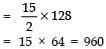
(i) 26 and 91
(ii) 510 and 92
(iii) 336 and 54
Solutions:
(i) 26 and 91
Prime factors of 26 = 2 x 13
Prime factors of 91 = 7 x 13
HCF of 26 and 91 = 13
LCM of 26 and 91 = 2 x 7 x 13
= 14 x 17
= 182
Product of two numbers = 26 x 91
= 2,366
LCM x HCF = 182 x13 = 2,366
So, product of two numbers = LCM x HCF

(ii) 510 and 92
Prime factors of 510 = 2 x 3 x 5 x17
Prime factors of 92 = 2x 2 x 23
HCF of two numbers = 2
LCM of two numbers = 2 x 2 x 3 x 5 x 17 x 23
= 23460
Product of two numbers = 510×92
= 46920
LCM x HCF = 2 x 23460
=46920
Product of two numbers = LCM x HCF

(iii) 336 and 54
Prime factors of 336 = 2 x 2 x 2 x 2 x 3 x 7
Prime factors of 54 = 2 x 3 x 3 x 3
HCF of two numbers = 6
LCM of two numbers = 2 x 2 x 2 x 2 x 3 x 3 x 3 x 7
= 24 x 33 x 7 = 3024
Product of two numbers = 336 x 54
=18144
LCM x HCF = 3024 x 6 =18144
Product duct of two numbers = LCM x HCF

Q3. Find the LCM and HCF of the following integers by applying the prime factorisation method.
(i) 12, 15 and 21
(ii) 17, 23 and 29
(iii) 8, 9 and 25
Solutions:
(i) 12, 15 and 21
Prime factors of 12 = 2 x 2 x 3
= 22 x 3
Prime factors of 15 = 3 x 5
Prime factors of 21 = 2 x 2 x 3
HCF of 12,15 and 21 = 3
LCM of 12,15 and 21 = 22 x 3 x 5 x 7
= 420

(ii) 17, 23 and 29
Prime factors of 17 = 17 x 1
Prime factors of 23 = 23 x 1
Prime factors of 29 = 29 x 1
HCF of 17, 23 and 29 = 1
LCM of 17, 23 and 29 = 17 x 23 x 29
= 11339

(iii) 8, 9 and 25
Prime factors of 8 = 2 x 2 x 2 x1
= 23 x 1
Prime factors of 9 = 3 x 3 x1
= 32 x 1
Prime factors of 25 = 5 x 5 x 1
= 52 x 1
HCF of 8, 9 and 25 = 1
LCM of 8,9 and 25 = 2 x 2 x 2 x 3 x 3 x 5 x 5
= 1800

Q4. Given that HCF (306, 657) = 9, find LCM (306, 657).
Solution:
Given, HCF (306, 657) = 9.
We have to find,
LCM (306, 657) = ?
We know that
LCM x HCF = Product of two numbers
LCM x 9 = 306x 657

LCM = 34 x 657
LCM = 22338

Q5. Check whether 6n can end with the digit 0 for any natural number n.
Solution: 
Prime factors of 6n = (2 x 3)n = (2)n (3)n
You can observe clearly, 5 is not in the prime factors of 6n.
That means 6n will not be divisible by 5.
Therefore, 6n cannot end with the digit 0 for any natural number n.

Q6. Explain why 7 × 11 × 13 + 13 and 7 × 6 × 5 × 4 × 3 × 2 × 1 + 5 are composite numbers.
Solution:
It can be observed that,
7 x 11 x 13 + 13 = 13 (7 x11 +1)
= 13( 77 + 1)
= 13 x 78
= 13 x13 x 6 x1
= 13 x13 x 2 x 3 x1
The given number has 2,3,13 and 1 as its factors. Therefore, it is a composite number.

Q7. There is a circular path around a sports field. Sonia takes 18 minutes to drive one round of the field, while Ravi takes 12 minutes for the same. Suppose they both start at the same point and at the same time, and go in the same direction. After how many minutes will they meet again at the starting point?
Solution: 
LCM of 18 and 12,
18 = 2 x 3 x 3
12 = 2 x 2 x 3
LCM of 12 and 18 = 2 x 2 x 3 x 3 = 36
Therefore, Ravi and Sonia will meet together at starting point after 36 minutes.


Check out the NCERT Solutions of all the exercises of Real Numbers:

Exercise 1.2 NCERT Solutions: Real Numbers