12.Maheshwar- Textbook Solutions

Q1: Who was Ahilya Bai?
Ans: Ahilya Bai was a warrior queen who ruled over Maheshwar in Madhya Pradesh. She built the Maheshwar Fort and was kind and wise.

Q2: Where is Maheshwar Fort located? What makes its location special?
Ans:
 Maheshwar Fort is located in Maheshwar, Madhya Pradesh, 95 kilometres from Indore. Its location is special because it is on a hill by the Narmada River, overlooking the town and the river.

Q3: What materials were used to build Maheshwar Fort, and where did they come from?
Ans: 
The Maheshwar Fort was built with special red stones. These stones came from Gujarat and Rajasthan.

Q4: What does the statue of Queen Ahilya Bai in front of the palace represent?
Ans:
 The 13-feet tall statue of Queen Ahilya Bai represents her as a guardian watching over her land.B. Think and discuss.

Q1: Aarav and Ananya get excited about visiting Maheshwar Fort. What do you think makes historical places like this interesting?
Ans
: Historical places like Maheshwar Fort are interesting because they tell stories about old times, show beautiful buildings, and let us learn about brave people like Queen Ahilya Bai.

Q2: If you were Aarav or Ananya, what part of the fort would you be most excited to see—the overhanging balconies, the statue, or the temples? Why?
Ans:
 I would be most excited to see the overhanging balconies because they seem to float in the air, and it would be fun to look down from them.

Let us Learn

A. The words “smiling”, “grinning”, and “laughing” have similar meanings.

Example:     

  • happy, joyful, cheerful     
  • brave, bold, fearless

Given below are sets of words that have similar meaning along with a word that does not fit the group. Circle the odd one out.
Q1: sad, unhappy, tearful, thrilled
Ans
: The odd one out is thrilled because it means happy, while the others mean sad.

Q2: talk, discuss, kind, speak
Ans:
 The odd one out is kind because it means nice, while the others are about speaking.

Q3: noisy, quiet, silent, calm
Ans:
 The odd one out is noisy because it means loud, while the others mean soft or quiet.

Q4: cotton, wooden, silk, woollen
Ans:
 The odd one out is wooden because it is made from wood, while the others are soft fabrics.

Find out two such sets of words and write them below.
Ans:

  • Set 1: big, large, huge
  • Set 2: run, jump, walk

B. Read the word ‘design’ aloud. 

What did you observe? 

The letter ‘g’ is silent.

Now, read the following words. Underline the words that have a silent ‘g’ letter.

Ans:

(Note: In these words, the ‘g’ is not pronounced, e.g., “sign” sounds like “sine,” “night” like “nite,” and “high” like “hi.”)

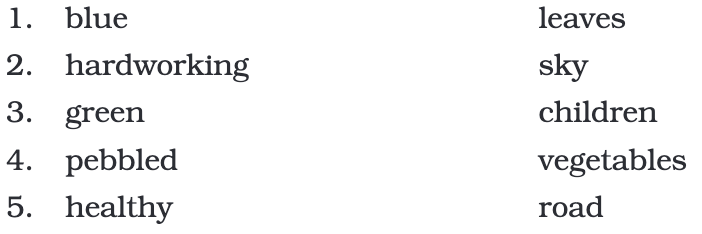
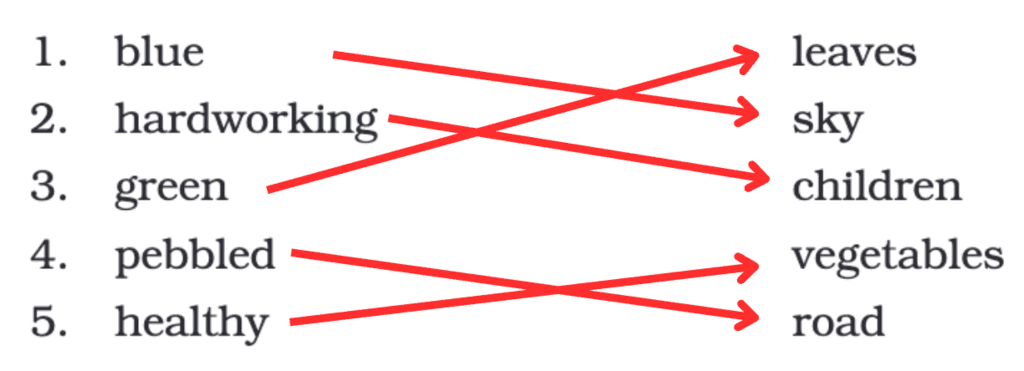
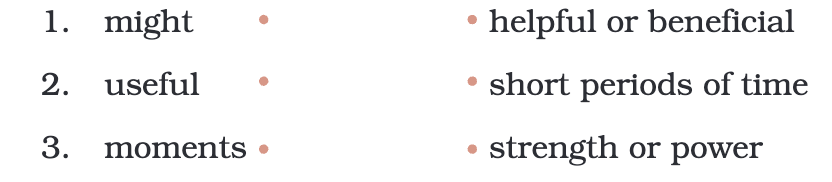
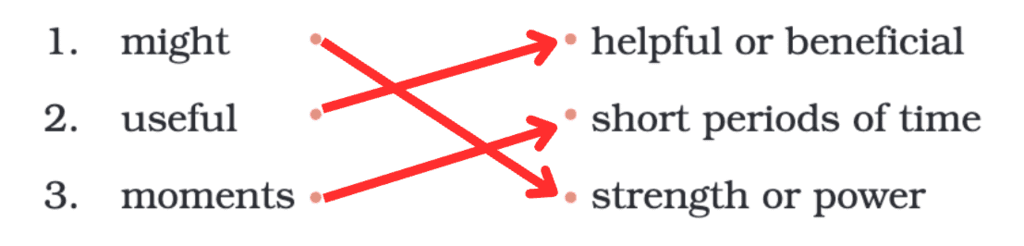
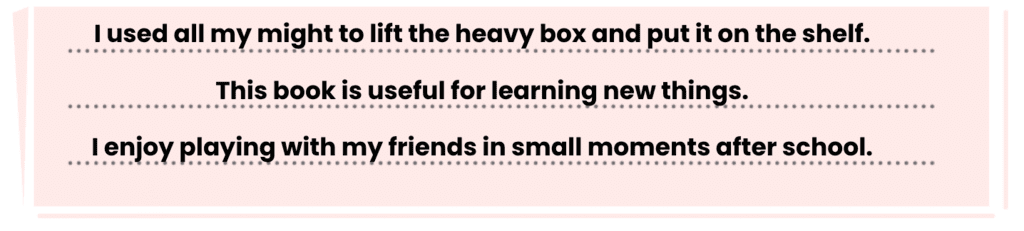
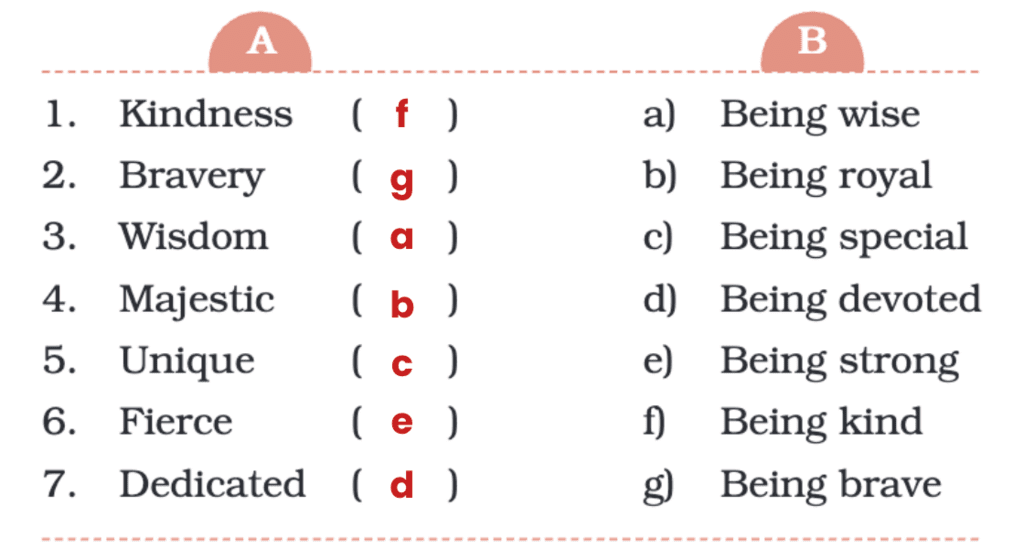
C. Match the following.
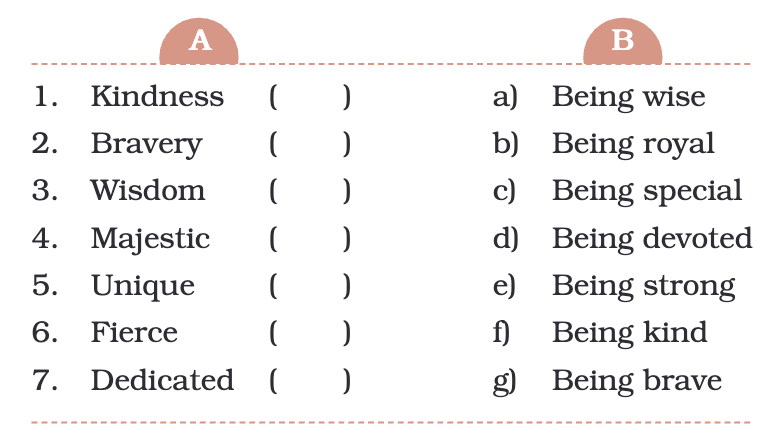
Ans:
Let us Listen
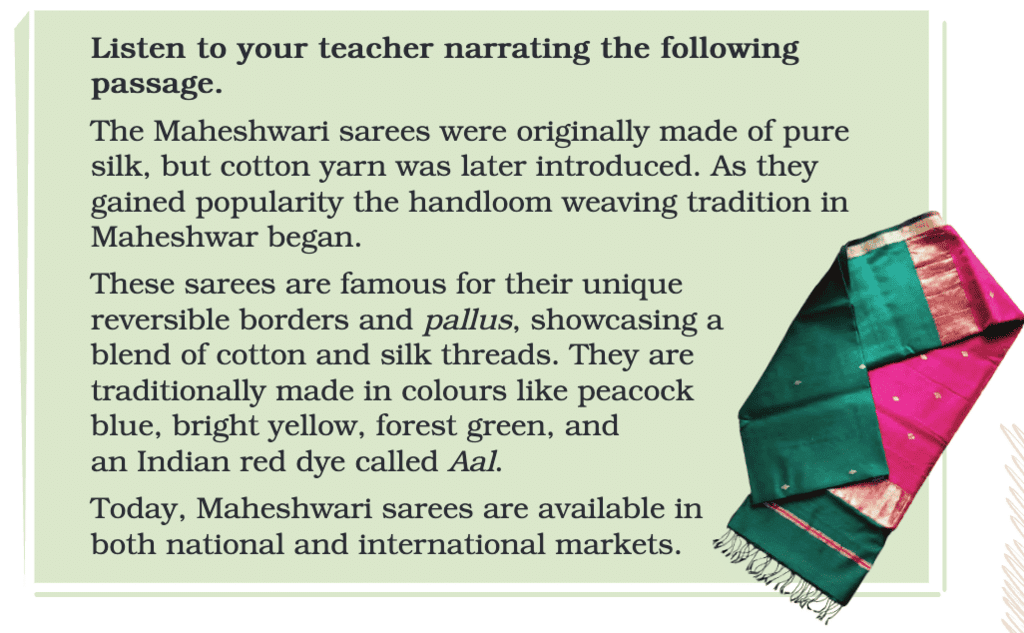
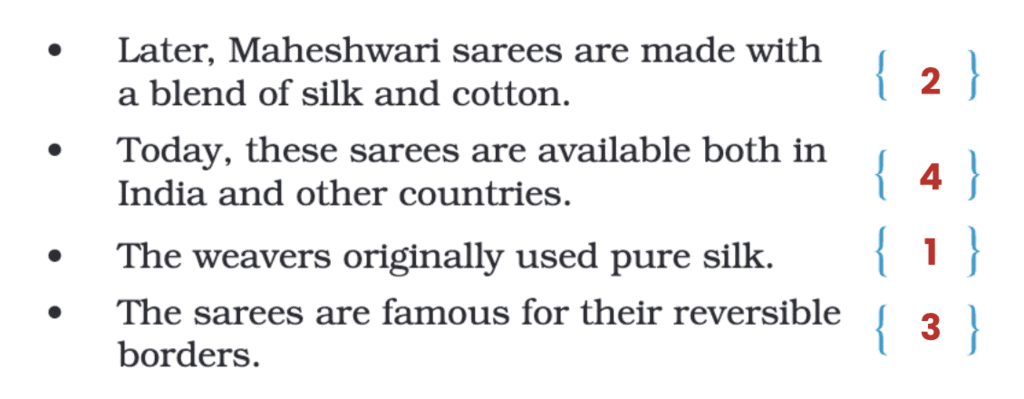
Arrange the following sentences in the order in which they appear in the passage.
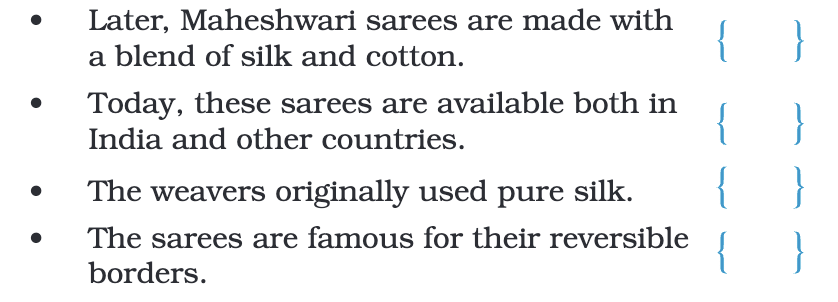
Ans: 
Let us Speak

A. Find out from the elders of your home and your locality about any historical place that is there in your town or nearby. You may consider more than one place too! Collect information and pictures of that place and present it to the class.
Ans:

  • Name of the place: Agra
  • Name of the monument: Taj Mahal
  • Historical people associated with that monument: Emperor Shah Jahan and Mumtaz Mahal
  • Special features of that monument: It is a beautiful white marble building with a big dome and four tall minarets.
  • How the monument is connected to the people (emotionally): People feel proud of the Taj Mahal because it is a symbol of love and a wonder of the world.
  • Other relevant information: It was built in the 1600s, and many tourists visit it every year.
    Presentation: I will show pictures of the Taj Mahal and tell my class, “This is the Taj Mahal in Agra. It was built by Shah Jahan for his wife Mumtaz Mahal. It is made of white marble and looks very beautiful. People love it because it shows true love. It is also a famous place for tourists.”

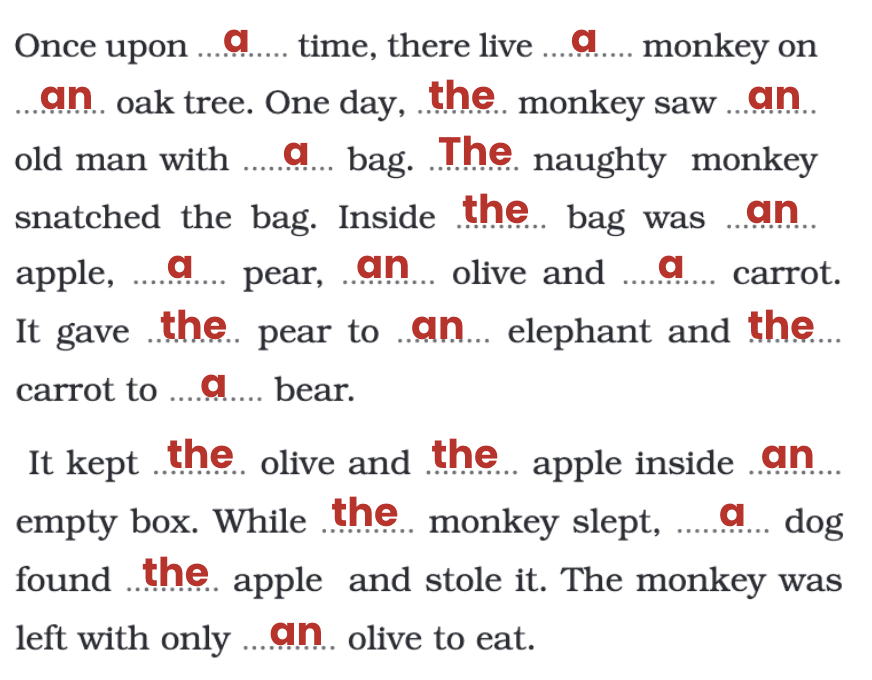
B. Complete the following passage with suitable Articles (a, an, and the)
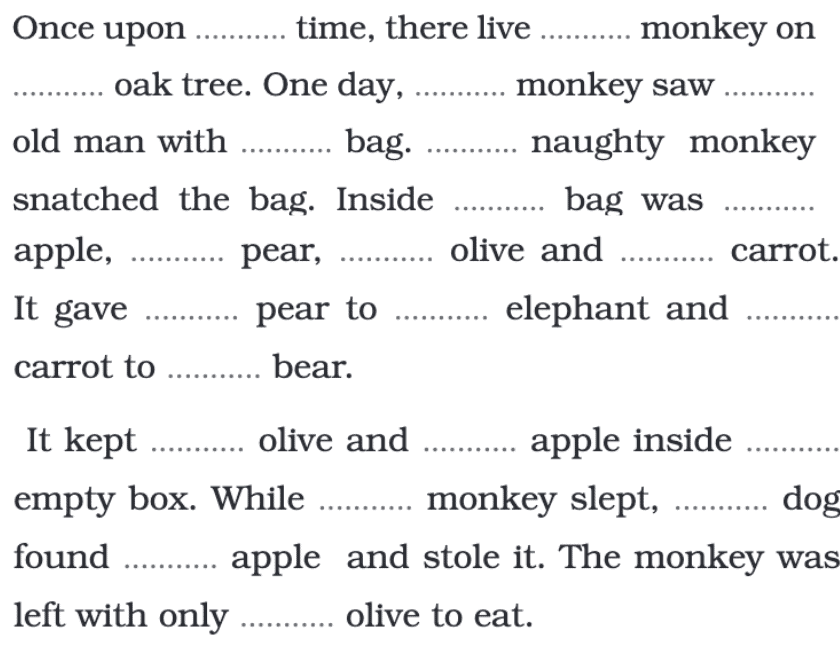
Ans: 
​Let us Write

A. Imagine you are visiting Maheshwar Fort with your family. Write a short description of what you see and feel as you explore the fort’s balconies and temples.
Ans: I am at Maheshwar Fort with my family. I see the big red stone walls and the overhanging balconies that look like they are floating. From the balconies, I can see the Narmada River shining below and the town of Maheshwar. The temples near the fort have beautiful designs, and I hear bells ringing. I feel excited to be in such a grand place and happy to learn about Queen Ahilya Bai. It feels like I am in a story from the past.

B. Based on the facts that you have learnt in the lesson, write a short paragraph on the Maheshwar Fort.
Ans: Maheshwar Fort is a beautiful fort in Maheshwar, Madhya Pradesh, built by Queen Ahilya Bai. It is on a hill by the Narmada River and made of red stones from Gujarat and Rajasthan. The fort has overhanging balconies, grand staircases, and nearby temples. A 13-feet tall statue of Queen Ahilya Bai stands in front of the palace. The fort is famous, and people in Maheshwar also make special Maheshwari sarees.
11.A Journey to the Magical Mountains- Textbook Solutions

A. Answer the following.

Q1: Who was Minam, and what did she enjoy doing with her grandfather?
Ans:
 Minam was a young girl who lived in a village at the foot of the Himalayas. She enjoyed listening to stories about the mountains and going on long walks with her grandfather.

Q2: What did Minam’s grandfather say to her one sunny morning?
Ans:
 Minam’s grandfather said, “Minam, you have become strong, and you can walk for a long distance. Today, I will take you on a special journey to the mountains. We’ll see the beauty of the Himalayas up close!”

Q3: What items did Minam pack for her journey to the mountains?
Ans:
 Minam packed rotis with achaar, two water bottles, and her favourite fruit, apples, for her journey.

Q4: Where did Minam and her grandfather stop for lunch? What did they do there?
Ans: 
They stopped for lunch by a small river with clear water. They ate rotis, watched fish swim, and Minam dipped her feet in the cool water while eating an apple.

Q5: What was Minam’s reaction when she saw snow for the first time?
Ans: 
Minam was amazed as she had never seen so much snow before. She laughed and played with her grandfather, making a small snowman.

Q6: What did Minam promise her grandfather at the end of their journey?
Ans:
 Minam promised to take care of the mountains and share their magic with everyone she met.

B. Think and discuss.

Q7: Minam enjoyed learning from her grandfather during their walk. Is there someone in your family or community who teaches you special things? What have you learned from them?
Ans:
 Yes, my grandmother teaches me special things. She taught me how to make round rotis and told me stories about our family.

Q8: Minam saw yaks and mountain goats helping people in the mountains. Can you think of animals or things in your surroundings that are very important to the people around you? How do they help?
Ans:
 In my surroundings, cows are very important. They give us milk, which we use to make curd and butter, and they help farmers by pulling carts.

Q3: Minam promised to protect the mountains. Is there something in nature around your home, school, or neighbourhood that you feel should be protected? What would you do to keep it safe?
Ans:
 I feel the trees near my school should be protected. I would water them, not pluck their leaves, and tell my friends to keep the area clean.

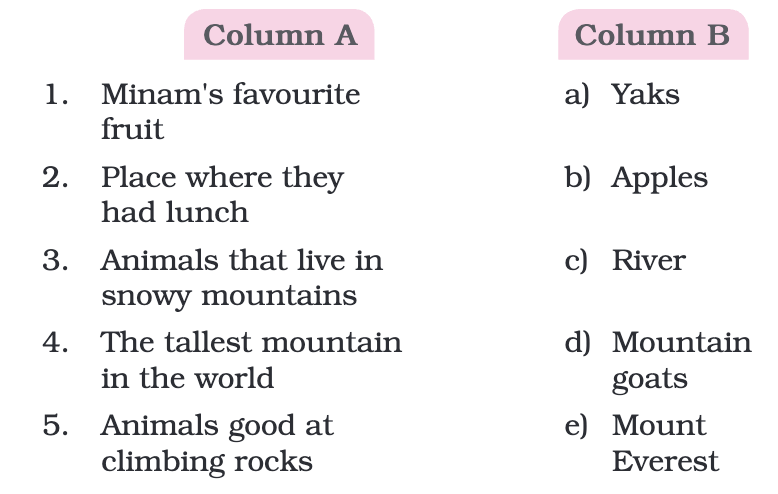
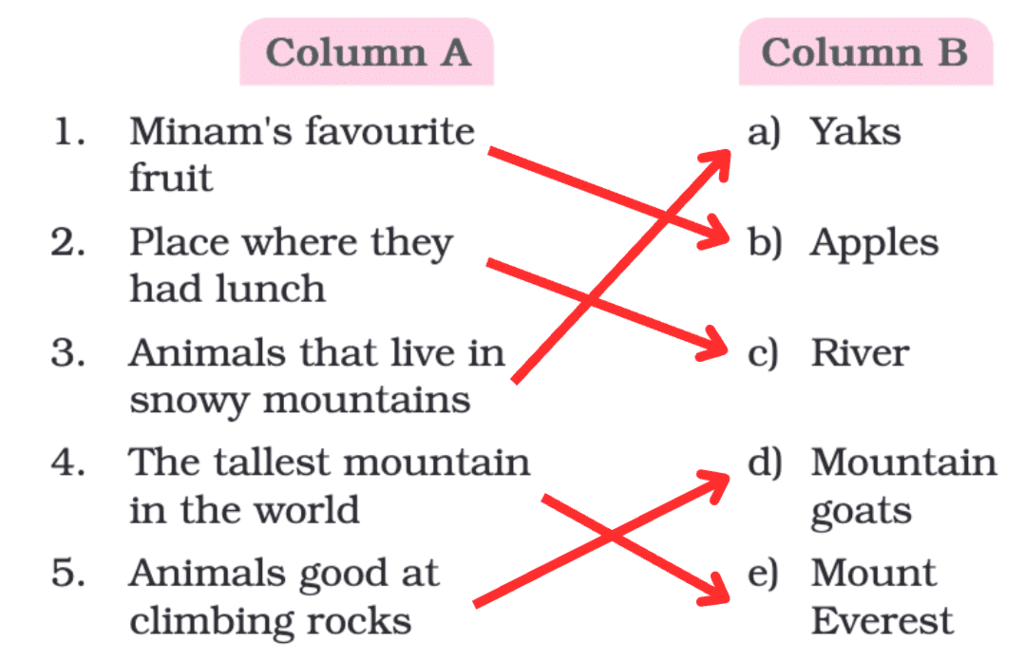
C. Match the following based on the story.

Ans: 

 Let us Learn

A. Use the words to complete these sentences.

Q1: Minam saw the tall peaks of the ________
Ans:
 Minam saw the tall peaks of the Himalayas.
Q2: Her grandfather was once a ________
Ans:
 Her grandfather was once a Sherpa.
Q3: They went on a long _______ to the mountains.
Ans:
 They went on a long journey to the mountains.

Q4: Yaks are used by mountain people to carry ________
Ans: 
Yaks are used by mountain people to carry heavyloads.

Q5: They saw the snow-covered mountains. She and her grandfather made a small ________
Ans:
 They saw the snow-covered mountains. She and her grandfather made a small snowman.

Q6: The day created beautiful _______ for Minam.
Ans: 
The day created beautiful memories for Minam.

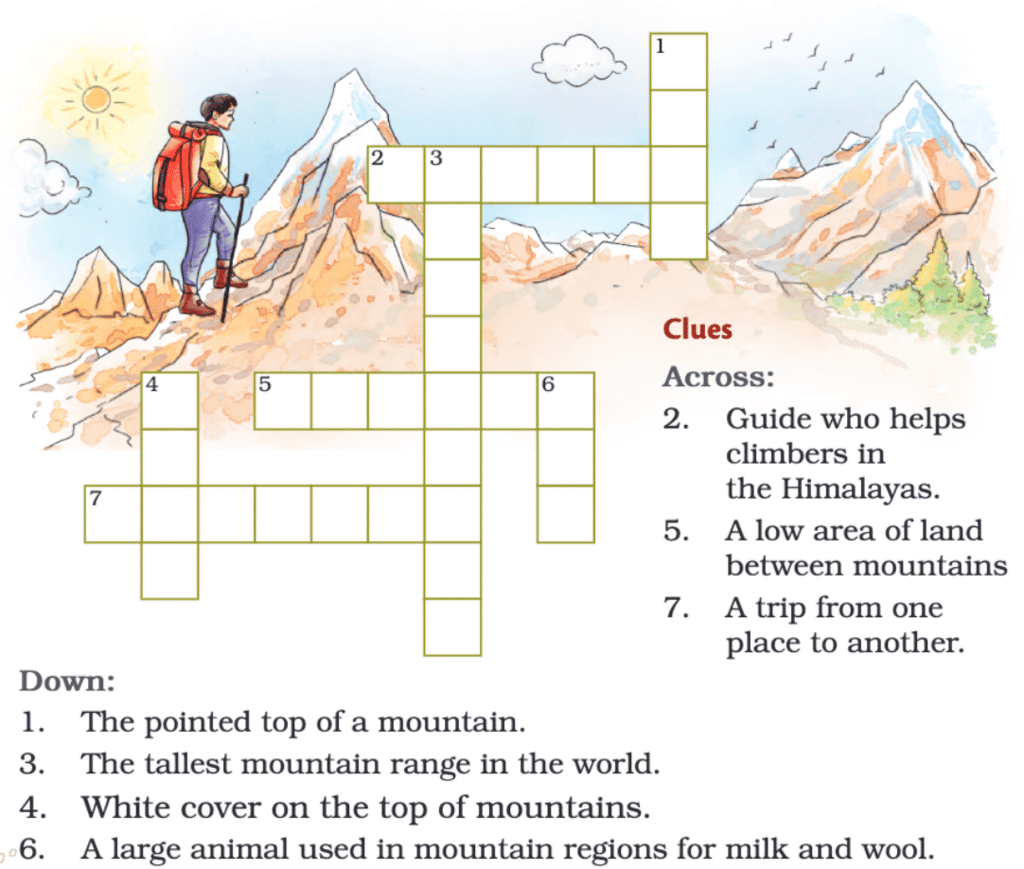
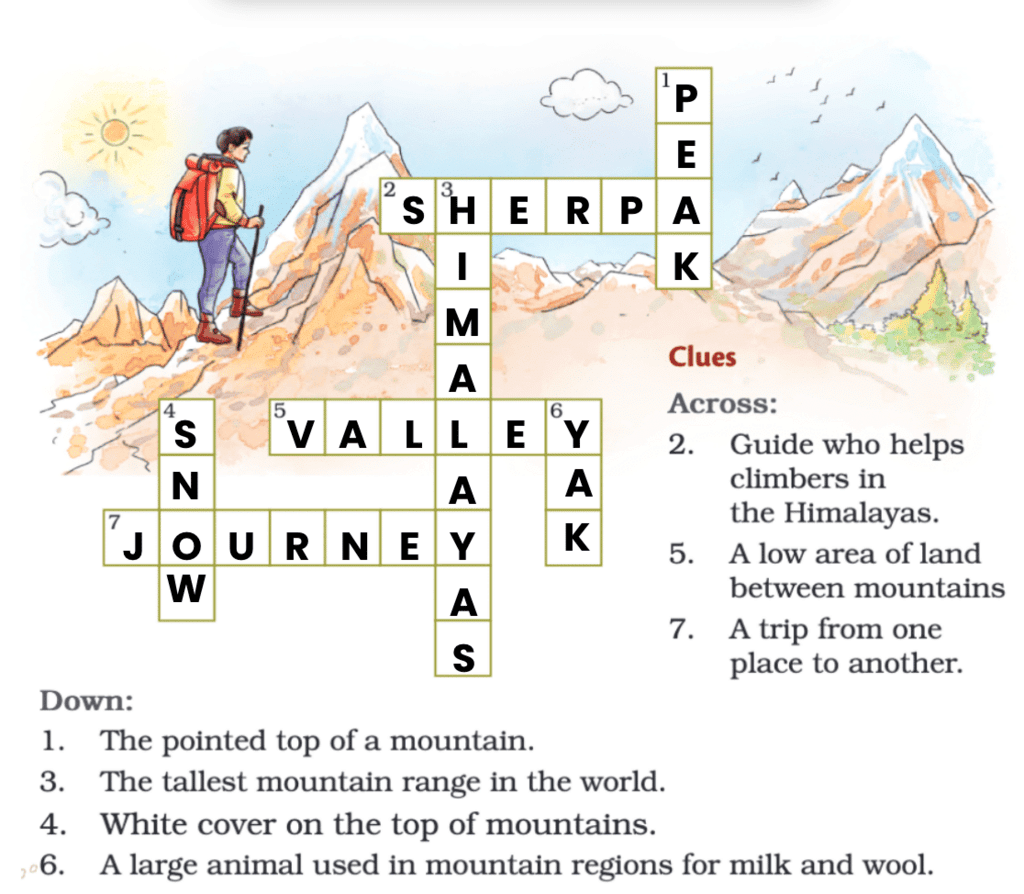
B. Solve the crossword puzzle.

Ans: 

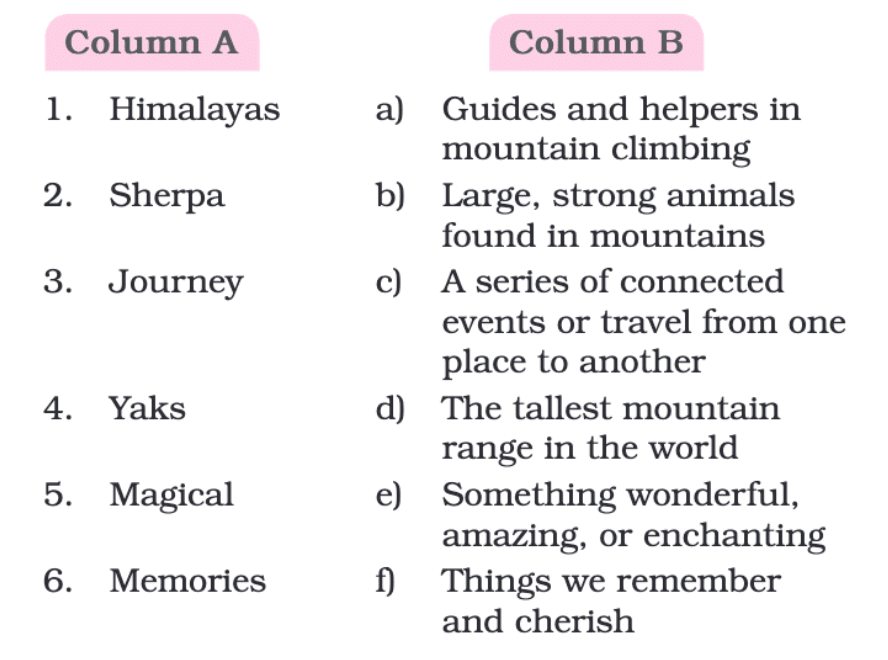
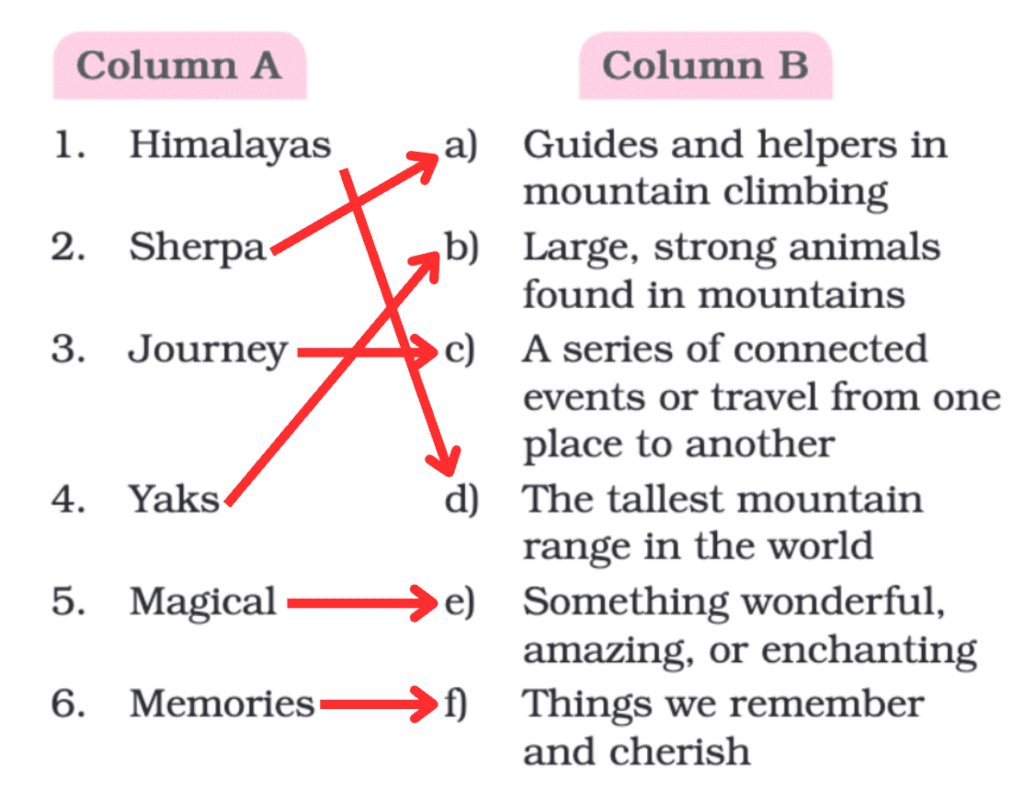
C. Match each word with its correct meaning.

Ans: 

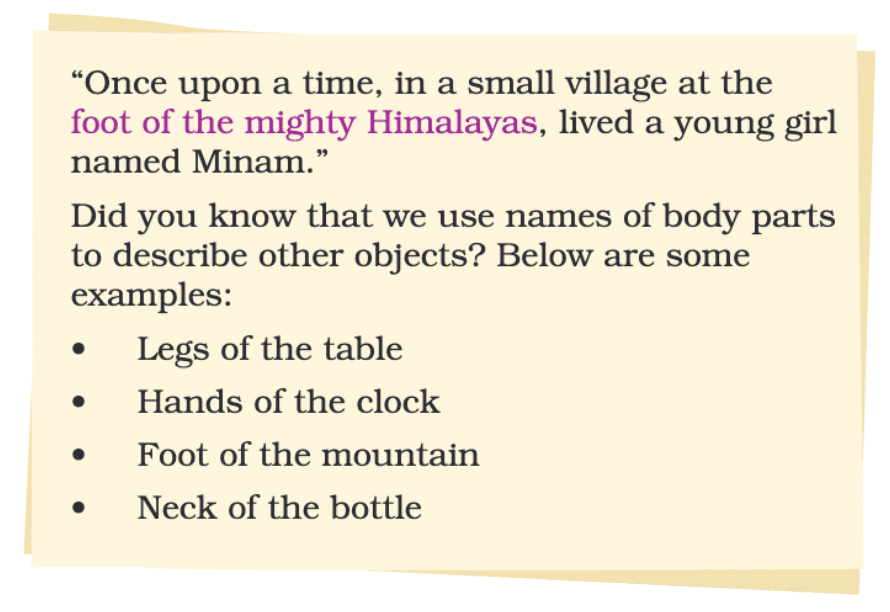
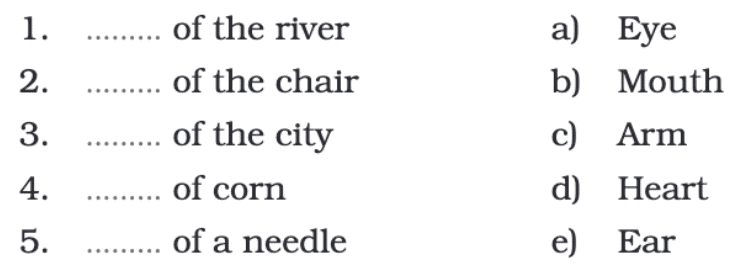
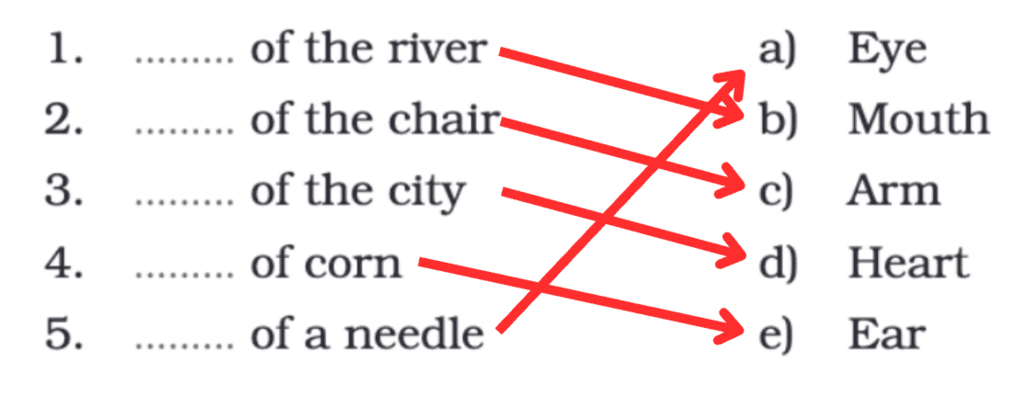
​D. Read these lines from the lesson.

Now, it’s your turn to think creatively! Match the objects below with the correct “body part” they are often compared to.

Ans: 

Let us Write

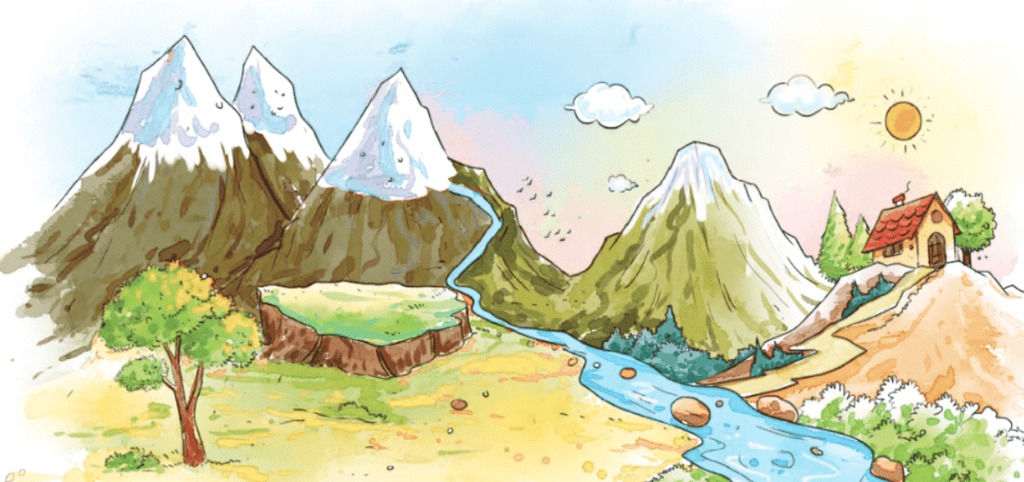
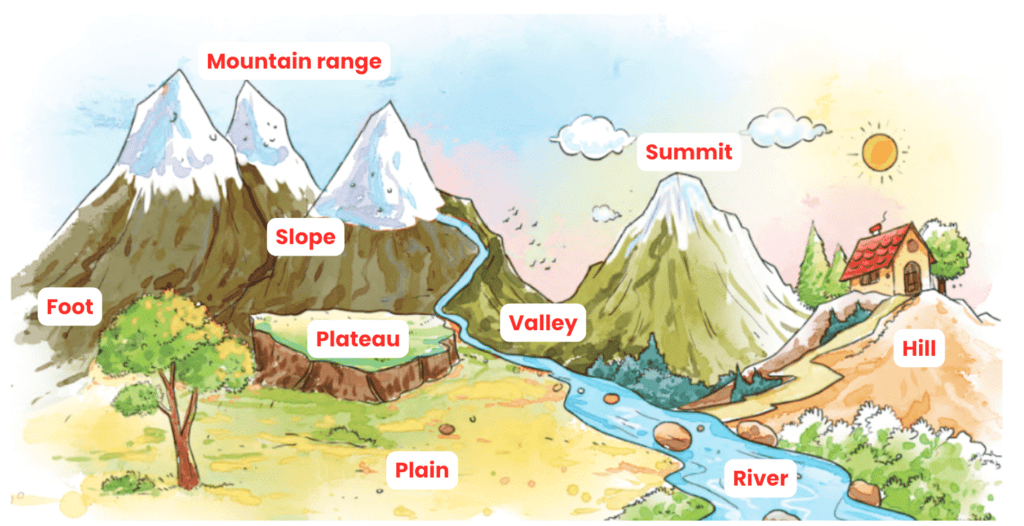
A. Look up a dictionary and find the meaning of the words in the box. Later label the picture.

Ans:

Meanings:

  • Plain: A flat, open area of land.
  • River: A large stream of water that flows into a sea or lake.
  • Valley: A low area of land between hills or mountains.
  • Summit: The highest point of a mountain.
  • Foot: The lowest part of a mountain.
  • Slope: A slanted surface of a hill or mountain.
  • Plateau: A flat area of land that is higher than the surrounding land.
  • Hill: A small, raised area of land, smaller than a mountain.
  • Mountain range: A group of mountains together.

Label the picture:

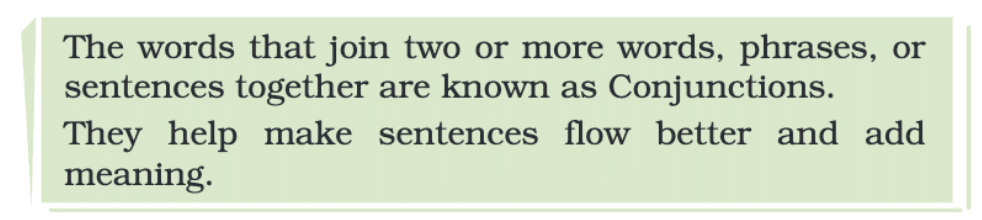
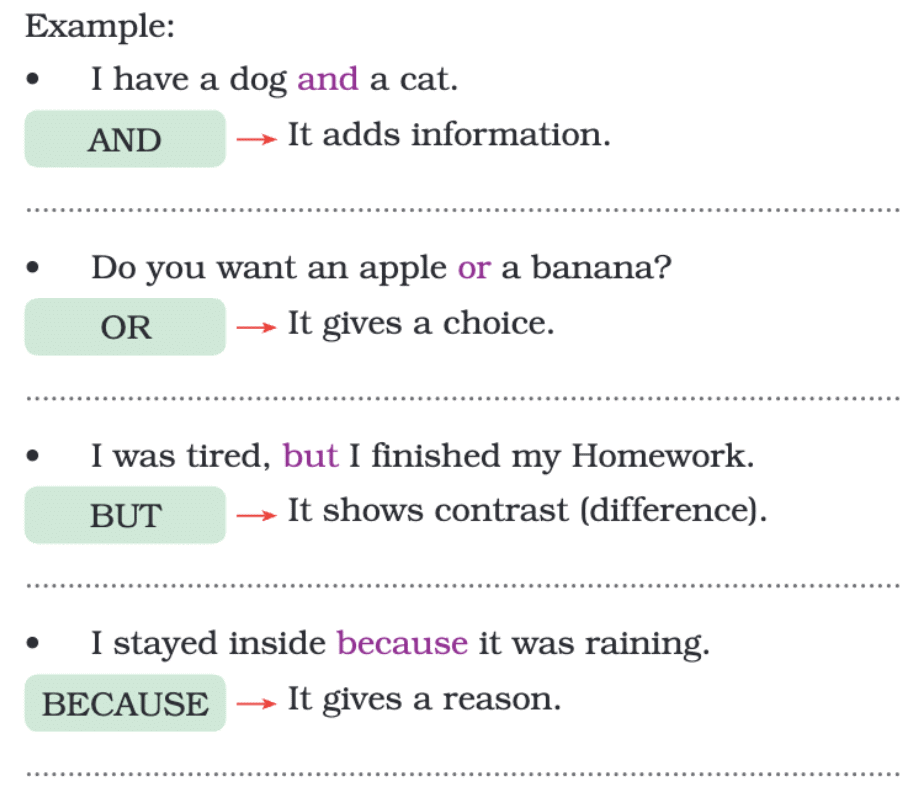
B. Join the sentences using the correct conjunction.
Q1: She was hungry. She ate a sandwich. (or/but/because)
Ans:
 She was hungry because she ate a sandwich.

Q2: I wanted to go out. It was too late. (or/and/but)
Ans:
 I wanted to go out, but it was too late.

Q3: He was happy. He got a new toy. (or/and/because)
Ans:
 He was happy because he got a new toy.

Q4: We can go to the zoo. We can go to the aquarium. (or/but/because)
Ans:
 We can go to the zoo or we can go to the aquarium.

Q5: Aman has a pen. Aman has a pencil. Aman has an eraser. (or/because/and)
Ans:
 Aman has a pen, and Aman has a pencil, and Aman has an eraser.

Q6: Simran loves to eat mangoes. She loves bananas. (or/and/but)
Ans: 
Simran loves to eat mangoes, and she loves bananas.
Q7: He ran fast. He missed the bus. (and/but/because)
Ans:
 He ran fast, but he missed the bus.

Q8: She stayed home. She was not feeling well. (or/and/because)
Ans:
 She Moody home because she was not feeling well.

Q9: I love chocolate. I love vanilla. (and/but/or)
Ans: 
I love chocolate, and I love vanilla.

Q10: The baby is crying. He is hungry. (but/or/because)
Ans: 
The baby is crying because he is hungry.

Let us Speak

Form your class into two groups, A and B. Each group will sit facing to each other. Follow the instructions to play the ‘Sentence Completion’ game.
Q1: On a bright summer morning,
Ans: On a bright summer morning, I went to the park with my friends.

Q2: One day, a clever squirrel decided
Ans: One day, a clever squirrel decided to hide its nuts in a big tree.

Let us Do

Pick any one of the given mountain animal or bird. 

Find out details about them. You may include their picture, habitat, adaptation, life cycle and lifestyle, as well as how they survive in harsh conditions. Design a colourful chart with drawings, pictures, and captions about the animal or bird. Make a presentation and present it to the class.
Ans:
I will pick the Snow Leopard.
Details:

  • Habitat: Snow Leopards live in the high mountains of the Himalayas and other cold regions.
  • Adaptation: They have thick fur to keep them warm and big paws to walk on snow.
  • Life Cycle: A baby snow leopard is born in spring, stays with its mother for 2 years, and then lives alone.
  • Lifestyle: They hunt animals like mountain goats and rest in caves during the day.
  • Survival in Harsh Conditions: Their grey-white fur helps them hide in the snow, and they can jump long distances to catch food.
    Chart Description: I will draw a snow leopard on a snowy mountain with a blue sky. I will add captions like “Thick fur keeps me warm!” and “I can jump far to hunt!” I will use white, grey, and blue colors for the chart.
    Presentation: I will show my chart to the class and say, “This is a snow leopard. It lives in cold mountains and has thick fur to stay warm. It hunts goats and can jump very far. I drew it on a snowy mountain because that’s where it lives.”

10.The Swing- Textbook Solutions

A. Answer the following.

Q1: What does the poet see when the swing goes over the wall?
Ans:
 The poet sees rivers, trees, cattle, and the countryside when the swing goes over the wall.

Q2: Does the poet enjoy swings? Which lines tell us that?
Ans:
 Yes, the poet enjoys swings. The lines “Oh, I do think it the pleasantest thing, Ever a child can do!” tell us that.

Q3: “Up in the air so blue” Why do you think the poet says the air is blue?
Ans:
 The poet says the air is blue because the sky looks blue when you are up high on the swing.

B. Think and discuss.

Q4: Have you seen a swing? Where have you seen it? What was it made of?
Ans:
 Yes, I have seen a swing. I saw it in a park near my house. It was made of wood and ropes.

Q5: What would you like to see when you are up in the air on a swing?
Ans:
 I would like to see birds flying, green trees, and my friends playing below when I am up in the air on a swing.

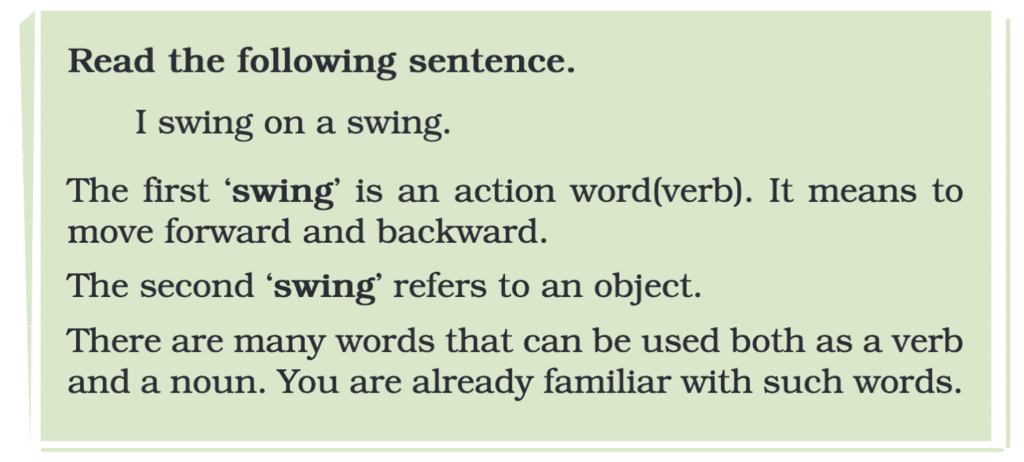
Let us Learn

Stringing together.

Jeevan waited.
Jeevan waited for the bus.
Jeevan waited for the bus all morning.
Jeevan waited for the bus all morning in the rain.
Jeevan waited for the bus all morning in the rain because his scooter was in the garage being repaired.

Frame a set of sentences as shown in the example. Make sure that each sentence is longer than the previous one.
Ans:

Riya smiled.
Riya smiled happily.
Riya smiled happily at her friend.
Riya smiled happily at her friend in the garden.
Riya smiled happily at her friend in the garden on a sunny day.

Let us Listen

A. Now, read the following sentences. Circle the verbs and underline the nouns. One has been done for you.

Ans: 

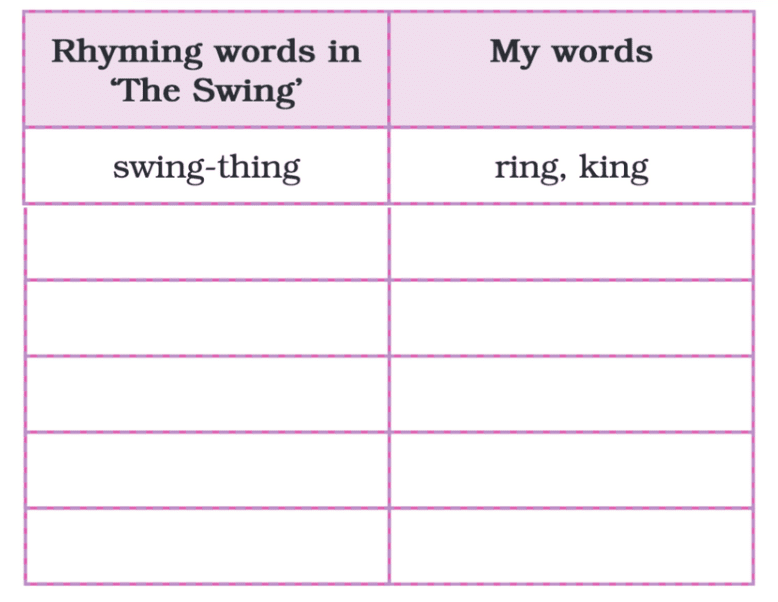
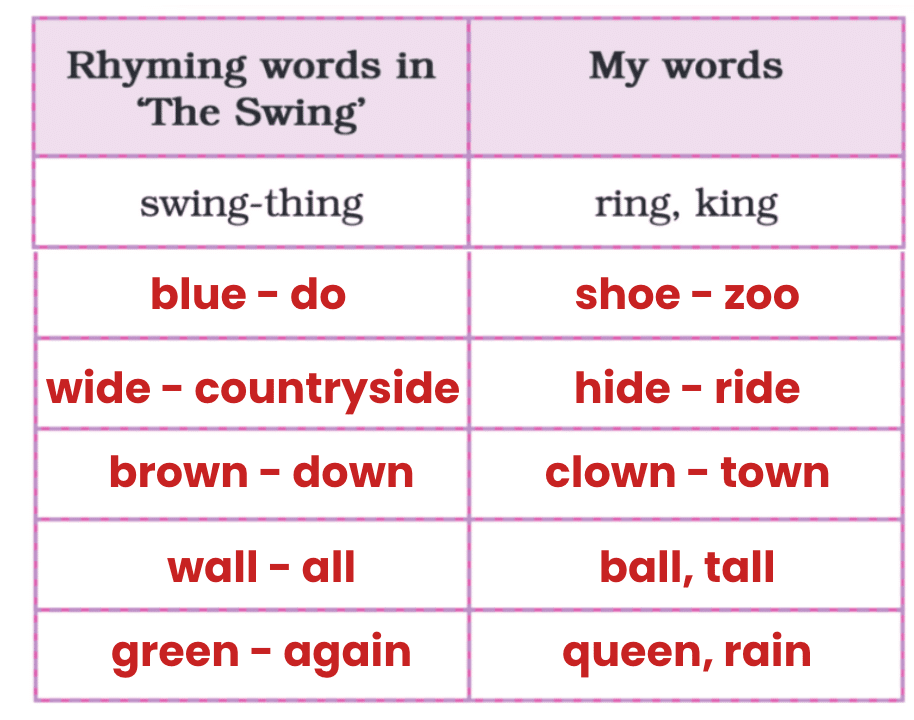
B. Your teacher will read out the poem again. Listen carefully and make a list of words that rhyme. You may add two more words of your choice as well.

Ans:

Let us Write

The word ‘pleasantest’ means enjoyable. There are many things that people enjoy doing.

1. Write a short paragraph about the activities you enjoy doing in your free time.
Ans:
In my free time, I enjoy playing with my friends in the park. I like riding my bicycle because it is fun and fast. Sometimes, I draw pictures of flowers and animals with my crayons. I also enjoy reading storybooks about adventures. These activities make me happy and keep me busy.

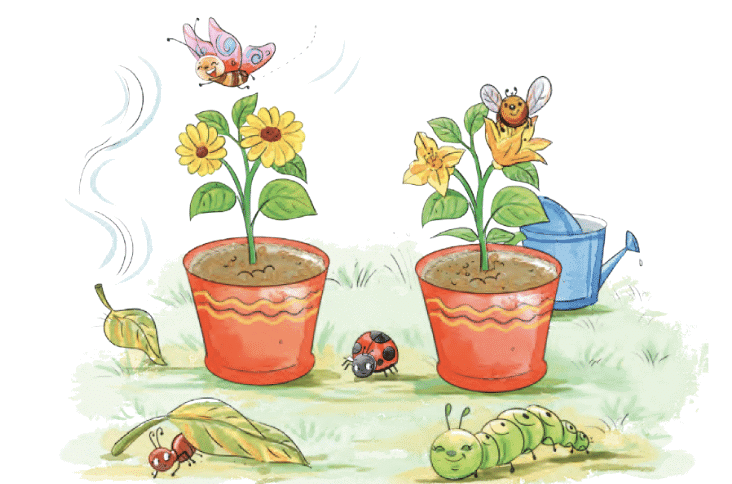
2. Look at the picture carefully.

Fill in the blanks with suitable prepositions from the box.
Q3: There is a ladybug ______ the two flower pots.
Ans:
 There is a ladybug between the two flower pots.

Q4: A butterfly is flying _______ the flower.
Ans:
 A butterfly is flying above the flower.

Q5: A honeybee is sitting _______ the flower.
Ans:
 A honeybee is sitting on the flower.

Q6: The watercan is _______ the flower pots.
Ans:
 The watercan is behind the flower pots.

Q7: An ant is walking ______ the leaf.
Ans:
 An ant is walking under the leaf.

Q8: A caterpillar is walking ______ a flowerpot.
Ans:
 A caterpillar is walking in front of a flowerpot.

Q9: A leaf has fallen ___ the flower pot.
Ans:
 A leaf has fallen beside the flower pot.

09.Hekko- Textbook Solutions

A. Answer the following.

Q1: What does the word ‘Hekko’ mean?
Ans: 
The word ‘Hekko’ means “Challenging the tiger.”

Q2: What are the two teams in the game called?
Ans:
 The two teams in the game are called Aakho and Aami.

Q3: How many players are there in each team?
Ans:
 There are 11 players in each team.

Q4: What do the players in the Aami team do inside the circle?
Ans:
 The players in the Aami team make a human chain and stay inside the circle.

Q5: Why do you think the Aakho team (Tiger) must say “Joko” when they are caught?
Ans: 
The Aakho team must say “Joko” because it means surrender, showing they accept they are caught and cannot continue until released.

B. Think and discuss.

Q1: If you were playing the game Hekko, would you prefer to be in the Aami or Aakho team? Why?
Ans: 
I would prefer to be in the Aami team because I like working together with friends to make a strong chain and catch the other team.

Q2: If you could add a new rule to the game, what would it be? What would be the benefit of the new rule?
Ans:
 I would add a rule that each team gets a 5-minute break in the middle of the game. The benefit is that players can rest, drink water, and play better without getting too tired.

Let us Learn

A. Choose the correct option to complete the sentence.
1. their/there
Q1: _______ is a beautiful park in my neighbourhood.
Ans:
 There is a beautiful park in my neighbourhood.

Q2: They completed _______ work very fast.
Ans: 
They completed their work very fast.

2. two/too
Q3: ______ of my friends participated in the poster-making competition.
Ans: 
Two of my friends participated in the poster-making competition.

Q4: I was ______ tired after playing.
Ans:
 I was too tired after playing.

3. through/threw
Q5: The bowler ______ the ball towards the batsman.
Ans:
 The bowler threw the ball towards the batsman.

Q6: I can see the clouds ______ my window pane.
Ans:
 I can see the clouds through my window pane.

4. caught/cot
Q7: My mother ______ me eating an ice cream at night.
Ans: 
My mother caught me eating an ice cream at night.

Q8: I sleep on ______ when I am at my grandmother’s village.
Ans:
 I sleep on a cot when I am at my grandmother’s village.

5. right/write
Q9: While crossing the road, look to your _______ then left, then right again and then cross the road.
Ans: 
While crossing the road, look to your right then left, then right again and then cross the road.

Q10: _______ in a neat and legible handwriting.
Ans:
 Write in a neat and legible handwriting.

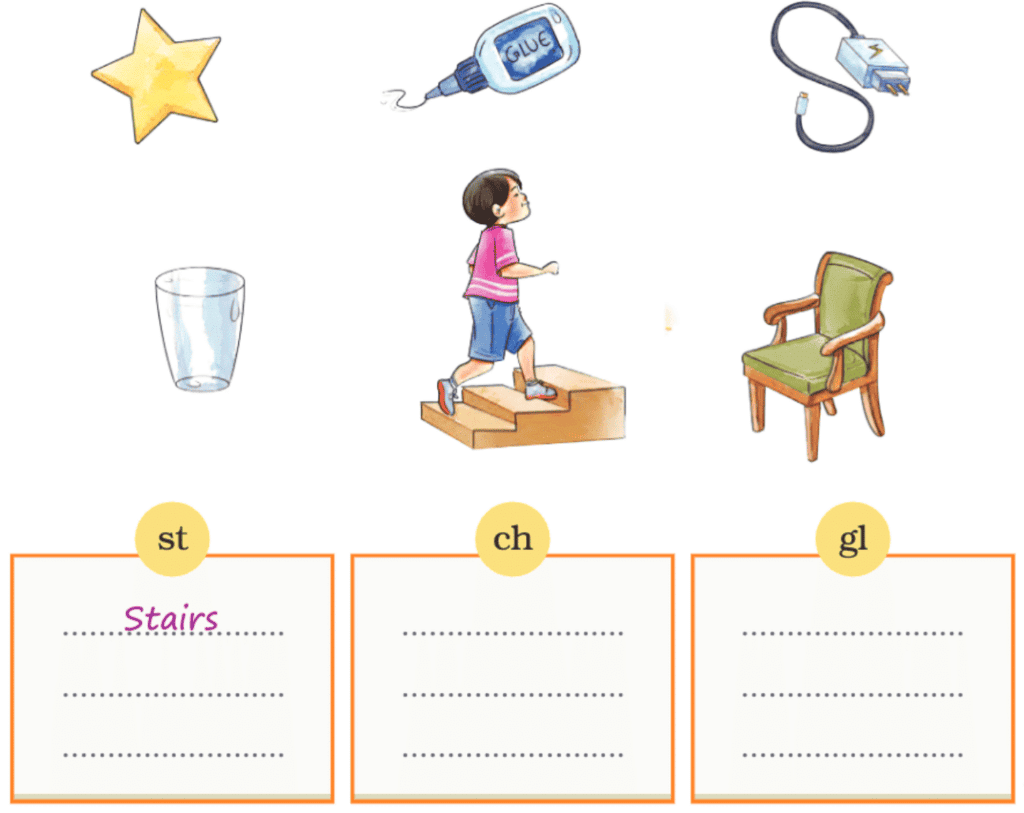
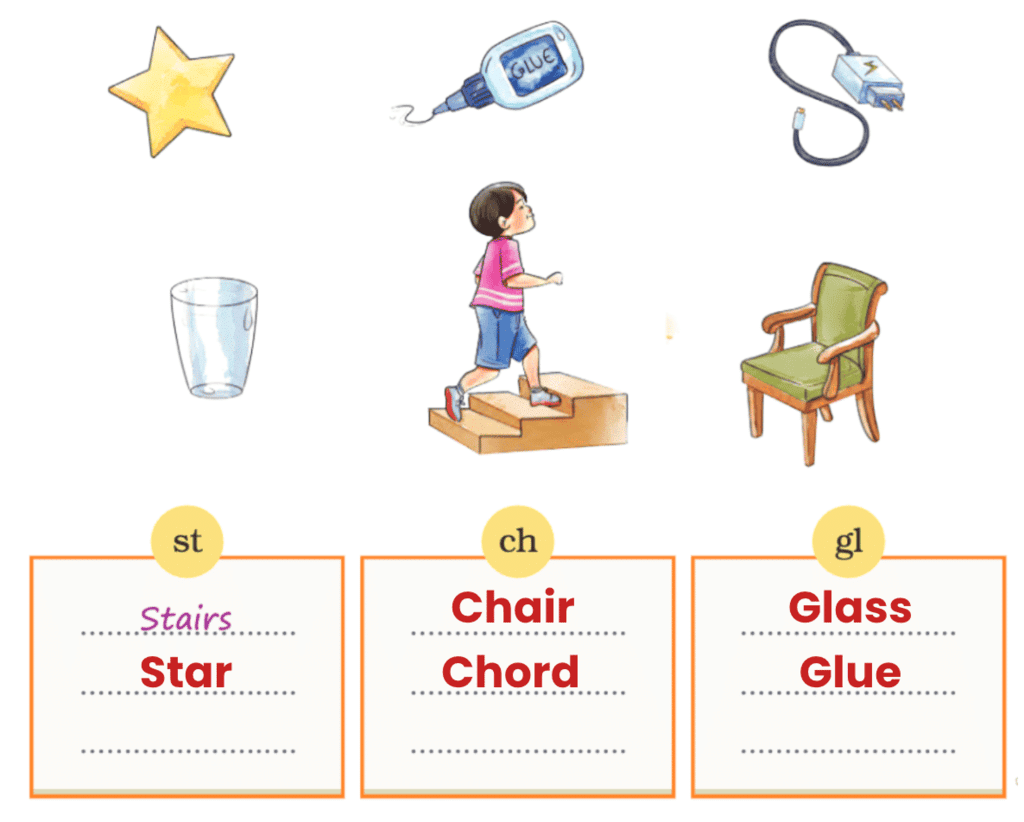
B. Look at the pictures and write their names. One has been done for you.

Ans:

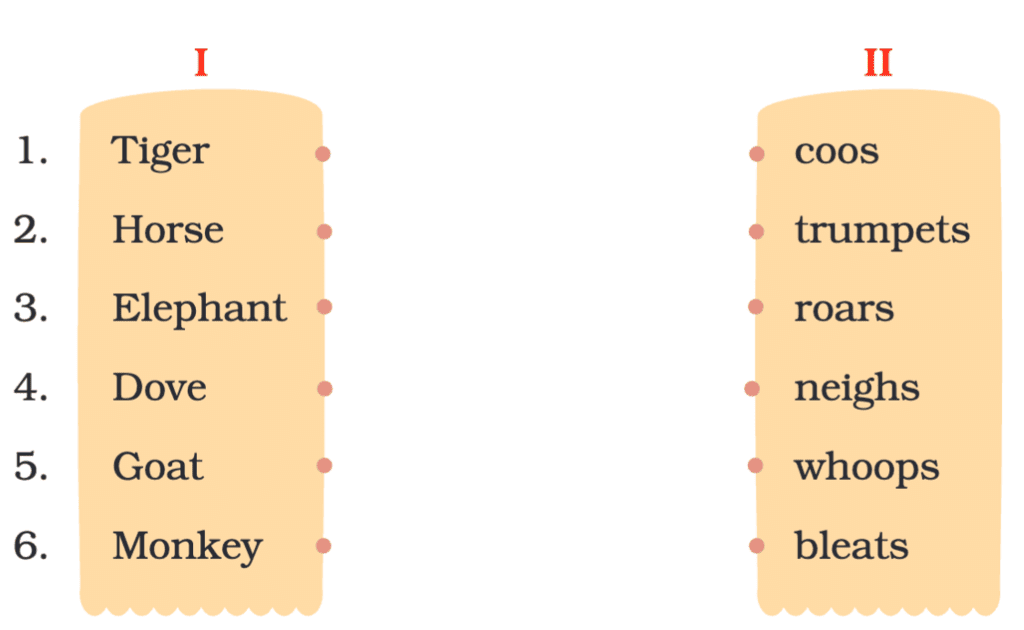
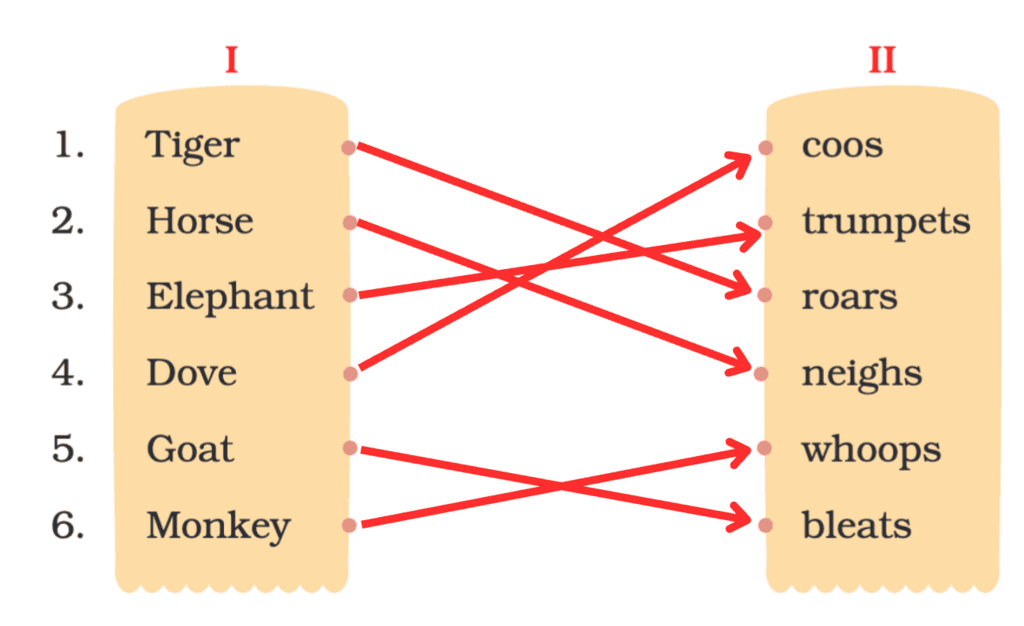
C. Match the animals with their sound.

Ans: 

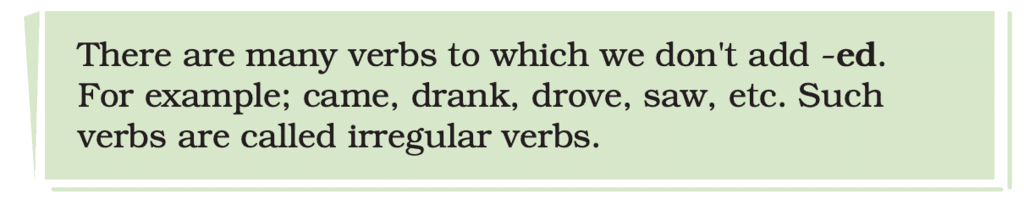
D. Read the following sentences. Notice the underlined words.

Once upon a time, humans and animals lived together. Aakho declared that the tigers had the first right on all the things. The humans challenged Aakho.

  • The underlined words tell us that the events happened some time ago or in the past.
  • In past simple tense, you can add -ed to verbs to get this form.

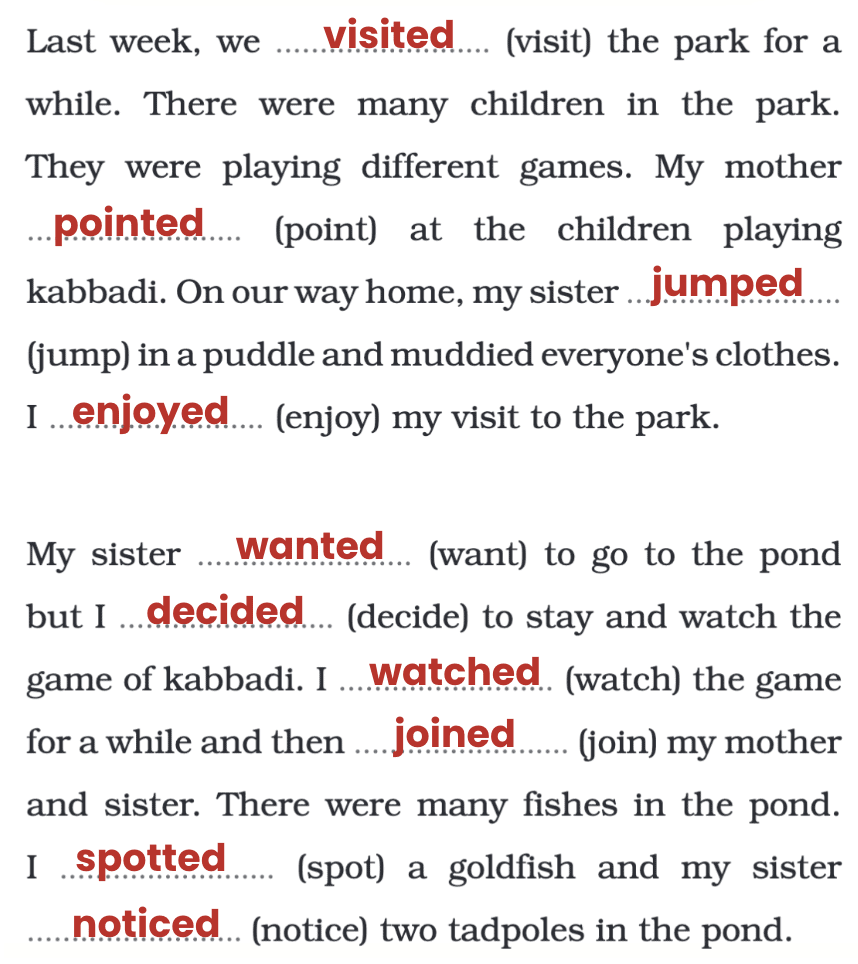
E. Fill in the blanks using -ed.

Let us Listen

Listen to the description of some traditional games of India. Identify each game and write its name in the space given below.
Q1: In this game, we stack seven stones on top of each other. The first team throws a ball to knock them down… Can you guess the name of the game?
Ans:
 The name of the game is Lagori.

Q2: In this game, there are two teams. One player from the first team crosses into the second team’s side while chanting the name of the game continuously without taking a breath!… Can you guess the name of this game?
Ans:
 The name of the game is Kabaddi.

Q3: This game is played with two wooden sticks—a short one and a longer one. The goal is to hit the shorter stick and make it jump in the air…
Ans: 
The name of the game is Gilli Danda.

Q4: In this game, two children form an arch with their arms while others walk under it, singing a song…
Ans:
 The name of the game is London Bridge.

Q5: In this game, children use a small round-shaped glass object, aiming to knock out other round glass objects placed in a circle…
Ans:
 The name of the game is Marbles.

Let us Write

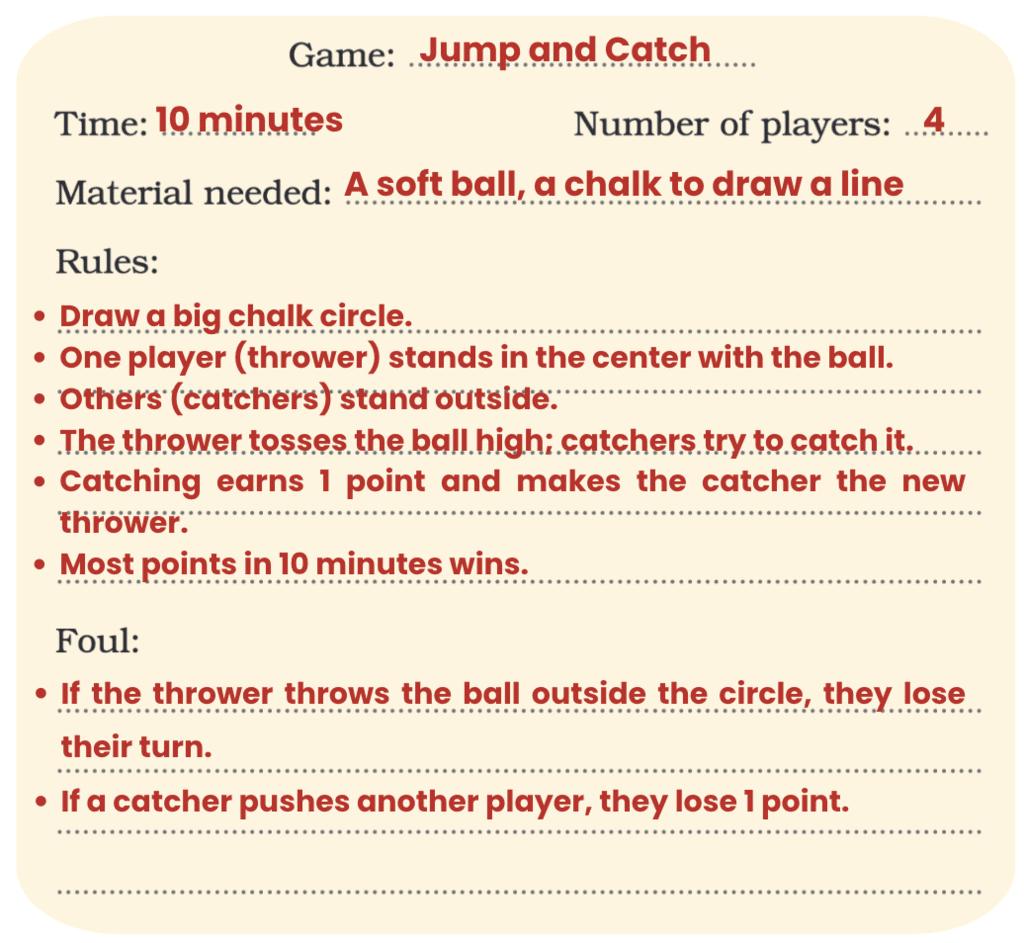
A. You read how the people of Nagaland made the game of Hekko. Use the space given below to write about a new game that you would like to play.
Ans:

08.The Lagori Champions- Textbook Solutions

Page 76

On the basis of your understanding the text, answer the following.

Q1: Who joined the group in the end?
Ans: 
Imran joined the group in the end.

Q2: How many and what kind of stones are used in this game?
Ans:
 Seven flat stones are used in this game.

Q3: In which state of India is the game of lagori is also known as Satoliya?
Ans:
 The game of lagori is also known as Satoliya in Rajasthan.

Q4: What is the name of the opponent team of Sundarpur Tigers?
Ans: 
The name of the opponent team of Sundarpur Tigers is Green Warriors.

Page 79 

On the basis of your understanding the text, answer the following.

Q1: Who blew the whistle to start the match?
Ans:
 The referee blew the whistle to start the match.

Q2: Who took the first shot?
Ans
: Deepa took the first shot.

Q3: What did Prakash do before the final whistle?
Ans:
 Prakash set the seventh stone on top before the final whistle.

Q4: Who shook hands at the end of the match? Why?
Ans: 
The players from both teams shook hands at the end of the match because they appreciated each other for a good game.

Let us Think

A. Answer the following.

Q1: What is Lagori, and how is it played?
Ans:
 Lagori is a game of seven stones. One team knocks down the stacked stones with a ball, and the other team tries to rebuild the stack while avoiding the ball thrown by the opponent team.

Q2: What is the name of Deepa’s team, and who are they competing against?
Ans:
 The name of Deepa’s team is Sundarpur Tigers, and they are competing against the Green Warriors.

Q3: Why is Prakash selected by the captain for playing the Lagori match?
Ans:
 Prakash is selected by the captain because he is a good runner and quick.

Q4: Who told Prakash about Lagori, and what name does he use for it?
Ans: 
Nidhi told Prakash about Lagori, and he calls it Satoliya.

Q5: What did the villagers do after the Sundarpur Tigers won the match?
Ans:
 The villagers clapped and cheered the teams after the Sundarpur Tigers won the match. The referee lifted the hands of both captains, and everyone celebrated with laughter and joy.

B. Think and discuss.

Q6: The Sundarpur villagers clapped for both the teams and the refree lifted the hands of both captains. Why did they do so? Do you agree with them?
Ans:
 The villagers clapped for both teams to show they enjoyed the game, and the referee lifted the captains’ hands to honor their efforts. Yes, I agree with them because it shows teamwork and fairness, and everyone should be happy for a good match.

Q7: How does teamwork help in winning games?
Ans:
 Teamwork helps in winning games because everyone works together, helps each other, and uses their skills to reach the goal, like rebuilding the stones in Lagori.

Q8: According to Deepa, Lagori was more exciting than video games. Do you think she is right? Why or why not?
Ans: 
Yes, I think she is right. Lagori is more exciting because it involves running, teamwork, and playing outside with friends, while video games are just sitting and pressing buttons.

C. True or False.

Q1: Satoliya is played in Sundarpur village.
Ans:
 False

Q2: Ravi plays for Green Warriors team.
Ans:
 False

Q3: Prakash set the seventh stone on top.
Ans:
 True

Q4: Imran helped Nidhi to dodge the ball.
Ans:
 False

Q5: The Sundarpur Tigers won the match.
Ans:
 True

D. Fill in the blanks.

Q1: Ravi came _____ with ______ dripping down his face.
Ans:
 Ravi came running with sweat dripping down his face.

Q2: ______ is the captain of Sundarpur Tigers.
Ans: 
Deepa is the captain of Sundarpur Tigers.

Q3: The Lagori match reminded everyone of the simple joys of ______ and ______.
Ans: 
The Lagori match reminded everyone of the simple joys of teamwork and friendship.

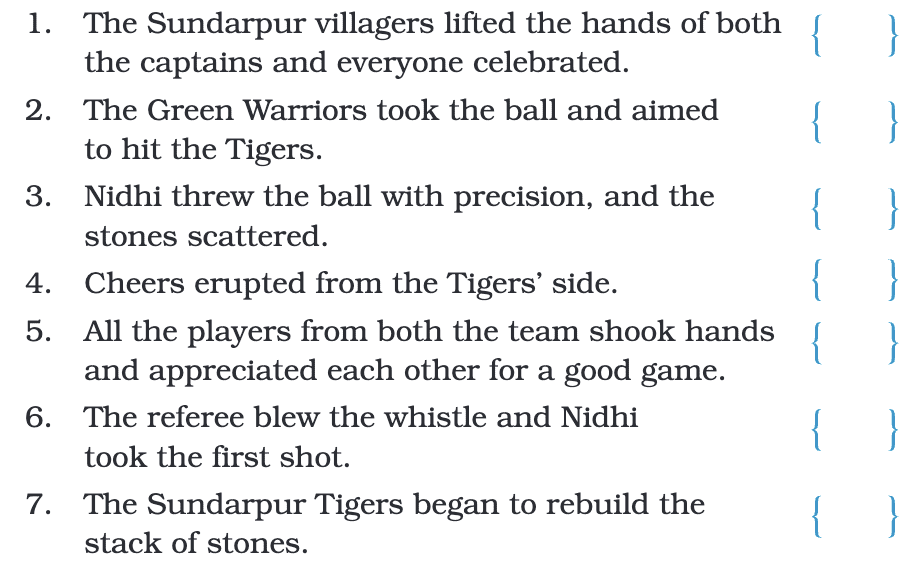
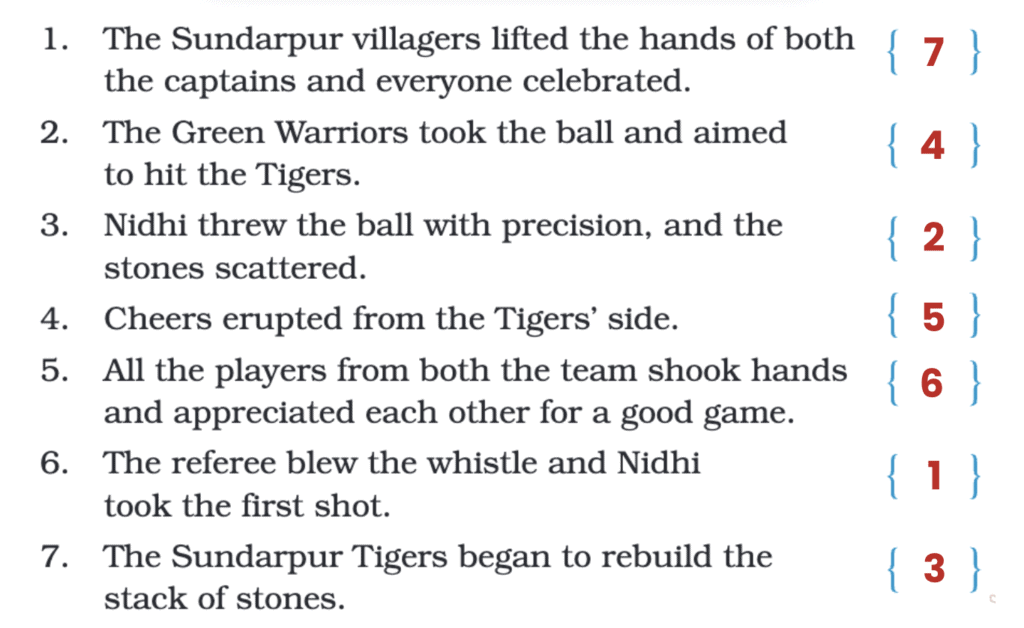
E. Number the sentences in order as per the events given in the story.

Ans:

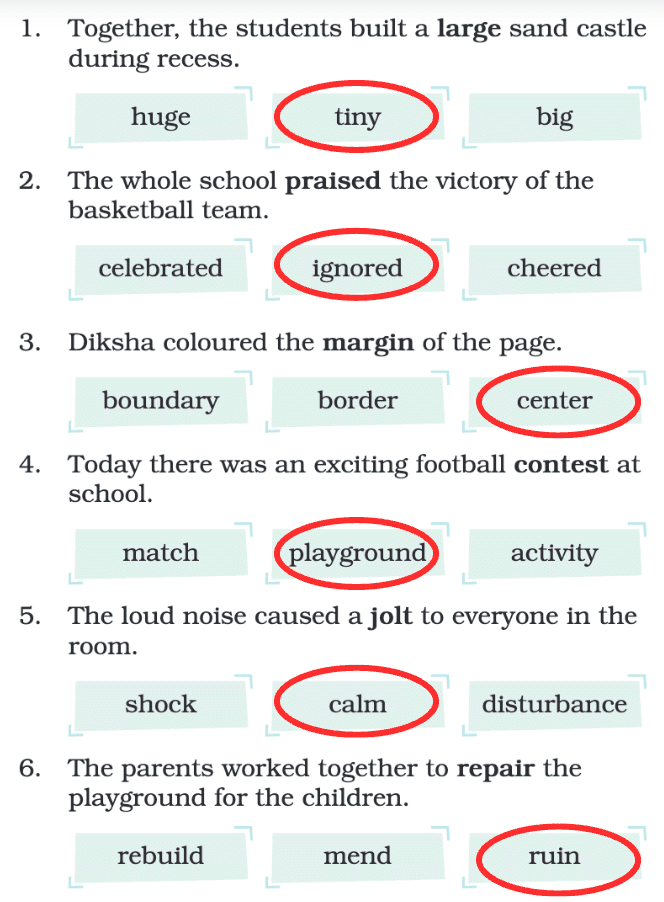
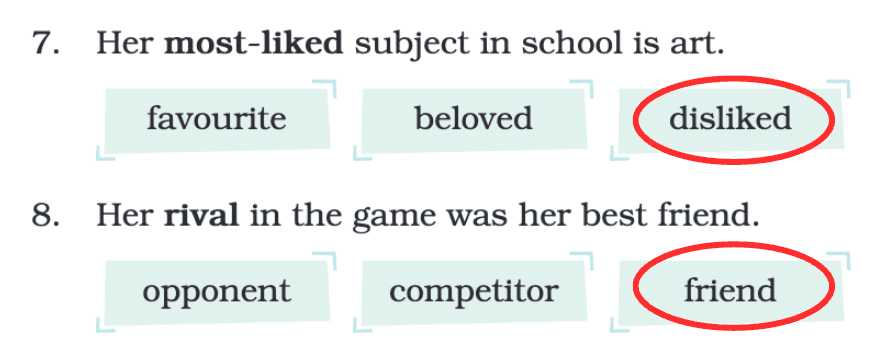
Let us LearnA. Circle the word that does not have the same meaning as the word in bold.

B. Let’s unscramble the letters as per the meaning of the words given.

Q1: Hint: “a place or region beyond a boundary” – D E O T I U S
Ans: 
outside

Q2: Hint: “to raise your hand and move it from side to side as a way of greeting someone” – V E A W
Ans: 
wave

Q3: Hint: “a sports competition or event in which two people or two teams compete against each other” – H M T A C
Ans:
 match

Q4: Hint: “a child of a person’s aunt or uncle” – I O U N S C
Ans: 
cousin

Let us Listen

Your teacher will read out short sentences for you. Each sentence has one word in it which is different from the rest. Write down the word that does not fit in each sentence.
Q1: I’m learning the rules of different sports like football, basketball, reading, running and swimming.
Ans:
 reading

Q2: After school in the playground, we play Gilli Danda, hide and seek, Satoliya, swimming, hopscotch, skipping and hockey.
Ans: 
swimming

Q3: My brother likes to play Kabbadi, basketball, badminton, kho-kho, knitting and Lagori.
Ans:
 knitting

Q4: In the sports class, we get training for climbing, sprinting, jumping, stretching and writing.
Ans:
 writing

Q5: We use a ball while playing cricket, hockey, skipping, tennis and volleyball.
Ans:
 skipping

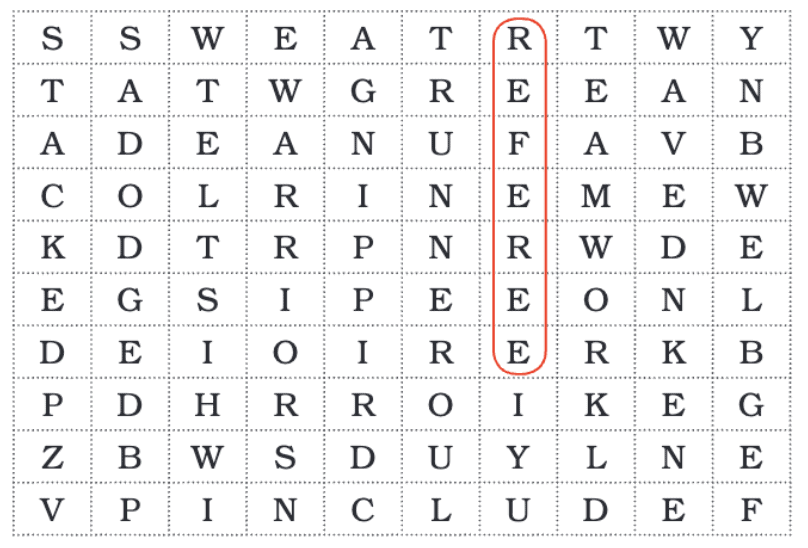
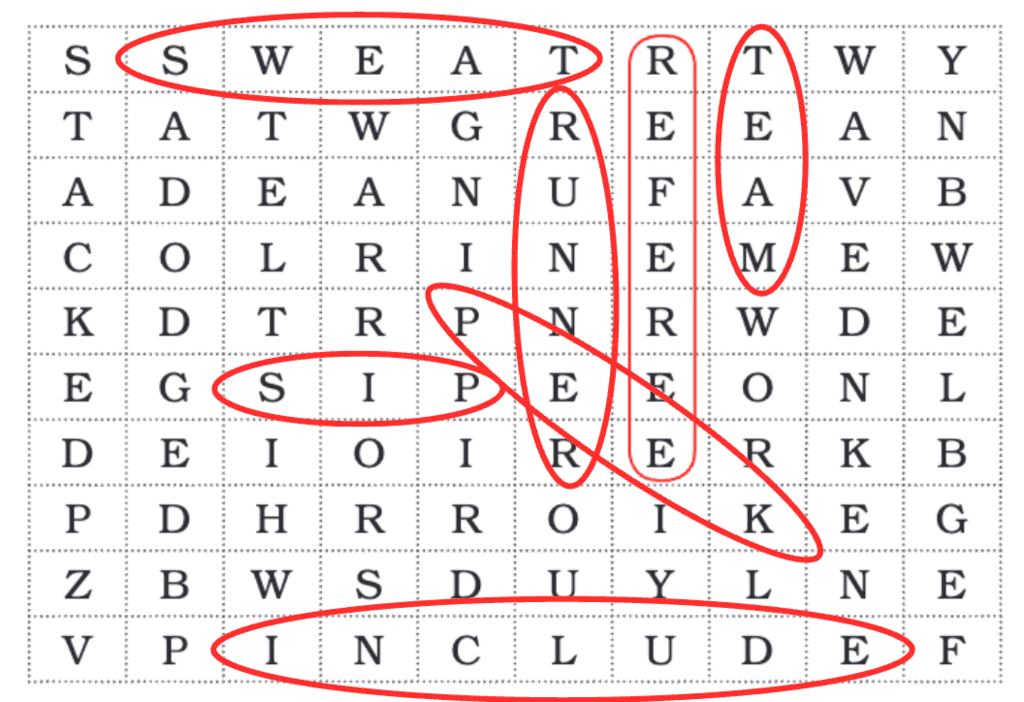
Let us WriteA. Some words from the story are hidden in the word grid below. One word has been done for you. Find at least six words in the box.

Ans:

Use these words in sentences of your own.
Ans: 

  • SWEAT
    I had sweat on my face after playing outside in the hot sun.
  • RUNNER
    My friend is a fast runner and won the race at school.
  • SIP
    I took a sip of juice because I was thirsty after lunch.
  • INCLUDE
    We decided to include my little brother in our game of hide and seek.
  • TEAM
    My team worked together to build a big sandcastle on the beach.
  • PEEK
    I took a peek through the window to see the colourful birds outside.

B. Rearrange the words to form meaningful sentences.

Q1: boundary / field / is / the / marked / a / with
Ans:
 The field is marked with a boundary.

Q2: looked / prakash / at / surprise / everybody /with
Ans:
 Everybody looked at Prakash with surprise.

Q3: peacock / saw / a / dancing / I / the / in / rain
Ans:
 I saw a peacock dancing in the rain.

Q4: white / there / and / grey / are / the / clouds / sky / in
Ans: 
There are white and grey clouds in the sky.

Q5: fresh / need / every day / water / plants
Ans:
 Plants need fresh water every day.

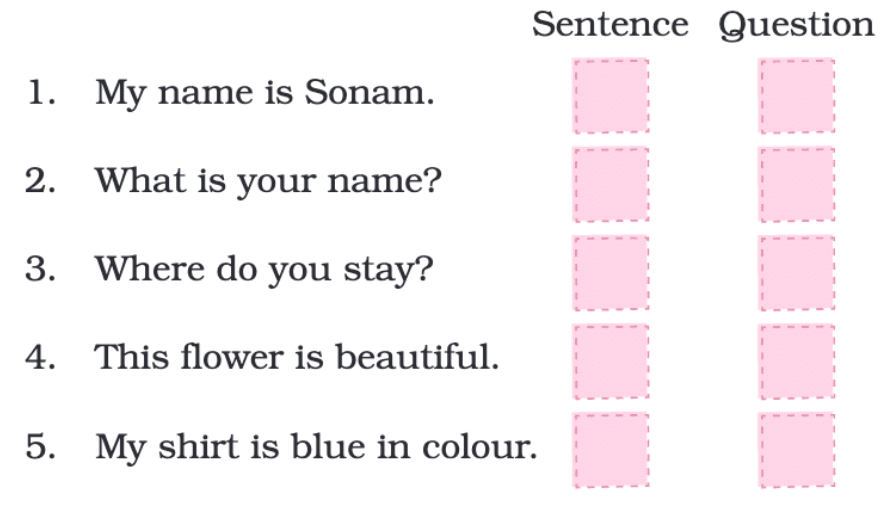
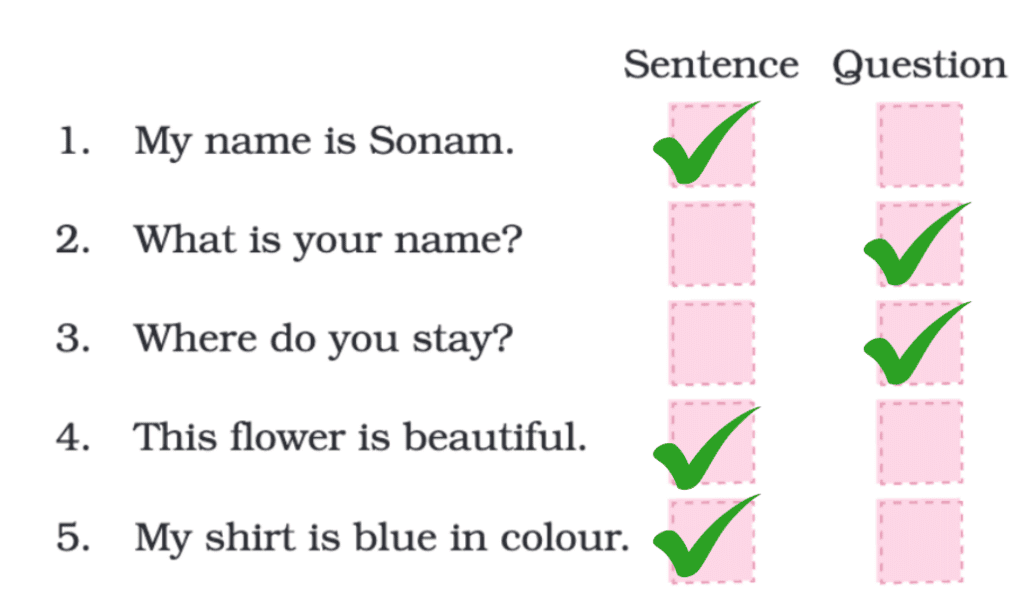
C. Tick (✓) the right box.

Ans: 

Let us Do

A. Divide the class into small groups and imagine that you are forming a Lagori team. Each team will create your own ‘Lagori Team Badge’ using art and creativity, reflecting your understanding of teamwork and traditional games.
Ans:
(Note: This is a reference answer.)
My group is called “Sunshine Strikers.” We used a drawing sheet, colored pencils, and glitter. We drew stacked stones and a ball to show Lagori. We added a sun to show our energy and teamwork. The badge has yellow and green colours for happiness and nature. We will tell the class that our design means we work together like the sun gives light to everyone, and Lagori is our traditional game.

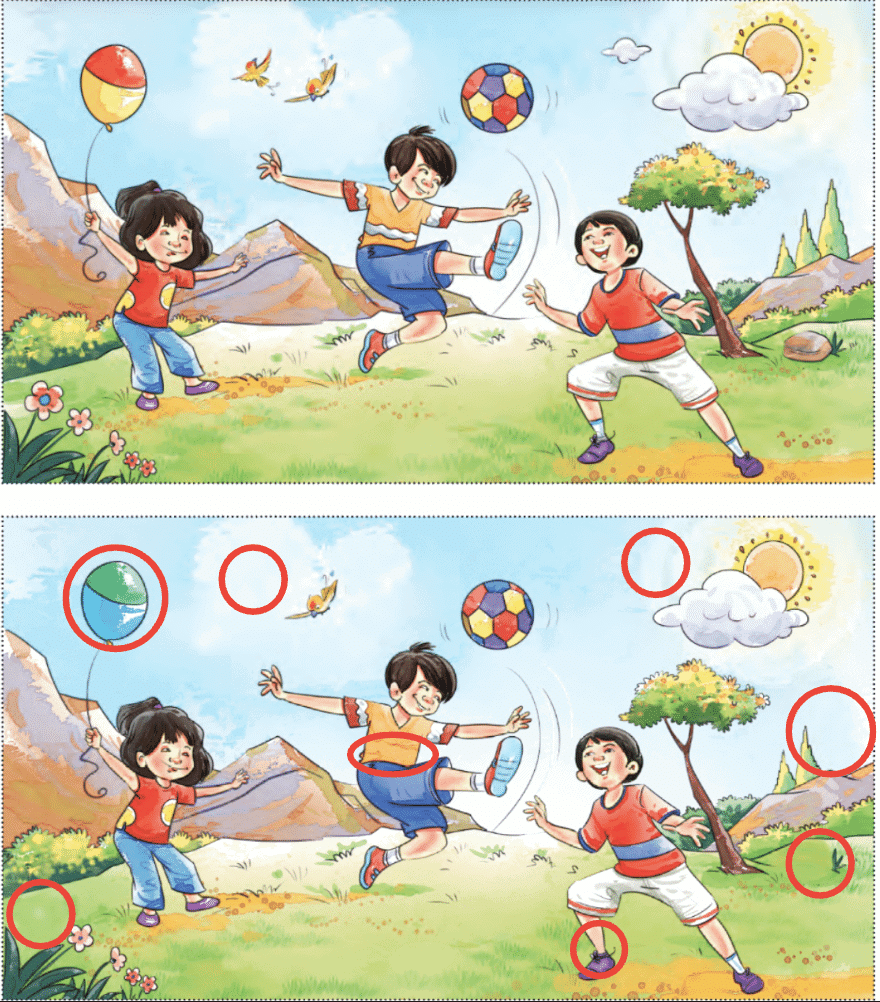
B. Point out the eight differences between the two pictures given below.

07.Fit Body, Fit Mind, Fit Nation- Textbook Solutions

A. Observe how the children are described in the poem, like ‘Active Boy Anant’, ‘Graceful girl Geeta’ etc. Write one quality that starts with the same letter as your name.
Ans: My name is Riya, so a quality starting with R is: Responsible Riya.

B. Answer the following.
Q1: Which game does Anant play?
Ans:
Anant plays the game of hockey.

Q2: Which musical instruments are mentioned in the poem?
Ans:
The musical instruments mentioned in the poem are a guitar and a sitar.

Q3: Who among the children mentioned in the poem likes moving in rhythm?
Ans: 
Meena likes moving in rhythm because she is described as “musical Meena, singing in rhythm.”

Q4: Who learns every day from the mistakes done during skating?
Ans:
Geeta learns every day from the mistakes done during skating.

C. Think and discuss.
Q5: Which game do you generally play in school?
Ans:
I generally play kho-kho in school.

Q6: What do you enjoy more—playing an indoor game or an outdoor game?
Ans:
I enjoy playing an outdoor game more because I like running and playing with my friends in the open air.

Q7: Which musical instrument do you like to play?
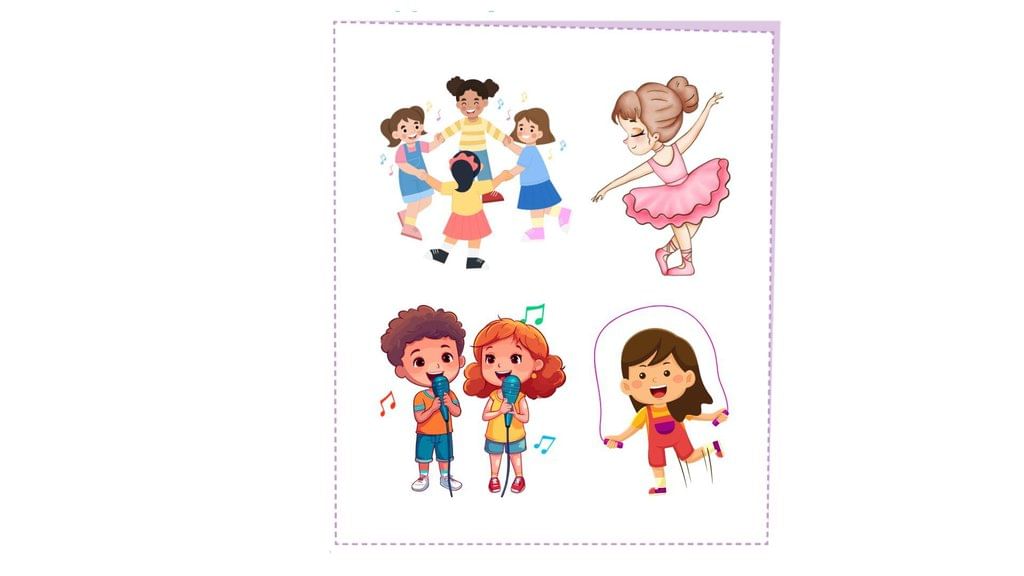
Ans: 
I like to play the drum because it makes a fun sound.

Q8: Have you seen musical instruments? If yes, name them.
Ans: 
Yes, I have seen musical instruments. Some of them are a guitar, a drum, a flute, and a harmonium.

Q9: Which dance form do you like the most? Name a famous dance from your region/district.
Ans:
I like the Kathak dance form the most. A famous dance from my region is Garba, which is from Gujarat.

Let us Learn

A. Let’s match.

Ans: 

B. Now, fill in the blanks with naming words that suit the first word.
happy ______
red _______
fierce _______
beautiful ________

Ans:

  • happy child
  • red apple
  • fierce lion
  • beautiful flower

Now, add the descriptions/describing words for the following:
_________ mangoes

_________ baby

_________ nation

_________ winner
Ans:

  • sweet mangoes
  • cute baby
  • strong nation
  • proud winner

Let us Do

Healthy and tasty food is liked by everyone. But have you cooked anything for anyone? Organise a “Preparing a Dish Without Fire” activity in your class. Your teacher may assist you in class.
Ans:
(Note: This is a hands-on activity, but a reference answer is provided here.)
I can make a fruit salad without fire. I will take some fruits like bananas, apples, and grapes. I will cut them into small pieces with the help of my teacher. Then, I will mix them in a bowl and add a little honey to make it tasty. I can share this healthy dish with my friends in class.

Let us Write

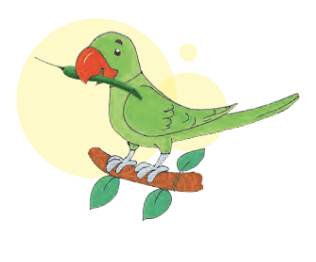
A. Look at the picture and fill in the blanks with words that have double letters.
Example: Village has ‘ll’ in it.
This is my pet ___. 
It loves to eat ___. which are ___ in colour.
Ans:
This is my pet parrot. It loves to eat chillies, which are green in colour.

  • parrot (has ‘rr’)
  • chillies (has ‘ll’)
  • green (has ‘ee’)

B. Now, go to your kitchen and find out any five things that have double letters in their spelling.
Ans:
a) spoon (has ‘oo’)
b) butter (has ‘tt’)
c) cheese (has ‘ee’)
d) bottle (has ‘tt’)
e) apple (has ‘pp’)

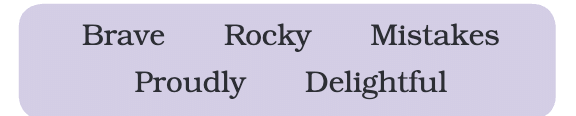
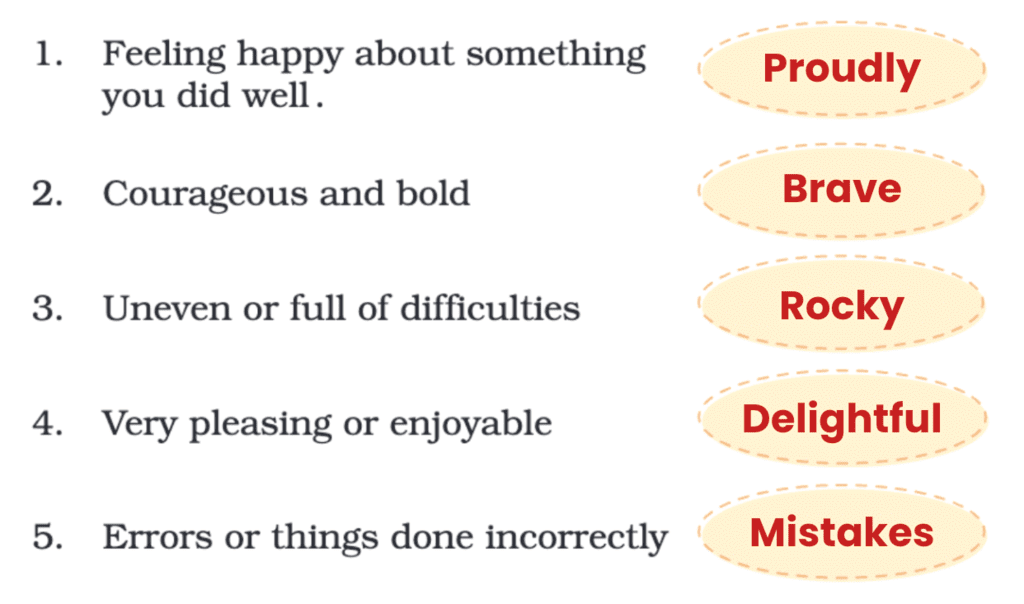
C. Rhyming words. Find and write the rhyming words from the poem.
Q1: Hockey
Ans: 
Rocky

Q2: Skates
Ans: 
Mistakes

Q3: Guitar
Ans:
Sitar

Q4: Race
Ans:
Pace

Q5: Joy
Ans:
Boy

D. Some words are given in the box below. Write them in the circle in front of their meanings.

Let us Explore

Find out about the “Paralympic Games”. Share your points with the class.
Ans:
The Paralympic Games are sports events for people with disabilities, like those who cannot see, walk, or have other challenges. They happen every four years after the Olympic Games. Athletes play games like swimming, cycling, and running. They show that anyone can be strong and win with hard work. I learned that the Paralympic Games started in 1960, and India has also won medals in these games.

06.Braille- Textbook Solutions

A. Answer the following.
Q 1: Describe the Braille alphabet.
Ans: The Braille alphabet is a way of reading through touch. It uses raised dots for each letter of the English alphabet. Each letter has a different pattern of dots, but the letters need more space and cannot be too close together.

Q2: Why was ‘Night Writing’ not a success?
Ans:
 ‘Night Writing’ was not a success because it was too difficult. It used raised dots and dashes, but soldiers found it hard to read with their fingers in the dark.

Q3: What did Louis Braille do to make reading easier for the blind?
Ans:
 Louis Braille simplified ‘Night Writing’ and made the Braille alphabet. He created an easier way with raised dots for each letter, so blind people could read by touching the patterns.

B. Think and discuss.
Q4: You may have seen people with blindness walking with a white cane. Why is the cane always white-coloured?
Ans:
 The cane is white-coloured so that people can easily see it and know that the person using it is blind. It helps others be careful and make way for them.

Q5: Imagine that the world becomes dark for a day and there is no light. What difficulties might one face on such a day?
Ans: 
If the world becomes dark for a day with no light, we might face difficulties like not seeing where to walk, bumping into things, or not finding our way. It would be hard to do things like read, cook, or play safely.

Let us Speak

Close your eyes. Pick an object. Keep the object back. Now complete the sentences and share them with the class.
Q1: The object in my hand was ___ in shape.
Ans:
 The object in my hand was round in shape.

Q2: The object in my hand was (longer/shorter) than my forefinger.
Ans:
 The object in my hand was longer than my forefinger.

Q3: The object in my hand was a ___.
Ans:
 The object in my hand was a pencil.

Now add two more lines to describe the object.
Ans:

  • The pencil felt smooth and hard.
  • It had a pointy end for writing.

Let us Write

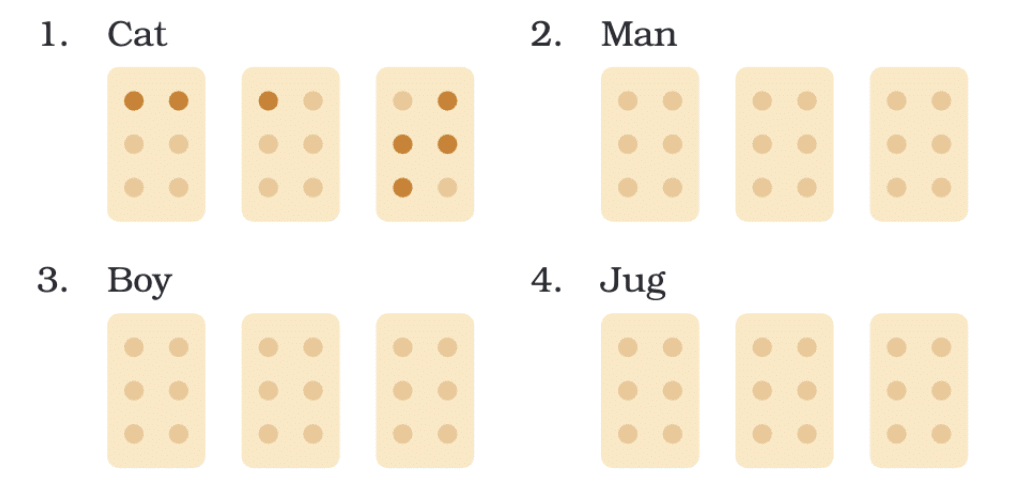
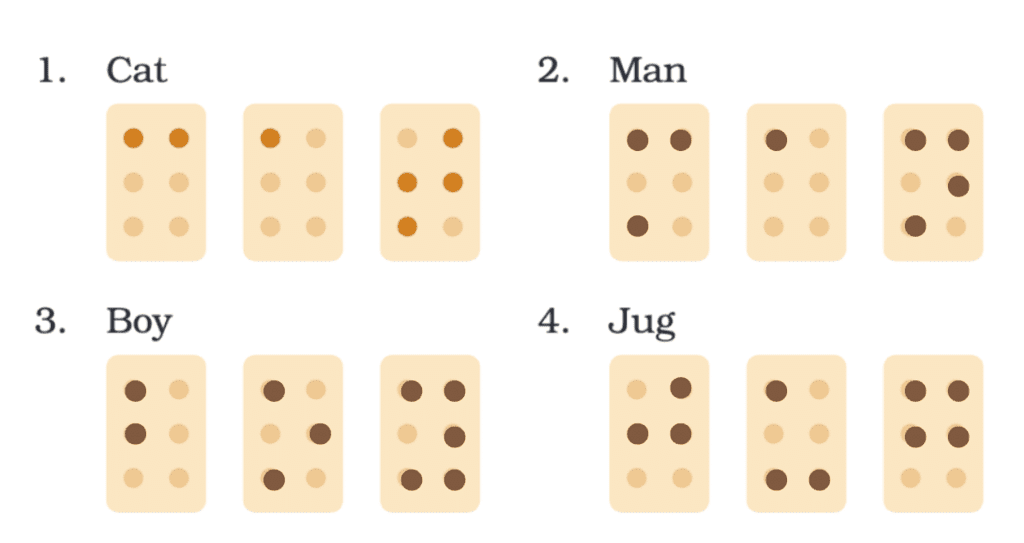
A. Write these words using the Braille alphabet. You can paste “bindis”.

Ans: 

B. Louis Braille lost his eyesight in an accident. Some time ago, a newspaper reported that a child lost one eye while lighting firecrackers. List the precautions that should be taken to protect eyes from harm.
Ans:

  • Do not play with sharp things like tools or sticks.
  • Wear safety glasses when doing experiments or playing with things that can hurt.
  • Do not light firecrackers without an adult’s help.
  • Keep away from bright lights or fire that can burn your eyes.
  • Wash your hands before touching your eyes to keep them clean.

C. Read the following sentences and notice the underlined words.     

•     Long ago, in France, a little boy named Louis Braille was playing near his home.     

•     The cats were sleeping when I reached home.    

 •     Sameer was playing hopscotch last evening.     

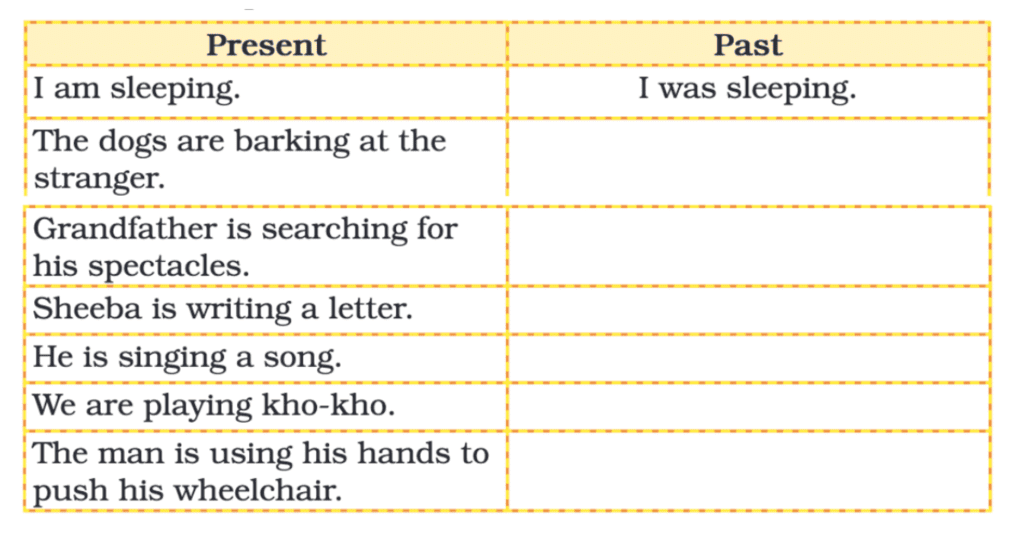
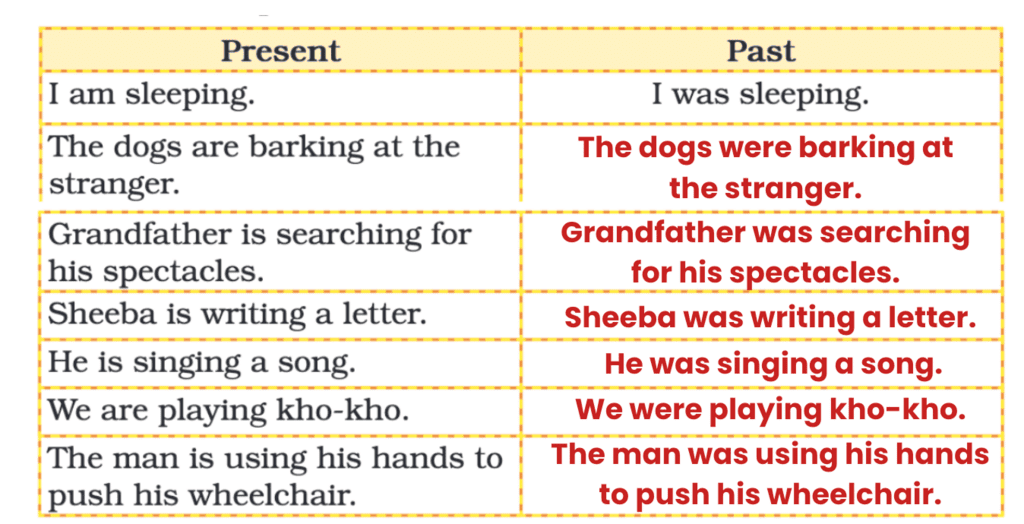
All the above sentences are examples of events that started in the past and continued for some time. If the sentence is about one person, animal or bird, we use ‘was + action word + ing.’          

Example: The student was writing in his notebook. If the sentence is about more than one person, animal or bird, we use ‘were + action word + ing.’          

Example: The students were writing in their notebooks.

The following sentences describe actions in the present. Change them to the past as shown in the examples.

Ans:

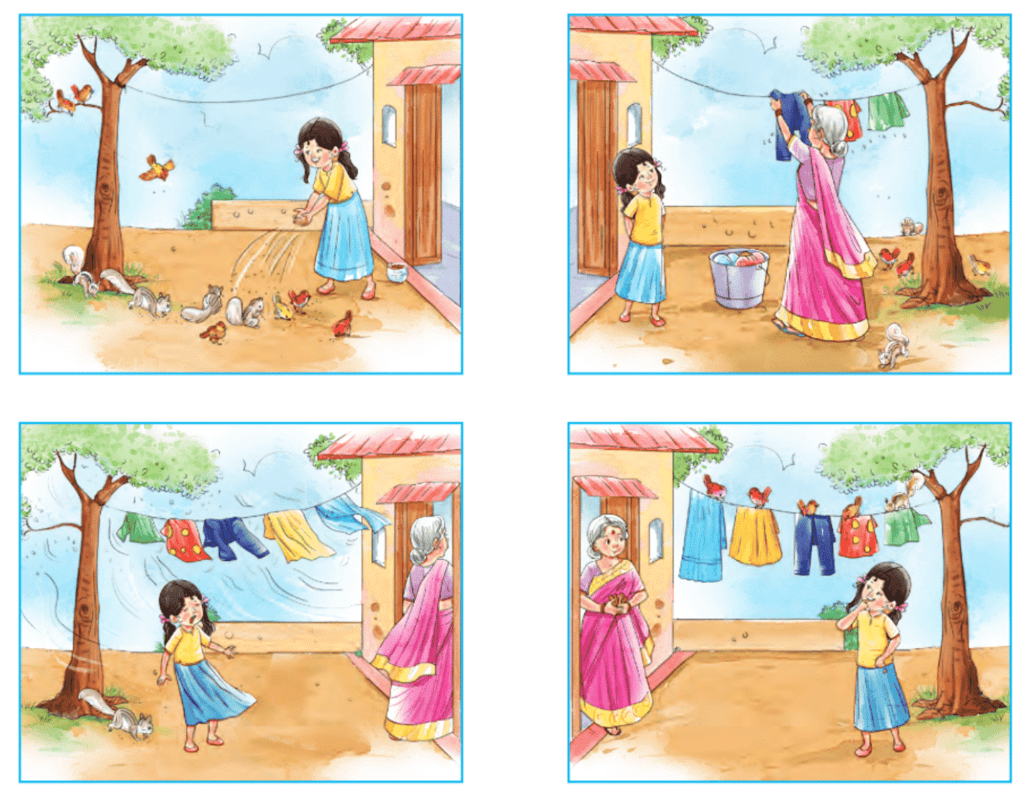
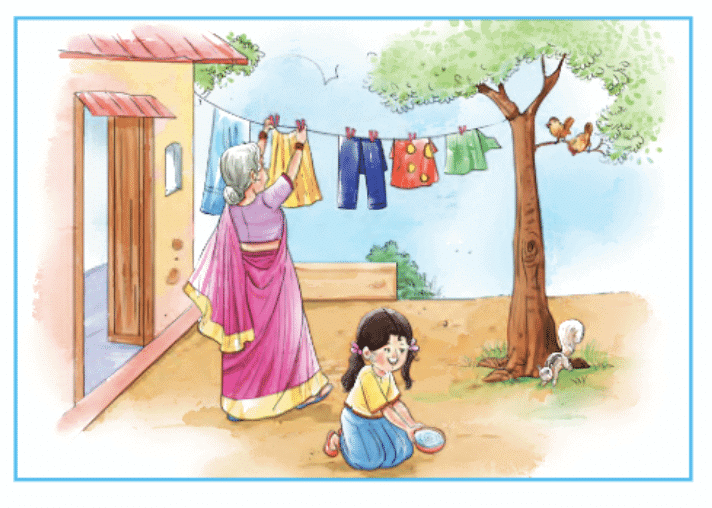
D. Look at the picture story.

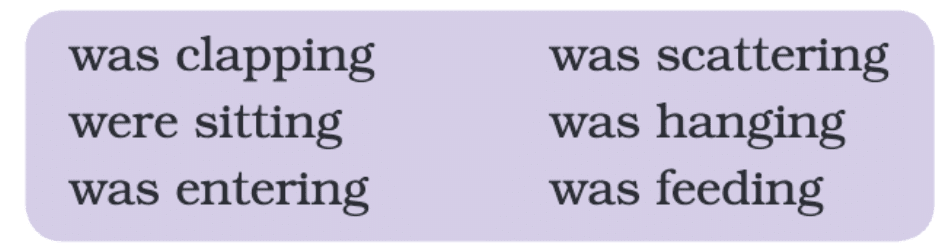
Now fill in the blanks from the suitable options.

Ans: 

My friend Tarandeep told me an interesting thing yesterday. She was feeding her friends, the squirrels and the sparrows. She was scattering grains for them. Her grandmother was hanging out the clothes to dry on a clothesline. Grandmother was entering the house when a strong wind began to blow. When she returned with the clothes pegs, she saw a wonderful scene! The sparrows and squirrels were sitting on the clothes to prevent them from falling. Tarandeep was clapping her hands with joy. Grandmother put the pegs on the clothes, and Tarandeep set down a bowl of water for her friends.

Let us Do

Q1: Take a piece of paper. With the help of a matchstick, or the back of a pencil, press hard on the paper to ‘draw’ a circle, a plus sign, or a letter of the alphabet. Now, close your eyes, turn the page over, and run your finger on the raised surface on the paper. Can you make out what the shape or outline is? Now, try the same activity with your friend. You may also use white clay for the same.
Ans:
(Note: This is an activity, this answer is only for reference.)
I took a piece of paper and used the back of a pencil to press hard and draw a circle. Then, I closed my eyes, turned the paper over, and ran my finger on the raised surface. I could feel the round shape and guessed it was a circle. I tried this with my friend, and she drew a plus sign. I felt the lines crossing and knew it was a plus sign. We also used white clay to make shapes, and it was fun to feel them with our eyes closed.

Q2: There are some children with low vision (e.g., wearing thick glasses or holding a book too close to their eyes). Being a classmate and friend, how can you assist them?
Ans:

  • I can read aloud to them so they don’t strain their eyes.
  • I can help them find things they might not see easily, like their pencil or book.
  • I can share my notes in big writing to make it easier for them to read.
  • I can walk with them and tell them if there are obstacles in the way.
  • I can sit with them and explain things they might not see clearly on the board.

05.The Old Stag- Textbook Solutions

A. Answer the following.

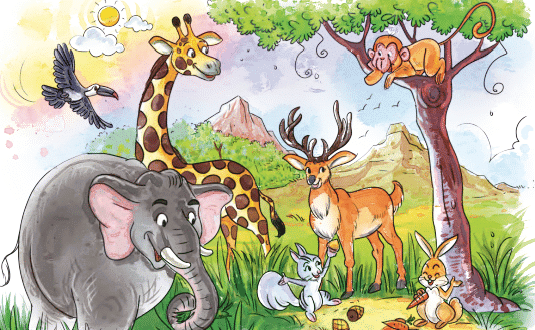
Q1: Why was the old stag popular?
Ans: 
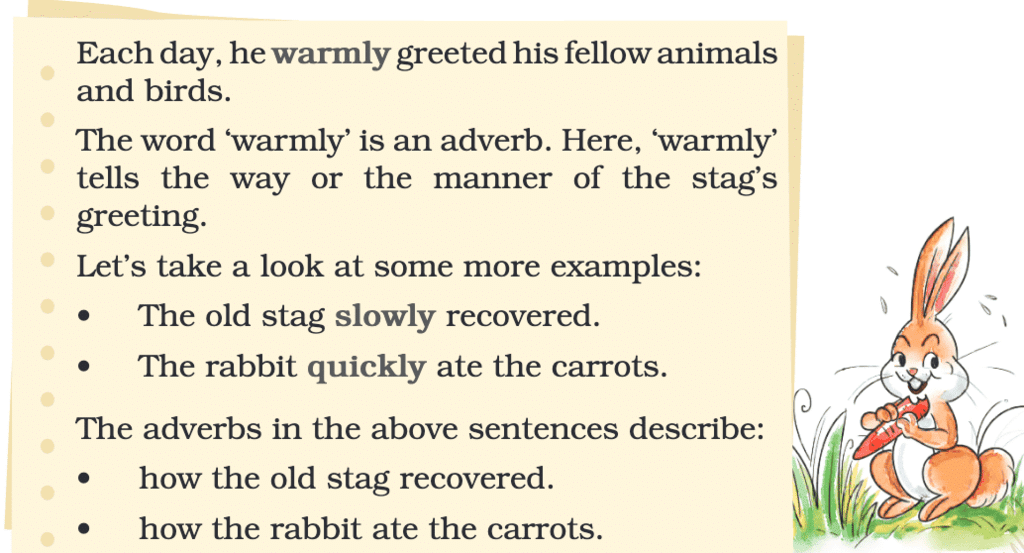
The old stag was popular because of his kindness. Every day, he warmly greeted his fellow animals and birds, and they all loved him.

Q2: Why did the old stag not go down the hillock to meet his friends?
Ans:
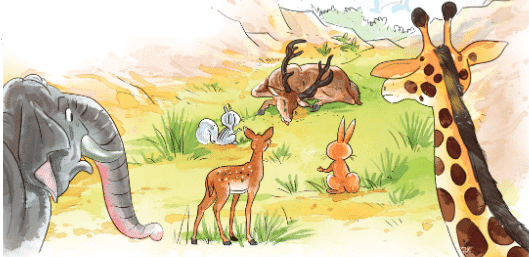
 The old stag did not go down the hillock to meet his friends because he had fallen ill and was too weak to leave the hillock.

Q3: Why did the green cover of the hillock slowly vanish?
Ans: 
The green cover of the hillock slowly vanished because many animals who came to visit the stag ate the tender grass, and it was consumed quickly, leaving little for the stag.

Q4: Did the animals realise their mistake towards the end? What did they do?
Ans:
 Yes, the animals realized their mistake when they saw that the stag was not getting enough grass to recover. They felt ashamed and decided to find food elsewhere in the forest. Some animals even brought fresh leaves for the stag. The grass grew back, and the stag recovered.

B. Think and Discuss.

Q5: Did the animals do the right thing in the end? Why do you think so?
Ans: 
Yes, the animals did the right thing in the end. They stopped eating the grass on the hillock and brought food for the stag. I think this was right because it helped the stag recover and showed they cared for their friend.

Q6: What would happen to the green plants around us if each one of us thought only of our own needs?
Ans:
 If each one of us thought only of our own needs, the green plants around us would disappear. Everyone would take too much, and there would be nothing left for others or the future.

Let us Learn

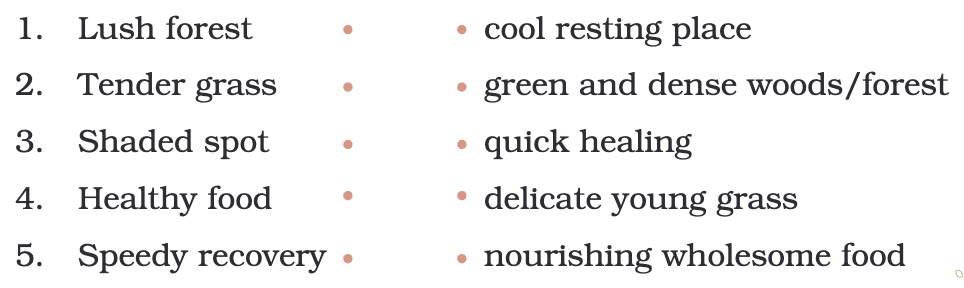
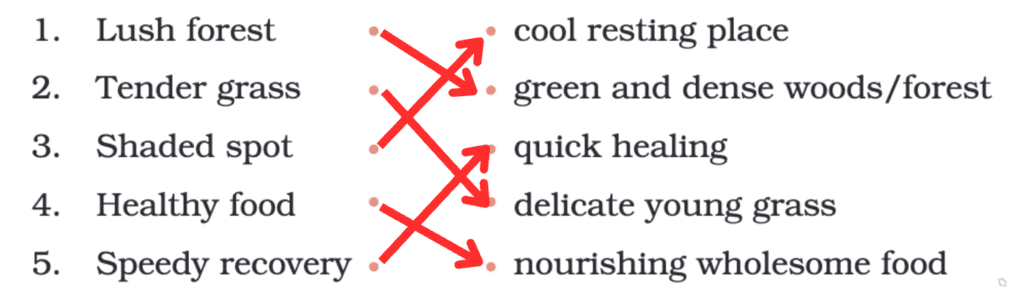
A. Match the words to their meaning.

Ans: 

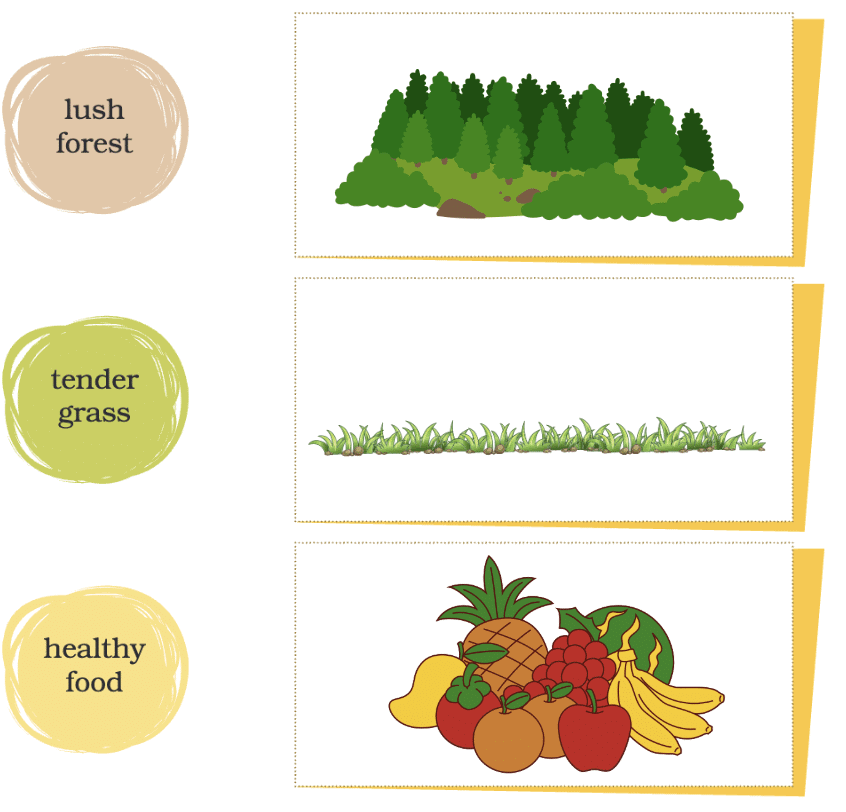
B. Draw the image that comes to your mind when you read the following: 

Ans:

C. Read the following sentence.

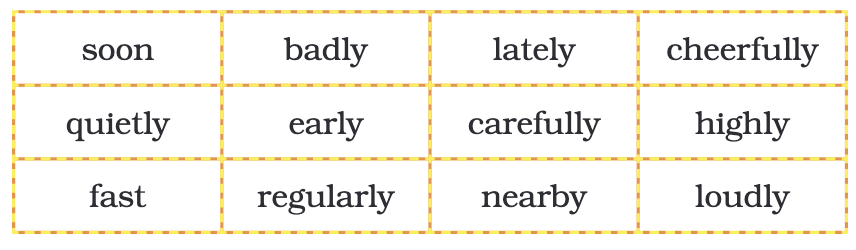
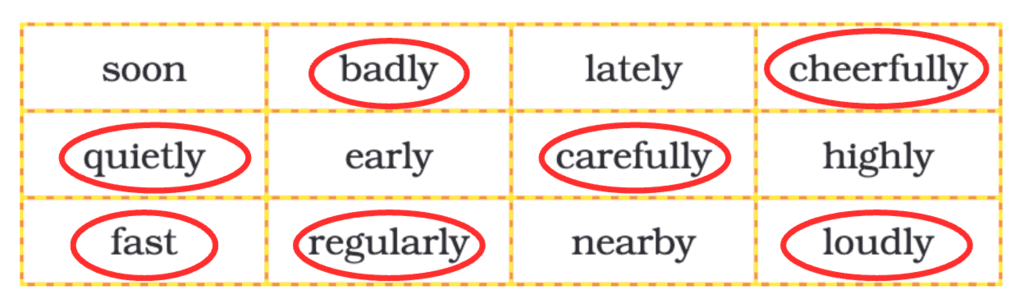
Encircle the adverbs that describe how something is done.

Ans:

Now work with your partner and write a sentence for each encircled adverb.
Ans:

  • I wrote my homework badly because I was in a hurry.
  • The children sang cheerfully during the school event.
  • We walked quietly so we wouldn’t wake the baby.
  • I packed my bag carefully to make sure I didn’t forget anything.
  • The dog ran fast to catch the ball.
  • I brush my teeth regularly every morning and night.
  • The teacher spoke loudly so everyone could hear her.

Let us Write

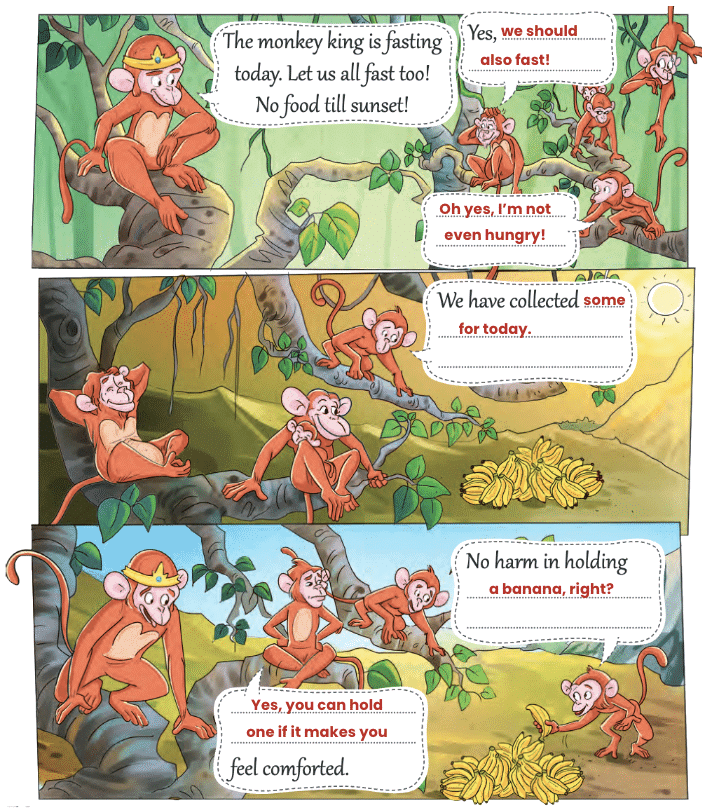
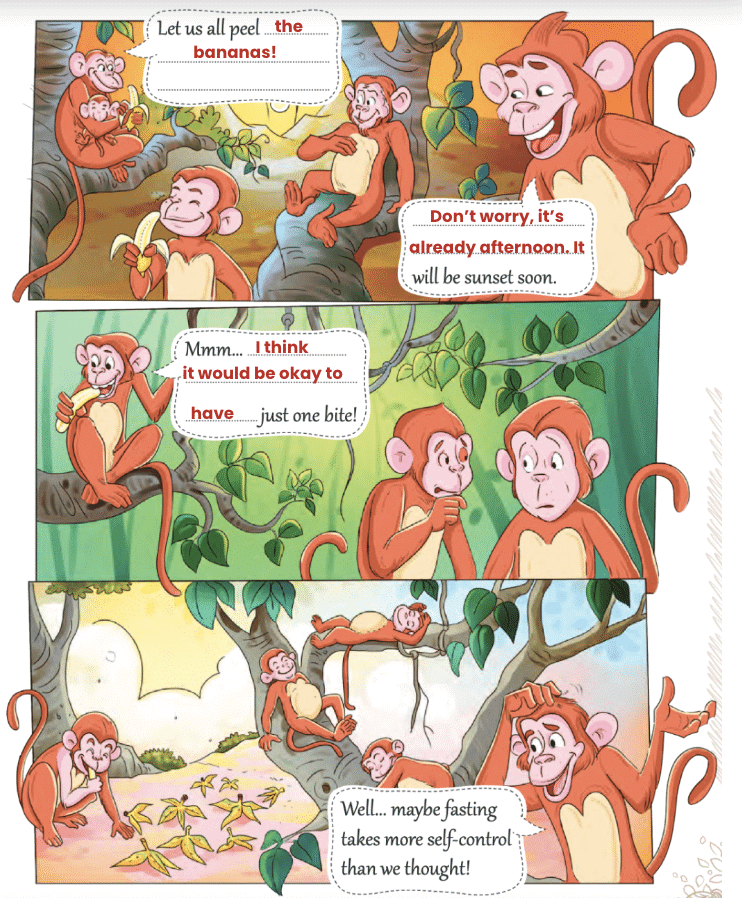
A. Complete the story by writing dialogues in the speech blurbs. The Monkeys’ Fast.
Ans:

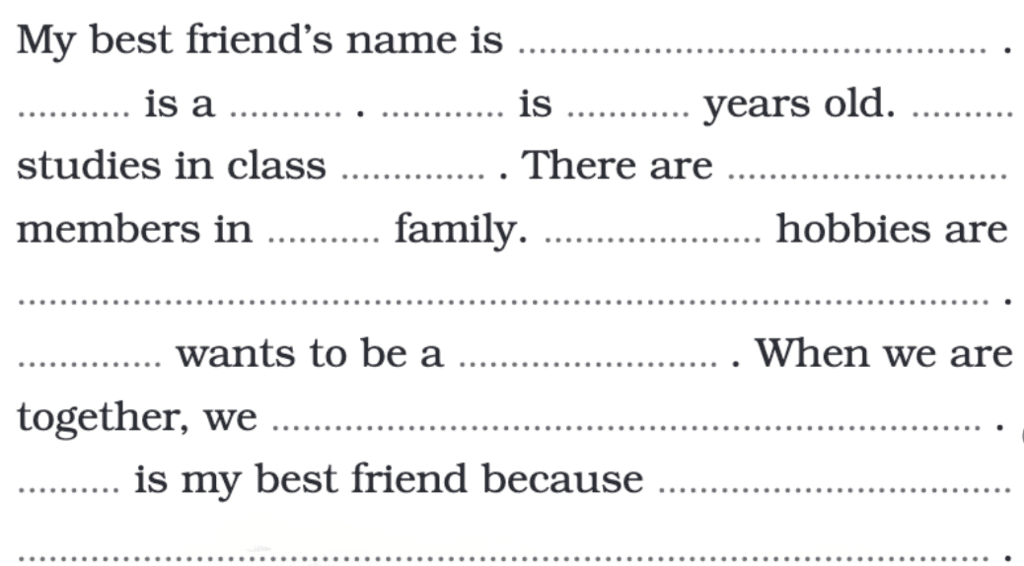
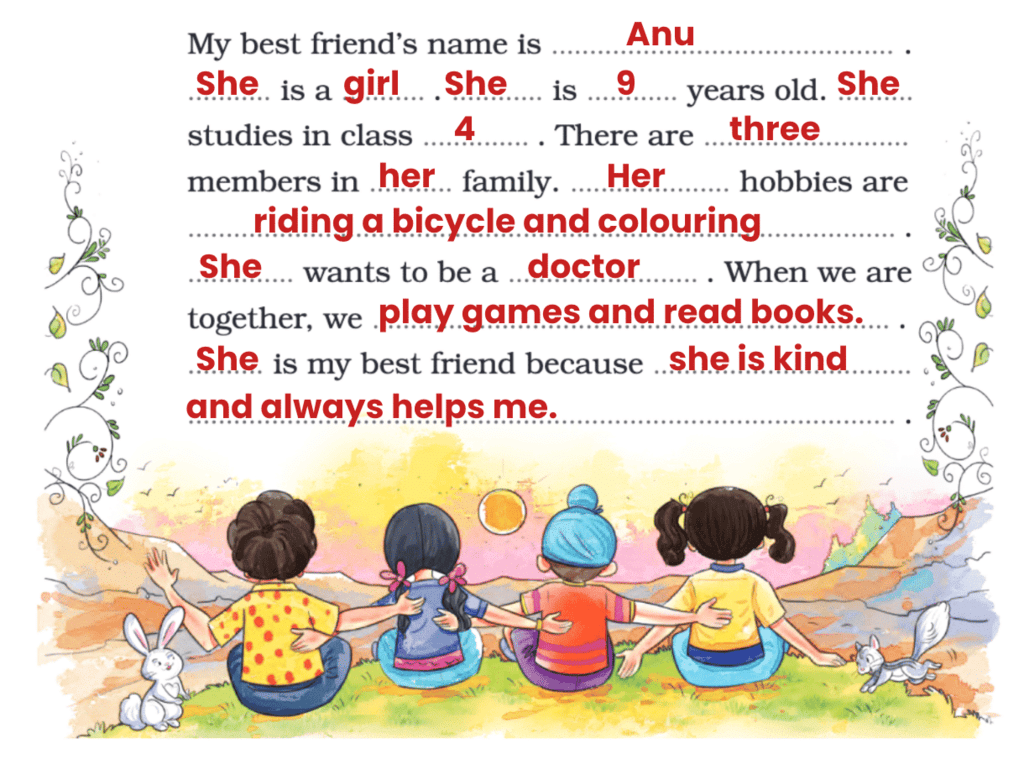
B. Write about your best friend and complete the paragraph.

Ans:

Let us Speak

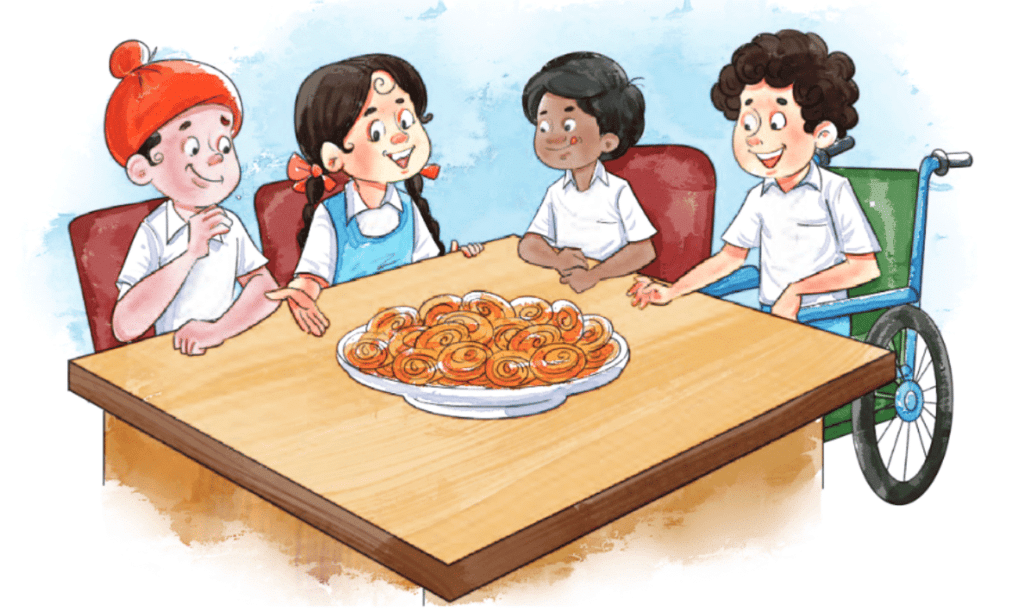
Look at this picture.

Imagine a large bowl of delicious jalebis is in your classroom. You and your friends start enjoying the sweets, one by one. Everyone loves the jalebis so much that you keep reaching for more. Now, think about what might happen next.

Discuss the following in the class:
Q1: How would you feel if the jalebis were almost finished, but some friends hadn’t had enough yet?
Ans: 
I would feel sad if the jalebis were almost finished and some friends hadn’t had enough. I would want everyone to enjoy them equally.

Q2: What will happen to the bowl of jalebis after some time?
Ans
: After some time, the bowl of jalebis will be empty because everyone keeps eating them without waiting for others.

Q3: Why is it important to share when we have something that everyone enjoys?
Ans:
 It is important to share because it makes everyone happy and shows we care for our friends. If we don’t share, some people might feel left out.

Q4: How can we make sure there are enough jalebis for everyone to enjoy?
Ans: 
We can make sure there are enough jalebis by taking only a few at a time and passing the bowl to everyone. We can also count how many friends there are and divide the jalebis equally.

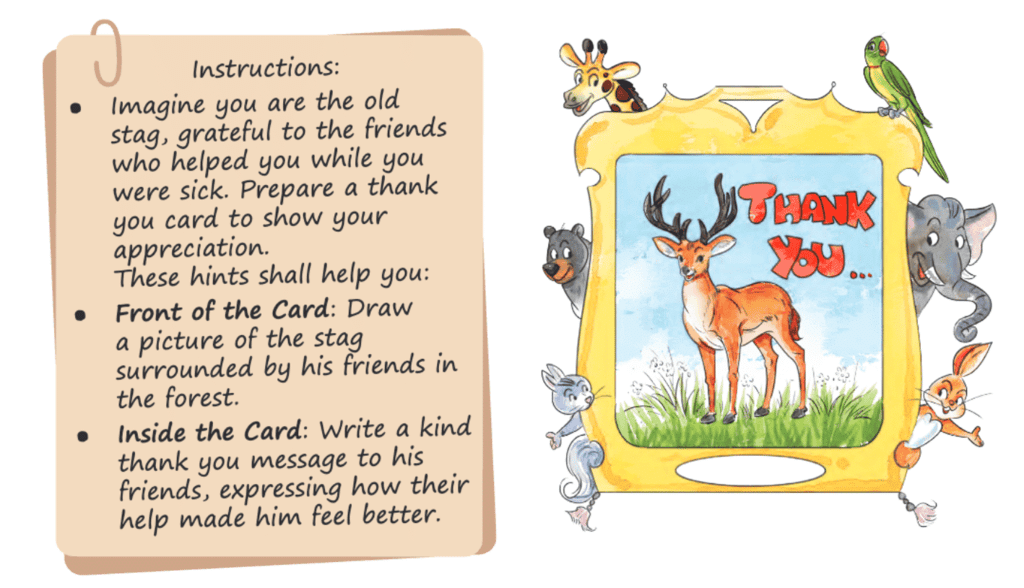
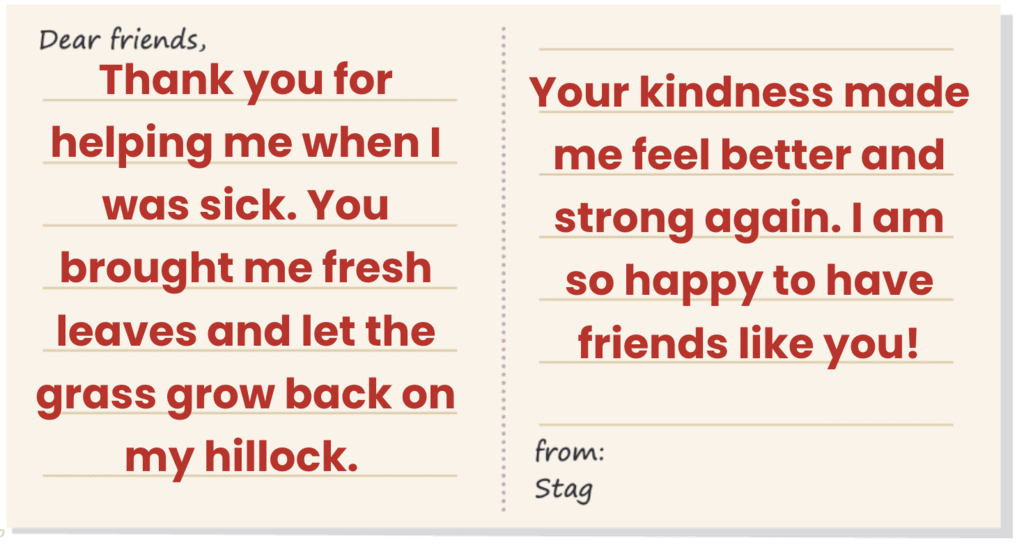
Let us DoCreate a Thank You Card from the Old Stag.

Ans:

04.One Thing at a Time- Textbook Solutions

A. Answer the following.

Q1: Why is it important to focus on doing one thing at a time?
Ans
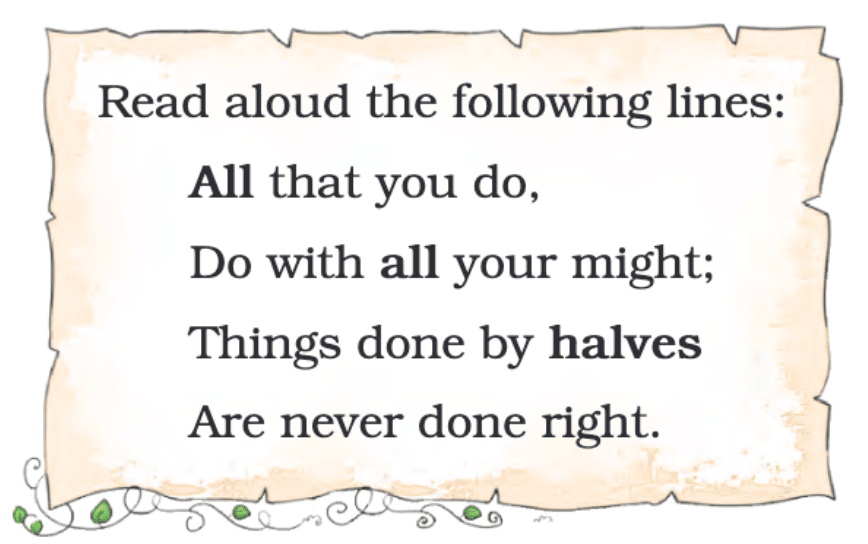
: It is important to focus on one thing at a time because when we do, we can do it well and finish it properly. The poem says that when we do things halfway, they are not done right. So, doing one thing at a time helps us give our best effort.

Q2: Make a list of words that rhyme in the poem ‘One thing at a time’.
Ans:

  • play – way
  • might – right
  • well – tell
  • time – rhyme
  • away – play

Q3: How do you feel after finishing a task that you have done well?
Ans:
 I feel proud and happy after finishing a task well. It makes me feel good about my work and encourages me to do more tasks in the same way.

Q4: What are some of the things you do every day that help you stay calm and focused?
Ans:
 I read books, take deep breaths, and sit quietly to help me stay calm and focused every day. These activities help me concentrate better on my work.

B. Think and discuss.

Q5: What do you like doing in your free time?
Ans:
 I like playing with my friends, drawing pictures, and reading storybooks in my free time.

Let us Learn

A. Match the words with their meanings.

Ans:

Now use the words and frame meaningful sentences.

Let us Speak

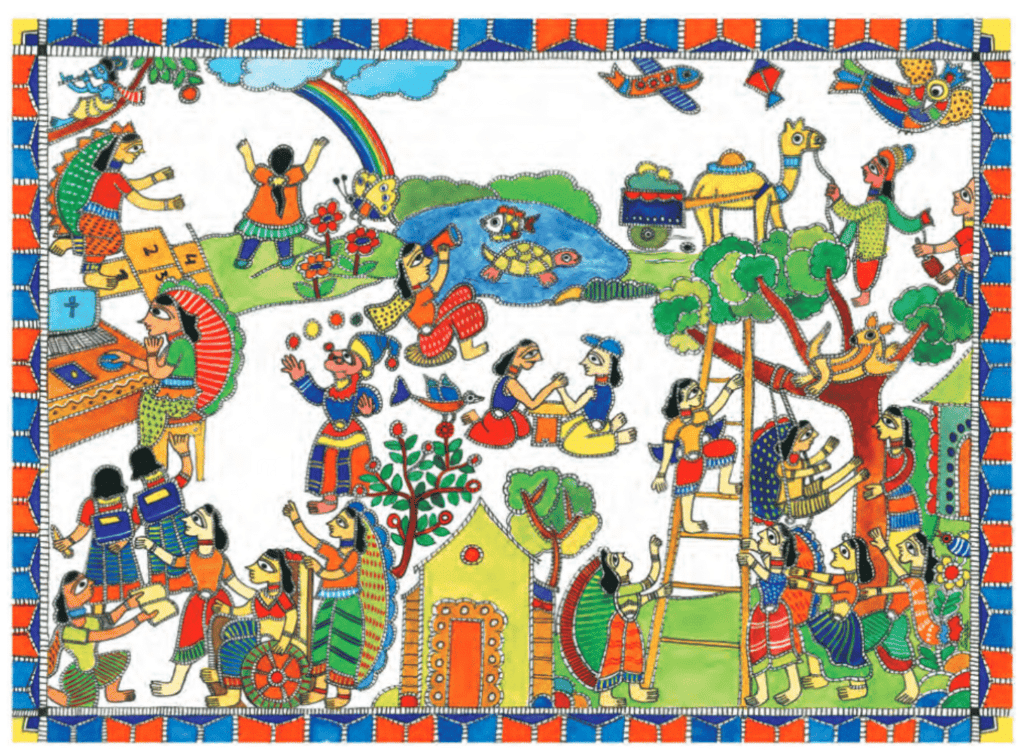
Describe what everyone is doing in the picture.

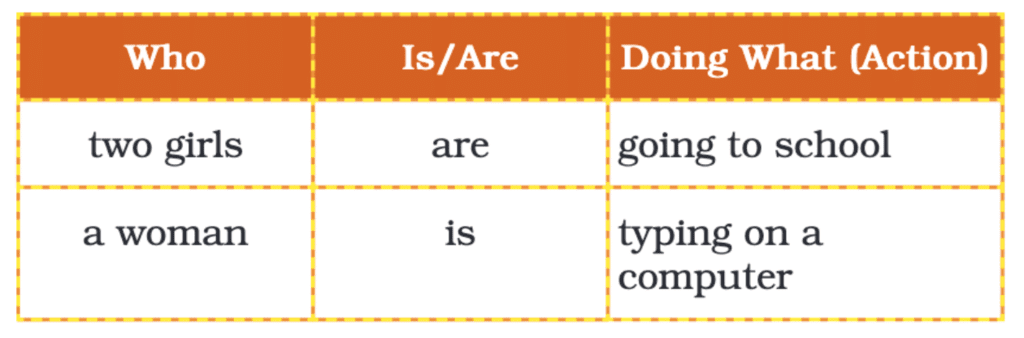
Q: Using the above sentence structure, create sentences of your own. Write at least seven sentences in your notebook.
Ans:

  1. A girl is working on a computer.
  2. Two girls are going to school.
  3. A kite is flying in the sky.
  4. A woman is climbing stairs. 
  5. A woman is sitting in a chair.
  6. A camel is pulling a load.
  7. A Tortoise and a fish are there in the pond

Let us Listen

The case of missing ‘L’

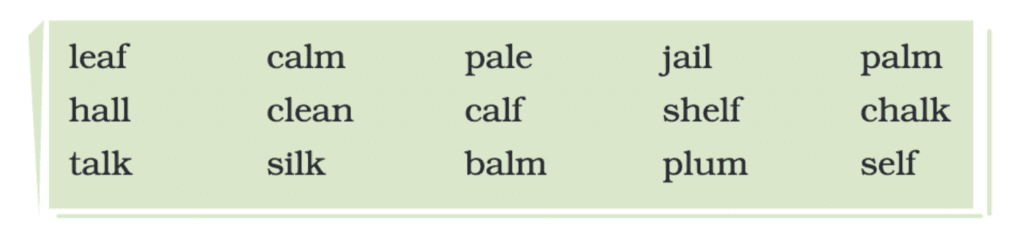
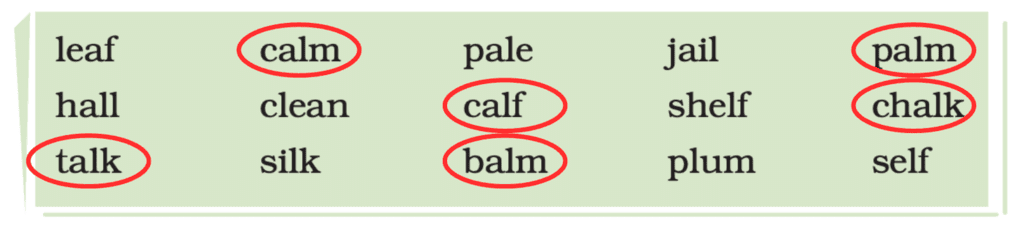
 Circle the words in which you don’t hear the ‘L’ sound.

Ans: 

Here’s the list of words with the ones where the ‘l’ sound is not heard (silent ‘l’) marked in bold:

  • calm
  • palm
  • balm
  • chalk
  • talk
  • calf

In these words, the ‘l’ is silent, so you don’t hear it when they’re spoken aloud. The other words (leaf, pale, jail, hall, clean, shelf, silk, plum, self) have a clear ‘l’ sound.

Let us Write

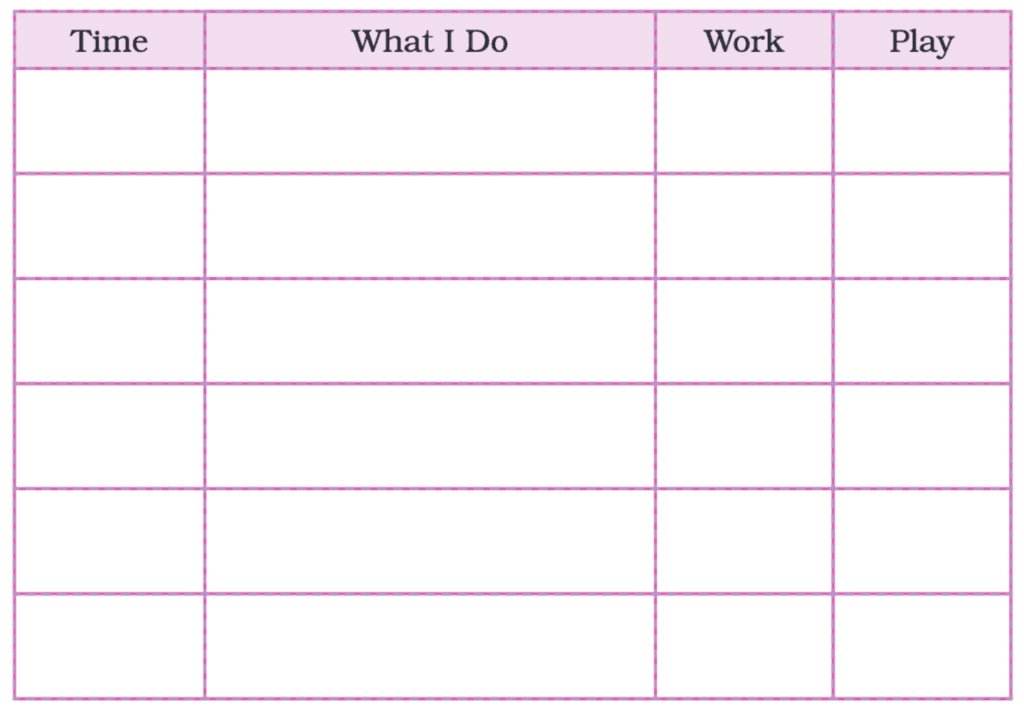
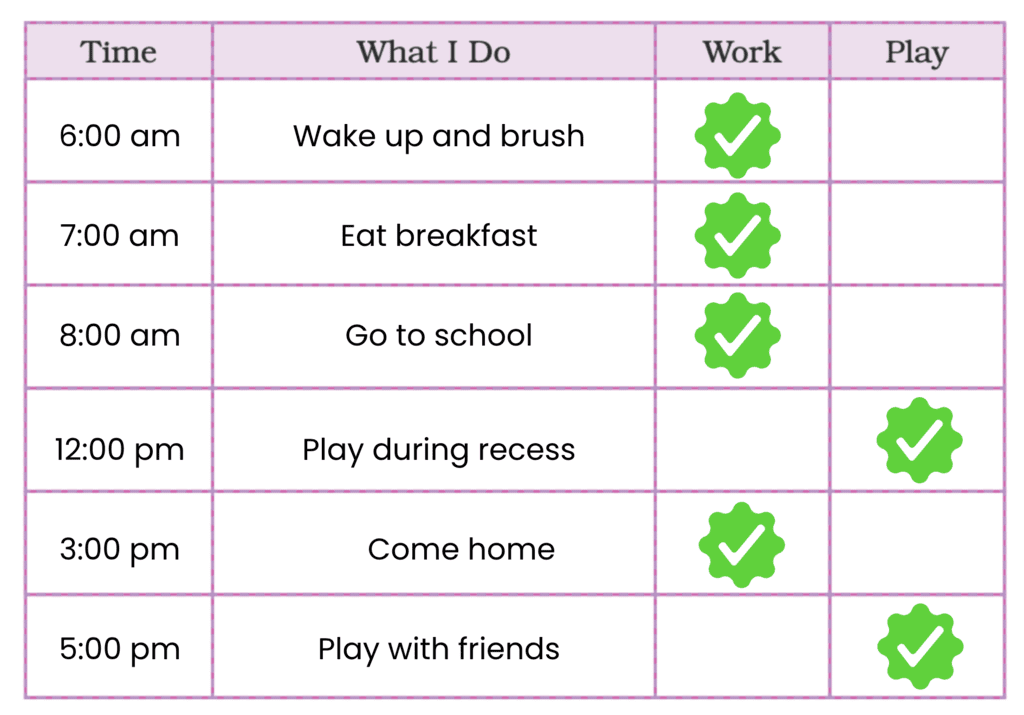
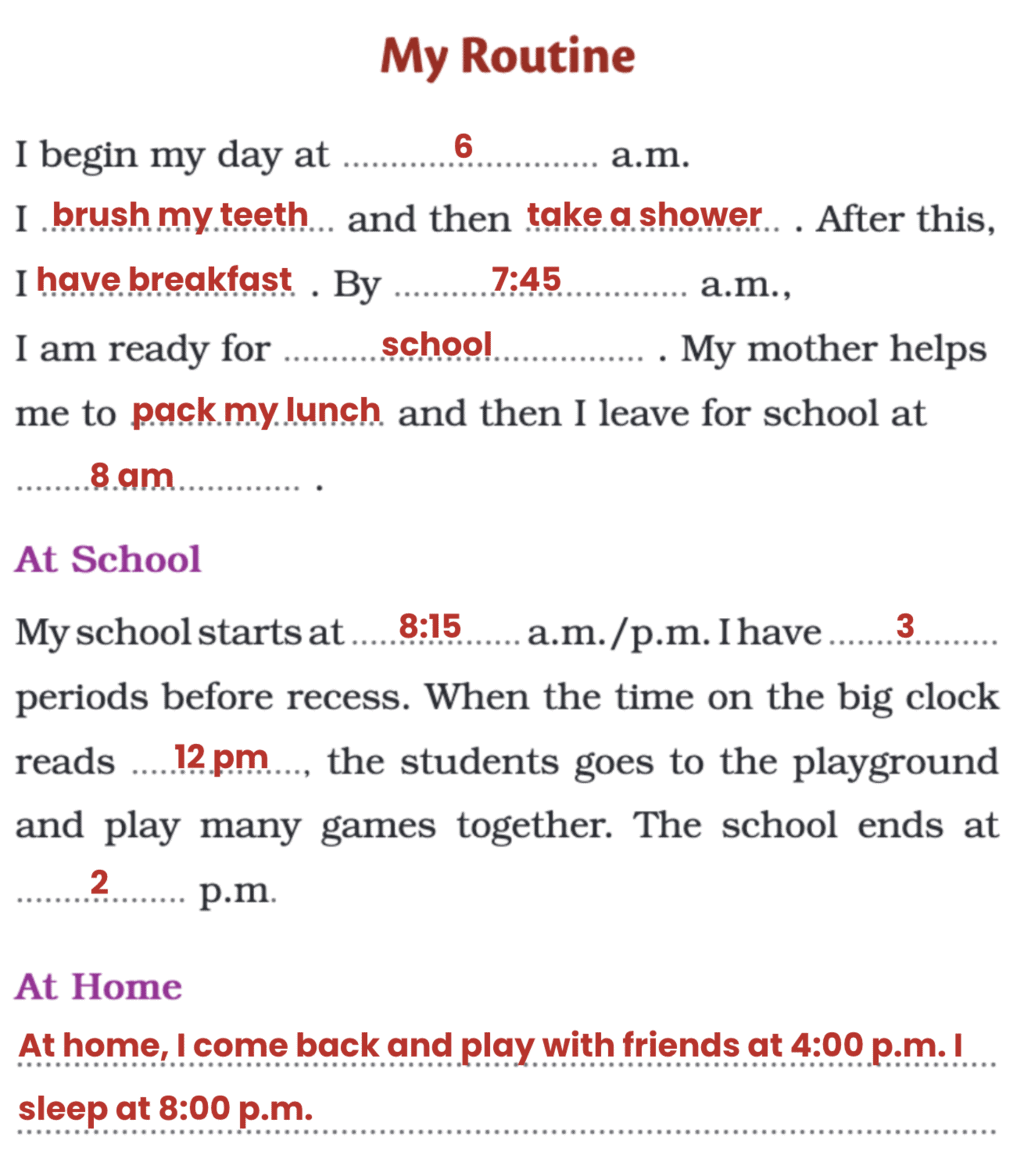
Write down your daily routine in the space given below. Tick (✓) if they are work or play.

Ans:

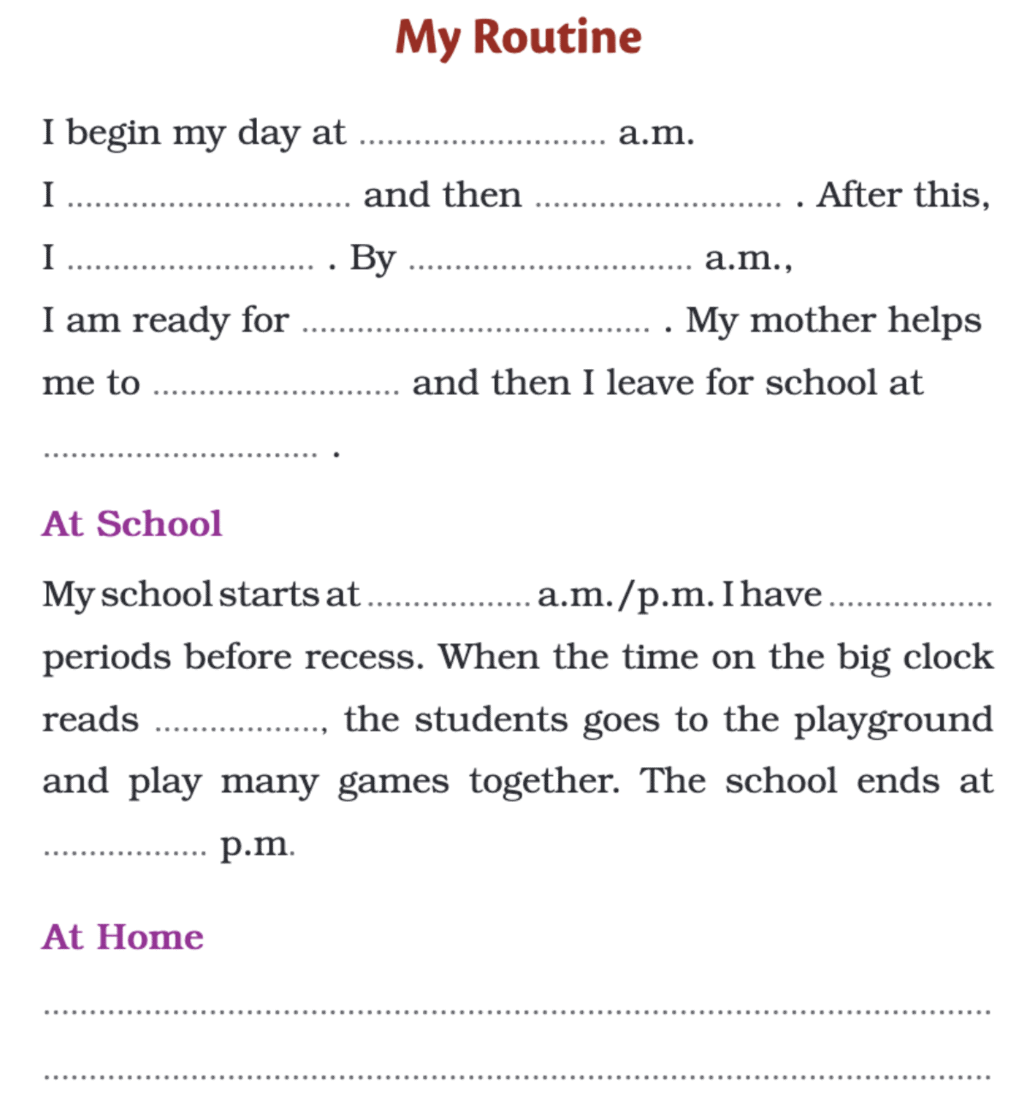
Now write the above routine as a paragraph.

Ans: 

Let us Do

A. Guess the following riddles.
Q: Thirty white horses on a red hill, now they chomp, now they stomp, now they stand still.

Ans: The answer is teeth. 

The riddle describes teeth as white horses on the red hill (tongue or gums), chomping and stomping (chewing), and standing still (when not eating).

Q: Tall lady in a white frock, with a yellow face, and a red nose. The longer she stands, the shorter she grows.
Ans: 
The answer is a candle. 

The riddle describes a candle as a tall lady in a white frock (wax), with a yellow face (flame) and a red nose (wick), and it gets shorter as it burns longer.

Q Hard and brown outside, soft and white inside…”
Ans: A coconut 

The hard brown shell and soft white flesh inside match the description.

B. Use the space to draw activities that you enjoy doing in holidays. You may also paste pictures from old newspapers or magazines.
Ans: 

03.Be Smart, Be Safe- Textbook Solutions

Let us Think

A. Answer the following.
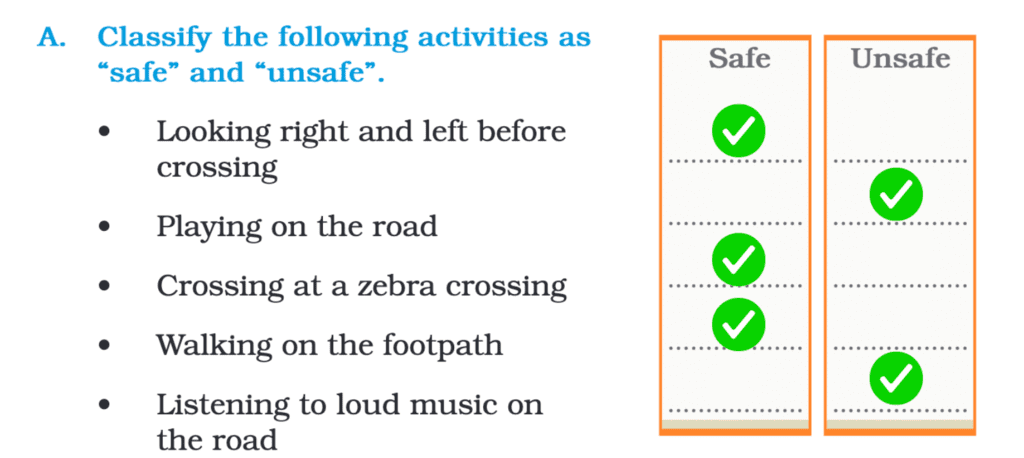
Q1: What should you do before crossing a road?
Ans:
 Before crossing a road, I should look right, then left, and then right again to make sure no vehicles are coming. I should also wait for the green pedestrian signal at traffic lights.

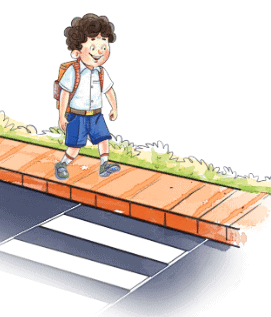
Zebra Crossing

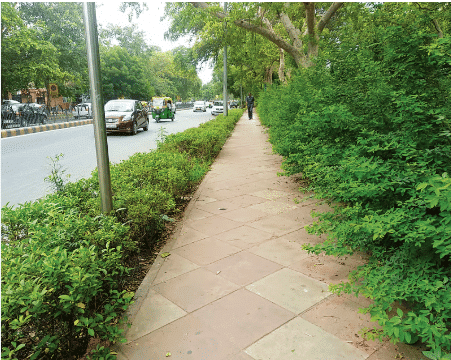
Q2: Why should you not play on the footpath?
Ans:
 I should not play on the footpath because it is meant for walking. Playing there can make me bump into other people or get distracted and step onto the road where vehicles are moving.

Q3: Why should you hold an adult’s hand while crossing the road?
Ans: 
I should hold an adult’s hand while crossing the road because they can keep me safe. They can see the traffic better and help me cross when it is safe.

Let us LearnA. True or False.

Q1: You should always walk on the footpath.
Ans:
 T

Walking on the footpath keeps me safe from moving vehicles.

FootpathQ2: It is safe to run while crossing the road.
Ans:
 F

It is not safe to run while crossing the road because I might trip or not see vehicles coming.

Q3: You should use the zebra crossing to cross the road.
Ans:
 T

Using the zebra crossing is the safest way to cross the road.

Q4: Wearing dark clothes in the evening makes you more visible.
Ans:
 F

Wearing dark clothes in the evening makes me less visible. I should use reflective stickers to be seen by drivers.

Reflective Stickers

Q5: It is safe to play near the road.
Ans:
 F

It is not safe to play near the road because I might get distracted and run into traffic.

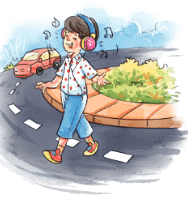
Q6: You should wear headphones while walking on the road.
Ans:
 F

I should not wear headphones because they can distract me from hearing traffic sounds.

B. Encircle the correct option.
Q1: What should you do before crossing a road?
a) Run quickly  
b) Stop, look right, then left, again right 
c) Close your eyes
Ans:
 b) Stop, look right, then left, again right

This is the safe way to check for vehicles before crossing.

Q2: Where should you walk near the road?
a) On the footpath  
b) On the road  
c) In the middle of the vehicles
Ans:
 a) On the footpath

The footpath is the safest place for walking near the road.

Do not use headphone while crossing the road

Q3: Why should you avoid using headphones on the road?
a) It looks bad  
b) It makes you run faster  
c) It can distract you from traffic sounds
Ans:
 c) It can distract you from traffic sounds

Headphones stop us from hearing vehicles or horns while crossing the road, which can be dangerous.

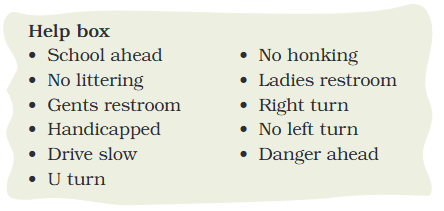
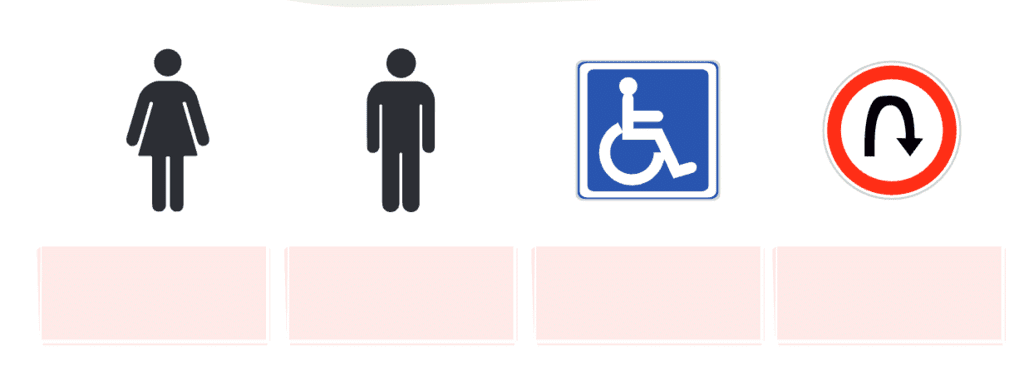
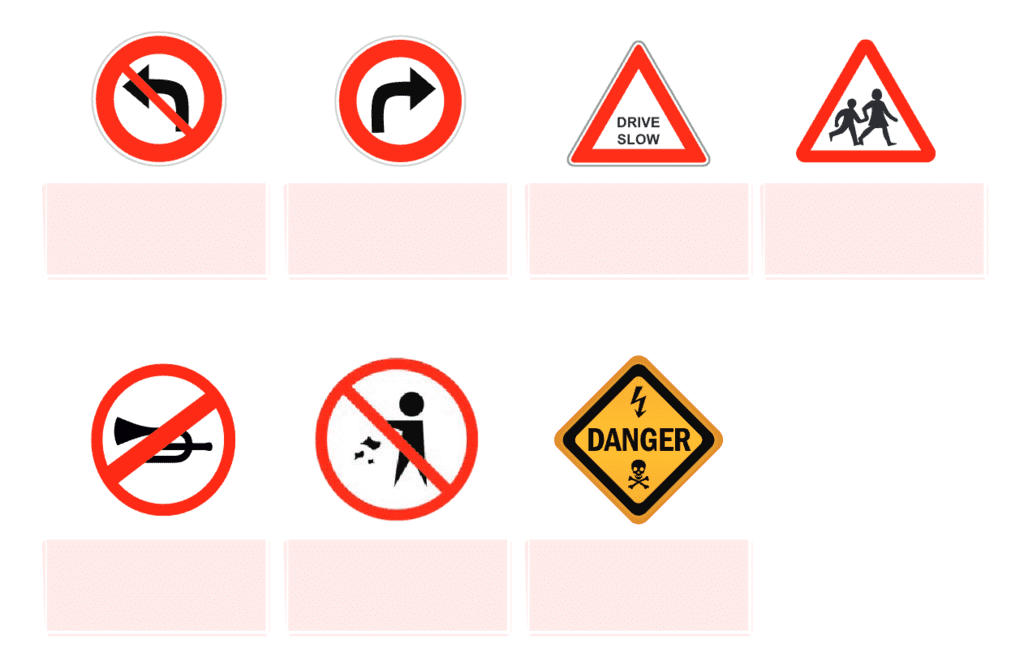
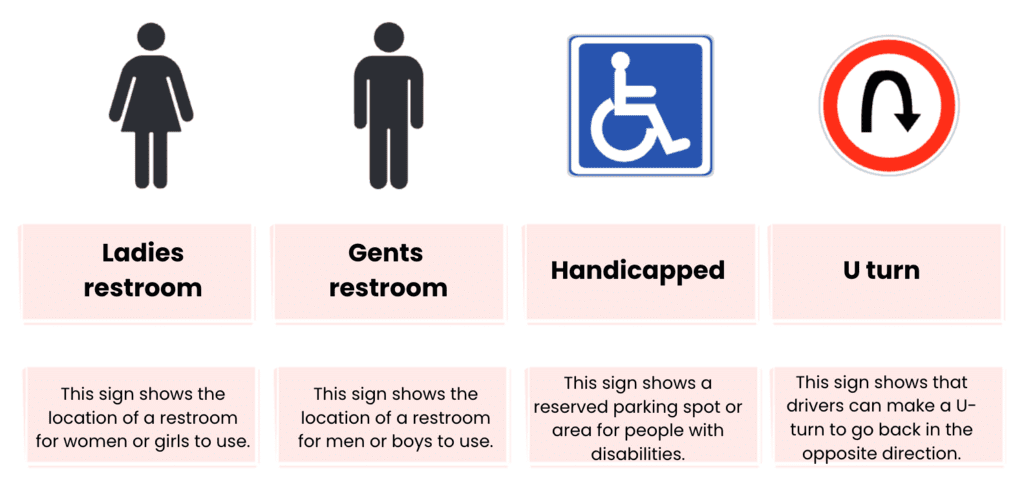
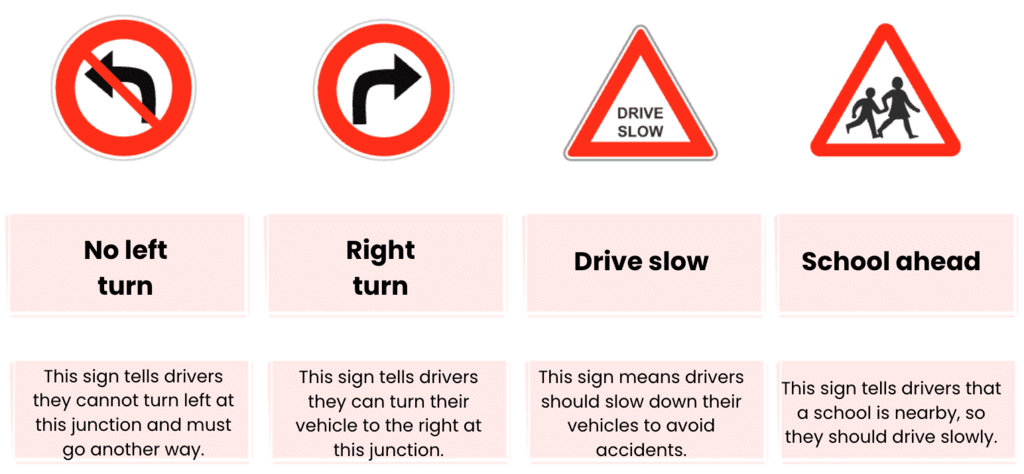
C. Identify the following symbols and write their meanings.

Ans: 

Let us Do

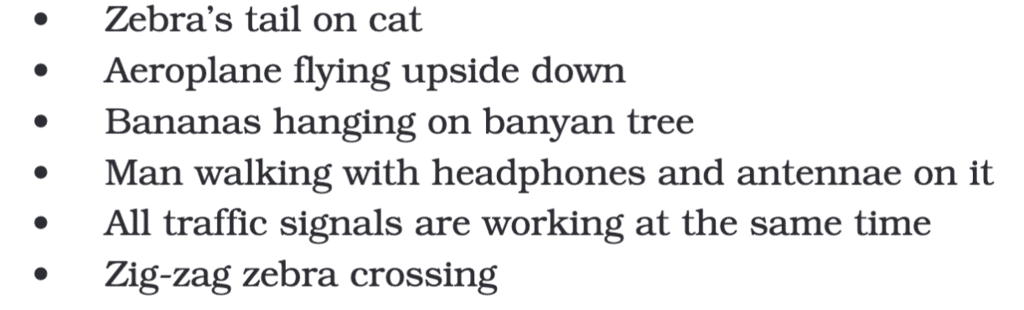
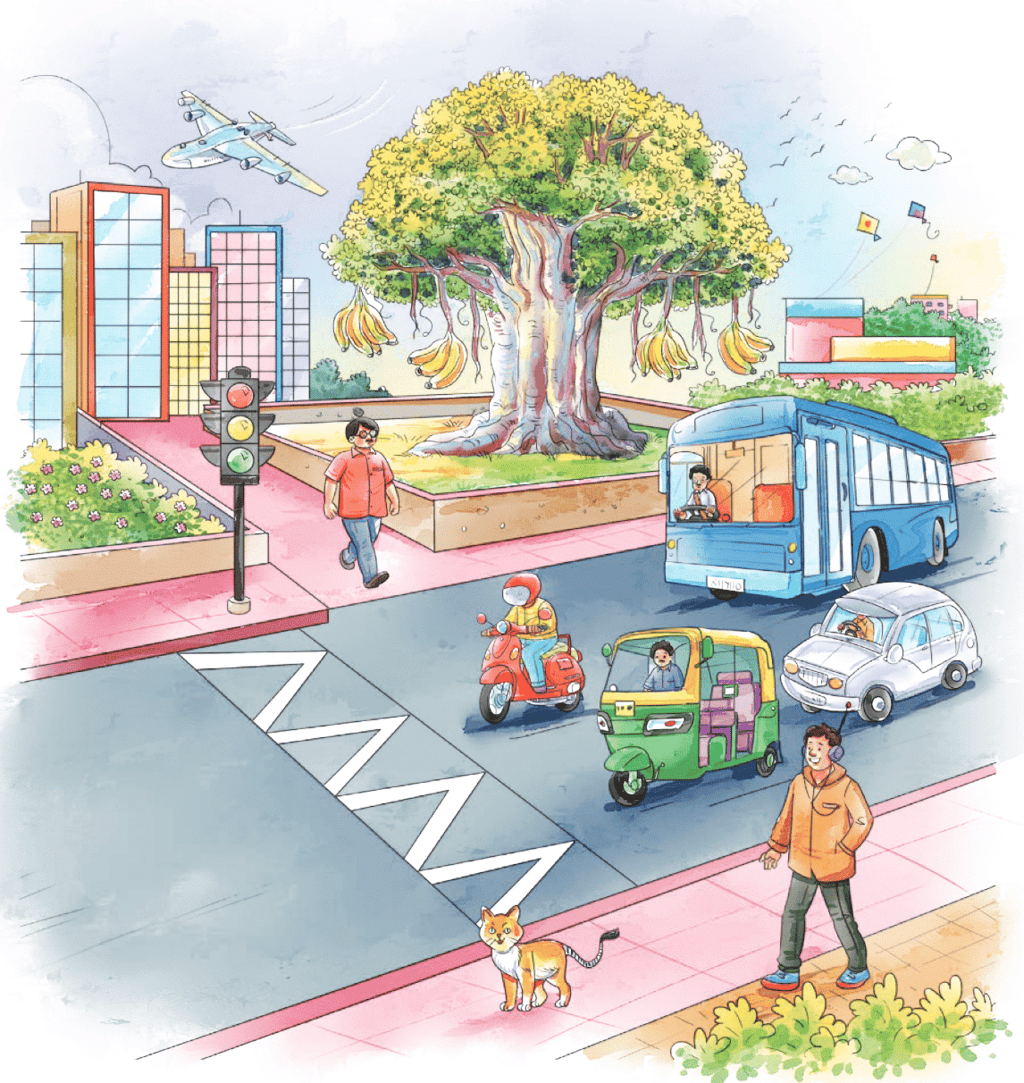
B. Spot what’s wrong with the picture. Look at the following picture below and spot six errors.
Ans:

Ans: 

Let us Write

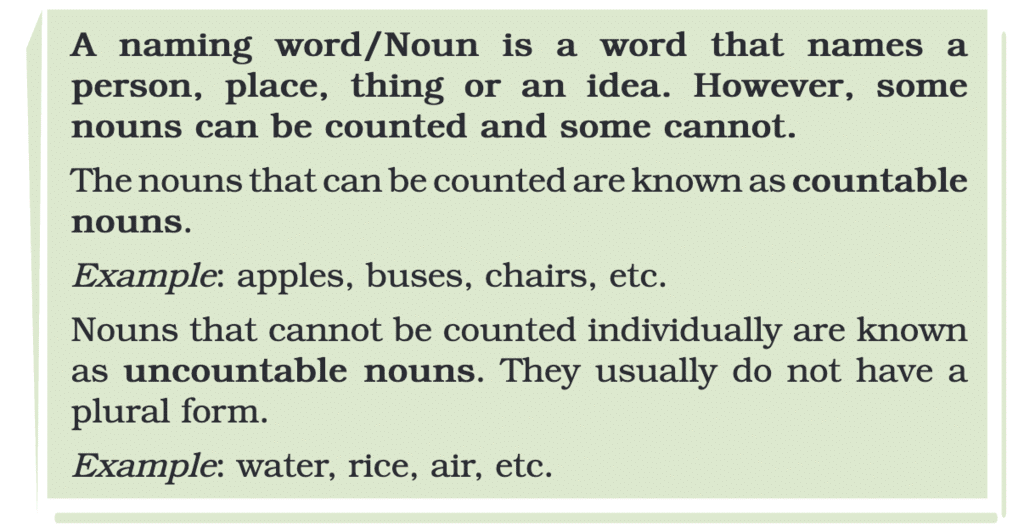
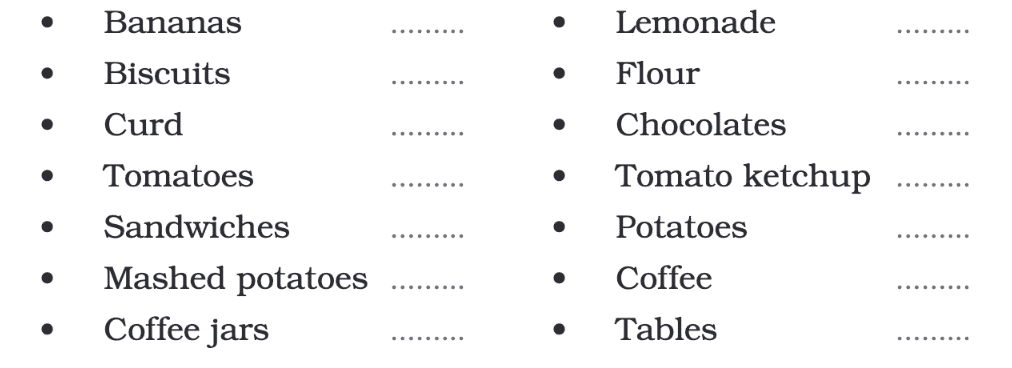
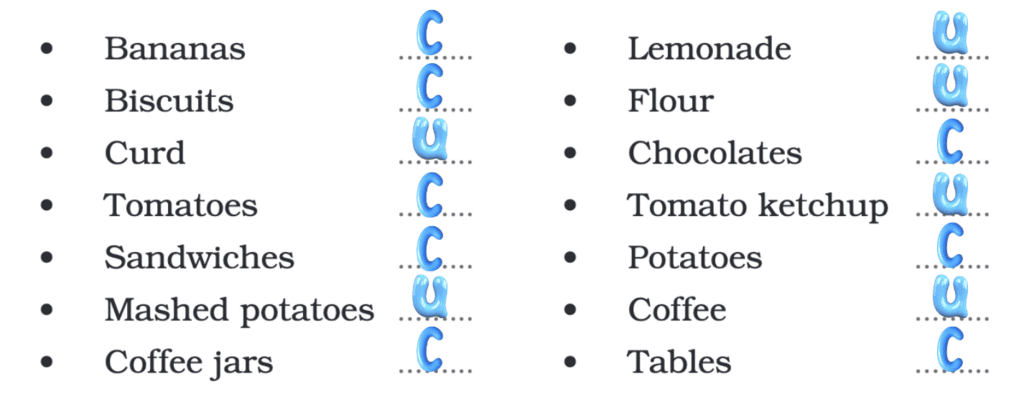
A. Classify the following as “C” (Countable) and “U” (Uncountable).

Ans: 


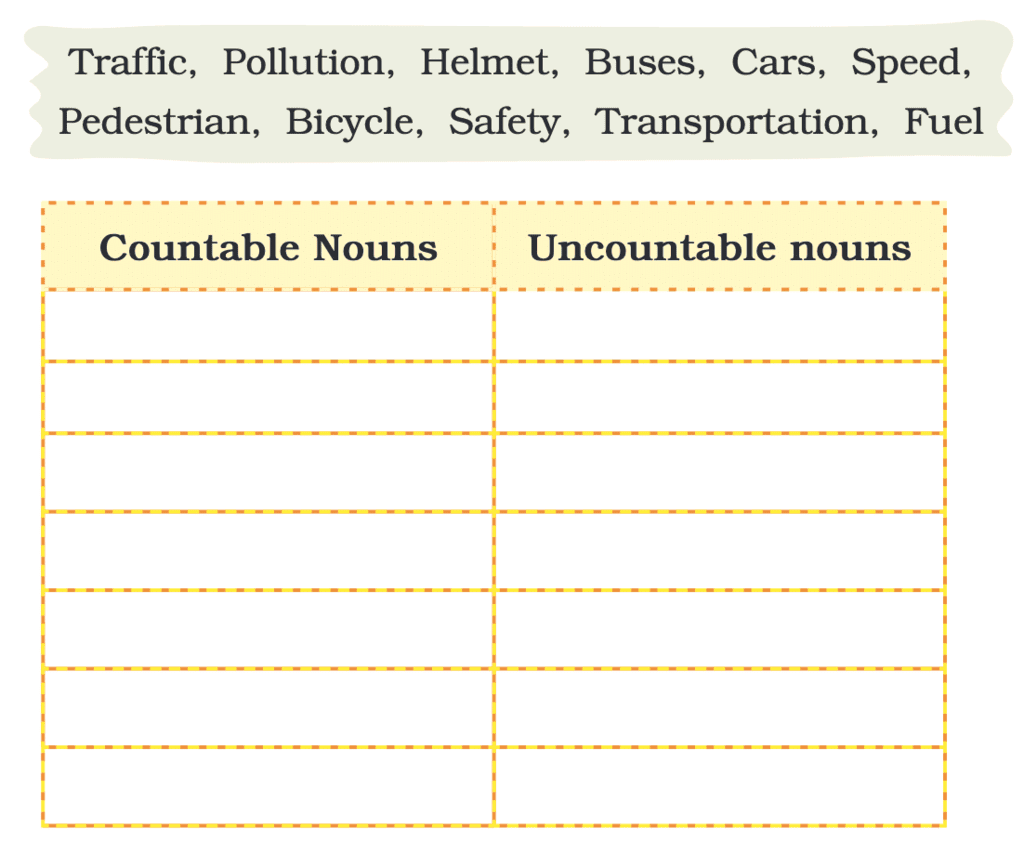
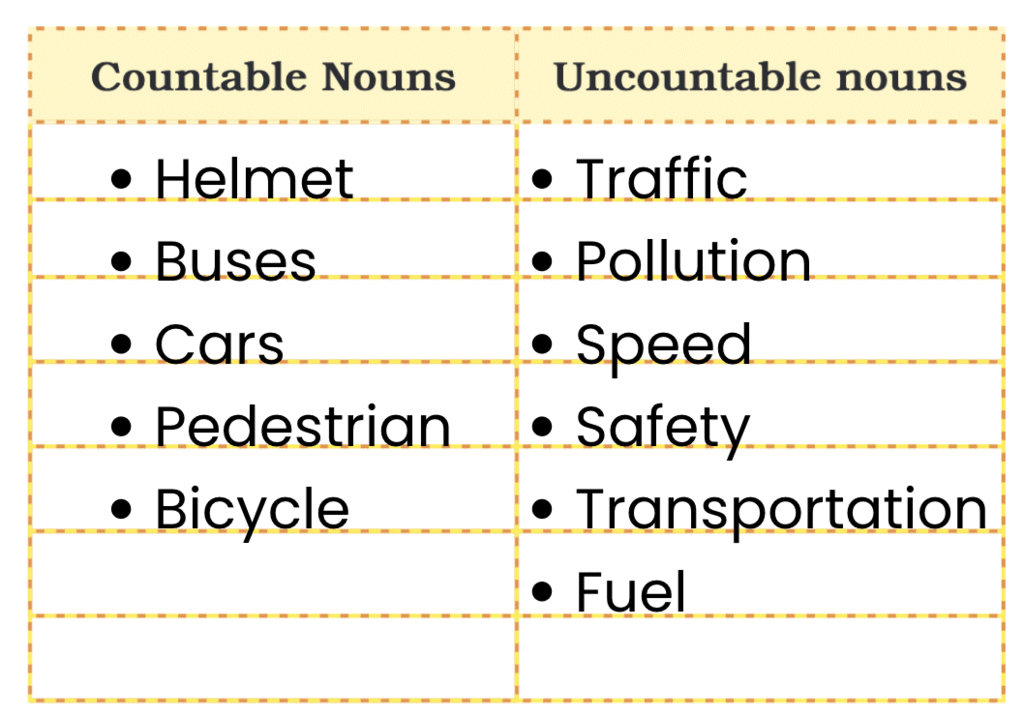
B. Now, classify the following into countable and uncountable nouns.

Ans:

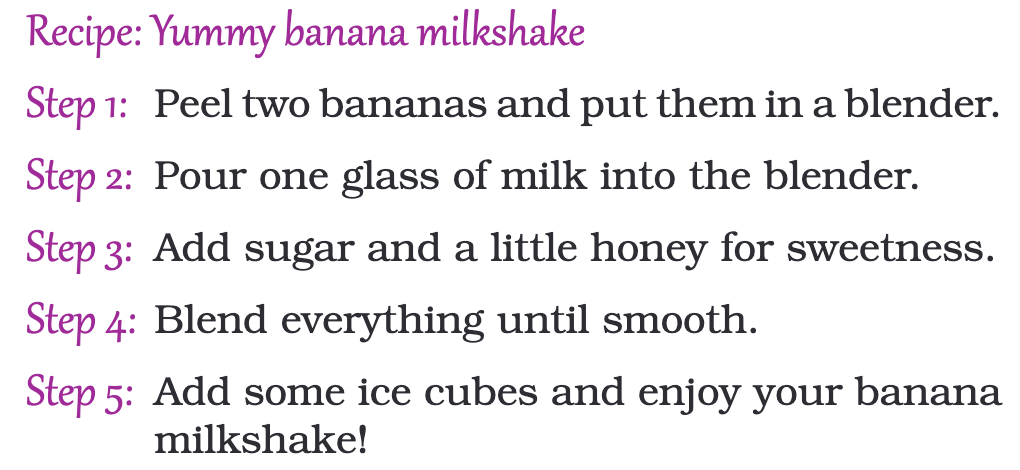
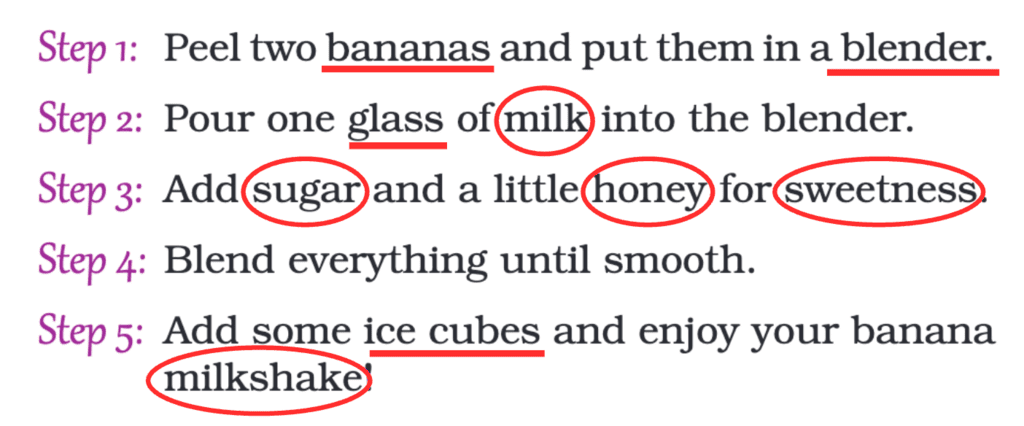
C. Read the recipe below. Underline the countable nouns and circle the uncountable nouns.

Ans:

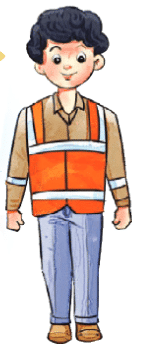
D. Write a letter to the traffic police of Bharat to thank them and promise to follow all the traffic rules and stay safe.
Ans:
Dear Traffic Police Officer,
Thank you for keeping us safe on the roads. You work so hard to make sure everyone follows the rules and no one gets hurt. I see how you stand in the sun, rain, and cold to help us.
I have read your letter carefully and understood that I should always use the zebra crossing, walk on the footpath, and hold an adult’s hand while crossing the road. I promise to follow all the traffic rules, like looking right and left before crossing and not playing near the road. I will also use reflective stickers in the evening to stay safe. I will tell my friends to follow these rules too.
Jai Hind!
Name: Riya
Grade: 4