03.Metals and Non-metals- Textbooks Solutions

Page No. 40

Q1. Give an example of a metal which
(a) is a liquid at room temperature.
(b) can be easily cut with a knife.
(c) is the best conductor of heat.
(d) is a poor conductor of heat.
Ans:
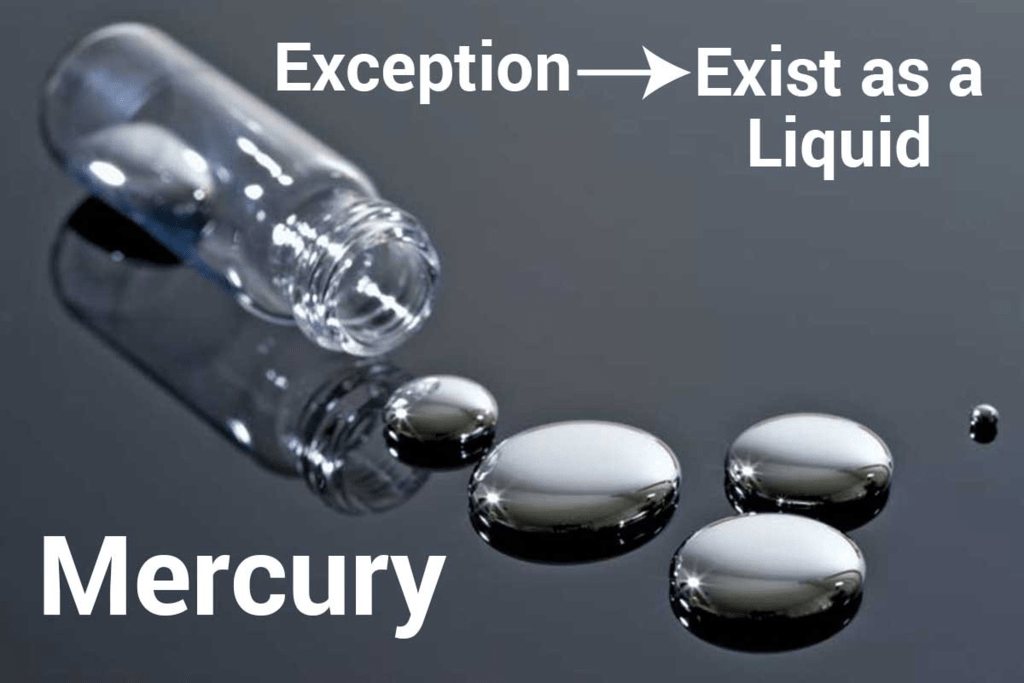
(a) Metal that exists in a liquid state at room temperature is mercury.
(b) Metal that can be easily cut with a knife is sodium.
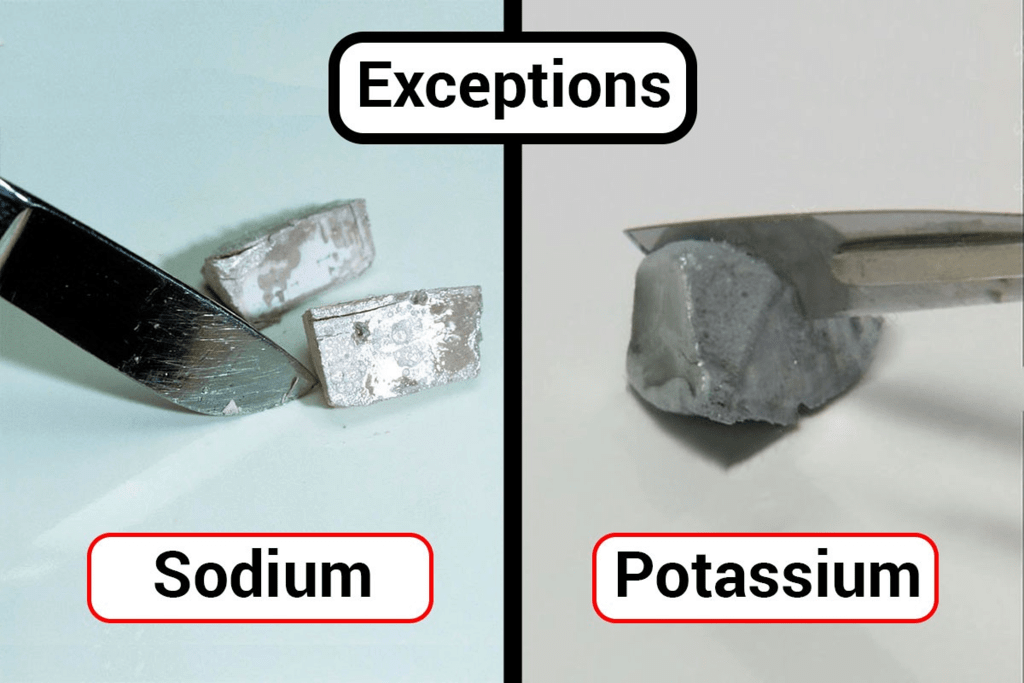
Sodium and Potassium are so soft that they can be cut with a knife.(c) Metal that is the best conductor of heat is silver.
(d) Metal that is a poor conductor of heat is lead.

Q2. Explain the meanings of Malleable and Ductile.
Ans:
Malleable

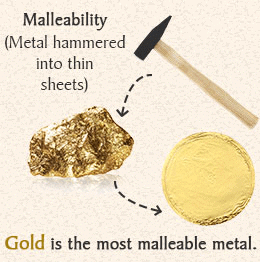
  • Substances that can be beaten into thin sheets are called malleable. Most of the metals are malleable. The most malleable metals are gold and silver.
Ductile

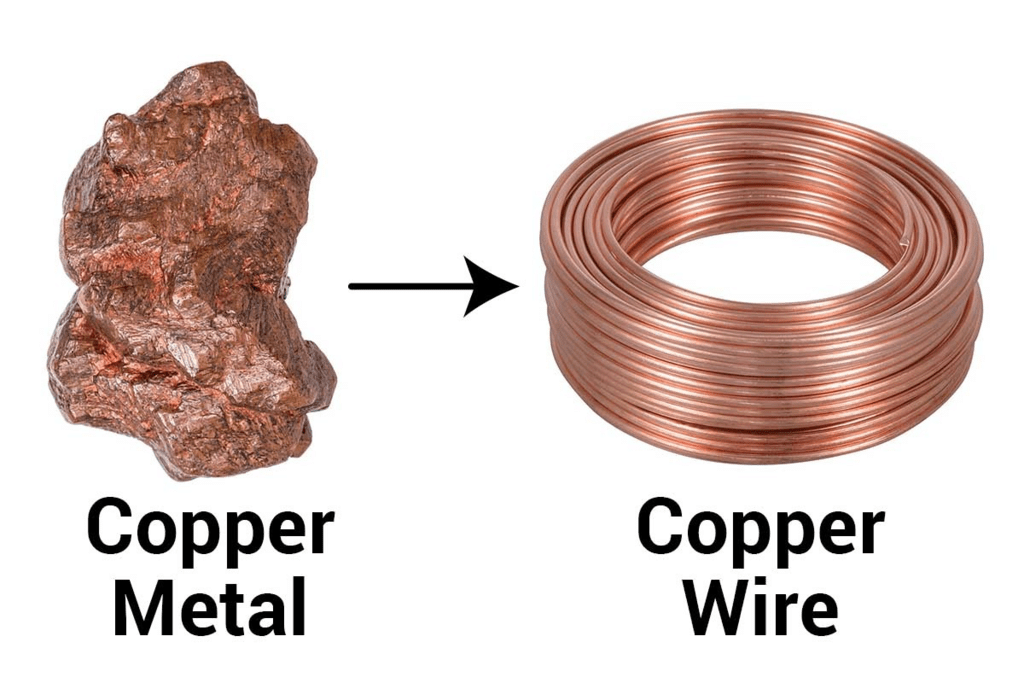
  • Substances that can be drawn into thin wires are called ductile. Most of the metals are ductile. Platinum, gold, and silver are the most ductile metals.
Ductility

Page No. 46

Q1. Why is sodium kept immersed in kerosene oil?
Ans:

  • Sodium is a very reactive metal and combines explosively with air(oxygen) at room temperature.
  • It also reacts violently with cold water. Hence, it catches fire if kept in open. 
  • Therefore, to prevent accidental fires and accidents, sodium is stored immersed in kerosene oil.
Q2. Write equations for the reactions of
(a) iron with steam
(b) calcium and potassium with water

Ans: 
(a) Iron reacts with steam to form a magnetic oxide of Fe with the liberation of H2.
3Fe(s) + 4H2O(g) → Fe3O4(s) + 4H2(g)
(b) Calcium reacts with water to form calcium hydroxide and hydrogen.
Ca(s) + 2H2O(I) → Ca(OH)2(aq) + H2(g) 
Potassium reacts with cold water violently immediately with evolution of H2 which catches fire.
2K(s) + 2H2O(I) → 2KOH(aq) + 2H2(g)

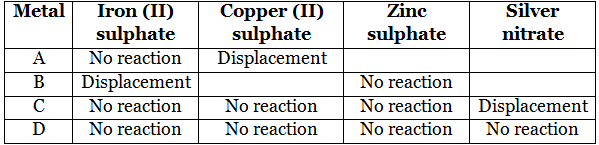
Q3. Samples of four metals A, B, C, and D were taken and added to the following solution one by one. The results obtained have been tabulated as follows.

Use the table above to answer the following questions about metals A, B, C, and D.
(a) Which is the most reactive metal?
(b) What would you observe if B is added to a solution of copper (II) sulfate?
(c) Arrange the metals A, B, C, and D in the order of decreasing reactivity.

Ans:

  • A + FeSO4 → No reaction, i.e., A is less reactive than iron.
  • A + CuSO4 → Displacement, i.e., A, is more reactive than copper.
  • B + FeSO4 → Displacement, i.e., B is more reactive than iron.
  • B + ZnSO4 →No reaction, i.e., B is less reactive than zinc.
  • C + FeSO4 → No reaction, i.e., C is less reactive than iron.
  • C + CuSO4 → No reaction, i.e., C is less reactive than copper.
  • C + ZnSO4 → No reaction, i.e., C is less reactive than zinc.
  • C + AgNO3 → Displacement, i.e., C is more reactive than silver.
  • D + FeSO4/CuSO4/ZnSO4/AgNO3 → No reaction, i.e.
  • D is less reactive than iron, copper, zinc, and silver.
  • From the above equations, we obtain:
    (a) B is the most reactive metal.
    (b) If B is added to a solution of copper (II) sulfate, then it would displace copper.
    B + CuSO4→ Displacement
    (c) The arrangement of the metals in the order of decreasing reactivity is: B > A > C > D

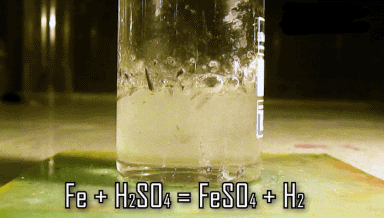
Q4. Which gas is produced when diluted hydrochloric acid is added to a reactive metal? Write the chemical reaction when iron reacts with dilute H2SO4.
Ans: When dilute hydrochloric acid is added to a reactive metal; hydrogen gas is evolved.

The reaction between iron and H2SO4 is:

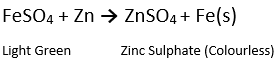
Q5. What would you observe when zinc is added to a solution of iron (II) sulfate? Write the chemical reaction that takes place.
Ans: Zinc is more reactive than iron. Therefore, if zinc is added to a solution of iron (II) sulfate, then it would displace iron from the solution.
Page No. 49

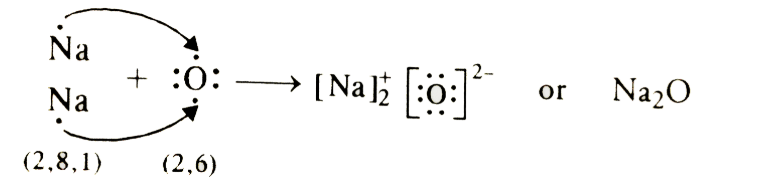
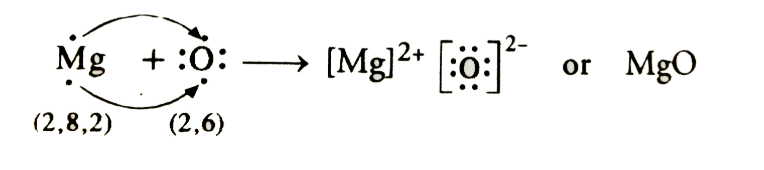
Q1. (a) Write the electron-dot structures for sodium, oxygen, and magnesium.
(b) Show the formation of Na2O and MgO by the transfer of electrons.
(c) What are the ions present in these compounds?

Ans: 
(a)

  • The electronic configuration of sodium is 2,8,1. The electron dot structure of sodium is 
  • The electronic configuration of oxygen is 2,6. The electron dot structure of oxygen is 
  • The electronic configuration of magnesium is 2,8,2. The electron dot structure of magnesium is 

(b) Formation of Na2O and MgO

  • Na     →  Na+ e
    2,8,1        2,8
  • O    +2e → O
    2,6              2,8
  • Mg    → Mg2++ 2e
    2,8,2     2,8
  • O   +  2e  → O2
    2,6                2,8

(c) The ions present are Na+, O2- and Mg2+ in compounds sodium oxide (Na2O) and magnesium oxide (MgO).

Q2. Why do ionic compounds have high melting points?
Ans: Ionic compounds have high melting points because of the strong force of attraction between the oppositely charged ions. High energy is required to break the metallic bonds between these ions.

Page No. 53

Q1. Define the following terms.
(a) Mineral 
(b) Ore 
(c) Gangue
Ans:
(a) Mineral 

  • The natural materials in which metals occur in the form of their compounds are called minerals.
  • They are mostly found in earth’s crust. Some minerals are also found in seawater.
    Example: NaCl (sodium chloride), feldspar, mica, kaolin, etc.

(b) Ore 

  • They are minerals from which metals are extracted profitably.
    Example: 
    Hematite (Fe2O3) is an ore of iron, bauxite (Al2O 3.2H2O ) is an ore of aluminium.

(c) Gangue

  • The unwanted material present in the ores mined from the earth is called gangue.
  • It needs to be removed prior to the extraction process.

Q2. Name two metals which are found in nature in the free state.
Ans: The metals at the bottom of the reactivity series are mostly found in a free state.
Example: Gold, Silver, and Platinum

Q3. What chemical process is used for obtaining a metal from its oxide?
Ans: The chemical process used for obtaining a metal from its oxide is reduction.
There are mainly three different methods of reduction:
(i) By heating
(ii) By using carbon
(iii) By using aluminium, calcium, sodium, etc., as reducing agents.

Page No. 55

Q1. Metallic oxides of zinc, magnesium, and copper were heated with the following metals.
In which cases will you find displacement reactions taking place?
Ans:

Q2. Which metals do not corrode easily?
Ans: The more reactive a metal is, more likely it is to be corroded. Therefore, less reactive metals are less likely to get corroded. This is why gold plating provides high resistance to corrosion. 
Example: Gold, Platinum.

Q3. What are alloys?
Ans: Alloys are homogeneous mixtures of two or more elements. The elements could be two metals or a metal and a non-metal. An alloy is formed by first melting the metal and then dissolving the other elements in it.
Example: Steel is an alloy of iron and carbon.

Excercise (Page 56)

Q1. Which of the following pairs will give displacement reactions?
(a) NaCl solution and copper metal.
(b) MgCl2 solution and aluminium metal.
(c) FeSOsolution and silver metal.
(d) AgNOsolution and copper metal.
Ans: 
This is decided on the basis of the activity series of metal. A metal higher on the activity series can displace a metal lower on the activity series from its salt solution. Thus
(a) No displacement
(b) No displacement
(c) No displacement
(d) Displacement reaction takes place
Cu(s) + 2AgNO3(aq) → Cu(NO3)2(aq)+ 2Ag(s)
because copper is more reactive than Ag.

Q2. Which of the following methods is suitable for preventing an iron frying pan from rusting?
(a) Applying grease
(b) Applying paint
(c) Applying a coating of zinc
(d) all of the above

Ans: (c)

Explanation:

  • Greece and paints are organic matter which can burn on heating.
  • So, we do not apply grease or paint on a frying pan to prevent it from rusting. We can prevent it from rusting by applying a coating of zinc.
  • Zinc is more reactive than iron, and hence it does not allow the iron to rust.

Q3. An element reacts with oxygen to give a compound a high melting point. This compound is also soluble in water. The element is likely to be
(a) Calcium
(b) Carbon
(c) Silicon
(d) Iron

Ans: (a)
Explanation: Calcium oxide has a high melting point as it is ionic in nature and is soluble in water.

Q4. Food cans are coated with tin and not with zinc because
(a) zinc is costlier than tin.
(b) zinc has a higher melting point than tin.

(c) zinc is more reactive than tin.
(d) zinc is less reactive than tin.

Ans: (c) Zinc is more reactive than tin; that is why tin is used.
Explanation: Food cans are coated with tin and not with zinc because zinc is above the tin in the reactivity series means more reactive than tin and can react with food elements preserved in it.

Q5. You are given a hammer, a battery, a bulb, wires, and a switch.
(a) How could you use them to distinguish between samples of metals and non-metals?
(b) Assess the usefulness of these tests in distinguishing between metals and non-metals
.
Ans: (a) 

  • Take the sample of metal. Hammer it for a long time. Observe the metal after some time.
  • Take the sample of non-metal and hammer it a little. You will observe that metal changes into sheets on hammering, i.e., it is malleable, whereas non-metal is brittle, and it breaks on hammering.
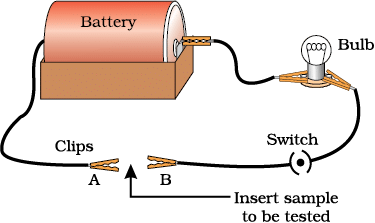
  • Set the apparatus, as shown in the figure above.
  • Take the sample of metal and put it between the clips. Switch on the current and observe the bulb.
  • Now take the sample of non-metal and insert it between clips. Switch on the current and observe the bulb.
  • You will observe that the bulb glows when current is switched on in the case of metal sample. 
  • The bulb does not glow in case of non-metal sample.
  • This shows metals are good conductors of electricity, whereas non-metals are bad conductors of electricity.

(b) 

  • These two tests can be used to distinguish between metals and non-metals.
  • Hammering can be used in most metals except in the case of sodium, potassium, and lithium.
  • Conduction of electricity can be used in the classification of most of the metals and non-metals except in graphite, which is a non-metallic conductor.


Q6. What are amphoteric oxides? Give two examples of amphoteric oxides.
Ans:

  • The oxides which act as both acidic as well as basic are called amphoteric oxides.
    Example: Al2O3 and ZnO are amphoteric oxides

Q7. Name two metals which will displace hydrogen from dilute acids, and two metals which will not.
Ans: Zn and Al will displace hydrogen from dilute acids because they are more reactive than hydrogen, whereas Cu and Ag cannot displace hydrogen from dilute acids because they are less reactive than hydrogen.
Zn(s) + 2HCl(dil) → ZnCl2(aq) + H2(g)
2Al(s) + 6HCl(dil) → 2AlCl3(aq) + 3H2(g)

Page No. 57

Q8. In the electrolytic refining of a metal M, what would you take as the anode, the cathode, and the electrolyte?
Ans: Impure metal acts as an anode, and pure metal acts as a cathode. Soluble salt of metal acts as an electrolyte.

  • When current is passed through the electrolyte, the impure metal from the anode is dissolved in the electrolyte and an equal amount of pure metal from the electrolyte is deposited on the cathode.

Q9. Pratyush took a sulphur powder on a spatula and heated it. He collected the gas evolved by inverting a test tube over it, as shown in the figure below.
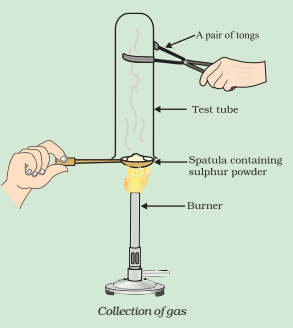
(a) What will be the action of gas on:
(i) dry litmus paper?
(ii) moist litmus paper?

(b) Write a balanced chemical equation for the reaction taking place.
Ans: (a) 
(i) There will be no action on dry litmus paper.
(ii) The colour of litmus paper will turn red because sulfur is non-metal, and the oxides of non-metal are acidic in nature.
(b) Chemical Equation for the reaction taking place.
S + O2   → SO2
(Sulphur)              Sulphur dioxide
SO2     +   H2O → H2SO3
(Sulphurous acid)

Q10. State two ways to prevent the rusting of iron.
Ans: Two ways to prevent the rusting of iron are:
(i) Painting

  • Iron articles are painted so that surface does not come in contact with air and water, and it does not get rusted.

(ii) Galvanisation

  • It is a process in which iron particles are coated with zinc metal so as to prevent them from rusting. 
  • Zinc is more reactive than iron; therefore, it loses electrons more readily and prevents iron from rusting.


Q11. What type of oxides are formed when non-metals combine with oxygen?
Ans: Mostly acidic oxides are formed when non-metal combines with oxygen.

Q12. Give reasons.
(a) Platinum, gold, and silver are used to make jewellery.
(b) Sodium, potassium, and lithium are stored under oil.
(c) Aluminium is a highly reactive metal, yet it is used to make utensils for cooking.
(d) Carbonate and sulfide ores are usually converted into oxides during the process of extraction.

Ans:

(a) Platinum, gold, and silver are used to make jewellery because they are:

  • Very lustrous
  • Also, they are very less reactive and do not corrode easily.

(b) Sodium, potassium, and lithium are:

  • Very reactive metals and react very vigorously with air as well as water.
  • Therefore, they are kept immersed in kerosene oil in order to prevent their contact with air and moisture.

(c) Though aluminium is a highly reactive metal, it is resistant to corrosion. 

This is because:

  •  Aluminium reacts with oxygen present in the air to form a thin layer of aluminium oxide. 
  • This oxide layer is very stable and prevents further reaction of aluminium with oxygen. 
  • Also, it is light in weight and a good conductor of heat. Hence, it is used to make cooking utensils.

(d) Carbonate and sulfide ores are usually converted into oxides during the process of extraction because metals can be easily extracted from their oxides rather than from their carbonates and sulfides.

Q13. You must have seen tarnished copper vessels being cleaned with lemon or tamarind juice. Explain why these sour substances are effective in cleaning the vessels.
Ans:

  • Copper reacts with moist carbon dioxide in the air to form copper carbonate, and as a result, the copper vessel loses its shiny brown surface forming a green layer of copper carbonate.
  • The citric acid present in the lemon or tamarind neutralises the basic copper carbonate and dissolves the layer.
  • That is why tarnished copper vessels are cleaned with lemon or tamarind juice to give the surface of the copper vessel its characteristic lustre.
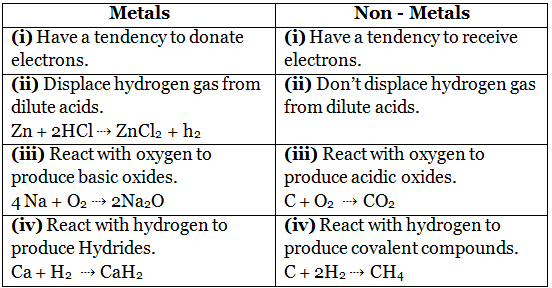
Q14. Differentiate between metal and non-metal on the basis of their chemical properties.
Ans:

Q15. A man went door to door posing as a goldsmith. He promised to bring back the glitter of old and dull gold ornaments. An unsuspecting lady gave a set of gold bangles to him, which he dipped in a particular solution. The bangles sparkled like new, but their weight was reduced drastically. The lady was upset, but after a futile argument, the man beat a hasty retreat. Can you play the detective to find out the nature of the solution he had used?
Ans:

  • The solution he had used was aqua regia, which is a freshly prepared mixture of concentrated hydrochloric acid and concentrated nitric acid in the ratio of 3:1.
  • Aqua regia is one of the few reagents that are able to dissolve gold.
  • When the person claimed to be a goldsmith dipped bangles in aqua regia, some of the gold got dissolved, and hence the weight of the bangles got reduced.

Q16. Give reasons why copper is used to making hot water tanks and not steel (an alloy of iron).
Ans: Copper is used for making hot water tanks because it has excellent thermal conductivity, allowing efficient heat transfer. It is also highly resistant to corrosion, unlike steel, which rusts easily when exposed to water.
02.Acids, Bases and Salts- Textbooks Solutions

Page No. 18

Q1. You have been provided with three test tubes. One of them contains distilled water, and the other two contain an acidic solution and a basic solution, respectively. If you are given only red litmus paper, how will you identify the contents of each test tube?
Ans: 

(i) Put the red litmus paper in all the test tubes, turn by turn. The solution which turns red litmus to blue will be a basic solution. The blue litmus paper formed here can now be used to test the acidic solution.

(ii) Put the blue litmus paper obtained above in the remaining two test-tubes, turn-by-turn. The solution which turns the blue litmus paper to red will be the acidic solution.

(iii) The solution which has no effect on any litmus paper will be neutral and hence it will be distilled water.

Page No. 22

Q1. Why should curd and sour substances not be kept in brass and copper vessels?
Ans: 
Curd and sour substances should not be kept in brass and copper vessels because these and other sour food-stuffs contain acids which can react with the metal of the vessel to form poisonous metal compounds which can cause food poisoning and affect our health adversely. 


Q2. Which gas is usually liberated when an acid reacts with a metal? Illustrate with an example. How will you test for the presence of this gas?
Ans: 
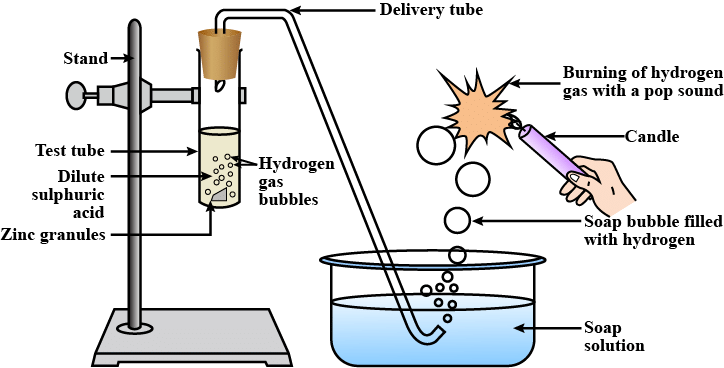
Usually, hydrogen gas is liberated when an acid reacts with a metal. For example, let us take the reaction between zinc and sulphuric acid.

The reaction of zinc granules with dil. H2SO4 to liberate hydrogen gas which burns with a ‘pop’ sound
(i) Take 5 g of zinc granules in a test tube.
(ii) Set the apparatus, as shown in the diagram.
(iii) Add 20 mL of dil. H2SO4 with the help of a thistle funnel.
(iv) Collect the gas evolved in a gas jar, as shown in the figure.
(v) Observe the colour and odour of the gas.
(vi) Bring a burning matchstick near the gas jar and record your observations.

Observation: A colourless, odourless gas is evolved. It burns explosively with a ‘pop’ sound when a burning matchstick is brought near it, indicating the presence of hydrogen gas. 

The pop sound is because whenever we bring hydrogen in contact with heat it expands , it is so fast that it breaks the sound barrier.

Chemical Reaction: Zn(s) + H2SO4(dil) → ZnSO4(aq) + H2(g)

Q3. Metal compound A reacts with dilute hydrochloric acid to produce effervescence. The gas evolved extinguishes a burning candle. Write a balanced chemical equation for the reaction if one of the compounds formed is calcium chloride.
Ans: 
Calcium carbonate (A), when reacts with hydrochloric acid, produces carbon dioxide gas with effervescence. Carbon dioxide gas is used as a fire extinguisher. Therefore, it extinguishes a burning candle. Hence, the metal compound A is calcium carbonate.

Chemical Reaction: CaCO3(s) + 2HCl(aq) → CaCl2(s)+ CO2 (g) + H2O(l)

Page No. 25

Q1. Why do HCl, HNO3, etc., show acidic characters in aqueous solutions while solutions of compounds like alcohol and glucose do not show acidic character?
Ans: 
Release of H+ ion in water will make a compound acidic or non-acidic. Acids are substances which, upon dissociating with water, resulting in the production of Hydrogen ions.  HCI, HNO3, etc. dissociate into their ions in the presence of water. They form hydrogen ions (H+). These hydrogen ions combine with H2O to form hydronium ions (H3O+). 
The reaction can be given as follows:
HCl → H+ + Cl
H+ + H2O → H3O+
Similarly, HNO3 → H+ + NO3
H+ + H2O →  H3O+

  • Due to this property, HCl and HNO3 show acidic character in aqueous solutions. On the other hand, alcohol and glucose cannot dissociate in water to form hydrogen ions. Hence, they do not show acidic character.

Q2. Why does an aqueous solution of an acid conduct electricity?
Ans: 
An aqueous solution of acid conducts electricity because of the presence of charged particles called ions in it. When dissolved in water, acids dissociate to form ions. 
Example:
HCl + H2O → Cl + H3O+
These ions are responsible for conducting electricity.

Q3. Why does dry HCl gas not change the colour of the dry litmus paper?
Ans: 
Dry HCl gas do not change the colour of dry litmus paper because:

  • We know that H+ ions of acid change the colour of the litmus. 
  • Dry HCI does not dissociate to give H+ ions. 
  • Acids dissociate to give ions only in the aqueous medium. 
  • Since in this case, neither HCI is in the aqueous form nor is the litmus paper wet, so the colour of the litmus paper does not change.

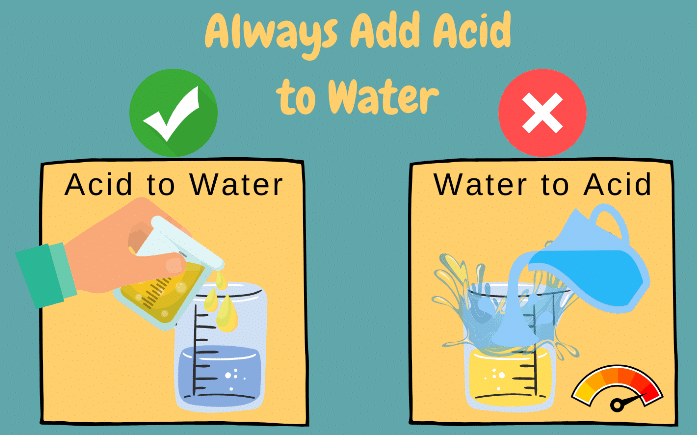
Q4. While diluting an acid, why is it recommended that the acid should be added to water and not water to the acid?
Ans: 
The process of dissolving an acid in water is highly exothermic. The acid must always be added slowly to water with constant stirring. If water is added to a concentrated acid, the heat generated may cause the mixture to splash out and cause severe burns. The glass container may also break due to excessive heating.

Q5. How is the concentration of hydronium ions (H3O+) affected when a solution of an acid is diluted?
Ans: 

  • When a given amount of acid is added to water, there is a fixed number of hydronium ions per unit volume of the solution.
  • On dilution number of hydronium ions per unit volume decreases and the concentration of hydronium ions (H3O+) decreases and becomes weak.

Q6. How is the concentration of hydroxide ions (OH) affected when excess base is dissolved in a solution of sodium hydroxide?
Ans:

  • The concentration of hydroxide ions (OH) increases when the excess base is dissolved in a solution of sodium hydroxide.
  • The concentration of (OH) Hydroxide ions increases when the excessive base is added to the solution of Sodium Hydroxide as the base itself dissociates to give out OH ions which increase their concentration per unit volume.

Page No. 28

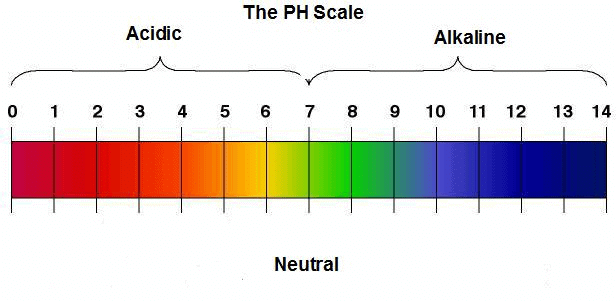
Q1. You have two solutions, A and B. The pH of solution A is 6, and the pH of solution B is 8. Which solution has more hydrogen ion concentration? Which of these is acidic, and which one is basic?
Ans: 
Solution A has more H+ ion concentration. A pH value of less than 7 indicates the acidic nature, while greater than 7 indicates the basic nature of a solution. So, solution A is acidic, and solution B is basic.

Q2. What effect does the concentration of H+(aq) ions have on the nature of the solution?
Ans: 
The concentration of H+(aq) can have a varied effect on the nature of the solution. With an increase in H+ ion concentration, the solution becomes more acidic, while a decrease in H+ ion causes an increase in the basicity of the solution.

Q3. Do basic solutions also have H+(aq)  ions? If yes, then why are these basic?
Ans: 
Yes, the basic solution also has H+(aq) ions. However, their concentration is less as compared to the concentration of OH ions that makes the solution basic.

Q4. Under what soil conditions do you think a farmer would treat the soil of his fields with quick lime (calcium oxide) or slaked lime (calcium hydroxide) or chalk (calcium carbonate)?
Ans: 
If the farmer finds his soil to be more acidic, then to increase the basicity of the soil, he should treat the soil of his field with quick lime (calcium oxide) or slaked lime (calcium hydroxide) or chalk (calcium carbonate).

Page No. 33

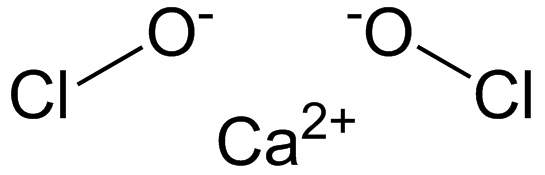
Q1. What is the common name of the compound Ca(OCl)2?
Ans: 
Bleaching Powder
Explanation: The compound Ca(OCl)2 is commonly known as bleaching powder. The reason for this common name is due to the compound’s primary use. It is often used as a disinfecting agent and to bleach cotton and linen in the textile industry. The chemical name for this compound is calcium hypochlorite, but it is more widely recognized and referred to as bleaching powder.
Bleaching powder structural formula

Q2. Name the substance which on treatment with chlorine yields bleaching powder?
Ans: 
Dry slaked lime [Ca(OH)2].

Explanation: Bleaching powder, also known as Calcium hypochlorite [Ca(OCl)2], is produced by the action of chlorine on dry slaked lime [Ca(OH)2]. This reaction can be represented by the following chemical equation:

2Ca(OH)2 + 2Cl2 → Ca(OCl)2 + CaCl2 + 2H2O

In this reaction, chlorine (Cl2) is added to dry slaked lime (Ca(OH)2) to produce bleaching powder (Ca(OCl)2), calcium chloride (CaCl2), and water (H2O). The chlorine oxidizes the calcium hydroxide to produce the calcium hypochlorite, which is the main component of bleaching powder. The calcium chloride is a byproduct of this reaction.

So, the substance which on treatment with chlorine yields bleaching powder is dry slaked lime [Ca(OH)2].


Q3. Name the sodium compound which is used for softening hard water.
Ans: 
Washing soda (Na2CO3.10H2O)

Explanation: Hard water contains minerals like calcium and magnesium that can cause a buildup in plumbing and appliances, and make it difficult for soap to lather. Sodium carbonate, also known as washing soda or soda ash, is used to soften hard water. When added to water, it reacts with the calcium and magnesium ions, forming insoluble precipitates that can be removed from the water. This reduces the mineral content of the water, effectively “softening” it. The formula Na2CO3.10H2O represents washing soda, which means it is a hydrated salt with 10 molecules of water of crystallization.

Q4. What will happen if a solution of sodium hydro carbonate is heated? Give the equation of the reaction involved.
Ans: 
When sodium hydrogen carbonate is heated, then sodium carbonate and water are formed along with carbon dioxide gas evolution.


Q5. Write an equation to show the reaction between Plaster of Paris and water.
Ans: 

Exercises (Page No. 34 & 35) 

Q1. A solution turns red litmus blue, its pH is likely to be
(a) 1
(b) 4
(c) 5
(d) 10

Ans: (d) 
Solution: pH = 10, bases turn red litmus blue, and their pH is more than 7.

Q2. A solution reacts with crushed egg-shells to give a gas that turns lime-water milky. The solution contains
(a) NaCl
(b) HCl 
(c) LiCl 
(d) KCl
Ans: (b)
Solution:
Eggshells are made up of CaCO3 which reacts with HCl to form CO2, and this CO2 turns lime water milky.
Example:
CaCO3(s) + 2HCl(dil)→ CaCl2(aq) + H2O(l) + CO2(g)
Ca(OH)2(aq) + CO2(g) → CaCO3(s) + H2O(l)

Q3. 10 mL of a solution of NaOH is found to be completely neutralised by 8 ml of a given solution of HCl. If we take 20 ml of the same solution of NaOH, the amount of HCl solution (the same solution as before) required to neutralise it will be
(a) 4 mL
(b) 8mL
(c) 12 mL 
(d) 16 mL
Ans: (d) 
Solution:
∴ 10 mL of NaOH will neutralise
= 8 mL of HCI.
= 20 mL of NaOH will neutralise
= 8/10 x 20 = 16 mL.

Q4. Which one of the following types of medicines are used for treating indigestion?
(a) Antibiotic
(b) Analgesic
(c) Antacid
(d) Antiseptic

Ans: (c) 
Solution:

  • Antacids are used to neutralise hyperacidity in the stomach due to excess of HCI which causes indigestion. 
  • Antibiotics are used to fight infections. 
  • Analgesics are pain killer while antiseptics prevent the growth of bacteria and other micro-organisms on wounds.

Q5. Write word equations and then balanced equations for the reaction taking place when:
(a) Dilute sulphuric acid reacts with zinc granules.
(b) Dilute hydrochloric acid reacts with magnesium ribbon.
(c) Dilute sulphuric acid reacts with aluminium powder.
(d) Dilute hydrochloric acid reacts with iron filings.

Ans:
(a)

(b)

(c)

(d)


Q6. Compounds such as alcohols and glucose also contain hydrogen but are not categorized as acids. Describe an activity to prove it.
Ans:

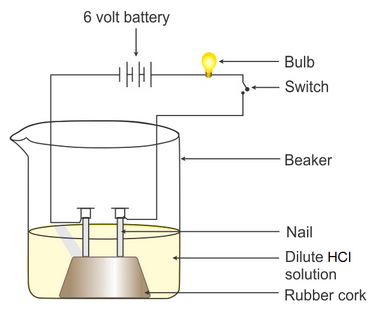
  • Fix two iron nails on a cork and place this cork in a beaker.
  • Connect the nails to the two terminals of a 6-volt battery through a switch and a bulb, as shown in the figure.
  • Now add some dilute hydrochloric acid in the beaker and switch on the current. Take the observation.
  • Repeat the experiment separately with alcohol and glucose solution.

Observation: You will observe that in the case of dilute hydrochloric acid bulb glows, but when glucose or alcohol solution is taken in the beaker, the bulb does not glow.
Conclusion: The aqueous solution of hydrochloric acid conducts electricity due to the presence of types of charged particles: Hydrogen ions and chloride ions. Unlike acids glucose and ethanol do not ionise in an aqueous solution, i.e. they do not give H+ ions; therefore, they cannot conduct electricity. Thus, glucose and ethanol are not categorized as acids.

Q7. Why does distilled water not conduct electricity, whereas rainwater does? 

Ans: 

  • Distilled water does not conduct electricity because it does not contain any ionic compound (like acids, bases or salts) dissolved in it.
  • Rainwater, while falling to the earth through the atmosphere, dissolves an acidic gas carbon dioxide from the air and forms carbonic acid (H2CO3). 
  • Carbonic acid provides hydrogen ions, H+ (aq) and carbonate ions, CO(aq)32to rainwater. 
  • Hence, due to the presence of carbonic acid which provides ions to rainwater, the rainwater conducts electricity.

Q8. Why do acids not show acidic behaviour in the absence of water?
Ans: 
It is because acids do not dissociate into ions in the absence of water. But when an acid is dissolved in water, it forms hydrogen ions and hence, shows acidic behaviour.

Q9. Five solutions A, B, C, D and E when tested with universal indicator showed pH as 4, 1, 11, 7 and 9, respectively. Which solution is
(a) Neutral?
(b) Strongly alkaline?
(c) Strongly acidic?
(d) Weakly acidic?
(e) Weakly alkaline?
Arrange the pH in increasing order of hydrogen-ion concentration.

Ans:pH level from acidic to basic

(a) Neutral → Solution D with pH 7
(b) Strongly alkaline → Solution C with pH 11
(c) Strongly acidic → Solution B with pH 1
(d) Weakly acidic → Solution A with pH 4
(e) Weakly alkaline → Solution E with pH 9

  • The pH can be arranged in the increasing order of the concentration of hydrogen ions as: 11 < 9 < 7 < 4 < 1.

Q10. Equal lengths of magnesium ribbons are taken in test tubes A and B. Hydrochloric acid (HCl) is added to test tube A, while acetic acid (CH3COOH) is added to test tube B. In which test tube will the fizzing occur more vigorously and why?
Ans: 
Fizzing will occur more vigorously in test tube A. Hydrochloric acid (HCl) is a strong acid whereas acetic acid (CH3COOH) is a weak acid. Being strong acid, the hydrochloric acid solution contains a much greater amount of hydrogen ions in it due to which the fizzing will occur more vigorously in test tube A (containing hydrochloric acid). The fizzing is due to the evolution of hydrogen gas which is formed by the action of acid on the magnesium metal of magnesium ribbon.

Q11. Fresh milk has a pH of 6. How do you think the pH will change as it turns into curd? Explain your answer.
Ans: 
Milk contains carbohydrate lactose. When milk sets into curd, lactose gets converted into an acid called lactic acid. Due to the formation of lactic acid, the pH of milk falls below 6.

Q12. A milkman adds a very small amount of baking soda to fresh milk.
(a) Why does he shift the pH of the fresh milk from 6 to slightly alkaline?
(b) Why does this milk take a long time to set as curd?

Ans: 
(a) The milkman shifts the pH of the fresh milk from 6 to slightly alkaline because, in alkaline conditions, milk does not set as curd easily.
(b) Since this milk is slightly basic than usual milk, acids produced to set the curd are neutralized by the base. Therefore, it takes a longer time for the curd to set.

Q13. Plaster of Paris should be stored in a moisture-proof container. Explain why?
Ans: 
It will absorb water to form gypsum which sets into a hard solid mass. This will make Plaster of Paris useless after some time.
Example:

Q14. What is a neutralization reaction? Give two examples.
Ans: 
A reaction in which an acid and base react with each other to give salt and water is termed as neutralization reaction.
Example:
NaOH(aq) + HCl(aq) → NaCl(aq) +H2O(l)
H2SO4(aq) + 2NH4OH(aq) → (NH4)2SO4(aq) + 2H2O

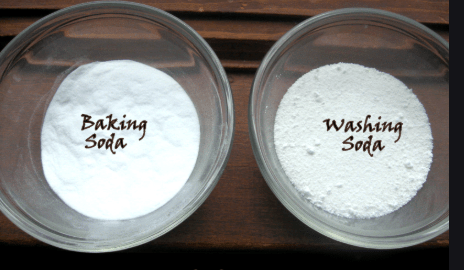
Q15. Give two important uses of washing soda and baking soda.
Ans:

Uses of Washing Soda
(i) It is used in the manufacture of glass, soap, paper, and other sodium compounds like borax, etc.
(ii) It is used in softening hard water.

Uses of Baking Soda
(i) It is used as an antacid to neutralise the excess of acidity (hyper-acidity) in the stomach.
(ii) It is an ingredient of baking powder that contains NaHCO3 and tartaric acid.
(iii) It is used in making soda acid fire extinguishers.

01. Chemical Reactions and Equations- Textbooks Solutions

Page No. 6

Q.1. Why should a magnesium ribbon be cleaned before burning in air?
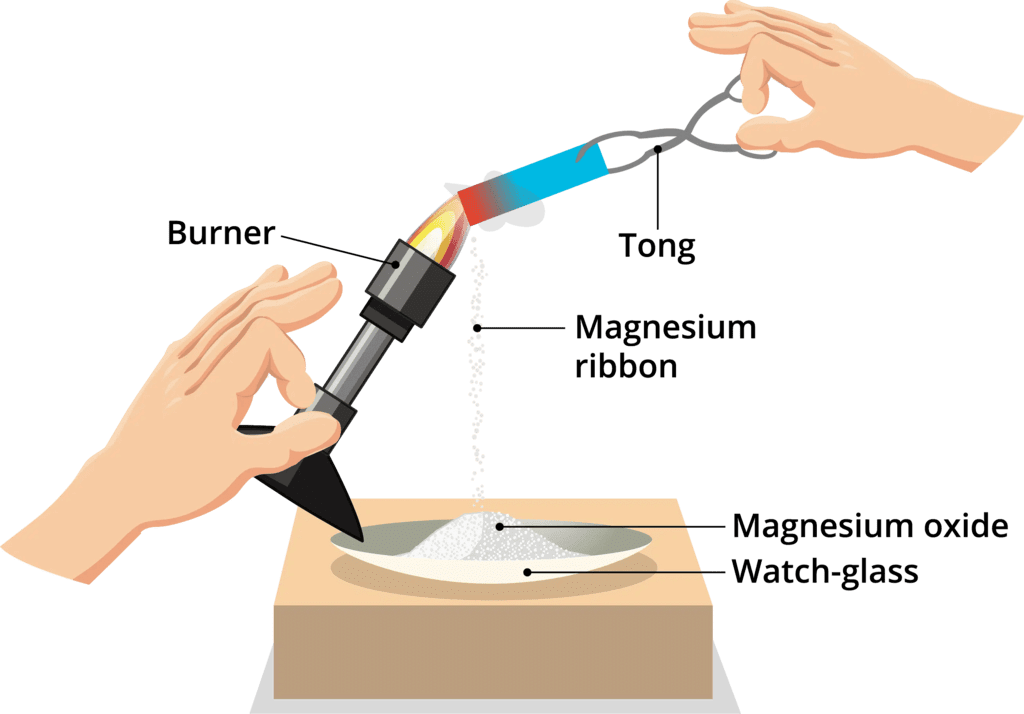
Ans: When magnesium ribbon is exposed to air, it forms a layer of magnesium oxide on its surface. This layer of magnesium oxide, being a stable compound, prevents further reaction of magnesium with oxygen. Hence, it should be cleaned before burning in air to remove this layer so that the metal can be exposed to air properly (the oxide layer may prevent or slow down the burning of magnesium.

Burning of Magnesium Ribbon


Q.2. Write the balanced equation for the following chemical reactions.
(a) Hydrogen + Chlorine → Hydrogen chloride
(b) Barium chloride + Aluminium sulphate → Barium sulphate + Aluminium chloride
(c) Sodium + Water → Sodium hydroxide + Hydrogen
Ans:
(a) H2(g) + Cl2(g) → 2HCl(g)
(b) 
3BaCl​2(aq)+Al​2(SO​4)​3(aq)→3BaSO​4(s)+2AlCl3(aq)
(c) 2Na(s) + 2H2O(l) → 2NaOH(aq) + H2(g)

Q.3. Write a balanced chemical equation with state symbols for the following reactions.
(a) Solutions of barium chloride and sodium sulphate in water react to give insoluble barium sulphate and the solution of sodium chloride.
(b) Sodium hydroxide solution (in water) reacts with a hydrochloric acid solution (in water) to produce sodium chloride solution and water.

Ans: 

a) Barium chloride reacts with sodium sulphate to form barium sulphate (insoluble) and sodium chloride:

BaCl2(aq)+Na2SO4(aq)→BaSO4(s)+2NaCl(aq)

(b) Sodium hydroxide solution reacts with hydrochloric acid solution to produce sodium chloride solution and water:

NaOH(aq)+ HCl(aq)→NaCl(aq)+H2O(l)


Page No. 10

Q.1. A solution of a substance ‘X’ is used for whitewashing.
(a) Name the substance ‘X’ and write its formula.
(b) Write the reaction of the substance ‘X’ named in (i) above with water.

Ans: 
(a) The substance ‘X’ is calcium oxide. Its chemical formula is CaO. 
(b) Calcium oxide reacts vigorously with water to form calcium hydroxide (slaked lime).

CaO(s)+ H2O(l)→Ca(OH)2(aq)
Calcium oxide + water → Calcium Hydroxide

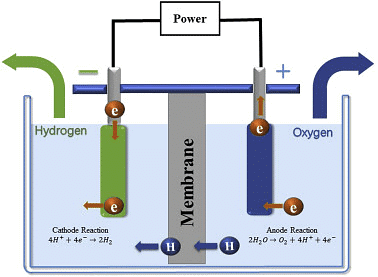
Q.2. Why is the amount of gas collected in one of the test tubes in Activity 1.7 double the amount collected in the other? Name this gas. 
Ans:

Electrolysis of Water

In Activity 1.7, gas collected in one of the test tubes is double of the amount collected in the other. This can be explained with the help of the chemical reaction that takes place.

2H2O (l)→ 2H2(g) + O2(g)

The volume of the gas is proportional to the number of molecules of the gas as indicated in the balanced equation. There are two molecules of hydrogen and one molecule of oxygen in the balanced equation. Hence the amount of Hydrogen collected would be double than that of oxygen.

Page No. 13

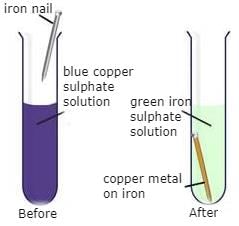
Q.1. Why does the colour of copper sulphate solution change when an iron nail is dipped in it?
Ans: Iron is more reactive than copper. So, When an iron nail is dipped in a copper sulphate solution, iron displaces copper from its solution to form iron sulphate, which is green in colour.
Fe(s) + CuSO4(aq) → FeSO4(aq) + Cu(s)
Hence, the blue colour of copper sulphate solution changes into green colour because of this displacement reaction.

Iron nail dipped in copper sulphate solution


Q.2. Give an example of a double displacement reaction other than the one given in Activity 1.10
Ans: Sodium carbonate and calcium chloride exchange ions to form two new compounds calcium carbonate and sodium chloride.
Na2CO3(aq) + CaCl2(aq) → CaCO3(s) + 2NaCl(aq)

Q.3. Identify the substances that are oxidised and the substances that are reduced in the following reactions.
(a) 4Na (s)+ O2 (g) → 2Na2O (s)
(b) CuO (s) +H2 (g) → Cu (s)+ H2O (g)

Ans: 
(a) Sodium (Na) is oxidised as it gains oxygen and oxygen gets reduced.
(b) Copper oxide (CuO) is reduced to copper (Cu) while hydrogen (H2) gets oxidised to water (H2O).


Page No. 14 – 16

Exercise Questions
Q.1. Which of the statements about the reaction below are incorrect?
2PbO (s) + C (s) → 2Pb (s) + CO2 (g)
(a) Lead is getting reduced.
(b) Carbon dioxide is getting oxidised.
(c) Carbon is getting oxidised.
(d) Lead oxide is getting reduced.

(i) (a) and (b)
(ii) (a) and (c)
(iii) (a), (b) and (c)
(iv) all 
Ans: 
(a) Lead is getting reduced is an incorrect answer.
(b) Carbon dioxide is getting oxidised is an incorrect answer.
(c) Carbon is getting oxidised is an correct answer because the removed oxygen from lead is added to the elemental Carbon.
(d) Lead oxide is getting reduced is correct answer because oxygen is being removed.
As statements (a) and (b) are incorrect, answer (i) is correct.

Q.2. Fe2O3 + 2Al → Al2O + 2Fe
The above reaction is an example of a
(a) combination reaction.
(b) double displacement reaction.
(c) decomposition reaction.
(d) displacement reaction.
 
Ans: (d)
In this reaction Aluminum is more reactive metal than Fe. The Oxygen from the Ferrous oxide is getting displaced to the Aluminium metal to form Aluminium Oxide. Therefore Al will displace Fe from its oxide. Since one-time displacement is occurring, therefore, it is called a single displacement reaction. 

Q.3. What happens when dilute hydrochloric acid is added to iron filings? Tick the correct answer.
(a) Hydrogen gas and iron chloride are produced.
(b) Chlorine gas and iron hydroxide are produced.
(c) No reaction takes place.
(d) Iron salt and water are produced.
 
Ans: (a)
Fe(s) + 2HCl(dil.) → FeCl2(aq) + H2(g) 
Hydrogen gas and Iron (II) chloride are produced.

Q.4. What is a balanced chemical equation? Why should chemical equations be balanced?
Ans: Balanced chemical equation means total number of atoms of each element should be equal on both sides of the reaction.
For example, magnesium and oxygen combine, when heated to form a single compound magnesium oxide.
2Mg(s) + O2(g) → 2MgO(s)
The reaction should be balanced because matter can neither be created nor be destroyed. The total mass of reactants should be equal to the total mass of products.

Q.5. Translate the following statements into chemical equations and then balance them.
(a) Hydrogen gas combines with nitrogen to form ammonia.
(b) Hydrogen sulphide gas burns in air to give water and sulphur dioxide.
(c) Barium chloride reacts with aluminium sulphate to give aluminium chloride and a precipitate of barium sulphate.
 
(d) Potassium metal reacts with water to give potassium hydroxide and hydrogen gas. 
Ans:
(a) Unbalanced equation: H2(g) + N2(g) → NH3(g)
Balanced equation: 3H2(g) + N2(g) → 2NH3(g) 
(b) Unbalanced equation: H2S + O→ H2O + SO2
Balanced equation: 2H2S (g) + 3O2(g) → 2H2O(g) + 2SO2(g)   
(c) Unbalanced equation: BaCl2(aq) + Al2(SO4)3(aq)  → AlCl3(aq) + BaSO4(s)
Balanced equation: 3BaCl2(aq) + Al2(SO4)3(aq) → 2AlCl3(aq) + 3BaSO4(s)
(d) Unbalanced equation: K(s) + H2O(l) → KOH (aq) + H2(g)
Balanced equation: 2K(s) + 2H2O(l) → 2KOH(aq) + H2(g)

Q.6. Balance the following chemical equations.
(a) HNO3 + Ca(OH)2 → Ca(NO3)2 + H2O
(b) NaOH + H2SO4 → Na2SO4 + H2O
(c) NaCl + AgNO3 → AgCl + NaNO3
(d) BaCl2 + H2SO4 → BaSO4 + HCl

Ans: Balanced chemical equations are given as under :
(a) 2HNO3(aq) + Ca(OH)2(aq) → Ca(NO3)2(aq) + 2H2O(l)
(b) 2NaOH(aq) + H2SO4(aq) → Na2SO4(aq) + 2H2O(l)
(c) NaCl(aq) + AgNO3(aq) → AgCl(s) + NaNO3(aq)
(d) BaCl2(aq) + H2SO4(aq) → BaSO4(s) + 2HCl(aq)

Q.7. Write the balanced chemical equations for the following reactions.
(a) Calcium hydroxide + Carbon dioxide → Calcium carbonate + Water
(b) Zinc + Silver nitrate → Zinc nitrate + Silver
(c) Aluminium + Copper chloride → Aluminium chloride + Copper
(d) Barium chloride + Potassium sulphate → Barium sulphate  + Potassium chloride

Ans: Balanced chemical equations for the reactions are given as under:
(a) Ca(OH)2(aq) + CO2(g) → CaCO3(s) + H2O(l)
(b) Zn(s) + 2AgNO3(aq) → Zn(NO3)2(aq) + 2Ag(s)
(c) 2Al(s) + 3CuCl2(aq) → 2AlCl3(aq) + 3Cu(s)
(d) BaCl2(aq) + K2SO4(aq) → BaSO4(s) + 2KCl(aq)

Q.8. Write the balanced chemical equation for the following and identify the type of reaction in each case.
(a)Potassium bromide (aq) + Barium iodide (aq)­ → Potassium iodide (aq) + Barium bromide(s) 
(b) Zinc carbonate (s) → Zinc oxide (s)  + Carbon dioxide (g) 
(c) Hydrogen (g) + Chlorine (g) → Hydrogen chloride (g)
(d) Magnesium (s) + Hydrochloric acid (aq) → Magnesium chloride(aq) + Hydrogen (g)

Ans:
(a) 2KBr(aq) + BaI2(aq) → 2KI(aq) + BaBr2(s)
Double displacement reaction
(b) ZnCO3(s) →  ZnO(s) + CO2(g)
Decomposition reaction
(c) H2(g) + Cl2(g) → 2HCl(g)
Combination reaction
(d) Mg(s) + 2HCl(aq) → MgCl2(aq) + H2(g)
Displacement Reaction 

Q.9. What does one mean by exothermic and endothermic reactions? Give examples. 
Ans: Endothermic Reaction: An endothermic reaction occurs when energy is absorbed from the surroundings in the form of heat. 
Examples: Photosynthesis, melting of ice, evaporation.
Exothermic Reaction: Conversely, an exothermic reaction is one in which energy is released from the system into the surroundings. 
Examples: Explosions, concrete setting, nuclear fission and fusion. 

Q.10. Why is respiration considered an exothermic reaction? Explain. 
Ans: During respiration, glucose combines with oxygen in the cells of our body and provides energy. As energy is released during respiration, therefore, respiration is regarded as an exothermic reaction.
C6H12O(aq) + 6O2(g) → 6CO2(g) + 6H2O(l) + Energy

Q.11. Why are decomposition reactions called the opposite of combination reactions? Write equations for these reactions.
Ans: Decomposition reactions are those in which a compound breaks down to form two or more substances. These reactions require a source of energy to proceed. Thus, they are the exact opposite of combination reactions in which two or more substances combine to give a new substance with the release of energy. For Example of decomposition Reactions are:
ZnCO3 → ZnO + CO2
CaCO3 + Energy → CaO + CO2
2HgO → 2Hg + O2

Q.12. Write one equation each for decomposition reactions where energy is supplied in the form of heat, light or electricity. 
Ans:
(a) Thermal decomposition reaction (Thermolysis): When decomposition is carried out by heating, it is called thermal decomposition. On heating, Calcium carbonate decomposes to calcium oxide and carbon dioxide as shown below:
CaCO3(s) → CaO(s) + CO2(g) 
(b) Photodecomposition reaction (Photolysis): When decomposition is carried out by light, it is called photolysis. The below reaction is used in black and white photography.
2AgCl(s) →  2Ag(s)  + Cl2 (g) 
(c) Electrolytic decomposition reaction (Electrolysis): When decomposition is carried out by electricity, it is called electrolysis. On passing electricity, water decomposes to hydrogen and oxygen.
2H2O (l) → 2H2(g) + O2(g)

Q.13. What is the difference between displacement and double displacement reactions? Write equations for these reactions. 
Ans: Displacement reaction: Those reactions in which more reactive metal displaces less reactive metal from its salt solution is called displacement reactions.
Fe(s) + CuSO4(aq) → FeSO4(aq) + Cu(s)
Double displacement reaction: Those reactions in which two compounds exchange their ions to form two new compounds are called double displacement reactions.
HCl(aq) + NaOH(aq) → NaCl(aq) + H2O(l)

Q.14. In the refining of silver, the recovery of silver from silver nitrate solution involved displacement by copper metal. Write down the reaction involved.
Ans: Cu(s) + 2AgNO3(aq) → Cu(NO3)2(aq) + 2Ag(s)

Q.15. What do you mean by a precipitation reaction? Explain by giving examples.
Ans: When two solutions containing soluble salts are combined, a double displacement reaction takes place in which the ions are exchanged between the compounds. When one of such compounds is formed  in solid form (that is insoluble in aqua) then it settles down at the bottom of the container. This solid is known as the precipitate and the respective reaction is termed as the precipitation reaction. Few examples of precipitation reactions are:
When solutions of silver nitrate and sodium chloride are mixed, white precipitate of silver chloride is formed.
AgNO3(aq) + NaCl(aq) → AgCl(s) + NaNO3(aq)

On adding dilute hydrochloric acid to the aqueous solution of lead nitrate, precipitate of lead chloride is formed.
Pb(NO3)2 + 2HCl → PbCl2 + 2HNO3

Q.16. Explain the following in terms of gain or loss of oxygen with two examples each.
(a) Oxidation
(b) Reduction

Ans: (a) Oxidation: It is a process in which gain of oxygen takes place
Examples:
2Mg(s) + O2(g) → 2MgO(s) (Burning)
2Cu(s) + O2(g) → 2CuO(s) (Heat)

(b) Reduction: It is a process in which removal of oxygen takes place.
Examples:

CuO(s) + H2(g) → Cu(s) + H2O(g) (Heat)
Fe2O3(s) + 2Al(s) → Al2O3(s) + 2Fe(s)


Q.17. A shiny brown-coloured element ‘X’ on heating in air becomes black in colour. Name the element ‘X’ and the black coloured compound formed.
Ans: ‘X’ is Copper.
Copper gets oxidised to copper oxide which is black in colour.
2Cu(s) + O2(g) → 2CuO(s) (Heat)

Q.18. Why do we apply paint on iron articles? 
Ans: Painting is done so as to prevent iron from rusting. When the surface of iron is coated with paint, its surface does not come in contact with oxygen and moisture and therefore, rusting does not take place.

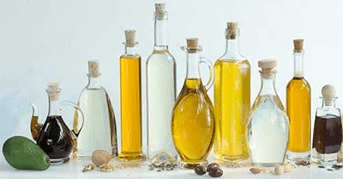
Q.19. Oil and fat containing food items are flushed with nitrogen. Why?
Ans: The main purpose of flushing Nitrogen into food packets that contain oil and fat items is to prevent Rancidity which occurs when the oil or fat reacts with the oxygen letting out an unpleasant smell and taste. Therefore by flushing Nitrogen, an unreactive surrounding is created thus preventing rancidity.
Variety of Oils

Q.20. Explain the following terms with one example each.
(a) Corrosion
(b) Rancidity

Ans: (a) Corrosion: It is the process in which metals are slowly eaten up by the action of air moisture or chemicals. For example rusting is a form of corrosion in which iron is eaten up by the action of air and moisture and a reddish brown coating of iron oxide is formed as shown in the following chemical reaction.
2Fe + 3H2O → Fe2O3 + 3H2
(b) Rancidity: When the substance containing oils and fats are exposed to air they get oxidised and become rancid due to which their smell, taste and colour change. This process is known as rancidity. For example when a when butter is kept open for a long time then its smell and taste gets changed.