03.Metals and Non-metals- Textbooks Solutions

Page No. 40

Q1. Give an example of a metal which
(a) is a liquid at room temperature.
(b) can be easily cut with a knife.
(c) is the best conductor of heat.
(d) is a poor conductor of heat.
Ans:
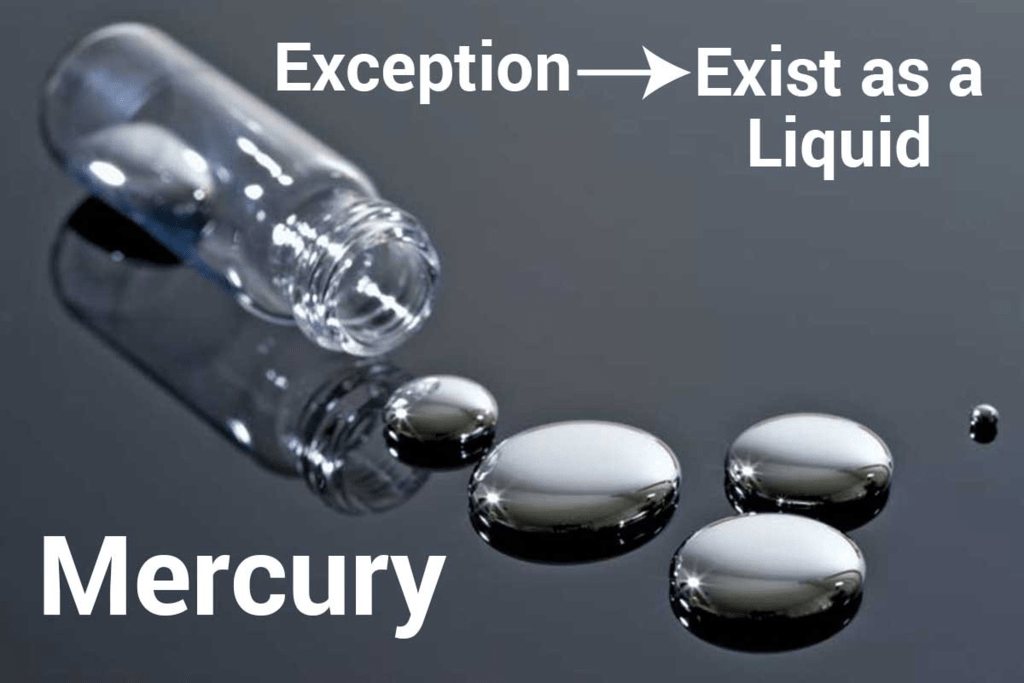
(a) Metal that exists in a liquid state at room temperature is mercury.
(b) Metal that can be easily cut with a knife is sodium.
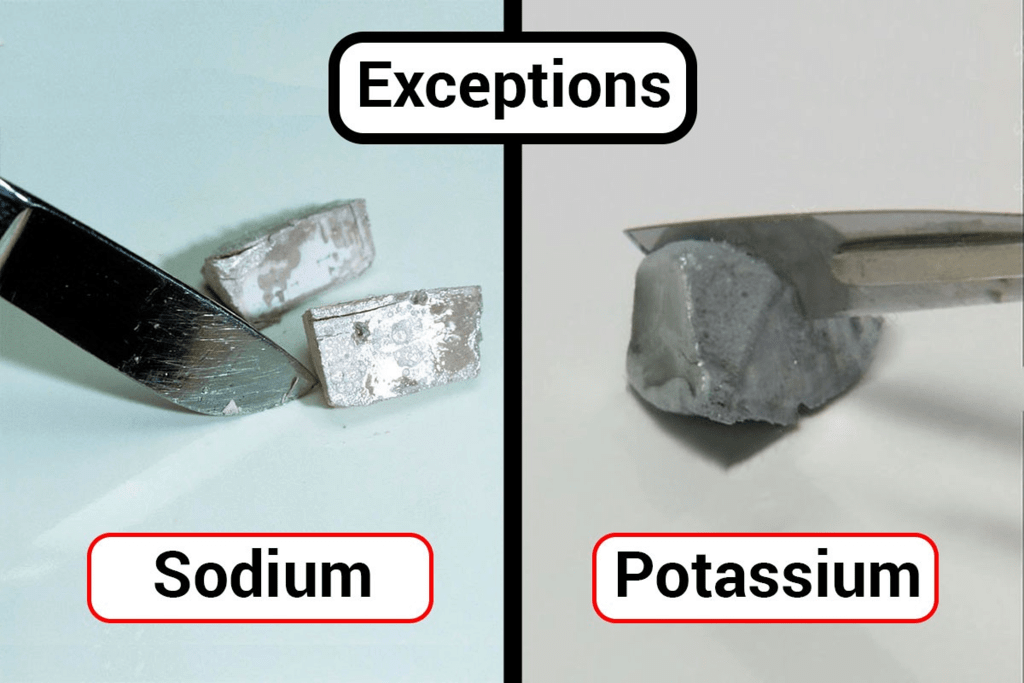
Sodium and Potassium are so soft that they can be cut with a knife.(c) Metal that is the best conductor of heat is silver.
(d) Metal that is a poor conductor of heat is lead.

Q2. Explain the meanings of Malleable and Ductile.
Ans:
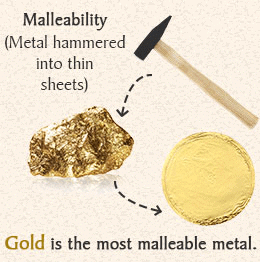
Malleable

  • Substances that can be beaten into thin sheets are called malleable. Most of the metals are malleable. The most malleable metals are gold and silver.
Ductile

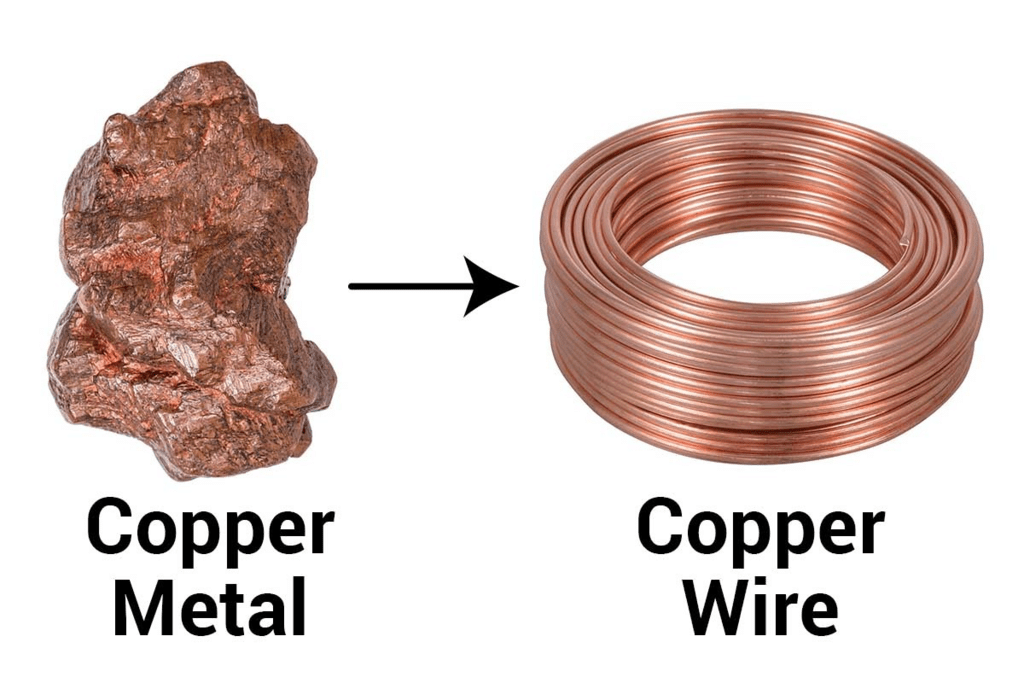
  • Substances that can be drawn into thin wires are called ductile. Most of the metals are ductile. Platinum, gold, and silver are the most ductile metals.
Ductility

Page No. 46

Q1. Why is sodium kept immersed in kerosene oil?
Ans:

  • Sodium is a very reactive metal and combines explosively with air(oxygen) at room temperature.
  • It also reacts violently with cold water. Hence, it catches fire if kept in open. 
  • Therefore, to prevent accidental fires and accidents, sodium is stored immersed in kerosene oil.
Q2. Write equations for the reactions of
(a) iron with steam
(b) calcium and potassium with water

Ans: 
(a) Iron reacts with steam to form a magnetic oxide of Fe with the liberation of H2.
3Fe(s) + 4H2O(g) → Fe3O4(s) + 4H2(g)
(b) Calcium reacts with water to form calcium hydroxide and hydrogen.
Ca(s) + 2H2O(I) → Ca(OH)2(aq) + H2(g) 
Potassium reacts with cold water violently immediately with evolution of H2 which catches fire.
2K(s) + 2H2O(I) → 2KOH(aq) + 2H2(g)

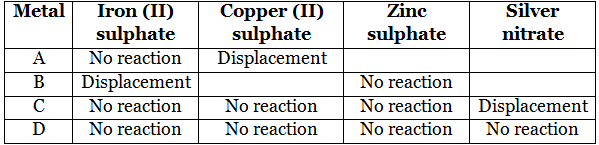
Q3. Samples of four metals A, B, C, and D were taken and added to the following solution one by one. The results obtained have been tabulated as follows.

Use the table above to answer the following questions about metals A, B, C, and D.
(a) Which is the most reactive metal?
(b) What would you observe if B is added to a solution of copper (II) sulfate?
(c) Arrange the metals A, B, C, and D in the order of decreasing reactivity.

Ans:

  • A + FeSO4 → No reaction, i.e., A is less reactive than iron.
  • A + CuSO4 → Displacement, i.e., A, is more reactive than copper.
  • B + FeSO4 → Displacement, i.e., B is more reactive than iron.
  • B + ZnSO4 →No reaction, i.e., B is less reactive than zinc.
  • C + FeSO4 → No reaction, i.e., C is less reactive than iron.
  • C + CuSO4 → No reaction, i.e., C is less reactive than copper.
  • C + ZnSO4 → No reaction, i.e., C is less reactive than zinc.
  • C + AgNO3 → Displacement, i.e., C is more reactive than silver.
  • D + FeSO4/CuSO4/ZnSO4/AgNO3 → No reaction, i.e.
  • D is less reactive than iron, copper, zinc, and silver.
  • From the above equations, we obtain:
    (a) B is the most reactive metal.
    (b) If B is added to a solution of copper (II) sulfate, then it would displace copper.
    B + CuSO4→ Displacement
    (c) The arrangement of the metals in the order of decreasing reactivity is: B > A > C > D

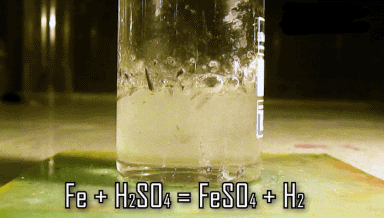
Q4. Which gas is produced when diluted hydrochloric acid is added to a reactive metal? Write the chemical reaction when iron reacts with dilute H2SO4.
Ans: When dilute hydrochloric acid is added to a reactive metal; hydrogen gas is evolved.

The reaction between iron and H2SO4 is:

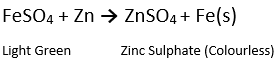
Q5. What would you observe when zinc is added to a solution of iron (II) sulfate? Write the chemical reaction that takes place.
Ans: Zinc is more reactive than iron. Therefore, if zinc is added to a solution of iron (II) sulfate, then it would displace iron from the solution.
Page No. 49

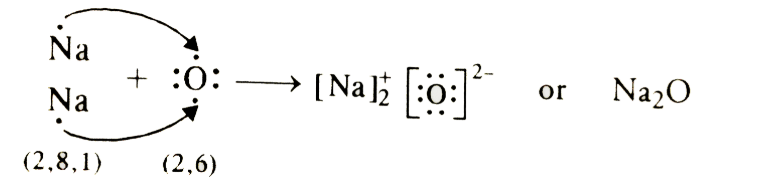
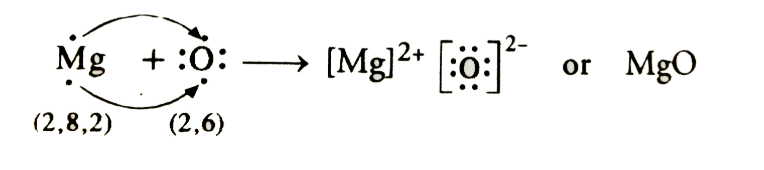
Q1. (a) Write the electron-dot structures for sodium, oxygen, and magnesium.
(b) Show the formation of Na2O and MgO by the transfer of electrons.
(c) What are the ions present in these compounds?

Ans: 
(a)

  • The electronic configuration of sodium is 2,8,1. The electron dot structure of sodium is 
  • The electronic configuration of oxygen is 2,6. The electron dot structure of oxygen is 
  • The electronic configuration of magnesium is 2,8,2. The electron dot structure of magnesium is 

(b) Formation of Na2O and MgO

  • Na     →  Na+ e
    2,8,1        2,8
  • O    +2e → O
    2,6              2,8
  • Mg    → Mg2++ 2e
    2,8,2     2,8
  • O   +  2e  → O2
    2,6                2,8

(c) The ions present are Na+, O2- and Mg2+ in compounds sodium oxide (Na2O) and magnesium oxide (MgO).

Q2. Why do ionic compounds have high melting points?
Ans: Ionic compounds have high melting points because of the strong force of attraction between the oppositely charged ions. High energy is required to break the metallic bonds between these ions.

Page No. 53

Q1. Define the following terms.
(a) Mineral 
(b) Ore 
(c) Gangue
Ans:
(a) Mineral 

  • The natural materials in which metals occur in the form of their compounds are called minerals.
  • They are mostly found in earth’s crust. Some minerals are also found in seawater.
    Example: NaCl (sodium chloride), feldspar, mica, kaolin, etc.

(b) Ore 

  • They are minerals from which metals are extracted profitably.
    Example: 
    Hematite (Fe2O3) is an ore of iron, bauxite (Al2O 3.2H2O ) is an ore of aluminium.

(c) Gangue

  • The unwanted material present in the ores mined from the earth is called gangue.
  • It needs to be removed prior to the extraction process.

Q2. Name two metals which are found in nature in the free state.
Ans: The metals at the bottom of the reactivity series are mostly found in a free state.
Example: Gold, Silver, and Platinum

Q3. What chemical process is used for obtaining a metal from its oxide?
Ans: The chemical process used for obtaining a metal from its oxide is reduction.
There are mainly three different methods of reduction:
(i) By heating
(ii) By using carbon
(iii) By using aluminium, calcium, sodium, etc., as reducing agents.

Page No. 55

Q1. Metallic oxides of zinc, magnesium, and copper were heated with the following metals.
In which cases will you find displacement reactions taking place?
Ans:

Q2. Which metals do not corrode easily?
Ans: The more reactive a metal is, more likely it is to be corroded. Therefore, less reactive metals are less likely to get corroded. This is why gold plating provides high resistance to corrosion. 
Example: Gold, Platinum.

Q3. What are alloys?
Ans: Alloys are homogeneous mixtures of two or more elements. The elements could be two metals or a metal and a non-metal. An alloy is formed by first melting the metal and then dissolving the other elements in it.
Example: Steel is an alloy of iron and carbon.

Excercise (Page 56)

Q1. Which of the following pairs will give displacement reactions?
(a) NaCl solution and copper metal.
(b) MgCl2 solution and aluminium metal.
(c) FeSOsolution and silver metal.
(d) AgNOsolution and copper metal.
Ans: 
This is decided on the basis of the activity series of metal. A metal higher on the activity series can displace a metal lower on the activity series from its salt solution. Thus
(a) No displacement
(b) No displacement
(c) No displacement
(d) Displacement reaction takes place
Cu(s) + 2AgNO3(aq) → Cu(NO3)2(aq)+ 2Ag(s)
because copper is more reactive than Ag.

Q2. Which of the following methods is suitable for preventing an iron frying pan from rusting?
(a) Applying grease
(b) Applying paint
(c) Applying a coating of zinc
(d) all of the above

Ans: (c)

Explanation:

  • Greece and paints are organic matter which can burn on heating.
  • So, we do not apply grease or paint on a frying pan to prevent it from rusting. We can prevent it from rusting by applying a coating of zinc.
  • Zinc is more reactive than iron, and hence it does not allow the iron to rust.

Q3. An element reacts with oxygen to give a compound a high melting point. This compound is also soluble in water. The element is likely to be
(a) Calcium
(b) Carbon
(c) Silicon
(d) Iron

Ans: (a)
Explanation: Calcium oxide has a high melting point as it is ionic in nature and is soluble in water.

Q4. Food cans are coated with tin and not with zinc because
(a) zinc is costlier than tin.
(b) zinc has a higher melting point than tin.

(c) zinc is more reactive than tin.
(d) zinc is less reactive than tin.

Ans: (c) Zinc is more reactive than tin; that is why tin is used.
Explanation: Food cans are coated with tin and not with zinc because zinc is above the tin in the reactivity series means more reactive than tin and can react with food elements preserved in it.

Q5. You are given a hammer, a battery, a bulb, wires, and a switch.
(a) How could you use them to distinguish between samples of metals and non-metals?
(b) Assess the usefulness of these tests in distinguishing between metals and non-metals
.
Ans: (a) 

  • Take the sample of metal. Hammer it for a long time. Observe the metal after some time.
  • Take the sample of non-metal and hammer it a little. You will observe that metal changes into sheets on hammering, i.e., it is malleable, whereas non-metal is brittle, and it breaks on hammering.
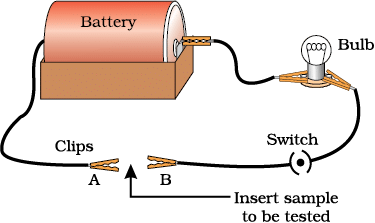
  • Set the apparatus, as shown in the figure above.
  • Take the sample of metal and put it between the clips. Switch on the current and observe the bulb.
  • Now take the sample of non-metal and insert it between clips. Switch on the current and observe the bulb.
  • You will observe that the bulb glows when current is switched on in the case of metal sample. 
  • The bulb does not glow in case of non-metal sample.
  • This shows metals are good conductors of electricity, whereas non-metals are bad conductors of electricity.

(b) 

  • These two tests can be used to distinguish between metals and non-metals.
  • Hammering can be used in most metals except in the case of sodium, potassium, and lithium.
  • Conduction of electricity can be used in the classification of most of the metals and non-metals except in graphite, which is a non-metallic conductor.


Q6. What are amphoteric oxides? Give two examples of amphoteric oxides.
Ans:

  • The oxides which act as both acidic as well as basic are called amphoteric oxides.
    Example: Al2O3 and ZnO are amphoteric oxides

Q7. Name two metals which will displace hydrogen from dilute acids, and two metals which will not.
Ans: Zn and Al will displace hydrogen from dilute acids because they are more reactive than hydrogen, whereas Cu and Ag cannot displace hydrogen from dilute acids because they are less reactive than hydrogen.
Zn(s) + 2HCl(dil) → ZnCl2(aq) + H2(g)
2Al(s) + 6HCl(dil) → 2AlCl3(aq) + 3H2(g)

Page No. 57

Q8. In the electrolytic refining of a metal M, what would you take as the anode, the cathode, and the electrolyte?
Ans: Impure metal acts as an anode, and pure metal acts as a cathode. Soluble salt of metal acts as an electrolyte.

  • When current is passed through the electrolyte, the impure metal from the anode is dissolved in the electrolyte and an equal amount of pure metal from the electrolyte is deposited on the cathode.

Q9. Pratyush took a sulphur powder on a spatula and heated it. He collected the gas evolved by inverting a test tube over it, as shown in the figure below.
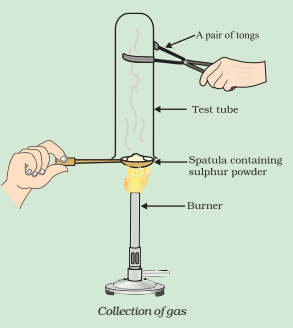
(a) What will be the action of gas on:
(i) dry litmus paper?
(ii) moist litmus paper?

(b) Write a balanced chemical equation for the reaction taking place.
Ans: (a) 
(i) There will be no action on dry litmus paper.
(ii) The colour of litmus paper will turn red because sulfur is non-metal, and the oxides of non-metal are acidic in nature.
(b) Chemical Equation for the reaction taking place.
S + O2   → SO2
(Sulphur)              Sulphur dioxide
SO2     +   H2O → H2SO3
(Sulphurous acid)

Q10. State two ways to prevent the rusting of iron.
Ans: Two ways to prevent the rusting of iron are:
(i) Painting

  • Iron articles are painted so that surface does not come in contact with air and water, and it does not get rusted.

(ii) Galvanisation

  • It is a process in which iron particles are coated with zinc metal so as to prevent them from rusting. 
  • Zinc is more reactive than iron; therefore, it loses electrons more readily and prevents iron from rusting.


Q11. What type of oxides are formed when non-metals combine with oxygen?
Ans: Mostly acidic oxides are formed when non-metal combines with oxygen.

Q12. Give reasons.
(a) Platinum, gold, and silver are used to make jewellery.
(b) Sodium, potassium, and lithium are stored under oil.
(c) Aluminium is a highly reactive metal, yet it is used to make utensils for cooking.
(d) Carbonate and sulfide ores are usually converted into oxides during the process of extraction.

Ans:

(a) Platinum, gold, and silver are used to make jewellery because they are:

  • Very lustrous
  • Also, they are very less reactive and do not corrode easily.

(b) Sodium, potassium, and lithium are:

  • Very reactive metals and react very vigorously with air as well as water.
  • Therefore, they are kept immersed in kerosene oil in order to prevent their contact with air and moisture.

(c) Though aluminium is a highly reactive metal, it is resistant to corrosion. 

This is because:

  •  Aluminium reacts with oxygen present in the air to form a thin layer of aluminium oxide. 
  • This oxide layer is very stable and prevents further reaction of aluminium with oxygen. 
  • Also, it is light in weight and a good conductor of heat. Hence, it is used to make cooking utensils.

(d) Carbonate and sulfide ores are usually converted into oxides during the process of extraction because metals can be easily extracted from their oxides rather than from their carbonates and sulfides.

Q13. You must have seen tarnished copper vessels being cleaned with lemon or tamarind juice. Explain why these sour substances are effective in cleaning the vessels.
Ans:

  • Copper reacts with moist carbon dioxide in the air to form copper carbonate, and as a result, the copper vessel loses its shiny brown surface forming a green layer of copper carbonate.
  • The citric acid present in the lemon or tamarind neutralises the basic copper carbonate and dissolves the layer.
  • That is why tarnished copper vessels are cleaned with lemon or tamarind juice to give the surface of the copper vessel its characteristic lustre.
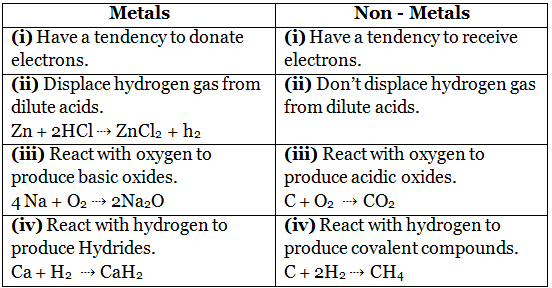
Q14. Differentiate between metal and non-metal on the basis of their chemical properties.
Ans:

Q15. A man went door to door posing as a goldsmith. He promised to bring back the glitter of old and dull gold ornaments. An unsuspecting lady gave a set of gold bangles to him, which he dipped in a particular solution. The bangles sparkled like new, but their weight was reduced drastically. The lady was upset, but after a futile argument, the man beat a hasty retreat. Can you play the detective to find out the nature of the solution he had used?
Ans:

  • The solution he had used was aqua regia, which is a freshly prepared mixture of concentrated hydrochloric acid and concentrated nitric acid in the ratio of 3:1.
  • Aqua regia is one of the few reagents that are able to dissolve gold.
  • When the person claimed to be a goldsmith dipped bangles in aqua regia, some of the gold got dissolved, and hence the weight of the bangles got reduced.

Q16. Give reasons why copper is used to making hot water tanks and not steel (an alloy of iron).
Ans: Copper is used for making hot water tanks because it has excellent thermal conductivity, allowing efficient heat transfer. It is also highly resistant to corrosion, unlike steel, which rusts easily when exposed to water.
02.Acids, Bases and Salts- Textbooks Solutions

Page No. 18

Q1. You have been provided with three test tubes. One of them contains distilled water, and the other two contain an acidic solution and a basic solution, respectively. If you are given only red litmus paper, how will you identify the contents of each test tube?
Ans: 

(i) Put the red litmus paper in all the test tubes, turn by turn. The solution which turns red litmus to blue will be a basic solution. The blue litmus paper formed here can now be used to test the acidic solution.

(ii) Put the blue litmus paper obtained above in the remaining two test-tubes, turn-by-turn. The solution which turns the blue litmus paper to red will be the acidic solution.

(iii) The solution which has no effect on any litmus paper will be neutral and hence it will be distilled water.
Page No. 22

Q1. Why should curd and sour substances not be kept in brass and copper vessels?
Ans: 
Curd and sour substances should not be kept in brass and copper vessels because these and other sour food-stuffs contain acids which can react with the metal of the vessel to form poisonous metal compounds which can cause food poisoning and affect our health adversely. 


Q2. Which gas is usually liberated when an acid reacts with a metal? Illustrate with an example. How will you test for the presence of this gas?
Ans: 
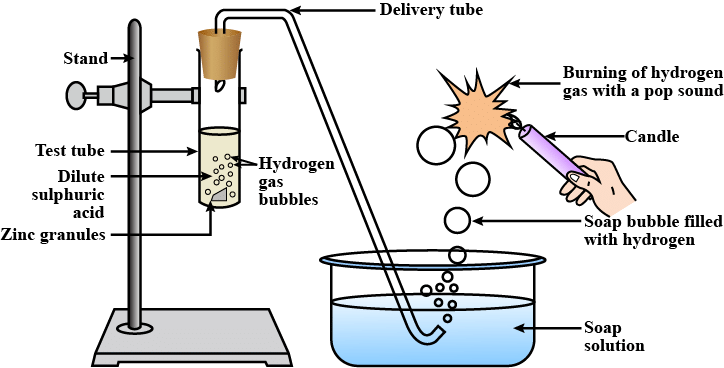
Usually, hydrogen gas is liberated when an acid reacts with a metal. For example, let us take the reaction between zinc and sulphuric acid.

The reaction of zinc granules with dil. H2SO4 to liberate hydrogen gas which burns with a ‘pop’ sound
(i) Take 5 g of zinc granules in a test tube.
(ii) Set the apparatus, as shown in the diagram.
(iii) Add 20 mL of dil. H2SO4 with the help of a thistle funnel.
(iv) Collect the gas evolved in a gas jar, as shown in the figure.
(v) Observe the colour and odour of the gas.
(vi) Bring a burning matchstick near the gas jar and record your observations.

Observation: A colourless, odourless gas is evolved. It burns explosively with a ‘pop’ sound when a burning matchstick is brought near it, indicating the presence of hydrogen gas. 

The pop sound is because whenever we bring hydrogen in contact with heat it expands , it is so fast that it breaks the sound barrier.

Chemical Reaction: Zn(s) + H2SO4(dil) → ZnSO4(aq) + H2(g)

Q3. Metal compound A reacts with dilute hydrochloric acid to produce effervescence. The gas evolved extinguishes a burning candle. Write a balanced chemical equation for the reaction if one of the compounds formed is calcium chloride.
Ans: 
Calcium carbonate (A), when reacts with hydrochloric acid, produces carbon dioxide gas with effervescence. Carbon dioxide gas is used as a fire extinguisher. Therefore, it extinguishes a burning candle. Hence, the metal compound A is calcium carbonate.

Chemical Reaction: CaCO3(s) + 2HCl(aq) → CaCl2(s)+ CO2 (g) + H2O(l)

Page No. 25

Q1. Why do HCl, HNO3, etc., show acidic characters in aqueous solutions while solutions of compounds like alcohol and glucose do not show acidic character?
Ans: 
Release of H+ ion in water will make a compound acidic or non-acidic. Acids are substances which, upon dissociating with water, resulting in the production of Hydrogen ions.  HCI, HNO3, etc. dissociate into their ions in the presence of water. They form hydrogen ions (H+). These hydrogen ions combine with H2O to form hydronium ions (H3O+). 
The reaction can be given as follows:
HCl → H+ + Cl
H+ + H2O → H3O+
Similarly, HNO3 → H+ + NO3
H+ + H2O →  H3O+

  • Due to this property, HCl and HNO3 show acidic character in aqueous solutions. On the other hand, alcohol and glucose cannot dissociate in water to form hydrogen ions. Hence, they do not show acidic character.

Q2. Why does an aqueous solution of an acid conduct electricity?
Ans: 
An aqueous solution of acid conducts electricity because of the presence of charged particles called ions in it. When dissolved in water, acids dissociate to form ions. 
Example:
HCl + H2O → Cl + H3O+
These ions are responsible for conducting electricity.

Q3. Why does dry HCl gas not change the colour of the dry litmus paper?
Ans: 
Dry HCl gas do not change the colour of dry litmus paper because:

  • We know that H+ ions of acid change the colour of the litmus. 
  • Dry HCI does not dissociate to give H+ ions. 
  • Acids dissociate to give ions only in the aqueous medium. 
  • Since in this case, neither HCI is in the aqueous form nor is the litmus paper wet, so the colour of the litmus paper does not change.

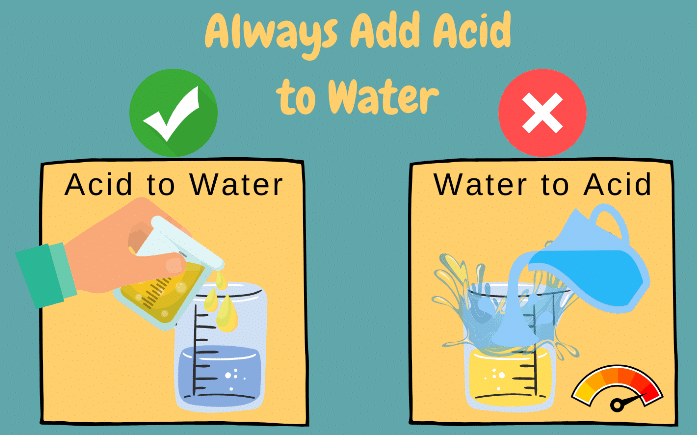
Q4. While diluting an acid, why is it recommended that the acid should be added to water and not water to the acid?
Ans: 
The process of dissolving an acid in water is highly exothermic. The acid must always be added slowly to water with constant stirring. If water is added to a concentrated acid, the heat generated may cause the mixture to splash out and cause severe burns. The glass container may also break due to excessive heating.

Q5. How is the concentration of hydronium ions (H3O+) affected when a solution of an acid is diluted?
Ans: 

  • When a given amount of acid is added to water, there is a fixed number of hydronium ions per unit volume of the solution.
  • On dilution number of hydronium ions per unit volume decreases and the concentration of hydronium ions (H3O+) decreases and becomes weak.

Q6. How is the concentration of hydroxide ions (OH) affected when excess base is dissolved in a solution of sodium hydroxide?
Ans:

  • The concentration of hydroxide ions (OH) increases when the excess base is dissolved in a solution of sodium hydroxide.
  • The concentration of (OH) Hydroxide ions increases when the excessive base is added to the solution of Sodium Hydroxide as the base itself dissociates to give out OH ions which increase their concentration per unit volume.

Page No. 28

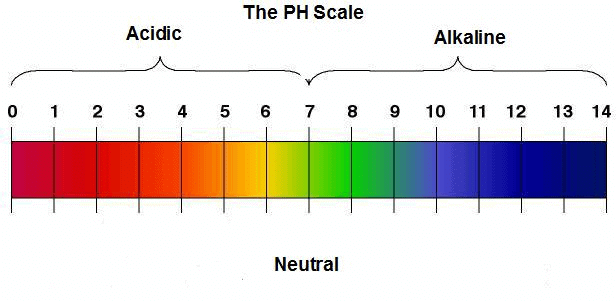
Q1. You have two solutions, A and B. The pH of solution A is 6, and the pH of solution B is 8. Which solution has more hydrogen ion concentration? Which of these is acidic, and which one is basic?
Ans: 
Solution A has more H+ ion concentration. A pH value of less than 7 indicates the acidic nature, while greater than 7 indicates the basic nature of a solution. So, solution A is acidic, and solution B is basic.

Q2. What effect does the concentration of H+(aq) ions have on the nature of the solution?
Ans: 
The concentration of H+(aq) can have a varied effect on the nature of the solution. With an increase in H+ ion concentration, the solution becomes more acidic, while a decrease in H+ ion causes an increase in the basicity of the solution.

Q3. Do basic solutions also have H+(aq)  ions? If yes, then why are these basic?
Ans: 
Yes, the basic solution also has H+(aq) ions. However, their concentration is less as compared to the concentration of OH ions that makes the solution basic.

Q4. Under what soil conditions do you think a farmer would treat the soil of his fields with quick lime (calcium oxide) or slaked lime (calcium hydroxide) or chalk (calcium carbonate)?
Ans: 
If the farmer finds his soil to be more acidic, then to increase the basicity of the soil, he should treat the soil of his field with quick lime (calcium oxide) or slaked lime (calcium hydroxide) or chalk (calcium carbonate).

Page No. 33

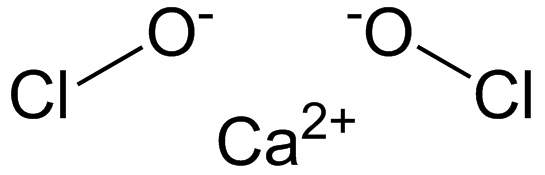
Q1. What is the common name of the compound Ca(OCl)2?
Ans: 
Bleaching Powder
Explanation: The compound Ca(OCl)2 is commonly known as bleaching powder. The reason for this common name is due to the compound’s primary use. It is often used as a disinfecting agent and to bleach cotton and linen in the textile industry. The chemical name for this compound is calcium hypochlorite, but it is more widely recognized and referred to as bleaching powder.
Bleaching powder structural formula

Q2. Name the substance which on treatment with chlorine yields bleaching powder?
Ans: 
Dry slaked lime [Ca(OH)2].

Explanation: Bleaching powder, also known as Calcium hypochlorite [Ca(OCl)2], is produced by the action of chlorine on dry slaked lime [Ca(OH)2]. This reaction can be represented by the following chemical equation:

2Ca(OH)2 + 2Cl2 → Ca(OCl)2 + CaCl2 + 2H2O

In this reaction, chlorine (Cl2) is added to dry slaked lime (Ca(OH)2) to produce bleaching powder (Ca(OCl)2), calcium chloride (CaCl2), and water (H2O). The chlorine oxidizes the calcium hydroxide to produce the calcium hypochlorite, which is the main component of bleaching powder. The calcium chloride is a byproduct of this reaction.

So, the substance which on treatment with chlorine yields bleaching powder is dry slaked lime [Ca(OH)2].


Q3. Name the sodium compound which is used for softening hard water.
Ans: 
Washing soda (Na2CO3.10H2O)

Explanation: Hard water contains minerals like calcium and magnesium that can cause a buildup in plumbing and appliances, and make it difficult for soap to lather. Sodium carbonate, also known as washing soda or soda ash, is used to soften hard water. When added to water, it reacts with the calcium and magnesium ions, forming insoluble precipitates that can be removed from the water. This reduces the mineral content of the water, effectively “softening” it. The formula Na2CO3.10H2O represents washing soda, which means it is a hydrated salt with 10 molecules of water of crystallization.

Q4. What will happen if a solution of sodium hydro carbonate is heated? Give the equation of the reaction involved.
Ans: 
When sodium hydrogen carbonate is heated, then sodium carbonate and water are formed along with carbon dioxide gas evolution.


Q5. Write an equation to show the reaction between Plaster of Paris and water.
Ans: 

Exercises (Page No. 34 & 35) 

Q1. A solution turns red litmus blue, its pH is likely to be
(a) 1
(b) 4
(c) 5
(d) 10

Ans: (d) 
Solution: pH = 10, bases turn red litmus blue, and their pH is more than 7.

Q2. A solution reacts with crushed egg-shells to give a gas that turns lime-water milky. The solution contains
(a) NaCl
(b) HCl 
(c) LiCl 
(d) KCl
Ans: (b)
Solution:
Eggshells are made up of CaCO3 which reacts with HCl to form CO2, and this CO2 turns lime water milky.
Example:
CaCO3(s) + 2HCl(dil)→ CaCl2(aq) + H2O(l) + CO2(g)
Ca(OH)2(aq) + CO2(g) → CaCO3(s) + H2O(l)

Q3. 10 mL of a solution of NaOH is found to be completely neutralised by 8 ml of a given solution of HCl. If we take 20 ml of the same solution of NaOH, the amount of HCl solution (the same solution as before) required to neutralise it will be
(a) 4 mL
(b) 8mL
(c) 12 mL 
(d) 16 mL
Ans: (d) 
Solution:
∴ 10 mL of NaOH will neutralise
= 8 mL of HCI.
= 20 mL of NaOH will neutralise
= 8/10 x 20 = 16 mL.

Q4. Which one of the following types of medicines are used for treating indigestion?
(a) Antibiotic
(b) Analgesic
(c) Antacid
(d) Antiseptic

Ans: (c) 
Solution:

  • Antacids are used to neutralise hyperacidity in the stomach due to excess of HCI which causes indigestion. 
  • Antibiotics are used to fight infections. 
  • Analgesics are pain killer while antiseptics prevent the growth of bacteria and other micro-organisms on wounds.

Q5. Write word equations and then balanced equations for the reaction taking place when:
(a) Dilute sulphuric acid reacts with zinc granules.
(b) Dilute hydrochloric acid reacts with magnesium ribbon.
(c) Dilute sulphuric acid reacts with aluminium powder.
(d) Dilute hydrochloric acid reacts with iron filings.

Ans:
(a)

(b)

(c)

(d)


Q6. Compounds such as alcohols and glucose also contain hydrogen but are not categorized as acids. Describe an activity to prove it.
Ans:

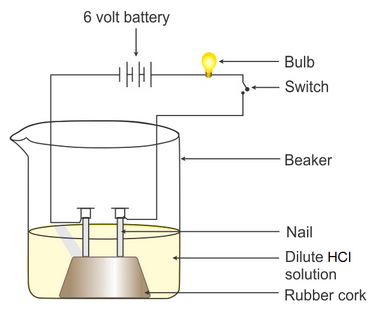
  • Fix two iron nails on a cork and place this cork in a beaker.
  • Connect the nails to the two terminals of a 6-volt battery through a switch and a bulb, as shown in the figure.
  • Now add some dilute hydrochloric acid in the beaker and switch on the current. Take the observation.
  • Repeat the experiment separately with alcohol and glucose solution.

Observation: You will observe that in the case of dilute hydrochloric acid bulb glows, but when glucose or alcohol solution is taken in the beaker, the bulb does not glow.
Conclusion: The aqueous solution of hydrochloric acid conducts electricity due to the presence of types of charged particles: Hydrogen ions and chloride ions. Unlike acids glucose and ethanol do not ionise in an aqueous solution, i.e. they do not give H+ ions; therefore, they cannot conduct electricity. Thus, glucose and ethanol are not categorized as acids.

Q7. Why does distilled water not conduct electricity, whereas rainwater does? 

Ans: 

  • Distilled water does not conduct electricity because it does not contain any ionic compound (like acids, bases or salts) dissolved in it.
  • Rainwater, while falling to the earth through the atmosphere, dissolves an acidic gas carbon dioxide from the air and forms carbonic acid (H2CO3). 
  • Carbonic acid provides hydrogen ions, H+ (aq) and carbonate ions, CO(aq)32to rainwater. 
  • Hence, due to the presence of carbonic acid which provides ions to rainwater, the rainwater conducts electricity.

Q8. Why do acids not show acidic behaviour in the absence of water?
Ans: 
It is because acids do not dissociate into ions in the absence of water. But when an acid is dissolved in water, it forms hydrogen ions and hence, shows acidic behaviour.

Q9. Five solutions A, B, C, D and E when tested with universal indicator showed pH as 4, 1, 11, 7 and 9, respectively. Which solution is
(a) Neutral?
(b) Strongly alkaline?
(c) Strongly acidic?
(d) Weakly acidic?
(e) Weakly alkaline?
Arrange the pH in increasing order of hydrogen-ion concentration.

Ans:pH level from acidic to basic

(a) Neutral → Solution D with pH 7
(b) Strongly alkaline → Solution C with pH 11
(c) Strongly acidic → Solution B with pH 1
(d) Weakly acidic → Solution A with pH 4
(e) Weakly alkaline → Solution E with pH 9

  • The pH can be arranged in the increasing order of the concentration of hydrogen ions as: 11 < 9 < 7 < 4 < 1.

Q10. Equal lengths of magnesium ribbons are taken in test tubes A and B. Hydrochloric acid (HCl) is added to test tube A, while acetic acid (CH3COOH) is added to test tube B. In which test tube will the fizzing occur more vigorously and why?
Ans: 
Fizzing will occur more vigorously in test tube A. Hydrochloric acid (HCl) is a strong acid whereas acetic acid (CH3COOH) is a weak acid. Being strong acid, the hydrochloric acid solution contains a much greater amount of hydrogen ions in it due to which the fizzing will occur more vigorously in test tube A (containing hydrochloric acid). The fizzing is due to the evolution of hydrogen gas which is formed by the action of acid on the magnesium metal of magnesium ribbon.

Q11. Fresh milk has a pH of 6. How do you think the pH will change as it turns into curd? Explain your answer.
Ans: 
Milk contains carbohydrate lactose. When milk sets into curd, lactose gets converted into an acid called lactic acid. Due to the formation of lactic acid, the pH of milk falls below 6.

Q12. A milkman adds a very small amount of baking soda to fresh milk.
(a) Why does he shift the pH of the fresh milk from 6 to slightly alkaline?
(b) Why does this milk take a long time to set as curd?

Ans: 
(a) The milkman shifts the pH of the fresh milk from 6 to slightly alkaline because, in alkaline conditions, milk does not set as curd easily.
(b) Since this milk is slightly basic than usual milk, acids produced to set the curd are neutralized by the base. Therefore, it takes a longer time for the curd to set.

Q13. Plaster of Paris should be stored in a moisture-proof container. Explain why?
Ans: 
It will absorb water to form gypsum which sets into a hard solid mass. This will make Plaster of Paris useless after some time.
Example:

Q14. What is a neutralization reaction? Give two examples.
Ans: 
A reaction in which an acid and base react with each other to give salt and water is termed as neutralization reaction.
Example:
NaOH(aq) + HCl(aq) → NaCl(aq) +H2O(l)
H2SO4(aq) + 2NH4OH(aq) → (NH4)2SO4(aq) + 2H2O

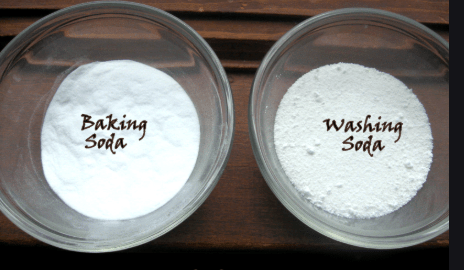
Q15. Give two important uses of washing soda and baking soda.
Ans:

Uses of Washing Soda
(i) It is used in the manufacture of glass, soap, paper, and other sodium compounds like borax, etc.
(ii) It is used in softening hard water.

Uses of Baking Soda
(i) It is used as an antacid to neutralise the excess of acidity (hyper-acidity) in the stomach.
(ii) It is an ingredient of baking powder that contains NaHCO3 and tartaric acid.
(iii) It is used in making soda acid fire extinguishers.

01. Chemical Reactions and Equations- Textbooks Solutions

Page No. 6

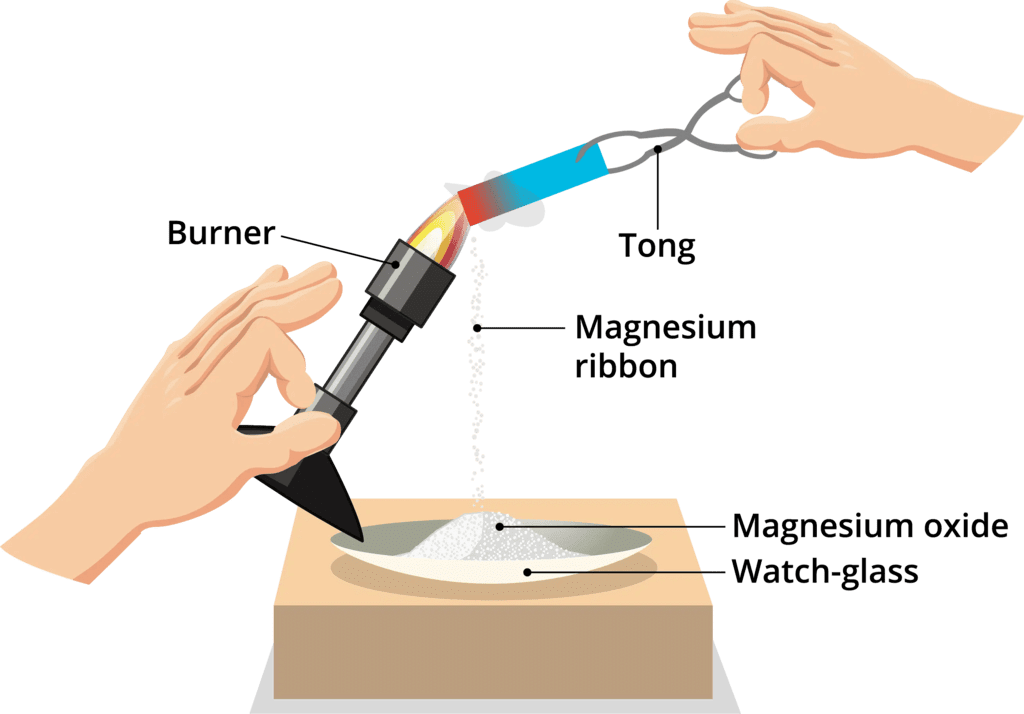
Q.1. Why should a magnesium ribbon be cleaned before burning in air?
Ans: When magnesium ribbon is exposed to air, it forms a layer of magnesium oxide on its surface. This layer of magnesium oxide, being a stable compound, prevents further reaction of magnesium with oxygen. Hence, it should be cleaned before burning in air to remove this layer so that the metal can be exposed to air properly (the oxide layer may prevent or slow down the burning of magnesium.

Burning of Magnesium Ribbon


Q.2. Write the balanced equation for the following chemical reactions.
(a) Hydrogen + Chlorine → Hydrogen chloride
(b) Barium chloride + Aluminium sulphate → Barium sulphate + Aluminium chloride
(c) Sodium + Water → Sodium hydroxide + Hydrogen
Ans:
(a) H2(g) + Cl2(g) → 2HCl(g)
(b) 
3BaCl​2(aq)+Al​2(SO​4)​3(aq)→3BaSO​4(s)+2AlCl3(aq)
(c) 2Na(s) + 2H2O(l) → 2NaOH(aq) + H2(g)

Q.3. Write a balanced chemical equation with state symbols for the following reactions.
(a) Solutions of barium chloride and sodium sulphate in water react to give insoluble barium sulphate and the solution of sodium chloride.
(b) Sodium hydroxide solution (in water) reacts with a hydrochloric acid solution (in water) to produce sodium chloride solution and water.

Ans: 

a) Barium chloride reacts with sodium sulphate to form barium sulphate (insoluble) and sodium chloride:

BaCl2(aq)+Na2SO4(aq)→BaSO4(s)+2NaCl(aq)

(b) Sodium hydroxide solution reacts with hydrochloric acid solution to produce sodium chloride solution and water:

NaOH(aq)+ HCl(aq)→NaCl(aq)+H2O(l)


Page No. 10

Q.1. A solution of a substance ‘X’ is used for whitewashing.
(a) Name the substance ‘X’ and write its formula.
(b) Write the reaction of the substance ‘X’ named in (i) above with water.

Ans: 
(a) The substance ‘X’ is calcium oxide. Its chemical formula is CaO. 
(b) Calcium oxide reacts vigorously with water to form calcium hydroxide (slaked lime).

CaO(s)+ H2O(l)→Ca(OH)2(aq)
Calcium oxide + water → Calcium Hydroxide

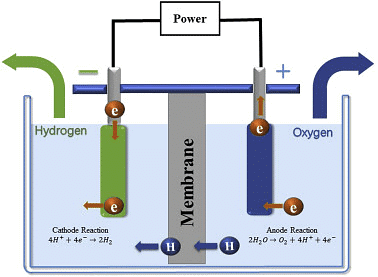
Q.2. Why is the amount of gas collected in one of the test tubes in Activity 1.7 double the amount collected in the other? Name this gas. 
Ans:

Electrolysis of Water

In Activity 1.7, gas collected in one of the test tubes is double of the amount collected in the other. This can be explained with the help of the chemical reaction that takes place.

2H2O (l)→ 2H2(g) + O2(g)

The volume of the gas is proportional to the number of molecules of the gas as indicated in the balanced equation. There are two molecules of hydrogen and one molecule of oxygen in the balanced equation. Hence the amount of Hydrogen collected would be double than that of oxygen.

Page No. 13

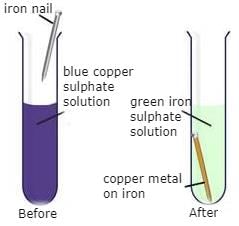
Q.1. Why does the colour of copper sulphate solution change when an iron nail is dipped in it?
Ans: Iron is more reactive than copper. So, When an iron nail is dipped in a copper sulphate solution, iron displaces copper from its solution to form iron sulphate, which is green in colour.
Fe(s) + CuSO4(aq) → FeSO4(aq) + Cu(s)
Hence, the blue colour of copper sulphate solution changes into green colour because of this displacement reaction.

Iron nail dipped in copper sulphate solution


Q.2. Give an example of a double displacement reaction other than the one given in Activity 1.10
Ans: Sodium carbonate and calcium chloride exchange ions to form two new compounds calcium carbonate and sodium chloride.
Na2CO3(aq) + CaCl2(aq) → CaCO3(s) + 2NaCl(aq)

Q.3. Identify the substances that are oxidised and the substances that are reduced in the following reactions.
(a) 4Na (s)+ O2 (g) → 2Na2O (s)
(b) CuO (s) +H2 (g) → Cu (s)+ H2O (g)

Ans: 
(a) Sodium (Na) is oxidised as it gains oxygen and oxygen gets reduced.
(b) Copper oxide (CuO) is reduced to copper (Cu) while hydrogen (H2) gets oxidised to water (H2O).


Page No. 14 – 16

Exercise Questions
Q.1. Which of the statements about the reaction below are incorrect?
2PbO (s) + C (s) → 2Pb (s) + CO2 (g)
(a) Lead is getting reduced.
(b) Carbon dioxide is getting oxidised.
(c) Carbon is getting oxidised.
(d) Lead oxide is getting reduced.

(i) (a) and (b)
(ii) (a) and (c)
(iii) (a), (b) and (c)
(iv) all 
Ans: 
(a) Lead is getting reduced is an incorrect answer.
(b) Carbon dioxide is getting oxidised is an incorrect answer.
(c) Carbon is getting oxidised is an correct answer because the removed oxygen from lead is added to the elemental Carbon.
(d) Lead oxide is getting reduced is correct answer because oxygen is being removed.
As statements (a) and (b) are incorrect, answer (i) is correct.

Q.2. Fe2O3 + 2Al → Al2O + 2Fe
The above reaction is an example of a
(a) combination reaction.
(b) double displacement reaction.
(c) decomposition reaction.
(d) displacement reaction.
 
Ans: (d)
In this reaction Aluminum is more reactive metal than Fe. The Oxygen from the Ferrous oxide is getting displaced to the Aluminium metal to form Aluminium Oxide. Therefore Al will displace Fe from its oxide. Since one-time displacement is occurring, therefore, it is called a single displacement reaction. 

Q.3. What happens when dilute hydrochloric acid is added to iron filings? Tick the correct answer.
(a) Hydrogen gas and iron chloride are produced.
(b) Chlorine gas and iron hydroxide are produced.
(c) No reaction takes place.
(d) Iron salt and water are produced.
 
Ans: (a)
Fe(s) + 2HCl(dil.) → FeCl2(aq) + H2(g) 
Hydrogen gas and Iron (II) chloride are produced.

Q.4. What is a balanced chemical equation? Why should chemical equations be balanced?
Ans: Balanced chemical equation means total number of atoms of each element should be equal on both sides of the reaction.
For example, magnesium and oxygen combine, when heated to form a single compound magnesium oxide.
2Mg(s) + O2(g) → 2MgO(s)
The reaction should be balanced because matter can neither be created nor be destroyed. The total mass of reactants should be equal to the total mass of products.

Q.5. Translate the following statements into chemical equations and then balance them.
(a) Hydrogen gas combines with nitrogen to form ammonia.
(b) Hydrogen sulphide gas burns in air to give water and sulphur dioxide.
(c) Barium chloride reacts with aluminium sulphate to give aluminium chloride and a precipitate of barium sulphate.
 
(d) Potassium metal reacts with water to give potassium hydroxide and hydrogen gas. 
Ans:
(a) Unbalanced equation: H2(g) + N2(g) → NH3(g)
Balanced equation: 3H2(g) + N2(g) → 2NH3(g) 
(b) Unbalanced equation: H2S + O→ H2O + SO2
Balanced equation: 2H2S (g) + 3O2(g) → 2H2O(g) + 2SO2(g)   
(c) Unbalanced equation: BaCl2(aq) + Al2(SO4)3(aq)  → AlCl3(aq) + BaSO4(s)
Balanced equation: 3BaCl2(aq) + Al2(SO4)3(aq) → 2AlCl3(aq) + 3BaSO4(s)
(d) Unbalanced equation: K(s) + H2O(l) → KOH (aq) + H2(g)
Balanced equation: 2K(s) + 2H2O(l) → 2KOH(aq) + H2(g)

Q.6. Balance the following chemical equations.
(a) HNO3 + Ca(OH)2 → Ca(NO3)2 + H2O
(b) NaOH + H2SO4 → Na2SO4 + H2O
(c) NaCl + AgNO3 → AgCl + NaNO3
(d) BaCl2 + H2SO4 → BaSO4 + HCl

Ans: Balanced chemical equations are given as under :
(a) 2HNO3(aq) + Ca(OH)2(aq) → Ca(NO3)2(aq) + 2H2O(l)
(b) 2NaOH(aq) + H2SO4(aq) → Na2SO4(aq) + 2H2O(l)
(c) NaCl(aq) + AgNO3(aq) → AgCl(s) + NaNO3(aq)
(d) BaCl2(aq) + H2SO4(aq) → BaSO4(s) + 2HCl(aq)

Q.7. Write the balanced chemical equations for the following reactions.
(a) Calcium hydroxide + Carbon dioxide → Calcium carbonate + Water
(b) Zinc + Silver nitrate → Zinc nitrate + Silver
(c) Aluminium + Copper chloride → Aluminium chloride + Copper
(d) Barium chloride + Potassium sulphate → Barium sulphate  + Potassium chloride

Ans: Balanced chemical equations for the reactions are given as under:
(a) Ca(OH)2(aq) + CO2(g) → CaCO3(s) + H2O(l)
(b) Zn(s) + 2AgNO3(aq) → Zn(NO3)2(aq) + 2Ag(s)
(c) 2Al(s) + 3CuCl2(aq) → 2AlCl3(aq) + 3Cu(s)
(d) BaCl2(aq) + K2SO4(aq) → BaSO4(s) + 2KCl(aq)

Q.8. Write the balanced chemical equation for the following and identify the type of reaction in each case.
(a)Potassium bromide (aq) + Barium iodide (aq)­ → Potassium iodide (aq) + Barium bromide(s) 
(b) Zinc carbonate (s) → Zinc oxide (s)  + Carbon dioxide (g) 
(c) Hydrogen (g) + Chlorine (g) → Hydrogen chloride (g)
(d) Magnesium (s) + Hydrochloric acid (aq) → Magnesium chloride(aq) + Hydrogen (g)

Ans:
(a) 2KBr(aq) + BaI2(aq) → 2KI(aq) + BaBr2(s)
Double displacement reaction
(b) ZnCO3(s) →  ZnO(s) + CO2(g)
Decomposition reaction
(c) H2(g) + Cl2(g) → 2HCl(g)
Combination reaction
(d) Mg(s) + 2HCl(aq) → MgCl2(aq) + H2(g)
Displacement Reaction 

Q.9. What does one mean by exothermic and endothermic reactions? Give examples. 
Ans: Endothermic Reaction: An endothermic reaction occurs when energy is absorbed from the surroundings in the form of heat. 
Examples: Photosynthesis, melting of ice, evaporation.
Exothermic Reaction: Conversely, an exothermic reaction is one in which energy is released from the system into the surroundings. 
Examples: Explosions, concrete setting, nuclear fission and fusion. 

Q.10. Why is respiration considered an exothermic reaction? Explain. 
Ans: During respiration, glucose combines with oxygen in the cells of our body and provides energy. As energy is released during respiration, therefore, respiration is regarded as an exothermic reaction.
C6H12O(aq) + 6O2(g) → 6CO2(g) + 6H2O(l) + Energy

Q.11. Why are decomposition reactions called the opposite of combination reactions? Write equations for these reactions.
Ans: Decomposition reactions are those in which a compound breaks down to form two or more substances. These reactions require a source of energy to proceed. Thus, they are the exact opposite of combination reactions in which two or more substances combine to give a new substance with the release of energy. For Example of decomposition Reactions are:
ZnCO3 → ZnO + CO2
CaCO3 + Energy → CaO + CO2
2HgO → 2Hg + O2

Q.12. Write one equation each for decomposition reactions where energy is supplied in the form of heat, light or electricity. 
Ans:
(a) Thermal decomposition reaction (Thermolysis): When decomposition is carried out by heating, it is called thermal decomposition. On heating, Calcium carbonate decomposes to calcium oxide and carbon dioxide as shown below:
CaCO3(s) → CaO(s) + CO2(g) 
(b) Photodecomposition reaction (Photolysis): When decomposition is carried out by light, it is called photolysis. The below reaction is used in black and white photography.
2AgCl(s) →  2Ag(s)  + Cl2 (g) 
(c) Electrolytic decomposition reaction (Electrolysis): When decomposition is carried out by electricity, it is called electrolysis. On passing electricity, water decomposes to hydrogen and oxygen.
2H2O (l) → 2H2(g) + O2(g)

Q.13. What is the difference between displacement and double displacement reactions? Write equations for these reactions. 
Ans: Displacement reaction: Those reactions in which more reactive metal displaces less reactive metal from its salt solution is called displacement reactions.
Fe(s) + CuSO4(aq) → FeSO4(aq) + Cu(s)
Double displacement reaction: Those reactions in which two compounds exchange their ions to form two new compounds are called double displacement reactions.
HCl(aq) + NaOH(aq) → NaCl(aq) + H2O(l)

Q.14. In the refining of silver, the recovery of silver from silver nitrate solution involved displacement by copper metal. Write down the reaction involved.
Ans: Cu(s) + 2AgNO3(aq) → Cu(NO3)2(aq) + 2Ag(s)

Q.15. What do you mean by a precipitation reaction? Explain by giving examples.
Ans: When two solutions containing soluble salts are combined, a double displacement reaction takes place in which the ions are exchanged between the compounds. When one of such compounds is formed  in solid form (that is insoluble in aqua) then it settles down at the bottom of the container. This solid is known as the precipitate and the respective reaction is termed as the precipitation reaction. Few examples of precipitation reactions are:
When solutions of silver nitrate and sodium chloride are mixed, white precipitate of silver chloride is formed.
AgNO3(aq) + NaCl(aq) → AgCl(s) + NaNO3(aq)

On adding dilute hydrochloric acid to the aqueous solution of lead nitrate, precipitate of lead chloride is formed.
Pb(NO3)2 + 2HCl → PbCl2 + 2HNO3

Q.16. Explain the following in terms of gain or loss of oxygen with two examples each.
(a) Oxidation
(b) Reduction

Ans: (a) Oxidation: It is a process in which gain of oxygen takes place
Examples:
2Mg(s) + O2(g) → 2MgO(s) (Burning)
2Cu(s) + O2(g) → 2CuO(s) (Heat)

(b) Reduction: It is a process in which removal of oxygen takes place.
Examples:

CuO(s) + H2(g) → Cu(s) + H2O(g) (Heat)
Fe2O3(s) + 2Al(s) → Al2O3(s) + 2Fe(s)


Q.17. A shiny brown-coloured element ‘X’ on heating in air becomes black in colour. Name the element ‘X’ and the black coloured compound formed.
Ans: ‘X’ is Copper.
Copper gets oxidised to copper oxide which is black in colour.
2Cu(s) + O2(g) → 2CuO(s) (Heat)

Q.18. Why do we apply paint on iron articles? 
Ans: Painting is done so as to prevent iron from rusting. When the surface of iron is coated with paint, its surface does not come in contact with oxygen and moisture and therefore, rusting does not take place.

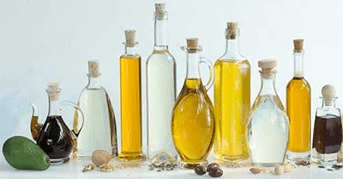
Q.19. Oil and fat containing food items are flushed with nitrogen. Why?
Ans: The main purpose of flushing Nitrogen into food packets that contain oil and fat items is to prevent Rancidity which occurs when the oil or fat reacts with the oxygen letting out an unpleasant smell and taste. Therefore by flushing Nitrogen, an unreactive surrounding is created thus preventing rancidity.
Variety of Oils

Q.20. Explain the following terms with one example each.
(a) Corrosion
(b) Rancidity

Ans: (a) Corrosion: It is the process in which metals are slowly eaten up by the action of air moisture or chemicals. For example rusting is a form of corrosion in which iron is eaten up by the action of air and moisture and a reddish brown coating of iron oxide is formed as shown in the following chemical reaction.
2Fe + 3H2O → Fe2O3 + 3H2
(b) Rancidity: When the substance containing oils and fats are exposed to air they get oxidised and become rancid due to which their smell, taste and colour change. This process is known as rancidity. For example when a when butter is kept open for a long time then its smell and taste gets changed.

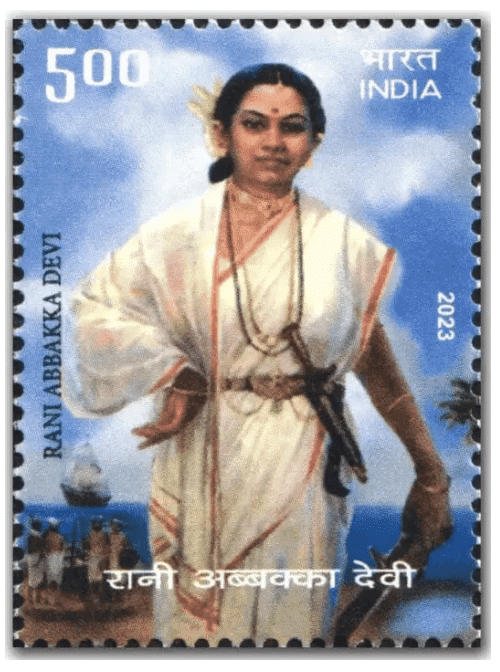
15. Rani Abbakaka Chapter short and Long Answer Questions

Short Answer Questions

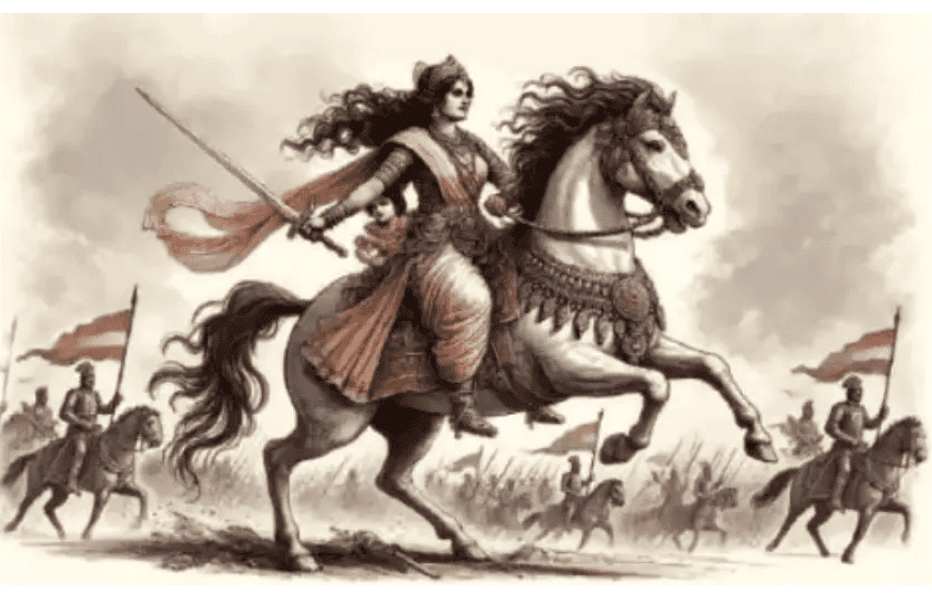
Q1: Why did Rani Abbakka refuse to pay tribute to the Portuguese?
Ans: Rani Abbakka refused to pay tribute to the Portuguese because she believed Ullal was a sovereign, independent country that should not be controlled or take orders from Portugal. Her bold stance reflected her commitment to protecting her kingdom’s freedom and dignity.

Q2: What was Veera Narasimha’s reaction to Abbakka’s plan to resist the Portuguese?
Ans: Veera Narasimha, Abbakka’s husband, was worried about her plan to resist the Portuguese, fearing it was rash and could provoke their wrath, endangering his kingdom of Bangadi. He tried to persuade her to change her mind and even ordered his soldiers to stop her, but Abbakka remained resolute.

Q3: How did Rani Abbakka strengthen Ullal against the Portuguese?
Ans: Rani Abbakka strengthened Ullal by ordering the construction of merchant ships, forming an alliance with the Zamorin of Kozhikode, and uniting local rajas against the Portuguese. These strategic moves boosted Ullal’s economy through trade with Arabia and built a stronger defence against the enemy.

Q4: What happened during the battle for Ullal?
Ans: During the four-day battle for Ullal, Rani Abbakka led her soldiers courageously, fighting alongside them against the Portuguese attack. The people of Ullal showed great bravery, defeating the Portuguese, who were forced to retreat, never troubling Ullal again.

Q5: How did Rani Abbakka’s victory impact other Indian rulers?
Ans: Rani Abbakka’s victory over the powerful Portuguese inspired other Indian rulers to resist foreign powers. Her courage and success demonstrated that with unity and fearless leadership, even strong enemies could be defeated, boosting their confidence to fight for their independence.Long Answer Questions

Q1: How did Rani Abbakka’s determination shape her response to the Portuguese demand for tribute, and what does this reveal about her character?
Ans: Rani Abbakka’s story is a powerful example of how determination and courage can lead to victory, even in the face of overwhelming odds. By refusing to pay tribute to the Portuguese, Abbakka showed her unwavering commitment to her kingdom’s sovereignty, despite facing threats and opposition. Her leadership in uniting local rajas and forming a strategic alliance with the Zamorin of Kozhikode, combined with her hands-on approach in leading her forces, demonstrates her deep dedication to her people and her land. Her actions during the four-day battle and subsequent attack on the Portuguese fort showcased her fearless spirit, ensuring Ullal’s independence and inspiring others to resist foreign domination. This story reinforces the importance of standing up for what is right, no matter the challenges, and the power of unity and resilience in the pursuit of freedom.

Q2: What challenges did Rani Abbakka face in her fight against the Portuguese, and how did she overcome them?
Ans: Rani Abbakka’s story is a testament to overcoming challenges through determination and strategic thinking. Despite facing the might of the Portuguese, opposition from her own husband, and doubts from local rajas, Abbakka was able to rally support for her cause. She formed crucial alliances, like the one with the Zamorin of Kozhikode, and improved her kingdom’s strength by building merchant ships. Her ability to inspire unity and lead her people in battle, even under intense pressure, highlights her fearless leadership. Ultimately, her victory against the Portuguese showcases how courage, strategic planning, and teamwork can lead to success, teaching readers the importance of resilience when facing obstacles.

Q3: Why was Rani Abbakka’s leadership significant in uniting her people and allies against the Portuguese?
Ans: Rani Abbakka’s leadership was pivotal in uniting her people and allies against the Portuguese, showcasing her confidence, strategic vision, and fearlessness. Faced with the challenge of rallying hesitant local rajas, who doubted their ability to stand against the Portuguese, Abbakka’s bold declaration of Ullal’s sovereignty inspired hope and determination. She communicated a clear, united front and strategically formed an alliance with the Zamorin of Kozhikode, strengthening both Ullal’s military and economic position. During the intense four-day battle, Abbakka fought alongside her soldiers, setting an example of courage that empowered her people. Her victory over the Portuguese not only secured Ullal’s independence but also motivated other Indian rulers to resist foreign domination. Her leadership reflects the moral of courage and unity, inspiring readers to lead with conviction and unite others to achieve common goals.

Q4: How did Rani Abbakka’s victory over the Portuguese influence Ullal and other Indian kingdoms?
Ans: Rani Abbakka’s victory over the Portuguese had a significant impact on Ullal and other Indian kingdoms, reinforcing Ullal’s independence and inspiring resistance against foreign rule. By defeating the Portuguese in a fierce four-day battle, Abbakka secured Ullal’s freedom, causing the Portuguese to retreat and never return. Her bold attack on their fort further solidified Ullal’s strength and pride, with her people standing united behind her, motivated by her fearless leadership. The victory also boosted Ullal’s economy, as her alliance with the Zamorin of Kozhikode and trade with Arabia thrived, demonstrating the benefits of her strategic defiance. Abbakka’s success sent a powerful message to other Indian rulers, showing that even small kingdoms, through unity and determination, could defeat powerful colonial forces. This inspired a wave of resistance, promoting a spirit of independence throughout the region. The story’s moral of standing up for freedom and working together is embodied in Abbakka’s legacy, urging readers to draw strength from her example and fight for justice and unity in their own communities, knowing that strong leadership can create lasting change.

Q5: What lessons about courage and leadership can we learn from Rani Abbakka’s story?
Ans: Rani Abbakka’s story offers powerful lessons on courage and leadership, demonstrating that unwavering determination and strategic unity can triumph over even the most formidable adversaries, inspiring others to stand up for what is right. Her courage was evident when she refused to pay tribute to the Portuguese, boldly declaring Ullal’s sovereignty despite threats and opposition from her husband. This showed that sticking to one’s principles requires bravery, even when it involves personal and political risks. Abbakka’s leadership was highlighted by her ability to unite hesitant local rajas, inspire her people, and forge an important alliance with the Zamorin of Kozhikode, showcasing her strategic foresight and persuasive leadership. During the four-day battle, she fought alongside her soldiers and led by example, demonstrating hands-on leadership and resolute determination. Her victory not only secured Ullal’s freedom but also inspired other rulers, emphasising how one leader’s courage can ignite widespread change. The story’s moral encourages us to value independence and collective action, urging readers to emulate Abbakka’s bravery, stand up for justice, and lead with confidence to unite others for a common cause. Her legacy teaches us to face challenges with unwavering courage and to lead with vision, fostering unity and resilience in the pursuit of freedom and dignity.

14. My Dear soldiers Chapter short and Long Answer Questions

Short Answer Questions

Q1: How does the poet describe soldiers in the first stanza?
Ans: In the first stanza, the poet describes soldiers as “Defenders of borders” and “great sons of my land,” highlighting their role as protectors of the nation’s boundaries. The poet notes that while people sleep, soldiers remain vigilant, committed to their duty, emphasizing their sacrifice and dedication.

Q2: What harsh conditions do soldiers face according to the second stanza?
Ans: According to the second stanza, soldiers face harsh conditions like windy seasons, snowy days, and the scorching sun’s sweltering rays. Despite these challenges, they stay awake, guarding the nation and patrolling lonely expanses, showing their resilience and determination.

Q3: What different terrains do soldiers protect in the third stanza?
Ans: In the third stanza, soldiers protect diverse terrains including mountains (climbing heights), valleys (striding lowlands), deserts, marshes, seas (through surveillance), and air (securing airspace). This shows their extensive efforts to safeguard the nation across varied landscapes.

Q4: What does the poet compare soldiers to in the second stanza, and why?
Ans: In the second stanza, the poet compares soldiers to “yogis,” spiritual seekers who walk alone with focus. This comparison highlights soldiers’ determination and strength as they tread lonely expanses, enduring harsh conditions with discipline and purpose, similar to a yogi’s solitary, dedicated path.

Q5: What does the poet pray for in the final stanza?
Ans: In the final stanza, the poet prays for the safety and well-being of the soldiers, asking that “the Lord bless you all.” This reflects gratitude and admiration for their brave actions, symbolised by the nation’s “wind chimes” vibrating with pride for their feats.

Long Answer Questions

Q1: How does the poet convey the sacrifices made by soldiers in the poem, and what impact does this have on the reader?
Ans: The poet shows the sacrifices of soldiers through strong and clear descriptions of their hard work and the tough conditions they face. In the first stanza, soldiers are called “Defenders of Borders” and stay awake while others sleep, showing their selfless duty. The second stanza explains how they face extreme weather—wind, snow, and heat—walking alone like yogis, which makes us respect their strength and patience. In the third stanza, the poet shows that soldiers work in many places like mountains, deserts, seas, and even in the sky, giving up the best years of their life for the country. The last stanza talks about “wind chimes” that sing of their bravery and ends with a prayer for their safety. This poem helps readers feel thankful and proud of the soldiers, reminding us to value their courage and sacrifices for our freedom.

Q2: Why does the poet compare soldiers to yogis in the second stanza, and how does this enhance the poem’s message?
Ans: The poet compares soldiers to yogis in the second stanza to show their discipline, focus, and strength in lonely places. Yogis are people who live simply and stay alone to focus on a higher goal. In the same way, soldiers quietly protect the country in tough weather like wind, snow, and heat, without complaining. This comparison shows that a soldier’s work is not just a duty—it is like a spiritual mission. It helps readers understand how strong and dedicated soldiers are, and makes us respect them even more. The poet wants us to be thankful for their hard work and pray for their safety.

Q3: How does the third stanza illustrate the diverse roles of soldiers in protecting the nation?
Ans: The third stanza shows that soldiers work in many different places to keep the country safe. The poet says they climb mountains and walk through valleys, which means they protect both high and low areas. They also guard hot deserts and wet marshes, showing they can handle all kinds of tough weather. Soldiers watch over the seas and skies too, keeping India safe from every side—on land, in water, and in the air. The poet says they give the “prime of their youth” to the country, meaning they spend their best years protecting us. This stanza reminds us how hard soldiers work in many places and makes us respect their great sacrifice even more.

Q4: What role does the imagery in the poem play in expressing gratitude for soldiers’ service?
Ans: The poem uses strong images to help us feel thankful for soldiers and understand their bravery. In the first stanza, we imagine soldiers staying awake to protect us while we sleep, which makes us feel grateful for their hard work. The second stanza shows them walking through wind, snow, and heat, like calm and focused yogis, helping us respect their strength and quiet courage. The third stanza takes us to mountains, deserts, seas, and skies where soldiers work, showing how much they do for our safety. In the last stanza, the poet says the “wind chimes of my land” sing about the soldiers’ bravery, and he prays for their safety. These pictures in the poem help us clearly see what soldiers go through and remind us to honour and thank them for protecting our country.

Q5: What lessons about gratitude and respect can we learn from the poem’s tribute to soldiers?
Ans: The poem teaches us to feel thankful and respectful toward soldiers who protect our country. It shows how soldiers stay awake while others sleep, facing tough weather like snow and heat, and walking alone in far-off places. In the third stanza, the poet explains how they work in many areas—mountains, deserts, seas, and even the air—giving up the best years of their lives to keep us safe. The final stanza talks about “wind chimes” that sing of their bravery, and the poet prays for their safety. The comparison of soldiers to yogis shows their quiet strength and focus. The poem’s main message is that we should honour soldiers’ sacrifices by remembering them, praying for them, and showing respect in our actions. It reminds us that our freedom has come through their hard work and courage, and we must keep their memory alive.

13. A Homage to our Brave soldiers Chapter short and Long Answer Questions

Short Answer Questions

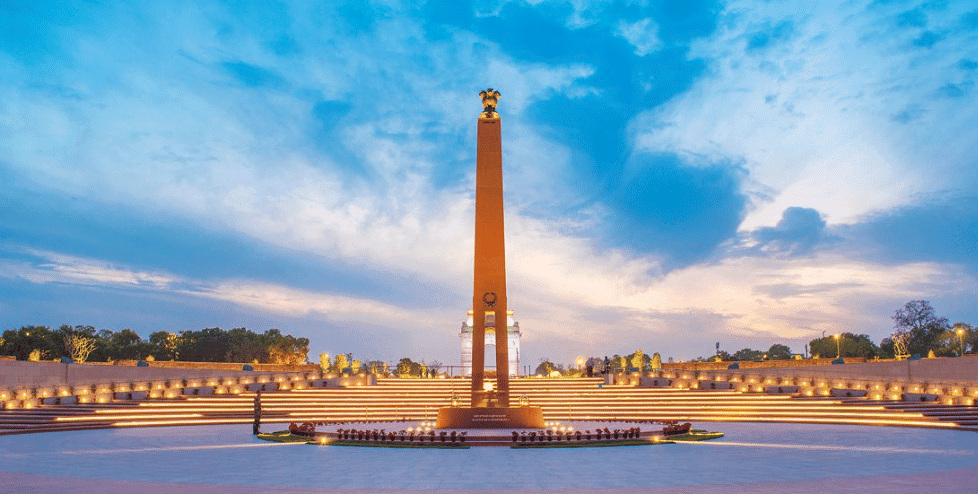
Q1: What is the National War Memorial, and what does it honour?
Ans: The National War Memorial, located near India Gate in New Delhi, is a monument built between April 2018 and February 2019 to honour soldiers who died in conflicts like the Indo-China War (1962), Indo-Pak Wars (1965 and 1971), and the Kargil War (1999). It holds 29,000 tablets with over 26,000 names of fallen heroes, commemorating their sacrifices for India’s freedom.National War MemorialQ2: What is the Amar Chakra at the National War Memorial?

Ans: The Amar Chakra, or Circle of Immortality, at the National War Memorial is home to the eternal flame, symbolising that the spirits of fallen soldiers live on. It represents the everlasting legacy of their bravery and sacrifice, creating a solemn and respectful atmosphere at the memorial.

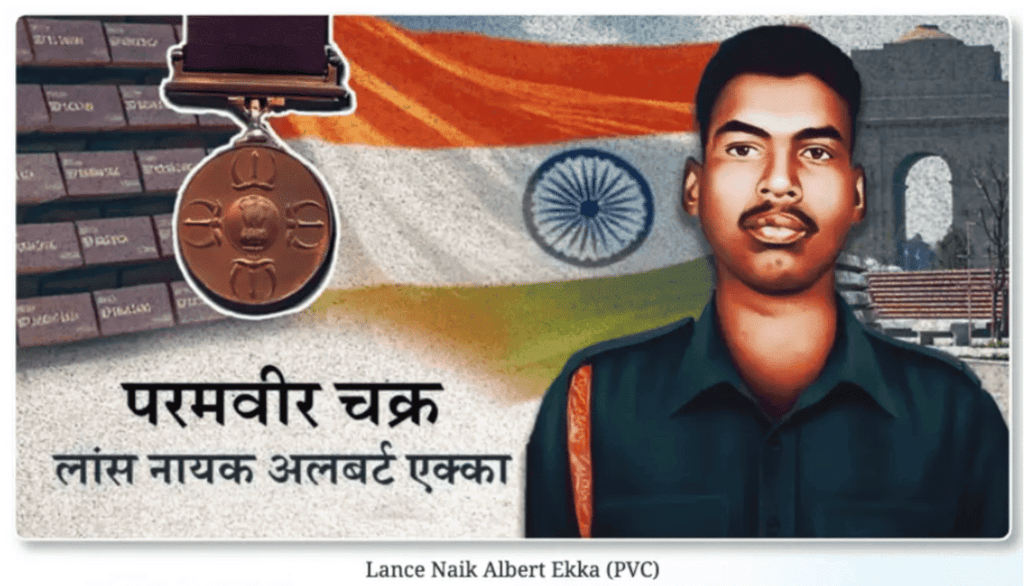
Q3: Who is Lance Naik Albert Ekka, and why does Soumya admire him?
Ans: Lance Naik Albert Ekka was a soldier who fought bravely in the 1971 Indo-Pak War, continuing to battle despite serious injuries until he died. Soumya admires him for his courage and selflessness, inspired by his story to serve the nation, as his gallantry earned him the Param Vir Chakra.

Q4: What does Ananda recall about his visit to a war memorial in Chandigarh?
Ans: Ananda recalls visiting a war memorial in Chandigarh’s Bougainvillaea Garden, where people laid flowers to honour fallen soldiers. This visit reminds him of the Hindi poem Pushp ki Abhilasha by Makhanlal Chaturvedi, where a flower wishes to honour brave soldiers, deepening his respect for their sacrifices.

Q5: Who is Captain Anuj Nayyar, and how does Ananda learn about him?
Ans: Captain Anuj Nayyar was a brave soldier in the Kargil War who was awarded the Maha Vir Chakra after his death. Ananda learns about him from an interview with Nayyar’s mother, who wrote an emotional book about her son, expressing both her pain and pride in remembering him.

Long Answer Questions

Q1: How does Soumya’s visit to the National War Memorial deepen her understanding of soldiers’ sacrifices?
Ans: Soumya’s visit to the National War Memorial in New Delhi helps her understand and appreciate the sacrifices of Indian soldiers. On her school trip, she learns that the memorial was built between 2018 and 2019 to honour over 26,000 soldiers who lost their lives in wars like the Indo-China War, Indo-Pak Wars, and the Kargil War. Their names are written on 29,000 tablets. The memorial has different sections, like the Amar Chakra with an eternal flame showing that the spirit of the soldiers lives on, and the Tyag Chakra with names on walls shaped like a Chakravyuh. These features make Soumya feel both proud and emotional. She is especially inspired by brave soldiers like Lance Naik Albert Ekka and Major Padmapani Acharya, who continued fighting even after getting seriously injured. The memorial’s beauty, with wreaths, lights, and bronze murals, leaves a deep impact on her. In her letter to Ananda, she expresses her wish to serve the nation and respect the bravery of the soldiers. The story teaches us to honour and remember those who gave their lives for our country’s freedom.

Q2: What are the symbolic features of the National War Memorial, and how do they contribute to its message?
Ans: The National War Memorial’s special features strongly express respect for the bravery and sacrifice of Indian soldiers. The Amar Chakra (Circle of Immortality) has an eternal flame that shows the spirits of the soldiers live on. The Veerta Chakra (Circle of Bravery) displays six bronze murals of heroic battles like the Kargil War, honouring the courage of the soldiers. The Tyag Chakra (Circle of Sacrifice) has walls shaped like a Chakravyuh, with the names of over 26,000 soldiers who gave their lives for the country. The Raksha Chakra (Circle of Protection) is lined with trees, showing soldiers as the protectors of the nation. These symbols, along with the wreaths and changing lights from morning to night, create a respectful and emotional atmosphere. In her letter to Ananda, Soumya describes these parts of the memorial, showing how they fill her with pride and respect. The memorial teaches us to be thankful for the freedom we have and to remember the brave heroes who made it possible.

Q3: How does the story of Lance Naik Albert Ekka inspire Soumya, and why is it significant to the lesson?
Ans: The story of Lance Naik Albert Ekka inspires Soumya by showing his great bravery and selflessness, and it strengthens the lesson’s message of honouring the sacrifices of soldiers. During her visit to the National War Memorial, Soumya learns that Ekka fought in the 1971 Indo-Pak War and, even after being badly injured, continued to fight for the country until he lost his life. He was awarded the Param Vir Chakra for his courage. His story touches Soumya deeply and makes her want to serve the nation like him. This moment is important to the lesson because it shows how learning about such heroes can encourage young people like Soumya to feel proud of their country and want to do something meaningful. Ekka’s example, along with other brave soldiers like Major Padmapani Acharya, helps Soumya connect emotionally to the idea of sacrifice for the country. By sharing Ekka’s story in her letter, she not only honours his bravery but also inspires Ananda and other readers to respect and remember those who protect India’s freedom.

Q4: How does Ananda’s response to Soumya’s letter reflect his feelings about soldiers and his own aspirations?
Ans: Ananda’s reply to Soumya’s letter shows his deep respect for soldiers and his strong wish to join the Armed Forces, which supports the lesson’s message of patriotism and courage. He is touched by Soumya’s vivid description of the National War Memorial and sees it as a powerful way to thank those who gave their lives for the country. Ananda connects this with his own visit to the war memorial in Chandigarh, where offering flowers reminded him of the poem Pushp ki Abhilasha, making him feel even more grateful to the brave soldiers. He is inspired by the stories of heroes Soumya mentioned, like Lance Naik Albert Ekka and Major Padmapani Acharya, and especially by Captain Anuj Nayyar, whose mother’s book shares her pride and sorrow. These stories stir Ananda’s emotions and encourage his dream of serving the country. He also feels excited about using the National War Memorial app and wants to make a collage at school to honour these heroes. His letter, full of appreciation for Soumya’s words and his interest in stamp collecting, supports the lesson’s moral of respecting brave soldiers and letting their sacrifice inspire our own goals.

Q5: What lessons about gratitude and courage can we learn from the letter exchange between Soumya and Ananda?
Ans: The letters between Soumya and Ananda teach us important lessons about being thankful and brave. They show how we can honour the sacrifices of soldiers and let their courage inspire us. Soumya’s letter describes her visit to the National War Memorial in New Delhi, where she learns about over 26,000 soldiers who gave their lives in wars like 1962, 1965, 1971, and 1999. The eternal flame, murals, and names on the tablets help her understand how much soldiers have done for our country. She feels inspired by heroes like Lance Naik Albert Ekka and Major Padmapani Acharya, who fought bravely even when they were hurt. Ananda’s reply shows how touched he is by Soumya’s words. He remembers his own visit to a war memorial in Chandigarh and connects his feelings with the poem Pushp ki Abhilasha, which speaks about serving the nation. Both Soumya and Ananda want to give back to the country, just like the soldiers they admire. The story teaches us to be thankful by remembering the bravery of our soldiers, visiting memorials, and living with purpose and respect. Their letters inspire us to follow our dreams, be brave, and always remember the heroes who helped keep our nation free.

12. Conquering the summit Chapter short and Long Answer Questions

Short Answer Questions

Q1: What was Arunima Sinha’s dream before her accident?
Ans: Before her accident, Arunima Sinha dreamed of joining the paramilitary forces, which would allow her to pursue her passion for sports, especially volleyball, while building a career. As a 24-year-old who excelled in sports and held a law degree, she was driven by her love for athletic challenges.

Q2: What happened to Arunima on April 11, 2011?
Ans: On April 11, 2011, Arunima Sinha met with a terrible train accident that resulted in the loss of one of her legs. Doctors fitted her with an artificial limb, marking a life-changing incident that tested her resilience but inspired her to pursue a new dream of climbing Mount Everest.

Q3: Who guided Arunima during her mountaineering training?
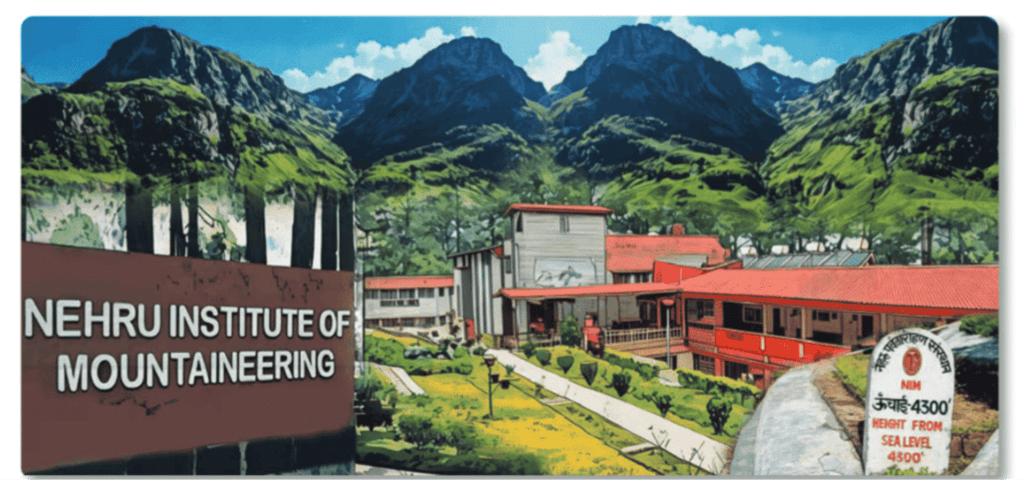
Ans: Arunima was guided by Bachendri Pal, the first Indian woman to climb Mount Everest, during her training at the Nehru Institute of Mountaineering in Uttarkashi. Bachendri believed in Arunima’s determination, encouraging her to chase her ambitious dream despite her physical challenges.

Q4: What did Arunima do when she reached the summit of Mount Everest?
Ans: When Arunima reached the summit of Mount Everest on May 21, 2013, she planted the Indian flag and placed a photograph of Swami Vivekananda, her inspiration, at the top. These acts symbolised her pride and gratitude, marking her historic achievement as the first Indian woman with an artificial leg to conquer the peak.

Q5: What was Arunima’s achievement by January 2019?
Ans: By January 2019, Arunima became the first woman amputee to climb Mount Vinson in Antarctica, completing her mission to conquer the Seven Summits—the highest peaks on all seven continents. This remarkable feat solidified her legacy as a trailblazer in mountaineering.Long Answer Questions

Q1: How did Arunima Sinha’s early life and dreams shape her response to the accident that changed her life?
Ans: Arunima Sinha’s love for sports and her strong personality helped her deal with the life-changing train accident on April 11, 2011, which caused her to lose a leg. Growing up in Ambedkar Nagar, Uttar Pradesh, with an army engineer father and a health supervisor mother, Arunima was passionate about volleyball and studied law, hoping to join the paramilitary forces. This foundation of hard work and ambition made her determined to set goals and achieve them. After the accident, instead of feeling hopeless, Arunima found inspiration in Mount Everest while recovering in the hospital. She decided to climb it, despite others doubting her. Her love for overcoming challenges through sports gave her the drive to train hard at the Nehru Institute of Mountaineering. The connection between her early dreams and her determination after the accident shows the story’s lesson: with determination and self-belief, we can turn challenges into opportunities, inspiring others to face their own difficulties with strength.

Q2: What challenges did Arunima face in her journey to climb Mount Everest, and how did she overcome them?
Ans: Arunima Sinha faced huge physical, emotional, and societal challenges while trying to climb Mount Everest, but she overcame them with strong determination, hard work, and support. After losing her leg in a train accident in 2011, she had to adjust to using a prosthetic leg, making the climb much harder. Many people doubted her ability to succeed, which could have affected her confidence. As a woman with a disability, she also faced challenges in a field full of able-bodied climbers. To tackle these, Arunima trained for 18 months at the Nehru Institute of Mountaineering under the guidance of Bachendri Pal, the first Indian woman to climb Everest. Bachendri’s belief in her dream helped strengthen Arunima’s resolve. After months of tough training, Arunima successfully climbed Everest on May 21, 2013, becoming the first Indian woman with an artificial leg to reach the top. By planting the Indian flag and a photo of Swami Vivekananda at the summit, she celebrated her victory. Arunima’s story shows that with courage and hard work, we can overcome even the biggest challenges, inspiring readers to face their own struggles with determination and belief.

Q3: Why is Arunima’s achievement of conquering the Seven Summits significant, and how does it reflect her character?
Ans: Arunima Sinha’s achievement of climbing the Seven Summits—the highest peaks on each continent—shows her incredible determination. She became the first woman amputee to do this, starting with her summit of Mount Everest in 2013, despite the challenges of using a prosthetic leg. She then climbed mountains in Europe, Africa, Australia, South America, North America, and Antarctica, each with its own difficulties. This journey required not just physical strength, but also mental toughness to overcome doubts and obstacles. Arunima’s belief in herself and her courage helped her succeed, proving that she would not let her disability or society’s expectations limit her. Her accomplishment, especially climbing Mount Vinson, inspires people with disabilities and anyone facing tough challenges. Arunima’s story teaches that with determination, we can turn challenges into strengths and achieve our dreams.

Q4: How does Arunima’s story demonstrate the power of mental strength in overcoming physical limitations?
Ans: Arunima Sinha’s story shows how mental strength can help overcome physical challenges. After losing her leg in a train accident in 2011, she faced many difficulties with her prosthetic leg. Even everyday tasks were hard, but her determination, inspired by Swami Vivekananda, helped her keep going. She set her sights on climbing Mount Everest, even though many people thought it was impossible for her. During her 18 months of training, she pushed through pain and exhaustion. On May 21, 2013, she became the first Indian woman with an artificial leg to reach the summit of Everest. Later, she also climbed the Seven Summits, proving that belief in herself and hard work can help overcome even the toughest obstacles. Arunima’s journey teaches that mental strength can help you face any challenge and achieve great things.

Q5: What lessons about perseverance and self-belief can we learn from Arunima Sinha’s journey?
Ans: Arunima Sinha’s journey teaches important lessons about perseverance and self-belief. After losing her leg in a 2011 train accident, Arunima faced many physical and societal challenges that could have stopped her dreams. Instead, she was inspired by reading about Mount Everest and motivated by Swami Vivekananda’s teachings to set a goal of climbing the world’s highest peak. Despite scepticism from others, she trained for 18 months, enduring physical and mental challenges. On May 21, 2013, she became the first Indian woman amputee to summit Everest. Arunima didn’t stop there; she went on to conquer the Seven Summits, including Mount Vinson, by 2019, proving that determination and self-belief can overcome the toughest obstacles. Her story shows that with persistence and confidence, even the most difficult challenges can turn into great achievements. It inspires us to never give up on our dreams, no matter how impossible they may seem.

11. Travel Chapter shorts and Long Answer Questions

Short Answer Questions

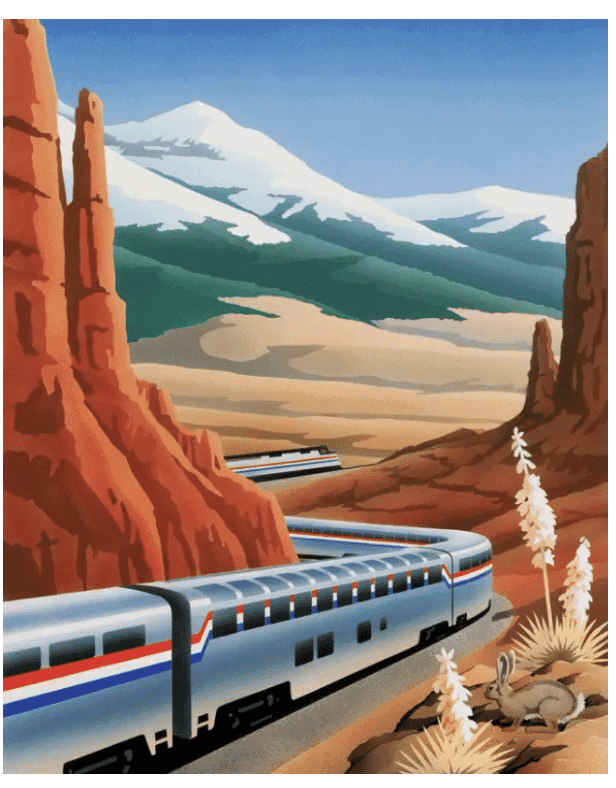
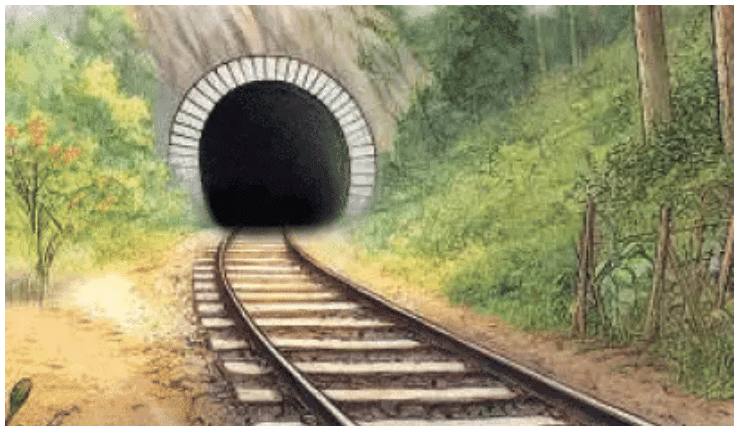
Q1: What does the speaker hear during the day despite the noisy voices?
Ans: Despite the noisy voices during the day, the speaker imagines hearing the shrieking whistle of a train. Even though the railroad track is miles away and no train passes nearby, the sharp, exciting sound captures their attention, reflecting their fascination with trains and travel.

Q2: What does the speaker see in their imagination at night?
Ans: At night, the speaker imagines seeing the red cinders of a train glowing against the sky. Despite the quiet meant for sleep and dreaming, these sparks from the train’s engine light up their mind, showing their restless thoughts of trains and the adventures they represent.

Q3: What sound does the speaker associate with the train at night?
Ans: The speaker associates the sound of the train’s engine steaming with the train at night. They imagine hearing the puffing steam, a lively sound that keeps the idea of the train’s movement and energy alive in their mind, even in the stillness of the night.

Q4: How does the speaker feel about their friends?
Ans: The speaker feels warmly affectionate toward their friends, describing their heart as “warm” with love and saying they couldn’t find better friends. This shows deep appreciation and happiness for the close connections they’ve made, despite their longing for travel.

Q5: Why would the speaker take any train?
Ans: The speaker would take any train, no matter where it’s going, because of their strong love for adventure and exploration. Their restless spirit and excitement for new experiences outweigh their ties to friends, showing a desire to embrace the unknown through travel.

Long Answer Questions

Q1: How does the speaker’s imagination bring trains to life in the poem, and what does this reveal about their love for travel?
Ans: The speaker’s imagination makes trains feel real, even when there are no trains nearby. This shows how much they love travel and how often they think about it. In the middle of a noisy day, even though the railway is far away, the speaker imagines hearing a train’s loud whistle, showing how their mind is full of thoughts about trains. At night, when everything is quiet and people are sleeping, they imagine glowing red sparks and the sound of the train’s steam, painting a lively picture of a moving train. These imagined sights and sounds—like whistles, sparks, and steam—make the train feel like it’s always with the speaker. This shows that they are full of energy and always dreaming of new places. The poem reminds us that having a strong curiosity and love for adventure can make life more exciting. The speaker’s thoughts show a wish to go beyond the familiar and explore the unknown, encouraging readers to be curious too.

Q2: Why does the speaker mention the noisy day and quiet night, and how do these settings enhance the poem’s theme of adventure?
Ans: The speaker talks about the noisy day and quiet night to show how their love for trains and travel is always with them, no matter the time. During the busy, loud day filled with people talking, they still imagine the train’s sharp whistle, showing how strong their fascination is. At night, when everything is calm and people are supposed to be asleep, they picture glowing sparks and hear the train’s steam, proving that their excitement for travel doesn’t go away—even in silence. This contrast between day and night shows that their dream of adventure is constant and powerful. The poem uses this idea to share its message: a deep love for exploring can live alongside everyday life and friendships. By showing the speaker’s train dreams in both noisy and quiet times, the poem encourages readers to stay connected to their passions, even during normal daily moments.

Q3: How does the speaker balance their love for friends with their desire to travel in the poem?
Ans: The speaker shows how they balance their love for friends with their desire to travel by expressing deep affection for their companions while also admitting to an overwhelming urge to explore. In the final stanza, the speaker describes their heart as “warm” with love for their friends, stressing how important these relationships are. However, they quickly reveal that they would take any train, no matter where it’s going, showing their strong pull toward adventure that sometimes competes with their connections to others. This contrast highlights the idea that while the speaker values their friendships, the call to explore and experience the unknown is even stronger. The poem’s message—suggesting that adventure and strong connections can coexist—encourages readers to embrace both love and exploration in their lives. The speaker’s honesty encourages people to find a balance between personal bonds and the pursuit of new experiences.

Q4: What role does the imagery of trains play in conveying the speaker’s adventurous spirit?
Ans: The imagery of trains plays a key role in showing the speaker’s adventurous spirit by bringing to life the energy, movement, and appeal of travel, making their desire for exploration feel real. The “shrieking” whistle during the day cuts through the noise, representing the call of adventure that captures the speaker’s attention. At night, the glowing “red cinders” and the “steaming” engine paint a lively, almost magical image of a train in motion, full of life and possibilities, sparking the speaker’s imagination even in quiet moments. These details—whistles, sparks, and steam—are more than just sensory images; they represent freedom and the unknown, reflecting the speaker’s restless desire to travel anywhere, “no matter where it’s going.” This vibrant train imagery, set against the ordinary day and peaceful night, highlights the speaker’s longing to explore, tying in with the poem’s message of embracing curiosity and new experiences. The trains’ lively presence in the speaker’s thoughts encourages readers to feel the same excitement for adventure and to celebrate the journey itself.

Q5: What lessons about following one’s passions can we learn from the speaker’s longing for travel in the poem?
Ans: The speaker’s longing for travel in the poem teaches valuable lessons about following one’s passions, showing that pursuing what excites you can lead to a more fulfilling life, even if it means stepping out of your comfort zone. The speaker’s obsession with trains—imagining their shrieking whistles during the day and red cinders at night—reveals how their love for travel dominates their thoughts, overshadowing daily distractions and quiet moments. Their willingness to board “any train, no matter where it’s going,” despite their strong affection for friends, emphasizes the power of this passion, suggesting that true happiness comes from embracing what excites you. The poem encourages openness to new experiences, as the speaker’s restless desire to explore proves that following a passion like travel can bring joy and growth, even if it leads to the unknown. By balancing their love for friends with a desire to explore, the speaker shows that passions can coexist with other important aspects of life, motivating readers to follow their dreams with courage and enthusiasm, knowing that these pursuits will add excitement and possibility to their lives.

10. The Tunnel Chapter short and Long Answer Questions

Short Answer Questions

Q1: Why does Suraj visit the railway tunnel?
Ans: Suraj visits the railway tunnel because he loves watching the midday steam train burst out, finding it magical. He cycles from town, hides his bike, and walks to the tunnel’s exit, not to catch the train but to enjoy the thrilling sight and sound of it roaring through the jungle, reflecting his adventurous spirit.

Q2: Who is Sunder Singh, and what is his job?
Ans: Sunder Singh is the watchman who looks after the railway tunnel. His job is to inspect the tunnel for obstacles and signal trains if anything is wrong, using a red flag by day or an oil lamp at night. He ensures the tracks are safe, maintaining the tunnel’s operation for passing trains.

Q3: What does Suraj see after walking through the tunnel?
Ans: After walking through the tunnel, Suraj sees a flash of orange and gold on the hillside—a swishing tail disappearing among the trees. This turns out to be a leopard, a familiar visitor to the area, as later explained by Sunder Singh, adding a touch of wild excitement to Suraj’s adventure.

Q4: How do Suraj and Sunder Singh scare the leopard away?
Ans: Suraj and Sunder Singh scare the leopard away by entering the tunnel, shouting, and using the light of Sunder Singh’s oil lamp. When they hear the leopard’s sawing sound, indicating its presence, their loud noises and the lamp’s glow startle the animal, causing it to flee into the jungle before the night train arrives.

Q5: What does Suraj see from the train when passing through the tunnel later?
Ans: When passing through the tunnel later on the night train with his father, Suraj sees the familiar glow of Sunder Singh’s oil lamp in the darkness. This sight reminds him of the watchman standing watch, lighting up the night for trains and leopards, and evokes fond thoughts of their shared adventure.

Long Answer Questions

Q1: How does Suraj’s fascination with the steam train set the stage for his adventure in the jungle?
Ans: Suraj’s fascination with the steam train sparks his adventure and leads him to the jungle tunnel, where his curiosity and love for exploration bring him exciting experiences and a new friendship. As a young boy who finds the train’s appearance magical, Suraj cycles from town, hides his bike, and treks to the tunnel to watch the train emerge like a “green, black, and gold dragon.” His passion for the train, with its snorting, puffing, and spark-spitting, shows his adventurous spirit and draws him into the wild jungle. Suraj’s decision to explore the damp, smoky interior of the tunnel after the train passes highlights his curiosity, leading to the discovery of a leopard’s tail and his meeting with Sunder Singh, the watchman. This fascination not only sets the events of the story in motion but also connects Suraj to the jungle’s mysteries, culminating in the thrilling night adventure with the leopard. His love for the train embodies the story’s moral that courage and curiosity can lead to rewarding experiences, opening doors to unexpected discoveries and meaningful bonds.

Q2: What role does Sunder Singh play in Suraj’s adventure, and how does their relationship develop?
Ans: Sunder Singh, the tunnel’s watchman, plays a key role in Suraj’s adventure by welcoming him, sharing knowledge, and guiding him through a dangerous situation, helping to build a special friendship founded on trust and bravery. When Suraj meets Sunder Singh at his hut, the watchman’s friendly, joking manner—claiming the tunnel as “his”—puts Suraj at ease and creates an immediate connection. Sunder Singh shares his responsibilities, like inspecting the tunnel and signaling trains, and helps Suraj understand the jungle better by identifying the leopard the boy saw. His kindness shows when he invites Suraj to return for the night train, and during the evening visit, their friendship deepens as they share tea and listen to the jungle sounds. When the leopard enters the tunnel, Sunder Singh’s leadership shines as he reassures Suraj and uses his oil lamp and loud shouts to scare the animal away, ensuring the safety of the train. This shared act of courage strengthens their bond, and Suraj later recalls Sunder Singh’s lamp with affection while riding the train. Their relationship, built on mutual respect and adventure, reflects the story’s moral of kindness and trust, showing how bold experiences can lead to meaningful connections.

Q3: How does the encounter with the leopard in the tunnel create excitement in the story?
Ans: The encounter with the leopard in the tunnel adds excitement to the story by introducing a sudden, dangerous challenge that tests the bravery of both Suraj and Sunder Singh, increasing the tension and thrill. As Suraj and Sunder Singh wait during the night visit, the lively sounds of the jungle—birds flying and porcupines moving—set an active, yet calm mood. The atmosphere changes when they hear a sawing noise from the tunnel, signaling the presence of the leopard just before the night train is due. This unexpected danger, described as a lithe, sinewy creature with a snarling tail, creates urgency, as the leopard is at risk of being hit by the approaching train. Sunder Singh’s quick decision to enter the tunnel with an axe and oil lamp, with Suraj by his side, builds suspense as they shout and use the lamp to scare the leopard, which then flees into the jungle. The roar of the train passing right after, leaving the jungle silent once more, caps this heart-pounding moment. This thrilling sequence, combining the wildness of the jungle with human courage, keeps readers on edge and reinforces the story’s moral that curiosity and bravery lead to thrilling adventures. The leopard encounter becomes a key, pulse-racing moment in the narrative.

Q4: Why is Suraj’s sighting of Sunder Singh’s oil lamp from the train significant to the story’s conclusion?
Ans: Suraj’s sighting of Sunder Singh’s oil lamp from the train marks an important moment in the story’s conclusion, symbolizing the lasting friendship and shared adventure between the boy and the watchman. A week after their thrilling leopard encounter, Suraj is traveling on the night train with his father and recognizes the tunnel. As he peers into the darkness, he spots the flickering glow of Sunder Singh’s lamp, a familiar sign that the watchman is still standing guard. This image brings back fond memories for Suraj—of the warmth and kindness Sunder Singh showed, their tea together in the jungle, and their brave act of saving the leopard. The lamp, described as illuminating the darkness for both trains and leopards, represents Sunder Singh’s quiet heroism, which made a lasting impact on Suraj. As the train moves away, leaving the jungle behind, this moment reinforces the story’s message of courage and kindness forging meaningful connections. It provides a heartfelt conclusion, showing how Suraj’s adventure not only filled him with excitement but also gave him a precious friendship. This moment encourages readers to appreciate the unexpected bonds formed through exploration and adventure.

Q5: What lessons about courage and friendship can we learn from Suraj’s adventure with Sunder Singh?
Ans: Suraj’s adventure with Sunder Singh offers valuable lessons about courage and friendship, showing how stepping into the unknown and trusting others can lead to rewarding experiences and lasting relationships. Suraj demonstrates courage when he treks alone to the jungle tunnel, explores its dark and smoky interior, and bravely joins Sunder Singh to confront a leopard, protecting both the animal and the train. His curiosity and willingness to face fear highlight how stepping outside one’s comfort zone can lead to thrilling adventures, as seen during the intense tunnel encounter. The friendship between Suraj and Sunder Singh grows through kindness and trust, built on warm welcomes, shared moments like tea, and reassurance during the dangerous situation with the leopard. Their teamwork to scare the leopard away reflects a deep sense of mutual support, and Suraj’s fond recollection of the watchman’s oil lamp shows how their bond lasts. The story’s moral encourages embracing courage to explore new places and forming friendships, as Suraj’s adventure proves that these qualities lead to exciting, meaningful experiences that enrich life and inspire others to seek adventure and connection.

09. North, south, East, West Chapter short and Long Answer Questions

Short Answer Questions

Q1: What does Shaana notice about the snow in Kashmir?
Ans: Shaana notices that there is less snow at the Thajiwas Glacier in Kashmir compared to the previous year. She describes the beautiful white and blue glaciers but points out the reduced snowfall, indicating her awareness of environmental changes while enjoying the cold and snowball fights with her parents.

Q2: What sounds does Shaana hear in Himachal Pradesh?
Ans: In Himachal Pradesh, Shaana hears the morning songs of colourful birds chirping around her cabin, creating a joyful atmosphere. At night, she hears growling sounds, which her mother jokingly says are her father snoring, adding a playful element to the mountain surroundings and sparking Shaana’s imagination.

Q3: Why does Shaana call Arunachal Pradesh her favourite stop?
Ans: Shaana calls Arunachal Pradesh her favourite stop because she loves the thick forest and the treehouse she stays in, and she is excited about the chance to see red pandas. Her enthusiasm for the region’s natural beauty and wildlife reflects her growing love for nature and adventure.

Q4: What makes the Rann of Kutch different from Kashmir?
Ans: The Rann of Kutch in Gujarat is hot, dry, and sandy, contrasting sharply with the cold, snowy glaciers of Kashmir. While Kashmir requires multiple layers of clothing due to its biting cold, the Rann of Kutch’s desert-like climate highlights India’s diverse weather and landscapes, as experienced by Shaana.

Rann of KutchQ5: How does Shaana feel about tunnels in Goa?
Ans: In Goa, Shaana feels confident riding a train through many tunnels, a contrast to her earlier fear of them. She now enjoys watching the view of plateaus and hills from the train window, reflecting her personal growth and newfound comfort with adventurous experiences during her journey.

Long Answer Questions

Q1: How does Shaana’s visit to the Thajiwas Glacier in Kashmir reflect her curiosity and awareness of environmental changes?
Ans: Shaana’s visit to the Thajiwas Glacier in Kashmir highlights her curiosity as she describes the white and blue glaciers and enjoys the snowy fun, like watching her parents throw snowballs. Despite her hands shaking from the cold because she forgot her gloves, she is still eager to explore. She also observes that there is less snow than last year, showing her awareness of possible environmental changes, like climate change. This blend of curiosity and observation connects to the story’s message about appreciating India’s diverse landscapes and being open to new experiences. Shaana’s postcard from Kashmir captures her sense of wonder and growing understanding, making her journey both exciting and thoughtful, inspiring readers to be mindful of their surroundings.

Q2: What role does Shaana’s imagination play during her stay in Himachal Pradesh, and how does it enhance her experience?
Ans: Shaana’s time in Himachal Pradesh shows how her imagination makes her trip more fun and exciting. Staying in a cabin surrounded by mountains, she enjoys the morning sounds of colourful birds, which bring her happiness. When she hears strange noises at night, her mother jokingly says it’s her father snoring, which leads Shaana to imagine meeting a bear and giving it a hug. This creative thinking turns ordinary moments, like hearing sounds at night, into exciting adventures. Shaana’s ability to make stories from her surroundings highlights the theme of curiosity and openness to new experiences. Through her postcards, she encourages her friends to see the world with her imaginative perspective, showing how embracing creativity can help us appreciate new places and experiences more fully.

Himachal PradeshQ3: How does Shaana’s experience in the Sundarbans show her mixed feelings of excitement and nervousness?
Ans:  Shaana’s time in the Sundarbans highlights her mix of excitement and nervousness as she explores the unique environment. She is fascinated by the mangrove trees growing in seawater, and her enthusiasm grows as she boats through the wetlands. Seeing crocodiles and a snake adds to her excitement but also makes her nervous, as these creatures can be intimidating. Her mother’s mention of frequent flooding brings up concerns about the area’s environmental challenges, adding to Shaana’s awareness of the region’s vulnerability. This blend of awe and caution reflects Shaana’s ability to embrace adventure while understanding the complexities of the world around her. Her postcards capture these mixed feelings, reinforcing the moral of the story: it’s important to stay open to new experiences, balance curiosity with caution, and appreciate the beauty and fragility of diverse landscapes like the Sundarbans.

Q4: How does Shaana’s journey in Goa reflect her personal growth, and why is it significant to the story?
Ans: Shaana’s journey in Goa reflects her personal growth through her newfound confidence in facing tunnels, which she once feared, and her excitement about exploring new landscapes, marking a significant moment in the story. Riding a train through many tunnels and plateaus, Shaana no longer feels scared but watches the views of hills and flatlands with enthusiasm, dreaming of touring them with her friends. This shift from fear to confidence highlights her growing comfort with adventurous experiences, developed through her travels across India’s diverse regions. Her ability to enjoy the journey and imagine future adventures shows a maturing perspective, blending her playful spirit with a bolder outlook. This moment in Goa is significant because it underscores the story’s theme of personal development through exploration, illustrating how exposure to new places can build resilience and excitement. Shaana’s postcards from Goa, filled with pride and aspiration, reinforce the moral that curiosity and openness to new experiences foster growth, inspiring readers to embrace challenges and find joy in their own journeys of self-discovery.

Q5: What lessons about appreciating India’s diversity can we learn from Shaana’s travel experiences?
Ans: Shaana’s travel experiences teach valuable lessons about appreciating India’s diversity by showcasing the country’s varied landscapes, climates, and wildlife through her curious and open-hearted perspective. From the snowy glaciers of Kashmir to the hot, sandy Rann of Kutch, the dense forests of Arunachal Pradesh, the mangrove wetlands of the Sundarbans, and the coastal beaches of Chennai, Shaana’s journey highlights India’s rich geographic tapestry. Her excitement about seeing red pandas, rafting on the Narmada River, or watching fish in Goa reflects her appreciation for the unique wildlife and activities each region offers. Her observations, like noting less snow in Kashmir or her mother’s concern about Sundarbans flooding, show an awareness of environmental diversity and challenges, deepening her understanding. By sharing these experiences through postcards, Shaana fosters connection with her friends, embodying the story’s moral of valuing and sharing India’s beauty. Her growth from fear of tunnels to confidence in Goa further emphasises how embracing diverse experiences builds appreciation and personal strength. Shaana’s story inspires readers to explore, respect, and celebrate the multifaceted beauty of their country with curiosity and wonder.