Q1: Who is the poet of “King Bruce and the Spider”? a) Kamala Nair b) Eliza Cook c) King Bruce d) Robert Burns
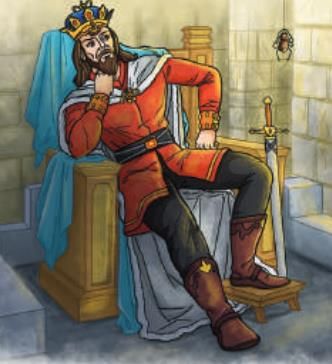
Q2: Why is King Bruce feeling sad in the beginning of the poem? a) He lost his crown b) He failed to achieve a great deed c) His people were angry with him d) He was sick and tired
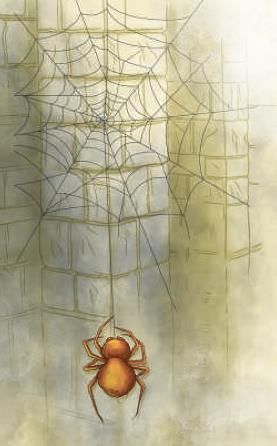
Q3: What does the spider do after falling multiple times? a) It gives up and leaves b) It keeps trying to climb the thread c) It builds a new web d) It waits for help
Q4: How many attempts does the spider make to reach its web, as counted by the poet? a) Six b) Seven c) Eight d) Nine
Q5: What does the word “endeavour” mean in the poem? a) A feeling of sadness b) A strong effort c) A thin thread d) A quick fall
Fill in the Blank
Q1: King Bruce watches a _______ trying to climb to its web.
Q2: The spider’s thread is described as a _______ clue.
Q3: The king feels _______ after failing to make his people glad.
Q4: The spider reaches its _______ after its final effort.
Q5: The word “toils” in the poem means to work very _______.
True or False
Q1: King Bruce decides to give up his efforts before watching the spider.
Q2: The spider reaches its web on its first attempt.
Q3: The poem teaches that perseverance can lead to success.
Q4: King Bruce thinks the spider is wise for trying repeatedly.
Q5: The word “monarch” means a spider’s web.
Very Short Answer Questions
Q1: What is the name of the king in the poem?
Q2: Where is the spider trying to climb?
Q3: What does King Bruce say when the spider succeeds?
Q4: What inspires King Bruce to try again?
Q5: What does the word “despair” mean in the poem?
Long Answer Questions
Q1: How does the spider’s persistence influence King Bruce’s actions in the poem?
Q2: Describe the spider’s efforts to reach its web and the challenges it faces.
Q3: Explain the moral of the poem with reference to King Bruce’s experience.
Q4: How does the poet create suspense in the poem while describing the spider’s attempts?
Q5: Discuss how the poem uses the spider as a symbol to teach a lesson about resilience.
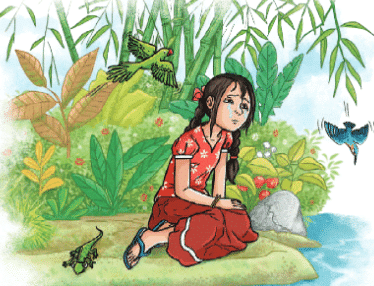
Q1: Who is the author of Jahnavi’s story? a) Gopi b) Kamala Nair c) Chandu d) Appu
Q2: Why is Jahnavi initially not allowed to go to school? a) She is too old b) She is a girl and needed at home c) There is no school in the village d) She does not want to study
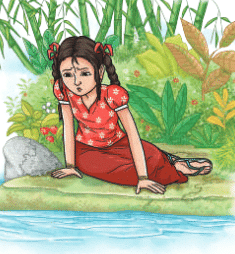
Q3: What does the river tell Jahnavi about girls’ abilities? a) Girls are better than boys b) Girls are just as capable as boys c) Girls should not go to school d) Girls should stay at home
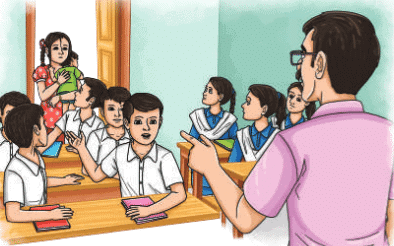
Q4: What story does the teacher tell in the classroom when Jahnavi enters? a) A story about ships b) A story about King Ashoka c) A story about the river d) A story about spiders
Q5: What is the meaning of the word “startled” as used in the story? a) Speaking softly b) Suddenly surprised or shocked c) Breathing heavily d) Moving smoothly
Fill in the Blanks
Q1: Jahnavi’s mother recalls her own childhood dream of _______.
Q2: The river speaks to Jahnavi in a _______ voice.
Q3: Jahnavi wants to become a _______ to help other girls.
Q4: Chandu is a _______ in the village.
Q5: The word “catamaran” refers to a small _______ used by fishermen.
True or False
Q1: Jahnavi has three brothers named Gopi, Ramu, and Appu.
Q2: The river suggests that Jahnavi should run away from home to achieve her dream.
Q3: Jahnavi’s father fully supports her dream of going to school from the beginning.
Q4: The story emphasises the importance of education for girls.
Q5: The word “thicket” means a loud, high-pitched sound.
Very Short Answer Questions
Q1: What is the name of Jahnavi’s youngest brother?
Q2: Where does Jahnavi spend time when she feels hopeless?
Q3: Who visits Jahnavi’s home to discuss her education?
Q4: What does the river mention about ships?
Q5: What does the word “conspiratorially” mean in the story?
Long Answer Questions
Q1: How does Jahnavi’s interaction with the river motivate her to pursue her dream?
Q2: Describe the role of the teacher in helping Jahnavi achieve her dream of going to school.
Q3: Explain how Jahnavi’s mother’s past influences her decision to support Jahnavi’s education.
Q4: What lessons does the story teach about courage and determination?
Q5: How does the story highlight the importance of support from others in achieving one’s dreams?
Let us do these activities before we read (Page 206)
Q1: Solve the riddle given below and share your answer with your classmates and the teacher. She was a queen who led the fight, She fought for her country and her right. With a shining sword in her hand, Her son on her back in a cloth band Remembered as a warrior grand, She died defending her beloved Motherland. Who is she?
Ans: The answer to the riddle is Rani Abbakka. She was a queen who fought bravely against the Portuguese to protect her country, Ullal. She is remembered as a great warrior who died defending her motherland.
Q2: Think of any other women warriors who made a significant contribution to India’s struggle for Independence. Share your answers with your classmates and the teacher.
Ans: Other women warriors who contributed to India’s struggle for Independence include Rani Lakshmibai of Jhansi, who fought against the British in 1857, and Captain Lakshmi Sahgal, who led the Rani of Jhansi Regiment in the Indian National Army.
Let us discuss (Page 213)
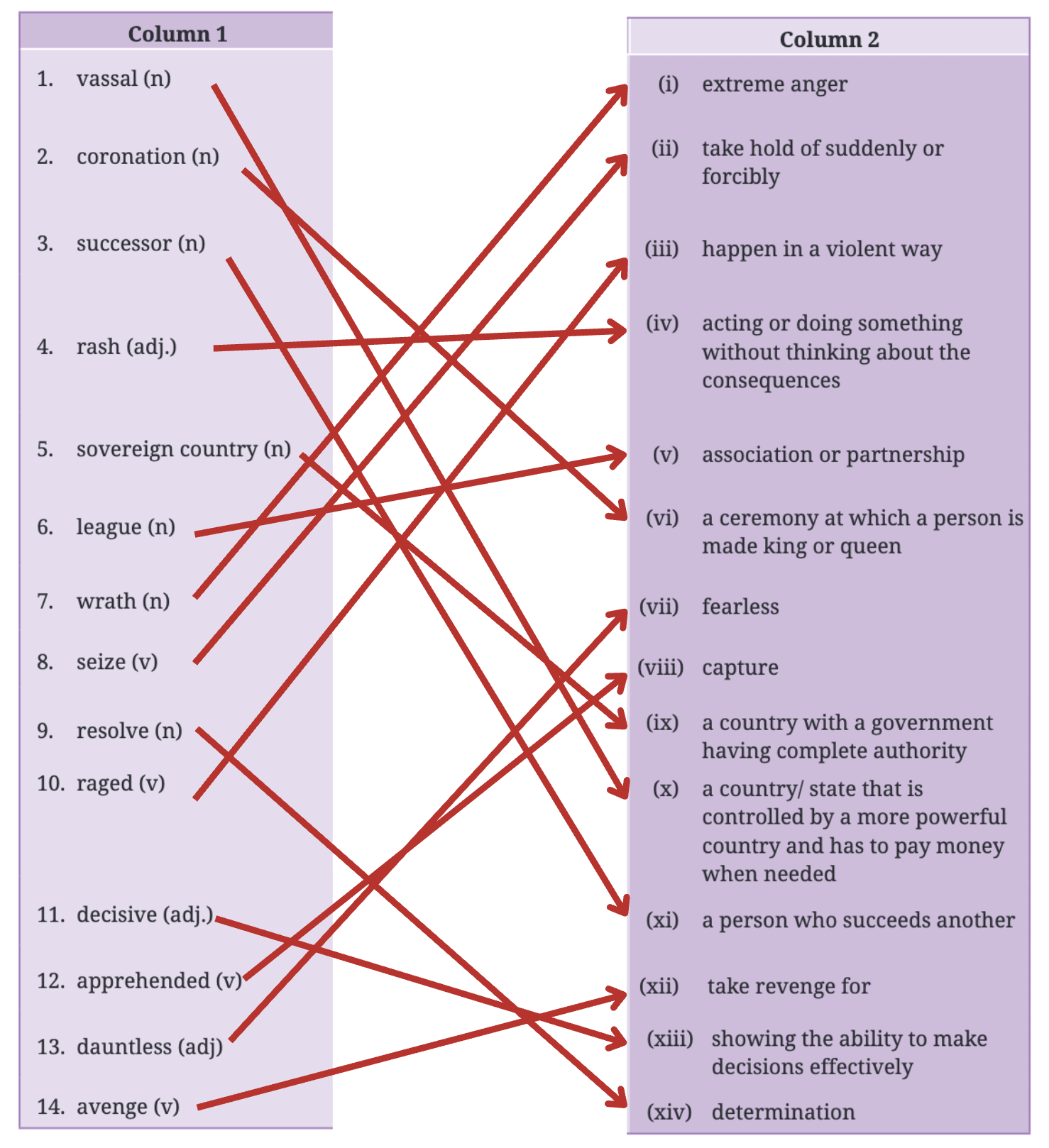
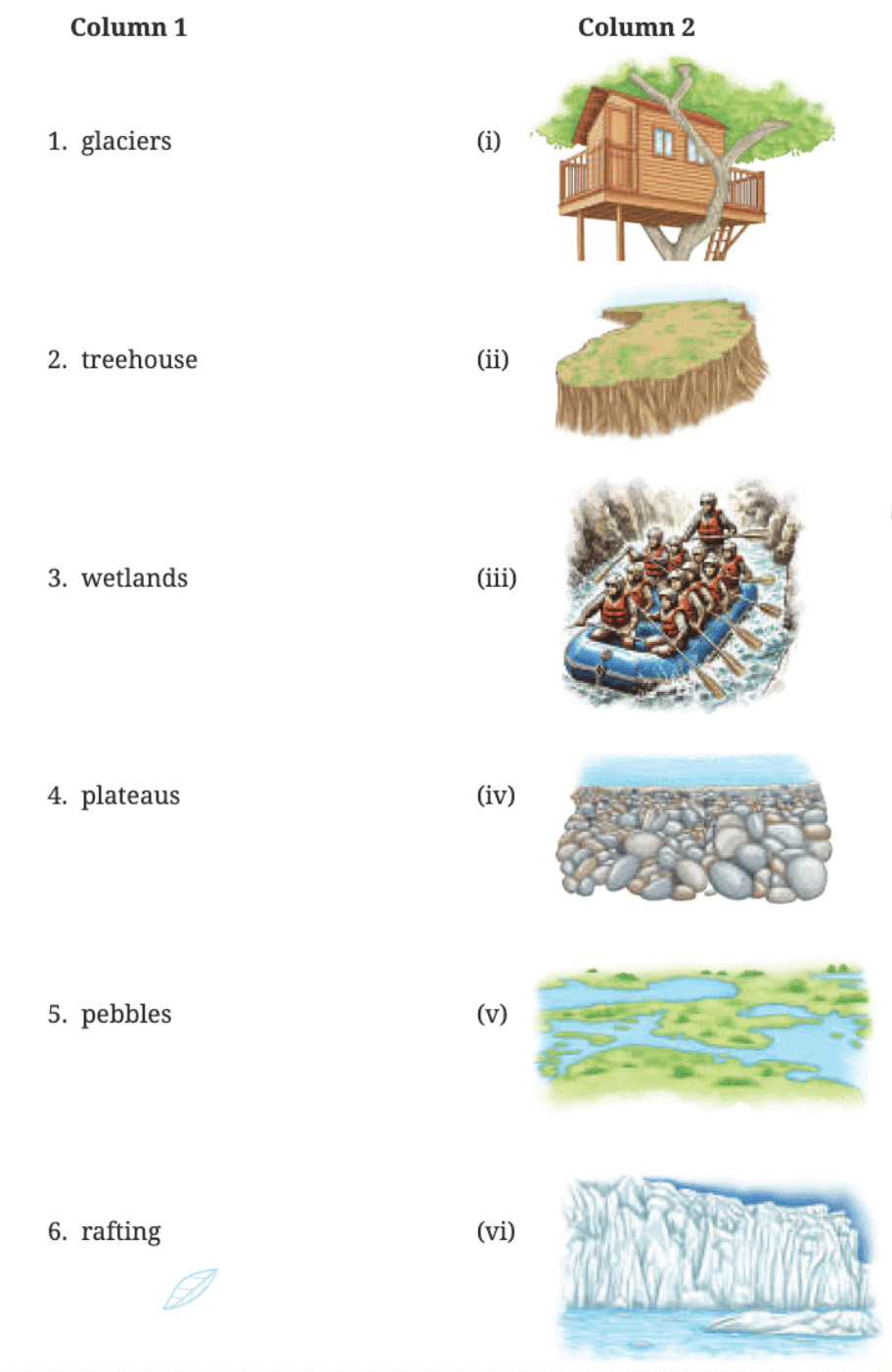
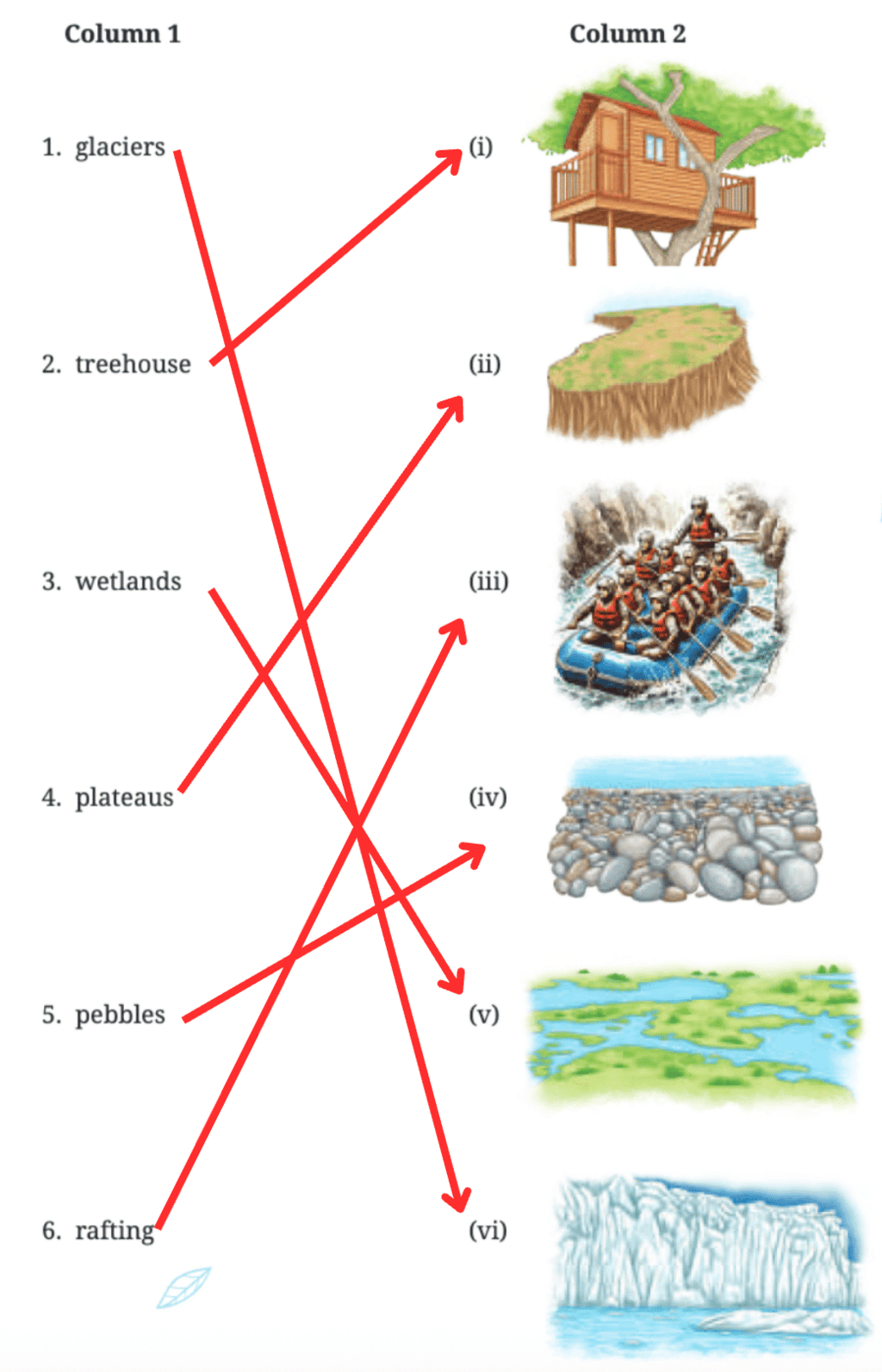
QI: Match the words in Column 1 with their meanings in Column 2. Share your answers with your classmates and the teacher.
Ans:
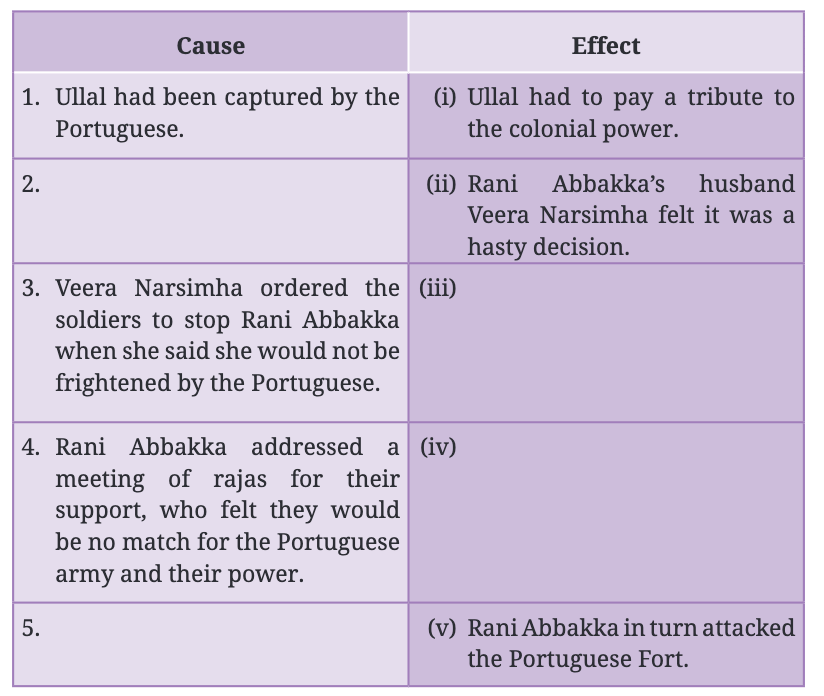
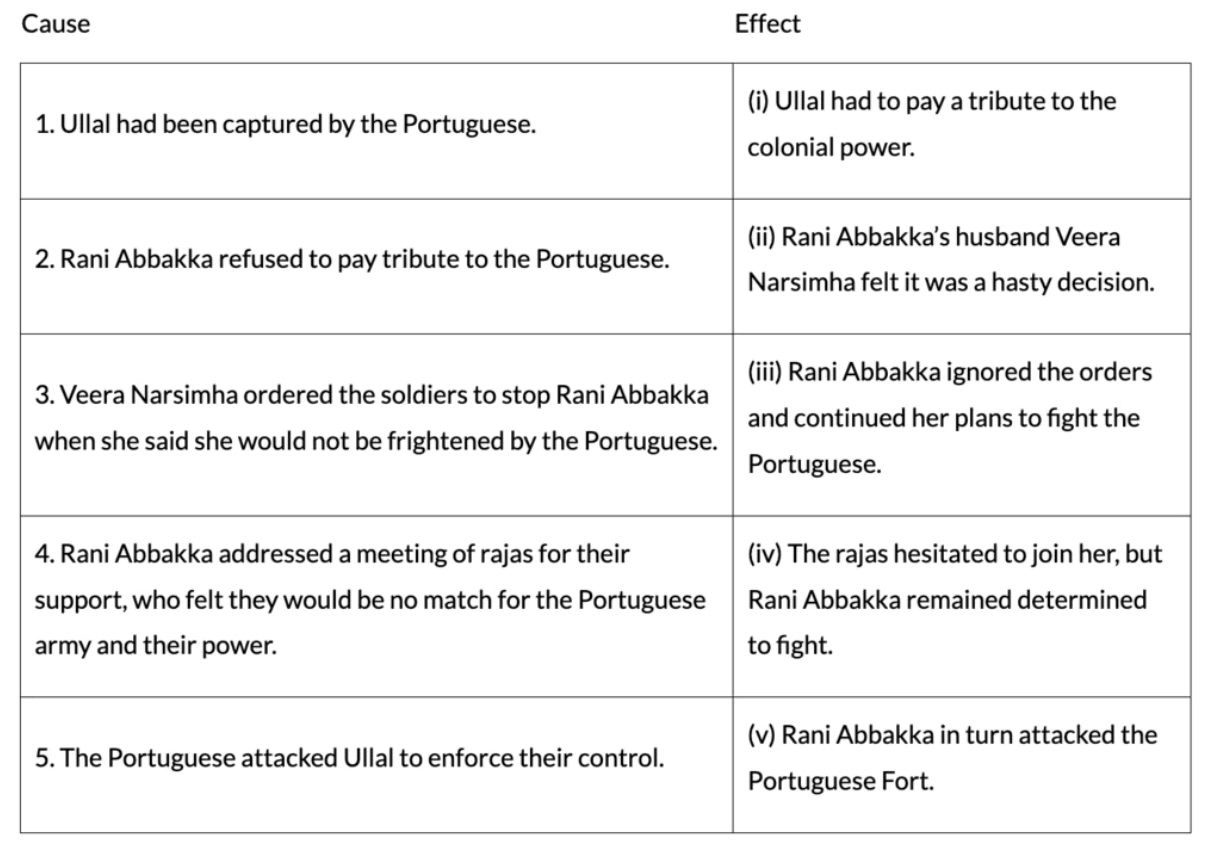
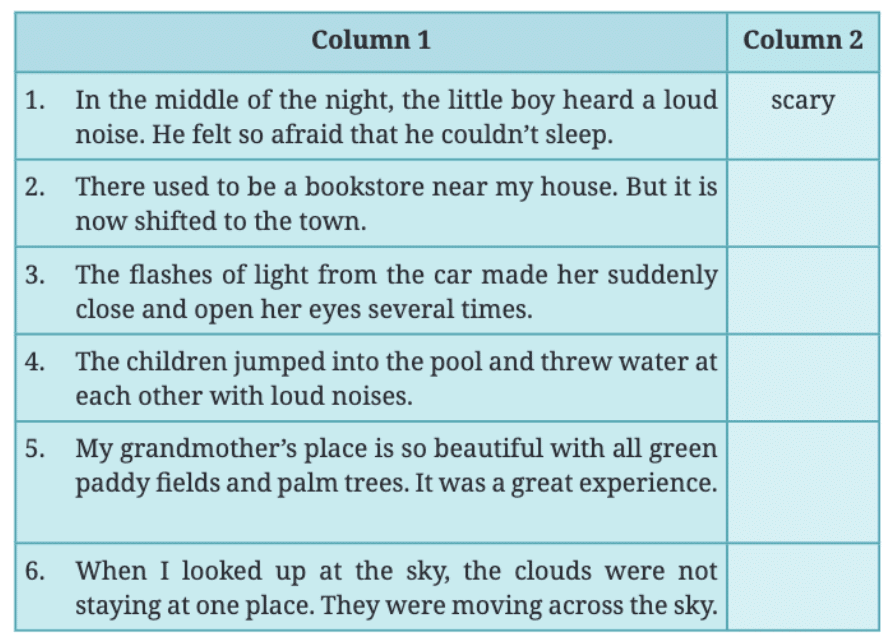
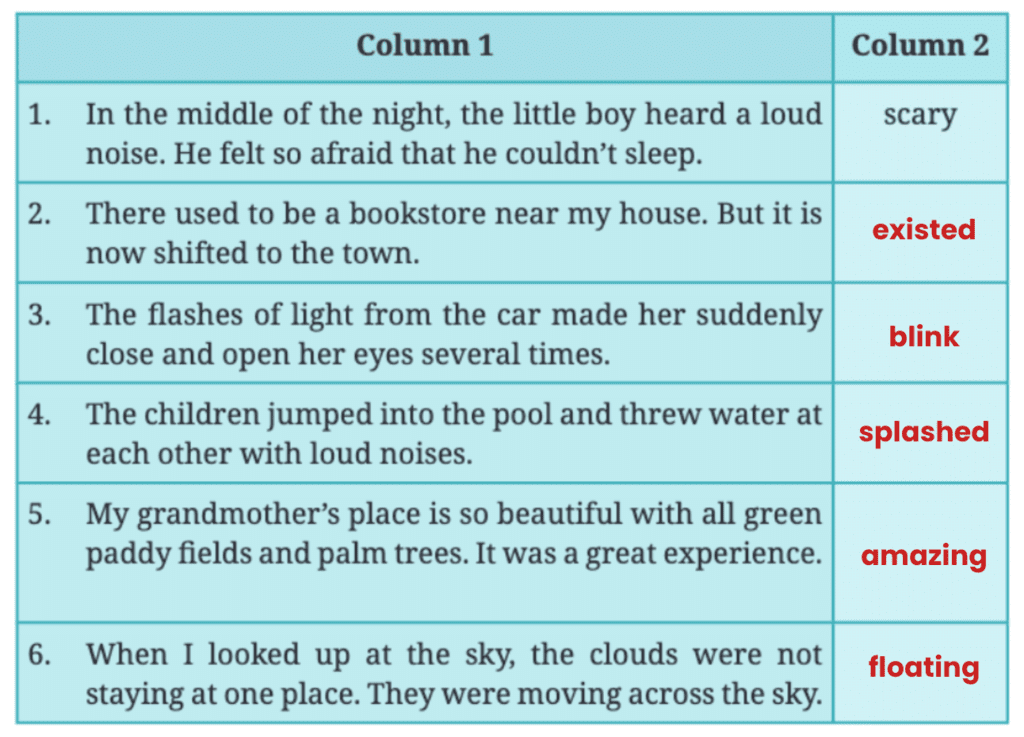
QII: Complete the table given below based on your understanding of the story. An example has been done for you. Share your answers with your classmates and the teacher.
Ans:
Let us think and reflect (Page 214)
QI: Read the extract given below and answer the questions that follow. Portuguese envoy: Our Governor has sent me to remind you that the annual tribute from Ullal is long overdue and… Rani Abbakka: We are a sovereign country. We don’t pay tribute to Portugal. And we don’t take orders from the Portuguese! Portuguese envoy: Your Majesty, you will regret your stand. Abbakka ordered merchant ships to be built and in alliance with the Zamorin of Kozhikode, she defied the Portuguese and established a hugely profitable trading relation with Arabia.
1. What does the word ‘tribute’ mean in this context?
Ans: In this context, ‘tribute’ means money or goods that Ullal had to pay to the Portuguese as a sign of being controlled by them.
2. Complete the sentence with a suitable reason. Rani Abbakka says, “We are a sovereign country” because
Ans: Rani Abbakka says, “We are a sovereign country” because Ullal is an independent nation with its own authority and does not accept Portuguese rule.
3. Identify whether the following statement is true or false. The Portuguese envoy threatened Rani Abbakka.
Ans: True. The Portuguese envoy threatened Rani Abbakka by saying, “Your Majesty, you will regret your stand.”
4. Choose a word given in brackets to replace the underlined word. “… she defied the Portuguese and established a hugely profitable trading relation with Arabia.” (defeated/disobeyed)
Ans: The word to replace ‘defied’ is ‘disobeyed’.
5. Choose the option that lists the qualities of Rani Abbakka, based on this extract. (i) bold (ii) thoughtful (iii) capable (iv) generous (v) determined A. (i), (ii), and (v) B. (ii), (iii), and (iv) C. (i), (iii), and (v) D. (ii), (iv), and (v)
Ans: C. (i), (iii), and (v)
Rani Abbakka was bold in refusing the Portuguese, capable in building trade relations, and determined to defy foreign control.
QII: Answer the following questions.
1. Rani Abbakka spoke to her mother on her deathbed. How might these words have made her mother feel? Ans: Rani Abbakka’s words to her mother, promising to protect Ullal and fight for its freedom, likely made her mother feel proud and reassured. Her mother would have felt confident that her daughter was strong and capable of leading Ullal.
2. What does the support of the people of Ullal and the soldiers for Rani Abbakka suggest about their mindset? Ans: The support of the people and soldiers suggests they had a patriotic and brave mindset. They trusted Rwarning: This chunk ends abruptly and does not complete the sentence or provide further context for the remaining questions. Below, I will continue to provide answers for the remaining questions based on the provided document and ensure all questions related to “Rani Abbakka” are addressed, maintaining the requested format and simplicity.
3. How might the people of Ullal have felt when the mighty Portuguese were defeated? Ans: The people of Ullal likely felt joyful, proud, and relieved when the Portuguese were defeated. Their victory would have boosted their confidence in Rani Abbakka’s leadership and their own strength as a community.
4. Why do you think Rani Abbakka’s victory against the Portuguese would have inspired other rulers to go against a foreign power?Ans: Rani Abbakka’s victory showed that a small kingdom like Ullal could defeat a powerful foreign force like the Portuguese. This would have inspired other rulers by proving that courage, strategy, and unity could overcome even strong enemies, encouraging them to resist foreign control.
Let us learn (Page 215)
QI: Study the following words from the text.
seize, sovereign, their, soldiers.
The spelling of the given words have ‘ei’ and ‘ie’ in them.
Spelling tip: ‘i’ before ‘e’ except after ‘c’. For example: receive, deceive.
Now, fill in the blanks with ‘ie’ or ‘ei’ for the following words.
Ans:
c_ei_ling – ceiling
bel_ie_ve – believe
th_ie_f – thief
ach_ie_ve – achieve
perc_ei_ve – perceive
prot_ei_n – protein
soc_ie_ty – society
sh_ie_ld – shield
w_ei_ght – weight
fr_ie_nd – friend
QII: Study the highlighted word in the following sentence from the text.
…; and Bangadi too may have to face their wrath.
Was the initial letter ‘w’ pronounced? There are many words in the English language where certain letters are not pronounced but are spelt. They are called ‘silent letters’.
For example: campaign, knowledge, pneumonia, honour, calm. Now, find more words with silent letters.
Ans: The initial ‘w’ in ‘wrath’ is not pronounced; it is a silent letter. More words with silent letters include:
doubt (silent ‘b’)
wrist (silent ‘w’)
knight (silent ‘k’)
debt (silent ‘b’)
listen (silent ‘t’)
QIII: Read the following expressions from the text.
laughing stock, last laugh.
Use the dictionary page given below to find the meanings of the following. burst out laughing, don’t make me laugh, laugh until you cry, have a good laugh. Now, use these expressions in sentences of your own.
Ans:
burst out laughing: Suddenly start laughing. Sentence: When Rani Abbakka tricked the Portuguese, her soldiers burst out laughing at their confusion.
don’t make me laugh: Used to show something is impossible or ridiculous. Sentence: The Portuguese thought they could scare Rani Abbakka—don’t make me laugh!
laugh until you cry: Laugh so hard that tears come to your eyes. Sentence: The people of Ullal laughed until they cried when they heard how Rani Abbakka outsmarted the enemy.
have a good laugh: Find something amusing. Sentence: After the victory, Rani Abbakka and her soldiers had a good laugh about the Portuguese’s failed attack.
QIV: Read the following dialogues from the text.
Rani Abbakka said, “I will make them pay for this.”
The merchants said to the Arabians, “Visit us again, brother.”
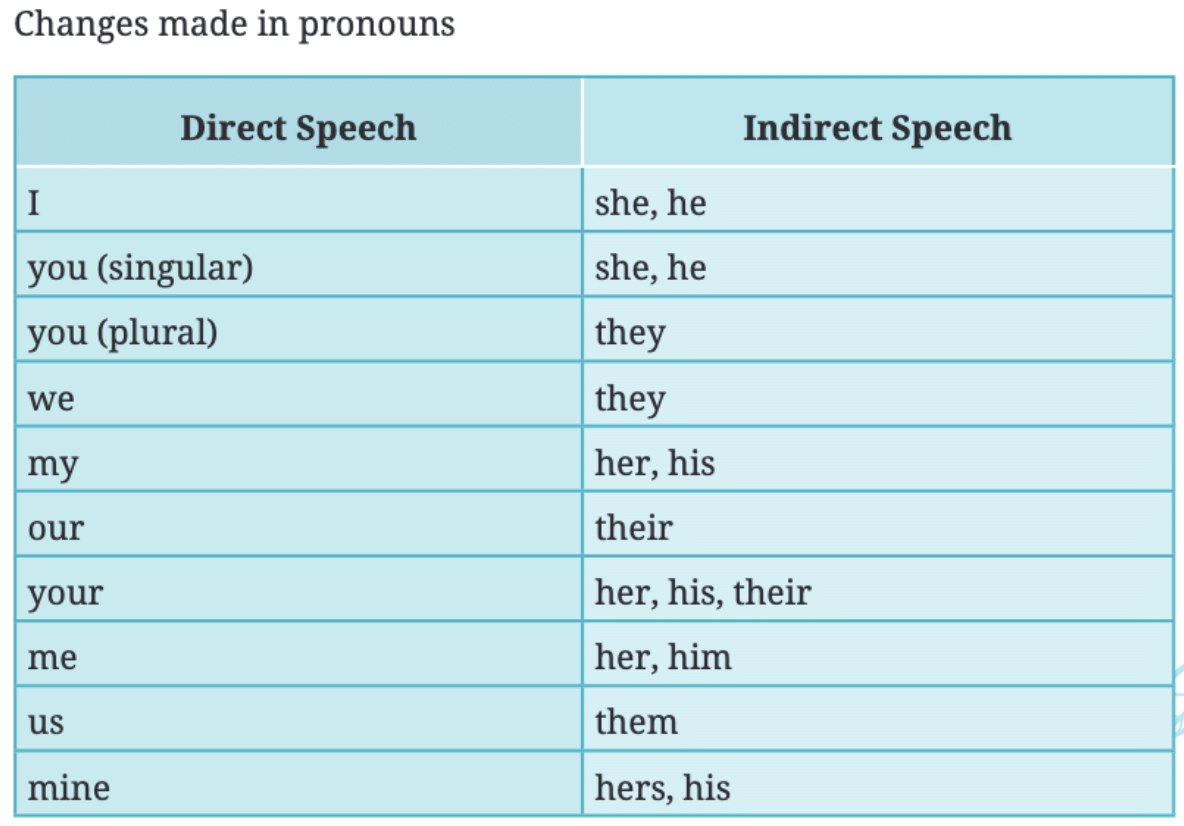
The given sentences are the direct words of the speaker; hence, they are in direct speech.
The reported forms or indirect forms of speech for the given sentences are:
Rani said that she would make them pay for that.
The merchants told the Arabian brothers to visit them again.
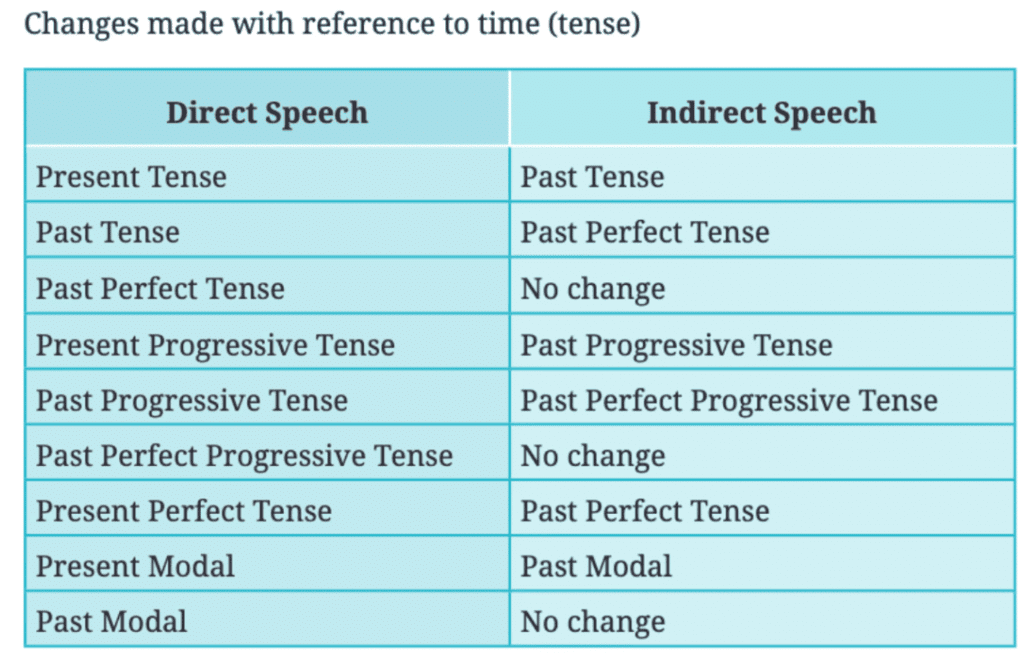
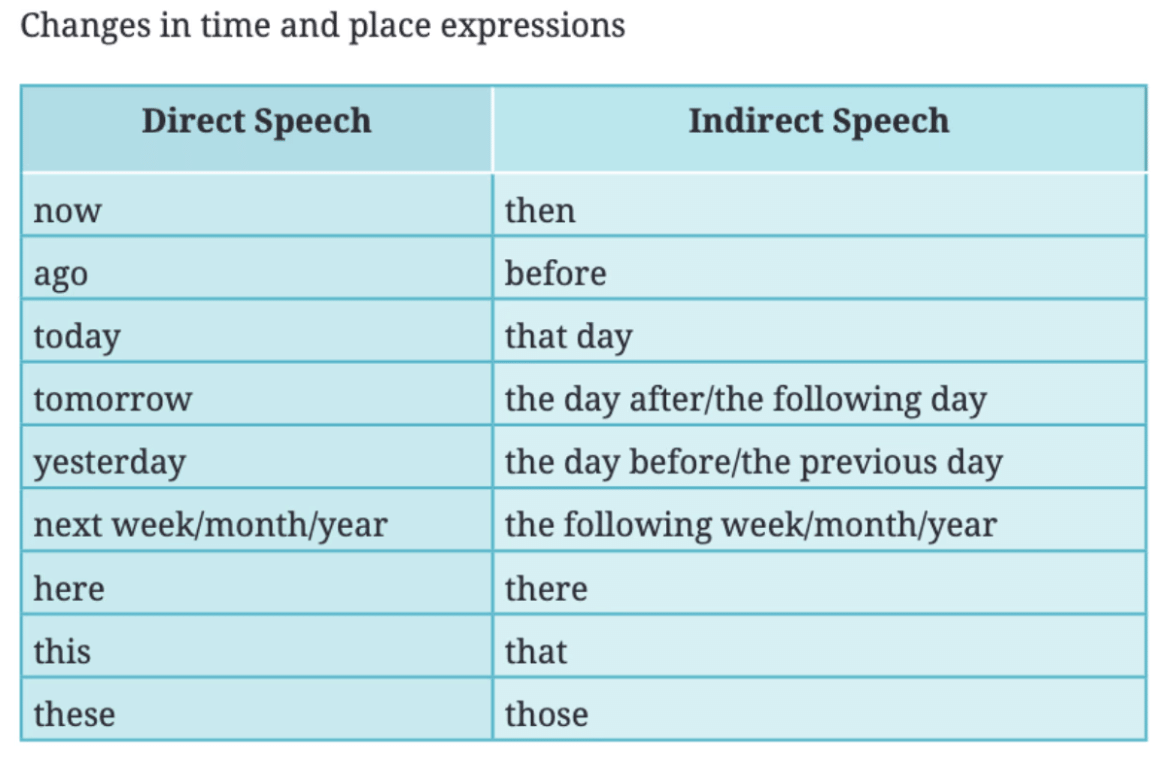
While reporting direct speech to indirect speech, we make certainmodifications related to time, place, and person.
Time (Tense): Verbs are typically shifted back from a present tenseto a past form in reported speech to reflect the change in time.
Place (Adverbs of Place): Words indicating place are adjusted to fitthe new context.
Person: Pronouns and subjects are modified to align with theperspective of the reporter.
Rewrite the following sentences in direct speech to indirect speech. Remember to make the necessary changes.
Ans:
The teacher said, “Women of valour have made significant contributions throughout history.” Ans: The teacher remarked that women of valour had made significant contributions throughout history.
“I enjoy reading historical novels,” said Smitha. Ans: Smitha shared that she enjoyed reading historical novels.
The captain said to the coach, “Our team won the championship last year.” Ans: The captain told the coach that their team had won the championship the previous year.
The class teacher said, “Please turn off the lights when you leave.” Ans: The class teacher requested that they turn off the lights when they left.
“Finish the work before dinner,” said mother to Ravi. Ans: Mother advised Ravi to finish the work before dinner.
The vet said to the pet owner, “Take the dog for a walk.” Ans: The vet instructed the pet owner to take the dog for a walk.
QV: Read the conversation between the Captain and the team. Captain: We need to focus on our strategy for the final match. Player: I have some ideas on how we can improve our strategy. Captain: Make sure to share those ideas with the team during practice. Complete the following paragraph by transforming the dialogue in the indirect form of speech.
Ans: The Captain remarked that they needed to focus on their strategy for the final match. To which one of the players replied that he had some ideas on how they could improve their strategy. The Captain advised the player to make sure to share those ideas with the team during practice.
Let us write (Page 221)
Q: India’s past was heroic, and at present, the pace of her development is inspiring. Women play a significant role in it. These women are around us, inspiring us all the time. With these thoughts, write a conversation between two students, Pratap and Tarana, discussing the role played by women in forming India’s identity as a strong nation.
Ans: Pratap: Tarana, I have a lot of respect for women like Rani Abbakka, who fought bravely against the Portuguese to protect Ullal. Tarana: I believe in the capabilities of women. Did you know Rani Lakshmibai led her army in the 1857 revolt against the British? Pratap: Yes, their courage shaped India’s identity as a fearless nation. Women like Indira Gandhi also strengthened India as a global leader. Tarana: Absolutely! Modern women like Kalpana Chawla, who became an astronaut, inspire us to aim high and contribute to India’s progress. Pratap: I admire how women in the Armed Forces, like Captain Lakshmi Sahgal, fought for freedom and now serve the nation. Tarana: And women like Kiran Bedi, who reformed policing, show how women lead with strength and vision. Pratap: These women prove that India’s strength comes from their determination and leadership. Tarana: I agree, Pratap. Their contributions make India a proud and powerful nation today.
Let us do these activities before we read (Page 199)
QI: Look around and identify the people who contribute to your life selflessly with a risk to their own lives. Share your answers with your classmates and the teacher. Ans: Soldiers, firefighters, and doctors contribute to our lives selflessly by risking their lives to protect and help us.
QII: Work in pairs. Discuss at least three questions that you would like to ask the people identified in I. Ans: 1. How do you stay brave when you face danger? 2. What made you choose this job? 3. How do you feel when you save someone’s life?
Let us discuss (Page 201)
QI: Complete the summary with an exact word from the poem. An example has been done for you. Share your answers with your classmates and the teacher. Ans: The poem is a tribute to the soldiers of the 1. land who defend the 2. borders of their country. It highlights their untiring commitment and sacrifices as they guard the nation. The soldiers remain vigilant and dedicated, whether it’s windy, snowy, or 3. scorching hot. They walk on 4. lonely stretches of land like the yogis. Their duty takes them to different terrains, including mountains, valleys, 5. deserts, and marshes. The poet acknowledges that they have given a major part of their 6. youth to protect the nation. The poet says the wind chimes show their respect to the soldiers’ 7. feat. The poet concludes with prayers for their well-being and blessings.
QII: Select the correct option for the following questions. 1: The theme of the poem is _______ (i) patriotism and sacrifice (ii) heroism and awareness (iii) nature and hardship (iv) seasons and terrain Ans: (i) patriotism and sacrifice
2: The tone of the poem is ______ (i) admiring (ii) sad (iii) respectful(iv) grateful (v) prayerful A. Only (v) B. (i) and (iii) C. (ii), (iii) and (v) D. (i), (iii), (iv) and (v) Ans: D. (i), (iii), (iv) and (v)
QIII: Complete the following sentences by explaining why the poet has used the following poetic devices. 1: Imagery because _________________________________________________ Ans: Imagery because it helps the reader picture the soldiers guarding in harsh weather and lonely places.
2: Simile because the soldiers are likened to _________________________________________________ Ans: Simile because the soldiers are likened to yogis walking in lonely places.
3: Metaphor because the poet uses wind chimes _________________________________________________ Ans: Metaphor because the poet uses wind chimes to show the respect and honour for soldiers’ brave actions.
4: Repetition of the words ‘you’ and ‘we’ because _________________________________________________ Ans: Repetition of the words ‘you’ and ‘we’ because it shows the connection between the soldiers and the people they protect.
5: Alliteration such as ‘season or snowy’ and to create _________________________________________________ Ans: Alliteration such as ‘season or snowy’ and to create a rhythm and make the poem sound more powerful.
Let us think and reflect (Page 202)
QI. Read the extract given below and answer the questions that follow.
When we are all asleep You still hold on to your deed Windy season or snowy days Or scorching sun’s sweltering rays You are there guarding all the time awake Treading the lonely expanses as yogis
1: Identify a set of opposite words from the extract. Ans: Asleep and awake
2: Complete the sentence appropriately. The phrase ‘still hold on to your deed’ refers to the soldier’s attitude of Ans: The phrase ‘still hold on to your deed’ refers to the soldier’s attitude of staying committed to their duty.
3: Identify whether the following statement is true or false. The soldiers walk across the deserted stretches of land. Ans: True
4: Give evidence from the extract to show that soldiers face harsh weather conditions. Ans: “Windy season or snowy days / Or scorching sun’s sweltering rays” shows soldiers face harsh weather conditions.
5: Which quality of the soldiers is highlighted in this extract? (i) modesty (ii) optimism (iii) simplicity (iv) dedication Ans: (iv) dedication
QII. Answer the following questions.
1: Who is the speaker of this poem? How can you say so? Ans: The speaker is A.P.J. Abdul Kalam, the poet. We can say so because his name is mentioned as the author of the poem.
2: How is the theme of the poem conveyed through imagery? Support your answer with examples from the poem. Ans: The theme of patriotism and sacrifice is shown through imagery like “windy season or snowy days” and “treading the lonely expanses,” which help us imagine soldiers working hard in tough conditions.
3: How does the poet highlight the commitment of the soldiers? Provide examples from the poem to support your answer. Ans: The poet highlights soldiers’ commitment by saying they guard “all the time awake” and work in “windy season or snowy days,” showing they never stop protecting the nation.
4: What is the significance of the line ‘Prime of your youth given to the nation!!’ with reference to sacrifice and service? Ans: The line means soldiers give their young years to serve the nation, sacrificing their personal life to protect the country.
5: The poem ends with a prayer for the soldiers’ well-being and blessings. Why is it important for each one of us to pray for the well-being of soldiers? Ans: It is important to pray for soldiers because they risk their lives to keep us safe, and praying shows our gratitude and support for them.
Let us learn (Page 202)
QI: The poem mentions a few terrains (physical features of land)-valleys, deserts, and marshes. Identify the terrains from the box given below. There are two that you do not need.Ans: Mountains, delta, peninsula
QII: Study the following phrases from the poem.
treading the lonely expanses
climbing the heights
scorching sun
Such phrases are word pairs that come together in combinations and are called collocations.
Fill in the blanks by choosing the words given in the brackets that collocate appropriately. Ans:
The hikers reached the peak (summit/peak)of the mountain after several days of trekking through challenging conditions.
The barren (empty/barren) landscape of the desert made it nearly impossible to find any water sources.
In the rainforest, the dense (heavy/dense) forest provides a habitat for a diverse range of wildlife.
Chitra is a very adventurous (heroic/adventurous) person and enjoys mountain climbing.
I’ll try to get back in time, but I’m not making (doing/making) any promises.
Let us write (Page 205)
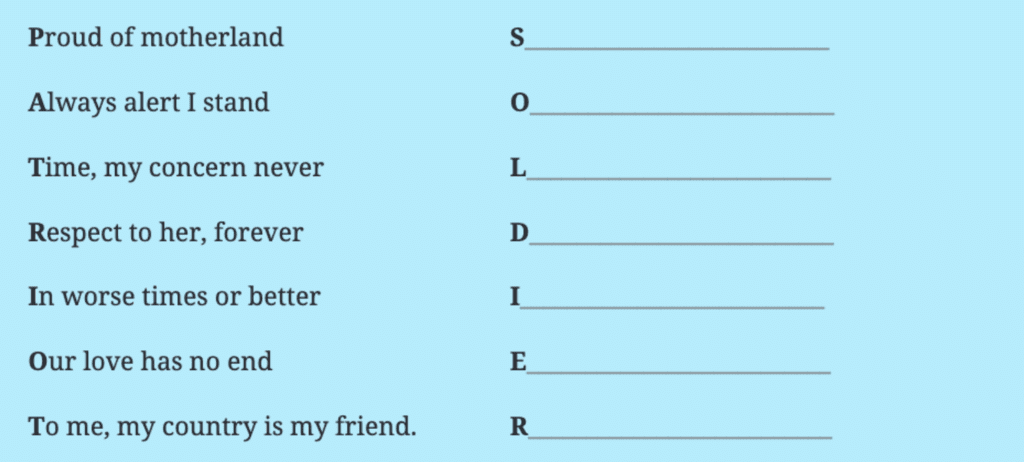
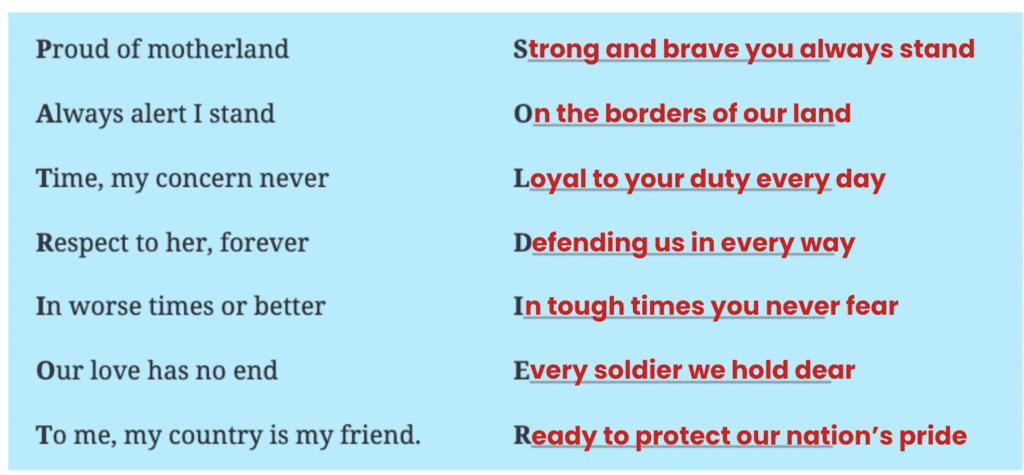
QI: An acrostic poem is the one in which the first letter of each line spells out a word, name or phrase when read vertically. Read the example given below and compose your own acrostic poem.
Let us do these activities before we read (Page 180)
QI: Homage means ‘something that is said or done to show respect publicly for someone’. Whom should every Indian pay homage to? Share your answers with your classmates and the teacher. Ans: Every Indian should pay homage to soldiers because they protect our country and sacrifice their lives for our freedom.
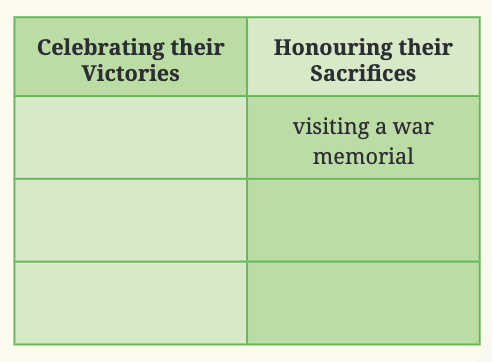
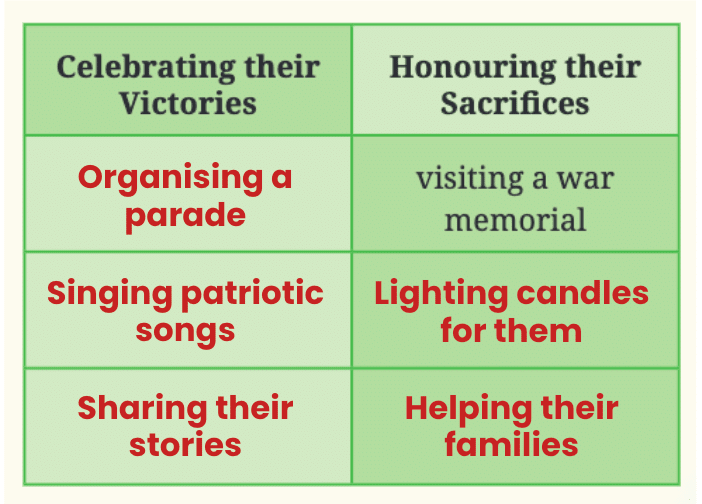
QII: Work in pairs to complete the table by writing any three ways in which we can celebrate the victories and honour the sacrifices of the soldiers. An example has been done for you. Share your answers with your classmates and the teacher.
Ans:
Let us discuss (Page 187)
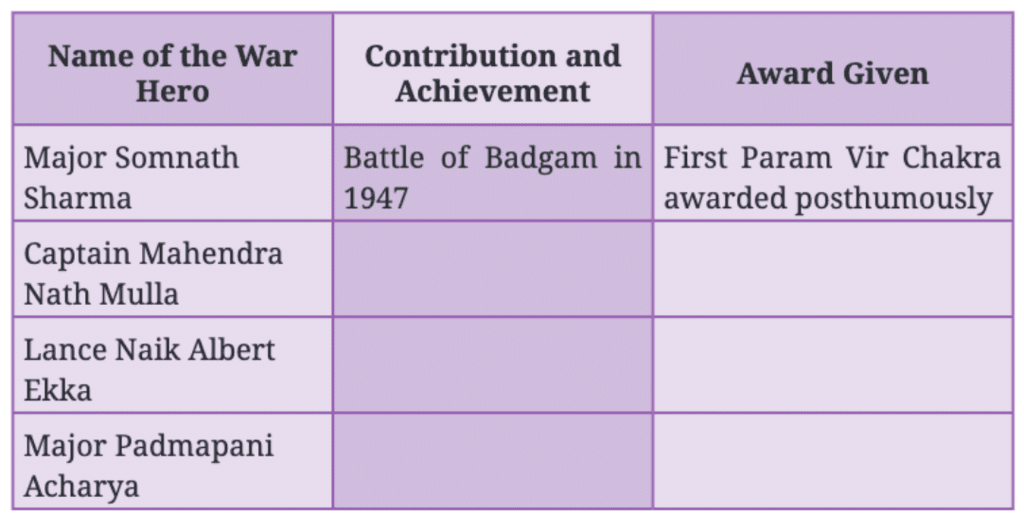
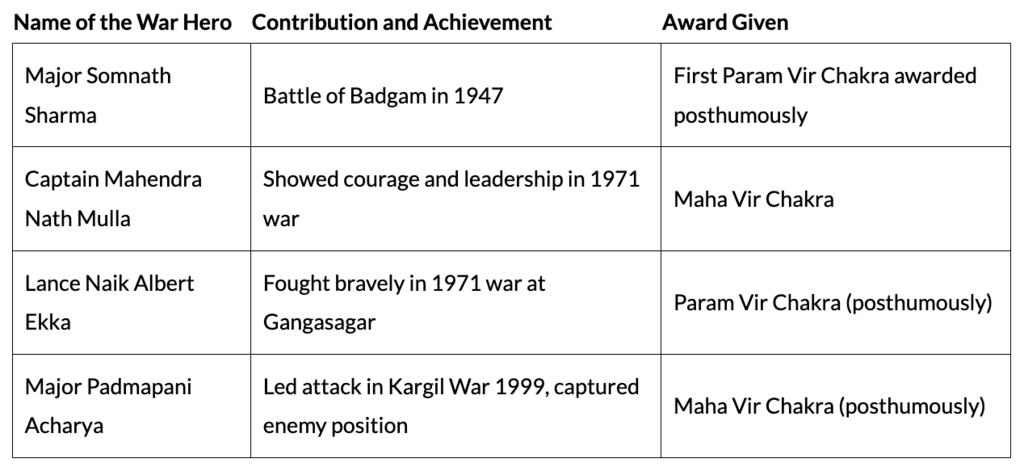
QI: Complete the table given below. An example has been done for you. Check your answers with the teacher.
Ans:
QII: Find the paragraph(s) and sentences in the text that evoke the feelings given below. 1: feeling of wonder Ans: “We were awestruck and humbled by his bravery.” (Page 182)
2: heartening Ans: “It was heartening to know that our government has recognised the sacrifice of brave soldiers.” (Page 181)
3: sense of motivation Ans: “It touched my heart and also motivated me.” (Page 182)
4: pride Ans: “It truly is a majestic site that filled me with pride for our nation.” (Page 183)
5: visually inspiring Ans: “The overall environment created an emotive experience that was visually inspiring.” (Page 185)
6: sadness Ans: “It was sad to think about the massive devastation and loss of life caused by wars.” (Page 185)
7: gratitude Ans: “In my view, it is also an expression of deep gratitude for the supreme sacrifice made by our brave soldiers defending the sovereignty and integrity of the country.” (Page 188)
8: inspiration Ans: “I am inspired by your letter!” (Page 191)
QIII: Which is India’s highest gallantry award? Ans: India’s highest gallantry award is the Param Vir Chakra.
QIV: How would Ananda feel after reading this letter? Ans: Ananda would feel inspired and motivated to join the Armed Forces and visit the National War Memorial.
QV: Do you think Soumya enjoyed writing this letter? Why or why not? Ans: Yes, Soumya enjoyed writing the letter because she was excited to share her inspiring experience and felt proud while writing about the soldiers.
Let us discuss (Page 191)
QI: Why was Ananda reminded of the poem ‘Pushp ki Abhilasha’? Ans: Ananda was reminded of the poem ‘Pushp ki Abhilasha’ because she saw people offering flowers to soldiers at the Chandigarh War Memorial, just like the flower in the poem wants to be offered to brave soldiers.
QII: How does Soumya’s letter help Ananda in pursuing her hobby? Ans: Soumya’s letter helps Ananda pursue her hobby of stamp collecting (philately) because the envelope has a beautiful stamp celebrating India’s independence, which Ananda can add to her collection.
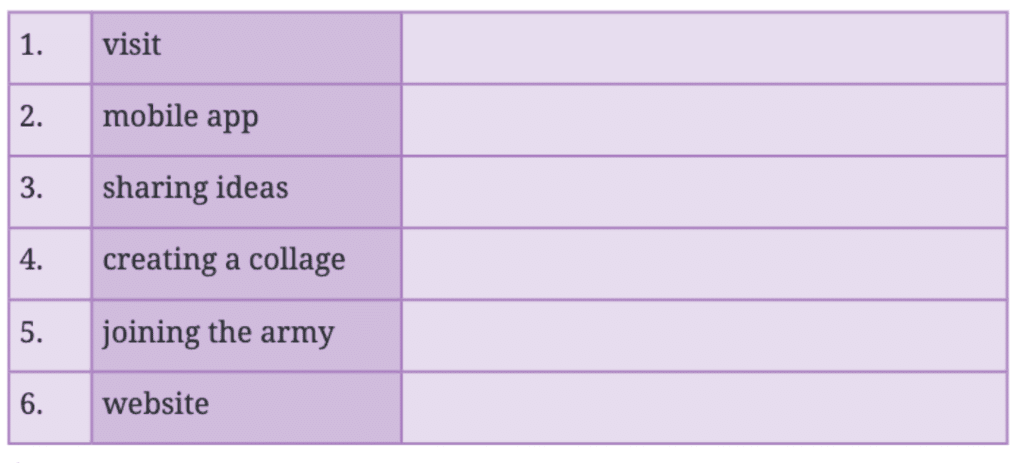
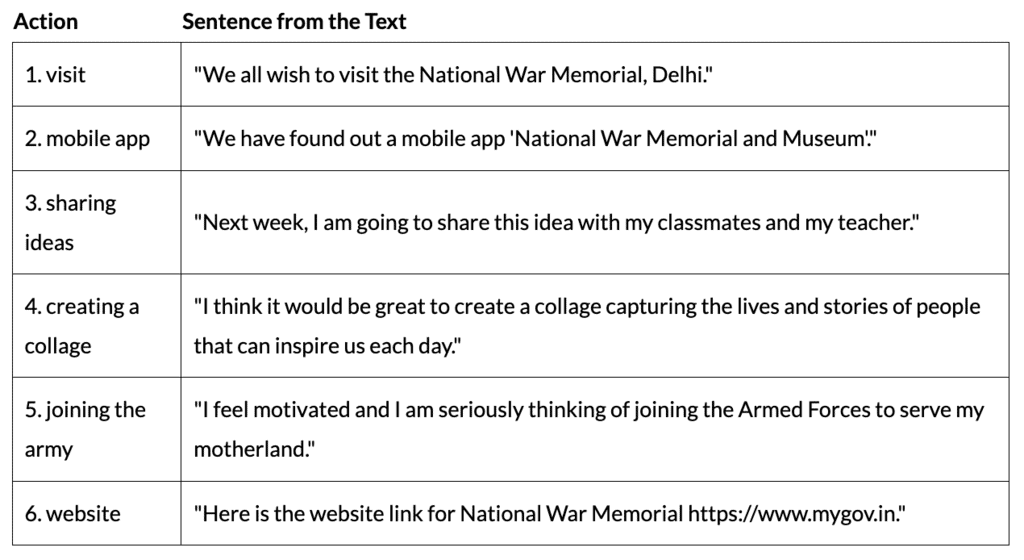
QIII: Ananda is inspired to act after reading the letter from Soumya. What actions does she intend to take up? Fill in the table citing the sentences from the text.
Ans:
Let us think and reflect (Page 192)
QI. Read the extracts given below and answer the questions that follow.
1. You can see the obelisk surrounded by wreaths that have been placed as a mark of respect. The lighting design is planned in such a way that it transforms the monument’s landscape as sunlight changes from dawn to dusk. It truly is a majestic site that filled me with pride for our nation. I was also overwhelmed by the interminable flame as a metaphor for eternal stories of courage and valour.
(i): Complete the analogy with a word from the extract. flame: valour :: wreath: Ans: flame: valour :: wreath: respect
(ii): How does the lighting design make the monument visually appealing? Ans: The lighting design makes the monument visually appealing by transforming the monument’s landscape as sunlight changes from dawn to dusk.
(iii): State whether the following sentence is a fact or an opinion. It truly is a majestic site… Ans: It is an opinion because it shows the writer’s feelings about the site.
(iv): What does the everlasting flame suggest? Ans: The everlasting flame suggests the eternal stories of courage and valour of the soldiers, showing their sacrifices will never be forgotten.
(v): Choose the correct option to complete the sentence. The tone of the writer in this extract is _____ A. modest B. light-hearted C. admiring D. nostalgic Ans: C. admiring
2. I was happy to hear that you got an opportunity to visit the National War Memorial. I have heard a lot about it. Some people might see a war memorial as just a monument, statue, an edifice to celebrate a war or victory and commemorate those who sacrificed their lives or got injured in the war. In my view, it is also an expression of deep gratitude for the supreme sacrifice made by our brave soldiers defending the sovereignty and integrity of the country.
(i): Choose a line from the extract which shows that Ananda was aware about the National War Memorial. Ans: “I have heard a lot about it.”
(ii): What might be the most likely reason for people to consider a war memorial as a monument? Ans: People consider a war memorial as a monument because it is a statue or structure built to celebrate war heroes or victories.
(iii): Fill in the blank with a suitable word from the extract. We conduct special competitions at school to _________ our Independence day. Ans: We conduct special competitions at school to commemorate our Independence day.
(iv): Select a phrase from the extract showing that Ananda is expressing an opinion. Ans: “In my view”
(v): Complete the sentence with a suitable reason. Ananda refers to the sacrifice of soldiers as ‘supreme’ sacrifice because ________. Ans: Ananda refers to the sacrifice of soldiers as ‘supreme’ sacrifice because they give their lives to protect the country’s freedom and safety.
QII. Answer the following questions.
1: What is the significance of the National War Memorial? Ans: The National War Memorial is important because it honours the soldiers who sacrificed their lives for India’s freedom and safety after Independence, reminding us of the cost of freedom.
2: Lance Naik Albert Ekka is an example of selflessness, determination, and exceptional courage. Elaborate. Ans: Lance Naik Albert Ekka showed selflessness by risking his life to save his team, determination by fighting even after being injured, and exceptional courage by attacking enemy bunkers alone during the 1971 war.
3: Explain how the National War Memorial and Museum app will be helpful in spreading awareness about war heroes. Ans: The app helps spread awareness by providing information about war heroes in 21 languages, showing their stories through murals, and answering questions interactively, making it easy for people to learn.
4: Why is it our duty to pay homage to our brave soldiers? Ans: It is our duty to pay homage to brave soldiers because they sacrifice their lives to protect our country, ensuring we live in peace and freedom.
5: What is the main idea of this text? How does it justify the title, ‘A Homage to our Brave Soldiers’? Ans: The main idea is to honour the sacrifices of soldiers who protect India. The title is justified because the text describes the National War Memorial and soldiers’ bravery, showing respect for them.
6: Why were the students awestruck and humbled? Explain in your own words. Ans: The students were amazed and felt humbled because they learned about Lance Naik Albert Ekka’s bravery in the 1971 war, where he fought fearlessly and sacrificed his life for his team.
Let us learn (Page 194)
Study the following words taken from the text. disregard, inconsequential, immortal, undaunted
These words are made by adding word beginnings like dis-, in-, im- and unto the root words regard, consequence, mortal, and daunt, respectively. Such word beginnings are called prefixes.
dis-+regard
in-+consequential
im-+mortal
un-+daunted
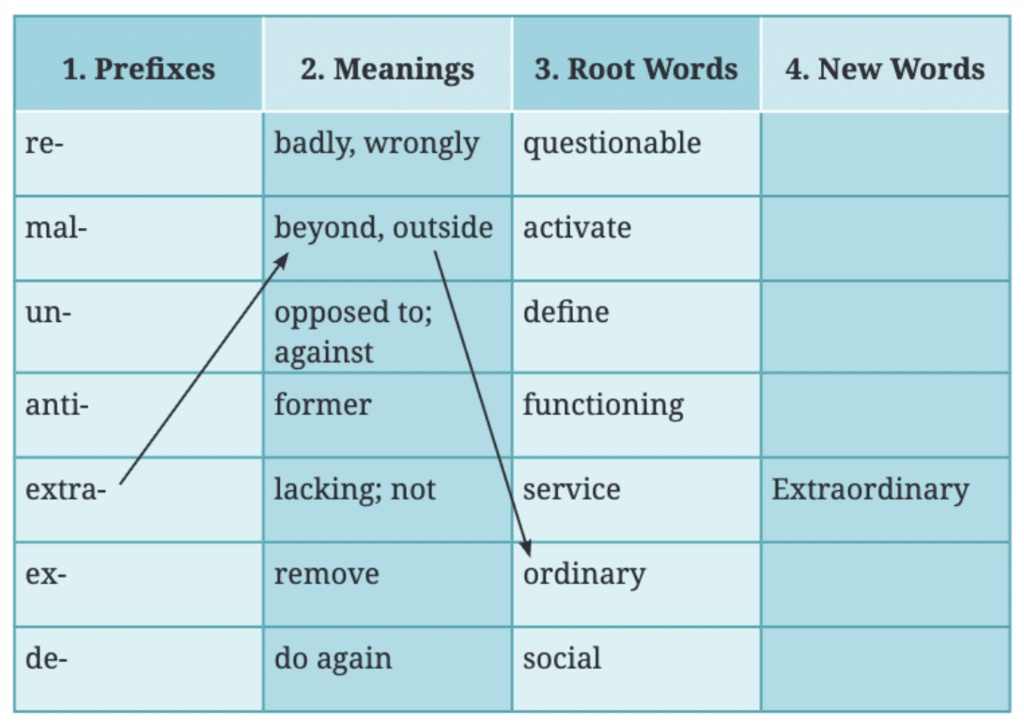
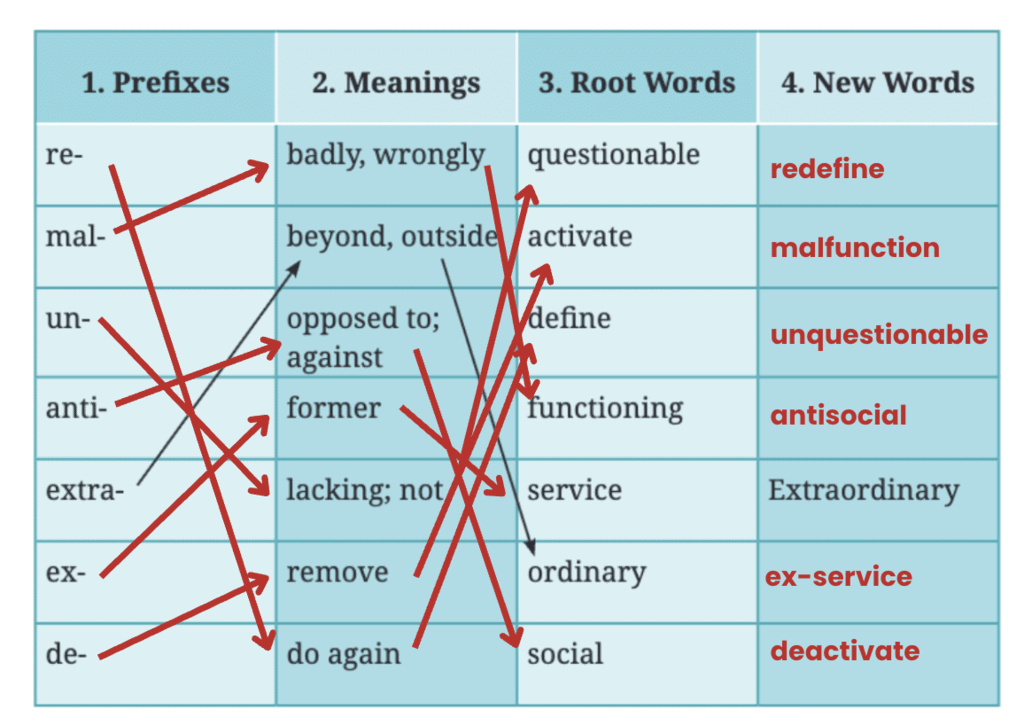
QI: Match the prefixes with their meanings and the root words to create a new word in the table given below. An example has been done for you.
Ans:
Now, complete the paragraph by using the new words created in the table. Ans: Soldiers undergo (i) extraordinary training to prepare for their challenging duties. They learn to (ii) deactivate explosives and handle (iii) malfunctioning equipment with precision. They stand as a powerful force against (iv) antiservice elements, displaying (v) unquestionable bravery. (vi) exservice members often share their experiences to inspire new recruits. Their service can continually (vii) redefine the essence of commitment and sacrifice.
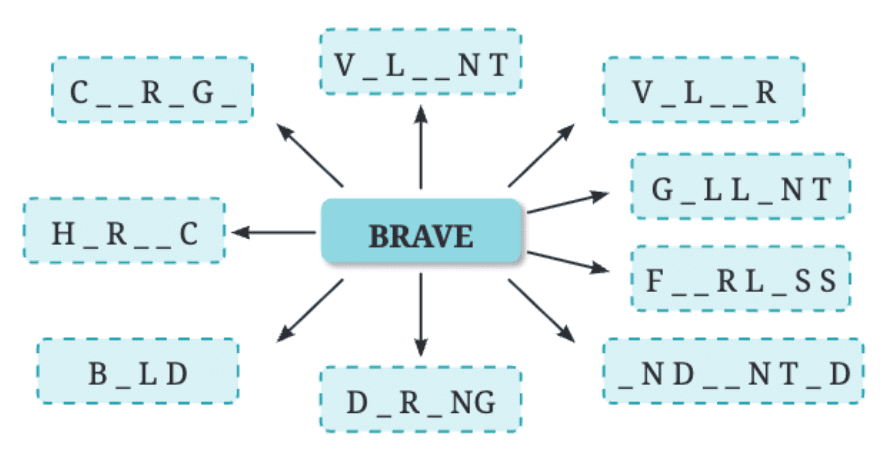
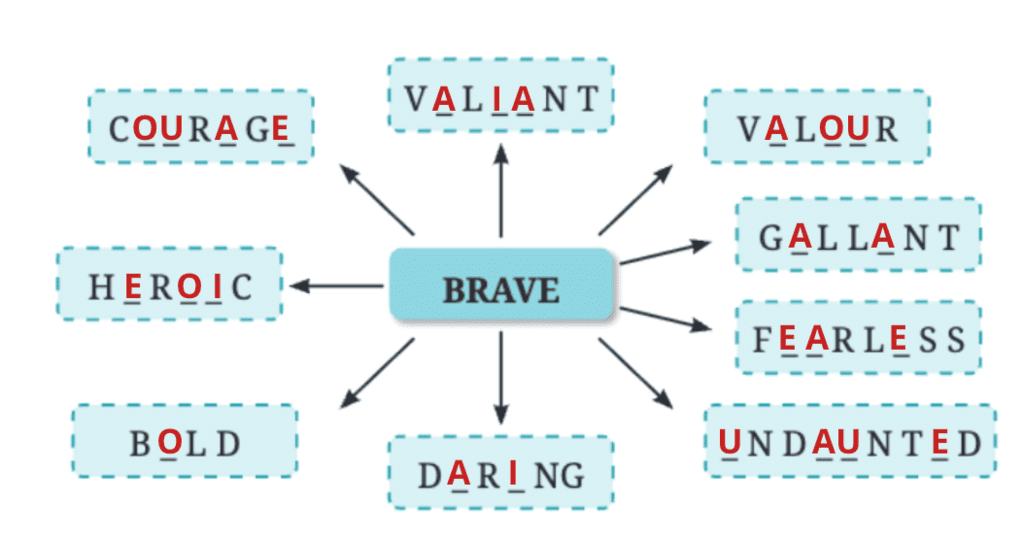
QII: Find words associated with ‘brave’ by filling in the missing vowels in the boxes given below.
Ans:
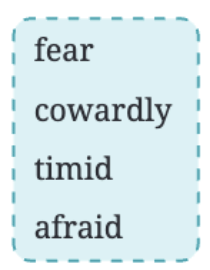
QIII: Fill in the blanks with the correct opposite words of ‘brave’ from the box to complete the following sentences.
1. Ajay’s ____________ refusal to stand up for his friend was disappointing to everyone. 2. The ____________ child hid behind his mother, too scared to meet the new teacher. 3. Anjali’s ____________ of heights prevented her from climbing the tall ladder. 4. Sushma felt ____________ as she entered the dark, abandoned building alone.
Ans:
Ajay’s cowardly refusal to stand up for his friend was disappointing to everyone.
The child hid behind his mother, too timid to meet the new teacher.
Anjali’s fear of heights prevented her from climbing the tall ladder.
Sushma felt scared as she entered the dark, abandoned building alone.
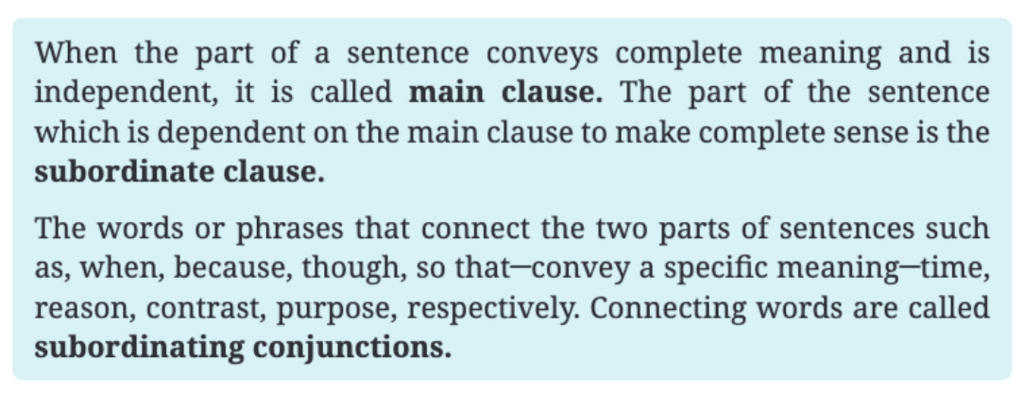
QIV: Read the following sentences from the text and divide them into two parts. An example has been done for you. 1: I aspire to be courageous like him when I join the army! Part 1: I aspire to be courageous like him Part 2: when I join the army!
2:They exchange letters and share their feelings of gratitude for the freedom they enjoy because of the sacrifices made by the bravehearts of the country. Part 1: They exchange letters and share their feelings of gratitude Part 2: for the freedom they enjoy because of the sacrifices made by the bravehearts of the country
3:Though seriously wounded in this encounter, he continued to fight alongside his comrades. Part 1: Though seriously wounded in this encounter Part 2: he continued to fight alongside his comrades
4:The sacrifices of the soldiers make monuments like the National War Memorial extremely important so that we should never forget the cost of freedom. Part 1: The sacrifices of the soldiers make monuments like the National War Memorial extremely important Part 2: so that we should never forget the cost of freedom
QV: Combine the following pairs of sentences using suitable subordinating conjunctions given in the box below.
1. Wasi burst into tears. He heard the good news. 2. Himani was very nervous. She delivered a great presentation. 3. This is the place. I was born. 4. The students performed very well. They studied diligently. 5. Water the plants. They will die.
Ans:
Wasi burst into tears when he heard the good news.
Himani was very nervous though she delivered a great presentation.
This is the place where I was born.
The students performed very well because they studied diligently.
Water the plants unless they will die.
QVI: Complete the following sentences with suitable main clause or subordinate clause. Ans:
Farheen was late to work because she missed the bus.
The dog started barking when a stranger came to the door.
She completed the marathon although she was very tired.
They saw a beautiful sunset while they were hiking in the mountains.
Abhishek received a promotion after working hard for two years.
They finished the project before the deadline approached.
We waited in the car until the rain stopped.
The children played happily as the waves rushed to the shore.
Let us write (Page 198)
Q: You have read about the sacrifices made by the Armed Forces during war. However, the Armed Forces also play a key role during peace time. Write a letter to your friend sharing how the Armed Forces contribute their services during the times of natural calamities (floods, earthquakes, etc.), infrastructure development (building bridges in remote areas, etc.) and for welfare initiatives (medical camps, establishment of libraries, etc.)
House No. 45, Sector 10 Chandigarh 05 May 2025
Dear Priya,
I hope you are doing well! I recently learned how our Armed Forces help during peace time, and I wanted to share this with you. During natural disasters like floods and earthquakes, they rescue people and provide food and shelter. They also build bridges in remote areas for better connectivity. Additionally, they organise medical camps and set up libraries for community welfare.
I feel so proud of them! What do you think? Write back soon.
Let us do these activities before we read (Page 166)
QI: Identify the activities represented by the icons given below. Share your answers with your classmates and the teacher.
Ans: 1. Paragliding 2. Mountain biking 3. Rock climbing 4. River rafting
QII: Work in pairs and discuss the following questions. 1: Why do you think people undertake the activities identified above? Ans: People undertake these activities for fun, adventure, to challenge themselves, and to enjoy nature.
2: How would they prepare for these activities? Ans: They prepare by training, getting the right equipment, learning safety rules, and checking the weather.
3: Which one of them do you find the most exciting? Why? Ans: I find river rafting the most exciting because it’s thrilling to ride fast on water with friends.
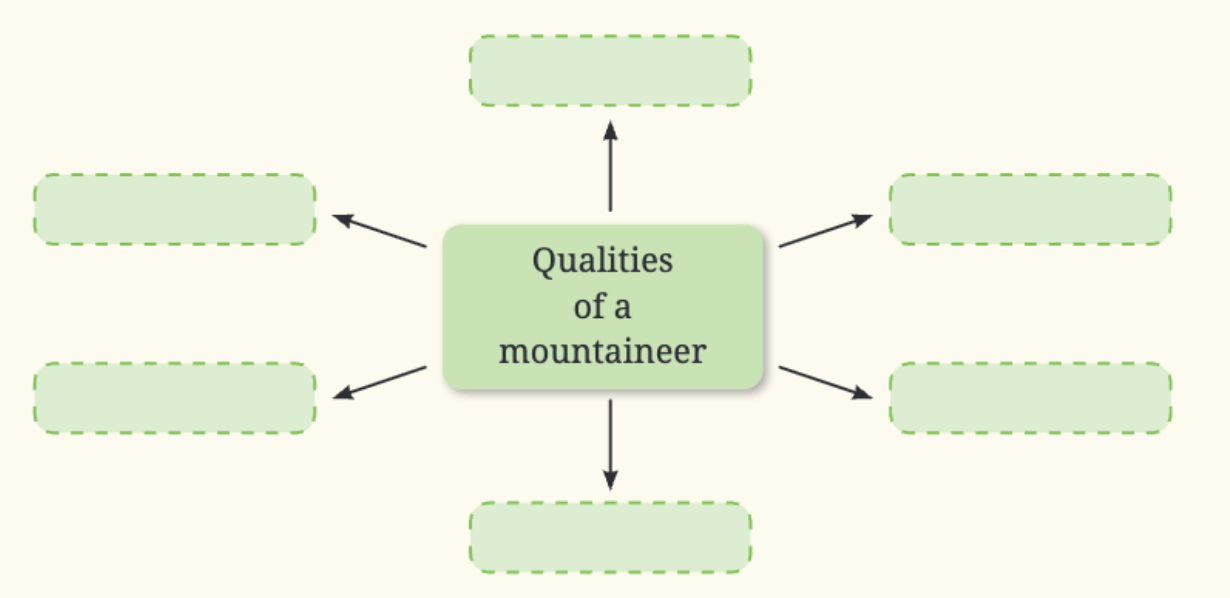
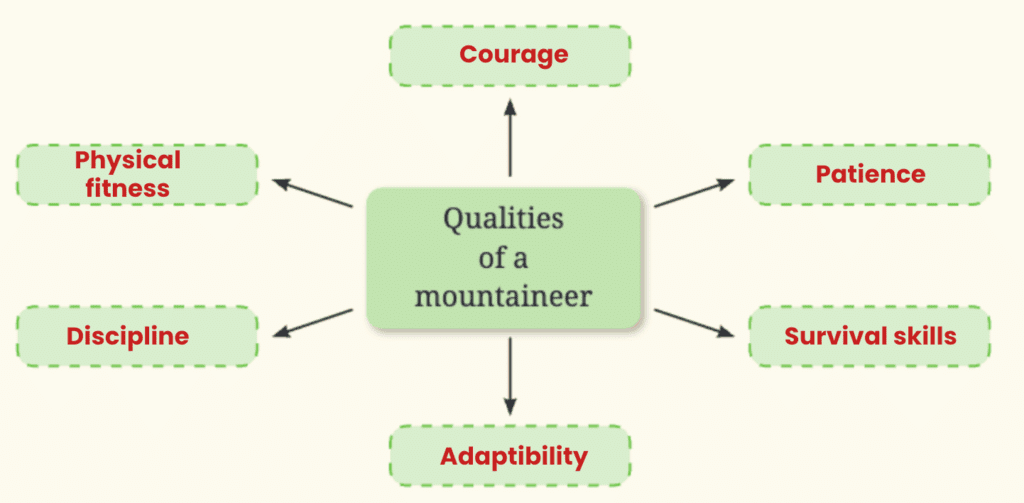
QIII: Work in pairs to complete the word web given below. Share the answers with the teacher.
Ans:
Let us discuss (Page 169)
Read the statements given below and explain each statement in your own words.
1. Arunima Sinha is considered a beacon of hope and resilience. Ans: Arunima is seen as a source of inspiration and strength because she didn’t give up after losing her leg in an accident. She climbed Mount Everest, showing others that they can overcome tough challenges with determination.
2. Arunima decided to climb Mount Everest despite losing her leg. Ans: Even though Arunima lost her leg in a train accident, she made a big decision to climb Mount Everest, the highest mountain in the world, proving she could achieve her dream with a prosthetic leg.
3. Bachendri Pal’s guidance was crucial in Arunima’s journey to the summit of Mount Everest. Ans: Bachendri Pal, the first Indian woman to climb Everest, helped Arunima a lot by giving her confidence and advice. Her support was very important for Arunima to succeed in reaching the top of Mount Everest.
4. Arunima’s achievements go beyond just physical endurance. Ans: Arunima’s success isn’t only about her physical strength to climb mountains. It also shows her mental strength, courage, and determination to face difficulties and achieve her goals, inspiring others.
5. Arunima’s autobiography inspires readers around the world. Ans: Arunima wrote a book about her life called Born Again on the Mountain. It motivates people everywhere by sharing her story of losing her leg, facing challenges, and climbing Mount Everest, encouraging them to chase their dreams.
Let us think and reflect (Page 170)
I. Read the extract given below and answer the questions that follow.
Bachendri Pal instilled confidence in Arunima and said, “My child, you decided to climb Mount Everest in these situations with a prosthetic leg—you have conquered the Everest within you; the world will realise it later.”
On 21 May 2013, after 52 exhausting days, Arunima Sinha reached the summit of Mount Everest. Standing at the top of the world, she felt a surge of emotions—pride, relief, and an overwhelming sense of achievement.
1: Complete the sentence with a suitable reason. Bachendri Pal said that Arunima had conquered the Everest within her because __________ Ans: Bachendri Pal said that Arunima had conquered the Everest within her because she decided to climb it with a prosthetic leg despite her challenges.
2: How might Arunima have felt after what Bachendri Pal told her? Ans: Arunima might have felt confident and motivated to achieve her goal.
3: Choose a phrase from the extract which shows that reaching the summit of Mount Everest was tiring. Ans: 52 exhausting days
4: Select the correct option to complete the sentence. After her success when Arunima felt ‘an overwhelming sense of achievement’, she would have most likely said, “______________” (i) I am confident of my abilities (ii) I will accomplish this soon (iii) I am excited to begin this climb (iv) I finally realised my dream Ans: (iv) I finally realised my dream
QII. Answer the following questions.
1: What did Arunima do in order to fulfil her ambition of conquering Mount Everest? Ans: Arunima completed a mountaineering course, trained for 18 months, and got guidance from Bachendri Pal.
2: Arunima is a beacon of hope and resilience. Support this statement with evidence from the text. Ans: Arunima lost her leg but still climbed Mount Everest, showing hope and resilience by not giving up.
3: Arunima’s autobiography is titled Born Again on the Mountain: A Story of Losing Everything and Finding It Back. Why do you think this title is appropriate? Ans: The title is appropriate because Arunima lost her leg but found new strength and success by climbing Everest.
4: Arunima says, “Failure is when we don’t have goals worthy enough.” What would be the most likely impact of this statement on readers? Ans: This statement might inspire readers to set big goals and work hard to achieve them.
Let us learn (Page 171)
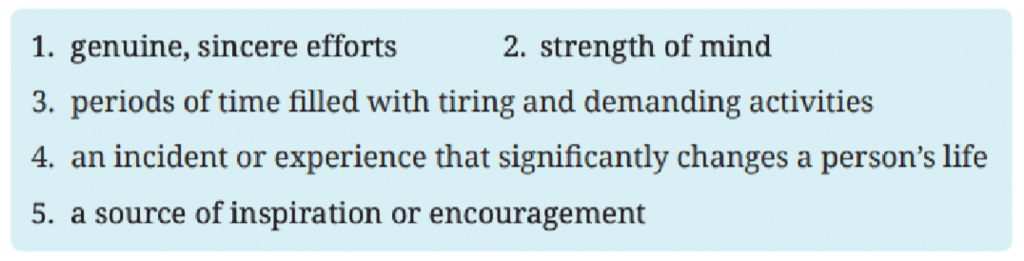
QI: Read the underlined phrases in sentences (i)–(v) and match them with their appropriate meanings given in the box below.
(i) Nisha was relieved when the final match was over after several exhausting days of practice. (ii) Despite several failures, her heartfelt attempts to learn the guitar showed her determination and passion for music. (iii) Moving to a new city was a life-altering event for Jagan, as it gave him the chance to make new friends and try different activities. (iv) Competing in the marathon requires not just physical strength but also mental fortitude to stay focused and finish the race. (v) The lighthouse served as a beacon of hope for the sailors lost at sea.
Ans:
1. genuine, sincere efforts – (ii) heartfelt attempts 2. strength of mind – (iv) mental fortitude 3. periods of time filled with tiring and demanding activities – (i) exhausting days 4. an incident or experience that significantly changes a person’s life – (iii) life-altering event 5. a source of inspiration or encouragement – (v) beacon of hope
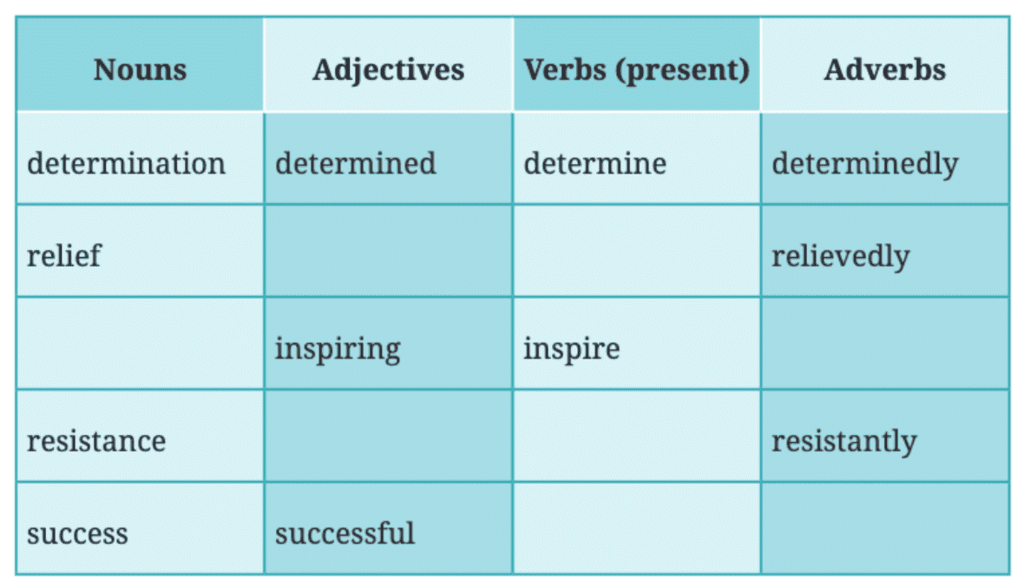
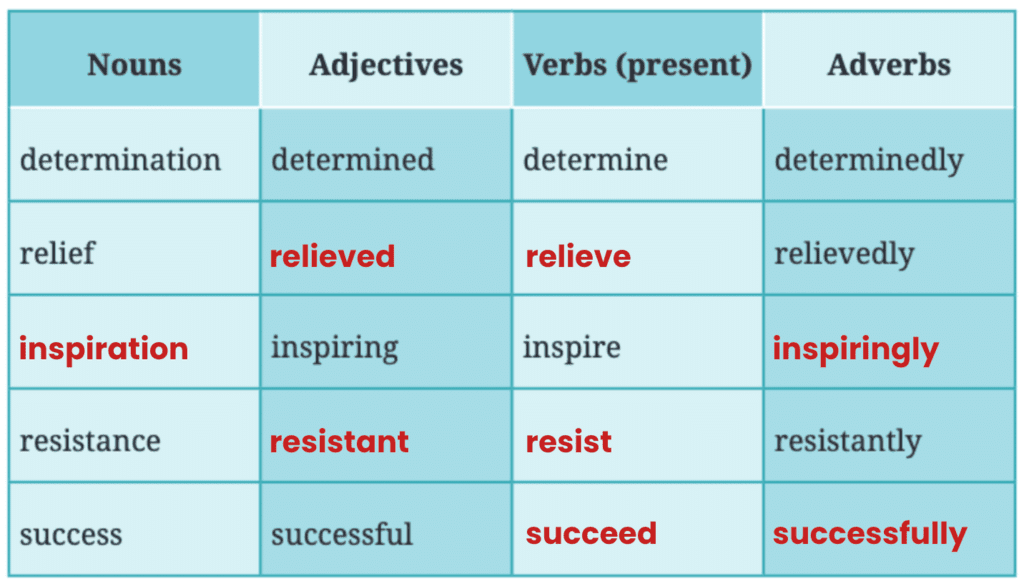
QII: Complete the following table by filling in the gaps with correct parts of speech mentioned. An example has been done for you.
Ans:
QIII: Study the highlighted words in the following sentences from the text.
Arunima made a vow that many would deem impossible.
Her father was an army engineer.
Standing at the top of the world, she felt a surge of emotions—pride, relief, and an overwhelming sense of achievement.
She planted the Indian flag at the summit and left behind a photograph of her idol, Swami Vivekananda.
Arunima Sinha’s journey from a devastating accident to scaling the highest peak in the world stands as a beacon of hope and resilience.
The highlighted words are articles.
‘A’ and ‘an’ are indefinite articles; ‘the’ is the definite article. The choice between ‘a’ and ‘an’ depends on the sound that follows the article, specifically the initial sound of the word that follows.
1: Fill in the blanks with ‘a’, ‘an’, ‘the’. Put an ‘x’ where no article is required. Ans: We planned (i) anadventurous trip to (ii) a remote island. (iii) The island was known for its beautiful landscapes and (iv) x diverse wildlife. On (v) the first day, we set out to explore (vi) the island’s dense jungle. (vii) A guide led us through (viii) the thick foliage and showed us (ix) a hidden waterfall. In (x) the evening, we gathered around (xi) a campfire to share stories and enjoy (xii) a meal we cooked. (xiii) The experience was truly unforgettable, and we felt (xiv) a connection with (xv) x nature.
2: There is an error in each sentence that has been underlined. Correct the error in the following sentences.
(i): We waited for a hour before the bus finally arrived. Ans: We waited for an hour before the bus finally arrived. Explanation: “a hour” is incorrect because “hour” starts with a vowel sound (/aʊ/), so “an” is used: “an hour.”
(ii): The guide insisted on an uniform jacket for the group’s safety during the trek. Ans: The guide insisted on a uniform jacket for the group’s safety during the trek. Explanation: “an uniform” is incorrect because “uniform” starts with a consonant sound (/juː/), so “a” is used: “a uniform.”
(iii): Mount K2 is a second highest peak in the world. Ans: Mount K2 is the second highest peak in the world. Explanation: “a second highest peak” is incorrect; “the” is needed for the superlative form to specify it’s a unique position: “the second highest peak.”
(iv): A Ganga is a sacred river in India, known for its cultural importance. Ans: The Ganga is a sacred river in India, known for its cultural importance. Explanation: “A Ganga” is incorrect because “Ganga” is a specific river, so the definite article “The” is used: “The Ganga.”
(v): Challenges are faced with courage and determination by a brave. Ans: Challenges are faced with courage and determination by the brave. Explanation: “a brave” is incorrect because “brave” here refers to a general group (brave people), so “the” is used: “the brave.”
(vi): A North Star has guided travellers for centuries. Ans: The North Star has guided travellers for centuries. Explanation: “A North Star” is incorrect because “North Star” is a specific star, so the definite article “The” is used: “The North Star.”
Let us write (Page 174)
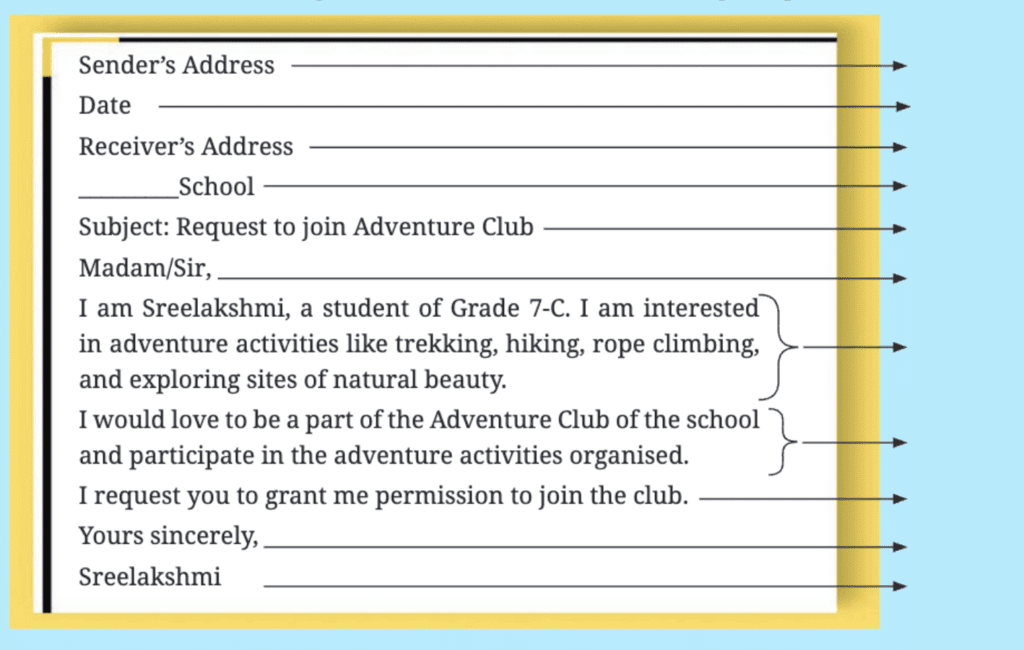
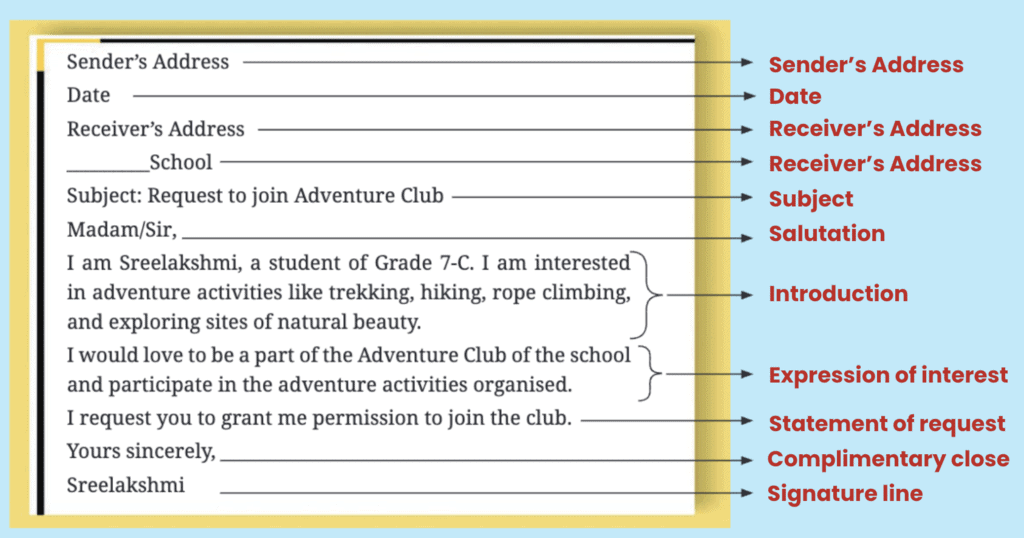
Q1: Read the various components of a formal letter from the box given below.
Ans:
Q2: Write a letter to the Principal of your school requesting her to organise an excursion to a nearby hill station for Grade 7 students of your school.
123, Green Street Lucknow Uttar Pradesh 10 May 2025
The Principal St. Mary’s School Lucknow Uttar Pradesh
Subject: Request to organise an excursion to a hill station
Dear Madam,
I am Riya Sharma, a student of Grade 7-A. I am writing to request you to organise an excursion to a nearby hill station for Grade 7 students.
An excursion to a hill station will be fun and educational. We can enjoy nature, learn about the environment, and do adventure activities like trekking. It will also help us bond with our classmates.
I kindly request you to consider this idea and arrange the trip for us.
Yours sincerely, Riya Sharma Grade 7-A, Roll Number 12
Let us do these activities before we read (Page 157)
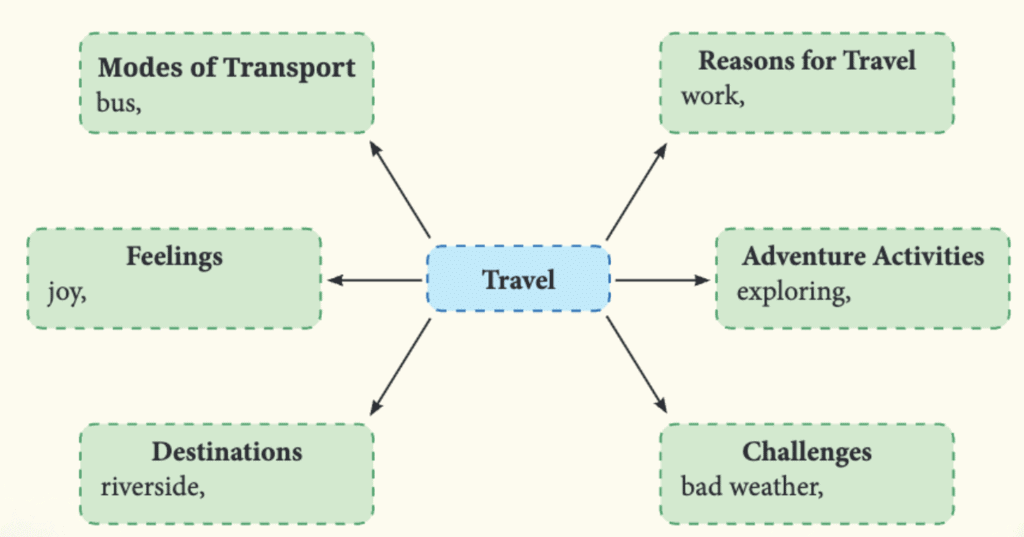
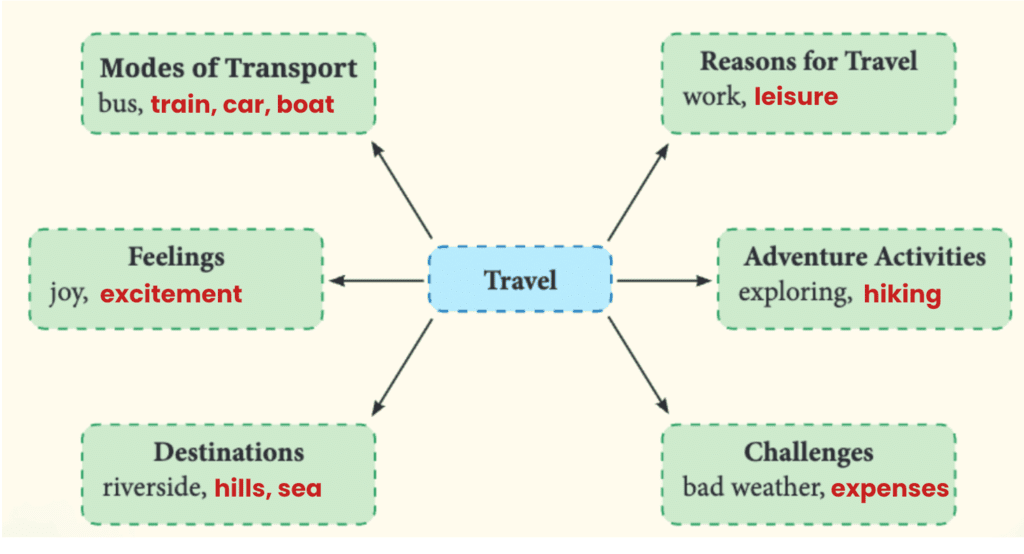
QI: Complete the following word web on travel.
Ans:
QII: You are going on a trip to an adventure camp with your classmates and teacher. 1: How will you travel to the adventure camp? Ans: I will travel to the adventure camp by bus with my classmates and teacher.
2: What things will you take along? Ans: I will take a water bottle, snacks, a backpack, comfortable clothes, and a camera.
3: Why would you like to go there? Ans: I would like to go there to have fun, try new activities, and spend time with my friends.
4: What are the activities you would like to do with your friends? Ans: I would like to do trekking, rope climbing, and campfire storytelling with my friends.
5: How much time will it take to complete your adventure trip? Ans: The adventure trip will take about 3 days to complete.
QIII: Discuss in pairs. What might be the reasons that people enjoy train journeys? Ans: People enjoy train journeys because:
They can see beautiful views like mountains and rivers.
It’s relaxing to sit and watch the scenery.
They can talk and play with friends or family.
Trains are comfortable and have space to move around.
Let us discuss (Page 161)
QI: The main ideas of each stanza of the poem are given below. Write the number of the stanza against the matching main idea. 1. At night, the speaker imagines the train and hears its engine in the quiet Ans: Stanza 2 2. The speaker feels a strong desire to take any train, no matter where it goes Ans: Stanza 3 3. The speaker hears the train whistle during the day, even though the train is far away Ans: Stanza 1
QII: Read the poem and underline the rhyming words in each stanza. Write the rhyming words from each stanza. An example has been done for you. 1. Stanza (i) Ans: away-day; speaking-shrieking 2. Stanza (ii) Ans: by-sky; dreaming-steaming 3. Stanza (iii) Ans: make-take; knowing-going
QIII: Identify the rhyme scheme of the poem from the options given below. 1. AABB 2. ABCA 3. ABAB 4. ABBC Ans: 1. AABB
QIV: Identify the word in the poem that personifies the whistle of the train. Ans: shrieking
QV: Tone refers to the attitude the poet has about the poem. Which of these words can be used to describe the poet’s tone in this poem?Ans: excited; curious; enthusiastic; joyful
QVI: Select the words that tell us what the train symbolises for the poet. 1. education 2. adventure 3. comfort 4. opportunities Ans: 2. adventure
QVII: Complete the following by choosing the correct option from those given in brackets. The poet repeats the line, ‘…there isn’t a train goes by,’ in all three stanzas to _______. (highlight the speaker’s fascination with the train/suggest that the area has many trains passing through) Ans: The poet repeats the line, ‘…there isn’t a train goes by,’ in all three stanzas to highlight the speaker’s fascination with the train.
QVIII: The poem contrasts the busy day with the stillness of the night. What is the common factor in these? Ans: The common factor is the speaker’s thoughts about the train in both day and night.
QIX: Imagery is a literary device that uses descriptive language to create mental pictures and appeal to the reader’s senses (sight, sound, smell, taste and touch). It makes the descriptions more relatable. Select the phrases from the poem that are examples of imagery. Ans: – day is loud
whistle shrieking
cinders red on the sky
engine steaming
Let us think and reflect (Page 162)
QI. Read the extract given below and answer the questions that follow.
1. My heart is warm with the friends I make, And better friends I’ll not be knowing…
(i): Choose the suitable option to complete the following. The line ‘My heart is warm’ refers to a heart that is _____ A. filled with worries B. full of love C. feeling upset D. experiencing anger Ans: B. full of love
(ii): What does the speaker say about her current friends? Ans: The speaker says she makes friends who make her heart warm.
(iii): What does the line ‘better friends I’ll not be knowing’ suggest about the speaker’s feelings toward their current friends? Ans: It suggests the speaker feels her current friends are the best and she won’t find better ones.
(iv): Complete the following suitably. The tone of the speaker in these lines is ______ (grateful/content) Ans: The tone of the speaker in these lines is content.
QII. Answer the following questions.
1: What does the phrase ‘cinders red on the sky’ tell us about the train at night? Ans: It tells us the train’s sparks light up the night sky like red cinders.
2: What is the significance of the repeated references to the train’s whistle? Ans: The train’s whistle shows the speaker’s strong fascination with trains and travel.
3: What does the line ‘no matter where it’s going’ reveal about the speaker’s attitude towards travel? Ans: It reveals the speaker loves travel and adventure so much that she doesn’t care about the destination.
4: Do you think the poet actually sees and hears the train? Why or why not? Ans: No, the poet doesn’t actually see or hear the train because the train is miles away, and she imagines its sounds and sights.
Let us learn (Page 163)
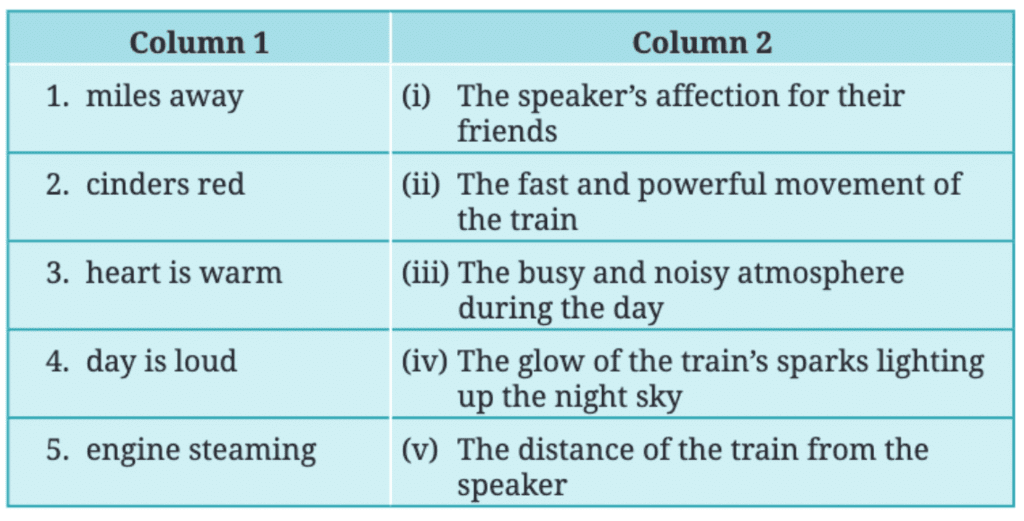
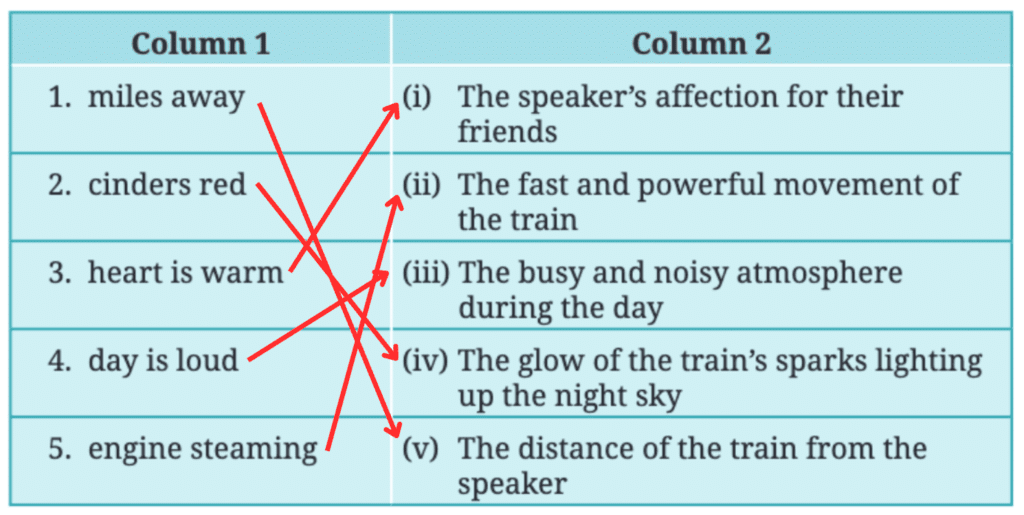
QI: Read the expressions from the poem given in Column 1 and match them with what they indicate in Column 2.
Ans:
Now, use the expressions in Column 1 to fill in the following blanks correctly. 1. After meeting her old friend, her heart is warm with the joy of rekindled memories. 2. As I arrived at the railway station I could hear the engine steaming. 3. The marketplace is bustling, and the day is loud with the chatter of shoppers and vendors. 4. The bonfire glowed brightly, throwing cinders red into the dark night sky. 5. The sound of a train could still be heard miles away as the evening grew quiet.
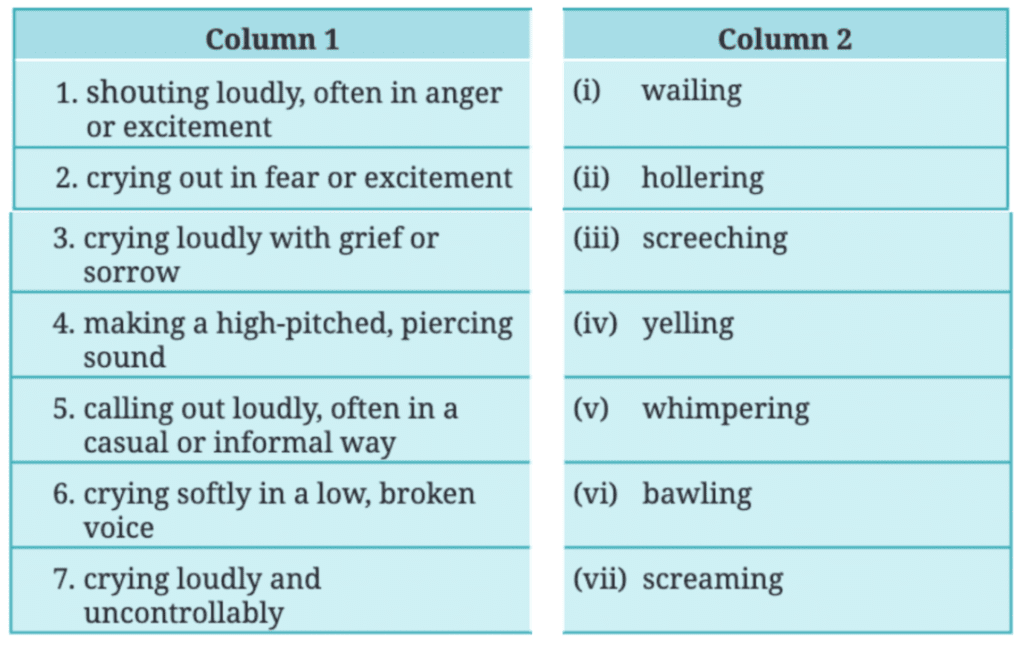
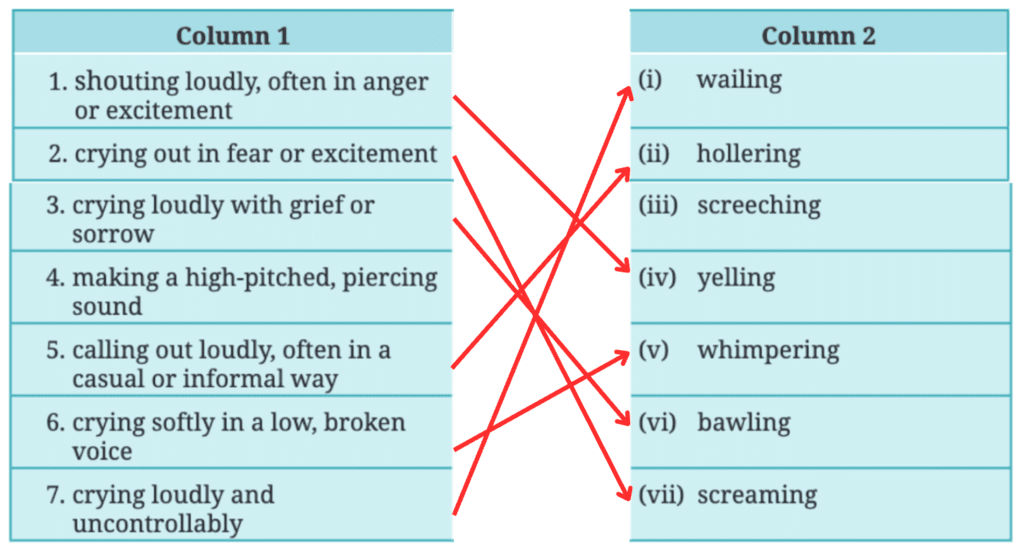
QII: The poet uses the word ‘shrieking’ to tell us about the sound of the train’s whistle. There are other words that tell us about different types of related sounds.
Read the meanings of such words in Column 1 and match them with the words in Column 2.
Ans:
Now, complete the following paragraph by using suitable words from Column 2. The street was filled with a variety of sounds. A shopkeeper was yelling to attract customers, while a child nearby was hollering at his friend to wait for him. From the other side of the road, a toddler was bawling uncontrollably after dropping his ice cream, and his mother tried to calm him as he began whimpering softly. In the background, someone’s loud screaming voice added to the bustling noise of the busy evening.
Let us write (Page 165)
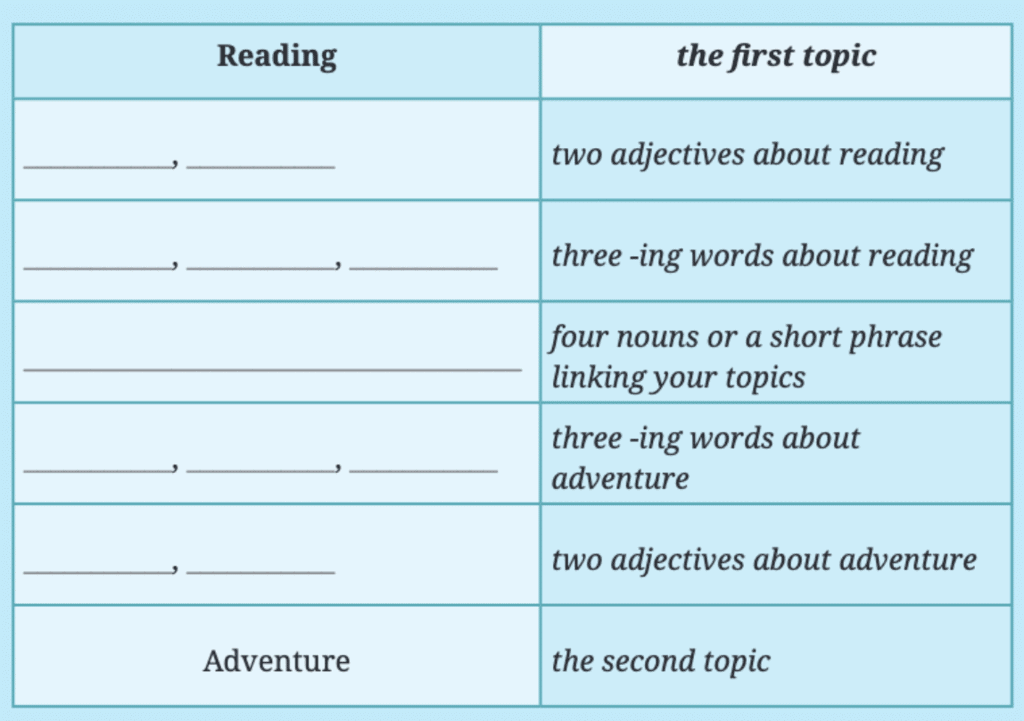
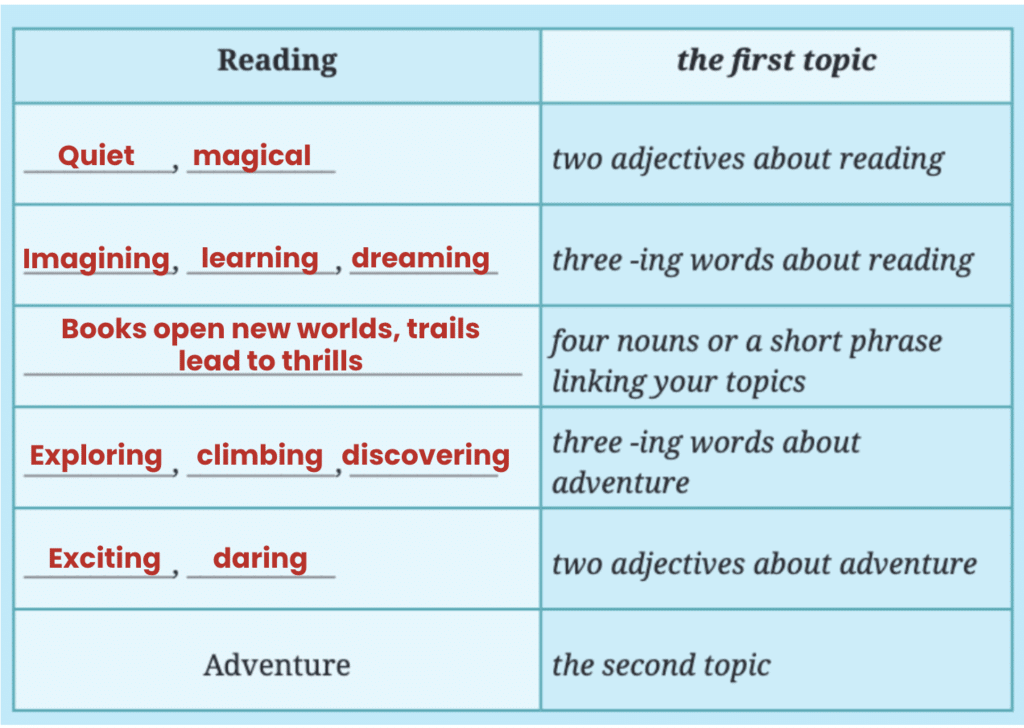
QI: A diamante poem is a poem that is shaped like a diamond, which uses specific types of words like adjectives and -ing words.
Let us now write a diamante poem that connects ‘reading’ and ‘adventure’.
Ans:
QII: We come across many interesting characters while travelling. They become interesting because of their actions, their behaviour, and manner of speaking. Describe one such character that you met. Ans: I met a character named Mr. Ravi, a cheerful train conductor. He was tall with a big smile and wore a blue uniform. Mr. Ravi checked tickets and helped passengers with their bags. He was kind and funny, always telling jokes to make everyone laugh. I liked when he said, “This train is your magic carpet, enjoy the ride!” to a child.
Q1: Suraj compares the train to a magical creature. Pick the phrases that convey the meaning. Ans: 1. Green, black, and gold dragon 2. Beautiful monster 3. Showering sparks 4. Roared a challenge
Q2: Suraj knew that the train was close by because Ans: He heard the shrill whistle of the engine and a sound like distant thunder from the tunnel.
Q3: What did Suraj see inside the tunnel? Ans: Suraj saw damp and sticky walls, a bat flying past, and a lizard scuttling between the lines.
Q4: Select the correct option. What does Sunder Singh convey about the tunnel? He says that _______________ (it is damp and sticky inside/he has lent it to the Government). Ans: He has lent it to the Government.
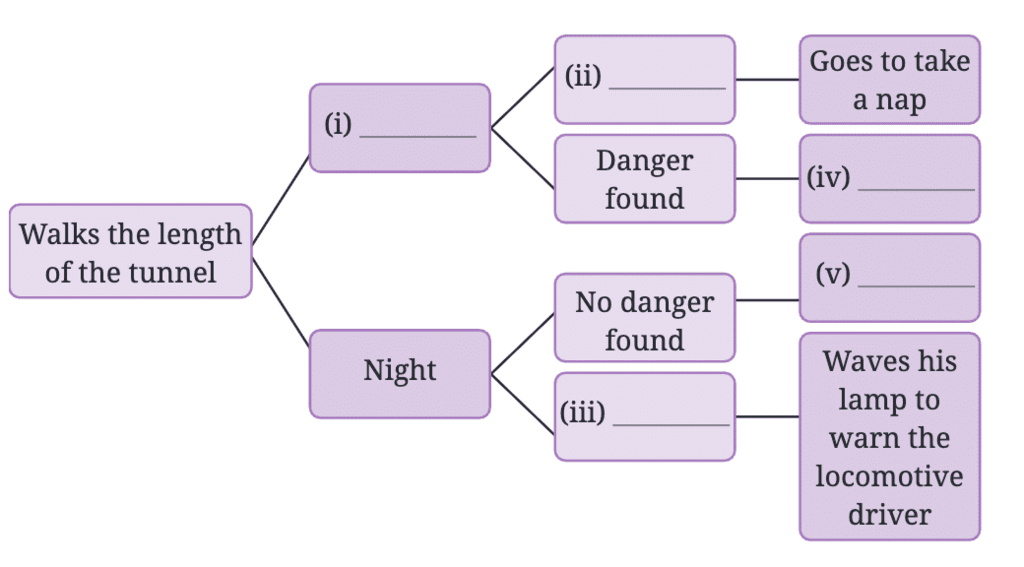
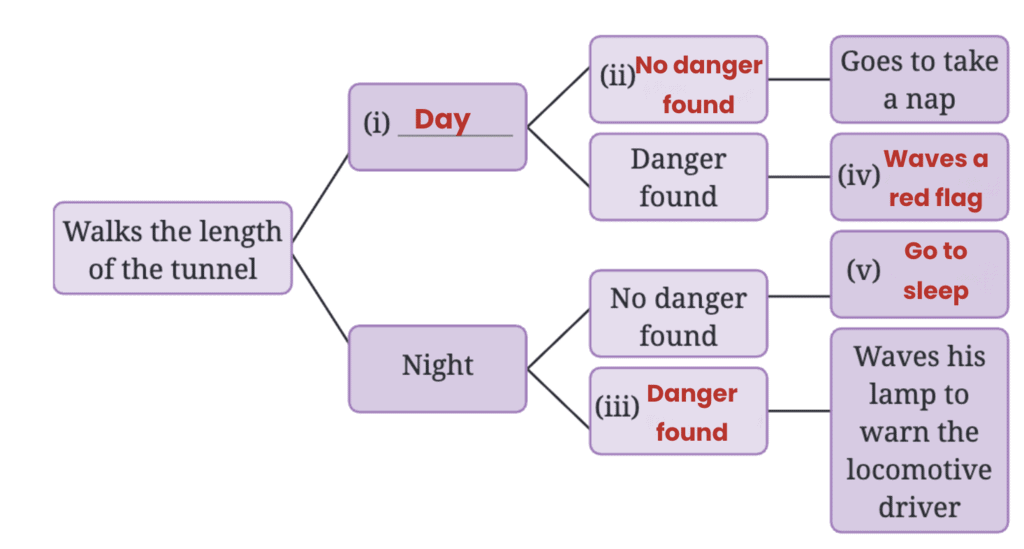
Q5: The watchman has created a system through which he informs the locomotive driver about any danger in the tunnel. The following flow chart shows this system. Refer to the text and complete the flow chart.
Ans:
Let us discuss (Page 149)
Q1: Sunder Singh knew that the leopard was in the tunnel because ___________. Ans: He heard a rhythmic sawing sound, like someone cutting a branch, which was the leopard’s sound.
Q2: Why do you think Suraj was unable to do any shouting in the tunnel in the beginning? (i) He was afraid of the leopard. (ii) He didn’t want to disturb the leopard. (iii) He was trying to listen for the leopard. (iv) He didn’t really believe Sunder Singh. Ans: (i) He was afraid of the leopard.
Q3: What made the leopard disappear into the darkness? Ans: The leopard disappeared because Suraj and Sunder Singh shouted together, and their voices rang through the tunnel, scaring the leopard.
Q4: How did Suraj know Sunder Singh was at the tunnel? Ans: Suraj saw the lamp lit by Sunder Singh near the tunnel, even though he couldn’t see Sunder Singh himself.
Q5: Why did Suraj’s father take him along to Delhi? Ans: Suraj’s father took him to Delhi on a business trip to teach him about his business, as he didn’t know where Suraj went most of the time.
Let us think and reflect (Page 149)
QI.Read the following lines and answer the questions that follow.
1. Suraj had to turn and look back at the opening to reassure himself that there was still daylight outside. Ahead of him, the tunnel’s other opening was just a small round circle of light.
The tunnel was still full of smoke from the train, but it would be several hours before another train came through. Till then, the cutting belonged to the jungle again.
Suraj didn’t stop, because there was nothing to do in the tunnel and nothing to see. He had simply wanted to walk through, so that he would know what the inside of a tunnel was really like.
(i): Write whether the following statement is true or false. Suraj looked back at the opening of the tunnel to check if the train was coming. Ans: False
Suraj didn’t look back at the tunnel opening to check for the train; he already knew it was coming from hearing its whistle and thunder-like sound, and he focused on moving forward without stopping.
(ii): Choose the correct option to complete the sentence given below. Suraj did not stop anywhere in the tunnel because A. there was nothing to see in the tunnel B. the tunnel was damp and sticky C. he was in a hurry to get out of the tunnel D. it was time for another train to come Ans: A. there was nothing to see in the tunnel
Suraj didn’t stop anywhere in the tunnel because he saw only damp walls, a bat, and a lizard, implying there was nothing interesting to see, so he kept moving forward without pausing.
(iii): What does the sentence ‘Till then, the cutting belonged to the jungle again’ mean? Ans: It means that after the train passed, the area around the tunnel became quiet and was taken over by the jungle’s natural sounds and animals until the next train came.
(iv): Suraj wanted to know the inside of the tunnel. What character trait of Suraj is highlighted here? Ans: Curiosity
Q2. “The train will soon be here,” said Suraj. “Yes, my friend. And if we don’t drive the leopard out of the tunnel, it will be run over and killed. I can’t let that happen.” “But won’t it attack us if we try to drive it out?” asked Suraj, beginning to share the watchman’s concern. “Not this leopard. It knows me well. We have seen each other many times. It has a weakness for goats and stray dogs, but it will not harm us. Even so, I’ll take my axe with me. You stay here, Suraj.”
(i): What was the watchman’s concern? Ans: The watchman was concerned that the leopard in the tunnel would be run over and killed by the train.
(ii): Complete the sentence with a suitable reason. Sunder Singh was sure that the leopard in the tunnel would not attack him and Suraj because Ans: he knew the leopard well, as they had seen each other many times, and it only attacked goats and stray dogs.
(iii): Select the sentences that are true from those given below. A. Suraj wants to see the leopards in the jungle. B. Suraj is concerned about Sunder Singh’s safety. C. The leopard in the tunnel attacks goats and stray dogs. D. Sunder Singh wants to protect Suraj. E. Sunder Singh knows all about the animals in the jungle. Ans: C. The leopard in the tunnel attacks goats and stray dogs. D. Sunder Singh wants to protect Suraj.
(iv): Choose the correct option to complete the sentence. Sunder Singh decides to take his axe with him. This tells us that he was A. violent B. cautious C. bold D. afraid Ans: B. cautious
QII. Answer the following questions.
1: What does Sunder Singh convey by saying that he has lent his tunnel to the Government? Ans: Sunder Singh means he takes care of the tunnel like it’s his own, but he allows the Government to use it for trains.
2: According to Sunder Singh, “It is safer in the forest than in the town”. What example does Sunder Singh give to support his opinion? What does this tell us about him? Ans: He says he was almost run over by a bus in town. This shows he feels more comfortable and safe in the jungle than in busy towns.
3: Sunder Singh has become part of the jungle life. Support the view with a suitable reason. Ans: He lives in a hut near the tunnel, knows the jungle sounds and animals like the leopard, and feels safe there, showing he is part of jungle life.
4: Sunder Singh and Suraj form an unlikely friendship. What draws them together? Ans: Their shared interest in the tunnel and trains, and Suraj’s curiosity and Sunder Singh’s welcoming nature, bring them together.
5: Why is Sunder Singh referred to as a ‘firefly’? Ans: Sunder Singh is called a firefly because his lamp lights up the darkness for trains and leopards, like a firefly’s light in the night.
6: Do you think Suraj is an adventure-loving boy? Give reasons. Ans: Yes, Suraj loves adventure because he cycles to the jungle, walks through a dark tunnel, and joins Sunder Singh to scare a leopard, showing his curiosity and bravery.
Let us learn (Page 151)
QI: Complete the following sentences using the suitable phrases from the text given in the box below.
1. We could hear the ______________________ of the train long before it came into view at the station. 2. The street was completely dark but the little boy walked to his house guided by the ______________________ from the houses. 3. The ______________________ from the carpenter’s workshop grew louder every hour. 4. From the balcony, she watched the ______________________ from her neighbour’s chimney float across the backyard.
Ans: 1. We could hear the approaching engine of the train long before it came into view at the station. 2. The street was completely dark but the little boy walked to his house guided by the flickering lights from the houses. 3. The sawing sound from the carpenter’s workshop grew louder every hour. 4. From the balcony, she watched the drifting smoke from her neighbour’s chimney float across the backyard.
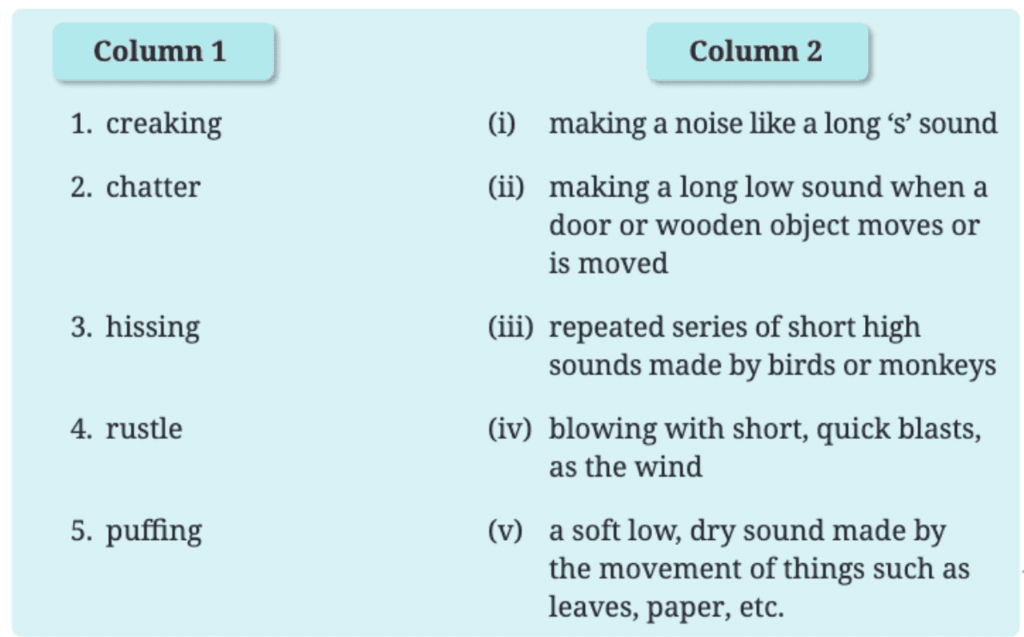
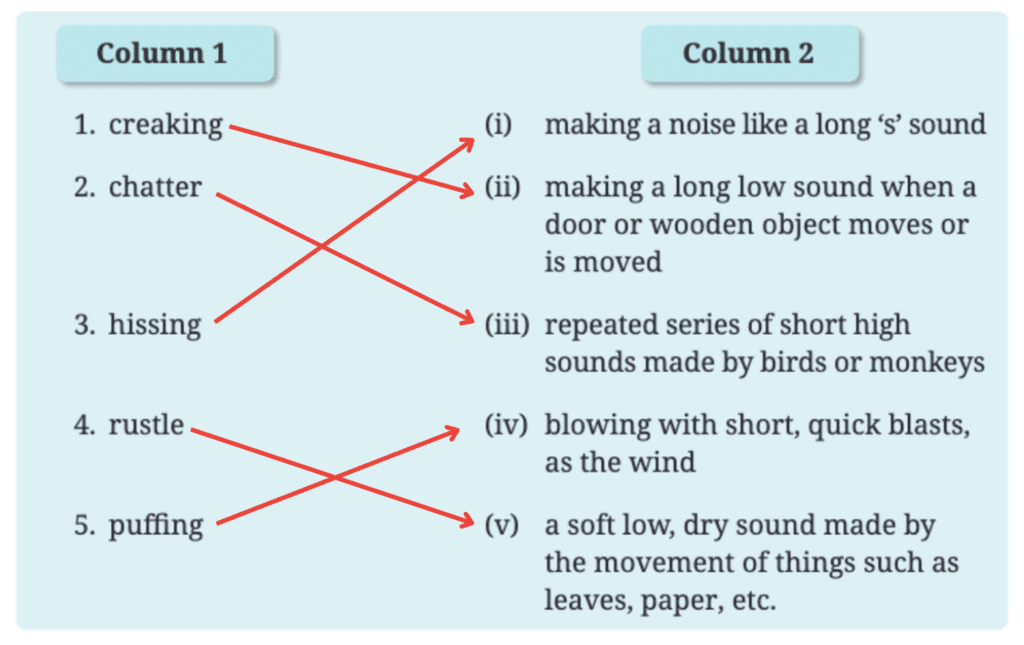
QII: The text has many ‘sound words’. Some of these words are given in Column 1 and their meanings are given in Column 2. Match the words with their meanings. You can use a dictionary.
Ans:
Now, complete the sentences given below by filling in the blanks with the correct form of the sound words given in Column 1.
1. The steam engine reached the station __________________ black smoke into the sky. 2. Suddenly, the snake raised its hood and made a __________________ noise. 3. When the wind blew, I heard the __________________ of the wooden roof. 4. He heard a __________________ of leaves behind him when he was walking in the woods. 5. I get disturbed by the continuous __________________ of the monkeys in the neighbourhood.
Ans: 1. The steam engine reached the station puffing black smoke into the sky. 2. Suddenly, the snake raised its hood and made a hissing noise. 3. When the wind blew, I heard the creaking of the wooden roof. 4. He heard a rustle of leaves behind him when he was walking in the woods. 5. I get disturbed by the continuous chatter of the monkeys in the neighbourhood.
QIII. Read what the watchman Sunder Singh did regularly at the tunnel as part of his duty. Notice the use of ‘would’.
Every day, before the train came through, he would walk the length of the tunnel. If all was well, he would return to his hut and take a nap. If something was wrong, he would walk back up the line and wave a red flagand the engine driver would slow down. At night, the watchman lit an oil lamp and made a similar inspection of the tunnel.
1: Why is the word ‘would’ used here? (i) to make a polite request (ii) to express a desire (iii) to talk about a habit in the past Ans: (iii) to talk about a habit in the past
In these sentences, the word ‘would’ is used to speak about a past habit.
Would and used to both describe something that happened regularly in the past. However, ‘used to’ indicates a past action that doesn’t happen any longer.
I used to paint when I was in Grade 4.
Riya used to eat a lot of junk food, but she stopped last year.
2: Complete the sentences using the verb in brackets with the correct form of ‘used to’ or ‘would’.
When I was a child we used to live in a village near a forest. Back then, we (i) _____________ (grow) vegetables in our back garden. Every day we (ii) _____________ (get up) early and go for a walk. The weather in summer (iii) _____________ (be) really nice. There was a lake near the house and we (iv) _____________ (go) there every Sunday for a picnic. Winters (v) _____________ (be) rather cold. In the evenings, my father(vi) _____________ (tell) us incredible stories and we (vii) _____________(listen) with admiration. Ans: When I was a child we used to live in a village near a forest. Back then, we (i) would grow vegetables in our back garden. Every day we (ii) would get up early and go for a walk. The weather in summer (iii) used to be really nice. There was a lake near the house and we (iv) would go there every Sunday for a picnic. Winters (v) used to be rather cold. In the evenings, my father (vi) would tell us incredible stories and we (vii) would listen with admiration.
QIV: We use punctuation marks to make our writing clear. You already know how to use full stops and commas. Let us look at three more punctuation marks—brackets, semicolon, and colon.
Colon (:) is used to introduce a list or an explanation.
You need the following ingredients to make Ela Ada: ghee, coconut, jaggery, and rice flour.
He has one goal: to win the championship.
Semicolon (;) is used to connect two clauses which are closely related without a conjunction.
She loves reading; he prefers watching movies.
Suraj followed close behind; but he found he was unable to do any shouting.
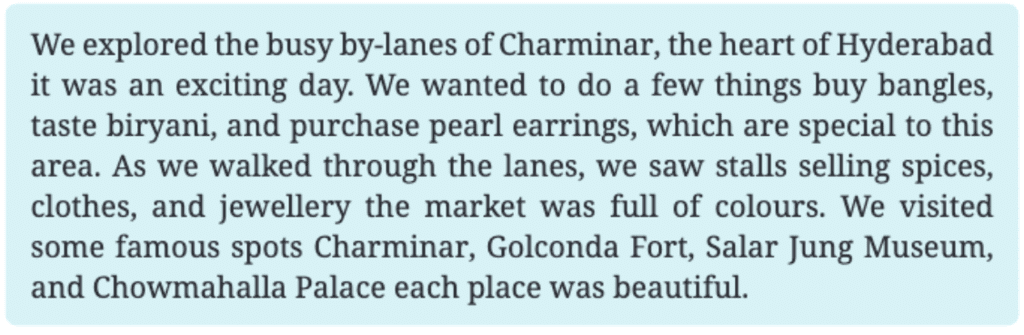
Now, use semicolons and colons to punctuate the following paragraph.
Ans:
We explored the busy by-lanes of Charminar, the heart of Hyderabad; it was an exciting day. We wanted to do a few things: buy bangles, taste biryani, and purchase pearl earrings, which are special to this area. As we walked through the lanes, we saw stalls selling spices, clothes, and jewellery; the market was full of colours. We visited some famous spots: Charminar, Golconda Fort, Salar Jung Museum, and Chowmahalla Palace; each place was beautiful.
Let us do these activities before we read (Page 118)
QI: Work in pairs. Discuss the place that you have enjoyed travelling to. Talk about who you went with, how you travelled, and what you learnt from the experience. Ans: I enjoyed travelling to Manali with my family. We went by car, and I learned about the beautiful mountains and local culture.
QII: Which State or Union Territory of India do you live in? Write the following details about it. 1. Part of the country—North, East, Northeast, West, South or Centre 2. Its capital 3. Language 4. River(s) 5. Tourist attraction 6. Food
Ans:
I live in Uttar Pradesh.
Part of the country: North
Capital: Lucknow
Language: Hindi
River(s): Ganga, Yamuna
Tourist attraction: Taj Mahal
Food: Kebabs, Biryani
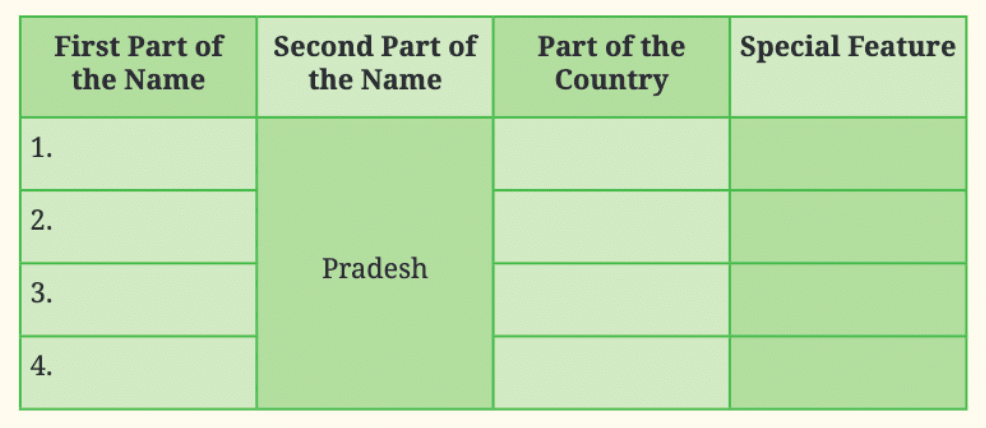
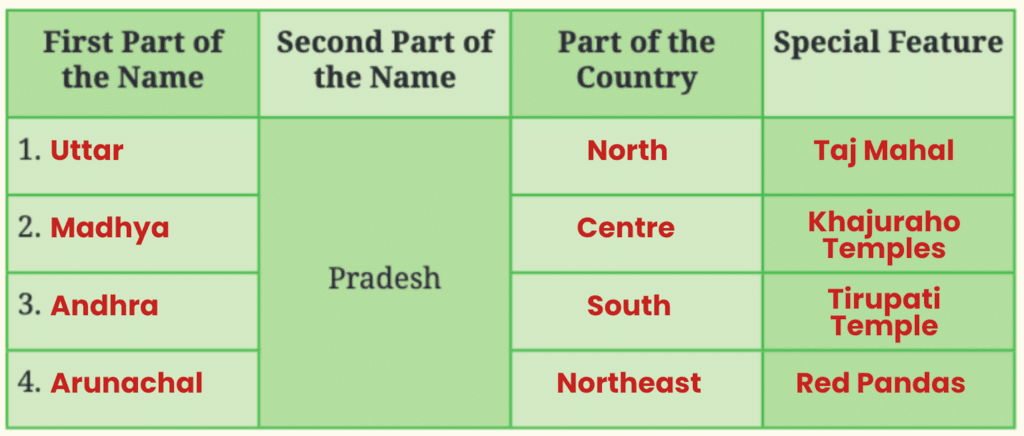
QIII: Work in pairs. Recall the names of the states of our country which have ‘Pradesh’ in their names. Mention if it is in the North, East, Northeast, West, South or Centre of our country. Recall any special feature about each ‘Pradesh’. Share your answers with your classmates and the teacher.
Ans:
Let us discuss (Page 125)
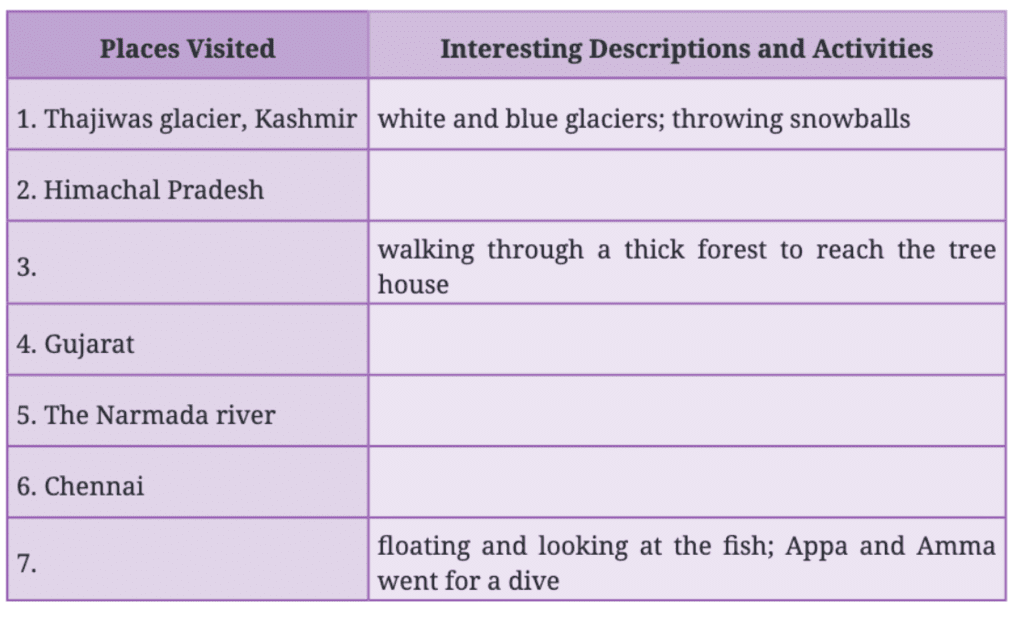
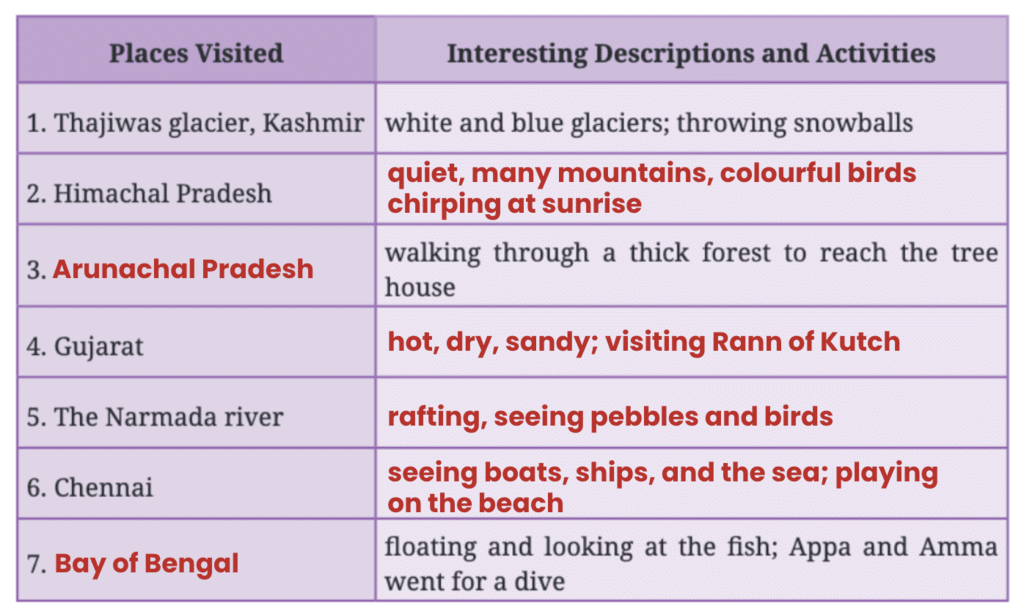
Q: Complete the table given below based on Shaana’s postcards. An example has been done for you. Share your answers with your classmates and the teacher.
Ans:
Let us think and reflect (Page 126)
QI. Read the extracts given below and answer the questions that follow.
1. Amma tells me that places like the Sundarbans are called wetlands. I never knew such a place existed, and that it was possible for trees called mangroves to grow in seawater! But Amma is sad about how much this place floods today.
We also saw crocodiles and a lonely snake while boating. I hope they don’t follow us home.
How is everyone? Are you missing me yet?
(i): What feeling does Shaana most likely experience when she says, “I never knew such a place existed…”? A. pride B. hope C. relief D. wonder Ans: D. wonder
(ii): Complete the following sentence with a suitable reason. Amma is sad about the frequent flooding in Sundarbans because ________ Ans: it harms the environment and wildlife.
(iii): Select the evidence from the text that reflects a feeling of the speaker’s slight nervousness. Ans: “I hope they don’t follow us home.”
(iv): Select the option that applies to both the Assertion and the Reason. Assertion: The speaker is missing her friends. Reason: The speaker wishes to know the well-being of her friends. A. Both the assertion and the reason are true, and the reason correctly explains the assertion. B. Both the assertion and the reason are true, but the reason does not correctly explain the assertion. C. The assertion is true, but the reason is false. D. Both the assertion and the reason are false. Ans: A. Both the assertion and the reason are true, and the reason correctly explains the assertion.
2. Amma and Appa are fast asleep, and I should be sleeping too, but I just love looking out of the window. I think we’re in the southwest part of the country, in Goa, and you won’t believe how nice the plateaus look.
There are so many hills here, and beaches too. There are also a lot of tunnels that the train goes through. I used to be afraid of tunnels, but I’m not any more. Someday, I wish we could all go on a tour of the plateaus.
(i): Complete the sentence with a suitable reason. The speaker chooses to stay awake because ___________ Ans: she loves looking at the beautiful plateaus outside the train window.
(ii): What does the speaker mean by saying, ‘You won’t believe how nice the plateaus look’? Ans: She means the plateaus are very beautiful and surprising to see.
(iii): What has been the change in the speaker’s attitude towards tunnels? A. from fear to comfort B. from courage to confidence C. from doubt to clarity D. from fascination to delight Ans: A. from fear to comfort
(iv): Fill in the blanks with the correct option from those given in the brackets.
The speaker’s wish to share the experience of touring the plateaus with others indicates her ________ (ability to communicate/sense of connection) as well as the value she places on ________ (shared experiences/updating information) with her peers. Ans: The speaker’s wish to share the experience of touring the plateaus with others indicates her sense of connection as well as the value she places on shared experiences with her peers.
II. Answer the following questions.
Q1: Shaana mentions that she used to be afraid of tunnels. What could have been the most likely reason for her to be scared of tunnels? Ans: She was scared because tunnels are dark and enclosed, which can feel frightening.
Q2: Do you think Shaana’s Appa and Amma enjoyed themselves, just like children do? Support your answer with evidence from the text. Ans: Yes, they enjoyed themselves like children. Evidence: In Kashmir, they threw snowballs at each other.
Q3: Shaana mentions less snow in the glaciers and more flooding in the Sundarbans. Explain what these observations indicate. Ans: These observations indicate climate change, causing melting glaciers and increased flooding.
Q4: Shaana’s visits to different parts of the country highlight the diversity of India’s geography. Support this statement with evidence from the text. Ans: Shaana visits snowy glaciers in Kashmir, mountains in Himachal Pradesh, thick forests in Arunachal Pradesh, sandy deserts in Gujarat, rivers like Narmada, and coastal Chennai, showing India’s varied landscapes.
Q5: How does Shaana use language to convey her excitement, curiosity, and sometimes her fears about the places she visits? Ans: She uses excited words like “you won’t believe” for plateaus, curious phrases like “I never knew such a place existed” for Sundarbans, and nervous phrases like “I hope they don’t follow us home” for crocodiles.
Q6: What might Shaana have learned from her travels across India? How would it impact her understanding of the country? Ans: Shaana learned about India’s diverse landscapes, cultures, and wildlife. This would make her appreciate India’s variety and understand its environmental challenges better.
Q7: What could be the author’s purpose of presenting the text in the form of postcards? Ans: The author uses postcards to show Shaana’s personal experiences and emotions, making the story engaging and relatable.
Let us learn (Page 128)
QI: Read the words from the text given in Column 1 and match them with suitable pictures in Column 2.
Ans:
QII: Read the situations given in Column 1. Choose the associated words from the text given in the box below and write them in Column 2.
Ans:
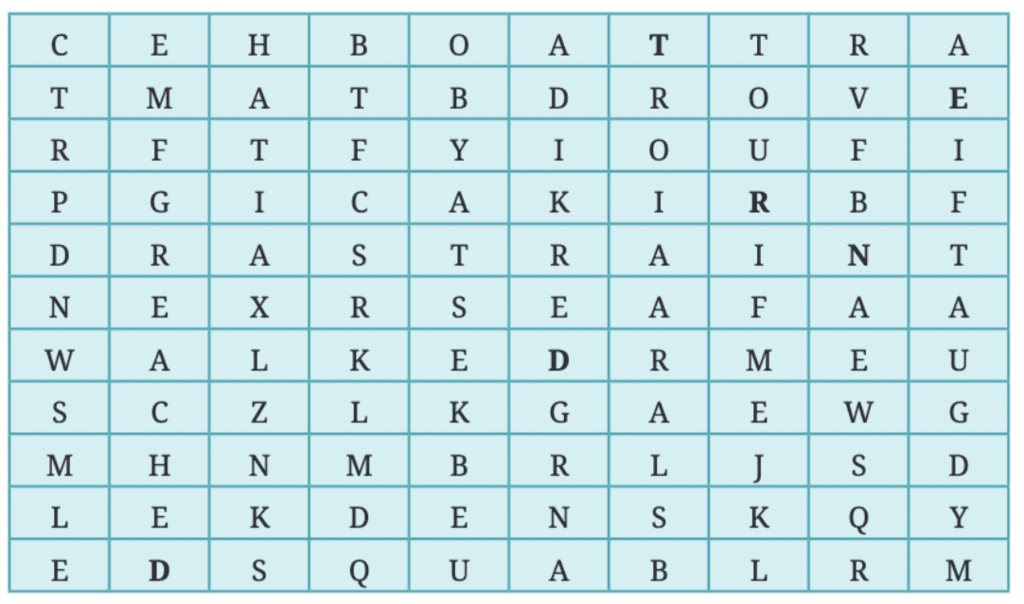
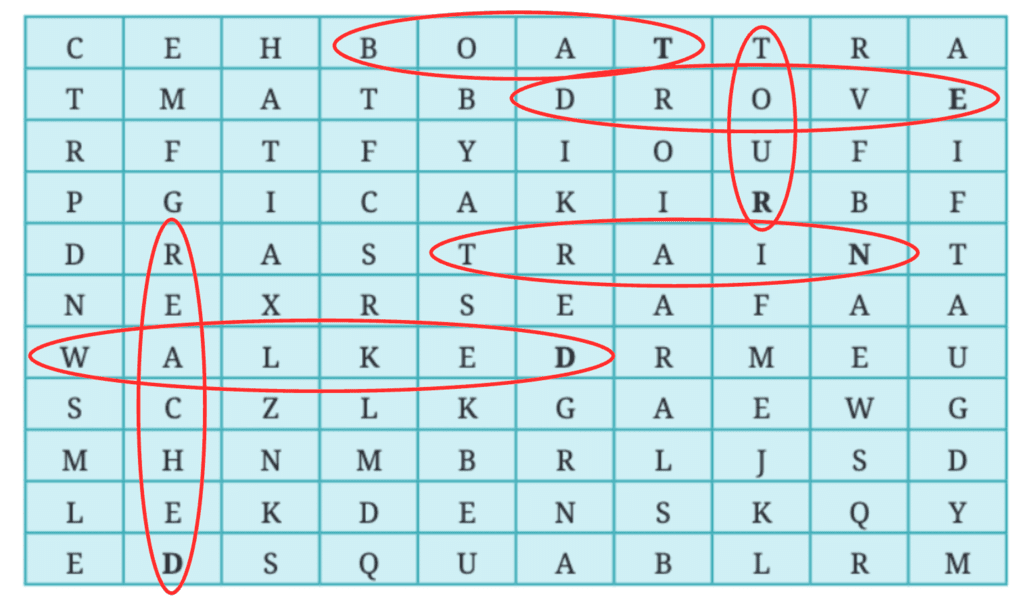
QIII: The following word grid has six words related to ‘travel’ used in the lesson. Circle the words in the grid. You can search horizontally and vertically. The last letter of each word has been highlighted.
Ans:
QIV: Read the following sentences from the text and underline the subject and the verb.
1. Amma and Appa are fast asleep. (When the subject of a sentence has two or more nouns or pronouns that are connected by ‘and’, we use a plural verb). Ans: Amma and Appa (subject) are (verb) fast asleep.
2. It’s hot, dry, and there is sand everywhere. (In case the subject is ‘it’, the verb that follows is either ‘is’ or ‘was’ depending on the tense of the sentence). Ans: It (subject) is (verb) hot, dry, and there is sand everywhere.
3. There are so many hills here, and beaches too. (When we begin a sentence with ‘there’, the subject comes after the verb). Ans: There are (verb) so many hills (subject) here, and beaches too.
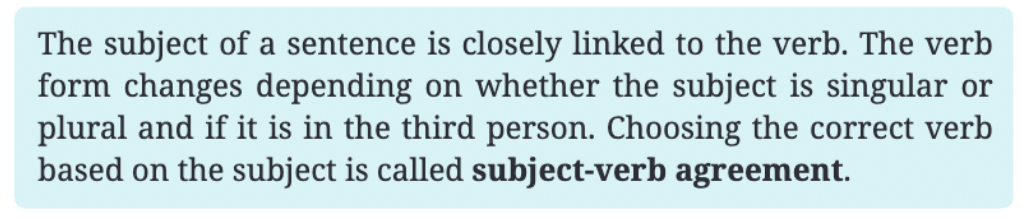
Let us understand subject-verb agreement better.
A subject and its verb must agree, even if other words or phrases come between them. Example: The formation of paragraphs is important in writing.
When the subjects are considered individually, we use a singular verb. Example:Every man and womanhas the right to vote.
Collective nouns such as ‘class’, ‘committee’, ‘audience’, and ‘team’ can be singular or plural, based on the context of the sentence. If the sentence implies the group is acting as one unit, the noun is singular and takes a singular verb. Example: The committeedecides on the new policy tomorrow.
The indefinite pronouns ‘each’, ‘either’, ‘every’, ‘much’, and ‘neither’ always require singular verbs. Example: Each of the children was given a gift.
Subjects that look plural because they end in ‘s’ but refer to one thing are singular. Example: Mathematicsis an interesting subject.
Some nouns (like glasses, scissors, pants, and tongs) are plural but take a singular verb when the phrase ‘pair of’ is placed before it. Here, ‘pair’ is the subject. This pair of scissors is sharp.
When subjects are joined by ‘or’ or ‘nor’, the verb should match the subject that is closer to it. – Neither the students nor the teacherwants to cancel the trip. – Either the manager or the employeesare responsible for the mistake.
QV: Choose the correct option from the words given in the brackets.
1. A pair of sunglasses is (is/are) essential when travelling to sunny destinations. 2. Either the tour guide or the tourists have (has/have) to arrive first at the meeting point. 3. The information on travel expenses is (is/are) useful for first-time travellers. 4. Neither the flight crew nor the pilot was (was/were)aware of the delay. 5. The news about the heavy rains makes (makes/make)many people reconsider their vacation plans. 6. A pair of binoculars is (is/are) useful for spotting wildlife on a safari. 7. The hill stations in India remain (remains/remain) a popular travel destination during winter. 8. Keeping accounts is important for spending money wisely during travel. 9. Either the ticket or the bus passes needs to be used for travelling in the tourist bus. 10. Neither the passengers nor the taxi driver was aware of the best route to the hotel.
Let us write (Page 133)
Q: Imagine that you have to travel to your hometown to attend a family event. Write an application to the Principal of your school, requesting leave of absence. Remember to include the duration of the leave, the reason for the leave and mention how you will complete your school work. Use the format of the application and the verbal cues given below.
Leave Application
123, Green Street Lucknow Uttar Pradesh 10 May 2025
The Principal St. Mary’s School Lucknow Uttar Pradesh
Subject: Request for leave for 5 days
Dear Sir,
I am writing to request 5 days leave with effect from 15 May 2025 to 19 May 2025 in order to attend a family event in my hometown.
I would like to assure you that I would complete all my school work by taking notes from my classmates and submitting assignments on time.
I would be grateful if you could grant me the leave.
Yours sincerely, Riya Sharma Class 7, Section A, Roll Number 12